Introduction
Negative biases in information processing are characteristic of depression and are seen in both laboratory-based and real-life measures (see Leppänen, Reference Leppänen2006 for a review). For example, in facial expression recognition paradigms, depression is associated with increased recognition of negative cues and/or decreased recognition of happy facial expressions (Gur et al. Reference Gur, Erwin, Gur, Zwil, Heimberg and Kraemer1992; Surguladze et al. Reference Surguladze, Young, Senior, Brebion, Travis and Phillips2004; Harmer et al. Reference Harmer, O'Sullivan, Favaron, Massey-Chase, Ayres, Reinecke, Goodwin and Cowen2009b ). Similarly, depressed patients tend to show increased recall of negative compared to positive affective cues in emotional memory tasks (Bradley et al. Reference Bradley, Mogg and Williams1995; Harmer et al. Reference Harmer, O'Sullivan, Favaron, Massey-Chase, Ayres, Reinecke, Goodwin and Cowen2009b ). Such biases are thought to reinforce negative self beliefs and thoughts in depression and play a key role in the aetiology and maintenance of this disorder (Beck et al. Reference Beck, Rush, Shaw and Emery1979). Negative biases are a clear target for psychological treatments such as cognitive behavioural therapy and recent evidence suggests that administration of antidepressant drugs can also reverse negative biases in depression and increase the relative processing of positive compared to negative information in healthy volunteers (see Harmer et al. 2009 a, Reference Harmer, Cowen and Goodwin2011 for reviews). These effects are typically seen early in treatment, before changes in mood are apparent. However, these actions have been hypothesized to contribute to the later clinically relevant effects of medication as the patient is gradually exposed to this new and more positive intra- and interpersonal environment (Harmer et al. 2009 a).
These effects on emotional processing have been seen with different types of antidepressant drug treatments and we have hypothesized that this kind of emotional processing change may be a final common pathway that is necessary for antidepressant action (Harmer et al. Reference Harmer, Cowen and Goodwin2011). Consistent with this, non-drug treatments for depression, such as vagus nerve stimulation (Critchley et al. Reference Critchley, Lewis, Orth, Josephs, Deichmann, Trimble and Dolan2007) and high-density negative ion (HDNI) treatment (Malcolm et al. Reference Malcolm, Cowen and Harmer2009), have also been reported to affect emotional processing. Although the underlying mechanism of action of HDNI treatment is far from clear, small-scale randomized clinical trials suggest that this has antidepressant effects in seasonal affective disorder (SAD) (Terman et al. Reference Terman, Terman and Ross1998; Terman & Terman, Reference Terman and Terman2006; but see Flory et al. Reference Flory, Ametepe and Bowers2010) and in chronic depression (Goel et al. Reference Goel, Terman, Terman, Macchi and Stewart2005). We previously reported that a single session of HDNI exposure was able to increase positive affective recall and recognition performance in healthy volunteers (Malcolm et al. Reference Malcolm, Cowen and Harmer2009). However, it is unclear whether this manipulation can reverse negative biases seen in the context of seasonal depression early in treatment.
The current study was therefore designed to investigate the effects of HDNI administration in individuals with current seasonal depression on measures of emotional processing sensitive to antidepressant administration (see Harmer et al. Reference Harmer, Cowen and Goodwin2011). It was predicted that those affected by current symptoms of seasonal depression would show negative biases on the measures of emotional processing compared to control, unaffected participants and that a single exposure to HDNI treatment would remediate these negative affective biases. It was further predicted that these early changes in emotional processing would be seen in the absence of significant changes in mood and subjective state, similar to the profile seen with antidepressant drugs (Harmer et al. 2009 b).
Method
Subjects and study design
Testing occurred between October and March. Individuals interested in participating in this study were asked to complete the seasonal pattern assessment questionnaire (SPAQ; Rosenthal et al. Reference Rosenthal, Genhart, Sack, Skwerer, Wehr, Hudson and Pope1987) online. Those with low (<2) or high (>9) seasonality scores on the questionnaire were invited for face-to-face assessment with the Structured Clinical Interview for DSM-IV (SCID). For the SAD group, all 21 participants were required to meet the lifetime criteria for a diagnosis of DSM-IV recurrent major depression with a seasonal pattern specifier. Eleven of the patients met current criteria for major depression whereas the remaining 10 had current subsyndromal depressive symptomatology. The average score in the SPAQ was 14.8 (s.d.=3.7). The control group (n=21) were ascertained to be free of any current or past Axis I disorder on DSM-IV. All participants were medication free, apart from the contraceptive pill.
Participants in both SAD and control groups were randomly assigned to either HDNI treatment or inactive condition in a double-blind parallel-group design. HDNI treatment was delivered by a SphereOne Fresh AIR Negative Ionizer (SphereOne Inc., USA) with wrist strap, shown to be effective in previous studies of winter depression. The device was deactivated for the inactive condition but this was not visible to participants or the experimenter. Participants received 30 min of HDNI exposure and then began the emotional test battery described below. During this test period, which lasted for about 60 min, the HDNI treatment was continued.
Emotional processing tasks
Facial expression recognition
The facial expression recognition task featured six basic emotions (happiness, surprise, sadness, fear, anger, disgust) taken from 10 individual characters from the Pictures of Affect Series (Ekman & Friesen, Reference Ekman and Friesen1976), which had been morphed between each prototype and neutral. In brief, this procedure involved taking a variable percentage of the shape and texture differences between the two standard images 0% (neutral) and 100% (full emotion) in 10% steps. Four examples of each emotion at each intensity were given (6 emotions×10 intensities×4 examples=240 stimuli). Each face was also given in a neutral expression (10 stimuli), giving a total of 250 stimulus presentations. The facial stimuli were presented on a computer screen (in a randomized order) for 500 ms and then replaced by a blank screen. Volunteers made their responses by pressing one of seven labelled keys on the keyboard. Each participant was asked to respond as quickly and as accurately as possible. To prevent fatigue, a break of 1–2 min was given halfway through the task (after 125 face presentations). Accuracy, misclassifications and reaction times (ms) for correct responses were measured in this task for each emotion.
Emotional categorization and memory tasks
Emotional categorization
Sixty personality characteristics selected to be extremely disagreeable (e.g. domineering, untidy, hostile) or agreeable (e.g. cheerful, honest, optimistic) (taken from Anderson, Reference Anderson1968) were presented on the computer screen for 500 ms. These words were matched in terms of word length, ratings of frequency and meaningfulness. Volunteers were asked to categorize these personality traits as likable or dislikable as quickly and as accurately as possible. Specifically, they were asked to imagine whether they would be pleased or upset if they overheard someone else referring to them as possessing this characteristic, so that the judgement was in part self-referring. Classifications and reaction times for correct identifications were computed for this task.
Emotional memory
For this task, 15 min after completion of the emotional categorization task, participants were asked to recall as many of the personality traits as possible. Recognition memory was then assessed by asking participants to respond with a ‘familiar’ or ‘novel’ to each item presented on the computer screen containing the 60 targets plus 60 matched distracters (30 positive, 30 negative). The number of positive and negative words correctly and incorrectly identified was computed, which allowed signal detection analysis to be used to assess performance irrespective of differences in response criteria. This was calculated using the formula:

where Y is the proportion of accurate hits and X is the proportion of false alarms for each valence (Grier, Reference Grier1971).
Visual dot-probe task
Two types of emotional words were used in this task: 60 negative words and 60 positive words. Each emotional word was paired with a neutral word matched for length. On each trial, one of the words appeared above and the other below a central fixation position. In the unmasked condition, the word pair was presented for 500 ms and then a probe appeared in the location of one of the preceding words. The probe was either one or two stars and participants were asked to press one of two labelled buttons to indicate the number of stars present. Participants were asked to respond as quickly and as accurately as possible. The sequence of events was the same in the masked condition, except the duration of the word pair was 14 ms and the display of the word pair was immediately followed by a mask that was displayed for 186 ms. The mask was constructed from digits, letters and other non-letter symbols and was matched for word position and length. There were 180 trials in total (masked: 30 positive–neutral, 30 negative–neutral, 30 neutral–neutral; unmasked: 30 positive–neutral, 30 negative–neutral, 30 neutral–neutral) and masked and unmasked trials were presented in a random order. Reaction time and accuracy scores were recorded. Reaction time data lying at more than 2 standard deviations above or below each participant's mean score was removed. To simplify these results, attentional vigilance scores were calculated for each participant by subtracting the reaction time obtained from trials when probes appeared in the same position as the emotional word (congruent trials) from trials when probes appeared in the opposite position to the emotional word (incongruent trials).
Subjective state assessments
Measures of mood and temperament were made at baseline using the Beck Depression Inventory (BDI; Beck et al. Reference Beck, Ward, Mendelson, Mock and Erbaugh1961), the Eysenck Personality Questionnaire (EPQ; Eysenck & Eysenck, Reference Eysenck and Eysenck1975) and the State–Trait Anxiety Inventory (STAI; Spielberger et al. Reference Spielberger, Gorsuch and Lushene1970). To assess any change in mood with time or treatment, visual analogue scales (VAS) were used for the following variables: happy, sad, calm, hostile, alert, anxious. These were completed before exposure to the treatment and just before completion of the emotional processing tasks.
Statistical analysis
The effects of depression and treatment were assessed using an ANOVA, with treatment (HDNI versus control) and patient group (depressed patients versus controls) as between-subjects factors. For the psychological tasks, emotion was also included as the within-subject factor. For the visual dot-probe task, masking was included as an additional within-subject factor. Statistically significant interactions were followed up with simple analyses for group differences.
Results
Demographic and clinical variables
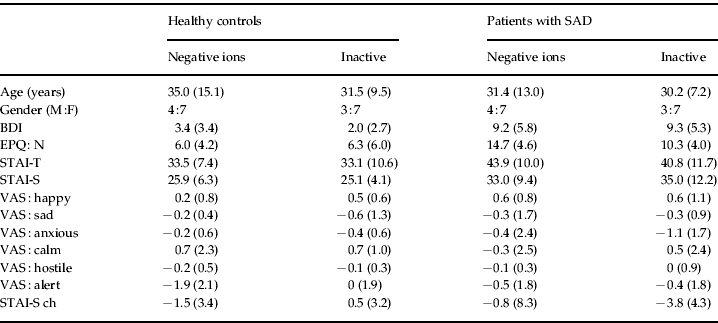
The four groups were matched on age (p values >0.5) and gender (Table 1). As expected, the patients with SAD scored significantly higher on BDI ratings of depression (F 1,38=22.1, p<0.001), state (F 1,38=10.3, p=0.003) and trait (F 1,38=8.6, p=0.006) anxiety and neuroticism (F 1,38=18.7, p<0.001). There was no interaction between treatment group and patient group in any of these measures taken before treatment (all p values >0.5). The patient group on average had eight previous episodes (range 2–20) and a mean age of first onset of 21 years (range 10–47 years).
Demographic and subjective state measures

SAD, Seasonal affective disorder; M, male; F, female; BDI, Beck Depression Inventory; EPQ: N, Eysenck Personality Questionnaire: Neuroticism; STAI-T, State–Trait Anxiety Inventory – Trait scale; STAI-S, State–Trait Anxiety Inventory – State scale; VAS, visual analogue scale; STAI-S ch, State-Trait Anxiety Inventory – change in State score.
Values given as means (and standard deviations).
Mood ratings with VAS and STAI-S represent change in values from pre- to post-treatment in the four groups.
Subjective state
There was no effect of negative ion treatment on subjective ratings of anxiety, mood or alertness (Table 1). As expected, therefore, the single dose of negative ions did not change subjective state.
Facial expression recognition
Accuracy
There was an interaction between treatment group and emotional facial expression (F 5,190=2.7, p=0.02), suggesting that negative ion treatment affected recognition of specific facial expressions (Fig. 1). Univariate analysis suggested that negative ion treatment decreased recognition of disgust and that this was not moderated by patient group (main effect of treatment: F 1,38=4.2, p=0.046; patient group×treatment: F 1,38=1.1, p=0.3). Negative ion treatment also increased recognition of happy facial expressions but this effect was particularly apparent in the SAD group (main effect of treatment: F 1,38=12.6, p<0.001; patient group×treatment group: F 1,38=13.7 p<0001). Under the control treatment, the SAD group showed reduced recognition of happy facial expressions compared to healthy volunteers (t=−3.5, df=18, p=0.003, Fig. 1 a) but this was ameliorated following negative ion treatment (SAD group: control versus negative ion treatment: t=4.7, df=19, p<0.001, Fig. 1 b). No other effects were significant (all p values >0.08). These results suggest that negative ion treatment decreases the recognition of negative versus positive emotional facial expressions and that this effect may be particularly prominent in those suffering from SAD who show a negative bias under baseline conditions (Fig. 1).
Facial expression recognition performance. (a) Healthy controls compared to participants with seasonal affective disorder (SAD) under the inactive condition. (b) Participants with SAD following the inactive versus high-density negative ion (HDNI) treatment. Values represent the mean percentage correct for each of the six basic emotions. Asterisks represent the statistical comparison between groups * p<0.05, (*) p<0.05 main effect of treatment, non-significant interaction with clinical group.

Reaction time
There was no effect of patient group or negative ion treatment on reaction time (all p values >0.15).
Misclassifications
There was no effect of patient group or negative ion treatment on misclassifications (all p values >0.3).
Emotional memory
Categorization
There were no differences between groups in reaction time to classify the positive and negative personality words (all p values >0.19).
Recall
There was a trend interaction between emotion and patient group (F 1,37=2.7, p=0.1) but this did not interact further with treatment (p values >0.3). This was driven by a tendency for the SAD group to show reduced recall of positive versus negative items.
Recognition
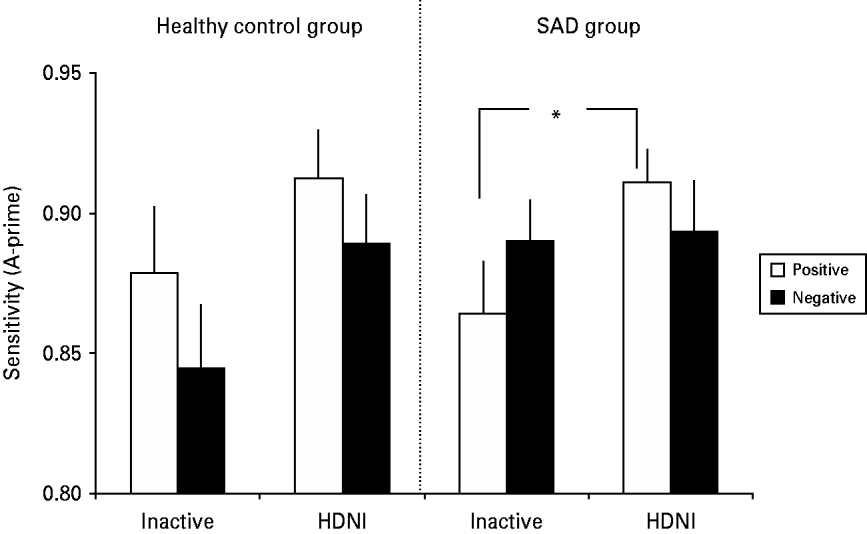
There was an emotion×patient group×treatment group interaction (F 1,38=7.1, p=0.01). Under the control treatment, the SAD group showed increased recognition of negative versus positive items compared to the healthy controls (emotion×patient group (F 1,18=5.6, p=0.029). However, negative ion treatment increased positive recognition memory compared to control treatment in the SAD group (F 1,19=4.7, p=0.04) but impaired positive versus negative memory in the healthy controls (F 1,19=6.7, p=0.02). Using a signal detection analysis to account for any differences in response criteria, negative ion treatment specifically increased positive affective recognition performance in the SAD group (t=2.2, df=19, p=0.043) and was without effect in the healthy control group (all p values >0.3; Fig. 2).
Recognition memory task performance in healthy controls and the group with seasonal affective disorder (SAD). Values represent mean sensitivity scores (A′) using a signal detection analysis for the positive and negative items during high-density negative ion (HDNI) and sham exposure. Asterisks represent the statistical comparison between groups * p<0.05.

Visual dot-probe
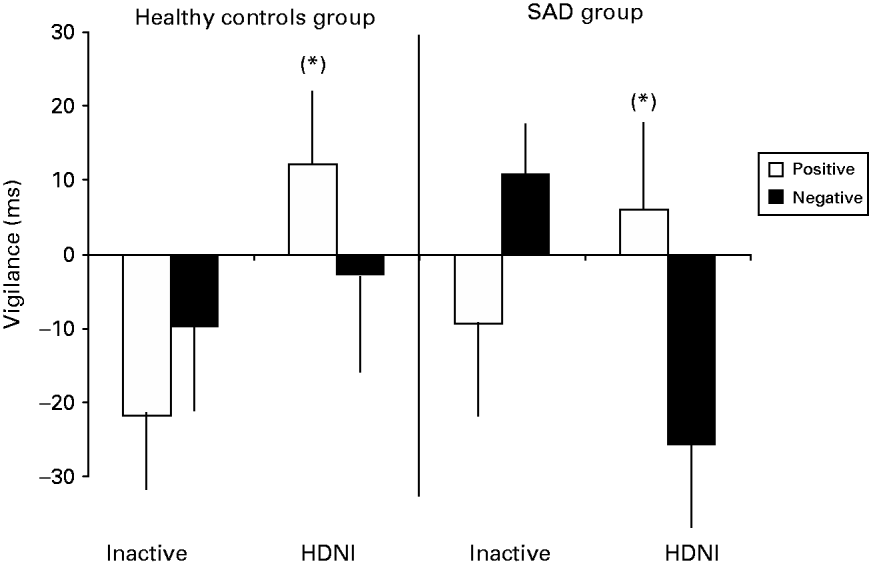
There was an interaction between emotion and treatment group (F 1,38=4.0, p=0.05) and an interaction between emotion×mask×patient group (F 1,38=5.9, p=0.02). To clarify these interactions, separate ANOVAs were conducted for masked and unmasked conditions (see Fig. 3). In the masked version, the SAD participants showed increased vigilance to the negative versus positive stimuli in this task compared to the healthy controls (emotion×patient group F 1,38=4.6, p=0.038), in line with negative attentional bias in this group. For the unmasked condition, there was an interaction between emotion and negative ion treatment group (F 1,38=8.3, p=0.006), which did not interact with patient group (all p values >0.3). Those receiving negative ion treatment showed increased vigilance to positive stimuli in this task (t=2.2, df=40, p=0.03). Hence, the negative ion treatment increased vigilance to unmasked positive stimuli irrespective of patient group.
Vigilance towards positive and negative items in the dot-probe task in healthy controls and the group with seasonal affective disorder (SAD) during high-density negative ion (HDNI) and sham exposure. Values represent the mean reaction time difference (ms) to detect a probe presented in the same versus opposite location with positive and negative word presentation. Asterisks represent the statistical comparison between groups: (*) p<0.05 main effect of treatment, non-significant interaction with clinical group.

Discussion
These findings suggest that a single session of negative ion exposure can increase positive emotional bias in information processing and that these effects are able to remediate negative affective bias in patients suffering from SAD. Such results are consistent with clinical trial evidence that repeated exposure to negative ions is an effective treatment for SAD (Terman et al. Reference Terman, Terman and Ross1998; Terman & Terman, Reference Terman and Terman2006), and validate emotional processing measures as early markers of efficacy for diverse treatment modalities for depression (Harmer et al. Reference Harmer, Cowen and Goodwin2011). These effects were seen in the absence of changes in mood or subjective state, suggesting that they may be a more sensitive marker of early antidepressant effects.
Depression is characterized by negative biases in information processing, which can be measured in the type of tasks included here. Hence, previous studies have reported decreased recognition of positive and/or increased recognition of negative facial expressions in major depression (Gur et al. Reference Gur, Erwin, Gur, Zwil, Heimberg and Kraemer1992; Surguladze et al. Reference Surguladze, Young, Senior, Brebion, Travis and Phillips2004; Harmer et al. Reference Harmer, O'Sullivan, Favaron, Massey-Chase, Ayres, Reinecke, Goodwin and Cowen2009b ). Similarly, emotional memory tends to favour negative over positive information in depression (Harmer et al. Reference Harmer, O'Sullivan, Favaron, Massey-Chase, Ayres, Reinecke, Goodwin and Cowen2009b ) and increased attentional vigilance for negative information has been observed in both depression and anxiety (see Browning et al. Reference Browning, Holmes and Harmer2010).
The participants in the current study who were suffering from seasonal depression showed similar biases under control conditions in this battery of tasks. Thus, they identified fewer facial expressions of happiness, recognized fewer positive items in the emotional memory task and showed increased vigilance to the negative versus positive items in the dot-probe task compared to healthy volunteers. This suggests that our patient sample shows key psychological characteristics known to be important in depression and that negative affective biases are also seen in those suffering from seasonal depression. These results are consistent with previous studies that report attentional bias in the emotional Stroop task (Spinks & Dalgleish, Reference Spinks and Dalgleish2001) and a negative attributional style (Hodges & Marks, Reference Hodges and Marks1998; Dalgleish et al. Reference Dalgleish, Spinks, Golden and du Toit2004) in SAD. Such an approach may therefore provide a useful model to explore the role of psychological bias in depression with a characteristic onset and offset pattern. However, it is noteworthy that, although recognition memory was biased in SAD in the current study, with a trend for the same pattern in recall, two previous studies showed no difference in recall for personally endorsed negative and positive information in SAD (in Dalgleish et al. Reference Dalgleish, Spinks, Golden and du Toit2004). The factors that may contribute to or moderate any memory biases in SAD therefore require further investigation but it is possible that these earlier studies included patients on antidepressant drug treatment, which can reverse negative biases in this kind of memory task.
Drug treatment for depression typically increases positive affective bias across emotional processing tasks in healthy volunteers and depressed patients (see Harmer et al. Reference Harmer, Cowen and Goodwin2011). We have hypothesized that this may be an important mechanism of drug action, with a change in bias leading to changes in mood and symptoms over time as the patient becomes exposed to new more positive interpretations, memories and experiences (Harmer et al. Reference Harmer, Goodwin and Cowen2009a ). It is therefore of interest that the same effect is seen here with a treatment operating through a different modality and that these effects were apparent across a wide range of different tasks. Thus, negative ion treatment increased recognition of positive versus negative facial expressions, increased positive affective recognition memory and increased vigilance for positive information. These effects were able to remediate negative affective biases seen in SAD and had the largest effects on emotional processing in this group. Thus, it was only in the SAD group that negative ion exposure increased the recognition of happy facial expressions and positive recognition memory. However, the increased vigilance to positive information and the decrease in recognition of negative facial expressions was seen across the SAD and healthy volunteer groups. These results suggest that the effects of treatment on emotional processing may be apparent in healthy volunteers but that such actions may be seen to a greater extent in those participants with negative affective biases. Consistent with this, we previously showed greater effects of the antidepressant reboxetine on emotional memory in depressed versus healthy participants (Harmer et al. Reference Harmer, O'Sullivan, Favaron, Massey-Chase, Ayres, Reinecke, Goodwin and Cowen2009b ).
The current study suggests a psychological explanation for the actions of negative ion exposure in depression, similar to that suggested for antidepressant drug treatment (see Harmer et al. Reference Harmer, Goodwin and Cowen2009a ). However, the neurophysiological mechanism of action of negative ion treatment remains elusive, although studies in rodents suggest that exposure to atmospheric negative ions can affect serotonin neurotransmission (e.g. Dowdall & De Montigny, Reference Dowdall and De Montigny2004). Nevertheless, the current results do suggest that this intervention can affect psychological processing important in depression. It highlights a treatment that deserves further attention as an antidepressant for depression and potentially for anxiety. For example, although effects on the recognition of happy facial expressions and emotional memory have been particularly associated with antidepressant drug treatment, effects on attentional bias seen in tasks such as the visual probe have been observed for anxiolytic drugs in particular (Harmer et al. Reference Harmer, Cowen and Goodwin2011). The emotional processing model may therefore be a useful way of exploring psychological mechanisms of antidepressant action for early indicators of possible therapeutic treatments for a range of emotional disorders.
The current study has some limitations. The patients included in the sample were suffering from relatively mild depression, with BDI scores in the lower end of the depression range, and it is unclear whether the same result would be seen in more severe SAD. However, the BDI does not contain questions reflecting the atypical symptoms seen in SAD, such as increased appetite or weight gain, carbohydrate craving or hypersomnia, so our estimate of current depression using this scale may be underestimated. It is also notable that this group had, on average, recurrent illness, which may be associated with enduring negative biases in emotional processing (Bhagwagar et al. Reference Bhagwagar, Cowen, Goodwin and Harmer2004; Victor et al. Reference Victor, Furey, Fromm, Ohman and Drevets2010). The effects of negative ion exposure were also assessed in a small sample, mainly because of the time constraints needed to test participants within the winter months, and replication is therefore required on a wider scale. It is also of interest that we did not see the increase in positive affective memory with negative ion treatment in the healthy volunteers, which we have described previously (Malcolm et al. Reference Malcolm, Cowen and Harmer2009). This may be because the healthy volunteers in this study were selected to have particularly low levels of seasonal variation in mood and may therefore have been more resistant to the effects of such treatment than an unselected healthy volunteer group. Such factors, however, are likely to be important when designing biomarker studies of novel treatment candidates. Finally, longitudinal studies are required to test to what extent these early changes in emotional processing are relevant to therapeutic efficacy. A preliminary study suggested that increase in happy recognition with the selective serotonin reuptake inhibitor (SSRI) citalopram was associated with increased therapeutic response in depressed patients after 6 weeks (Tranter et al. Reference Tranter, Bell, Gutting, Harmer, Healy and Anderson2009), but whether the kinds of changes seen here with negative ion administration are related to mood effects seen with repeated exposure remain to be assessed.
In conclusion, these results confirm that acute exposure to negative ions affects emotional processing in SAD and in healthy volunteers. Changes in emotional processing may therefore be a crucial and common node in the translation of treatment effects for depression and may be a useful way of characterizing early effects of new candidate treatments unrestricted to one particular mechanism of action. Further studies are needed to assess the predictive validity of these early changes in emotional processing for treatment efficacy and also to more fully characterize the actions of negative ion treatment for depression and anxiety.
Declaration of Interest
C.J.H. serves on the advisory board of P1vital Ltd, and receives consultancy fees from and has shares in the company; and is also a director of Oxford Psychologists Ltd. P.J.C. has been a paid member of advisory boards of Eli Lilly, Lundbeck and Servier, and has received remuneration for scientific advice given to legal representatives of GlaxoSmithKline.