Electrical injury of the myocardium has been described in several settings, such as injury produced by lightning, high voltage electrical injury, and low voltage 50–60 Hertz alternating current. Most of the events in children occur as accidents at home, with household electrical and extension cords usually found as the major cause of electrocution in young children, with risk-taking behaviour emerging as the cause for most high voltage electrocution in teenagers.Reference Rabban, Blair, Rosen, Adler and Sheridan1–Reference DiVicenti, Moncrief and Pruitt3 The clinical spectrum of cardiac involvement includes life-threatening arrhythmias, and electrocardiographic abnormalities due to myocardial damage.Reference Garcia, Smith, Choen and Fernandez4 The objective of our study was to evaluate and investigate the cardiac sequels in children injured by electric shock and treated in our medical centre.
Methods
We conducted a retrospective review of medical records using the term “electrocution” for children admitted to the Soroka University Medical Center between 1992 and 2004. Clinical reports, electrocardiographic data, echocardiographic examination, biochemical parameters, and follow-up records were evaluated retrospectively. The study was reviewed and approved by the Medical Center ethics committee.
Results
Between January, 1992, and July 2004, 52 children had been admitted to the Pediatric Department or the Intensive Care Unit with the diagnosis of electrocution. Of the group, 42 (80.2%) were boys. The age of the group ranged from 7 months to 17 years, with a mean age of 10.1 ± 5.1 years.
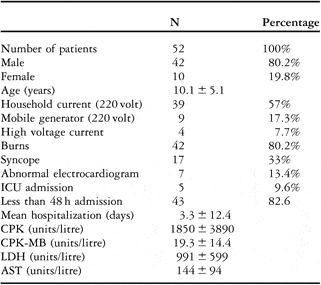
All patients had been exposed to alternating electric current, with 39 patients (75%) electrified by household current at 220 volts, 9 patients (17.3%) by a mobile generator at 220 volts, and 4 (7.7%) by high voltage current. Burns, mostly mild in degree, were observed in 80.2% of the patients. Syncope was the presenting symptom in 17 patients (33%). The clinical findings are summarized in Table 1.
Demographic data and clinical findings for patients with electrocution.

Abbreviations: ICU: intensive care unit; CPK: creatine phosphokinase; LDH: lactic acid dehydrogenase; AST: aspartate aminotransferase.
All patients had electrocardiograms performed on their arrival in the emergency room. Abnormal electrocardiographic findings and arrhythmias were found in 7 patients. Asystole was the presenting feature in 1 patient, and ventricular fibrillation or tachycardia was recorded in 2. Changes in the ST segments mimicking an ischaemic anterior wall were seen in 2 patients, while 1 patient showed non specific changes with frequent atrial premature beats. Another had multiple ventricular premature beats, and 1 further patient had a right axis P-wave.
On admission, 5 patients were unconscious, and were admitted to the intensive care unit, requiring cardiopulmonary resuscitation and mechanical ventilation for a significant period. In addition to the cardiopulmonary resuscitation, defibrillation was necessary in 2 of these patients, both sustaining significant neurological damage. Of these patients, 1 died after three months from Streptococcus A sepsis. None of the survivors was left with any cardiac disability following the acute event. From the overall group, 43 were hospitalized for observation of up to 48 hours, and 4 children were discharged from the emergency room after several hours of observation. The mean period of hospitalization was 3.3 ± 12.4 days.
Total creatine phosphokinase was measured in 33 children (63%), and was elevated in 20, at a mean value of 1850 ± 3890 U/L. Creatine phosphokinase -MB was measured in 11 patients (21%), and was abnormal in six (54%), the mean value being 19.3 ± 14.4. U/L. Lactic acid dehydrogenase was measured in 11 patients (21%), and was abnormal in six (54%), with a mean value of 991 ± 599U/L. Aspartate aminotransferase was measured in 18 patients (35%) and was abnormal in six (33%), the mean value being 144 ± 94 U/L. Troponin I was measured in three children (6%), and was significantly raised in 1 (33%).
Echocardiography was performed on 3 patients, revealing temporary impairment of left ventricular function in 1.
Discussion
Electrical injury has been described in several settings, the most frequent being household injury,Reference Jensen, Thomsen, Bagger, Norgaard and Baandrup5 albeit that arrhythmia is known to be common following lightning injury. Electrical injury can be complicated by a variety of cardiac abnormalities, mainly damage to the myocardium and conduction tissues. Induction of coronary arterial spasm, direct thermal injury, ischaemia secondary to arrhythmia-induced hypotension, and catecholamine mediated injuries are all suggested as possible mechanisms. The highest resistance to the flow of current is in the bones and skin, with moist skin decreasing resistance. The duration of exposure to the injurious current is an important factor. Exposure to alternating current causes tetanic stimulation, which in itself can lengthen the exposure.Reference Solem, Fischer and Strate6 When electrical injuries are seen during childhood, household electrical and extension cords are noted as a major cause of electrocution in young children, while risk-taking behaviour is the cause for most high voltage electrocution in teenagers.Reference Rabban, Blair, Rosen, Adler and Sheridan1–Reference DiVicenti, Moncrief and Pruitt3, Reference Gifford, Marty and MacCollum7 Children injured by household currents have a very low risk of developing a life-threatening arrhythmia, and therefore do not require electrocardiographic evaluation or continuous cardiac monitoring.Reference Bailey, Gaudreault, Thivierge and Turgeon8 In our study, over nine-tenths of the children had been electrified by household current of 220 volts, the remainder being electrocuted by high voltage current.
Most cardiac events are observed during the acute phase and immediately subsequent to electrocution. Sinus nodal dysfunction, atrial fibrillation,Reference Shoenfeld, Savage and Rupp9 ventricular fibrillation,Reference Halperin, Oberhansli and Rouge10 and asystoleReference Jensen, Thomsen, Bagger, Norgaard and Baandrup5 have all been described. Possible mechanisms are damage to cell membranes, damage to smooth muscle in blood vessel walls, endothelial damage, and transformation from electrical energy to heat, causing damage to cardiac muscle and arrhythmias. We observed 1 patient with ventricular fibrillation, another with ventricular tachycardia, and 1 with asystole. All were treated and responded to cardiopulmonary resuscitation. Elevations of the ST segments were noted in 2 of the patients who underwent resuscitation. Both had serious neurological damage, and it is possible that the changes observed were secondary to the prolonged resuscitation, rather than to the electrocution. Elevation of the ST-segments has been seen in one-sixth of patients who received transthoracic shocks for haemodynamically unstable ventricular tachyarrhythmias during electrophysiological studies.Reference Kok, Mitchell, Haines, Mounsey and DiMarco11 ST-segment elevation was transient, and was not associated with clinical evidence of myocardial infarction.
Biochemical abnormalities were observed in half of our patients. All were transient, and values returned to normal during hospitalization. Elevated levels of creatine phosphokinase, myoglobin, creatine phosphokinase-MB levels have previously been associated with cumulative delivered energy.Reference Vikenes, Omvik, Farstad and Nordrehaug12 The release of creatine phosphokinase -MB appears to be influenced by the duration of resuscitation or by use of g cardioversion devices. Increase in levels of troponin in the serum have been linked to acute myocardial infarction, being due to death of myocytes.Reference Mullner, Oschatz and Sterz13, Reference Lund, French, Johnson, Williams and White14 We found only one patient with significantly high levels of troponin, albeit that this patient had a poor prognosis due to serious neurological damage. Being a relatively new test, it was used by us in only 3 patients, and its value should be tested in future studies. Our study is limited by its retrospective nature. As a result, there is missing data on some of the patients. More prospective studies are also needed, therefore, to understand the pathophysiology and the biochemical changes following electric injury in children. A recent review on such electrical injuries, nonetheless, concluded that it is safe to discharge children without an initial electrocardiogram evaluation or inpatient cardiac monitoring after exposure to common household current.Reference Chen and Sareen15 We conclude that cardiac abnormalities, such as arrhythmia or electrocardiographic changes, are seen only in the acute phase, and should be managed as an emergency. We observed no delayed effects or complications, and survival was good. Patients who present with no cardiac events in the acute phase are not expected to develop any in the near future, and we endorse the notion that prolonged hospitalization is usually not necessary.