Introduction
An inducible gene expression system, which allows gene induction in a temporal and spatial manner, is a useful tool for gene function analysis. It is also used for the analysis of biological roles of seed dormancy- or germination-associated genes (Piskurewicz et al., Reference Piskurewicz, Jikumaru, Kinoshita, Nambara, Kamiya and Lopez-Molina2008; Martinez-Andujar et al., Reference Martinez-Andujar, Ordiz, Huang, Nonogaki, Beachy and Nonogaki2011). Chemically inducible gene expression provides an excellent experimental system and also offers great potential for technology development to control seed germination (Martinez-Andujar et al., Reference Martinez-Andujar, Ordiz, Huang, Nonogaki, Beachy and Nonogaki2011). However, there is a problem of impermeability of the testa to chemical ligands. Some chemical ligands may not penetrate the testa efficiently. While it is possible to deliver those ligands through the endosperm and the embryo by particularly targeting the stages after testa rupture, dormant seeds do not exhibit testa rupture and cannot take in chemical ligands efficiently, which hinders examination of the function of genes potentially associated with dormancy release or germination induction.
An inducible gene expression system with a permeable ligand is also important for the development of seed technologies that enable germination recovery from hyperdormant seeds. Different systems to cause hyperdormancy in seeds have been developed for prevention of preharvest sprouting (PHS) (Martinez-Andujar et al., Reference Martinez-Andujar, Ordiz, Huang, Nonogaki, Beachy and Nonogaki2011; Nonogaki, Reference Nonogaki2014; Nonogaki et al., Reference Nonogaki, Sall, Nambara and Nonogaki2014). However, the next important question is: how can hyperdormancy be released when PHS-resistant seeds need to be germinated? This question can be addressed by inducible expression of positive regulators of germination with a permeable ligand. In this paper, problems associated with impermeability of the Arabidopsis seed testa and the potential of an inducible gene expression system with a permeable ligand will be discussed.
Materials and methods
Seed germination
Arabidopsis seeds were plated on filter papers moistened with 3.5 ml of deionized water or test solutions, which were contained in 9-cm-diameter Petri dishes, and were incubated at 22°C under light. Germination percentages after 7 d, with or without 7-d pre-chilling (indicated for individual experiments), were recorded.
β-Glucuronidase staining
β-Glucuronidase (GUS) staining was performed using 100 mM sodium phosphate buffer (pH 7.0) containing 0.1% (v/v) Triton X-100 and 2 mM X-Gluc (5-bromo-4-chloro-3-indolyl β-d-glucuronic acid; RPI Co., Mount Prospect, Illinois, USA). Staining was examined after overnight incubation at room temperature in the dark.
Reverse transcription-polymerase chain reaction
For reverse transcription-polymerase chain reaction (RT-PCR) to analyse gene expression, RNA was extracted from seeds using a standard phenol-sodium dodecyl sulphate (SDS) extraction. Two micrograms of total RNA were reverse transcribed with Moloney Murine Leukemia Virus reverse transcriptase (Promega, Madison, Wisconsin, USA). The conditions for PCR were: one cycle at 94°C (1 min), touchdown cycles (94°C for 15 s, 66°C → 59°C for 15 s and 72°C for 30 s) (one cycle for each annealing temperature) and 30 cycles at 94°C (15 s), 59°C (15 s) and 72°C (30 s), followed by extension at 72°C (7 min). Twenty cycles, instead of 30 cycles, were used for semi-quantitative RT-PCR. For the expression of the At2g48160 gene, the forward (5′- ACAGAGGAGAGGAAGCAATC-3′) and reverse (5′-CTGAGAGCTTAGCAGACACT-3′) primers were used. Ex Taq DNA polymerase (Takara, Mountain View, California, USA) was used for RT-PCR.
Nine-cis-epoxycarotenoid dioxygenase induction
The details about the 9-cis-epoxycarotenoid dioxygenase (NCED) inducible system were described previously (Martinez-Andujar et al., Reference Martinez-Andujar, Ordiz, Huang, Nonogaki, Beachy and Nonogaki2011). Briefly, seeds carrying the inducible NCED were incubated in the presence or absence of Intrepid2F (Dow AgroSciences, Indianapolis, Indiana, USA), a chemical inducer which contained 62 μM methoxyfenozide as an active ingredient.
Nitrate-inducible gene expression
The 5′ upstream sequence (2092 bp) of the Arabidopsis NITRITE REDUCTASE 1 (NIR1) was amplified using the Arabidopsis Columbia (Col-0) genomic DNA and the forward (AtNIR-Pro-F3: 5′-AGTAGGGATGTGTCGTGTGT-3′) and reverse primers (AtNIR-Pro-R: 5′-GATGATGGCGGAAGAAGGAGT-3′). The isolated fragment was re-amplified for InFusion (Takara) reaction with the forward (pNIR InFusion[HindIII]-F: 5′- GGCCAGTGCCAAGCTTAGTAGGGATGTGTCG-3′) and reverse (pNIR InFusion[BamHI]-R: 5′- CGGTACCCGGGGATCCGATGATGGCGGAAGA-3′) primers. PrimeSTAR, a high-fidelity DNA polymerarse (Takara), was used for this purpose.
The fragment prepared with the InFusion primers was cloned to the pCambia 1301 vector (courtesy of Tony Chen, Department of Horticulture, Oregon State University) digested with HindIII and BamHI. Then, the BamHI site in the vector was re-digested to insert a test gene (long non-coding RNA) using an InFusion reaction. The complete vector was used for Agrobacterium-mediated plant transformation as described previously (Liu et al., Reference Liu, Koizuka, Martin and Nonogaki2005a, Reference Liu, Koizuka, Homrichhausen, Hewitt, Martin and Nonogakib). Transgenic plants carrying the nitrate-inducible system were selected using hygromycin.
For induction experiments, 10 mg of seeds produced from the hemizygous T1 plants were plated with 10 mM potassium nitrate or potassium chloride (control) solution. RNA was extracted from seeds as described previously (Liu et al., Reference Liu, Koizuka, Martin and Nonogaki2005a, b). For leaf induction, a rosette was cut at the petiole, which was soaked in a test solution contained in a 0.5-ml tube and incubated for 5 h. RT-PCR was performed as described above, except that different forward (#1847: 5′-GAACGTGGAACCCTTAGTTAC-3′) and reverse (#1828: 5′-ATGAGGAAGCCAAACTCCAA -3′) primers were used in this experiment.
Results and discussion
Impermeability of the testa
It has been suggested that the testa of Arabidopsis seed is impermeable to some small chemicals (Debeaujon et al., Reference Debeaujon, Leon-Kloosterziel and Koornneef2000; Rajjou et al., Reference Rajjou, Gallardo, Debeaujon, Vandekerckhove, Job and Job2004). We have also observed a similar issue for the penetration of 5-bromo-4-chloro-3-indolyl β-d-glucuronic acid, a substrate for GUS, into seeds before testa rupture. When an enhancer-trap line exhibiting GUS expression in the cotyledon tips was isolated, its expression was also detected in seeds (Fig. 1) (Liu et al., Reference Liu, Koizuka, Martin and Nonogaki2005a, b). The excised embryos showed the GUS signals at the tip of cotyledons. The GUS signals were also visible in the intact seeds (Fig. 1). However, the signals seemed to be limited to only the stages after testa rupture and were not observed at the early stages of imbibition.
An Arabidopsis enhancer-trap line exhibiting GUS signals in the cotyledon tips. The signals were detected in a seedling (top, left), excised embryos (top, right) and seeds (bottom). The signals in seeds were detected after testa rupture.

In contrast, the analysis of the expression of the corresponding gene (At2g48160) in imbibed seeds using RT-PCR indicated that its expression peaked around 6 h after the start of imbibition (Fig. 2a). We speculated that the lack of the GUS signals at the early imbibitional stages in the enhancer-trap seeds was probably because the endosperm and the embryo were not exposed to the substrates, due to the impermeability of the testa.
Expression of the At2g48160 gene corresponding to the enhancer-trap line shown in Fig. 1. (a) Expression of the enhancer-trapped gene in seeds at the different imbibitional stages (0, 6, 12 and 18 h), which was examined by RT-PCR; ACT2, ACTIN2. (b) Expression of the enhancer-trapped gene in the seeds with the transparent testa3 (tt3) transparent testa glabra (ttg) background. The line was created by crossing the tt3 ttg line as female with the pollen from the enhancer-trap line, which produced pale-coloured seeds. GUS expression at the cotyledon tips is highlighted in the schematic representation and the close-up views at bottom.

To test this possibility, the enhancer-trap line was crossed to the transparent testa3 (tt3) transparent testa glabra (ttg) double mutant (as a female). All resultant seeds exhibited a pale-coloured testa, which is known to have better permeability (Debeaujon et al., Reference Debeaujon, Leon-Kloosterziel and Koornneef2000; Rajjou et al., Reference Rajjou, Gallardo, Debeaujon, Vandekerckhove, Job and Job2004). When these seeds were examined for GUS expression, the signals were detected at the imbibitional stages much earlier than testa rupture, with the peak expression around 6–12 h after the start of imbibition (Fig. 2b). The GUS signals localized exclusively to the cotyledon tip regions as observed before. The timing of the GUS expression in imbibed seeds with the transparent testa (Fig. 2b) was reasonably consistent with the results of RT-PCR using the enhancer-trap seeds with the wild-type testa (Fig. 2a). These results suggest that the pigment proanthocyanidins contained in the testa (Nesi et al., Reference Nesi, Jond, Debeaujon, Caboche and Lepiniec2001) cause limited permeability to the GUS substrate.
A similar issue was observed for Intrepid2F (ingredient: methoxyfenozide), a chemical ligand used for the Plant Gene Switch System, which is a chemically inducible gene expression system (Padidam, Reference Padidam2003; Koo et al., Reference Koo, Asurmendi, Bick, Woodford-Thomas and Beachy2004; Tavva et al., Reference Tavva, Dinkins, Palli and Collins2006; Martinez-Andujar et al., Reference Martinez-Andujar, Ordiz, Huang, Nonogaki, Beachy and Nonogaki2011). Induction of NCED, a rate-limiting abscisic acid (ABA) biosynthesis gene, by this system was sufficient to suppress seed germination (Martinez-Andujar et al., Reference Martinez-Andujar, Ordiz, Huang, Nonogaki, Beachy and Nonogaki2011). However, almost all NCED-induced seeds were suppressed only after the testa rupture in this system (examples shown in Fig. 3). Since ABA is synthesized and functions inside seeds to maintain dormancy in the native system and dormant seeds do not exhibit testa rupture after imbibition, it is not conceivable that NCED and ABA play their roles particularly in the narrow window of the stages between testa and endosperm rupture. The fact that almost all of the seeds were arrested after testa rupture in the NCED-inducible system would rather suggest that NCED induction and ABA synthesis did not occur until the rupture of the testa, which prevented the entry of the chemical ligand methoxyfenozide into the endosperm and the embryo. These results exemplify that testa permeability is also an issue for chemically inducible gene expression systems with this type of ligand.
Typical appearance of the NCED-induced Arabidopsis seeds by the chemcal ligand Intrepid2F (methoxyfenozide). While near-complete suppression of germination was observed, almost all seeds still reached testa rupture, suggesting that induction occurred only after testa rupture and that the testa is impermeable to methoxyfenozide.

The need for an inducible expression system with a permeable ligand
The impermeability of the testa may not be an issue when a germination suppressing gene is induced, because sooner or later radicle growth will be inhibited by the expression of the negative regulator, as observed for the NCED-inducible system above. However, inducible gene expression systems with chemical ligands, which cannot penetrate through the endosperm and the embryo, will not operate well when germination recovery is intended. Dormant seeds do not exhibit testa rupture and therefore will not provide an opportunity for the chemical ligand to trigger gene expression inside seeds, even when a positive regulator of germination is successfully incorporated into the system. This could be a problem when genes with dormancy-releasing potential are examined for their function in basic research. Therefore, it is necessary to develop an inducible gene expression system with a testa-permeable ligand.
Inducing positive regulators of seed germination is also important for seed enhancement or germination recovery technologies. An advanced system, which imposes hyperdormancy to developing seeds through amplification of NCED expression and the ABA biosynthesis and signalling, has been developed for the prevention of PHS (Nonogaki et al., Reference Nonogaki, Sall, Nambara and Nonogaki2014) [called ‘NCED-amplified lines (NCED∞)’ hereafter]. The NCED-amplified lines do not need chemical induction but increase ABA levels in seeds during the maturation stages in a spontaneous manner, through a positive-feedback mechanism. The dormancy imposed by this system is extremely deep (Fig. 4a). While this phenotype is preferable for PHS prevention, it is necessary to establish strategies for seed germination recovery to make a comprehensive technology for germination control. We found that the hyperdormancy imposed by this system can be released partially by a combination of seed storage, prolonged prechilling treatments and dormancy-releasing chemicals (Fig. 4b). However, full recovery of germination needs to be achieved by more progressive approaches.
Suppression and recovery of seed germination in the NCED-amplified Arabidopsis lines (NCED∞), in which ABA biosynthesis and signalling were amplified through a positive-feedback mechanism and hyperdormancy was induced in a spontaneous manner. (a) Examples of germination suppression in 3-month-old seeds of the four independent NCED∞ lines (3, 12, 39, 43). Wild-type (WT) and the NCED-amplified (NCED∞) seeds from the same maternal plant were compared for each line in water [modified from Nonogaki et al. (Reference Nonogaki, Sall, Nambara and Nonogaki2014) The Plant Journal 78, 529–539]. (b) Recovery of germination by a combination of 50 mM potassium nitrate (KNO3) and 7-d prechilling treatments. One-month-old seeds of the three independent NCED∞ lines (38, 39, 43) were examined. Note that full germinaiton recovery was not observed, even with the most efficient treatment (KNO3 plus 7-d prechilling).

Induction of germination-promoting factors, such as gibberellin (GA) biosynthesis genes, ABA deactivation genes and NCED antisense or RNA interference (RNAi), has great potential to recover germination. However, the inducible system mentioned above may not function well for this purpose because the chemical ligand does not seem to penetrate the testa efficiently and the NCED-amplified hyperdormant seeds do not exhibit testa rupture. Therefore, it is necessary to develop a new inducible gene expression system with a chemical ligand that could permeate through the endosperm and the embryo, particularly for germination recovery purposes.
The potential of the nitrate-inducible gene expression system
To explore an inducible gene expression system in imbibed seeds before testa rupture, we focused on a gene promoter responsive to nitrate, which is a soluble chemical known to be permeable through the testa and also as a dormancy-releasing reagent (Fig. 4b; discussed below). The promoter of the Arabidopsis NIR1 has been characterized (Konishi and Yanagisawa, Reference Konishi and Yanagisawa2010). Approximately 3-kb upstream and 2-kb downstream regions of this gene enable induction of a GUS reporter gene in Arabidopsis seedlings in a nitrate-responsive manner. The promoter region contains the nitrate-responsive cis-element (NRE). A synthetic promoter, which contains the four copies of a 43-bp sequence including NRE and the 35S minimal promoter, is capable of directing nitrate-responsive transcription (Konishi and Yanagisawa, Reference Konishi and Yanagisawa2010).
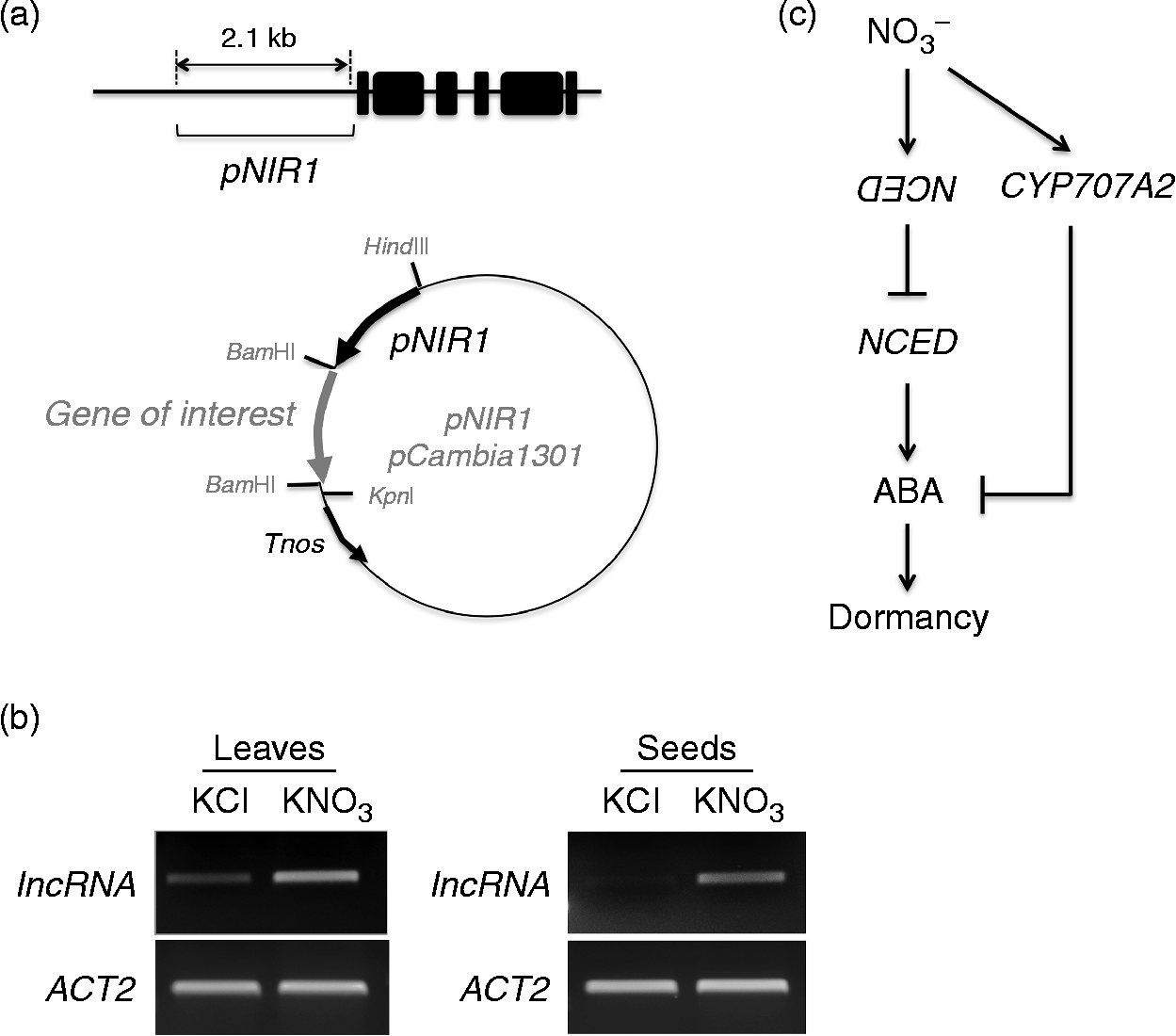
Based on this information, we have isolated a 2.1-kb region of the promoter containing NRE together with part of the 5′ untranslated region (UTR) of this gene and cloned the fragment to a transformation vector (Fig. 5a), which was used to prepare transgenic plants. A test transcript [long non-coding RNA (lncRNA)] was examined in the transgenic Arabidopsis leaves. The accumulation of lncRNA, which was also observed in the control leaves at a moderate level, was strongly enhanced in a nitrate-responsive manner (Fig. 5b), verifying the responsiveness of the NIR1 promoter to nitrate. In seeds, this lncRNA was expressed at a very low level; however, it was clearly induced by nitrate (Fig. 5b). The seeds used for RNA extraction for that experiment were harvested at 15 h of imbibition, at which no testa rupture was observed. Clear induction of gene expression in the seeds by nitrate demonstrates the utility of the inducible system with a permeable ligand for gene induction at the relatively early stage of imbibition before testa rupture. It is known that nitrate induces CYP707A2, an ABA deactivation gene in seeds (Matakiadis et al., Reference Matakiadis, Alboresi, Jikumaru, Tatematsu, Pichon, Renou, Kamiya, Nambara and Truong2009). Therefore, if NCED-suppressive genes, such as antisense NCED or NCED RNAi, are induced by nitrate, it could have a dual effect of reducing ABA biosynthesis and increasing ABA deactivation, both of which are expected to reduce ABA levels in seeds and promote seed germination (Fig. 5c). Thus, the NIR1 system has great potential for inducible gene expression in seeds.
Nitrate-inducible gene expression in Arabidopsis seeds. (a) Schematic representaitons of the structure of the NITRITE REDUCTASE 1 (NIR1), including the promoter region (pNIR1) used for the experiments (top) and the transformation vector containing pNIR1, to which a germination recovery gene of interest can be inserted (bottom). The major restriction sites (BamHI, HindIII, KpnI) are indicated in the scheme. Tnos, nos (nopaline synthase) terminator. (b) Semi-quantitative RT-PCR showing examples of induction of a gene of interest [long non-coding RNA (lncRNA)] in leaves and 15-h-imbibed seeds by 10 mM potassium nitrate (KNO3) with a control of potassium chloride (KCl); ACT2, ACTIN2. (c) Schematic representation of the concept of dual effects of ABA reduction by antisense NCED-induction by the nitrate-inducible system. Since nitrate induces CYP707A2, an ABA deactivation gene in the native system, antisense NCED induction by nitrate could have dual effects of decreasing ABA biosynthesis and increasing ABA deactivation, both of which reduce ABA levels in seeds and release dormancy.

There are many systems that can be used for chemically inducible gene expression (Padidam, Reference Padidam2003). Antibiotic-based inducible systems, such as tetracycline repressor (TetR)-based inducible system or TetR-based tetracycline-inactivatable (tTA) system, have been developed and used successfully for plants (Gatz, Reference Gatz1997; De Veylder et al., Reference De Veylder, Beeckman, Van Montagu and Inzé2000; Love et al., Reference Love, Scott and Thompson2000). There are also the glucocorticoid receptor (GR)-based dexamethasone-inducible system (Lloyd et al., Reference Lloyd, Schena, Walbot and Davis1994; Aoyama et al., Reference Aoyama, Dong, Wu, Carabelli, Sessa, Ruberti, Morelli and Chua1995) and the oestrogen receptor (ER)-based oestradiol-inducible system (Bruce et al., Reference Bruce, Folkerts, Garnaat, Crasta, Roth and Bowen2000; Zuo et al., Reference Zuo, Niu, Frugis and Chua2002). Even a combination of GR-based and TetR-based systems in a dual-control system has been established (Böhner et al., Reference Böhner, Lenk, Rieping, Herold and Gatz1999). However, the antibiotics and steroid hormones used in these systems are not ideal ligands for applications, especially in seed-production fields or seed-processing factories. The ecdysone receptor (EcR)-based Plant Gene Switch System with methoxyfenozide, a non-steroidal ecdysteroid agonist (Mosallanejad et al., Reference Mosallanejad, Badisco, Swevers, Soin, Knapen, Vanden Broeck and Smagghe2010), has addressed this application issue. However, we experienced the permeability issue, particularly for seeds, and addressed that issue in this study. The nitrate-inducible gene expression system examined in this work met the requirements for both the regulatory aspect (field applicable) and induction efficiency (testa permeable). A similar system to the nitrate-inducible system, which uses a testa-permeable ligand, is the ethanol-inducible gene expression system (Caddick et al., Reference Caddick, Greenland, Jepson, Krause, Qu, Riddell, Salter, Schuch, Sonnewald and Tomsett1998; Roslan et al., Reference Roslan, Salter, Wood, White, Croft, Robson, Coupland, Doonan, Laufs, Tomsett and Caddick2001). Since a low concentration of ethanol, which may not affect seed germination, is sufficient for induction of gene expression, this system can also be applied to gene expression in seeds. However, it has been suggested that care must be taken not to expose plants (and seeds) to ethanol vapour so that induction is not triggered inadvertently (Padidam, Reference Padidam2003). Basal expression of reporter genes driven with the ethanol-inducible system was observed in seedlings grown on agar in the absence of exogenous inducer (Padidam, Reference Padidam2003). It is also possible to have leaky expression in the nitrate-inducible system. These issues need to be considered carefully during experimental design and data interpretation.
It should also be noted that a precaution is required for the use of the nitrate-inducible gene expression system in seed research, especially when it is used to characterize function of genes with germination-inducing potential. The dormancy releasing effects of nitrate could make it difficult to separate the positive effects of the gene examined and of nitrate itself. In that case, it will be necessary to include a good control, such as nitrate-treated wild-type seeds, which are produced under the same conditions as transgenic seeds, and examine germination differences between the control and nitrate-induced transgenic seeds. In contrast, when putative negative regulators of seed germination are induced by this system and germination suppression phenotypes are observed despite the positive role of nitrate in seed germination, that would be even more convincing for functional characterization of the negative regulators of germination.
While there are both advantages and disadvantages for the use of the nitrate-inducible gene expression system in basic seed research, from a technology development point of view, the system, which allows gene induction at the relatively earlier stages of imbibition before testa rupture will be a robust tool for seed germination recovery and enhancement technologies. The combination of this system with the PHS prevention systems will provide a comprehensive technology for the future.
Acknowledgements
We are grateful to Roger Beachy, World Food Center, University of California, Davis, California, for his suggestions; Eric Liu, Jessica Kristof and Tanja Homrichhausen, previous students at Oregon State University, for technical assistance in the analysis of the enhancer-trap lines; and Cristina Martinez-Andujar, Centro de Edafologia y Biologia Aplicada del Segura–Consejo Superior de Investigaciones Cientificas (CEBAS-CSIC), Spain, for assistance in NCED induction experiments.
Financial support
This work was partially supported by the Integrative Seed Biology fund of the Oregon State University Foundation.
Conflicts of interest
One of the technologies described in this manuscript has been filed for a patent. One of the authors is a trainee from a seed company that is not related to the patent.