The current state of knowledge with regard to consequences of childhood adversities for later stress sensitivity and depressive disorder is characterized by seemingly conflicting bodies of evidence. The divergent findings can roughly be categorized into three ways in which childhood adversities and recent stressors jointly influence the development of depression: stress sensitization (SS), stress amplification (SA), and stress inoculation (SI; Rudolph & Flynn, Reference Rudolph and Flynn2007).
The SS and SA models both predict that childhood adversities increase vulnerability to the negative effects of stressors occurring later in development, but they diverge in the assumed expression of this vulnerability. The SS model states that childhood adversities lower the threshold for depressive reactions to recent stressors, and hence that individual differences in depression risk caused by childhood adversities are expressed in low current stress conditions in particular. This model has predominated in research on the role of early experiences in the development of depressive disorders, and it was empirically supported in adolescents (Harkness, Bruce, & Lumley, Reference Harkness, Bruce and Lumley2006; Rudolph & Flynn, Reference Rudolph and Flynn2007) and young adults (Hammen, Henry, & Daley, Reference Hammen, Henry and Daley2000). As opposed to the SS model, the SA model predicts that individual differences in depression risk will be expressed in high rather than low current stress conditions. Support for SA due to childhood adversities was found by Kendler, Kuhn, and Prescott (Reference Kendler, Kuhn and Prescott2004) and McLaughlin, Conron, Koenen, and Gilman (Reference McLaughlin, Conron, Koenen and Gilman2010), while Rudolph and Flynn (Reference Rudolph and Flynn2007) and Seery, Holman, and Silver (Reference Seery, Holman and Silver2010) provided partial support.
Although the SS and SA models differ with respect to the current stress conditions under which the effects of childhood adversities are most discernible, the starting point of both is that childhood adversities result in an increased risk of depression. The SI model starts from a completely different premise: that childhood adversities may protect against the effects of later life stress (Andrews, Page, & Neilson, Reference Andrews, Page and Neilson1993), because of “steeling” effects (Lyons & Parker, Reference Lyons and Parker2007; Rutter, Reference Rutter2006). Seery et al. (Reference Seery, Holman and Silver2010) found that individuals who had been exposed to moderate cumulative lifetime adversity levels were more resilient to the effects of recent stressful events than were those with no history of adversity. Additional findings suggesting SI are, among others, lower cortisol levels during current stress in children exposed to moderate early adversity levels than in children exposed to low early adversity levels (Gunnar, Frenn, Wewerka, & Van Ryzin, Reference Gunnar, Frenn, Wewerka and Van Ryzin2009), and greater resilience to current work stress in young adults who had experienced work stress as adolescents than in those who had not (Mortimer & Staff, Reference Mortimer and Staff2004).
At first sight, the concepts of SS, SA, and SI seem irreconcilable. However, this is not necessarily true. Rudolph and Flynn (Reference Rudolph and Flynn2007) found evidence for both SS and SA by childhood adversity in youth, but not in the same individuals: SS effects were seen in prepubertal boys and pubertal girls, SA effects in prepubertal girls. A combination of SI and SA effects was reported by Seery et al. (Reference Seery, Holman and Silver2010), who found curvilinear associations between lifetime adversity and sensitivity to recent stressful events, with the lowest sensitivity levels in individuals exposed to moderate lifetime adversity. The SI and SS models have a different focus, but both propose that individuals exposed to (moderate) childhood adversities are relatively better off in current high- than low-stress conditions, as compared to individuals not exposed to childhood adversities.
Taken together, these findings imply two things. There is no single overarching principle of how childhood adversities affect depressive reactions to stressful events later in life. Different processes can occur in different individuals, depending on, among other things, the level of adversity they were exposed to as children and their ability to cope with these stressors at that time. We postulate that children who are able to manage the challenges well can gain toughness and mastery to cope with future stressors (Koolhaas et al., Reference Koolhaas, Bartolomucci, Buwalda, De Boer, Flugge and Korte2011; Seery et al., Reference Seery, Holman and Silver2010). In other words, these children may show later stress responses that correspond with the SI model. If adversity levels exceed their regulatory capacity, they may develop depressive reaction patterns, possibly as an evolutionary conserved shutdown mechanism to give up engagement in order to preserve energy and increase chances of survival (Belsky, Reference Belsky2008; Zellner, Watt, Solms, & Panksepp, Reference Zellner, Watt, Solms and Panksepp2011). Childhood-onset mental health problems have been reported to mediate the association between childhood adversities and adolescent mental health problems (Bakker, Ormel, Verhulst, & Oldehinkel, Reference Bakker, Ormel, Verhulst and Oldehinkel2012). Hence, children whose adversities exceed their coping skills may develop a depressive reaction pattern, corresponding with the SA model, and therefore have a high risk of childhood-onset depressive episodes. If true, this suggests that SA effects are most likely to be observed in samples that include many individuals with early-onset depressions. In contrast, absence of early-onset depressions is hypothesized to be a marker of SI. It is crucial to distinguish between children with early-onset depressions and those who survived childhood adversities without developing a depressive reaction style, because mixing these two groups up is likely to result in inconsistent findings.
One may wonder where this leaves the SS model. The answer could be related to the second issue that needs to be to acknowledged: vulnerability and resilience may not apply under all circumstances, but be context dependent. Childhood adversities that do not induce a depressive reaction style may program individuals for a life with high rather than low stress levels. From this point of view, whether childhood adversities should be considered a risk or a resilience factor depends on the environment an individual ends up in. High-stress environments generally provide suboptimal conditions for growing up, but children adapt to adversities by developing strategies to make the best of it (Boyce & Ellis, Reference Boyce and Ellis2005; Brumbach, Figueredo, & Ellis, Reference Brumbach, Figueredo and Ellis2009; Nederhof & Schmidt, Reference Nederhof and Schmidt2011; Pollak, Reference Pollak2008). These acquired skills provide them with an advantage in later high-stress situations, possibly at the cost of relatively worse functioning in low-stress situations owing to higher trait levels of depression (Rosenman & Rodgers, Reference Rosenman and Rodgers2006). The resulting pattern of associations resembles a pattern typically interpreted as reflecting SS (i.e., more depressive symptoms in individuals exposed to childhood adversities; converging lines) in the low to medium current stress range, which turns into a pattern consistent with the SI model (more depressive symptoms in the nonexposed group; diverging lines) after the point where the lines cross, that is, in the medium to high current stress range.
Whereas the supposition that exposure to childhood adversities can be advantageous in high-stress conditions later in life follows naturally from the notion that early experiences program individuals for later ones (e.g., Brumbach et al., Reference Brumbach, Figueredo and Ellis2009), the idea that these same individuals have a relative disadvantage, compared to individuals not exposed to childhood adversities, in low-stress situations is less straightforward. A higher depression risk of exposed individuals in favorable, low-stress conditions may be the price that has to be paid because the acquired insensitivity is not necessarily restricted to negative experiences, but could also involve experiences that can enhance positive affect (Ellis, Boyce, Belsky, Bakermans-Kranenburg, & van IJzendoorn, Reference Ellis, Boyce, Belsky, Bakermans-Kranenburg and van IJzendoorn2011; Fergusson, Horwood, & Shannon, Reference Fergusson, Horwood and Shannon1984; Hankin et al., Reference Hankin, Nederhof, Oppenheimer, Young, Abela and Smolen2011). Low positive affect is a well-established risk factor for depression. Note that the assumed disadvantage of individuals exposed to childhood adversities in low-stress conditions relates to a relative incapability to benefit from risk-reducing positive influences and does not imply that these individuals have a higher depression risk in current low-stress than in high-stress conditions in absolute terms.
Adolescence is a particularly informative life phase to investigate consequences of childhood adversities on depression, because it is characterized by a high incidence of major depression (Hankin et al., Reference Hankin, Abramson, Moffitt, Silva, McGee and Angell1998; Oldehinkel, Wittchen, & Schuster, Reference Oldehinkel, Wittchen and Schuster1999) and many potentially stressful challenges (Nelson, Leibenluft, McClure, & Pine, Reference Nelson, Leibenluft, McClure and Pine2005; Oldehinkel & Bouma, Reference Oldehinkel and Bouma2011; Paus, Keshaven, & Giedd, Reference Paus, Keshavan and Giedd2008). In the present study, we used data from a large longitudinal population survey of adolescents to test the following hypotheses:
-
Hypothesis 1: Childhood adversities are associated with an increased risk to develop a (incident) depressive episode. The relative risk is particularly high in childhood and decreases over time.
-
Hypothesis 2: Adolescents who survived childhood adversities without getting depressed in childhood or early adolescence (in this study defined as the period until the age of 16) have, compared to adolescents exposed to few adversities: (a) a lower probability to develop a depressive episode in current high-stress conditions and (b) a higher probability to develop a depressive episode in current low-stress conditions.
Note that, although these hypotheses were developed by combining aspects of the SS, SA, and SI models, they cannot be used to test any of these three models directly.
A number of features make our study particularly suitable for investigating long-term effects of childhood adversities on sensitivity to recent stressful events and depression risk: a follow-up period of over 10 years, multi-informant ratings of childhood adversities during various periods, information about the lifetime occurrence of DSM-IV major depressive episodes and their age of onset, and meticulous assessments of stressful events occurring between the ages of 16 and 19 through contextual, interviewer-based ratings.
Methods
Sample
The data were collected as part of the Tracking Adolescents' Individual Lives Survey, a prospective cohort study of Dutch adolescents (Ormel et al., Reference Ormel, Oldehinkel, Van Oort, Raven, Veenstra and Vollebergh2012). Four assessment waves have been completed to date, which ran from March 2001 to July 2002 (Time 1 [T1]), September 2003 to December 2004 (Time 2 [T2]), September 2005 to August 2007 (Time 3 [T3]), and October 2008 to September 2010 (Time 4 [T4]). The study was approved by the Dutch Central Committee on Research Involving Human Subjects. Participants were treated in compliance with American Psychological Asociation ethical standards, and all measurements were carried out with their adequate understanding and written consent.
At T1, 2,230 (pre)adolescents were enrolled in the study (response rate 76%, mean age = 11.1, SD = 0.6, 51% girls; De Winter et al., Reference De Winter, Oldehinkel, Veenstra, Brunnekreef, Verhulst and Ormel2005), of whom 96% (N = 2,149, mean age = 13.6, SD = 0.5, 51% girls) participated at T2. The response rates at T3 and T4 were, respectively, 81% (N = 1,816, mean age = 16.3, SD = 0.7, 52% girls) and 83% (N = 1,881, mean age = 19.1, SD = 0.6, 52% girls).
The fourth assessment wave included questionnaires, a psychiatric diagnostic interview, and a life events interview. Because the life events interview was costly and labor intensive, it was only administered to part of the sample, in which respondents with a psychiatric diagnosis were oversampled. Of all T4 participants, 84% (N = 1,584) agreed to have the diagnostic interview, 93% of whom gave consent for a life events interview. Of these, 45% (n = 659) met DSM-IV criteria for a psychiatric disorder during the past year. These adolescents were all selected for the life events interview, and 580 (89%) were actually interviewed; for 11% an interview was not feasible within the study period owing to practical constraints. Of the adolescents without a past-year diagnosis (n = 808), 49% were selected for the life events interview and 47% (n = 377) were actually interviewed, yielding a total of 957 interviews (mean age = 19.1, SD = 0.6, 55% girls). As compared to the part of the T4 sample that did not get the life events interview, participants were more often females (55% vs. 50%; χ2 1 = 4.5, p = .04); were younger (mean age = 19.0, SD = 0.6 vs. 19.2, SD = 0.6), t (df = 1,879) = 6.3, p < .01; and reported more depressive symptoms (mean item score 0.33, SD = 0.31 vs. 0.26, SD = 0.29); t (df = 1,694) = –4.4, p < .01, as assessed with the Adult Self-Report (Achenbach & Rescorla, Reference Achenbach and Rescorla2003).
Measures
Major depression
The presence of psychiatric disorders was assessed during T4, by means of the World Health Organization Composite International Diagnostic Interview (CIDI), version 3.0. The CIDI is a structured diagnostic interview that yields lifetime and current diagnoses according to DSM-IV (American Psychiatric Association, 2000). The CIDI has been used in a large number of surveys worldwide (Kessler & Ustun, Reference Kessler and Ustun2004), and it has shown good concordance with clinical diagnoses (Haro et al., Reference Haro, Arbabzadeh-Bouchez, Brugha, De Girolamo, Guyer and Jin2006; Kessler et al., Reference Kessler, Avenevoli, Green, Gruber, Guyer and He2009).
Depression was operationalized as a major depressive episode (MDE). In addition to the lifetime occurrence of an MDE, the CIDI also yields information with regard to the age of first onset, the age at which the last episode started, and the age at which the last episode ended.
Childhood adversities
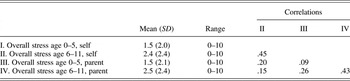
Exposure to childhood adversities was assessed at T2, by means of parent- and self-reported ratings of overall stressfulness of the child's life between ages 0–5 and 6–11, respectively. Parents were asked, “How stressful was your child's life in this life phase?” and adolescents were asked, “How many bad things happened to you in this period?” The stressfulness was rated on an 11-point scale (0 = not at all, 10 = very much). Means and correlations of the individual adversity measures are given in Table 1. Based on these four adversity measures, we constructed a factor score (ML extraction) to capture the common core of these measures, which explained 42% of the variance in the individual measures. This factor score was used as the main predictor in subsequent analyses.
Descriptive statistics of the childhood adversity measures used in this study

Note: N = 1584.
Recent stressful events
Stressful life events in the period between T3 and T4 were assessed with Kendler's Life Stress Interview (LSI; Kendler, Karkowski, & Prescott, Reference Kendler, Karkowski and Prescott1998), which was based on the Life Events and Difficulties Schedule (Brown & Harris, Reference Brown and Harris1989). The LSI encompasses 11 personal events, that is, events occurring primarily to the respondents themselves, including assault, breakup of romantic relationship, illness or injury, trouble with police, loss of a confidant, and difficulties at work or school. In addition, there are 4 classes of events occurring primarily to an individual in the respondent's social network (e.g., a serious crisis, illness, or death). Each reported stressful life event was dated as accurately as possible by means of mnemonic aids such as personal calendars. A distinguishing feature of the LSI is that the events are not rated by the respondent, but by the interviewer. Furthermore, the ratings are contextual, that is, based on what most people would feel about an event given the circumstances and biography, taking no account of respondents' reaction or any following mental health problems. Interviewer-based contextual ratings are essential to prevent intracategory variability and to disentangle objective event characteristics from the emotions and behaviors evoked by the event (Dohrenwend, Reference Dohrenwend2006).
For each event in the time period between T3 and T4, we rated the severity (i.e., long-term contextual threat) and dependence on respondent's will or behavior (i.e., planned actions or events directly caused by neglect or carelessness). Severity ratings ranged from 1 = minor to 4 = severe; possible dependence ratings were 1 = clearly independent, 2 = probably independent, 3 = probably dependent, and 4 = clearly dependent. Examples of clearly independent events are death or disease of someone, while breaking up a relationship and being caught for robbery are clearly dependent events. Events like burglary, being discharged, and abuse will often be rated as probably independent or dependent, depending on their specific context. All interviewers were extensively trained and regularly attended booster sessions in order to ensure reliable and valid scores. Furthermore, all interviews were tape-recorded and scored by a second rater blind to the interviewer's scores. In case of discordant ratings, the two raters discussed the scores until consensus was reached or a third rater made the final judgment.
For the depressed adolescents, we included all events that occurred in the year of the depression onset and the preceding year. The time frame for the life events in the control group also spanned 2 years, and it was chosen in such a way that the distribution of the time lag to the T4 assessment equaled the distribution in the depressed group.
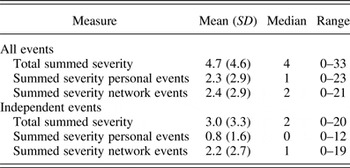
We calculated the summed severity of all events that occurred within the time frame as well as the summed severity of only the independent events, the personal events, and the network events. Descriptive statistics of these measures are presented in Table 2.
Descriptive statistics of the life event measures used in this study

Note: N = 875.
Analysis
We examined whether childhood adversities were associated with the onset of an MDE during childhood or adolescence, using a Cox proportional hazards regression model with age of onset of the first MDE as the dependent variable and the factor score representing adversities experienced between age 0 and 11 as the predictor. In addition to the main effect of childhood adversities, we included its interaction with age, to test the hypothesis that the effect of childhood adversities declines over time. Gender was included as a covariate. The analysis was repeated using the adversities measures pertaining to ages 0–5 and 6–11 (averaged across informants), respectively, and the parent reports and self-reports (averaged across timeframes) separately.
Then we examined whether childhood adversities were associated with depressive reactions to stressful life events during adolescence, operationalized as the association between recent stressful events and MDE onset. This was tested in a logistic regression model, with MDE onset as the dependent variable. We did not control for the oversampling of adolescents with a psychiatric diagnosis, because odds ratios are valid regardless of the distribution of the outcome variable. Predictor variables were childhood adversities (overall exposure from age 0 to 11), recent stressful life events prior to onset (total summed severity), and the interaction of the two. Gender was included as a covariate, and gender differences in the effect of any of the predictor variables or their interaction were examined by testing interaction effects, which were maintained in the model if significant. Adolescents who were depressed at T3 were excluded from these analyses, because the LSI did not cover a pre-onset period in their case. The remaining sample was split into two subgroups: adolescents with and without an onset of depression before T3. Hypothesis 2 was tested in the group without an onset before T3 (i.e., at risk for a first onset), while the analysis was repeated in the group with a remitted onset before T3 (i.e., at risk for a recurrent onset) for the sake of comparison.
To examine the robustness of the findings with regard to the timing (0–5 vs. 6–11 years) and informant (parent vs. self-report) of the childhood adversities, as well as to the nature (dependent vs. independent) of the recent stressful events, the analysis was replicated using alternative measures. To ease interpretation of the odds ratios, all continuous predictor variables were standardized to a mean of 0 and a standard deviation of 1. The data were analyzed using PASW Statistics software, version 18.0.3.
Results
Childhood adversities and onset of depression
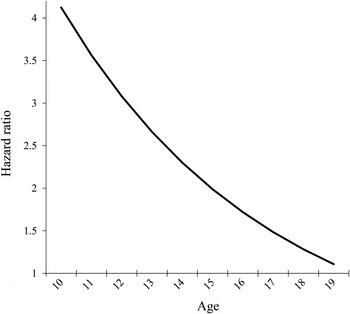
Of the 1,584 adolescents included in this study, 17% had a lifetime diagnosis of MDE. The Cox regression analysis revealed that the factor score representing childhood adversities strongly increased the probability of depression onset early in life (main effect adversities: B = 2.88, SE = 0.20, p < .001, hazard ratio = 17.8) and that the effect decreased with increasing age (interaction adversities by age: B = –0.15, SE = 0.01, p < .001, hazard ratio = 0.9) to hazard ratios near 1 in late adolescence (see Figure 1). These effects were the same regardless of the period (i.e., during age 0–11, 0–5, or 6–11 years) and informant (i.e., factor score, parent reports, or self-reports) of the childhood adversities. Comparable results (main effect adversities: B = 2.80, SE = 0.24, p < .001; interaction with age: B = –0.14, SE = 0.02, p < .001) were found in the subsample of 957 adolescents who participated in the life events interview.
The estimated effect of childhood adversities (standardized factor score) on depression onset, by age.

Childhood adversities and sensitivity to recent stressful events
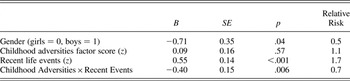
The LSI was administered to 957 adolescents, of whom 801 had not experienced a depression onset before T3. This group was used to test Hypothesis 2. Forty-three adolescents developed a first onset of depression between T3 and T4. Logistic regression analysis revealed a significant negative interaction between the effects of childhood adversities and recent stressful events, indicating that the association between recent stressful life events and MDE onset was weaker in adolescents who had been exposed to high adversity levels during childhood than in those exposed to low adversity levels (Table 3). Inspection of the (joint) distribution of childhood adversities and recent life events indicated that the negative interaction effect was not driven by any outliers. Furthermore, none of the effects differed significantly between boys and girls (all ps > .19).
Prediction of onset of depression by childhood adversities and recent life events, in adolescents without an onset of depression before age 16

Note: N = 801.
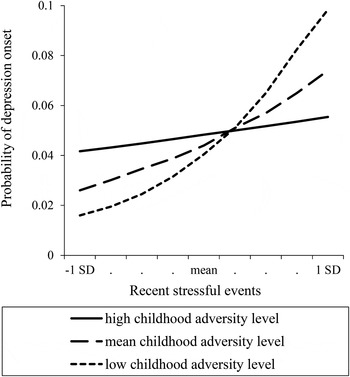
This pattern of associations was found regardless of the time frame (0–5 vs. 6–11 years) or informant (parent vs. self-report) of the childhood adversities, and regardless of the nature of the recent events (personal vs. network, including or excluding person-dependent events): all measures yielded a nonsignificant main effect of childhood adversities, a significant main effect of recent life events and, and a significant (p < .05) negative interaction effect of childhood adversities and recent stressful life events (details available upon request). The estimated risk of MDE onset between T3 and T4, conditional on childhood adversities and recent stressful events, is depicted in Figure 2. As hypothesized, at recent low-stress conditions, the probability of depression onset was higher for adolescents exposed to many childhood adversities than for those exposed to few adversities, while at recent high-stress conditions, their probability was lower. The regions of significance (p < .05) for the effect of childhood adversities on depression onset covered recent stress levels smaller than –0.76 SD below the mean (region of significant positive effect of childhood adversities on probability of depression) and larger than + 1.55 SD above the mean (region of significant negative effect). That the regions were asymmetrically dispersed around the mean is largely due to the skewed distribution of recent life events (Table 2). Simple slopes analyses revealed that recent stressful life events significantly predicted depression onset in adolescents exposed to low (B = 0.95, SE = 0.20, p < .001) and mean (B = 0.55, SE = 0.14, p < .001) childhood adversity levels, but not in those exposed to high levels of childhood adversity (B = 0.14, SE = 0.20, p = .48).
The estimated probability of first depression onset between ages 16 and 19, by childhood adversities and recent stressful events.

To examine if the negative interaction between childhood adversities and recent life events was specific for adolescents without an early depressive episode, we repeated the analysis for the 74 adolescents who had experienced a depressive episode before T3 but were nondepressed (and so at risk for a recurrent episode) at T3. Of these adolescents, 28 developed an episode between T3 and T4. Sample size differences prohibit a comparison between the two subsamples based on statistical significance, but the small size of the interaction effect (B = –0.01, SE = 0.21, p = .96, odds ratio = 1.0) strongly suggests that the modifying effect of childhood adversities did not pertain to the adolescents with an early onset of depression.
Discussion
How childhood adversities modify later stress sensitivity and risk of depressive disorder has been described by three seemingly conflicting theories: the stress sensitization, stress amplification, and stress inoculation models. In this study, we aimed to reconcile these models by emphasizing that all may apply, but in different persons and different circumstances. We hypothesized that childhood adversities would increase risk of depression during and shortly after the adversities, but have a waning effect on depression incidence over time (Hypothesis 1). In adolescents without an early onset, childhood adversities were hypothesized to decrease risk of depression in current high-stress conditions (Hypothesis 2a) and increase risk of depression in current low-stress conditions (Hypothesis 2b).
The results provided support for both hypotheses. More specifically, we found that childhood adversities strongly increased the probability of depression onset early in life and that this effect decreased over time. Furthermore, in the subgroup of adolescents without an early onset of depression, those who had been exposed to childhood adversities were less sensitive to the effects of recent stressful life events than were the nonexposed group, as evidenced by a lower probability of depression onset in current high-stress, and a lower probability in current low-stress conditions. This suggests that exposure to adversities either leads to early-onset depressive episodes or programs children for high-stress conditions later in life, at the expense of a relatively higher risk of depression in low-stress conditions. Early-onset depressions may reflect cognitive (Abela, Reference Abela2001; Hankin & Abramson, Reference Hankin and Abramson2001) or epigenetic (Essex et al., Reference Essex, Boyce, Hertzman, Lam, Armstrong and Neumann2011; Meaney & Szyf, Reference Meaney and Szyf2005) vulnerabilities causing stress sensitization, stress amplification, or both. At best, adolescents with an early-onset depression are not worse off, but they never seem better off than others. Adolescents who do not develop a depression during or shortly after the childhood adversities cannot be labeled as being at high or low risk in general. Rather, they seem to be optimally adapted to stressful environments, which they can stand better than can adolescents not exposed to childhood adversities (Del Giudice, Ellis, & Shirtcliffe, Reference Del Giudice, Ellis and Shirtcliff2011; Ellis et al., Reference Ellis, Boyce, Belsky, Bakermans-Kranenburg and van IJzendoorn2011). The apparent price they paid is a relatively high risk of depression in current low-stress environments. Figure 2 suggests that adolescents who were exposed to childhood adversities show less sensitivity to their current environment, both in low-stress and high-stress situations. Given that low-stress environments tend to contain more constructive elements than do high-stress ones (Fergusson et al., Reference Fergusson, Horwood and Shannon1984), adolescents exposed to childhood adversities may benefit less from the positive influences in their current environment (Belsky, Bakermans-Kranenburg, & van IJzendoorn, Reference Belsky, Bakermans-Kranenburg and van IJzendoorn2007), resulting in lower positive affect.
Combined, our findings provide tentative support for Boyce and Ellis's (Reference Boyce and Ellis2005) theory of biological sensitivity to context. This theory proposes a U-shaped relation between childhood adversity and the magnitude of biological stress responses, in that both individuals exposed to high adversity levels and those exposed to low adversity levels during childhood are programmed to be more sensitive to the current context than are individuals exposed to medium childhood adversity levels. We found a strong short-term effect of childhood adversities on the probability of depression (see Figure 1), suggesting that high childhood adversity levels may actually induce high stress-sensitivity, which in turn, given the stressful environment the children grow up in, can lead to early-onset depressive episodes. Children exposed to low childhood adversity levels may have the same sensitivity but fewer triggers (i.e., stressors), and hence they survive childhood without depression. In other words, if early-onset depressions reflect high sensitivity to the current context owing to high childhood adversity levels, the association between childhood adversity and depressive reactions to recent stressful life events may show a U-shaped pattern comparable to the relation Boyce and Ellis assumed between childhood adversities and biological stress responses, and in line with Seery's (Reference Seery, Holman and Silver2010) findings that individuals exposed to moderate lifetime adversities were less sensitive to recent stressful events than were those with either lower or higher lifetime adversity levels. However, because the assumption that early-onset depressions reflect high sensitivity to the context has not been tested yet, this is rather speculative and in need of further research.
Although a causal effect of exposure to childhood adversity on developmental trajectories is highly plausible and empirically supported in animal research (Meaney & Szyf, Reference Meaney and Szyf2005), it is not the only explanation possible for the associations found: part of the effects may be due to gene–environment correlations, that is, genetic influences on exposure to risky or supportive environments (Jaffee & Price, Reference Jaffee and Price2007; Kendler & Baker, Reference Kendler and Baker2007). Exposure to adversities and depression share genetic risk factors (Kendler & Karkowski-Shuman, Reference Kendler and Karkowski-Shuman1997), which could cause spurious relationships. However, the complex and heterogeneous nature of the associations found in our study argues against gene–environment correlation as their sole reason.
Our study has a number of notable strengths: a large sample of adolescents, a follow-up period of almost 10 years, multi-informant ratings of childhood adversities during various periods, information about the lifetime occurrence of DSM-IV major depressive episodes and their age of onset, and assessment of recent stressful events through contextual, interviewer-based ratings. The combination of these factors offered unique opportunities to investigate the long-term effects of childhood adversities on later depressive reactions to stressful events.
A number of limitations should be accounted for when interpreting the associations found. First, exposure to childhood adversities was assessed by retrospective reports of the overall stressfulness of the child's life, which left much room for respondents' own interpretations. We cannot exclude that respondents' (imminent) depressive symptoms during the assessment of childhood adversities influenced the ratings of the stressfulness of their childhood, most likely in such a way that the symptoms inflated the stressfulness ratings and hence the association between childhood adversities and depression. Confounding is probably limited, however, because childhood adversities were assessed 5 years before the psychiatric diagnostic interview, and the scores of two independent informants yielded a similar pattern of findings. The essential question to be answered is to which extent the retrospective evaluations of the childhood adversities might have influenced their interaction with recent stressful life events. The most probable report bias is that the childhood adversity ratings reflected (later) stress-vulnerability or subthreshold depressive symptoms instead of mere exposure to environmental influences. In that case, we would expect a stronger effect of recent life events on depression in adolescents with high childhood adversity ratings. The negative interaction found is in the opposite direction and thus unlikely to be spurious. A second limitation is that the CIDI provides onset ages in years, which precluded a fine-grained analysis of temporal effects of events. The depressogenic effect of stressful effects wanes over time and usually loses most of its power after a couple of months (Kendler et al., Reference Kendler, Karkowski and Prescott1998; Wainwright & Surtees, Reference Wainwright and Surtees2002). The study design ensured that no depression onsets after stressful life events were missed, but it did not prevent the inclusion of events without a depression onset shortly afterward. If anything, this has affected the associations conservatively. The relatively crude dating of depression onsets also made it possible that some of the stressful events occurred after the onset of depression rather than before. Because the findings remained basically similar if we restricted the analyses to person-independent events only, however, reverse causality (depression causing the events rather than the other way around) is not very likely. Third, the life events measures covering childhood and early adolescence were not accurate enough to provide detailed information about the association between stressful events and early onsets of depression. This implies that the notion of increased stress sensitivity in children with an early onset of depression is an assumption that remains to be tested in future research. Fourth, to have unambiguous onset data we focused on depressive disorder only, and ignored possible co-occurring conditions such as anxiety and conduct disorder. Hence, concepts like risk and resilience only pertain to depression, and not to (mental) health and well-being in general.
In sum, our results suggest that there is no unequivocal relation between childhood adversity and depressive reactions to stressful life events during adolescence. Depressive history, notably the age at first onset of the problems, seems to be an effective marker to distinguish between various types of reaction patterns. Nevertheless, much remains to be learned about the actual conditions under which childhood adversities lead to later stress (in)sensitivity and depression. Another issue that deserves further study concerns the implications of (innate or acquired) insensitivity to environmental influences for prevention or intervention strategies; possibly individuals characterized by environmental insensitivity require other strategies in order to be treated effectively than sensitive ones. Our study may thus contribute to the further development of evidence-based tailor-made interventions.