It is a hallmark of child language that children omit both functional and lexical elements in their utterances, regardless of whether their language allows for the omission of these elements (e.g., Chinese and Spanish) or does not (e.g., English and German). In recent years, researchers have begun to look to discourse pragmatics to account for children's argument omission as it occurs in natural conversation. This line of argument goes back to Greenfield and Smith (Reference Greenfield and Smith1976), who presented evidence that, from very early on, children show a tendency to verbalize simply what is new in a situation.
Researchers in the field of discourse pragmatics now approach omission phenomena as part of the larger theoretical framework of argument realization. Argument realization refers to the process of selecting different linguistic forms for the arguments of a verb (i.e., subject and object). These can be realized by various referring expressions: a definite or indefinite lexical noun, a demonstrative, or a pronoun. They can also be omitted entirely, which is referred to as null reference. In very general terms, researchers seek to identify various discourse factors that might explain why arguments are realized with a particular form (for an overview, see Allen, Skarabela & Hughes, Reference Allen, Skarabela, Hughes, De Houwer, Gillis and Behrens2008). Choosing an appropriate referring expression in any given situation is a social–cognitive skill that requires assessment of the listener's state of mind in terms of whether the intended referent is already known to the listener, termed the level of givenness (Gundel, Hedberg, & Zacharski, Reference Gundel, Hedberg and Zacharski1993) and accessibility (Ariel, Reference Ariel1988, Reference Ariel, Sanders, Schilperoord and Spooren2001) of the referent(s) in question. A distinction is made between high and low information forms: The former refers to lexical nouns, which uniquely pick out the referent in question, and the latter comprise pronouns, demonstratives, and null references, which are only informative if the referent is accessible.
For child language, factors affecting the accessibility of referents have been investigated in both naturalistic and experimental studies; a comprehensive overview of the naturalistic data can be found in Allen et al. (Reference Allen, Skarabela, Hughes, De Houwer, Gillis and Behrens2008). Summing up developmental research in the field, the authors define several individual accessibility features influencing the choice of particular referring expressions in discourse. They list factors such as givenness Footnote 1 (the recency of mention of the referent in discourse: the further toward the given end of the givenness–newness continuum, the higher up the accessibility hierarchy the referent will be, and thus it is more likely to be realized with a low information form), topicality (whether the referent is the topic of the current conversation), absence (whether the referent is physically absent or present), query (whether the referent is the subject of or the response to a question), person (third person referents have a greater search space, and thus, are less accessible, than first and second person) and attention (whether both speaker and listener are focusing on the same referent while aware of each other's attentional state). Of particular importance for the present study, Allen et al. (Reference Allen, Skarabela, Hughes, De Houwer, Gillis and Behrens2008) also include the feature contrast, which refers to a situation in which a referent has competitor referents in the linguistic or physical context of the conversation and thus is more likely to be realized with a high information form.
SUBJECTS VERSUS OBJECTS
It is widely acknowledged that there is an asymmetry in the patterning of argument omissions cross-linguistically, with subjects being omitted more often than objects in a number of typologically diverse languages (Allen, Reference Allen2000; Hyams & Wexler, Reference Hyams and Wexler1993; Serratrice, Sorace, & Paoli, Reference Serratrice, Sorace and Paoli2004). The asymmetry also characterizes young children's language development even when the syntax of the language being learned, for instance, English, generally does not “permit” argument drop (Valian, Reference Valian1991). Different theoretical perspectives offer different explanations for this asymmetry. From a generativist perspective, higher levels of subject omission are assumed to reflect a wrong parameter setting (Chomsky & Lasnik, Reference Chomsky, Lasnik, Jacobs, von Stechow, Sternefeld and Vennemann1993; Yang, Reference Yang2004). The parameter account captures the typological difference between languages in which the omission of subjects is grammatical (e.g., Chinese) and those in which it is not (e.g., English), termed pro-drop and non-pro-drop languages, respectively. Thus, the same fully formed, innate syntactic structure allows for two different surface options. Within this framework, a language permits null subjects only if its morphological system is uniform (Huang, Reference Huang, Jaeggli and Safir1989), that is, “if all its forms are morphologically complex or none of them are” (Hyams, Reference Hyams, Weissenborn, Goodluck and Roeper1992, p. 254). During language acquisition, children set the parameter based on evidence for either one of those two options in their ambient language. Because English does not fall into either of those two categories, but is morphologically mixed, English-acquiring children initially set their parameters incorrectly (Hyams, Reference Hyams, Weissenborn, Goodluck and Roeper1992; Yang, Reference Yang2004).
Discourse-pragmatic approaches appeal to the different discourse properties of subjects and objects. Although each referent in an utterance can assume all possible information forms, there is a documented tendency cross-linguistically for grammatical roles to favor a particular form (Lambrecht, Reference Lambrecht1994). Grammatical subjects tend to be sentence topics and thus are more likely to be realized with low information forms: pronouns or null references.
In addition, a phenomenon referred to as preferred argument structure (Du Bois, Reference Du Bois1987) reports a robust statistical tendency across many languages such that while transitive subjects contain given information, the information conveyed by transitive objects is primarily new. Intransitive subjects, on the other hand, reference mainly new information and are thus expressed with high information forms. Preferred argument structure thus presents us with another difference between subjects and objects that might contribute to the reported asymmetry in child language; transitive subjects are usually given and thus likely candidates for omission (Allen, Reference Allen, Sorace, Heycock and Shillcock1997; Clancy, Reference Clancy and Clark1993). By contrast, objects are less likely to be dropped, because they are usually new. Following from Greenfield and Smith's (Reference Greenfield and Smith1976) original proposal of the principle of informativeness, the discourse factor givenness has reliably been shown to be one of the strongest predictors of null references in child language.
It is important to note that the information status of a referent necessarily also plays a role in generative accounts of omission. Even though Italian is a uniformly morphologically complex language and thus permits null subjects, argument omissions are discourse dependent. If, for example, a subject has not been mentioned before, or if it contrasts with another subject, then it cannot be omitted. In a similar fashion, in languages without a rich morphological system, such as Chinese, arguments can only be omitted if their referents are recoverable via the discourse.
THEORETICAL APPROACHES TO OBJECT OMISSION
We will first consider discourse-pragmatic explanations for object omissions. Consider Example (1):
- (1)
a. MOT: I'm glad you said sorry, but you're not to touch things like that.
b. CHI: ?I am going to touch Ø.
c. MOT: No.
d. MOT: ?You are not going to touch Ø.
(John 2;10.24, Manchester corpus)
Examples (1b) and (1d) are traditionally considered ungrammatical in English. The verb “to touch” is transitive and therefore requires the direct object to be realized, as in (1a) “things like that.” If the object is given, this is likely to be a low information form, such as the pronoun them.
In the field of discourse pragmatics, all three utterances in question, (1a), (1b), and (1d), are examples of the variable information status of a referent under different discourse conditions. These conditions are the linguistic or extralinguistic features of the discourse in which the sentence is uttered. Sentences (1b) and (1d) might, therefore, be utterances in which the object referent is not phonologically realized because both interlocutors were jointly attending to it, because it was given, or because it was being queried (Allen et al., Reference Allen, Skarabela, Hughes, De Houwer, Gillis and Behrens2008). This contrast between grammaticality and discourse pragmatics is perhaps clearer in English than in many other languages, where omitted arguments are considered grammatical due to the high frequency with which they occur, for example, pro-drop languages like Chinese (Huang, Reference Huang1984, Reference Huang, Jaeggli and Safir1989).
In an attempt to capture omission phenomena in non-pro-drop languages, Goldberg (Reference Goldberg2001) provides a construction grammar account of object omission with causative verbs in adult English. Proceeding from claims that the patient arguments of causative verbs must always be expressed, she identifies the semantic and discourse factors that license object omission with such verbs. Objects of causative verbs are generally highly discourse prominent and, due to their typical focal status, cannot be omitted. However, under certain conditions, semantic and discourse factors combine to license the omission of causative objects. Goldberg identifies omissible patient arguments as indefinite and nonspecific; in order for omission to occur, the action must be construed as generic or iterative, as in (2):
(2) Tigers only kill Ø at night.
In this example, the patient is interpreted nonspecifically (in the sense of “animals”) and the repetition of action is entailed or evoked. A repetitive action shifts attention away from the patient. Additionally, the patient argument is not focal, in that it is highly predictable, and it is also not topical because it has no discourse antecedent. According to Goldberg (Reference Goldberg2001), different combinations of these factors help establish situations of low discourse prominence in which it is felicitous to omit patient arguments of causatives. Based on these observations, Goldberg (Reference Goldberg2001, p. 514) defines the principle of omission under low discourse prominence (3):
(3) Omission of the patient argument is possible when the patient argument is construed to be deemphasized in the discourse vis-à-vis the action. That is, omission is possible when the patient argument is not topical (or focal) in the discourse, and the action is particularly emphasized (via repetition, strong affective stance, discourse topicality, contrastive focus, etc.).
If the omission of causative objects is felicitous under these circumstances in adult English, then Goldberg's diagnostics (or a combination thereof) provide a good starting point for the investigation of omission phenomena with noncausative objects in child language. Although such objects are also typically focal and thus are not omissible in the adult grammar, factors such as iterated actions and highly predictable objects may contribute to children's omission of grammatical objects. Goldberg states that the omission of highly topical, and thus definite patients, occurs when there is an emphasis on paired actions. Furthermore, in situations where patient arguments are used contrastively, they are no longer predictable and become focal elements.
An alternative explanation for object omissions is provided by generative approaches. Within this framework, Pérez-Leroux, Pirvulescu, and Roberge (Reference Pérez-Leroux, Pirvulescu and Roberge2008) target object omission in children. They propose that children's syntactic notations of transitive verbs always contain objects, which can be instantiated lexically or as null objects (in the sense of object drop). The default case of their proposed parameter is null, that is, objects are assumed to be implicit or generic and nonreferential (in the sense of “I ate Ø already”). Children start out with this parameter setting and initially extend this option to referential contexts (i.e., contexts in which the object referent is needed for successful communication), until the felicitous object-drop options available in the respective language are learned.
In an experiment designed to provide evidence for this proposal, Pérez-Leroux et al. (Reference Pérez-Leroux, Pirvulescu and Roberge2008) presented 3-, 4-, and 5-year-old English-speaking children, as well as adults, with transitive scenes using mixed verbs. Participants saw pictures and heard a description of the scenes, in which, depending on condition, both the verb and object were mentioned (Condition 1) or not (Condition 2). In Condition 1, the experimenter asked a question of the type “What is X doing with Y?,” where X denoted the subject and Y the object of the transitive scene, both of which were mentioned prior to the question. The action was also known from the description prior to the question but was rendered as “doing” in the question. In Condition 2, the experimenter asked “What is X doing?,” where X denoted the subject. Verb and object were not mentioned in the question or in the prior description. The authors argued that answers to questions in Condition 1 require an object in adult speech, whereas questions in Condition 2 do not, because they are nonreferential and generic. The results showed that adults never omitted the objects in Condition 1 but omitted them around 25% of the time in Condition 2. Similar to adults, the 4- and 5-year-old children almost never omitted objects in Condition 1 but omitted them around 27% of the time in Condition 2. The 3-year-old children, however, omitted the object to equal degrees in both conditions (40%). Thus, the authors conclude, a null object stage exists for the youngest children because they omit both nonreferential and referential objects. Older children have learned the available options and, like adults, omit nonreferential objects while producing referential objects.
These findings raise several issues. The authors had to manipulate the discourse context (i.e., the givenness of the referent), in order to achieve different readings of the mixed verbs used in the illustrations. It can thus be argued that verb meaning is discourse-pragmatically motivated and does not require an underlying syntactic notation from which an element is deleted. Furthermore, the findings in both conditions can be explained by Goldberg's diagnostics for object omission: in Condition 1, the object was mentioned as part of the question and thus provided a discourse antecedent, which effectively prevents omission. In Condition 2, the object did not constitute a discourse antecedent while the type of question placed emphasis on the action, which facilitates omission.
It is very interesting, however, that at 3 years of age, children seem to omit object arguments to the same extent, regardless of the previous discourse context (prompt), while older children omit fewer objects and vary omission depending on the discourse situation. This is in line with a developmental account that points to children's developing sensitivity to different discourse features. Earlier in development, children have been shown to be more sensitive to the factor joint attention than to linguistic availability (Skarabela, Reference Skarabela2007; Salomo, Graf, Lieven, & Tomasello, Reference Salomo, Graf, Lieven and Tomasello2011). In the above study, the referent is perceptually available for both interlocutors in both conditions, making it a prime candidate for omission regardless of whether “Y” was mentioned: the joint attentional focus allowed for the recoverability of the omitted object.
The current study, then, presents an attempt to explore experimentally the influence of a particular discourse feature on a referent's discourse prominence and, consequently, the likelihood of the referent's omission from young children's utterances. The structure under investigation is the transitive, for which subject and object provision is typically obligatory in English. Based on the principle of omission under low discourse prominence (Goldberg, Reference Goldberg2001), we assume that predictability renders an object nonfocal and that an additional contrastive focus, as applied to one of the remaining constituents of a transitive construction, deemphasizes the object by shifting attention towards the contrast. In this case, omission is more likely to occur. It therefore also follows that if a patient argument is used contrastively, it is not predictable and thus is less likely to be omitted. The transitive construction allows us to extend these hypotheses to the subject as well. If the realization of arguments is influenced by discourse pragmatics, then the same assumptions should hold for the subject of an utterance.
As introduced above, Allen et al. (Reference Allen, Skarabela, Hughes, De Houwer, Gillis and Behrens2008) identify contrast as a discourse feature where “a particular referent has potential competitor referents in the linguistic or physical context that could easily be confused with the target referent” (p. 112). According to these authors, “the speaker will more likely realize a potentially ambiguous referent with a high information form to make its identity clear” (p. 112). Contrastive arguments are realized lexically almost by definition. This ties in with Goldberg's assertion that a referent's contrastive focus lowers its predictability and effectively prevents omission.
In the current study, we investigate if and how contrast influences the discourse prominence of subject and object referents, and we ask whether it can account for young English-speaking children's realization or omission of both grammatical arguments.
Children versus adults
Although discourse features influence the selection of particular referring expressions of both children (Allen et al., Reference Allen, Skarabela, Hughes, De Houwer, Gillis and Behrens2008) and adults (Gundel et al., Reference Gundel, Hedberg and Zacharski1993), it should be noted that children's sensitivity to individual features might be weighted differently during language development and, furthermore, that argument omissions are not characteristic of adult English (or other non-pro-drop languages, such as German). Studies have shown that children are particularly sensitive to the features joint attention and givenness (Greenfield & Smith, Reference Greenfield and Smith1976; Skarabela, Reference Skarabela2007). Matthews, Theakston, Lieven, and Tomasello (Reference Matthews, Lieven, Theakston and Tomasello2006) found that while 3- and 4-year-old children refer to given referents with pronouns and to new referents with lexical nouns, children at the age of 2 make use of null references and lexical nouns. Similarly, Salomo and colleagues (Reference Salomo, Graf, Lieven and Tomasello2011) reported that 4-year-old (German-acquiring) children use lexical nouns in the absence of joint attention but pronouns for referents that are jointly attended to. Three-year-olds, however, resort to null referents in episodes of joint attention while using pronouns when the referent is not jointly attended to.
Greenfield and Smith (Reference Greenfield and Smith1976) showed that children are sensitive to discourse features as early as the one-word stage by selectively realizing what is new in a situation and leaving out given information. As children begin to combine words in two- and multiword combinations, they maintain this basic distinction between given and new information but only gradually expand their inventory of referring expressions to incorporate the range of linguistic forms available to them in their native language besides null references. Because of children's developing cognitive skills (such as memory capacity or mean length of utterance), the omission of given information is more frequent than in adults, who nevertheless omit arguments under certain discourse conditions (Goldberg, Reference Goldberg2001; Perez-Leroux et al., Reference Pérez-Leroux, Pirvulescu and Roberge2008). Put another way, during development, children omit information that is given and predictable somewhat indiscriminately both in conditions where adults omit and those where adults would, for example, use pronouns. With particular regard to contrast, the discourse feature under investigation here, it is reasonable to assume that when cognitive resources are limited, as is the case in young children, then a contrastive focus in a sentence constitutes a condition under which children may sacrifice noncontrastive (i.e., predictable) elements.
PREVIOUS STUDIES ASSESSING THE DISCOURSE FEATURE CONTRAST
Corpus studies assessing the influence of contrast on children's realization of subject arguments consistently find that contrasted elements are significantly more likely to be realized with high information forms. In pro-drop languages (e.g., Inuktitut), pronouns can also be high information forms. Since arguments can be omitted; in situations of contrast it might suffice for a form to be expressed overtly as a pronoun rather than as a lexical noun to disambiguate the contrasted element. Allen (Reference Allen2000) thus differentiates between overt and covert referring expressions. In languages where covert forms are the default, overt forms signal a difference, even if they are pronouns.
Evidence for the influence of contrast during language development comes from languages as diverse as Inuktitut (Allen, Reference Allen2000), Italian (Serratrice & Sorace, Reference Serratrice, Sorace, Beachley, Brown and Conlin2003), Korean (Clancy, Reference Clancy and Clark1993), Spanish, and English (Paradis & Navarro, Reference Paradis and Navarro2003). The feature is defined slightly differently in different studies, but generally, the effect of disambiguating a referent from potential contextual or linguistic competitors is evident in all of them (for an overview, see Allen et al., Reference Allen, Skarabela, Hughes, De Houwer, Gillis and Behrens2008).
Experimental studies can also shed light on the role of contrast in argument provision. Although these studies have not specifically focused on contrast, they allow for conclusions as to the differential impact of a contrastive focus due to the different kinds of questions used in the tasks. In their 2007 study, Arnold and Griffin describe what they call the “two-character effect.” In a picture description task, the authors find that whenever there are two potential subject referents in a visual scene, adult English speakers consistently use lexical nouns when they refer to just one of them. Speakers do so even in situations where both referents (e.g., Mickey Mouse and Minnie Mouse) had been introduced, that is, were discourse given at the moment of the target utterance, and should have been referred to by a pronoun (“he” or “she”). In addition, participants also displayed this behavior in a condition where the competitor referent was merely visible in the picture prior to the target picture, which contained only one referent. Arnold and Griffin (Reference Arnold and Griffin2007) argue that, competitor elements compete for attentional resources in the (in their case, adult) speaker's representation of the discourse.
Serratrice (Reference Serratrice2008) provides evidence that children are also sensitive to contrast in contexts where there are potential competitor referents in the visual scene. She presented 3-, 5-, and 6-year-old children with a predicate-focus question (“What's that person doing?”) in a picture-matching task. Depending on condition, the experimenter had visual access to the child's pictures or not. The pictures portrayed either one-person or two-person events to examine the effect of competitor elements in the context. Serratrice found that, similar to adults, 5- and 6-year-old children were more likely to use lexical nouns to refer to two-referent events than to one-referent events, even though using gender-marked pronouns for the male and female referent would have uniquely identified the two. The children resorted to this strategy even when their addressee could see the pictures in question. As predicted by Allen et al. (Reference Allen, Skarabela, Hughes, De Houwer, Gillis and Behrens2008), if a referent has potential competitors, then it is more likely to be realized with a high/overt information form.
Salomo, Lieven, and Tomasello's (Reference Salomo, Lieven and Tomasello2010) study casts light on 2-year-old children's sensitivity to perceptual and linguistic contrast. They presented the children with video clips of three successive transitive scenes. In one condition, these involved either the same (i.e., given) subject and object referents but a new verb (action) in each scene: The frog feeds the duck; The frog combs the duck; The frog washes the duck. In another condition, the scenes involved the same subject and verb, but a new object referent: The frog washes the duck; The frog washes the ladybug; The frog washes the hedgehog. The first two scenes were described by the experimenter. Since the video clips were presented successively, the verb (in the verb-new condition) and the object (in the object-new condition) contrasted both perceptually and linguistically with the verbs/objects presented before. During the third and final scene, the children were asked: “What's the frog doing now?” Salomo et al.'s results showed that in the verb-new condition, children were more likely to give a one-word answer containing the new, contrastive, element: the verb. In the object-new condition, they found that children were more likely to express the object (and quite frequently, the verb as well). Thus, even children as young as 2 years of age show sensitivity to the discourse feature contrast.
The above studies provide evidence that contrast influences children's as well as adults’ choice of referring expressions. Whenever a referent has potential competitors in the linguistic or physical context, children and adults realize this referent significantly more often with a lexical noun. Furthermore, children were shown to demonstrate an understanding of different (contrastive) foci as targeted by questions from very early on. Questions provide a particularly strong form of discourse context by focusing on exactly what the questioner does not know. Thus, children zoom in on the requested element at the expense of other arguments.
In the present study, we were interested in young children's sensitivity to discourse-pragmatic cues in the absence of requested information in order to see whether children are equally sensitive to contrasted elements without the linguistic scaffold of a question.
THE CURRENT STUDY
We investigated the relative contribution of Goldberg's principle of omission under low discourse prominence (Reference Goldberg2001) and the discourse feature contrast to children's argument realization. Contrast was used in order to investigate whether the same discourse feature motivates the realization of subjects and objects in young English-speaking children's language. In accordance with Allen et al. (Reference Allen, Skarabela, Hughes, De Houwer, Gillis and Behrens2008), we hypothesized that contrasting elements in a sentence means not only that those elements will be realized with a high information form but also, in accordance with Goldberg, that a contrastive focus shifts attention away from other elements in favor of that contrast and thus promotes omission.
To this end, the present study was designed to examine the effect of a single contrast in a transitive utterance. The transitive allows for the examination of contrast effects on all the parts of the construction: subject, verb, and object. If the discourse feature contrast causes the overt realization of the contrasted elements while influencing the omission of the remaining constituents of a transitive construction in a similar way, then this presents evidence that the omission of different argument types is motivated by the same discourse feature. The predictions are as follows: if the subject is contrasted with another potential subject, then this will cause the subject to be realized overtly and the object to be dropped. If the object is contrasted with another object referent, the subject is likely to be dropped while the object is realized overtly. Goldberg places special importance on the construal of the verb in her hypothesis, such that if the action is understood repetitively or if actions are paired (i.e., contrasted), the omission of an object is more likely. Thus, a focus on the action might deemphasize the object referent and it will be dropped. It can be expected that a focus on the action will serve to deemphasize subject referents in the same manner as well. In the context of the current study, noncontrasted referents are, by definition, repeated in the discourse and, as a result, are more accessible than contrasted referents within the same sentence. Therefore, we also compared argument provision rates in sentences with contrasted and noncontrasted arguments where the degree of prior discourse accessibility was similar to determine the unique contribution of the discourse feature contrast.
Discourse accounts predict that perceptually available referents are more likely to be omitted (Salomo, Graf, Lieven, & Tomasello, Reference Salomo, Graf, Lieven and Tomasello2011; Skarabela, Reference Skarabela2007), therefore, perceptual availability (PA) was manipulated as a between-subjects variable in order to examine how the physical absence or presence of the referents under investigation influences the realization of referents. In addition, we examined the subject–object asymmetry by comparing the relative rates of subject and object omission for noncontrasted arguments for which the degree of accessibility was controlled.
Method
Participants
Forty-eight typically developing, monolingual, English-speaking children aged between 3 years 2 months (3;2) and 4;2 (M = 3;6) were included in the study (22 girls, 26 boys). A further two children were excluded from the analysis because one was bilingual and, in the second case, the quality of the audio recording did not allow for coding. The children were tested in their nursery.
Materials and design
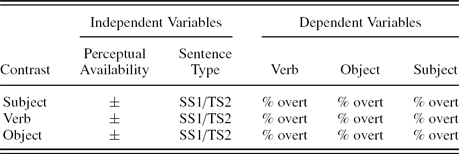
The sentence repetition study was a 3 (condition) × 2 (sentence type) × 2 (PA) mixed design. The between-subjects independent variable, PA, consisted of two levels: (a) +PA and (b) –PA. In each of the within-subjects conditions, one of the elements of the transitive utterance was contrasted. Thus, there were three levels to the independent variable condition: (a) a subject contrast, (b) a verb contrast, and (c) an object contrast. The dependent variable had three levels in each condition: provision of subject, verb, and object. For an overview, see Table 1.
Overview of conditions

Note: SS, simple sentence; TS, target sentence; %, percentage realized.
The linguistic prompts consisted of two types of sentences. Thus, there were two levels to the independent variable sentence type: (a) simple sentence (SS) and (b) target sentence (TS). The TS consisted of two conjoined transitive utterances (e.g., The fox smells the sock and the giraffe smells the sock). However, every target sentence was first presented as two individual simple transitives (e.g., The fox smells the sock. vs. The giraffe smells the sock.), which served to establish the referents and actions within them as given. As shown in Example (4), each trial began with two simple sentences (SS1 and SS2); SS1 is noncontrastive, whereas SS2 contained the contrastive element. These two SSs were then conjoined to form the target sentence (TS, labeled TS1 and TS2, respectively, in analyses); SS1 is used as a noncontrastive baseline in order to analyze how contrast affects the realization of constituents in TS2. Prior to SS1, the subject and object referents, although introduced to the child, have not yet appeared in a transitive sentence, and in this respect, SS1 can be compared to the contrasted element in TS2 (whereas in SS2, TS1, and for the noncontrasted element in TS2, sentence elements have been repeated, rendering them accessible and providing a discourse rationale for omission that does not apply to the contrasted element).
- (4)
SS1 The fox smells the sock.
SS2 The giraffe smells the sock.
TS (1+2) (1) The fox smells the sock and (2) the giraffe smells the sock.
Each of the three contrast conditions contained 4 trials. Thus, across conditions, each child received 12 trials. The order of presentation of trials within each condition was counterbalanced across participants. The order in which the participants received the conditions was also counterbalanced.
The materials consisted of a puppet theatre, 6 hand puppets and 16 other inanimate objects. There were six subject referents (pig, fox, monkey, giraffe, crocodile, elephant) from which the child selected one or two at the beginning of each condition for use in each of the four trials. The subject-contrast condition required two subject referents to be used throughout the four trials.
In each trial, one of the subjects appeared in SS1 (see Example (4), fox) and the other appeared in SS2 (see Example (4), giraffe). Since the target sentence was a combination of the two SSs, both subjects reappeared in the respective target sentence. Thus, each subject was used 8 times in total across the four trials in the subject-contrast condition. Both the verb- and object-contrast conditions required only one subject referent to be used throughout the four trials, 16 times in total (4 times per trial: SS1, SS2, TS1 + 2). Each referent could only be chosen once by each child, which meant that only four of the six possible subject referents (two in the subject-contrast condition, one each in the verb- and object-contrast conditions) were used across conditions for any given child.
There were 16 object referents (sock, bag, mirror, soap, spoon, box, pen, train, bottle, table, pillow, picture, curtain, aeroplane, cup, tree). These referents were counterbalanced for number of syllables across the three conditions. In the subject- and verb-contrast conditions, 4 different object referents were used, each four times per trial (SS1, SS2, TS1 + 2). In the object-contrast condition, 2 different object referents were used per trial, twice each (one in SS1 and TS1, the other in SS2 and TS2). Thus, there were 8 different objects used across four trials.
Sixteen actions were chosen (smell, kick, push, bite, hit, throw, clean, kiss, rip, pull, shake, roll, lick, break, touch, lift). Each of the subject- and object-contrast conditions contained four different verbs, one per trial. In each trial the verb was repeated four times (SS1, SS2, TS1 + 2). In the verb-contrast condition, each of the trials contained two different actions (i.e., eight actions across all four trials). Each action occurred twice per trial (SS1 + TS1 and SS2 + TS2). For a full list of trial sentences in the three conditions, see Appendix A.
Procedure
Together with two experimenters the child took part in a puppet show game. Both the child and the first experimenter (E1) were sitting in front of the puppet theater, which served as a kind of barrier between the child and the puppets in order to prevent the child from using the puppets. The second experimenter (E2) was behind the puppet theatre.
The child was asked to help the first experimenter with a puppet show. In order to help, the child had to repeat sentences: E1 pretended to make up an action to be acted out by E2 with the puppets. These made-up actions were the trial sentences as shown in Example (4). The first experimenter told the child that the puppets could do lots of funny things but that the game would not work if E1 simply told E2 what to do with the puppets. Instead, the child would have to tell E2 what to do. The second experimenter then made it clear that she could operate the puppets and that she would only listen to what the child participant told her to do. After having established that the child was willing to help, E1 whispered the instruction into the child's ear and asked the child to tell E2 what should be done. The child could relay the sentence in whatever form he or she liked (i.e., E1 did not ask the child to imitate or repeat what she had just said; she simply asked the child to “tell” E2). Thus, the children were free to use the referential expression of their choice. After having heard the instructions from the child, E2 acted out the scenes in an engaging way.
Before the study started, the child received a pretest in which the six subject referents that were always given were introduced. E1 whispered that she would like to see a subject referent (e.g., the monkey) and asked the child to relay that to E2. This pretest served as a training phase for the game. The pretest also reinforced the fact that E2 was receiving the instructions and not the puppets themselves. After the child told E2 which puppet they wanted to see, E2 presented the puppet in question. This was done for all six subject referents.
In each of the three conditions, the child chose one or more new subject referents to play with from the set of six mentioned above. In the subject-contrast condition, she had to choose two referents because the subject in this condition was contrasted and required two different subjects. For both the verb-contrast and the object-contrast condition, the child was asked to choose only one referent from the remaining referents. After a referent had been chosen it was removed from the set and could not be picked again.
Since E1 had the child ask E2 for the relevant agent/subject referent and the patient/object referents at the beginning of each trial, the referents were available linguistically and perceptually for both simple sentences (SS1 + SS2). In one condition (–PA), E2 removed both subject and object referents after the second simple sentence, such that at the moment of the target sentence, the referents were known (from prior discourse) but not currently perceptually available. In the other condition (+PA), the target referents remained perceptually available for the TS. Children were randomly assigned to one of the two conditions.
E1 started each trial by saying that she wanted to see the puppets do something funny and asked the child to tell E2 what they wanted to see. E1 whispered the trial utterances in the child's ear one at a time in the following way:
E1: “Let's see something funny. Hmm, what could it be? Oh, I know!
The pig throws the pillow! (SS1)
Can you tell E2?”
After the child relays this sentence (SS1) to E2, E1 offered the next sentence (SS2):
E1: “And what now? Hmm. . . Ah, I know!
The ladybird throws the pillow! (SS2)
Can you tell E2?”
After the child relayed this sentence (SS2) to E2, E1 announced the target sentence (TS1 + 2):
E1: “Oh that was fun! I want to see that again! Can you tell E2:
The pig throws the pillow and the ladybird throws the pillow!” (TS1 + 2)
Note that only after the child had relayed one trial utterance to E2 would E1 whisper the next utterance to the child.
When some of the children had trouble remembering the second part of the conjoined target sentence and only relayed the first half (TS1), they were cued by E1 with “Tell her what's next!” In virtually every case this cue triggered the second half (TS2).Footnote 2
The trial sentences were presented with natural intonation. That is, SS1 received unmarked predicate-focus stress; whereas, in SS2 stress fell on the contrasted element (depending on condition, subject, or verb or object). The coordinated target sentence (TS1 + 2) set up the contrast. Depending on condition, subject, verb, or object were stressed in both parts of the TS.
Transcription and coding
The children's utterances were audio recorded. We coded only children's first responses. In the three +PA conditions (S-contrast, V-contrast, and O-contrast), there were a total of 288 target sentences and an equal number of first simple sentences (4 trials × 3 conditions × 24 children = 288). In the three –PA conditions (S-contrast, V-contrast, and O-contrast), there were also a total of 288 target sentences and an equal number of first simple sentences (4 trials × 3 conditions × 24 children = 288). In order to be included in the analyses, each child participant had to attempt a trial and relay the complete TS (see examples below for instances of attempts) for at least two out of four trials per condition. On that basis, 8 trials were excluded in the +PA (leaving 280 TS + 280 SS) condition and none in the –PA conditions. The total number of analyzable target sentences was 568.
Analyses were carried out on the proportions of subjects, verbs, and objects realized in the second half of the target utterance (TS2) and the first simple sentence (SS1) in each of the four trials per condition. To this end, both subject and object arguments of both SS1 and TS2 were coded as either overt or covert. Covert comprised omitted arguments. Because the focus of the present study was on omissions, pronouns and lexical nouns were grouped together as overt. It should be noted that due to their similar information status (i.e., given), pronouns and null references are typically grouped together (in non-pro-drop languages). However, in doing so for the purposes of the present study, we might have artificially boosted our omission rates. Therefore, we chose to treat omissions individually. Overall, the children's use of pronouns was negligible.Footnote 3
Verbs were coded as either absent or present. The proportions were arcsine transformed (2 × arcsine  $\sqrt{p}$), according to Howell (Reference Howell1992) and all statistical analyses were run on the transformed data. Example responses taken from the S-contrast condition are shown in Example (5) (apart from full repetitions):
(5) SS1Footnote 4: fox smell(s) sock; smell(s) sock; smell(s) it; it/he smell(s)
(it); smell(s); fox smell(s)
TS2: giraffe smell(s) sock; giraffe smell(s) it; giraffe smell(s),
giraffe
Results
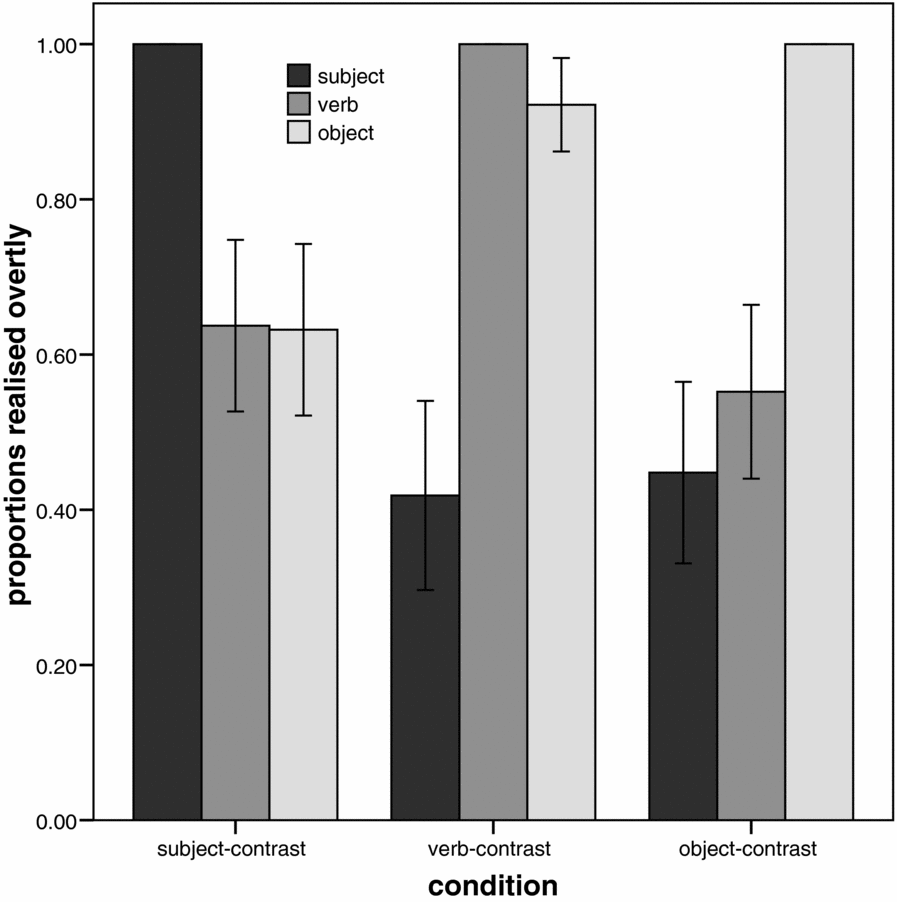
Since the children realized each contrasted element 100% of the time (i.e., there is no variance in three of the cells) nonparametric tests were used to compare the children's level of provision of subjects, verbs, and objects according to whether or not the referents were perceptually available. Mann–Whitney tests revealed that there were no significant effects of perceptual availability (ps = .332–1). Thus, the following analyses report on 3-year-olds (M = 3;6) as a single group collapsing across conditions for perceptual availability. An overview of subject, verb and object provision in TS2 according to condition can be seen in Figure 1.
The proportion of overt subject, verb, and object provision in target sentence 2 (TS2) in three conditions (error bars 95% confidence interval).
The first analysis focused on whether the different sentential elements (subject, verb, object) were realized overtly at different rates in TS2 according to which element was contrasted. In order to test for differences in the provision of each sentential element, i.e., subject (S), verb (V) and object (O), as a function of condition (i.e., subject, verb, and object contrast), three separate Friedman's analyses of variance (ANOVAs) were carried out, one per sentential element. Each statistic was conducted with the mean proportion of overt arguments as the dependent variable.
With regard to the overt realization of the subject in the three experimental conditions, a Friedman ANOVA revealed a significant effect of condition, χ2 (2) = 54, p = .001. Post hoc Wilcoxon tests for pairwise comparisons revealed that the children were significantly more likely to use an overt referring expression as the subject in the subject-contrast condition (Mdn = 1) than in the verb-contrast condition (Mdn = 0.25, T = 0, p = .001), or the object-contrast condition (Mdn = 0.50, T = 0, p = .001). The provision rates for the subject in the verb-contrast and in the object-contrast conditions did not differ (T = 199, p = .759).
With regard to verb provision across conditions, a Friedman ANOVA revealed an effect of condition, χ2 (2) = 48, p = .001. Pairwise comparisons (Wilcoxon) showed that the children were significantly more likely to realize the verb in the verb-contrast condition (Mdn = 1) than in the subject-contrast condition (Mdn = 0.75, T = 0, p = .001) or the object-contrast condition (Mdn = 0.50, T = 0, p = .001). The provision rates for the verb in the subject-contrast and in the object-contrast conditions were also different: the children realized the verb more often in the subject-contrast condition than in the object-contrast condition (T = 99, p = .047).
With regard to object provision, a Friedman ANOVA also revealed an effect of condition, χ2 (2) = 43, p = .001. Pairwise (Wilcoxon) comparisons showed that the children were significantly more likely to use an overt referring expression as the object in the object-contrast condition (Mdn = 1) than in the subject-contrast condition (Mdn = 0.75, T = 0, p = .001) or the verb-contrast condition (Mdn = 1, T = 0, p = .004). The provision rates for the object in the subject- and in the verb-contrast conditions were also different: The children realized the object more often in the verb-contrast condition (T = 7, p = .001).
In sum, whenever the subject was contrasted, it was also realized overtly; when it was not contrasted, it was omitted on around 55% (object contrast) and 58% (verb contrast) of trials. When the verb was contrasted, it was always realized overtly, but when it was not contrasted it was omitted between 36% (subject contrast) and 45% (object contrast) of the time. When the object was contrasted, it was realized overtly each time, whereas when it was not contrasted it was omitted between 37% (subject contrast) and 8% (verb contrast) of the time.
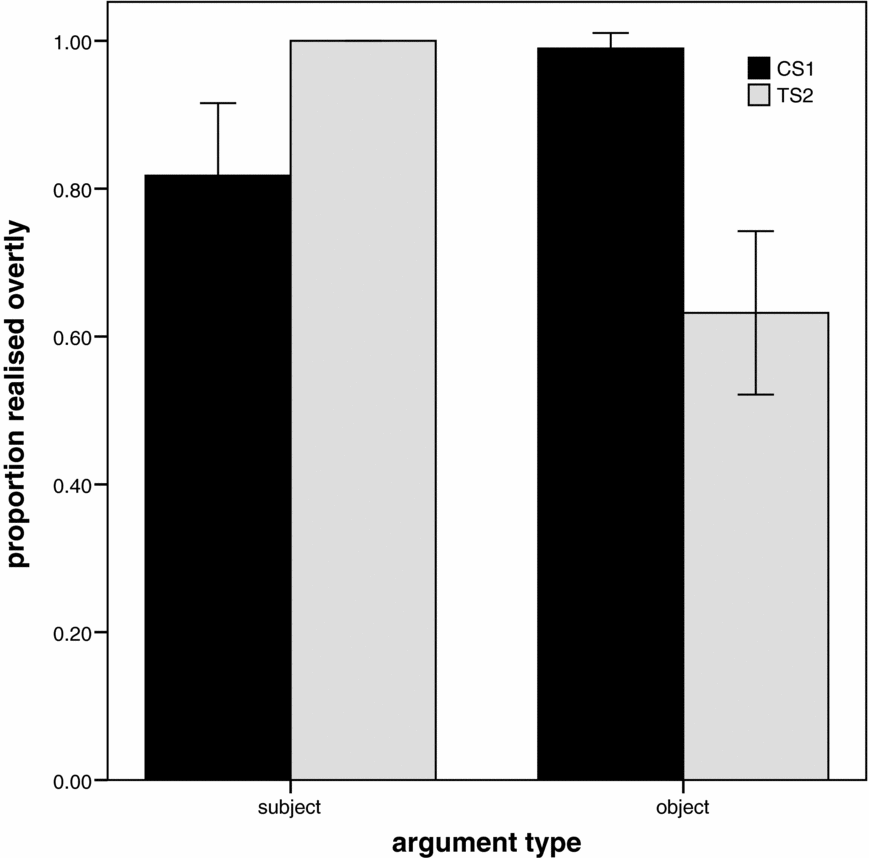
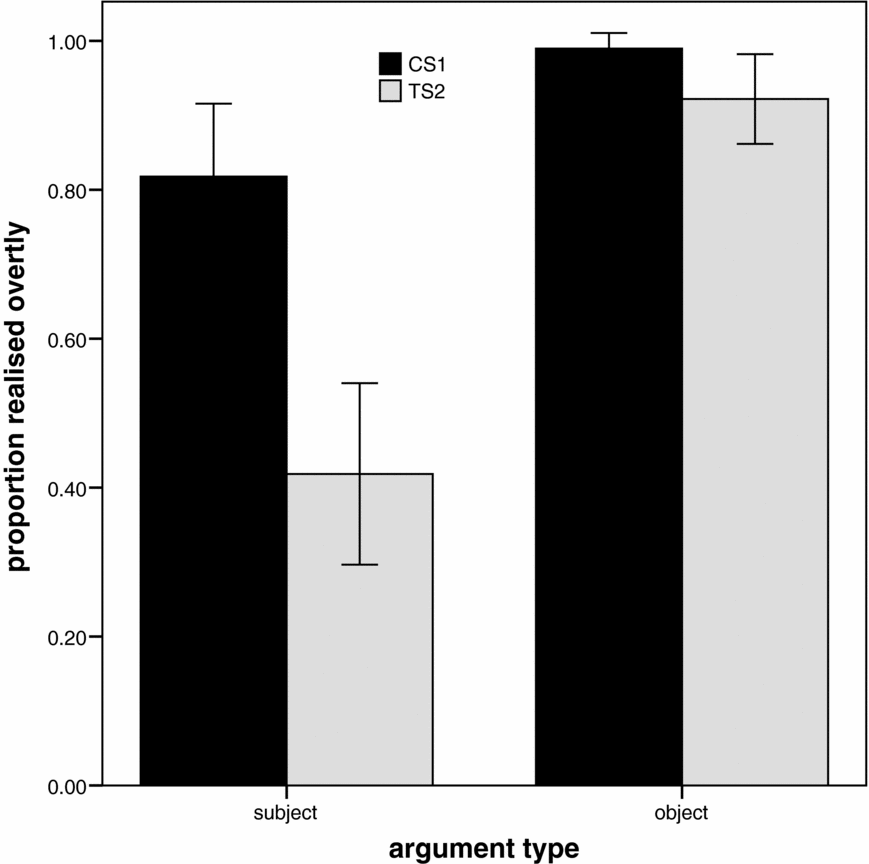
A second set of analyses was conducted which constituted a stricter test of the effect of the discourse feature contrast on the omission of subject and object arguments. It can be argued that the different omission rates observed between contrasted and noncontrasted arguments in TS2 in the first set of analyses could reflect differences in their relative discourse accessibility rather than contrast per se. In TS2, the noncontrasted subject or object had appeared in that particular sentence position three times previously (SS1, SS2, and TS1); whereas, the contrasted argument had appeared in a transitive sentence only once before. In SS1 neither the subject nor object had previously appeared in a transitive sentence, although both had previously been mentioned. Thus, comparing rates of provision of contrasted elements in TS2 to provision (of noncontrasted elements) in SS1 provides a stronger test of the influence of contrast by controlling for prior discourse accessibility. Thus, analyses were conducted on the proportions of overt subject and object provision in the first simple sentence (SS1, not contrasted) and compared to those in the contrasted target utterance (TS2, contrasted) in all three conditions. An overview of the overt realization rates (%) of the different sentence constituents in SS1 and TS2 is provided in Figure 2, Figure 3, and Figure 4.
The percentage of subject and object provision in simple sentence 1 (SS1) and target sentence 2 (TS2) in the subject-contrast condition (error bars 95% confidence interval).
The percentage of subject and object provision in simple sentence 1 (SS1) and target sentence 2 (TS2) in the verb-contrast condition (error bars 95% confidence interval).
The percentage of subject and object provision in simple sentence 1 (SS1) and target sentence 2 (TS2) in the object-contrast condition (error bars 95% confidence interval).
With regard to the subject-contrast condition, a Wilcoxon test revealed a significant difference in both the subject and object provision rates between SS1 and TS2. Subjects were omitted significantly more often in SS1 (Mdn = 1) than in TS2 (Mdn = 1, T = 0, p = .001). Objects were omitted significantly more often in TS2 (Mdn = 0.75) than in SS1 (Mdn = 1, T = 0, p = .001). See Figure 2 for an illustration.
Regarding the verb-contrast condition, the Wilcoxon also showed a difference in the provision rates of subjects between SS1 and TS2. Subjects were omitted significantly more often in TS2 (Mdn = 0.25) than in SS1 (Mdn = 1, T = 12, p = .001). There is no difference in the omission rate of objects (TS2: Mdn = 1, SS2: Mdn = 1, T = 6, p = .55). Figure 3 provides an illustration.
Regarding the object-contrast condition, the Wilcoxon showed a difference in the provision rates of subjects between SS1 and TS2. Subjects were omitted significantly more often in TS2 (Mdn = 0.50), than in SS1 (Mdn = 1, T = 115, p = .001). There is no difference in the omission rate of objects (SS1: Mdn = 1, TS2: Mdn = 1, T = 0, p = 1). See Figure 4 for an illustration.
In sum, the Wilcoxon analyses showed differences in the subject and object realization rates between SS1 (no contrast) and TS2 (one element contrasted) in all three conditions. When the subject referent was contrasted, the children had significantly lower omission rates in TS2 than in SS1. When the object referent was contrasted there was no difference in omission rates between TS2 and SS1, most likely reflecting close to ceiling performance on SS1. However, when the subject referent was not contrasted, the children showed significantly higher levels of omission in TS2 than in SS1 (both the verb-contrast and the object-contrast condition). When the object was not contrasted, the children showed significantly higher omission rates in TS2 in the subject-contrast condition than in SS1. In the verb-contrast condition, there was a trend in the same direction.
DISCUSSION
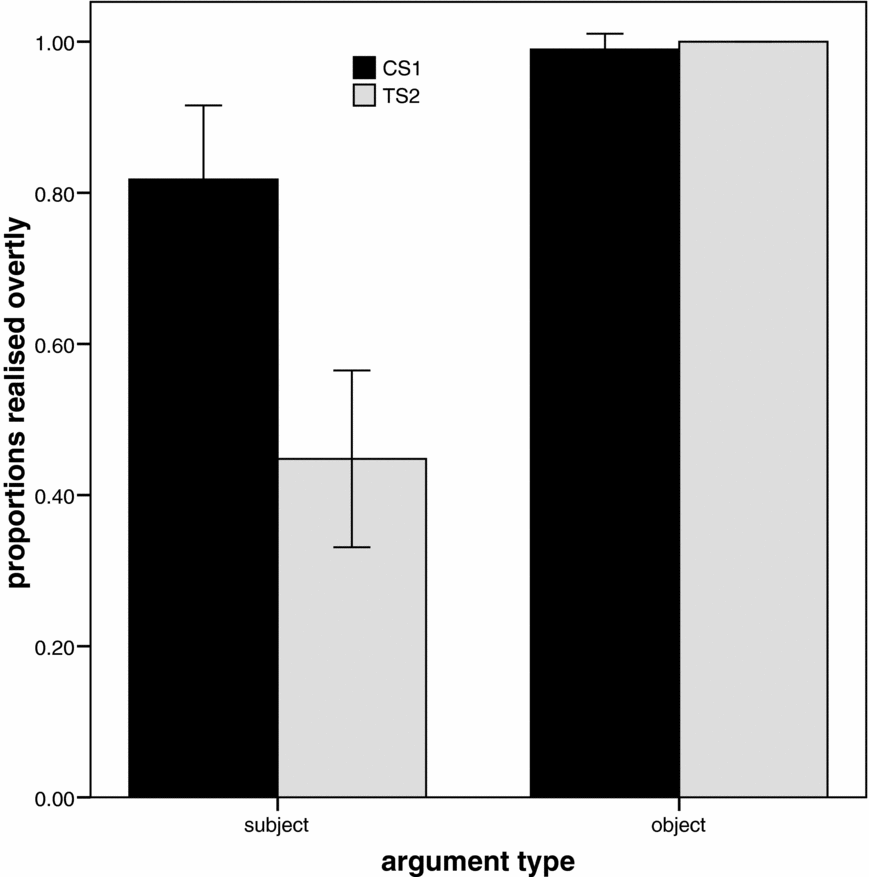
In this study we examined the effect of the discourse feature contrast on the overt realization of the subject, verb, and object in a simple transitive sentence. To summarize, the 3-year-olds in the present study were significantly more likely to realize a contrasted element within a transitive utterance with an overt referring expression (i.e., a full noun phrase [NP], a pronoun, and/or the verb) than they were to overtly realize these same elements when used noncontrastively. In other words, when an element was contrasted, the children realized it overtly 100% of the time, whereas they omitted elements that were not contrasted (albeit to varying degrees, see Figure 1). Moreover, when the degree of prior discourse accessibility was controlled, children omitted contrasted subjects significantly less often than noncontrasted subjects. The pattern was similar for objects but nonsignificant due to ceiling effects. These findings present evidence that the discourse feature contrast contributes to the selective realization or omission of both subject and object arguments in child language.
Subjects versus objects
With regard to the subject–object asymmetry, Figures 1 through 4 show that subjects were dropped more often than objects, both in SS1 and in TS2, when both arguments were not part of a contrast. When comparing objects with subjects in SS1, it can be seen that their omission rates (to some extent) reflect a preferred argument structure distribution in which subject arguments are more frequently omitted than objects, even though in this study both arguments were previously introduced to the child (recall that the children requested subject and object referents at the beginning of each trial). In SS1, subjects were omitted about 18% of the time, whereas objects were almost never omitted.
The children's reliance on a preferred argument structure pattern in SS1 serves to illustrate just how strong contrast is with regard to argument realization (see Figure 2). In the subject-contrast condition, the subject provision rates in SS1 (82%) are significantly lower than in TS2 (100%) when the subject was contrasted. By comparison, when the subject was not contrasted, the provision rate in TS2 dropped (42% in the verb-contrast condition, see Figure 3; 45% in the object-contrast condition, Figure 4).
One explanation for the subject–object asymmetry is that research on information structure consistently finds that new information comes last in the sentence (for an overview, see Arnold, Losongco, Wasow & Ginstrom, Reference Arnold, Losongco, Wasow and Ginstrom2000). This points to two possibilities. The first is based on the statistical tendency for new information to come last and to be realized with a lexical NP. Accordingly, the English transitive is understood to be a predicate-focus construction (Lambrecht, Reference Lambrecht1994); that is, new information is typically expressed in the predicate. One possibility is that children rely on a prototypical formula of the transitive construction, which calls for the realization of the object more often than the subject (which is mostly given and can be realized with a pronoun or as a null reference). This could have led the children to produce an overt object referent, even when its information status was such that the object could be inferred from the discourse context, whereas for subjects with identical discourse status, omissions were preferred (for similar arguments and empirical evidence relating to children's erroneous use of pronominal reference for subjects that represent new information, see Theakston, Reference Theakston2012). Along these lines, we argue that the subject–object asymmetry in predicate-focus languages like English is mainly a product of preferred argument structure predictions of the prototypical transitive. The predicate-focus construction calls for the overt realization of the mainly new object argument using a high information form. The prototypical subject argument, on the other hand, is given, and since it is not the focus of the construction, it can be realized with a low information form (i.e., pronoun or null reference).
The second possibility is based on a model of learning: in a computational study of optional infinitives in Dutch and English, Freudenthal, Pine, and Gobet (Reference Freudenthal, Pine and Gobet2007) found that their model's utterance-final bias in learning determined the proportion of nonfinite utterances produced by the model at different stages in the development, mirroring developmental corpus data. The authors argued that children learn preferentially (or faster) from the end of a sentence, leading to the omission of elements that occur at the beginning of utterances. If that is the case, then it presents another explanation as to why object-omission rates are lower than subject-omission rates, as objects typically come later in the sentences than do subjects.
Goldberg's principle versus ellipted structures
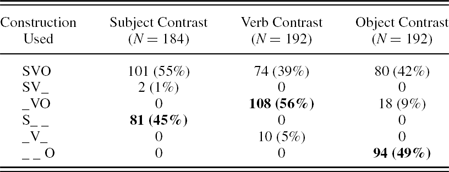
The results show that discourse-available transitive object referents were more likely to be omitted when the subject or verb of that utterance was contrasted with the subject or verb of a previous utterance. This is consistent with Goldberg's argument structure account of omission under low discourse prominence, as it suggests that a contrast of subject or verb causes the omission of objects. However, with a closer look at the types of constructions the children produced for TS2, this conclusion seems somewhat less straightforward (see Table 2).
Types of constructions used in TS2 (N = 568)
Note: TS, target sentence; SVO, subject–verb–object; SV, subject–verb; VO, verb–object; S, subject; V, verb; O, object.
Recall that Goldberg's principle of omission under low discourse prominence states that the object is omitted when it is deemphasized in favor of the action. One means to achieve this deemphasis is to contrast the action as in Example (6):
(6) You wash Ø and I'll dry Ø.
(Ø = the dishes)
The children in our study, however, virtually never produced the subject–verb (SV_) structure predicted by Goldberg's principle of omission under low discourse prominence. Table 2 shows that in the verb-contrast condition, the children omitted the subject (not the object) and realized only the verb and the object in TS2 (subject–verb–object [SVO] + _VO) about half of the time, even though the object was given. Goldberg's principle further states that the omitted referent must not refer to a discourse antecedent. However, in order to establish the object as discourse given, we provided such an antecedent in our study. This might explain the low number of SV_ structures observed.
In a similar vein, when the subject or the object was contrasted, the children produced corresponding ellipses for about half the trials. That is, in the subject-contrast condition, the children produced coordinated SVO + S_ _ structures 45% of the time and in the object-contrast condition, they produced SVO +_ _O structures 49% of the time. Now consider the following two examples:
(7) The monkey smells the sock and then the crocodile.
(8) The fox lifts the cup and then the aeroplane.
In English, Example (7) can be considered ambiguous, whereas Example (8) is generally not. In Example (7) the monkey either smells the sock and then he smells the crocodile (object reading) or the monkey smells the sock and then the crocodile smells the sock (subject reading). However, the seemingly unambiguous objective reading of Example (8), namely, that the fox lifts both the cup and the aeroplane, is supported by the fact that the second patient argument, aeroplane, is inanimate. In the current study, all agents were animate and all patients were inanimate. Thus, when the child reduced the conjoined sentence to just an NP, then an inanimate NP pointed to an object reading, because inanimate referents are not typically perceived as agents/subjects. In contrast, an animate NP, pointed to a subject reading, with the omission of verb and object.
One way to look at the overall difference in provision rates between subjects and objects with regard to this study is that children are more likely to omit a subject when the object is contrasted, because of the prototypical object reading of an ellipted sentence (as in Example (8)). Moreover, dropping the object when the subject is contrasted renders a sentence ambiguous (as in Example (7)) although in this study, this ambiguity could be resolved by the fact that only agents were animate and thus pointed to a subject reading.
A related issue regarding the disambiguation of ellipted sentences is the provision of do-anaphora. The ambiguity would be quickly resolved with a construction like SVO + S “does too.” The children in our study, however, never produced an anaphora. Three-year-olds are probably too young for such sophisticated means of establishing discourse coherence. A study by Donaldson and Cooper (Reference Donaldson and Cooper2009) found children's anaphora to be productive only at the age of 4;7. These authors also reported that the production of anaphora was influenced by the presentation of the events described, such that when two events were presented sequentially (i.e., one after the other, just like in the present study), the children produced fewer anaphoric utterances than when the events were relayed simultaneously.
The methodology we used might have contributed to children's use of illicit ellipted structures. By presenting our participants with simple and conjoined transitive utterances, we introduced an element of structural priming, which could have caused the children to use an ellipted transitive with a subject reading SVO + S_ _. The use of full lexical noun phrases might have contributed to the children's overall low uses of pronouns. However, sentence repetition of this kind has been used successfully in order to shed light on omission phenomena (Valian, Hoeffner, & Aubry, Reference Valian, Hoeffner and Aubry1996; Valian, Prasada, & Scarpa, Reference Valian, Prasada and Scarpa2006). The assumption here is that children's repetitions uncover processing limitations. Our findings point to such processing difficulties during language development but, at the same time, reveal systematicity in children's omissions.
Conclusions
The results of these studies suggest that both object and subject drop are influenced by the same discourse-pragmatic feature: contrast. Contrasting one element in a transitive utterance, while keeping all other elements the same and establishing them as given, leads to the omission of the given elements in favor of the contrasted element. Even though Goldberg's principle of omission under low discourse prominence could not specifically be supported (i.e., the children did not exclusively omit objects while realizing both subject and verb), these findings speak to the importance of the discourse feature contrast in explaining omission phenomena in general.
However, there are other factors that make direct comparisons between the subject and the object of a transitive sentence problematic. In English, an array of factors influences the production of objects: objects generally contain new information and new information is realized with a high information form. Objects typically present the last and newest element in the transitive construction. Objects are part of the verb phrase and as such are dependent on and specified by the verb, while at the same time giving specific meaning to the verb. This means that the object sits right at the heart of a four-way interface: syntax (argument structure) and semantics (verb meaning and valency), discourse pragmatics, and information (preferred argument) structure. Subjects, in contrast, do not similarly feature in the traditional calculation of a verb's core arguments, because they do not specify the meaning of a verb in the same way. In addition, unlike objects, subjects frequently convey given information and are realized as pronouns.
For these reasons, it can be difficult to compare the subjects and objects of a transitive construction directly. In order to demonstrate that the differential realization of both types of arguments is influenced equally by discourse-pragmatic features, it will also be important to compare subjects and objects when they are under similar discourse pressures. If omissions are in fact a discourse phenomenon, then putting the object in the position before the verb (and vice versa), as can occur in languages other than English, will allow for a more rigorous assessment of the asymmetry between subjects and objects. German, for example, has an object-first construction in which the object constitutes the topic of the utterance. If discourse pragmatics contributes to argument omission such that given and topical referents are dropped, then the omission rates in subject-first and object-first sentences should be similar.
In conclusion, the results of the current study show that, despite the subject-object asymmetry, objects are omitted when they are not themselves part of a contrast and when they are both established in the prior discourse and not in focus. Thus, the discourse pragmatic feature contrast is a factor in both subject and object drop, and children show sensitivity to this feature from at least the age of 3;0. This suggests that contrast contributes to the selective realization and omission of arguments in child language, regardless of the grammatical function (i.e., subject or object) of these arguments.
APPENDIX A
Trial sentences in three conditions
The first condition is the subject contrast condition.
Trial 1:
SS1 The crocodile* smells the sock.
SS2 The fox smells the sock.
TS The crocodile smells the sock, and the fox smells the sock.
Trial 2:
SS1 The crocodile kicks the bag.
SS2 The fox kicks the bag.
TS The crocodile kicks the bag, and the fox kicks the bag.
Trial 3:
SS1 The crocodile pushes the bottle.
SS2 The fox pushes the bottle.
TS The crocodile pushes the bottle, and the fox pushes the bottle.
Trial 4:
SS1 The crocodile bites the table.
SS2 The fox bites the table.
TS The crocodile bites the table, and the fox bites the table.
(*Each child's two puppets of choice were used here.)
The second condition is the verb contrast condition.
Trial 1:
SS1 The monkey* hits the pillow.
SS2 The monkey throws the pillow.
TS The monkey throws the pillow, and the monkey hits the pillow.
Trial 2:
SS1 The monkey cleans the mirror.
SS2 The monkey kisses the mirror.
TS The monkey kisses the mirror, and the monkey cleans the mirror.
Trial 3:
SS1 The monkey rips the curtain.
SS2 The monkey pulls the curtain.
TS The monkey pulls the curtain, and the monkey rips the curtain.
Trial 4:
SS1 The monkey shakes the box.
SS2 The monkey rolls the box.
TS The monkey rolls the box, and the monkey shakes the box.
(*Each child's choice of one puppet was inserted here.)
The third condition is the object contrast condition.
Trial 1:
SS1 The elephant* licks the soap.
SS2 The elephant licks the spoon.
TS The elephant licks the spoon, and the elephant licks the soap.
Trial 2:
SS1 The elephant breaks the train.
SS2 The elephant breaks the pen.
TS The elephant breaks the pen, and the elephant breaks the train.
Trial 3:
SS1 The elephant touches the tree.
SS2 The elephant touches the picture.
TS The elephant touches the picture, and the elephant touches the tree.
Trial 4:
SS1 The elephant lifts the aeroplane.
SS2 The elephant lifts the cup.
TS The elephant lifts the cup, and the elephant lifts the aeroplane.
(*Each child's choice of one puppet was inserted here.)
ACKNOWLEDGMENTS
We are grateful to the Manchester nursery directors and to the children who participated in our study. We thank Jessica Butcher and Elizabeth Wills for helping with testing.