Introduction
Two-dimensional modal logics have been the object of increasing philosophical interest given intuitive interpretations assigned to the modal operators. In particular, that such logics provide us with a logical analysis of metaphysical necessity, actuality, and a priori knowledge is now an important facet of prominent philosophical views in philosophy of language, epistemology, and metaphysics. Logics developed with the purpose of shedding light on a priori reasoning and its relation with the modal notions of necessity and actuality arguably originated with Davies & Humberstone (Reference Davies and Humberstone1980), and have recently been investigated by Restall (Reference Restall2012), Fritz (Reference Fritz2013, Reference Fritz2014), Fusco (Reference Fusco2020), and others. Furthermore, the semantic treatment of epistemic and indexical terms in the works of Evans (Reference Evans1979), Kaplan (Reference Kaplan, Almog, Perry and Wettstein1989), and Chalmers (Reference Chalmers2004, Reference Chalmers and Rabern2014) make essential use of elements present in two-dimensional modal logics, while Weatherson (Reference Weatherson2001) and Wehmeier (Reference Wehmeier2013) adopt similar two-dimensional semantics to provide formal treatments of both subjunctive and indicative conditionals.
The goal of this paper is to generalize two-dimensional modal logics with actuality operators to any finite dimension. To be more precise, the logics investigated here are generalizations of the logic for epistemic two-dimensional semantics studied by Fritz (Reference Fritz2014) under the name
 $\textbf{2Dg}$
, which in a certain sense is the same logic as those investigated proof-theoretically in Restall (Reference Restall2012) and Lampert (Reference Lampert2018)—although the logics in Lampert (Reference Lampert2018) contain first-order quantifiers. The formal language defined here contains several modal operators, one for each dimension, including indexed boxes,
 $\Box _i$
, as well as actuality operators,
 $@_i$
. As will be seen below, the resulting logics can be characterized as logics of generalized diagonal sequences, and therefore as natural generalizations of two-dimensional modal logics in which formulas in the scope of certain operators are evaluated at the diagonal points of square models, that is, models based on frames containing ordered pairs of worlds. Notwithstanding the formal character and scope of this paper, whose principal concern is with model- and proof-theoretic investigations of certain classes of frames and models for modal logics, the development of n-dimensional modal logics is in fact philosophically motivated and arises from considerations regarding the expressive power of modal languages for necessity, actuality, and apriority. In what follows we briefly describe some of these motivations as well as the plan for the rest of the paper.
Background
Crossley and Humberstone (Reference Crossley and Humberstone1977) introduced the actuality operator, @, to remedy an expressive deficit in the first-order modal language,Footnote
1
i.e. the language of first-order logic augmented by the modal operators
 $\Box $
and
 $\Diamond $
. What they observed was that there is no formula in that language that expresses the following truth condition:
-
(1)
 $\exists w\forall \textsf{x}(R\textsf{x}\text {-at-}z\rightarrow S\textsf{x}\text {-at-}w )$
,

where z is the “actual world” of the underlying frame.Footnote
2
According to (1), there is a world w such that every object that is R in the actual world z is S in w. As Crossley and Humberstone (Reference Crossley and Humberstone1977), p. 12 point out, there are readings of English sentences with truth conditions corresponding to (1), such as “It is possible for every red thing to be shiny”. But the most obvious attempts to represent (1) in the object language all fail:
 $\Diamond \forall \textsf{x}(R\textsf{x}\rightarrow S\textsf{x})$
expresses the truth condition
 $\exists w\forall \textsf{x}(R\textsf{x}\text {-at-}w\rightarrow S\textsf{x}\text {-at-}\textit{w})$
,
 $\forall \textsf{x}\Diamond (R\textsf{x}\rightarrow S\textsf{x})$
the truth condition
 $\forall \textsf{x}\exists w(R\textsf{x}\text {-at-}w\rightarrow S\textsf{x}\text {-at-}w )$
and, if we assume that truth in a model is defined as real-world truth,Footnote
3
i.e. truth at the actual world of the model—in which case formulas are initially evaluated at z—
 $\forall \textsf{x}(R\textsf{x}\rightarrow \Diamond S\textsf{x})$
expresses the truth condition
 $\forall \textsf{x}(R\textsf{x}\text {-at-}z\rightarrow \exists w(S\textsf{x}\text {-at-}w) )$
. None of these truth conditions are equivalent to (1). Yet, in the presence of the actuality operator (1) can be expressed by the formula
 $\Diamond \forall \textsf{x}(@R\textsf{x}\rightarrow S\textsf{x})$
. This is so because the semantic evaluation clause for the actuality operator invariably takes back the evaluation of a formula in its scope to the actual world of the frame. Let
 $\mathfrak {M}=(W,z,\mathcal {R},\mathcal {D},V)$
be a model for the first-order modal language containing @, where W is a set of possible worlds,
 $z\in W$
,
 $\mathcal {R}\subseteq W\times W$
,
 $\mathcal {D}$
is a domain of objects, and V is a valuation function defined as usual.Footnote
4
For any formula
 $\varphi $
,Footnote
5
 $$\begin{align*}\mathfrak{M},w\vDash @ \varphi\Longleftrightarrow\mathfrak{M},z\vDash \varphi.\end{align*}$$
So even if the formula
 $@R\textsf{x}$
occurs within the scope of
 $\Diamond $
, the semantic entry for @ makes us consider the objects in the domain of the world introduced by
 $\Diamond $
that are R in the actual world z, thereby, as it were, temporarily suspending the scope of the
 $\Diamond $
operator.
There is, however, a subtle difference in the semantic clause for @ when we move to a full-blooded two-dimensional modal logic.Footnote
6
In this case, formulas are evaluated against pairs of possible worlds,
 $(w,v)$
, where w is taken intuitively as a counterfactual world and v as a world considered as actual (or an epistemic scenario, such as in Fritz (Reference Fritz2014)), and so the set of evaluation points W in the frames can now be defined as the Cartesian product of some nonempty underlying set of worlds, say, S. This means that rather than having a single fixed actual world as a part of the frame, any world can be actual as long as it occupies the second coordinate of the pair of worlds relative to which a formula is evaluated. That is, to use a metaphor from Humberstone (Reference Humberstone2004), p. 26, we first dethrone the single actual world from the identity of the frames or models, and formulate the semantic clause for @ asFootnote
7
 $$\begin{align*}\mathfrak{M},(w,v)\vDash @ \varphi\Longleftrightarrow\mathfrak{M},(v,v)\vDash \varphi, \end{align*}$$
where v can be any element of S. Then the truth conditions for
 $\Box _1\varphi $
, where
 $\Box _1$
is now used for the metaphysical necessity operator, can be given with the aid of its corresponding accessibility relation,
 $\mathcal {R}_{\Box _1}$
, which relates a pair
 $(w,v)$
to any pair
 $(x,y)$
such that
 $y=v$
. That is, the actual world is held fixed while the counterfactual world varies. Additionally, two-dimensional modal languages are equipped with a diagonal necessity operator, interpreted intuitively as an apriority operator, which is sometimes taken as a primitive operator in the language (Restall, Reference Restall2012; Fritz, Reference Fritz2014; Lampert, Reference Lampert2018), or defined in terms of other operators (Davies & Humberstone, Reference Davies and Humberstone1980). Here we notate it as
 $\Box _2$
, and its corresponding accessibility relation will be
 $\mathcal {R}_{\Box _2}$
, which in turn relates a pair
 $(w,v)$
to any pair
 $(x,y)$
such that
 $x=y$
. Intuitively, the semantic entry for the apriority operator then says that a formula is true a priori if and only if, no matter which world turns out to be actual, that formula remains true in that world. The reason why we call this a diagonal operator is because when models are defined with a domain of pairs of possible worlds the operator
 $\Box _2$
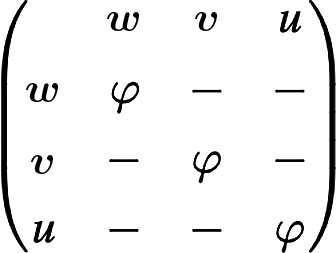
projects precisely along the pairs consisting of identical coordinates. This can be illustrated by distributing the pairs constructed out of possible worlds
 $w,v,u$
in a 2-D matrix, in which the X axis contains counterfactual worlds and the Y axis worlds taken as actual.
 $\Box _2\varphi $
is then true if
 $\varphi $
holds along the diagonal points of the matrix, as seen in Figure 1 below.
2-D matrix.

It is possible to subsume the semantic clauses for
 $\Box _1$
and
 $\Box _2$
under a single schema as follows. Let
 $\sigma $
and
 $\tau $
be sequences (of length n) of possible worlds. Then:
 $$\begin{align*}\text{(GB) } \mathfrak{M},\sigma\vDash \Box_i \varphi\Longleftrightarrow\text{for every } \tau\in W, \text{if } \sigma\mathcal{R}_{\Box_i}\tau, \text{ then } \mathfrak{M},\tau\vDash \varphi, \end{align*}$$
where
 $\sigma \mathcal {R}_{\Box _i}\tau $
if and only if the first i coordinates in
 $\tau $
are all identical and
 $\sigma $
and
 $\tau $
are identical beyond i, i.e. for all
 $j>i$
, the jth coordinate of
 $\sigma $
is the same as the jth coordinate of
 $\tau $
.Footnote
8
It is simple to check that (GB) delivers the correct semantic entries for both
 $\Box _1$
- and
 $\Box _2$
-formulas. And since there is no single distinguished point in the underlying frames anymore, we can add to them a set
 $D=\{(z,z)\mid z\in S\}$
of diagonal points, and define truth in a model relative to the elements of D, in which case D is the set of distinguished points of the underlying frame. This is by and large the approach used by Fritz (Reference Fritz2014) to define a class of what he calls matrix frames with distinguished elements for the propositional two-dimensional language.
Of a first-order two-dimensional framework we may ask whether the following relative of the truth condition in (1) is expressible in it:
-
(1*)
$\exists (w,z)\forall \textsf{x}(R\textsf{x}\text {-at-}(z,z)\rightarrow S\textsf{x}\text {-at-}(w,z) )$
.

The answer is positive if
 $@$
is present in the language, for (1*) is expressed by the formula
 $\Diamond _1\forall \textsf{x}(@R\textsf{x}\rightarrow S\textsf{x})$
. In fact, it would seem that standard proofs for the analogous inexpressibility result in the one-dimensional setting would transfer, more or less directly, to the two-dimensional setting if the latter did not contain
 $@$
in the language. This can be done with Wehmeier’s (2003) proof, for example, under the obvious generalization of the models for the two-dimensional case. Now, assuming the availability of @, and given that
 $\Diamond _2$
quantifies over diagonal pairs of worlds in W, it seems reasonable to expect that the truth condition in (2) be expressible, too:
-
(2)
$\exists (w,w)\forall \textsf{x}(R\textsf{x}\text {-at-}(z,z)\rightarrow S\textsf{x}\text {-at-}(w,w) )$
.

But it is not obvious whether (2) can be expressed by a formula in this language; the most obvious candidate,
 $\Diamond _2\forall \textsf{x}(@R\textsf{x}\rightarrow S\textsf{x})$
, expresses the truth condition
 $\exists (w,w)\forall \textsf{x}( R\textsf{x}\text {-at-}(w,w)\rightarrow S\textsf{x}\text {-at-}(w,w) )$
. This is so because within the scope of
 $\Diamond _2$
, @ is idle. Thus, the expressive deficit of the first-order (one-dimensional) modal language that motivated the introduction of @ in the first place seems to reoccur in the two-dimensional case: while @ is able to, as it were, temporarily suspend the scope of
 $\Diamond _1$
, there is apparently no analogous device in the two-dimensional language that has the same effect on the scope of
 $\Diamond _2$
. Furthermore, there are readings of English sentences such as “It is not a priori that not every red thing is shiny” whose truth conditions correspond to (2). That is, besides the apparent inability to express truth conditions that, on the face of it, should be expressible with the two-dimensional operators, it does not seem to be possible to formalize relevant portions of the kind of natural-language discourse targeted by two-dimensional semantics.
One way to fix this is to add a single distinguished point (pair of worlds) back in the frames and a new operator, say,
 $\textsf{A}$
, that forces formulas in its scope to be evaluated at that distinguished point. In other words,
 $\textsf{A}$
does just what @ did in the one-dimensional case (before it was dethroned). If we let this point be
 $(z,z)$
, the semantic clause for
 $\textsf{A}$
will be:
 $$\begin{align*}\mathfrak{M},(w,v)\vDash \textsf{A} \varphi\Longleftrightarrow\mathfrak{M},(z,z)\vDash \varphi. \end{align*}$$
Now the truth condition (2) can be expressed by the formula
 $\Diamond _2\forall \textsf{x}(\textsf{A}R\textsf{x}\rightarrow S\textsf{x})$
. Alternatively, we can take a point z from the underlying set S as distinguished, and instead of adding
 $\textsf{A}$
to the language, add an operator
 $\textsf{D}$
with the following semantic clause:
 $$\begin{align*}\mathfrak{M},(w,v)\vDash \textsf{D} \varphi\Longleftrightarrow\mathfrak{M},(w,z)\vDash \varphi. \end{align*}$$
The truth condition (2) can then be expressed by the formula
 $\Diamond _2\forall \textsf{x}(\textsf{D}@R\textsf{x}\rightarrow S\textsf{x})$
, and
 $\textsf{A}$
can be simulated in this language by the compound operator
 $\textsf{D}@$
.
Yet another option in a similar spirit is to dethrone the single distinguished element of S and thereby move to three-dimensional frames, just as the original actual world was dethroned in the introduction of two-dimensional frames. In this setting, formulas are evaluated relative to triples of worlds, that is,
 $W=S^3$
, and a set of distinguished elements is defined in the frames as
 $D=\{(z,z,z)\mid z\in S\}$
. In this new language we can have three
 $\Box _i$
operators whose semantic entries can be fully specified by the (GB) clause above, this time for
 $i\in \{1,2,3\}$
. Accordingly,
 $\Box _1\varphi $
is true at a triple
 $(w,v,u)$
if and only if
 $\varphi $
is true at any
 $\mathcal {R}_{\Box _1}$
-related triple
 $(x,y,z)$
, where
 $y=v$
and
 $z=u$
;
 $\Box _2\varphi $
is true at a triple
 $(w,v,u)$
if and only if
 $\varphi $
is true at any
 $\mathcal {R}_{\Box _2}$
-related triple
 $(x,y,z)$
, where
 $x=y$
and
 $z=u$
(i.e. at any triple
 $(x,x,u)$
); and, finally,
 $\Box _3\varphi $
is true at a triple
 $(w,v,u)$
if and only if
 $\varphi $
is true at any
 $\mathcal {R}_{\Box _3}$
-related triple
 $(x,y,z)$
, where
 $x=y=z$
(i.e. at any triple
 $(x,x,x)$
). Now, just as Fritz (Reference Fritz2014) adds an accessibility relation for the actuality operator in the two-dimensional frames,Footnote
9
we can relabel the actuality operator @ as
 $@_2$
, add a new actuality operator,
 $@_3$
, to the language, and accessibility relations to describe their semantic clauses schematically as follows:
 $$\begin{align*}\text{(GA) } \mathfrak{M},\sigma\vDash @_i \varphi\Longleftrightarrow\text{for every } \tau\in W, \text{ if } \sigma\mathcal{R}_{@_i}\tau, \text{ then } \mathfrak{M},\tau\vDash \varphi, \end{align*}$$
where
 $\sigma \mathcal {R}_{@_i}\tau $
if and only if the first i coordinates in
 $\tau $
are all identical and
 $\sigma $
and
 $\tau $
are identical beyond
 $i-1$
. Thus, according to (GA),
 $@_2\varphi $
is true at a triple
 $(w,v,u)$
if and only if
 $\varphi $
is true at any
 $\mathcal {R}_{@_2}$
-related triple
 $(x,y,z)$
, where
 $x=y=v$
and
 $z=u$
(i.e. at the triple
 $(v,v,u)$
); and
 $@_3\varphi $
is true at a triple
 $(w,v,u)$
if and only if
 $\varphi $
is true at any
 $\mathcal {R}_{@_3}$
-related triple
 $(x,y,z)$
, where
 $x=y=z=u$
(i.e. at the triple
 $(u,u,u)$
). Additionally, (GA) gives us an
 $@_1$
operator which turns out to be redundant, for
 $@_1\varphi $
is true at a triple
 $(w,v,u)$
if and only if
 $\varphi $
is true at any
 $\mathcal {R}_{@_1}$
-related triple
 $(x,y,z)$
, where
 $x=w$
,
 $y=v$
, and
 $z=u$
(i.e. at the triple
 $(w,v,u)$
itself). If we now adapt the truth condition (2) to the three-dimensional environment we obtain
-
(2*)
$\exists (w,w,z)\forall \textsf{x}(R\textsf{x}\text {-at-}(z,z,z)\rightarrow S\textsf{x}\text {-at-}(w,w,z) )$
,

which is expressible by the formula
 $\Diamond _2\forall \textsf{x}(@_3R\textsf{x}\rightarrow S\textsf{x})$
.
What motivated the introduction of the original actuality operator, and the subsequent move to two dimensions, is really the same thing that motivates the introduction of the new actuality operator into the two-dimensional language, and the subsequent move to three dimensions. And even though it is not obvious what natural language correspondents for operators such as
 $\Box _3$
and
 $@_3$
might be, it is clear that the original expressive deficit in the first-order modal language, which reoccurred in the two-dimensional case, seems to appear once again in the three-dimensional setting since
 $@_3$
does not seem able to reset the point of evaluation within the scope of
 $\Diamond _3$
. That is to say, the following truth condition is apparently not expressible by any formula in the three-dimensional language under consideration:
-
(3)
$\exists (w,w,w)\forall \textsf{x}(R\textsf{x}\text {-at-}(z,z,z)\rightarrow S\textsf{x}\text {-at-}(w,w,w) )$
.

The most obvious candidate,
 $\Diamond _3\forall \textsf{x}(@_3R\textsf{x}\rightarrow S\textsf{x})$
, is unsuccessful for the same reason
 $\Diamond _2\forall \textsf{x}(@R\textsf{x}\rightarrow S\textsf{x})$
fails to express the truth condition in (2).
It is now evident that analogous cases of expressive deficit will seem to occur for any finite dimension n. To be more specific, where
 $n\geq 2$
, a first-order n-dimensional language contains operators
 $\Box _i$
and
 $@_i$
for each
 $i\in \{1,\ldots ,n\}$
, and a frame for this language is defined by a set
 $W=S^n$
, where S is a non-empty set of worlds, relations
 $\mathcal {R}_{\Box _i}$
and
 $\mathcal {R}_{@_i}$
for each
 $i\in \{1,\ldots ,n\}$
, a set
 $D=\{\overline {s}\mid s\in S\}$
of distinguished points, where
 $\overline {s}$
is that sequence
 $\sigma \in W$
for which
 $\sigma _i=s\in S$
for all
 $1\leq i\leq n$
, besides a domain of objects
 $\mathcal {D}$
. The truth conditions for
 $\Box _i$
- and
 $@_i$
-formulas are set by (GB) and (GA). Then, where
 $\sigma =\overline {s}$
and
 $\tau =\overline {t}$
, the following truth condition would not seem to be expressible by any formula in the n-dimensional language:
-
(n)
$\exists \sigma \forall \textsf{x}(R\textsf{x}\text {-at-}\tau \rightarrow S\textsf{x}\text {-at-}\sigma )$
.

In Lampert (Reference Lampert2018), some of the philosophical ramifications of this general case for two-dimensional semantics were explored. In particular, the move from two to three-dimensions was motivated by the fact that some of the other solutions to the expressive deficit of the first-order two-dimensional language—namely, the ones involving the addition of the operators
 $\textsf{A}$
or
 $\textsf{D}$
—would result in the frames validating
 $\textsf{A}\varphi \rightarrow \Box _2\textsf{A}\varphi $
or
 $\textsf{D}@\varphi \rightarrow \Box _2\textsf{D}@\varphi $
, respectively. But according to the intuitive interpretation we assign to these operators, such formulas should not be valid: if
 $\varphi $
is true in the real actual world, it does not follow intuitively that it is a priori that it is true in that world. However, a similar issue ultimately arises in the three-dimensional language, as
 $@_3\varphi \rightarrow \Box _2@_3\varphi $
, too, would be valid in its respective class of frames.
In this paper, however, we will not be concerned with philosophical implications of employing multidimensional frameworks to model a priori knowledge of finite or ideal agents. Rather, we shall focus on the logical generalization to higher-dimensions of logics for necessity, actuality, and a priori knowledge, which do raise a variety of questions from a purely logical point of view. The n-dimensional frames with distinguished elements defined earlier are natural generalizations of the two-dimensional matrix frames with distinguished elements defined in Fritz (Reference Fritz2014). Fritz proves that such frames, which he defines for a propositional two-dimensional language, admit of a finite axiomatization through a more general class of matrix frames, which do not contain distinguished elements. Fritz calls the logic of such frames
 $\mathbf {2Dg}$
. It is natural to ask, in light of the constructions above, whether
 $\mathbf {2Dg}$
is a special case of a more general framework, and whether similar results transfer to n-dimensional frames defined for n-dimensional propositional languages.Footnote
10
Are these frames finitely axiomatizable? Are the logics decidable? We settle these and more questions in the course of this paper. In §1 we work towards proving a completeness theorem for the logic of n-dimensions relative to n-dimensional frames without distinguished elements, and then we use this result to show that n-dimensional frames with distinguished elements are also complete. In §2 we prove that the resulting logics are decidable by means of n-dimensional tableaux and a systematic procedure guaranteeing termination for every tableau so constructed. At the end of the paper we suggest some additional questions to be investigated in future work.
1 The logic of sequence frames
1.1 Syntax and semantics
Definition 1.1 (Multidimensional language)
Let
 $\textsf{PROP}$
be a denumerable set of propositional variables
 $p,q,...$
. The language
 $\mathcal {L}^@_n$
is recursively generated by the following grammar:
 $$\begin{align*}\varphi::=p\mid \neg\varphi\mid(\varphi\land\varphi)\mid\Box_i\varphi\mid@_i\varphi \end{align*}$$
for all
 $1\leq i\leq n$
, where
 $n\geq 2$
. The other Boolean connectives are defined as usual, and
 $\Diamond _i\varphi :=\neg \Box _i\neg \varphi $
. Finally, let
 $\mathcal {O}\in \{\Box ,@\}$
.
Definition 1.2 (Sequences)
Let S be a nonempty set and
 $W=S^n$
, i.e. W is the n-fold Cartesian product of S, so that W contains sequences
 $\sigma =(s_1,\ldots ,s_n)$
of elements
 $s_1,\ldots ,s_n\in S$
. When
 $\sigma =(s_1,\ldots ,s_n)$
, we write
 $\sigma _i$
for
 $s_i$
. For
 $s\in S$
,
 $\overline {s}$
is that sequence
 $\sigma $
for which
 $\sigma _i=s$
for all
 $1\leq i\leq n$
. Moreover, we say that a tuple
 $\sigma $
is i-diagonal just in case
 $\sigma _1=\sigma _2=\cdots =\sigma _i$
, and for any sequence
 $\sigma \in W$
, let
 $\sigma ^i_z$
be that sequence
 $\tau $
for which
 $\tau _1=\tau _2=\cdots =\tau _i=z$
and for
 $j>i$
,
 $\tau _j=\sigma _j$
, so that
 $\sigma ^i_z$
is always i-diagonal. We say that
 $\sigma $
and
 $\tau $
are identical beyond i if for all
 $j>i$
,
 $\sigma _j=\tau _j$
.Footnote
11
Now we define sequence frames for n-dimensional modal logics. The number of dimensions dictates the length of the sequences in the frame, which can be thought of as sequences of possible worlds. Strictly speaking, all that is needed to fully specify the desired frames are pairs
 $(S,n)$
, where S is a nonempty set. Yet, it will be helpful to add the relations
 $\mathcal {R}_{\Box _i}$
and
 $\mathcal {R}_{@_i}$
to the official definition of the frames, as these play an essential role in the Sahlqvist completeness theorem proved in §1.3, besides making several definitions easier to articulate. Thus the official definition of n-dimensional sequence frames is the following:
Definition 1.3 (n-dimensional sequence frame)
Let
 $n\geq 2$
. An n-dimensional sequence frame for
 $\mathcal {L}^@_n$
is a triple,
 $\mathfrak {F}=(W,(\mathcal {R}_{\Box _i})_{1\leq i\leq n},(\mathcal {R}_{@_i})_{1\leq i\leq n})$
, such that
 $W=S^n$
for some nonempty set S,
 $\mathcal {R}_{\Box _i}\subseteq W\times W$
and
 $\mathcal {R}_{@_i}\subseteq W\times W$
for all
 $1\leq i\leq n$
, such that for any sequences
 $\sigma ,\tau \in W$
,
-
•
$\sigma \mathcal {R}_{\Box _i}\tau $
iff
$(i)\ \tau $
is i-diagonal, and
$(ii)\ \sigma $
and
$\tau $
are identical beyond i. -
•
$\sigma \mathcal {R}_{@_i}\tau $
iff
$(i)\ \tau $
is i-diagonal, and
$(ii)\ \sigma $
and
$\tau $
are identical beyond
$i-1$
.


Additionally, let
 $\textsf{F}$
be the class of n-dimensional sequence frames.
To make the behaviour of each accessibility relation more explicit, we register the main characteristic properties that hold in every n-dimensional sequence frame. We begin with the properties involving only the
 $\mathcal {R}_{\Box _i}$
relations, moving in turn to the properties involving only the
 $\mathcal {R}_{@_i}$
relations, and then to the properties involving both families of relations. The proofs of these facts are straightforward, and so we omit them.
Proposition 1.1. Let
 $1\leq j\leq i\leq n$
and
 $\mathfrak {F}=(W,(\mathcal {R}_{\Box _i})_{1\leq i\leq n},(\mathcal {R}_{@_i})_{1\leq i\leq n})$
be an n- dimensional sequence frame. Then:
-
(1)
$\mathcal {R}_{\Box _1}$
is an equivalence relation. -
(2)
$\mathcal {R}_{\Box _i}$
is serial, i.e. for all sequences
$\sigma $
there is a
$\tau $
such that
$\sigma \mathcal {R}_{\Box _i}\tau $
. -
(3) (Upward transitivity) If
$\sigma \mathcal {R}_{\Box _j}\tau $
and
$\tau \mathcal {R}_{\Box _i}\upsilon $
, then
$\sigma \mathcal {R}_{\Box _i}\upsilon $
. -
(4) (Upward Euclideanity) If
$\sigma \mathcal {R}_{\Box _j}\tau $
and
$\sigma \mathcal {R}_{\Box _i}\upsilon $
, then
$\tau \mathcal {R}_{\Box _i}\upsilon $
. -
(5) (Downward weak density) If
$\sigma \mathcal {R}_{\Box _i}\tau $
, there is a
$\upsilon $
such that
$\sigma \mathcal {R}_{\Box _j}\upsilon $
and
$\upsilon \mathcal {R}_{\Box _i}\tau $
. -
(6) (Downward shift reflexivity) If
$\sigma \mathcal {R}_{\Box _i}\tau $
, then
$\tau \mathcal {R}_{\Box _j}\tau $
. -
(7) (Strictly decreasing weak density) When
$1<i\leq n$
, if
$\sigma \mathcal {R}_{\Box _{i-1}}\tau $
, there is a
$\upsilon $
such that
$\sigma \mathcal {R}_{\Box _{i}}\upsilon $
and
$\upsilon \mathcal {R}_{\Box _{i-1}}\tau $
.


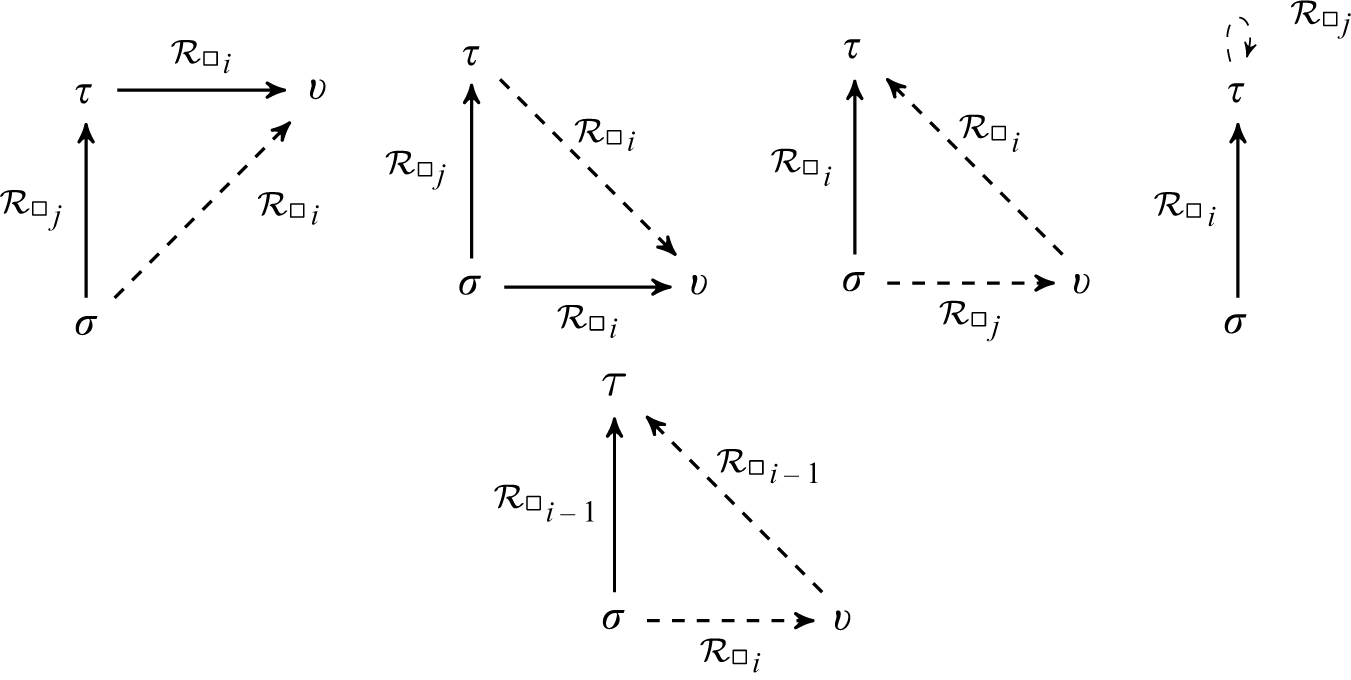
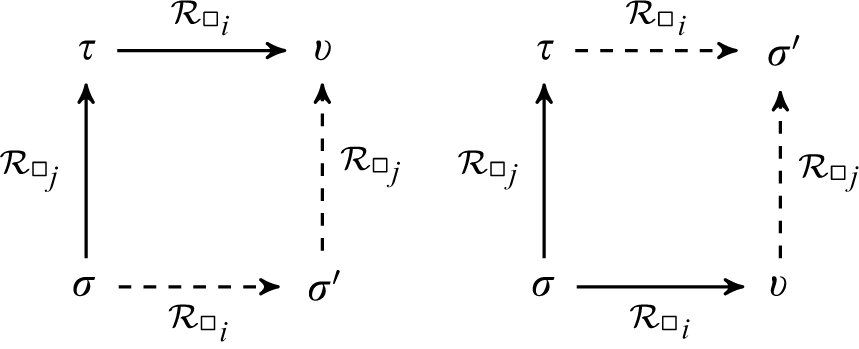
Upward transitivity, upward Euclideanity, downward weak density, downward shift reflexivity, and strictly decreasing weak density properties.

Proposition 1.2. Let
 $1\leq i\leq n$
and
 $\mathfrak {F}=(W,(\mathcal {R}_{\Box _i})_{1\leq i\leq n},(\mathcal {R}_{@_i})_{1\leq i\leq n})$
be an n- dimensional sequence frame. Then:
-
(1)
$\mathcal {R}_{@_1}$
is reflexive. -
(2)
$\mathcal {R}_{@_i}$
is serial. -
(3)
$\mathcal {R}_{@_i}$
is functional, i.e. if
$\sigma \mathcal {R}_{@_i}\tau $
and
$\sigma \mathcal {R}_{@_i}\upsilon $
, then
$\tau =\upsilon $
. -
(4) (Upward-downward transitivity) When
$1<i\leq n$
, if
$\sigma \mathcal {R}_{@_{i}}\tau $
and
$\tau \mathcal {R}_{@_{i-1}}\upsilon $
, then
$\sigma \mathcal {R}_{@_{i}}\upsilon $
.


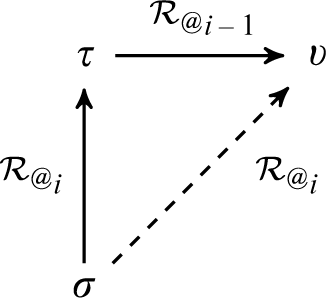
Upward-downward transitivity.

Remark 1.1. By Proposition 1.2(3), it follows that each
 $\mathcal {R}_{@_{i}}$
is a function. Additionally, because
 $\mathcal {R}_{@_{1}}$
is reflexive,
 $\mathcal {R}_{@_{1}}$
is the identity function on the frame.
Proposition 1.3. Let
 $1\leq j< i\leq n$
and
 $\mathfrak {F}=(W,(\mathcal {R}_{\Box _i})_{1\leq i\leq n},(\mathcal {R}_{@_i})_{1\leq i\leq n})$
be an n- dimensional sequence frame. Then:
-
(1) (Strictly decreasing act-box) When
$1<i\leq n$
, if
$\sigma \mathcal {R}_{@_{i}}\tau $
, then
$\sigma \mathcal {R}_{\Box _{i-1}}\tau $
. -
(2) (Act-box) If
$\sigma \mathcal {R}_{@_i}\tau $
, then
$\sigma \mathcal {R}_{\Box _{i}}\tau $
. -
(3) (Mixed upward transitivity) If
$\sigma \mathcal {R}_{\Box _{j}}\tau $
and
$\tau \mathcal {R}_{@_{i}}\upsilon $
, then
$\sigma \mathcal {R}_{@_{i}}\upsilon $
. -
(4) (Mixed shift reflexivity) If
$\sigma \mathcal {R}_{\Box _{i}}\tau $
, then
$\tau \mathcal {R}_{@_{i}}\tau $
.


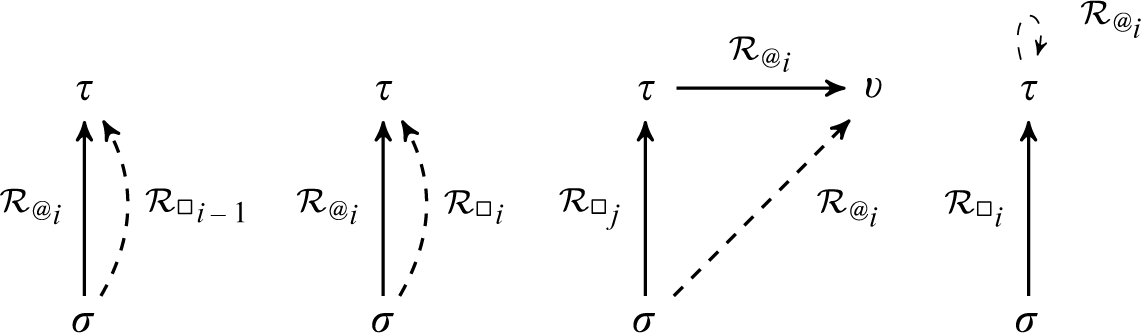
Strictly decreasing act-box, act-box, mixed upward transitivity, and mixed shift reflexivity properties.

Note that downward shift reflexivity now follows immediately from mixed shift reflexivity together with act-box and strictly decreasing act-box. Similarly, the properties (5) and (7) in Proposition 1.1 are provable from the other properties involving the
 $\mathcal {R}_{@_{i}}$
relations. With respect to (3) and (4), that is, upward transitivity and upward Euclideanity, they can also be derived from the other properties alongside (simple) transitivity and the Euclidean property. Thus, in order to characterize sequence frames syntactically we only need to add the modal axioms for transitivity and the Euclidean property alongside the other axioms listed below. Moreover, from the properties listed in Proposition 1.1 one can show that sequence frames have the property of left commutativity as well as the Church–Rosser property, that is:
Corollary 1.1. Let
 $1\leq j\leq i\leq n$
, and
 $\mathfrak {F}=(W,(\mathcal {R}_{\Box _i})_{1\leq i\leq n},(\mathcal {R}_{@_i})_{1\leq i\leq n})$
be an n- dimensional sequence frame. Then:
-
(1) (Left commutativity) If
$\sigma \mathcal {R}_{\Box _j}\tau $
and
$\tau \mathcal {R}_{\Box _i}\upsilon $
, then there is a
$\sigma ^{\prime }$
such that
$\sigma \mathcal {R}_{\Box _i}\sigma ^{\prime }$
and
$\sigma ^{\prime }\mathcal {R}_{\Box _j}\upsilon $
. -
(2) (Church–Rosser) If
$\sigma \mathcal {R}_{\Box _j}\tau $
and
$\sigma \mathcal {R}_{\Box _i}\upsilon $
, then there is a
$\sigma ^{\prime }$
such that
$\tau \mathcal {R}_{\Box _i}\sigma ^{\prime }$
and
$\upsilon \mathcal {R}_{\Box _j}\sigma ^{\prime }$
.


Proof.
 $(1)$
. If
 $\sigma \mathcal {R}_{\Box _j}\tau $
and
 $\tau \mathcal {R}_{\Box _i}\upsilon $
, it follows that
 $\sigma \mathcal {R}_{\Box _i}\upsilon $
, by upward transitivity. But then
 $\upsilon \mathcal {R}_{\Box _j}\upsilon $
, by downward shift reflexivity. Therefore, there is a sequence
 $\sigma ^{\prime }$
, namely,
 $\upsilon $
itself, such that
 $\sigma \mathcal {R}_{\Box _i}\sigma ^{\prime }$
and
 $\sigma ^{\prime }\mathcal {R}_{\Box _j}\upsilon $
.
 $(2)$
. If
 $\sigma \mathcal {R}_{\Box _j}\tau $
and
 $\sigma \mathcal {R}_{\Box _i}\upsilon $
, then
 $\tau \mathcal {R}_{\Box _i}\upsilon $
, by the upward Euclidean property. But then
 $\upsilon \mathcal {R}_{\Box _j}\upsilon $
, by downward shift reflexivity. Therefore, there is a sequence
 $\sigma ^{\prime }$
, namely,
 $\upsilon $
itself, such that
 $\tau \mathcal {R}_{\Box _i}\sigma ^{\prime }$
and
 $\upsilon \mathcal {R}_{\Box _j}\sigma ^{\prime }$
.
Left commutativity and Church–Rosser properties.

These properties are known for playing an important role in characterizing product frames for product logics (see Gabbay et al., 2003, p. 222). Note, however, that the property of right commutativity, which holds in product frames, does not hold in general for n-dimensional sequence frames.Footnote
12
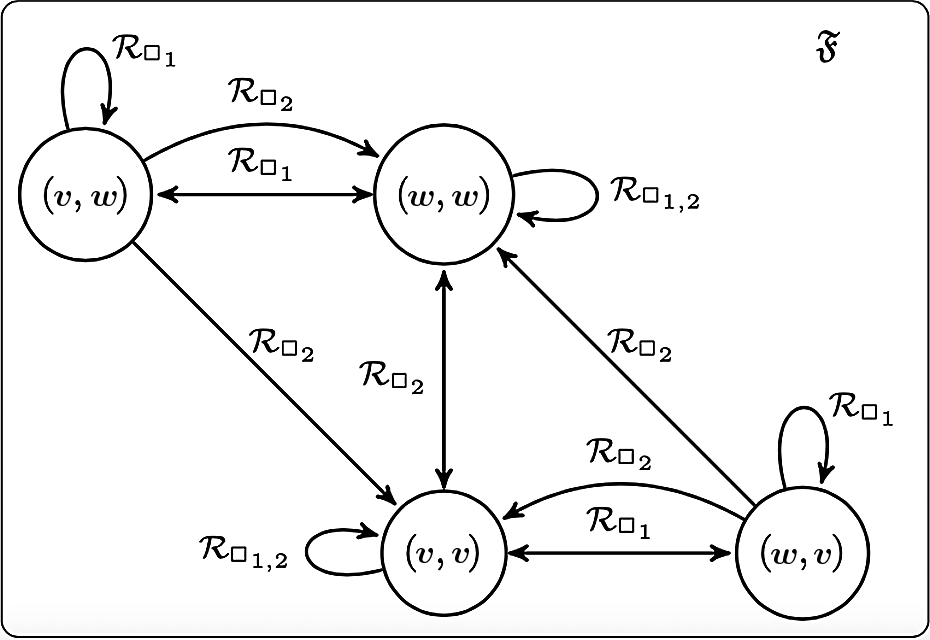
Consider, for instance, the two-dimensional sequence frame
 $\mathfrak {F}=(W,\mathcal {R}_{\Box _1},\mathcal {R}_{\Box _2},\mathcal {R}_{@_1},\mathcal {R}_{@_2})$
displayed in Figure 6, where
 $W=S^2$
and
 $S=\{w,v\}$
. Then each of the properties listed in Proposition 1.1, 1.2, and 1.3 hold in that frame, but while
 $(v,w)\mathcal {R}_{\Box _2}(v,v)$
and
 $(v,v)\mathcal {R}_{\Box _1}(w,v)$
, there is no pair
 $\sigma ^{\prime }$
such that
 $(v,w)\mathcal {R}_{\Box _1}\sigma ^{\prime }$
and
 $\sigma ^{\prime }\mathcal {R}_{\Box _2}(w,v)$
.
Two-dimensional sequence frame displaying only the
 $\mathcal {R}_{\Box _i}$
relations falsifying right commutativity.

Even though no accessibility relation except for
 $\mathcal {R}_{\Box _1}$
is in general reflexive or symmetric, there is at least a weak sense in which n-dimensional sequence frames can be seen as generalizations to n dimensions of
 $\mathbf {S5}$
-frames, a sense that emerges when we restrict attention to the relations between sequences that are i-diagonal for some i. Consider the following definition:
Definition 1.4. Let S be non-empty and
 $W=S^n$
as before.
 $\mathcal {R}_{\Box _i}$
is pseudo-reflexive if it is reflexive on
 $W^i$
; it is pseudo-symmetric if for all
 $\sigma ,\tau \in W^i$
,
 $\sigma \mathcal {R}_{\Box _i}\tau $
implies
 $\tau \mathcal {R}_{\Box _i}\sigma $
; it is pseudo-transitive if for all
 $\sigma ,\tau ,\upsilon \in W^i$
,
 $\sigma \mathcal {R}_{\Box _i}\tau $
and
 $\tau \mathcal {R}_{\Box _i}\upsilon $
implies
 $\sigma \mathcal {R}_{\Box _i}\upsilon $
; and pseudo-Euclidean if for all
 $\sigma ,\tau ,\upsilon \in W^i$
,
 $\sigma \mathcal {R}_{\Box _i}\tau $
and
 $\sigma \mathcal {R}_{\Box _i}\upsilon $
implies
 $\tau \mathcal {R}_{\Box _i}\upsilon $
. Finally,
 $\mathcal {R}_{\Box _i}$
is a pseudo-equivalence relation if it is pseudo-reflexive and pseudo-Euclidean.
Note that if
 $n=1$
(and the language is one-dimensional), the pseudo notions coincide with the original notions, so they are legitimate generalizations of the latter. Now it can be shown that every n-dimensional sequence frame contains a subframe on which every relation
 $\mathcal {R}_{\Box _i}$
is an equivalence relation:
Proposition 1.4. Let
 $\mathfrak {F}=(W,(\mathcal {R}_{\Box _i})_{1\leq i\leq n},(\mathcal {R}_{@_i})_{1\leq i\leq n})$
be an n-dimensional sequence frame. For each
 $1\leq i\leq n$
,
 $\mathcal {R}_{\Box _i}$
is an equivalence relation on
 $W^i$
. In other words, for each
 $1\leq i\leq n$
,
 $\mathcal {R}_{\Box _i}$
is a pseudo-equivalence relation on W.
Proof. Obviously,
 $\mathcal {R}_{\Box _i}$
is pseudo-reflexive, since any member of
 $W^i$
is i-diagonal and identical with itself beyond i. Moreover, it is easy to see that
 $\mathcal {R}_{\Box _i}$
is pseudo-Euclidean, for if
 $\sigma \mathcal {R}_{\Box _i}\tau $
and
 $\sigma \mathcal {R}_{\Box _i}\upsilon $
, then
 $\sigma $
,
 $\tau $
, and
 $\upsilon $
are all identical beyond i, so that
 $\tau \mathcal {R}_{\Box _i}\upsilon $
as long as
 $\upsilon \in W^i$
.
In addition, observe that any n-dimensional sequence frame has a certain kind of universality property governing its last accessibility relation,
 $\mathcal {R}_{\Box _n}$
, in the sense that every point in W is
 $\mathcal {R}_{\Box _n}$
-related to every n-diagonal point. This property, which we may call shift universality, plays an important role in the completeness theorem below, for we use the fact that if a point is n-diagonal, then it is
 $\mathcal {R}_{\Box _n}$
-accessible to any point in the frame. Yet, shift universality is not modally definable. To verify this, let
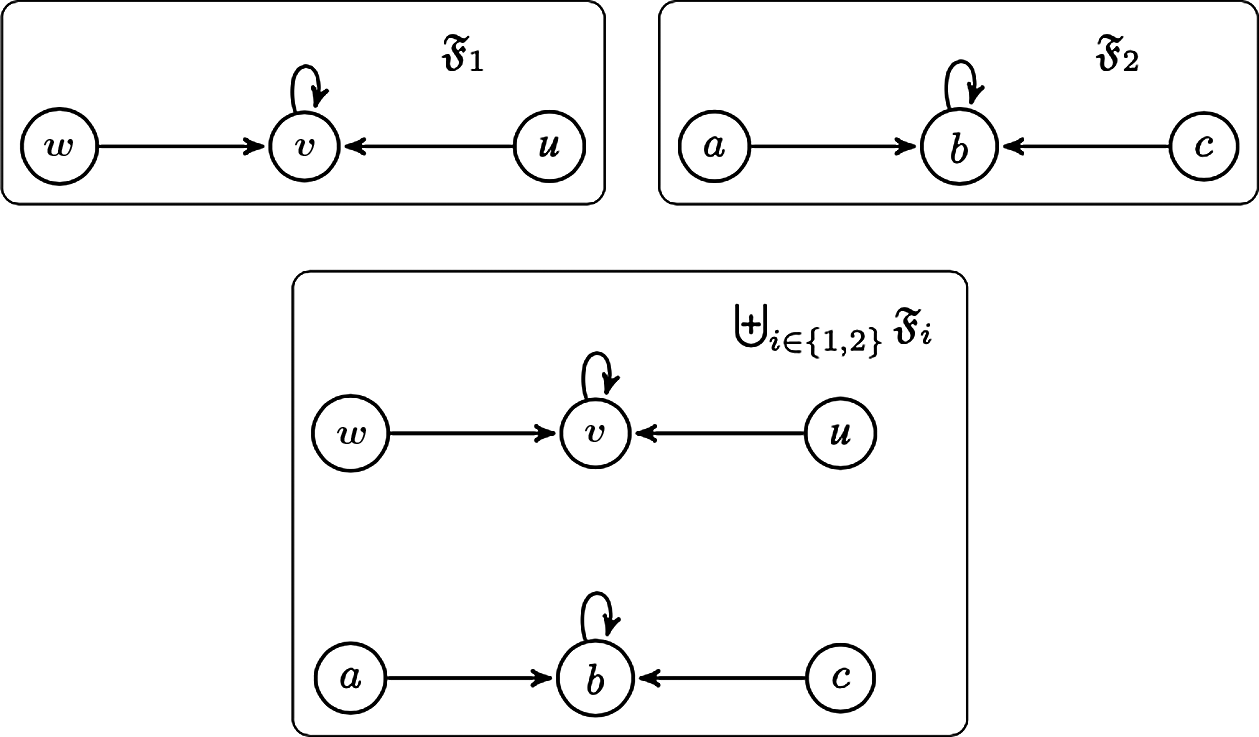
 $\mathfrak {F}_1=(W_1,\mathcal {R}_1)$
be a usual Kripke frame with points
 $w,u,v$
such that
 $\mathcal {R}_{1}=\{(w,v),(v,v),(u,v)\}$
, and
 $\mathfrak {F}_2=(W_2,\mathcal {R}_2)$
a frame with points
 $a,b,c$
such that
 $\mathcal {R}_{2}=\{(a,b),(b,b),(c,b)\}$
. Then the first-order formula expressing shift universality, that is,
 $\forall x\exists y(y\mathcal {R}x\rightarrow \forall z\ z\mathcal {R}x)$
, is valid in both
 $\mathfrak {F}_1$
and
 $\mathfrak {F}_2$
, but not in their disjoint union, as illustrated in Figure 7. Therefore, by the Goldblatt–Thomason theorem—which states that a first-order definable class of frames is modally definable if and only if it is closed under taking disjoint unions, generated subframes, bounded morphic images, and reflects ultrafilter extensions—shift universality is not modally definable.Footnote
13
Non-definability of shift universality.

Next we define concepts such as models based on n-dimensional sequence frames, truth of a formula at a sequence in a model, as well as the core logical notions of validity and consequence.
Definition 1.5 (n-dimensional sequence models)
An n-dimensional sequence model is a quadruple,
 $\mathfrak {M}=(W,(\mathcal {R}_{\Box _i})_{1\leq i\leq n},(\mathcal {R}_{@_i})_{1\leq i\leq n},V)$
, where V is a function assigning to each
 $p\in \textsf{PROP}$
a subset
 $V(p)\subseteq W$
. We say that
 $\mathfrak {M}$
is based on an n-dimensional sequence frame,
 $\mathfrak {F}=(W,(\mathcal {R}_{\Box _i})_{1\leq i\leq n},(\mathcal {R}_{@_i})_{1\leq i\leq n})$
.
Definition 1.6 (Truth)
We define ‘
 $\varphi $
is true at
 $\sigma $
in a model
 $\mathfrak {M}$
’, written
 $\mathfrak {M},\sigma \vDash \varphi $
, by recursion on
 $\varphi $
. For a sequence
 $\sigma \in W$
, and a valuation V in
 $\mathfrak {M}$
,
 $$ \begin{align*}\begin{array}{lll} \mathfrak{M},\sigma\vDash p&\Longleftrightarrow&\sigma\in V(p)\\ \mathfrak{M},\sigma\vDash \neg \varphi&\Longleftrightarrow& \mathfrak{M},\sigma\nvDash \varphi\\ \mathfrak{M},\sigma\vDash (\varphi\land\psi)&\Longleftrightarrow& \mathfrak{M},\sigma\vDash\varphi\text{ and }\mathfrak{M},\sigma\vDash \psi\\ \mathfrak{M},\sigma\vDash \Box_i \varphi&\Longleftrightarrow& \text{for every }\tau\in W, \text{ if } \sigma\mathcal{R}_{\Box_i}\tau, \text{ then } \mathfrak{M},\tau\vDash \varphi\\ \mathfrak{M},\sigma\vDash @_i \varphi&\Longleftrightarrow& \text{for every } \tau\in W, \text{ if } \sigma\mathcal{R}_{@_i}\tau, \text{ then } \mathfrak{M},\tau\vDash \varphi \end{array}\end{align*} $$
Definition 1.7 (Logical notions)
A sentence
 $\varphi $
is satisfiable in a model
 $\mathfrak {M}$
iff there is a sequence
 $\sigma $
in
 $\mathfrak {M}$
such that
 $\mathfrak {M},\sigma \vDash \varphi $
, and satisfiable in a frame
 $\mathfrak {F}$
iff it is satisfiable in a model based on
 $\mathfrak {F}$
. A sentence
 $\varphi $
is valid in an n-dimensional sequence model
 $\mathfrak {M}$
, written
 $\mathfrak {M}\vDash \varphi $
, iff
 $\mathfrak {M},\sigma \vDash \varphi $
for every
 $\sigma \in W$
. A sentence
 $\varphi $
is valid at a point
 $\sigma $
in a frame
 $\mathfrak {F}$
, written
 $\mathfrak {F},\sigma \vDash \varphi $
, iff
 $\varphi $
is true at
 $\sigma $
in every model
 $\mathfrak {M}$
based on
 $\mathfrak {F}$
, and
 $\varphi $
is valid in a frame
 $\mathfrak {F}$
, written
 $\mathfrak {F}\vDash \varphi $
, iff it is valid at every point in
 $\mathfrak {F}$
. A sentence
 $\varphi $
is valid on a class of frames
 $\textsf{C}$
, written
 $\textsf{C}\vDash \varphi $
, iff
 $\varphi $
is valid in every
 $\mathfrak {F}\in \textsf{C}$
. A sentence
 $\varphi $
is a logical consequence of a set of sentences
 $\Gamma $
over a class of frames
 $\textsf{C}$
if and only if for every
 $\mathfrak {M}$
in
 $\textsf{C}$
and sequence
 $\sigma $
in
 $\mathfrak {M}$
, if
 $\mathfrak {M},\sigma \vDash \gamma $
for all
 $\gamma \in \Gamma $
, then
 $\mathfrak {M},\sigma \vDash \varphi $
.
1.2 Axiomatization
In this section we axiomatize n-dimensional sequence frames. The logic of n-dimensional sequence frames is called
 $\mathbf {S}@_n$
:
Definition 1.8 (The logic
$\mathbf {S}@_n$
)

Let
 $1\leq i\leq n$
, where
 $n\geq 2$
.
 $\mathbf {S}@_n$
is the classical normal modal logic defined by the following axioms:
 $$\begin{align*} \begin{array}{ll} ( \textbf{T}_{\Box_1} )& \Box_1 p\rightarrow p. \\ ( \textbf{4}_{\Box_i} ) & \Box_i p\rightarrow\Box_i\Box_i p.\\ ( \textbf{5}_{\Box_i} ) & \Diamond_i p\rightarrow\Box_i\Diamond_i p. \\ ( \textbf{T}_{@_1} ) & @_1 p\rightarrow p. \\ ( \textbf{D}_{@_i} ) & @_i p\rightarrow\neg@_i\neg p. \\ ( \textbf{F}_{@_i} ) & \neg@_i\neg p\rightarrow@_i p.\end{array}\end{align*} $$
 $$\begin{align*} \begin{array}{ll}( \textbf{A}_{i} ) & \Box_{i-1} p\rightarrow@_i p,\text{ for } 1<i\leq n.\\ ( \textbf{AT}_{i} ) & \Box_{i} p\rightarrow@_i p. \\ ( \textbf{A4}_{i} ) & @_{i} p\rightarrow\Box_{j}@_i p, \text{ for } 1\leq j<i\leq n.\\ ( \textbf{AR}_{i} ) & \Box_{i}(@_i p\rightarrow p). \end{array}\end{align*} $$
Where
 $\vdash _n$
denotes the provability relation in
 $\mathbf {S}@_n$
,
 $\Gamma \vdash _n\varphi $
if and only if there are formulas
 $\psi _1,\ldots ,\psi _n$
in
 $\Gamma $
such that
 $\vdash _n\psi _1\land \cdots \land \psi _n\rightarrow \varphi $
.
As derived rules we can also add the rule of regularity and the rule of congruentiality, similarly to the basic modal case:
 $$ \begin{align*}\begin{array}{ll} (\textbf{RR}) & \text{If }\vdash_n p\rightarrow q, \text{ then } \vdash_n\Box_i p\rightarrow\Box_i q.\\ (\textbf{RC}) &\text{If }\vdash_n p\leftrightarrow q, \text{ then } \vdash_n\Box_i p\leftrightarrow\Box_i q. \end{array}\end{align*} $$
Moreover, left commutativity
 $\Box _i\Box _j p\rightarrow \Box _j\Box _i p$
and the Church-Rosser axiom
 $\Diamond _j\Box _i p\rightarrow \Box _i\Diamond _j p$
are both derivable from the axioms above.
With the exception of
 $\mathbf {T}_{@_1}$
, and by setting
 $n=2$
, the axioms above are just the ones found in Fritz (Reference Fritz2014), p. 391, for the logic
 $\mathbf {2Dg}$
. Note that by setting
 $n=2$
there are two box-like operators in the language, namely,
 $\Box _1$
, corresponding to the (metaphysical) necessity operator
 $\Box $
in
 $\mathbf {2Dg}$
, and the final box-like operator
 $\Box _2$
, corresponding to the a priori operator A in
 $\mathbf {2Dg}$
. The reason why
 $\mathbf {T}_{@_1}$
is not found in
 $\mathbf {2Dg}$
is because its language has a single actuality operator which, provided
 $n=2$
, corresponds to
 $@_2$
in
 $\mathcal {L}^@_2$
. Having a single actuality operator in the language is, after all, expected since
 $\mathbf {2Dg}$
is designed to be a logic of necessity, actuality, and the a priori, and hence
 $@_2$
is just the traditional actuality operator found in other two-dimensional modal logics, such as Davies and Humberstone’s (Reference Davies and Humberstone1980) logic for deep necessity, for example. As mentioned before, we have added
 $@_1$
to the language for the sake of generality, so that there are n boxes and actuality operators. Nevertheless, it is now easy to see that
 $p\rightarrow @_1 p$
is derivable from the axioms above, and hence
 $ p\leftrightarrow @_1 p$
is also derivable, by
 $\mathbf {T}_{@_1}$
, which in turn means that
 $@_1$
is directly eliminable from the language
 $\mathcal {L}^@_2$
(in fact,
 $\mathcal {L}^@_n$
) without loss of expressive power. Therefore, by discounting the
 $@_1$
operator,
 $\mathbf {S}@_n$
is a generalization of
 $\mathbf {2Dg}$
to n dimensions with many actuality operators.
1.3 Completeness
The axioms listed above are all Sahlqvist formulas, and hence we can compute their locally corresponding frame conditions by the general Sahlqvist algorithm for converting modal formulas into first-order formulas (see Blackburn et al., 2001, chap. 3.6 for a general description), from which it follows that
 $\mathbf {S}@_n$
is strongly complete with respect to the class of frames it defines.
Informally, we say that a class of frames
 $\textsf{C}$
is defined by a set of formulas
 $\Gamma $
(respectively, formula
 $\varphi $
) if for every frame
 $\mathfrak {F}$
,
 $\mathfrak {F}\in \textsf{C}$
just in case
 $\mathfrak {F}\vDash \Gamma $
(respectively,
 $\mathfrak {F}\vDash \varphi $
). Additionally, let
 $\psi (x)$
be a formula of first-order logic where x is the only free variable in
 $\psi $
. Then
 $\psi (x)$
locally corresponds to a modal formula
 $\varphi $
if
 $\psi (x)$
expresses a condition satisfiable on a point w in a first-order structure
 $\mathfrak {F}$
just in case
 $\varphi $
is valid at w in
 $\mathfrak {F}$
, where
 $\mathfrak {F}$
is taken as a Kripke frame. That is, for any frame
 $\mathfrak {F}$
and point w in
 $\mathfrak {F}$
,
 $\mathfrak {F},w\vDash \varphi $
just in case
 $\mathfrak {F},\alpha [x/w]\vDash \psi ,$
where
 $\alpha [x/w]$
is the assignment function that sends x to w. Then the following first-order formulas locally correspond to the axioms of
 $\mathbf {S}@_n$
:
 $$ \begin{align*}\begin{array}{lll} \textbf{T}_{\Box_1}&\Box_1 p\rightarrow p&w\mathcal{R}_{\Box_1}w\\ \textbf{4}_{\Box_i}&\Box_i p\rightarrow\Box_i\Box_i p&\forall vz((w\mathcal{R}_{\Box_i} v\land v\mathcal{R}_{\Box_i}z)\rightarrow w\mathcal{R}_{\Box_i} z)\\ \textbf{5}_{\Box_i}&\Diamond_i p\rightarrow\Box_i\Diamond_i p&\forall vz((w\mathcal{R}_{\Box_i} v\land w\mathcal{R}_{\Box_i}z)\rightarrow v\mathcal{R}_{\Box_i} z)\\ \textbf{T}_{@_1}&@_1 p\rightarrow p&w\mathcal{R}_{@_1}w\\ \textbf{D}_{@_i}&@_i p\rightarrow\neg@_i\neg p&\exists v(w\mathcal{R}_{@_i}v)\\ \textbf{F}_{@_i}&\neg@_i\neg p\rightarrow@_i p&\forall vz((w\mathcal{R}_{@_i}v\land w\mathcal{R}_{@_i}z)\rightarrow v=z)\\ \textbf{A}_{i}&\Box_{i-1} p\rightarrow@_i p&\forall v(w\mathcal{R}_{@_i}v\rightarrow w\mathcal{R}_{\Box_{i-1}}v),\text{ for } 1<i\leq n\\ \textbf{AT}_{i}&\Box_{i} p\rightarrow@_i p&\forall v(w\mathcal{R}_{@_i}v\rightarrow w\mathcal{R}_{\Box_{i}}v)\\ \textbf{A4}_{i}&@_{i} p\rightarrow\Box_{j}@_i p&\forall vz((w\mathcal{R}_{\Box_{j}}v\land v\mathcal{R}_{@_{i}}z)\rightarrow w\mathcal{R}_{@_i} z),\text{ for } 1\leq j<i\leq n\\ \textbf{AR}_{i}&\Box_{i}(@_i p\rightarrow p)&\forall v(w\mathcal{R}_{\Box_i}v\rightarrow v\mathcal{R}_{@_i}v) \end{array}\end{align*} $$
Theorem 1.1 (Sahlqvist completeness)
 $\mathbf {S}@_n$
is sound and strongly complete with respect to the class of frames
 $\textsf{F}_{\mathbf {S}@_n}$
(that is, the class of first-order frames defined by
 $\mathbf {S}@_n$
).
Proof. By Theorem 4.42 in Blackburn et al. (Reference Blackburn, de Rijke and Venema2001), the proof of which can be found in chapter 5.
Let an
 $\mathbf {S}@_n$
-frame be any frame in
 $\textsf{F}_{\mathbf {S}@_n}$
. It is clear that the axioms above are sound, too, with respect to the class of all n-dimensional sequence frames, given their correspondence to the first-order properties of these frames. An important question is whether the axioms above are also sufficient, that is, whether they settle the completeness problem for
 $\mathbf {S}@_n$
with respect to n-dimensional sequence frames. This question is settled here by generalizing the approach in Fritz (Reference Fritz2014), in which a completeness theorem for
 $\mathbf {2Dg}$
is derived by first passing through an intermediate class of frames—in that case, the frames defined in Restall (Reference Restall2012). But rather than using an intermediate class of frames such as Restall’s, we take the point-generated subframe of a frame in
 $\textsf{F}_{\mathbf {S}@_n}$
and construct a bounded morphism from a sequence frame onto this point-generated subframe. Still, the proof strategy extends the main ideas employed in Fritz (Reference Fritz2014), Lemmas 2.5–8.
First we prove a series of lemmas in order to establish the main completeness result for
 $\mathbf {S}@_n$
. In particular, Lemmas 1.1 to 1.4 are instrumental in the proof of Lemma 1.5, which is in turn the principal lemma for the completeness theorem, namely, Theorem 1.3.
Lemma 1.1. The following Sahlqvist formulas are derivable in
 $\mathbf {S}@_n$
. Let
 $1\leq j<i\leq n$
:
-
(1) (Seriality)
$\vdash _n\Box _i p\rightarrow \Diamond _i p$
. -
(2) (Upward transitivity)
$\vdash _n\Box _i p\rightarrow \Box _j\Box _i p$
. This formula corresponds to the frame condition
$\forall vz((w\mathcal {R}_{\Box _j}v\land v\mathcal {R}_{\Box _{i}}z)\rightarrow w\mathcal {R}_{\Box _i}z).$
-
(3) (Upward Euclideanity)
$\vdash _n\Diamond _i p\rightarrow \Box _j\Diamond _i p$
. This formula corresponds to the frame condition
$\forall vz((w\mathcal {R}_{\Box _j}v\land w\mathcal {R}_{\Box _{i}}z)\rightarrow v\mathcal {R}_{\Box _i}z).$


Proof. (1). This is derivable from
 $\mathbf {AT}_i$
and its dual,
 $@_i p\rightarrow \Diamond _i p$
.
(2). Consider the following derivation:
 $$\begin{align*} \begin{array}{lll} 1.&\vdash_n\Diamond_i p\rightarrow\Box_i\Diamond_i p&\textbf{5}_{\Box_{i}}\\ 2.&\vdash_n\Box_i\Diamond_i p\rightarrow@_i\Diamond_i p&\textbf{AT}_{i}\\ 3.&\vdash_n\Diamond_i p\rightarrow@_i\Diamond_i p&1,2\\ 4.&\vdash_n\neg@_i\neg\Box_i\neg p\rightarrow\Box_i\neg p&3\\ 5.&\vdash_n @_i\Box_i p\rightarrow\Box_i p&\textbf{D}_{@_i},4\\\end{array} \end{align*}$$
 $$\begin{align*}\begin{array}{lll} 6.&\vdash_n \Box_j@_i\Box_i p\rightarrow\Box_j\Box_i p&\textbf{Nec}_{\textbf{j}},\textbf{K}_{\Box_j},5\\ 7.&\vdash_n @_i\Box_i p\rightarrow\Box_j@_i\Box_i p&\textbf{A4}_{i}\\ 8.&\vdash_n @_i\Box_i p\rightarrow\Box_j\Box_i p&6,7\\ 9.&\vdash_n \Box_i p\rightarrow\Box_i\Box_i p&\textbf{4}_{\Box_i}\\ 10.&\vdash_n \Box_i\Box_i p\rightarrow@_i\Box_i p&\textbf{AT}_{i}\\ 11.&\vdash_n \Box_i p\rightarrow@_i\Box_i p&9,10\\ 12.&\vdash_n \Box_i p\rightarrow\Box_j\Box_i p&8,11\\ \end{array} \end{align*}$$
(3). Consider the following derivation:
 $$ \begin{align*}\begin{array}{lll} 1.&\vdash_n\Box_i\Diamond_i p\rightarrow\Diamond_i\Diamond_i p&(1)\\ 2.&\vdash_n\Diamond_i\Diamond_i p\rightarrow\Diamond_i p&\text{Dual of }\textbf{4}_{\Box_i}\\ 3.&\vdash_n\Box_i\Diamond_i p\rightarrow\Diamond_i p&1,2\\ 4.&\vdash_n \Box_j\Box_i\Diamond_i p\rightarrow\Box_j\Diamond_i p&\textbf{Nec}_{j},3,\textbf{K}_{\Box_j}\\ 5.&\vdash_n \Box_i\Diamond_i p\rightarrow\Box_j\Box_i\Diamond_i p&(2)\\ 6.&\vdash_n \Diamond_i p\rightarrow\Box_i\Diamond_i p&\textbf{5}_{\Box_i}\\ 7.&\vdash_n \Diamond_i p\rightarrow\Box_j\Diamond_i p&4,5,6\\ \end{array}\end{align*} $$
For the next lemmas,
 $\mathcal {R}_{\mathcal {O}_i}[X]$
is the image of the set X under the relation
 $\mathcal {R}_{\mathcal {O}_i}$
, and for each function
 $\mathcal {R}_{@_i}$
,
 $\mathcal {R}_{@_i}(w)$
is the unique v such that
 $w\mathcal {R}_{@_i}v$
, and
 $im(\mathcal {R}_{@_i})$
is the image of the function
 $\mathcal {R}_{@_i}$
.
Lemma 1.2. Let
 $\mathfrak {F}=(W,(\mathcal {R}_{\Box _i})_{1\leq i\leq n},(\mathcal {R}_{@_i})_{1\leq i\leq n})$
be an
 $\mathbf {S}@_n$
-frame,
 $w\in W$
, and
 $\mathfrak {F}^w=(W^w,(\mathcal {R}^w_{\Box _i})_{1\leq i\leq n},(\mathcal {R}^w_{@_i})_{1\leq i\leq n})$
the subframe of
 $\mathfrak {F}$
generated by w. Then:
-
(1)
$W^w=\mathcal {R}^w_{\Box _1}[\mathcal {R}^w_{\Box _2}[\cdots [\mathcal {R}^w_{\Box _i}[\cdots [\mathcal {R}^w_{\Box _n}[\{w\}]]]]]]$
. -
(2)
$v\mathcal {R}^w_{\Box _n}u$
if and only if
$u\in im(\mathcal {R}^w_{@_{n}})$
.


Proof. (1). One inclusion is clear. For the other direction, let
 $$\begin{align*}Z=\mathcal{R}^w_{\Box_1}[\mathcal{R}^w_{\Box_2}[\cdots[\mathcal{R}^w_{\Box_i}[\cdots[\mathcal{R}^w_{\Box_n}[\{w\}]]]]]]. \end{align*}$$
We first prove that (1a)
 $w\in Z$
, and then that (1b) Z is closed under every relation
 $\mathcal {R}^w_{\mathcal {O}_i}$
in the frame
 $\mathfrak {F}^w$
.
(1a). Let z be the element in
 $W^w$
such that
 $\mathcal {R}^w_{@_n}(w)=z$
, and for each i such that
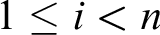 $1\leq i<n$
, let
 $\mathcal {R}^w_{@_i}(w)=z_i$
and
 $\mathcal {R}^w_{@_i}(z_i)=v_i$
. Then
 $w\mathcal {R}^w_{\Box _n}z$
, by
 $\mathbf {AT}_n$
, and both
 $w\mathcal {R}^w_{\Box _{n-1}}z_{n-1}$
and
 $z_{n-1}\mathcal {R}^w_{\Box _{n-1}}v_{n-1}$
, by
 $\mathbf {AT}_{n-1}$
. So
 $w\mathcal {R}^w_{\Box _{n-1}}v_{n-1}$
, by transitivity of
 $\mathcal {R}^w_{\Box _{n-1}}$
. But
 $w\mathcal {R}^w_{\Box _{n-1}}z$
follows by
 $\mathbf {A}_n$
, and so
 $z\mathcal {R}^w_{\Box _{n-1}}v_{n-1}$
, since
 $\mathcal {R}^w_{\Box _{n-1}}$
is Euclidean. Then
 $$\begin{align*}w\mathcal{R}^w_{\Box_n}z\mathcal{R}^w_{\Box_{n-1}}v_{n-1}. \end{align*}$$
Moreover, both
 $w\mathcal {R}^w_{\Box _{n-2}}z_{n-2}$
and
 $z_{n-2}\mathcal {R}^w_{\Box _{n-2}}v_{n-2}$
follow by
 $\mathbf {AT}_{n-2}$
. So
 $w\mathcal {R}^w_{\Box _{n-2}}v_{n-2}$
, by transitivity of
 $\mathcal {R}^w_{\Box _{n-2}}$
. Also, both
 $w\mathcal {R}^w_{\Box _{n-2}}z_{n-1}$
and
 $z_{n-1}\mathcal {R}^w_{\Box _{n-2}}v_{n-1}$
, by
 $\mathbf {A}_{n-1}$
. So
 $w\mathcal {R}^w_{\Box _{n-2}}v_{n-1}$
, again by transitivity of
 $\mathcal {R}^w_{\Box _{n-2}}$
. Hence
 $v_{n-1}\mathcal {R}^w_{\Box _{n-2}}v_{n-2}$
, as
 $\mathcal {R}^w_{\Box _{n-2}}$
is Euclidean. Then
 $$\begin{align*}w\mathcal{R}^w_{\Box_n}z\mathcal{R}^w_{\Box_{n-1}}v_{n-1}\mathcal{R}^w_{\Box_{n-2}}v_{n-2}. \end{align*}$$
By repeating this argument multiple times, it follows that there is a chain
 $$\begin{align*}w\mathcal{R}^w_{\Box_n}z\mathcal{R}^w_{\Box_{n-1}}v_{n-1}\mathcal{R}^w_{\Box_{n-2}}v_{n-2}\cdots\mathcal{R}^w_{\Box_{3}}v_{3}\mathcal{R}^w_{\Box_{2}}v_{2}. \end{align*}$$
Now, by
 $\mathbf {A}_{2}$
, both
 $w\mathcal {R}^w_{\Box _{1}}z_{2}$
and
 $z_{2}\mathcal {R}^w_{\Box _{1}}v_{2}$
, whence
 $w\mathcal {R}^w_{\Box _{1}}v_{2}$
and so
 $v_{2}\mathcal {R}^w_{\Box _{1}}w$
, by transitivity and symmetry of
 $\mathcal {R}^w_{\Box _{1}}$
, respectively, thereby extending the chain above to
 $$\begin{align*}(\ast)\ w{\mathcal{R}}^w_{\Box_n}z{\mathcal{R}}^w_{\Box_{n-1}}v_{n-1}{\mathcal{R}}^w_{\Box_{n-2}}v_{n-2}\cdots{\mathcal{R}}^w_{\Box_{3}}v_{3}{\mathcal{R}}^w_{\Box_{2}}v_{2}{\mathcal{R}}^w_{\Box_{1}}w. \end{align*}$$
Therefore,
 $w\in Z$
.
(1b). For
 $\mathcal {R}^w_{\Box _1}$
, suppose that
 $v\in \mathcal {R}^w_{\Box _1}[Z]$
. Then there is a
 $u\in Z$
such that
 $u\mathcal {R}^w_{\Box _1}v$
. But since
 $u\in Z$
, it follows by an argument similar to that which established
 $(*)$
in (1a) that there are
 $z_n,\ldots ,z_2\in W^w$
such that
 $$\begin{align*}w\mathcal{R}^w_{\Box_n}z_n\mathcal{R}^w_{\Box_{n-1}}z_{n-1}\mathcal{R}^w_{\Box_{n-2}}z_{n-2}\cdots\mathcal{R}^w_{\Box_{3}}z_{3}\mathcal{R}^w_{\Box_{2}}z_{2}\mathcal{R}^w_{\Box_{1}}u. \end{align*}$$
By transitivity of
 $\mathcal {R}^w_{\Box _1}$
, it then follows that
 $z_2\mathcal {R}^w_{\Box _1}v$
, and so
 $v\in Z$
.
For
 $\mathcal {R}^w_{\Box _i}$
, where
 $1<i\leq n$
, suppose that
 $v\in \mathcal {R}^w_{\Box _i}[Z]$
. Then there is a
 $u\in Z$
such that
 $u\mathcal {R}^w_{\Box _i}v$
. But since
 $u\in Z$
, it follows by an argument similar to the one establishing
 $(*)$
in (1a), that there are
 $z_n,\ldots ,z_2\in W^w$
such that
 $$\begin{align*}w\mathcal{R}^w_{\Box_n}z_n\mathcal{R}^w_{\Box_{n-1}}z_{n-1}\mathcal{R}^w_{\Box_{n-2}}z_{n-2}\cdots\mathcal{R}^w_{\Box_{3}}z_{3}\mathcal{R}^w_{\Box_{2}}z_{2}\mathcal{R}^w_{\Box_{1}}u. \end{align*}$$
By upward transitivity, it follows that
 $z_2\mathcal {R}^w_{\Box _i}v$
. Now, if
 $i=2$
, then
 $z_{3}\mathcal {R}^w_{\Box _{2}}v$
, by transitivity of
 $\mathcal {R}^w_{\Box _{2}}$
, from which it follows that
 $v\in Z$
, as
 $\mathcal {R}^w_{\Box _1}$
is reflexive. If, on the other hand,
 $2<i<n$
, since
 $z_3\mathcal {R}^w_{\Box _2}z_2$
, it follows that
 $z_3\mathcal {R}^w_{\Box _i}v$
, by upward transitivity; since
 $z_4\mathcal {R}^w_{\Box _3}z_3$
and
 $z_3\mathcal {R}^w_{\Box _i}v$
, it follows that
 $z_4\mathcal {R}^w_{\Box _i}v$
by upward transitivity; after multiple repetitions of this argument, since
 $z_i\mathcal {R}^w_{\Box _{i-1}}z_{i-1}$
and
 $z_{i-1}\mathcal {R}^w_{\Box _i}v$
, it follows that
 $z_i\mathcal {R}^w_{\Box _i}v$
by upward transitivity. Then
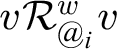 $v\mathcal {R}^w_{@_i}v$
, by
 $\mathbf {AR}_i$
, whence
 $v\mathcal {R}^w_{\Box _{i-1}}v$
, by
 $\mathbf {A}_i$
, and so
 $v\mathcal {R}^w_{@_{i-1}}v$
, by
 $\mathbf {AR}_{i-1}$
, whence
 $v\mathcal {R}^w_{\Box _{i-2}}v$
, by
 $\mathbf {A}_{i-1}$
, and so on. After multiple repetitions of this argument,
 $v\mathcal {R}^w_{@_{3}}v$
, by
 $\mathbf {AR}_{3}$
, whence
 $v\mathcal {R}^w_{\Box _{2}}v$
, by
 $\mathbf {A}_{3}$
. Also
 $v\mathcal {R}^w_{\Box _{1}}v$
, since
 $\mathcal {R}^w_{\Box _{1}}$
is reflexive, and so
 $v\in Z$
. In case
 $i=n$
, since
 $w\mathcal {R}^w_{\Box _{n}}z_{n}$
, and
 $z_{n}\mathcal {R}^w_{\Box _n}v$
follows as in the argument above, it then follows that
 $w\mathcal {R}^w_{\Box _n}v$
by transitivity of
 $\mathcal {R}^w_{\Box _n}$
. The rest of the argument for the descending chain is exactly as the case
 $2<i<n$
above.
For
 $\mathcal {R}^w_{@_1}$
, suppose that
 $v\in \mathcal {R}^w_{@_1}[Z]=Z$
, since
 $\mathcal {R}^w_{@_1}$
is the identity function. So
 $v\in Z$
.
For
 $\mathcal {R}^w_{@_i}$
, where
 $1<i\leq n$
, suppose that
 $v\in \mathcal {R}^w_{@_i}[Z]$
. Then there is a
 $u\in Z$
such that
 $u\mathcal {R}^w_{@_i}v$
. So
 $u\mathcal {R}^w_{\Box _i}v$
, by
 $\mathbf {AT}_i$
. That
 $v\in Z$
now follows from the argument for
 $\mathcal {R}^w_{\Box _i}$
.
(2). For the left-to-right direction, suppose that
 $v\mathcal {R}^w_{\Box _n}u$
. By
 $\mathbf {AR}_n$
,
 $u\mathcal {R}^w_{@_n}u$
, so
 $u\in im(\mathcal {R}^w_{@_{n}})$
. For the converse, assume that
 $u\in im(\mathcal {R}^w_{@_{n}})$
, and let z be the element in
 $ W^w$
such that
 $\mathcal {R}^w_{@_{n}}(w)=z$
. Now, consider any point
 $v\in W^w$
. We show that (2a)
 $v\mathcal {R}^w_{\Box _n}z$
, and then that (2b)
 $z\mathcal {R}^w_{\Box _n}u$
, from which
 $v\mathcal {R}^w_{\Box _n}u$
follows by transitivity of
 $\mathcal {R}^w_{\Box _n}$
, thereby proving the lemma.
(2a) Since
 $v\in W^w$
, it follows by an argument similar to the one establishing
 $(*)$
in (1a) that there are
 $z_n,\ldots ,z_2\in W^w$
such that
 $$\begin{align*}w\mathcal{R}^w_{\Box_n}z_n\mathcal{R}^w_{\Box_{n-1}}z_{n-1}\mathcal{R}^w_{\Box_{n-2}}z_{n-2}\cdots\mathcal{R}^w_{\Box_{3}}z_{3}\mathcal{R}^w_{\Box_{2}}z_{2}\mathcal{R}^w_{\Box_{1}}v. \end{align*}$$
By symmetry of
 $\mathcal {R}^w_{\Box _1}$
, it follows that
 $v\mathcal {R}^w_{\Box _1}z_2$
. Now consider
 $z_3^{\prime }\in \mathcal {R}^w_{@_2}(z_3)$
. By
 $\mathbf {AT}_2$
, it follows that
 $z_3\mathcal {R}^w_{\Box _2}z_3^{\prime }$
. So
 $z_3\mathcal {R}^w_{\Box _2}z_2$
and
 $z_3\mathcal {R}^w_{\Box _2}z_3^{\prime }$
, from which
 $z_2\mathcal {R}^w_{\Box _2}z_3^{\prime }$
follows from the Euclidean property of
 $\mathcal {R}^w_{\Box _2}$
. So
 $v\mathcal {R}^w_{\Box _1}z_2$
and
 $z_2\mathcal {R}^w_{\Box _2}z_3^{\prime }$
, hence
 $v\mathcal {R}^w_{\Box _2}z_3^{\prime }$
, by upward transitivity. Now consider
 $z_4^{\prime }=\mathcal {R}^w_{@_3}(z_4)$
. By
 $\mathbf {AT}_3$
, it follows that
 $z_4\mathcal {R}^w_{\Box _3}z_4^{\prime }$
. So
 $z_4\mathcal {R}^w_{\Box _3}z_3$
and
 $z_4\mathcal {R}^w_{\Box _3}z_4^{\prime }$
, from which
 $z_3\mathcal {R}^w_{\Box _3}z_4^{\prime }$
follows from the Euclidean property of
 $\mathcal {R}^w_{\Box _3}$
. Since
 $z_3\mathcal {R}^w_{\Box _2}z_3^{\prime }$
, it follows that
 $z_3^{\prime }\mathcal {R}^w_{\Box _3}z_4^{\prime }$
, by upward Euclideanity. And since
 $v\mathcal {R}^w_{\Box _2}z_3^{\prime }$
, it follows that
 $v\mathcal {R}^w_{\Box _3}z_4^{\prime }$
, by upward transitivity. By repeating this argument multiple times, it follows that
 $v\mathcal {R}^w_{\Box _{n-1}}z_n^{\prime }$
. Now consider
 $z=\mathcal {R}^w_{@_n}(w)$
. By
 $\mathbf {AT}_n$
, it follows that
 $w\mathcal {R}^w_{\Box _n}z$
. So
 $w\mathcal {R}^w_{\Box _n}z_n$
and
 $w\mathcal {R}^w_{\Box _n}z$
, whence
 $z_n\mathcal {R}^w_{\Box _n}z$
, by the Euclidean property of
 $\mathcal {R}^w_{\Box _n}$
. Then
 $z_n\mathcal {R}^w_{\Box _{n-1}}z_n^{\prime }$
(by a previous iteration of the argument) and
 $z_n\mathcal {R}^w_{\Box _n}z$
, so
 $z_n^{\prime }\mathcal {R}^w_{\Box _n}z$
follows by upward Euclideanity. Therefore,
 $v\mathcal {R}^w_{\Box _{n-1}}z_n^{\prime }$
and
 $z_n^{\prime }\mathcal {R}^w_{\Box _n}z$
, from which
 $v\mathcal {R}^w_{\Box _n}z$
follows by upward transitivity.
(2b). Since
 $u\in W^w$
, by hypothesis, it follows by an argument similar to the one establishing
 $(*)$
in (1a) that there are
 $z_n,\ldots ,z_2\in W^w$
such that
 $$\begin{align*}w\mathcal{R}^w_{\Box_n}z_n\mathcal{R}^w_{\Box_{n-1}}z_{n-1}\mathcal{R}^w_{\Box_{n-2}}z_{n-2}\cdots\mathcal{R}^w_{\Box_{3}}z_{3}\mathcal{R}^w_{\Box_{2}}z_{2}\mathcal{R}^w_{\Box_{1}}u. \end{align*}$$
Consider
 $z=\mathcal {R}^w_{@_n}(w)$
. Then
 $w\mathcal {R}^w_{\Box _n}z$
, by
 $\mathbf {AT}_n$
. Since
 $\mathcal {R}^w_{\Box _n}$
is Euclidean, it follows that
 $z\mathcal {R}^w_{\Box _n}z_n$
. Since
 $u\in im(\mathcal {R}^w_{@_n})$
, there is a
 $u_n\in W^w$
such that
 $u_n\mathcal {R}^w_{@_n}u$
. By
 $\mathbf {AT}_n$
,
 $u_n\mathcal {R}^w_{\Box _{n}}u$
, whence
 $u\mathcal {R}^w_{@_{n}}u$
, by
 $\mathbf {AR}_{n}$
, and so
 $u\mathcal {R}^w_{\Box _{n}}u$
, by
 $\mathbf {AT}_{n}$
. By
 $\mathbf {A}_n$
, in turn, it also follows that
 $u_n\mathcal {R}^w_{\Box _{n-1}}u$
, so
 $u\mathcal {R}^w_{@_{n-1}}u$
by
 $\mathbf {AR}_{n-1}$
, whence
 $u\mathcal {R}^w_{\Box _{n-2}}u$
by
 $\mathbf {A}_{n-1}$
. Then
 $u\mathcal {R}^w_{@_{n-2}}u$
by
 $\mathbf {AR}_{n-1}$
, whence
 $u\mathcal {R}^w_{\Box _{n-3}}u$
by
 $\mathbf {A}_{n-2}$
. By repeating this argument multiple times, it follows that
 $u\mathcal {R}^w_{\Box _{3}}u$
by
 $\mathbf {A}_{4}$
and, similarly, that
 $u\mathcal {R}^w_{\Box _{2}}u$
by
 $\mathbf {A}_{3}$
. Now, since
 $z_2\mathcal {R}^w_{\Box _1}u$
and
 $u\mathcal {R}^w_{\Box _2}u$
,
 $z_2\mathcal {R}^w_{\Box _2}u$
follows by upward transitivity. And because
 $z_3\mathcal {R}^w_{\Box _2}z_2$
and
 $z_2\mathcal {R}^w_{\Box _2}u$
,
 $z_3\mathcal {R}^w_{\Box _2}u$
follows by transitivity of
 $\mathcal {R}^w_{\Box _2}$
. But since
 $z_3\mathcal {R}^w_{\Box _2}u$
and
 $u\mathcal {R}^w_{\Box _3}u$
,
 $z_3\mathcal {R}^w_{\Box _3}u$
follows by upward transitivity, and so
 $z_4\mathcal {R}^w_{\Box _3}u$
follows by transitivity of
 $\mathcal {R}^w_{\Box _3}$
. By repeating this argument multiple times it follows that
 $z_n\mathcal {R}^w_{\Box _{n-1}}u$
. But since
 $u\mathcal {R}^w_{\Box _{n}}u$
, it follows that
 $z_n\mathcal {R}^w_{\Box _{n}}u$
by upward transitivity. And since
 $z\mathcal {R}^w_{\Box _n}z_n$
, it follows that
 $z\mathcal {R}^w_{\Box _n}u$
by transitivity of
 $\mathcal {R}^w_{\Box _n}$
, as desired.
Lemma 1.3. Let
 $\mathfrak {F}=(W,(\mathcal {R}_{\Box _i})_{1\leq i\leq n},(\mathcal {R}_{@_i})_{1\leq i\leq n})$
be an
 $\mathbf {S}@_n$
-frame, and
 $v\in W$
. Then
 $\mathcal {R}_{@_i}(\mathcal {R}_{@_{i+1}}(v))=\mathcal {R}_{@_{i+1}}(v),$
for
 $1\leq i<n$
.
Proof. Let
 $\mathcal {R}_{@_{i+1}}(v)=z$
. Then
 $v\mathcal {R}_{\Box _{i+1}}z$
, by
 $\mathbf {AT}_{i+1}$
, and so
 $z\mathcal {R}_{@_{i+1}}z$
follows by
 $\mathbf {AR}_{i+1}$
. Now
 $z\mathcal {R}_{\Box _{i}}z$
follows by
 $\mathbf {A}_{i+1}$
, and
 $z\mathcal {R}_{@_{i}}z$
follows by
 $\mathbf {AR}_{i}$
. So
 $v\mathcal {R}_{@_{i+1}}z\mathcal {R}_{@_{i}}z$
, and hence
 $$\begin{align*}\mathcal{R}_{@_{i}}(\mathcal{R}_{@_{i+1}}(v))=\mathcal{R}_{@_{i}}(z)=z=\mathcal{R}_{@_{i+1}}(v), \end{align*}$$
as desired.
In order to establish the main completeness result of this section we now want to show the existence and relevant properties of certain families of surjective functions, which are essential to construct the relevant bounded morphism from a sequence frame onto an
 $\mathbf {S}@_n$
-frame (or, more precisely, a point-generated subframe of an
 $\mathbf {S}@_n$
-frame). In Fritz’s (2014), Lemma 2.8, in the completeness proof for the two-dimensional case, this is done as follows. Let
 $\mathfrak {F}=(W,\mathcal {R}_{\Box _1},\mathcal {R}_{\Box _2},\mathcal {R}_{@_1},\mathcal {R}_{@_2})$
be an
 $\mathbf {S}@_2$
-frame, and
 $\mathfrak {F}^w=(W^w,\mathcal {R}^w_{\Box _1},\mathcal {R}^w_{\Box _2},\mathcal {R}^w_{@_1},\mathcal {R}^w_{@_2})$
the subframe of
 $\mathfrak {F}$
generated by w. Validity is preserved by taking generated subframes,Footnote
14
and hence the
 $\mathbf {S}@_2$
axioms hold in
 $\mathfrak {F}^w$
. Now, for every element
 $w\in W^w$
there is a surjective function
 $g^1_w:W^w\rightarrow \mathcal {R}^w_{\Box _1}[g^0_\emptyset (w)]$
such that
 $g^1_w(w)=\mathcal {R}^w_{@_2}(g^0_\emptyset (w))$
, where
 $g^0_\emptyset =Id_{W^w}$
. The family
 $g^1$
of surjections exists since for every
 $w\in W^w$
,
 $\mathcal {R}^w_{\Box _{1}}[g^0_\emptyset (w)]\subseteq W^w$
, and also because
 $\mathcal {R}^w_{@_2}$
is a function such that
 $\mathcal {R}^w_{@_2}\subseteq \mathcal {R}^w_{\Box _{1}}$
, by
 $\mathbf {A}_2$
. We then construct a two-dimensional sequence frame,
 $\mathfrak {F}^{\prime }=(W^{\prime },\mathcal {R}_{\Box _1}^{\prime },\mathcal {R}_{\Box _2}^{\prime },\mathcal {R}_{@_1}^{\prime },\mathcal {R}_{@_2}^{\prime })$
, where
 $W^{\prime }=W^w\times W^w$
, and define a map f from
 $W^{\prime }$
onto
 $W^w$
by
 $f((w,v))=g^1_v(w)$
, which is a bounded morphism from
 $\mathfrak {F}^{\prime }$
onto
 $\mathfrak {F}^w$
—this can be verified by a standard back-and-forth argument. Since we know by Sahlqvist completeness (Theorem 1.1) that
 $\mathbf {S}@_2$
is strongly complete with respect to
 $\mathbf {S}@_2$
-frames, completeness of
 $\mathbf {S}@_2$
relative to the class of two-dimensional sequence frames now follows since modal satisfaction is invariant under taking bounded morphisms between models, and the fact that every formula in the language is satisfiable in an
 $\mathbf {S}@_2$
-model if and only if it is satisfiable in a point-generated submodel of it.Footnote
15
This is by and large Fritz’s argument except for minor notational differences, the absence of an
 $\mathcal {R}_{@_i}$
relation, and the fact that he uses an intermediate class of frames from Restall (Reference Restall2012) indirectly instead of the point-generated subframes
 $\mathfrak {F}^w$
.
To see how this method can be generalized for n dimensions it is instructive first to briefly mention the adaptation of the argument above for three dimensions, as the definition of the bounded morphism in this case will need multiple families of surjections which are constructed in stages, just as in the n case. So, let
 $\mathfrak {F}$
be an
 $\mathbf {S}@_3$
-frame, and
 $\mathfrak {F}^w$
the subframe of
 $\mathfrak {F}$
generated by w. In order to prove that
 $\mathbf {S}@_3$
is complete relative to three-dimensional sequence frames, we construct a three-dimensional sequence frame,
 $\mathfrak {F}^{\prime }=(W^{\prime },(\mathcal {R}^{\prime }_{\Box _i})_{1\leq i\leq n},(\mathcal {R}^{\prime }_{@_i})_{1\leq i\leq n})$
, where
 $W^{\prime }=W^w\times W^w\times W^w$
, and a bounded morphism from
 $\mathfrak {F}^{\prime }$
onto
 $\mathfrak {F}^w$
. This is done as follows. Let
 $g^0_\emptyset =Id_{W^w}$
. Then for every
 $w\in W^w$
there is a surjective function
 $g^1_w:W^w\rightarrow \mathcal {R}^w_{\Box _2}[g^0_\emptyset (w)]$
such that
-
(i)
$g^1_w(w)=\mathcal {R}^w_{@_3}(g^0_\emptyset (w))$
.

The family
 $g^1$
of surjections exists since for any
 $w\in W^w$
,
 $\mathcal {R}^w_{\Box _{2}}[g^0_\emptyset (w)]\subseteq W^w$
, and also because
 $\mathcal {R}^w_{@_3}$
is a function such that
 $\mathcal {R}^w_{@_3}\subseteq \mathcal {R}^w_{\Box _{2}}$
, by
 $\mathbf {A}_3$
. Additionally, for every
 $w,v\in W^w$
there is a surjective function
 $g^2_{w,v}:W^w\rightarrow \mathcal {R}^w_{\Box _1}[g^1_v(w)]$
such that
-
(ii)
$g^2_{w,v}(w)=\mathcal {R}^w_{@_2}(g^1_v(w))$
.

The family
 $g^2$
of surjections exists since for any
 $w,v\in W^w$
,
 $\mathcal {R}^w_{\Box _{1}}[g^1_v(w)]\subseteq W^w$
, and also because
 $\mathcal {R}^w_{@_2}$
is a function such that
 $\mathcal {R}^w_{@_2}\subseteq \mathcal {R}^w_{\Box _{1}}$
, by
 $\mathbf {A}_2$
. Then for every
 $w\in W^w$
, since
 $g^2_{w,w}(w)=\mathcal {R}^w_{@_2}(g^1_w(w))$
, by (ii),
 $g^1_w(w)=\mathcal {R}^w_{@_3}(g^0_\emptyset (w))$
, by (i), and
 $\mathcal {R}^w_{@_2}(\mathcal {R}^w_{@_3}(w))=\mathcal {R}^w_{@_3}(w)$
, by Lemma 1.3, it follows that
-
(iii)
$g^2_{w,w}(w)=\mathcal {R}^w_{@_3}(w)$
.

The map f from
 $W^{\prime }$
onto
 $W^w$
defined by
 $f((w,v,z))=g^2_{v,z}(w)$
is then a bounded morphism from
 $\mathfrak {F}^{\prime }$
onto
 $\mathfrak {F}^w$
, which can again be verified by a standard back-and-forth argument.
The aim of the next two lemmas is to register the existence of similar surjections in the general n-dimensional case as well as to construct the desired bounded morphism for the completeness proof.
Lemma 1.4. Let
 $\mathfrak {F}=(W,(\mathcal {R}_{\Box _i})_{1\leq i\leq n},(\mathcal {R}_{@_i})_{1\leq i\leq n})$
be an
 $\mathbf {S}@_n$
-frame. Then:
-
(1) There is a sequence
$g^0,\ldots ,g^{n-1}$
of families of surjective functions defined on W, where the family
$g^i$
is indexed by
$W^i$
,
$g^0_\emptyset =\text {Id}_W$
, and for each
$1\leq i\leq (n-1)$
and every
$w_1,\ldots ,w_i\in W$
, such that
$$\begin{align*}g^i_{w_1,\ldots,w_i}:W\rightarrow\mathcal{R}_{\Box_{n-i}}[g^{i-1}_{w_2,\ldots,w_i}(w_1)] \end{align*}$$
$$\begin{align*}g^i_{w_1,\ldots,w_i}(w_1)=\mathcal{R}_{@_{n-(i-1)}}(g^{i-1}_{w_2,\ldots,w_i}(w_1)). \end{align*}$$


-
(2) If an initial segment of
$w_1,\ldots ,w_{n-1}$
is such that
$w_1=\cdots =w_j=z$
, for
$1\leq j\leq (n-1)$
, and
$z\in W$
, then
$$\begin{align*}g^{n-1}_{w_1,\ldots,w_{n-1}}(z)=\mathcal{R}_{@_{j+1}}(g^{n-(j+1)}_{w_{j+1},\ldots,w_{n-1}}(w_j)). \end{align*}$$


Proof. (1). The proof is by induction on
 $1\leq i\leq (n-1)$
. For
 $i=1$
, since for any
 $w_1\in W$
,
 $\mathcal {R}_{\Box _{n-1}}[g^0_\emptyset (w_1)]\subseteq W$
, and
 $\mathcal {R}_{@_n}$
is a function such that
 $\mathcal {R}_{@_n}\subseteq \mathcal {R}_{\Box _{n-1}}$
, by
 $\mathbf {A}_n$
, there is a family of surjective functions
 $$\begin{align*}g^1_{w_1}:W\rightarrow\mathcal{R}_{\Box_{n-1}}[g^{0}_\emptyset(w_1)] \end{align*}$$
such that
 $$\begin{align*}g^1_{w_1}(w_1)=\mathcal{R}_{@_n}(g^{0}_\emptyset(w_1)). \end{align*}$$
Assume the induction hypothesis, for
 $i=k$
, where
 $1\leq k< (n-1)$
, that there is family of surjective functions
 $$\begin{align*}g^{k}_{w_1,\ldots,w_{k}}:W\rightarrow\mathcal{R}_{\Box_{n-k}}[g^{k-1}_{w_2,\ldots,w_{k}}(w_1)] \end{align*}$$
such that
 $$\begin{align*}g^{k}_{w_1,\ldots,w_{k}}(w_1)=\mathcal{R}_{@_{n-(k-1)}}(g^{k-1}_{w_2,\ldots,w_k}(w_1)). \end{align*}$$
We show that the lemma holds for
 $i=k+1$
. Since, by the induction hypothesis, there are functions
 $g^{k}_{w_1,\ldots ,w_k}$
, and both
 $\mathcal {R}_{\Box _{n-(k+1)}}[g^{k}_{w_2,\ldots ,w_{k+1}}(w_1)]\subseteq W$
and
 $\mathcal {R}_{@_{n-k}}\subseteq \mathcal {R}_{\Box _{n-(k+1)}}$
, by
 $\mathbf {A}_{n-k}$
, it follows that there is a family of surjective functions
 $$\begin{align*}g^{k+1}_{w_1,\ldots,w_{k+1}}:W\rightarrow\mathcal{R}_{\Box_{n-(k+1)}}[g^{k}_{w_2,\ldots,w_{k+1}}(w_1)] \end{align*}$$
such that
 $$\begin{align*}g^{k+1}_{w_1,\ldots,w_{k+1}}(w_1)=\mathcal{R}_{@_{n-k}}(g^{k}_{w_2,\ldots,w_{k+1}}(w_1)), \end{align*}$$
as desired.
(2). The proof is by induction on j. For
 $j=1$
, it follows from (1) that
 $$\begin{align*}g^{n-1}_{w_1,\ldots,w_{n-1}}(z)=\mathcal{R}_{@_{2}}(g^{n-2 }_{w_2,\ldots,w_{n-1}}(w_1)). \end{align*}$$
Now let
 $j=k$
, where
 $1\leq k< (n-1)$
, and assume that
 $$\begin{align*}g^{n-1}_{w_1,\ldots,w_{n-1}}(z)=\mathcal{R}_{@_{k+1}}(g^{n-(k+1)}_{w_{k+1},\ldots,w_{n-1}}(w_k)). \end{align*}$$
Suppose that
 $w_1=\cdots =w_{k+1}=z$
. Then the family of surjections
 $$\begin{align*}g^{n-(k+1)}_{w_{k+1},\ldots,w_{n-1}}:W\rightarrow\mathcal{R}_{\Box_{n-(n-(k+1))}}[g^{(n-(k+1))-1}_{w_{k+2},\ldots,w_{n-1}}(w_{k+1})] \end{align*}$$
is such that
 $$\begin{align*}g^{n-(k+1)}_{w_{k+1},\ldots,w_{n-1}}(w_k)=\mathcal{R}_{@_{n-((n-(k+1))-1)}}(g^{(n-(k+1))-1}_{w_{k+2},\ldots,w_{n-1}}(w_{k+1})), \end{align*}$$
by (1), and hence
 $$\begin{align*}g^{n-1}_{w_1,\ldots,w_{n-1}}(z)=\mathcal{R}_{@_{k+1}}(\mathcal{R}_{@_{n-((n-(k+1))-1)}}(g^{(n-(k+1))-1}_{w_{k+2},\ldots,w_{n-1}}(w_{k+1}))). \end{align*}$$
Note, moreover, that
 $n-((n-(k+1))-1)=k+2$
, and hence
 $$\begin{align*}g^{n-1}_{w_1,\ldots,w_{n-1}}(z)=\mathcal{R}_{@_{n-((n-(k+1))-1)}}(g^{(n-(k+1))-1}_{w_{k+2},\ldots,w_{n-1}}(w_{k+1})), \end{align*}$$
by Lemma 1.3, as desired.
Lemma 1.5. Let
 $\mathfrak {F}=(W,(\mathcal {R}_{\Box _i})_{1\leq i\leq n},(\mathcal {R}_{@_i})_{1\leq i\leq n})$
be an
 $\mathbf {S}@_n$
-frame,
 $w\in W$
, and
 $\mathfrak {F}^w=(W^w,(\mathcal {R}^w_{\Box _i})_{1\leq i\leq n},(\mathcal {R}^w_{@_i})_{1\leq i\leq n})$
the subframe of
 $\mathfrak {F}$
generated by w. Then
 $\mathfrak {F}^w$
is a bounded morphic image of a sequence frame.
Proof. Let
 $\mathfrak {F}$
,
 $w\in W$
, and
 $\mathfrak {F}^w$
be as in the hypothesis. Because generated subframes preserve validity between frames, all of the
 $\mathbf {S}@_n$
axioms hold in
 $\mathfrak {F}^w$
. So in what follows we construct a sequence frame,
 $\mathfrak {F}^{\prime }=(W^{\prime },(\mathcal {R}^{\prime }_{\Box _i})_{1\leq i\leq n},(\mathcal {R}^{\prime }_{@_i})_{1\leq i\leq n})$
, such that
 $W^{\prime }=(W^w)^n$
, where
 $(W^w)^n$
is the n-fold Cartesian product of
 $W^w$
, and a surjective bounded morphism
 $f:\mathfrak {F}^{\prime }\twoheadrightarrow \mathfrak {F}^w$
. Then, where
 $\sigma \in (W^w)^n$
, let
 $f:(W^w)^n\rightarrow W^w$
be defined as
 $$\begin{align*}f(\sigma)=g^{n-1}_{\sigma_2,\ldots,\sigma_n}(\sigma_1), \end{align*}$$
where the sequence
 $g^0,\ldots ,g^{n-1}$
of families of surjective functions is defined on
 $W^w$
. We prove that f so defined is a bounded morphism from
 $\mathfrak {F}^{\prime }$
onto
 $\mathfrak {F}^w$
by checking the back and forth conditions for each accessibility relation as follows:
 $[\mathcal {R}_{\Box _1}]$
Suppose that
 $\sigma \mathcal {R}^{\prime }_{\Box _1}\sigma ^{\prime }$
. Then
 $\sigma $
and
 $\sigma ^{\prime }$
are identical beyond 1. So
 $f(\sigma )=g^{n-1}_{\sigma _2,\ldots ,\sigma _{n}}(\sigma _1) \in \mathcal {R}^w_{\Box _{1}}[g^{n-2}_{\sigma _3,\ldots ,\sigma _{n}}(\sigma _2)]$
, and
 $f(\sigma ^{\prime })=g^{n-1}_{\sigma _2^{\prime },\ldots ,\sigma _{n}^{\prime }}(\sigma _1^{\prime }) \in \mathcal {R}^w_{\Box _{1}}[g^{n-2}_{\sigma _3,\ldots ,\sigma _{n}}(\sigma _2)]$
, from which it follows that
 $f(\sigma )\mathcal {R}^w_{\Box _1}f(\sigma ^{\prime })$
. Conversely, suppose that
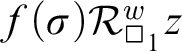 $f(\sigma )\mathcal {R}^w_{\Box _1}z$
. Since
 $$\begin{align*}f(\sigma)=g^{n-1}_{\sigma_2,\ldots,\sigma_{n}}(\sigma_1) \in\mathcal{R}^w_{\Box_{1}}[g^{n-2}_{\sigma_3,\ldots,\sigma_{n}}(\sigma_2)], \end{align*}$$
it follows that
 $z\in \mathcal {R}^w_{\Box _{1}}[g^{n-2}_{\sigma _3,\ldots ,\sigma _{n}}(\sigma _2)]$
. And since
 $g^{n-1}_{\sigma _2,\ldots ,\sigma _{n}}$
is a surjection, there is a
 $v\in W^w$
such that
 $g^{n-1}_{\sigma _2,\ldots ,\sigma _{n}}(v)=z$
, whence
 $f(\sigma ^1_v)=g^{n-1}_{\sigma _2,\ldots ,\sigma _{n}}(v)=z$
. Furthermore,
 $\sigma \mathcal {R}^{\prime }_{\Box _1}\sigma ^1_v$
.
 $[\mathcal {R}_{\Box _i}, 1<i<n]$
Suppose that
 $\sigma \mathcal {R}^{\prime }_{\Box _i}\sigma ^{\prime }$
. Then
 $\sigma ^{\prime }$
is i-diagonal and identical with
 $\sigma $
beyond i. So
 $f(\sigma ^{\prime })=g^{n-1}_{\sigma _2^{\prime },\ldots ,\sigma _{n}^{\prime }}(\sigma _1^{\prime })=\mathcal {R}^w_{@_i}(g^{n-i}_{\sigma _{i+1}^{\prime },\ldots ,\sigma _{n}^{\prime }}(\sigma _{i}^{\prime }))$
, by Lemma 1.4(2), and
 $f(\sigma )=g^{n-1}_{\sigma _2,\ldots ,\sigma _{n}}(\sigma _1) \in \mathcal {R}^w_{\Box _{1}}[g^{n-2}_{\sigma _3,\ldots ,\sigma _{n}}(\sigma _2)]$
. Since
 $g^{n-i}_{\sigma _{i+1}^{\prime },\ldots ,\sigma _{n}^{\prime }}(\sigma _{i}^{\prime })\mathcal {R}^w_{@_i}f(\sigma ^{\prime })$
, it follows that
 $g^{n-i}_{\sigma _{i+1}^{\prime },\ldots ,\sigma _{n}^{\prime }}(\sigma _{i}^{\prime })\mathcal {R}^w_{\Box _i}f(\sigma ^{\prime })$
, by
 $\mathbf {AT}_i$
. Also,
 $g^{n-i}_{\sigma _{i+1}^{\prime },\ldots ,\sigma _{n}^{\prime }}(\sigma _{i}^{\prime }) \in \mathcal {R}^w_{\Box _{i}}[g^{(n-i)-1}_{\sigma _{i+2},\ldots ,\sigma _{n}}(\sigma _{i+1})]$
, since the sequences
 $\sigma $
and
 $\sigma ^{\prime }$
are identical beyond i, whence
 $g^{(n-i)-1}_{\sigma _{i+2},\ldots ,\sigma _{n}}(\sigma _{i+1})\mathcal {R}^w_{\Box _{i}}f(\sigma ^{\prime })$
, by transitivity of
 $\mathcal {R}^w_{\Box _{i}}$
. But
 $$ \begin{align*}\begin{array}{llll} g^{n-2}_{\sigma_3,\ldots,\sigma_{n}}(\sigma_2)\in\mathcal{R}^w_{\Box_{2}}[g^{n-3}_{\sigma_4,\ldots,\sigma_{n}}(\sigma_3)],\\ g^{n-3}_{\sigma_4,\ldots,\sigma_{n}}(\sigma_3)\in\mathcal{R}^w_{\Box_{3}}[g^{n-4}_{\sigma_5,\ldots,\sigma_{n}}(\sigma_4)],\\ ...,\\ g^{n-i}_{\sigma_{i+1},\ldots,\sigma_{n}}(\sigma_{i})\in\mathcal{R}^w_{\Box_{i}}[g^{(n-i)-1}_{\sigma_{i+2},\ldots,\sigma_{n}}(\sigma_{i+1})]. \end{array}\end{align*} $$
So
 $g^{n-i}_{\sigma _{i+1},\ldots ,\sigma _{n}}(\sigma _{i})\mathcal {R}^w_{\Box _{i}}f(\sigma ^{\prime })$
, by the Euclidean property of
 $\mathcal {R}^w_{\Box _{i}}$
. Now,
 $g^{n-(i-1)}_{\sigma _{i},\ldots ,\sigma _{n}}(\sigma _{i-1}) \in \mathcal {R}^w_{\Box _{i-1}}[g^{n-i}_{\sigma _{i+1},\ldots ,\sigma _{n}}(\sigma _{i})]$
. So
 $g^{n-(i-1)}_{\sigma _{i},\ldots ,\sigma _{n}}(\sigma _{i-1})\mathcal {R}^w_{\Box _{i}}f(\sigma ^{\prime })$
, by upward Euclideanity. By an analogous argument, since
 $g^{n-(i-2)}_{\sigma _{i-1},\ldots ,\sigma _{n}}(\sigma _{i-2}) \in \mathcal {R}^w_{\Box _{i-2}}[g^{n-(i-1)}_{\sigma _{i},\ldots ,\sigma _{n}}(\sigma _{i-1})]$
, it follows that
 $g^{n-(i-2)}_{\sigma _{i-1},\ldots ,\sigma _{n}}(\sigma _{i-2})\mathcal {R}^w_{\Box _{i}}f(\sigma ^{\prime })$
, by upward Euclideanity. By multiple repetitions of this argument, it follows that
 $g^{n-2}_{\sigma _3,\ldots ,\sigma _{n}}(\sigma _2)\mathcal {R}^w_{\Box _{i}}f(\sigma ^{\prime })$
. Since
 $g^{n-1}_{\sigma _2,\ldots ,\sigma _{n}}(\sigma _1) \in \mathcal {R}^w_{\Box _{1}}[g^{n-2}_{\sigma _3,\ldots ,\sigma _{n}}(\sigma _2)]$
, by upward Euclideanity, again, it follows that
 $g^{n-1}_{\sigma _2,\ldots ,\sigma _{n}}(\sigma _1)\mathcal {R}^w_{\Box _{i}}f(\sigma ^{\prime })$
, and therefore
 $f(\sigma )\mathcal {R}^w_{\Box _{i}}f(\sigma ^{\prime })$
. Conversely, suppose that
 $f(\sigma )\mathcal {R}^w_{\Box _i}z$
. Then
 $f(\sigma )=g^{n-1}_{\sigma _2,\ldots ,\sigma _{n}}(\sigma _1) \in \mathcal {R}^w_{\Box _{1}}[g^{n-2}_{\sigma _3,\ldots ,\sigma _{n}}(\sigma _2)]$
. So
 $$\begin{align*}g^{n-2}_{\sigma_3,\ldots,\sigma_{n}}(\sigma_2)\mathcal{R}^w_{\Box_{1}}f(\sigma)\mathcal{R}^w_{\Box_i}z, \end{align*}$$
from which
 $g^{n-2}_{\sigma _3,\ldots ,\sigma _{n}}(\sigma _2)\mathcal {R}^w_{\Box _i}z$
follows by upward transitivity. Now,
 $g^{n-2}_{\sigma _3,\ldots ,\sigma _{n}}(\sigma _2) \in \mathcal {R}^w_{\Box _{2}}[g^{n-3}_{\sigma _4,\ldots ,\sigma _{n}}(\sigma _3)]$
, whence
 $$\begin{align*}g^{n-3}_{\sigma_4,\ldots,\sigma_{n}}(\sigma_3)\mathcal{R}^w_{\Box_{2}}g^{n-2}_{\sigma_3,\ldots,\sigma_{n}}(\sigma_2)\mathcal{R}^w_{\Box_i}z, \end{align*}$$
from which
 $g^{n-3}_{\sigma _4,\ldots ,\sigma _{n}}(\sigma _3)\mathcal {R}^w_{\Box _i}z$
follows by upward transitivity. Similarly,
 $g^{n-3}_{\sigma _4,\ldots ,\sigma _{n}}(\sigma _3) \in \mathcal {R}^w_{\Box _{3}}[g^{n-4}_{\sigma _5,\ldots ,\sigma _{n}}(\sigma _4)]$
, whence
 $$\begin{align*}g^{n-4}_{\sigma_5,\ldots,\sigma_{n}}(\sigma_4)\mathcal{R}^w_{\Box_{3}}g^{n-3}_{\sigma_4,\ldots,\sigma_{n}}(\sigma_3)\mathcal{R}^w_{\Box_i}z, \end{align*}$$
from which
 $g^{n-4}_{\sigma _5,\ldots ,\sigma _{n}}(\sigma _4)\mathcal {R}^w_{\Box _i}z$
follows by upward transitivity. By repeating this argument,
 $g^{n-i}_{\sigma _{i+1},\ldots ,\sigma _{n}}(\sigma _{i})\mathcal {R}^w_{\Box _{i}}z$
, but since
 $g^{n-i}_{\sigma _{i+1},\ldots ,\sigma _{n}}(\sigma _{i}) \in \mathcal {R}^w_{\Box _{i}}[g^{(n-i)-1}_{\sigma _{i+2},\ldots ,\sigma _{n}}(\sigma _{i+1})]$
, it follows that
 $$\begin{align*}g^{(n-i)-1}_{\sigma_{i+2},\ldots,\sigma_{n}}(\sigma_{i+1})\mathcal{R}^w_{\Box_{i}}g^{n-i}_{\sigma_{i+1},\ldots,\sigma_{n}}(\sigma_{i})\mathcal{R}^w_{\Box_{i}}z, \end{align*}$$
and so
 $g^{(n-i)-1}_{\sigma _{i+2}...\sigma _{n}}(\sigma _{i+1})\mathcal {R}^w_{\Box _{i}}z$
follows by transitivity of
 $\mathcal {R}^w_{\Box _{i}}$
. Then
 $z\in \mathcal {R}^w_{\Box _{i}}[g^{(n-i)-1}_{\sigma _{i+2},\ldots ,\sigma _{n}}(\sigma _{i+1})]$
. Now, since
 $g^{n-i}_{\sigma _{i+1},\ldots ,\sigma _{n}}$
is a surjective function, it follows that there is a
 $v\in W^w$
such that
 $$\begin{align*}(*)\ g^{n-i}_{\sigma_{i+1}...\sigma_{n}}(v)=z. \end{align*}$$
So consider the i-diagonal sequence
 $(v,\ldots ,v,\sigma _{i+1},\ldots ,\sigma _{n})\in (W^w)^n$
, which is identical with
 $\sigma $
beyond i. Then
 $\sigma \mathcal {R}^{\prime }_{\Box _{i}}(v,\ldots ,v,\sigma _{i+1},\ldots ,\sigma _{n})$
, and so:
 $$ \begin{align*}\begin{array}{llll} f((v,\ldots,v,\sigma_{i+1},\ldots,\sigma_{n}))&=&g^{n-1}_{v,\ldots,v,\sigma_{i+1},\ldots,\sigma_{n}}(v)&\text{[by def. of } f]\\ &=&\mathcal{R}^w_{@_{i}}(g^{n-i}_{\sigma_{i+1},\ldots,\sigma_{n}}(v))&\text{[by Lemma 1.4(2)]}\\ &=&\mathcal{R}^w_{@_{i}}(z).&\text{[by } (*)]\\ \end{array}\end{align*} $$
So
 $z\mathcal {R}^w_{@_{i}}\,f((v,\ldots ,v,\sigma _{i+1},\ldots ,\sigma _{n}))$
, whence
 $z\mathcal {R}^w_{\Box _{i}}\,f((v,\ldots ,v,\sigma _{i+1},\ldots ,\sigma _{n}))$
, by
 $\mathbf {AT}_i$
. Then
 $f(\sigma )\mathcal {R}^w_{\Box _{i}}\,f((v,\ldots ,v,\sigma _{i+1},\ldots ,\sigma _{n}))$
follows by transitivity of
 $\mathcal {R}^w_{\Box _{i}}$
. Furthermore,
 $z\mathcal {R}^w_{@_{i}}z$
follows from the original hypothesis and
 $\mathbf {AR}_i$
, in which case both
 $z\mathcal {R}^w_{@_{i}}\,f((v,\ldots ,v,\sigma _{i+1},\ldots ,\sigma _{n}))$
and
 $z\mathcal {R}^w_{@_{i}}z$
, from which
 $f((v,\ldots ,v,\sigma _{i+1},\ldots ,\sigma _{n}))=z$
follows by
 $\mathbf {F}_{@_i}$
, as desired.
 $[\mathcal {R}_{\Box _{n}}]$
Suppose that
 $\sigma \mathcal {R}^{\prime }_{\Box _{n}}\sigma ^{\prime }$
. So
 $\sigma ^{\prime }$
is n-diagonal. Then
 $f(\sigma ^{\prime })=g^{n-1}_{\sigma _2^{\prime },\ldots ,\sigma _{n}^{\prime }}(\sigma _1^{\prime })=\mathcal {R}^w_{@_{n}}(\sigma _n^{\prime })$
, by Lemma 1.4(2), whence
 $f(\sigma ^{\prime })\in im(\mathcal {R}^w_{@_{n}})$
. It follows that
 $f(\sigma )\mathcal {R}^w_{\Box _{n}}f(\sigma ^{\prime })$
, by Lemma 1.2(2). Conversely, suppose that
 $f(\sigma )\mathcal {R}^w_{\Box _{n}}z$
. So
 $z\mathcal {R}^w_{@_{n}}z$
, by
 $\mathbf {AR}_n$
, in which case there is a
 $v\in W^w$
, namely, u, such that
-
(⋆)
$\mathcal {R}^w_{@_{n}}(v)=z$
,

as
 $\mathcal {R}^w_{@_{n}}$
is a function. Now consider the sequence
 $\sigma ^{n}_v\in (W^w)^n$
. Then:
 $$ \begin{align*}\begin{array}{llll} f(\sigma^{n}_v)&=&g^{n-1}_{v,\ldots,v}(v)&\text{[by def. of } f]\\ &=&\mathcal{R}^w_{@_{n}}(v)&\text{[by Lemma 1.4(2)]}\\ &=&z.&\text{[by } (\star)]\\ \end{array}\end{align*} $$
Additionally,
 $\sigma \mathcal {R}^{\prime }_{\Box _{n}}\sigma ^{n}_v$
.
 $[\mathcal {R}_{@_{1}}]$
Suppose that
 $\sigma \mathcal {R}^{\prime }_{@_{1}}\sigma ^{\prime }$
. Then
 $\sigma =\sigma ^{\prime }$
. Since
 $\mathcal {R}^w_{@_{1}}$
is reflexive, it follows that
 $f(\sigma )\mathcal {R}^w_{@_{1}}f(\sigma ^{\prime })$
. Now suppose that
 $f(\sigma )\mathcal {R}^w_{@_{1}}z$
. Because
 $\mathcal {R}^w_{@_{1}}$
is reflexive,
 $f(\sigma )\mathcal {R}^w_{@_{1}}f(\sigma )$
, hence
 $f(\sigma )=z$
, as
 $\mathcal {R}^w_{@_{1}}$
is a function. Also,
 $\sigma \mathcal {R}^{\prime }_{@_{1}}\sigma $
.
 $[\mathcal {R}_{@_{i}}, 1<i<n]$
Suppose that
 $\sigma \mathcal {R}^{\prime }_{@_{i}}\sigma ^{\prime }$
. Then
 $\sigma ^{\prime }$
is i-diagonal and identical with
 $\sigma $
beyond
 $i-1$
. So
 $$\begin{align*}f(\sigma^{\prime})=g^{n-1}_{\sigma_2^{\prime},\ldots,\sigma_{n}^{\prime}}(\sigma_1^{\prime})=\mathcal{R}^w_{@_i}(g^{n-i}_{\sigma_{i+1}^{\prime},\ldots,\sigma_{n}^{\prime}}(\sigma_{i}^{\prime})), \end{align*}$$
by Lemma 1.4(2), and
 $f(\sigma )=g^{n-1}_{\sigma _2,\ldots ,\sigma _{n}}(\sigma _1) \in \mathcal {R}^w_{\Box _{1}}[g^{n-2}_{\sigma _3,\ldots ,\sigma _{n}}(\sigma _2)]$
. Then
 $f(\sigma )\mathcal {R}^w_{\Box _{1}}g^{n-2}_{\sigma _3,\ldots ,\sigma _{n}}(\sigma _2)$
, by symmetry of
 $\mathcal {R}^w_{\Box _{1}}$
. Also,
 $$ \begin{align*}\begin{array}{llll} g^{n-2}_{\sigma_3,\ldots,\sigma_{n}}(\sigma_2)\in\mathcal{R}^w_{\Box_{2}}[g^{n-3}_{\sigma_4,\ldots,\sigma_{n}}(\sigma_3)],\\ g^{n-3}_{\sigma_4,\ldots,\sigma_{n}}(\sigma_3)\in\mathcal{R}^w_{\Box_{3}}[g^{n-4}_{\sigma_5,\ldots,\sigma_{n}}(\sigma_4)],\\ \ldots,\\ g^{n-(i-1)}_{\sigma_i,\ldots,\sigma_{n}}(\sigma_{i-1})\in\mathcal{R}^w_{\Box_{i-1}}[g^{n-i}_{\sigma_{i+1},\ldots,\sigma_{n}}(\sigma_{i})]. \end{array}\end{align*} $$
Now, since
 $\sigma ^{\prime }$
is identical with
 $\sigma $
beyond
 $i-1$
, it also follows that
 $g^{n-(i-1)}_{\sigma _i,\ldots ,\sigma _{n}}(\sigma _{i-1}) \in [g^{n-i}_{\sigma _{i+1}^{\prime },\ldots ,\sigma _{n}^{\prime }}(\sigma _{i}^{\prime })]_{\mathcal {R}^w_{\Box _{i-1}}}$
. And since
 $g^{n-i}_{\sigma _{i+1}^{\prime },\ldots ,\sigma _{n}^{\prime }}(\sigma _{i}^{\prime })\mathcal {R}^w_{@_i}f(\sigma ^{\prime })$
, it follows that
 $g^{n-i}_{\sigma _{i+1}^{\prime },\ldots ,\sigma _{n}^{\prime }}(\sigma _{i}^{\prime }) \mathcal {R}^w_{\Box _{i-1}}f(\sigma ^{\prime })$
, by
 $\mathbf {A}_i$
, and so
 $$\begin{align*}g^{n-(i-1)}_{\sigma_i,\ldots,\sigma_{n}}(\sigma_{i-1})\mathcal{R}^w_{\Box_{i-1}}f(\sigma^{\prime}), \end{align*}$$
as
 $\mathcal {R}^w_{\Box _{i-1}}$
is Euclidean. But since
 $g^{n-(i-2)}_{\sigma _{i-1},\ldots ,\sigma _{n}}(\sigma _{i-2}) \in \mathcal {R}^w_{\Box _{i-2}}[g^{n-(i-1)}_{\sigma _i,\ldots ,\sigma _{n}}(\sigma _{i-1})]$
, it follows that
 $g^{n-(i-2)}_{\sigma _{i-1},\ldots ,\sigma _{n}}(\sigma _{i-2})\mathcal {R}^w_{\Box _{i-1}}f(\sigma ^{\prime })$
, by upward Euclideanity. And since
 $g^{n-(i-3)}_{\sigma _{i-2},\ldots ,\sigma _{n}}(\sigma _{i-3}) \in \mathcal {R}^w_{\Box _{i-3}}[g^{n-(i-2)}_{\sigma _{i-1}...\sigma _{n}}(\sigma _{i-2})]$
, it follows that
 $$\begin{align*}g^{n-(i-3)}_{\sigma_{i-2},\ldots,\sigma_{n}}(\sigma_{i-3})\mathcal{R}^w_{\Box_{i-1}}f(\sigma^{\prime}), \end{align*}$$
again by upward Euclideanity. By repeating this argument, it follows that
 $g^{n-2}_{\sigma _3,\ldots ,\sigma _{n}}(\sigma _2)\mathcal {R}^w_{\Box _{i-1}}f(\sigma ^{\prime })$
, by upward Euclideanity. Then
 $f(\sigma )\mathcal {R}^w_{\Box _{i-1}}f(\sigma ^{\prime })$
, follows from upward Euclideanity, too. But since
 $g^{n-i}_{\sigma _{i+1}^{\prime },\ldots ,\sigma _{n}^{\prime }}(\sigma _{i}^{\prime })\mathcal {R}^w_{@_i}f(\sigma ^{\prime })$
, it follows that
 $f(\sigma ^{\prime })\mathcal {R}^w_{@_i}f(\sigma ^{\prime })$
, by
 $\mathbf {AT}_i$
and
 $\mathbf {AR}_i$
, respectively. So
 $f(\sigma )\mathcal {R}^w_{@_i}f(\sigma ^{\prime })$
, by
 $\mathbf {A4}_i$
. Conversely, suppose that
 $f(\sigma )\mathcal {R}^w_{@_{i}}z$
. Consider the sequence
 $\sigma ^{\prime }\in (W^w)^n$
such that
 $\sigma ^{\prime }$
is i-diagonal and identical with
 $\sigma $
beyond
 $i-1$
. Then
 $\sigma \mathcal {R}^{\prime }_{@_i}\sigma ^{\prime }$
. So
 $$\begin{align*}f(\sigma^{\prime})=g^{n-1}_{\sigma_2^{\prime},\ldots,\sigma_{n}^{\prime}}(\sigma_1^{\prime})=\mathcal{R}^w_{@_i}(g^{n-i}_{\sigma_{i+1}^{\prime},\ldots,\sigma_{n}^{\prime}}(\sigma_{i}^{\prime})), \end{align*}$$
by Lemma 1.4(2), and
 $f(\sigma )=g^{n-1}_{\sigma _2,\ldots ,\sigma _{n}}(\sigma _1) \in \mathcal {R}^w_{\Box _{1}}[g^{n-2}_{\sigma _3,\ldots ,\sigma _{n}}(\sigma _2)]$
. By the same argument as in the forth direction, it follows that
 $f(\sigma )\mathcal {R}^w_{@_i}f(\sigma ^{\prime })$
. But since
 $f(\sigma )\mathcal {R}^w_{@_{i}}z$
, by assumption, it follows that
 $f(\sigma ^{\prime })=z$
, by
 $\mathbf {F}_{@_i}$
.
 $[\mathcal {R}_{@_{n}}]$
Suppose that
 $\sigma \mathcal {R}^{\prime }_{@_{n}}\sigma ^{\prime }$
. Then
 $\sigma ^{\prime }$
is n-diagonal and identical with
 $\sigma $
beyond
 $(n-1)$
. So
 $$\begin{align*}f(\sigma^{\prime})=g^{n-1}_{\sigma_2^{\prime},\ldots,\sigma_{n}^{\prime}}(\sigma_1^{\prime})=\mathcal{R}^w_{@_{n}}(\sigma^{\prime}_n), \end{align*}$$
by Lemma 1.4(2), and
 $f(\sigma )=g^{n-1}_{\sigma _2,\ldots ,\sigma _{n}}(\sigma _1) \in \mathcal {R}^w_{\Box _{1}}[g^{n-2}_{\sigma _3,\ldots ,\sigma _{n}}(\sigma _2)]$
. Since
 $\sigma _n=\sigma _n^{\prime }$
, it follows that
 $\sigma _n\mathcal {R}^w_{@_{n}}f(\sigma ^{\prime })$
, and so both
 $\sigma _n\mathcal {R}^w_{\Box _{n-1}}f(\sigma ^{\prime })$
, by
 $\mathbf {A}_n$
, and
 $f(\sigma ^{\prime })\mathcal {R}^w_{@_{n}}f(\sigma ^{\prime })$
, by
 $\mathbf {AR}_n$
. Now,
 $g^{1}_{\sigma _{n}}(\sigma _{n-1}) \in \mathcal {R}^w_{\Box _{n-1}}[\{\sigma _n\}]$
, so it follows that
 $g^{1}_{\sigma _{n}}(\sigma _{n-1})\mathcal {R}^w_{\Box _{n-1}}f(\sigma ^{\prime })$
, as
 $\mathcal {R}^w_{\Box _{n-1}}$
is Euclidean. Also,
 $g^{2}_{\sigma _{n-1},\sigma _{n}}(\sigma _{n-2}) \in \mathcal {R}^w_{\Box _{n-2}}[g^{1}_{\sigma _{n}}(\sigma _{n-1})]$
. So
 $g^{2}_{\sigma _{n-1},\sigma _{n}}(\sigma _{n-2})\mathcal {R}^w_{\Box _{n-1}}f(\sigma ^{\prime })$
by upward Euclideanity. Analogously,
 $$\begin{align*}g^{3}_{\sigma_{n-2},\sigma_{n-1},\sigma_{n}}(\sigma_{n-3}) \in\mathcal{R}^w_{\Box_{n-3}}[g^{2}_{\sigma_{n-1},\sigma_{n}}(\sigma_{n-2})]. \end{align*}$$
So
 $g^{3}_{\sigma _{n-2},\sigma _{n-1},\sigma _{n}}(\sigma _{n-3})\mathcal {R}^w_{\Box _{n-1}}f(\sigma ^{\prime })$
, again by upward Euclideanity. By repetitions of this argument, it follows that
 $g^{n-2}_{\sigma _3,\ldots ,\sigma _{n}}(\sigma _2)\mathcal {R}^w_{\Box _{n-1}}f(\sigma ^{\prime })$
, by upward Euclideanity. Since
 $f(\sigma )\mathcal {R}^w_{\Box _{1}}g^{n-2}_{\sigma _3,\ldots ,\sigma _{n}}(\sigma _2)$
, by symmetry of
 $\mathcal {R}^w_{\Box _{1}}$
, it follows that
 $f(\sigma )\mathcal {R}^w_{\Box _{n-1}}f(\sigma ^{\prime })$
, by upward transitivity. Therefore,
 $f(\sigma )\mathcal {R}^w_{@_{n}}f(\sigma ^{\prime })$
, by
 $\mathbf {A4}_n$
. Conversely, suppose that
 $f(\sigma )\mathcal {R}^w_{@_{n}}z$
. Now consider the sequence
 $\sigma ^{\prime }\in (W^w)^n$
such that
 $\sigma ^{\prime }$
is n-diagonal and identical with
 $\sigma $
beyond
 $n-1$
. Also
 $\sigma \mathcal {R}^{\prime }_{@_{n}}\sigma ^{\prime }$
. So
 $$\begin{align*}f(\sigma^{\prime})=g^{n-1}_{\sigma_2^{\prime},\ldots,\sigma_{n}^{\prime}}(\sigma_1^{\prime})=\mathcal{R}^w_{@_{n}}(\sigma^{\prime}_n), \end{align*}$$
by Lemma 1.4(2), and
 $f(\sigma )=g^{n-1}_{\sigma _2,\ldots ,\sigma _{n}}(\sigma _1) \in \mathcal {R}^w_{\Box _{1}}[g^{n-2}_{\sigma _3,\ldots ,\sigma _{n}}(\sigma _2)]$
. By the same argument as in the forth direction, it follows that
 $f(\sigma )\mathcal {R}^w_{@_n}f(\sigma ^{\prime })$
. But since
 $f(\sigma )\mathcal {R}^w_{@_{n}}z$
, it follows that
 $f(\sigma ^{\prime })=z$
, by
 $\mathbf {F}_{@_n}$
.
This concludes the back and forth cases. It remains to show that f is surjective. Consider any
 $u\in W^w$
. By Lemma 1.2(1),
 $$\begin{align*}u\in\mathcal{R}^w_{\Box_1}[\mathcal{R}^w_{\Box_2}[...[\mathcal{R}^w_{\Box_i}[...[\mathcal{R}^w_{\Box_n}[\{w\}]]]]]], \end{align*}$$
so there are elements
 $v_n,\ldots ,v_2\in W^w$
, and a chain
 $$\begin{align*}w\mathcal{R}^w_{\Box_n}v_n\mathcal{R}^w_{\Box_{n-1}}v_{n-1}\mathcal{R}^w_{\Box_{n-2}}v_{n-2}\cdots\mathcal{R}^w_{\Box_{3}}v_{3}\mathcal{R}^w_{\Box_{2}}v_{2}\mathcal{R}^w_{\Box_{1}}u. \end{align*}$$
Consider the mapping
 $g^1_{v_n}:W^w\rightarrow \mathcal {R}^w_{\Box _{n-1}}[\{v_n\}]$
. As this is surjective, and
 $v_{n-1}\in \mathcal {R}^w_{\Box _{n-1}}[\{v_n\}]$
, there is a
 $z_{n-1}\in W^w$
such that
 $g^1_{v_n}(z_{n-1})=v_{n-1}$
. Now consider the mapping
 $g^2_{z_{n-1},v_n}:W^w\rightarrow \mathcal {R}^w_{\Box _{n-2}}[g^1_{v_n}(z_{n-1})]$
. As this is surjective, and
 $v_{n-2}\in \mathcal {R}^w_{\Box _{n-2}}[g^1_{v_n}(z_{n-1})]$
, there is a
 $z_{n-2}\in W^w$
such that
 $g^2_{z_{n-1},v_n}(z_{n-2})=v_{n-2}$
. After multiple repetitions of this argument, consider the mapping
 $g^{n-1}_{z_2,\ldots ,z_{n-1},v_n}:W^w\rightarrow \mathcal {R}^w_{\Box _{1}}[g^{n-2}_{z_3,\ldots ,z_{n-1},w}(z_2)]$
. By a previous iteration of the argument,
 $g^{n-2}_{z_3,\ldots ,z_{n-1},v_n}(z_2)=v_2$
, and so
 $u\in \mathcal {R}^w_{\Box _{1}}[g^{n-2}_{z_3,\ldots ,z_{n-1},v_n}(z_2)]$
. As
 $g^{n-1}_{z_2,\ldots ,z_{n-1},v_n}$
is also surjective, there is a
 $z_{1}\in W^w$
such that
 $g^{n-1}_{z_2,\ldots ,z_{n-1},v_n}(z_{1})=u$
. Therefore, there is a sequence
 $(z_1,z_2,\ldots ,z_{n-1},v_n)\in (W^w)^n$
such that
 $$\begin{align*}f((z_1,z_2,\ldots,z_{n-1},v_n))=g^{n-1}_{z_2,\ldots,v_n}(z_{1})=u, \end{align*}$$
as desired.
This is sufficient to prove that
 $\mathbf {S}@_n$
is the multidimensional logic of sequence frames:
Theorem 1.2 (Soundness and completeness)
 $\mathbf {S}@_n$
is sound and strongly complete with respect to the class
 $\textsf{F}$
of sequence frames.
Proof. Soundness is clear given the correspondence between the axioms of
 $\mathbf {S}@_n$
and the properties of n-dimensional sequence frames. For strong completeness, by Theorem 1.1,
 $\mathbf {S}@_n$
is strongly complete with respect to the class of
 $\mathbf {S}@_n$
-frames, that is,
 $\textsf{F}_{\mathbf {S}@_n}$
. So it suffices to prove that a set of formulas is satisfiable in a sequence frame if and only if it is satisfiable in an
 $\mathbf {S}@_n$
-frame. Suppose that a set of formulas
 $\Gamma $
is satisfiable in a sequence frame
 $\mathfrak {F}\in \textsf{F}$
. Because every sequence frame is an
 $\mathbf {S}@_n$
-frame, it follows that
 $\Gamma $
is also satisfiable in an
 $\mathbf {S}@_n$
-frame. Conversely, suppose that
 $\Gamma $
is satisfiable in an
 $\mathbf {S}@_n$
-frame, say,
 $\mathfrak {F}$
. Then
 $\Gamma $
is satisfiable in a model
 $\mathfrak {M}=(W,(\mathcal {R}_{\Box _i})_{1\leq i\leq n},(\mathcal {R}_{@_i})_{1\leq i\leq n},V)$
based on
 $\mathfrak {F}$
. So there is a point w in
 $\mathfrak {M}$
such that
 $\mathfrak {M},w\vDash \Gamma $
. Let
 $\mathfrak {M}^w=(W^w,(\mathcal {R}^w_{\Box _i})_{1\leq i\leq n},(\mathcal {R}^w_{@_i})_{1\leq i\leq n},V^w)$
be the submodel of
 $\mathfrak {M}$
generated by w. Since modal satisfaction is invariant under taking generated submodels, and
 $w\in W^w$
, it follows that
 $\mathfrak {M}^w,w\vDash \Gamma $
, and so
 $\Gamma $
is satisfiable in the point-generated subframe
 $\mathfrak {F}^w$
of
 $\mathfrak {F}$
. But, by Lemma 1.5,
 $\mathfrak {F}^w$
is a bounded morphic image of a sequence frame, say,
 $\mathfrak {F}^{\prime }=(W^{\prime },(\mathcal {R}^{\prime }_{\Box _i})_{1\leq i\leq n},(\mathcal {R}^{\prime }_{@_i})_{1\leq i\leq n})$
. Let
 $f:\mathfrak {F}^{\prime }\twoheadrightarrow \mathfrak {F}^w$
be a surjective bounded morphism from
 $\mathfrak {F}^{\prime }$
onto
 $\mathfrak {F}^w$
, and
 $\mathfrak {M}^{\prime }=(W^{\prime },(\mathcal {R}^{\prime }_{\Box _i})_{1\leq i\leq n},(\mathcal {R}^{\prime }_{@_i})_{1\leq i\leq n},V^{\prime })$
a model based on
 $\mathfrak {F}^{\prime }$
such that for each
 $p\in \textsf{PROP}$
,
 $V^{\prime }(p)=\{\sigma \in W^{\prime }\mid f(\sigma )\in V^w(p)\}$
. Because f is surjective, and
 $w\in W^w$
, let
 $\sigma ^{\prime }$
be a sequence in
 $W^{\prime }$
such that
 $f(\sigma ^{\prime })=w$
. Then
 $\mathfrak {M}^w,f(\sigma ^{\prime })\vDash \Gamma $
. But as
 $\mathfrak {M}^w$
is a bounded morphic image of
 $\mathfrak {M}^{\prime }$
, this implies that
 $\mathfrak {M}^{\prime },\sigma ^{\prime }\vDash \Gamma $
, since modal satisfaction is invariant under bounded morphisms between models. Therefore,
 $\Gamma $
is satisfiable in the sequence frame
 $\mathfrak {F}^{\prime }$
.
Recall that in Fritz (Reference Fritz2014), p. 386, a class of frames with distinguished elements is derived from matrix frames—or, according to our nomenclature, two-dimensional sequence frames (again, for a language without
 $@_1$
). The logic of these frames is then derived syntactically from 2Dg, and a completeness proof is presented in Fritz (Reference Fritz2014), p. 394. Given the completeness result established just above, we show that Fritz’s argument can once more be generalized for the n-dimensional case. We say that an n-dimensional sequence frame with distinguished elements is a quadruple,
 $$\begin{align*}\mathfrak{F}^D=(W,(\mathcal{R}_{\Box_i})_{1\leq i\leq n},(\mathcal{R}_{@_i})_{1\leq i\leq n},D), \end{align*}$$
where
 $(W,(\mathcal {R}_{\Box _i})_{1\leq i\leq n},(\mathcal {R}_{@_i})_{1\leq i\leq n})$
is an n-dimensional sequence frame such that
 $W=S^n$
, and
 $D=\{\overline {s}\mid s\in S\}$
. Let
 $\textsf{F}^D$
be the class of n-dimensional sequence frames with distinguished elements.
Models based on such frames with distinguished elements are defined in the obvious way, and the logical notions of validity and consequence are now relativized to generalized diagonal points
 $\overline {s}$
, as expected. Even though, as pointed out by Fritz (Reference Fritz2014), p. 286, such logics characterizing frames with distinguished elements are not, in general, normal, for they do not have to be closed under the rule of generalization (or necessitation) for each
 $\mathcal {O}_i$
, they can be defined syntactically from their normal counterparts, as it were, as follows:
Definition 1.9.
 $\vdash ^D_n\varphi $
iff
 $\vdash _{n}@_n\varphi $
.
Let
 $\mathbf {S}@^D_n$
be the logic characterizing n-dimensional sequence frames with distinguished elements. Given the strong completeness of
 $\mathbf {S}@_n$
relative to the class of n-dimensional sequence frames, the argument for the strong completeness of
 $\mathbf {S}@^D_n$
relative to
 $\textsf{F}^D$
is then a simple adaptation of the argument in Fritz (Reference Fritz2014), p. 394, Theorem 2.11.
Theorem 1.3 (Soundness and completeness)
 $\mathbf {S}@^D_n$
is sound and strongly complete with respect to
 $\textsf{F}^D$
.
2 n-dimensional tableaux
It is very natural, as will be seen below, to define indexed tableau systems for
 $\mathbf {S}@_n$
following the style of Melvin Fitting’s prefixed tableaux for modal logics.Footnote
16
In fact, generalizations of indexed tableau systems for a variety of two-dimensional modal logics appear in Lampert (Reference Lampert2018) as well as in Gilbert (Reference Gilbert2016).
In order to define indices and index-sequences for the tableaux, we apply similar conventions as found in Definition 1.2 for sequences of possible worlds. A nice feature of these tableaux is their simplicity, for we only need, in effect, a single rule for each modal operator in the language rather than multiple rules corresponding to multiple properties of the accessibility relations, as is usually the case. Next we define the notions of index-sequences, indexed formulas, and root of an n-dimensional tableau. These will consist in slight modifications of the notions appearing in Definition 1.2 for sequences of possible worlds.
Definition 2.1 (Index-sequence, formula, root)
An index is a natural number greater than 0. Let
 $\mathtt{s}=(x_1,\ldots ,x_n)$
be an index-sequence, where each
 $x_i$
is an index. We will often write
 $\mathtt{s}_i$
for
 $x_i$
. An indexed formula is an expression, [
 $\varphi $
]
 $\mathtt{s}$
, where
 $\mathtt{s}$
is an index-sequence and
 $\varphi $
is a formula of
 $\mathcal {L}^@_n$
. All indexed formulas are enclosed within brackets. The root of an n-dimensional tableau always contains the negation of the formula we are attempting to prove indexed by
 $(1,2,\ldots ,n)$
, that is, an index-sequence with the natural numbers ordered from 1 to n.
Definition 2.2 (Notation)
Let
 $\mathtt{s}^{i}_{z}$
be that index-sequence
 ${\mathtt{t}}$
for which
 ${\mathtt{t}}_1={\mathtt{t}}_2=\cdots ={\mathtt{t}}_i=z$
and for
 $j>i$
,
 ${\mathtt{t}}_j={\mathtt{t}}_j$
. Additionally, for an index x,
 $\overline {x}$
is that sequence
 $\mathtt{s}$
for which
 $\mathtt{s}_i=x$
for all
 $i\in \{1,\ldots ,n\}$
.
As per usual, a branch of a tableau is closed if for some formula,
 $\varphi $
, and index-sequence
 $\mathtt{s}$
, both [
 $\varphi $
]
 $\mathtt{s}$
and [
 $\neg \varphi $
]
 $\mathtt{s}$
occur on the branch. A tableau is closed just in case all of its branches are closed. Otherwise, the tableau is open. Finally, a tableau proof of a sentence,
 $\varphi $
, is a closed tableau for [
 $\neg \varphi $
]
 $\mathtt{s}$
, where
 $\mathtt{s}$
is the index-sequence
 $(1,2,\ldots ,n)$
. The tableau rules for
 $\mathbf {S}@_n$
are displayed in Figure 8 with some provisos for the modal rules explained below.
n-dimensional tableau rules.

The rules
 $(\neg \neg )$
,
 $(\land )$
, and
 $(\lor )$
comprise the portion from the classical propositional calculus. The necessity rules,
 $(\nu _i)$
, are applied to any index z already occurring on the branch, and the possibility rules,
 $(\pi _i)$
, may be used provided the index z is new to the branch. These are just the usual restrictions on indexed-tableau rules but generalized for n-dimensional modal logic. In the case of
 $(@_i)$
, the rule says to take the ith element of the sequence in question and copy it
 $(i-1)$
times towards the very first element in the sequence. For instance, the following is a proof of
 $\Diamond _3 p\rightarrow \Box _2\Box _1@_3\Diamond _3 p$
in a four-dimensional tableau:

Items 2 and 3 result from the rule
 $(\land )$
applied to the negated conditional. Item 4 results from applying the
 $(\pi _3)$
rule to item 2, and so the index-sequence
 $(5,5,5,4)$
appears on the tableau because the index
 $5$
is new, that is, it had no previous occurrences. Items 5 and 6 result from applications of
 $(\pi _2)$
and
 $(\pi _1)$
to items 3 and 5, respectively. The index-sequence
 $(6,6,3,4)$
appears in 5 because we needed a new index for
 $\neg \Box _2$
from item 3, and the index-sequence
 $(7,6,3,4)$
occurs because we needed a new index for
 $\neg \Box _1$
from item 5. Finally, 7 results from 6 by an application of
 $(@_3)$
, and so the index 3 is copied down in the index-sequence twice, and 8 results by applying
 $(\nu _3)$
, and so any index could have been chosen to compose its index-sequence. The index-sequence
 $(5,5,5,4)$
, therefore, is chosen so that the tableau closes.
2.1 Soundness
Definition 2.3 (Satisfiability)
Let F be a set of indexed formulas. We say F is satisfiable in a model
 $\mathfrak {M}=(W,(\mathcal {R}_{\Box _i})_{1\leq i\leq n},(\mathcal {R}_{@_i})_{1\leq i\leq n},V)$
, where
 $W=S^n$
, if there is a function f assigning to each single index
 $\mathtt{s}_i$
occurring in a sequence
 $\mathtt{s}$
in F a possible world
 $f(\mathtt{s}_i)\in S$
, and, where g is a function such that
 $g(\mathtt{s})=( f(\mathtt{s}_1),\ldots ,f(\mathtt{s}_n))$
,
-
• If
$[\varphi ]\mathtt{s}\in F$
, then
$\varphi $
is true at
$g(\mathtt{s})$
, i.e.
$\mathfrak {M},g(\mathtt{s})\vDash \varphi $
. -
• If the index-sequences
$\mathtt{s}$
and
$\mathtt{s}^{i}_{z}$
are in F, then
$g(\mathtt{s})\mathcal {R}_{\Box _i}g(\mathtt{s})^{i}_{f(z)}$
. If, moreover,
$z=\mathtt{s}_i$
, then also
$g(\mathtt{s})\mathcal {R}_{@_i}g(\mathtt{s})^{i}_{f(z)}$
.


Definition 2.4. A tableau branch
 $\mathfrak {b}$
is satisfiable if the set of indexed formulas on it is satisfiable in some model, and a tableau is satisfiable if some branch of it is satisfiable.
It follows immediately from the definitions that a closed tableau is not satisfiable. Then the following lemma can be established by induction on formulas:
Lemma 2.1. If one of the rules is applied to a tableau that is satisfiable in an n-dimensional sequence model
 $\mathfrak {M}=(W,(\mathcal {R}_{\Box _i})_{1\leq i\leq n},(\mathcal {R}_{@_i})_{1\leq i\leq n},V)$
, it results in another tableau satisfiable in
 $\mathfrak {M}$
.
Theorem 2.1 (Soundness)
If
 $\varphi $
has an n-dimensional tableau proof, then
 $\varphi $
is valid on the class of n-dimensional sequence frames
 $\textsf{F}$
.
Proof. Suppose
 $\varphi $
has a tableau proof, in which case there is a closed tableau,
 $\mathcal {T}$
, beginning with
 $[\neg \varphi ]\mathtt{s}$
, where
 $\mathtt{s}$
is the sequence
 $(1,2,\ldots ,n)$
. For a contradiction, assume that
 $\varphi $
is not valid. Thus, there is an n-dimensional sequence model
 $\mathfrak {M}=(W,(\mathcal {R}_{\Box _i})_{1\leq i\leq n},(\mathcal {R}_{@_i})_{1\leq i\leq n},V)$
, where
 $W=S^n$
, for some non-empty set S, such that
 $\mathfrak {M},\sigma \nvDash \varphi $
for some sequence
 $\sigma \in W$
. Define a function f such that for each
 $\mathtt{s}_i\in \mathtt{s}$
and
 $\sigma _i\in \sigma $
,
 $f(\mathtt{s}_i)=\sigma _i$
, such that
 $g(\mathtt{s})=(f(\mathtt{s}_1),\ldots ,f(\mathtt{s}_n))=\sigma $
. Then
 $\{[\neg \varphi ]\mathtt{s}\}$
is satisfiable in
 $\mathfrak {M}$
. Moreover, since the one point tableau
 $[\neg \varphi ]\mathtt{s}$
is satisfiable in
 $\mathfrak {M}$
,
 $\mathcal {T}$
is also satisfiable in
 $\mathfrak {M}$
, by Lemma 2.1. Therefore,
 $\mathcal {T}$
is both closed and satisfiable, which is impossible, whence
 $\mathfrak {M},\sigma \vDash \varphi $
, as desired.
2.2 Completeness
We establish completeness by constructing a systematic tableau proof procedure in the style of Fitting (Reference Fitting1983), chap. 8 producing a tableau proof in case there is one, and directing us to a countermodel otherwise. As it is shown below, this will also give us a decision procedure for the validities.
2.2.1 Systematic proof procedure
For the purposes of a systematic proof procedure, we do not want to apply the rules for a single occurrence of an indexed formula more than one time, so we need to make sure that each occurrence of an indexed formula is used only once. This is not difficult to keep track of, as we can just introduce a device to declare formulas used—a check mark, for instance, as in Smullyan (Reference Smullyan1968). The procedure is defined by stages, and for stage
 $n=1$
, introduce [
 $\neg \varphi $
]
 $\mathtt{s}$
at the tableau’s root, where
 $\mathtt{s}$
is the sequence
 $(1,2,\ldots ,n)$
. Next, suppose n stages of the procedure have been completed. If the tableau is closed, or every occurrence of an indexed formula is used, then stop. If, on the other hand, the tableau remains open, then we proceed to stage
 $n+1$
as follows: take the highest occurrence of an indexed formula in the tree, say, [
 $\psi $
]
 $\mathtt{s}$
, that is not yet used.Footnote
17
Now for each open branch
 $\mathfrak {b}$
through the occurrence of [
 $\psi $
]
 $\mathtt{s}$
, do the following:
-
I If [
$\psi $
]
$\mathtt{s}$
is atomic or a negation thereof, then declare it used. This ends stage
$n+1$
. -
II If [
$\psi $
]
$\mathtt{s}$
is [
$\neg \neg \chi $
]
${\mathtt{t}}$
, add [
$\chi $
]
${\mathtt{t}}$
to the end of
$\mathfrak {b}$
. -
III If [
$\psi $
]
$\mathtt{s}$
is [(
$\zeta \land \chi $
)]
${\mathtt{t}}$
, add both [
$\zeta $
]
${\mathtt{t}}$
and [
$\chi $
]
${\mathtt{t}}$
to the end of
$\mathfrak {b}$
(analogously for the other conjunctive cases). -
IV If [
$\psi $
]
$\mathtt{s}$
is [(
$\zeta \lor \chi $
)]
${\mathtt{t}}$
, split the end of
$\mathfrak {b}$
into
$\mathfrak {b}_1$
and
$\mathfrak {b}_2$
, adding [
$\zeta $
]
${\mathtt{t}}$
and [
$\chi $
]
${\mathtt{t}}$
to the end of
$\mathfrak {b}_1$
and
$\mathfrak {b}_2$
, respectively (analogously for the other disjunctive cases). -
V If [
$\psi $
]
$\mathtt{s}$
is [
$\Diamond _i\chi $
]
${\mathtt{t}}$
, take the smallest integer, z, which is new to
$\mathfrak {b}$
, and add [
$\chi $
]
${\mathtt{t}}^{i}_{z}$
to the end of
$\mathfrak {b}$
(analogously for
$\neg \Box _i$
). -
VI If [
$\psi $
]
$\mathtt{s}$
is [
$\Box _i\chi $
]
${\mathtt{t}}$
, for every index z occurring on the branch, add [
$\chi $
]
${\mathtt{t}}^{i}_{z}$
to the end of
$\mathfrak {b}$
(analogously for
$\neg \Diamond _i$
), and then add a fresh occurrence of [
$\Box _i\chi $
]
${\mathtt{t}}$
to the end of
$\mathfrak {b}$
. If, however, all possible [
$\chi $
]
${\mathtt{t}}^{i}_{z}$
already occur on the branch, do nothing (not even checking off the original boxed formula). -
VII If [
$\psi $
]
$\mathtt{s}$
is [
$@_i\chi $
]
${\mathtt{t}}$
, add [
$\chi $
]
${\mathtt{t}}^{i}_{\mathtt {t}_i}$
to the end of
$\mathfrak {b}$
(analogously for
$\neg @_i$
).


Once this procedure is completed for each open branch
 $\mathfrak {b}$
through [
 $\psi $
]
 $\mathtt{s}$
, mark that formula as used. This completes stage
 $n+1$
. Now, either the systematic procedure resulted in a closed tableau, producing a proof; the procedure terminated, producing an open branch; or it does not terminate, producing a possibly infinite open branch.
Let
 $\mathfrak {b}$
be a
 $complete$
open branch of a tableau
 $\mathcal {T}$
if any application of a rule to an indexed formula occurring on the branch would only introduce indexed formulas already occurring on it. In order to prove completeness we show that if
 $\mathfrak {b}$
is any complete open branch of a tableau, then
 $\mathfrak {b}$
is satisfiable in an n-dimensional sequence model constructed out of the formulas and index-sequences occurring on
 $\mathfrak {b}$
. Once completeness is established we come back to the case where the systematic procedure does not terminate.
Definition 2.5. We define a frame
 $\mathfrak {F}_{\mathfrak {b}}=(W,(\mathcal {R}_{\Box _i})_{1\leq i\leq n},(\mathcal {R}_{@_i})_{1\leq i\leq n})$
induced by
 $\mathfrak {b}$
as follows. Let the set of indices in
 $\mathfrak {b}$
be
 $S=\{x\mid \text { for some }\mathtt{s}\in \mathfrak {b}\text { and some }i, x=\mathtt{s}_i\}$
, and let
 $W=S^n$
. For every
 $\mathtt{s},\mathtt{s}^{i}_{z}\in W$
, set
 $\mathtt{s}\mathcal {R}_{\Box _i}\mathtt{s}^{i}_{z}$
, and when
 $z=\mathtt{s}_i$
, set
 $\mathtt{s}\mathcal {R}_{@_i}\mathtt{s}^{i}_{z}$
, too. A model
 $\mathfrak {M}_{\mathfrak {b}}=(W,(\mathcal {R}_{\Box _i})_{1\leq i\leq n},(\mathcal {R}_{@_i})_{1\leq i\leq n},V)$
, based on
 $\mathfrak {F}_{\mathfrak {b}}$
, is defined as follows: for each
 $p\in \textsf{PROP}$
, let
 $\mathtt{s}\in V(p)$
provided that [p]
 $\mathtt{s}$
occurs on
 $\mathfrak {b}$
; otherwise set
 $\mathtt{s}\notin V(p)$
.
It is simple to verify that the frames defined above are in fact n-dimensional sequence frames. The following lemma is then established by induction on formulas:
Lemma 2.2 (Truth lemma)
Let
 $\mathfrak {b}$
be a complete open branch of a tableau. Then, let
 $\mathfrak {F}_{\mathfrak {b}}=(W,(\mathcal {R}_{\Box _i})_{1\leq i\leq n},(\mathcal {R}_{@_i})_{1\leq i\leq n})$
be a frame induced by
 $\mathfrak {b}$
, and
 $\mathfrak {M}_{\mathfrak {b}}=(W,(\mathcal {R}_{\Box _i})_{1\leq i\leq n},(\mathcal {R}_{@_i})_{1\leq i\leq n},V)$
a model based on
 $\mathfrak {F}_{\mathfrak {b}}$
. For every indexed formula, [
 $\varphi $
]
 $\mathtt{s}$
,
 $$\begin{align*}[\varphi]\mathtt{s}\text{ occurs on }\mathfrak{b}\Leftrightarrow\mathfrak{M}_{\mathfrak{b}},\mathtt{s}\vDash\varphi. \end{align*}$$
Theorem 2.2 (Completeness)
If
 $\varphi $
is valid on the class of n-dimensional sequence frames
 $\textsf{F}$
, then
 $\varphi $
has an n-dimensional tableau proof.
Proof. We prove the contrapositive. Suppose
 $\varphi $
does not have a tableau proof, in which case any tableau
 $\mathcal {T}$
beginning with
 $[\neg \varphi ]\mathtt{s}$
remains open. Let
 $\mathfrak {b}$
be a complete open branch of
 $\mathcal {T}$
such that
 $[\neg \varphi ]\mathtt{s}$
occurs on
 $\mathfrak {b}$
. By Lemma 2.2, there is an n-dimensional sequence frame
 $\mathfrak {F}_{\mathfrak {b}}=(W,(\mathcal {R}_{\Box _i})_{1\leq i\leq n},(\mathcal {R}_{@_i})_{1\leq i\leq n})$
, induced by
 $\mathfrak {b}$
, and index-sequence
 $\mathtt{s}\in W$
, such that for an n-dimensional sequence model,
 $\mathfrak {M}_{\mathfrak {b}}=(W,(\mathcal {R}_{\Box _i})_{1\leq i\leq n},(\mathcal {R}_{@_i})_{1\leq i\leq n},V)$
, based on
 $\mathfrak {F}_{\mathfrak {b}}$
, we have
 $\mathfrak {M}_{\mathfrak {b}},\mathtt{s}\nvDash \varphi $
. Consequently,
 $\varphi $
is not valid on the class of n-dimensional sequence frames
 $\textsf{F}$
.
n-dimensional tableaux can be easily adapted for n-dimensional sequence frames with distinguished elements. For an index x, let
 $\overline {x}$
be that index-sequence
 $\mathtt{s}=(x_1,\ldots ,x_n)$
for which
 $x_i=x$
for all
 $1\leq i\leq n$
. Then a tableau proof in this case for a sentence
 $\varphi $
is a closed tableau for
 $[\neg \varphi ]\overline {x}$
. The soundness and completeness results above (as well as the decidability argument below) are also straightforward to adapt.
2.3 Decidability
In this section we prove decidability for
 $\mathbf {S}@_n$
by showing that the systematic tableau procedure used to prove completeness is in fact a decision procedure. For this purpose we can adapt the argument in Fitting (Reference Fitting1983), pp. 410–413. Say we are attempting a proof by way of the systematic procedure described above. However, we now modify the procedure so that no branch contains multiple occurrences of the same indexed formulas: if the procedure says we should add an indexed formula to the end of a branch that already contains an occurrence of it, refrain from adding the repeated occurrence of that indexed formula. This involves a simple modification to our step VI above—which is completely analogous to Fitting’s (Reference Fitting1983), p. 411. Now, we prove that the (modified) systematic procedure we have described guarantees termination for n-dimensional tableaux, whereby they either deliver a proof or a countermodel.
Proposition 2.1 (Termination)
Let
 $\varphi $
be an
 $\mathcal {L}^@_n$
-formula. A systematic attempt to prove
 $\varphi $
terminates.
Proof. For a contradiction, suppose a systematic attempt at proving
 $\varphi $
never terminates. Then there is a sequence
 $\mathcal {T}_0,\mathcal {T}_1,...$
of tableaux which successively properly extend each other. Let
 $\mathcal {T}$
be their limit, i.e.
 $$\begin{align*}\mathcal{T}=\bigcup_{n\geq0}\mathcal{T}_n. \end{align*}$$
Then
 $\mathcal {T}$
is a finitely branching infinite labeled tree. Hence, it follows by König’s lemma that
 $\mathcal {T}$
has an infinite branch, say,
 $\mathfrak {b}$
. Consider the set
 $\Sigma =\{\mathtt{s}\mid [\psi ]\mathtt{s}\in \mathfrak {b}\text { for some formula }\psi \}$
. Because
 $\mathfrak {b}$
is infinite, the set
 $\Sigma $
must be infinite, too. Otherwise, the set of indexed formulas, say,
 $\Phi $
, occurring on
 $\mathfrak {b}$
would be finite, since
 $\Phi \subseteq sb(\varphi )\times \Sigma $
, where
 $sb(\varphi )$
is the set of subformulas of
 $\varphi $
, which is itself finite. Moreover, because no multiple occurrences of the same indexed formulas are allowed, it is not possible for some index-sequence in
 $\Sigma $
to occur infinitely many times postfixing a formula on
 $\mathfrak {b}$
.
Let the height of an index-sequence
 $\mathtt{s}$
, written
 $height(\mathtt{s})$
, be the greatest natural number occurring in
 $\mathtt{s}$
, and for every
 $k\in \mathbb {N}$
, define
 $\Sigma _k=\{\mathtt{s}\mid \mathtt{s}\in \Sigma \text { and }height(\mathtt{s})=k\}$
. Then we let the set
 $\Sigma $
of all index-sequences on
 $\mathfrak {b}$
be the union of all sets
 $\Sigma _k$
. There are two cases that could allow
 $\Sigma $
to be infinite:
(1) For some height j,
 $card(\Sigma _j)=\aleph _0$
. But this is impossible. Consider the set
 $S_j=\{\mathtt{s}\mid height(\mathtt{s})=j\}$
of all possible sequences (with length n) of height j. Note that
 $card(S_j)=j^n-(j-1)^n$
. Since
 $card(S_j)$
is finite, and
 $\Sigma _j\subseteq S_j$
, there is no height j such that
 $card(\Sigma _j)=\aleph _0$
.Footnote
18
(2) For each height j,
 $card(\Sigma _j)<\aleph _0$
. Because
 $\Sigma $
is infinite, and
 $\Sigma $
is the union of all
 $\Sigma _k$
, each of which is of finite cardinality, there must be infinitely many heights j such that
 $\Sigma _j\neq \emptyset $
. Let the modal degree of a formula occurring on
 $\mathfrak {b}$
be the number of modal operators occurring in that formula. Because the modal degree of formulas gets smaller as the index-sequences increase in height, there is a height k such that any formula on the branch
 $\mathfrak {b}$
postfixed by an index-sequence of that height has modal degree 0. And since the modal rules do not apply in this case, there cannot be further index-sequences on
 $\mathfrak {b}$
with height
 $>k$
, in which case there are not infinitely many heights j such that
 $\Sigma _j\neq \emptyset $
, a contradiction.
Corollary 2.1 (Decidability)
 $\mathbf {S}@_n$
is decidable.
Proof. Immediately from the fact that systematic tableau constructions always terminate in a finite number of steps.
Conclusion
We have developed and proved several results about n-dimensional sequence modal logics with actuality operators. These are natural generalizations of two-dimensional modal logics known in the philosophical literature as logics for a priori knowledge, necessity, and actuality. In particular, the structures investigated here were shown to be extensions to any finite dimension of the structures studied in Fritz (Reference Fritz2014) for the system 2Dg. The completeness argument from Fritz was also generalized to any finite dimension, and it can now be seen as a special case of the completeness proof presented in §1.3 by just setting
 $n=2$
(given that
 $@_1$
is directly eliminable from the language). Additionally, we have developed sound and complete tableau calculi for the logics herein considered, and used these to show decidability by means of a systematic tableau construction. There are, of course, many questions left open by the present paper which can be settled by future research, namely, questions in proof-theory, model-theory, and even in complexity theory. Some examples of these include the following:
-
• Fritz’s axiom system 2Dg was naturally generalized for any arbitrary dimension, and the tableau calculi presented here also involved a natural generalization of tableaux for basic modal logic. Is there a natural generalization for n dimensions of the hypersequents developed in Restall (Reference Restall2012) for two-dimensional modal logic? What about different proof systems for modal logic such as natural deduction systems?
-
• What are the n-dimensional modal logics generated with multiple actuality operators such as
$\textsf{A}$
and
$\textsf{D}$
? There are many possibilities here, including classes of frames defined with a single distinguished point
$z\in S$
, and so formulas in the scope of
$\textsf{D}@_n$
would be evaluated relative to the generalized diagonal point
$(z,\ldots ,z)$
; or even frames with a distinguished point
$(z,\ldots ,z)$
for a language containing
$\textsf{A}$
, and so any formula in the scope of
$\textsf{A}$
would be evaluated relative to that point. It is expected that the main theorems proved here, such as completeness and decidability, would transfer to these cases, although it would be interesting to compare the expressive power of such languages relative to distinct notions of validity. One relevant question would be under which circumstances these actuality operators are eliminable from their respective languages, that is, whether the eliminability of the actuality operator, for instance, from the basic (one-dimensional) modal language when real-world validity is assumed (see, for example, Hazen, Rin, & Wehmeier, Reference Hazen, Rin and Wehmeier2013) carries over to n-dimensions. -
• Antonelli & Thomason (Reference Antonelli and Thomason2002) proved that adding propositional quantifiers to a modal logic with two S5 modalities results in a system that is (recursively) intertranslatable with full second-order logic. What about in this framework? Even though
$\Box _1$
is an equivalence relation, any
$\Box _i$
, for
$i>2$
, is not. So, in case there is a translation, it has to be modified accordingly, for the procedure described by Antonelli and Thomason does not seem to generalize for
$\mathbf {S}@_2$
(or
$\mathbf {S}@_n$
) with propositional quantification. Still, is there any recursive translation with full second-order logic, such as in Antonelli and Thomason’s case, that shows second-order
$\mathbf {S}@_2$
and hence
$\mathbf {S}@_n$
(
$1<n$
) to be undecidable? -
• Even though the validity problem for n-dimensional sequence modal logics was shown to be decidable, what is its complexity?
-
• Is the sequence modal logic of
$\omega $
-dimensions complete or decidable? -
• Standefer (Reference Standeferforthcoming) investigates relevant logics with the actuality operator. It would be interesting to see the relevant counterparts of multidimensional modal logics with, possibly, many actuality operators.


Acknowledgments
Portions of this paper were presented at the Society for Exact Philosophy Meeting in Storrs, Connecticut, in 2018, at the Department of Philosophy and at the Department of Linguistics at Goethe University Frankfurt, in 2018, and at C-ALPHA’s Logic Seminar at the University of California, Irvine, in 2019. I am thankful to the respective audiences for many helpful comments, questions, and suggestions, especially Ede Zimmermann, André Fuhrmann, Greg Lauro, Will Stafford, Jeremy Heis, Toby Meadows, Richard Mendelsohn, and Kai Wehmeier. Thanks to Shawn Standefer for commenting on an early draft of this paper. Thanks also to Guillaume Massas for many conversations about modal logic, completeness proofs, and for many helpful suggestions. I am grateful to two editors of The Review of Symbolic Logic, namely, Sean Walsh and Wes Holliday. Finally, I am indebted to Kai Wehmeier for reading and commenting on a number of previous drafts, and to an anonymous referee for many detailed comments and suggestions that helped improve this paper.