





Introduction
Contemporary discussions of life’s meaning have witnessed a decisive shift from the question of the meaning of life to that of meaning in life. Susan Wolf (Reference Wolf2010) and Thaddeus Metz (Reference Metz2013) have been among the most influential contributors to this development, arguing that philosophical reflection should move beyond the search for a single, overarching meaning of life and instead investigate the conditions under which individual lives can be meaningful. This paper accepts the importance of this shift but argues that its philosophical significance has not yet been fully articulated. The transition from the meaning of life to meaning in life does not merely involve a change in the object of inquiry. Rather, this paper claims that it is best understood as reflecting a transformation in the underlying conception of transcendence through which meaning itself is understood.
The central argument of this paper is that the distinction between the meaning of life and meaning in life refers to two fundamentally different configurations of transcendence. The question of the meaning of life is here interpreted as presupposing what we call absolute transcendence: a conception in which meaning is sought within a comprehensive horizon understood to disclose the significance of life as a whole. Because such a horizon is conceived as standing beyond the situated perspective of the individual subject, it favours an understanding of meaning from a third-person perspective (TPP). By contrast, meaning in life presupposes what we call immanent transcendence: a conception in which transcendence does not refer to a reality beyond lived existence but to the inexhaustibility of experience and interpretation from within life itself. Meaning emerges here from the first-person perspective (FPP) of a subject whose existence is constituted through a relation to what exceeds its own agency.Footnote 1
This paper therefore suggests that the contemporary shift from the meaning of life to meaning in life is best understood not as a movement away from transcendence but as a transformation of the way transcendence itself is conceived. The relevant distinction is thus not the distinction between transcendence and immanence, but between two different ways in which transcendence is configured: one that locates meaning within an overarching horizon beyond the subject, and one that locates meaning within the subject’s lived relation to an inexhaustible reality.Footnote 2
The paper develops its claim in two main parts. The first sketches the conceptual framework of transcendence as an interpretive structure. The second applies this framework to the contemporary debate on life’s meaning. Its first section examines absolute transcendence and the concept of the meaning of life, arguing that this model encounters a structural difficulty in that it favours a comprehensive horizon which replaces the interpreting subject instead of orienting it. Its second section develops the notion of immanent transcendence and argues that it provides the basis for an account of meaning in life grounded in the relation between subject, action, and event. In this context, the concept of the minimal self (MS) is introduced, understood as the pre-reflective dimension of subjectivity that precedes and grounds narrative self-understanding (NS) while also revealing its limits.
Transcendence as an interpretive category
In The Origin and Goal of History, Karl Jaspers introduces the notion of the ‘Axial Age’ to mark a transformation in human self-understanding:
What is new about this age, in all three areas of the world, is that man
becomes conscious of Being as a whole, of himself and his limitations. He
experiences the terror of the world and his own powerlessness. He asks radical questions. Face to face with the void he strives for liberation and redemption. By consciously recognising his limits he sets himself the highest goals.
He experiences absoluteness in the depths of selfhood and in the lucidity of
transcendence (Jaspers Reference Jaspers1949, 9).
According to Jaspers, the period between approximately 800 and 200 BCE witnessed a profound transformation that emerged independently in several regions of the ancient world. Among the figures associated with this period are Confucius and Laozi in China, the authors of the Upaniṣads and the Buddha in India, the Hebrew prophets in the Near East, and the Greek philosophers from Parmenides to Plato in Europe/in the West.Footnote 3 Jaspers approached this phenomenon not primarily as a chronological event in intellectual history but as a philosophical transformation in the structure of human self-understanding. The Axial Age, on this interpretation, marks the emergence of new forms of reflection, ethical consciousness, and religious orientation – what may be called the discovery of transcendence.Footnote 4
Broadly speaking, transcendence may be understood in three different senses: as a descriptive category referring to a distinct domain of entities, as a delimitative category marking boundaries or limits, or as an interpretive category Figure 1 that ‘signifies a way in which phenomena of this life are reinterpreted in the light of a particular meaning perspective and scheme of orientation’ (Dalferth Reference Dalferth, Bellah and Joas2012, 178–179). In the following, the third understanding is adopted. Thus, the notion of transcendence is understood not primarily as a reference to a separate realm of beings but as a mode through which reality becomes intelligible within a particular horizon of meaning. Within this framework, a distinction can be made between absolute transcendence and immanent transcendence.
Transcendence.

Transcendence as an interpretive category can be expressed formally as follows: S interprets p as q, where S denotes the interpreter, p the interpretandum, and q the interpretive framework. In contrast to transcendence as a descriptive category, transcendence as an interpretive category does not designate a separate domain beyond the world.Footnote 5 It refers instead to the fact that reality is always disclosed through an interpretive horizon while never being fully exhaustible by any finite horizon. The transcendent is not another object beyond the immanent. Rather, the notion of transcendence refers to the openness of interpretation itself.
Two ways to connect meaning and transcendence
Building on transcendence as an interpretive structure, this paper proposes that the distinction between the meaning of life and meaning in life can be reformulated as involving two different configurations of transcendence.
The first configuration corresponds to what we call absolute transcendence. Here, the interpretive horizon (q) is transformed into a comprehensive worldview (W): a totalizing framework within which life as a whole (p) is interpreted.Footnote 6 The central assumption is that meaning can ultimately be determined from a horizon that transcends the situated perspective of the individual subject.Footnote 7 On the present account, theism and naturalism represent two competing paradigmatic examples of such comprehensive frameworks, insofar as each seeks to provide an ultimate account of life’s intelligibility. By theism, we mean the view that reality is ultimately grounded in an omnipotent, omniscient, and perfectly good God. By naturalism, we mean the view that reality is to be understood exclusively in terms of natural entities and the explanatory principles of the sciences.
The second configuration corresponds to immanent transcendence. Here, transcendence does not consist in moving towards a standpoint beyond lived existence but in recognizing the inexhaustibility of meaning within life itself. The interpretive horizon (q) remains a horizon through which a subject (S) understands particular experiences, actions, and events, but it does not become an independent standpoint beyond the perspective of the subject. Rather, the subject constitutes the instance through which experiences, actions, and events become intelligible. Meaning arises within the situated relation between S, p, and q rather than from a perspective external to that relation.
The decisive difference between these two configurations concerns the role of the subject. In absolute transcendence, the interpretive horizon is elevated into a worldview that appears capable of providing meaning from a quasi-external standpoint.Footnote 8 As a consequence, FPP of the subject risks to be substituted by the supposedly comprehensive perspective of W. In immanent transcendence, by contrast, the subject remains the irreducible locus of interpretation. Transcendence is encountered not as access to a view from nowhere but as the subject’s recognition that its own existence is constituted through a relation to what exceeds it.
The distinction between the meaning of life and meaning in life can therefore be understood as reflecting two different structures through which meaning is disclosed. The former seeks to evaluate life as a whole from a standpoint beyond the subject and thus tends towards TPP. The latter begins from within lived existence and asks how meaning emerges through the first-person relation between subject, world, and interpretive horizon.
A way away from absolute transcendence
Absolute transcendence and the concept of theism
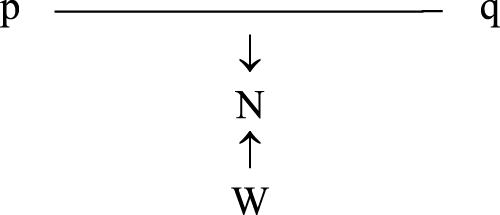
To clarify the structure of absolute transcendence, it is useful to begin with theism as a paradigmatic structural case. Within many traditional conceptions of theism, as understood on the present account, God functions as the ultimate horizon within which the meaning of human existence is understood. Whereas interpretation ordinarily involves a subject (S) who understands life (p) through an interpretive framework (q), absolute transcendence emerges when q is elevated into a comprehensive worldview (W) that claims to provide the final horizon of intelligibility for p as a whole Figure 2. Theism provides a paradigmatic example of this structure insofar as it understands God as the ultimate ground of reality and meaning. Within analytic philosophy of religion, theism has frequently been discussed in opposition to naturalism in that both positions offer competing accounts of the ultimate explanation of existence. The theistic worldview interprets reality with reference to God, whereas naturalism seeks to account for reality within the limits of naturalistic explanation.
Subject vs. worldview.

The present argument does not deal with the question of the truth or falsity of either worldview. It is merely descriptive and thus interested in pointing to the formal structure according to which a worldview functions as an account of meaning. The analysis of the structural level reveals that the disagreement between theism and naturalism concerns essentially the content of the interpretive horizon (q): they propose different answers to the question as to what ultimately explains reality. Yet, if they disagree on the content of the interpretive horizon, both positions can, in principle, assume the same structural form when q is transformed into W – a comprehensive horizon from which life is interpreted as a whole.
The central difficulty with absolute transcendence therefore does not lie in the affirmation of transcendence itself. It lies in the transformation of an interpretive horizon into an independent standpoint of interpretation. Once q becomes W, the worldview no longer functions as the horizon through which the subject (S) interprets life. Instead, W appears to occupy the position of the interpreting subject. FPP is thereby abandoned in favour of an allegedly comprehensive standpoint that claims to determine the meaning of life independently of the situated perspective of the subject. The issue, therefore, is not whether a particular worldview is religious or non-religious, but whether a worldview comes replacing the subject rather than orienting it. A worldview may provide an indispensable horizon of meaning while maintaining the status of a framework through which a subject interprets reality. The problem arises only when the framework is itself transformed into a standpoint that claims to speak from outside interpretation itself.
The formal structure of absolute transcendence can thus be described as the substitution of S by W. The interpretive horizon that should enable the subject’s understanding of p is instead conceived as an independent source of intelligibility. This displacement obscures the first-person conditions through which meaning becomes possible in the first place.
Absolute transcendence, narrative identity, and the meaning of life
To understand how absolute transcendence relates to the concept of meaning of life, we must first examine how meaning is attributed to human existence. When applied to human lives, meaning is commonly understood through the intelligibility of human actions: actions become meaningful when they can be situated within a broader framework that explains their significance.
This assumption is central to the narrative unity of human life. In After Virtue, Alasdair MacIntyre, for instance, illustrates this point through the example of a man who is gardening before winter. The same action can be understood in different ways: it may be interpreted as a simple household task or as an expression of concern for his wife and their shared life (cf. MacIntyre Reference MacIntyre2007, 206). The example demonstrates that actions become intelligible within a broader narrative context.
Within the present framework, the narrative mediates between worldview (W) and action (p as q). A worldview without concrete forms of action remains abstract, while individual actions without an orienting framework remain unintelligible. The narrative connects the two by embedding action within a broader structure of significance through which a life appears as meaningful Figure 3.
Narrative identity.

If narrative becomes the primary structure through which a life is understood, the unity and meaning of a life appear to consist in the coherence of its actions across time as expressed in narratability. Accordingly, the self becomes intelligible through the story which connects past actions, present commitments, and future aims.Footnote 9
The above sketched conception of narrative, however, encounters fundamental limitations.Footnote 10 Here, we focus with our critique on one single aspect. Human existence is not exhausted by the sphere of intentional action. Lives are shaped not only by what individuals do but by what happens to them. Events such as illness, accident, loss, or unexpected encounters can interrupt established narratives and transform the horizon within which earlier actions are understood. One might object that events can be contrasted with actions only if the subject is incapable of responding to them and thus integrating them into the narrative. Yet this is not the claim advanced here. Responses to events are themselves actions and therefore remain open to narrative integration. The point, rather, is that events confront the subject with circumstances that call forth action without themselves being reducible to action.
Consider, for example, a sixteen-year-old aspiring footballer whose life is oriented towards a future professional career. His training, sacrifices, and ambitions form a coherent narrative directed towards a specific goal. Yet a serious injury or illness may radically transform this trajectory. Such an event not only prevents the completion of an intended project but also reconfigures the horizon within which the subject’s previous actions had acquired their meaning.
The significance of such events is that they reveal a dimension of existence that cannot be reduced to agency. A life is constituted not only by what a person accomplishes but also by what the person undergoes. Events exceed the sphere of intentional action because they are not produced by the subject but encountered by it. They disclose a form of immanent transcendence: the subject encounters the limits of its own capacity to determine the meaning of its existence.
If such events are understood as limit experiences, however, a further dimension becomes visible. Besides transforming the subject’s narrative, they disclose the contingency of agency itself and thereby the subject’s dependence on conditions that cannot be fully mastered. What persists through such experiences is therefore not primarily the coherence of a self-narrative but the pre-reflective certainty of being the very subject to whom the experience occurs. Narrative remains indispensable for understanding human action. Yet narrative identity cannot fully account for experiences in which the subject discovers that it is not the absolute origin of meaning. The present account therefore proposes a shift from NS to MS as the primary locus of meaning. Correspondingly, the transition from absolute to immanent transcendence may be described as a transition from the meaning of life, grounded in NS, to meaning in life, grounded in MS.
An alternative way: the way of the way (Tao)
Immanent transcendence and śūnyatā as an example of relationality
The preceding discussion has argued that the transition from the meaning of life to meaning in life cannot be explained merely as a change in philosophical vocabulary or as a modification of the object of inquiry. Rather, it reflects a transformation in the underlying conception of transcendence itself. Whereas absolute transcendence seeks meaning by elevating an interpretive horizon (q) into a comprehensive standpoint (W), immanent transcendence preserves transcendence without abandoning FPP of the subject (S). The decisive question is therefore not whether meaning requires transcendence, but which conception of transcendence is presupposed. As seen, absolute transcendence locates meaning within a horizon that stands beyond the subject and seeks to determine the significance of life as a whole. Immanent transcendence, by contrast, does not refer to a reality beyond lived existence. It refers to the recognition that every finite interpretation remains open because reality always exceeds the particular horizon through which it is disclosed. Within this framework, the relation between subject (S), interpretandum (p), and interpretive horizon (q) remains intact. The subject does not receive meaning from a standpoint external to itself. Rather, meaning emerges within the situated relation between the subject and the world it interprets. Transcendence is therefore encountered not as a movement beyond life but as the subject’s recognition that its existence is constituted through a relation to what it does not and never can fully control.
This conception of transcendence can be found in different forms across various philosophical and religious traditions. The most emblematic tradition in this context is certainly Taoism. But we can find similarities in the structure of transcendence also, for instance, in Meister Eckhart’s notion of Gelassenheit, Schleiermacher’s account of the feeling of absolute dependence, Heidegger’s analysis of disclosedness, and the Buddhist concept of śūnyatā. All reject, in their respective way, the idea that transcendence must be understood as a separate reality standing over against the world. The conceptual differences should not be overlooked; nevertheless, all share a fundamental formal insight: transcendence concerns the structure of human existence and interpretation rather than the presence of an additional domain of being.
The Buddhist concept of śūnyatā provides a particularly clear illustration of this structure. Śūnyatā is often misunderstood as referring to an ultimate reality hidden behind appearances. Properly understood, however, it expresses the absence of independent existence: phenomena do not possess a self-sufficient ground outside the relations through which they arise. On the basis of śūnyatā, transcendence is therefore not understood as an object situated beyond the immanent world, but as the recognition of the radical interdependence of phenomena and thus of the relational character of reality, which no finite interpretation can exhaust.Footnote 11 The significance of śūnyatā for the present argument lies not primarily in its specifically Buddhist doctrinal content or ontological status, but in the formal structure it reveals. If transcendence belongs to interpretation itself, then meaning cannot be understood as an objective property attached to life independently of the subject who lives it. Meaning is not discovered from a comprehensive standpoint but disclosed within the ongoing relation between subject, world, and interpretive horizon. FPP is therefore not merely one possible perspective among others. It constitutes, in fact, the fundamental condition of possibility for the emergence of meaning. The subject is not the absolute creator of meaning. Rather, meaning emerges through the subject’s participation in a reality that exceeds its own attempts to fully comprehend and control it.
From narrative identity to the MS
The preceding account of immanent transcendence allows us to reformulate the critique of narrative identity developed earlier. Narratives undoubtedly play an essential role in human self-understanding. They render actions intelligible by integrating past, present, and future into broader patterns of significance. As narrative beings, human subjects understand themselves through the stories they tell about their commitments, projects, and relationships. Yet NS does not exhaust the structure of subjectivity. A narrative presupposes a subject who can be situated within a story, but the subject is not identical with the story through which it interprets itself. To account for this more fundamental dimension of subjectivity, this paper takes up the concept of the MS.
By the notion MS, we understand the pre-reflective dimension of subjectivity that precedes narrative self-interpretation. It does not refer to a distinct entity behind the NS, but to the immediate first-person presence through which experience is given as my experience.Footnote 12 The importance of MS becomes evident in experiences that exceed the sphere of intentional action. Human existence is shaped not only by what subjects do but also by what happens to them, thus by an insurmountable contingency. The events of life confront the subject with the realization that NS is not the ultimate source of personal identity but presupposes the more primordial dimension of the MS – the pre-reflective first-personal presence through which experience is given as one’s own. In such experiences, the subject encounters itself not primarily as the author of its life but as dependent upon what exceeds its own capacities. This experience of dependence marks the boundary of agency. Yet this boundary should not be understood merely as a limitation or deficiency. Rather, it discloses transcendence as an intrinsic dimension of subjectivity. The subject transcends itself not by leaving its own existence behind but by recognizing that its existence is constituted through relations that it does not fully control.Footnote 13 Events of this kind therefore possess a distinctive interpretive significance. They do not merely interrupt an existing narrative; they can transform the horizon within which both past actions and future possibilities become meaningful and allow to align the self-understanding with the radical relationality which grounds it. The event does not add new information to an unaltered narrative framework. Instead, it may disclose a new horizon in which the meaning of the narrative itself is reconfigured, all in maintaining a radical openness to events and transformations of the self.
Meaning in life therefore emerges not because a life achieves complete narrative coherence, but because the subject remains capable of reinterpretation and acceptance of the uncontrollable. The subject discovers meaning precisely through its capacity to receive what exceeds its previous understanding and to reinterpret it. In this sense, immanent transcendence is revealed within the structure of subjectivity itself: the subject is the locus of meaning, yet never its absolute ground.
Immanent transcendence and meaning in life
The transformation of the subject’s relation to transcendence clarifies the relation between meaning and purpose. This can be illustrated by referring to the philosophy of the Kyoto School, which draws on Zen-Buddhist thought and incorporates fundamental elements of Taoism. The search for the meaning of life typically asks for an ultimate explanation of why life exists or what purpose human existence ultimately serves. Such questioning presupposes that meaning requires a final justification located beyond lived existence itself, which is characteristic of the abovementioned concept of absolute transcendence. Immanent transcendence challenges precisely this assumption. If transcendence does not refer to a standpoint beyond life but to the inexhaustibility of life’s own disclosure, then meaning need not consist in the fulfilment of an externally given purpose. Meaning emerges within the way a life is experienced, interpreted, and transformed from within. FPP does not create meaning through arbitrary choice.Footnote 14 Rather, meaning arises from the encounter between a situated subject and a reality that exceeds its complete control and understanding. The subject is therefore neither the passive recipient of an externally imposed meaning nor the absolute author of meaning, but the participant in a process of disclosure.
Shizuteru Ueda illustrates this structure through a verse by Angelus Silesius:
The rose is without why
it blooms
because it blooms.
To itself it pays no heed
asks not if it is seen.Footnote 15
The statement that the rose is ‘without why’ does not deny meaning. It rejects only the assumption that meaning must be grounded in a purpose external to the phenomenon itself. The rose does not become meaningful because it fulfils an aim beyond its existence. Rather, its blooming manifests a mode of disclosure in which appearance and significance coincide. As teleological scopes are particularly dominant in Western thought, Ueda even radicalizes his hinting to the purposelessness by quoting a Zen saying in which even the last residual element of causal nexus we find in Silesius when he says ‘it blooms because it blooms’ is absent: ‘[T]he flowers blossom just as they blossom.’Footnote 16
Applied to human existence, this suggests that meaning in life does not require a final justification beyond life itself. Meaning is not something added to existence from an external perspective, but it emerges ‘on the way’ and through the ways in which a life discloses itself within concrete experiences, relationships, and transformations. The distinction between absolute and immanent transcendence should therefore not be understood in the sense of an antagonism between transcendence and immanence. Both conceptions affirm a transcendent dimension of meaning. They differ, however, in where they locate meaning. Absolute transcendence locates meaning within a comprehensive horizon beyond the subject and therefore seeks the meaning of life.Footnote 17 Immanent transcendence locates transcendence within the openness of lived interpretation and therefore provides a horizon within which the question of meaning in life can receive an answer that remains, however, provisional and non-definitive.Footnote 18
It seems thus legitimate not to understand the contemporary transition from one concept to the other as a bold rejection of transcendence but as the expression of a transformation in its very structure. Thus, meaning must no longer be understood as something to be discovered from a position beyond human existence, but as something disclosed through the subject’s ongoing relation to a reality that continually exceeds and transforms its understanding. This shift seems all the more pertinent as it facilitates the dialogue with and integration of perspectives of transcendence of non-Western thought traditions.
Conclusion
This paper has argued that the contemporary shift from the meaning of life to meaning in life should not be understood merely as a change in terminology or as a mere refinement of philosophical inquiry. As Susan Wolf and Thaddeus Metz have shown, the question of the meaning of life becomes problematic insofar as it appears to require a single, overarching answer concerning the ultimate purpose of human existence. Their turn towards meaning in life redirects attention towards the conditions under which individual lives become meaningful. The present argument has proposed a structural explanation of this transition by relating it to two different conceptions of transcendence. The question of the meaning of life corresponds to a model of absolute transcendence. Here, meaning is sought from a comprehensive horizon that claims to provide an ultimate interpretation of life as a whole. Because such a horizon assumes a standpoint beyond the situated perspective of the subject, it tends towards TPP on human existence. Within this framework, narrative identity becomes the primary model through which the unity and significance of a life are understood: a life becomes meaningful insofar as its actions can be integrated into a coherent narrative structure. However, the structure of absolute transcendence encounters two fundamental limitations. First, by transforming an interpretive horizon into an absolute standpoint, it risks displacing the subject as the locus of meaning-constitution. Second, by understanding the self primarily through the narrative unity of its actions, it risks overlooking the dimension of existence constituted by events that exceed agency. Human beings are not only authors of their lives but also beings who are affected by what happens to them.
The question of meaning in life, by contrast, corresponds to a model of immanent transcendence. Here, transcendence does not designate a reality beyond lived existence but the openness of experience and interpretation from within life itself. Meaning emerges from FPP of a subject who encounters itself not as the absolute source of meaning but as dependent upon relations, events, and conditions that exceed its own control but which are fundamental for the shaping of the very self. This requires the concept of MS: the pre-reflective dimension of subjectivity that makes NS possible without reducing the subject to the narrative through which it understands itself and while remaining aware of its limits. This ensures that the subject does not understand itself solely against the backdrop of a narrative but also as the instance through which its dependence on and situatedness within relations become intelligible. The transition from the meaning of life to meaning in life can therefore be framed as a transformation in both the structure of transcendence and the conception of subjectivity. With the concept of immanent transcendence, meaning is no longer understood as something derived from an external and absolute horizon, nor as the achievement of a fully coherent life narrative. Rather, meaning is disclosed through the ongoing interpretation of a life that belongs to the subject while always exceeding its complete possession, and can thus also be understood as the subject’s integration into the way reality is, in the sense articulated by the idea of the Tao. The significance of this transition is therefore not that transcendence disappears from contemporary accounts of meaning. Rather, transcendence is reconfigured: from an absolute standpoint beyond the subject to an immanent dimension within lived experience itself. The movement from the meaning of life to meaning in life thus reflects a broader transformation in the understanding of human existence – from a search for the ultimate meaning of life as a whole to an exploration of how meaning emerges within the finite, dependent, and interpretive character of life itself.
Acknowledgements
We would like to thank Ingolf U. Dalferth, Thaddeus Metz, and an anonymous reviewer for their helpful comments on this article.
Funding statement
This research received no specific grant from any funding agency.
Competing interests
The authors declare none.



 Open access

