I INTRODUCTION
In ‘Notes towards an anthropology of money’ Keith Hart observes that communities operate through culture or meanings held in common, and that ‘money is, with language, the most important vehicle for this collective sharing’.Footnote 1 Money is a medium that enables the commensuration of differing value systems (crucial to conquest or contact situations) and whose circulation defines particular political and/or social groupings. Money contributes to a sense of commonality, and its iconography encourages collective traditions, values and memory.Footnote 2 Money is, in short, one of several media that actively contribute to the formation and maintenance of a community and its traditions. It achieves this by being used, handled, seen and interpreted, and/or by becoming part of the embodied habits of daily social life: unnoticed and normative but nonetheless generating social constructions.Footnote 3
These functions were also present in the Roman world. Howgego has recently demonstrated the connection between coinage and Roman expansion, and the detailed study of the site of Lattara in Gaul has revealed how Roman conquest within this one settlement led to an increased presence of money in order to facilitate exchange and commensuration between differing value systems.Footnote 4 Although site finds often only contain coins that have been lost or discarded, and the archaeological record is far from complete, the presence of significant quantities of coins at excavated settlements (whether they be large cities like Athens or Corinth, Roman legionary camps like Numantia, or smaller settlements like Lattara or the mining village of La Loba) demonstrates that coinage did have a rôle in everyday life.Footnote 5 The extent of rural coin use is more controversial, but here new studies, at least for the Imperial period, suggest coin use was higher than originally believed.Footnote 6
Studies of Roman coinage have demonstrated how these media enabled Roman expansion and acted as ‘monuments in miniature’ that expressed and reinforced cultural values.Footnote 7 Imperial coins, struck in the name of Roman emperors, commonly carried imagery focused on the imperial family. The (mostly bronze) coinage struck by individual cities in the Roman Empire, labelled provincial coinage in modern scholarship, carried types of local significance, as well as local representations of Roman rule.Footnote 8 During the Roman Republic the somewhat static imagery introduced with the denarius system in c. 212 b.c. gradually transformed into an extraordinary array of designs that focused on the ancestry of individual moneyers (at least on denarii), a phenomenon that might be connected to the larger rôle of money as a medium of memory that ‘remembers’ our transactions with others.Footnote 9 But what type of imagery was borne by the local coinages of cities and tribes that fell under Republican imperium? As under the Roman Empire, coin types of local significance can be found in quantity in this earlier era. But as a medium of commensuration, money is an item that is often at the forefront of conquest, contact or colonial situations; thus we might expect that coinage struck within the regions under Roman control in the Republic would also carry indications of how Rome, and those under her dominion, conceptualized Roman hegemony. In sum, if provincial coinage of the Imperial period has proven a fruitful source for uncovering differing imperial ideologies and local reactions, then the coinage of the Republic might provide similar information.
In spite of the potential, analysis of these coins has not entered the scholarly discourse to the same extent as that of their Imperial cousins, although the material has seen more analysis within numismatics.Footnote 10 This relative neglect might be furthered by the fact that the Roman Provincial Coinage series begins in 44 b.c., while earlier coins struck in the Republican provinces are catalogued in the Historia Numorum and Sylloge Nummorum Graecorum series alongside archaic and classical Greek specimens. The iconography of these coins is also not obviously ‘Roman’ and so may not immediately attract the attention of the Roman historian (although the persistence of local coin imagery in the face of growing Roman power is a topic that needs further study). This article is intended to begin to redress this imbalance, exploring what the coins struck outside of the city of Rome might reveal about the way Roman control was understood in the Republican period.
The highly heterogeneous nature of coinage from this period makes categorizing it problematic. It is difficult to label this material ‘Republican provincial coinage’, since imperium and provincia in this period referred to the particular powers of a Roman magistrate and their limits, not to a territorial empire.Footnote 11 Identifying when an area became a ‘Roman province’ is inherently complicated: Numidia, for example, saw Roman presence and interference with the Jugurthine War, was awarded to several Romans as part their provincia, witnessed Roman settlers as part of the Lex Sempronia, but only became a ‘province proper’ under Septimius Severus.Footnote 12 The Romans did not possess a neat concept of what their Empire or imperium entailed, although the writings of Polybius, Cicero and others reveal that imperium was connected to the ability to command obedience.Footnote 13 The nature of Rome's relationships with other states or regions also varied over time, making any generalized statement about experience of an empire (whether ‘formal’, ‘informal’ or otherwise) impossible.Footnote 14
These complexities, unsurprisingly, find a parallel in the different coinages struck during the expansion of the Republic. In addition to the coinage struck by Roman magistrates and listed by Crawford in Roman Republican Coinage, this period saw numerous other types of coinage. Precious metal and non-precious metal coinage was struck at the initiative of cities or tribes, and also by Roman officials in the provinces (at times in military or war contexts to meet Roman expenses, at times issued for use by the provincials themselves). Other coins may have been struck under some form of Roman presence or control that is hard to define, and thus nearly impossible to concretely identify. ‘Roman’ and ‘provincial’ or ‘Roman’ and ‘non-Roman’ are slippery categories when examining coinage of this period. The bronze coinage struck by Roman magistrates for local use in western Sicily, for example, has, due to its mix of ‘Roman’ and ‘Sicilian’ features, attracted the term ‘Romano-Sicilian’.Footnote 15 Similarly, silver tetradrachms of Thasos were originally produced by the Thasians in the second century b.c. before ‘imitative types’ of the same design were produced by workshops in the Roman province of Macedonia from 148 to 90/80 b.c., presumably under Roman authority (the Romans may have influenced both sets of coinages here, it is impossible to know).Footnote 16 Only the high volume of production and findspots suggest the latter series is a Roman product, characteristics that have also helped to identify many other silver coinages struck for Roman use and discussed below. Many emissions remain of uncertain date. Embracing this complexity, variety, and uncertainty, however, provides an insight into the wider world of the Roman Republic, which in turn contributes to our understanding of the early years of the Principate: the coinage of Augustus, for example, also proves difficult to divide neatly into ‘Roman’ and ‘provincial’.Footnote 17
Coinage struck within the context of Roman Republican imperium did at times carry overt references to Roman hegemony. The gold stater carrying the portrait of Flamininus is one of the earliest and best discussed examples, and other Roman portraits appear on coinages in the second half of the first century b.c.Footnote 18 References to Roman magistracies appear on issues struck in the provinces via the representation of their objects of office (e.g. sella curulis, sella quaestoris, cista), and the names of Roman officials appear on silver coinage of local style throughout the first century b.c. in the eastern Mediterranean.Footnote 19 Cities might also make overt references to Rome: Locri struck silver coinage with what must be one of the earliest numismatic representations of Roma known (c. 275 b.c.).Footnote 20 In Amisos (Pontus) in c. 61–58/7 b.c., under the governor Gaius Papirius Carbo, Roma also featured on local coins: bronze issues displayed the bust of Roma on the obverse (accompanied by the legend ΑΜΙΣΟΥ, naming the coin as an issue of Amisos) and Roma Nikephoros seated on shields on the reverse (the accompanying legend reads EΠΙ ΓΑΙΟΥ ΠΑΠΕΙΡΙΟΥ ΚΑΡΒΩΝΟΣ, with ΡΩΜΗ in the exergue).Footnote 21
But in addition to these clear references to Rome (many dated to the first century b.c.), does the heterogeneous mass of surviving coinage reveal other ways in which Roman Republican imperium was presented or negotiated? This article focuses on less obvious references to growing Roman power on coins in the provinces, struck under the authority of Roman magistrates and/or civic élites. Given the very specific definitions of imperium and provincia in the Republic, how was the Roman presence represented at a local level, if at all? What follows is a selection of examples intended to demonstrate the diversity of experience; little of a generalizing or universalizing nature can be put forward. In this context I rely instead on specific case studies, coins struck by Roman magistrates in the provinces, or by cities or tribes in the provinces, covering the period from the third century b.c. until the Principate. These represent a select handful of examples from the hundreds of coinages surviving from this time period; what these examples reveal for a particular place at a particular moment in time cannot necessarily be thought representative of earlier or later periods, or of the experience of other regions. The evidence is messy, diverse, and at times uncertain, but so too were the differing conceptions of empire in the Republican period, and the iconography of Rome's own major currency, the denarius, from c. 130 b.c. What follows then is not a definitive discussion, but an exploration intended to highlight some of the potential of the heterogeneous mass. Analysis of other examples from other regions or time periods will likely reveal different phenomena, reflecting the diverse experience of interactions with Rome and her representatives on the ground.
A variety of approaches provides the best avenue for interpreting this diverse material, and this article focuses on three that best suit the case studies chosen. The first section explores how ambiguity might serve as a strategy in times of change or upheaval. Iconology is then employed to reveal the ways that Roman power may have been conceptualized by Romans and provincial élites. Finally, the concept of entanglement, and more specifically the rôle of entangled objects, is presented as a way of understanding and identifying (re)presentations of Roman power. These concepts are not intended as definitive approaches to the interpretation of this coinage, or to understanding representations of Roman power across the entire Mediterranean. Like the provincial coinage of the Principate, the messages and images borne by this medium are diverse, demanding a multitude of methodologies. Nonetheless, the concepts outlined below provide a useful framework to begin to fully exploit this type of evidence in Republican history.
II AMBIGUITY
Although disparaged in the modern English-speaking world, ambiguity is an important communication strategy within and between cultures, often occurring in liminal or boundary contexts.Footnote 22 Ambiguity can serve a number of cultural or political purposes, including contributing to the cohesion of differing groups.Footnote 23 An ambiguous phrase, word, object or image remains open to interpretation, meaning it can evoke a variety of responses, experiences or interpretations.Footnote 24 This is what makes ambiguity helpful in community formation: everyone may identify with an ambiguous image, for example, although all may have incompatible interpretations about what the image actually represents.Footnote 25 Shared usage of an object or image does not necessitate shared meaning; on the contrary, the shared use of an item minimizes the need to insist upon or create shared meaning (the object/image, rather than the meaning is the common factor).Footnote 26 An example of this is the rôle the Parthenon marbles played in discussions of British identity in the nineteenth century: because the meaning of the reliefs was not immediately apparent to British viewers, the figures evoked varying interpretations, each of which reflected different constructions of ‘Britishness’.Footnote 27 But in spite of these conflicting interpretations, diverse socio-political groups within Britain interacted and identified with the marbles, which became a shared ‘national’ object. Ambiguous images, by their very nature, can travel between various societal domains (imaginary, linguistic, intellectual, material) to form a focal point for a community, making abstract ideas of ‘nation’, ‘empire’ or ‘res publica’ more tangible for those concerned.Footnote 28
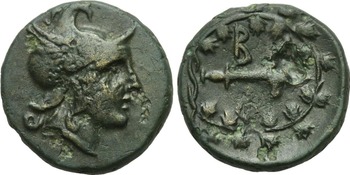
Close examination of coin iconography from the Republic suggests that ambiguity did play a rôle in certain contexts during Roman expansion. I have elsewhere discussed the ambiguity inherent within the bronze coinage struck after the Roman victory in Macedonia in 168 b.c. by the Roman quaestor Gaius Publilius and his successor Fulcinnius.Footnote 29 The issues, similar to the ‘Romano-Sicilian’ coins discussed below, were struck under the authority of a Roman quaestor for use in the region (might we then label them ‘Romano-Macedonian’?). The obverse of the series carried a helmeted head, traditionally identified as a representation of Roma (Fig. 1). However, the iconography of the head is also extremely similar to the head of the hero Perseus, an image that had graced Macedonian coinage before the Roman arrival (Fig. 2; Philip V had also portrayed himself as Perseus on silver tetradrachms).Footnote 30 It is difficult to discern whether this ambiguity was the intention of Publilius or the die engraver, but the absence of an identifying legend (which might have told the viewer whether the image was Roma or Perseus) would have contributed to the image's ability to be read in multiple ways. Earlier Macedonian coins had also presented the hero Perseus without an accompanying legend, furthering the potential for the images to be seen as interchangeable. Even if the ambiguity was not intentional, once in circulation the meaning of the image likely changed as the coin circulated from user to user: a Roman soldier may have glanced at the coin and seen Roma, a local Macedonian Perseus, and over time the identification of Roma may have become the more dominant interpretation.Footnote 31 Due to its mobility coinage has an inherently unstable viewing context that invites multiple meanings or associations.Footnote 32 Romans and Macedonians shared an object and an image in the aftermath of the Roman appearance in the region without necessarily possessing a shared meaning.
Bronze 25 mm coin of Macedonia, 168–167 b.c.(?). Obverse: Helmeted head; helmet ends at the top in a griffin's head. Reverse: ΜΑΚΕΔΟΝΩΝ ΤΑΜΙΟΥ ΓΑΙΟΥ ΠΟΠΛΙΛΙΟΥ within oak wreath. Mackay no. 1. (Classical Numismatic Group Inc., Mail Bid Sale 78, lot 445, www.cngcoins.com)

Bronze 17 mm coin of Philip V, Macedon, 221–179 b.c. Obverse: Head of Perseus right, wearing winged Phrygian helmet. Reverse: Harpa, BA above, Φ below; all within oak wreath. SNG München 1194. (Gitbud & Naumann, Auction 14 lot 137, www.pecunem.com)

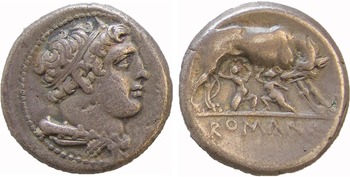
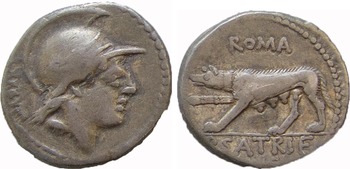
Similarly the figure of the wolf in the Republican world could act in an ambiguous manner, referring to Roman or to other cultures, or both simultaneously. The she-wolf with twins was a quintessential image of Rome, appearing on some of the earliest Roman coins (Fig. 3).Footnote 33 A wolf by itself might also reference Rome, as poignantly demonstrated by the coinage struck by the Italians during the Social War: on one issue a bull (representing Italy) is shown goring a wolf (representing Rome), an image that vividly encapsulated the rebellion of 90–88 b.c.Footnote 34 After the Social War the lone wolf also appeared on coinage issued by Roman moneyers (Fig. 4), an iconographic development perhaps inspired by the Italian use.Footnote 35 These are clear, unambiguous contexts.
Silver didrachm, 269–266 b.c., 20.5 mm Obverse: Head of Hercules, right, with hair bound with ribbon and club and lion-skin over shoulder; border of dots. Reverse: She-wolf, right, suckling twins; in exergue, ROMANO. RRC 20/1. (Yale University Art Gallery, ILE2002.11.32)

Silver denarius, 77 b.c., Rome, 18 mm. Obverse: Helmeted head of Roma; border of dots. Reverse: She-wolf left, ROMA above, P. SATRIE in exergue; border of dots. RRC 388/1b. (Yale University Art Gallery, 2001.87.1594)

But the wolf also acted as a shared image for Rome and some of the communities under her imperium. Dionysius of Halicarnassus relates a story about an omen that appeared to Aeneas which foretold the greatness of Lanuvium: a fire broke out in the forest and a wolf appeared and threw dry wood upon it, then an eagle appeared and fanned the flame with its wings, both animals ensuring the continuation of the fire in spite of a fox that attempted to put it out.Footnote 36 The story is perhaps referenced on Roman sextantes of the third century b.c., and is definitely shown on a first-century denarius displaying Juno Sospita on the obverse (a reference to Lanuvium) and the two animals tending the fire on the reverse.Footnote 37 The wolf then was a symbol shared by both Rome and Lanuvium. Similarly Strabo reports that the Samnite colony of the Hirpini was founded by a wolf, ‘for “hirpus” is what the Samnitae call the wolf’, and Dench suggests that the Hirpini altered their story in the third or second century b.c. so that the wolf was the same animal that would go on to suckle Romulus and Remus.Footnote 38 Multiple groups shared the image, although it was accompanied by different (simultaneously apparent) stories.
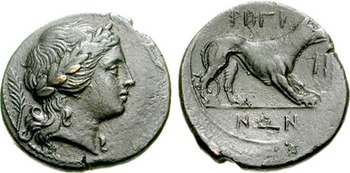
Rhegium provides a further example. Rhegium had been an ally of Rome from the third century b.c. and during the Second Punic War Roman military were stationed within the city.Footnote 39 Bronze coinage struck by Rhegium (carrying the city's ethnic) at this juncture becomes remarkably ‘Roman’ in nature: marks of value appear, and the city releases a type with the Dioscuri on the reverse, an imitation of Roman denarii and providing a terminus post quem of c. 212 b.c.Footnote 40 It was within this context that another bronze coin was struck, showing the head of Apollo on the obverse (a well-established numismatic type in the town) and a wolf on the reverse (Fig. 5).Footnote 41 The image is ambiguous in meaning, although again we have no way of knowing whether this was the intention of the die engraver or issuing authority. The wolf might be viewed as a reference to Rome (particularly given the other Roman influences on the coinage of Rhegium at this time, and the physical presence of Roman soldiers in the town), but it might also commemorate the recent victory of Rome, and Rhegium as her ally, over the Lucani. When striking coinage during the Second Punic War, the Lucani played on the similarity between their ethnic and the Greek word for wolf (λύκος), using a wolf's head as a symbol on their issues, and employing a Greek translation of their ethnic that intentionally underscored the similarity.Footnote 42 The addition of a palm leaf to the obverse of the coin does suggest the celebration of a victory, and the small numbers in which this particular type is found within the archaeological record reflect an issue more commemorative than substantive.Footnote 43 The wolf image then possessed multiple possible interpretations (even if this was not the intention of the creator); different users could generate their own particular meaning, although the image is shared between Romans and locals, providing a point of connection and commonality.
Bronze tetrantes, last quarter of the third century b.c.(?), 23 mm. Obverse: Laureate head of Apollo; palm branch behind. Reverse: Wolf, III in field right, ΡΗΓΙ above, ΝΩΝ in exergue. HN Italy 2562. (Classical Numismatic Group Inc., Mail Bid Sale 67, lot 200, www.cngcoins.com)

The bronzes of Rhegium formed an important source of small change within the city and more broadly within southern Italy, although finds of this wolf issue (and its accompanying larger denomination with jugate heads of the Dioscuri on the obverse) are relatively rare.Footnote 44 Known finds of Republican bronze in Rhegium mainly come from Imperial period contexts, and thus the bronze coinage struck in the name of the city likely facilitated daily transactions in the earlier Republican period: it is the rôle of Rhegium as a harbour that might serve Roman interests that probably meant the city was allowed to continue striking bronze coinage into the second century b.c., after other cities in Italy had ceased to mint.Footnote 45 The city produced coinage that would be used by both locals and Roman soldiers: the types chosen, including the wolf, reflect this context.
The rarity of both the wolf and the accompanying Dioscuri issue suggests they were only struck for a short period. Both series were overstruck on Brettian coins.Footnote 46 Castrizio connected the overstriking to the conquest of Taurianum by the garrison in Rhegium in 213 b.c., though this remains speculative.Footnote 47 In the western Mediterranean during the Second Punic War the Romans did remove existing non-Roman precious metal currency from circulation, presumably to be converted into Roman denarii.Footnote 48 Destruction or removal of the lower value bronze issues by Roman authorities, however, was less common. The overstriking of Brettian issues here may then have been the initiative of the civic élite of Rhegium, who converted the coinage into currency more aligned to Roman ideology (similar to the way that provincial cities in the Imperial period often took greater pains to enforce the damnatio memoriae of emperors on their civic coin issues than the Roman government, whose approach to coinage already in circulation was rather more laissez-faire).Footnote 49 The particular context cannot be certain, but what the overstriking does demonstrate is a monetary culture that saw money as a ‘monument in miniature’: opposing viewpoints communicated by other coin ‘monuments’ needed to be converted.
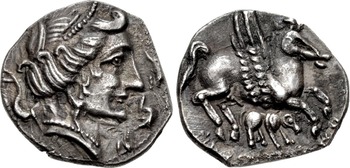
A further example can be found on the Iberian peninsula. Upon arrival in the region during the Second Punic War, Rome took over the production of Greek-style silver Emporitan drachms.Footnote 50 Output at the Emporion mint increased dramatically, and seems to confirm a Roman presence behind the production.Footnote 51 These drachms, now struck to finance Roman military campaigns, have a different style to earlier issues, though they continue to carry the image of a female head surrounded by three dolphins on the obverse, and Pegasus accompanied by the legend ΕΜΠΟΡΙΤΩΝ on the reverse (Fig. 17 below). At around the same time Iberian imitations of these types were struck by Iberian tribes, including one series carrying the Iberian legend ILTIRTAR with a four-legged animal beneath Pegasus, traditionally identified as a wolf (this is clearer on some issues than others) (Fig. 6).Footnote 52 The purpose of these issues is unclear, though they are likely connected to the Roman presence on the peninsula since they date to around this period and were issued in regions under Roman control.Footnote 53
Silver drachm, late third century b.c., 19 mm. Obverse: Female head right with necklace, three dolphins around. Reverse: Pegasus right, wolf and Iberian inscription below. ACIP 356. (Classical Numismatic Group Inc., Triton XVII lot 303, www.cngcoins.com)

Villaronga suggested that the wolf was a totemic animal of Iltirta, and perhaps had religious significance; alternatively the wolf may have referenced a foundation myth.Footnote 54 Wolves decorate other items of material culture on the Iberian peninsula, but the arrival of Rome would have given any representation of the wolf in this region further possible associations. As with Emcporion, Roman military presence on the peninsula was established early in Tarraco (86 km by road from Iltirta/Ilerda); what may be one of the first carvings by Roman artisans outside Italy, placed in the third-century b.c. city wall of Tarraco, shows Minerva with a shield decorated with a wolf's head.Footnote 55 The Romans would have brought a particular set of ideologies and images with them, and, as with the Rhegium coin, the association(s) of the wolf in this new political and cultural landscape may have changed from viewer to viewer.Footnote 56 The representation of the wolf on the drachms of Iltirta, as well as its unusual appearance on the shield of Minerva (in place of the usual gorgoneion), suggests that, like the Hirpini, both Romans and the neighbouring tribe of Iltirta identified with the wolf, and it may have, over time, become a shared symbol.
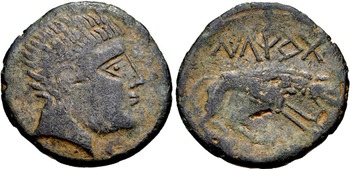
Bronze coinage struck in the name of Iltirta from the second century b.c. carried a wolf as the main design on the reverse (Fig. 7).Footnote 57 On some issues male genitalia is evident, but other examples are not as clear. Again, the image has an ambiguity: the wolf may reference Iltirta or local culture, but it may also (simultaneously) reference Rome for particular viewers. Excavations from Cabrera de Mar have demonstrated that the bronze coinage of Iltirta was present throughout the first century b.c. in both the Iberian oppidum of Buriac and the neighbouring Roman settlement: this issue, alongside other Iberian coinages and Roman denarii, was used by both populations.Footnote 58 The shared symbol became less ambiguous under Augustus when the city became the municipium Ilerda: at this juncture the wolf is altered to become obviously female, and hence unambiguously ‘Roman’. Likewise the male head that had traditionally graced the obverse of these coins becomes, unambiguously, the portrait of Augustus (Fig. 8).Footnote 59 This change in iconography may have been intended to introduce a new association of the wolf, but it may also have merely been articulating one of the associations the image already had amongst some viewers.
Bronze 22 mm coin of Iltirta, c. 80–72 b.c. Obverse: Male head right. Reverse: Wolf standing right, Iberian legend ILTIRTA above. ACIP 1273. (Classical Numismatic Group Inc., Electronic Auction 322, Lot 29, www.cngcoins.com)

Bronze 24 mm coin of Ilerda, 27 b.c.–a.d. 14. Obverse: Bare head of Augustus right, IMP CAESAR DIVI F. Reverse: ILERDA, she-wolf right. RPC 1 259. (Numismatica Ars Classica NAC AG, Auction 64, lot 2359)

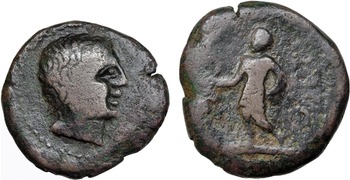
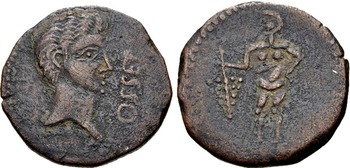
In other cities on the Iberian peninsula the transition to the Principate was more ambiguous. Many of the Iberian coinages struck during the Republic, particularly in Hispania Ulterior, carried male heads (sometimes diademed or laureate) on the obverse.Footnote 60 For the mints that continue into the Imperial period, this male head transforms into a portrait of the emperor, but in some instances the moment of this transition can be difficult to identify. One example is the relatively rare coinage of Osset. The majority of the city's coinage bore a male head on the obverse, and a man carrying a cluster of grapes on the reverse, with the city's name in Latin (Fig. 9).Footnote 61 While the editors of the RPC believed that at some point the male head comes to have the features of Augustus (although they admit the ‘identification is not certain’), others disagree and instead date the ‘Augustan’ coins to the first century b.c. (Fig. 10).Footnote 62 Again, a legend that would identify the image for the viewer is absent. If scholars with the full surviving corpus of Augustan portraiture at their disposal cannot agree on whether the image is Augustus or not (although there is a definitive change in the style of the portrait from earlier issues), then one imagines the inhabitants of Osset faced similar difficulties, with meaning dependent on the knowledge and context of the particular viewer.Footnote 63 We cannot know the precise date of the coin in Fig. 10, but this uncertainty, and the differing views amongst current scholarship, likely reflect the different interpretations the image generated amongst users as the coin circulated over time.
Bronze 32 mm, Osset, Iberia, c. 150 b.c. Obverse: Male head right. Reverse: Human figure standing left, holding bunch of grapes in outstretched right hand; OSET. ACIP 2463. (Jesus Vico S.A., Auction 132, lot 376)

Bronze 27 mm, Osset, Iberia, reign of Augustus(?). Obverse: Male head right (Augustus?), OSSET. Reverse: Nude male figure standing left, holding bunch of grapes in outstretched right hand. RPC 1 58. (Classical Numismatic Group Inc., Electronic Auction 322, Lot 463, www.cngcoins.com)

Similarly, in the Iberian town of Laelia the male head that had traditionally graced the obverse of their coinage may at some point transform into the portrait of Augustus, although the RPC notes they make this suggestion ‘without any great certainty’.Footnote 64 Irippo is another example.Footnote 65 Many mints in Iberia struck issues that named Augustus on the obverse, making their images non-ambiguous.Footnote 66 But even here the problems of differentiating Augustan coins from those issues struck earlier may have been encountered by illiterate members of the population: this class of coin user would have seen a continuation of male portraiture but been unable to read the identifying legend (although in these cases any controversy might eventually be resolved). Over time, however, with the dissemination of the imperial portrait, these ambiguous images may have come to be ‘read’ as Augustus without question. One wonders whether the ‘male head’ types of the first century b.c. and earlier that were still in circulation in the Imperial period might also have come to be ‘seen’ as the portrait of the emperor.
For the city of Turiaso it has been suggested that the female head on issues of the city (identified as a nymph or deity) transforms into the portrait of Livia during the reign of Augustus.Footnote 67 The legend on the obverse remains the same (TVRIASO) however, and so does not offer the viewer any clues; any identification must derive from knowledge of Livia's portraiture. Livia does not appear on the imperial coinage of Augustus, and so if Turiaso chose to place her on their coinage, then they were moving beyond official numismatic representations. In this case the image may have been kept intentionally ambiguous to allow multiple readings. Equally the image may never have been an intentional representation of Livia but may have been ‘read’ as such by users (and subsequently modern scholars). A similar ambiguity can be seen on the reverse of the coin issue. Before the Augustan period the city had struck the common Iberian type of a male head (obverse) and horseman (reverse); in the second half of the first century b.c. (perhaps after 29 b.c.), this horseman becomes similar to an equestrian statue, which some have interpreted as an equestrian statue of Octavian.Footnote 68 Other viewers, however, may have simply seen the continuation of traditional imagery. Coins of Turiaso, along with those of other Iberian cities, have been found along the Rhine, suggesting they, at least in a secondary context, travelled with the Roman military.Footnote 69 Like the issues of Rhegium and of Iltirta/Ilerda, the coins of these cities were used by both Romans and locals, viewed and interpreted by multiple audiences, lending themselves to multiple (re)readings during periods of political and cultural transition, and forming a concrete object through which new groups and identities could be negotiated.
III ICONOLOGY
Just as coins circulate from user to user generating differing interpretations, so too images can move beyond their medium in what Mitchell has characterized as a social life.Footnote 70 Within archaeology the social life of objects has seen some discussion, with object biographies tracing the ‘life’ of an object as it moves from context to context.Footnote 71 In its travels an object may be re-valued, re-imbued with (differing) meaning, re-appropriated, or even reincarnated. So too a particular image may travel from medium to medium (even becoming a mental or verbal image for a time), gaining new associations and meanings.Footnote 72 Key to tracing this social life is the acknowledgement that images are not passive, but can act upon their human observer. Images have the capacity to create new ways of seeing the world, and to introduce new forms of value.Footnote 73
Acknowledging that the meaning and associations of images change as they enter new contexts is vital to understanding how Republican Rome was represented on her coinage. The very first Roman coin bore the traditional numismatic imagery of Neapolis, with the head of Apollo on the obverse and a man-faced bull (likely representing a river) on the reverse.Footnote 74 The use of this imagery for a Roman coin would have given the images additional associations, although they still retained their connection with Neapolis. This complex semantic system persisted as Roman coinage continued; many of the Roman bronze coins produced outside of Rome, for example, bore iconography borrowed from Greek and Hellenistic mints.Footnote 75 This interconnectedness continued even as the quintessentially ‘Roman’ denarius system was introduced during the Second Punic War. This coinage was struck in several provinces simultaneously and, as mentioned above, was accompanied by the removal of precious metal currencies of other states. The imagery chosen for the denarius system was taken from the broader Hellenistic world: the eagle on the thunderbolt selected for Roman gold is otherwise best known from Ptolemaic coinage, the Victory crowning a trophy motif that appeared on Roman victoriati had initially appeared on Seleucid and other Hellenistic coinages, and even the Dioscuri had earlier featured on the issues of Taras and other Hellenistic cities.Footnote 76 The prow on the reverse of Roman bronzes also had precedent in the issues of Demetrius Poliorcetes and other Hellenistic states.Footnote 77
That Rome should choose to decorate her currency with motifs recalling Hellenistic kingdoms in the third century b.c. and not the wolf and twins, or other quintessentially ‘Roman’ imagery, at the moment she was emerging as a serious international power in the Mediterranean, reveals much about how Rome represented her growing hegemony. If images have the power to change how we see the world, can make us see this as that, then the numismatic iconography of Rome's denarius system was intended to show Rome as a Hellenistic power. As mass-produced objects that circulated throughout the Roman Republican world (though significantly more in the West than the East), this particular representation of Rome would have reached a larger audience than the representations of Roman power found in literature or other media. Like other Hellenistic entities in the Western Mediterranean, Rome adopted the visual language of the Hellenistic koine while simultaneously localizing and re-signifying the images chosen.Footnote 78
Hellenistic visual language might have travelled to Rome in multiple ways and via multiple types of media: via Sicily or other Greek cities in the West, and/or via Rome's encounters with Hellenistic monarchs like Pyrrhus. Hellenistic bronze coinages did reach Rome and the West, although the imagery associated with the Hellenistic koine could have travelled on other objects. Although not found in volume in the archaeological record, precious metal coinage of the Hellenistic kings may also have arrived in Rome as booty or via other mechanisms before being converted into Roman denarii.Footnote 79 The disappearance of competing precious metal currency in the West demonstrates that Rome was not averse to such currency conversions.
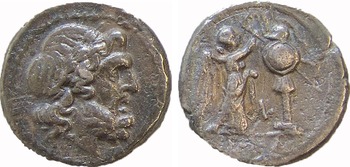
An iconological approach to Republican numismatic imagery has implications for the traditional interpretations of Roman coin types. The victoriatus reverse, for example, showing Nike crowning a trophy (Fig. 11), is traditionally thought to commemorate the gifting of a gold statue of Nike to Rome by Hieron of Syracuse in 217/16 b.c.Footnote 80 It is uncertain why the gifting of a gold statue of Nike would be represented by the image of Nike crowning a trophy, and why this image would have been chosen when Hieron also gifted wheat, barley and archers. Even if this image evoked Hieron's gift for some viewers (as it has for modern scholars), for others the image might have been read as a statement made within the broader context of the Hellenistic koine, with near identical representations seen on coins of the Seleucids, Agathokles (Fig. 12), Capua, and the Bretti (Fig. 13), amongst others.Footnote 81 Victory had previously appeared on Roman coinage (there was a temple to Victory in Rome from 294 b.c.) but this particular representation had never before been seen on Roman coinage. The appearance of Nike/Victory in this particular style signified that Rome was now presenting herself in a manner similar to other Hellenistic powers; the adoption of the iconography need not reflect any particular historical event, nor was it likely to generate only one interpretation.
Silver victoriatus, mint of Luceria, 211–208 b.c., 15 mm. Obverse: Laureate head of Jupiter. Reverse: Victory crowning trophy, L in between. ROMA in exergue. RRC 97/1b. (Yale University Art Gallery, 2001.87.149)

Silver tetradrachm, Syracuse, Agathokles, c. 310–304 b.c., 26 mm. Obverse: Head of Kore right, crowned with barley wreath, ΚΟΡΑΣ. Reverse: Nike fixing helmet to trophy, monogram to left, triskeles to right. ΑΓΑΘΟΚΛΕ in exergue. SNG Cop. 764. (Yale University Art Gallery, 2001.87.4788)

Bronze double, Bretti, c. 214–211 b.c., 27 mm. Obverse: Head of Ares, bearded and helmeted. Reverse: Nike standing left crowning trophy, caduceus symbol in field, ΒΡΕΤΤΙΩΝ. HN Italy 1975. (Yale University Art Gallery, 2001.87.2321)

Similarly, an iconological approach undermines the idea that the image of an eagle on a thunderbolt was placed on Roman gold coinage as a public statement of Ptolemaic financial support during the Second Punic War.Footnote 82 The eagle on the thunderbolt first appeared on the bronze of Ptolemy I in c. 323–305 b.c., but it had also been present on Roman coinage from c. 280–250 b.c.Footnote 83 From this time on the image represented Roman power as much as it did Ptolemaic, with both dynasties claiming the support of Zeus/Jupiter. Indeed, this image had also been used by numerous other cities and kings in the Hellenistic world, including the Bretti during the Second Punic War.Footnote 84 Though the image may have continued to possess Ptolemaic associations, it had gained additional meanings as it was used in new contexts. It cannot be interpreted unequivocally as a sign of Ptolemaic support for Rome.Footnote 85 That the eagle and thunderbolt represented Roman power can also be seen on the so-called ‘Bocchus monument’, one of the rare Republican monuments surviving today. Whether we connect the monument to Sulla or date it to the second century b.c., it is a public statement of Roman power from the Republican period, and significantly the reliefs carry the image of an eagle on a thunderbolt alongside other Hellenistic motifs.Footnote 86
The complexity of the situation can be seen in the city of Agrigentum (Akragas) in Sicily. In the second century b.c. the quaestor Manius Acilius struck, as part of the ‘Romano-Sicilian’ coinage issued for use in western Sicily and discussed below, a type that carried an eagle on a thunderbolt on the reverse (Fig. 14).Footnote 87 The issue may have been meant for use within Agrigentum, which struck the same obverse and reverse type carrying their ethnic (Fig. 15).Footnote 88 Although the dating of these two particular types remains uncertain, they are thought to be roughly contemporary. At this particular moment in time, then, Agrigentum contained two sets of coinages with identical imagery, one carrying the name of a Roman magistrate in Latin and the other the name of the city in Greek.Footnote 89 The city's earlier coinage had also borne eagle types (most commonly an eagle attacking a hare), and during the occupation of the city by the Carthaginians in the Second Punic War, silver half and quarter shekels were struck in the name of the city with an eagle on a thunderbolt on the reverse.Footnote 90 The image then would have had multiple possible meanings, and possessed significance for both Roman and Agrigentine users. The coin was a shared image and object that did not necessitate shared meaning.
Bronze 22 mm ‘Romano-Sicilian’ coin, western Sicily, c. 190/170–130/120 b.c. Obverse: Head of Zeus, dotted border. Reverse: Eagle on a thunderbolt with wings outstretched, MN (ligate) ACILI. Bahrfeldt 1904: no. 7. (Dr. Busso Peus Nachfolger, Peus Auction 378 lot 51)

Bronze 23 mm, Agrigentum, c. 170–130 b.c.? Obverse: Laureate head of Zeus, dotted border. Reverse: Eagle on a thunderbolt with wings outstretched, ΑΚΡΑΓANTINΩN. Gabrici no. 154. (Yale University Art Gallery, 2001.87.2677)

As a medium designed to make differing value systems commensurate, and which is often at the forefront of any cultural contact, it is no surprise that money should carry responses to, and presentations of, Roman imperium. The interaction and interplay between coin types in the Republican world reveals how Romans and local élites interacted within the framework of Republican imperium, a concept of ‘empire’ focused on influence and power rather than territory. From the second century b.c., for example, élites in Gaul selectively imitated Roman denarius types and struck coins on the Roman weight standard, in all likelihood to commemorate alliances between particular tribes and individual Romans. There is little other archaeological evidence to suggest influence from the Roman world at this time, and the issues are small in number, suggesting a political, rather than an economic motive for their minting.Footnote 91 As Rome adopted images from the broader Hellenistic koine to demonstrate their power and status, so too did this recur at a more local level, with élite individuals adopting Roman imagery to create statements about their own power and prestige. The resulting coins reveal how regions entered into the sphere of Roman imperium before they were ever officially ‘conquered’.
Similarly, towards the end of the third century b.c. the Iberian Saetabi began to strike coinage for the first time, perhaps to cover costs incurred as part of a relationship with Rome, or for other local expenses. The reverse type was an eagle copied directly from contemporary Roman gold coinage; as in Gaul, there is little other material evidence to suggest Roman influence in this region at this time.Footnote 92 Ripollés characterizes the image at this juncture as one of power and military triumph; given the issue was struck when Rome was establishing her hegemony in the region, it is uncertain whether the eagle here specifically referenced Roman power, or whether the Saetabi selectively adopted this particular image and its associations from Roman coinage to represent themselves and their aspirations. But it was a Roman coin, and the Roman arrival on the Iberian peninsula, that sparked the adoption of coinage and the use of this image. Like the broader Hellenistic world, the material culture and images of the Roman Republic are characterized by constant movement between the ‘universalizing’ and ‘particularizing’. The Roman Empire has recently been characterized as a process of increased cultural connectivity (particularly after 200 b.c.), with Versluys proposing that, archaeologically speaking, Rome is a ‘series of objects in motion’.Footnote 93 We might state that Rome was, additionally, constituted by a series of images in motion. Here the ‘universal’ image (the eagle) is made ‘particular’ by its appearance on a coin of the Saetabi, accompanied by the name of the tribe in Iberian script and an obverse showing the ‘universal’ Herakles made local through the addition of dots around the god's neck, which may represent a torque.Footnote 94
Studies of colonial or contact situations in the more modern world have demonstrated that while initially the dominant power creates a vision of the new order via currency, the adoption of this vision by those under the hegemonic power's control is the moment that ‘your’ money or ‘the government's money’, becomes ‘our’ money.Footnote 95 And it is at this moment that an ‘imagined community’ is created, when people begin to accept the message, communicated via media, that they belong to a larger community that exists beyond their everyday interactions or experiences.Footnote 96 The proliferation of the imperial image on coinage was key to the development of the ‘imagined community’ of the Roman Empire,Footnote 97 but what of the Republic? There is no single unifying image as in the later period, but the active rôle played by coinage, and coin imagery, can still be identified. A demonstrative example is provided by the ‘Romano-Sicilian’ bronzes, struck by the Romans for use in western Sicily, specifically in the region encompassing the cities of Panormos, Iaitas, Solus, Lilybaion and Agrigentum. Amongst the designs of these coinages was an issue decorated with the head of Zeus on the obverse and a ‘soldier’ or ‘warrior’ on the reverse (an ambiguous image open to multiple interpretations), and another with the head of Apollo on the obverse with a kithara on the reverse.Footnote 98 Panormos, Iaitas, Solus and Lilybaion later struck coins carrying their ethnics and reproducing the images of these particular coins, which circulated in their respective regions: the money of the Roman magistrates had become the money of the cities.Footnote 99
The adoption and use of the denarius as a denomination also contributed to the creation of a community. The introduction of a new type of currency and its acceptance in the western Mediterranean represented, in physical form, Rome's authority in these regions, although the example of Gaul demonstrates that élites elsewhere may have decided to adopt the denominational system as a political statement of alliance with Rome.Footnote 100 The circulation of this type of currency in the western Mediterranean would have spatially delineated Roman influence. The exchange of currency, as it passed from user to user would have reaffirmed the sense that both individuals belonged to the Roman political economy, with each monetary exchange ‘a momentary recognition of a common “imagined community”’.Footnote 101 Notably this phenomenon was confined to the West: denarii would not penetrate east into Greece and beyond until the final decades of the Republic, and in Syria they only circulated extensively in the late first and second centuries a.d.Footnote 102
The denarius denomination was also produced in quantity in Hispania Citerior by Iberian tribes (Hispania Ulterior, by contrast, struck no silver). The resulting coins are known as ‘Iberian denarii’. These silver denarii all bore similar iconography, albeit with some slight variation: on the obverse a male head (sometimes bearded, sometimes surrounded by dolphins or other symbols), and on the reverse a horseman, often carrying a lance or a palm-branch, accompanied by the name of the tribe in local Iberian or Celtiberian script (Fig. 16).Footnote 103 Iberian denarii were struck during the second century b.c. and ceased after the Sertorian wars, and are found mainly in the south of the peninsula.Footnote 104 Precisely when in the second century these denarii began to be produced (either early or middle second century) remains the subject of debate, as does their purpose.Footnote 105 The fact that they are only struck in Hispania Citerior and bear very similar iconography, although struck by different tribes, suggests some form of Roman tolerance or permission, while the types and script suggest local involvement.Footnote 106 Like the adoption of the imagery of a ruling power, the adoption of the denomination of the ruling power and making it one's own is significant in community formation. Scholarship to date has focused on the possible uses and contexts of this coinage, but perhaps the most significant thing about these issues is their very existence. A shared coin denomination and iconography within Hispania Citerior would have contributed to a shared sense of common identity throughout the region within the context of expanding Roman hegemony.
Silver Iberian denarius, Bolskan-Osca, second century b.c., 19 mm. Obverse: Bearded male head with collar, BON in Iberian script behind. Reverse: Horseman right holding spear. Iberian inscription BOLSKAN below. ACIP 1412–17, 1422–3. (Yale University Art Gallery, 2001.87.7291)

The eastern Mediterranean instead used different silver coinages, which may have changed association in response to the Roman presence. Rather than shipping in or minting denarii in the East, Rome made use of existing precious metal currencies: Athenian stephanophoric tetradrachms, Macedonian and Thasian tetradrachms, Achaean league hemidrachms, cistophori of Asia Minor, and tetradrachms of Philip Philadelphos.Footnote 107 Some issues show only stylistic differences to earlier coins, while others, like the cistophori, carry monograms or legends that refer to Roman magistrates. Many of the latter were struck in the first century b.c.: from 60 b.c. the cistophori of Ephesus and Pergamon began to carry monograms and the letter Q, referring to Roman quaestors, similar to the appearance of the letter Q and the name of Aesillas on the tetradrachms of Macedonia struck c. 90–70 b.c.Footnote 108 Before the denarius Rome had also made use of local precious metal currency in the West: upon arriving in Iberia, she took over the existing mint of Emporion, and struck drachms carrying the Greek ethnic of the town, albeit with a change in the style of Pegasus' head (Fig. 17).Footnote 109 It is impossible to define the precise nature of the Roman involvement in these mints, but an iconological approach to the material leads us to ask: did a Roman presence or context at these precious metal mints, marked by an increase in output, lead to a change in the associations of the coinage and its imagery for the user? The increase in volume, and the fact that these coins (and their imagery) were now struck for Roman contexts, must have affected the associations of these coinages in the minds of some users.
Silver drachm, Emporion, c. 218–212 b.c., 19 mm. Obverse: Female head right, grain ears in hair, three dolphins around. Reverse: Pegasus right, ΕΜΠΟΡΙΤΩΝ. ACIP 186. (Classical Numismatic Group Inc., Mail Bid Sale 64, lot 12, www.cngcoins.com)

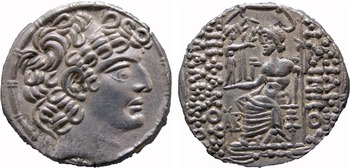
After the Roman conquest of Syria in 68 b.c., the mint at Antioch produced silver Philip Philadelphos tetradrachms with a small alteration to the original design: a monogram was added that referred to the autonomous city of Antioch.Footnote 110 With the arrival of the Roman governor Aulus Gabinius in c. 57 b.c., the monogram changed to refer to Gabinius (Fig. 18), and then the successive governors Crassus (54/3 b.c.), and Cassius (53/2 b.c.).Footnote 111 A Caesarian era was adopted on issues from 47/6 b.c., and the obverse showing the head of Philip Philadelphos was replaced by one showing and naming Augustus in 5 b.c.Footnote 112 As in other mints, the Roman presence resulted in a higher volume of silver production. Again, while some may have merely seen continuity, other coin users may have associated the Philadelphos tetradrachms with their new governor.Footnote 113 During Gabinius' governorship several cities in the region adopted the name Gabinia and Nysa-Scythopolis struck coins that probably bear his portrait accompanied by the letters ΓΑ (the first provincial representation of a Roman on a coin since Flamininus).Footnote 114 Find evidence demonstrates the Philadelphos tetradrachms of Gabinius and his successors circulated well into the Imperial period; over time the issues, and their imagery, must have come to be seen as products of the Roman government, whether Republican or Imperial.Footnote 115
Silver tetradrachm, Antioch, Aulus Gabinius, 57–55 b.c., 26 mm. Obverse: Diademed head of Philip Philadelphos. Reverse: Zeus seated left holding Nike and sceptre; monogram of ΑΥΓΒ to left; ΒΑΣΙΛΕΩΣ ΦΙΛΙΠΠΟΥ ΕΠΙΦΑΝΟΥΣ ΦΙΛΑΔΕΛΦΟΥ on either side. RPC 1 4124. (Yale University Art Gallery, 2005.6.47)

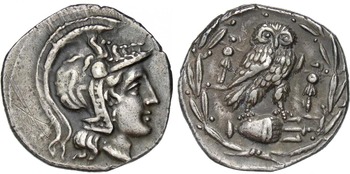
That Roman involvement in local silver coinages may have changed the association of these issues can be seen in references to ‘Lucullan’ coinage. Plutarch records that during Sulla's campaigns Lucius Lucullus was in charge of the mint, and most of the coinage used in the Peloponnese during the Mithridatic Wars was struck by him, and ‘called Lucullan after him’.Footnote 116 A first-century b.c. inscription from Delphi mentions the sum of 105 ‘flats of Lucullus’ (πλάτεων Λευκολλίω̣[ν]), confirming Plutarch's statement (Plutarch further observes that the coins circulated for a while).Footnote 117 As de Callataÿ observes the price of 105 ‘Lucullan’ pieces for enfranchisement suggests that the inscription (and hence Plutarch) are referring to tetradrachms or a large silver denomination.Footnote 118 These coins have traditionally been identified as the Athenian tetradrachms struck after Sulla's sack of Athens: these coins carry the imagery of Athens, but instead of an ethnic (ΑΘΕ) they carry monograms referring to Marcus Lucullus, one of Sulla's commanders (Fig. 19).Footnote 119 Rarer types probably bear representations of the trophies of Chaironeia, Sullan monuments that also decorated Roman aurei and denarii (Fig. 20).Footnote 120 Cistophori in Asia were also struck in quantity at this time (84/3–80/79 b.c.), particularly by Ephesus, and de Callataÿ suggests these may in fact be the ‘Lucullan coinage’ of our sources (Fig. 21), although overstruck tetradrachms of Thasos are also possible.Footnote 121 Whatever we identify as ‘Lucullan’ coinage, they are not Roman denarii, but issues struck with local designs by a Roman magistrate. In spite of their local imagery and denomination, they are named by two sources as ‘Lucullan’, indicating that the imagery, and the coinage it graced, had gained new associations.
Silver tetradrachm, pseudo-Athens, 86–84 b.c., 31 mm. Obverse: Head of Athena Parthenos right; dotted border. Reverse: Owl right, head facing, wings closed, standing on amphora which lies on its side. Monogram on either side, which reads ΜΑΡΚΟΥ ΤΑΜΙΟΥ. All within an olive wreath. Thompson 1923a. (Numismatica Ars Classica NAC AG, Auction 48, lot 79)

Silver tetradrachm, pseudo-Athens, Sulla, 86–84 b.c., 31 mm. Obverse: Head of Athena Parthenos right; dotted border. Reverse: Owl right, head facing, wings closed, standing on amphora which lies on its side, trophies on either side. All within an olive wreath. Thompson 1341–5. (Münzkabinett, Staatliche Museen zu Berlin, 18246483. Photograph by Reinhard Saczewski)

Silver cistophorus, Ephesus, 82–81 b.c., 26 mm. Obverse: Cista mystica with serpent within ivy wreath. Reverse: Bow case between two serpents. NΓ above, ΕΦΕ to left, torch to right. ΒΜC 165. (Yale University Art Gallery, 2001.87.222)

Although Hieron struck Ptolemaic types in SyracuseFootnote 122 and occasionally smaller Hellenistic rulers struck imitative types of other kings, the continued striking of existing precious metal currencies by Rome is unusual for its longevity; tetradrachms of Philadelphos, for example, were struck until 17/16 b.c., well after Rome had introduced her own currency system.Footnote 123 In the West production of local precious metal currencies ceased after the introduction of the denarius, but the practice continued to the very end of the Republic in the East. Local silver denominations continued to be produced in the eastern Mediterranean in the Imperial period, but with different imagery; the most obvious change is the introduction of the portrait of the reigning emperor. The widespread and continued use of local coinages by the Romans indicates some of the complexities behind the representation of Rome in the Republican period. Rome might represent her imperium through images that originated at Rome, but might equally transform existing imagery in a particular region.
IV ENTANGLED IMAGES AND OBJECTS
Objects, as well as images, transformed in meaning during Roman Republican expansion. Like images, objects can play an active rôle in communicating or conceptualizing particular abstract concepts, in communicating different relationships, and in making (imagined) communities ‘concrete’. In recent years this rôle has been explored through the idea of ‘entanglement’.Footnote 124 The concept was developed within Thomas' work Entangled Objects, which emphasized how objects can embody, symbolize, and clarify different human relations.Footnote 125 In particular, Thomas identifies the way an object can gain value and significance through previous connections with peoples and cultures. A good example of an entangled object is an engagement ring: once given, it is inalienable, removed from the sphere of commodities, and not to be sold or given away. The ring signifies the relationship between two people to such an extent that the ending of an engagement is achieved by the handing back of the ring: the signifier and signified are that closely connected.Footnote 126 Here and elsewhere material culture supports social interaction, contributing to the perception and understanding of one's place in the world.
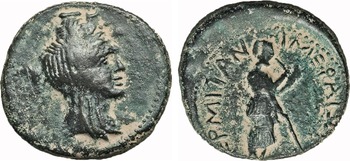
While coinage functioned as a medium of commensuration that went between cultures and value systems as it bound them together, the imagery carried by these coins also offers an insight into the entangled objects that might have defined relations between Rome and local cities. One example is the Sicilian city of Thermae, which Cicero states was founded by the citizens of Himera after the destruction of their city by the Carthaginians in 409/8 b.c.Footnote 127 After the Roman conquest of Sicily Thermae struck six bronze coin types. One issue bore the bust of Tyche on the obverse and the poet Stesichorus on the reverse (Fig. 22), another the head of Hercules on the obverse and what is likely three nymphs on the reverse. Other issues displayed the head of Herakles (obverse) and a standing Tyche (reverse) (Fig. 23), the bust of Demeter (obverse) and Pallas holding Nike(?) (reverse), and a female head or Hermes (obverse) with a goat on the reverse (Fig. 24).Footnote 128 While the dating of these issues is difficult to determine beyond being of the ‘Roman era’, Frey-Kupper has recently argued that the issue with the three nymphs, as well as the issue showing Tyche on the reverse, belongs to the period 90–50/40 b.c.Footnote 129 The other issues lack stratigraphic or hoard data that could be used for dating, although numismatists agree they were struck after Sicily became a Roman province.
Bronze 24 mm, Thermae, after 241 b.c. Obverse: Turreted and veiled head of Tyche right, cornucopia behind. Reverse: The poet Stesichorus standing right, leaning on staff and reading book. ΘΕΡΜΙΤΑΝ ΙΜΕΡΑΙΩΝ. Gabrici 5–6. (Heritage World Coin Auctions, Long Beach Signature Sale 3035, lot 32026)

Bronze 22 mm, Thermae, after 241 b.c. Obverse: Head of Hercules right, wearing lion-skin; dotted border. Reverse: Tyche wearing turreted crown, holding patera and cornucopia. ΘΕΡΜΙΤΑΝ ΙΜΕΡΑΙΩΝ. Gabrici 11–15. (Numismatica Ars Classica NAC AG, Auction P, lot 1199)

Bronze coin of Thermae, after 241 b.c., diameter unrecorded. Obverse: Draped bust of Hermes wearing winged petasus, caduceus in front; dotted border. Reverse: Goat resting. ΘΕΡΜΙΤΑΝ. (Numismatica Ars Classica NAC AG, Auction 46, lot 823)

The representation of Stesichorus, Tyche, and the goat are of particular interest since they recall the bronze statues of the city detailed by Cicero in his Verrine Orations. Cicero and other Roman orators acknowledged the power of images (verbal or mental), and often used them to evoke emotion or response from an audience.Footnote 130 In the fourth part of his second speech against Verres, Cicero details the statues and monuments stolen by the praetor from Sicily; in doing so Cicero aims to arouse the indignation of his Roman audience.Footnote 131 But Cicero goes one step further by including an example of works that Verres unsuccessfully attempted to remove.
Cicero details that Verres was taken by certain statues of Thermae and pressed a local, Sthenius, to help him obtain them. The statues included a figure of Himera, represented as the figure of a woman (the Tyche of the city), a statue of the poet Stesichorus ‘represented as an old man leaning forward and holding a book’, and the statue of a she-goat.Footnote 132 Sthenius' response was that Verres could not acquire the objects, since these statues were monumenta of Scipio Aemilianus and they ‘could not by any possibility be carried away from the town of Thermae so long as Thermae and the imperium of the Roman people (imperioque populi Romani) remained intact’.Footnote 133 Here we glimpse the function of these statues as entangled objects: like an engagement ring, they came to embody the relationship between Rome and Thermae to such an extent that their removal would signify the destruction of the relationship. Cicero elaborates by summarizing a speech Sthenius gave against Verres' proposal: ‘better, he said, for them to abandon Thermae than to allow the removal from Thermae of those memorials of their fathers, those trophies of victory, those gifts of their illustrious benefactor, those tokens (indicia) of their alliance and friendship with the Roman people’.Footnote 134 Verres’ desire to obtain the statues is thus not only an affront to the city of Thermae, but to the descendants of Scipio and the res publica more generally. Cicero makes Thermae's statues matter for his Roman audience.
The object biographies of these statues as related by Cicero reveal the multiple meanings these objects possessed. Cicero states that the statues had originally been located in Himera, had been taken by the Carthaginians, and then returned to the citizens of Thermae by Scipio Aemilianus.Footnote 135 After the destruction of Carthage and his subsequent triumph in 146 b.c., Scipio invited the cities of Sicily to claim their stolen cultural heritage.Footnote 136 Cicero observes that in addition to Thermae, Agrigentum, Gela, Himera, Tyndaris and Segesta reclaimed property that had previously been stolen by the Carthaginians.Footnote 137 Mummius, who also celebrated a triumph in 146 b.c., is also known to have distributed spoils to cities outside of Rome. Whether Scipio was in competition with Mummius or motivated by some other cause is hard to know: he may have wished to capitalize on the idea of defence of ‘hellenism’ against the Carthaginians and the possible parallels this might have evoked with Greek wars against the Persians; or Scipio may have wished to improve his client base in Sicily. As the words of Cicero so eloquently demonstrate, Scipio's actions would also serve to improve his reputation amongst the Roman élite.Footnote 138
Cicero argues that by returning the statues to Thermae Scipio achieved a form of immortality since, if they had gone to Rome, they ‘would be called Scipio's for a short while only’ and then gain the names of those who inherited them, but by placing them in Thermae they will ‘be Scipio's always; and so indeed they are described’.Footnote 139 Two statue bases from Thermae (both Imperial period copies) demonstrate that statues were publicly named as spoils given back to the city by Scipio.Footnote 140 The statues thus could evoke multiple (simultaneous) associations in the viewer/listener: they were symbols of the city's ancient Himeran past and the town's past glories (Stesichorus), and embodied the town's relationship with the Romans (Scipio) and Roman imperium. The biographies of these objects made them inalienable, and Cicero concludes that Thermae was almost the only place in the world that prevented Verres from removing their treasures.Footnote 141 Cicero's speech and the subsequent publication of the Verrines would only add extra levels of meaning to these objects: they are described within the Roman gaze of the conqueror (as charming or beautiful works of art) and become symbols of Verres' tyrannical actions.Footnote 142 Indeed, since Cicero presents two contrasting approaches to Roman rule within this work (one of exploitation, embodied by Verres, and another more lenient approach, embodied in the actions of Scipio and others), the statues of Thermae become a case study in how Rome should govern the regions under her control.Footnote 143
The multiple, simultaneously existent, associations of these statues would also have been present when looking at Thermae's coinage: as the coins circulated from user to user, one, several, or even perhaps none of the meanings discussed above would be evoked. If the coins are dated to before Scipio's actions (although it seems odd to choose to portray stolen statues on one's coinage), then their imagery would have gained additional meanings after 146 b.c.; the few archaeological contexts for these pieces suggest that they continued to be used until the Imperial period.Footnote 144 If the coins were struck after 146 b.c., then the designs were likely chosen to acknowledge the return of these pieces to Thermae. These particular issues (showing Stesichorus, Tyche, and the goat) appear to be rare in the archaeological record, suggesting that they may, in fact, have been celebratory or commemorative in nature, although future findings may change our understanding.Footnote 145 These bronze coins were struck to interact with and work alongside the silver currency of Rome, which is found in Thermae alongside Roman bronzes, and the coins carried imagery that embodied local-Roman points of interaction. Ironically, then, inalienable objects came to decorate a medium whose function is to make all things alienable.
That these coins show statues is not immediately apparent; none of the figures have statue bases that would communicate this fact to the viewer. Indeed, without Cicero we would not know the broader significance of these images, and the statues they reference. Other cities may have had similar statues or other objects that embodied their relationship with Rome. The case study of Thermae demonstrates that conceptualizations of Roman power could be very local. None of the other cities mentioned by Cicero in his work placed the statues described by Cicero on their local coinage (that is, none of the Roman-period coins of these cities carry types that match the descriptions of the statues provided by Cicero); the precise visualization of each city and its place in the Roman world differed.
Entanglement is an active process whereby ‘foreign’ goods are appropriated, transformed, and/or manipulated by individuals or social groups, resulting in new meanings and uses.Footnote 146 In this process ‘Roman’ and ‘local’ can be difficult to separate.Footnote 147 A contrast to the entangled objects of Thermae is the entangled imagery found on a coin issue of Gnaeus Domitius Calvinus, struck on the Iberian peninsula in 39 b.c. (Fig. 25).Footnote 148 Unlike at Thermae, this issue was not a civic coin with imagery chosen by the élite, but a precious metal coin that was a joint product of Osca and Domitius Calvinus (at least, this is the official statement of the coin itself, although in reality Domitius Calvinus may have ordered the issue). Calvinus had been a supporter of Caesar and was sent to Spain in 40 b.c. by Octavian. The obverse of the coin series bears the Latin legend OSCA, and the male head of local Oscan-Bolskan Iberian denarii (Fig. 16 above). The reverse bears Domitius Calvinus' titles as consul for the second time and imperator, and displays pontifical emblems. The result is an issue that is analogous to ‘double-portrait’ types seen in the late Republic: depending on which side of the coin you look at, the authority behind the coin changes (Osca, or Calvinus). The coin itself is both ‘Roman’ and ‘Oscan’, a physical manifestation of the entanglement between Rome and her provinces in this period.
Silver denarius, mint of Osca, 39 b.c., 18 mm. Obverse: Bearded male head right, wearing collar. OSCA behind. Reverse: Simpulum, aspergillum, axe and apex. DOM COS ITER IMP. Border of dots. RRC 532/1. (Münzkabinett, Staatliche Museen zu Berlin, 18237055. Photograph by Lutz-Jürgen Lübke (Lübke und Wiedemann))

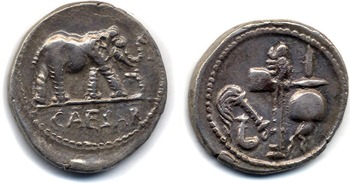
Although Crawford interpreted the iconography as a reference to Calvinus' position as a member of the Roman priesthood, the reverse image likely had more than one association.Footnote 149 In fact the reverse image is reproduced exactly from a coin issue of Julius Caesar struck in c. 49–48 b.c. (Fig. 26).Footnote 150 In the midst of the scholarly dispute surrounding the meaning of the elephant on the obverse of Caesar's issue, the extraordinary nature of the reverse (the first time all these symbols had been portrayed together on a single coin) can be overlooked. It is clear that both the obverse and reverse types came to reference Caesar himself; both the elephant and the pontifical emblems were used by supporters of Caesar on their own coins to proclaim their allegiances, initially to Caesar, and then to Octavian.Footnote 151 On Fig. 25 then, there are potential references to the local region, Calvinus' titles and office, his previous support of Caesar, and his current support of Octavian. Examples of this coin are found in Spain, but also in Italy and France.Footnote 152 As the coin travelled its Oscan iconography would likely have been read as ‘Roman’, a representation of Roman power.
Silver denarius, mint moving with Caesar, 49–48 b.c., 18 mm. Obverse: Elephant trampling snake(?) right, CAESAR in exergue. Border of dots. Reverse: culullus, aspergillum, axe, and apex. Border of dots. RRC 443/1. (Australian Centre for Ancient Numismatic Studies, Macquarie University)

V CONCLUSION: IMPERIAL IDEOLOGIES IN THE REPUBLIC
The above case studies demonstrate the variety of ideologies that developed within the Roman Republican world before the Principate, and the potential of coinage from this period as a source base. The above is only a selection of the large mass of material that survives, but these coins and others suggest that while there were some points of commonality, (re)presentations of Roman power were (re)negotiated at each point of contact. In a sense, the variety of strategies and ideologies that can be traced on coinage (and this article only provides a beginning) is not surprising, given that Roman coinage itself increasingly bore a multiplicity of messages created within the context of aristocratic competition and self-display.Footnote 153 What Roman Republican hegemony ‘looked like’ could vary from region to region and from year to year, a picture that conforms to other recent work on the Republic.Footnote 154
Those who found themselves under Roman imperium often conceptualized their world within existing frameworks, derived from the broader Hellenistic koine or from local contexts. Given the previous experiences of Hellenistic kings, it is no surprise that both Rome and provincial élites framed Roman control inside a Hellenistic framework. As elsewhere throughout history, images and material culture provided a basis for making abstract notions of Roman imperium concrete, for conceptualizing new political or cultural orders, with coinage and its imagery proving an important medium in this regard. Images and objects can have ambiguous, multiple meanings, and those within the Republic utilized this to great effect in order to communicate and/or negotiate Roman hegemony.
At what point then do we find a point of transition, a movement towards the ideologies and images that we typically associate with the provincial coinage of the Principate? Burnett's exploration has demonstrated that the Augustan ‘revolution’ on coinage was a slow process that lasted into the Julio-Claudian period, and was one that also had great diversity.Footnote 155 But a key transitional moment, in numismatic terms, may be the elephant coin of Julius Caesar (Fig. 26 above). Caesar had acquired the Roman treasury before striking this issue and it was one of the largest denarius issues the Republic had ever seen.Footnote 156 For the first time, a coin type that carried direct allusion to the position and achievements of one living individual was struck in large enough quantities to operate as a medium of mass communication on an empire-wide scale. It is surely no coincidence that this issue, carrying the image of an elephant on the obverse and the symbols of Caesar's priesthood on the reverse, is the first clear example of Roman numismatic imagery adopted on provincial coinage in multiple provinces across the Empire.Footnote 157 Before this, Roman coinage was characterized by a multitude of differing ideologies and images. It was a chameleon that responded to different moneyers and regions, lacking the focal point of the emperor that would come to dominate Imperial currency. In this context, the coinage of the regions that fell under or encountered Rome's imperium also reflected multiple conceptualizations of Roman hegemony, multiple ‘Roman Republics’. From the time of Caesar, however, Roman coinage became increasingly focused upon one individual.