Around AD 500, metal began to be used and exchanged in the Eastern Arctic (i.e., Canada and Greenland) in a more intensive and extensive way than what was previously seen in the region (Figure 1). The group that inhabited the Eastern Arctic at this time is known archaeologically as the Late Dorset (Figure 2; Appelt et al. Reference Appelt, Damkjar, Max Friesen, Friesen and Mason2016; Maxwell Reference Maxwell1985). The Late Dorset are the descendants of peoples that had lived in the Arctic since the first evidence of human presence in circumpolar North America around 3000 BC. They disappear from the archaeological record around the thirteenth to fourteenth centuries AD (Appelt et al. Reference Appelt, Damkjar, Max Friesen, Friesen and Mason2016; Appelt and Gulløv Reference Appelt, Gulløv, Maschner, Mason and McGhee2009; Friesen Reference Friesen2019; Savelle et al. Reference Savelle, Dyke, Whitridge and Poupart2012), which coincides with the eastward migration of the early Inuit—an archaeologically and genetically distinct group—from Alaska into Canada and Greenland (Fitzhugh Reference Fitzhugh, Morrison and Pilon1994; Friesen and Arnold Reference Friesen and Arnold2008; McGhee Reference McGhee, Maschner, Mason and McGhee2009; Pinard and Gendron Reference Pinard, Gendron, Maschner, Mason and McGhee2009; Raghavan et al. Reference Raghavan, DeGiorgio, Albrechtsen, Moltke, Skoglund, Korneliussen, Grønnow, Appelt, Gulløv, Max Friesen, Fitzhugh, Malmström, Rasmussen, Olsen, Melchior, Fuller, Fahrni, Stafford, Grimes, Priscilla Renouf, Cybulski, Lynnerup, Lahr, Britton, Knecht, Arneborg, Metspalu, Cornejo, Malaspinas, Yong Wang, Raghavan, Hansen, Khusnutdinova, Pierre, Dneprovsky, Andreasen, Lange, Geoffrey Hayes, Coltrain, Spitsyn, Götherström, Orlando, Kivisild, Villems, Crawford, Nielsen, Dissing, Heinemeier, Meldgaard, Bustamante, O'Rourke, Jakobsson, Thomas P, Gilbert and Willerslev2014).
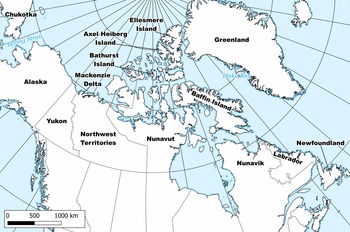
The North American Arctic with the names of major locations mentioned in the text.

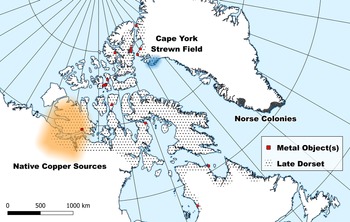
Location of potential metal sources and Late Dorset sites with surviving metal objects. (Color online)

Importantly, the term “Dorset” is used here as it is the most common term in the archaeological literature. The name is derived from “Cape Dorset,” the Euro-Canadian name for Kinngait, a community in southwest Baffin Island, where archaeological collections were first identified and defined for what we know now as the Dorset culture (Jenness Reference Jenness1925). The Dorset are thought to be the Tuniit of Inuit oral histories (e.g., Rowley Reference Rowley, Morrison and Pilon1994), and although an Inuit term is preferable over the archaeological designation from the author's perspective, there is no consensus among all stakeholders (e.g., Friesen Reference Friesen2015; Hodgetts and Wells Reference Hodgetts and Wells2016). As such, this article will use “Dorset” to refer to these peoples in order to remain consistent with the published record. This term represents similarities in the archaeological record only. How these Arctic peoples referred to themselves or how they understood any sociocultural divisions in the Eastern Arctic at this time is not known.
The emergence of the Late Dorset archaeological culture around AD 500 brings with it several changes (Appelt et al. Reference Appelt, Damkjar, Max Friesen, Friesen and Mason2016). This includes a reoccupation of High Arctic Canada and Greenland (Schledermann Reference Schledermann1990), a region unoccupied during the Middle Dorset period for nearly 500 years; large aggregation sites spread throughout the Eastern Arctic (Damkjar Reference Damkjar, Appelt, Berglund and Gulløv2000, Reference Damkjar and Sutherland2005; Park Reference Park2003; Ryan Reference Ryan2003); a purported increase in the production of carved “art” objects (Taçon Reference Taçon1983); increasingly similar artifact styles (Appelt et al. Reference Appelt, Damkjar, Max Friesen, Friesen and Mason2016; Maxwell Reference Maxwell1985); and the widespread use and exchange of copper and iron (Cooper Reference Cooper, Friesen and Mason2016; McCartney Reference McCartney and Ehrenreich1991).
Assessing the extent and intensity of Dorset metal use has largely relied on surviving metal tools in museum collections (Cooper Reference Cooper, Friesen and Mason2016; Farrell and Jordan Reference Farrell and Jordan2016; Pike et al. Reference Pike, Kory Cooper and Hunt2019). However, probably due to past excavation techniques, differential preservation, and object curation on the part of the Dorset, metal is underrepresented in existing collections (McCartney Reference McCartney, Shaw, Harrit and Dummond1988). Although new excavation methodologies have recovered proportionally more metal than previous work in Arctic sites (Appelt et al. Reference Appelt, Jensen, Myrup, Haack, Sørensen and Taube2015; LeMoine et al. Reference LeMoine, Helmer and Grønnow2003), Late Dorset metal is still recovered in relatively low quantities compared to other materials. This has led to the notion that metal was widespread but rarely used by Late Dorset groups.
Inuit contexts have produced proportionally more metal than Late Dorset contexts (McCartney Reference McCartney, Shaw, Harrit and Dummond1988, Reference McCartney and Ehrenreich1991; McCartney and Mack Reference McCartney and Mack1973). This disparity might be a result of most early Inuit contexts being younger than some Late Dorset contexts as well as many Dorset sites being scavenged and disturbed by later Inuit activity (Park Reference Park1993, Reference Park, Friesen and Mason2016). Research focusing on Inuit contexts has increased the scope of known metal use by measuring the thicknesses of blade slots on objects such as harpoon heads and knife handles. This demonstrated that many of these implements held metal blades if the blade slot was relatively thin, and they held either lithic or metal blades if the blade slot was relatively thick (Gullason Reference Gullason1999; Whitridge Reference Whitridge, Frink, Shepard and Reinhardt2002). Dorset collections have not been reassessed in the same way, which has left an incomplete picture of what is almost certainly the earliest widespread evidence of metal use in the Eastern Arctic.
This article expands the known intensity of Late Dorset metal use by assessing the blade slot thicknesses of harpoon heads and knife handles, and it refines the methodology used by other researchers in Inuit contexts. The results confirm that metal is underrepresented in Late Dorset collections and provide a higher-resolution dataset for Late Dorset metal use than what was previously known. Casting metal as an intensively (i.e., used frequently for one or more activities) and extensively (i.e., used at many different sites) used and exchanged material presents one of the best opportunities for understanding the scope of Late Dorset social networks and its influence on the archaeological record.
Arctic Metal Use
Unlike incipient metal use in other parts of the world, there is no evidence of metal being smelted and forged by the Arctic peoples of North America, although there is evidence of smelted metals being acquired through trade (Cooper et al. Reference Cooper, Kory, Mason, Mair, Hoffecker and Speakman2016; Schledermann and McCullough Reference Schledermann, McCullough and Barrett2003; Sutherland Reference Sutherland and Mary-Rousselière2002, Reference Sutherland, Brink and Price2008, Reference Sutherland, Maschner, Mason and McGhee2009; Sutherland et al. Reference Sutherland, Thompson and Hunt2014). Rather, raw lumps of metal were cold-worked into their desired form and, in some cases, annealed (Buchwald Reference Buchwald2001; Buchwald and Mosdal Reference Buchwald and Mosdal1985; Cooper et al. Reference Cooper, Ling and Brenneman2015; Franklin et al. Reference Franklin, Badone, Gotthardt and Yorga1981). The few systematic studies of metal object manufacture in an Arctic context limits any cross-cultural comparison, but it is clear that metal was used differently by different peoples in the Arctic (Dyakonov et al. Reference Dyakonov, Pestereva, Stepanov and Mason2019; Franklin et al. Reference Franklin, Badone, Gotthardt and Yorga1981).
Potentially the earliest vestiges of metal use in the North American Arctic is found around the Bering Strait. Here, various groups—such as Ipiutak, Old Bering Sea, Punuk, and Birnirk—began to use and exchange metal throughout northwestern coastal Alaska and Chukotka (Mason Reference Mason1998). The iron and copper-alloys identified in these Bering Strait sites were likely obtained through trade north from Asia (Cooper et al. Reference Cooper, Kory, Mason, Mair, Hoffecker and Speakman2016; Lebedintsev Reference Lebedintsev2000; Mason Reference Mason1998, Reference Mason, Appelt, Berglund and Gulløv2000). The first traces of copper-alloy objects appear in Chukotka as early as the late second millennium BC, and iron appears in the early first millennium AD (Dyakonov et al. Reference Dyakonov, Pestereva, Stepanov and Mason2019:363; Mason Reference Mason1998). Although the chronological data is imprecise, there is no evidence that this metal use extends across the Bering Strait into Alaska until the mid to late first millennium AD (Dyakonov et al. Reference Dyakonov, Pestereva, Stepanov and Mason2019:374). Native copper from the Copper River region of central Alaska also supplied metal to the coastal regions with the earliest evidence also falling in the late first millennium AD (Cooper Reference Cooper2012:566).
Despite the broadly similar timing, there is no evidence of these metals or other materials being exchanged with contemporary groups in the Eastern Arctic. Overall, aside from the few major population migrations throughout the human history of the Arctic, there is very limited evidence that groups east and west of the Mackenzie Delta interacted with any frequency until the last few centuries (Friesen and O'Rourke Reference Friesen and O'Rourke2019:488). Although there has been considerable erosion around the Mackenzie Delta, this border region between the Western and Eastern North American Arctic appears to have been uninhabited during the emergence of metal use and could be a barrier for movement of materials or peoples (Friesen and O'Rourke Reference Friesen and O'Rourke2019:496).
Eastern Arctic Metal Sources
In an Eastern Arctic context, there are effectively two main sources of metal located more than 1,000 km from each other (Figure 2). First, native copper was most likely acquired from the Coppermine River area and the adjacent Victoria Island (Farrell and Jordan Reference Farrell and Jordan2016; Franklin et al. Reference Franklin, Badone, Gotthardt and Yorga1981). The wide distribution of this source area is probably due to native copper primarily coming in the form of “float copper,” which is small nuggets or fragments transported by glacial or fluvial processes from their original formation (Franklin et al. Reference Franklin, Badone, Gotthardt and Yorga1981:5). There are other alternative copper sources in Central Labrador and Newfoundland, but there is no evidence of these sources being exploited by Dorset groups (Levine Reference Levine, Levine, Sassaman and Nassaney1999:189). Furthermore, these sources are farther south than the southernmost extent of Late Dorset (Fitzhugh Reference Fitzhugh1981:43).
In terms of iron, it was primarily collected from meteorite impact sites, with the Cape York meteorite strewn field in northwest Greenland being the largest and most likely source for most Late Dorset iron (Buchwald Reference Buchwald2001; Buchwald and Mosdal Reference Buchwald and Mosdal1985). It is possible, however, that smaller ferric meteorites were also exploited (McCartney and Kimberlin Reference McCartney and Kimberlin1988). Recent research suggests that the Cape York meteorite impact occurred toward the end of the Pleistocene (ca. 12,000 years ago), thousands of years before the first traces of humans in the area (Boslough Reference Boslough2013; Kjær et al. Reference Kjær, Larsen, Binder, Bjørk, Eisen, Fahnestock, Funder, Gard, Haack, Helm, Houmark-Nielsen, Kjeldsen, Kahn, Machguth, McDonald, Morlighem, Mouginot, Paden, Waight, Weikusat, Willerslev and MacGregor2018). Inuit groups collected “telluric iron” from Disko Bay in western Greenland, but this source lies far to the south of Late Dorset settlement in Greenland with no evidence of it being exploited by any group other than Inuit (Appelt et al. Reference Appelt, Jensen, Myrup, Haack, Sørensen and Taube2015:20; Buchwald Reference Buchwald2001, Reference Buchwald2005:36).
Finally, there is some indication that the Greenlandic Norse could have supplied smelted metals to contemporaneous Late Dorset and early Inuit groups. The scale of this source, however, is not completely understood (Schledermann and McCullough Reference Schledermann, McCullough and Barrett2003; Sutherland Reference Sutherland, Brink and Price2008, Reference Sutherland, Maschner, Mason and McGhee2009; Sutherland et al. Reference Sutherland, Thompson and Hunt2014).
Evidence of Dorset Metal Use
The earliest evidence of metal use in the Eastern Arctic is found in Pre-Dorset (3000–500 BC) sites on Victoria Island (Taylor Reference Taylor and William1967) and around the Coppermine River (Clark Reference Clark1975) near potential native copper sources. Other evidence of copper use by Pre-Dorset, Early Dorset (500 BC–AD 1), and Middle Dorset (AD 1–500) groups is not seen elsewhere in the Canadian Arctic and Greenland, or it is found in insecure contexts (Harp Reference Harp1958). Curiously, there is no evidence of iron use by Arctic groups in High Arctic Canada and Greenland prior to the Late Dorset, despite the availability of the Cape York meteorite source. Ultimately, this limited picture of pre–AD 500 metal use suggests that it was rare and probably confined geographically to sites in the vicinity of native copper sources.
The earliest widespread use of metal begins with the Late Dorset after AD 500. Late Dorset sites with surviving metal objects are geographically widespread, despite rarely having more than a few objects at each site. The main exceptions are sites from Little Cornwallis Island (LeMoine et al. Reference LeMoine, Helmer and Grønnow2003), the High Arctic (Appelt and Gulløv Reference Appelt and Hans Christian1999; Appelt et al. Reference Appelt, Gulløv, Kapel, Arneborg and Gulløv1998; Schledermann Reference Schledermann1990:261), and the western Canadian Arctic (Friesen Reference Friesen2004:687). Notably, some of these sites were surveyed with metal detectors, unlike most other Late Dorset sites, which might account for the difference in metal assemblage size.
Surviving native copper objects are found at sites around their source, but they were exchanged as far away as Ellesmere Island (Schledermann Reference Schledermann1990:216) and northern Greenland (Appelt et al. Reference Appelt, Gulløv, Kapel, Arneborg and Gulløv1998). The distribution of surviving meteoritic iron objects is slightly less widespread. These objects are found at sites around their source (Appelt et al. Reference Appelt, Gulløv, Kapel, Arneborg and Gulløv1998; Schledermann Reference Schledermann1990), in the Central High Arctic (LeMoine et al. Reference LeMoine, Helmer and Grønnow2003; McGhee Reference McGhee1981:75, Reference McGhee1984:5), and in northern Foxe Basin. Most of these objects appear to be utilitarian, or manufacturing or waste fragments. An amulet, probably made of European copper, in the shape of a harpoon head endblade that was found at Gulf Hazard 1 is a rare example of metal being used as personal adornment by the Late Dorset (Harp Reference Harp1974). Additionally, at the Qeqertaaraq site in northern Greenland, there is a fragment of a European brass vessel, but it is unclear if it was used by the Dorset or curated as an already fragmented object (Appelt and Gulløv Reference Appelt and Hans Christian1999:22; Appelt et al. Reference Appelt, Gulløv, Kapel, Arneborg and Gulløv1998:152). In addition to these two examples of Norse origin, there is one copper-alloy object found at a Late Dorset longhouse in Tuvaaluk (Diana Bay) in Nunavik (northern Quebec; Plumet Reference Plumet1985:189) and a piece of wrought iron at the Late Dorset Lake Buchanan site on Axel Heiberg Island (Sutherland Reference Sutherland, Appelt, Berglund and Gulløv2000:160). The results presented in this article cannot distinguish between the types of metal used, but they can expand our understanding of the scale of metal use.
Potential methods of detecting metal use other than the analysis presented here are possible, but they are outside the scope of this article. Most complementary to this study is using microscopy to examine possible copper or iron corrosion products left behind on bone or ivory harpoon heads and knife handles. The objects included in this study have been systematically analyzed in this manner, but those results will be reported separately given the scope of that work and its associated methodology (Jolicoeur Reference Jolicoeur2019). Microscopy is not perfect, however, because numerous taphonomic and post-excavation processes can remove any detectable trace of metal use. Consequently, it is effective at distinguishing which types of metals were used but not necessarily at quantifying the scale of metal use on its own. Second, it is possible to assess the choice between using metal or stone by observing cutmarks on faunal evidence, as seen in Neolithic-Bronze Age contexts in Europe (Greenfield Reference Greenfield1999, Reference Greenfield2000). Similarly, it is possible to assess the raw material of a blade based on use-wear and manufacturing traces left behind on finished or partially finished bone or ivory objects. LeMoine (Reference LeMoine and Sutherland2005) analyzed Late Dorset carved bone and ivory objects from sites in the Central Arctic in this manner and found that metal was used as often as stone in the manufacturing process. This does not indicate, however, if this pattern is representative of other regions of the Eastern Arctic. Moreover, neither these results nor the examination of cutmarks left on faunal remains indicates the full scale of metal use because a single metal knife can manufacture many carved objects or butcher many animals. Examining blade slot thicknesses is a more robust measure than these other analyses for determining the scale of metal use.
Methodology
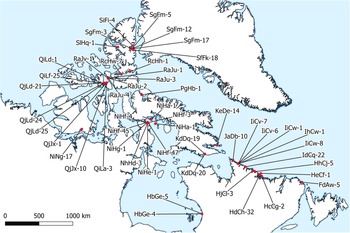
Blade slot thicknesses were measured from harpoon heads and knife handles from a variety of Early, Middle, and Late Dorset contexts across the Canadian Arctic to determine if they once held lithic or metal blades (Figure 3). To ensure that blade slot thicknesses relate to raw material choice and not simply different blade sizes, corresponding basal thickness measurements from lithic and metal tools were also recorded. “Blade slot thickness” is used here to mean the linear distance between both blade beds of a blade slot. Other studies use the term “blade slot width” to describe this same measurement, although the terminology is not consistent across previous work (Grønnow Reference Grønnow2017; Gullason Reference Gullason1999; Whitridge Reference Whitridge1999:259–270, Reference Whitridge, Frink, Shepard and Reinhardt2002).
Location of all sites sampled in the dataset with the associated Borden number. (Color online)

Fisher Scientific digital callipers were used for the measurements. These were measured to the nearest 0.01 mm. The instrument had an error range of 0.02 mm. Descriptive statistics and two sample t-tests assuming unequal variance (Welch's t-test) were calculated in Excel and R (version 3.5.2).
Following other studies (Gullason Reference Gullason1999; Whitridge Reference Whitridge, Frink, Shepard and Reinhardt2002), it is unlikely that a thin blade slot would hold an endblade that is thicker than the slot itself. There are, however, some considerations that should be noted regarding this assumption. There is some ethnographic evidence that Inuit harpoon heads were heat treated or soaked in water to make their blade slots more malleable to accommodate a slightly thicker endblade (Boas Reference Boas1965 [1888]:110). No charring was identified on any of the Late Dorset examples included in this study, but it is presently impossible to know if they were soaked in liquid. If this were the case, it is expected that the discarded harpoon head would retain the shape of the endblade it would have last supported. Unlike many early Inuit harpoon heads that have the distal tip of their blade slots warp backward, effectively pinching the endblade in place, none of the harpoon heads included in this dataset exhibited this attribute (Whitridge Reference Whitridge1999:260).
On the other hand, it is possible that a thicker blade slot would support a thinner endblade. Ethnographic observations show that packing material was occasionally used to ensure a tight fit for thinner endblades in thicker blade slots (Whitridge Reference Whitridge1999:261). Alternatively, other endblade securing techniques, such as using lashing or riveting, could also be employed. Therefore, a thick blade slot does not necessarily indicate that only lithic endblades were used, but a thin blade slot probably supported a metal endblade exclusively.
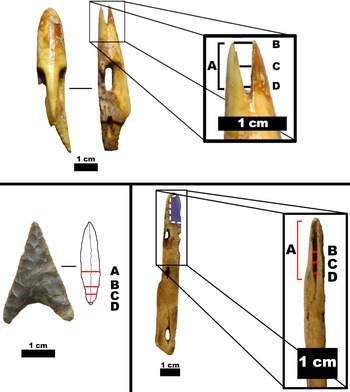
This dataset includes 183 harpoon heads made of ivory and antler from 27 sites in Nunavut and Labrador. Material was not sampled from Greenland or Nunavik. Harpoon heads that were included in this dataset have complete blade slots with both blade beds intact in order to facilitate measurements in three locations. The three locations represent the most distal portion of the blade slot, a proximal measurement located 1 mm from the most proximal portion of the blade slot, and a medial measurement representing the midpoint of the blade slot (Figure 4). These roughly equate to a thinnest (proximal), middle (medial), and thickest (distal) measurement of blade slot thickness. Frequently, in the few examples of harpoon heads with intact endblades, the most proximal portion of both the blade beds and endblade do not contact each other consistently. Moreover, given the wedge shape of most Dorset harpoon-head blade slots, the proximal measurements are less variable than the other two locations. For these reasons, the medial and distal measurements are relied upon for this analysis.
Measurement locations for harpoon heads (top), lithic endblades (bottom left), and side-hafted handles (bottom right). For the harpoon head and side-hafted knife handle, the blade slot (A) and the distal (B), medial (C), and proximal (D) measurement locations are noted. The dotted area indicates the profile of the side-hafted handle blade slot. For the lithic endblade, the maximum thickness (A), distal (B), medial (C), and proximal (D) measurement locations are noted on the diagrammatic cross-section. (Color online)

The harpoon-head data are compared to basal thicknesses measurements of lithic harpoon endblades that were probably intended to be mounted in a harpoon head's blade slot. This dataset includes 372 lithic endblades from 33 sites in Nunavut and Labrador. These come from a variety of Early, Middle, and Late Dorset contexts, and they represent a variety of lithic raw materials. As with the harpoon heads, endblade thickness was measured in three locations along the basal portion of the object (Figure 4), although the present study is again based only on the medial and distal measurements, which represent the area of most likely contact between the endblade and harpoon-head blade slot. The distal measurement represents the most distal point of basal thinning that is present. In the few cases where this thinning is not visible, the distal measurement was located at the center of the object. The distal measurement does not represent a maximum thickness that was recorded separately. The proximal measurement location was the basal edge of the endblade, and the medial measurement was the midpoint between distal and proximal measurements. Although there is a collection of attributes that were used for testing differences in endblade thickness, all examples are what Arctic archaeologists refer to as “triangular endblades.” These are pressure flaked with generally straight lateral sides and a straight or concave base. They can be bifacially or unifacially flaked, and some Early and Middle Dorset examples have a distinctive “tip flute”—a lithic reduction technique involving removal of a pair of small elongated flakes from its distal tip (Plumet and Lebel Reference Plumet and Lebel1997). “Thickness” for all lithic object measurements refers to the linear distance from one face of the object to the other.
The dataset also includes blade slot measurements on Dorset knife handles. These handles can have either end- or side-hafted blades. In this analysis, 23 end-hafted handles from four sites and 48 side-hafted handles from 11 sites are included. End-hafted handle measurement methods mirror exactly those used for harpoon heads. Side-hafted handle blade slots, however, were measured differently due to the profile of their blade slots not being exposed like those of end-hafted handles and harpoon heads. Measurements were instead taken on the accessible portion of the blade slot representing a proximal measurement, a most distal measurement (representing the midpoint of the blade slot), and a measurement between those two locations. This means the “distalmost” measurement for side-hafted blade slots is generally the thickest measurement (Figure 4). As a result, the side-hafted blade slot data are not directly comparable with the harpoon head or end-hafted handle data, but they are suitable for assessing their thicknesses with the associated lithic tool measurements.
These knife-handle blade slot measurements were compared to the corresponding lithic tools that would have most likely been used. There are 115 scrapers from 22 sites, 29 burin-like tools from 11 sites, and 133 microblades from 19 sites included in this analysis. Scrapers and burin-like tools would have most likely been used with end-hafted handles, whereas microblades are the most likely lithic tool secured in side-hafted handles. Single basal thickness measurements were taken for burin-like tools and scrapers given that there is less variation in their hafting location morphology compared to endblades. Thickness measurements for microblades were taken on the midpoint of their lateral edge, the most likely point of contact with the distal measurement on side-hafted handle blade slots.
There are few metal objects in Late Dorset collections that are suitable for this analysis. Most sites have only fragments of metal with little indication of how they were used. Even sites with large assemblages of metal, such as those from Little Cornwallis Island (LeMoine et al. Reference LeMoine, Helmer and Grønnow2003), have few complete blades that would suit this analysis. The data here include 11 metal objects, all likely made of meteoritic iron, from the Franklin Pierce (SiFi-4) site (Schledermann Reference Schledermann1990:261). This is a small, single component Late Dorset site, but it is one that contains a very wide range of metal tools.
Providing full details about these metal objects is outside of the scope of this article, but a brief description follows. The metal objects can be separated into three main categories: endblades (n = 4), stemmed endblades (n = 5), and side blades (n = 2). Metal endblades resemble their lithic counterparts. They are generally triangular and have flat or slightly concave bases. Stemmed endblades are similar to regular endblades, but they have a distinctive stem. Side blades are elongated, subrectangular blades that, unlike the other two types, seem to have been shaped to fit into a side-hafted handle. Some objects are not entirely finished, and they represent different steps in the manufacturing process. As such, although the thickness ranges presented below give an indication of Late Dorset metal blades, a larger sample is necessary to understand not only if these are representative but also how or if the thickness changes throughout the manufacturing process.
Results
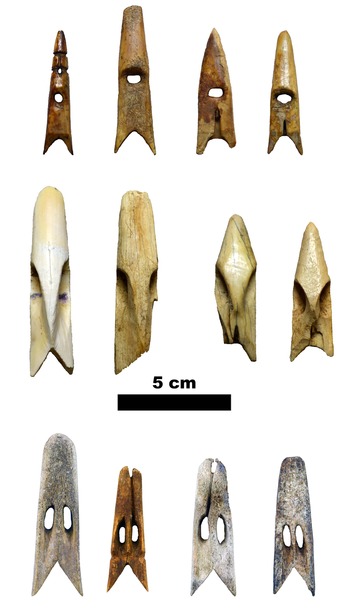
Harpoon heads were separated into three categories that roughly correspond to chronology: (1) Pre-Late Dorset harpoon heads (n = 38), representing a variety of single line-hole types from Early and Middle Dorset contexts (Maxwell Reference Maxwell and Maxwell1976); (2) Dorset Parallel harpoon heads (n = 76), a type found in Early, Middle, and Late Dorset contexts (Maxwell Reference Maxwell1985; Park and Stenton Reference Park and Stenton1999; Taylor Reference Taylor and William1968:52); and (3) Type G (n = 68), found exclusively in Late Dorset contexts (Park and Stenton Reference Park and Stenton1999; Figure 5). These categories should help the data presented below demonstrate if metal use is detected in Early and Middle Dorset contexts, if an existing harpoon head type was adapted in any way during the Late Dorset period, and if a harpoon head type only found in Late Dorset contexts shows any evidence of metal use. Beyond this, these categories probably represent functional differences of the harpoon heads. Dorset Parallel harpoon heads, which tend to be slightly larger, have been interpreted as walrus-hunting harpoon heads, whereas Type G and smaller Early and Middle Dorset harpoon heads are thought to have been used primarily to hunt seal (Maxwell Reference Maxwell and Maxwell1976:63; Murray Reference Murray1999:474; Park and Mousseau Reference Park and Mousseau2003:264). This functional difference might explain the resilience of the Dorset Parallel type through time and its concurrence with other harpoon head types.
Examples of Pre-Late Dorset (top), Dorset Parallel (middle), and Type G (bottom) harpoon heads. Note the visible securing holes on the two central Type G harpoon heads. The grooves and perforation found on the distal portion of the first Pre-Late Dorset harpoon head are below the blade slot, indicating that they were not used to secure an endblade. (Color online)

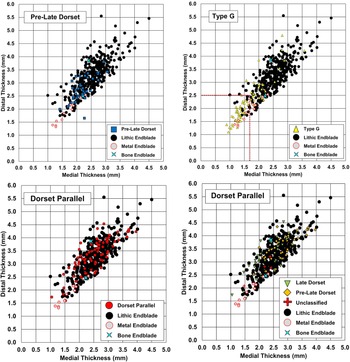
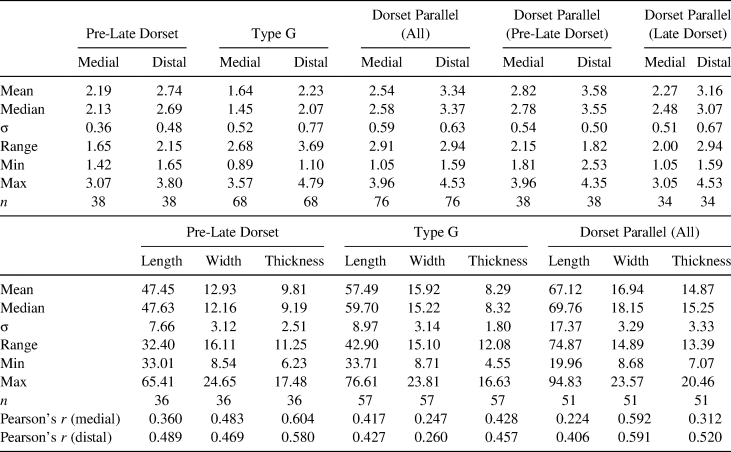
Comparing the three harpoon head categories based on the medial and distal measurements demonstrates clear differences (Figure 6; Table 1). The least variable group is the Pre-Late Dorset category despite its being the broadest in terms of physical attributes. Dorset Parallel harpoon heads tend to have the thickest blade slots. The exclusively Late Dorset Type G is variable, but its blade slots are thinner than the two other categories. The increased variability with Type G blade slots, despite the overall decrease in thickness, might indicate the need to create harpoon heads that could comfortably fit metal and lithic endblades. Dorset Parallel and Type G blade slot thickness correlate less strongly with overall object length, width, and thickness compared to Pre-Late Dorset harpoon heads (Table 1).
Comparison of medial and distal thickness measurements of endblades and harpoon head blade slots. The dotted area represents the thinnest segment of Type G harpoon heads that most likely held metal endblades. The endblade data are identical in each graph. (Color online)

Descriptive Statistics of Harpoon Head Medial and Distal Blade Slot Thicknesses (top) and Overall Dimensions of Complete Harpoon Heads (bottom).

Note: All measurements are in mm.
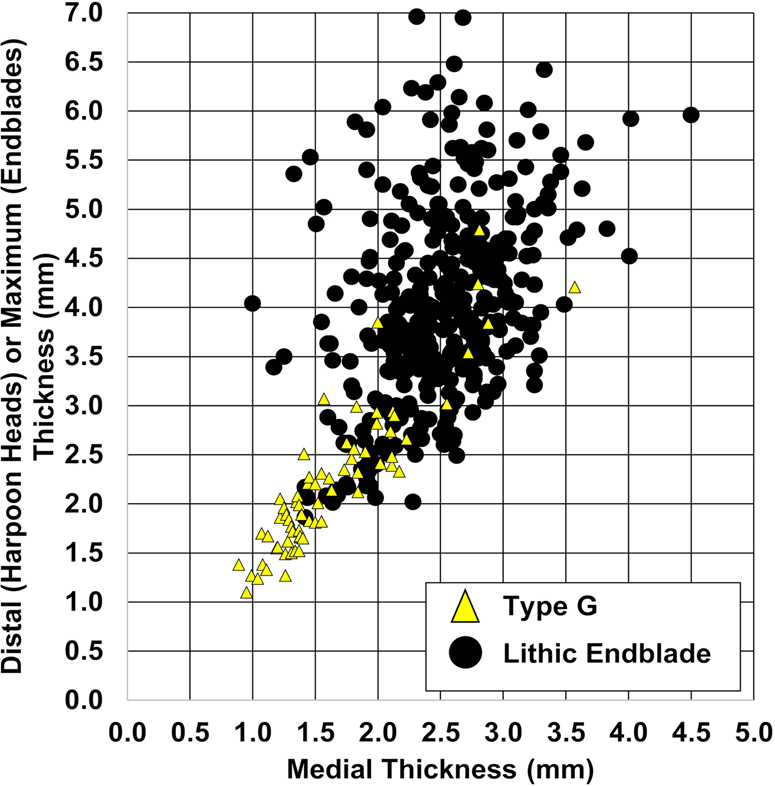
In order to evaluate how these blade slot measurements might indicate metal use, it is necessary to compare them with basal thicknesses of lithic endblades. There is good overall correspondence between Pre-Late Dorset and Dorset Parallel harpoon-head blade slot thicknesses and lithic endblade thicknesses. Conversely, 42 (61.8%) Type G harpoon heads have blade slots that are thinner than the majority of lithic endblades (<1.7 mm [medial] and <2.5 mm [distal]), with only 14 (3.8%) lithic endblades falling in that same segment. Furthermore, 35 (51.5%) Type G harpoon heads have blade slots that are thinner than all lithic endblades in this dataset (<1.4 mm [medial] and <2.0 mm [distal]). If the maximum rather than distal thickness measurement is used for endblades, the results are even starker (Figure 7). Despite the small size of the metal blade sample, there is a grouping of them that corresponds well to the thinnest segment of Type G harpoon-head blade slots.
Distal and medial Type G blade slot thickness compared to maximum and medial thickness of lithic endblades. (Color online)

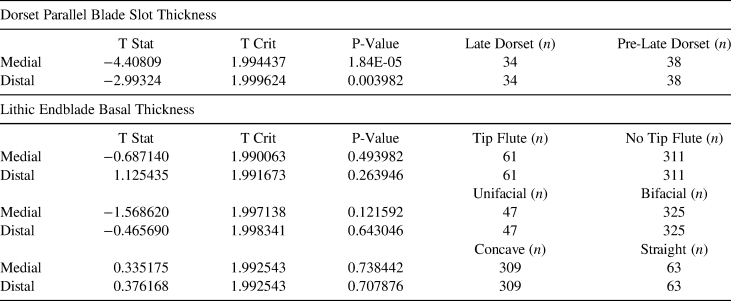
Interestingly, differences in blade slot thickness also exist in Dorset Parallel harpoon heads when separated by time. All Dorset Parallel harpoon heads were separated into either Pre-Late Dorset or Late Dorset contexts, depending on available chronological data for their associated sites. Some examples had to be excluded from this procedure due to insufficient dating evidence or mixed site assemblages. In the end, the Dorset Parallel from Pre-Late Dorset contexts have thicker slots than those from Late Dorset contexts (Figure 6; Table 1). These observations are supported by applying Welch's t-test for these two groupings, which indicates a statistically significant difference between both medial and distal blade slot thicknesses with their associated time period (Table 2).
Welch's T-Tests Comparing Dorset Parallel Blade Slot Thickness across Time (top) and Basal Thickness of Lithic Endblades with Their Physical Attributes (bottom).

Another significant difference between the harpoon head categories relates to the presence of visible traces of hafting techniques used to attach the endblades to the harpoon heads. These are absent on Pre-Late Dorset examples included in this dataset, and they are incredibly rare in the published literature (Mary-Rousselière Reference Mary-Rousselière2002:83–84). Different combinations of lashing grooves (i.e., circumferential grooves around the blade slot) and securing holes (i.e., a single perforation through both blade beds on the distal portion of the harpoon head) are rare with Dorset Parallel examples (5.2%), but they are present on 66.2% of Type G harpoon heads in this dataset. Securing holes alone occur on 35.1% of Type G harpoon heads. This indicates that the endblade that had been hafted would also need a perforation for these securing holes to be functional. This is physically impossible for flaked-stone endblades, and it would probably indicate that metal, bone, or ground-slate endblades had been used with those specific harpoon heads. Single perforations located along the midline of metal endblades are known in the published literature, but all examples are made of copper (Appelt et al. Reference Appelt, Gulløv, Kapel, Arneborg and Gulløv1998:152)
Fully detailing Late Dorset harpoon-head hafting techniques is outside the scope of this article, but the presence of bone and slate endblades are poor explanations for the emergence of securing holes on Late Dorset harpoon heads. Bone endblades are very rare in Late Dorset collections. An antler endblade found at QjJx-1 (Arvik) on Little Cornwallis Island has a perforation, suggesting that it was used in conjunction with a harpoon head with a securing hole (LeMoine et al. Reference LeMoine, Helmer and Grønnow2003:260). The only other organic endblade identified and included in this dataset is an ivory point from SgFm-3 (Longhouse) on Ellesmere Island (Schledermann Reference Schledermann1990:215). It has no perforation and is fairly narrow, resembling a prong more than an endblade. These two examples have medial and distal thicknesses well within the range of lithic endblades. More examples of bone endblades are needed to understand the scope of its use and to determine if the rarity in existing collections accurately represents reality or if, in the same way as metal, it is an underrepresented object type. It should be noted, however, that many Late Dorset sites have excellent organic preservation, and bone endblades are not present at sites other than QjJx-1 and SgFm-3. The presence of securing holes on harpoon heads, especially those with thin blade slots, probably represent metal endblade use with those with thicker slots representing either metal or bone endblades.
Slate endblades become increasingly rare in the Late Dorset period and are more commonly referred to as “lances” due to their increased size rather than their flaked stone counterparts (Maxwell Reference Maxwell1985:224, 227; Odess Reference Odess1998:428). A number of Early and Middle Dorset sites have produced slate endblades or lances with side-notching, but most do not have any sort of perforation (Fitzhugh Reference Fitzhugh and Fitzhugh1975:366; Mary-Rousselière Reference Mary-Rousselière2002:133, 179; Maxwell Reference Maxwell1973:52, 135; Renouf and Bell Reference Renouf and Bell2008; Taylor Reference Taylor and William1968:121). Those that have perforations, found mostly in Newfoundland, have paired sets of perforations along the lateral margins of the object, with only larger slate lances having a single midline perforation. This suggests that they were hafted to some sort of foreshaft rather than a harpoon head with a securing hole (e.g. Linnamae Reference Linnamae1975:119; Tuck Reference Tuck1976:95). Ultimately, slate endblades probably do not account for the presence of securing holes on Late Dorset harpoon heads.
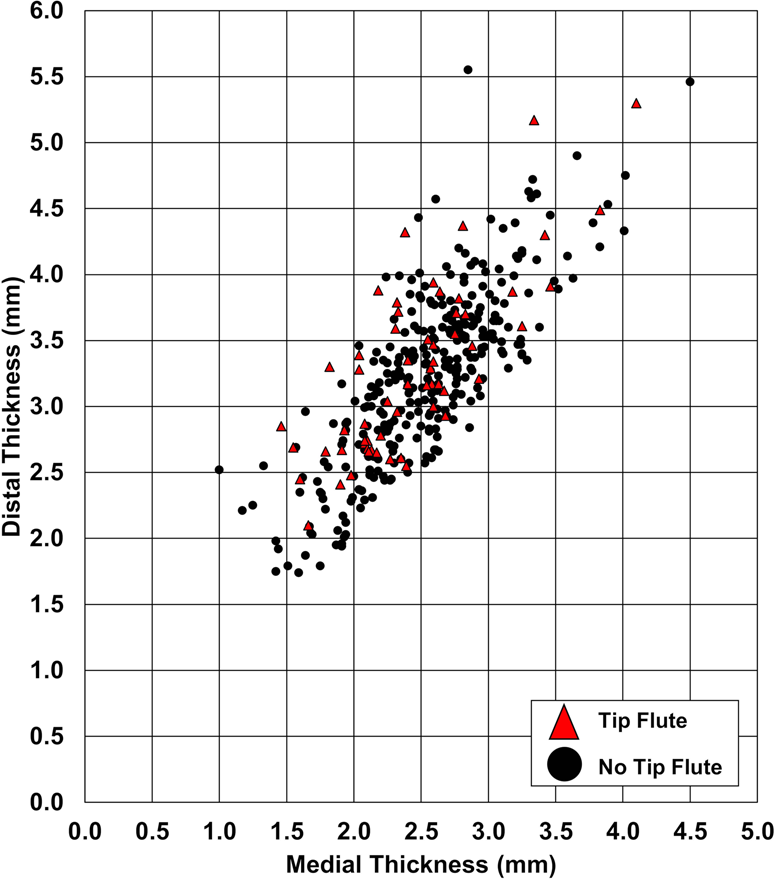
Non-slate lithic harpoon endblades are very common in all Dorset sites, but they cannot be separated into chronological categories as easily as harpoon heads, given that there are few identifiable physical attributes that can be confidently used Arctic-wide to associate an endblade with a specific time period. One exception is that Early and Middle Dorset endblades are occasionally tip fluted, but they are completely absent in Late Dorset contexts (Plumet and Lebel Reference Plumet and Lebel1997). Basal thickness is not significantly different between lithic endblades regardless of their physical attributes, including tip-fluted and non-tip-fluted specimens, which suggests that they did not become thinner in later periods, unlike harpoon-head blade slots (Figure 8; Table 2).
Medial and distal basal thicknesses for endblades with and without tip fluting. (Color online)

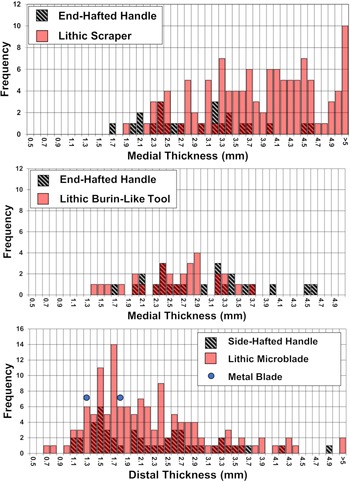
Similar patterns are not seen in cases where lithic blades are roughly the same thickness as metal counterparts. End-hafted handles do not have relatively thin blade slots compared to the associated lithic tools. Lithic tool types that would have been secured in end-hafted tools, such as scrapers and burin-like tools, are similar to or thinner than corresponding blade slot thicknesses on end-hafted handles (Figure 9). Similarly, Dorset side-hafted blade slots are not significantly thinner than the majority of microblades, the most likely lithic tool type that would have been used. This is because microblades are generally very thin, much like metal blades. As a result, blade slot measurements, in these cases, do not allow differentiation between raw materials. Given the data presented by LeMoine (Reference LeMoine and Sutherland2005), future use-wear analysis has significant potential for clarifying the uncertainty with the knife-handle blade-slot results.
Comparison of end- and side-hafted knife handle blade slot thicknesses with relevant lithic tools. Only a single measurement is used given the limitations of the lithic tools that are being compared. The two metal objects from SiFi-4 that could have been secured in side-hafted handles have their medial thicknesses marked with dots. (Color online)

Expanding Late Dorset Metal Use
These results demonstrate that (1) no clear evidence exists for metal being used by the Early and Middle Dorset, (2) metal began to be intensively and extensively used by Late Dorset groups, (3) and metal was incorporated into an existing technological system.
Pre-Late Dorset harpoon heads and Dorset Parallel harpoon heads from Early and Middle Dorset contexts have blade slots that are within the range of lithic endblade thicknesses. Despite blade slot thicknesses of Dorset Parallel harpoon heads overlapping with lithic endblade thicknesses, it is striking that examples from Late Dorset contexts have generally thinner blade slots than those from earlier contexts. This shift in blade slot thickness, as well as the majority of Type G harpoon heads having very thin blade slots, must represent the incorporation of a new endblade raw material. The increase in evidence for endblade hafting techniques in both Type G and Dorset Parallel harpoon heads, particularly the presence of securing holes, might also reflect this attempt at adapting harpoon head design for thinner metal endblades.
It is not impossible that thin lithic harpoon endblades, like metal endblades, are also underrepresented. Likewise, it is possible that bone endblades are equally archaeologically invisible. However, with the evidence of thinner blade slots in both new and established harpoon head types, increased prevalence of endblade hafting techniques, and the lack of correspondence between blade slots and both lithic and bone endblades, the most parsimonious explanation is that metal endblades were first being used by the Late Dorset and that their usage was much more common than the existing metal collections indicate.
Importantly, lithic technology does not disappear after metal begins to be widely used. Some Type G harpoon heads, and certainly most Dorset Parallel harpoon heads from Late Dorset contexts, could hold a lithic endblade. Additionally, the knife handle data, where there is no shift in blade slot thickness, suggest that Late Dorset probably did not have a need to create thinner blade slots because lithic blades were already as thin as metal (as in the case of microblades) or because there was no desire to switch to metal blades. Taken together, metal is clearly incorporated into an existing technological system that contrasts with some early Inuit contexts where lithic material is rare, which suggests that metal was being used as a replacement (McGhee Reference McGhee1984).
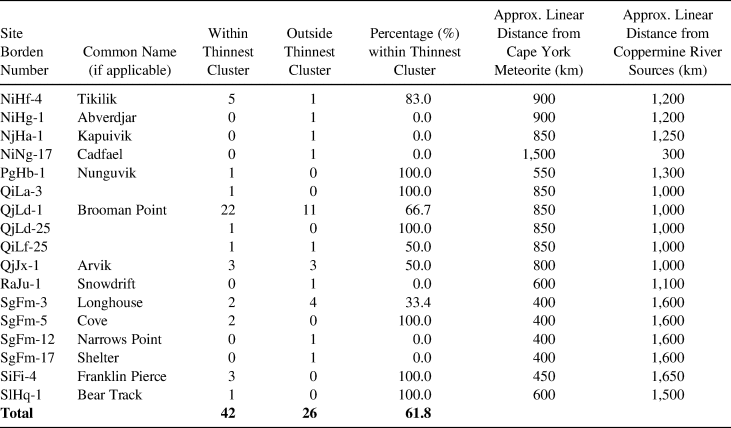
The likely metal-bearing harpoon heads are also geographically widespread throughout the Eastern Arctic and, significantly, are prevalent at most sites that were sampled (Table 3). Of the sites that have Type G harpoon heads, 61.8% have at least one specimen with a blade slot that is within the thinnest segment that would have likely held a metal endblade. All sites with more than one Type G have at least one specimen in that thinnest segment, suggesting that most sites had access to metal. The site with the largest sample size in the dataset, Brooman Point (QiLd-1; Park Reference Park2003), has 66.7% of its 33 Type G harpoon heads in the thinnest cluster. Significantly, this site, located on the east coast of Bathurst Island, is over 800 km away from known copper and iron sources. Interestingly, the only site with more than one Type G harpoon head that has less than 50% of specimens in the thinnest segment is the Longhouse site (SgFm-3) on Ellesmere Island (Schledermann Reference Schledermann1990:216), one of the closest sites in the dataset to Cape York, with 33.4% of Type G harpoon heads likely holding metal endblades. Consequently, this hints that metal use was not closely tied to geographic distance from potential metal sources. Given this prevalence, Late Dorset interaction networks must have been widespread and effective.
Number of Type G Blade Slots within or outside Thinnest Cluster (<1.7 mm medial and <2.5 mm distal) at Each Site and Their Approximate Linear Distances from Metal Sources.

Note: Distance rounded to the nearest 50 km.
Although there are no other materials that are known to have been exchanged over the same distance, the lack of a distance-decay pattern between the source region for the material and its ultimate deposition is also seen in Late Dorset soapstone exchange in Labrador (Nagle Reference Nagle1984:361–414). Although there are a number of potential sources of soapstone in Labrador, and it did not travel as far as metal does in the rest of the Arctic, Late Dorset sites in Labrador have relatively even proportions of soapstone from each known source in terms of both manufacturing fragments and finished vessels. Nagle (Reference Nagle1984:413) argues that even though there is no single explanation for the distribution of soapstone in Labrador, it probably fits into a multifaceted exchange network. The Late Dorset metal exchange can be profitably understood through this same lens. Metal itself was not exchanged in isolation—it was a single component in larger interaction networks. Both of these materials demonstrate the complexities of Dorset exchange networks in terms of space, time, and materials, and future research can profitably explore the interconnectedness of different materials across and through Dorset interaction networks.
Metal Use as Interaction Networks
This new analysis does not greatly expand the geographic extent of Late Dorset metal use given that surviving metal objects are already known from throughout the Eastern Arctic. The important contribution of this study is that metal must have been circulating at a high rate through expansive interaction networks. Because known sources of metal in the Arctic are both geographically discrete and far apart, increasing the intensity of known metal use also intensifies the amount of inter-group interaction that occurred. Although harpoon heads are simply a single category of use, they are good proxy indicators for metal use. It is important to note that harpoon head endblades are the first point of contact when a harpoon is thrown or thrusted into an animal and, as such, there is a high risk of them being lost or damaged (Gullason Reference Gullason1999:524; McCartney Reference McCartney, Shaw, Harrit and Dummond1988:115). It is likely that multiple endblades might have been created for a single harpoon head. Therefore, a single harpoon head with a thin blade slot might indicate multiple metal endblades. Unlike previous work that looked at the choice of using either stone or metal to manufacture carved bone objects where a single metal blade could manufacture multiple objects (LeMoine Reference LeMoine and Sutherland2005), this analysis better quantifies how much metal must have been used since each harpoon head holds a single endblade, and endblades themselves are replaced more often than the harpoon head. Furthermore, it is likely that metal was used in other ways, such as for the production of amulets or “art” (Harp Reference Harp1974), that will remain unknown until the metal objects themselves are recovered. Therefore, this analysis represents a minimum estimate of Late Dorset metal exchange.
Most striking is that the few and geographically distant source regions of metal, its high frequency of use, and the lack of mobility technologies common in Inuit context—such as dog sleds (Ameen et al. Reference Ameen, Feuerborn, Brown, Linderholm, Hulme-Beaman, Lebrasseur, Sinding, Lounsberry, Lin, Appelt, Bachmann, Betts, Britton, Darwent, Dietz, Fredholm, Gopalakrishnan, Goriunova, Grønnow, Haile, Hallsson, Harrison, Heide-Jørgensen, Knecht, Losey, Masson-MacLean, McGovern, McManus-Fry, Meldgaard, Midtdal, Moss, Nikitin, Nomokonova, Pálsdóttir, Perri, Popov, Rankin, Reuther, Sablin, Schmidt, Shirar, Smiarowski, Sonne, Stiner, Vasyukov, West, Ween, Wennerberg, Wiig, Woollett, Dalén, Hansen, Thomas P, Gilbert, Sacks, Larson, Dobney, Darwent and Evin2019; Morey and Aaris-Sørensen Reference Morey and Aaris-Sørensen2002) and large watercraft (Mary-Rousselière Reference Mary-Rousselière1979)—do not seem to have limited the amount of inter-group interaction among the Late Dorset (Appelt et al. Reference Appelt, Damkjar, Max Friesen, Friesen and Mason2016; Desrosiers Reference Desrosiers, Curtis and Desrosiers2017; Maxwell Reference Maxwell1985; Odess Reference Odess1998). Using a least-cost path analysis to estimate travel times between native copper sources and sites with existing copper objects, Pike and colleagues (Reference Pike, Kory Cooper and Hunt2019) demonstrate that most sites are over 112 hours of travel (i.e., 14 eight-hour days) in the warmer months, with roughly 30% of sites requiring more than 200 hours of travel (i.e., 25 eight-hour days). Although their analysis includes both Dorset and Inuit sites, this is a rough estimate of the significant time investment associated with any given metal object.
Although the exact networks that supported this metal exchange are unknown, it is likely that they flowed through common interaction networks established by the Late Dorset. Longhouse sites are one site type that might illustrate these networks. The purpose of Late Dorset longhouse sites has been long debated, but they are frequently interpreted as seasonal gathering sites (Appelt and Gulløv Reference Appelt and Hans Christian1999; Plumet Reference Plumet1985; Schledermann Reference Schledermann1990). Interestingly, Damkjar (Reference Damkjar and Sutherland2005:156) has shown that harpoon heads, particularly Type G, are recovered more frequently at longhouse sites than at other Late Dorset site types. Based on the analysis presented here, these harpoon heads might then be reasonable proxy indicators of metal use. Therefore, longhouses might represent the vectors that would have supported the high-intensity metal exchange described in this study (Appelt and Gulløv Reference Appelt and Hans Christian1999). In this regard, it is not surprising that the longhouse site of Brooman Point (QiLd-1) has a large amount of metal use evidence despite its distance from known metal sources. Although the frequency of longhouse site gatherings is unknown, annual or semiannual aggregations at these sites would easily support the multiday travel times between metal source and most sites in the Eastern Arctic (Pike et al. Reference Pike, Kory Cooper and Hunt2019).
Most importantly, however, the information that would have underpinned supposed similarity in “art” styles, architecture, and artifact typologies (Appelt et al. Reference Appelt, Damkjar, Max Friesen, Friesen and Mason2016; Damkjar Reference Damkjar and Sutherland2005; Darwent et al. Reference Darwent, Savelle, Darwent, Dyke, Lange, LeMoine and Pinard2018; Darwent et al. Reference Darwent, LeMoine, Darwent and Lange2019; Odess Reference Odess1998; Ryan Reference Ryan2003; Taçon Reference Taçon1983) would have flowed through these same channels. It is impossible at this stage to determine if intensive interaction and knowledge exchange facilitated the movement of novel raw materials or if it was the increased demand for metal and its cultural associations that helped develop the classic Late Dorset cultural similarities seen in the archaeological record. Moreover, longhouse sites themselves might have facilitated or, alternatively, been a symptom of these intensive interaction networks. Ultimately, these factors are clearly intertwined, and they contributed to each other. This merits future research, with this study representing an initial step toward clarifying these issues.
Conclusion
Metal becomes widely used across the North American Arctic around the middle of the first millennium AD. Significantly, there is little evidence for the connection between the metal use seen in the Bering Strait and the Eastern Arctic, suggesting that the material usage was independently developed (Dyakonov et al. Reference Dyakonov, Pestereva, Stepanov and Mason2019; Friesen and O'Rourke Reference Friesen and O'Rourke2019). In the case of the Eastern Arctic, metal becomes a widespread and intensively used material around AD 500, corresponding with the Late Dorset archaeological culture. The assumption that metal is underrepresented in the Late Dorset archaeological record has been largely confirmed by this study. Moreover, this study has demonstrated that it is possible to understand the use and exchange of a raw material even when that material no longer exists.
Late Dorset people began to exchange metal on an extensive and intensive scale. Although lithic technology is not entirely replaced by metal, the two materials were used in parallel with each other. In particular, this study has demonstrated that (1) Late Dorset created metal endblades in conjunction with a new harpoon head type (Type G) that was not used in earlier time periods and (2) that they potentially adapted an established harpoon head type (Dorset Parallel) to facilitate a thinner metal endblade. In the case of Type G harpoon heads, metal endblades were used at least as frequently as stone. Additionally, most sites showed at least some evidence of metal use, whereas only sites with single harpoon heads had no evidence. Some sites with evidence of metal use, such as Brooman Point (QiLd-1), are situated hundreds of kilometers away from source regions of the material. In this regard, metal is a keystone material for understanding the maximum extent and intensity of Late Dorset interaction networks.
Late Dorset metal use contrasts significantly with earlier examples of Pre-Dorset and Dorset metal use, which is small scale and regionally bound (Taylor Reference Taylor and William1967), and it is more similar to the scope and scale of the exchange networks that develop across the Bering Strait at roughly the same time (Cooper Reference Cooper2012; Dyakonov et al. Reference Dyakonov, Pestereva, Stepanov and Mason2019; Mason Reference Mason1998). However, unlike in the Bering Strait, where it is still unclear whether technologies or knowledge were also exchanged between different cultures, Late Dorset groups shared common architecture, material culture, and probably other elements of culture. It is through these same metal exchange networks that what it meant to be Dorset flowed (Appelt and Gulløv Reference Appelt and Hans Christian1999; Damkjar Reference Damkjar and Sutherland2005).
The methods used here are significant for other regions where composite bladed technology was used and the raw material of the blade is debated. This is especially relevant for questions around the earliest metal use in Chukotka, the Bering Strait, Sub-Arctic Alaska, the northern Pacific Coast of North America, and the Great Lakes region (Cooper Reference Cooper, Friesen and Mason2016; Mason Reference Mason1998). Furthermore, unlike other methods for measuring blade slots, a greater amount of flexibility is afforded by using multiple measurements to summarize the thickness of both the blade slot and the blade itself. Relying only on a single variable would potentially obscure relevant patterns.
Significantly, by expanding the evidence of known metal use, it is possible to refine the ways groups interacted with each other. Taking a raw material–centric approach for understanding past interaction networks is common in other regions (Bassett et al. Reference Bassett, Stevenson and Dussubieux2019; Hill et al. Reference Hill, Seeman, Nolan and Dussubieux2018; Loring Reference Loring, Fitzhugh, Loring and Odess2002, Reference Loring, Curtins and Desrosiers2017; Lothrop et al. Reference Lothrop, Burke, Winchell-Sweeney and Gauthier2018; Lulewicz Reference Lulewicz2019; McCaffery Reference McCaffery, Sassaman and Holly2011; Pike et al. Reference Pike, Kory Cooper and Hunt2019; Walder Reference Walder2019), but this study demonstrates that it is possible to ask similar questions even when the raw material in question cannot be physically analyzed. Moreover, this approach complements traditional provenance studies analyzing sourcing, exchange, and network analysis by adding a robust way of understanding the scale of past interaction networks in a quantitative way.
Acknowledgments
This research was funded by a Wenner-Gren Foundation Dissertation Fieldwork Grant and the Royal Anthropological Institute's Emslie Horniman Anthropological Scholarship Fund. This article was written while I was a postdoctoral fellow at the University of Toronto, where I was funded by a W. Garfield Weston Postdoctoral Fellowship in Northern Archaeological Research. I thank Colleen Batey for her excellent mentorship as well as Max Friesen and anonymous reviewers for their thoughtful feedback on the text. Louis-Vincent Laperrière-Désorcy graciously aided me with the translation of the French abstract. I am thankful for the Government of Nunavut, The Rooms, the Canadian Museum of History, and the Prince of Wales Northern Heritage Centre for providing access to the material and graciously supplying site data and artifact catalogs. Artifact photograph permissions are courtesy of the Government of Nunavut and the Canadian Museum of History.
Data Availability Statement
All objects used in this article are located at The Rooms, the Canadian Museum of History, and the Canadian Museum of Nature. The dataset is available at DOI:10.17632/6c65yc5vs3.1.