Introduction
It is difficult to spend much time in contemporary British social policy debates without coming across the idea of Universal Basic Income (UBI). Over the last five years, the possibility of replacing all or part of the social security system with an unconditional payment to every citizen has risen from the political margins to attract a wide range of supporters. Anthony Painter and Chris Thoung (Reference Painter and Thoung2015) of the Royal Society of Arts, the left-wing broadcaster Paul Mason (Reference Mason2015), and the acceleration theorists Nick Srnicek and Alex Williams (Reference Srnicek and Williams2015) have all highlighted the potential for UBI to transform the relationship between work, creativity and leisure in an age of automation. The Green Party put it at the heart of its 2015 and 2017 general election campaigns, and four Scottish councils – Glasgow, Fife, North Ayrshire, and Edinburgh – are hoping to launch pilot schemes. Even the Labour Party has set up a working group to explore the implications. ‘All of a sudden’, Shadow Chancellor John McDonnell has noted, basic income is ‘an idea whose time may well have come’. (The Independent, 2017)
This surge of interest in UBI is part of a larger global phenomenon, which reflects dissatisfaction with complex and coercive social security regimes and the growing use of cash transfers to tackle poverty in the developing world (van Parijs and Vanderborght, Reference van Parijs and Vanderborght2017). Many British enthusiasts are closely engaged with international campaigns through the Basic Income Earth Network (est. 1986) and UBI Europe (est. 2013) and have been inspired by recent experiments in Namibia, India and Finland. Yet the contemporary British debate also draws on a much longer history of interest in the idea which dates back at least to the end of the First World War, when Bertrand Russell called for a universal ‘vagabond's wage’ and Mabel and Dennis Milner published a plan for an unconditional ‘state bonus’. Despite important work by scholars such as Walter van Trier (Reference van Trier1995), this history is little known and poorly understood. When and why has UBI come on to the British policy agenda? How has the concept been shaped by wider changes in the UK economy, welfare provision and party politics over the past century?
This article draws on a close reading of the basic income literature and archival materials – the classic methods of historical research – in order to answer these questions. By tracing the character and reception of UBI proposals across five waves of interest, it highlights the distinctive contours of the British debate and uses the lessons of the past to evaluate the prospects for basic income today. In doing so, the article draws attention to three major themes. Firstly, it demonstrates the long history of UBI in British politics, which has often been obscured by the proliferation of terms used to describe the concept. At different times, British campaigners have characterised UBI as a ‘vagabond's wage’, a ‘state bonus’, a ‘social dividend’, a ‘new social contract’, a ‘basic income’, and a ‘citizen's income’ – each of which evokes a rather different set of connotations. Many advocates have stumbled across the idea independently, yet there have also been significant personal and intellectual links between the different eras of campaigning. For clarity's sake, I use basic income or UBI throughout this article as an umbrella term for an unconditional, non-withdrawable payment to every citizen, which should not be confused with more complex, conditional, and means-tested forms of income support, such as Milton Friedman's Negative Income Tax (NIT) and Iain Duncan Smith's Universal Credit. As Davide Tondani (Reference Tondani2009) has shown, means-tested NIT schemes embody a very different approach to work, risk, and uncertainty, even though their distributional effects may (under certain parameters) be identical.
Secondly, this article argues that UBI campaigning in Britain has had a distinctive character which reflects the centre-right background of many of its exponents. Since the 1980s, academic enthusiasm for basic income has largely been ‘utopian’ in character, taking its cue from egalitarian and left-libertarian conceptions of distributive justice and echoing Bertrand Russell's hopes of a radical shift in attitudes to work. Philippe van Parijs’ (Reference van Parijs1991) attempt to justify ‘Why surfers should be fed’ typifies this approach. As Bill Jordan (Reference Jordan2012) has pointed out, however, many of the leading British campaigners for UBI have been liberals or conservatives, attracted to the idea as a pragmatic solution to the failings of the existing safety-net or as a free-market alternative to wage regulation and state welfare provision. John Kay (Reference Kay1996) has characterised this philosophy as ‘redistributive market liberalism’: the belief that poverty and inequality are best alleviated through transfer payments outside the market system. Indeed, trade unionists and social democrats have often dismissed basic income advocates as dangerous cranks – ‘the Jehovah's Witnesses of social policy’, in Rory O'Kelly's (Reference O'Kelly1984: 29) memorable phrase – for precisely this reason. It is only recently that interest in UBI has migrated towards the left of the UK political spectrum.
Thirdly, the historical evidence presented here suggests that the idea of a basic income has always been intimately linked to debates about the future of work and the organisation of the labour market. UBI has tended to attract most support at times when the prospects for full employment and living wages have seemed most uncertain, as in the 1940s and 1980s, and to recede from view as governments have forged new economic and political settlements. Alongside this cyclical pattern, the context of UBI campaigning has been transformed by the transition to a service-based economy, the development of institutions such as the Citizen's Basic Income Trust (CBIT) and the use of microsimulation techniques to simulate the effects of policy options. Above all, the frame of reference has shifted from the UK to a European and global context. Where British campaigners once set the pace in basic income research, they now find themselves contributing to a fast-moving international dialogue.
The first wave: Vagabond's wage, state bonus and social dividend, 1918–39
The idea of an unconditional basic income for every citizen dates back at least as far as the age of enlightenment. Maximilien Robespierre declared that ‘the first law of society is that which guarantees the means of existence to all its members’, and British radicals adapted this new concept of social rights to their own narratives of dispossession. Thomas Paine (Reference Paine, Foot and Kramnick1797) proposed a universal endowment of £15 for twenty-one-year olds and a pension of £10 a year for everyone over fifty, as ‘compensation . . . for the loss of his or her inheritance, by the introduction of the system of landed property’. Thomas Spence (Reference Spence and Dickinson1803) went even further, suggesting that parishes should appropriate land and buildings and use the rents to pay a UBI to every citizen. Yet the concept was never likely to gain much traction in nineteenth-century Britain, where the experience (and mythology) of the ‘Speenhamland system’ of agricultural wage supplements cast a long shadow over the notion of a guaranteed minimum (Block and Somers, Reference Block and Somers2003).
The possibility of UBI was rekindled in 1918 by a Quaker engineer and his wife, Dennis and Mabel Milner (Reference Milner1918), who formed a State Bonus League to campaign for a weekly payment of 5 shillings per person, ‘just sufficient to maintain life and liberty’. Like Eleanor Rathbone's Family Endowment Society, the Milners were inspired by the system of separation allowances which the government paid to soldiers’ families in wartime, and argued that the bonus would give workers and housewives more independence. Bertrand Russell (Reference Russell1918) also favoured a small ‘vagabond's wage’ as a basis for artistic creativity and personal freedom and, although the Labour Party firmly rejected the idea in 1921, other left-wing thinkers continued to toy with it throughout the inter-war period. In particular, C.H. Douglas's Social Credit movement popularised the notion that the state should pay households a monthly ‘national dividend’ – financed by credit creation – to boost demand and tackle underconsumption (van Trier, Reference van Trier1995). Douglas’ theory of credit was sharply criticised by mainstream economists, but G.D.H. Cole (Reference Cole1935) pointed out that a Labour government could use a more conventional kind of ‘social dividend’ to distribute the profits of nationalised industries. Keynesian socialists such as James Meade (Reference Meade1938) also noted that this could serve as a counter-cyclical device, paid at a lower rate during booms and at a higher rate during slumps to even out the trade cycle.
The second wave: Juliet Rhys-Williams’ ‘new social contract’, 1942–55
Despite Russell's idealism, much of the inter-war interest in social dividends centred on their potential to act as an economic regulator or distributive mechanism in a market socialist economy. During the 1940s, however, the Liberal politician Juliet Rhys-Williams returned to the Milners’ conception of UBI as an alternative to poor relief and contributory social insurance (Sloman, Reference Sloman2016a). Rhys-Williams was determined to remove the unemployment trap she had witnessed in South Wales during the depression, which prevented unemployed men from taking on casual work without losing their benefits. The solution, she argued, was to adopt ‘the democratic principle that the State owes precisely the same advantages to every citizen, and should consequently pay the same benefits to the employed and healthy as to the idle and sick’ (Rhys-Williams, Reference Rhys-Williams1943: 144). Rhys-Williams proposed that all citizens should receive a weekly payment to cover basic subsistence and, in return, would pay income tax at a flat rate of 45 per cent on earnings up to the surtax threshold.
In many respects, Juliet Rhys-Williams set the parameters for subsequent British debate by framing UBI as a pragmatic form of tax-benefit simplification. Though she sought to appeal to feminists by pointing out that basic income would satisfy Rathbone's demand for ‘wages for housewives’, she also saw it as a way of reducing bureaucracy and making low-wage occupations such as agriculture more viable. Indeed, Rhys-Williams’ scheme might plausibly be read as an attempt to resist the growth of progressive taxation and the rising bargaining power of the organised working class. This impression is reinforced by Rhys-Williams’ ambivalence about the level of the payment and the question of conditionality. Her original proposal envisaged a subsistence-level payment (with regional variation for rent) which would form part of a ‘new social contract’: adults would commit to work to the best of their ability, or else lose their benefits. By the late 1940s, however, she seems to have realised that this contract would be difficult to enforce and that its cost was politically unattractive. In later versions of the scheme, she dropped the work requirement and backed the Liberal Party's (1950) proposals for a more modest UBI which would merely replace tax allowances and food subsidies.
The popularity of William Beveridge's plans for comprehensive social insurance meant that Rhys-Williams’ campaign for an alternative model of welfare was always likely to be an uphill struggle. Even so, her ideas attracted wide interest from Liberal and Conservative politicians who saw them as a way of challenging the drift towards collective provision and replacing Pay-As-You-Earn (PAYE) with a simpler form of income tax. Young economists such as Meade and Alan Peacock were also enthusiastic, and the Royal Commission on the Taxation of Profits and Income (1951-55) took evidence on the Liberal Party's scheme as a way of testing the feasibility of tax-benefit integration. In the end, however, this came to naught. The Inland Revenue was determined to keep tax and social security separate, and the Trades Union Congress and British Employers’ Confederation both objected to UBI in principle – the former because it would undermine National Insurance, the latter because it would be ‘detrimental to productive effort’ (Sloman, Reference Sloman2016a: 213). Beveridge's approach fitted much better with the producerist ethos of the post-war settlement, geared towards ‘full employment’ and breadwinner wages for male industrial workers.
The third wave: The rediscovery of poverty and the Heath government's tax credit scheme, 1965–74
UBI resurfaced in British policy debate during the 1960s and early 1970s in the context of the ‘rediscovery of poverty’ on both sides of the Atlantic. As Alice O'Connor (Reference O'Connor2001) has shown, the explosion of social research in the United States in this period privileged a particular kind of ‘poverty knowledge’, which measured income deficiency in relation to a ‘poverty line’ and drew on the techniques of neoclassical economics. In particular, Milton Friedman's discussion of NIT in Capitalism and Freedom (Reference Friedman1962) prompted a spate of interest in the possibility of eliminating poverty through fiscal transfers, which Friedman saw as a substitute for practically all other forms of social policy – including health and education provision, trade union rights and minimum wages. Other economists took up NIT in a more limited way, as a mechanism for improving the delivery of means-tested benefits, and Richard Nixon made a ‘Family Assistance Plan’ the centrepiece of his domestic agenda (Steensland, Reference Steensland2008). The possibility of a basic income also attracted attention, sparked by the futurist Robert Theobald (Reference Theobald1963) who argued that the coming ‘cybernation revolution’ would dramatically reduce demand for labour. Welfare rights activists were attracted to the unconditionality of UBI, and Democratic candidate George McGovern floated the idea of a universal ‘demogrant’ in the 1972 presidential election.
Although British politicians paid close attention to the US ‘War on Poverty’, NIT was much more influential than UBI during this period. Theobald's predictions of technological unemployment seemed alarmist in the optimistic 1960s, and studies by researchers such as Brian Abel-Smith and Peter Townsend suggested that government needed to plug gaps in the welfare state, not redesign it. Economic constraints and costly investment programmes in health, education and transport prompted ministers to place growing emphasis on means-tested benefits, such as the Heath government's Family Income Supplement (FIS) for low-income working families (Grover, Reference Grover2016). Moreover, the principle of redistribution was always liable to provoke controversy among Conservatives. Where Arthur Seldon of the Institute of Economic Affairs saw NIT as a way of moving towards a private market in welfare, Sir Keith Joseph (Reference Joseph1968) feared it would have ‘grave disincentive effects’ and reinforce the ‘trend towards socialisation of all income’. Enoch Powell (Reference Powell1970: 265) warned that FIS would revive the ‘evil’ of Speenhamland, and Margaret Thatcher (Reference Thatcher1985) thought a guaranteed income would become ‘a shirker's charter’.
Only a few British scholars – such as Tony Atkinson (Reference Atkinson1969) – studied UBI during the 1960s, but Juliet Rhys-Williams’ son Brandon shared his mother's interest in the subject and worked to keep her ideas alive. Election as Conservative MP for South Kensington (1968-88) gave Sir Brandon Rhys-Williams a platform and in 1972 he received an unexpected break. The Heath government was embarrassed by its inability to devise a workable NIT and by public criticism of FIS, especially the charge that high marginal withdrawal rates for means-tested benefits created a ‘poverty trap’. The Chancellor's special adviser, Arthur Cockfield, had encountered Juliet Rhys-Williams’ scheme at the Inland Revenue in the 1950s and recognised that it offered a way out. Cockfield devised a plan for replacing tax allowances and family allowances with reversible weekly tax credits, which would be offset against workers’ tax liability or (where they exceeded this level) paid in cash. The Inland Revenue embraced this proposal because it was coming under pressure from ministers to reduce administrative costs: tax credits would make it possible to abandon the complex coding work associated with PAYE in favour of a flat-rate deduction from pay for most workers. The Treasury minister Patrick Jenkin was ‘enormously impressed’ by the scheme's ingenuity, and Joseph saw ‘very great attractions from the social security point of view’ in reducing dependence on means-testing (Sloman, Reference Sloman2016b).
Cockfield's tax credit scheme – set out in a 1972 Green Paper – is the closest any British government has come to introducing UBI, and typified what Bill Jordan (Reference Jordan2012) has called a ‘low road to basic income’. Cockfield explicitly rejected the notion of welfare rights, and was determined to exclude ‘the vagrants, the drifters, the drop-outs, the petty criminals’, and the self-employed, whose incomes were difficult to verify: as a result, the scheme would only cover employees and National Insurance claimants, who (with their families) made up 90 per cent of the population (Cockfield, Reference Cockfield1971). Cockfield also sought to pay child credits via the father's wage packet, prompting an outcry from the Child Poverty Action Group and women's organisations.
Some Treasury officials were always cautious about Cockfield's scheme, pointing out that it would be less flexible than the current system of rates and thresholds and that the £1.3 billion cost (about 2 per cent of GDP) included a giveaway to many middle-income families. The four-year lead-in time required to introduce tax credits also meant that a bipartisan approach was desirable. Labour's tax and social security experts, however, were highly critical of the scheme: Nicholas Kaldor feared that it would ‘freeze’ the tax system in a proportional rather than progressive mould, whilst Frank Field and Tony Atkinson argued that improving existing benefits would have a bigger impact on poverty. Barbara Castle (Reference Castle1973: 82) also voiced trade unionists’ fears about the impact on collective bargaining, declaring that ‘the idea of the state subsidising wages’ was ‘repugnant in a modern society’. By the time Labour returned to office in 1974, the fiscal outlook had deteriorated and Treasury officials warned that even a scaled-back version would pose ‘a very significant budgetary problem’. Denis Healey duly scrapped the scheme, retaining only the child credit proposals – now paid in cash to the main carer – under the title of Child Benefit (Sloman, Reference Sloman2016b).
The fourth wave: The Basic Income Research Group and the future of work, 1974–97
The Heath government's tax credit scheme embodied a technocratic approach to social policy which went out of fashion after the 1973 oil crisis. During the 1970s and 1980s, structural and behaviourist explanations of poverty came to the fore and the Thatcher government focussed on attacking ‘welfare dependency’ (Page, Reference Page2015). Yet mainstream interest in tax credits never entirely went away, and UBI received an infusion of enthusiasm from a rather different source: the Claimants’ Unions and the environmental movement. As in other European countries – such as the Netherlands and Denmark – the onset of deindustrialisation opened up new political space for the concept. Basic income came to be seen as a radical and progressive idea by elements of the British left for the first time since the 1930s.
The Claimants’ Union movement, which began in Birmingham in 1968–9, provided a vigorous grassroots counterpoint to professional ‘poverty lobby’ groups such as the Child Poverty Action Group (Rose, Reference Rose1973). As Toru Yamamori (Reference Yamamori2014) has shown, the Claimants’ Unions put ‘the right to adequate income without means test for all people’ at the forefront of their demands as a way of ending the intrusive questioning and institutionalized sexism experienced by Supplementary Benefit claimants. The movement was certainly influenced by American welfare rights campaigns but it also drew on indigenous socialist ideas, such as the Labour movement's inter-war demand for ‘work or maintenance’. Feminist claimants also canvassed support for the idea at Women's Liberation Movement conferences, though they ran into opposition from middle-class feminists who saw it as a form of extravagant utopianism. At much the same time, PEOPLE – the forerunner of the Green Party – proposed a ‘National Income scheme’ in its 1974 Manifesto for Survival, and UBI quickly became a hallmark of its programme. The concept also received a wider airing among environmentalists through the ‘Turning Point’ meetings which James Robertson organised in London from 1975 onwards.
These groups were drawn to basic income, to a greater or lesser extent, by a rejection of the traditional work ethic and a sense that economic growth was no longer sustainable. Robertson (Reference Robertson1978: 88–100), for instance, believed that automation was likely to disrupt established employment patterns, that much paid work was ‘unsatisfying and pointless’, and that western societies should move towards a ‘post-industrial paradigm of work’ which placed more emphasis on informal activities within the home and community. The emergence of mass unemployment during the late 1970s and early 1980s pushed these ideas into the mainstream. For instance, the organisation theorist Charles Handy (Reference Handy1984) convened seminars on ‘The Future of Work’ at St George's House, Windsor Castle, and came out in favour of basic income as a way of underpinning the transition from an ‘employment society’ to ‘portfolio lives’. Peter Ashby of the National Council of Voluntary Organisations (NCVO) also examined UBI, and concluded that it would ‘restore dignity to the unemployed’, ‘virtually end the poverty trap’, and ‘provide major incentives for job creation’ – by allowing employers to offer lower wages (Ashby, Reference Ashby1984: 15–17).
This fourth wave of interest in basic income, like those before it, was heavily reliant on individual policy entrepreneurs, but it also witnessed the institutionalisation of UBI campaigning through the formation of the Basic Income Research Group (BIRG) – now the CBIT. Together with Sir Brandon Rhys-Williams’ research assistant, Hermione Parker, Ashby launched BIRG in the summer of 1984 ‘to establish whether a Basic Income scheme would be feasible and whether the costs to be borne by taxation would be capable of commanding a broad consensus’ (BIRG, 1984). The group received three years’ seed funding from NCVO, and its research panel included representatives from across the voluntary sector, such as Evelyn McEwen from Age Concern, Paul Lewis from Youthaid, and Malcolm Wicks from the Family Policy Studies Centre.
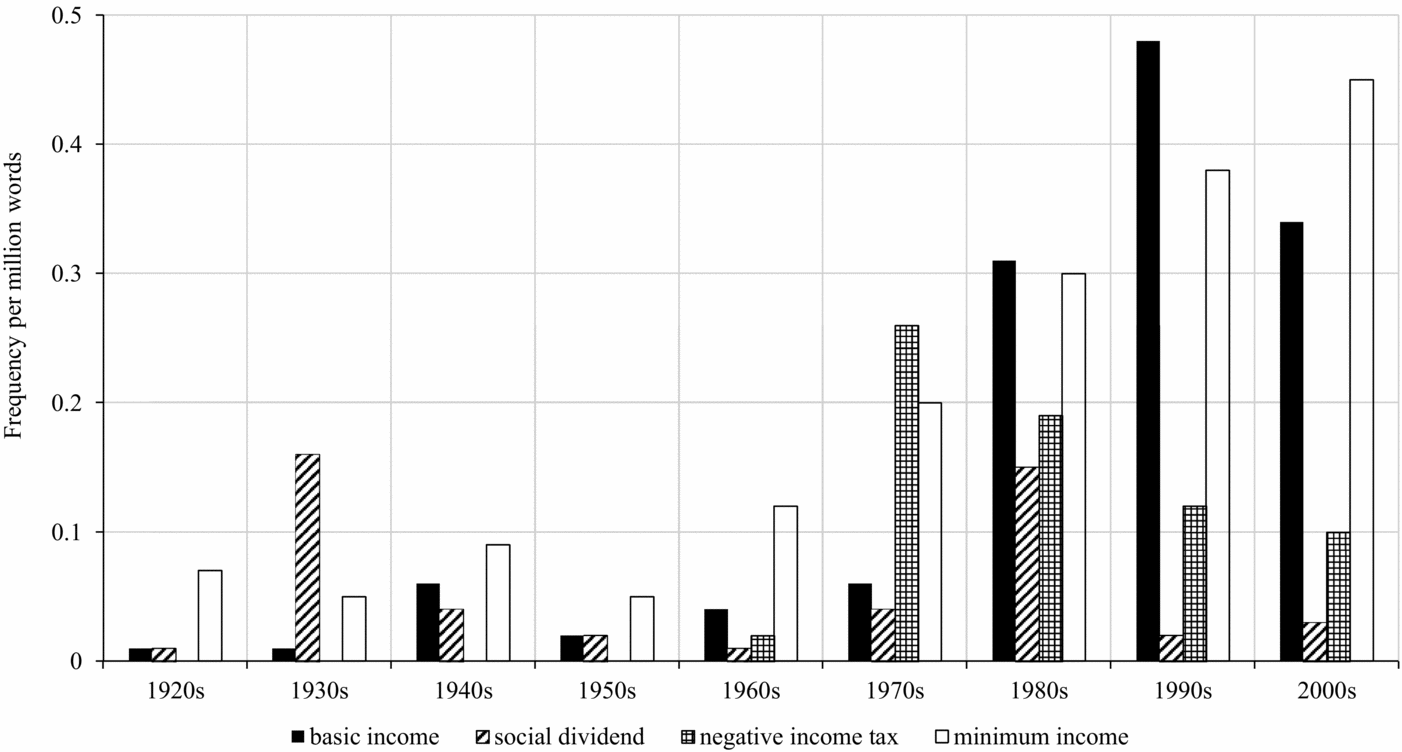
Parker and Ashby presented UBI as a universalist alternative to the system of means-tested income support which Norman Fowler introduced in the 1986 Social Security Act. Parker was particularly effective at cultivating centre-right support for basic income as a way of reducing administrative costs and promoting a more flexible labour market. Both ‘wet’ Tory MPs such as Francis Pym (Reference Pym1985) and some Thatcherites such as Edward Leigh (Reference Leigh1985) were attracted by its simplicity, and one member of the No. 10 Policy Unit, Christopher Monckton, even tried to press the idea on Mrs Thatcher (Monckton, Reference Monckton1993). Academic interest in UBI also took off in this period, sparked by Robert van der Veen and Philippe van Parijs’ famous article on ‘A capitalist road to communism’ (Reference van der Veen and van Parijs1986). As Figure 1 shows, mentions of ‘basic income’ in British English texts rose almost tenfold between the 1970s and the 1990s, whereas the older term ‘social dividend’ has largely fallen out of use – a reflection of an increasingly self-referential literature.
Frequency of ‘basic income’ and related terms in the Google Books (British English) corpus by decade, 1920–2008

BIRG was significant partly because of the way it brought together the pragmatic current of interest in UBI represented by Juliet and Brandon Rhys-Williams with the more radical critique of industrial capitalism which had emerged during the 1970s. Inevitably, however, the attempt to define a workable scheme revealed these underlying political differences. For instance, Parker (Reference Parker1988: 7) came to believe that ‘[a] full BI . . . is not [politically] feasible and probably never will be’ but others questioned whether there was any point in a lower payment which left existing benefits in place. In particular, Peter Mitchell (Reference Mitchell1985) of the Royal Association for Disability Rights (RADAR) argued that UBI would only be worthwhile if it was set high enough to avoid the need for extra supplements for the disabled. Likewise, Robin Smail (Reference Smail1985) of the Low Pay Unit insisted that a basic income should be combined with a national minimum wage to prevent exploitation.
Despite these divisions, BIRG gained traction during the late 1980s and early 1990s as politicians began to look to a world beyond Thatcherism. In particular, basic income resonated with two of the main ideological themes which emerged on the centre-left in the wake of the 1987 election (White and O'Neill, Reference White, O'Neill, Lodge and Gottfried2014). On the one hand, it fitted well with Marxism Today’s (1988) analysis of ‘New Times’, which suggested that ‘the old mass-production Fordist economy’ had been rendered obsolete by social and technological change and ‘a new, more flexible, post-Fordist order’ was here to stay. On the other hand, UBI could be seen as a concrete embodiment of the new politics of ‘citizenship’ which David Marquand (Reference Marquand1988) saw as a counterweight to Thatcherite individualism. Liberal Democrat leader Paddy Ashdown (Reference Ashdown1989: 83) took it up under the telling name of ‘citizen's income’, declaring that ‘every step we take towards it will diminish dependency, liberate economic power in the hands of the citizen and cut back on the oppressive power of the state bureaucracies over people's lives’.
BIRG attempted to tap into the citizenship agenda by changing its name to the Citizen's Income Trust, and received more than £200,000 from the Joseph Rowntree Charitable Trust for a programme of public dissemination (Torry, Reference Torry2017a). By the mid-1990s, however, the idea had begun to look distinctly passé. The Labour Party's Commission on Social Justice (1992-4) considered UBI but rejected it, partly because of the cost and partly because most of its members believed the public would not support it. Sir Gordon Borrie (Reference Borrie1994: 13) was impressed by the ‘feeling . . . that the contributory system has a genuine moral strength’, whilst Patricia Hewitt (Reference Hewitt, Bulmer and Rees1996: 258) feared that a basic income ‘would become an instrument of social exclusion’ by encouraging women to stay at home and weakening political concern for the unemployed. Support from ‘One Nation’ Conservatives dwindled, and the Liberal Democrats also dropped UBI on grounds of cost. Parker (Reference Parker1996a: 1) felt that ‘[a]t no time during the twelve years since the Basic Income Research Group was formed . . . has the immediate outlook for introduction of a Citizen's Income in Britain looked weaker’.
Why did UBI fall off the agenda so quickly? One problem was certainly the tax rate required to finance a subsistence-level income, estimated at around 70 per cent, which created a perception of unaffordability. Parker (Reference Parker1996b: 1) lamented that anyone could ‘rubbish’ UBI: ‘All they need is a computer print-out which says it would cost too much.’ Just as important, however, was the growing influence of communitarian ideas about work obligations and ‘reciprocity’. Richard Whitfield (Reference Whitfield1995: 3) thought it was ‘the perceived naïveté of [UBI] in terms of motivation and behaviour which so marginalises the idea in current debate’. The burgeoning philosophical literature was not particularly helpful in this respect, since van Parijs’ attempt to justify a basic income for ‘welfare hippies and Malibu surfers’ featured so prominently. Tony Atkinson (Reference Atkinson1996) attempted to accommodate the reciprocity principle by devising a ‘participation income’, but the idea of monitoring citizens’ contributions to society raised a host of practical and theoretical objections. The ‘work first’ strategy adopted by New Labour dealt with the legacy of deindustrialization in a very different way, using tax credits and other active labour market policies to promote service-sector employment. As Anton Hemerijck (Reference Hemerijck, van der Veen and Groot2000) pointed out, the popularity of welfare-to-work policies reduced the political space for UBI, especially when they seemed to be successful. The fall in the UK unemployment rate from 10.4 per cent in 1993 to 4.8 per cent in 2004 belied the gloomy predictions of post-industrial theorists and suggested that full employment was still attainable.
David Donnison (Reference Donnison1998) concluded that the opportunity for basic income had been and gone. It was ‘the great North-West Passage of social policy’: it ‘had to be explored’ but the renewed emphasis on work and reciprocity had driven it ‘off the map of politically feasible options’. An organisational crisis in the Citizen's Income Trust when Rowntree funding ended in 2000 seemed to confirm this diagnosis: Malcolm Torry has since run the trust on a shoestring budget of about £4,000 per annum. Discussions of UBI retreated to university seminar rooms, where political philosophers engaged in lively but largely theoretical debates over the merits of conditionality and capital endowments.
The fifth wave: Liberating the precariat, 2013 onwards
With each successive wave of interest in UBI in Britain, the frame of reference has become more international. Milner and Rhys-Williams’ schemes were largely indigenous and Cockfield drew only tangentially on the American debate, though he was well aware of Friedman's NIT proposals. During the 1980s, however, British activists played a key role in the formation of the Basic Income European Network (which became the Basic Income Earth Network in 2004), and Bill Jordan and Guy Standing – then a senior economist at the International Labour Organisation (ILO) – worked with van Parijs to build up the academic credibility of UBI and forge new connections. As a result of these efforts, the latest explosion of interest has been genuinely global (Caputo, Reference Caputo2012).
It is difficult to know how to date the beginnings of this fifth wave. Bob Deacon (Reference Deacon2013) has traced a new appreciation of universal transfers in global social policy discourse from the mid-2000s onwards, in reaction against the complexity of means-tested benefits and concern about their impact on skill development and saving. The apparent success of Brazil's 2003 ‘Bolsa Familia’ programme prompted a growing interest in simple (though not always unconditional) cash benefits within the development community, which has extended to Europe and North America since the 2008 financial crisis. Mounting concern about labour precarity – seen in the proliferation of low-paid service work and involuntary self-employment during and after the recession – has been one contributory factor, encapsulated by Guy Standing's influential analysis of The Precariat (Reference Standing2011). From a rather different perspective, Silicon Valley entrepreneurs such as Sam Altman have embraced UBI as a way of defusing political resistance to automation and technological change – which they regard as desirable and inevitable.
The surge of global interest in basic income has been strongly reinforced by a series of real-world trials, beginning with small-scale experiments in the Namibian village of Otjivero in 2008–9 and the Indian state of Madhya Pradesh in 2011–12 (van Parijs and Vanderborght, Reference van Parijs and Vanderborght2017: 138–9). Finland, the Netherlands and Altman's Y Combinator group have since announced plans for further experiments, prompting Guy Standing to label 2016 ‘the year of the pilots’ (McFarland, Reference McFarland2017). Though few results have yet been published, the trials have helped raise the profile of UBI and encouraged organisations such as the OECD to take it seriously as a policy option. The use of tools such as EUROMOD to simulate the distributional effects of basic income packages has also enhanced its credibility. In the UK, for instance, modelling by Malcolm Torry (Reference Torry2017b) suggests that replacing tax allowances with a modest basic income – of, say, £61 a week – would be financially feasible and reduce the Gini coefficient by about three percentage points.
Many of the problems which concern UBI campaigners in Britain – rising labour-market inequality, the patchwork nature of the existing safety-net, and the punitive impact of benefit sanctions on vulnerable claimants – have been apparent since the 1980s and 1990s, but it is only in the last five years that basic income has really moved back to the top of the British social policy agenda. The troubled implementation of Universal Credit has been one important catalyst, highlighting the technical difficulties involved in delivering means-tested income supplements; the 2013–14 European Citizens’ Initiative for UBI, launched by the Austrian activist Klaus Sambor, has been another (Torry, Reference Torry2017a). Although Sambor's petition failed to secure the one million signatures which would have required the European Commission to study UBI, it succeeded in raising its profile across the continent and prompted the formation of Basic Income UK to campaign for the idea. Unlike CBIT, Basic Income UK is not a charity and so is free to engage directly in politics. The group insists that the benefit must be ‘high enough to ensure a material existence and participation in society’, and has developed close links with anti-austerity campaigners, particularly in the West Midlands (Jacobson, Reference Jacobson2017).
Perhaps the most striking feature of this fifth wave in Britain is the way in which concern about the insecurity of temporary and casual employment has enabled UBI to attract unprecedented support within the Labour movement – for instance, from Neal Lawson of Compass. Though some social democrats still regard UBI as a Trojan horse for neoliberalism – which would ‘discourage work’, ‘perpetuate inequality’ and hasten ‘the total, final and irreversible alienation of labour’ (Cruddas and Kibasi, Reference Cruddas and Kibasi2016) – such attitudes are no longer universal. The debate at the 2016 TUC conference suggests that many union activists now see basic income as a way of liberating their members from the indignity of benefit sanctions and improving their bargaining power. Of course, this assumes that the national minimum wage would remain in place and that the UBI would be set high enough that workers could credibly threaten to withdraw their labour (TUC, 2016).
The growth of left-wing interest in UBI has been particularly visible in Scotland, where it has become closely intertwined with the debate over independence. The feminist economist Ailsa McKay used her involvement in the Scotland's Futures Forum to put basic income on the agenda, framing it as an emancipatory measure which could transform gender relations in a ‘new Scotland’ (McKay, Reference McKay2013). The policy was taken up by Radical Independence campaigners as a symbol of their egalitarian ambition in the run-up to the 2014 referendum, and has subsequently received growing attention from the SNP itself. The party's 2016 spring conference noted that UBI could ‘potentially provide a foundation to eradicate poverty, make work pay and ensure all our citizens can live in dignity’, and Inverclyde MP Ronnie Cowan secured a Westminster Hall debate on the issue in September 2016. Nicola Sturgeon has since announced that the SNP government at Holyrood is willing to provide financial support for local pilot schemes.
These developments have given UBI a higher profile in British politics than it has enjoyed for many years, but they also bear out Jurgen de Wispelaere's (Reference De Wispelaere2016) warnings about the difficulty of forging a coherent strategy. Much of the contemporary interest in UBI might well be seen as ‘cheap’, designed to win media coverage and signal a willingness to ‘think the unthinkable’. Both the Labour Party and the SNP have carefully avoided explicit commitments to the policy, and the Scottish government does not yet have the power to introduce a national scheme (Simpson, Reference Simpson2017). Perhaps more seriously, the growing appeal of UBI on the left seems to lie partly in its very transgressiveness, as a symbolic way of rejecting the harsh rhetoric and messy realities of mainstream UK welfare policy. This might well have the effect of ‘contaminating’ the policy and making it more difficult to win support among liberals and conservatives. As Samuel Brittan (Reference Brittan2005: 9) warned more than a decade ago, linking basic income with ‘fashionable anticapitalist causes such as anti-globalisation and extreme environmentalism’ risked ‘putting off the enlightened minority among anti-socialist politicians who might otherwise give it some house room’. The implosion of the Green Party's proposals at the 2015 election may already have had this effect, cementing public perceptions of the policy as a form of utopian escapism. The Conservative government's dismissive response to the Westminster Hall debate on UBI suggests that ministers think such a critique is intrinsically damning (Hinds, Reference Hinds2016). Likewise, the (rather superficial) recent enquiry by the Work and Pensions Select Committee (2017: 3) claimed that UBI ‘risks being a distraction from workable welfare reform’ and urged ministers ‘not to expend any energy on it’.
Conclusion
UBI advocates in the UK and around the world frequently claim that it is ‘an idea whose time has come’, but we can only understand the significance of contemporary interest in the policy if we recognise that it is also an idea which has come and gone. On the one hand, the long history of the British debate over basic income reminds us of its ambiguity and malleability – a policy instrument which can be sold to different political constituencies as a solution to a variety of different problems. On the other hand, it also reveals some striking cyclical patterns in the way the idea has been framed, considered and rejected in British policy-making circles.
UBI has repeatedly come to the fore at times of uncertainty about the UK's labour market and social security models: the Great Depression, the ‘rediscovery of poverty’, the collapse of the post-war settlement, and the aftermath of the 2008 financial crisis. On each occasion, it has run up against deep-seated anxieties about the cost of unconditional payments and the likely impact on work incentives. UBI advocates have also found their arguments trumped by the availability of cheaper and more politically acceptable alternative solutions: social insurance in the 1940s, child benefit and FIS in the 1970s, and active labour market policies in the 1990s. Although concern about precarity has created a new opening in recent years, Conservative policies point towards a very different ‘make work pay consensus’ (Clegg, Reference Clegg2015: 497) based on the National Living Wage, a higher income tax threshold and the extension of conditionality to those in work through Universal Credit. If this strategy is successful, more radical options which challenge the primacy of earned incomes could again be frozen out.
The history of UBI campaigning in the UK makes it easy to understand why many social policy analysts continue to treat it with suspicion. Some of the leading enthusiasts for basic income have been conservatives and neoliberals, who have seen it as a way of justifying labour market deregulation, privatising other parts of the welfare state and reducing marginal tax rates on higher incomes. More broadly, the philosophy of redistributive market liberalism which has inspired many UBI proponents tends to equate poverty with income deficiency, and so risks neglecting those forms of inequality and disadvantage which cannot be captured by income data. It is also clear that many of the arguments for UBI have been asserted rather than proven, as Daniel Sage and Patrick Diamond have recently noted: far from promoting social integration and gender neutrality, it might well exacerbate tensions over migration and the boundaries of citizenship, reduce women's labour market participation, and ‘cement gendered norms around care and domestic work’ (Sage and Diamond, Reference Sage and Diamond2017: 28). In any case, divisions over the level and purpose of basic income show no sign of disappearing. It is difficult to see how tech entrepreneurs and the TUC could ever be brought together in support of a particular scheme.
At the same time, basic income campaigners also have grounds for cautious optimism. Support for the idea is more ideologically contiguous than in the past, and it shows signs of becoming a totemic policy for some left-wing activists, particularly in Scotland. As trade union leaders come to terms with the passing of the post-war employment model, UBI might become a rallying-point around which different strands of the British left can unite. Labour's unexpectedly strong performance in the 2017 general election suggests that concern about inequality runs deep and that younger voters are increasingly receptive to radical thinking. Likewise, even if the SNP's support is shallow and cheap, basic income might become a difficult policy to abandon. In the event of independence or ‘devo-max’, the Scottish government is likely to face pressure to introduce UBI or at least launch a large-scale pilot. Such a ‘policy laboratory’ approach could at last turn the century-old vision of basic income for all into a social and political reality.
Acknowledgements
I am grateful to Dr Malcolm Torry, Professor Bill Jordan, Ms Barb Jacobson, and Mr Anthony Painter for agreeing to be interviewed for this research and sharing their experiences of UBI campaigning. I would also like to thank Professor Jim Tomlinson, Dr Ben Jackson, Dr Daniel Zamora, Dr Chris Renwick, Mr Andrew Seaton, Mr Nick Garland, the two anonymous referees, and participants at the POLIS departmental seminar in Cambridge in November 2017 for their comments on earlier versions of this article.