If the responses to international economic crises are led by national governments, the consequences of those responses are felt at the regional and local levels. Across many decentralised countries, central governments’ policies for dealing with a downturn affect what subnational governments can do for their citizens. This reality was felt by European regions in the aftermath of the Great Recession that unfolded between 2008–09 and 2015. In a context of rising budgetary deficits, regional governments were compelled to cut back spending so that central governments could achieve their goals of fiscal consolidation (Kincaid et al. Reference Kincaid, Tarr and Wälti2010; Braun and Trein Reference Braun and Trein2014). This latter policy was imposed with remarkable rigour in Europe, following the eruption of the Eurozone’s sovereign debt crisis in 2010 and the introduction of austerity rules at multiple levels of authority (Caporaso et al. Reference Caporaso, Kim, Durrett and Wesley2015). These rules forced members of the single currency – and their constituent parts – to engage in processes of fiscal consolidation in order to meet the imposed targets for budgetary deficits and debt.
So far, however, little attention has been paid to the behaviour of subnational units during the implementation of national governments’ responses to international economic crises. Much of this literature is dominated by “methodological nationalism” (Beck Reference Beck2003) focusing on the policy choices of national governments (e.g. Gourevitch Reference Gourevitch1986; Bermeo and Pontusson Reference Bermeo and Pontusson2012; Vail Reference Vail2014). This is understandable: national governments are the relevant units in the international system for coordinating responses to downturns, since they control the fiscal and monetary policy instruments needed for implementing these responses. Therefore, data-gathering efforts on fiscal policy have been dedicated to the decisions of central governments (Devries et al. Reference Devries, Guajardo, Leigh and Pescatori2011), while the literature has examined the national-level political and institutional configurations that shape the content of these decisions (Jensen and Mortensen Reference Jensen and Mortensen2014; Armingeon et al. Reference Armingeon, Guthmann and Weisstanner2016; Hübscher and Sattler Reference Hübscher and Sattler2017). Yet, there are several good reasons for examining the subnational dimension of these policies.
The first is that regional governments are responsible for managing a significant share of public expenditure and delivering a wide range of public services, especially in the area of welfare, meaning that any national government’s effort at fiscal consolidation will need to be coordinated with regional governments. However, coordinating the actions of central and regional governments is a problem across all types of decentralised systems because the distinct political incentives of subnational units militate against it. Being accountable to a narrower constituency than central governments, regional governments can reject central government fiscal policy, by continuing to overspend and borrow, while central government aims to consolidate (Wildasin and Wildasin Reference Wildasin and Wildasin1997). Moreover, the shrinking revenues and rising social needs occasioned by the economic crisis will intensify the incentive for subnational units to behave opportunistically, hampering any efforts at coordination and potentially setting them on a collision course with the central government. Finally, since federalism is a constitutive component of “state structures” (Weir and Skocpol Reference Weir, Skocpol, Evans, Rueschemeyer and Skocpol1985), this potential collision in the system of intergovernmental relations will constrain the capacity of central governments to deal with a downturn, to engage in fiscal consolidation (Braun et al. Reference Braun, Bullinger and Wälti2002; Braun Reference Braun2018) and to undertake economic reforms (Remmer and Wibbels Reference Remmer and Wibbels2000; Wibbels Reference Wibbels2005). The policies of regional governments can have significant knock-on effects for the rest of the federation.
But what explains the policies of regional governments? Do they all behave in a similar way during a crisis and simply follow the central government’s lead in cutting back public spending? Or do they forge their own path, one that reflects the distinct values of the parties that govern or the policy priorities of the constituents that voted for them? The answer to this question is crucial but remains a glaring gap in the ongoing empirical research on governmental responses to economic crises and on welfare state retrenchment more broadly. As Rodden and Wibbels (Reference Rodden and Wibbels2002, 529) asked: “to the degree that provincial politics is important, research in comparative federalism must turn to the subnational level of analysis. What political factors influence fiscal behaviour at the provincial level?”
This article aims to answer this question by examining how regional governments in Spain and Italy have adjusted to austerity. To do so, we assess the effect of budget deficits on regional spending and the moderating role of region-specific political and policy factors by examining the yearly spending decisions of regional governments between 2003 and 2015.
In the next sections, we develop a theoretical framework outlining our expectations about the spending responses of regional governments to austerity and justify our selection of the country cases. Then we describe our data and present the results of our analyses. We find that rising deficits at the regional level have an important negative effect on the spending of regional governments. Interestingly, however, the strength of this effect is mitigated by the presence of a left-wing party in regional office. In addition, we find that regional governments tend to protect healthcare and focus their retrenchment efforts on “non-core” sectors such as social assistance and public administration. However, partisanship matters here too, as healthcare spending will be even more protected when a region is ruled by the left.
These findings suggest that even in the highly constrained circumstance in which Spanish and Italian regions found themselves – faced with the strict imposition of austerity from multiple levels of authority – partisanship and policy sector are decisive factors for understanding the variable speed and incidence of retrenchment at the substate level.
The determinants of regional public spending retrenchment
There are two different perspectives that we can adopt to develop some hypotheses about regional spending adjustments to deteriorating public finances. The first is a “functional” perspective in which regional government policy is shaped by the functional imperatives set by external forces: the market, interjurisdictional competition or the central government. The second is a “political” perspective in which regional government policy is shaped by political imperatives set by internal democratic forces including voters and political parties.
Both perspectives have been adopted by the literature on decentralisation (Keating Reference Keating2013). Functional regionalism refers to the establishment of regional institutions designed for specific policies and tasks on the basis of criteria such as efficiency and optimality (Hooghe and Marks Reference Hooghe and Marks2009; Schakel Reference Schakel2010). In particular, the assignment of policy responsibility and financial resources at different territorial levels of government may be aimed at achieving targets set by central authorities and providing services for well-defined “policy communities” (Keating Reference Keating2009). On the other hand, political decentralisation is often aimed at responding to demands coming from territorial political movements, creating representative institutions and giving elected politicians more power in public decisionmaking at the regional level. The welfare literature has also contrasted political decisions – mainly shaped by left–right party competition – with “functional constraints”, deriving from increasing economic internationalisation and (financial) interdependence, demographic shifts and socio-economic transformations (Vis and Van Kersbergen Reference Vis and Van Kersbergen2013). In this article, we focus on the “budget constraint”. Below we argue that, in a period of deteriorating public finances, this mechanism is important in most decentralised countries regardless of whether they rely on markets or hierarchical state structures to enforce regional fiscal discipline.
A functional perspective
The starting point of the functional perspective is to ask several basic questions about the activity of regional governments: what functions do they fulfil, how much money is spent on these functions and how is this paid for? Once this is known, it moves on to ask the crucial question of what shapes the budget constraint that regional governments face. The political economy literature offers several answers: markets, interjurisdictional competition and hierarchy. What is common to these is that the determinant of regional policy is an external source of pressure and the relationship to that source of pressure is based on discipline.
If regional governments enjoy the power to tax and borrow, they are treated by credit markets and central governments as sovereign. Their budget constraint is shaped by creditors’ belief that their spending and debt trajectories are sustainable and, crucially, that they will not be “bailed out” by the central government (Rodden Reference Rodden2006). So regional governments discipline their spending levels in function of credit markets’ signals. This awareness of how their spending is perceived by credit markets extends to their immediate neighbours. The budget constraint of regional government is shaped by the assumption that a mobile population will move to jurisdictions offering higher social benefits. According to the “benefit competition” hypothesis, this mobility induces a downward competition in welfare spending between states intent on avoiding the inflow of dependent individuals, which could lead to unwanted increases in spending and taxation (Peterson and Rom Reference Peterson and Rom1989). This competition in turn results in a convergence towards a homogeneous and lower level of public spending across units (Rom et al. Reference Rom, Peterson and Scheve1998; Bailey and Rom Reference Bailey and Rom2004). Thus, regional governments’ spending is disciplined by the imperative of equalising the resources they devote to their function with that of their neighbours.
The pressure exerted by credit markets and interunit competition has proven to be especially powerful in existing federations like the United States (US). An alternative route to fiscal discipline in formerly unitary decentralised systems, such as Spain and Italy, is the one imposed by central governments. Here, regional governments are not viewed as sovereign entities but rather as an arm of the central government, tasked with carrying out its functions. This means delivering public services and spending money in the core areas of welfare, healthcare and education. In such systems, taxation is highly centralised, so the money for funding regional governments’ functions comes from a mix of central government grants and interregional fiscal equalisation. Moreover, since there are no commitments by the central government to forswear bailing out regional governments, tight controls are imposed on their ability to borrow (Von Hagen and Eichengreen Reference Von Hagen and Eichengreen1996). Regional governments thus face a “soft” budget constraint (Rodden Reference Rodden, Rodden, Eskeland and Litvack2003): because they are not responsible for raising the money they spend, they are impervious to the fiscal discipline imposed by credit markets or interunit competition.
Instead, they are disciplined by the rules imposed by their hierarchical superiors. The introduction of EU-wide and domestic rules committing member-states to a balanced budget resulted in a hardening of the budget constraint faced by regional governments in Spain and Italy. Moreover, this constraint was imposed at a time when public finances were rapidly deteriorating because the recession had produced a sudden fall in revenues and a dramatic increase in public need, spurred by rising unemployment and poverty. This centrally imposed requirement is comparable in its effects on public spending adjustments to the balanced-budget rules that exist in the constitution of many states in the US (Poterba Reference Poterba1995). Faced with stagnant or declining revenues, a limited ability to borrow and the weak use of intergovernmental grants by the central government to smooth-out public consumption over the business cycle, regional governments have little choice but to reduce their expenditure, if they wish to respect balanced-budget rules. This is consistent with what we know about the procyclical fiscal adjustments of regional governments to recession (Rodden and Wibbels Reference Rodden and Wibbels2010). We can expect that a balanced-budget rule will force regional governments to reduce public spending and that larger constraints follow from higher deficits.Footnote 1 Thus, we hypothesise that:
H1: The greater the size of the budget deficit, the greater the retrenchment in regional government spending
A political perspective
There is little scope in the functional perspective for region-specific political dynamics to produce policy divergence between regional governments; all regions are expected to conform equally to functional imperatives. In the political perspective, in contrast, regional governments enjoy some autonomy from central government control. Rather than working in a hierarchical relationship, central and regional governments are mutually dependent in the coordination of fiscal responses to the crisis. Regions are also conceived as sites for the expression of distinct values and policy goals by way of democratic contestation. As a result, the political perspective rejects the expectation of a uniform trend across regions and instead puts forward certain suggestions about what might be at the source of subnational variation.
Partisan ideology
Budget deficits should constrain spending. Yet, the impact of deficit on spending may not be territorially homogeneous and, instead, may be moderated by regional-level political factors. Indeed, politics does not only play a role in times of plenty, when constraints are low, but also when previous patterns of expansion are no longer sustainable and fiscal constraints are stronger due to increasing deficits. As the literature on the welfare effects of globalisation has shown, external constraints do not necessarily translate into identical governmental responses but interact with domestic political factors, leading to significantly different outcomes (Garrett Reference Garrett1998; Swank Reference Swank2002). Therefore, adjustments to austerity may result in regional divergence rather than convergence.
In a party democracy with regional elections, the ideology of the party in regional government may influence levels of regional public spending. There exists a long track record of research examining the argument that “parties-do-matter” for levels of public spending at national levels (Hicks and Swank Reference Hicks and Swank1992; Cusack Reference Cusack1997) and local levels (Pettersson-Lidbom Reference Pettersson-Lidbom2008; Ferreira and Gyourko Reference Ferreira and Gyourko2009). A stylised fact that emerges from this body of work is that left-wing parties are associated with greater government spending, especially in the area of welfare (Huber et al. Reference Huber, Ragin and Stephens1993; Esping-Andersen Reference Esping-Andersen2017). We hypothesise that the effect of left-wing parties may also be felt at the regional level, especially in states like Spain and Italy where regions are responsible for a significant amount of welfare spending. Partisanship should still matter during an economic downturn and in a context of deteriorating public finances, followed by austerity, where the cardinal public policy goal is to contain social expenditures and achieve fiscal consolidation. In such a situation, left-wing parties are associated with a slower speed of welfare retrenchment than right-wing parties (Korpi and Palme Reference Korpi and Palme2003; Allan and Scruggs Reference Allan and Scruggs2004). Thus, we expect that:
H2: If regional government is led by a left-wing party, the effect of the deficit on spending will be weaker
Partisan (In)congruence
A second aspect of partisanship that is relevant for understanding the effect of budgetary deficits on regional spending is the ideological alignment or “congruence” of regional and central governments. In federations, ideological alignment has a significant effect on the substance of regional governments’ policies: there is evidence that, in time of plenty, parties in central government will reward their fellow copartisans at the regional level with more generous discretionary intergovernmental transfers (e.g. Simon-Cosano et al. Reference Simon-Cosano, Lago-Peñas and Vaquero2013) and spending on education (Kleider et al. Reference Kleider, Röth and Garritzmann2018). Coordinating public policies at two levels is also crucial during an economic crisis, when central governments rely on the regional governments to implement stricter fiscal (mainly spending) policies. With state-wide electoral mandates, central governments will pursue economic objectives that they think are aligned with national interests. But regional governments are accountable to their jurisdiction and might pursue a distinct policy. Ideological resistance is thus territorialised as a policy conflict between different levels of government (Eaton Reference Eaton2017). Centralised and disciplined state-wide parties that compete in a nationalised and “integrated” party system (Filippov et al. Reference Filippov, Ordeshook and Shvetsova2004) and that simultaneously hold office at the two levels are the most direct solution to this problem. The central branch can persuade the regional branch to follow national economic policy either by leveraging its direct control over regional branch resources and careers (Willis et al. Reference Willis, Garman and Haggard1999; Garman et al. Reference Garman, Haggard and Willis2001) or by highlighting the negative electoral coattails that would ensue from visible political discord and policy failure (Rodden et al. Reference Rodden, Eskeland and Litvack2003; Rodden and Wibbels Reference Rodden and Wibbels2011). Parties in regional office will be less likely to shift the burden of adjustment to the central government and other regions, if their colleagues would suffer the political consequences. In contrast, partisan “disharmony” (Riker and Schaps Reference Riker and Schaps1957) will result if the central government has few copartisans at the regional level. There is mixed evidence in favour of this argument (Khemani Reference Khemani2007; Jones et al. Reference Jones, Sanguinetti and Tommasi2000). However, following the logic outlined above, we hypothesise that congruence should facilitate regional compliance with balanced-budget rules and result in a more pronounced spending retrenchment. Conversely, regional governments that are led by parties which do not control central government are less likely to comply. Therefore,
H3: If there is vertical incongruence in governmental leadership between the centre and the region, the effect of the deficit on spending will be weaker
Policy sector
The discretion that regional governments exercise in formulating their policy choices will affect not only how much to cut back but also where to cut back. Public policies are not simply developed and delivered as isolated initiatives, but as interrelated bundles. Research on state-level policies in the US shows that states differ in their spending priorities (Sorens et al. Reference Sorens, Muedini and Ruger2008; Caughey and Warshaw Reference Caughey and Warshaw2016). In Europe, scholars have pointed to the emergence of “regional welfare” models within decentralised systems (Gallego and Subirats Reference Gallego and Subirats2012). This means that regional governments may be inclined to cut or increase spending more in some sectors than in others. The question of how to divide the pie is central to budgetary politics, especially in times of austerity, because it is indicative of how policy priorities adjust to the constraint. Research has shown that there are trade-offs between spending across sectors: some regional governments will favour universalistic goods that address public needs, such a healthcare or transportation, whereas others will provide particularistic goods that affect a narrow constituency, such as social assistance payments or public-sector wages (Garand and Hendrick Reference Garand and Hendrick1991; Jacoby and Schneider Reference Jacoby and Schneider2001).
Evaluating the variation of provision across types of goods is more difficult in the case of Spain and Italy, where regions are active across fewer spending items than in the US. Healthcare is a core policy responsibility of regions in both countries and is the largest spending sector in all the regions included in this study.Footnote 2 Existing work on the dismantling of the national welfare state has shown that it is more difficult to introduce retrenchment in policy sectors with large potential constituencies, such as healthcare, than in sectors with narrow constituencies, such as income support programmes (Pierson Reference Pierson and Pierson2001; Hacker Reference Hacker2004). Cuts in health spending will be even more difficult to implement for regional governments, since the services they provide in Italy and Spain must meet minimum standards set by national framework legislation (Vampa Reference Vampa2016). We therefore hypothesise that the effect of the deficit will be weaker in the core universalistic policy area of healthcare than in other policy areas, such as social assistance. At the same time, given the relative weight of healthcare in regional policy making, one may hypothesise that cuts in this sector, even if less substantial, could be more “politicised” than in other, less relevant, policy areas. Since political competition in Italian and Spanish regions is mainly based on welfare policies centred on healthcare (Vampa Reference Vampa2016), the moderating role of partisanship could be stronger in this sector than in others. Therefore:
H4: The effect of the deficit on spending will be weaker on the core sector of healthcare
H5: The moderating influence of partisanship will be greater in the core sector of healthcare than in other policy sectors
Why Spain and Italy
We selected Spain and Italy because they share several institutional and contextual features that we can control for, enabling us to treat regional governments as equivalent units of observations and to focus on regional-level variables that explain inter- and intra-country variation (Slater and Ziblatt Reference Slater and Ziblatt2013). In this section, we provide a list of relevant features.
Welfare state
Spain and Italy are large South European states with mixed-market economies (Molina and Rhodes Reference Molina, Rhodes, Hancké, Rhodes and Thatcher2007) and “Southern” models of welfare. The welfare system is financed by contributions and tax revenues and features a universalist healthcare system, a fragmented system of income support and strong “familialism” (Ferrera Reference Ferrera1996).
Decentralisation
Since the late 1970s, both Spain and Italy have steadily decentralised powers to regional governments, which today play a crucial role in spending public monies for welfare services, particularly healthcare, which is the largest spending sector in all regions of the two countries (Vampa Reference Vampa2016). Regional governments nevertheless remain in a hierarchical system of territorial financing in which the bulk of the revenues derive from central government transfers and shared taxation.
Regional politics
Politics in Italy and Spain has been affected by the socio-economic (left–right) and centre-periphery cleavages (Lipset and Rokkan Reference Lipset and Rokkan1967). The second dimension of competition is particularly important for the mobilisation of regionalist parties, which have been relevant political players in both countries (De Winter and Türsan Reference De Winter and Türsan1998; Mazzoleni and Mueller Reference Mazzoleni and Mueller2017). In Spain, from 2003 to 2015, five regional governments were led at least once by a member of a regionalist party: Basque Country, Canary Islands, Cantabria, Catalonia and Navarra. Over the same period, there are seven cases in Italy: Aosta Valley, Autonomous Province of Bolzano/South Tyrol, Autonomous Province of Trento, Lombardy, Piedmont, Sicily and Veneto.Footnote 3 The Catalan Convergence and Union (CiU) and the Basque Nationalist Party (PNV) can be regarded as clear examples of “substate” nationalism in Spain in the historic regions of Spain and both have also been relevant in supporting the formation and stability of central governments. In Italy, the Northern League (LN) has been a key regional and national actor since the early 1990s.Footnote 4 The existence of regionalist parties playing different roles at various territorial levels of government makes the testing of the congruence/incongruence hypothesis (H3) particularly interesting.
Economic crisis and deteriorating public finances
The Great Recession was a significant shock to the economies of Spain and Italy: both countries experienced a downturn from 2008 to 2010. This was followed by the Eurozone sovereign debt crisis which worsened in 2011–12 and lasted until 2014. The crisis had a strong negative effect on the public finances of both countries. Fiscal balances deteriorated dramatically in Spain, which went from a surplus of a 2% of GDP in 2007 to a deficit of more than 10% in 2009. The Italian government managed to contain the increase in the budget deficit, which never went beyond 5%. However, the country’s precrisis debt level was high, so that between 2008 and 2014, it climbed from 102 to 132%, the second highest of the EU after Greece. Cutting deficits therefore remained a priority as part of a general strategy aimed at reducing the massive stock to debt. In Spain, budget deficits also resulted in rising overall debt, which more than doubled from 40 to 86% of GDP between 2009 and 2012; it reached 100% in 2014.
European austerity
Both Spain and Italy came under the pressure of the European Union (EU) to introduce austerity measures. The key response of EU institutions to the crisis was to pass a series of measures (e.g. the “European Semester”, the “two-pack” and “six-pack” regulations) that gradually augmented their ability to supervise national budgets and to compel member-states to adopt the “fiscal adjustment paths” necessary to achieve fiscal balance (Salines et al. Reference Salines, Glöckler and Truchlewski2012; Verdun Reference Verdun2015). These culminated in the 2012 in the “Treaty on Stability, Coordination and Governance of EMU”, which obliged member-states to transpose budgetary stability into national law (Fabbrini Reference Fabbrini2016). As a result, both Spain and Italy introduced formal reforms that institutionalised their commitment to fiscal stability and forced regional governments to comply with this commitment.
Domestic austerity
In a context of rising deficits (and debt), the most significant direct measure taken by the Spanish central government was to reform Art.135 of the Constitution in September 2011, which committed public administration at all levels to the principle of budgetary stability. This reform was given sharper teeth with the passing of Organic Law 2/2012 on Budgetary Stability and Financial Sustainability, which outlined the imperative of reaching a balanced budget and set out the limits of debt that public administrations could incur. It also gave the central government the legal means to enforce the principle of budgetary stability. The central government also passed several executive decrees that took the direct measure of reducing the size of grants transferred to regional governments earmarked for cofinancing the health and education sectors.
The Italian government followed a similar trajectory. It first introduced an “Internal Stability Pact” to contain the spending and debt of regions and municipalities. A constitutional amendment was approved in April 2012, which stated that subnational authorities were required to contribute to the achievement of the targets set by the EU. This introduced a further constraint on regional and local governments, which were tasked with achieving a balanced budget. The Internal Stability Pact was accompanied by a series of direct measures aimed at reducing spending on the regional and local administration and reducing regional debt (Art. 10, Law 242, 2012). Thus, when their finances started to deteriorate, regional governments in both Spain and Italy were constrained by their respective central governments and the EU to maintain a balanced budget. How they responded to this challenge is what we aim to investigate in the empirical analysis below.
Variables and data
Dependent variable
The dependent variable in this analysis is the annual change in per capita regional spending (in year t), operationalised as a percentage of total spending in the previous year (t-1).Footnote 5 We follow the procedure adopted by Tellier (Reference Tellier2006) in her study on public expenditures in Canadian provinces. We refer to actual expenditure (at the end of year t). The formula is the following:
 $$\Delta \,{\rm{Spending}} = {\rm{ }}{{({\rm{Total}}\;{\rm{Spendin}}{{\rm{g}}_t}{\rm{ - Total}}\;{\rm{Spendin}}{{\rm{g}}_{t{\rm{ - 1}}}})} \over {{\rm{Total}}\;{\rm{Spendin}}{{\rm{g}}_{t{\rm{ - 1}}}}}} \times 100$$
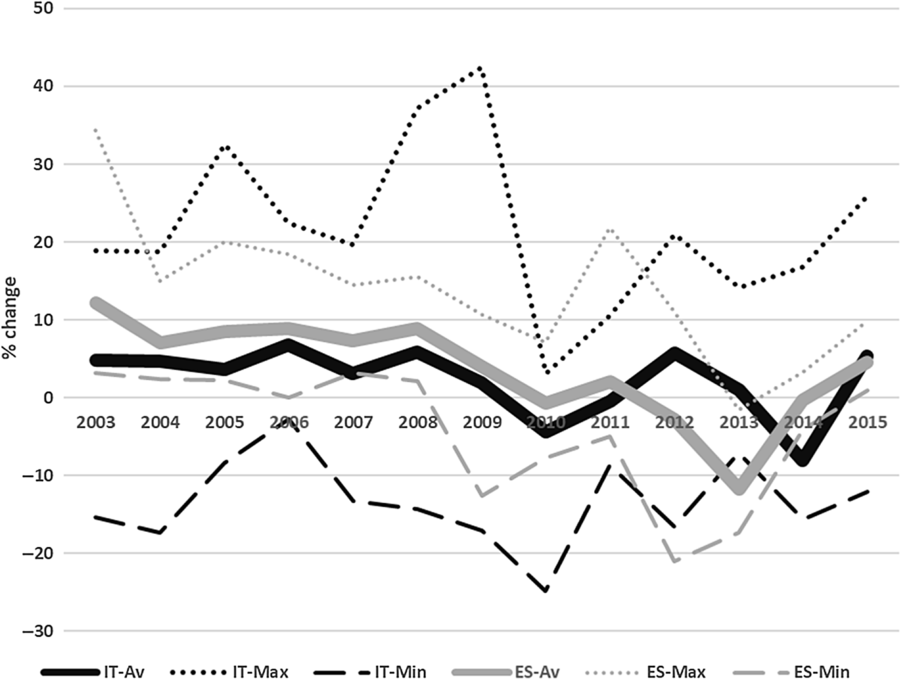
Figure 1 illustrates the trend in regional spending for Italy and Spain between 2003 and 2015. It shows that whereas the precrisis period is characterised by a significant growth in regional spending, the postcrisis period is characterised by stagnation and retrenchment. Spanish regions were highly active in the run-up to the crisis, increasing spending by an average of 9% per annum, while Italian regions did so by 6%. Between 2008 and 2010 regions in both countries saw a steady decline in spending growth. By 2011, Spanish regions began undertaking a reduction in spending, which reached a floor (−11%) in 2013. Italian regions’ experience of retrenchment was concentrated in a shorter one-year period (2013–14) and was less severe, reaching a floor (−8%) in 2014. Thus, the discrepancy in regional spending growth between the two periods is much more marked in Spanish than Italian regions.
Regional per capita spending change in Italy and Spain (2003–2015).
Source: see footnote 5.
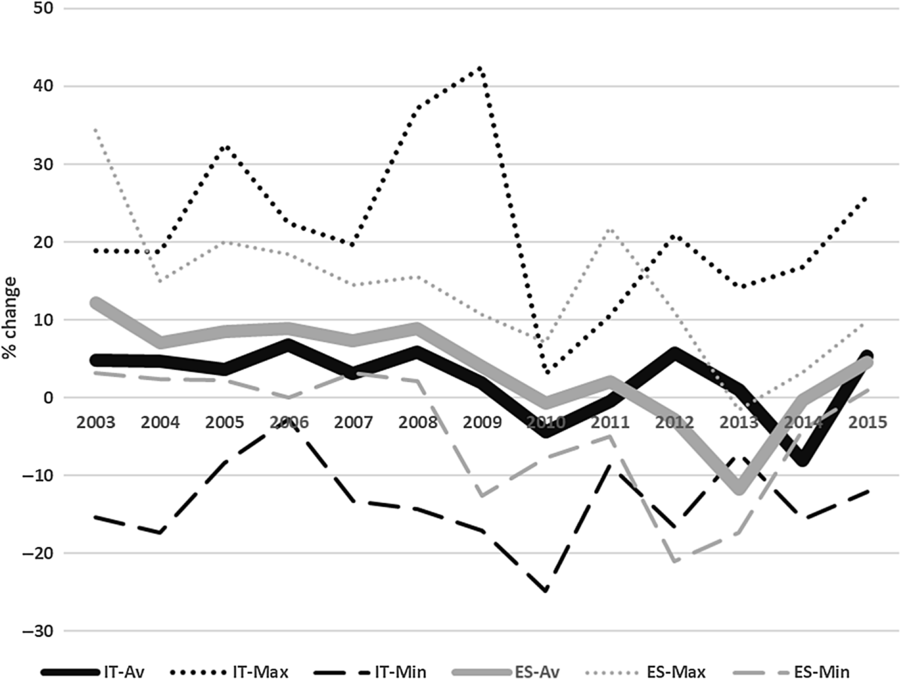
This pattern of growth, stagnation and retrenchment in regional spending did not affect all regions of Spain and Italy evenly. Mapping the minimum and maximum values of regional spending, Figure 1 also reveals the divergence in spending growth between regions.
In the precrisis period Spanish Autonomous Communities (ACs) experienced a steady but uneven expansion in public spending. In Italy, interregional differences were more marked, because some regions were already implementing cutbacks, as part of a collective effort to bring down the country’s debt, while others were increased spending. Differences between Spanish regions narrowed in 2007–08, but then opened up again in the period of stagnation (2008–10) and retrenchment (2011–12). All ACs followed a similar trend, but to different degrees. By 2013, however, all ACs converged to decreasing their spending and since the recovery of 2014–15, there has been convergence between ACs towards modest spending increases. A similar pattern holds for Italy, but with far more important discrepancies between its regions. There was a narrowing of differences around 2006, as most regions experienced an expansion of spending. However, divergence appeared during the period of decline (2008–10). Differences narrowed again in the period of modest recovery that lasted until 2011, during which regions were either increasing their spending or slowing down their reductions. However, divergence returned during the period of retrenchment in 2013–14 and recovery since 2015, as certain regions resumed spending growth while others continued to cut back. What is notable in the Italian case is that at no moment during this period do all regions converge to a point when they are all simultaneously engaged in an expansion or retrenchment of spending.
The fact that there were important interregional differences during and after an economic crisis, which witnessed a re-assertion of central government authority and an overall decline and cutback of expenditure, suggest that there is a pressing need to study this variation, since regions adjusted in a visibly different way to the policy of austerity.
Independent variable
The main independent variable we examine in this analysis is a regional government’s budget deficit in the year preceding spending change (t-1). Our key hypothesis is that spending retrenchment is caused by regional governments’ need to eliminate deficits in order to re-balance their budgets. The enforcement of fiscal discipline is regarded as important elements of stability and credibility within the Eurozone. The deteriorating financial situation of European member-states, particularly at the periphery of the Eurozone, may therefore explain the drastic change in spending growth rates after the crisis observed in Figure 2. Higher deficits thus impose constraints on the expansion of regional spending and may require retrenchment. We operationalise deficit with this formula:
 $${\rm{\% Defici}}{{\rm{t}}_{{\rm{t - 1}}}}{\rm{ = }}\frac{{\rm{\left( {Total\;Spendin{g_{\it t - \rm1}} - Total\;Revenue{s_{\it t - \rm 1}}} \right)}}\over\rm{{Total\;Revenue{s_{\it t - \rm 1}}}}} \times 100 $$
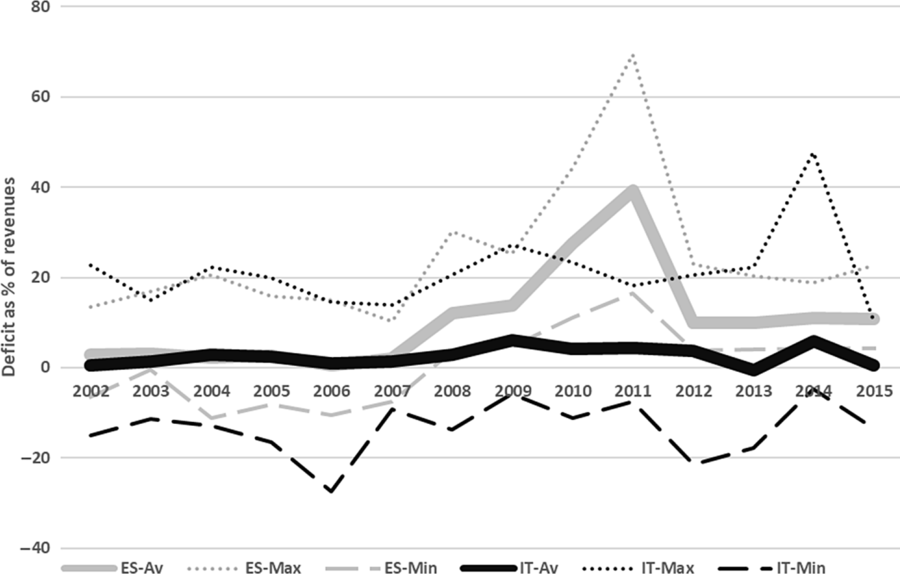
Regional budgetary deficits in Italy and Spain (2002–2015).
Source: see footnote 5.
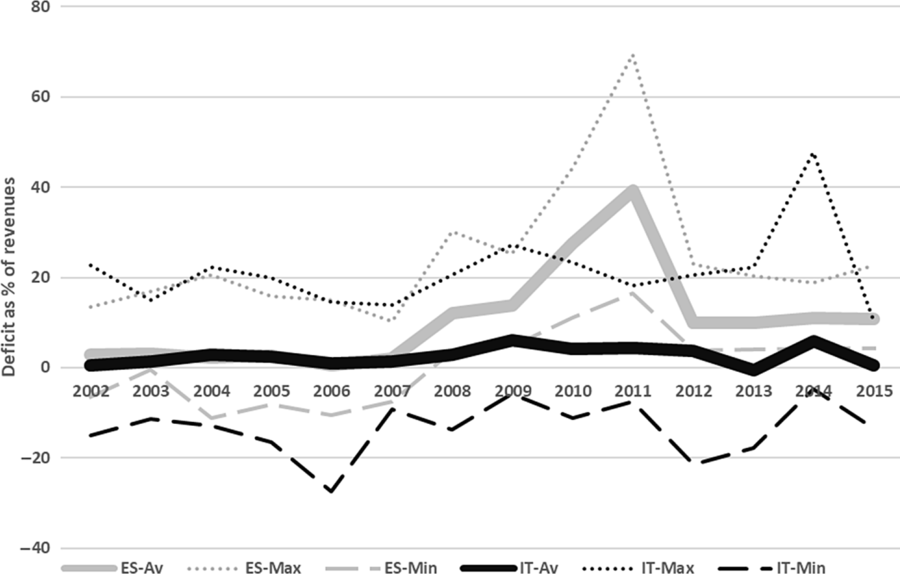
The difference between spending and revenues is calculated as a percentage of the revenues received by a region in a year (see Asatryan et al. Reference Asatryan, Feld and Geys2015). We subtract revenues from spending since we focus on increasing deficits. Therefore, the higher the score, the higher the deficit. Negative scores mean that the region is running a surplus. Figure 2 shows that in the postcrisis period, budget deficits were more significant than before the crisis. Yet, deficits reach much higher levels in Spain than in Italy. We can see that Spanish regions’ fiscal situation deteriorated dramatically in a very short period, from 2007 to 2011 and that deficits were only bought under control from 2012 onwards. At its height in 2011, the average deficit of Spanish regions was an astounding 39% of total revenues, whereas in Italy, already focused on containing its huge debt before the crisis, it reached an average peak of 6% in 2009. These differences result from each country’s fiscal history within the Eurozone in the prelude to the crisis and might explain the more marked spending adjustment experienced in Spanish regions, which we described above.
Yet these country-level trends mask important interregional differences depicted by the maximum and minimum lines in Figure 2. In the precrisis period, there were very significant differences between the budgetary positions of Italian regions in deficit and those in surplus. However, these differences diminished gradually from 2003 to 2007. In Spain, there was a similar process of convergence between ACs in deficit and in surplus, although absolute interregional variation was smaller than in Italy. From 2008 to 2011, the budgetary position of Spanish regions, however, diverged: they were all in deficit, but differences grew, reaching a peak in 2011. Since then, differences among Spanish regions have declined but remain important. Italian regions experienced a similarly divergent trajectory during their crisis (2011–14), with some regions facing a deficit, while others remained in surplus. Since the passing of the crisis, differences in the budgetary positions of Italian regions have also narrowed. Thus, the main difference with Spain was that the deficits faced by Italian regions were smaller overall and that some regions were still in surplus.
Moderating variables
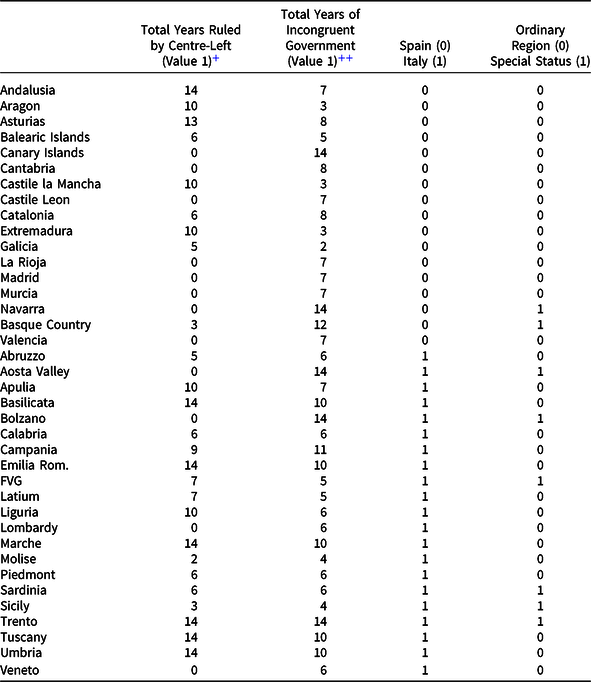
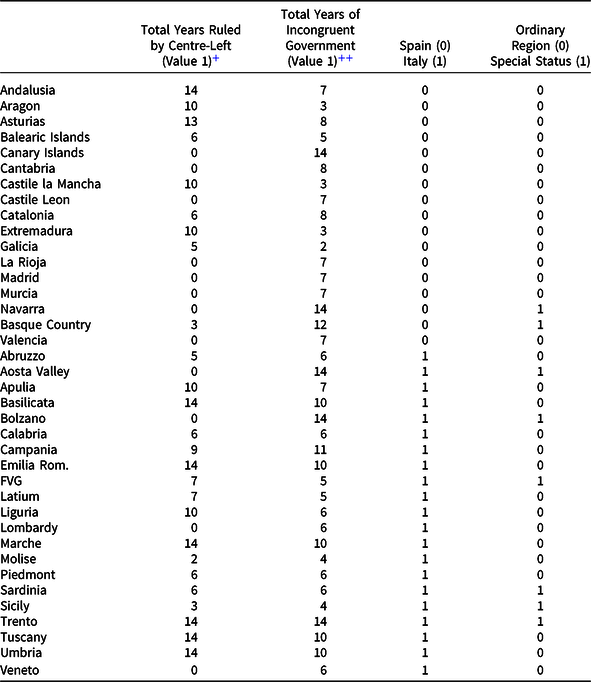
In the theoretical section, we identified two political variables that might moderate the effects of deficits on regional governments’ spending. The first one is the partisan ideology of regional governments on the “left–right” axis (H2). This is operationalised as follows: a region in which a centre-right or centrist party is the largest ruling party is coded 0, one governed by a centre-left party is coded 1 (see Appendix, Table A2, for details on coding). The other variable is partisan (in)congruence in the composition of regional and national governments (H3). Here, a region in which the main ruling party is the same controlling central government is coded 0 (congruence), one governed by a different party is coded 1 (incongruence).
Controls
Our analysis aims to assess regional governments’ responses to fiscal imbalances, regardless of the level of revenues they receive. In Italy and Spain, regional governments have considerably more spending powers than taxation powers. As a result, most of their revenues are exogenously determined and do not (at least directly) derive from political decisions taken at the regional level. Therefore, the question we ask is: how would a regional government react to a deteriorating fiscal situation (rising deficit) when holding revenues constant? Controlling for revenues is crucial since part of the spending patterns that we observe in Figure 1 might have been determined by changes in revenues rather than by adjustments to deficits. Indeed, as argued by Tellier (Reference Tellier2006), change in revenues can be considered as an additional constraint to regional spending. Yet, we do not lag our revenue variable. Indeed, our deficit measure already contains revenues in t-1 (see above). Our additional control variable accounts for revenues in the year when the money is spent, since our dependent variable refers to actual expenditure rather than planned one and, as such, it may have been adjusted to changes in revenues occurred during the year. Like change in spending, this variable is also operationalised as a percentage.
At the same time, however, we must recognise that decentralisation is an important driver of within-country variation in subnational social spending (Kleider Reference Kleider2018) and thus acknowledge the existence of certain regions that enjoy higher levels of autonomy than others. We therefore include a dummy variable to control for asymmetry in regional authority (Hooghe et al. Reference Hooghe, Marks, Schakel, Chapman Osterkatz, Niedzwiecki and Shair-Rosenfield2016), which can be observed in both Italy and Spain. The following regions are coded (1) as “special” autonomy: South Tyrol, Trento, Friuli Venetia-Giulia, Aosta Valley, Sicily, Sardinia, Navarre and Basque Country. We also include a “country” dummy (Spain = 0, Italy = 1) to account for differences between the two countries, which are not captured by our model.
Lastly, we control for two socio-demographic variables that might explain change in annual spending. The first one is the increase in population aged 65 and above. This variable is particularly important since the largest spending sector in both Italian and Spanish regions is healthcare. Ageing may be considered as an indicator of “social vulnerability” and, as underlined by Fésüs et al. (Reference Fésüs, Rillaers, Poelman and Gáková2008, 3), may lead to significant increases in public expenditure in the fields such as healthcare and social assistance (elderly care). We operationalise this variable as the percentage increase in the number of people aged 65 or above. Another important variable is increase in unemployment. The social effects of this phenomenon and the need to address them may add more pressure to regional spending, particularly in the area of social assistance (which includes poverty relief). Regions which have been particularly affected by the crisis and, as a result, have experienced a dramatic rise in levels of unemployment are therefore expected to have increased their spending at a faster rate (or decreased it at a lower rate) than others. We operationalise this variable as the difference in the rate of unemployment between t and t-1.
Model and results
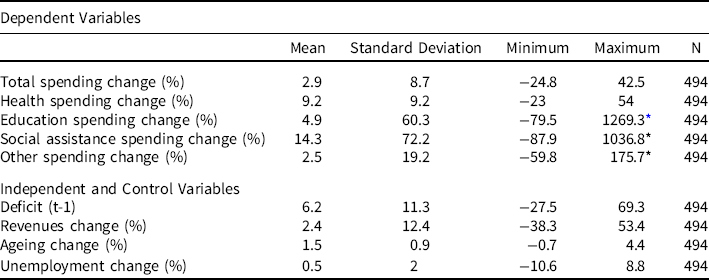
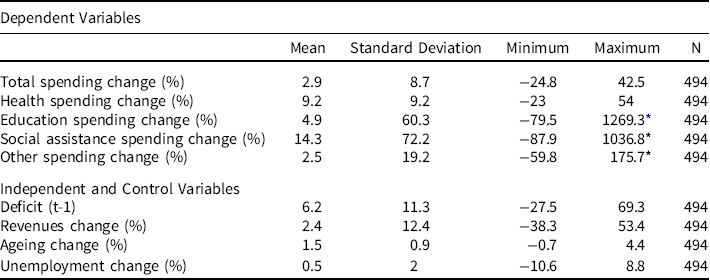
To test our hypotheses about the impact of deficit on annual regional spending, we run ordinary least squares (OLS) regression models with robust standard errors clustered by regions. We follow the procedure adopted by Khemani (Reference Khemani2007). Summary statistics for all variables (Appendix, Table A1) suggest that while annual change in total and health spending is normally distributed, other sectors include outliers (as suggested by minimum and maximum values). There are some extreme positive outliers (above the value of 100), which are isolated and may be explained by exceptional events. Therefore, they have been removed (Ho and Naugher Reference Jones, Sanguinetti and Tommasi2000, 2–3). Whereas in the case of spending on education and “other” sectors, we are dealing with just 2 or 3 outliers out of 494 observations, in the case of social assistance the number is larger (21). All analyses below include the control variables mentioned in the previous section (summary statistics in Tables 1 and A2, Appendix).
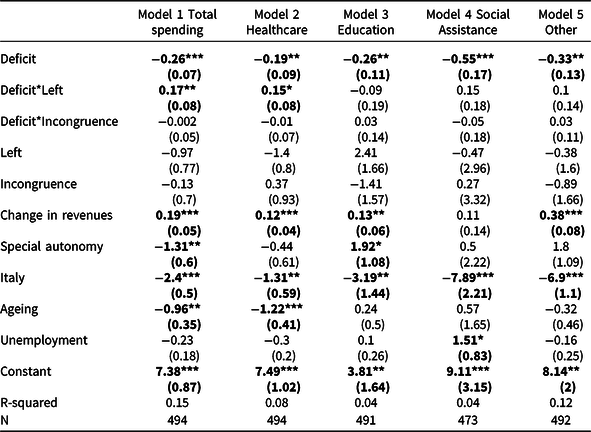
Explaining annual change in spending (%) in Italian and Spanish regions from 2003 to 2015
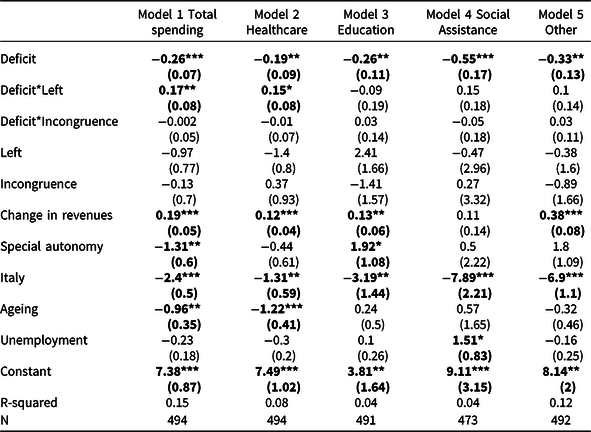
*p < 0.1; **p < 0.05; ***p < 0.01 Standard errors in brackets. Statistically significant coefficients in bold.
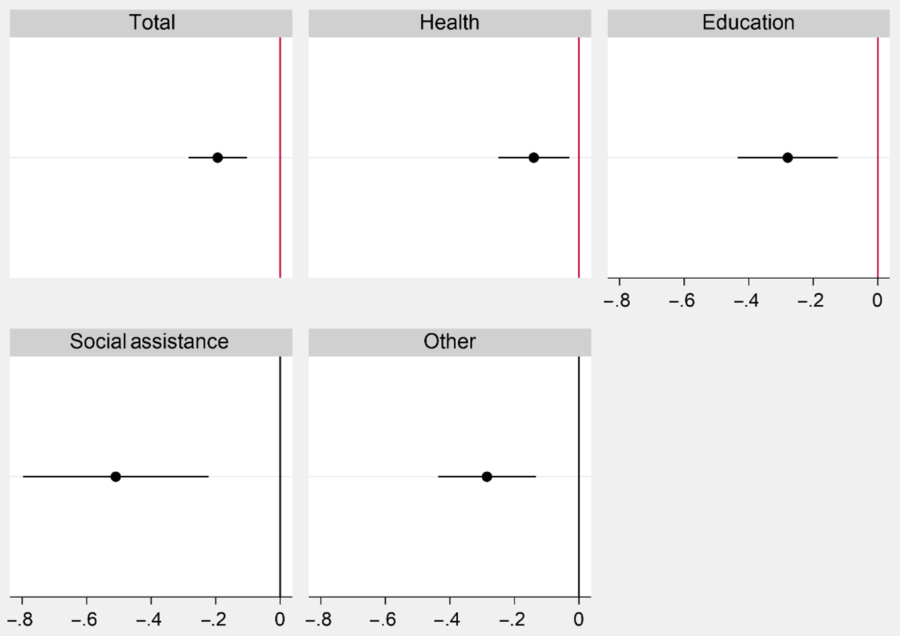
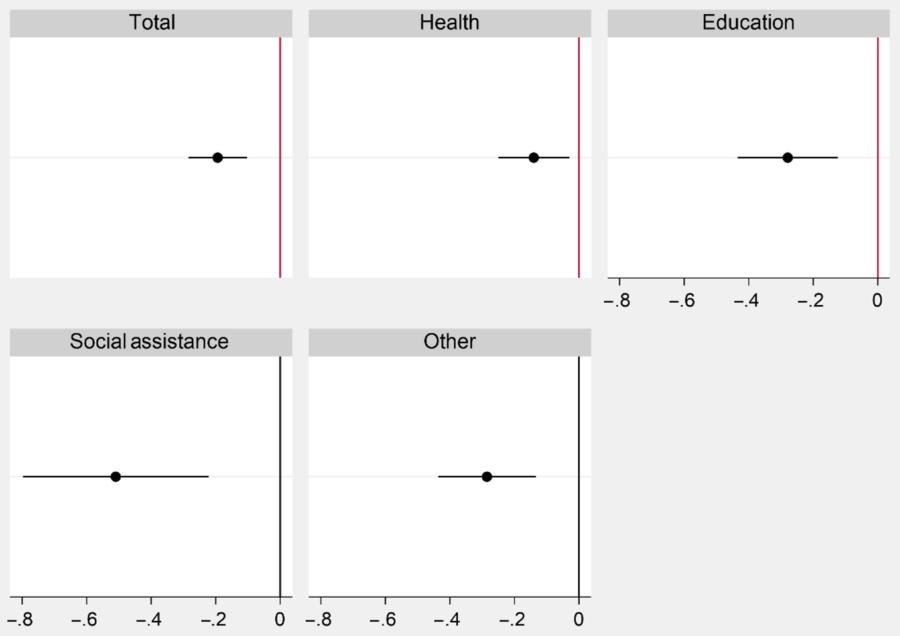
Figure 3 shows the marginal effects of deficit on spending regardless of political variables (“left–right” and “congruence-incongruence”). They confirm H1 since the effect of one-point increase in deficit on total spending is negative and statistically significant (the 95% confidence interval does not include 0). They also confirm H4, since the marginal effect of deficit is less substantial in the case of healthcare than in all other sectors. Whereas a one percentage point increase in deficit has a minimal negative impact on annual variation in health spending (−0.14%), it results in more than half a point decline in social assistance spending from one year to the next.
Effect of one percentage point increase in deficit on spending (annual change in %).
The models 1–5 in Table 1 include two interaction effects: one between deficit and left-wing ruling party and the other between deficit and vertical incongruence. We focus on the key independent and moderating variables presented above.Footnote 6 In this way we can test H2, H3 and H5 and check whether the spending adjustment determined by regional deficits is moderated by the political factors identified in the theoretical part of this article. Model 1 focuses on overall spending. We then run four separate models that consider specific spending sectors: healthcare, education, social assistanceFootnote 7 and other. The latter mainly includes public administration spending.
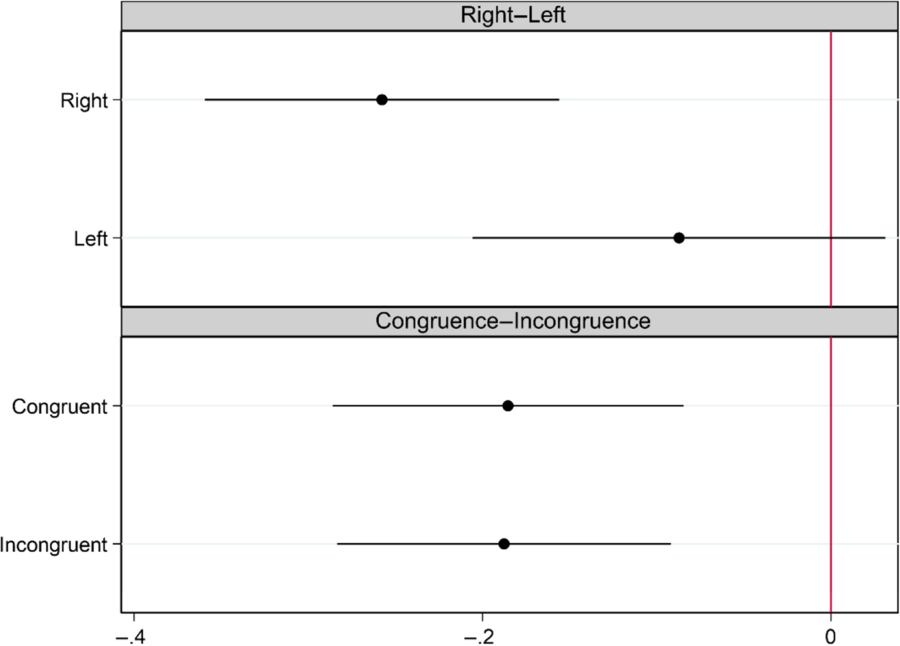
Model 1 confirms H2. As shown by the interaction effect between deficit and left, which is statistically significant (at 0.05 level): the negative effect of deficit on public spending is considerably less strong in regions that are ruled by centre-left parties. Figure 4 shows effects of deficit conditional on the political characteristics of the regional government. It clearly emerges that in regions ruled by centre-right parties, one percentage point increase in deficit leads to a 0.26% reduction in total spending, which is also statistically significant at any conventional level. On the other hand, in regions ruled by centre-left parties the effect is much smaller, a reduction of just 0.09%, and is not statistically significant.
Effect of one percentage point increase in deficit on spending (annual change in %), moderated by political variables.
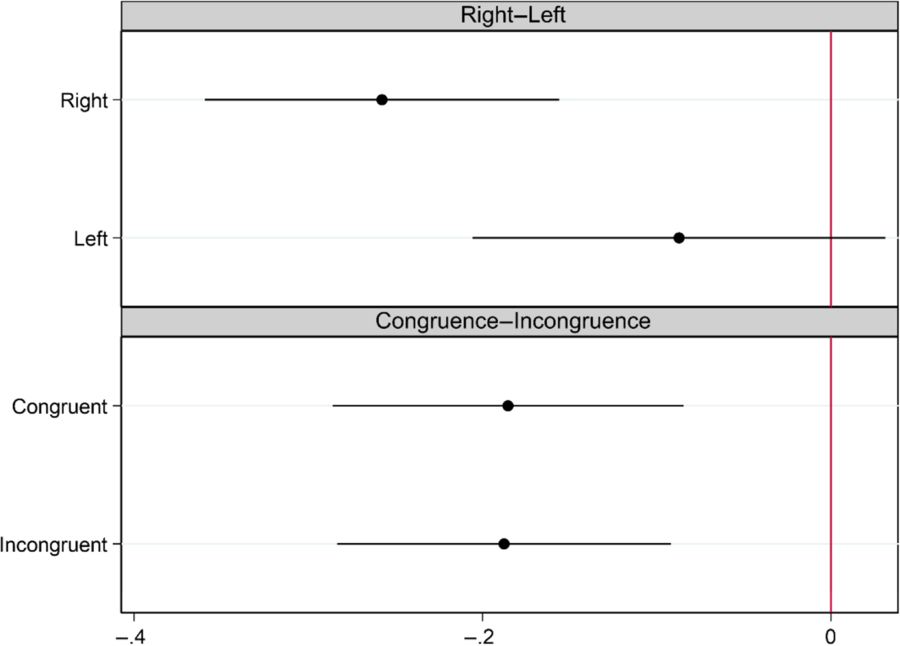
Interestingly, vertical incongruence in governmental leadership does not seem to change the effect of deficit on spending, as the lower part of Figure 4 shows. The effect is basically identical in both cases: negative and statistically significant. So, having a leading party in regional government, which is different from the one in national government, does not significantly reduce the effect of deficit on spending. This contradicts recent literature that, focusing mainly on the 1990s and early 2000s (a period of economic expansion), has highlighted the importance of centre-periphery dynamics, which seemed to have gradually replaced traditional left–right politics (Vampa Reference Vampa2016). Instead, in an age of increasing fiscal constraints and austerity, regional responses seem mainly shaped by the traditional left–right political cleavage.
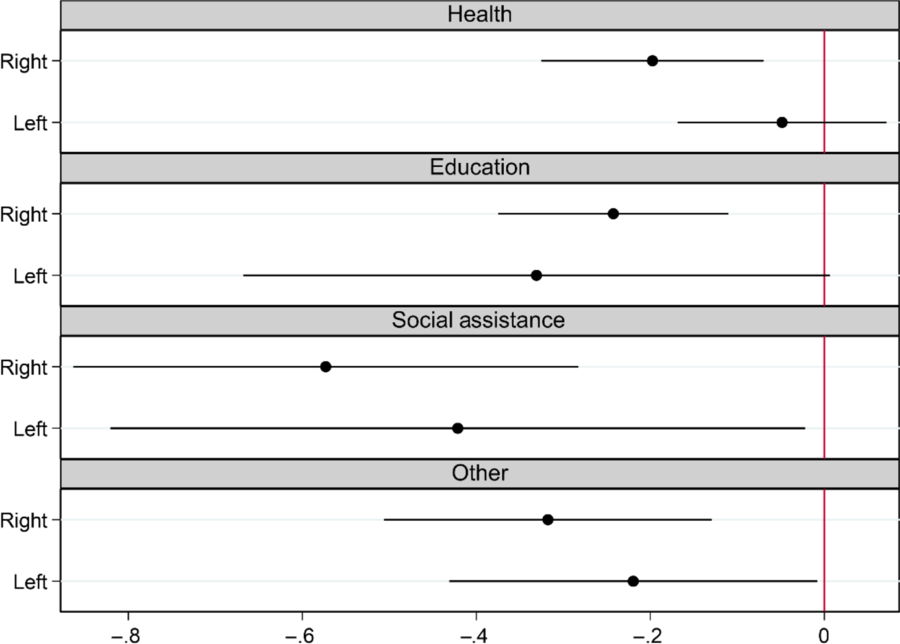
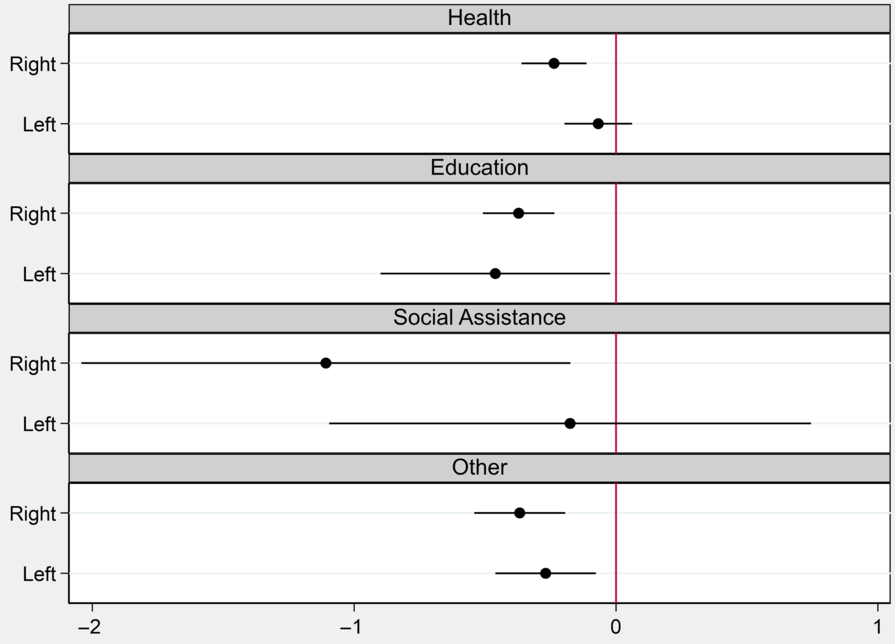
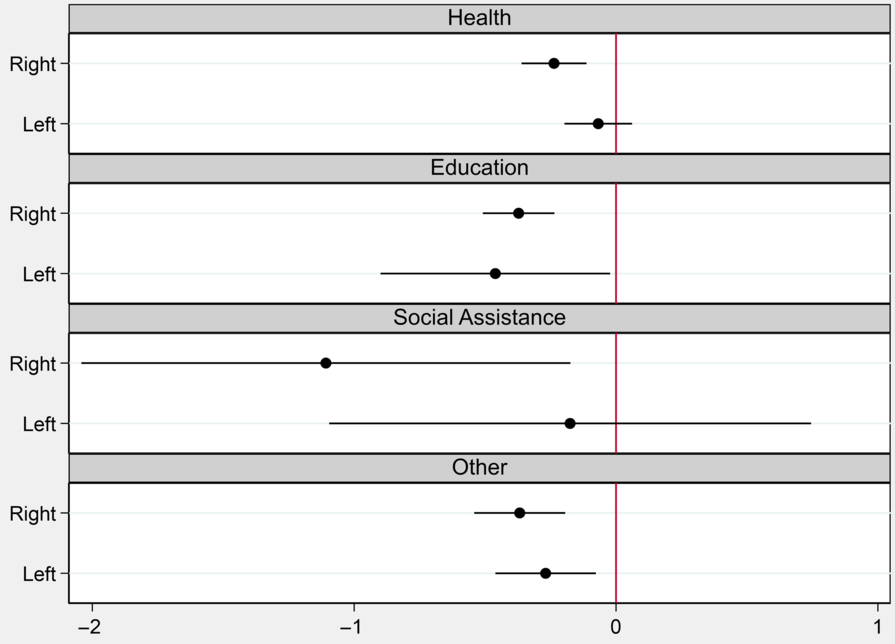
Models 2–5 of Table 1 focus on spending in individual sectors. Figure 5 shows the effect of deficit on annual change in spending conditional on the ideological position of the regional ruling party on the left–right axis. Once again, we have compelling evidence that the core universalistic sector of healthcare is better sheltered from deficit reduction than more particularistic goods such as social assistance (i.e. the effects of both “left” and “right” are smaller than in all other sectors). Additionally, as shown in Table 1 (Model 2), the interaction between deficit and left is statistically significant only in the case of healthcare (p < 0.1). Having a left-wing party in regional government almost completely neutralises the negative effect of deficit on health spending. This confirms the argument about the politicisation of the “core” regional spending sector (H5). In the other sectors, we have consistent retrenchment regardless of which party is in government. In the case of social assistance, however, running the regression with all the outliers dropped in the main model slightly changes the result (see Appendix Figure A1).
Effect of one percentage point increase in deficit on spending (annual change in %) by sector, moderated by partisan ideology (right versus left).
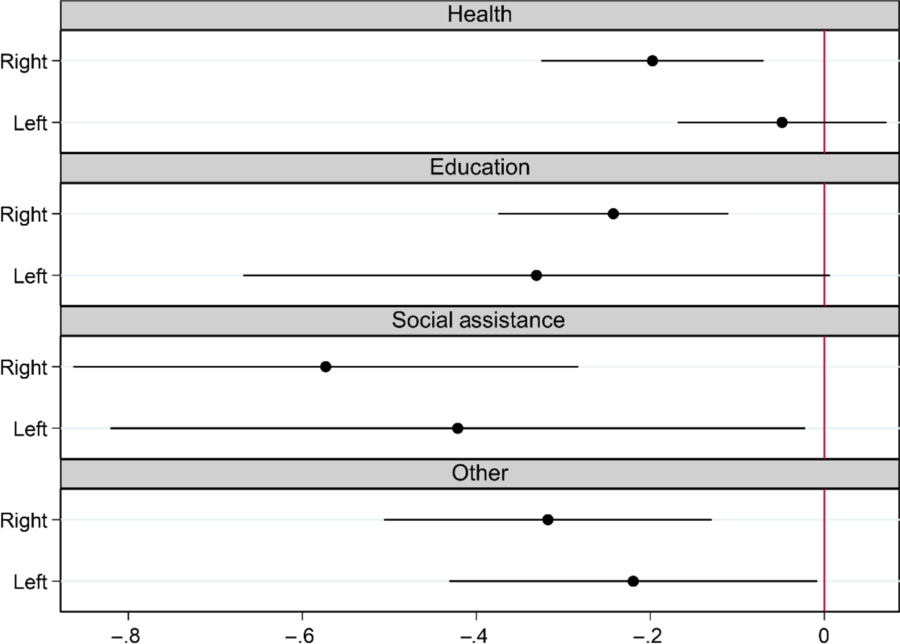
In sum, regional competition between centre-left and centre-right parties seems most relevant in the core area of the whole regional welfare system: healthcare. Regional governments are mostly accountable for what they do in the health sector in both Italy and Spain. Therefore, in a context of rising deficits they tend to cut more in marginal spending sectors (particularly social assistance, the smallest of the four sectors considered). Additionally, the cuts they implement in the health sector are not completely driven by “technocratic”, “functional” adjustments but partly reflect political decisions deriving from the competition between left and right.
Consistent with what we found earlier, vertical incongruence in governmental leadership between central and regional government does not seem to matter in any sector. All interaction coefficients in Table 1 are very small, and none are statistically significant at any conventional level, meaning that this variable does not seem to have a moderating impact on deficit. The lack of significant sectoral effects linked to “vertical” political competition between centre and periphery is as interesting as the existence of more clear differences between the ideological orientations of regional governments on the left–right axis. This point is discussed in the next section. Yet before moving to the conclusions, we briefly discuss the robustness of our analysis.
Robustness checks
To test our hypotheses, we followed the procedure adopted by Khemani (Reference Khemani2007) in her study on fiscal discipline in Indian states. However, given the longitudinal nature of the data, it would be equally legitimate to use Beck and Katz’s (Reference Poterba1995) recommended procedure based on panel-corrected standard errors (PCSEs), corrections for first-order autocorrelation and imposition of a common rho. Even adopting this approach, the results remain very similar. A model with region fixed effects (RFE) and clustered standard errors, in which time invariant variables such as “country” and “special autonomy” are dropped, also confirms our findings.
Discussion and conclusion
In examining how regional governments adjusted to increasing budget constraints, this article has sought to shed new light on the fiscal behaviour of substate authorities and on the factors leading to public sector retrenchment.
First, we found that, among Spanish and Italian regions, the functional imperative of curbing deficits was powerful: regions with the highest deficits were confronted with the most urgent imperative of bringing their budget into balance and reducing their spending. The tendency of regional governments to cutback spending is consistent with what we know about the procyclicality of provincial budgets in federations (Rodden and Wibbels Reference Rodden and Wibbels2010). Deprived of access to credit markets and to stabilising intergovernmental transfers, regional governments in Spain and Italy could not independently counter the business cycle and were thus constrained to reduce their expenditure, in function of the size of their deficits.
Our second result offers evidence about the significance of political variables for understanding variations in the fiscal behaviour of regional governments. Much of the existing literature on the fiscal performance of federations tends to focus on the influence of fiscal rules and taxation autonomy on the behaviour of subnational units (Asatryan et al. Reference Asatryan, Feld and Geys2015) and to aggregate this behaviour at the level of the federation, without exploring the sources of variation between subnational units (Rodden and Wibbels Reference Rodden and Wibbels2010). This focus overlooks the fact that, although they function in a common institutional setting, regions are governed by parties with different ideological orientations that are answerable to different constituencies, both of which will colour the way in which they adjust to austerity.
In contrast to the “functional” perspective, we found that the presence of a left-wing party in regional government mitigated the effect of deficits on spending. Whereas right-wing and centrist parties are more sensitive to the need of reducing spending to balance their budgets, left-wing parties adopt a more flexible attitude towards fiscal discipline and contain retrenchment. Differences between left and right thus matter for Spanish and Italian regions. This result is consistent with research on national-level fiscal consolidation which shows that while adjustments are undertaken by both left-wing and right-wing parties, the former are more modest in the speed and scope of their undertaking (Jensen and Mortensen Reference Jensen and Mortensen2014; Hübscher Reference Hübscher2016). Yet it represents a distinct contribution to existing research on subnational fiscal policy where the effect of partisanship has been shown to be more muted, insofar as it might be less important than fiscal rules (Poterba Reference Poterba1994) or the competitiveness between rival parties over the control of public sector patronage (Remmer and Wibbels Reference Remmer and Wibbels2000).
This finding is particularly topical in light of the current debate on the “crisis” of social democracy, which is torn between renewed support for welfare expansion and the need for fiscal consolidation and budgetary rigour (Bremer Reference Bremer2018). Previous studies have underlined that in multi-level systems, social-democratic parties might face challenges in the implementation of their traditional policies (Keating Reference Keating and Hassan2004). However, observing more resistance to fiscal discipline coming from centre-left parties suggests that the economic crisis and the imposition of austerity have not led to the complete evaporation of politics and to the disappearance of the programmatic differences existing between left and right, at least at the subnational level. Rather, these seismic events might have opened the subnational level as an important arena of political contestation to centrally imposed austerity rules.
A more surprising finding to emerge from this article was the absence of any effect for the vertical incongruence of governments. Our expectation was that, in the context of a significant fiscal adjustment exercise, a region ruled by a party in national opposition would resist national-level fiscal consolidation policies. In contrast, regions ruled by national-level copartisans should be brought to heel through party discipline (Jones et al. Reference Jones, Sanguinetti and Tommasi2000). However, similar to Remmer and Wibbels (Reference Remmer and Wibbels2000), we find that this variable has no effect on the influence of deficits on spending. Our interpretation of this result is that, during a crisis, a territorial logic of action may lead to the articulation of centre-periphery conflicts between governments ruled by the same state-wide party. In decentralised systems such as Spain and Italy, where regional elections are shaped by distinct competitive dynamics, there are strong incentives for parties to respond to the demands of their constituencies. Moreover, the regional branches of state-wide parties have the autonomy to run these contests and regional presidents hold a lot of sway when speaking on behalf of their constituents. So, we can expect them to oppose or deviate from the fiscal adjustment policies imposed by their national-level partisan colleagues. What is required next, therefore, is to study how the features of regional party competition – like fragmentation and competitiveness – shaped territorial conflict over austerity.
Lastly, in a hitherto unprecedented effort to assess the incidence of austerity across different policy areas, we also found that, much like national-level dismantling processes (Pierson Reference Pierson1994), healthcare was better protected from cutbacks than social assistance payments or spending on education and regional public administration. This might still be consistent with a “functional” interpretation, since the regional health sector appears more nationally coordinated than other sectors, like social assistance (Vampa Reference Vampa2017). Therefore, regions might have been “forced” to cut elsewhere to maintain minimum health standards guaranteed by the national legislative framework. Yet we also find some support for a more “political” interpretation. Indeed, our results suggest that the health sector is even more protected by left-wing parties than right-wing ones. Interviews conducted with regional policy makers in ItalyFootnote 8 seem to support the coexistence of “functional” and “political” factors shaping spending patterns in healthcare. Even if the margins for retrenchment seem smaller in this sector, right-wing parties will still be more inclined to reduce spending by resorting to “horizontal subsidiarity” – outsourcing service provision (and costs) to the private sector (Vampa Reference Vampa2016) – while left-wing parties will try to maintain a stronger public sector.
Generally, understanding the causes of our “sectoral” results requires a deeper examination of the nature of political competition and public policymaking at the subnational level to assess the potential of rival explanations. On the one hand, it is intuitive that a universalist policy such as healthcare should be sheltered from the worst of cutbacks given the wide cross-party constituency that this would affect, from new parents to elderly citizens, and the fact that it is relevant for an outcome as critical to citizens as their health (Pierson Reference Pierson1996; Vis Reference Vis2009). The electoral costs of cutbacks are certainly easier to manage when they affect the smaller and more marginalised constituencies that depend on social assistance or a narrower set of group interests, such as those of regional bureaucrats. However, the protection of healthcare is also consistent with strong legacy effects and the inelastic nature of expenditure in this policy sector. Important capital investments in hospitals and other medical facilities, as well as long-term supply contracts for medical equipment and pharmaceuticals, make cutbacks practically more difficult to implement than in other sectors which rely primarily on cash payments for income support, social service provisions or salaries. Further research is thus needed to examine the influence of these two drivers on the observed outcomes.
Data Availability Statement
Replication materials are available in the Journal of Public Policy Dataverse at https://doi.org/10.7910/DVN/2MZAL2
Acknowledgements
The authors thank the Research Priority Area Development Funding of the University of Nottingham for its financial support. The authors also thank Deborah Zak Godoy and Cristina Lira for their help with data collection and all the colleagues who provided comments on earlier drafts of this article during various workshops and conferences. Finally, the authors wish to thank the editor and the anonymous reviewers for their insightful and constructive feedback.
Appendix
Effect of one percentage point increase in deficit on spending (annual change in %) by sector, moderated by partisan ideology (right versus left). Outliers included.
Summary statistics of continuous, interval-level variables
Summary statistics of dummy variables (0, 1)