INTRODUCTION
Different strategies to govern resource commons produce effects that can be assessed along different dimensions, in terms of the ecological or social sustainability of the resource system, contributions to the livelihoods of those who rely on these resources or equity in the allocation of benefits (Hilborn Reference Hilborn2007; Ainsworth et al. Reference Ainsworth, Pitcher and Rotinsulu2008; Sudtongkong & Webb Reference Sudtongkong and Webb2008). These different characteristics of outcomes are generated simultaneously. But they are not systematically related to each other positively (or negatively) across different contexts. Sometimes greater sustainability may be associated with improvements in livelihoods or equity (Kajisa et al. Reference Kajisa, Palanisami and Sakurai2007; Walpole & Wilder Reference Walpole and Wilder2008; Suich Reference Suich2010). At other times, these three outcomes may not be associated with each other, or may have a negative association (Young Reference Young1999; McShane et al. Reference McShane, Hirsch, Trung, Songorwa, Kinzig, Monteferri, Mutekanga, Thang, Dammert, Pulgar-Vidal, Welch-Devine, Brosius, Coppolillo and O'Connor2010). No theory or robust empirical evidence exists concerning whether improvements in sustainability are likely also to improve equity or levels of livelihood benefits to those depending on a given natural resource. This is also true for additional dimensions of outcomes that may be relevant for specific resource commons, such as biodiversity conservation in relation to forests.
The lack of knowledge is unfortunate from a conceptual as well from a practical perspective. These outcomes are all of major interest to policy makers and to those interested in understanding the nature of the relationships among these outcomes from a theoretical perspective (Chhatre & Agrawal Reference Chhatre and Agrawal2009). More systematic understanding of the conclusions of the existing work on the commons concerning the relationships among these different outcomes can therefore show both the extent and the limits of existing knowledge about how multiple outcomes are related to each other, and areas in which further work is necessary to understand the drivers of different outcomes. An important beginning has been made in documenting multiple ecosystem services and outcomes by scholars of ecosystems and those interested in conservation and poverty (Bennett et al. Reference Bennett, Peterson and Gordon2009; Cao et al. Reference Cao, Zhong, Yue, Zeng and Zeng2009; Swallow et al. Reference Swallow, Sang, Nyabenge, Bundotich, Duraiappah and Yatich2009; Raudsepp-Hearne et al. Reference Raudsepp-Hearn, Peterson and Bennett2010). But scholars of common-pool resources such as fisheries, irrigation and grazing lands, the focus of this review, need to undertake far more work to assess how commons outcomes relate to each other and to determine the underlying causes of multiple outcomes. There is great interest in such relationships among outcomes: for example, gaining understanding of the broad relationship between livelihood promotion and resource conservation efforts (Agrawal & Redford Reference Agrawal and Redford2006), or how grazing-based livelihoods affect carbon sequestration in grasslands.
In most countries and for most resources, de facto community use and management practices have typically predated central government or state policies to govern resource use (Peluso & Vandergeest Reference Peluso and Vandergeest2001). Government control of resources such as forests in the developing world, for example, was often formalized with colonial interventions that coincided with industrialization and increasing prices for many forest products such as timber. Stronger state presence to manage irrigation waters and infrastructure emerged with greater investments in irrigation infrastructure, and perceived gaps in existing community-level efforts. Yet, in recent years, recognition of information, distribution and corruption-related problems have often led to demands and pressures for greater local involvement in the management of renewable resources, and hence to decentralization and community-based natural resource management (CBNRM) as a consequence of decentralization (Ribot Reference Ribot1999; Sudtongkong & Webb Reference Sudtongkong and Webb2008).
Such demands for a greater role for local involvement in the governance of resource commons have been strengthened by scholarly work on local, community-based governance of natural resources. Scholarship on common property spans many disciplines. Anthropologists, resource economists, ecologists, historians, political scientists, rural sociologists and others have contributed to the flood of writings on the subject (National Research Council [NRC] 1986; Ostrom Reference Ostrom1990). Much recent empirical work on the commons draws significantly from theories of property rights, institutions and transactions costs (Coase Reference Coase1937, Reference Coase1960; Demsetz Reference Demsetz1964; Cheung Reference Cheung1970; Alchian & Demsetz Reference Alchian and Demsetz1972; North Reference North1980, Reference North1990; Schotter Reference Schotter1981; Sugden Reference Sugden1984; Fudenberg & Maskin, Reference Fudenberg and Maskin1986; Eggertsson Reference Eggertsson1990; Libecap Reference Libecap1990; Rose Reference Rose1994). It also draws on other approaches, including political, ecological, ethnographic and historical (McCay & Acheson Reference McCay and Acheson1987; Berkes Reference Berkes1989). Much of this research typically focuses on locally situated small user groups and communities.
Commons research has shown that markets and private property arrangements, and public ownership and central state management, do not exhaust the range of plausible institutional mechanisms to govern natural resource use (Ostrom Reference Ostrom1990). Communities, local peoples and indigenous groups can also successfully govern renewable natural resources (McCay & Acheson Reference McCay and Acheson1987; Berkes Reference Berkes1989). Further, such common-pool resources and successful local efforts to manage them are distributed throughout the world. Scholarship has also identified a series of biophysical, sociopolitical, institutional, demographic and policy variables that are associated with improved resource governance outcomes. Admittedly, local contexts are highly variable and renewable resources can be of many different types. Yet, the collection of case study work on renewable resources such as pastures, irrigation and fisheries can be seen as having made a substantial contribution to the better understanding of when and how these resources can be better governed.
Scholarship on the commons has also documented that local resource governance institutions comprise a significant proportion of local rural institutions globally (Pretty & Ward Reference Pretty and Ward2001). They also play a fundamentally important role in influencing local incomes and wealth, sustainability of local resource bases and distribution of benefits from local resources (White & Martin Reference White and Martin2002). These characteristics of renewable resource management mean that such resources are crucial to rural lives and livelihoods and that government policies seeking to improve rural incomes and sustainable resource use can often aim towards those goals by improving resource governance.
Local demands for a role in the management of commons, failures of central efforts to improve resource governance, and an intellectual justification for decentralized collective management of resources have meant that larger areas and amounts of renewable resources are currently managed locally, with an explicit or implicit recognition of local claims by higher-level decision makers. Local institutions for resource governance have increased at least in numbers in the past two decades, as national governments have claimed to involve local populations in the governance of local resources by creating new local institutional arrangements (Dietz et al. Reference Dietz, Ostrom and Stern2003).
The documentation and defence of the role of communities in resource governance has rested chiefly on the analysis and examination of hundreds of separate case studies of successful common-pool resource governance. Such studies cover both historical cases of resource governance, but also more recently created natural resource commons (Berkes et al. Reference Berkes, Davidson-Hunt and Davidson-Hunt1998; White & Martin Reference White and Martin2002; Agrawal Reference Agrawal2007; Charnley & Poe Reference Charnley and Poe2007). These newly-created commons are a result of policy shifts in many developing countries, whereby governments have turned to local-level actors and common property institutions and seemingly decentralized the resource governance. These policy shifts are no more than a belated recognition that sustainable resource management is not independent of the sustainability of human institutions that frame resource governance, and that local users are often those with the greatest stakes in sustainability of resources and institutions.
Increasing state involvement in most resource governance arrangements, whether they be rangelands, forests, irrigation water or fisheries, suggests that even where communities and local groups have long-standing rights to manage local resources, such rights require at least the implicit sanction of state legislation and/or officials (Agrawal Reference Agrawal2007). For resources that are deemed valuable (such as timber and fish) local rights often exist as a result of specific actions by government and state agencies (Ribot Reference Ribot1999). For example, of the 400 million hectares of tropical forests under formal community control, more than half have been transferred to community management in the past quarter century (Sunderlin et al. Reference Sunderlin, Hatcher and Liddle2008; Agrawal et al. Reference Agrawal, Chhatre and Hardin2008). Similar estimates for fisheries and irrigation do not exist, but it is reasonable to assume that informal rights to commercially less valuable ecosystem products and services often exist without explicit decentralization reforms. Given the role of state policies in shaping the governance of renewable resources and their outcomes, it becomes even more necessary to ensure that such policies take into account the multiple outcomes that renewable common pool resources generate and do not focus on just one type of outcome, because in doing so they may unwittingly worsen others.
This paper reviews the currently available literature on community-based natural resource governance. It focuses on three major renewable resources, namely pastures, fisheries and irrigation water, which provide livelihood benefits to millions of households in diverse ecological contexts around the world (Pretty Reference Pretty2003). Such institutions related to renewable resources have been the subject of extensive scholarly attention, particularly since the early 1980s. In reviewing the theoretical approach and thrust of this body of work, the major argument we advance is that most existing writings on fishery, pastoral, and irrigation commons have been inattentive to the multiple outcomes that management of all renewable resources generates. In particular, we suggest that studies of these three types of commons have mostly failed to distinguish among livelihoods, sustainability and equity dimensions of natural resource governance outcomes, and that existing research rarely attends to the distinctions among these outcomes, their distinctive determinants and drivers, and the nature of trade-offs and synergies among them. The failure of the bulk of scholarly contributions to attend to multiple outcomes on pastoral, fishery, and irrigation commons, to examine the synergies between and drivers of these outcomes, or to identify methods or theories that can examine these outcomes in their own rights continues to hinder future development of the field of commons research.
We first summarize the background of the study, and briefly describe the methods and approach used for the review. We consider three outcomes: livelihoods contributions of commons for users, sustainability of the commons (ecological or social/institutional) and equity in allocation of benefits from the commons. We explore the extent to which existing research allows conclusions about whether some outcomes suffer (for example sustainability) as other outcomes improve (for example contributions to livelihoods). We critically review the differing theories proposed by scholars working on fisheries, and pastoral and irrigation commons to explain outcomes.
METHODS
To identify the major factors that explain variations in commons outcomes and institutional forms through which state agencies connect to local resource management efforts, we conducted a review of the literature on inshore fisheries, irrigation and pasture commons. We did not include the literature on forests for two reasons: (1) several reviews oriented toward the literature on forests already exist (Pagdee et al. Reference Pagdee, Kim and Daugherty2006; Agrawal Reference Agrawal2007; Charnley & Poe Reference Charnley and Poe2007) and (2) many of the conclusions this paper reaches about the paucity of research on multiple outcomes also apply to the work on forest commons, as indicated by existing reviews. Indeed, comparative assessment of multiple outcomes remains a rare phenomenon in commons scholarship despite the near ubiquitous occurrence of multiple outcomes in reality. However, we also recognize that there is some community-forests related scholarship that pays attention to multiple outcomes (Chhatre & Agrawal Reference Chhatre and Agrawal2009).
Using different keywords for searches in the ISI Web of Science, we scanned more than 2200 articles for information about cases of fisheries, pastures and irrigation management to identify an initial set of approximately 300 articles that had substantial empirical content. Our final set of articles included 76 that focused on fisheries, 45 on irrigation and 31 on pastures (a total of 152 papers), all published after 1980.
In selecting these articles, we ensured all papers selected focused on explanations of one of the three outcomes that are the focus of this review. We also analyzed them to assess how they measured the outcomes of interest, and the extent to which they examined trade-offs and explanations of trade-offs across any set of these three outcomes. We identified the information contained in these articles based both on their specific use of terms (such as trade-offs or synergies), and if the discussion and analysis in the article substantively addressed questions of trade-offs and relationships among outcomes (without necessarily using the terms). We focused especially on whether and how the article measured different outcomes, compared or assessed variations in more than one outcome, and analysed specific outcomes. We reviewed the coding of the cases and, where there were questions about the coding, reexamined the article. In our classification, sustainability outcomes included both ecological and social/institutional sustainability; articles that analysed either or both of these types of sustainability dimensions were coded as analysing sustainability.
In providing a systematic examination of the existing literature and its findings in relation to multiple outcomes, their relationships and the drivers of these relationships, our review follows existing trends in the scholarship on the commons. In other words, it does not attempt to identify factors that scholars of pastoral, fishery and irrigation commons have not used to explain outcomes. It attends only to the explanations that have been used by at least one study covered by our review. To this extent, the review may well be ignoring real-world factors and processes that cause variations in sustainability, livelihoods and equity if these factors and processes are being ignored in the literature.
The selected articles have a broad regional spread, but writings on five countries represent more than half the articles in the set: India, Philippines, Brazil, South Africa and Mexico. More complete information on the methods we used to identify and code information available in these articles and the full set of 300 references are also available (Appendix 1, see supplementary material at Journals.cambridge.org/enc).
THE DIVERSITY OF COMMONS OUTCOMES
Three important outcomes with which local governance of common-pool resources is typically concerned are livelihoods contributions of commons to users, sustainability of the commons, and the equity of allocation of benefits from the commons. Policy measures attempting to shape how local natural resources should be governed are often preoccupied with these same goals of resource governance. Commons can yield these outcomes to differing degrees depending on many factors, including the ways in which local users govern them. They can provide different levels of livelihoods contributions to their users as a group. They can be managed more or less sustainably. Additionally, as users with different capacities and endowments seek to improve their life chances by drawing upon local resource commons, some gain more and others less. It is important to understand the different factors that lead to higher or lower levels of one outcome in comparison to another.
An analysis of the work on local resource governance that examines variations in multiple outcomes and the reasons for such variation is long overdue. This is because writings on local governance and resource institutions typically focus on explaining outcomes by referring to a common set of factors. They tend not to explicitly distinguish among the different outcomes that can be attributed to resource commons even when different writings are clearly concerned with different kinds of outcomes. Consider, as examples, the writings of Wade (Reference Wade1994), Ostrom (Reference Ostrom1990) and Baland and Platteau (Reference Baland and Platteau1996), some of the best known work on the commons. Their analysis is generally concerned with the identification of the factors that lead to ‘better’ commons outcomes, or sustainability of commons institutions. However, different aspects of stronger institutional performance can promote different outcomes to differing degrees. Similarly, as a description of aggregate outcomes, ‘better’ can hide variations in institutional performance on different dimensions; there is no reason to expect systematic improvements in resource condition to be associated positively with livelihoods and equity. Distinguishing among these different dimensions of outcomes is thus important both from a theoretical and a policy position.
Considering the distinctions among outcomes seriously and reviewing the available evidence is important to understand whether there are trade-offs across the different kinds of outcomes to which resource commons contribute or whether it is possible to improve multiple dimensions of commons outcomes simultaneously. An analysis of whether available evidence in writings on the commons allows conclusions about whether and how some outcomes suffer (for example, sustainability) as other outcomes improve (for example, contributions to livelihoods) is the task in this section.
In examining how commons yield social benefits in the three different dimensions that are the focus of this review, we distinguished between articles that mention outcomes (Table 1) and those that empirically analyse the outcomes in which they are interested (Table 2). To illustrate this distinction, consider a specific example. Maroney (Reference Maroney2005) stated that grazing commons resources provide important products, namely fodder and fuel, and that their use for meat, milk, and wool was increasing. However, this article, as is true of many others, did not provide explicit measures of these outcomes, such as the extent of increase or the proportion contributed to livelihoods. Consequently, we classify Maroney (Reference Maroney2005) as mentioning livelihoods outcomes, but not analysing these outcomes.
Outcomes mentioned explicitly in reviewed commons articles (n = 152).

Outcomes analysed explicitly in reviewed commons articles (n = 152).

Livelihoods outcomes are a concern in writings on common-pool resources such as fisheries, irrigation and pastures most often, with 120 (79%) of the articles mentioning the importance of livelihoods compared to only 86 articles (57%) mentioning equity (Table 1). Although equity is mentioned the least often out of the three outcomes, it is the most frequently mentioned outcome dimension in writings on irrigation commons. Research on irrigation commons often addresses the challenge of ensuring equity between upstream and downstream users in an irrigation system, identifies differential benefits among groups that depend on irrigation systems, and examines how inequitable land allocation may also lead to inequitable allocation of irrigation water.
Distribution of outcomes
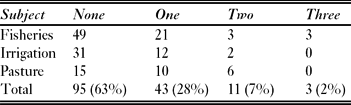
Analytical attention to explanation of outcomes is relatively limited in commons research (Table 2). Approximately one-third of the articles provided empirical measures of any of the three outcomes of interest or tried to account for variations in these individual outcomes.
Still fewer articles attempted to examine more than one outcome or the relationships among multiple outcomes, or the factors that explained observed relationships between outcomes (Table 3).
Number of outcomes analysed (n = 152).

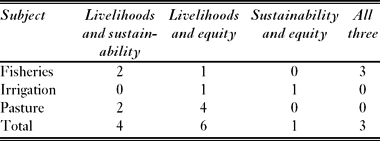
Only three articles focused on all three outcome dimensions. Eleven articles explicitly analysed two outcomes. The three articles that addressed livelihoods, sustainability and equity outcomes all focused on fisheries (Baticados & Agbayani Reference Baticados and Agbayani2000; Garaway Reference Garaway2006; Maliao & Polohan Reference Maliao and Polohan2008). We thus conclude that the dominant trend in the scholarship on the commons, when the available literature focuses on specific outcomes, is to analyse a single dimension among multiple outcomes: 75% of the studies (43) that analysed any outcome, only did so for one outcome.
Studies of multiple outcomes in pastoral, fisheries, and irrigation commons
A small, but significant, number of studies (11) did examine more than one outcome in an attempt to identify how these outcomes varied (Table 4). Livelihoods and equity outcomes represent the most frequent combination of outcomes addressed in the articles, with six articles explicitly analysing both livelihoods and equity outcomes (see Johnson Reference Johnson2001 for fisheries; Kajisa et al. Reference Kajisa, Palanisami and Sakurai2007 for irrigation; and Berkes et al. Reference Berkes, Davidson-Hunt and Davidson-Hunt1998; Mearns Reference Mearns2004; Bogale & Korf Reference Bogale and Korf2007; Ray & Bijarnia Reference Ray and Bijarnia2007 for pastures).
Combinations of outcomes addressed (n = 14).

One key article that not only examined more than one outcome, but also tried to explain why outcomes diverged was Sharma et al. (Reference Sharma, Pradhan and Leung2001). This study on irrigation commons in Nepal analysed the relationship between sustainability and equity together. Through a comparative analysis of irrigation efficiency and equity in two locations, Sharma et al. (Reference Sharma, Pradhan and Leung2001) found that the area with higher technical efficiency registered more equitable outcomes, resulting in high positive outcomes for both sustainability and equity, compared with another area which scored low on both sustainability and equity. This synergy between sustainability and equity thus rested on technological improvements.
Studies may treat multiple outcomes in relation to each other but without causal analysis. For example, Maliao and Polohan (Reference Maliao and Polohan2008) analysed livelihoods (contribution of fishing to household income), sustainability (ecological and institutional resilience) and equity (household access to resources, and income and gender disparity) in their fisheries case study in the Philippines. They suggest that institutional resilience does not have a necessary correlation with ecological resilience because, in their study area, rule compliance and communication among government agents and fisher groups improved, but fish abundance declined. Allocation of benefits from the fishery also became less equitable; thus, ‘better outcomes’ on the commons cannot be taken to mean that a given set of institutional arrangements leads to improvements in multiple dimensions. But the study did not attempt to explain why improvements in one dimension (institutional sustainability) were negatively related with those in other dimensions (ecological sustainability and equity).
Trade-offs
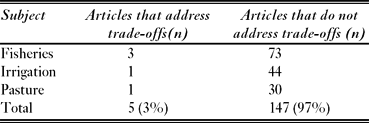
The corollary to accepting that common-pool resource systems produce multiple outcomes is that these outcomes may be associated systematically with each other depending on the configurations of factors associated with different outcome dimensions. Unfortunately, of the full set of studies we examined, only five looked at relationships among outcomes and their driving factors. Even when existing studies recognized the importance of multiple outcomes, they seldom mentioned how these outcomes were related. The absence of analyses that look at or explain synergies or trade-offs among outcomes remains a significant limitation in the common property literature. There was limited analysis of outcome relationships across the three types of resources upon which we focused (Table 5).
Trade-offs across sustainability, livelihoods and equity dimensions (n = 152).

Attention to trade-offs is most common in the work on fisheries. But even here, only three studies invoke the idea of trade-offs. Branch et al. (Reference Branch, Hauck, Siqwana-Ndulo and Dye2002), for example, stated that the needs of subsistence fishers for food and livelihoods must be balanced with resource sustainability needs. The tensions between livelihoods and resource sustainability were implicitly recognized, but Branch et al. (Reference Branch, Hauck, Siqwana-Ndulo and Dye2002) did not analyse how, why, or to what extent the goal of enhancing livelihoods may be in tension with that of sustainability; indeed, they did not use the word ‘trade-off’ in the study.
Another study on fishing also recognized the idea of trade-offs across management objectives in its discussion of how Indonesian fisheries managers work toward sustainable management (Novcaczek et al. 2001); fishers were under pressure to increase fisheries employment and income at the same time as they faced demands to improve exports. Attempts to balance fish exports and local food security induced direct negative impacts on resource sustainability (Novcaczek et al. 2001). Although this study provides a clear account of the management pressures that yield specific synergistic relationships between sustainability and equity, and trade-offs across higher commercial incomes and sustainability, it does not present quantitative estimates of the relationships between sustainability, equity and livelihoods.
In contrast, in his study of fisheries flood plains in Nigeria, Thomas (Reference Thomas1996, p. 309) concluded that ‘a focus on biological production may be too limited; trade-offs may be necessary between the various (human-ascribed) goals of fisheries management’. Mechanisms to restrict access to prevent overfishing may not be socially acceptable, and thus there are trade-offs between livelihoods and ecological sustainability outcomes (Thomas Reference Thomas1996).
Research on irrigation and pastures also provides instances of analyses of trade-offs. Thus, Hirsch and Thinh (Reference Hirsch and Thinh1996, p. 167) wrote that ‘concern with environmental implications of reform plays an especially interesting role. . . since environmental change is closely linked to questions of local livelihoods versus development in the name of a wider good, invoking trade-offs between socially and geographically distinct interests’. Similarly, although Fox et al. (Reference Fox, Yonzon and Podger1996) did not use the word ‘trade-off’, they measured the conflict between herder incentives for livelihoods and biodiversity protection of the red panda and found that meeting the needs of biodiversity conservation and local communities is difficult. They concluded that balancing economic development with biodiversity conservation needs far more attention, a conclusion that remains relevant.
Our examination of studies of trade-offs across different commons outcomes suggests that existing research provides only slender evidence upon which to base generalizations about the relationships among multiple commons outcomes. Despite the recognition that natural resources yield multiple outcomes and that these outcomes do not necessarily exist in synergistic relationships, the literature on the commons needs to work more systematically toward distinguishing among different outcomes, identifying the nature of the relationships across outcomes (trade-off, absence or synergy), and analysing the driving causal factors that lead to different outcomes. Although, in their review of the common property literature, Dietz et al. (Reference Dietz, Ostrom and Stern2003, p. 1908) wrote that ‘every environmental decision requires trade-offs’, relatively little of the work on the commons has paid careful attention to understanding the nature of these trade-offs.
Generalizations based on the few studies that discuss trade-offs may be hasty, but these studies do suggest that there are trade-offs between ecological sustainability and economic livelihoods goals. That is to say, attempts to improve livelihoods or ecological sustainability exist in a trade-off relationship; improvements in one outcome tend to occur at the cost of improvements in the other. Whether this is a broadly generalizable relationship across ecological and cultural contexts will require more careful and systematic work than is possible based on our review. Certainly, the existence of such trade-offs makes intuitive sense.
The studies we reviewed suggest that there is nothing deterministic about the existence of trade-offs. Some sets of outcomes may be more amenable to moving in the same direction based on appropriate institutional incentives. Appropriate institutional rules, highlighting equity in outcomes and socially equitable processes, for example, can lead to synergies between sustainability and equity. Technological improvements may yield ecological sustainability together with improved livelihoods. However, the evidentiary basis for such generalizations needs more systematic empirical research than has been the case until now in the literature on fisheries, pastoral and irrigation commons.
Explanations of outcomes
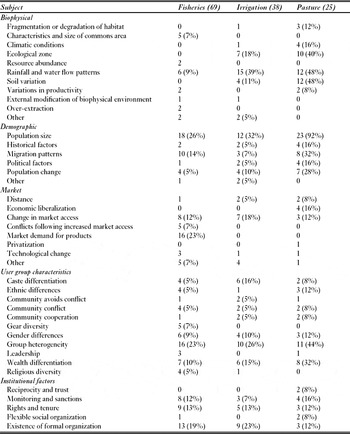
To gain a composite sense of how the existing literature on the commons explains the outcomes to which it does attend, we examined the different factors cited as explanations for observed outcomes. A number of existing studies of the commons have identified five sets of variables as influencing different outcomes: biophysical conditions, user group features, institutional characteristics, market (and technology-related) forces, and demographic factors (Agrawal Reference Agrawal2001; Ostrom Reference Ostrom2007). The explanatory factors we identified in the reviewed studies can be divided into these five broad categories (Table 6), providing a indication of the major findings of the case-based literature on irrigation, fisheries and grazing commons, in terms of how different variables affect outcomes.
Factors influencing observed outcomes (percentages provided only when above 5%).

Three general points can be gleaned from our data, all related to the diversity of explanatory factors identified in the existing body of work on the commons to explain outcomes. Firstly, the existing work on fisheries, grazing and irrigation commons has identified a very large set of factors that account for observed sustainability, livelihoods and equity outcomes. There were more than 40 causal variables, distributed across the five classes (Table 6). The diversity of factors used to explain observed outcomes in studies of fisheries, irrigation and pastoral commons resembles the patterns observed in the studies of forest commons (Agrawal Reference Agrawal2007). Indeed, it is reasonable to suggest that there are many different causal processes and factors that shape common-pool resource outcomes. But an important question that must then be addressed concerns the reasons why different studies of the commons do not examine the multiple factors identified by others as potential causal explanations. Indeed, few studies of the commons examine the causal role of multiple alternative explanations.
Secondly, the existing body of work has tended to focus on quite different sets of factors as being relevant to observed outcomes for fisheries, irrigation and pasture commons. Admittedly, some factors are cited commonly across different types of common-pool resources and outcomes. In particular, population pressures, market variables and some form of user group heterogeneity are used most commonly to explain commons outcomes. Generally, however, there are significant differences among cited explanations of outcomes.
Finally, with the large number of factors used to explain observed outcomes, it is surprising that quantitative studies form a relatively small proportion (approximately one-sixth) of the available work on pastoral, irrigation and fisheries commons. Unless case studies of renewable commons are carefully selected to minimize the likelihood of competing explanatory hypotheses being correct (which reviewed studies seldom do), it is difficult at best to know whether the causal factors identified by the author(s) are the only ones at work. ‘Careful selection’ does not imply quantitative analysis, but it does require better attention to research design and case selection.
Among biophysical factors, 15 articles on fisheries, 22 on irrigation and 24 on grazing commons pay attention to at least one variable that relates to the resource system itself. Clearly, studies of grazing in particular, but also those of irrigation, are more attentive to the effects of biophysical factors on resources. Characteristics and size of fishing grounds are cited as relevant to resource governance for work on fisheries, but not for grazing or irrigation commons. Although macro-level studies of renewable resources often target resource availability and size as relevant to sustainable use patterns, this emphasis seems to be missing in micro-level studies of renewable natural resources.
Some of the differences in how biophysical features and conditions are used to explain outcomes across different resource types may have to do with the features of resources themselves. The effects of low rainfall, temperature variations and fodder availability are directly visible in the migration patterns of herders and livestock, and water in irrigation channels. The very invisibility of fish, lack of information about their reproduction and difficulties in associating levels of harvest with fish abundance may make it harder to establish clear causal relationships between biophysical factors and the health of fisheries.
Demographic factors are the most often cited variables of all. Within demographic variables, population density and changes in population over time are the variables most commonly viewed as explaining commons outcomes. Typically, higher population density and (rapid) increase in population levels has a negative effect on the condition of resources in all the three sectors. In contrast to many macro-level studies that attempt to establish a direct relationship between demographic variables and resource conditions, micro-level studies of the commons tend to examine demographic variables in conjunction with institutional arrangements, and typically suggest that demographic pressures are mediated by institutional arrangements.
Migration influences the condition of fisheries and irrigation commons negatively, both when a significant number of people emigrate (such emigration reduces the interest of the community in protecting the commons) and immigrate (immigration also adversely affects existing institutions to manage the commons and increases harvesting pressures on the resource system). This causal process is different for pastoral commons, which are often characterized by migrating herders. In most of the grazing commons reviewed for this study, migration itself does not have adverse effects on resources; rather it is the disruption of existing migration patterns owing to new technologies, sedentarization or changing institutional regimes that affect resources adversely.
Some of the studies also discussed how ecological, economic, historical and political factors shape demographic trends and thereby resource conditions. For example, Bennett and Barrett (Reference Bennett and Barrett2007) described how apartheid shaped outcomes in their pastoralist case study areas: Guquka and Koloni villages in the Eastern Cape Province in the former Ciskei homeland have a turbulent political and social history, including racial separation during apartheid. Apartheid resettlement programmes did not uniformly redistribute individuals, resulting in uneven population densities and heterogeneous communities (Bennet & Barrett Reference Bennett and Barrett2007). Focusing on grazing systems, Agrawal (Reference Agrawal1999) described many of the historical and institutional changes that have shaped grazing practices. These include the emergence of irrigation and consolidation of national boundaries that confined herders to specific migration routes, and limited migration and herder mobility over time. Without recourse to mobility, herders were often forced to graze their animals on grounds that did not have sufficient fodder because of variations in rainfall, a chronic feature of the semi-arid environments in which most pastoral systems exist.
Overall, market factors are used relatively infrequently to explain outcomes related to grazing and irrigation commons, particularly in contrast to fisheries commons. Again, some of the differences across these three types of resources relate to the extent to which fish, in comparison to grazing and irrigation water (in small systems) are sold in markets. Because markets for the last two resources are typically less developed, market related factors also tend to find less attention in studies of these two types of commons. When commons scholars do attend to market pressures and grazing or irrigation, they tend to focus on changes in broad economic or market conditions and their influence on common-pool resources. For example, Fernandez-Gimenez (Reference Fernandez-Gimenez2002) described liberalization trends in Mongolia that reduced market access for herders and led to urban-rural migration for herding. Herding in this context turned out to be a social safety net to which urban dwellers took recourse, based on their existing social networks and knowledge of herding.
More than half the papers examined some set of factors related to user groups and institutions. The reviewed studies were particularly attentive to the role of user group related variables that influenced outcomes, and focused on a large number of different types of factors as being important. Social capital is often a key feature of user groups that is associated with positive resource outcomes. Three key fisheries studies discussed the effect of social capital among fishers on their fishing practices and thus fish stocks (Young Reference Young2001; da Silva Reference da Silva2004; Sekhar Reference Sekhar2007). Sekhar (Reference Sekhar2007) focused on social capital as the main explanatory factor, and found that fishers in India had strong bonding social capital, but weak linking social capital, evidenced by a lack of trust between fishers and state. As a result, they were able to maintain local fishing practices, but less able to take advantage of government programmes to assist fishers. Seven studies of pastoral commons articles also mentioned social capital among pastoral user groups (see Chakravarty-Kaul Reference Chakravarty-Kaul1998; Robbins Reference Robbins1998; Fernandez-Gimenez Reference Fernandez-Gimenez2002; Fratkin & Mearns Reference Fratkin and Mearns2003; Davis et al. Reference Davis, Ainslie and Finca2008; Ray & Bijarnia Reference Ray and Bijarnia2007; Roncoli et al. Reference Roncoli, Jost, Perez, Moore, Ballo, Cisse and Quattara2007).
But the user-group related factor cited most often as influencing outcomes is heterogeneity among group members. There are different forms of group heterogeneity, such as gender, wealth, caste and religion (Table 6), but a majority of the articles that focus on user group characteristics as influencing outcomes also talk about heterogeneity of users as a basic variable influencing outcomes. Although the theoretical literature on the commons acknowledges both positive and negative influences of social differences on outcomes, the empirical studies we reviewed tend to emphasize the negative effects of heterogeneity. User group heterogeneity has clearly negative effects on equity in distribution of benefits from the commons, but it is also generally detrimental to institutional functioning and livelihoods. A few of the studies suggest that heterogeneity can promote sustainability by helping exclude some users and thereby reducing levels of harvest.
CONCLUSIONS
We have identified and investigated a major gap in the existing literature on community-based natural resource management for three types of natural resources, namely fisheries, irrigation and pastures. We have provided an assessment of the extent to which existing scholarship has carefully or systematically analysed the outcomes related to resource governance, and examined how this gap in the literature hobbles future advances and insights.
Somewhat surprisingly, we found that although many studies referenced multiple outcomes in natural resource governance, few analysed relationships among outcomes systematically. Thus, a significant number of studies recognized that natural resource systems generate multiple outcomes in which those relying on resources are interested, such as livelihoods, equity in allocation of benefits and long-term sustainability of the resource system. Indeed, most scholars of natural resources analyse the functioning of resource systems with implicit or explicit reference to one of these types of outcomes, yet they seldom attempt to disentangle the relationships across multiple outcomes, or the causal drivers of distinctive outcomes under different institutional, political or socioeconomic contexts. A better understanding of how variations or changes in sustainability relate to those in equity and livelihoods outcomes, and how causal processes simultaneously affect multiple natural resource management outcomes but not necessarily in the same direction, is necessary to improve the governance of natural resource systems. Otherwise, it is likely that attempts to improve sustainability will, in some circumstances, improve livelihoods and, in others, worsen them. Under some conditions improvements in equity will go together with improvements in sustainability and, in others, they will worsen sustainability.
Given the current state of knowledge, we simply cannot confidently predict how equity, sustainability and livelihoods outcomes are related to each other systematically, or identify the underlying causal factors and processes that influence one, two or all three of these outcomes. Our analysis is based on three types of renewable commons, and therefore the conclusions are likely to be of the greatest interest to scholars of pastoralism, fisheries and irrigation commons. But, even in forestry and forest resources, only a few studies exist focusing on multiple outcomes and the relationships among multiple outcomes (for some useful findings, see Steffan-Dewenter et al. Reference Steffan-Dewenter, Kessler, Barkmann, Bos, Buchori, Erasmi, Faust, Gerold, Glenk, Gradstein, Guhardja, Harteveld, Hertel, Höhn, Kappas, Köhler, Leuschner, Maertens, Marggraf, Migge-Kleian, Mogea, Pitopang, Schaefer, Schwarze, Sporn, Steingrebe, Tjitrosoedirdjo, Tjitrosoemito, Twele, Weber, Woltmann, Zeller and Tscharntke2007; Chhatre & Agrawal Reference Chhatre and Agrawal2009).
Multiple outcomes in the fields of fishery, irrigation and grazing commons may be predicted by identifying two important associations and generalizations reported around pairs of multiple outcomes in existing studies, although other associations are also mentioned in some studies. Firstly, nearly all the studies that analyse relationships between sustainability and livelihood outcomes suggest that there are trade-offs between efforts to achieve greater sustainability of a given resource and deriving higher livelihoods from the same resource. At one level, this conclusion is not surprising; increasing extraction, as is likely necessary to improve resource-dependent livelihoods, should be expected to impact resource conditions and sustainability adversely. There is a substantial body of work on conservation and livelihoods that has sought to identify how livelihoods can be promoted at the same time as conservation outcomes are enhanced, and external inputs in the form of leadership, capital or know-how are inevitably needed to improve both livelihoods and conservation outcomes even as such inputs often fail to achieve the intent of promoting outcomes benefitting all (Agrawal & Redford Reference Agrawal and Redford2006). But, at another level, this finding also suggests that trade-offs in decision making about resource management must be recognized, instead of easy assumptions that multiple outcomes can simultaneously be enhanced.
Secondly, the important structuring role of institutional and technological improvements enables a positive association between ecological sustainability and social equity. Several articles indicate the importance of technology and institutions in promoting improvements in more than one outcome, especially as concerns sustainability and equity (Table 6). It is necessary to attend to the role and use of technological and institutional interventions if the goal is to improve performance along multiple dimensions of resource governance outcomes.
These two patterns raise interesting hypotheses and are worth investigating further. For example, it may be that technological improvements and institutional rearrangement permit higher levels of livelihoods benefits from a given common pool system without adversely affecting sustainability. Examining a range of common property systems using such an explicit hypothesis can help improve understanding of variations in the relationship between sustainability and livelihoods under different conditions. Similarly, relatively homogenous group membership may yield improved livelihoods benefits from a common pool resource system, as well as relatively equitable distribution of such benefits among user group members. Better targeted and directed investigations of common property arrangements have the potential to improve existing knowledge of the effects of varying contextual conditions on equity and livelihoods.
Nearly four decades of sustained research on decentralized natural resource governance has created a substantial body of knowledge. Our analysis of this literature focuses on the continuing gap in scholarly and policy understanding of outcomes, relationships among different aspects of outcomes and the drivers of varying relationships. Indeed, addressing this gap may improve future natural resource governance and scholarship on the commons.
To improve the state of knowledge regarding the drivers of relationships among different outcomes, scholars of renewable resources must think more broadly about their subject of analysis, and move away from a narrow concern with resource condition or livelihoods or equity. Commons investigators must broaden their empirical, practical and analytical focus in gathering the necessary data, developing conceptual frameworks and theoretical models, and carrying out analyses that yield rich pay-offs by permitting generalizations about patterns and relationships among different outcomes dimensions, and the drivers of these patterns and relationships.
It is equally necessary that researchers pay attention to analytical strategies, both qualitative and quantitative, that allow the simultaneous examination of multiple outcomes and their relationships. Our review shows that even when existing scholars are aware that common pool resources produce multiple outcomes, they do not systematically measure, compare and contrast, or attempt to explain how multiple outcomes unfold in a given commons situation or across multiple commons arrangements. Textual analysis of variations, simple cross-tabulations of causes and outcomes across multiple outcomes, and statistical analyses, in short, the marriage of qualitative and quantitative approaches, discursive and mathematical models, is necessary to improve existing efforts to analyse the different outcomes that all resource commons generate.