Introduction
Cannabis use and cannabis use disorders (CUDs) are prevalent in people with schizophrenia (Toftdahl, Nordentoft, & Hjorthøj, Reference Toftdahl, Nordentoft and Hjorthøj2016). This has led to the hypothesis that cannabis, at least its high-potency variety, may be a component cause of schizophrenia (Marconi, Di Forti, Lewis, Murray, & Vassos, Reference Marconi, Di Forti, Lewis, Murray and Vassos2016; Moore et al., Reference Moore, Zammit, Lingford-Hughes, Barnes, Jones, Burke and Lewis2007; Nielsen, Toftdahl, Nordentoft, & Hjorthoj, Reference Nielsen, Toftdahl, Nordentoft and Hjorthøj2017). However, the causal nature of these findings is debated, with alternative explanations including self-medication and common genetic underpinnings (Carey et al., Reference Carey, Agrawal, Bucholz, Hartz, Lynskey, Nelson and Bogdan2016; Demontis et al., Reference Demontis, Rajagopal, Thorgeirsson, Als, Grove, Leppälä and Børglum2019; Ferdinand et al., Reference Ferdinand, Sondeijker, van der Ende, Selten, Huizink and Verhulst2005; Macleod et al., Reference Macleod, Oakes, Copello, Crome, Egger, Hickman and Davey Smith2004; Pasman et al., Reference Pasman, Verweij, Gerring, Stringer, Sanchez-Roige, Treur and Vink2018, Reference Pasman, Verweij and Vink2019). A few studies have found that the polygenic risk score (PRS) for schizophrenia predicts cannabis use in healthy individuals (Carey et al., Reference Carey, Agrawal, Bucholz, Hartz, Lynskey, Nelson and Bogdan2016; Hiemstra et al., Reference Hiemstra, Nelemans, Branje, van Eijk, Hottenga, Vinkers and Boks2018; Power et al., Reference Power, Verweij, Zuhair, Grant, Henders, Heath and Martin2014; Verweij et al., Reference Verweij, Abdellaoui, Nivard, Sainz Cort, Ligthart, Draisma and Vink2017). Since these individuals were not diagnosed with schizophrenia, this indicates that a shared genetic etiology might explain at least part of the association between cannabis use and schizophrenia. The studies, however, have been relatively small, and with one exception have not considered other PRS than schizophrenia. Cannabis is generally not considered a cause of disorders such as autism spectrum disorders (ASD), attention-deficit hyperactivity disorder (ADHD) (Fergusson & Boden, Reference Fergusson and Boden2008), and anorexia nervosa. Consequently, we hypothesized that any shared genetics for CUD would be specific to schizophrenia rather than a more general genetic liability for mental disorders.
Establishing whether the observed link between cannabis and schizophrenia may reflect a causal relationship may have important implications, not least given the increasing worldwide tendency to decriminalize or legalize cannabis either therapeutically or recreationally.
In this study, we aimed to investigate whether the PRS of schizophrenia would predict CUD in people with and without schizophrenia. We further aimed to investigate if the PRS of autism, ADHD, and anorexia nervosa would not predict cannabis use.
Methods
The present investigation was based on data from iPSYCH, which combines DNA obtained from dried neonatal bloodspots with a set of Danish registers as previously described (Pedersen et al., Reference Pedersen, Bybjerg-Grauholm, Pedersen, Grove, Agerbo, Bækvad-Hansen and Mortensen2018). Within this dataset, we focused on three sets of individuals: People diagnosed with schizophrenia, people diagnosed with other psychiatric disorders (bipolar disorder, depression, ASD, ADHD, or anorexia nervosa), and people with neither of those disorders. We selected individuals born from 1981 (the inception of the biobank containing the dried bloodspots) to 2001 (to allow adequate follow-up time to occur with regards to incident CUDs). Diagnostic information was available until April 2017.
Polygenic risk scores
PRSs are a metric which summarized the combined genetic load for a specific disorder as a function of the associations of individual single nucleotide polymorphisms (SNPs) on the disorder in question. PRS for schizophrenia, ASD, ADHD, and anorexia nervosa were estimated using the most recent summary statistics from genome-wide discovery data-sets from the Psychiatrics Genetics Consortium, in all cases excluding the Danish samples and pruned with respect to linkage disequilibrium (r 2 ⩽ 0.05) (Grove et al., Reference Grove, Ripke, Als, Mattheisen, Walters, Won and Børglum2019; Lee et al., Reference Lee, Ripke, Neale, Faraone, Purcell, Perlis and Wray2013; Ripke et al., Reference Ripke, Neale, Corvin, Walters, Farh, Holmans and O’Donovan2014; Watson et al., Reference Watson, Yilmaz, Thornton, Hübel, Coleman, Gaspar and Bulik2019). The PRS for ASD, ADHD, and anorexia nervosa were included as these disorders are not typically considered to be potentially caused by cannabis use. We decided a priori to use a threshold [p(t)] of 0.05 for inclusion of SNPs in calculations of the various PRS (Ripke et al., Reference Ripke, Neale, Corvin, Walters, Farh, Holmans and O’Donovan2014). The PRSs were then, for each individual, calculated as the weighted sum of risk alleles at each SNP, weighted by the risk estimates in the discovery data-sets. We split each of the PRS into deciles based on scores in the subpopulation of controls.
Cannabis use disorder
CUD was defined in the Psychiatric Central Researcher and the National Patient Register as ICD-8 code 304.5 (drug dependence of cannabis sativa) or ICD-10 codes F12.x (Mental and behavioral disorders due to use of cannabinoids) (Lynge, Sandegaard, & Rebolj, Reference Lynge, Sandegaard and Rebolj2011; Mors, Perto, & Mortensen, Reference Mors, Perto and Mortensen2011). The vast majority of CUDs were classified as harmful use or dependence of cannabis.
Statistical analyses
Analyses were conducted with hazard ratios (HRs) representing a one standard-deviation increase in PRS. We further compared those in the highest decile of genetic risk for the psychiatric disorder in question to people in the remaining nine deciles. The decile cutoffs were determined in the subpopulation of controls and were thus identical in all three subpopulations. First, we investigated whether PRSs for schizophrenia, ASD, ADHD, and anorexia nervosa predicted the development of CUD in the three populations. We used Cox proportional hazards regression, estimating HRs, with 95% confidence intervals (CIs). People were followed from birth (for controls) or from incident psychiatric disorder (for the psychiatric populations) until incident CUD or censoring due to death, migration, or end of registers on 10 April 2017, whichever occurred first. All analyses were adjusted for sex, birth year, and calendar year as a time-varying covariate. In the two psychiatric populations, this meant that observations with incident CUD preceding the psychiatric disorder were excluded, as this would have led to negative follow-up times. For this reason, we also conducted a set of sensitivity analyses in which we altered the incident date of CUD to the day after the onset of schizophrenia or other psychiatric disorders for analyses on these two populations, if the CUD preceded the psychiatric diagnosis, so that these individuals would not be excluded from the analyses. As the analyses were intended to investigate the cross-disorder genetic foundations of CUD, it was not relevant to adjust for other variables.
Second, we investigated whether the different PRS would explain part of an observed association between CUD and schizophrenia. In these Cox regression models, we followed all individuals in the sample from birth until incident schizophrenia or censoring due to death, migration, or end of registers on 10 April 2017, whichever occurred first. Information on CUD was entered into the analyses as a time-varying covariate and was adjusted for the top four principal components of ancestry, sex, birth year, and calendar year. Consequently, only CUDs diagnosed before an eventual diagnosis of schizophrenia were included in the analyses. Subsequent analyses then repeated this model, adding each of the four PRS independently.
Results
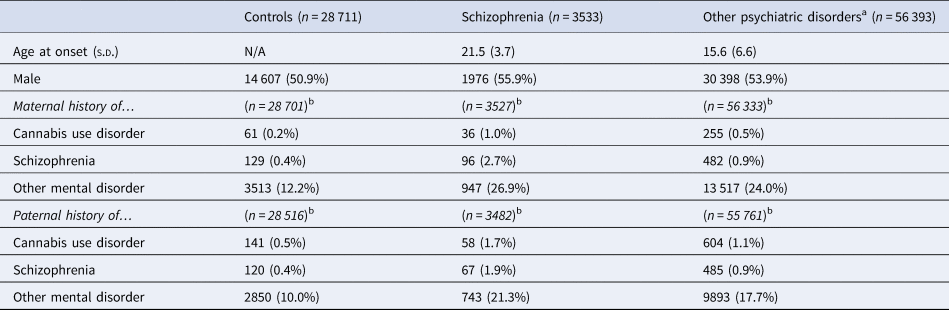
The study included 88 637 individuals, of whom 28 711 were non-psychiatric controls, 3533 had schizophrenia, and 56 393 had one of the other investigated psychiatric disorders. Characteristics of the different populations are shown in Table 1. Among controls, 14 607 (50.9%) were male. Among patients with schizophrenia, 1976 (55.9%) were male, and among patients with other disorders, 30 398 (53.9%) were male. Mean (s.d.) age at onset was 21.5 (3.7) years for the population with schizophrenia, and 15.6 (6.6) years for the population with other disorders.
Characteristics of the three study populations

a Bipolar disorder, unipolar depression, ADHD, autism spectrum disorder, or anorexia nervosa.
b Valid information was lacking on a few of the cohorts' parents. Later analyses imputed this information.
Association between polygenic risk scores and cannabis use disorder
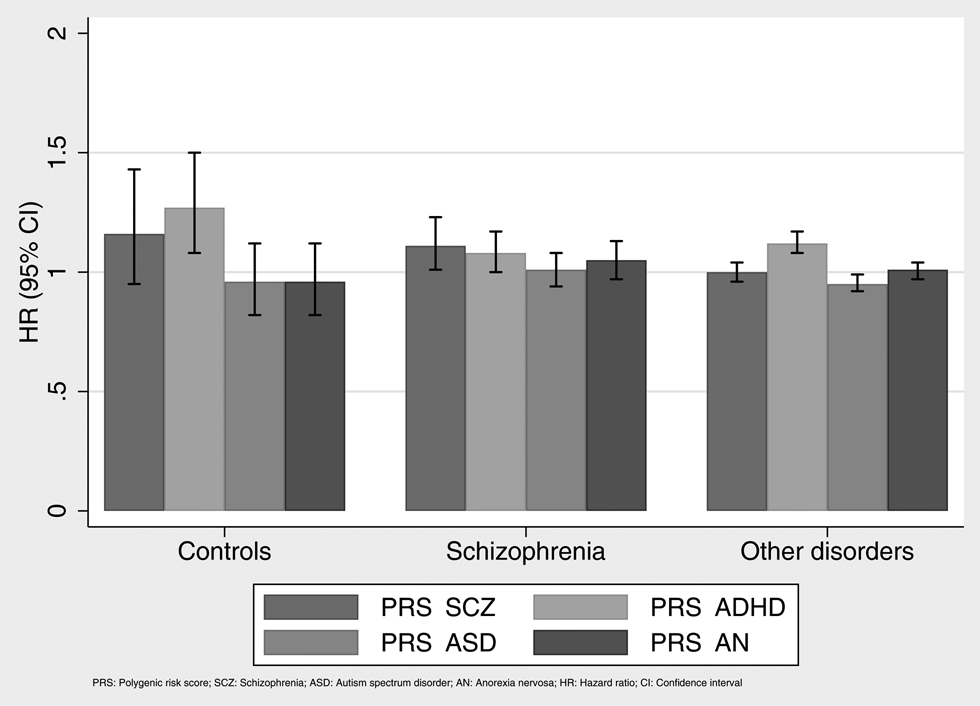
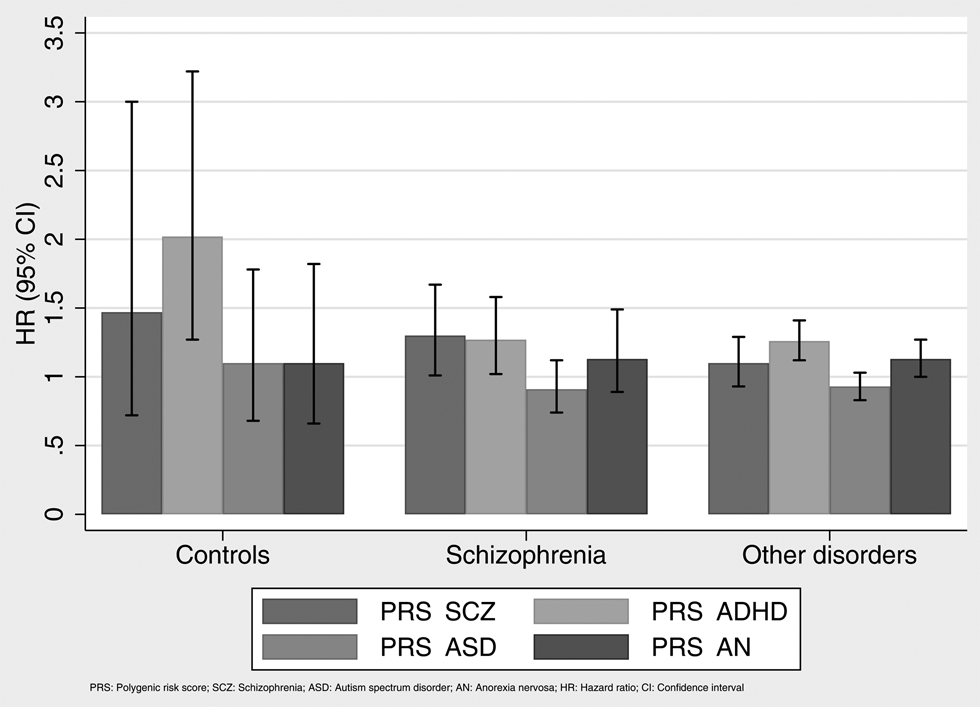
Figure 1 shows the association between PRS for schizophrenia, autism, ADHD, and anorexia nervosa and the risk of developing CUD, using p(t)<0.05 for the calculation of the PRS. The HRs in the figure correspond to a one standard-deviation increase in PRS. Figure 2 shows similar analyses, except that the HRs displayed in this figure correspond to the highest decile of PRS compared to the rest. The 28 711 controls were followed for a total of 630 200 person-years, giving rise to 184 incident cases of cannabis-use disorder. Of the original 3533 schizophrenia cases, 781 had developed CUD before the onset of schizophrenia and were consequently excluded from the analyses. The remaining 2752 cases with schizophrenia were followed for a total of 18 878 person-years, giving rise to 325 incident cases of CUD. Of the original 56 393 cases with other psychiatric disorders, 3277 were excluded from the analyses due to prior CUD, leaving 53 116 cases with other psychiatric disorders for the analyses. These were followed for a total of 488 486 person-years, giving rise to 1873 incident cases of CUD. The polygenic risk for schizophrenia did not predict CUD in controls (HR = 1.16, 95% CI 0.95–1.43 per standard-deviation increase in PRS, or HR = 1.47, 95% CI 0.72–3.00 when comparing the highest decile of PRS with the remaining deciles), but the PRS for ADHD did (HR = 1.27, 95% CI 1.08–1.50 per standard-deviation increase of PRS, or HR = 2.02, 95% CI 1.27–3.22 for the highest decile). In cases with schizophrenia, both PRS for schizophrenia (HR = 1.11, 95% CI 1.01–1.23 per standard-deviation increase or HR = 1.30, 95% CI 1.01–1.67 for the highest decile) and for ADHD (HR = 1.08, 95% CI 1.00–1.17 per standard-deviation increase or HR = 1.27, 95% CI 1.02–1.58 for the highest decile). Among patients with the remaining psychiatric disorders, the same tendencies as for controls were also observed. The PRSs for ASD and anorexia nervosa were not associated with CUD in any of the three populations, except for an inverse association with CUD per standard-deviation increase of PRS-ASD in patients with other psychiatric disorders (HR = 0.95, 95% CI 0.92–0.99), and an increase in risk of CUD in the same population per standard-deviation increase of PRS-anorexia (HR = 1.13, 95% CI 1.00–1.27).
Association between a one standard-deviation increase in polygenic risk scores and incident cannabis use disorder.

Association between being in the highest decile of polygenic risk scores and incident cannabis use disorder.

Sensitivity analyses
We conducted sensitivity analyses in the two psychiatric populations in which we altered the day of onset of CUD to be the day after the incident psychiatric disorder, as these observations were excluded from the main analyses. In patients with schizophrenia, the results of these sensitivity analyses were virtually identical to those from the main analyses (data not shown). In patients with other psychiatric disorders, the results regarding the PRS as continuous scales were also virtually identical to those from the main analyses (data not shown). Being in the highest decile of PRS for schizophrenia was also identical to the main analysis (data not shown). In these sensitivity analyses being in the highest decile of polygenic risk for ADHD (HR = 1.51, 95% CI 1.37–1.66), ASD (HR = 1.13, 95% CI 1.03–1.25), and anorexia nervosa (HR = 1.41, 95% CI 1.27–1.56) were all associated with CUD.
Influence of polygenic risk scores on the association between cannabis use disorder and schizophrenia
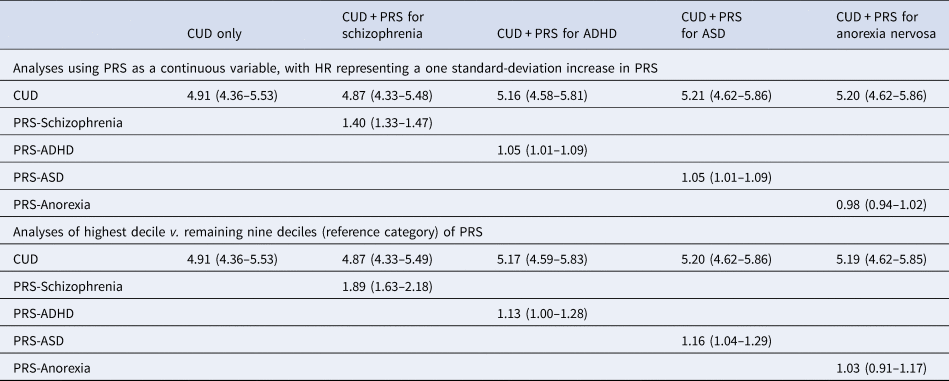
The 88 637 individuals were followed for 2 070 664 person-years, giving rise to 3312 incident cases of schizophrenia. This number of cases with schizophrenia differs from that in previous analyses due to different censorings. Table 2 shows the association between CUD and schizophrenia, with and without adjustment for the various PRS. Prior diagnosis of CUD was strongly associated with the risk of developing schizophrenia, with HR = 4.91 (95% CI 4.36–5.53) in the basic model. While all the PRS, except for anorexia nervosa, individually predicted schizophrenia, their inclusion in the model did not appreciably change the HR for CUD.
Association between cannabis use disorder and development of schizophrenia, with and without adjustment for polygenic risk scores

CUD, cannabis use disorder, entered as a time-varying covariate; PRS, polygenic risk score; ASD, autism spectrum disorder.
Numbers are hazard ratios (HR) and 95% confidence intervals.
Each model includes the presented predictors, and is further adjusted for the top four principal components of ancestry, sex, birth year, and calendar year.
Discussion
Contrary to our hypothesis, the PRS for schizophrenia was not associated with CUD in either controls or patients with other psychiatric disorders, but with a small increase in the risk of CUD in patients with schizophrenia. As such, we were not able to replicate previous findings (Carey et al., Reference Carey, Agrawal, Bucholz, Hartz, Lynskey, Nelson and Bogdan2016; Hiemstra et al., Reference Hiemstra, Nelemans, Branje, van Eijk, Hottenga, Vinkers and Boks2018; Power et al., Reference Power, Verweij, Zuhair, Grant, Henders, Heath and Martin2014; Verweij et al., Reference Verweij, Abdellaoui, Nivard, Sainz Cort, Ligthart, Draisma and Vink2017). If the findings of our study are correct, this would then counter one of the most often used arguments against the theory of cannabis being a component cause of schizophrenia. Further, while most other studies have investigated lifetime cannabis use, we investigated the more extreme phenotype of CUD. It has been shown that the potentially causal association between cannabis and schizophrenia is driven by severe use of cannabis and not infrequent or lifetime use (Marconi et al., Reference Marconi, Di Forti, Lewis, Murray and Vassos2016). Consequently, it may be prudent to put more trust into studies such as ours using an extreme form of phenotype for cannabis, rather than most previous genetic studies which, as mentioned, have looked at lifetime use of cannabis. Another common argument against the theory of cannabis having a causal effect on the risk of schizophrenia is that increasing prevalence of use and misuse of cannabis (Compton, Grant, Colliver, Glantz, & Stinson, Reference Compton, Grant, Colliver, Glantz and Stinson2004) and increasing levels of cannabinoids (Mehmedic et al., Reference Mehmedic, Chandra, Slade, Denham, Foster, Patel and ElSohly2010) would have resulted in an increase in the incidence of schizophrenia, something which the opponents of this theory claim has not been observed. Our research group has previously shown that the latter part of this argument, at least, is invalid, in that an increase in the incidence of schizophrenia has in fact been observed (Kühl, Laursen, Thorup, & Nordentoft, Reference Kühl, Laursen, Thorup and Nordentoft2016). Consequently, perhaps the leading theory to explain the association between cannabis use and psychosis would be the theory of causation (Moore et al., Reference Moore, Zammit, Lingford-Hughes, Barnes, Jones, Burke and Lewis2007), with perhaps particular evidence of the association being driven by high-potency or severe use of cannabis (Marconi et al., Reference Marconi, Di Forti, Lewis, Murray and Vassos2016; Nielsen et al., Reference Nielsen, Toftdahl, Nordentoft and Hjorthøj2017). This may in turn indicate that caution should be exercised by policy makers when considering whether to legalize cannabis, as evidence is currently inconclusive as to whether such legalization leads to an increase in cannabis use or not (Cerdá et al., Reference Cerdá, Wall, Feng, Keyes, Sarvet, Schulenberg and Hasin2017; Shi, Lenzi, & An, Reference Shi, Lenzi and An2015).
However, it should be noted that the PRS for schizophrenia did indeed predict CUD in patients with schizophrenia. In the absence of such an association, this is unlikely to reflect a true underlying genetic overlap. It has previously been shown that, among patients with schizophrenia, increased PRS for schizophrenia is associated with both poorer functioning and higher use of psychiatric services (Hjorthøj, Uddin, Hougaard, Sørensen, & Nordentoft, Reference Hjorthøj, Uddin, Hougaard, Sørensen and Nordentoft2019; Meier et al., Reference Meier, Agerbo, Maier, Pedersen, Lang, Grove and Mattheisen2016). Thus, the association in the population with schizophrenia may rather be one of self-medication.
Genetic vulnerability to ADHD and risk of cannabis use disorder
Contrary to our hypothesis, we found evidence that genetic vulnerability to ADHD increased the risk of CUD in both non-psychiatric controls and patients with schizophrenia and other psychiatric disorders. This is in contrast to a previous study which found a negative association between PRS for ADHD and non-problem cannabis use (Carey et al., Reference Carey, Agrawal, Bucholz, Hartz, Lynskey, Nelson and Bogdan2016). The most plausible explanation for our finding is that genes that are associated with ADHD are also associated with CUD, even in the absence of a diagnosis of ADHD. At least one previous study has previously reported a genetic overlap between lifetime cannabis use and ADHD (Pasman et al., Reference Pasman, Verweij, Gerring, Stringer, Sanchez-Roige, Treur and Vink2018). This may at least partly help explain the consistent finding that, e.g. childhood ADHD is associated with later problematic substance involvement, including that of cannabis (Ottosen, Petersen, Larsen, & Dalsgaard, Reference Ottosen, Petersen, Larsen and Dalsgaard2016; Zulauf, Sprich, Safren, & Wilens, Reference Zulauf, Sprich, Safren and Wilens2014). Further, there is evidence of impairments of the endocannabinoid system in patients with ADHD, both in terms of anandamide degradation leading to impairments in attention and memory, and through the link of the endocannabinoid system with the brain's reward systems (Centonze et al., Reference Centonze, Bari, Di Michele, Rossi, Gasperi, Pasini and Maccarrone2009; Volkow, Hampson, & Baler, Reference Volkow, Hampson and Baler2017). However, since this was an unexpected and preliminary finding, further studies are required to test whether this is a true genetic overlap.
Impact of adjusting for polygenic risk scores on the association between cannabis use disorder and schizophrenia
Adjusting for the different PRS did not noticeably alter the increase in the risk of schizophrenia in those with prior CUD compared to those without. This lends further support to the notion that the association between prior cannabis use and schizophrenia is not confounded by a common genetic vulnerability. In these analyses, the PRS for schizophrenia was independently associated with the development of schizophrenia, even after adjusting for CUD, which indicates that the PRS is a valid construct also in our dataset. Furthermore, while the PRSs for ADHD and anorexia nervosa were not associated with the risk of developing schizophrenia in the fully adjusted model, the PRS for ASD did increase the risk of developing schizophrenia. A strong genetic overlap between the two disorders has previously been established (Crespi, Stead, & Elliot, Reference Crespi, Stead and Elliot2010; Gandal et al., Reference Gandal, Haney, Parikshak, Leppa, Ramaswami, Hartl and Geschwind2018).
Strengths and limitations
Our study has several strengths. We were able to include substantially more non-psychiatric controls than previous studies, reducing the risk of both type I and type II errors. Also, since genetic information was collected at birth for almost everybody in Denmark, we are not subject to the same issues of selection bias as many other genetic studies, by relying on explicit patient consent, suffer from. Furthermore, the use of nationwide register-based data on phenotypes further reduces the risk of selection bias. Cox regression provides an advantage over, e.g. logistic regression in that it handles censoring, e.g. due to variable follow-up times in the sample, and in that it allows estimation of increased risk of outcome in the form of earlier onset.
The use of PRS is a strength in that it allows us to focus on the combined genetic load for a highly polygenic disorder such as schizophrenia (Ripke et al., Reference Ripke, Neale, Corvin, Walters, Farh, Holmans and O’Donovan2014). However, other study designs such as genetic correlation and Mendelian randomization should also be considered.
However, a few limitations to our study also need to be acknowledged. The populations are relatively young, meaning that some of the non-psychiatric controls in our study may develop psychiatric disorders later. However, results among controls and patients with schizophrenia were very similar, so this is unlikely to have an influence on results. The use of registers also means that we had to rely on a rather extreme phenotype of diagnosed CUD rather than just any cannabis use. However, previous studies have shown that the association between cannabis use and schizophrenia is driven by more severe cannabis phenotypes, e.g. use of high-potency cannabis or CUD (Marconi et al., Reference Marconi, Di Forti, Lewis, Murray and Vassos2016; Nielsen et al., Reference Nielsen, Toftdahl, Nordentoft and Hjorthøj2017), so this may actually be a strength rather than a limitation. While CUD is likely underestimated in register data, the fact that there was no association between the PRS for schizophrenia and CUD in people with schizophrenia indicates that this may not be an important limitation, as the degree of underestimation of CUD is likely to be less in this population.
Conclusion
Two sets of results in the present study speak against the hypothesis that the association between cannabis use and later development of schizophrenia is caused by a common genetic vulnerability; the PRS for schizophrenia did not predict CUD in controls nor patients with other psychiatric disorders; and adjustment for this and other PRS did not alter the associations between prior CUD and the later development of schizophrenia. The theory of causation is thus still the leading candidate to explain the association between cannabis use and schizophrenia. Finally, we identified a previously unknown association between the PRS for ADHD and CUD in non-psychiatric controls. This association requires further research.
Acknowledgements
This study was funded by The Lundbeck Foundation Initiative for Integrative Psychiatric Research – iPSYCH. All authors declare that we have no conflicts of interest. iPSYCH utilizes the Danish National Biobank resource which was supported by the Novo Nordisk Foundation.
Financial support
This study was funded by The Lundbeck Foundation Initiative for Integrative Psychiatric Research – iPSYCH.
Conflict of interest
All authors declare that we have no conflicts of interest.