Introduction
Fatigue syndromes have been described for centuries. Different labels have been used to describe them over this period, such as neurasthenia, myalgic encephalomyelitis (ME), post-viral fatigue syndrome (PVFS) and chronic fatigue syndrome (CFS) (Wessely, Reference Wessely1997). Most authorities believe that the different labels describe the same illness (CFS/ME Working Group, 2002). Fatigue syndromes and irritable bowel syndrome (IBS) are both defined primarily by their symptoms, and have poorly understood aetiologies, with much debate as to their underlying cause (Raine et al. Reference Raine, Carter, Sensky and Black2004; Moss-Morris & Spence, Reference Moss-Morris and Spence2006). There is a considerable overlap in the symptoms experienced by patients with these two diagnoses. This has led to a debate between those who regard the two conditions, along with several other symptom-based syndromes, such as fibromyalgia, as being largely the same, under the umbrella term functional somatic syndromes – the ‘lumpers’ (Wessely et al. Reference Wessely, Nimnuan and Sharpe1999; Aggarwal et al. Reference Aggarwal, McBeth, Zakrzewska, Lunt and Macfarlane2006), and those who believe that they should be regarded as separate conditions –the ‘splitters’ (Wessely & White, Reference Wessely and White2004; Moss-Morris & Spence, Reference Moss-Morris and Spence2006).
One way of resolving this debate is to study the aetiology. In this regard, the role of infections is instructive. Epstein–Barr viral infection is a well-recognized risk factor for both fatigue and CFS (Buchwald et al. Reference Buchwald, Rea, Katon, Russo and Ashley2000; White et al. Reference White, Thomas, Kangro, Bruce-Jones, Amess, Crawford, Grover and Clare2001; Hickie et al. Reference Hickie, Davenport, Wakefield, Vollmer-Conna, Cameron, Vernon, Reeves and Lloyd2006; Petersen et al. Reference Petersen, Thomas, Hamilton and White2006), with a fivefold risk after infection, although the role of other infections is uncertain (Wessely et al. Reference Wessely, Chalder, Hirsch, Pawlikoska, Wallace and Wright1995). Different, mainly gastrointestinal, infections, such as Campylobacter jejuni, may lead to IBS, with a sixfold risk after intestinal infection (Moss-Morris & Spence, Reference Moss-Morris and Spence2006; Thabane et al. Reference Thabane, Kottachchi and Marshall2007).
In prospective studies, the development of CFS has also been related to pre-morbid levels of fatigue and psychiatric morbidity (Wessely et al. Reference Wessely, Chalder, Hirsch, Pawlikoska, Wallace and Wright1995; Lawrie et al. Reference Lawrie, Manders, Geddes and Pelosi1997). A strong relationship between CFS and psychiatric, particularly mood, disorders is a constant finding in population-based studies (Pawlikowska et al. Reference Pawlikowska, Chalder, Hirsch, Wallace, Wright and Wessley1995), including general practice attenders (Euba et al. Reference Euba, Chalder, Deale and Wessely1996). Additional ill-health experience before the onset of CFS is not restricted to psychiatric morbidity. Two case-control studies have been performed on an insured population and a primary care population. In both, patients with a CFS had reported a wide range of symptoms more frequently than controls: up to 15 years before diagnosis (Hall et al. Reference Hall, Hamilton and Round1998; Hamilton et al. Reference Hamilton, Hall and Round2001). Other putative causes or predispositions include immunization, antibiotics, atopy, and having had another ‘functional somatic syndrome’ (Afari & Buchwald, Reference Afari and Buchwald2001; CFS/ME Working Group, 2002; Aggarwal et al. Reference Aggarwal, McBeth, Zakrzewska, Lunt and Macfarlane2006).
IBS is characterized by altered bowel function, associated with pain and a feeling of abdominal distension (Spiller, Reference Spiller2007). IBS patients frequently have fatigue, weakness and headache. Like fatigue syndromes, it is more common in women, with rates of between two and four times that in men. Psychological stress and mood disorders predict the development of IBS after acute gastroenteritis (Moss-Morris & Spence, Reference Moss-Morris and Spence2006; Jones et al. Reference Jones, Latinovic, Charlton and Gulliford2006; Thabane et al. Reference Thabane, Kottachchi and Marshall2007), in much the same manner as they predict the development of fatigue syndromes after infections (Pawlikowska et al. Reference Pawlikowska, Chalder, Hirsch, Wallace, Wright and Wessley1995; Petersen et al. Reference Petersen, Thomas, Hamilton and White2006).
Most studies of pre-morbid risk markers for fatigue syndromes and IBS have involved retrospective surveys after diagnosis. However, faulty recollection by patients and preconceived ideas on the part of the investigator may impair the validity of this process. Elimination of recall bias can be achieved by using medical information that has been collected before the condition has developed. We examined the pre-morbid electronic primary care records of all fatigue syndrome patients, matched against IBS controls and patients attending for any other ill-health reasons, to test the following hypotheses about pre-morbid risks: (1) that future fatigue syndrome patients and IBS patients consult more frequently than other attenders; (2) that other symptom-based and mood diagnoses are made more frequently in both future fatigue syndrome patients and IBS patients; and (3) that future IBS patients would have had more consultations for gastrointestinal complaints than either fatigue syndrome patients or other attenders. We also sought to replicate associations for risk markers that had been previously reported in fatigue syndromes or IBS (see above). We hypothesized the existence of risk markers common to both fatigue syndromes and IBS (pre-morbid mood and symptom-based diagnoses) and also specific markers for fatigue syndromes and IBS alone (atopy, immunizations, different infections). We further hypothesized that CFS would have different markers to PVFS, more shared with IBS. These markers could occur close to diagnosis (recent), over a year before diagnosis (distant), or throughout the whole period before diagnosis.
Method
This was a matched case-control study using data from the General Practice Research Database (GPRD) in the UK; the largest primary care database in the world. Doctors contributing to the GPRD record full details of patient characteristics on their practice computers, including all consultations. The database contains complete information on age, sex and prescribing data in addition to less complete data on weight, blood pressure, smoking habits and diagnostic tests. Data are subject to thorough validation and stringent quality checks. Electronic records in the GPRD are regarded as high quality and have been used in many research studies.
Identification of fatigue syndrome cases
A list of fatigue syndrome diagnoses was collated from the library of diagnostic codes within the GPRD (Gallagher et al. Reference Gallagher, Thomas, Hamilton and White2004). Patients aged ⩾16 years with a new fatigue syndrome diagnosis in their records for the calendar years 1988–2001 were identified: only patients with a complete record for the 3 years before the date of diagnosis (the index date) were studied. Two subgroups of fatigue syndrome cases were studied: those with a diagnostic label that included the word ‘post-viral’ or ‘post-infectious’, which we call PVFS here, and the remainder, composed of CFS or ME, which we call CFS/ME.
Identification of controls
There were two control groups. The first group was composed of patients with a diagnosis of ‘IBS’. As with the fatigue syndromes, a list of IBS codes was assembled from the library of GPRD codes (available from the authors; mainly IBS and functional bowel disorder). Patients with records of both IBS and a fatigue syndrome were excluded from this control group. The second control group was composed of patients attending their general practitioner (GP) for any other reason of ill health, henceforth called other attenders (OAs). OAs were excluded if they had either a fatigue syndrome or IBS diagnosis recorded. Patients in both control groups were excluded if they were below 16 years of age, or did not have 3 years of complete pre-morbid data. Patients in the control groups were matched (1:1:1) to each fatigue syndrome case by gender, age (in 3-year bands), and individual general practice. Finally, the patient with the date of an IBS diagnosis, or other attendance, nearest to the index date of the matched fatigue syndrome case was selected.
Variables studied
Variables representing possible aetiological factors were assembled from the library of GPRD codes. These included: atopy (incorporating codes for asthma, eczema and hay fever); depressive disorder (incorporating all depressive diagnoses); other symptom-based diagnoses (functional somatic disorders) (list available from the authors; all included except for fatigue syndromes and IBS); dizziness (or vertigo); all infections combined; influenza-like illnesses; other viral illnesses; tonsillitis; and gastroenteritis; fatigue symptoms (as opposed to fatigue diagnoses); abdominal pain; menstrual disorders; medical certificates; immunizations; prescriptions; body mass index; and low blood pressure (defined as a systolic blood pressure <101 mmHg). All these variables had previously been reported as being of possible significance in the aetiology of either fatigue syndromes or IBS. The number of fractures was investigated in all three groups as a measure of sampling bias. The time period for the presentation of pre-morbid data was split into ‘distant’ (in years −3 to −1 before diagnosis) and ‘recent’ (in the final year before diagnosis) to differentiate predisposing variables from possible triggering variables.
Analysis and statistical methods
Differences between patient characteristics in the case and control groups were assessed by χ2 analysis for categorical data and Kruskal–Wallis tests for continuous data. Differences between cases and controls were analysed using univariable conditional logistic regression. The univariable analysis was repeated using multinomial regression and three outcomes: fatigue syndrome, IBS or OA, and repeated with CFS against the matched controls. Results from this were similar to the conditional logistic regression; as the latter are easier to interpret, they were chosen for presentation. Some variables could be both recent and distant, which were likely to be correlated with each other. For these variables, four categories were used initially in the multivariable analysis: distant only, recent only, both or neither. Putative explanatory variables associated with case or control status with a univariable p value ⩽0.1 were entered into a series of conditional logistic regression analyses. Variables that were significant for all three periods (distant, recent or both) in multivariable analysis were converted to the binary variable (ever present/never present). Analysis was repeated for women only to investigate gender-specific variables. Statistical analyses were performed using Stata release 9.0 (Stata Corporation, College Station, TX, USA).
The sample size was calculated using data from the study by Hall et al. (Reference Hall, Hamilton and Round1998), which found abdominal pain (postulated as a specific risk marker for IBS and a general risk marker for fatigue syndrome) to be reported by 11% of CFS cases and 6.5% of controls. To identify such a difference with 90% power and α set at 0.05 required 871 cases in each group. The GPRD contained many more cases than this, so all were accepted.
Results
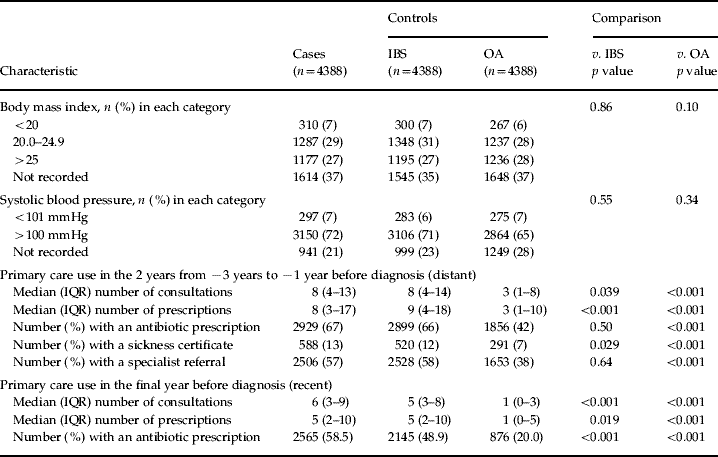
After applying the inclusion and matching criteria, 4388 fatigue syndrome patients (527 CFS and 3861 PVFS) were matched to both an IBS and OA control. The median (interquartile range) age of both cases and controls was 41 (31–53) years, with PVFS cases slightly older than CFS (median 42 v. 41 years). Of the cases, 3004 (68.5%) were female, with no significant difference between CFS and PVFS cases. A further 210 fatigue syndrome patients could not be matched to both an IBS and an OA control. These 210 were of similar age and sex to those matched successfully (median age 41.5 years, p=0.44; 138 (66%) females, p=0.43). Because the IBS controls were matched to the age and sex of fatigue syndrome patients, they were slightly unrepresentative of the whole population of IBS patients in the GPRD as of April 2002, which had a median age of 44.9 years and was 76% female (both differences p<0.001). Patient characteristics and their use of primary care are shown in Table 1.
Fatigue syndrome patient characteristics and use of primary care in the 3 years before diagnosis

IBS, Irritable bowel syndrome; OA, other attender; IQR, interquartile range.
There were no significant differences in body mass index or hypotension. The fatigue syndrome cases were very similar to the IBS controls and were very different from the OA controls with regard to a greater numbers of consultations, prescriptions, antibiotics, specialist referrals and sickness certificates. The fatigue syndrome cases received more prescriptions for antibiotics and had more consultations in the year before diagnosis than the IBS controls.
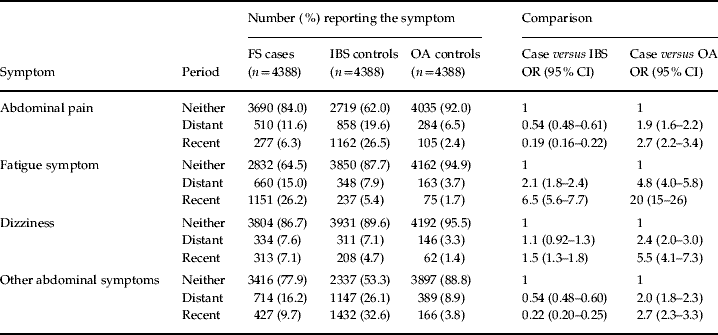
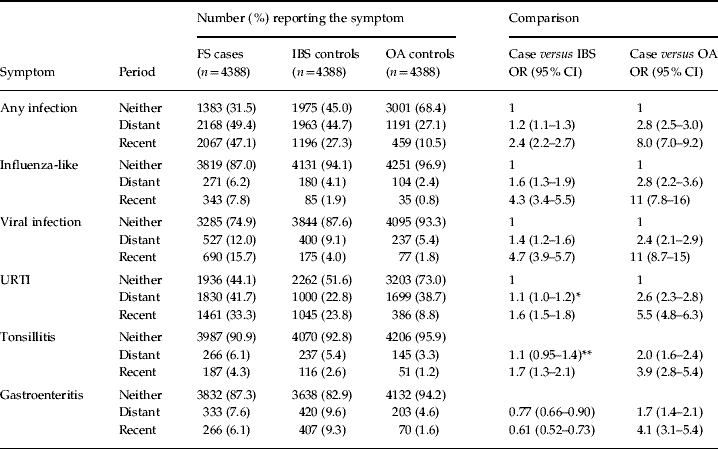
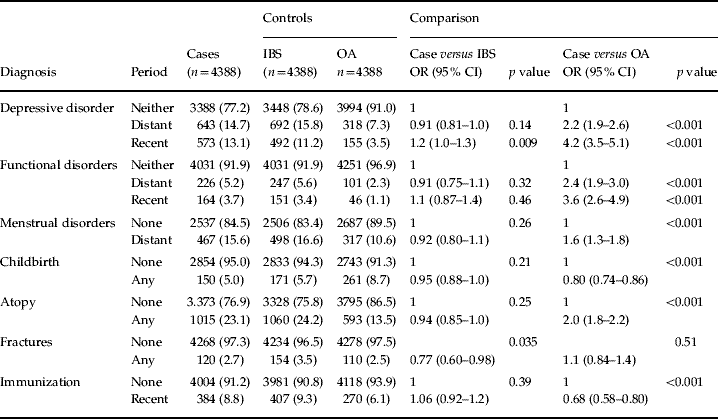
Table 2 shows clinical features occurring before diagnosis. In addition to those variables shown, glandular fever was recorded in the final year before diagnosis in 32 fatigue syndrome cases and one OA control, but no IBS controls. All risk markers were more frequent in the fatigue syndrome cases compared to the OA controls with the exception of fractures; this last result being expected. Women in both the fatigue syndrome and IBS groups were less likely to have delivered a child. Fatigue syndrome cases more commonly attended for fatigue compared to IBS controls, but less commonly for abdominal symptoms, including pain. Compared to the IBS controls, fatigue syndrome cases attended more frequently for an infection, both recently and across the whole 3 years, and less often for gastroenteritis. Both fatigue and IBS cases were equally more likely to have been diagnosed with a mood or symptom-based disorder than OAs. Immunizations were more common before fatigue syndromes compared to OA controls, but no more common than before IBS. The percentage of OA controls reporting abdominal pain at some time in the 3 years was 8.0%, compared to our estimated 6.5% used in the sample size calculation.
Symptom reporting by fatigue syndrome (FS) patients and controls before diagnosis

IBS, Irritable bowel syndrome; OA, other attender; OR, odds ratio; CI, confidence interval.
All comparisons were significant with p<0.001.
Infections reported in fatigue syndrome (FS) patients and controls before diagnosis

IBS, Irritable bowel syndrome; OA, other attender; OR, odds ratio; CI, confidence interval; URTI, upper respiratory tract infection.
All comparisons were significant with p<0.001, except for
* p=0.004 and ** p=0.17.
Other clinical events reported in fatigue syndrome patients and controls before diagnosis

IBS, Irritable bowel syndrome; OA, other attender; OR, odds ratio; CI, confidence interval; URTI, upper respiratory tract infection.
Percentages for menstrual disorders and childbirth calculated for the 3004 females only.
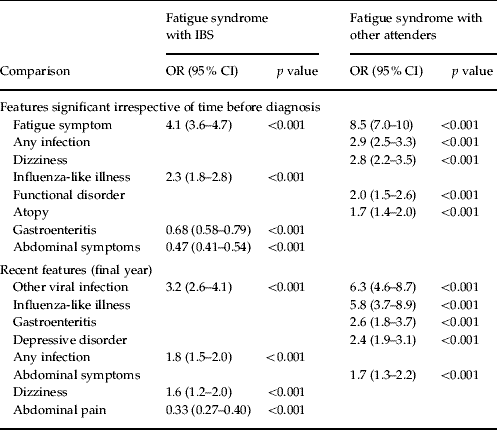
Table 3 shows the results of the multivariable analysis. Two variables, consultation numbers and medical certification, were omitted from this analysis, as they may have been consequences of ill-health rather than possible causes or predictors. Both were, however, independently significant if included in the final model comparing fatigue syndromes with OAs, but neither was significant when compared with IBS. Childbirth was less common (p<0.001) in women in the model comparing fatigue syndromes with OAs, but not so when compared with IBS; menstrual disorders were not significant in either comparison. As fatigue symptoms are a core component of diagnosis of a fatigue syndrome, the analyses in Table 3 were repeated after excluding it as a variable. All the other variables remained significant with p values <0.001, and with higher odds ratios.
Multivariate analyses of risks of all fatigue syndromes compared to the control groups

OR, odds ratio; CI, confidence interval.
Total of 4388 subjects in all three groups. For the blank cells, no significant association was identified in the multivariate analysis.
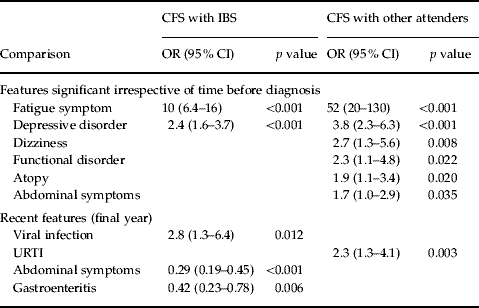
Differences in risk markers between the two subgroups of fatigue syndrome, CFS/ME and PVFS, were assessed by testing for interaction terms in the models presented in Table 3. The presence of prior fatigue symptoms or prior depressive disorders was more common in patients labelled with CFS/ME. Prior infections, particularly viral ones (but not influenza), were more common in patients labelled with PVFS. The interaction terms all had p values of <0.001 in likelihood ratio tests, except for depressive disorder in the fatigue syndrome versus OA analysis, where p=0.04. The multivariable models for CFS are presented in Table 4. Fatigue and depressive disorders predicted CFS in both models, but different recent infections differentiated CFS from IBS in particular.
Multivariate analyses of risks of CFS/ME compared to the control groups

CFS, Chronic fatigue syndrome; ME, myalgic encephalomyelitis; IBS, irritable bowel syndrome; OR, odds ratio; CI, confidence interval; URTI, upper respiratory tract infection.
Total of 527 subjects in all three groups. For the blank cells, no significant association was identified in the multivariate analysis.
Discussion
These data suggest that both fatigue and irritable bowel syndromes are similar in sharing generic distant risk markers, but are also different in having some more recent risk markers that are specific to each condition. CFS/ME was more similar to IBS than was PVFS. The common predisposing risk markers were symptoms, such as dizziness and menstrual symptoms, in addition to diagnoses such as atopy, mood and other symptom-based disorders, and immunizations. We also found that consultations and sickness certificates were independent risk markers for both fatigue syndromes and IBS. Specific risks markers included symptoms such as fatigue for fatigue syndromes and abdominal symptoms for IBS. Specific predisposing diagnoses included infections in general, particularly systemic viral infections, for fatigue syndromes, but a greater risk of IBS after gastroenteritis.
Remarkably, the pattern of shared and differentiating risk markers was the same for triggering risk markers, but with greater contrasts for specificity. The only changes from predisposing risks were the greater specific risks following a depressive disorder, glandular fever and tonsillitis in the year before a fatigue syndrome.
There were no significant differences between groups for having a fracture, apart from a slightly lower risk of fracture in the year before a fatigue syndrome. This variable was included as it was expected to be similar across the groups, and acted as a marker for possible recording bias in one of the disease groups. Of note, childbirth was equally less common in both fatigue syndromes and IBS in all time periods examined; a finding that has not been reported previously. Neither low blood pressure nor abnormal body mass index was a risk marker for either condition. Immunization and atopy were general risk markers for triggering both syndromes, but there was no significant difference between them, suggesting that they were generic rather than specific risk markers. The absence of these risks from the multivariate analyses suggests that they were markers for a greater propensity to health-care attendance.
Regarding the use of primary and secondary care, these data reflect the generally shared risks for developing both conditions, with greater similarities than differences between fatigue syndromes and IBS. Both conditions had significantly greater use of primary and secondary care at all times compared to the controls, suggesting that a tendency to seek health care is an independent risk marker. The larger number of antibiotic prescriptions in the year before a fatigue syndrome probably reflects the greater number of infections, as this marker was no longer significant in the multivariate analysis.
The data also suggested that there are subgroup differences in the risks for particular fatigue syndromes. The symptom of fatigue, mood and symptom-based diagnoses were all specific risks for a diagnosis of CFS/ME compared to PVFS, whereas almost all infectious groups were specific to PVFS in contrast to CFS/ME. CFS/ME was more similar to IBS than PVFS with regard to its risk markers. Even so, depressive diagnoses were a greater long-term risk marker for CFS/ME than IBS, and, as expected, systemic and gut infections also differentiated the two syndromes.
These data, therefore, supported most of our hypotheses. Both fatigue syndrome and IBS patients consult more often pre-morbidly than other attenders. Both symptom-based and depressive diagnoses are risk markers for fatigue syndrome and IBS patients, although mood diagnoses are more specific risk markers for CFS/ME. As would be expected, gastrointestinal complaints are a specific risk for IBS and fatigue for fatigue syndromes, but these risks are apparent several years before diagnosis, suggesting that they are independent risks and not just early indicators of the conditions. The same risk markers predispose patients to develop fatigue syndromes and IBS, but specific markers trigger the specific illnesses. Finally, CFS/ME had different risk markers to PVFS, suggesting some differences between the conditions, with a greater similarity to IBS. However, we did not find that either atopy or immunization differentiated fatigue syndromes and IBS.
Strengths and weaknesses
This is the largest ever study of the risk markers for fatigue syndromes. Its strengths are its size, prospective design, the setting in primary care and the division of predisposing and triggering risk factors. The size of the study means that many of the statistically significant comparisons could have had little clinical relevance; we have exercised clinical judgement in interpreting them. Size has its advantages too: the confidence intervals are narrow. Its weaknesses are, first, the reliance on GPs and hospital specialists being accurate in their diagnoses. No confirmatory tests were made and operational criteria were not used. Second, the division between predisposing and triggering risk markers was necessarily arbitrary, based on time before diagnosis. It is likely that there was overlap between these risks. Third, this is a study of patients presenting to their GPs and cannot be used to provide evidence about these conditions when the patient does not attend their GP, and the data rely on the accuracy of diagnoses made by GPs. Finally, we were only able to examine risk markers that were measured and others, such as pre-morbid activity (Harvey et al. Reference Harvey, Wadsworth, Wessely and Hotopf2008), were unavailable.
Implications for future research
Future aetiological research should consider fatigue syndromes, at least, as heterogeneous, while at the same time exploring the paradox that predisposing risks may be the same as found with other symptom-based disorders (Kato et al. Reference Kato, Sullivan, Evengård and Pedersen2009). Are the risk markers of both mood and symptom-based diagnoses related by genetic risk, environmental risk, or an interaction between the two (Heim et al. Reference Heim, Wagner, Maloney, Papanicolaou, Solomon, Jones, Unger and Reeves2006; Kato et al. Reference Kato, Sullivan, Evengård and Pedersen2009)? The novel finding of the possibly protective role of childbirth needs testing and explaining, particularly because these fatigue syndromes and IBS are more common in women. Future research into the role of immunizations, atopy and antibiotics are unlikely to yield useful data.
What can we conclude from this study? There are both generic and specific risk markers for both fatigue and irritable bowel syndromes, supporting both common and independent aetiologies and pathophysiological mechanisms. The generic risk markers of other symptom-based disorders and mood disorders may be mediated by enhanced or supersensitive interoception – visceral perception (Cameron, Reference Cameron2001; Craig, Reference Craig2002), that may form the common brain link between symptom-based disorders, enhanced by mood disorders (Phillips et al. Reference Phillips, Gregory, Cullen, Cohen, Ng, Andrew, Giampietro, Bullmore, Zelaya, Amaro, Thompson, Hobson, Williams, Brammer and Aziz2003; Wiens, Reference Wiens2005). By contrast, peripheral pathophysiologies were specific and necessary to trigger each condition (Wessely & White, Reference Wessely and White2004; Moss-Morris & Spence, Reference Moss-Morris and Spence2006). These data also suggest that fatigue syndromes are heterogeneous (Vollmer-Conna et al. Reference Vollmer-Conna, Aslakson and White2006), and that CFS/ME and PVFS should be considered as separate conditions, with CFS/ME having more in common with IBS than PVFS does (Aggarwal et al. Reference Aggarwal, McBeth, Zakrzewska, Lunt and Macfarlane2006). This requires revision of the ICD-10 taxonomy, which classifies PVFS with ME (WHO, 1992). The duration of PVFS of the same patients in this study was considerably less than CFS/ME, supporting this distinction (Hamilton et al. Reference Hamilton, Gallagher, Thomas and White2005). These data would support the repeated observation that CFS/ME is associated with IBS (Afari & Buchwald, Reference Afari and Buchwald2001; Aggarwal et al. Reference Aggarwal, McBeth, Zakrzewska, Lunt and Macfarlane2006), but extend this work to suggest that they have common predisposing risk markers, but uncommon triggers (Moss-Morris & Spence, Reference Moss-Morris and Spence2006).
Acknowledgements
A.M.G. was funded by a grant from the Department for Work and Pensions. The research was conducted independently from the funding source. Ethical approval was obtained from the Scientific and Ethical Advisory Group of the GPRD.
Declaration of Interest
Professor White has undertaken some consultancy work for the Department for Work and Pensions.