Following highly visible public controversies over the World Trade Organization, the North American Free Trade Agreement, and other manifestations of economic globalization, the sources of public opinion about international trade began to draw increased attention from scholars of international trade. Recent research in the field of international political economy presents evidence that the distributional effects of trade on individual income drive support and opposition to it.Footnote 2 Controversies on this issue among scholars of trade policy have typically involved the identification and measurement of the economic interests at stake. The question of whether factor ownership or sectors of employment are more important in shaping preferences is arguably the most important bone of contention, but there are others. For example, some have questioned the use of education as an indicator of human capital,Footnote 3 the lack of attention to the consumption side of trade,Footnote 4 and whether the expected relationship between human capital and public opinion holds in developing countries.Footnote 5
For all the recent debate on the topic, research within the field of international political economy has rarely questioned whether economic self-interest actually makes any difference for individual views on trade policy. Some scholars have offered this more fundamental objection, however. They have argued that beliefs about the impact of trade on the community as a whole, as well as other related attitudes, shape opinions about trade policy. This skeptical view holds that these opinions arise from relatively stable symbolic predispositions that have no necessary relationship to an individual's material self-interest. These symbolic predispositions are more important than economic self-interest, which makes no difference at all in some accounts.Footnote 6 This skepticism demands serious consideration. It follows from a large body of research in the field of American politics about the effect of self-interest on individuals' voting decisions and their opinions on other policy issues.Footnote 7 This body of work generally concludes that most survey respondents have little understanding of their economic self-interest and that other factors play a much greater role in shaping their opinions.
This research raises real doubts about the claim that individuals deduce their opinions on trade policy from their economic self-interest. This claim is important because it is a basic assumption in most research about the politics of trade. In the remainder of this article, we will argue that recent skeptical conclusions about the role of economic interests in shaping trade policy attitudes are premature for two reasons. First, they rest on empirical evidence that other attitudes predict trade policy views better than objective indicators of economic self-interest. Using one attitude to predict another raises difficult questions about the direction of causation that current studies fail to address explicitly. These difficulties are especially serious in tests of sociotropic models of attitude formation that rely on subjective evaluations of the effects of trade. Second, the understanding of how economic interest could influence individual attitudes toward trade policy is unrealistically narrow. Calculations of individual economic costs and benefits are not the only way in which this influence could occur. Once we move away from an extremely individualistic definition of material concerns, economic interests may play a less direct, but no less potent role in shaping attitudes.
The remainder of this article proceeds as follows. First, we review the key features of the critique of economic self-interest as a source of trade policy attitudes. Next, we explain our two objections to this critique, drawing on the data used recently by Mansfield and Mutz to illustrate the practical implications of these objections.Footnote 8 A final section summarizes our argument and outlines avenues for further research.
Economic Self-Interest and Its Critics
Recent skeptical accounts of the influence of economic self-interest on individual trade policy attitudes rest on two main arguments. The first is that individuals' broader symbolic predispositions are more important than objective indicators of self-interest in shaping their opinions about trade policy. These predispositions include nationalism, ethnic identity, and the like. O'Rourke and Sinnott and Mayda and Rodrik, who argue that economic self-interest is very important, also find that support for trade protection is related to nationalist attitudes.Footnote 9 They conclude that attitudes such as chauvinism and national pride “encourage thoughts of national isolationism, and abstention from political alliances and other international economic relations.”Footnote 10
Other authors go somewhat further. Rankin argues that respondents' attachment to national sovereignty is crucial to the processing of cues about trade policy. He finds that conceptions of national identity are more strongly associated with trade policy attitudes than is economic self-interest, even though self-interest still has some effect.Footnote 11 Edwards similarly focuses on general value orientations, including respondents' comfort with the pace of modern life and the extent to which consumerism is perceived as a threat to their culture, to explain attitudes toward trade and economic globalization.Footnote 12 The study further includes subjective assessments of the prospects for the national economy as a predictor of trade attitudes, finding that a pessimistic outlook has a persistent negative effect on support for globalization.
Mansfield and Mutz offer the strongest version of the skeptical view, concluding that economic self-interest plays little or no role in shaping support for free trade. Evaluating the impact of education, which is commonly used as a proxy for skill level in testing the influence of economic interest on trade policy attitudes, they conclude that “after accounting for the effects of isolationism and ethnocentrism, we find that education has no direct effect on trade attitudes, thus suggesting that its effects represent out-group anxiety rather than self-interest.”Footnote 13
Mansfield and Mutz also offer a second, related argument against the influence of economic self-interest. They find that individuals' sociotropic beliefs about the impact of trade on the country as a whole shape their policy attitudes. In fact, they are more important than individuals' egocentric beliefs about their personal interests. Sears and Funk's review of research on economic policy attitudes in American politics provides a foundation for this line of argument. They note that perceived self-interest rarely influences these attitudes because the stakes are small and ambiguous, and because Americans are reluctant to attribute their personal successes and failures to government policy or broader societal processes.Footnote 14 Mansfield and Mutz find that individual beliefs about the impact of trade on the nation as a whole strongly influence trade policy attitudes even when one controls for both objective determinants of economic interests and subjective beliefs about respondents' self-interest.
These two arguments rest on a distinctive understanding of self-interest and the way it might influence individual attitudes best developed in research on economic voting and the sources of economic policy attitudes in American politics. Mansfield and Mutz draw on the work of Sears and Funk, who define self-interest “as the (1) short-to-medium term impact of an issue (or candidacy) on the (2) material well-being of the (3) individual's own personal life (or that of his or her immediate family).”Footnote 15 Other studies, such as Rankin also cite Sears and Funk and provide essentially the same definition.Footnote 16 This definition makes sense in the context of efforts to assess whether individuals actually engage in “pocketbook voting” rather than acting on ideological considerations or their views about the welfare of the country as a whole, the purpose for which it was developed. However, it permits economic interests to influence political attitudes through only one pathway: the conscious calculation (or at least perception) of immediate individual self-interest.
This understanding of how economic interests might influence individual attitudes will probably seem unrealistically narrow to readers accustomed to treating these interests as politically important. However, the literature stressing the influence of economic interests on trade policy attitudes offers no alternative account of how these interests might work. Instead, researchers implicitly accept essentially the same understanding offered in the American politics literature. Scheve and Slaughter are the most explicit when they note (correctly) that “in the literature on the political economy of trade policy, it is commonly assumed that individuals evaluate trade policy based on how their current factor incomes are affected without regard for aggregate national welfare.” The authors also state that they “assume that individuals know with certainty the effects of trade policies on individual incomes and asset holdings.”Footnote 17
The word assume is important here. The assumption that economic self-interest shapes preferences is fundamental to the literature from which their research question arose. The goal of most of this work is to explain policy outcomes or the positions of organized interests, not individual preferences. Indeed, its departure from this analytical focus is what makes the recent work on public opinion and trade policy in international political economy new and distinctive. Behavioral assumptions about the importance of individual self-interest provide explanatory leverage for models of these aggregate-level phenomena. They allow researchers to set aside the complicated process through which individuals actually form their preferences in order to focus on explaining broader outcomes such as trade liberalization. Because they are simplifications, these assumptions are, strictly speaking, false. Their plausibility matters but they need only be a first approximation. Their value is not in whether they correctly describe reality but in whether they produce useful theoretical insights about the larger outcomes in which researchers are actually interested. Assumptions about self-interested behavior are pervasive among economists and political scientists who study trade policy. Perhaps for this reason, an extensive discussion of how economic interests actually work might seem unnecessary.
Recent skeptical accounts of the role of economic interest demonstrate that something more than an appeal to long-standing assumptions is necessary. Once individual preferences become the object of study rather than merely an element of an explanation for some other phenomenon, assumptions about them no longer suffice. A more complete account of the causal process leading to their formation is needed.
Why Economic Interests Might Still Matter
We have two objections to the skeptical treatment of economic interests outlined in the last section. The first concerns the research design for showing that other attitudes are more important than objective indicators of economic self-interest. It would apply even if one accepted the understanding of economic self-interest found in this research. Our second objection is that this understanding of self-interest excludes alternative pathways through which an individual's economic position in society could influence his or her views on trade policy. We will reanalyze Mansfield and Mutz's data to illustrate these objections because they come to the most skeptical conclusions about economic interests. However, our concerns apply equally to other studies making the same arguments. Overall, our argument is less about the relationships found in the data than about the conclusions these relationships support.
Predicting Attitudes with Attitudes
The skeptics' central claim is that other attitudes are just as important as indicators of economic self-interest in shaping trade policy preferences.Footnote 18 Mansfield and Mutz go the furthest in this respect. Controlling for ethnocentrism and isolationism, they find no evidence that economic self-interest has any effect at all. The evidence for all these claims comes from regression models that treat individual trade policy attitudes as a function of other attitudes and indicators of economic self-interest. Because their estimated effects are large, researchers conclude that the other attitudes strongly influence individual trade policy views.
The trouble with this approach is that the meaning of a strong relationship between one attitude and another is far from obvious. Nearly all researchers who find such a relationship infer that the attitude used as an independent variable causes the attitude used as a dependent variable but one would find the same correlation if the causal arrow were reversed. This problem of causal inference applies to nearly any instance in which one attitude is regressed on another, but it is especially clear when attempting to estimate the impact of subjective beliefs about the effects of trade on trade policy attitudes. It is not clear that the independent variable is causally prior to the dependent variable. As Mansfield and Mutz rightly note, individuals are subjected to large amounts of information about the beneficial or harmful consequences of different aspects of economic globalization, including trade. If people have attachments to organized interests or other individuals who present these political arguments, they might form their opinions about trade policy first, based on these group attachments. These opinions could then shape their beliefs about the economic impact of trade. In short, trade policy attitudes might influence individuals' assessments of how trade affects their family as well as the country as a whole.
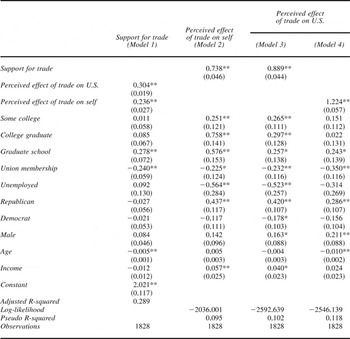
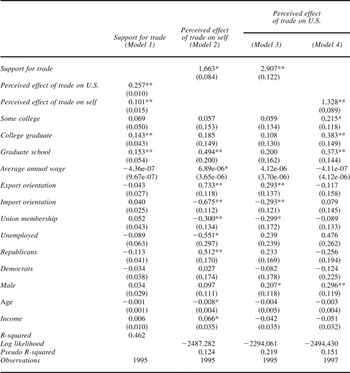
We will illustrate this problem of causal inference using the two surveys employed by Mansfield and Mutz.Footnote 19 The first was conducted as part of the 2004 National Annenberg Election Study (NAES). The second was designed by Mansfield and Mutz and administered by Knowledge Networks (KN) in 2007. Mansfield and Mutz constructed an index of trade policy attitudes using several survey items.Footnote 20 They found that the best predictors of trade policy attitudes were sociotropic and egocentric beliefs about the likely impact of trade. They measured these beliefs using two survey items: one on trade's effects on the United States economy, the other about its impact on the respondent and his or her family. Table 1 presents the results of four models estimated using the NAES data. Table 2 presents the results of four corresponding models estimated using the KN data.Footnote 21
Relationships between attitudes toward trade and perceived effects of trade in the National Annenberg Election Study data

Notes: Model 1 estimated using ordinary least squares (OLS). Models 2 to 4 estimated using ordered logit. Estimated cut points for these models are omitted for reasons of space. Standard errors are in parentheses.
** p < .05;
* p < .10, in a two-tailed test.
Relationships between attitudes toward trade and perceived effects of trade in the Knowledge Networks survey data

Notes: Model 1 estimated using ordinary least squares (OLS). Models 2 to 4 estimated using ordered logit. Estimated cut points for these models are omitted for reasons of space. Standard errors are in parentheses.
** p < .05;
* p < .10, in a two-tailed test.
The first column in Table 1 presents results of a model similar to the one Mansfield and Mutz reported in Table 1, Model 5 of their article.Footnote 22 We did not have data on import competition, export orientation, wages, and tariff rates in the sector in which survey respondents worked, so we did not include these variables. Mansfield and Mutz did not find any of them to be statistically significant in their analysis, and our results are nearly identical in other respects. Beliefs about the impact of trade on the U.S. economy were more strongly related to support for liberal trade policies than any other independent variable. A move from the lowest to the highest score on this independent variable was associated with a move across roughly 30 percent of the range of the dependent variable, other things remaining equal. Beliefs about the impact of trade on oneself also had a substantial effect but it was 23 percent smaller than that of beliefs about the country as a whole. The effects of the remaining variables were all quite small by comparison when they were even statistically significant. The first model in Table 2 estimates a very similar model using the KN data. (It is identical to the one Mansfield and Mutz presented in Table 3, Model 4, of their article.) It supports the same apparent conclusion: sociotropic beliefs dominate all other considerations in shaping trade policy views.
Although these results seem to show that sociotropic perceptions about the impact of trade dominate other considerations, especially objective indicators of economic self-interest, this conclusion falls prey to uncertainty about the direction of causation. It is not obvious that sociotropic or egocentric perceptions about the impact of trade lead to opinions about trade policy. Instead, opinions about trade policy could lead to beliefs about its likely effects. As we noted earlier, some individuals might have heard trusted political leaders or media figures express support for a liberal (protectionist) trade policy and then inferred that trade is good (bad) for the country as a whole. Models 2 and 3 in Tables 1 and 2 illustrate the plausibility of this alternative interpretation. Attitudes toward trade policy predict individuals' beliefs about trade's impact on them and on the country as whole. Not surprisingly, these effects are just as strong as the apparent effects of beliefs about the effects of trade on attitudes toward trade policy.
Another aspect of the results in Table 2 suggests a further alternative interpretation of the relationship among these attitudes and the objective indicators of self-interest. As Model 1 indicates, the sectoral variables in the KN survey failed to predict individual attitudes toward trade policy. However, Models 2 and 3 suggest that these indicators of self-interest do predict beliefs about the effects of trade, especially egocentric beliefs. Individuals working in relatively export-oriented sectors are more likely to think trade will have a positive effect on them, while those working in more import-competitive sectors think it will have a negative effect. These are findings we would expect based on respondents' objective self-interest. Union membership also has the expected negative effect on beliefs about the effect of trade, even though it was not a significant predictor of trade policy attitudes. In view of these results, one could argue that economic self-interest influences attitudes toward trade policy, but that it does so mainly through its effects on beliefs about the likely effects of trade.
Model 4 in each of the tables presents yet another way in which these attitudes might be related. In this case, we hypothesize that beliefs about the effect of trade on the United States as a whole are generalized from individuals' beliefs about its likely effect on them and their families. This process need not work through the self-conscious rationalization of one's own perceived self-interest. It may be that individuals form their sociotropic attitudes based on what they think will happen to people like them, or perhaps that they unconsciously assume that most of the country consists of such people. Conover, Feldman, and Knight found that personal economic situation plays an important role in how people evaluate macroeconomic conditions.Footnote 23 If a similar process takes place in the formation of trade policy attitudes, then part of the apparent effect of sociotropic beliefs in Model 1 is actually due to the indirect effect of perceived self-interest. Once again, the results seem to support this claim. Egocentric beliefs appear to have an enormous effect on sociotropic attitudes.
We do not wish to use these results to argue either that trade policy attitudes cause beliefs about the impact of trade or that egocentric beliefs shape sociotropic beliefs. Both claims are plausible. Our point is that regressions such as those in Tables 1 and 2 in which one attitude is used to predict another do not reveal the direction of causation. Alternative interpretations will nearly always be possible. We can be reasonably confident that the other variables in the model are exogenous to beliefs about trade and trade policy. Respondents are not educated, wealthy, male, young, or employed because of their beliefs about trade or trade policy. (Economists working in Washington think tanks might form a limited exception to the last of these claims about exogeneity.) Beliefs about trade might have some influence on an individual's decision to join a union or identify with a political party, but even these effects seem unlikely. By contrast, it is very difficult to say which of the attitudes in these models comes first. Indeed, it seems more likely that they cluster together without any real causal relationship to one another, and were acquired more or less simultaneously as a function of some exogenous influence. In a sense, they might best be understood as different aspects of a single attitude.Footnote 24 However one assesses the various ways in which the relationship among these attitudes might have emerged, the regression analysis provides no grounds for excluding alternative interpretations.
Alternative Pathways for the Influence of Economic Interests
Our second objection is that economic interest might influence individual attitudes in ways other than conscious calculations of self-interest. As we noted earlier, these calculations are the only causal pathway consistent with the definition of self-interest used in the research on which most skeptics draw. Although this narrow understanding of how economic interests work is consistent with the behavioral assumptions in most research on international political economy, including recent work on individual trade policy attitudes, a broader understanding of economic interests suggests other ways that they might influence individual attitudes. Discussions of “economic interest” commonly refer as much to groups as to individuals. Indeed, “economic interest” is often shorthand for the group sharing a particular stake on some issue. Group interests are rooted in individual-level economic outcomes but the fact that many individuals share the same economic stake in many social and political outcomes matters for assessing how those economic stakes might influence their individual views.
This line of argument about group economic interest is not really at odds with recent skeptical views of the role of economic self-interest in shaping trade policy opinions. The mechanisms through which group interests act as an indirect conduit for self-interest fit within what Mansfield and Mutz refer to as information-based models. In these models, attitudes “are rooted in people's perceptions (and misperceptions) derived from any number of sources of information, beyond personal life experience.”Footnote 25 Group economic interests influence the information people receive, however. As Mansfield and Mutz write, “in addition to mass media, local economic conditions that individuals learn about through interpersonal contact and casual conversations also influence their perceptions of the direction of national economic change.”Footnote 26 Views that arise from this process are not part of self-interest narrowly understood, but they are quite likely to reflect group economic interests that correspond to individual self-interest.
This recognition that group economic interests influence trade policy attitudes rests uneasily with the broader conclusion that economic self-interest does not matter. It is very difficult to separate individual self-interest from group interests. People learn about their interests by interacting with others. Most know little about issues like trade, but they may have better informed friends and co-workers. The circle of people with whom an individual interacts most frequently is biased toward sharing his or her self-interest. Because geographic location is one determinant of economic self-interest, people living near one another are likely to share these interests. Co-workers are even more likely to have similar stakes in particular economic policies and conditions. The individual interests within a family are so closely intertwined that it often makes little sense to separate them. Economic statistics are frequently reported for households instead of individuals for exactly this reason. It is easy to see why one perceives one's material well-being as closely tied to that of one's family or community. Friends and family can not only shape an individual's views by providing information directly but also indirectly by influencing the public figures and media outlets to which the individual turns for information.
In addition to informal groups of peers and colleagues, organized groups such as trade unions provide a large share of the facts and opinions from which people distill their views on trade, foreigners, or the national interest. Economic interests can influence this process in at least two related ways. First, the groups themselves may be organized around the shared economic interests of their members. This is certainly the case for unions and many other pressure groups. Individuals will come to identify with or even join a group if their interests align with it. As a result, people may come to hold specific attitudes about policies that are perceived as harmful (or beneficial) to the group. Even if most individuals do not have a very sophisticated understanding of their economic interests, frequent contact with others who have the same interests should bias their sense of collective identity toward groups that correspond to those interests anyway. To be sure, individuals might join groups that do not reflect their self-interest but these are likely to be the exception rather than the rule. Second, the information these groups provide to affiliated individuals is likely to be biased in favor of the interests they represent. While some interest groups may try to influence attitudes about trade directly, others may supply arguments that are only indirectly related to trade. In sum, a person's economic self-interest could determine to which group one belongs and to what type of information one has access. If information affects attitudes, as research reviewed by Mansfield and Mutz suggests, economic self-interest has a clear, if indirect, role to play.
This line of argument about the indirect influence of economic interests is similar to what Popkin and others examining voting behavior call “low-information rationality.”Footnote 27 Recognizing that most people have little information about trade and trade policy, Scheve and Slaughter cite this work in explaining how voters might construct coherent views about the issue that reflect their interests.Footnote 28 The argument is that voters combine rudimentary political knowledge acquired as a byproduct of everyday life with information gathered during the course of a campaign to select candidates who are more likely to reflect their preferences. A candidate's party identification is the most important information shortcut used in this process, but there are others.Footnote 29 Formulating an issue position is somewhat different from choosing a candidate but similar processes can produce positions that reflect individual self-interest. As Lupia noted in the context of referenda on insurance reform in California, voters were able to use the identity of information providers—especially the insurance industry—to choose a position on the issue consistent with their own interests even in the absence of partisan cues or a candidate with a previous record.Footnote 30 Individuals could use similar cues based on the positions of key politicians, unions, and business leaders to inform their positions in debates about trade policy. While actual policy debates usually create these cues, survey questions rarely include them. Survey analyses thus might understate the correspondence between positions on trade policy and individual self-interest in real life.
The group processes through which economic interests can influence individual attitudes raise important questions about another piece of the evidence supporting recent skepticism about the role of economic interests. A wide range of authors present regression results showing that noneconomic attitudes are strong predictors of individual opinion on trade policy. Most of them focus on nationalism of one kind or another, finding that more patriotic or chauvinistic individuals are more likely to support protectionist trade policies.Footnote 31 Mansfield and Mutz find no relationship between nationalism and trade policy opinions but show that these opinions are related to attitudes toward U.S. involvement in international affairs (isolationism) and toward members of other ethnic or racial groups (ethnocentrism). They find that the inclusion of variables indicating these attitudes renders education statistically insignificant, suggesting that the effect of education on trade policy opinions works through these other attitudes rather than economic self-interest.Footnote 32
Like our other objections, this one concerns the meaning rather than the existence of relationships among these noneconomic attitudes and individual trade policy opinions. If group processes shape individual views on trade, then the statistical association between opinions about trade and opinions on other matters may not be causal. Groups adopt common positions on many issues. There is not necessarily a causal relationship among these positions. Some common attitudes are logically unrelated but are nevertheless consistent within the group. For example, members of a particular occupation might dress or speak in a similar way to show their solidarity—or simply to blend in—even if nothing about their job requires them to do so. Even though one would certainly find a strong statistical relationship between these modes of dress and speech and the attitudes typical of the group, this relationship is not causal. (Group membership produces all of these commonalities, though perhaps through different processes.) The same problem of causal inference applies to associations between logically unrelated attitudes on less trivial matters. A group might be especially patriotic, ethnocentric, or isolationist, but there is not necessarily a causal relationship between these attitudes and the group's typical position on trade.
Of course, sometimes there is a logical relationship among a set of attitudes that makes it difficult to hold one without holding the other. This might well be the case with nationalistic, ethnocentric, or isolationist attitudes and individual views about trade and trade policy. For example, if one views foreign influence on American life as dangerous, it follows that the nation should restrict international trade in goods or services that carry this dangerous influence. There might indeed be a causal relationship between logically related attitudes. Unfortunately, efforts to sort out the direction of causation among these attitudes using survey data must confront the problem of causal inference outlined earlier. Since the two attitudes imply one another, the adoption of either one could trigger the adoption of the other. In the case of protectionist and xenophobic sentiment just mentioned, it is difficult to say whether one came to oppose foreign influence because of one's views on trade or vice versa. As with the relationship among the other attitudes discussed in the last section, the survey data do not reveal the direction of causation.
In some instances, economic interests might actually create the logical relationships among attitudes. For example, trade competition with an ethnically different and potentially threatening nation might create an association between protectionism and ethnocentrism or nationalism. In this case, individuals could come to hold all of these attitudes because of the same underlying economic interest. Group processes will strengthen such an association. Organized interests have every reason to use logically related attitudes to increase support for their policy agenda. This is particularly true of groups seeking trade protection, which is necessarily a parochial demand. The potential appeal of such a position will almost always be increased if it can be tied to nationalism or other broadly shared sentiments. It is probably the case, as O'Rourke and Sinnott argue, that “a totally economic determinist or reductionist explanation of nationalism is … implausible” but this does not mean that these views are entirely exogenous to group economic interests.Footnote 33 To the extent that economic interests influence the attitudes in question, using them all together as independent variables in a single regression will artificially reduce the estimated effect of economic interests. Indeed, exactly this result is the basis for Mansfield and Mutz's conclusion that isolationism and ethnocentrism trump the effect of economic interests, as indicated by education, on trade policy attitudes.
Obviously, economic interests are not the only source of attitudes like nationalism, ethnocentrism, or isolationism. For example, war or other intense experiences, as well as the views of one's parents, could strongly influence these predispositions. Nevertheless, it is not safe to assume that attitudes formed early in life are exogenous to economic interests. Even long-standing views could be colored by group economic interests likely to correspond to one's self-interest. Economic interests as well as social attitudes are often inherited from one's parents. The parents' position in the economy and their associated trade interests may have a significant impact on their children's attitudes, especially during the early years of life. Children are exposed to the economic interests of their parents, whether the parents relate them directly in conversation or the child experiences them indirectly through family income. If a family has benefited from international trade, it stands to reason that the views expressed at home would be favorable toward both trade and toward those with whom one trades. In contrast, families that have seen their economic fortunes decline due to trade should be more likely to transmit negative views about trade and perhaps complementary attitudes about foreigners or the value of American foreign policy activism. It is certainly true that an individual's attitudes can change later on in life as a result of education, employment, and other factors. But despite some degree of social and geographic mobility, many people's socioeconomic status is strongly affected by that of the parents. The similarity of experiences and economic interests may then further reinforce both trade attitudes and broader worldviews. Our point here is not that all attitudes can be reduced to economic interests but rather that their independence from these interests must be demonstrated rather than assumed.
Overall, skeptical conclusions about the influence of economic self-interest on trade policy attitudes rest on a narrow understanding of the process underlying this relationship. People form their views on many issues through contact with family, friends, and co-workers who are highly likely to share their individual economic interests. Organized groups such as trade unions will often reinforce these same views. People who form their opinions about trade in this way are quite likely to end up with positions that reflect their economic self-interest even if they do not fully understand the economic fundamentals. These group processes also cast doubt on claims that broader attitudes such as nationalism, isolationism, or ethnocentrism shape trade policy views. Groups will share many attitudes and social practices even when these attitudes are logically unrelated. When common attitudes really are logically related, it is impossible to infer that one causes another based on survey evidence used in current research on trade policy attitudes.
Conclusion
Recent skeptical treatments of the sources of trade policy attitudes point to some important weaknesses in research that treats them as a simple function of economic self-interest. Because most people understand little about how international trade actually affects their economic interests, the view that calculations of these interests drive the formation of trade policy attitudes is unrealistic. Most research on the politics of trade adopts this view as a simplifying assumption. The success of this research program in explaining policy outcomes and key features of the political process suggests that it is adequate for this purpose. However, a more realistic account of the process through which individuals form their attitudes about trade is necessary once these attitudes become the object of study rather than a theoretical building block for explaining some other phenomenon.
While the skeptics are right to doubt simple claims about the importance of economic self-interest, the conclusion that economic interests are not very important is unwarranted. Their critique rests largely on the claim that other attitudes predict individual opinion about trade policy better than objective indicators of economic interest. In this article we have outlined two problems with the evidence presented in support of this claim. Both concern the interpretation of the relationships found in recent research rather than their existence or nonexistence. First, the direction of causation is far from obvious in most models using one attitude to predict another. It is especially difficult to know whether the strong correlation between beliefs about the likely effects of trade and opinions about trade policy means that the former causes the latter, vice versa, or whether both are jointly caused by some exogenous influence. We know that these opinions hang together, but there are several plausible explanations for the linkages among them, all of which are equally compatible with the empirical results. Without evidence that some of these other attitudes are exogenous to trade policy opinions, one cannot sustain the claim that they shape these opinions.
Second, the understanding of economic self-interest in research on trade policy attitudes—both skeptical and supportive of its role—focuses exclusively on individual calculations of self-interest from economic fundamentals. This account of the process excludes some important group processes through which economic interests shape individual attitudes. If the goal is to distinguish calculations of economic self-interest from processes that rely on information from other sources, this understanding of the process might make sense. If the goal is to assess the influence of an individual's economic position in society on his or her political opinions, it is unrealistically narrow. Economic interests may be rooted in individual-level economic outcomes, but they are shared by groups of people who live and work in close proximity to one another. Groups of people—organized or not—who share common interests might also adopt attitudes about foreigners, national sovereignty, or broader foreign policy matters that complement their interests. These processes of attitude formation are indeed “information-based models,” but they are shaped by group economic interests. Accounts of the role of economic interests in attitude formation that set aside these indirect effects are likely to draw overly negative conclusions.
Our purpose here has been to point out the difficulties with recent skepticism about the role of economic interest rather than to provide definitive evidence that these interests really do shape trade policy attitudes. Although we do not find these skeptical arguments persuasive, we agree that the process through which individuals form their trade policy attitudes requires more attention. The indirect pathways through which we have argued that economic interests might influence individual views can and should be tested with more detailed data on the context in which they form their views. The possibility that other attitudes are indeed causally prior to opinions about trade and perhaps independent of economic interests also requires further research. Ethnocentrism, isolationism, and nationalism are clearly related to views on foreign trade. One way to clarify the relationship among these attitudes is to determine whether some of them are more central to a respondent's worldview than other views. In the case of ethnocentrism, a relevant question is whether individuals who stand to benefit from a particular commercial relationship will nevertheless express negative views about trade if the trading partner is significantly different in ethnic or racial terms. Such a study could compare Americans' attitudes toward trade with Canada or the European Union with their views on trade with Mexico or China.
Another approach to assessing the influence of both economic interests and potentially exogenous attitudes on trade policy opinion is to examine how these opinions change over time. We have already suggested that a person's trade views may be shaped directly and indirectly by parents' economic interests. Hainmueller and Hiscox argue that education, in particular college-level economic classes, may have a significant impact.Footnote 34 Much as other attitudes have been shown to evolve over time, a systematic study of trade attitudes may reveal how these attitudes change with an individuals' exposure to the effects of trade. Economic interests related to trade are likely to differ at different stages of a person's lifetime and employment history. This type of study could also illuminate to what extent views on trade are transmitted by parents and peers along the same lines suggested for other political orientations. Similarly, exogenous shocks such as wars might lead individuals to form negative views of particular states which in turn affect their opinions about trade with those former enemies.
The most important contribution of recent research questioning the role of economic interests is to reveal the need for more attention to the process through which trade policy attitudes form. We do not agree that economic interests play little or no role in this process, but it is clear that the way they work is poorly understood. Assuming that individuals understand and act upon their individual economic self-interest does not constitute an adequate theoretical argument. It is a useful simplifying assumption not because it is descriptively accurate but because there are other, more complex processes that result in the appearance of self-interested attitudes and behavior much of the time. In the end, the debate over the role of economic self-interest in shaping individual trade policy attitudes leaves us with an important theoretical puzzle: if people lack the information and cognitive capacity to calculate their interests from the economic fundamentals, how does individual opinion come to approximate self-interest? Like Mansfield and Mutz, we suspect that interests shared among groups of people are an important part of the answer to this question. A convincing theoretical argument about the sources of individual preferences must illuminate the processes linking these preferences to one's social and economic position.