Introduction
As the number of elderly people suffering from Alzheimer's disease (AD) and related dementia disorders rose from 55,000 in 2005 to almost 130,000 in 2012, Taiwan faces a challenge in the growth of health expenditures to cover the costs of care (Taiwan Alzheimer's Disease Association, 2013). The first estimate of the direct medical costs of dementia in Taiwan published in 2000 was between New Taiwan dollars (NTD) 41,535–52,032 (approx. US$1,200–1,504) per patient per year (the average exchange rate at that time was 34.6 NTD = 1 USD) (Chou et al., Reference Chou, Chang, Fu and Wang2000). A decade later, there is a need for a more current estimate of the impact of dementia on healthcare costs. As a country with a National Health Insurance (NHI) system, pharmaceutical therapy for dementia has been covered by the NHI in Taiwan since the year 2000 but with strict criteria (Bureau of National Health Insurance, 2013).
First, patients must be diagnosed with AD by either a neurologist or psychiatrist according to either NINCDS-ADRDA (National Institute of Neurological and Communicative Diseases and Stroke/Alzheimer's Disease and Related Disorders Association), DSM (Diagnostic and statistical manual of mental disorders) or ICD (the International Classification of Diseases) criteria to be considered for drug reimbursement. In addition, patients who apply for drug reimbursement for the first time must have their physician complete case studies of clinical symptoms, blood tests, cognitive tests, and neurological images such as brain CT or MRI are also required. For a detailed description of the application and review process for cholinesterase inhibitors (ChEI) reimbursement, see Sun et al. (Reference Sun, Lai, Lu and Chen2008). For patients with mild to moderate AD, there are currently three kinds of ChEI for which patients can apply for reimbursement in Taiwan according to the Bureau of National Health Insurance (BNHI): donepezil, rivastigmine, and galantamine hydrobromide. For patients with moderate to moderately severe AD, the BNHI reimbursement rule allows one type of N-methyl-D-aspartate (memantine) antagonist receptor, memantine. For patients with severe AD, they may apply for the use of either donepezil or memantine. However, combined use of memantine with any of the ChEIs is currently not covered. Furthermore, patients on ChEIs or memantine must be re-evaluated every year and the drugs were no longer reimbursed if the MMSE score of the patient worsened by 3 points or more or if their Clinical Dementia Rating (CDR) scale worsened by 1 grade when compared to the initial score at application. Only with a recent change in government policy (as of August, 2013) has the comparator been changed to MMSE or CDR scores recorded in the previous year (Bureau of National Health Insurance, 2013). As a result, patients treated with ChEI or memantine have been at a high risk of discontinuation, and the average treatment duration has only been 14 months (Sun et al., Reference Sun, Lai, Lu and Chen2008).
In contrast to the strict reimbursement rules mentioned previously, cerebral vasodilators (CBVs) which could improve brain perfusion are covered by the NHI with no additional requirement; thus, these CBVs such as piracetam, nicergoline, and ginkgo are commonly prescribed to patients with dementia. In this paper, we first consider CBVs as one type of cognitive enhancer along with ChEI and memantine (Vellas et al., Reference Vellas, Froelich and Sampaio2007). However, previous studies have questioned the efficacy of these drugs for treating dementia since no well-performed clinical trial has been able to demonstrate their benefit (Montastruc et al., Reference Montastruc2013). Therefore, in addition to a combined analysis of the three groups of cognitive enhancer, we also performed a separate analysis to assess the prevalence of CBV use in Taiwan and its economic impact on medical care costs.
Since hospitalization and post-acute care account for the majority of excess direct costs among patients with mild or moderate AD, a review of several utilization studies from Medicare and managed care organizations in the US indicated that ChEI therapy was able to reduce healthcare costs by improving the cognitive function and daily functioning of the patients under consideration (Fillit and Hill, Reference Fillit and Hill2004). One study which was also included in that review examined donepezil use among 204 AD patients in the US and found that the medical costs for patients taking donepezil were significantly lower than those for controls (Hill et al., Reference Hill, Futterman, Mastey and Fillit2002b). The researchers attributed the cost savings mainly to lower costs of inpatient hospitalization and skilled-nursing facilities services. Another case-control study among patients with mild to moderate dementia enrolled in a large Medicare managed care plan reported similar findings: patients receiving donepezil had lower total healthcare costs compared to matched patients with dementia not on donepezil (Lu et al., Reference Lu, Hill and Fillit2005). In light of these findings, the current study seeks to examine whether ChEI or memantine therapy for patients with dementia in Taiwan is also associated with reduced medical care costs.
Using nationwide population-based data for all elderly in Taiwan who were diagnosed with dementia in the NHI claims between 2009 and 2011, our goals were to examine the recent trend in treated prevalence and incidence rates of dementia in Taiwan, to compare the economic impact of using cognitive enhancers among patients with dementia, and to examine whether the potential benefit of using ChEI or memantine for treating dementia was also associated with cost savings for the healthcare system.
Methods
Data and sample
This retrospective economic analysis used 2009–2011 data from the National Health Insurance Research Database (NHIRD) of Taiwan. Estimates of treated prevalence and incidence rates, number of comorbidities, medical care costs, and medication use were derived from the medical claims and pharmacy claims of the NHIRD. Since the coverage rate for Taiwan's universal health insurance program was greater than 99.5% during the study period, this dataset contained almost all of the patients with dementia in Taiwan who used any health services covered by the NHI. To ensure that our sample included confirmed cases of dementia, we included those aged 65 years or older who had been diagnosed with dementia twice within one year in either an outpatient or inpatient setting.
Measurements
A diagnosis of dementia was defined according to the ICD-9-CM codes since it was the best information available in the claims files: senile or pre-senile organic psychotic condition (290), dementia in conditions classified elsewhere (294.1), and Alzheimer's disease (331.0) (Chien et al., Reference Chien2008). We also classified patients into four dementia subtypes based on their ICD-9-CM codes: vascular dementia (VaD) (290.4), AD (290 or 331.0), mixed dementia (those who had both a VaD and an AD diagnosis in one year), and the rest were classified as other types of dementia. Patients with AD were defined by either 290 or 331.0 since previous studies on the costs of dementia which used claims data have also recommended a more inclusive case definition for AD (Lin et al., Reference Lin, Kaufer, Maciejewski, Ganguly, Paul and Biddle2010; Yang et al., Reference Yang, Zhang, Lin, Clevenger and Atherly2012).
The cognitive enhancers examined in this study included three groups: ChEI, memantine, and CBVs. We searched the BNHI medication list to identify the drug codes involving different dosages of the following drugs: donepezil, rivastigmine, galantamine hydrobromide, memantine, dihydroergotoxine, piracetam, nicergoline, ginkgo biloba, and pentoxifylline. By searching these drug codes, we identified patients with dementia using different types of cognitive enhancers and compared medical care costs associated with using the drugs. Since about half of the ChEI users also took CBVs (before their application for ChEI was approved), we counted those who used both ChEI and CBVs in the same year as ChEI users. A similar definition was applied to memantine users which included combined use of memantine and CBVs. To prevent double counting our sample, we excluded CBV users who were previously on ChEI or memantine but kept those that used only CBVs during three-year study period.
The following cost categories were created for analysis: medication costs, inpatient costs, outpatient costs, and total medical care costs. Total costs in the NHIRD were defined as the sum of inpatient and outpatient costs while medication costs were considered as a component of outpatient costs. Although we compared costs by cognitive enhancer groups, medication costs in this paper refer to the sum of cognitive enhancer drug cost and other medication costs by patients with dementia regardless of indications. All cost categories included service utilization for any cause because this study was aimed at a calculation of the gross medical care costs of dementia in Taiwan. We chose the gross cost approach to calculate all the costs for patients with dementia but not costs specifically due to dementia following the methods used in the World Alzheimer Report (Wilmo and Prince, Reference Wilmo and Prince2010). Analyses of costs were conducted on an annual basis, and only direct costs for services covered under the NHI were included. The patient costs were limited to co-payments and did not include costs related to social care or other out-of-pocket medication purchases. All expenditures were first converted into constant 2011 NTD using the Consumer Price Index corresponding and to USD using the average exchange rate in 2011 which was 29 NTD = 1 USD (Directorate General of Budget Accounting and Statistics (DGBAS), 2013).
Statistical analysis
We calculated annual treated prevalence from 2009 to 2011 by dividing the number of annual prevalent cases of dementia by the total number of persons aged 65 years or older in Taiwan in the given year. Persons who filed any medical claim with dementia as their diagnosis for the first time were defined as incident cases, and incidence rates for the year 2009 were not available since in this study we did not have historic data prior to that year. Therefore, the annual treated incidence rate was calculated from 2010 to 2011 using the same denominator as that for annual prevalence.
Next, we took two approaches to analyze the use of three groups of cognitive enhancer in Taiwan. We first conducted an individual-level analysis to examine the characteristics of users and the mean annual costs per person for the three groups of cognitive enhancer, followed by a market-level analysis in which we looked at the overall utilization and compared their share of spending among cognitive enhancer users. For descriptive statistics in the individual-level analysis, an analysis of variance (ANOVA) was used to compare differences in mean costs per service type across the three drug groups; when the differences were found to be significant, post-hoc paired comparisons were conducted using the Bonferroni method to identify pairwise differences.
In addition to comparing the unadjusted means in healthcare costs across cognitive enhancer groups, multivariate analysis was used to estimate medication, outpatient, inpatient, and total care costs for patients with dementia after adjusting for patient characteristics including comorbidities. Because healthcare costs were extremely skewed, cost measures were estimated using generalized linear models with a log link and a normal distribution to estimate predicted expenditures (Mihaylova et al., Reference Mihaylova, Briggs, O’Hagan and Thompson2011). Our regression model also included stratification on propensity scores to adjust for observed differences between ChEI/memantine users and non-users in order to reduce selection bias (Hirano and Imbens, Reference Hirano and Imbens2001; Austin et al., Reference Austin, Grootendorst and Anderson2007). The propensity scores were obtained by calculating predictions after estimating a logistic regression of whether the patients with dementia received any CBVs as the outcome. All in our sample were stratified into four equally sized groups using the quartiles of the estimated propensity score. The stratification indicators were included in the model in addition to a list of covariates including age, gender, and the 16 chronic conditions used to construct the Charlson Comorbidity Index (CCI) based on Deyo's coding algorithm (Deyo et al., Reference Deyo, Cherkin and Ciol1992). All regressions were conducted with version 12 of the STATA software package (Stata Corp, College Station, TX). Cost differences, defined as the predicted costs for cognitive enhancer users minus the predicted costs for non-users, were calculated and tested for statistical significance using the Z test. Since our data contained repeated observations of annual healthcare costs for an individual across three years, clustered standard errors that allowed for intra-group correlation were used to construct 95% confidence interval.
Results
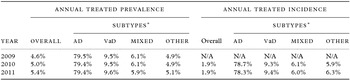
Table 1 shows the annual treated prevalence of dementia from 2009 to 2011 and the annual incident rates of dementia from 2010 to 2011 among elderly Taiwanese people. The number of elderly people who were diagnosed with dementia in 2009 was 112,368. Dividing the number of prevalent cases by a total of 2,426,251 elderly people aged 65 above in Taiwan yielded a treated prevalence rate of 4.6% in 2009. While the treated prevalence increased from 4.6% to 5.4% in 2011, the annual treated incidence stayed around 1.9%. In the subtype analysis for 2011, AD accounted for 79.4% of the prevalent dementia cases, followed by 9.6% for VaD, 5.9% for mixed dementia, and 5.1% for other types of dementia. AD also accounted for the majority of incidence cases of dementia (78.3%), and we observed a similar distribution of dementia subtypes followed by VaD and mixed dementia (Table 1).
Treated prevalent and incident rates of dementia and its subtypes, 2009–2011
Data Source: 2009–2011 NHIRD including patients aged 65+ with ≥2 diagnoses of dementia in a year; the denominator of prevalence rate and incidence rates was the total number of population aged 65+ in Taiwan in a given year from the Census Bureau.
*Subtypes were based on ICD-9-CM codes: AD = Alzheimer's disease (290 or 331.0); VaD = vascular dementia (290.4); Mixed = Mixed AD/VaD.
Comparison of three groups of cognitive enhancers
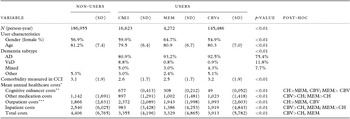
The characteristics of users of three groups of cognitive enhancer are summarized in the upper part of Table 2, and the mean medical care costs per service category are shown in the lower part. We also presented characteristics of patients with dementia who had not used any cognitive enhancer on the far left column, although the p-value and post-hoc comparisons on the far right were based on three group comparisons. The non-users seemed older, more likely to suffer from VaD than cognitive enhancer users did and reported the highest total medical care costs. Among patients with dementia who also used cognitive enhancers between 2009 and 2011, CBV use was most common (n = 145,486), followed by ChEI (n = 16,623), while memantine was the least used drug (n = 4,272). The mean ages of cognitive enhancer users were between 79.5 and 80.9 years, and female accounted for more than half of the users. Results from the χ2-test showed differences in the dementia subtype by cognitive enhancer group. While 93.2% of ChEI users and 92.5% of memantine users reported having AD, a lower percentage of CBV users exhibited AD (75.4%) but relatively more exhibited VaD (11.8%) or mixed dementia (7.7%). On the other hand, CBV users reported higher comorbidity measured in CCI than the other two groups. The bottom part of Table 2 presents mean costs comparisons, and based on results from the Bonferroni method, ChEI was the most costly drug among the three groups of cognitive enhancer. ChEI users also had the highest outpatient costs but the lowest inpatient costs among all cognitive enhancer users. In contrast, CBV users had the highest total medical care costs due to having much higher inpatient costs than the other two groups.
The mean costs and utilization patterns of selected cognitive enhancers (CE)
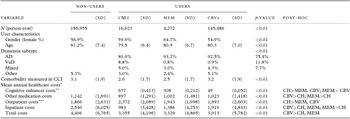
Note: P-value reported from ANOVA was performed for continuous variables, and an χ2-test was used for categorical variables; pairwise comparisons between drugs using the Bonferroni methods are reported in the post-hoc column: CH = ChEI (cholinesterase inhibitors); MEM = memantine; CBV = cerebral vasodilators.
Dementia subtypes were based on ICD-9-CM codes: AD = Alzheimer's disease (290 or 331.0); VaD = vascular dementia (290.4); Mixed = Mixed AD/VaD.
*All costs reported in USD among prevalent cases of dementia; **cognitive enhancer costs refer to ChEI, MEM, or CBVs used; ***outpatient costs also include medication costs.
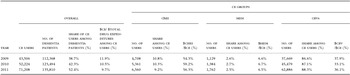
Table 3 presents the shares of both utilization and spending on three groups of cognitive enhancer nationwide between 2009 and 2011. Overall, more than 38% of patients with dementia were taking cognitive enhancers, but the costs of cognitive enhancers on average accounted for 10% of the total pharmaceutical expenditures incurred by cognitive enhancer users. Among 71,208 patients with dementia who took at least one type of cognitive enhancer in 2011, CBV users claimed the highest proportion (88.3%) while ChEI accounted for the highest share (56.3%) of pharmaceutical spending. NHI spending on cognitive enhancers in Taiwan was calculated to be US$6.6 million annually, and the dollars spent on ChEI amounted to US$3.7 million. Looking at the trend of growth during this period, the share of ChEI users among patients with dementia stayed around 10%, but the share of ChEI spending in total cognitive enhancer spending increased slightly from 54.3% to 56.3%. The share of CBV spending in total cognitive enhancer spending, on the other hand, decreased from 37.9% to 36.1% during the same period, possibly due to its lower price as compared to ChEI.
Profile of utilization and expenditures on cognitive enhancers in Taiwan
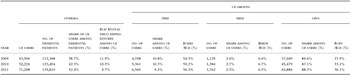
Note: CE = cognitive enhancer; ChEI = cholinesterase inhibitors; MEM = memantine; CBV = cerebral vasodilators.
Comparison between unadjusted and adjusted medical care costs by types of cognitive enhancers
Since the clinical effectiveness of ChEI and memantine was quite different from that of CBVs, we combined users of ChEI and memantine against CBV users in this comparative cost analysis. The left columns in Table 4 showed that ChEI/memantine users had higher medication and outpatient costs but lower inpatient and total healthcare costs than CBV users. However, the right columns in Table 4 showed that after adjusting for comorbidities, predicted care costs were still higher among ChEI/memantine users in regard to medication costs and outpatient costs. The cost difference remained in that ChEI/memantine users reported lower inpatient costs than CBV users after adjustment. However, there was no statistically significant difference in adjusted total healthcare costs by user status (p = 0.686).
Comparison between unadjusted and adjusted medical care costs by types of cognitive enhancers (CE)

Note: ChEI = cholinesterase inhibitors; MEM = memantine; CBV = cerebral vasodilators.
All costs in USD and costs differences were derived from generalized linear models with propensity score adjustments and controlling for calendar year, age, gender, and 16 comorbid conditions.
*Medication costs equal to cognitive enhancer cost plus other medication costs; **outpatient costs also include medication costs.
Discussion
An earlier survey that also used NHI claims found that the prevalence of treated dementia in Taiwan increased from 0.7% in 1996 to 1.92% in 2003 (Chien et al., Reference Chien2008). A decade later, our study showed that the treated prevalence rate of dementia has increased three times more to 5.4% in 2013. However, the latest figure released in 2012 from a nationwide community survey of dementia in Taiwan was 4.79%, a figure lower than our prevalence estimate (Taiwan Alzheimer's Disease Association, 2013). While the current study used only ICD-9-CM codes to identify patients with dementia, the community survey used Clinical Dementia Rating scale to define its disease population. Therefore, plausible explanations for the rate difference could be due to sampling design and different diagnostic criteria (Erkinjuntti et al., Reference Erkinjuntti, Ostbye, Steenhuis and Hachinski1997; Lopez et al., Reference Lopez, McDade, Riverol and Becker2011). Among prevalent cases of dementia in 2011, we found AD to be the most common subtype (79.4%), followed by VaD (9.6%), and this gap in proportion was similar to an earlier community-based study of dementia in rural Taiwan (Liu et al., Reference Liu1998). However, this unequal distribution in regard to the dementia subtype could also reflect current clinical practice using the ICD-9-CM diagnoses, in which less common subtypes, such as dementia with Lewy bodies or frontotemporal dementia, were rarely used in coding during this period.
Another issue related to dementia subtype was why patients other than AD patients also used ChEI or memantine, when there was no indication for the prescription according to the NHI criteria. While AD and mixed dementia together accounted for over 96% of ChEI use, VaD accounted for 0.8% and other subtype for 3.0%. As Parkinson's disease dementia has been approved for ChEI reimbursement in Taiwan since May 2010, we found that 18.4% of ChEI users with other unspecified dementia had Parkinson's disease. Furthermore, the small number of VaD diagnoses (n = 164) may have occurred after prescription of ChEI or memantine given that our unit of observation was by year.
Since we found that in 2011 about 52.4% of elderly patients with dementia in Taiwan used any cognitive enhancer and among those users, only 9.2% of them took ChEI, multiplying the two numbers yielded a low proportion (4.8%) of ChEI users among all elderly patients with dementia identified from the NHI claims. A similar calculation was done for the other two groups of cognitive enhancer and indicated that only 1.3% of our study population used memantine, but 46.3% of them took CBVs. The percentage of patients with dementia receiving ChEI or memantine observed in our study was much lower than that from studies based in Europe. In a study that examined medication in community-residing patients with AD in France, 89% of the sample received ChEI therapy, and 24% had been prescribed CBVs, although the latter drugs were considered potentially inappropriate medications due to their limited efficacy for patients with dementia (Montastruc et al., Reference Montastruc2013). Another study using national data from the Swedish Dementia Registry (SveDem) found that more than 80% of AD patients were treated with ChEI (Johnell et al., Reference Johnell, Religa and Eriksdotter2013). Although there is currently no curative treatment available for dementia, results from many cost-effective studies have supported the use of ChEI and memantine to be beneficial for cognition and global functioning in patients with AD (Bond et al., Reference Bond2012; Hyde et al., Reference Hyde2013). While the magnitude of improvement may be small, the limited use of these drugs among patients in Taiwan is still a concern since more patients with dementia could have benefited from this therapy.
On the other hand, the high proportion of CBV use observed in our study deserves attention, especially since the social healthcare systems in other countries like France have discontinued reimbursement for CBVs (Montastruc et al., Reference Montastruc2013). In fact, a consensus panel established in France selected CBVs, including ergot derivatives, ginkgo-biloba, and nicergoline, in the list of potentially inappropriate medications for the elderly population in France (Laroche et al., Reference Laroche, Charmes and Merle2007). It is likely that CBVs have been prescribed as a replacement for ChEI therapy in Taiwan given that ChEI had strict reimbursement rules; yet the main concern is that evidence from clinical trials does not support their therapeutic equivalency (Mimica Matanović and Vlahovic-Palcevski, Reference Mimica Matanović and Vlahovic-Palcevski2012). In our study, patients with dementia who used CBVs reported more comorbidities and higher medical care costs than other cognitive enhancer users, but it was not clear whether the higher spending was a cause or consequence of CBV use. A follow-up study of new drug users is needed in the future to evaluate the cost-effectiveness of CBVs in comparison with the use of ChEI in treating dementia.
Our findings that the use of ChEIs was associated with lower inpatient and total medical care costs are consistent with results from several studies conducted in US Medicare managed care populations (Hill et al., Reference Hill, Futterman, Mastey and Fillit2002b; Fillit and Hill, Reference Fillit and Hill2004; Lu et al., Reference Lu, Hill and Fillit2005). A recent study showed that each additional month of ChEI treatment was associated with a reduction of 1% in total all-cause healthcare costs (Mucha et al., Reference Mucha, Wang, Cuffel, McRae, Mark and Valle2008). In the case of donepezil and memantine, a great deal of evidence has suggested that the cost of these drugs can be offset by the clinical and economic benefits provided by slowing the progression of dementia (Cappell et al., Reference Cappell, Herrmann, Cornish and Lanctôt2010). ChEI achieves cost savings by reducing the incidence of negative events that trigger hospitalizations (such as falls and other accidents) and thus prevent inpatient stays (Fillit and Hill, Reference Fillit and Hill2004). The potential cost savings for the society is presumably greater if we consider costs related to institutionalization, given that many studies have found that ChEI could possibly delay entry into nursing homes (Hill et al., Reference Hill, Futterman, Duttagupta, Mastey, Lloyd and Fillit2002a; Marin et al., Reference Marin2003; Wimo et al., Reference Wimo, Winblad, Stöffler, Wirth and Möbius2003).
Under the current NHI policy in Taiwan, ChEI is only allowed in the treatment of good responders who can maintain cognitive function before disease progression. However, this population-based study revealed that the treatment of both ChEI and memantine among patients with dementia was limited both in regard to expenditures and in regard to the share of patients who had access to the drugs. Although these drugs cost much more than CBVs, our findings of comparable total healthcare costs between the two groups seem to challenge the preconception that ChEI/memantine treatment for dementia is costly to Taiwan's healthcare system. This is a reminder that the overall spending in CBVs should not be overlooked. While the strict NHI reimbursement rules were initially in place to control healthcare budgets, these rules may also have unintendedly increased the use of CBVs.
The use of a retrospective claims-based database for this study allowed for a large sample of patients who used cognitive enhancer across Taiwan. However, several limitations need to be discussed. First, it was not possible to verify the basis for which an AD diagnosis in this administrative database was made because of a lack of clinical back-ups (e.g. cognition tests or brain imaging). However, the possibility of incorrect diagnosis was also greatly diminished for users of ChEI or memantine given that current reimbursement rules required such stringent clinical details. Moreover, due to the nature of the claim data, we did not have information on other key variables, including functional status or behavioral symptoms. While numerous studies on the cost-of-illness of dementia have shown that indirect costs are a much heavier burden for caregivers than direct costs (Wilmo and Prince, Reference Wilmo and Prince2010; Mauskopf and Mucha, Reference Mauskopf and Mucha2011), our dataset only provided information regarding direct costs of medical care. Finally, since this was not a randomized study, we cannot rule out sample biases that might account for the differences across medication utilization. Although we used propensity score adjustment methods to correct for observed differences, we could not evaluate the potential influence of some important but unobserved factors, such as disease severity or more detailed classification of dementia.
Conclusions
This study used national data to compare utilization of major types of cognitive enhancers among patients with dementia in Taiwan and found some significant differences in both user profile and by types of healthcare costs. ChEI users had the highest medication and outpatient costs but the lowest inpatient costs among all users. While CBV users had lower medication costs, their total medical care costs were not significantly different from ChEI users. Given that only 6.1% of the elderly patients with dementia in Taiwan used ChEI or memantine compared to the 46.3% that were on CBVs, our finding suggests that the strict reimbursement policy of the NHI may have prevented greater utilization of anti-dementia medications.
Conflict of interest
None.
Description of authors’ roles
L.-J. Ku designed the study, analyzed the data, and wrote the paper. M.-C. Pai formulated the research questions and assisted with writing the paper.
Acknowledgments
This study was supported by grant from the National Science Council (NSC) grant No. 101-3114-Y-006-001 and No. 102-2410-H-006-001-SS2 in Taiwan. The authors would like to express their sincere appreciation to the anonymous reviewers and Dr Jung-der Wang for their constructive comments on the paper.