Introduction
The quest and desire for beauty is eternal in human civilisation. Though human nature defines the attributes of personal character, external appearance and beauty add to an individual's well-being by enhancing their courage and confidence to communicate. Rhinoplasty is the most commonly performed aesthetic surgery worldwide. It has a long history dating back to the days of Sushruta, considered the father of rhinoplasty.Reference Sorta-Bilajac and Muzur1 The first physically documented evidence comes from the Edwin Smith Papyrus.Reference Whitaker, Karoo, Spyrou and Fenton2
After corrective rhinoplasty, expectations, desires and goals regarding the cosmetic surgery vary considerably among individuals undergoing the procedure. Hence, the success of any aesthetic surgery depends on a perfect balance between the patient's expectations, desires and satisfaction.Reference Chauhan, Warner and Adamson3–Reference Carruthers and Carruthers5 The patient's expectations need to be assessed pre-operatively, and the basic measurement of success is a happy face after the surgery. The determinants of a successful outcome in other surgical procedures, such as eradication of disease and preservation of organ function, are less relevant in aesthetic surgery.Reference Cano, Browne and Lamping6–Reference Panchapakesan, Klassen, Cano, Scott and Pusic8 Satisfaction levels with the post-operative appearance and quality of life (QoL), which cover the psychological and social status of the candidate, describe patient-perceived outcomes of rhinoplasty in a greater way.Reference Alderman and Chung9 Though many studies assess surgical outcome from a surgeon's perspective, the patient's perspective is more meaningful,Reference Cano, Browne and Lamping6 and a patient's needs, experiences and preferences determine their perceptions about the results of corrective rhinoplasty.Reference Ching, Thoma, McCabe and Antony7
Various parameters determine surgical outcomes, such as patient satisfaction with appearance, improved psychosocial status and QoL,Reference Chauhan, Warner and Adamson3,Reference Fagien and Carruthers4,Reference Ching, Thoma, McCabe and Antony7,Reference Carruthers, Fagien and Matarasso10,Reference Bolton, Pruzinsky, Cash and Persing11 and these parameters can be assessed using a variety of questionnaires. The Rhinoplasty Outcomes EvaluationReference Alsarraf12,Reference Alsarraf, Larrabee, Anderson, Murakami and Johnson13 is one such instrument; however, it does not measure the outcome from the patient's objective. Klassen et al.Reference Klassen, Cano, Scott, Snell and Pusic14 introduced the FACE-Q survey to address this deficiency; it is a patient-reported outcome instrument comprising various independently functioning appraisal scales.
This study aimed to evaluate various parameters, including satisfaction with overall facial appearance and appearance of the nose, psychosocial distress, psychological function, social function and QoL improvements, in those undergoing rhinoplasty, using the FACE-Q.
Materials and methods
The prospective study was conducted on 79 patients, who were operated on in our tertiary care institute from May 2016 to November 2018 for cosmetic and functional reasons, following clearance from the psychiatry department. Of these 79 patients, 65 completed the six-month follow-up period and were enrolled in the study. Ethical clearance was obtained from the institutional ethics committee. Permission to use the FACE-Q questionnaire was obtained from the original authors.
The inclusion criteria were: patients scheduled for cosmetic surgery of the nose (rhinoplasty), for any reason; patients of either gender, aged 16–60 years; and patients willing to participate in the study and provide consent for the same. The exclusion criteria were: patients operated on for revision rhinoplasty; patients who refused to participate in the study; and patients suffering from any systemic or psychiatric diseases.
Prior to inclusion in the study, all individuals were informed about the investigation, and written informed consent was obtained from the participants in a language they could well understand. Those who consented to participate were assessed using the FACE-Q appraisal scales prior to and six months after rhinoplasty. Sociodemographic data and the clinical profile of the participants were also recorded.
The FACE-Q is a patient-reported outcome instrument, consisting of independently functioning appraisal scales that measure outcomes after an aesthetic procedure.Reference Panchapakesan, Klassen, Cano, Scott and Pusic8,Reference Klassen, Cano, Scott, Snell and Pusic14–Reference Pusic, Klassen, Scott and Cano17 The FACE-Q appraisal scales measure the following variables: (1) how satisfied a candidate is with facial appearance; (2) how satisfied a candidate is with appearance of the nose; (3) how much a patient's psychosocial distress level decreased; (4) how much improvement was noticed in psychological function; (5) how social the candidate is after the procedure; and (6) how satisfied the candidate is with the outcome.
Data analysis was conducted using SPSS® version 21.0 statistical software. The conversion scores – the Rasch-transformed scoresReference Cano, Klassen and Pusic18 – for the FACE-Q appraisal scales, which range from 0 to 100, were computed for each variable. The scores for the authenticated FACE-Q variables (satisfaction with facial appearance, social function, psychosocial distress, psychological function and satisfaction with appearance of the nose) pre- and post-rhinoplasty were compared within individuals and in a cumulative manner. Higher FACE-Q scores in the form of Rasch-transformed responses represent greater objective values for the subjective FACE-Q scale variables.
Results
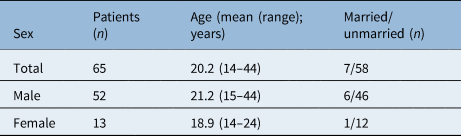
The study included 65 participants (52 males and 13 females), with mean age of 20.2 years (range = 14–44 years), who were operated on by a single surgeon in our institution (Table 1).
Age and sex distribution of patients

Most of the Western literature suggests a much higher number of females seeking cosmetic surgery as compared to males. Surprisingly, the number of males seeking rhinoplasty is higher in our country. The patriarchal society in our country and a lack of aesthetic consciousness among the females makes them hesitant to opt for aesthetic surgery.
Only 7 out of the 65 patients were married, suggesting that the demand and quest for enhanced cosmesis is significantly higher in unmarried individuals, associated with the social goals of attractiveness, a confident personality or employment prospects.
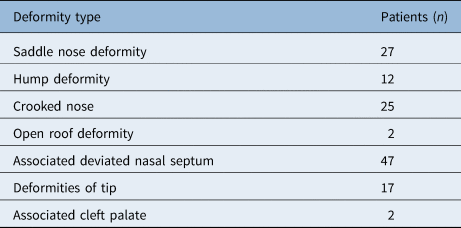
Of the 65 patients, 27 (41.5 per cent) presented with saddle nose deformity, 12 had a hump, 25 had a crooked nose, 1 patient had an open roof deformity, and 1 patient had an open roof and saddle nose deformity. Most patients (47 out of 65) had an associated deviated nasal septum. Multiple deformities were the most common indication for rhinoplasty in the present series. Tip corrections were required in 17 patients and 2 patients had associated cleft palates (Table 2). India has concerning incidences of road traffic accidents, and the majority of our patients had either suffered a road traffic accident or had previously undergone septoplasty elsewhere. Our institution, an apex care centre in the region, usually treats more complex cases, which may account for a higher incidence of saddle nose deformity in our study. Moreover, most individuals in this region are less concerned about minor deformities.
Types of deformities in rhinoplasty patients

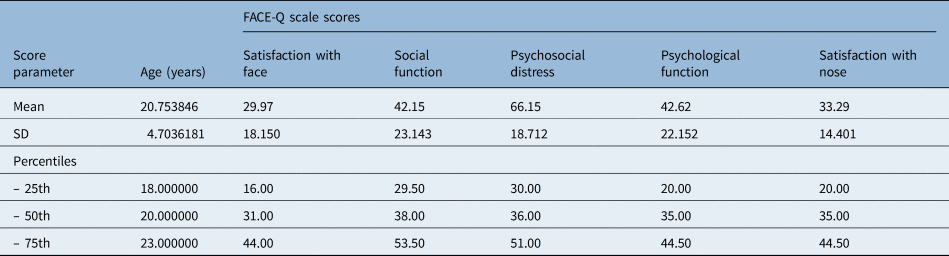
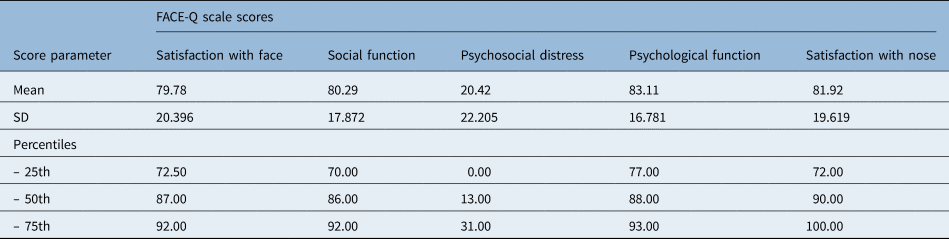
The pre-operative mean ± standard deviation (SD) FACE-Q scores (Table 3) were: 29.97 ± 18.15 for satisfaction with the face; 42.15 ± 23.14 for social function; 66.15 ± 18.71 for psychosocial distress; 42.62 ± 22.15 for psychological function; and 33.29 ± 14.40 for satisfaction with the nose. The post-operative mean ± SD FACE-Q scores (Table 4) were: 79.78 ± 20.40 for satisfaction with the face; 80.29 ± 17.87 for social function; 20.42 ± 22.21 for psychosocial distress; 83.11 ± 16.78 for psychological function; and 81.92 ± 19.62 for satisfaction with the nose.
Pre-rhinoplasty FACE-Q scale scores

SD = standard deviation
Post-rhinoplasty FACE-Q scale scores

SD = standard deviation
Pre- and post-rhinoplasty comparison of scores using paired sample t-tests revealed significant improvements in: satisfaction with facial appearance (p < 0.0001, t = 15.639, degrees of freedom = 64); social function (p < 0.0001, t = 12.208, degrees of freedom = 64); psychosocial distress (p < 0.0001, t = 13.864, degrees of freedom = 64); psychological function (p < 0.0001, t = 12.681, degrees of freedom = 64); and satisfaction with the nose (p < 0.0001, t = 16.421, degrees of freedom = 64). The median overall cumulative satisfaction score was 87, with the 25th percentile at 79; there was a significant skew to the right in the Kolmogorov–Smirnov test. This suggests that at least 75 per cent of the operated cases had more than 79 per cent satisfaction from the outcome of rhinoplasty (Table 5).
Satisfaction with outcome

SD = standard deviation
These increased scores of the FACE-Q survey suggest an improvement in various parameters, including overall QoL. Four patients in the study did not achieve a satisfactory outcome; of those four, one participant had no change in scores after surgery.
On evaluating the scores, we found that four patients had minimal scores for satisfaction with facial appearance outcome (i.e. 19, 19, 24 and 24). All these patients had no improvement in psychological function, and the scores remained static (i.e. 30, 40, 40 and 47). Three patients showed no improvement in psychosocial distress and their scores remained static (i.e. 64, 67 and 77). Two patients showed no improvements in the satisfaction with nose appearance scores (i.e. 20 and 30). The scores of social function remained the same in one patient (i.e. 24). Twenty-six patients achieved full scores (i.e. 100) for overall satisfaction with the outcome. Twenty-one patients achieved full scores (i.e. 100) for the satisfaction with nose appearance outcome. Fifteen patients achieved full scores (i.e. 100) for psychological function.
Overall, the results revealed significant improvements after rhinoplasty in terms of facial appearance, appearance of the nose, social confidence and psychological well-being.
Discussion
Facial features form a significant component of physical personality. The nose, being the most prominent part of the midface, plays an important role in physiological, aesthetic and psychosocial functions for individuals, and alterations or deviation can lead to psychosocial distress or an unhappy life. Studies have shown that a centrally positioned nose with enhanced anthropometric facial features draws pertinent attention associated with enhanced attractiveness compared to a deviated nose, irrespective of the skin tone.Reference Mikalsen, Folstad, Yoccoz and Laeng19 These reasons explain why rhinoplasty is the most commonly performed facial aesthetic procedure in the world.
In India, facial anthropometrics parameters differ from those of Caucasian, black and Mongolian populations because of mixed genetic and ethnic features. Hence, the ideal anthropometric measurements described in the literature for Western populations do not hold true in Indian populations. We therefore utilised the subjective FACE-Q questionnaire for evaluation of patient-related satisfaction and QoL outcomes, rather than an objective surgeon-measured assessment. Given the myriad shapes and sizes of the human nose, especially in a diverse and mixed ethnic population like India, it is difficult to say what comprises a perfect nose. Thus, rhinoplasty is best evaluated by the patient themselves using an outcome measuring tool such as the FACE-Q.
The FACE-Q measures patient-related outcomes in an subjective way, in contrast to the measurements of facial feature dimensions. Such evaluation of dimensions after blepharoplasty, brow lift, face lift and/or neck lift showed a reduction in patients’ apparent age, but could not show significant improvements in attractiveness,Reference Zimm, Modabber, Fernandes, Karimi and Adamson20 supporting the use of a patient-related outcome measure to evaluate the post-operative results.
• The results of rhinoplasty can only be adequately assessed by patients
• Patient satisfaction reflects surgical success
• The FACE-Q is a robust survey that measures parameters related to the outcome of an aesthetic procedure
Patient-reported outcome scales are more appropriate and collect relevant data, in comparison to other instruments.Reference Ching, Thoma, McCabe and Antony7,Reference Pusic, Klassen, Scott, Klok, Cordeiro and Cano21,Reference Pusic, Lemaine, Klassen, Scott and Cano22 Surveys such as the FACE-Q allow surgeons to evaluate their ability to deliver and cater to the needs of those seeking or requiring rhinoplasty, for individuals of different racial and/or ethnic backgrounds, geographical locations, and socioeconomic status. Indeed, delivering consistent results in rhinoplasty is a difficult task,Reference Tardy23 as ‘noses are difficult to predict’ and ‘difficult to construct’.Reference Millard24 Furthermore, the complexity of rhinoplasty procedures has increased tremendously in the last few decades.Reference Sheen25
Other patient-related outcome assessment scales include: the Rhinoplasty Outcome Evaluation scale,Reference Alsarraf, Larrabee, Anderson, Murakami and Johnson13,Reference Meningaud, Lantieri and Bertrand26–Reference Arima, Velasco and Tiago29 which is brief; the Facial Appearance Sorting Test, which has not evoked much interest; and the Derriford Appearance Scale (‘DAS-59’), which focuses primarily on distress and less on outcome measures concerned with facial appearance.Reference Ching, Thoma, McCabe and Antony7 The Facial Appearance Sorting Test consists of 18 drawings of facial profiles, which vary according to attractiveness, and patients are then asked to rank themselves with respect to these drawings. It uses a visual analogue scale to rate satisfaction from poor to excellent. Responses are subjective and difficult to interpret, because they represent a complex function of expectations that may vary greatly among patients with comparable results. Hence, we employed the FACE-Q survey, which is comprehensive, exhaustive, and very easy to use by patients and physicians to calculate patient-related outcome measures.
All five parameters assessed, namely satisfaction with facial appearance, satisfaction with appearance of the nose, social function, psychological well-being and psychosocial distress, showed significant improvement, indicating a superior QoL and better psychological satisfaction post-rhinoplasty in the study population.
Nevertheless, one patient in our study had the same scores for satisfaction with facial appearance before and after surgery, and a total of four patients including him were not too satisfied with the results. The same patient also had the lowest overall satisfaction outcome score. We evaluated the patients’ records to determine the possible reason for the unsatisfactory outcomes. When the pre-operative scores of these patients were compared to their post-operative scores, we found high ratings of psychosocial distress. Thus, it is likely that the overall score did not improve because of unrealistic expectations. This represents an important factor for successful outcome in terms of patient satisfaction. Hence, pre-operative counselling regarding expectations is a must for patients as well as the surgeon.
This study helped us to understand and determine the impact of patients’ expectations when undertaking such procedures. Poor psychological well-being (which can be determined via the assessment scale) can lead to dissatisfaction later in the post-operative period. Therefore, these scores can be used at the beginning of the consultation to screen out patients who are unlikely to benefit from the procedure. This is further supported by a recent systematic review of 33 studies that utilised 12 different measurement tools; the authors reported that the FACE-Q and the Standardized Cosmesis and Health Nasal Outcomes Survey aesthetic subscale were the best measures of outcomes in aesthetic surgical procedures.Reference Van Zijl, Mokkink, Haagsma and Datema30
Study limitations
This paper describes a single surgeon and single institution based study, with a limited sample size (65 patients) and a male patient majority. The few females who participated were mostly from an urban background. Additional multi-institutional studies that include patients from all socioeconomic backgrounds are required to increase the demographical validity of the results, with equal distribution and representation from both sexes.
Conclusion
The FACE-Q is an adequate instrument for determining successful aesthetic surgery based on patient satisfaction. This two-way tool measures the degree of success with respect to the patient as well as being an assessment tool for the surgeon. Rhinoplasty improved face and nose appearance, and social interaction, and decreased psychosocial distress, leading to overall superior QoL.
Acknowledgement
The authors gratefully thank the Department of Psychiatry, All India Institute of Medical Sciences, Jodhpur, for helping us continuously during the study.
Competing interests
None declared