Introduction
The rivers of South and Central America host the most diverse ichthyofauna on the planet, inhabited by ~6000 out of ~13,000 species reported throughout the world (Reis et al., Reference Reis, Kullander and Ferraris2003). A considerable component of the Neotropical freshwater ichthyofauna is represented by predominantly marine groups, such as anchovies, croakers, sardines, needlefishes, flatfishes, puffers and stingrays (Marlier, Reference Marlier1967; Géry, Reference Géry, Fittkau, Illies, Klinge, Shwabe and Sioli1969; Roberts, Reference Roberts1972; Fink & Fink, Reference Fink and Fink1979; Reis et al., Reference Reis, Kullander and Ferraris2003). Earlier attempts to address the origin of this fauna suggested that the fluvial nature of the Amazon River (i.e. slow speed, absence of rapids and large dimensions) would favour the dispersion of marine taxa into the South American river systems (Marlier, Reference Marlier1967; Roberts, Reference Roberts1972). However, in the past three decades, other explanations for the origin and diversification of Neotropical fish of marine origin have been proposed (Brooks et al., Reference Brooks, Thorson, Mayes, Funk and Brooks1981; Domning, Reference Domning1982; Grabert, Reference Grabert1983; Nuttal, Reference Nuttal1990; Webb, Reference Webb1995; Lovejoy, Reference Lovejoy1997; Lovejoy et al., Reference Lovejoy, Bermingham and Martin1998, Reference Lovejoy, Albert and Crampton2006, Reference Lovejoy, Lester, Crampton, Marques and Albert2010; Albert et al., Reference Albert, Lovejoy and Crampton2006) and the current available data suggest that a great part of this component of the Neotropical biodiversity derived from marine regions during the sea incursions in the Miocene (Boeger & Kritsky, Reference Boeger and Kritsky2003; Lovejoy et al., Reference Lovejoy, Albert and Crampton2006; but see Carvalho et al., Reference Carvalho, Maisey and Grande2004).
The freshwater stingrays of the family Potamotrygonidae are restricted to rivers of South America that flow into the Atlantic Ocean and Caribbean Sea. The family comprises two monotypic genera, Paratrygon and Plesiotrygon, and the specious Potamotrygon. For the latter, Deynat (Reference Deynat2006) suggested that its diversity is represented by 16 species and Rosa et al. (Reference Rosa, de Carvalho and Wanderley2008) estimated 19–21 species. However, recent surveys of potamotrygonids from Amazonian drainages revealed that the diversity of Potamotrygon is underestimated (F.P.L. Marques, unpublished data; M.R. de Carvalho, pers. comm.).
The origin of the freshwater potamotrygonids has been contentious (Brooks et al., Reference Brooks, Thorson, Mayes, Funk and Brooks1981; Lovejoy, Reference Lovejoy1997; Hoberg et al., Reference Hoberg, Brooks, Molina-Ureña and Erbe1998, Lovejoy et al., Reference Lovejoy, Bermingham and Martin1998, Carvalho et al., Reference Carvalho, Maisey and Grande2004). The hypothesis of Brooks et al. (Reference Brooks, Thorson, Mayes, Funk and Brooks1981), for the origin of the freshwater potamotrygonids based on their parasite fauna, contradicted earlier beliefs that the marine-derived Neotropical fish fauna had entered South American river systems through the current mouth of the Amazon, or resulted from multiple invasions of rivers, which at present open into the Atlantic and Caribbean oceans. Later reiterated by Brooks (Reference Brooks1992, Reference Brooks1995), Hoberg et al. (Reference Hoberg, Brooks, Molina-Ureña and Erbe1998) and Zamparo et al. (Reference Zamparo, Brooks and Barriga1999), this hypothesis entertained the idea of the Pacific origin of Neotropical freshwater stingrays, despite substantial counter-evidence from host phylogeny and biogeographical distribution (Lovejoy, Reference Lovejoy1997; Lovejoy et al., Reference Lovejoy, Bermingham and Martin1998; Marques, Reference Marques2000; but see Carvalho et al., Reference Carvalho, Maisey and Grande2004) and severe critiques on the reliability of the parasite data (Caira, Reference Caira, Pratt, Gruber and Taniuchi1990, Reference Caira1994) and biogeographical methodology used (Straney, Reference Straney1982).
Host–parasite relationships have the potential to enhance our understanding of host phylogeny, coevolution and historical biogeography. Von Ihering (Reference von Ihering1891, Reference von Ihering1902) first proposed that the relationships of parasites could provide an insight into the phylogeny of their hosts, as well as an independent source of data to reconstruct the historical connection of geographical areas (e.g. southern South America and New Zealand). This research programme has become known as the ‘von Ihering method’ (Metcalf, Reference Metcalf1929). For many decades since its inception, generations of parasitologists have increasingly developed the theoretical and conceptual aspects of this research programme as well as providing ample empirical documentation of such coevolutionary processes (e.g. Metcalf, Reference Metcalf1923; Deets, Reference Deets1987; Klassen & Beverly-Burton, Reference Klassen and Beverley-Burton1988; Hafner & Nadler, Reference Hafner and Nadler1990; Hoberg, Reference Hoberg1992; Klassen, Reference Klassen1992; Brooks & McLennan, Reference Brooks and McLennan1993; Page & Charleston, Reference Page and Charleston1998; Carreno & Hoberg, Reference Carreno and Hoberg1999; Dolezel et al., Reference Dolezel, Koudela, Jirku, Hypsa, Obornik, Votypka, Modry, Slapeta and Lukes1999; Paterson et al., Reference Paterson, Wallis, Wallis and Gray2000; Brooks et al., Reference Brooks, van Veller and McLennan2001; Paterson & Banks, Reference Paterson and Banks2001). This is the context in which parasite data have been used to address the history of potamotrygonid diversification.
Historical associations between hosts and parasites require extensive and accurate information on the host and parasite lineages. As Caira et al. (Reference Caira, Jensen, Healy, Littlewood and Bray2001) point out, high-quality and extensive taxonomic and phylogenetic data must be provided prior to addressing questions regarding the evolution of any host/parasite systems. However, despite several recent systematic reviews of potamotrygonid parasites, most on cestodes (Brooks & Amato, Reference Brooks and Amato1992; Marques & Brooks, Reference Marques and Brooks2003; Marques et al., Reference Marques, Brooks and Araújo2003; Reyda, Reference Reyda2007), the parasites of potamotrygonid stingrays still remain poorly understood (Luchetti et al., Reference Luchetti, Marques and Charvet-Almeida2008). That is particularly true for monogenoids, whose taxonomy has been neglected for decades and has just recently been better documented (Domingues & Marques, Reference Domingues and Marques2007; Domingues et al., Reference Domingues, Pancera and Marques2007).
Among the lineages of monogenoids reported to the Neotropical freshwater system, members of typically marine monogenoid groups are also reported from marine-derived hosts (e.g. Monocotylidae, Hexabothriidae, Diplectanidae and Microcotylidae), suggesting that the parasite diversification tracked the colonization of this derived biogeographical area. Evidence for this assertion can be found in the study of Boeger & Kritsky (Reference Boeger and Kritsky2003) who proposed a hypothesis for the historical biogeography of the freshwater croakers, Plagioscion, based on their monogenoidean parasites (i.e. Euryhaliotrema), palaeogeographical history of South America and fossil records. They suggested that the colonization of this derived environment by this host–parasite system probably occurred via marine incursions through western Venezuela during the Miocene. The hypothesis advanced by Boeger & Kritsky (Reference Boeger and Kritsky2003) is congruent with what has been suggested for the biogeographical history of potamotrygonids (Lovejoy et al., Reference Lovejoy, Bermingham and Martin1998; Marques, Reference Marques2000; but see Carvalho et al., Reference Carvalho, Maisey and Grande2004). However, at this moment there are insufficient data to address the phylogenetic position of the monogenoidean parasites of potamotrygonids within marine monocotylids, as well as to fully assess their evolution, diversification, relationships and biology (e.g. host specificity) in the large Neotropical river system.
As a result of the most recent efforts to document the diversity of monogenoidean parasites of potamotrygonids (Domingues & Marques, Reference Domingues and Marques2007; Domingues et al., Reference Domingues, Pancera and Marques2007), presently we recognize ten species of monocotylids and a single species of hexabothriid for Neotropical freshwater stingrays. Here, we re-evaluate the taxonomic status of some nominal species of Potamotrygonocotyle, propose four new species, and provide the first phylogenetic hypothesis for its members based on morphological data.
Materials and methods
Parasitological procedures
Specimens of potamotrygonids were collected using spears, gill nets or long lines in Brazil, Argentina and Peru during 2001–2007. The gills were removed and placed in plastic bags containing heated (~65°C) 4% formaldehyde solution. Unstained helminths were mounted in Hoyer's or Gray and Wess medium to study sclerotized structures (Humason, Reference Humason1979). Whole mounts of monogenoids were stained with Gomori's trichrome to examine internal features (Humason, Reference Humason1979). In the Results section, measurements are all given in micrometres. The dimensions of organs and other structures represent the greatest measurement in dorsoventral view; lengths of curved or bent structures (anchors, male copulatory organ) represent linear distances between extreme ends. The mean measurements are followed by ranges and number of specimens measured (n) in parentheses.
Illustrations were prepared with the aid of a drawing tube on an Olympus BX–51 microscope with differential interference contrast and phase-contrast optics. Specimens prepared for scanning electron microscopy (SEM) were post fixed in 1% osmium tetroxide for 1–2 h at room temperature, dehydrated in a graded ethanol series, critical point dried and sputter-coated with gold.
Basins and sub-basin nomenclature follows the Agência Nacional de Águas, Ministério do Meio Ambiente, Brazil (http://hidroweb.ana.gov.br/). Type specimens and vouchers are deposited in the Coleção Helmintológica do Instituto Oswaldo Cruz (CHIOC), Rio de Janeiro, RJ, Brazil; Coleção Helmintológica do Museu de Zoologia da Universidade de São Paulo (MZUSP), São Paulo, SP, Brazil; Instituto de Pesquisas da Amazônia (INPA), Manaus, AM, Brazil; the Harold W. Manter Laboratory of Parasitology (HWML), Lincoln, Nebraska, USA; and the United States National Parasite Collection (USNPC), Beltsville, Maryland, USA. Morphological terminology of monocotylid follows Chisholm et al. (Reference Chisholm, Wheeler and Beverley-Burton1995). Hosts have been deposited at the Museu de Zoologia da Universidade de São Paulo (MZUSP), SP, Brazil and information about them is available online (http://www.ib.usp.br/hpc/hpc_search.php).
Phylogenetic analysis
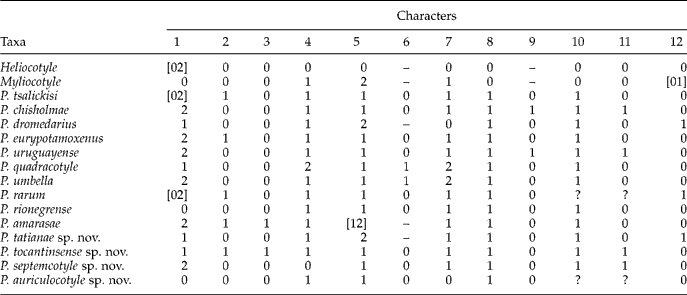
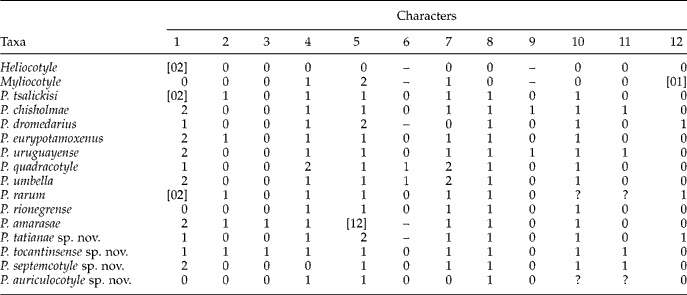
Twelve characters were used for the phylogenetic analysis of 16 terminals, which included 14 species of Potamotrygonocotyle, and Heliocotyle and Myliocotyle used as outgroups to root the cladogram. The codings for the outgroup terminals represent summaries of the following nominal species: Myliocotyle pteromylaei Neifar, Euzet & Ben Hassine, 1999 (Muséum National d'Histoire Naturelle (Paris), MNHN no. 644 HF–Tk 178, 645 HF–Tk180) and Heliocotyle kartasi Neifar, Euzet & Ben Hassine, 1999 (MNHN no. 580 HF–Tk 97–98), as well as information available in the literature (i.e. Neifar et al., Reference Neifar, Euzet and Ben Hassine1999a, Reference Neifar, Euzet and Ben Hassineb; Chisholm & Whittington, Reference Chisholm and Whittington2000, Reference Chisholm and Whittington2004). The choice of the outgroup taxa was based on an ongoing, more inclusive phylogenetic study of Monocotylidae (M.V. Domingues, unpublished data). Characters and character states were defined based on light microscopy and SEM examination of type specimens and/or vouchers. The data matrix (table 1) was constructed using the program Windows Notepad version 5.1. The phylogenetic analysis was performed with the program T.N.T. (Goloboff et al., Reference Goloboff, Farris and Nixon2008), using implicit enumeration, as the tree search algorithm, and collapsing unsupported branches after search. Character optimization was verified using Winclada (version 1.00.08; Nixon, 1999–Reference Nixon2002). All characters were considered unordered and equally weighted.
Character matrix to reconstruct evolutionary relationships of Potamotrygonocotyle spp. Abbreviations: 1–12 refer to characters (see Character analysis in Results section for character definition); ‘?’ refers to an unknown character state; ‘–’ refers to an inapplicable state; numbers in square brackets refer to polymorphic characters.
Results
Character analysis
Characters used in the analysis are described as follows: character definition, consistency indices (CI; Kluge & Farris, Reference Kluge and Farris1969) and retention indices (RI; Farris, Reference Farris1989) between square brackets, and assigned character states (codes within parentheses). The character matrix used for this analysis is presented in the table 1. In the following, ‘fig.’ indicates a figure in the present paper and ‘Fig.’, a figure in cited references.
Character 1: Male copulatory organ [CI=50; RI=60]
(0) Inverted ‘J’-shaped tube (e.g. fig. 8B; Neifar et al., Reference Neifar, Euzet and Ben Hassine1999a, Fig. 4; Neifar et al., Reference Neifar, Euzet and Ben Hassine1999b, Fig. 3; Chisholm & Whittington, Reference Chisholm and Whittington2004, Figs 4 and 7; Domingues et al., Reference Domingues, Pancera and Marques2007, Figs 23–24); (1) short, straight/arcuate tube (e.g. see figs 4B, 5B; Domingues & Marques, Reference Domingues and Marques2007, Fig. 16; Domingues et al., Reference Domingues, Pancera and Marques2007, Fig. 2); (2) long, straight/arcuate tube (e.g. fig. 6B; Chisholm & Whittington, Reference Chisholm and Whittington2000, Fig. 2B; Domingues & Marques, Reference Domingues and Marques2007, Figs 11, 21–22, 27; Domingues et al., Reference Domingues, Pancera and Marques2007, Figs 13–14, 29). The definition of short and long tubes is made by the comparison between the size of base of the male copulatory organ (MCO) and its length (fig. 4B). For instance, long MCOs possess length>three times the length of the base, whereas short MCOs possess length ≤ three times the length of the base. This character is polymorphic for Heliocotyle (i.e. H. kartasi, inverted ‘J’-shaped MCO, versus H. ewingi, long, straight/arcuate MCO), Potamotrygonocotyle tsalickisi and P. rarum.
Character 2: Distal portion of the male copulatory organ [CI=100; RI=100]
(0) Terminal (e.g. figs 4B, 6B, 8B; Neifar et al., Reference Neifar, Euzet and Ben Hassine1999a, Fig. 4; Neifar et al., Reference Neifar, Euzet and Ben Hassine1999b, Fig. 3; Chisholm & Whittington, Reference Chisholm and Whittington2000, Fig. 2B; Chisholm & Whittington, Reference Chisholm and Whittington2004, Figs 4 and 7; Domingues & Marques, Reference Domingues and Marques2007, Figs 11, 16, 27); (1) subterminal (e.g. fig. 5B; Domingues & Marques, Reference Domingues and Marques2007, Figs 6, 21–22; Domingues et al., Reference Domingues, Pancera and Marques2007, Figs 19, 29).
Character 3: Anterior cavities in the ejaculatory bulb [CI=100; RI=100]
(0) Absent; (1) present (e.g. fig. 5A; Domingues et al., Reference Domingues, Pancera and Marques2007, Fig. 31).
Character 4: Number of peripheral loculi in the haptor [CI=66; RI=0]
(0) Seven (e.g. figs 6A, 7; Neifar et al., Reference Neifar, Euzet and Ben Hassine1999b, Figs 1–2; Chisholm & Whittington, Reference Chisholm and Whittington2000, Figs 1, 3A); (1) eight (e.g. figs 4A, 5A, 8A; Neifar et al., Reference Neifar, Euzet and Ben Hassine1999a, Figs 1–2; Chisholm & Whittington, Reference Chisholm and Whittington2004, Figs 1, 2, 5; Domingues & Marques, Reference Domingues and Marques2007, Figs 1, 5, 10, 15, 20, 26; Domingues et al., Reference Domingues, Pancera and Marques2007, Figs 12, 18, 22, 28); (2) four (e.g. Domingues et al., Reference Domingues, Pancera and Marques2007, Figs 1, 6, 10).
Character 5: Dorsal haptoral accessory structure associated with the posterolateral loculi [CI=100; RI=100]
(0) Absent; (1) bilobate (e.g. figs 3B, 9B–D); (2) semicircular (e.g. figs 3D, 4A, 9A; Chisholm & Whittington, Reference Chisholm and Whittington2004, Figs 1, 2, 5; Domingues & Marques, Reference Domingues and Marques2007, Figs 15, 32). This character is polymorphic for Potamotrygonocotyle aramasae.
Character 6: Dorsal haptoral accessory structure associated with the posterolateral loculi (when bilobate) [CI=100; RI=100]
(0) Semicircular lobes (e.g. fig. 9B–D; Domingues & Marques, Reference Domingues and Marques2007, Figs 31, 33–34; Domingues et al., Reference Domingues, Pancera and Marques2007, Figs 35–37); (1) elongate lobes (e.g. Domingues et al., Reference Domingues, Pancera and Marques2007, Figs 7, 34).
Character 7: Dorsal haptoral accessory structure associated with the posterior loculi [CI=50; RI=33]
(0) Semicircular (e.g. fig. 9D; Domingues & Marques, Reference Domingues and Marques2007, Fig. 32); (1) elongate laterally (e.g. figs 3B, 3D, 9A–C; Domingues & Marques, Reference Domingues and Marques2007, Figs 31, 33–34; Domingues et al., Reference Domingues, Pancera and Marques2007, Figs 35–37); (2) elongate anteroposterior (e.g. Domingues et al., Reference Domingues, Pancera and Marques2007, Figs 7, 34).
Character 8: Mouth sclerotization [CI=100; RI=100]
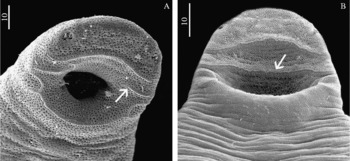
(0) Absent; (1) present (fig. 1). Sclerotization of the mouth is defined by the presence of a sclerotized line, anterior and posterior to the mouth. Using SEM, Chisholm & Whittington (Reference Chisholm and Whittington2000) reported an anterior ridge (line) on the mouth of Heliocotyle ewingi Chisholm & Whittington, Reference Chisholm and Whittington2000; however, these authors were not sure whether this structure was muscular or sclerotized. However, we examined H. kartasi (MHNH no. 580 HF–Tk 97–98) under differential interference contrast (DIC) and phase-contrast light microscopy, and the ridge does not look similar to the ridge observed on all septa that we know to be sclerotized. Thus, Heliocotyle was coded as not having this feature.
Morphology of the anterior region of Potamotrygonocotyle. (A) Mouth of P. umbella Domingues, Pancera & Marques, Reference Domingues, Pancera and Marques2007, showing the discontinuous medial sclerotization; (B) mouth of P. chisholmae Domingues, & Marques, Reference Domingues, Pancera and Marques2007, showing the continuous medial sclerotization. Arrows show the medial sclerotization. Scale bars in μm.

Character 9: Mouth sclerotization (medial sclerotization) [CI=100; RI=100]
(0) Medial sclerotization discontinuous (fig. 1A); (1) medial sclerotization continuous (fig. 1B).
Character 10: Egg [CI=100; RI=100]
(0) Tetrahedral (e.g. Neifar et al., Reference Neifar, Euzet and Ben Hassine1999a, Fig. 5a); (1) ovate (e.g. Domingues & Marques, Reference Domingues and Marques2007, Fig. 3).
Character 11: Egg filament [CI=50; RI=66]
(0) Short (e.g. fig. 4C; Domingues & Marques, Reference Domingues and Marques2007, Figs 7, 17, 23; Domingues et al., Reference Domingues, Pancera and Marques2007, Figs 3, 15, 25, 30); (1) long (e.g. figs 5C, 6C; Domingues & Marques, Reference Domingues and Marques2007, Figs 12, 28). A long egg filament is defined by the length of the filament being ≥ 0.5 times the length of the egg, whereas a short egg filament has a length < 0.5 times the length of the egg.
Character 12: Roots of the anchor [CI=50; RI=50]
(0) Deep root equal to or 1.5 times bigger than superficial root (e.g. figs 5E, 6E, 8D; Domingues & Marques, Reference Domingues and Marques2007, Figs 9, 14, 25, 30; Domingues et al., Reference Domingues, Pancera and Marques2007, Figs 5, 17, 27, 33); (1) deep root twice as big as the superficial root (e.g. fig. 4E; Domingues & Marques, Reference Domingues and Marques2007, Fig. 19; Domingues et al., Reference Domingues, Pancera and Marques2007, Fig. 21). This character is polymorphic for Myliocotyle (i.e. M. borneoensis Chisholm & Whittington, Reference Chisholm and Whittington2004 – deep root twice as big as the superficial root – versus M. pteromylaei and M. multicrista Chisholm & Whittington, Reference Chisholm and Whittington2004 – deep root twice as big as the superficial root).
Phylogenetic analysis
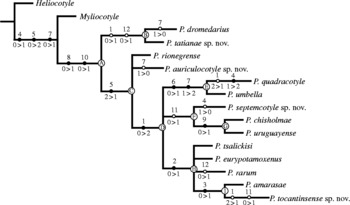
The phylogenetic analysis based on 12 morphological characters (table 1) for 16 terminals resulted in a single most parsimonious topology 23 steps long with a CI = 69 and RI = 72 (fig. 2). Potamotrygonocotyle can be defined by two unambiguous synapomorphies: (1) the presence of sclerotizations around the mouth (character 8), and (2) the presence of ovate eggs (character 10). As a result of the restricted number of characters we were able to compile for this dataset, 30% of the nodes remained unresolved after phylogenetic analysis. We also observed that some nominal species of Potamotrygonocotyle resulted in polytomic nodes (e.g. node H in fig. 2) or as sister taxa of other nominal species (e.g. node G in fig. 2) without any autapomorphies that could diagnose them. Based on this systematic evidence, we have made some taxonomic decisions that will be discussed in detail below.
Phylogenetic hypothesis for 14 terminals for Potamotrygonocotyle, including ten nominal species and four newly described taxa, based on 12 morphological characters. Heliocotyle and Myliocotyle are presented as outgroups. Tree length = 23; consistency index = 69; retention index = 72. Numbers above the branches indicate respective characters. Numbers below the branches refer to postulated evolutionary changes. Open circles on the branches indicate a homoplastic character state. Filled circles on the branches indicate a synapomorphic or autapomorphic character state. Open circle with Roman alphabet characters on the nodes of the ingroups are used to indicate grouping information available in the text.

Systematics
POLYONCHOINEA Bychowsky, 1937
MONOCOTYLIDAE Taschenberg, 1879
HETEROCOTYLINAE Chisholm, Wheeler & Beverley-Burton, Reference Chisholm, Wheeler and Beverley-Burton1995
Potamotrygonocotyle Mayes, Brooks & Thorson, 1981
Type species. P. tsalickisi Mayes, Brooks & Thorson, 1981.
Remarks. Potamotrygonocotyle was revised by Domingues & Marques (Reference Domingues and Marques2007).
Potamotrygonocotyle tsalickisi Mayes, Brooks & Thorson, 1981
Synonymy. Potamotrygonocotyle eurypotamoxenus Domingues & Marques, Reference Domingues and Marques2007
Type host and type locality
Potamotrygon constellata (Vaillant, 1880), Rio Itacoaí, 5 km SE Atalaia do Norte, Brazil, July 1976; July 1978.
Other hosts and localities. Potamotrygon castexi Castello & Yagolkowski, 1969, Rio Salobra, District of Salobra, Municipality of Miranda, Mato Grosso do Sul, Brazil (56°22′42″W, 20°14′26″S), 19–24 July 2004 (Host nos MZUSP MS04–02, MS04–05–06, MS04–11, MS04–21–22, MS04–26; MS04–39 and MS04–44); P. cf. castexi Rio Madre de Dios, Municipality of Boca Manu, Madre de Dios, Peru (12°17′047″W, 70°53′086″S), May 2001 (Host no. MZUSP PU–19); P. falkneri Castex & Maciel, 1963, Rio Salobra, District of Salobra, Municipality of Miranda, Mato Grosso do Sul, Brazil (56°22′42″W, 20°14′26″S), 19–24 July 2004 (Host no. MZUSP MS04–03); P. histrix (Müller & Henle, 1834), Rio Salobra, District of Salobra, Municipality of Miranda, Mato Grosso do Sul, Brazil (56°22′42″W, 20°14′26″S), 19–24 July 2004 (Host nos MZUSP MS04–09, MS04–31, MS04–41, MS04–43); P. motoro (Müller & Henle, 1841), Rio Salobra, District of Salobra, Municipality of Miranda, Mato Grosso do Sul, Brazil (56°22′42″W, 20°14′26″S), 19–24 July 2004 (Host nos MZUSP MS04–13, MS04–23, MS04–34); P. motoro from Rio Paraná, Paraje Santa Tecla, Municipality of Ituzaingó, Province of Corrientes (56°24′05.1″W, 27°36′34.4″S) and Rio Paraná, Presa de Yacyretá, Municipality of Ituzaingó, Province of Corrientes, Argentina (56°39′15.2″W, 27°29′31.8″S), May 2005; P. cf. motoro, Rio Mutum, Municipality of Barão de Melgaço, Mato Grosso, Brazil (11°51′19″S, 60°43′10″W), 8 July 2006 (Host nos MZUSP AC06–017–021); P. orbygnyi (Castelnau, 1855), Rio Yavari, Municipality of Benjamin Constant, Amazonas, Brazil (4°18′25″S, 70°4′31″W), 5 September 2006 (Host no. MZUSP TA06–18); P. orbignyi, Rio Tarauacá, Lago Arara, Municipality of Tarauacá, Acre, Brazil (11°51′19″S, 60°43′10″W), 22 July 2006 (Host no. MZUSP AC06–094); Potamotrygon sp., Rio Paraguay, Igarapé do Padre Inácio, Municipality of Cáceres, Mato Grosso, Brazil (16°00′09″S, 57°42′22″W), 29 June 2007 (Host no. MZUSP MT07–01); Potamotrygon sp. ‘tar_1’, Rio Tarauacá, Lago Arara, Municipality of Tarauacá, Acre, Brazil (11°51′19″S, 60°43′10″W), 22–23 July 2006 (Host nos MZUSP AC06–088, AC06–092, AC06–95, AC06–105, AC06–108–109, AC06–111); Potamotrygon humerosa Garman, 1913, Rio Abacaxis, Municipality of Borba, Amazonas, Brazil (4°23′05″S, 59°35′44″W), 9–26 January 2007 (Host nos MZUSP AM07–03, AM07–06, AM07–21); Potamotrygon sp., Rio Amazonas, Iquitos, Peru (3°43′22″S, 73°12′42″W) 18 April 2005 (Tomáš Scholz no. 05PI 199).
Material examined. USNPC nos 77 157, 77 158, 103685-103687, HWML nos 21 390, 49338-49339, MZUSP nos 6356-6359, 6364, 6873-6888, CHIOC nos 37443-37447, INPA nos 575-577.
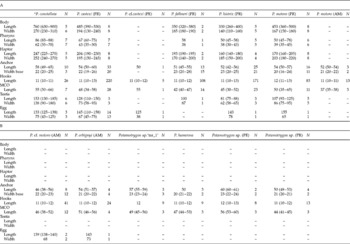
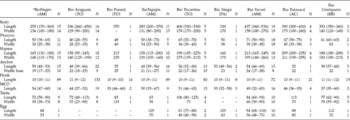
Comparative measurements. Table 2A, B.
Comparative measurements (μm) of Potamotrygonocotyle tsalickisi Mayes, Brooks & Thorson, 1981 from potamotrygonids in Brazil and Peru. N, Number of specimens measured; AM, Amazonas; PR, Paraná; PE, Peru.

* Type host and type locality.
Remarks. Potamatrygonocotyle tsalickisi is the type species of the genus and it was recently redescribed by Domingues & Marques (Reference Domingues and Marques2007) based on type material. The phylogenetic position of this species is in a polytomy (node H, fig. 2) with P. eurypotamoxenus, P. rarum and (P. aramasae+P. tocantinsense sp. nov.), based on the presence of the distal portion of the male copulatory organ being subterminal (character 2, table 1 and fig. 2). Except for some morphometric differences (table 2), which we no longer consider as evidence of interspecific variation, this species is very similar to P. eurypotamoxenus by sharing the same morphology of the MCO (long male copulatory organ with subterminal aperture). Additionally, throughout character analysis, we were unable to find any autapomorphy for either of these two nominal species. Thus, we consider P. eurypotamoxenus a junior synonymy of P. tsalicksi.
Potamotrygonocotyle aramasae Domingues, Pancera & Marques, Reference Domingues, Pancera and Marques2007
Type host and type locality. Paratrygon aiereba (Müller & Henle, 1841), Rio Negro, Municipality of Barcelos, Amazonas, Brazil (62°55′13.64″W, 0°58′11.72″S), 26 January 2005 (Host no. MZUSP RN05–33).
Other localities. Rio Paranã, Municipality of Paranã, Tocantins, Brazil (12°37′48″S, 52°57′36″W), 3 August 2004 (Host no. MZUSP TO04–11); Rio Tapajós, Municipality of Santarém, Pará, Brazil (2°16′47″S, 55°0′0″W), 3 and 9 October 2005 (Host nos MZUSP TJ05–02; TJ05–29); Rio Araguaia, Municipality of São Miguel do Araguaia, Goiás, Brazil (12°56′51″S, 50°31′32″W), 6 June 2006 (Host nos MZUSP TO05–02–04; TO05–08–12; TO05–29; TO05–80); Rio Araguaia, Municipality of Caseara, Tocantins, Brazil (9°16′11.9994″S, 49°57′36″W), 6 June 2006 (Host no. MZUSP TO05–45); Rio Tocantins, Municipality of Ipueiras, Tocantins, Brazil (11°18′36″S, 48°27′36″W), 14 June 2005 (Host no. MZUSP TO05–29); Rio Xingú, Municipality of São Félix do Xingú, Pará, Brazil (6°39′36″S, 52°0′0″W), 6 July 2005 (Host no. MZUSP TO05–80); Rio Yavari, Municipality of Benjamin Constant, Amazonas, Brazil (4°18′25″S, 70°4′31″W), 4–5 September 2006 (Host nos MZUSP TA06–14–16); Rio Urariquera, Municipality of Boa Vista, Brazil (3°22′51.9594″N, 60°35′44.1594″W), 24 February 2007 (Host no. MZUSP AM07–48).
Material examined. MZUSP nos 6373–6374, 6848–6864, CHIOC nos 37448-37451, INPA nos 575–577, USNPC nos 103688–103691, HWML nos 49340–49342.
Comparative measurements. Table 3.
Comparative measurements (μm) of Potamotrygonocotyle aramasae Domingues, Pancera & Marques, Reference Domingues, Pancera and Marques2007 from eight localities. N, Number of specimens measured; AC, Acre; AM, Amazonas; PA, Pará; RR, Roraima; TO, Tocantins.

* Type host and type locality.
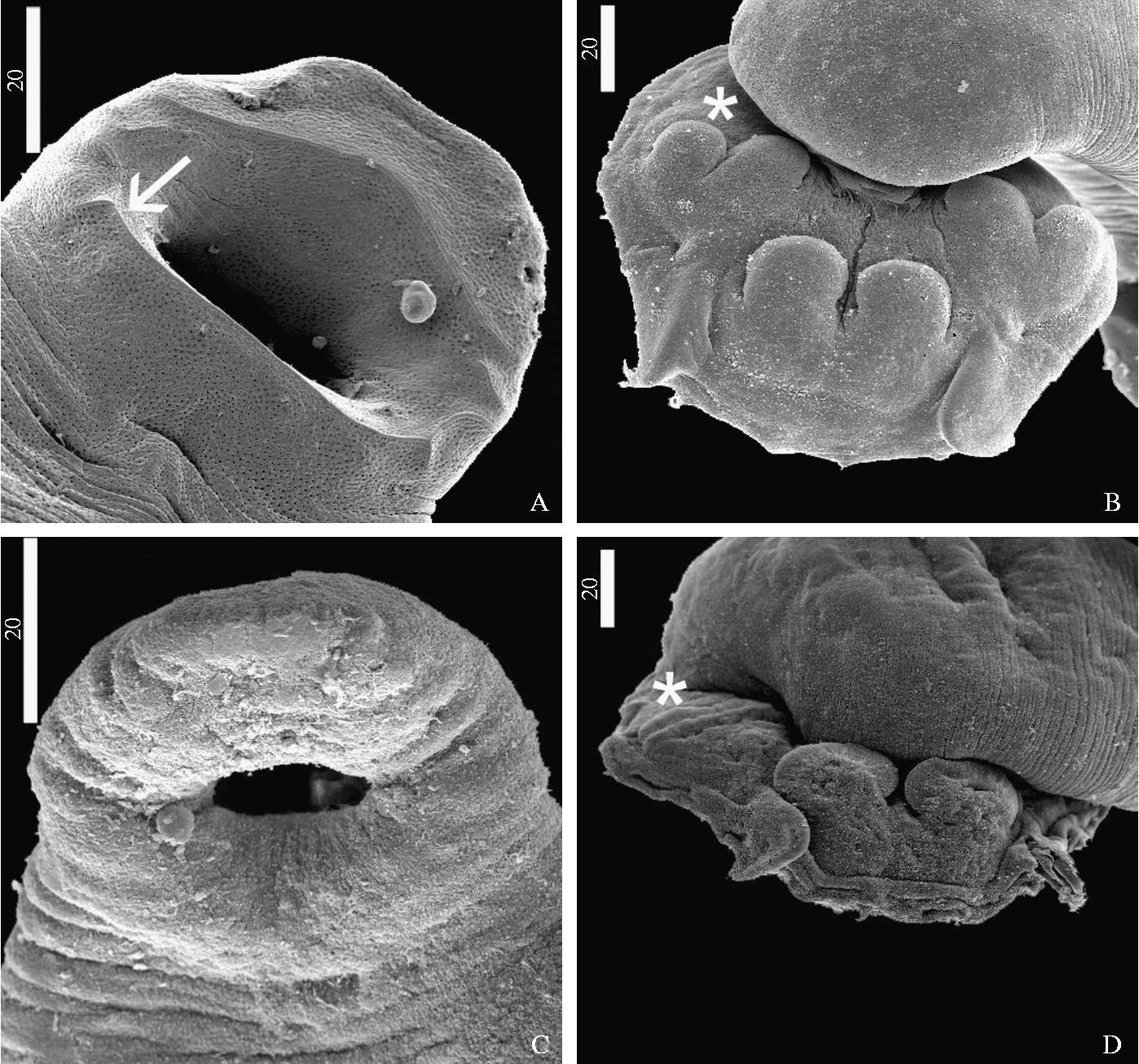
Remarks. Potamotrygonocotyle aramasae is widespread in the Amazon Basin and seems to be host specific to Paratrygon aiereba. Two forms of Potamotrygonocotyle aramasae were recognized based on the morphology of the anterior dorsal haptoral accessory structure (ADHAS) and presence/absence of the sclerotization around the mouth (fig. 3A–D). One morphotype is characterized by having a bilobate ADHAS (fig. 3B) and is reported from Rio Araguaia (TO), Rio Paranã (TO), Rio Negro (AM, type-locality) and Rio Xingú (PA). The other morphotype is characterized by possessing a semicircular ADHAS (fig. 3D) and is reported from Rio Tocantins (TO), Rio Yavari (AM), Rio Tarauacá (AC) and Rio Tapajós (PA). Specimens from Rio Tapajós also lack the sclerotizations around their mouth (fig. 3C). Since this character is considered a synapomorphy for the genus (see Character analysis section), the absence of sclerotizations around the mouth is considered a secondary loss for the Rio Tapajós population. We believe that future phylogeographic studies will help us to define the real taxonomic status of these populations.
Morphology of Potamotrygonocotyle aramasae Domingues, Pancera & Marques, Reference Domingues, Pancera and Marques2007. (A) Anterior region of P. aramasae forma ‘A’, arrow shows the sclerotization around the mouth; (B) haptor (dorsal view) of P. aramasae forma ‘A’, asterisk shows the bilobate anterior dorsal haptoral accessory structure; (C) anterior region of P. aramasae forma ‘B’; (D) haptor of P. aramasae forma ‘B’, asterisk shows the semicircular anterior dorsal haptoral accessory structure. Scale bars in μm.
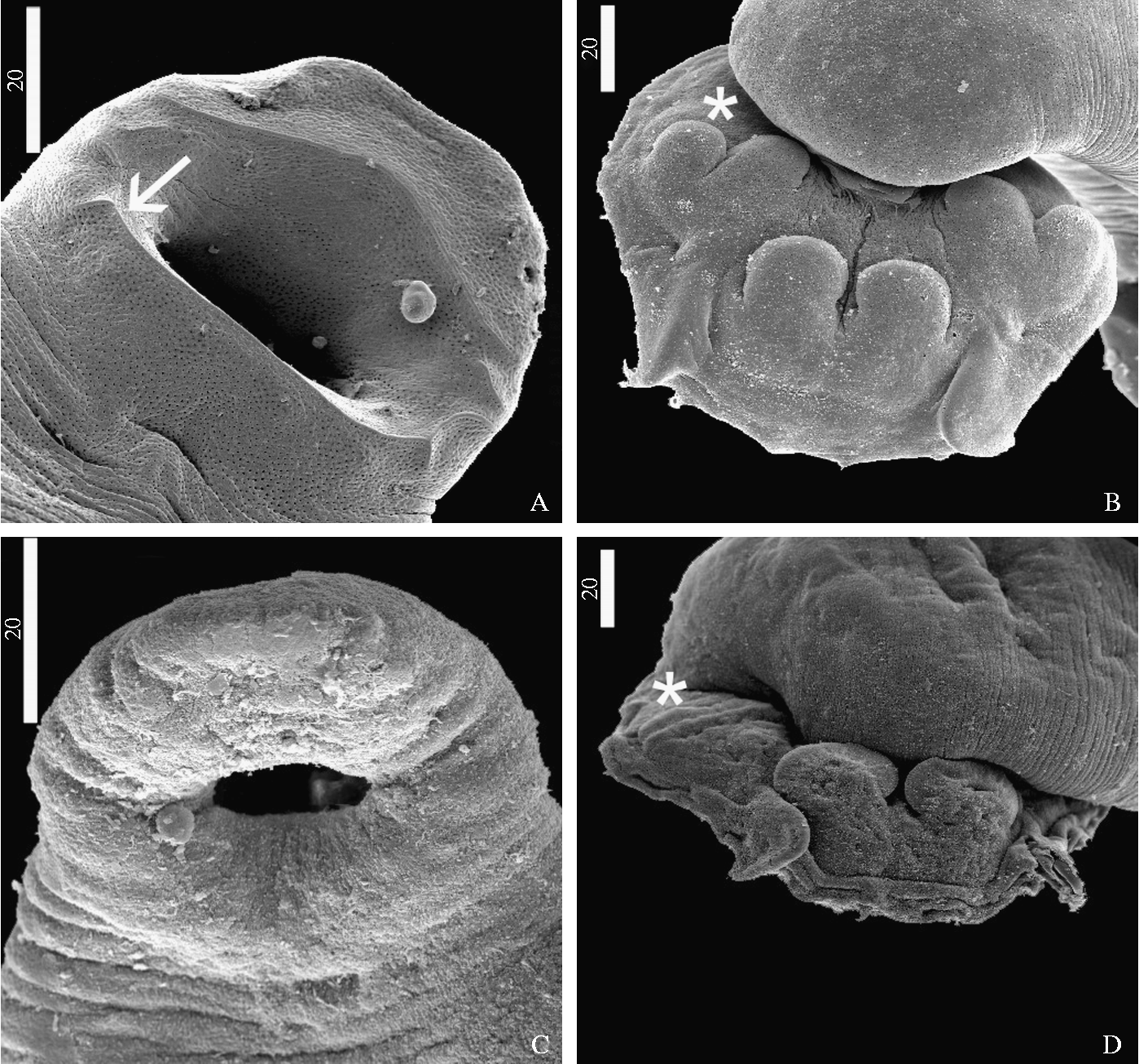
A comparison of morphometric attributes (table 3), as well as the comparative morphology of the ejaculatory bulb, male copulatory organ and haptoral structures (e.g. anchor, hook) do not reveal significant morphologic differences among the morphotypes, which we would consider as evidence for different lineages. The variation observed possibly represents an intraspecific, maturity or seasonal variation, suggesting that specimens of Potamotrygonocotyle that parasitize Paratrygon aiereba from different Amazonas and Tocantins sub-basins are representatives of Potamotrygonocotyle aramasae.
This species is sister to P. tocantinsense sp. nov. (node I, fig. 2). Both species share the presence of the ejaculatory bulb with two anterior ovate cavities (character 3, table 1 and fig. 2). However, P. aramasae can be distinguished from P. tocantinsense sp. nov. by the shape of the male copulatory organ (long MCO versus short MCO, respectively; character 1, table 1 and fig. 2) and by the size of the egg filament (short versus long, respectively; character 11, table 1 and fig. 2).
Potamotrygonocotyle chisholmae Domingues & Marques, Reference Domingues and Marques2007
Synonymy. Potamotrygonocotyle uruguayense Domingues & Marques, Reference Domingues and Marques2007.
Type host and type locality. Potamotrygon motoro, Rio Salobra, District of Salobra, Miranda, Mato Grosso do Sul, Brazil (56°22′42″W, 20°14′26″S), 19–24 July 2004 (Host no. MZUSP MS04–13).
Other hosts and localities. P. brachyura (Günther, 1880), Rio Uruguay, Municipality of Porto Xavier, Rio Grande do Sul, Brazil (27°53′52″S, 55°13′26″W), 24–31 March 2005 (Host nos MZUSP UR05–01–02, UR05–04); P. brachyura, Rio Mutum, Municipality of Barão de Melgaço, Mato Grosso, Brazil (11°51′19″S, 60°43′10″W), 5–7 July 2006 (Host nos MZUSP AC06–007–008, AC06–011); P. henlei (Castelnau, 1855), Rio Araguaia, Municipality of Caseara, Tocantins, Brazil (9°16′11″S, 49°57′47″W), 25 June 2005 (Host no. MZUSP TO05–70); P. leopoldi Castex & Castello, 1970, Rio Xingú, Municipality of São Félix do Xingú, Pará, Brazil (6°39′36″S, 52°0′0″W), 1–6 July 2005 (Host nos MZUSP TO05–68, TO05–71, TO05–75, TO05–83–87, TO05–89–90); P. motoro Rio Shilive, Municipality of Boca Ishiriwe, Madre de Dios, Peru (12°29′24.31″S, 70°35′41.77″W), May 2001 (Host no. MZUSP PU–14); P. motoro, Rio Paraná, Paraje Santa Tecla, Municipality of Ituzaingó, Province of Corrientes, Argentina (56°24′05.1″W, 27°36′34.4″S) and Rio Paraná, Presa de Yacyretá, Municipality of Ituzaingó, Province of Corrientes, Argentina (56°39′15.2″W, 27°29′31.8″S), May 2005; P. motoro, Rio Mutum, Municipality of Barão de Melgaço, Mato Grosso, Brazil (11°51′19″S, 60°43′10″W), 5 July 2006 (Host nos MZUSP AC06–001, AC06–003); P. motoro, Rio Purus, Lago Novo, Municipality of Boca do Acre, Acre, Brazil (8°44′27″S, 67°22′52″W), 17 July 2006 (Host nos MZUSP AC06–074–75); P. motoro, Rio Amazonas, Iquitos, Peru (3°43′22″S, 73°12′42″W), 5–8 September 2006; P. motoro, Rio Paraguay, Igarapé do Padre Inácio, Municipality of Cáceres, Mato Grosso, Brazil (16°00′09″S, 57°42′22″W), 29 June 2007 (Host no. MZUSP MT07–02); P. motoro, Rio Arari, Igarapé do Urubu, Municipality of Cachoeira do Arari, Pará, Brazil (1°00′36″S, 48°57′36″W), 28 August 2007 (Host no. MZUSP PA07–50); P. motoro, Rio Tocantins, Baía de Marajó, Municipality of Colares, Pará, Brazil (0°55′45″S, 48°17′29″W), 29 August 2007 (Host no. MZUSP PA07–82); P. cf. motoro, Rio Tapajós, Municipality of Santarém, Pará, Brazil (2°16′47″S, 55°0′0″W), 4 October 2005 (Host nos MZUSP AC06–017, AC06–20–21); P. cf. motoro, Rio Solimões, Municipality of Tabatinga, Amazonas, Brazil (4°20′22″S, 69°53′18″W), 25–26 August 2006 (Host nos MZUSP TA06–02–04); P. orbignyi, Rio Tarauacá, Lago Arara, Municipality of Tarauacá, Acre, Brazil (11°51′19″S, 60°43′10″W), 22 July 2006 (Host no. MZUSP AC06–094); P. scobina Garman, 1913, Rio Tocantins, Baía de Marajó, Municipality of Colares, Pará, Brazil (0°55′45″S, 48°17′29″W), 16, 22 and 29 August 2007 (Host nos MZUSP PA07–07, PA07–46, PA07–83); Potamotrygon sp. ‘1’, Potamotrygon sp. ‘2’, and Potamotrygon sp. ‘3’, Rio Solimões, Municipality of Tabatinga, Amazonas, Brazil (4°20′22″S, 69°53′18″W), 25–26 August 2006 and 1 September 2006 (Host nos MZUSP TA06–01, TA06–06 and TA06–09, respectively); Potamotrygon sp. ‘tpj_1’, Rio Tapajós, Municipality of Pimental, Pará, Brazil (4°33′35″S, 56°15′35″W), 10 October 2005 (Host nos MZUSP TJ05–36, TJ05–40–41), Rio Teles Pires, Municipality of Alta Floresta, Mato Grosso, Brazil (8°52′48″S, 57°22′48″W), 2 and 5 December 2005 (Host nos MZUSP MT05–05, MT05–17, MT05–26–27), and Rio Jamanxim, Municipality of Novo Progresso, Pará, Brazil (7°08′24″S, 55°22′48″W), 13 December 2005 (Host nos MZUSP MT05–26–27); Potamotrygon sp. ‘tar_1’, Rio Tarauacá, Lago Arara, Municipality of Tarauacá, Acre, Brazil (11°51′19″S, 60°43′10″W), 22–23 July 2006 (Host nos MZUSP AC06–088, AC06–092, AC06–095, AC06–105, AC06–108–109, AC06–111); Potamotrygon sp. ‘tar_2’, Rio Tarauacá, Lago Arara, Municipality of Tarauacá, Acre, Brazil (11°51′19″S, 60°43′10″W), 22–23 July 2006 (Host nos MZUSP AC06–103–104; AC06–110); Potamotrygon sp. ‘mar_1’, Rio Arari, Igarapé do Urubu, Municipality of Cachoeira do Arari, Pará, Brazil (1°00′36″S 48°57′36″W) 28 August 2007 (Host nos MZUSP PA07–51, PA07–62–63, PA07–74, PA07–84–85); Potamotrygon sp. ‘toc_2’, Rio Tocantins, Municipality of Ipueiras, Tocantins, Brazil (11°18′36″S, 48°27′36″W), 11–15 June 2005 (Host nos MZUSP TO05–16; TO05–18; TO05–20; TO05–23–28; TO05–30–32).
Material examined. MZUSP nos 6352, 6354 a–ak, 6365–6366 a–v, 6902–6956, CHIOC nos 37412–37436, INPA nos 552–566, USNPC nos 103658–103677, HWML nos 49321–49333.
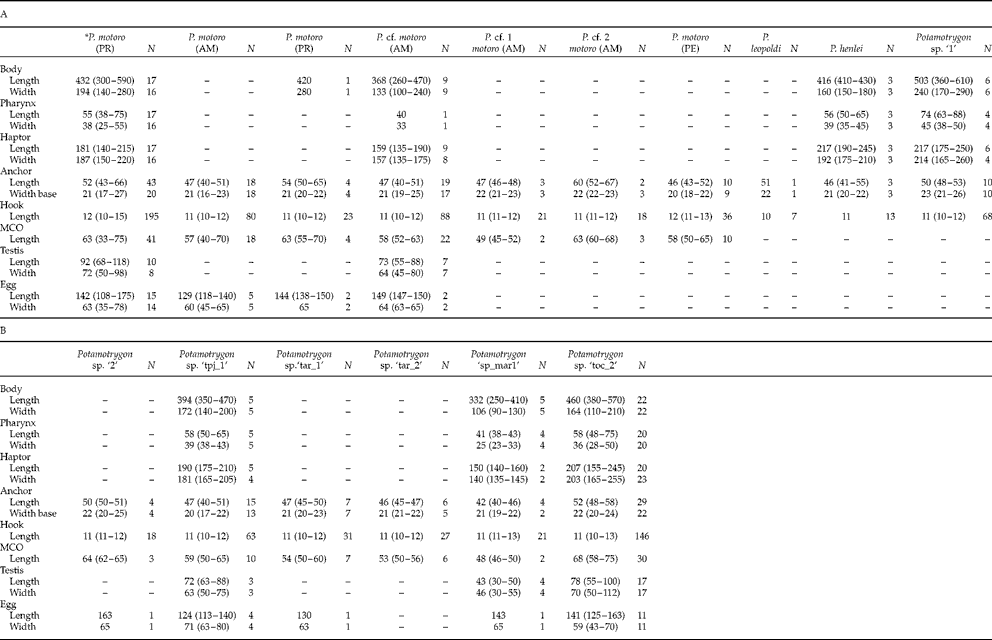
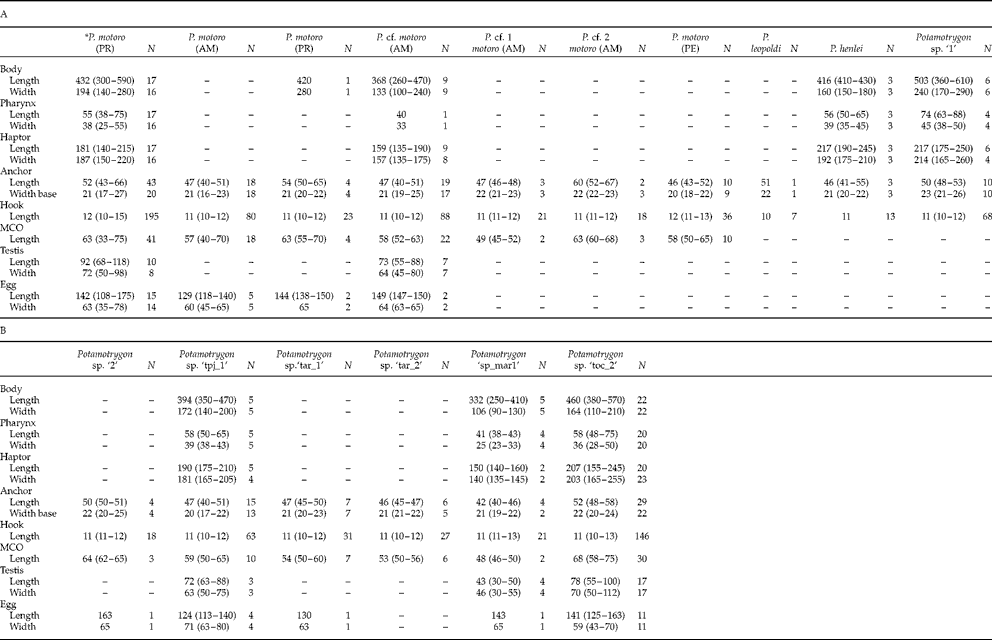
Comparative measurements. Table 4A, B.
Comparative measurements (μm) of Potamotrygonocotyle chisholmae Domingues & Marques, Reference Domingues and Marques2007 from potamotrygonids in Brazil and Peru. N, Number of specimens measured; AM, Amazonas; PR, Paraná; PE, Peru.
* Type host and type locality.
Remarks. Pamotrygonocotyle chisholmae was sister to P. uruguayense (node G, fig. 2) by sharing continuous medial sclerotization on the mouth (character 9, table 1 and figs 1B and 2). Domingues & Marques (Reference Domingues and Marques2007) distinguished P. chisholmae from P. uruguayense on the basis of the shape of the ADHAS (trilobate versus bilobate, respectively). However, re-evaluation of this character based on the collection of new material from different hosts and localities suggested no clear-cut distinction between trilobate and bilobate ADHAS that could be assigned to any of these nominal species unequivocally. We recognize that this character displays a continuum of variation among populations once credited to different lineages. In addition, throughout character analysis, we were unable to determine any autapomorphy for either of these species. Thus, we consider P. uruguayense as a junior synonymy of P. chisholmae.
Potamotrygonocotyle dromedarius Domingues & Marques, Reference Domingues and Marques2007
Type host and type locality. Potamotrygon motoro, Rio Salobra, District of Salobra, Miranda, Mato Grosso do Sul, Brazil (56°22′42″W, 20°14′26″S), 21 July 2004 (Host no. MZUSP MS04–13).
Other hosts and localities. P. henlei, Rio Araguaia, Municipality of Caseara, Tocantins, Brazil (9°16′11″S, 49°57′47″W), 25 June 2005 (Host no. MZUSP TO05–70); P. leopoldi, Rio Xingú, Municipality of São Félix do Xingú, Pará, Brazil (6°39′36″S, 52°0′0″W), 3 and 6 July 2005 (Host nos MZUSP TO05–75, TO05–89); P. motoro, Rio Shilive, Municipality of Boca Ishiriwe, Madre de Dios, Peru (12°29′24.31″S, 70°35′41.77″W), May 2001 (Host no. MZUSP PU–14); P. motoro, Rio Mutum, Municipality of Barão de Melgaço, Mato Grosso, Brazil (11°51′19″S, 60°43′10″W), 7 July 2006 (Host no. MZUSP AC06–009); P. motoro, Rio Paraguay, Igarapé do Padre Inácio, Municipality of Cáceres, Mato Grosso, Brazil (16°00′09″S, 57°42′22″W), 29 June 2007 (Host no. MZUSP MT07–02); Potamotrygon sp. ‘toc_2’, Rio Tocantins, Municipality of Ipueiras, Tocantins, Brazil (11°18′36″S, 48°27′36″W), 14–15 June 2005 (Host nos MZUSP TO05–28, TO05–16, TO05–18, TO05–20, TO05–23–28, TO05–30–32).
Material examined. MZUSP nos 6354–6355, 6865–6872, CHIOC nos 37437-37442, INPA nos 567–570, USNPC nos 103678–103684, HWML nos 49334–49337.
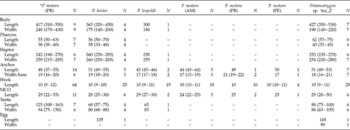
Comparative measurements. Table 5.
Comparative measurements (μm) of Potamotrygonocotyle dromedarius Domingues & Marques, Reference Domingues and Marques2007 from potamotrygonids in Brazil and Peru. N, Number of specimens measured; AM, Amazon; PR, Paraná; PE, Peru.

* Type host and type locality.
Remarks. Potamotrygonocotyle dromedarius was sister to P. tatianae sp. nov. based on two homoplastic characters: the male copulatory organ as a short tube (character 1, table 1 and fig. 2), and the deep root twice as large as the superficial root (character 12, table 1 and fig. 2). However, it differs from P. tatianae sp. nov. by possessing a semicircular posterior dorsal haptoral accessory structure (DHAS), which is elongate laterally in P. tatianae sp. nov. (character 7, table 1 and fig. 2).
Potamotrygonocotyle quadracotyle Domingues Pancera & Marques, Reference Domingues, Pancera and Marques2007
Type host and type locality. Potamotrygon sp. ‘cururu’, Rio Negro, Municipality of Barcelos, Amazonas, Brazil (62°55′13″W, 0°58′11″S), January–February 2005 (Host nos MZUSP RN05–02, RN05–10, RN05–40, RN05–68, RN05–97).
Material examined. MZUSP nos 6367–6368.
Remarks. Potamotrygonocotyle quadracotyle is restricted to Potamotrygon sp. ‘cururu’, an undescribed species locally referred as ‘cururu’, from Rio Negro. This species is closely related to another species endemic to Rio Negro, P. umbella, (node E, fig. 2) based on the presence of the DHAS associated with the posterolateral and posterior loculi with elongate lobes (characters 6 and 7, respectively; table 1 and fig. 2). However, this species is unique among Potamotrygonocotyle by possessing a haptor with one central and four peripheral loculi (character 4, table 1 and fig. 2). Many genera within Monocotylidae have been established on the basis of haptor loculi configuration (e.g. Nonacotyle, Decacotyle, Euzetia), which would suggest that P. quadracotyle could well be assigned to a different genus. However, that would make Potamotrygonocotyle paraphyletic. Our results call for a re-evaluation of haptoral loculi configuration as the justification for erecting genera within Monocotylidae and show the relevance of phylogenetic studies within this family to guide taxonomic decisions.
Potamotrygonocotyle rarum Domingues Pancera & Marques, Reference Domingues, Pancera and Marques2007
Type host and type locality. Potamotrygon schroederi Fernández-Yépez, 1958, Rio Negro, Municipality of Barcelos, Amazonas, Brazil (62°55′13.64″W, 0°58′11.72″S), 25–26 January 2005 (Host nos MZUSP RN05–01, RN05–12, RN05–21, RN05–23, RN05–36).
Material examined. MZUSP nos 6371–6372.
Remarks. Potamotrygonocotyle rarum is restricted to Potamotrygon schroederi. This species nested in a clade with P. tsalickisi ( = P. eurypotamoxenus), P. tocantinsense sp. nov. and P. aramasae (node H) based on the morphology of the male copulatory organ (character 2, table 1, fig. 2; see comments on P. tsalickisi). However, P. rarum differs from the other species within the node H by having anchors with deep roots twice as big as superficial (character 12, table 1, fig. 2).
Potamotrygonocotyle rionegrense Domingues Pancera & Marques, Reference Domingues, Pancera and Marques2007
Type host and type locality. Potamotrygon motoro, Rio Negro, Municipality of Barcelos, Amazonas, Brazil (62°55′13.64″W, 0°58′11.72″S), 23 and 31 January 2005 (Host nos MZUSP RN05–04–05, RN05–62).
Other hosts and localities. Potamotrygon motoro, Rio Purus, Lago Novo, Municipality of Boca do Acre, Acre, Brazil (8°44′27″S, 67°22′52″W), 17 July 2006 (Host nos MZUSP AC06–073–75, AC06–079); P. motoro, Rio Mutum, Municipality of Barão de Melgaço, Mato Grosso, Brazil (11°51′19″S, 60°43′10″W), 5–8 July 2006 (Host nos MZUSP AC06–001, AC06–003, AC06–020, AC06–022); P. cf. motoro, Rio Mutum, Municipality of Barão de Melgaço, Mato Grosso, Brazil (11°51′19″S, 60°43′10″W), 8 July 2006 (Host no. MZUSP AC06–020); P. cf. motoro, Rio Solimões, Municipality of Tabatinga, Amazonas, Brazil (4°20′22″S, 69°53′18″W), 26 August 2006 (Host no. MZUSP TA06–04); Potamotrygon sp., Rio Amazonas, Iquitos, Peru (3°43′22″S, 73°12′42″W) 7–8 September 2006 (Tomáš Scholz nos P235a, P312a, P334a); P. motoro, Rio Arari, Igarapé do Urubu, Municipality of Cachoeira do Arari, Pará, Brazil (1°00′36″S 48°57′36″W), 28–29 August 2007 (Host nos MZUSP PA07–50; PA07–82); Potamotrygon sp., Rio Paraguay, Igarapé do Padre Inácio, Municipality of Cáceres, Mato Grosso, Brazil (16°00′09″S, 57°42′22″W), 29 June 2007 (Host no. MZUSP MT07–01); Potamotrygon sp. ‘3’, Rio Solimões, Municipality of Tabatinga, Amazonas, Brazil (4°20′22″S, 69°53′18″W), 1 September 2006 (Host no. MZUSP TA06–06); Potamotrygon sp. ‘tar_2’, Rio Tarauacá, Lago Arara, Municipality of Tarauacá, Acre, Brazil (11°51′19″S, 60°43′10″W), 22–23 July 2006 (Host nos MZUSP AC06–103–104, AC06–110); P. humerosa, Rio Abacaxis, Municipality of Borba, Amazonas, Brazil (4°23′05″S, 59°35′44″W), 9–26 January 2007 (Host nos MZUSP AM07–03; AM07–06–07, AM07–09, AM07–16, AM07–18, AM07–20, AM07–22).
Material examined. MZUSP nos 6371–6372, 6889–6901, CHIOC nos 37452-37453, INPA no. 578, USNPC nos 103692–103694.
Comparative measurements. Table 6
Comparative measurements (μm) of Potamotrygonocotyle rionegrense Domingues, Pancera & Marques, Reference Domingues, Pancera and Marques2007 from potamotrygonids in Brazil, and Peru. N, Number of specimens measured; AM, Amazonas; PR, Paraná; PE, Peru.

* Type host and type locality.
Remarks. Potamotrygonocolyle rionegrense nested in a clade (node C, fig. 2) with P. auriculocotyle sp. nov. and a large group of Potamotrygonocotyle species, i.e. clade D (fig. 2) based on the presence of bilobate DHAS associated with the posterolateral loculi (character 5, table 1 and fig. 2). Potamotrygonocotyle rionegrense differs from P. auriculocotyle sp. nov. by the morphology of the DHAS associated with the posterior loculi (elongate laterally versus semicircular, respectively).
Potamotrygonocotyle umbella Domingues, Pancera & Marques, Reference Domingues, Pancera and Marques2007
Type host and type locality. Potamotrygon sp. ‘cururu’, Rio Negro, Municipality of Barcelos, Amazonas, Brazil (62°55′13″W, 0°58′11″S), 23 and 26 January 2005 (Host nos MZUSP RN05– 02, RN05– 10, RN05– 40).
Material examined. MZUSP nos 6369–6370 a–k.
Remarks. Potamotrygonocotyle umbella is restricted to Potamotrygon sp. ‘cururu’. This parasite species is sister with another endemic monocotylid from Rio Negro, P. quadracotyle (node E, fig. 2), based on the presence of the DHAS associated with the posterior and posterolateral loculi with elongate lobes (characters 6 and 7, respectively; table 1, and fig. 2). P. umbella is easily distinguished from P. quadracotyle by eight peripheral loculi in the haptor, whereas specimens of P. quadracotyle possess four.
Potamotrygonocotyle tatianae sp. nov
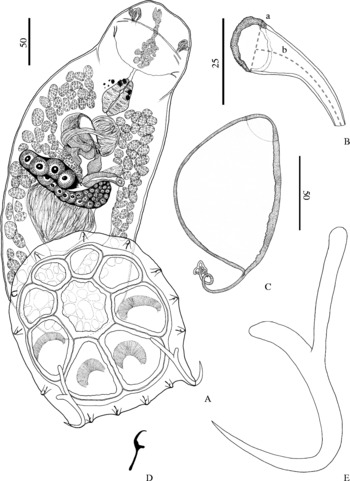
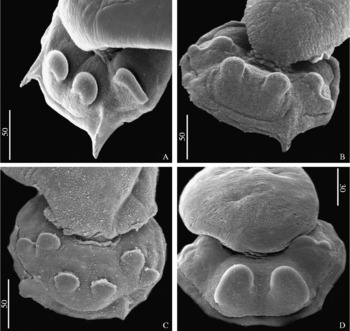
Description. Based on 15 specimens (fig. 4). Body fusiform, total length – excluding haptor – 406 (360–470; n = 7); 151 (120–180; n = 7) wide at level of germarium. Tegument smooth. Cephalic lobes poorly developed or absent; three pairs of head organs converging to unique pore; cephalic glands unicellular, posterolateral to pharynx, with rod-shaped secretion. Anteromedial gland present. Dispersed pigment granules dorsal to pharynx, infrequently absent. Mouth surrounded by sclerotized ridges, medial sclerotization of the mouth discontinuous. Pharynx elongate ovate, 49 (45–55; n = 7) long, 33 (28–33; n = 7) wide; oesophagus short; two intestinal caeca, non-confluent, lacking diverticula; distal ending close to testis. Haptor circular, 203 (200–205; n = 4) long, 191 (175–205; n = 4) wide, with one central and eight peripheral loculi (two anterior, four lateral, two posterior); septa surrounded by slightly sinuous sclerotized ridge. Dorsal surface of haptor with two pairs of haptoral accessory structures associated with lateral and posterior peripheral loculi; each dorsal haptoral accessory structure with sclerotized margins. Anterior pair of dorsal haptoral accessory structures associated with posterolateral loculi semicircular; posterior pair of dorsal haptoral accessory structures associated with posterior loculi semicircular (see fig. 9A). Anchors 71 (62–76; n = 13) long, base 24 (15–26; n = 12) wide, with heavy diverging roots; deep root twice as large as superficial root; evenly curved shaft and point. Hooks similar, 10 (n = 24) long, distributed on marginal membrane of haptor, with slightly depressed thumb, shaft with proximal portion dilated and curved point. Male copulatory organ sclerotized, short slightly arcuate tapered tube, 45 (43–47; n = 7) long, aperture terminal. Accessory piece absent. Testis cordiform or transversally ovate, 73 (38–90; n = 7) long, 88 (75–100; n = 7) wide; vas deferens not observed; seminal vesicle lateral to ejaculatory bulb, entering dorsal surface of posterior region of ejaculatory bulb. Ejaculatory bulb muscular, ovate without distinct internal chambers; glands associated with ejaculatory bulb not observed. Germarium tubular, unbranched, looping right intestinal caecum; distal end ascendant; Mehlis' glands not observed. Vagina heavily muscular. Vaginal pore sinistroventral at level of proximal portion of germarium; seminal receptacle not observed. Oötype well developed. Vitellarium coextensive with gut, absent in regions of reproductive organs. Egg ovate, 114 (113–115; n = 2) long, 83 (78–88; n = 2) wide, with short filament; distal end of filament reticulate.
Potamotrygonocotyle tatianae sp. nov. (A) Whole mount (holotype); (B) male copulatory organ (MCO); a, length of the base of the MCO; b, total length of the MCO; (C) egg; (D) hook; (E) anchor. Scale bars in μm.

Holotype, type host and type locality. MZUSP no. 6835; Paratrygon sp. ‘1’, Rio Yavari, Municipality of Benjamin Constant, Amazonas, Brazil (4°18′25″S, 70°4′31″W), 5 September 2006 (Host no. MZUSP TA06–17).
Other specimens. 14 paratypes: 9 MZUSP no. 6836a–i, 1 CHIOC no. 37404, 1 HWML no. 49318, 2 INPA no. 548a–b, 1 USNPC no. 103650, Paratrygon sp. ‘1’, Rio Yavari, Municipality of Benjamin Constant, Amazonas, Brazil (4°18′15.1194′′S, 70°4′19.56′′W), 5 September 2006 (Host no. MZUSP TA06–17).
Site of infection. Gills.
Etymology. The specific name is attributed after Tatiana Raso de Moraes Possato (in memoriam; born 1 April 1978, died 30 April 2006), a young researcher who dedicated her short life to the study of elasmobranchs.
Remarks. Potamotrygonocotyle tatianae sp. nov. is sister species to P. dromedarius (node B, fig. 2). Both species share the presence of an anchor with a deep root twice as large as the superficial root (character 12, table 1 and fig. 2), a homoplastic character also found in P. rarum, and a short male copulatory organ (character 1, table 1 and fig. 2), another homoplastic character that can be observed in P. tocantinsense sp. nov. However, P. tatianae sp. nov. can be distinguished from its sister species in comparative morphology of the dorsal haptoral accessory structure associated with the posterior loculi (elongate laterally versus semicircular, respectively).
Potamotrygonocotyle tocantinsense sp. nov
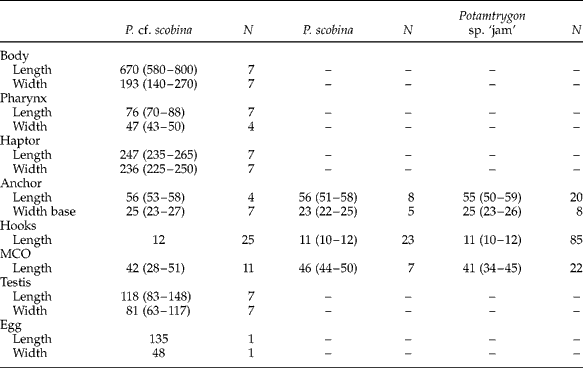
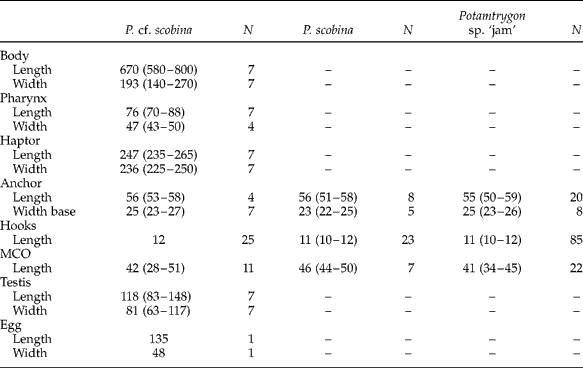
Description. Based on 19 specimens (fig. 5). Body fusiform, total length – excluding haptor – 670 (580–800; n = 7), 193 (140–270; n = 7) wide at level of germarium. Tegument smooth. Cephalic lobes poorly developed or absent; three pairs of head organs converging to unique pore; cephalic glands unicellular, posterolateral to pharynx, with rod-shaped secretion. Anteromedial gland present. Dispersed pigment granules laterodorsal to pharynx, infrequently absent. Mouth surrounded by sclerotized ridges, medial sclerotization of the mouth discontinuous. Pharynx elongate ovate, 76 (70–88; n = 7) long, 47 (43–50; n = 7) wide; oesophagus short; two intestinal caeca, non-confluent, lacking diverticula; distal ending at midpoint between testis and posterior body ending. Haptor circular, 247 (235–265; n = 7) long, 47 (225–250; n = 7) wide, with one central and eight peripheral loculi (two anterior, four lateral, two posterior); septa ventrally surrounded by slightly sinuous sclerotized ridge. Dorsal surface of haptor with two pairs of haptoral accessory structures associated with lateral and posterior peripheral loculi; each dorsal haptoral accessory structure with sclerotized margins. Anterior pair of dorsal haptoral accessory structures associated with posterolateral loculi bilobate, with slightly concave separation between lobes; posterior pair of dorsal haptoral accessory structures associated with posterior loculi semicircular (see fig. 9B). Anchors 55 (53–58; n = 8) long, base 25 (23–27; n = 10) wide, with diverging roots, evenly curved shaft and point. Hooks similar, 12 (10–12; n = 44) long, distributed on marginal membrane of haptor, with depressed thumb, shaft with proximal portion dilated and curved point. Male copulatory organ sclerotized, short, arcuate, tapered tube, 42 (28–51; n = 13) long, distal portion slightly expanded laterally, aperture subterminal. Accessory piece absent. Testis ovate, 118 (83–148; n = 7) long, 81 (63–118; n = 7) wide; vas deferens not observed; seminal vesicle C-shaped, entering dorsal surface of posterior region of ejaculatory bulb. Ejaculatory bulb muscular, ovate with distinct internal chambers; glands associated with ejaculatory bulb not observed. Germarium tubular, unbranched, looping right intestinal caecum; distal end ascendant; Mehlis' glands bilateral to oötype. Vagina muscular. Vaginal pore sinistroventral at level of common genital pore; distal portion expanded; seminal receptacle spherical. Oötype well developed. Vitellarium coextensive with gut, absent in regions of reproductive organs. Egg ovate, 130 (125–135; n = 2) long, 61 (48–75; n = 2) wide, with elongate filament; distal end of filament reticulate.
Potamotrygonocotyle tocantinsense sp. nov. (A) Whole mount (holotype); (B) male copulatory organ; (C) egg; (D) hook; (E) anchor. Scale bars in μm.

Holotype, type host and type-locality. MZUSP no. 6837; Potamotrygon cf. scobina, Rio Tocantins, Municipality of Ipueiras, Tocantins, Brazil (11°18′36″S, 48°27′36″W), 13 June 2005 (Host no. MZUSP TO05–22).
Other hosts and localities. 16 paratypes: 9 MZUSP no. 6838a–i, 3 CHIOC no. 37405 a–c, 2 INPA no. 549a–b, 2 USNPC no. 103651, P. cf. scobina, Rio Tocantins, Municipality of Ipueiras, Tocantins, Brazil (11°15′48.52′′S, 48°26′56.79″W), 13 June 2005 (Host no. MZUSP TO05–22); 33 vouchers: 4 MZUSP no. 6847a–d, 1 INPA no. 551, 2 CHIOC nos 37410-37411, Potamotrygon scobina, Rio Urariquera, Municipality of Boa Vista, Roraima, Brazil (3°22′51.9594″N, 60°35′44.1594″W), 21 February 2007 (Host nos MZUSP AM07–40, AM07–45 and AM07–47); 13 MZUSP nos 6839–6846, 5 INPA no. 550a–e, 4 CHIOC nos 37406–37409, 4 USNPC nos 103655–103657, Potamotrygon sp. ‘jam’, Rio Jamari, Municipality of Itapoã do Oeste, Rondônia, Brazil (9°4′33.96′′S, 63°18′17.64′′W), 11–13 July 2006 (Host nos MZUSP AC06–027, AC06–029–030, AC06–032–033, AC06–069).
Site of infection. Gills.
Etymology. The specific name refers to the Rio Tocantins, from where the type-series was collected.
Comparative measurements. Table 7.
Comparative measurements (in μm) of Potamotrygonocotyle tocantinsense sp. nov. from Potamotrygon cf. scobina (type host), Potamotrygon scobina and Potamotrygon sp. ‘jam’. N, Number of specimens measured.
Remarks. Potamotrygonocotyle tocantinsense sp. nov. is sister to P. aramasae (node I, fig. 2) based on the presence of an ejaculatory bulb with distinct internal chambers (character 3, table 1 and fig. 2). However, P. tocantinsense sp. nov. differs from P. aramasae by having two autapomorphies: male copulatory organ as a short tube (character 1, table 1 and fig. 2) and egg with elongate filament (character 11, table 1 and fig. 2).
Potamotrygonocotyle septemcotyle sp. nov
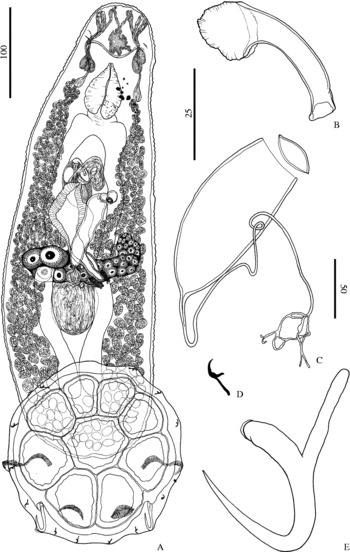
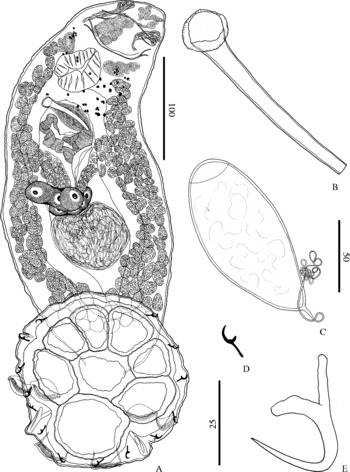
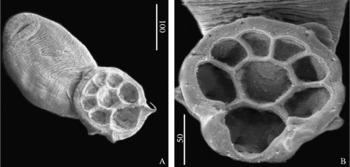
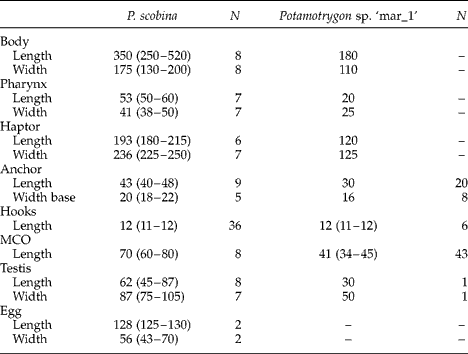
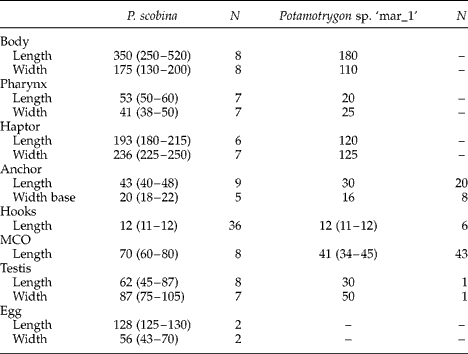
Description. Based on 17 specimens (figs 6, 7). Body fusiform, total length – excluding haptor – 350 (250–520; n = 8), 175 (130–200; n = 8) wide at level of germarium. Tegument smooth. Cephalic lobes poorly developed or absent; three pairs of head organs converging to unique pore; cephalic glands unicellular, posterolateral to pharynx, with rod-shaped secretion. Anteromedial gland present. Dispersed pigment granules dorsal to pharynx, infrequently absent. Mouth surrounded by sclerotized ridges, medial sclerotization of the mouth discontinuous. Pharynx elongate ovate, 53 (50–60; n = 7) long, 41 (38–50; n = 7) wide; oesophagus short; two intestinal caeca, non-confluent, lacking diverticula; distal ending close to testis. Haptor circular, 193 (180–215; n = 6) long, 184 (170–200; n = 6) wide, with one central and seven peripheral loculi (two anterior, four lateral, one posterior) (fig. 7); septa surrounded by slightly sinuous sclerotized ridge. Dorsal surface of haptor with two pairs of haptoral accessory structures associated with lateral and posterior peripheral loculi; each dorsal haptoral accessory structure with sclerotized margins. Anterior pair of dorsal haptoral accessory structures associated with posterolateral loculi bilobate, with well-separated lobes, each lobe semicircular; posterior pair of dorsal haptoral accessory structures associated with posterior loculus semicircular (see fig. 9C). Anchors 43 (40–48; n = 9) long, base 20 (18–22; n = 5) wide, with heavy diverging roots; evenly curved shaft and point. Hooks similar, 12 (11–12; n = 36) long, distributed on marginal membrane of haptor, with slightly depressed thumb, shaft with proximal portion dilated and curved point. Male copulatory organ sclerotized, long, straight, slightly tapered tube, 70 (60–80; n = 8) long, distal aperture terminal. Accessory piece absent. Testis cordiform, 62 (45–88; n = 8) long, 88 (75–105; n = 7) wide; vas deferens and seminal vesicle not observed. Ejaculatory bulb muscular, ovate without distinct internal chambers; glands associated with ejaculatory bulb not observed. Germarium tubular, unbranched, looping right intestinal caecum; distal end ascendant; Mehlis' glands not observed. Vagina heavily muscular. Vaginal pore sinistroventral at level of proximal portion of germarium; seminal receptacle not observed. Oötype well developed. Vitellarium coextensive with gut, absent in regions of reproductive organs. Egg ovate, 128 (125–130; n = 2) long, 56 (43–70; n = 2) wide, with long filament; distal end of filament reticulate.
Potamotrygonocotyle septemcotyle sp. nov. (A) Whole mount (holotype); (B) male copulatory organ; (C) egg; (D) hook; (E) anchor. Scale bars in μm.

Morphology of structures of Potamotrygonocotyle septemcotyle sp. nov., scanning electron micrographs. (A) Whole specimen, ventral view; (B) ventral view of haptor showing loculi. Scale bars in μm.

Holotype, type-host and type-locality. MZUSP no. 6823; Potamotrygon scobina, Rio Tocantins, Baía de Marajó, Municipality of Colares, Pará, Brazil (0°55′45″S, 48°17′29″W) 16 August 2007 (Host no. MZUSP PA04–07).
Other specimens. 15 paratypes: 10 MZUSP no. 6824a–j, 2 CHIOC no. 37397a–b, 1 INPA no. 543, 2 USNPC no. 103649, P. scobina, Rio Tocantins, Baía de Marajó, Municipality of Colares, Pará, Brazil (0°55′34.68″S, 48°17′25.4394″W), 16 August 2007 (Host no. MZUSP PA07–07); 4 vouchers: 1 MZUSP no. 6826, 1 CHIOC no. 37398, P. scobina, Rio Arari, Igarapé do Urubu, Municipality of Cachoeira do Arari, Pará, Brazil (0° 59′ 58.2″S 48°57′52.5594″W), 29 August 2007 (Host no. MZUSP PA07–83); 1 MZUSP no. 6825, 1 INPA no. 544, Potamotrygon sp. ‘mar_1’, Rio Arari, Igarapé do Urubu, Municipality of Cachoeira do Arari, Pará, Brazil (0°59′58.2″S 48°57′52.5594″W), 28 August 2007 (Host nos MZUSP PA07–63–64).
Site of infection. Gills.
Etymology. The specific name refers to the presence of seven peripheral loculi on the haptor.
Comparative measurements. Table 8.
Comparative measurements (in μm) of Potamotrygonocotyle septemcotyle sp. nov. from Potamotrygon scobina (type host) and Potamotrygon sp. ‘mar_1’. N, Number of specimens measured.
Remarks. Potamotrygonocotyle septemcotyle sp. nov. nested as sister to the clade at node G (fig. 2), which is represented by P. chisholmae and its junior synonym P. uruguayense, based on the presence of a long egg filament (character 11, table 1 and fig. 2) – a homoplastic character also found in P. tocantinsense. Potamotrygonocotyle chisholmae can be distinguished from P. septemcotyle by possessing continuous medial sclerotization on the mouth, an autapomorphy for the former (character 9, table 1, and fig. 1B). Potamotrygonocotyle septemcotyle sp. nov. differs from all other species of Potamotrygonocotyle by possessing seven peripherical loculi (character 4, table 1 and fig. 2).
Potamotrygonocotyle auriculocotyle sp. nov
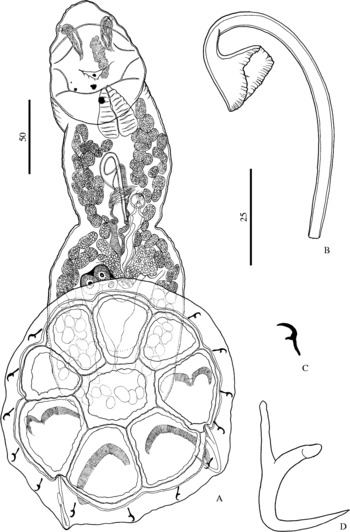
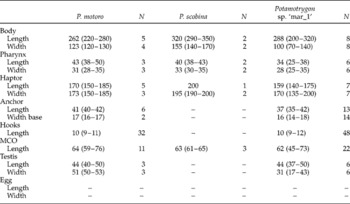
Description. Based on 11 specimens (fig. 8). Body fusiform, total length – excluding haptor – 262 (220–280; n = 5), 123 (120–130; n = 4) wide at level of germarium. Tegument smooth. Cephalic lobes poorly developed or absent; three pairs of head organs converging to unique pore; cephalic glands unicellular, posterolateral to pharynx, with rod-shaped secretion. Anteromedial gland present. Dispersed pigment granules dorsal to pharynx, infrequently absent. Mouth surrounded by sclerotized ridges, medial sclerotization of the mouth discontinuous. Pharynx elongate ovate, 43 (38–50; n = 3) long, 31 (28–35; n = 3) wide; oesophagus short; two intestinal caeca, non-confluent, lacking diverticula; distal ending close to testis. Haptor circular, haptoral disc approximately 2/3 of body length, 170 (150–185; n = 5) long, 173 (150–185; n = 5) wide, with one central and eight peripheral loculi (two anterior, four lateral, two posterior); septa ventrally surrounded by slightly sinuous sclerotized ridge. Dorsal surface of haptor with two pairs of haptoral accessory structures associated with lateral and posterior peripheral loculi; each dorsal haptoral accessory structure with sclerotized margins. Anterior pair of dorsal haptoral accessory structures associated with posterolateral loculi bilobate, each dorsal haptoral accessory structure with lobe with slightly concave separation between lobes, each lobe semicircular; posterior pair of dorsal haptoral accessory structures associated with posterior loculi semicircular, each lobe laterally expanded, ear-like (fig. 9D). Anchors 41 (40–42; n = 6) long, base 17 (16–17; n = 2) wide, with heavy diverging roots; deep root twice as large as superficial root; evenly curved shaft and point. Hooks similar, 10 (9–11; n = 32) long, distributed on marginal membrane of haptor, with slightly depressed thumb, shaft with proximal portion dilated and curved point. Male copulatory organ sclerotized, long arcuate tapered tube, inverted ‘J’ shape, 64 (59–76; n = 11) long, aperture terminal. Accessory piece absent. Testis cordiform, 44 (40–50; n = 3) long, 51 (50–53; n = 3) wide; vas deferens and seminal vesicle not observed. Ejaculatory bulb muscular, ovate without distinct internal chambers; glands associated with ejaculatory bulb not observed. Germarium tubular, unbranched, looping right intestinal caecum; distal end ascendant; Mehlis' glands not observed. Vagina heavily muscular. Vaginal pore sinistroventral at level of genital pore; seminal receptacle not observed. Oötype well developed. Vitellarium coextensive with gut, absent in regions of reproductive organs. Egg not observed.
Potamotrygonocotyle auriculocotyle sp. nov. (A) Whole mount (composite); (B) male copulatory organ; (C) hook; (D) anchor. Scale bars in μm.

Morphology of dorsal haptoral accessory structures of Potamotrygonocotyle spp., scanning electron micrographs. (A) Potamotrygonocotyle tatianae sp. nov.; (B) Potamotrygonocotyle tocantinsense sp. nov.; (C) Potamotrygonocotyle septemcotyle sp. nov.; (D) Potamotrygonocotyle auricolacotyle sp. nov. Scale bars in μm.

Holotype, type-host and type-locality. MZUSP no. 6827; P. motoro, Rio Arari, Igarapé do Urubu, Municipality of Cachoeira do Arari, Pará, Brazil (1°00′36″S 48°57′36″W), 28 August 2007 (Host no. MZUSP PA07–50).
Other specimens. 9 paratypes: 7 MZUSP no. 6828a–h, 1 CHIOC no. 37399, 1 INPA no. 545, P. motoro, Rio Arari, Igarapé do Urubu, Municipality of Cachoeira do Arari, Pará, Brazil (0°59′58.2″S 48°57′52.5594″W), 28 August 2007 (Host nos MZUSP PA07–50); 26 vouchers: 1 CHIOC no. 37403, P. motoro, Rio Arari, Igarapé do Urubu, Municipality of Cachoeira do Arari, Pará, Brazil (0°59′58.2″S 48°57′52.5594″W), 29 August 2007 (Host no. MZUSP PA07–82); 8 MZUSP nos 6829–6834, 4 CHIOC no. 37400-37402, 5 INPA no. 547a–e, 3 USNPC nos 103652–103654, 3 HWML no. 49136, Potamotrygon sp. ‘mar_1’, Rio Arari, Igarapé do Urubu, Municipality of Cachoeira do Arari, Pará, Brazil (0°59′58.2″S 48°57′52.5594″W), 28 August 2007 (Host nos MZUSP PA07–62–64, PA07–84–85); 1 INPA no. 546, 1 HWML no. 49317, P. scobina, Baía de Marajó, Rio Tocantins, Municipality of Colares, Pará, Brazil (0°55′34.68″ S, 48°17′25.4394″W), 22 August 2007 (Host no. MZUSP PA07–46).
Site of infection. Gills.
Comparative measurements. Table 9.
Comparative measurements (in μm) of Potamotrygonocotyle auriculocotyle sp. nov. from Potamotrygon motoro (type host), Potamotrygon scobina and Potamotrygon sp. ‘mar_1’. N, Number of specimens measured.

Etymology. The specific name is from Greek and refers to the posterior dorsal haptoral accessory structure which is similar to an ear.
Remarks. Potamotrygonocotyle auriculocotyle sp. nov. nested in a polytomy with P. rionegrense and a large clade comprised of most of the species of Potamotrygonocotyle (node D) in a node (C) supported by the presence of the dorsal haptoral accessory structure associated with the posterolateral loculi bilobate (character 5, table 1 and fig. 2). Potamotrygonocotyle auriculocotyle sp. nov. differs from P. rionegrense by having the posterior dorsal haptoral accessory structure elongated laterally, similar to an ‘ear’ (character 7, table 1 and fig. 2), which is semicircular in P. rionegrense.
Discussion
Taxonomic status of Potamotrygonocotyle
The monophyly of Potamotrygonocotyle is supported by the presence of sclerotizations around the mouth. We did not observe eggs in P. auriculocotyle sp. nov. and P. rarum; however, based on our analysis, the presence of an ovate egg seems to represent another synapomorphy for the genus. We recognized 12 valid species for the genus after examining 772 specimens collected in 436 potamotrygonid host individuals from 19 localities (i.e. sub-basins) throughout South America. This is the most extensive sampling effort ever to document the monogenoid fauna of freshwater stingrays, without which we would not have been able to acknowledge the morphological variability within each nominal species and provide a more robust taxonomy for this genus.
Early attempts to advance our understanding of the diversity of freshwater monocotylids generally overlooked the importance of biogeographical and host representation on the circumscription of Potamotrygonocotyle species. As a result, two recently erected species (e.g. Potamotrygonocotyle eurypotamoxenus and P. uruguayense; Domingues & Marques, Reference Domingues and Marques2007) are now considered junior synonyms of P. tsalickisi and P. chisholmae, respectively. For each case, as more material became available to us, it became clear that certain diagnostic characters that were once thought to be discrete are, in fact, part of a continuous morphological cline. Thus, since we have examined more specimens for each nominal species, understanding the boundaries of interspecific variability for each of these nominal species became possible. This observation only points out the obvious: we need large sample sizes and meaningful biogeographical and host representation to achieve our goal of a fair assessment and understanding of the diversity of freshwater monocotylids. This pattern should not be different for any other parasite group, but historically our understanding of the diversity of parasites of potamotrygonids, except for a few recent studies (e.g. Marques & Brooks, Reference Marques and Brooks2003; Reyda, Reference Reyda2007), has traditionally been based on biological data obtained from restricted biogeographical areas, low host representation, and only a few examined specimens. Our prediction is that, as we study other taxa of parasites of potamotrygonids within the framework adopted in the present study, we will better understand the diversity of this host–parasite system and consequently be able to define species boundaries based on robust and unambiguous morphological characters.
It is worth mentioning that the species recognition approach used here for Potamotrygonocotyle is underlined by a species concept that provided hypotheses for nominal species that are themselves open to critical test. We recognized as valid species all terminals that either possessed an autapomorphy or could be distinguished from those in the topology (fig. 2). As will be discussed below, some valid species (e.g. P. chisholmae and P. tsalickisi) recognized here have a widespread distribution through out South America and are hosted by many different species of potamotrygonids, raising the possibility that these comprise species complexes. Be that as it may, we believe that the approach undertaken in this study is sound, even though we were limited by the number of morphological characters considered informative for the systematics of this group, which was unable to resolve 30% of the nodes. The lack of resolution is attributed to the low number of informative characters compiled. We believe that the inclusion of different sources of characters (e.g. molecular) will not only improve the resolution of the sister-group relationships within Potamotrygonocotyle but also test our concept of valid species within the genus.
Patterns of distribution and host specificity in Potamotrygonocotyle
The pattern of distribution for species of Potamotrygonocotyle seems to mirror those already reported for other helminths (cestodes) inhabiting potamotrygonids (Marques & Brooks, Reference Marques and Brooks2003; Marques et al., Reference Marques, Brooks and Araújo2003; Bueno, Reference Bueno2010). For instance, some species are known to inhabit a single host species, which is in turn only found in a single biogeographical region (i.e. sub-basin), such as P. quadracotyle and P. umbella from Potamotrygon sp. ‘cururu’, all restricted to Rio Negro. On the other hand, P. rarum collected from Potamotrygon schroederi in Rio Negro and P. tatianae sp. nov. from Paratrygon sp. ‘1’ from the upper Solimões seem to be biogeographically restricted despite the observation that their hosts are found elsewhere. Potamotrygon schroederi is also known from the Orinoco basin (Carvalho et al., Reference Carvalho, Lovejoy, Rosa, Reis, Kullander and Ferraris2003) and this undescribed species of Paratrygon has been collected in the upper Solimões and lower Amazon (F.P.L. Marques, unpublished data). Close attention to the pattern of distribution of Potamotrygonocotyle aramasae reveals that this species is tightly associated with its host (Paratrygon aiereba) throughout its distribution. This observation suggests that we should expect to find P. rarum and P. tatianae in the Orinoco and lower Amazon, respectively, if this distributional pattern is not constrained by any particular abiotic properties of South American rivers (see below). Since we did not have access to gill samples from these particular hosts in other localities, this prediction remains to be tested by additional sampling.
An indication that some species are biogeographically restricted despite the distribution of their hosts is somewhat illustrated by the species of Potamotrygonocotyle found in the lower Amazon (i.e. Baía de Marajó, Pará, Brazil). We reported two species for this area, P. septemcotyle sp. nov. and P. auriculocotyle sp. nov.; both found in Potamotrygon scobina and an undescribed species of Potamotrygon (herein referred to as ‘mar_1’), in addition to the report of P. auriculocotyle sp. nov. in Potamotrygon motoro. Although this undescribed species of Potamotrygon is only known for Baía de Marajó and we have not obtained samples of Potamotrygon scobina from elsewhere, we examined many specimens of Potamotrygon motoro from other localities without finding P. auriculocotyle sp. nov.
In contrast to the patterns described above, four species of Potamotrygonocotyle (i.e. P. tsalickisi, P. chisholmae, P. dromedarius and P. rionegrense) are widely distributed. In all cases, they can be found in both major basins of South America: Amazon and La Plata. Among those, some parasite species are restricted to as few as 4–5 host species (i.e. P. dromedarius and P. rionegrense, respectively) or to as many as 10 (i.e. P. tsalickisi and P. chisholmae). This pattern of host specificity and distribution is unusual among monogenoids, which are considered to exhibit strict host specificity (Bychowsky, Reference Bychowsky1957; Llewellyn, Reference Llewellyn1982). One could argue that some of these species may include hidden lineages within their concept (i.e. cryptic species). We do not rule out this possibility, the corollary of which would be that the pattern observed is due to taxonomic artefact, which could be tested with additional material and the assessment of different source data.
At the present state of knowledge, we provide no detailed explanation for the patterns described above. This depends primarily on additional samples from areas that have never been appropriately surveyed, better refinement on the taxonomy of the hosts, and examination of additional host species, among others. It is clear that this is a complex system of host–parasite association, nested in a biogeographical region with equally complex history that currently houses a mosaic of aquatic environments – each of these with their own abiotic properties. The underlying processes responsible for the patterns recovered thus far ought to have historical and ecological components.
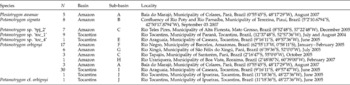
Explanations for the absence of lineages of Potamotrygonocotyle in some hosts and localities are equally complex to provide, due to the patterns described above. Throughout this study, members of Potamotrygonocotyle have been collected from the gills of 12 nominal species of Potamotrygonidae from the major basins of South America. Although we have sampled more than 60% of 16–21 valid host species, in addition to 171 unidentified hosts from an unknown number of undescribed potamotrygonids, we have not collected members of Potamotrygonocotyle in Plesiotrygon iwamae Rosa, Castello & Thorson, 1987, Potamotrygon signata Garman, 1913, an undescribed species of Potamotrygon from upper Tabajós (herein referred to as Potamotrygon sp. ‘tpj_2’), and three distinct chromatic patterns of an unidentified species of Potamotrygon from upper Tocantins (referred to as Potamotrygon spp. ‘toc_1’, ‘toc_3’ and ‘toc_4’) (table 10). Although few specimens have been found parasitizing Potamotrygon orbignyi from the upper Amazon region (Rio Yavari and Rio Tarauacá), we did not find Potamotrygonocotyle on P. orbignyi from five Amazonian sub-basins (e.g. Negro, Xingú, Tapajós, Urariquera, Rio Araguaia/Tocantins; see table 10) and the mouth of the Amazon (i.e. Baía de Marajó; see table 10).
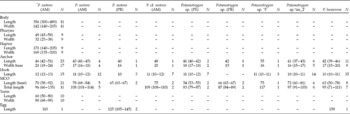
List of hosts for which no parasites were recorded. A, Meruu–Acará–Guama–others; B, Parnaíba; C, Amazonas–Tapajós–Juruena; D, Tocantins–Paranã–Palma; E, Rio Araguaia–Crixas Açu–Peixe; F, Solimões–Negro–Branco; G, Amazonas–Xingú–Iriri-Paru; H, Amazonas–Trombetas–others; I, Rio Araguaia–Crixas Açu–Peixe; J, Tocantins–Manoel Alves–Sono.

The absence of members of Potamotrygonocotyle in Plesiotrygon iwamae could have at least two explanations: one related to abiotic conditions of the locality from which the available samples came, the other historical. The samples we examined for this host came from a survey carried out in Baía de Marajó, an area of the lower Amazon which suffers tidal and salinity fluctuations throughout the year. Potamotrygonids have been known to exhibit low tolerance to brackish water (Thorson et al., Reference Thorson, Brooks and Mayes1983), although the limits tolerated seem to be unknown and certainly varied among different species (Charvet-Almeida, Reference Charvet-Almeida2001). Among the species collected at the same locality from which we obtained our samples for Plesiotrygon iwamae, the latter seems to be the most tolerant to different levels of diluted salt in the water (Charvet-Almeida, Reference Charvet-Almeida2001). If members of Potamotrygonocotyle do not share the same level of salt tolerance as Plesiotrygon iwamae, we would expect that salinity is determining the distribution of these parasites in this species at this particular collecting site. If that is true, we would expect to find members of Plesiotrygon iwamae hosting monogenoids in the middle and upper portions of the Amazon, both of which are within the distributional range of this potamotrygonid. If upon the examination of additional hosts we fail to encounter members of Potamotrygonocotyle, sorting events (i.e. extinction or failure to speciate) could be contemplated as a hypothesis to explain the absence of the parasite on this host species.
Compared to most species of potamotrygonids, Potamotrygon signata, an endemic species from Rio Parnaíba, has been known to host very few species of cestodes (Marques & Brooks, Reference Marques and Brooks2003). For instance, cestode genera commonly found in potamotrygonids (i.e. Acanthobothrium, Rhinebothrium and Potamotrygonocestus) have never been reported after examining more than 20 host specimens (Marques & Brooks, Reference Marques and Brooks2003; Marques et al., Reference Marques, Brooks and Araújo2003; Reyda, Reference Reyda2007; Bueno, Reference Bueno2010). Compared to the rivers from Amazon and La Plata basins, Rio Parnaíba has a very distinct geological and palaeoclimatic history (see Rosa et al., Reference Rosa, Menezes, Britski, Costa, Groth, Leal, Tabarelli and da Silva2003; Ribeiro, Reference Ribeiro2006). Compared to adjacent and historically connected sub-basins of the Amazon, Pantanal and north-eastern Brazil, Rio Parnaíba has a much lower fish diversity, of which a little more than 90% of the lineages found in that river have also been reported elsewhere. The underlined assumption to explain the low diversity of Rio Parnaíba is the extinction of many lineages as a result of the palaeogeographical history of this basin. Thus, the absence of parasites in Potamotrygon signata mirrors the absence of many groups of fishes found in other rivers that have been connected historically to Rio Parnaíba (see Hubert & Renno, Reference Hubert and Renno2006).
The absence of members of Potamotrygonocotyle in Potamotrygon orbignyi and other species from Rio Tocantins and Tapajós (see above) remains puzzling. These species are hosts of the majority of the lineages of cestodes documented for potamotrygonids (Marques & Brooks, Reference Marques and Brooks2003; Marques et al., Reference Marques, Brooks and Araújo2003, Reyda, Reference Reyda2007; Bueno, Reference Bueno2010). There are no data available on the ecology of these species that would allow any ecological explanation for the absence of members of Potamotrygonocotyle. The same applies for any historical explanation, which would depend on evaluating the phylogenetic positions of these hosts in comparison to the phylogeny of the parasites. This and a number of other unanswered questions, which ultimately depend on refining the taxonomy and phylogeny of each component of the system under the possession of more robust data, should be addressed as we acummulate more information on this host–parasite system.
Acknowledgements
We would like to thank M. Cardoso Jr, V.M. Bueno, G. Mattox, N. Luchetti, M.L. Goés, S. Melo, J.P.C.B. da Silva, T.S. Loboda and M.R. de Carvalho for assistance during the collecting trips; F. Reyda (State University of New York, College at Oneonta, USA) and T. Scholz (Institute of Parasitology, Academy of Sciences of the Czech Republic, Czech Republic) for collecting and sending material from Peru; J.O. Garcia from the Universidad Nacional de Misiones for collecting and sending material from Argentina; N.C.M. Pancera for laboratory assistance; V.M. Bueno (Universidade de São Paulo, Brazil) for reviewing early versions of this manuscript. We thank E. Mattos and E. Mattos (in memorian) (Universidade de São Paulo, Brazil) for scanning electron microscopy support. We thank two anonymous reviewers for their excellent contribution to this manuscript. This work was supported by a research grant from the Fundação de Amparo à Pesquisa do Estado de São Paulo-FAPESP (FAPESP 03/01816–2 and 05/01299–3) to F.P.L.M. and by the post doctoral fellowship to M.V.D. (FAPESP 04/09267–0).