Introduction
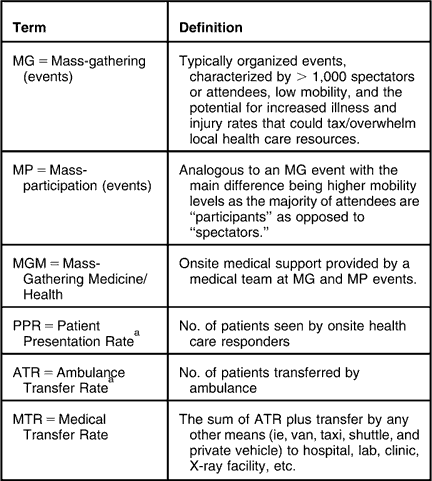
The British Columbia (BC) Ride to Conquer Cancer (hereafter referred to as the “Ride”), an annual charitable cycling event with thousands of participants, 1 is a mass-participation (MP) event. Mass-participation events are a distinct subcategory of mass gatherings (MGs, Table 1) and involve a higher degree of participant mobility and more intense levels of activity (eg, riding a bicycle vs sitting at a concert) that naturally place participants at an increased risk for illness and injury.Reference Milsten, Maguire, Bissell and Seaman 2 , Reference Arbon 3
Commonly Used Abbreviations and Definitions

Abbreviations: ATR, ambulance transfer rate; MG, mass gathering; MGM, mass-gathering medicine; MP, mass participation; MTR, medical transfer rate; PPR, patient presentation rate.
aAll rates are per 1,000 attendees/staff/volunteers at event.
Raising funds for cancer research, the Ride is held annually in several locations across Canada. In BC, the Ride is a 2-day, 250 km, paved cycling event starting just south of Vancouver, BC, Canada and concluding just north of Seattle, Washington, in the United States [US].
Two issues related to the specific nature of the event make it unique. First, the Ride crosses an international border between Canada and the US, creating many issues. For example, each participant, volunteer staff member, spectator, and member of the medical crew is required to report for customs clearance. Due to issues with credentials across international borders, two medical directors, one Canadian and one American are required to address jurisdictional issues. And, because the Ride passes through multiple Emergency Medical Services (EMS) catchment areas on both sides of the border, the event requires a medical plan involving international collaboration between Canadian and American health care providers.
Second, given the mobile nature of the event, there is a need to provide support in strategic locations over the 250 km (155 mile) distance of the Ride, or a “rolling” medical plan. This is in stark contrast to confined arena-based sporting events, or even marathons, for which the distances and the event footprint are generally much smaller. As an added challenge, given the range of rider fitness levels, the spread between the riders at any given time during the Ride was up to 100 km, requiring medical assets to be coordinated over an extensive distance.
This report describes a case series of three years based on data available in the University of British Columbia (UBC) Mass-Gathering Medicine (MGM) Online Event and Patient Registry. 4 This case series reports the patient presentation rate (PPR), the ambulance transfer rate (ATR), the medical transfer rate (MTR), and case mix of the participants from 2010 through 2012. The MTR is preferred by the authors over the transfer to hospital rate (TTHR) or ATR, which are also used in the MGM literature, since not all transfers off site involve ambulances or hospital-based care.Reference Lund, Gutman and Turris 5 All rates are per 1,000 participants.Reference Arbon, Bridgewater and Smith 6
In addition, this report describes the strategies employed by the medical operations team to address challenges associated with this type of event, providing future medical organizers with information that may be of assistance in hosting events of similar type and size. Knowledge gained from this study may assist medical directors in formulating prevention-related strategies.
Background and Review of Literature
Internationally, cycling is enjoyed as both a recreational pastime and a competitive endeavor. As with most sporting activities, there is an inherent heightened risk of injury. Specifically, cycling injuries account for one-half of all injuries requiring hospital admissions in Canada in the recreation and summer sports category. 7 Furthermore, serious head traumas historically have been reported at cycling events, although incidence rates have decreased with the advent of helmet legislation.Reference Macpherson, To, Macarthur, Chipman, Wright and Parkin 8 - Reference Kennedy 11
The popularity of cycling has become such that many charitable organizations are hosting short, middle, and long-distance rides to raise funds. At charitable long-distance cycling events, many cyclists enter as recreational riders and may not have extensive race or road riding experience. A study by Bowles et al reported that approximately 50% of the participants of MP cycling events rated themselves as inexperienced riders.Reference Bowles, Rissel and Bauman 12 This inexperience may be a factor in the higher number of participants requiring first aid and/or medical services compared to other categories of MG events.
Several papers describe the medical coverage at large-scale cycling events, including reports on the Cycle Across Maryland tour (Maryland USA),Reference Dannenberg, Needle, Mullady and Kolodner 9 the California AIDS Ride (California USA),Reference Friedman, Rodi, Krueger and Votey 13 Bike New York (New York USA),Reference Emond, Tayoun, Bedolla and Camargo 10 the Register's Annual Great Bike Ride Across Iowa (RAGBRAI, Iowa USA),Reference Boeke, House and Graber 14 and the Heartland AIDS Ride (Minnesota, Wisconsin, and Illinois USA).Reference Townes, Barsotti and Cromeans 15 With the exception of Boeke and his colleagues, who reported on the RAGBRAI over a 5-year period,Reference Boeke, House and Graber 14 researchers typically focus on describing a single year of data.Reference Dannenberg, Needle, Mullady and Kolodner 9 , Reference Emond, Tayoun, Bedolla and Camargo 10 , Reference Friedman, Rodi, Krueger and Votey 13 , Reference Townes, Barsotti and Cromeans 15
Reported PPRs vary extensively among studies, perhaps due to the different durations (ie, one to seven days), varying distances (ie, 50-500 miles),Reference Dannenberg, Needle, Mullady and Kolodner 9 , Reference Emond, Tayoun, Bedolla and Camargo 10 , Reference Friedman, Rodi, Krueger and Votey 13 - Reference Townes, Barsotti and Cromeans 15 and “off road” components incorporated into some races. The case mix reported includes a spectrum of traumatic, orthopedic, cardiopulmonary, gastrointestinal, neurological, and dermatological injuries.Reference Dannenberg, Needle, Mullady and Kolodner 9 , Reference Emond, Tayoun, Bedolla and Camargo 10 , Reference Friedman, Rodi, Krueger and Votey 13 , Reference Boeke, House and Graber 14
Accordingly, medical planning for long-distance cycling events must provide care across the continuum ranging from basic treatment for nonacute injuries through to Advanced Life Support and stabilization of the critically injured. The goal is to treat on site whenever possible in order to avoid unnecessary transport of patients to local medical facilities, thus reducing the burden on local EMS.Reference Gutman, Lund and Turris 16 - Reference Herring, Bergfeld and Boyajian-O'Neil 18
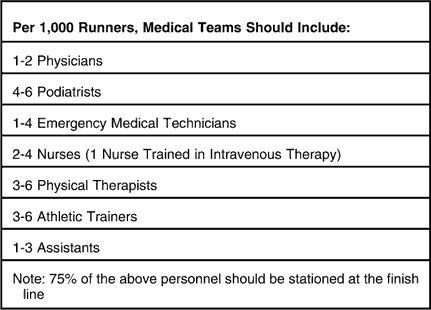
Rigorous theory and models regarding the number of first aid and medical team members required to safely cover an event similar to the Ride is lacking at this time. However, the American College of Sports Medicine (Indianapolis, Indiana USA) has made recommendations for estimating the number of medical personnel per 1,000 people for long-distance running events (Table 2).Reference Armstrong, Epstein, Greenleaf, Haymes, Hubbard and Roberts 19 Of note, these recommendations apply to events with a fixed location for the finish of the event.
Recommendations for Medical Team Ratios Servicing Long-distance Running Events19

The medical director should be able to collaborate with event planners and local EMS services prior to the event to address the administrative issues associated with the event, including, but not limited to: a hazardous condition plan, transportation of injured participants on and off site, communication between members of the medical team and between groups of volunteers/staff at the event, competitor education, competition site preparation, staffing for medical areas, and medical equipment. Medical protocols should be apparent and familiar to all members of the medical crew and other event crew members.Reference Herring, Bergfeld and Boyajian-O'Neil 18 Moreover, event-specific concerns (eg, methods of hydration and energy replacement) should be addressed prior to events as well as their associated illness (eg, dehydration, hyponatremia, fatigue, and anaphylaxis). Environmental conditions during the event, such as extremes of temperature, humidity, and precipitation must be considered and planned for in terms of medical supplies and equipment.
Drawing on the above literature and the experience gained providing medical support for other MP events, this report team provided medical services planning and support for the participants of the 2010 through 2012 Rides to Conquer Cancer. The following discussion outlines the team's analysis of three years of data on illness and injury rates for this cross-border cycling event.
Methods
Ethical approval for this project was granted from the UBC's Behavioural Research Ethics Board. Three years of data were prospectively enrolled into the MGM Event and Patient Online Registry.Reference Lund, Turris, Amiri, Carson and Lewis 20
Preprinted patient encounter forms (PEFs) and minor treatment logs (MTLs), with complimentary data fields, were used during the event. Samples of these forms are available.Reference Arbon, Bridgewater and Smith 6 The PEFs and MTLs were distributed to each of the medical care sites and mobile roving teams. At some care sites with higher than anticipated demand, when forms ran out, blank paper was used to record patient encounters in order to minimize data loss. A research assistant was available at the camp and finish line to collect completed forms. Two categories of data were entered: 1) data related to event variables, and 2) data related to patient encounters. Analysis was performed on electronically unidentified patient data that had been prospectively entered into the web-based Event and Patient Online Registry.
Event Data
Event-related demographic data were gathered via event medical organizers and registry study personnel (eg, number of participants, crowd mood, crowd density, alcohol availability at the event, and ground surface condition). Meteorological data (eg, weather conditions, sky coverage, humidity, and temperature range) for Day 1 in Surrey, BC, Canada and for Day 2 in Seattle were extracted from Environment Canada and Weather Underground, respectively. 21
Patient Data
Patients were triaged according to the UBC MGM Triage and Discharge Acuity Scale, a 5-category triage system for MGsReference Turris and Lund 22 based on Simple Triage and Rapid Treatment (START) and the Canadian Triage and Acuity Scale (CTAS).Reference Bullard, Unger, Spence and Grafstein 23 , Reference Navin, Sacco and McCord 24 The categories are black (obviously deceased), red (emergent and requiring immediate intervention), yellow (urgent with the potential to become life threatening), green (non-urgent), and white (self treatment).
Report
Event-related Data
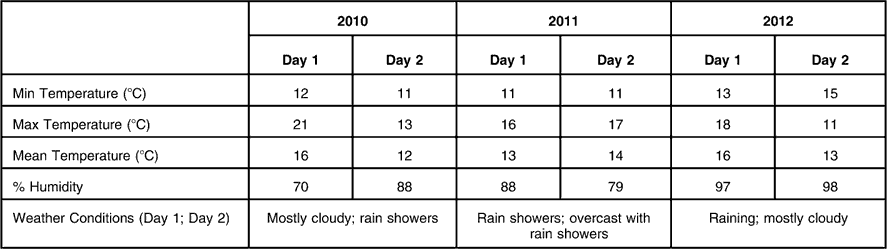
The Ride took place outdoors on paved roads, with the exception of the camp at night when event planners provided tents for participants, volunteers, and event staff. The participants were highly mobile and spread out, reflecting cycling speed. Riders experienced similar weather conditions—overcast with precipitation. The mean temperatures ranged from 12-16° C for all three years (Table 3). Alcohol was available for purchase at the campsite on Day 1 and at the finish line on Day 2.
Meterological Data, 2010-2012

Organization of Services
Because supplies, including medications, were transported across an international border, customs clearance had to be obtained; preprinted manifests for the contents of each vehicle were required. To address equipment and supply needs, a 2-tonne rental truck was loaded prior to the Ride with medical equipment required to stock the 40’ x 40’ (12.2 m x 12.2 m) main medical tent at the camp and finish line. Although this was only a 2-day event, capacity to carry overstock (ie, to replace supplies in preparation for the next special event) was vital as the medical team already had begun equipment deployment to cover a half-marathon and an outdoor concert the following weekend. To supplement the 2-tonne truck, a panel-style cargo van was used to shuttle equipment between pit stops and to run errands.
Charter buses were used to transport team members and preassigned equipment to each of the four pit stops and the lunch stop medical station, all of which were support/refreshment, first aid, and cheering stations located along the route. First aid stations were typically located under a 10’ x 10’ (3 m x 3 m) tent, with a more extensive set-up at the lunch stop. Camp and finish line staff were shuttled in via buses. Notably, one physician was present at camp from the opening of the event. Six additional physicians were riders (roving responders) and up-staffed the medical tent after their arrival in camp.
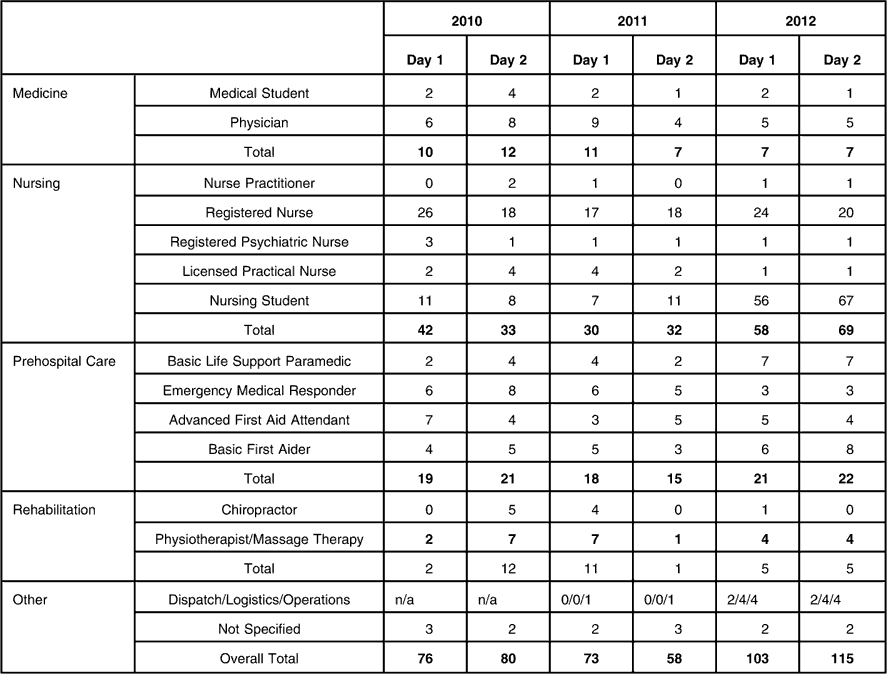
Medical staffing for the 2011 Ride included 152 volunteers, far in excess of the guidelines published by the American College of Sports Medicine for long distance running events.Reference Armstrong, Epstein, Greenleaf, Haymes, Hubbard and Roberts 19 The team included physicians, nurse practitioners, nurses, chiropractors, physiotherapists, paramedics, first aid attendants, dispatchers, and operations staff (Table 4). Mentored students participating in a variety of health care programs were an invaluable asset to the medical team. Onsite capabilities at the medical tents included Basic Life Support and Advanced Life Support, as well as the capability to supply oral/intravenous medications and treat traumatic and environmental illnesses of varying severity. Mobile teams distributed over the 120 km route for Day 1 and Day 2 included five roving minivans and five bicycle teams equipped to provide Basic Life Support, first aid, and spinal immobilization until an event physician, roving team, or ambulance arrived on scene.
Medical Team Members

Communication
A Medical Dispatcher was set up at the camp (Day 1) and finish line (Day 2). Event staff and medical team members were able to communicate directly to the Medical Dispatcher using a variety of options, including: 1) preprogrammed mic-phones supplied by the Ride's Event Communications Coordinator; 2) 2-way radios for the camp and finish line areas, but not out on the course due to their limited range; and 3) BlackBerry Bold Smart Phones (BlackBerry, Waterloo, Ontario Canada) for communication via text message or by using a free chat platform (Google Talk, Google Inc., Mountain View, California USA).
During this event, medical team members participated in a study of the use of text messaging to dispatch medical teams as a primary or secondary source of communication.Reference Lund, Wong, Lewis, Turris, Vaisler and Gutman 25 The Ride was included in the study as it posed unique communication challenges related to distance and mobility. Global Positioning System tracking abilities were also valuable. In addition to the Medical Dispatcher, a “Command Vehicle,” which included the Medical Director, the Operations Director, and a Communications staff member, followed the Ride, checked in with each pit stop team, carried gear for scene response, and rejoined the medical camp and finish line teams each day.
Patient-related Data
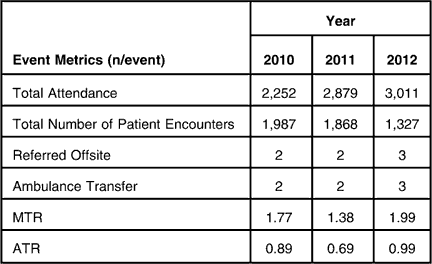
Since the event's inception, the number of participants in the BC event has grown by 62%, from 1,701 in 2009 to 2,879 in 2011, and 3,011 in 2012. The event has adopted an open registration system, resulting in participants of differing ages and fitness levels. Of note, a number of participants had unique premorbid risks associated with current cancer treatment or “survivor” status. All participants were required to have travel/medical insurance valid in the US. The course was active from 7:00 am until 6:00 pm each day. Participants and volunteers enjoyed refreshments and dinner at the prepared campsite (Day 1) before turning in for the night, or at the finish line (Day 2).
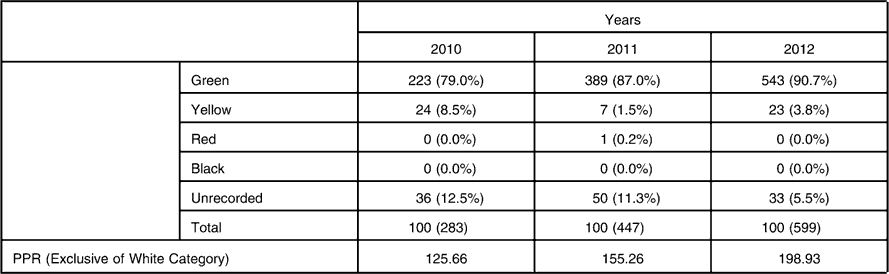
In 2010, 2011, and 2012, there were 1,987, 1,868, and 1,327 documented patient encounters, respectively. These figures include the nonurgent, dispensary, or self-treatment category. Exclusive of the nonurgent category, the number of patient encounters dropped substantially (2010, 283; 2011, 447; 2012, 599). The corresponding PPRs in each year, exclusive of the nonurgent category encounters, were 125.66/1,000 (2010), 155.26/1,000 (2011), and 198.93/1,000 (2012).
A great many people sought care for nonurgent issues, such as blister treatment, requests for acetaminophen, sunscreen, and water. These requests were categorized as “white” in terms of acuity. For 2010, there were 1,701 patient encounters in the white category. In 2011 and 2012, the number of self-treatment requests dropped to 1,421 and 728, respectively. It was hypothesized that as the event evolved, riders came prepared to provide self-treatment based on their experiences in preceding years.
The vast majority of patient encounters occurred at the main medical tent at the camp on Day 1, and then at the finish line on Day 2. However, the most serious cases presented almost exclusively en route. These included all of the serious crashes that involved injuries to the head, neck, clavicle, or extremities where continued riding was not possible, or transport to the nearest emergency department was indicated. Of the nonacute presentations, lower limb injuries comprised approximately one-third of all patient presentations, in each of the three years.
In 2010 and 2011, two patients were transferred to the hospital via the ambulance, compared with three ambulance transfers in 2012. In addition, several patients were referred offsite for care or transported by means other than an ambulance (two each in 2010 and 2011; three in 2012). The MTR and ATR for the three years were comparable (Table 5). The distribution of acuity levels shifted over the study period (Table 6). This may have been due to the fact that volunteers became more skilled with the use of the acuity scale each subsequent year.
Disposition of Patients, 2010-2012

Abbreviations: ATR, ambulance transfer rate; MTR, medical transfer rate.
Breakdown of Patient Acuity Levels Exclusive of the White Category, 2010-2012

Abbreviation: PPR, patient presentation rate.
Discussion
The challenges created by the crossing of an international border, combined with the spread of participants over long distances and great variation in the general fitness levels of the participants, made the Ride a complex event. Currently, events are categorized according to the following taxonomy: Type I events involve primarily spectators or attendees (eg, arena sporting events); Type II events involve mobile crowds (eg, golf tournaments and festivals); and Type III events involve primarily participants (eg, charity walks). In 2005, Townes proposed adding Type IV to the taxonomy, to capture the complexity of variable terrain, distances of hundreds of kilometers, and unique communication challenges that occur with adventure races.Reference Townes, Barsotti and Cromeans 15 The Ride is a Type IV event.
Of note, the PPR for the Ride was higher than injury and illness rates reported in the literature (0.14 to 90 [/1,000 people]).Reference Milsten, Maguire, Bissell and Seaman 2 The disparity among PPRs of similar events has been noted previously, as the PPR and transfer to hospital rate (TTHR) ranges can differ up to 60-fold.Reference Arbon 26
In the current study, data were collected prospectively as opposed to retrospectively. Due to the differing methods of data collection, it is difficult to make significant statements regarding the differing PPRs of previously published cycling events. However, several tentative implications should be considered. First, there does not seem to be an obvious correlation between the PPRs and the number of participants, total distance covered, distance per day covered, or the year in which it was held. This implies a wider range of variables and a complex interplay that has not been identified clearly. Second, it is difficult to compare a wide range of variables among events because some variables may be investigated by one team while another study focuses on different variables. Directions for future research should include establishing common data fields so that meaningful comparisons can be made.Reference Ranse and Hutton 27 , Reference Turris and Lund 28 Such comparisons will lead to a more sophisticated understanding of the complex variables at play during cycling and MP events.
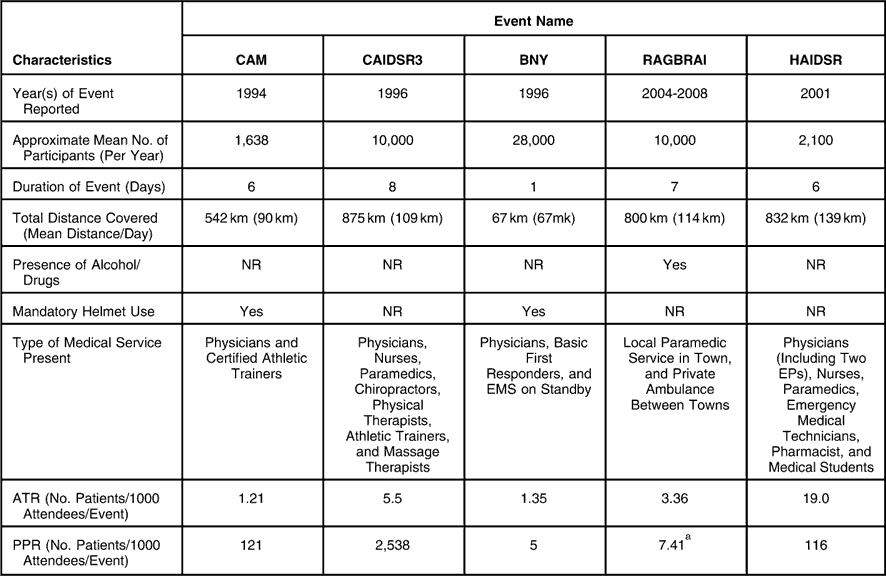
The reported ATR values (0.69-0.99) are lower than for similar events, which range from 1.21-19.0 (Table 7). The low ATR may suggest that the medical team was able to minimize ambulance transfers for patients. Physicians and nurse practitioners were invaluable in diagnosing patients and providing definitive treatment on site (eg, splinting, asthma treatment, and allergy presentations for which ambulance transport would otherwise have been required). In this context, emergency physicians bring specific and valuable experience regarding physiology, sport, and emergency medicine to the medical team at sporting events.Reference Grange, Baumann and Vaezazizi 29 Nurses capable of initiating IVs and delivering parenteral medications also enhanced the team's ability to provide care that traditionally would require a hospital visit. The extensive athletic care services (eg, physiotherapists, massage therapists, and chiropractors) that were available also may have contributed to lowering the ATRs by addressing musculoskeletal injury prevention and treatment.
Relevant event characteristics and patient presentations of similar long-distance cycling events. The mean value is reported if an event takes place over multiple days.

Abbreviations: ATR, ambulance transfer rate; BNY, Bike New York;10 CAIDSR3, California AIDS Ride 3;13 CAM, Cycle Across Maryland Tour;9 EP, emergency physician; HAIDSR, Heartland AIDS Ride;15 NR, not reported ; PPR, patient presentation rate; RAGBRAI, Register's Annual Great Bike Ride Across Iowa.14
aThe mean PPR over 5 years.
Cycling is associated with particular patterns of illness and injury, primarily musculo-skeletal, genito-urinary, and environmental. Knee injuries associated with overuse are the most common injury requiring medical attention at cycling events.Reference Dannenberg, Needle, Mullady and Kolodner 9 , Reference Townes, Barsotti and Cromeans 15 There are established risk factors associated with knee over-usage in recreational riders, most related to inexperience and lack of preride conditioning.Reference Dannenberg, Needle, Mullady and Kolodner 9 Given the incidence of lower leg injuries in the present study, interventions focused on prevention could yield substantial improvements in injury rates.
In contrast with the above reports, Boeke et al published a 5-year cycling case series on the RAGBRAI and confirmed a higher incidence of upper body soft-tissue and bone injuries compared to lower body.Reference Boeke, House and Graber 14 The authors suggested that “clipping” the shoes to the pedals possibly forced riders to use their upper limbs to break falls. Unfortunately, at the Ride, data related to footwear were not collected from 2010 to 2012.
For cycling in general (noncompetitive events), those riding on paved surfaces have a lower incidence of head and spinal cord injuries, possibly due to the commonplace use of helmets (or requirement for event participation, as in the case of The Ride)Reference Kennedy 11 , Reference Rivara, Thompson and Thompson 30 or lack of environmental hazards (ie, uneven ground, off-road obstacles). Linn et al reported that head and face injuries were more common in those who did not use helmets.Reference Linn, Smith and Sheps 31 Moreover, in a population-based study, provinces that had adopted mandatory helmet legislation showed a 45% decrease in head injuries.Reference Macpherson, To, Macarthur, Chipman, Wright and Parkin 8 Approximately three percent of all injuries at the Ride for all three years were head/neck injuries. There are similarly low values at other cycling events where helmet use was either mandatory for participation or not reported. The Ride event planners formulated a set course with low levels of vehicular traffic and predominantly smooth terrain, reducing traffic related risks for the participants.
Future Considerations
Those planning medical support for MP events must address several key questions. First, how should event planners address cross-border provision of care? In the current study, multiple medical directors with nation-specific credentials were necessary. Health care professionals from both countries provided medical support in the context of a strong collaboration between the American and Canadian medical directors. Of note, providers working outside of their licensed jurisdictions were acting as uncredentialed volunteers, and as such, any action undertaken had to be “approved” by the appropriate Medical Director.
Second, what is the appropriate allocation of the medical team around the course? One of the unique contributions of three years of data is the ability to more accurately predict resource needs. The majority of assets for the Ride were deployed at the pit stops and finish lines. The placement of the main medical tent at the finish line of the Ride (Day 1 at the night camp and Day 2 at the true finish line) has been supported by other studies.Reference Martinez 17 , Reference Armstrong, Epstein, Greenleaf, Haymes, Hubbard and Roberts 19 , Reference Nguyen, Milsten and Cushman 32 In addition, Nguyen and colleagues reported that for a marathon event, the first aid station en route at the middle of the course was the second busiest (compared with the finish line).Reference Nguyen, Milsten and Cushman 32 This observation parallels those at the Ride, where most injuries that occurred en route were attended to at the lunch stop and finish lines each day.
Third, what is the appropriate method of transport for medical teams and patients, taking into account the terrain and efficiency? In the present study, roving assets were valuable for nonemergency responses for “downed riders.” The roving teams travelled by bicycle and by minivan. Importantly, neither type of roving team could respond to time-sensitive emergency calls because the bikes and vans did not have the capacity to proceed to a particular location Code Three (ie, lights and sirens). In true emergency situations, 911 and local EMS were deployed.
Fourth, what is the burden of MGs on local services? In the future, liaison with local clinics and hospital emergency departments, and a “flagging” system for event-related charts, could be established, resulting in a more complete representation of event-related patient presentations. Both improved data entry on the part of the medical team, and improvements to the PEF form itself, would support the study of additional variables (eg, age and gender) that were missed or under-reported in the current study. To streamline real-time data entry and correct issues of illegibility, portable electronic sources (ie, tablet devices) likely will play a role.
Limitations
This study has three main limitations, primarily related to data collection and completeness. The Ride was unbounded and publicly accessible, and thus, presented a significant challenge in accurately determining the number of attendees (spectators and participants). The PPR, MTR, and ATR results may have been inflated artificially, as the denominator did not include spectators along the route.
Despite all the care put into documentation, ensuring complete capture of all patient data became an arduous task when upsurges in patient volume made recording all fields challenging. As a result, quick, incomplete, and abbreviated documentation was observed. Illegible writing in the narrative fields presented a challenge for data input as it made charts difficult to interpret. Similar difficulties related to documentation have been reported as a persistent problem, despite attempts to standardize the paper work at MG events.Reference Milsten, Maguire, Bissell and Seaman 2 , Reference Boeke, House and Graber 14 , Reference Gutman, Lund and Turris 16 , Reference Hnatow and Gordon 33
Finally, the research team had no access to follow-up documentation for patients who were treated and released by the on-site medical service providers and then required follow-up off site, a limitation found in most of the MG literature. Although on-site treatment of all injuries was the goal, the current approach to data collection did not provide the capacity to account for those who sought medical attention offsite (ie, family physician and local clinic).
Conclusion
The Ride is a logistically complex event. Organizers seek to accommodate as many participants as possible, while providing for nutritional needs, course marshalling, communications, event coordination, mechanical support for bikes, overnight shelter, sanitation, security, entertainment, and other services, all in the context of minimizing risks to public health and safety.
Accordingly, medical providers for long-distance, cross-border, charitable cycling events face a unique set of circumstances, including higher mobility, potentially higher PPRs, and legislative issues (eg, helmet law and medical credentials). Careful planning in the context of a diverse and mobile medical team, including physicians, basic and advanced first aid providers, and rehabilitation-related professionals, is recommended in order to increase the safety of all participants and minimize impact on the surrounding health care system.
Acknowledgements
The authors thank Rockdoc+ Consulting Inc. and all medical staff who volunteered their time to provide medical support and to record the patient data, without which this project would not have been possible. In addition sincere thanks are extended to Jordan Myers for providing invaluable event and medical coverage-related histories and to Michael Carson, of Trivent Consulting, for translating the electronic data from the Registry into user-friendly reports. Finally, this manuscript is dedicated to the memory of our American Medical Director, Dr. Keith Hardy.