Increasingly, the US and other international militaries are called on to provide disaster relief in the wake of large natural disasters. Since 2004, the US military has deployed to disaster zones 40 times. Between 2003 and 2006 alone, the United States deployed military assets 15 times for disaster relief.Reference Metcalfe, Haysom and Gordon 1 Many of these disasters took place in the Asia-Pacific: 45% in all between 1980 and 2009 and accounting for 83% of deaths due to natural disaster between 2000 and 2008. 2 In many of these contexts, military and humanitarian organizations occupy the same space and undertake similar tasks in support of international humanitarian relief efforts.
Yet, despite the increasing frequency with which military and humanitarian organizations coordinate activities during disaster relief efforts, few empirical data exist to assess the effectiveness of coordination efforts or to identify the factors shaping perceptions about the effectiveness of civil-military engagement. This study examined civil-military engagement in response to Typhoon Haiyan (locally Yolanda), which hit the Philippines on November 8, 2013. The study was conceived during an assessment mission to the Philippines taken in late November 2013. Observations from that mission revealed a lack of basic empirical evidence on the effectiveness of civil-military engagement.
The purpose of this study was to examine the perceptions of humanitarian actors as they related to civil-military engagement in response to natural disasters and to better characterize how major humanitarian actors view civil-military engagement in disaster relief. The study further makes a contribution to the literature on civil-military coordination by documenting operational experiences and perceptions of civil-military engagement in order to inform policy on humanitarian civil-military coordination, help shape the research agenda on civil-military engagement, and highlight gaps in current knowledge.
Methods
Detailed empirical evidence of the characteristics of civil-military engagement in response to natural disaster is scant. Most information about coordination between civilian and military actors in disaster response is based on a very small number of interviews with key stakeholders or single case studies. Although limited in scope, this study offers preliminary empirical data on civil-military engagement.
A survey instrument was designed on the basis of an analysis of the literature on civil-military engagement in response to natural disasters, a field assessment mission to the Philippines immediately following Typhoon Haiyan, and input from leading experts. The survey comprised 80 questions, some demographic and others focused on participant perceptions of the civil-military engagement in response to Typhoon Haiyan.
The survey instrument was made available online by using Google Forms (Google Inc, Mountain View, CA), and links to the survey were sent to country directors and agency leads who played a role in the response. Information about which international nongovernmental agencies (NGOs) were on the ground and which United Nations (UN) agencies played a role in the response is a matter of public record. The survey was targeted at international humanitarian agencies; future assessments would benefit from surveying local community groups and military actors, as well as state disaster management agencies.
The survey was available online from May 1, 2014, to August 30, 2014. A total of 64 surveys were completed. It is impossible to assess the return rate on the survey because it was anonymous (to encourage candid responses) and because there are no good estimates of the total number of plausible humanitarian actors in a position to assess the effectiveness of the coordination between military and civilian actors. In short, this was a targeted convenience sample, not a random sample. No claims about causality between explanatory and outcome variables can be made.
Results
The survey instrument used in the study incorporated basic demographic questions about the respondents, their role in the response, and their role within their organizations (the categorical variables), as well as Likert scale questions designed to capture humanitarian aid worker perceptions of the characteristics of civil-military engagement in the humanitarian response (the continuous variables).
Who Responded?
The survey respondents were by and large a skilled group of professionals with many years of professional experience. Fully 46% of respondents had more than 10 years of professional experience and 62% had more than 5 years of professional experience. Nearly half of the survey respondents played a civil-military role for their organization. Not surprisingly, the respondents stated that they engaged most with the military of the Philippines (36/64) and the United States (19/64), followed by Australia (17/64), Canada (15/64), the United Kingdom (10/64), and Japan (10/64).
Respondents played a variety of professional roles in their organizations. Thirty-eight percent of respondents self-identified as having an operational role, 30% had a program management role, and 10% had a logistics role. The remaining 22% of respondents had technical and information roles.
Training
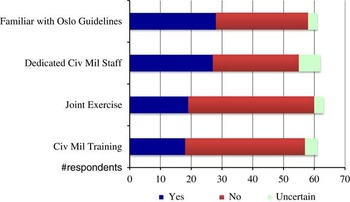
Respondents were queried about their knowledge of civil-military guidelines and their participation in civil-military training. Despite significant levels of professional experience, many respondents had modest levels of exposure to civil-military training or participation in joint exercises (Figure 1). Furthermore, just under half of respondents were familiar with the Guidelines on the Use of Foreign Military and Civil Defence Assets in Disaster Relief (the “Oslo Guidelines”). Only 12% of respondents stated that the Oslo Guidelines were used to develop organizational policy on engagement with military actors. This is notably low given that the Oslo Guidelines are the leading policy instrument for civil-military engagement. These findings suggest that better communication about the guidelines and follow-up with humanitarian organizations are needed to ensure that the guidelines are being properly incorporated into training.
Respondents’ Familiarity With the Oslo Guidelines, Whether the Respondent’s Organization Had a Dedicated Civil-Military Staff Member, Whether the Respondent Participated in Joint Civil-Military Exercises, and Whether the Respondent Participated in Civil-Military Courses.

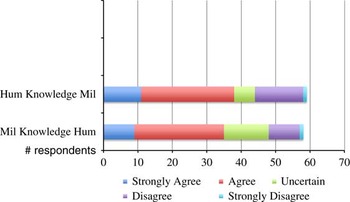
A large proportion of respondents felt that irrespective of training, civilian and military actors had limited knowledge of one another’s role in disaster response. Interestingly, humanitarian actors held that they themselves lacked as much knowledge of military actors as they felt military actors lacked knowledge of them (Figure 2).
Respondents’ Assessment of Their Own Knowledge of the Military Role in Disaster Response and of Military Knowledge of Humanitarians’ Role in Disaster Relief. Questions were as follows: “Regardless of training, humanitarian agency knowledge of the military’s role in disaster response is limited” (top bar) and “Regardless of training, military knowledge of the humanitarian mission is limited” (bottom bar).
When asked about the most critical information needed to effectively coordinate with military actors, respondents listed the following: contact points with military actors, lists of available military assets, guidelines for requesting use of military assets, and country-specific guidelines for coordinating with the military. The most effective coordinating bodies were UN cluster meetings, the use of liaisons, and government cluster meetings, in that order. Sixty-eight percent of respondents felt that liaisons should participate in cluster meetings.
Sixty-seven percent of respondents noted that their organization utilized military assets or support to assist in the delivery of humanitarian assistance. Only 21% said their organization did not rely on military assets, whereas 12% were uncertain. Thirty-two percent of organizations that utilized military assets did so for more than 2 weeks, with 18% of organizations relying on support for between 6 and 14 days, and 23% for 5 days or less. While military assets were important, most agencies did not rely primarily on military assets to deliver aid. The majority of respondents noted that needs assessments were shared among the UN, NGOs, and the military. Thirty-six percent of these respondents said that their organizations shared data with other agencies as soon as the data were acquired, 22% shared data on a daily basis, and 19% shared data on a weekly basis.
Perceptions
Consistent with other reports and findings, the empirical evidence from this study supports the claim that civil-military engagement in response to Typhoon Haiyan was well coordinated and effective. Sixty-seven percent of respondents noted that their organization utilized military assets or support in the delivery of humanitarian assistance. Seventy-one percent of respondents said that military assets enabled more efficient delivery of aid to populations in need. Only 2% suggested otherwise.
When asked whether coordination with military actors hindered operations, only 5% of respondents suggested that this was the case. Sixty-three percent said that coordinating with military actors did not hinder operations. The remaining 32% did not express an opinion. Sixty-four percent of respondents said that overall, civil-military coordination functioned well. Only 3% claimed that civil-military coordination did not function well.
When asked whether civil-military engagement had a positive outcome for local communities, 70% agreed that it did. Again, only 5% felt that there was a negative impact on local communities.
Limitations
There were some inherent limits to the research design. The first was that this study did not use a random sample of humanitarian aid workers, but relied on a convenience sample of leading humanitarian organization staff known to have been responsible for relief programs during the response to Typhoon Haiyan. This has at least two potential effects. The first is that it limited the overall number of respondents because it was up to the individual agency heads to distribute the link to their own agency staff. The second is that the results are potentially biased because it is likely that only those humanitarians who felt that they were able to comment authoritatively on civil-military engagement were likely to have responded.
Another limitation of the study was the time period during which the study was undertaken. The survey was not distributed until 6 months after the disaster, which may have had the effect of again limiting the number of respondents (because they had subsequently left the Philippines and were no longer engaged in the response), and because recall is likely to dwindle with time.
The length of the survey was likely a deterrent to many. Future studies should rely on fewer variables and aim to increase the number of survey responses.
Finally, this survey was a measure of humanitarian aid worker perceptions. Nothing can be inferred about how the local disaster-affected community views the effectiveness of civil-military coordination, nor can inferences be made about military perceptions of their interaction with humanitarian organizations.
Discussion and Conclusion
This study was designed to begin filling the gap in data on civil-military engagement in response to natural disaster. The findings will likely be of interest to policy makers and organizations involved in the delivery of humanitarian services in complex emergencies, as well as to the military, which will benefit from understanding humanitarian agency perceptions of military involvement in the delivery of humanitarian aid.
This study represents a departure from previous studies in that it seeks to build an empirical evidence base that explores the perceptions of humanitarians toward civil-military engagement during natural disasters and begins to account for those factors that best explain humanitarians’ perceptions of what accounts for good coordination.
Key factors associated with positive humanitarian aid worker perceptions of civil-military engagement in response to Typhoon Haiyan were identified. On the whole, humanitarians viewed civil-military coordination as effective and efficient. Furthermore, humanitarians felt that international militaries and the Philippines Armed Forces played an important role in ensuring that aid reached people in need, particularly in the early days of the response.
The study highlighted that, despite humanitarian perceptions of effective coordination, less than half of respondents were familiar with the Oslo Guidelines, and only 12% of respondents thought that the Oslo Guidelines were used to develop organizational policy on humanitarian aid agency engagement with military actors. Serious consideration should be given to greater dissemination of the guidelines, especially to those who have not yet participated in formal civil-military training courses.
Acknowledgments
Dr. Frederick Burkle was instrumental to the design of this study and has influenced my thinking about critical aspects of civil-military engagement. I am enormously indebted to his mentorship over the last 17 years.