Dynamic terrain of the Martian north-polar cap
The layering and deep ravines identified in the Martian north polar cap (Mars Surveyor, Mars Reconnaissance Orbiter) shows this to be one of the planet's most dynamic regions in geological terms. Four zones are distinguished in strata of the upper 800 m of the cap and the upper zone shows ~30 m periodic layering, which can be matched across much of the cap (MRO images, Milkovich & Head Reference Milkovich and Head2005). The layering is thought to record the accumulation of lag deposits alternating with accumulations of frost/snow on the 51 kyr insolation cycle corresponding to changes in the obliquity of Mars's axis.
The 3 Myr-old cap is thus significantly eroded on the 50 kyr timescale. That erosive sublimation occurs most strongly on south-facing slopes presumably explains the formation of the ravines, up to 1 km deep. Cliffs gradually form through south-facing slopes sublimating and gaining a dirt-encrusted surface, while horizontal surfaces brighten through frost deposits. The sublimating icy-dirt is unstable because of dust and frost feedback on surface albedo: sublimation reveals more dirt, which lowers the albedo and increases the temperature and leads to further sublimation. Depending on local details, nocturnal frosting dominates on some parts, while daytime sublimation clears others, so a two-phase surface develops (Pelletier Reference Pelletier2004). The resulting terrain is generated over diurnal cycles of frosting and sublimation, and over annual seasonal cycles. The steep south-facing sides of observed ravines when unshadowed would see, for a few hours, the full intensity of sunlight at near normal incidence, without the atmospheric dimming that occurs at similar inclinations on Earth.
We thus expect the diurnal warming of these slopes in the summer to form a diurnally warmed porous crust over sublimating ice. This dirt-crust's main function is to buffer the ice against diurnal temperature fluctuations, but it also slows down vapour diffusion, analogous to the growth and loss of ground-ice. The sublimating ice–dust mix could constitute a suitable habitat for microbiota, in that when sunlit it warms to 250–270 K, is bathed in water vapour and has low levels of diffuse light. During the winter season, atmospheric water vapour infiltrates and rebuilds the ice (perhaps at ~200 K) while the microbes hibernate. Over decades or centuries, fragments of the crust would break away, transporting the microbes to neighbouring sites, the smallest fragment being borne on the winds to the margins of the cap or further, where they might find a site conducive to life. Temperatures depend strongly on slope orientation and albedo, but organisms might have to wait ~100 kyr for the highest obliquity angles of ~45° for warm enough conditions.
In the current epoch with obliquity around 25° and hardly changing [2], atmospheric water tends to distil onto the polar caps and be buried under dust deposits. Diffusive release from ground-ice replenishes atmospheric water, allowing the gradual build up of the polar ice–dust cap. Modelling shows precipitable vapour at 10–50 μm year−1, varying sensitively with small changes in orbital obliquity (Schorghofer Reference Schorghofer2007). However, this modelling applies to a smooth globe with regionally uniform albedo, although albedo changes as observed over recent years (Fenton et al. Reference Fenton, Geissler and Haberle2007) may also have long-term components.
As an exposed ice surface sublimates at T >200 K (where its partial pressure exceeds typical Martian value ~0.1 Pa), a crust of dirt develops to maintain quasi-stability. The dirt crust's main function is to buffer the ice against diurnal temperature fluctuations, but it also slows down vapour diffusion – analogous to south polar ice sublimation (Skorov et al. Reference Skorov, Markiewicz, Basilevsky and Keller2001) and the growth of ground-ice (Schorghofer & Aharonson Reference Schorghofer and Aharonson2005). Annual sublimation of 1–10 mm year−1 is compatible with the 50 kyr life and scales of the north polar ravines.
Modelling of icy-dirt crusts in the polar cap
We envisage 1–10 mm year−1 as the net sublimation rate and take H2O partial pressure to be ~0.1 Pa. Plane-parallel layers have been used to model the changing temperature through the dirt-encrusted ice cliff (Wickramasinghe Reference Wickramasinghe2007). Thermal conduction through the dirt crust limits sublimation of underlying ice. This allows use of the thermal wave solution:

where the thermal diffusivity α, combining conductivity and specific heat, is taken to be constant and τ0=1.88 year is the Martian year. Following Schorghofer and Aharonson (Reference Schorghofer and Aharonson2005), we adopt a sinusoidal temperature variation and take α=0.0001 m2h−1. Like the Martian ground ice case, the transition from dirt to ice is quite sharp. We integrate the sublimation of ice with 10% dirt content over seasonal solar variations of T av and T o=140 K. The solution applies at an ice interface deeper than the diurnal skin depth √(ατMarsπ−1)=2.7 cm (the martian day τMars=24.6 h).
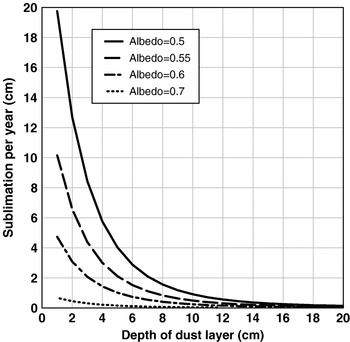
The surface temperature variation at the polar cap determined from local radiative balance is largely determined by albedo, while sublimation losses from a south-facing cliff are concentrated in the summer months. For fresh frost, the albedo is close to unity but values of 0.6–0.8 allow for varying amounts of exposed dirt or dust, as explored in Fig. 1. This shows the integrated ice loss over one Martian year (687 Earth days) using the thermal wave solution and the Clausius–Clapeyron equation for ice sublimation:

Thickness of ice sublimated from a south-facing cliff at latitude 80–90°N in one Martian year, integrated over diurnal temperature variation and season for given values of the albedo parameter A. The interior temperature is taken as 140 K and the thermal wave that applies below a few diurnal skin depths (√(ατ1π−1)=2.7 cm, with τ1=24.6 h the rotation period of Mars) has T peak=220 K×[2.5 (1 – A)]0.25 appropriate to Mars' orbit. Because of the necessary averaging over the diurnal cycle with non-linear frosting and sublimation, the parameterization via A means this is just roughly equivalent to the mean physical surface albedo. Sublimation cuts off when the atmospheric vapour pressure (0.1 Pa) exceeds that at the ice interface.

The solutions in Fig. 1 indicate that a 10–15 cm dirt crust develops quite quickly, within a few decades, becoming thick enough to choke back the sublimation rate to under 1 mm year−1, compatible with the age of the cliffs. Less steep slopes develop rather thinner crusts. The seasonal thermal wave of Eq. (1) applies for depths exceeding ~5 cm (two diurnal skin depths). For A of 0.6, Fig. 1 shows a 10 cm thick crust builds up in ~30 years; such a crust could plausibly be maintained against weathering processes. If A<0.5, the mean temperature is too high for thermal inertia alone to choke off the sublimation; the crust thickens to more than 10 cm within a few years and the self-sealing (deposition) and flow-retarding (adsorption/desorption) properties become significant in the thicker and hotter crust (Skorov et al. Reference Skorov, Markiewicz, Basilevsky and Keller2001). For A>0.7, a 5 cm crust cuts the sublimation rate to less than 0.1 mm year−1 – we expect frost deposition to dominate, keeping the surface icy with high albedo for most of the diurnal cycle. Some thermal lag due to latent heat needs to be included for realistic modelling of the dirt-ice crust. Thus, our parameterized exploration reveals a regime where sublimation is 10–100 times higher than precipitable water deposition, implying vapour pressures that are relatively favourable for ice-living microbes. Note that Schorghofer's (Reference Schorghofer2007) modelling for near-polar surfaces that are horizontal has ~30 cm deep soil that has filled with pore ice over the last 500 kyr.
Environments for ice-based life
Ice-dwelling microorganisms found in the Antarctic may be viable on Mars (McKay Reference McKay2003; Hoover et al. Reference Hoover, Pikuta, Wickramasinghe, Wallis, Sheldon, Levin and Rozanov2004). Ices generally have mobile water on the internal surfaces of crystals and contaminants, which is presumed to facilitate the diffusive transport of nutrients, enzymes and waste products, and to be available for cell processes. Species of archaea are found living in low-T ice. Data on methane in the GISP2 ice core and N2O in the Vostok core have been used (Tung et al. Reference Tung, Bramhall and Price2005) to infer that there is no cut-off at T as low as 220 K and to derive an exp (−A/T) fit to data indicative of metabolic rates.
Schulze-Makuch et al. (Reference Schulze-Makuch, Fairén and Davila2008) have reviewed organisms adapted to sub-zero ice and the strategies they use. Though photosynthesis-based growth seems to require T>253 K, the MEPAG (2006) study envisages, on the basis of the water activity parameter a w, that reproductive life is known as low as T ~230 K (a w=0.62) and set the limit at ~210 K (a w=0.5). Junge et al. (Reference Junge, Eicken, Swanson and Deming2006) has studied a psychrophile that is abundant in terrestrial polar environments (Colwellia psychrerythraea str. 34H), showing that tritium-labelled leucine is incorporated by it at still lower temperatures, when extra-cellular polymers give osmotic and cryo-protection. Its psychrophilic lifestyle is achieved through synergistic changes in overall genome content and amino acid composition that include membrane adaptation (polyunsaturated fatty acids), flexible cold-active enzymes, exopolymer production, cold-shock proteins and adapting to solutes.
Thus, the transient temperatures in subcrustal ice on sunward slopes during the daytime in the Martian summer are quite high enough for psychrophilic microbes. They reactivate metabolically under the midday warming pulse and take advantage of vapour from the underlying ice at 10–100 times higher density than that of the atmosphere. On Mars (as on comets), even millimetre-scale crusts would protect microbes from the harsh surface ultraviolet (UV) conditions, while allowing sufficient sunlight to penetrate for photosynthesis. Cryo-protective mechanisms adapt them to the diurnal cycle, while microbial spores and resting states survive the extreme cold of the polar winter.
Though these crustal ecosystems are isolated, changes over the 50 kyr cycle erode the crust and mobilize the organisms, allowing dispersal by the strong winds. We have also considered that meteorite impacts fragment and mobilize crustal material (Wallis et al. Reference Wallis, Wickramasinghe and Wickramasinghe2008); craters ~0.3 m deep from the smallest high speed impacts dominate, the volume integral of the excavated mass equates to an average ‘gardening’ rate of ~1 cm Myr−1. The smallest craters are sparse on a Myr timescale, although secondary craters from excavated material would also contribute to mobilizing centimetre-deep crusts. The impacts have some role in mobilizing material of the older stabilized crusts over the more than 3 Myr life of the polar cap.
The formation and fragmentation of the microbe-containing crusts is thus expected to contribute a biological component to Martian soils in the sub polar region, which potentially reaches the 68°N position of the Phoenix probe. We anticipate these would be distinguishable via the on-board microscopy.