Despite her cult's origins in the Byzantine Empire in the seventh century, and the purported discovery of her relics on Mount Sinai in the tenth, European veneration of St Katherine of Alexandria emanated from a hill overlooking Rouen starting in the mid-eleventh century.Footnote 1 In the 1030s, St Katherine's finger bones were presented to the newly founded Ste-Trinité monastery, which would later become known as Ste-Catherine-du-Mont.Footnote 2 Her relics secreted miraculous healing oil and attracted a steady stream of pilgrims during the eleventh and twelfth centuries.Footnote 3 From small relics grew a great cult: by the fourteenth century, St Katherine was one the most popular saints in Europe, and as a female saint, she was second only to the Virgin Mary.Footnote 4 Concomitant with the growth of popular devotion to Katherine, there emerged a high number of office chants to be sung on her feast day, 25 November. Despite their wide geographic diffusion and temporal resilience, chant and liturgy for St Katherine have hitherto received little consideration from musicologists, with the exception of David Hiley, who in his 2012 study suggests that this lack of attention may be due to the apparent uniformity of later medieval liturgies for St Katherine.Footnote 5 But, as Hiley points out, when tracing the origins of the office to the nascent stages of the cult's dissemination, one discovers that the earlier stages of her liturgy are varied and complex.
The abbot of St-Pierre-sur-Dives, named Ainard – who had previously been a monk of Ste-Catherine – is credited by Orderic Vitalis with the composition of a historia for St Katherine. The genre and identity of Ainard's historia has remained shrouded in mystery, partially due to a series of historiographical errors, with some suggestion that Ainard's creation had been lost. Considering palaeographic and musical-textual evidence, I propose that the notated breviary, Paris, Bibliothèque nationale de France, nouv. acq. lat. 1083, originated at Ste-Catherine-du-Mont and records the monastic office for St Katherine that Ainard composed for performance on her feast day at the very institution where her European relics were held.Footnote 6 In its entirety, this office remained an institutional tradition, but was likely revised and transmitted as a secular office, from which it was subsequently expanded as needed in later monastic manuscripts. Beyond palaeographic and codicological evidence that links F-Pnm n. a. lat. 1083 to Ste-Catherine, the office in F-Pnm n. a. lat. 1083 can be read as historicising and legitimising a nascent cult by associating it with established feasts. Its overall assembly and musical style demonstrate an awareness of progressive theories and strategies that characterise a ‘late’ style of chant composition, one which would be consistent with the work of a composer trained in southern Germany during the eleventh century. In other words, a monk like Ainard.
History and historiography: Orderic Vitalis and ‘Historia’
The chronicler and Benedictine monk Orderic Vitalis (1075–c.1142) informs us that Ainard, the German-born abbot of St-Pierre-sur-Dives in Normandy, composed antiphons and responsories for St Katherine of Alexandria. Orderic writes:
Gerbert of St-Wandrille, Ainard of Dives, and Durand of Troarn, may be compared to three stars shining in the firmament of heaven, so brightly did these three abbots glow in the temple of the Lord. They were talented men, distinguished by piety and true religion, and they devoted themselves unceasingly to the praise and worship of God in the liturgy. They stood out among the most skilled masters of the art of musical composition, and wrote melodious chants for antiphons and responsories … [Ainard] was a German by birth, well versed in the twin sciences of poetry and music, and a most skilled writer of melodies. This is plain to all from the historiae of Kilian, bishop of Würzburg, and the virgin Catherine and many other sweet songs which he composed to the glory of his Creator.Footnote 7
Orderic's use of the Latin word ‘historia’, which could be used in the Middle Ages to describe a liturgical office, resulted in erroneous interpretations obscuring Ainard's work. Some scholars of the hagiographical tradition of St Katherine understood Orderic's use of historia to mean a prose life, or vita. In the introductory chapter to their 1981 edition of the English vernacular life of St Katherine and the ‘vulgate’ vita (BHL 1663), S. R. T. O. d'Ardenne and E. J. Dobson attribute the writing of a prose life of St Katherine to Ainard, which they say is ‘since lost’.Footnote 8 This interpretation was echoed by Saara Nevanlinna and Irma Taavitsainen, who, in the introduction to their edition of the prose life of St Katherine in Southwell Minster 7, write: ‘A monk named Ainard wrote a lengthy Latin account of the saint, perhaps to publicise the relic. Ainard's passion of St Katherine, based on the Pseudo-Athanasian text, came to be known as the vulgate version of the legend.’Footnote 9 Jacqueline Jenkins and Katherine Lewis continue this tradition in the introduction to their edited volume as well: ‘A monk called Ainard wrote a Latin account of St Katherine's martyrdom which may have been based on Athanasius's text, and which subsequently may have provided the basis for an early Anglo-Norman poem.’Footnote 10 Among scholars of the broader cult of St Katherine, it was Christine Walsh who first credited Ainard with having composed an office, but she also writes that it is lost.Footnote 11 Most recently, Tina Chronopoulos has demonstrated the textual, geographic and chronological origins for the two most common Latin vitae of St Katherine, namely BHL 1663 and BHL 1659.Footnote 12 Although not the focus of her study, Chronopoulos writes that Ainard was responsible for the composition of ‘an account of Katherine's Passion’, and that ‘Ainard is said to have composed a chant in honour of the saint’.Footnote 13 In fact, Orderic uses the word historia to refer to a sung liturgical office for a saint,Footnote 14 and the nature of Ainard's musical creation is emphasised in the context of Orderic's explicit references to music. He specifically articulates that Ainard's musical skills were demonstrated by his historiae of Kilian, Katherine and other saints. Furthermore, no evidence precludes the possibility that one of the extant offices of St Katherine was created by Ainard in the mid-eleventh century.Footnote 15
Offices of St Katherine, eleventh to thirteenth centuries
In surveying the extant earliest manuscript sources for liturgies for St Katherine, three distinct ‘families’ of offices that can be traced to the late eleventh or early twelfth centuries emerge as potentially linked with the monk Ainard. Each reveals a conscious compositional process at its origin, but only one family of liturgies can be traced to Ste-Catherine, and therefore, likely to Ainard. I have named these families using present-day political and geographic terms derived from the provenances of the majority of their respective manuscript sources: first, an ‘Anglo-French’ family, the most common office in English and French sources from the twelfth to the fifteenth century;Footnote 16 second, the smallest ‘Norman-Neapolitan’ family, based on an office first recorded in the early twelfth-century fragment, Naples, Biblioteca nazionale Vittorio Emanuele III, XIII.G.24; and third, a ‘Norman-German’ family, which is a more diverse corpus mostly diffused in modern-day northeastern France, Germany, Austria and the Low Countries. Manuscript sources with a terminus post quem in the fifteenth century nearly all contain the Anglo-French office.Footnote 17 However, the diversity of Katherinian liturgies in manuscripts from the eleventh, twelfth and thirteenth centuries, represented by these familial groupings, evince zones of regional variation and practice. Manuscript sources testify to sharing between these regions and it is critical to emphasise the intra-familial hybridity evident in the repertoire.
At the base of all the families are chant texts and liturgical readings (when included) proper to a vita of St Katherine; modal order bestows musical cohesion on the cycles of antiphons and responsories and reinforces narrative development. These features gesture toward a conscious compositional process at play, all of which can be traced to the ‘sphere’ of the Norman church (Normandy, England and southern Italy), making each of them a candidate to have been created by Ainard.
Anglo-French family
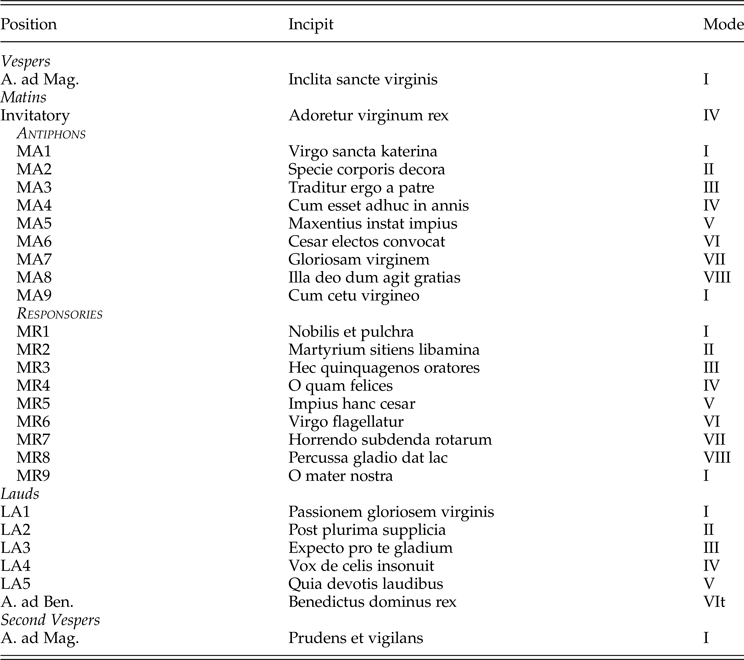
The majority (62%) of manuscripts considered in this article include the secular Anglo-French office or one closely related to it. There is a gradual increase between the twelfth and fifteenth centuries in the use of the Anglo-French office throughout Europe, and most manuscripts created or amended after the turn of the fourteenth century contain an Anglo-French office, from Bari to York, and as far east as Klosterneuburg.Footnote 18 The Anglo-French family was not only widespread, but also unique in the intra-familial stability of its chants. The secular liturgy is relatively consistent across sources, and in cases where secular offices are monasticised, the order of the original chants is generally maintained except for the additions of fourth responsories per nocturn, after (the secular cursus) responsories 3, 6 and 9. Table 1 represents the norm of the Anglo-French family. Antiphons and responsories are in modal order, forming two complete modal series divided among three nocturns. Intra-liturgical order is reinforced by consistent textual schemes: antiphon texts are in prose, while responsory texts are in hexameters.Footnote 19 Chant texts reference specific events in the vita of St Katherine, following the saint from her upbringing (Virgo sancta katerina, antiphon 1) to her torture on the spiked wheel (Horrendo subdenda rotarum, responsory 7), and finally to her execution, angelic interment on Mount Sinai and a description of her oil-secreting relics (Percussa gladio dat lac pro sanguine collo/quam manus angelica sepelivit vertice synai V. Membris virgineis olei fluit unda salubris, responsory 8).Footnote 20
The Anglo-French office (as recorded in GB-Ob Bod 126)

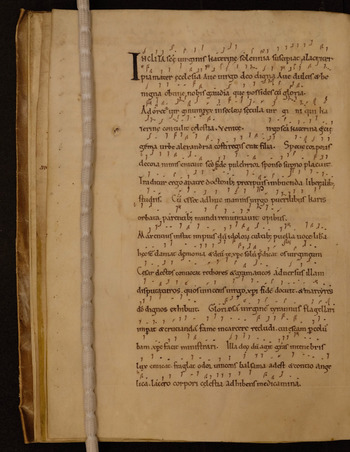
It is tempting to assume that this most widespread and consistent office might originate close to the Rouennais relics of St Katherine. I have shown elsewhere that its earliest source, the late eleventh- or early twelfth-century fragment Oxford, Bodleian Library Bodley 126 (Figure 1), is most likely English in origin.Footnote 21 This office appears to have been the only one for St Katherine circulating in England until the Reformation; the earliest evidence for the recitation of the full Anglo-French office in Normandy is from the fourteenth century.Footnote 22 The Anglo-French liturgy either supplanted other offices that had existed in Normandy without achieving widespread distribution there, or was implemented in institutions that previously had not observed the feast of St Katherine with liturgical propers.Footnote 23
GB-Ob Bodl 126, fol. 60v.

Furthermore, the secular cursus of the earliest Anglo-French office makes its origin in a monastic setting less likely. Perhaps most significantly, the earliest office manuscripts securely ascribed to Ste-Catherine-du-Mont (Rouen, Bibliothèque municipale A.572 and A.591, non-notated breviaries of the fourteenth and fifteenth centuries, respectively) contain the texts for a version of the Norman-German office, even when almost all other contemporaneously copied manuscripts throughout Europe include the Anglo-French office. It is therefore doubtful that the Anglo-French office originated at Ste-Catherine or was created by Ainard.
Norman-Neapolitan family
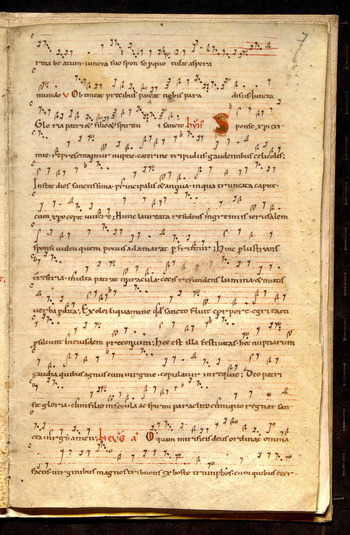
A second family of liturgical sources, which I have called Norman-Neapolitan, is constituted of only four manuscripts. Despite the paucity of exemplars compared to the Anglo-French family, its Norman associations provide possible connections with Ste-Catherine-du-Mont and Ainard, and therefore must be investigated. The earliest Norman-Neapolitan source is recorded in I-Nn XIII.G.24 (Figure 2). Hiley has suggested a twelfth-century dating for the manuscript, and through palaeographic analysis shows that the manuscript was created in Normandy or by a Norman-trained scribe working in southern Italy during the period of Norman rule there.Footnote 24 He argues that the office in I-Nn XIII.G.24 cannot decisively be associated with Ainard and Ste-Catherine-du-Mont. The fragment contains a full prose life of St Katherine divided into twelve readings, followed by notated monastic Vespers and Matins liturgies, including chants up to the second responsory of the second nocturn of Matins (see Table 2). Its antiphon texts are in hexameters, while its responsories are in prose, inversely to the Anglo-French office. Unfortunately, the final Matins chants are lost from this manuscript, together with any Lauds chants that may once have been recorded.
I-Nn XIII.G.24, fol. 7r.

The Norman-Neapolitan Vespers, Matins and Lauds Liturgies (I-Nn XIII.G.24 completed with F-Pnm lat. 1027)

aIn F-Pn lat. 1027, ‘Hostis iustitie’ is replaced by ‘In bello victus’.
Further clues about this fragment's provenance may lie in the vita that it transmits, as discussed by Tina Chronopoulos. Its readings are not derived from the most common vita, catalogued as BHL 1663, but rather the Latin text written in southern Italy between c.910 and c.970 (BHL 1659).Footnote 25 The known Norman manuscripts that contain BHL 1659 are F-R Rouen, Bibliothèque municipale, U.109 (Jumièges?, eleventh century) and U.22 (Rouen, thirteenth century).Footnote 26 An epilogue in F-R U.109 and I-Nn XIII.G.24 aligns their vita with BHL 1663, ending with a reference to oil flowing from Katherine's tomb on Mount Sinai, instead of with her beheading (as do the other exemplars of BHL 1659).Footnote 27 The vita in I-Nn XIII.G.24 and F-R U.109 is the only extant version of BHL 1659 that concludes with this particular epilogue.Footnote 28 Furthermore, both F-R U.109 and I-Nn XIII.G.24 credit ‘Arechis’ instead of ‘Petrus’ as translator.Footnote 29 Chronopoulos has proposed that although the text of BHL 1659 originated in southern Italy, it was transmitted to Normandy, where it was altered by adding the conclusion of the circulating BHL 1663, which had been composed in northern France.Footnote 30 The use of this epilogue in I-Nn XIII.G.24, which is absent in other known southern Italian sources, suggests that this manuscript or its exemplar was produced in Normandy and thereafter transported to southern Italy, not the inverse.
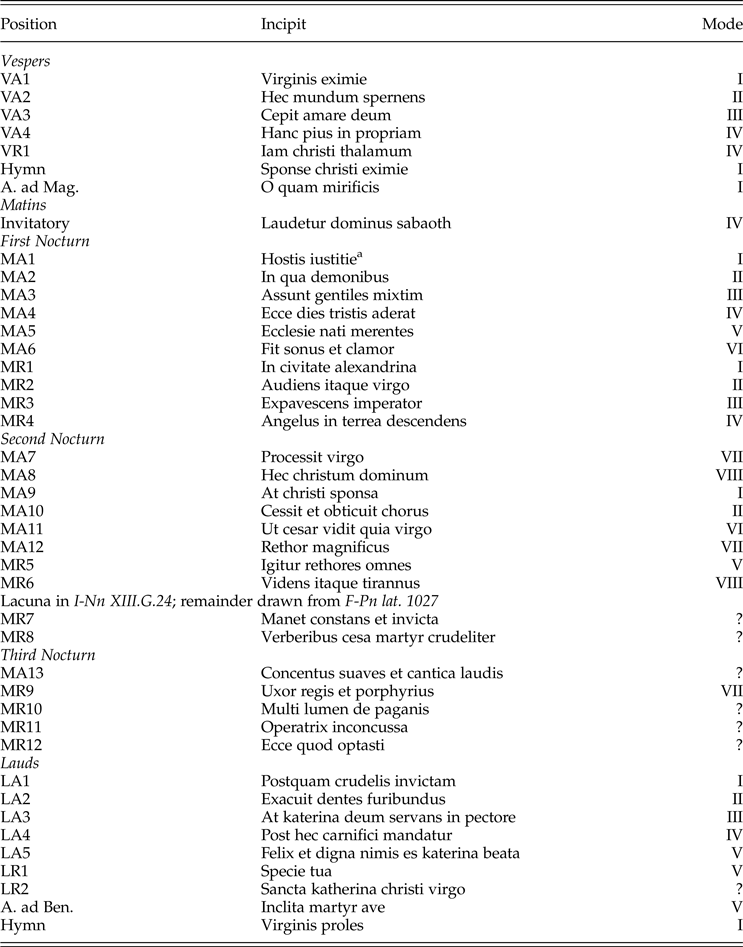
In addition, this office has substantial concordances with other Norman manuscripts from the thirteenth and fourteenth centuries, including Paris, Bibliothèque de l'Arsenal, 279 (Bayeux, thirteenth century) and Paris, Bibliothèque nationale de France, lat. 1027 (Rouen, fourteenth century). The Matins liturgy in F-Pa 279 is composed of the Norman-Neapolitan antiphons and the Anglo-French responsories to generate a fully hexametrical office.Footnote 31 F-Pnm lat. 1027 was produced for use at the central-Rouen nunnery of St-Amand, which was founded by Goscelin and Emmeline d'Arcques, the founders and patrons of Ste-Catherine.Footnote 32 The two foundations evidently had independent liturgical traditions, since the previously mentioned manuscripts from Ste-Catherine contain a version of the Norman-German office (discussed in the next section). The beginning of the Matins liturgy for St Katherine copied in F-Pnm lat. 1027 is concordant with the office present in I-Nn XIII.G.24 and furthermore, the office is completed by additional chants, which may be those missing from I-Nn XIII.G.24 (see Table 2).Footnote 33 In sum, the manuscripts that constitute the Norman-Neapolitan family present a monastic office with Norman origins that was known, at least in the fourteenth century, at Ste-Catherine's sister house in the heart of Rouen. Its geographical and institutional proximity to Ste-Catherine and therefore to Ainard is suggestive, but there remains no evidence to link it directly to liturgical practice at Ste-Catherine.
Norman-German family
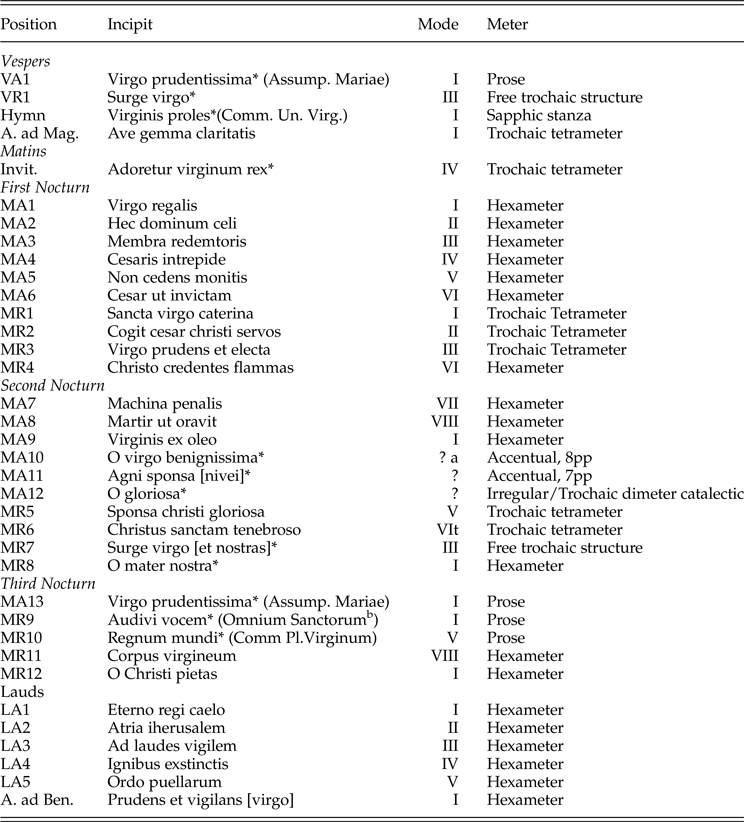
Numbering twenty, the majority of manuscript sources containing a Norman-German office originate in German-speaking regions. As with the Anglo-French family, both monastic and secular exemplars survive; unlike the Anglo-French family, the earliest form of the office is difficult to identify because of the high degree of variation of chant contents in extant manuscripts (the result of apparent importation and reordering of chants). The oldest manuscript source for this office, the late eleventh-century notated breviary F-Pnm n. a. lat. 1083, contains a monastic office of Norman but otherwise unknown institutional provenance (Table 3).
Vespers, Matins and Lauds Liturgies for St Katherine in F-Pnm n. a. lat. 1083

*Denotes the absence of notation in F-Pn nal 1083.
aI have found no notated source for antiphons 10, 11 or 12.
bThe responsory Audivi vocem also appears in several sources for the Feast of Eleven Thousand Virgins.
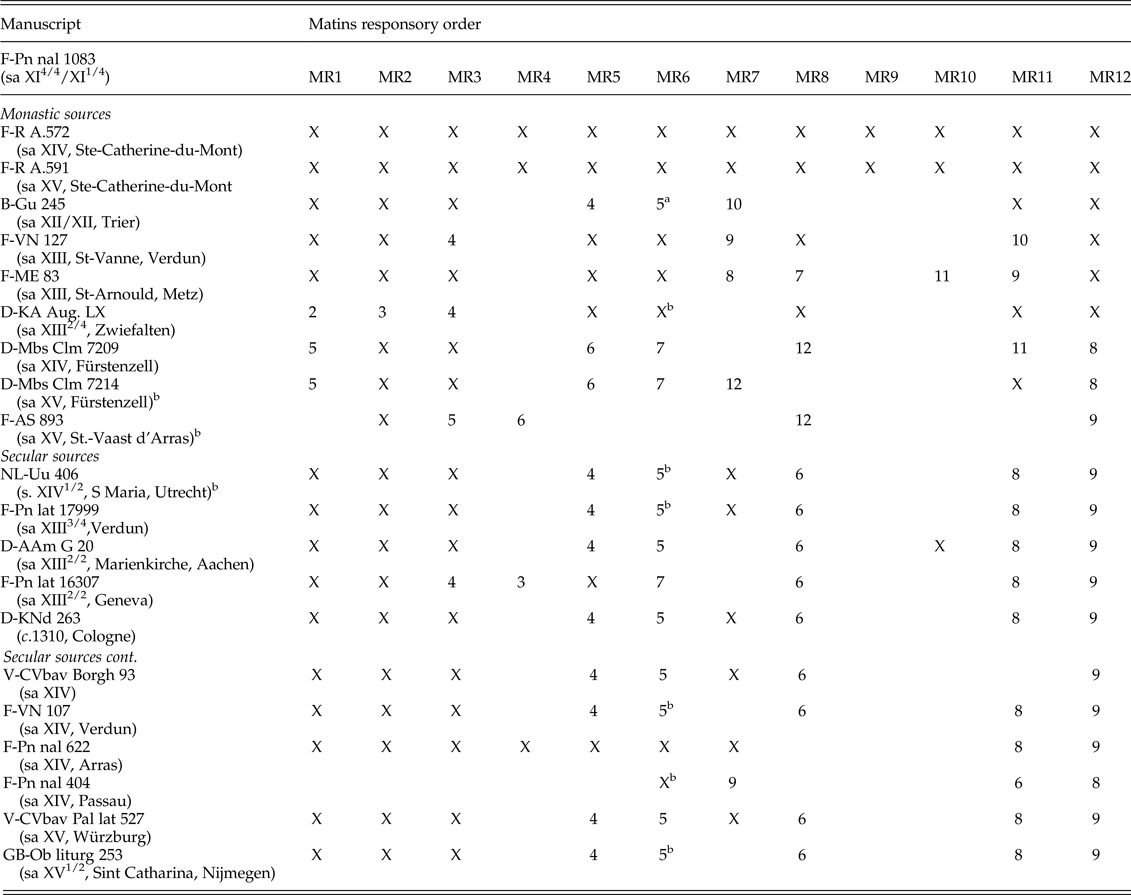
Later Norman-German manuscripts contain either secular offices or a range of monastic offices, all of which have in common a core of chants proper to St Katherine (Table 4). These chants are present, along with other chants that are not proper but thematically suitable for St Katherine, in F-Pnm n. a. lat. 1083. There is no fourth- or seventh-mode responsory in any Norman-German source, suggesting that a proposed earliest office should also exclude responsories in these modes. The cycle of Lauds antiphons and the Benedictus antiphon Prudens et vigilans virgo are also nearly consistent across Norman-German sources, indicating that they form part of an original layer of the liturgy.Footnote 34
Norman-German responsories in related manuscripts

aTextual variant: ‘spiritus sanctam tenebroso’
bIndicates a later addition to the original manuscript
Note: ‘X’ denotes Matins responsory correspondence with F-Pn nal 1083, while Arabic numerals indicate a given Matins responsory's position in a manuscript when it differs from F-Pn nal 1083; for example responsory 5 in F-Pn nal 1083 is deployed as responsory 4 in NL-Uu 406.
The diversity of chant contents seen especially in later monastic manuscripts could indicate that the office is secular in origin and was monasticised differently as it circulated and was copied. If this were the case, the notated office recorded on fols. 234v–237r of Utrecht, Universiteitsbibliotheek, Ms. 406 could represent the earliest iteration of a Norman-German office; it is among the oldest manuscript exemplars of a secular Norman-German office, and its chants are deployed across secular and monastic Norman-German sources, positioning its office as a common source. By extension, the office in F-Pnm n. a. lat. 1083 would be a monasticisation of a pre-existing secular office, despite the earlier dating of the manuscript. In this scenario, NL-Uu 406 would be a later copy of an earlier, unknown manuscript.Footnote 35
At face value this might appear to be a more straightforward solution, but the weight of the evidence suggests otherwise. I propose that F-Pnm n. a. lat. 1083 is not only the oldest extant Norman-German manuscript source, but that it also represents the earliest version of the Norman-German office for St Katherine, as I show in the next section. It was likely created for use at Ste-Catherine, the point of origin for the disseminated cult, by composing new proper chants around a group of strategically chosen pre-existing chants. The monastic office was later transmitted from Ste-Catherine and reduced to a secular office, represented by the office in NL-Uu 406, by excising chants that were not proper to St Katherine and those that were specific to the institutional needs of Ste-Catherine-du-Mont. New monastic offices were subsequently created based on the transmitted secular office and without knowledge of an extant monastic office in Normandy. The result is a wide variety of monastic offices, differentiated in particular by responsories (Table 4).Footnote 36 If F-Pnm n. a. lat. 1083 is indeed a manuscript of the monastery of Ste-Catherine, its office for St Katherine is likely to be composed by Ainard and the historia that Orderic mentions.
F-Pnm n. a. lat. 1083 (notated breviary, eleventh century)
The office in F-Pnm n. a. lat. 1083 (see Table 3) consists of chant texts that are proper to the vita of St Katherine, and a selection of Common of Virgins, Marian or All Saints chants. The texts of proper antiphons and responsories narrate the events of the vita or comment directly on it. The final three proper responsories, O mater nostra, Corpus virgineum and O Christi pietas are all general in subject matter, praising Katherine and invoking her as an intercessor through her relics. No responsory describes Katherine's own martyrdom – a glaring omission in a liturgy meant to venerate a virgin martyr. Although the twelfth lesson describes Katherine's execution and the translation of her relics, it concludes with a description of the oil-secreting relics, and their potentials for faithful supplicants. Pride of place at the conclusion of the lesson accorded to the miraculous oil is reinforced by the text of the longest responsory in the liturgy, O Christi pietas, that follows.Footnote 37
According to Victor Leroquais, the scribal hands, notation and inclusion of Rouennais saints in F-Pnm n. a. lat. 1083 render Norman provenance quite certain.Footnote 38 The lessons, moreover, are drawn from the text of BHL 1659, including the aforementioned continuation of the narration that describes Katherine's burial on Sinai and myroblytic relics (lectio XII, fol. 167r) reinforce Norman provenance.Footnote 39
Leroquais cites the presence of an office for the octave of St Denis in F-Pnm n. a. lat. 1083 as evidence for provenance from a local abbey of St-Denis; the only known abbey of St-Denis in Normandy was at Duclair, although the historical record is unclear on whether it had been re-founded by the eleventh century after its destruction at the hands of Norse invaders.Footnote 40 However, there is no office for the octave of St Denis in this manuscript; the office that Leroquais references is the single festal liturgy, from first to second vespers inclusive. A misplaced folio containing the offices of Simon and Jude, and Luke interrupts the office of St Denis between the fourth and fifth lessons of Matins.Footnote 41 Given the absence of a liturgy for the octave of St Denis in F-Pnm n. a. lat. 1083, and the wide reverence that St Denis enjoyed in northern France (explaining the inclusion of a festal office), there is no reason to link the manuscript with Duclair.
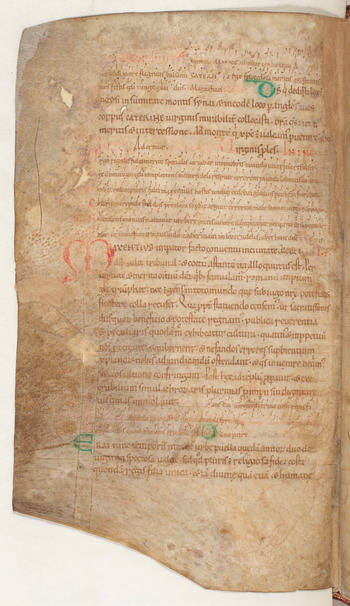
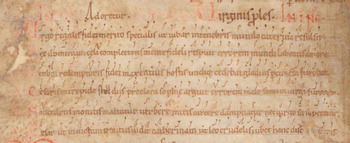
In sum, no evidence presented to date has led to a firm institutional attribution for the Norman-produced manuscript F-Pnm n. a. lat. 1083. Furthermore, there is no evidence of any other institution in Normandy venerating St Katherine as early as the turn of the twelfth century – solely Ste-Catherine-du-Mont. When the included notated office of St Katherine (Fig. 3) and the absence of liturgical material in contemporaneous Norman sources is brought to bear on the question of institutional attribution, there is a high probability that a singular late eleventh or early twelfth-century manuscript containing a festal liturgy for St Katherine originated at the monastery housing her relics.
F-Pnm n. a. lat. 1083, fol. 164v.

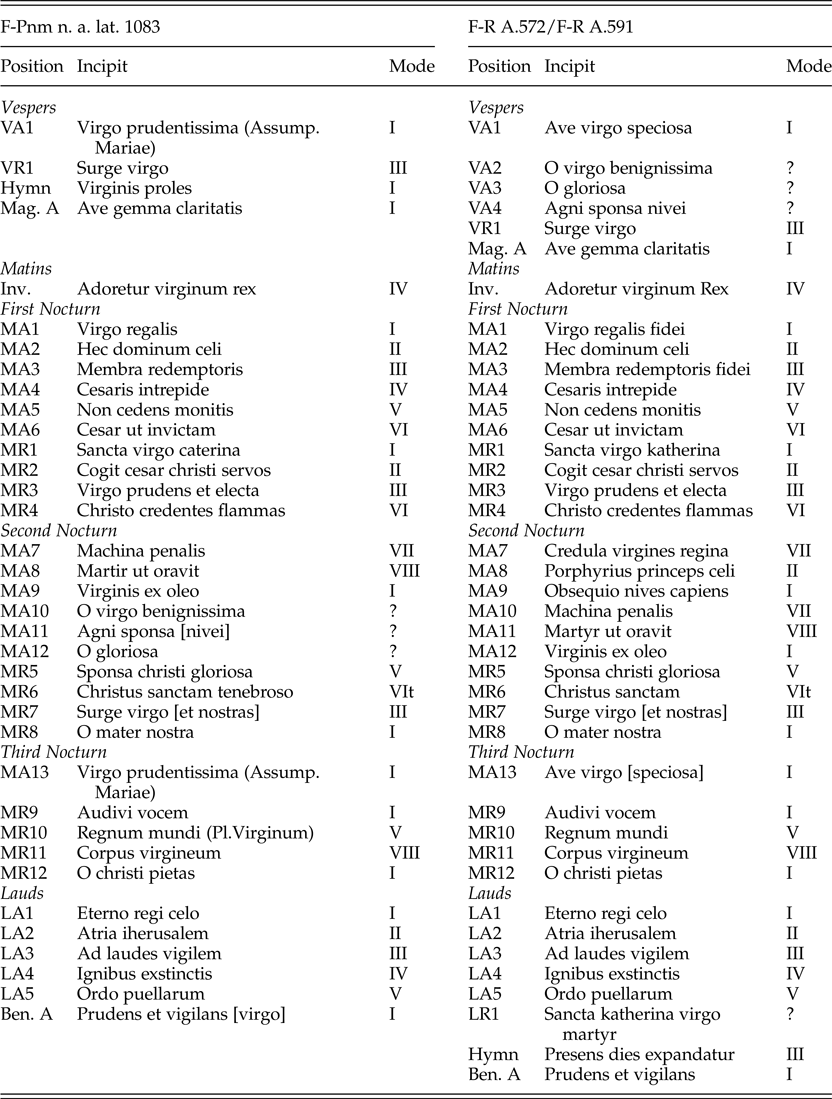
Most significant is the relationship between the offices for St Katherine in F-Pnm n. a. lat. 1083 and those in the non-notated Ste-Catherine breviaries F-R A.572 (fourteenth century) and F-R A.591 (fifteenth century). These manuscripts contain a version of the Norman-German office that is nearly identical to the office in F-Pnm n. a. lat. 1083, albeit with some minor reordering of chants,Footnote 42 and a lacuna in the first nocturn antiphons and one responsory in F-R A.591 (Table 5). The continuity of this particular monastic liturgical tradition at Ste-Catherine until at least the fifteenth century,Footnote 43 as well as its absence in other houses – most notably Ste-Catherine's own sister nunnery of St Amand – suggests that this office was intimately connected with the physical presence of St Katherine's relics.
Offices for St Katherine in F-Pnm n. a. lat. 1083 and F-R A. 572

Palaeographic evidence gives further reason to link F-Pnm n. a. lat. 1083 to Ste-Catherine-du-Mont. The office of St Katherine beginning on fol. 164r is the only sanctoral office in which the name of the festal saint is written in rustic capitals larger than the rest of the text (Fig. 4).
Rustic capitals in F-Pnm n. a. lat. 1083, fol. 165r.

The office is, furthermore, one of the few complete offices in the extant portion of the manuscript (along with only St John the Baptist, the Marian feasts and All Saints),Footnote 44 but the only one to be almost completely notated (Fig. 5). The thorough-going presence of notation points to a high degree of solemnity for the feast that would have been unlikely outside of Ste-Catherine-du-Mont given the limited reach of her cult in the late eleventh century. The fact that notation is included here but not elsewhere is highly likely to indicate that the book's users lacked familiarity with the chant melodies; if the office had been a relatively recent creation, singers would have needed notation in order to sing the office correctly and completely, an exigency made all the more critical by the physical presence of St Katherine's relics.
Notation in F-Pnm n. a. lat. 1083, fol. 164v.

Finally, the office of St Katherine references the office of St Austreberta (‘require in festo sancte Austreberte’) after the gospel incipit (‘simile est regnum celorum’), indicating that the full text of the gospel reading had been copied for the feast of St Austreberta on 10 February.Footnote 45 The local cult of St Austreberta was particularly well known at Ste-Catherine after the convent that housed her relics at Pavilly became a priory of Ste-Catherine in 1094.Footnote 46
Legitimacy through history
Beyond palaeographic considerations that bring this manuscript to the summit of Côte-Ste-Catherine, the contents and structure of the office that it contains imply an agenda of publicity and historicisation of St Katherine – a strategy consistent with aggrandising the status of her relics and the institution that possessed them, also evinced by the composition of the miracula of St Katherine commissioned by the monastery.Footnote 47 In the office, publicity is carried out through chant texts and lessons that narrate the vita and highlight the relics of St Katherine, while legitimacy is conferred on the relics and cult through a strategy of embedment in and association with universal feasts, signified by their respective chants included in St Katherine's office.
The Matins liturgy in F-Pnm n. a. lat. 1083 includes chant texts proper to the feast of St Katherine, although the ninth responsory, Audivi vocem, is imported from the Feast of All Saints, the tenth responsory, Regnum mundi, is from the Common for Virgin Martyrs and the canticle antiphon Virgo prudentissima from the Feast of the Assumption of Mary.Footnote 48 The combination of newly composed melodies and texts with existing chants taken from distinct and established repertories effectively align the new saint with established devotions. Katherine is presented and venerated not only as holy in her own right, but also in a way that associates her with other virgin martyrs, with the Virgin Mary and with all the saints. The responsory O Christi pietas shares an incipit text with St Nicholas, an established myroblyte saint, and may also be considered part of this strategy. This approach is not historically unique in the broader office repertoire. Writing about the offices for Sts Henry and Kunigunde at Bamberg's cathedral, Roman Hankeln suggests that the use of pre-existing commune chants bestowed upon Henry an ‘aura of liturgicality that symbolised his right to be included in the great fellowship of the saints venerated from time immemorial’.Footnote 49 The comingling of newly composed proper chants with pre-existing chants may evince a similar approach with respect to St Katherine in F-Pnm n. a. lat. 1083.
Beyond the walls of Ste-Catherine-du-Mont this agenda of establishment and reinforcement was less necessary since there were no other primary relics to legitimise. Later secular offices tend to omit the Marian, Common for Virgins and All Saints chants, as well as melodies and texts that explicitly reference the sanctity of Katherine's bones, signalling an established cult of a saint that did not need recourse to non-proper repertoires, and was not tethered to the location of its relics.
Heralding late style in Normandy
Returning to Ainard, it is possible that his identity shines through in stylistic elements of chant melodies and the overall organisation of the office. Despite its inclusion of older chants, which I have argued serves a purpose of legitimation and cultic embedment, the office for St Katherine in F-Pnm n. a. lat. 1083 and its newly composed chants is modally systematic and consistent. The modal systematisation present in these chants not only suggests a conscious compositional process, but also gestures toward a composer familiar with the modal theory emanating contemporaneously from the southern German Lands. Discussing a Norman cycle of chants for Mary Magdalene, David Hiley has ascribed the progressive nature of that cycle to the possible presence of southern Germans in Norman institutions.Footnote 50 Orderic provides no information about Ainard's upbringing or musical education, but as a southern German, he may have been acquainted with the flourishing of theoretical writing and compositional activity in his natal region before and during his lifetime.
Roman Hankeln, David Hiley, Jean-François Goudesenne, Làszlò Dobszay, Janka Szendrei and Alison Altstatt have dealt with the periodisation of stylistic development in chant and liturgical composition. Although there remain some vestiges of a traditional chant style in the newly composed proper melodies for St Katherine in F-Pnm n. a. lat. 1083, they include and are structured around many features of what Altstatt has called a ‘late style’ of chant composition (which can be periodised to c.1050 and later) with metric poetic texts (as opposed to hagiographical prose), antiphons that do not correspond to traditional melodies, and freely composed responsories. Subtonal (‘Gallican’) cadences (e.g. C–D–D) feature prominently, particularly in the antiphons, and the full octave range is achieved in eight of nine newly composed responsories and seven of nine newly composed antiphons; in the latter, the wide ambitus of relatively short melodies would have been particularly striking. Both features are recognised as characterising a ‘late’ or ‘progressive’ (to use Hiley's terminology) style of chant composition. Other ‘late style’ features present include neumatic ornamentation, scalar passages and leaps of a fifth and greater.Footnote 51
Mode stands out as an organising principle at multiple levels in this liturgy: antiphons are ordered by mode (see Table 3), a strategy chiefly associated with later liturgical creation, but also evident in some examples of office composition as early as the tenth century, as Hiley has shown.Footnote 52 The modal order that is evident in the first nine antiphons demonstrates compositional unity and signifies awareness of mode as a structuring concept on the part of the composer. It reinforces the narrative progression of antiphon texts, uniting the vita of St Katherine by mode and poetic metre (hexameters). The final three proper antiphons, O virgo benignissima, Agni sponsa nivei and O gloriosa et sancta virgo break with the established metric pattern, separating their more general and intercessory themes from the preceding chants that are narrative in theme and style.
Responsories, on the other hand, are not in modal order and there are no responsories in mode IV or mode VII. Their texts are a mixture of rhythmic trochaic tetrameters and quantitative Leonine hexameters (based on syllable length in the Classical tradition), as well as what I have called a ‘free trochaic structure’ (seen, for example, in Surge virgo).Footnote 53 Narration is highlighted by metric consistency in the responsories as well, but conversely to the narrative antiphons (written in hexameters), responsories with specifically narrative texts are written in trochaic tetrameters, commencing with an introduction of Katherine and her family lineage in responsory 1 (Sancta virgo caterina costi regis filia), through to her visitations while in prison (Christus sanctam tenebroso, responsory 6). Description of the martyrdom of the defeated philosophers, however, is depicted in hexameters in responsory 4 (Christo credentes flammas), temporarily disrupting the metric pattern. There is no verbal depiction of Katherine's own martyrdom in the responsories, and her execution merits only a passing reference in the antiphon Martir ut oravit.Footnote 54 At responsory 8, a metrical shift to hexameters coincides with a textual shift away from narration. The final three proper responsories, O mater nostra, Corpus vigineum and O Christi pietas o virtus are all general in subject matter, praising Katherine and invoking her as an intercessor through her myroblytic relics. Despite the modal disorder among responsories, the internal structures of each melody confirm a sophisticated knowledge of and concern for mode as a theoretical principal and compositional strategy.
Musical phrases correspond to textual phrases, and are delineated by a division of the modal scale by structural pitches into the lower pentachord and upper tetrachord of authentic modes, and lower tetrachord and upper pentachord of plagal modes, divided by the fifth scale degree above the final – consistent with ‘trend[s] in music-theoretical writing of the time, where modality is defined in terms of scale segments’, as Hiley writes.Footnote 55 The division of the modal scale according to species of the consonances emerged largely from the writing of southern German theorists, namely Wilhelm of Hirsau, Berno of Reichenau and Hermannus Contractus.Footnote 56 Intra-phrasal melodic gestures reinforce the polarity of these pitches, and cadences usually fall on the final or the fifth scale degree above it. Hiley notes that in a late style of chant composition, the coincidence of word endings with structural pitches is indicative of the ‘pull’ of these pitches and their use as melodic poles, reinforcing the sonic scaffolding of the mode.Footnote 57 Furthermore, the placement of structural pitches at the ends of polysyllabic words renders the words more aurally comprehensible, since their length requires a higher degree of attention on the part of the listener (as well as the singer). The alignment of aurally conspicuous polysyllabic words with structural pitches, especially at cadences, demonstrates a concern with modal structure, and mode and polysyllabic words can be understood as mutually reinforcing. The degree of textual and melodic co-ordination also suggests that the same individual composed both the text and the melody. The polarity of these structural pitches is evident at the level of individual words: among antiphons the majority (57%) of two-syllable words ends on these structural pitches (the rate ranges from 33% in antiphon 3 to 80% in antiphon 7). This figure is slightly higher in responsories, at 64% (with rates in individual chants ranging from 33% in responsory 3 to 80% in responsory 2).Footnote 58
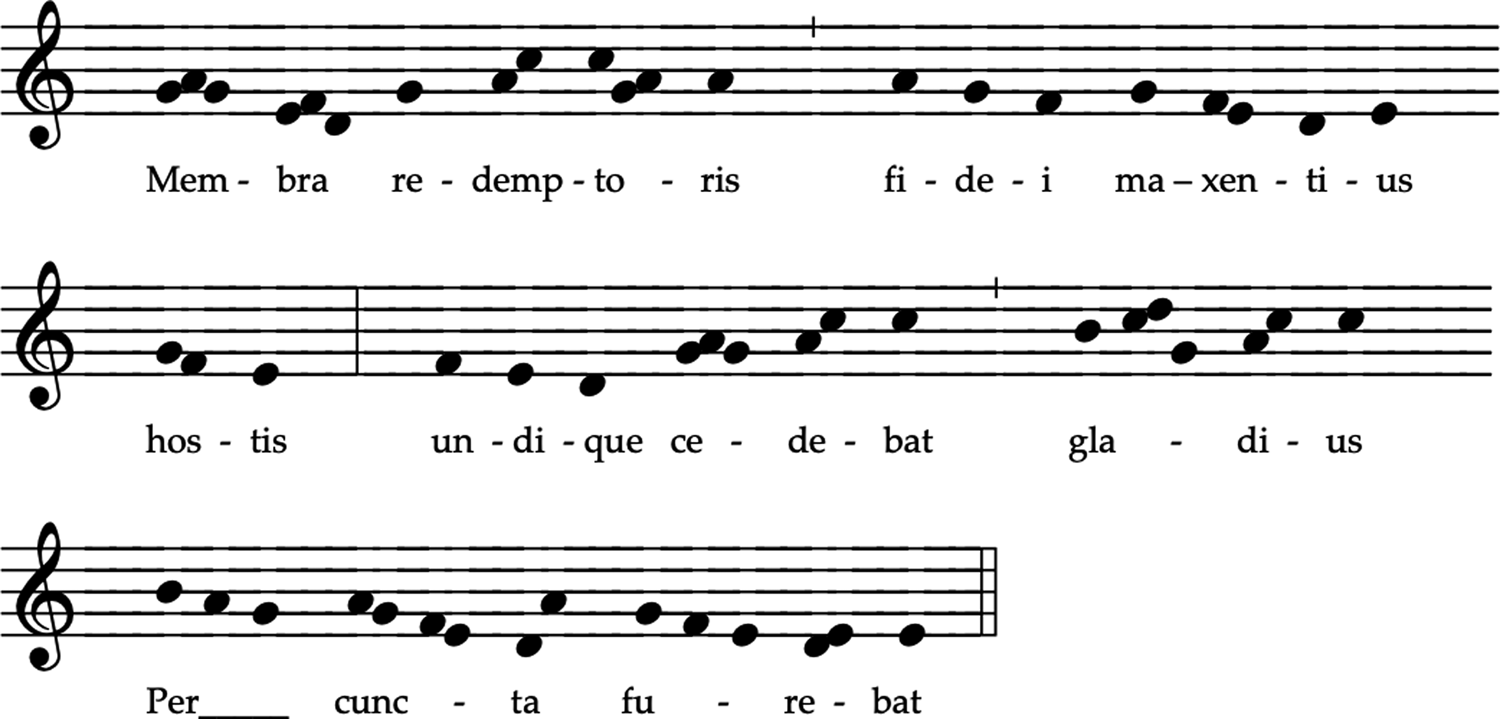
The third antiphon (Membra redemptoris; Fig. 6Footnote 59) is a ‘double antiphon’, a formal strategy that first emerged during a ‘transitional’ period of chant composition, which Altstatt, drawing on Dobszay and Szendrei, ascribes to approximately the ninth to eleventh centuries.Footnote 60 Its melody includes neumatic ornamentation, a sequential gesture (‘fidei Maxentius hostis / undique’), a scalar figure that descends a sixth on ‘per cuncta’ and a striking descending fifth leap from the upper limit of the range (a full octave) on the word ‘gladius’. The melody is structured around the pitches E and c, the traditional reciting tone of E-mode chants, gesturing here to an older melodic style. Two of the four cadential gestures are subtonal cadences, with the third cadence pitch (‘cedebat’) approached from a third below, both non-traditional in style.
Matins antiphon 3 (Mode III). ‘The enemy Maxentius was cutting down on all sides the members of the redeemer of faith; the sword was raging through them all’ (trans. Jennifer Ottman).

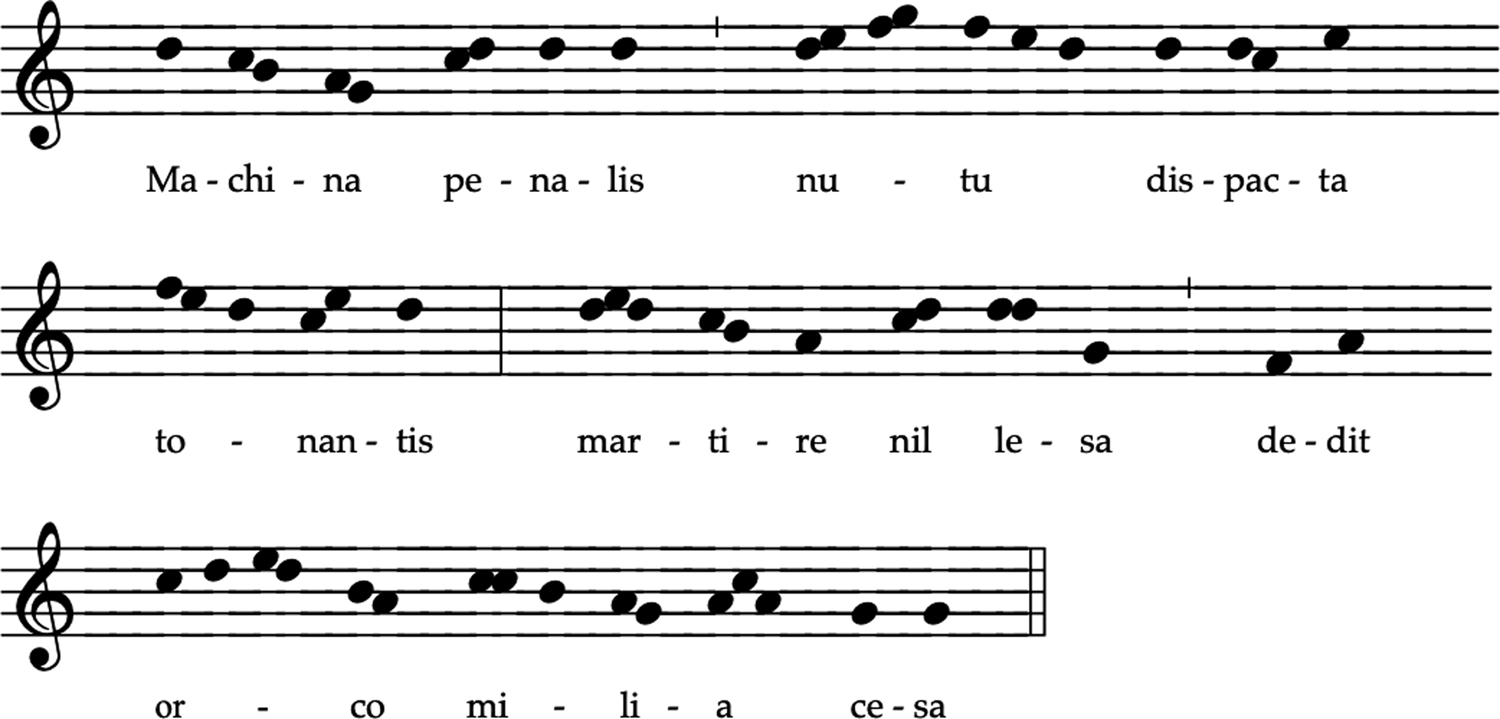
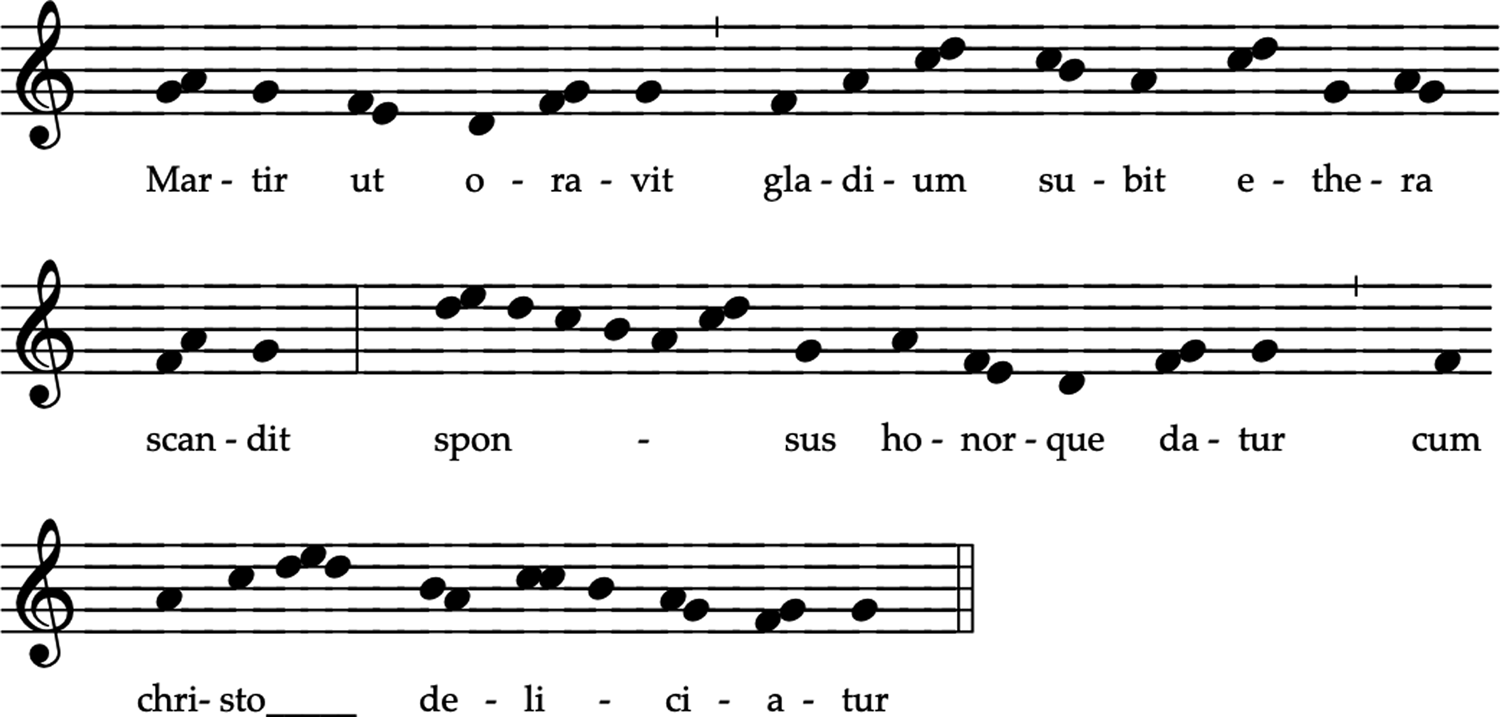
In antiphons 7 (Fig. 7, Machina penalis, mode VII) and 8 (Fig. 8, Martir ut oravit, mode VIII), divisions of the modal scale are discrete and distributed systematically across musical-textual phrases.Footnote 61 The first phrase of Machina penalis achieves and is clearly bounded by the modal octave, but the pentachord and tetrachord are systematically distributed between the two parts of the phrase. Similar distributions are evident in Martir ut oravit (Antiphon 8, Fig. 8); both antiphons include prominent descending scales (on ‘machina’ and ‘sponsus’, for example), subtonal cadences, and leaps of a fifth.
Matins antiphon 7 (Mode VII). ‘The punishment machine, shattered by the Thunderer's nod, dealt out a thousand corpses to hell/the underworld, while the martyr was unhurt’ (trans. Jennifer Ottman).

Matins antiphon 8 (Mode VIII). ‘As she had prayed, the martyr went beneath the sword; she mounts the skies, is given the bridegroom and honour, experiences delight with Christ’ (trans. Jennifer Ottman).

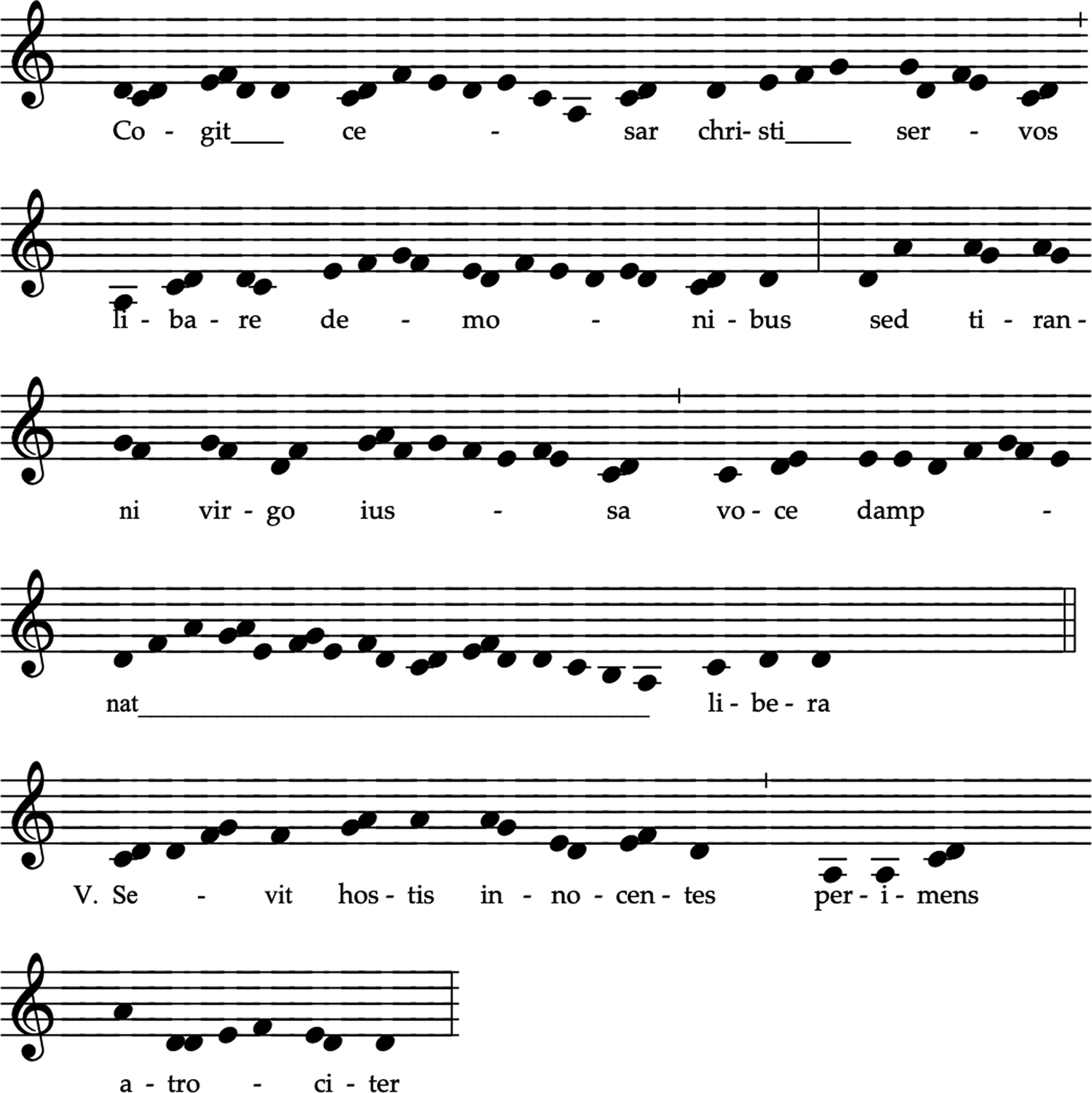
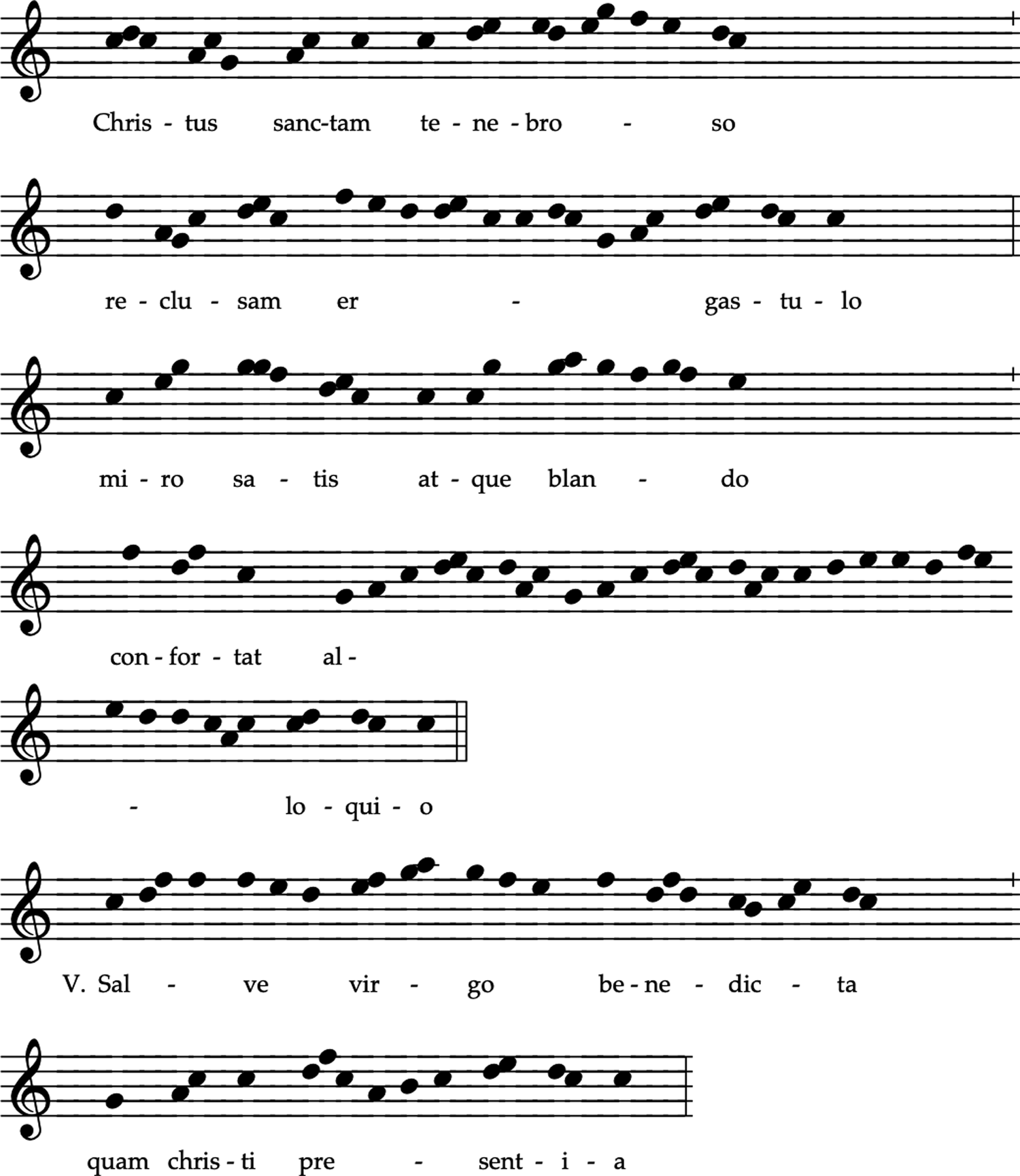
Taking responsories 2 (Fig. 9, Cogit Caesar Christi servos, mode II) and 6 (Fig. 10, Christus sanctam tenebroso, mode VI transposed) as examples, the deployment of ‘late style’ features is similar, despite differences in generic style between responsories and antiphons. Although there are isolated instances in the cycle that are suggestive of the traditional formulaic responsories, these melodies are freely composed. They display considerable neumatic ornamentation. Melodies are mostly in stepwise motion, but, in contrast with earlier melodies, include frequent scalar passages, large leaps and sequential repetitions, particularly in melismas.
Matins responsory 2 (Mode II). ‘Caesar compels Christ's servants to make offerings to demons, but the virgin condemns the tyrant's orders with a frank voice. V. The enemy rages, atrociously doing away with the innocent’ (trans. Jennifer Ottman).

Matins responsory 6 (Mode VI, transposed). ‘Christ comforts the holy one, shut up in a dark prison, with a quite marvellous and mild address. V. Hail, virgin blessed as the presence of Christ!’ (trans. Jennifer Ottman).

These examples demonstrate the tendency of the office of St Katherine in F-Pnm n. a. lat. 1083 toward a later style of chant composition and liturgical assembly that by the thirteenth and fourteenth centuries would be seen in new chant composition across Europe. It does not, however, appear to have been a style widespread in eleventh-century Normandy, providing further evidence in favour of an attribution to Ainard, whose background could have positioned him to implement these currents in music theoretical knowledge. The office for St Katherine is constituted of newly composed proper chants and pre-existing chants that serve to legitimise and historicise St Katherine, reinforcing the palaeographical evidence that links the earliest Norman-German source with Ste-Catherine-du-Mont. The newly composed chants display a high degree of modal awareness, as does the broader organisation of the liturgy. The features of a ‘late style’ of chant composition present in the office point to Ainard as a likely composer.
Conclusion
Orderic Vitalis provides a record of the former monk of Ste-Catherine monastery, Ainard, who was known for his exceptional musical and compositional capabilities. And yet over the course of the twentieth century, Ainard's musical contributions became obscured. It was thought that his composition was lost or could not be identified among the rubble of the earliest stage of European devotion to St Katherine, having been displaced by a pan-European musical-liturgical tradition by the fourteenth century.
A regard to the earliest office liturgies for the Feast of St Katherine reveals a rich and diverse range of liturgical practices. Organisation of these offices, dating from as early as the late eleventh century, into three liturgical ‘families’ shows that Ainard was probably not the only composer (as the term might be deployed today) at work, as the base office of each family provides evidence for a deliberate creative process. An office likely composed in England (an ‘Anglo-French’ office) is the most common in later manuscript sources, and the Norman-Neapolitan office has exemplars in Rouen, but only the Norman-German office can be linked with liturgical practice at Ste-Catherine.
F-Pnm n. a. lat. 1083 contains a monastic office liturgy for St Katherine, and comparison with later sources demonstrates that this manuscript likely preserves the earliest iteration of the office widely used in German-speaking regions of Europe. The complete notation, graphic emphasis on Katherine's name, and references to St Austreberta make a Ste-Catherine provenance for F-Pnm n. a. lat. 1083 likely. Furthermore, there is no evidence to suggest that St Katherine was revered in Normandy during the late eleventh century outside the institution that owned her relics, substantiating this institutional attribution. Although manuscripts of the Norman-German family of sources transmit a range of liturgies, I have argued that this is due to an excision of chants not proper to the Feast of St Katherine, generating a new secular office and providing space for new chants to monasticise the liturgy differently in various institutions.
Furthermore, musical analysis of the matins chants for St Katherine recorded in F-Pnm n. a. lat. 1083 provides evidence of a trained composer at work, as well as for the centrality of text setting in the creation of this office. Chant melodies employ melodic phrase divisions based on textual versification. Narrative is emphasised through the modal order of chants. Phrases are centred on clearly delineated portions of the modal scale according to contemporaneous theories on species of fifths, and individual words reinforce an aural sense of modality. It is probable that the composer understood this theoretical knowledge and was well versed in novel stylistic trends, suggesting connections with southern Germany, Ainard's homeland.
These theoretical aspects, combined with the associative potentials of juxtaposing proper and common chants, reinforced the legitimacy of the cult of St Katherine with the aim of generating status, power and profit for the owners of her relics. If F-Pnm n. a. lat. 1083 originated at Ste-Catherine, its office of St Katherine is likely to be the very office to which Orderic refers, composed by the monk Ainard. His ‘lost’ composition found, Ainard can once again stand, in Orderic's words: ‘inter praecipuos cantores scientia musicae artis’.