Introduction
Skin management is an essential element in the surgical implantation of bone-anchored solutions or bone-anchored hearing aids, regardless of the type of systemReference Huber, Sim, Xie, Chatzimichalis, Ullrich and Roosli1, Reference Eeg-Olofsson, Hakansson, Reinfeldt, Taghavi, Lund and Jansson2 or surgical protocol.Reference van de Berg, Stokroos, Hof and Chenault3 A number of publications have discussed the skin issues in this type of surgery, mostly with respect to local complications.Reference van de Berg, Stokroos, Hof and Chenault3, Reference Fontaine, Hemar, Schultz, Charpiot and Debry4 Local irritation of the skin has been shown to result in granulation formation and infection, which may lead to implant loss. The original surgical approach presented by Tjellström et al. highlighted the importance of skin reduction in order to reduce skin shifting around the abutment.Reference Tjellström, Lindström, Hallén, Albrektsson and Brånemark5 Newer surgical techniques have utilised minimal to no skin thinning.Reference Dumon, Medina and Sperling6, Reference Gordon and Coelho7 Although these techniques have been shown to be safe and effective,Reference Hultcrantz8 a subset of patients will still develop skin reactions that may be related to excess skin mobility around the abutment. Interestingly, there is a lack of reports on the extent of skin mobility in the retroauricular space, typical for the implant location.
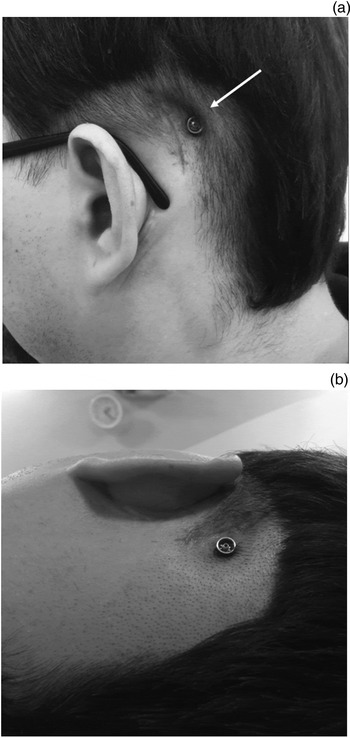
Scalp movement is a natural feature, resulting from voluntary or involuntary muscle contractions, and due to gravity. This movement affects the retroauricular skin as well. Therefore, the head position – which is different under routine follow-up conditions after implantation (upright) or during the surgery (supine position with headrest support) – and the resulting differences in skin mobility, may explain skin complications during the post-operative period (Figure 1).
(a) Patient with skin overhang in the postero-superior aspect of the abutment (arrow), photographed in an upright position with relaxed facial muscles. (b) The same patient in the supine position with correct skin position.

With this in mind, this study aimed to assess objectively skin mobility in the retroauricular region, to advance our knowledge of the skin aspect in osseointegrated implant surgery, both for surgical planning and for the management of potential post-surgical complications.
Materials and methods
The study was designed to detect and evaluate scalp movements over the skull, with a special focus on the retroauricular region. Thirty-nine randomly selected individuals, who were patients and students without dentures, and who had not undergone a previous surgical intervention within the auricle or retroauricular region, participated in the study. The study population consisted of 12 females and 27 males, aged 21–86 years, with a mean age of 40.7 years (median age of 37 years). The calculated body mass index (BMI) was 20.99–35.92 kg/m2 (mean BMI = 25.71 kg/m2). The study was approved by the local ethics committee.
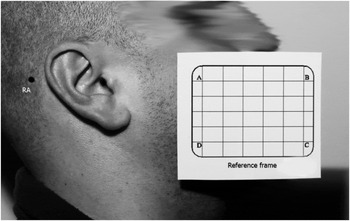
In order to carry out the skin shift measurements, the skin reference retroauricular point (‘RA’) was marked in the retroauricular region at the implant site (50 mm from the external auditory canal, in the postero-superior direction, at the level of the pinna attachment). Patients were asked to bite down on a rod integrated with a reference frame and hold it between their teeth for more precise alignments and detailed measurements. Given the direct connection to the patients’ teeth, hence the bony framework, the reference frame represented the immobile skull under the mobile skin.
Three photographs of the ear and retroauricular region were taken for each patient (using a Nikon D300 camera, with a Nikkor 35 mm f2.0 lens). Photographs were taken from the side of the patient, 1 m from the patient's head, in the axis perpendicular to the auricle, under three conditions or positions. These were: (1) upright with relaxed facial muscles (i.e. neutral); (2) upright with contracted facial muscles (i.e. facial grimace); or (3) supine (head resting on the bed with relaxed facial muscles).
Measurements
The photographs of each individual were superimposed onto each other with respect to the reference frame, which remained unchanged for all photographed conditions. The transparency technique allowed us to obtain a single photograph with one (visually present) reference frame, representing the patient's skull. The rest of the picture, including the marked reference point, representing soft tissue of the head, could also be observed on the photograph. The transparency of the original photographs revealed the various shifts of the reference point in terms of distance and direction due to muscle contractions or position change (Figure 2). These changes were evaluated (registration of the co-ordinates) and calculated with graphic software (Adobe Photoshop® CS5, Microsoft® Paint 5.1) and Microsoft Excel spreadsheet software.
Localisation of reference point (‘RA’ = retroauricular) on the retroauricular skin. The position of the reference frame, bite and hold between teeth represents patients’ immobile skull.

The reference point position was defined by x(n) and y(n) values on the composite picture, where ‘n’ represents the photographed clinical situation (neutral, facial grimace or supine). Segments between the primary position of the reference point and the secondary position of the same point were calculated.
Main outcome measures
Evaluation of the extent of skin shift (i.e. reference point shift) was measured in two scenarios: facial grimace, from position 1 (upright with relaxed facial muscles, i.e. neutral) to position 2 (upright with contracted facial muscles, i.e. facial grimace); and head rest, from position 1 (neutral) to position 3 (supine, i.e. head resting on the bed with relaxed facial muscles).
The obtained measures were correlated to demographic data (age and gender) and to morphological data (height, weight and BMI).
The registered reference position co-ordinates for each patient in both scenarios (facial grimace and head rest) were transferred onto the co-ordinate system for evaluation of skin shift direction.
Statistical analysis was performed with Statistica software version 12.0 and Microsoft Excel 2010 spreadsheets. Descriptive statistics were used for continuous data. Spearman's rank correlation co-efficient was used to compare the skin shift measurements during facial grimace and head rest positions with age, weight, height and BMI. The student's t-test was used to compare the relationship between the obtained results and patients’ gender.
Results
Full data were available for 37 out of 39 individuals. Patient number 10 was excluded from the study because of shifting of the reference frame in both photographed scenarios (alignment of all three photographs was not possible). Patient number 4 was excluded because a single photograph of the supine position had an incomplete alignment (a reference frame shift).
Extent of skin shift
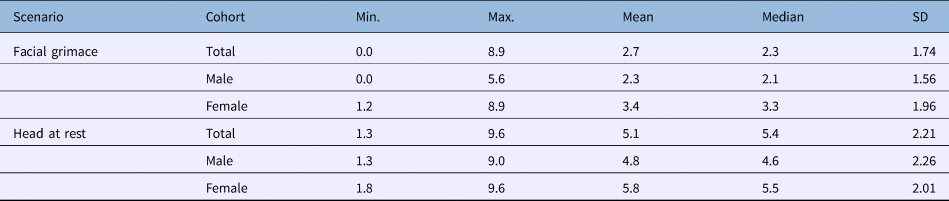
The results of the facial grimace scenario, related to skin movement during facial muscle contraction (position 2), compared to the relaxed face (position 1) revealed retroauricular skin movement ranging from 0 mm to 8.9 mm upon facial muscle contraction. The mean value was 2.7 mm (standard deviation (SD) = 1.74).
The maximum range of skin shift was present during the head rest scenario (i.e. when changing from a relaxed and upright position (1) to a relaxed and supine position (2)). In this scenario, movement of the retroauricular skin, represented by the reference point ‘RA’, ranged between 1.3 mm and 9.6 mm. The mean value during the head rest scenario was 5.1 mm (SD = 2.21) (Table 1).
Summary of conducted measurements*

Data represent skin shifts (in millimetres). *Total n = 37 (26 males and 11 females). SD = standard deviation
In 84 per cent of studied cases (n = 31), the extent of skin shift was greater in the head rest scenario, by an average of 3.1 mm (range, 0.1–6.7 mm). In the remaining 16 per cent of cases (n = 6), the facial grimace resulted in a greater skin shift in the retroauricular region (mean of 0.9 mm; range, 0.2–2.5 mm).
A comparison of skin movement between the two studied scenarios revealed a moderate correlation. The extent of skin shift during the facial grimace scenario corresponded to the extent of skin shift during the head rest in a supine position scenario (Spearman's correlation co-efficient r = 0.32721).
Gender correlation
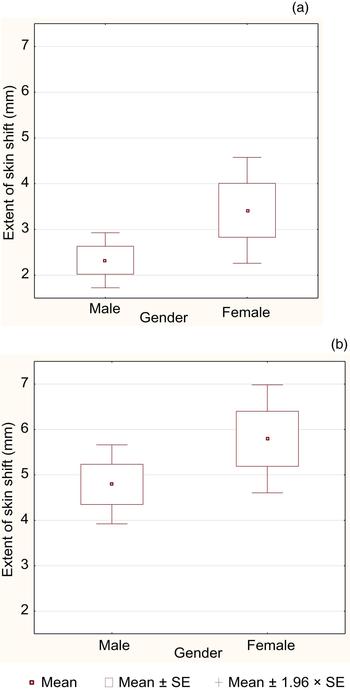
In males, the analysed retroauricular skin shifts (based on reference point localisation measurements) ranged between 0 mm and 5.6 mm (mean of 2.3 mm) for the facial grimace scenario, and between 1.3 mm and 9.0 mm (mean of 4.8 mm) for the head rest scenario. In females, behind-the-ear skin shifts ranged between 1.2 mm and 8.9 mm (mean of 3.4 mm) for the facial grimace scenario, and between 1.8 mm and 9.6 mm (mean of 5.8 mm) for the head rest scenario (Figure 3). Despite the difference between males and females (with higher values for females), the correlation results were not statistically significant (t-test result for facial grimace scenario was p = 0.08; head rest scenario result was p = 0.21).
The extent of skin shifts with respect to patients’ gender in the (a) facial grimace and (b) head at rest scenarios. SE = standard error

Morphological parameters correlation
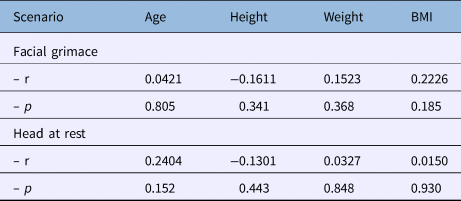
The skin shift results revealed no correlation to the patients’ morphological parameters of BMI, height or weight (Spearman co-efficient). Age as the additional parameter was not informative either. The p-values were greater than 0.05 for both scenarios, when comparing skin shifts and objective parameters (Table 2).
Correlations between skin shifts and patient variables*

*Total n = 37. BMI = body mass index; r = Spearman's rank correlation co-efficient
Skin shift direction
The graphical representation of skin shift direction demonstrates the high variability of the findings (Figure 4). The referral line for the proper and comparable localisation of the co-ordinates system was the Frankfurt line (i.e. the line from the lateral eye corner to the auricular attachment). The centre of the co-ordinates system was located at the reference point of the neutral position. The dots of the graph refer to the retroauricular position in the facial grimace position and head rest scenarios.
Graphical representation of skin shift directions in the (a) facial grimace and (b) head at rest scenarios. The centre of the co-ordinates system is located at the retroauricular reference point (referred to previously as ‘RA’), corresponding to the typical localisation of bone-anchored hearing aid system implant. The dots represent the new retroauricular position during the studied scenarios (x and y coordinates are given in pixels).

Discussion
Skin movement and its direct evaluation can be utilised for reconstructive purposesReference Frey, Jenny, Giovanoli and Stussi9 or for the evaluation of psychomotor function.Reference LeResche and Dworkin10, Reference Trotman, Stohler and Johnston11 Occasionally, soft tissue movement can be considered an obstacle to the precise evaluation of skeletal movement. Furthermore, unnecessary skin shift, considered as a soft tissue artifact,Reference Bonci, Camomilla, Dumas, Cheze and Cappozzo12 is a risk factor for local skin complications in skin-penetrating implant surgery, such as in the bone-anchored systems.Reference Van Rompaey, Claes, Verstraeten, van Dinther, Zarowski and Offeciers13
Evaluation of skin mobility in the mastoid region has previously been conducted by Trotman et al.Reference Trotman, Stohler and Johnston11 They suggested that landmarks over the mastoid may be considered as stable reference points, suitable for determining, for example, relative head movements. The results of the present study do not support the conclusion that the retroauricular skin is stable with respect to the underlying bone, as suggested by Trotman et al.
In their primary report on bone-anchored hearing aids, Tjellström et al. indicated the role of immobility of the skin around the penetrating abutment in the prevention of local skin complications.Reference Tjellström, Lindström, Hallén, Albrektsson and Brånemark5 For that reason, surgery with skin reduction was an essential part of the implantation. The recent trend towards simplifying and shortening the implantation procedure has resulted in a technique without skin reduction for percutaneous penetrating implants. Reports on local skin complications have not revealed differences between surgical techniques; however, constant skin tension and irritation around the skin-penetrating abutment due to soft tissue shifts in everyday conditions is evident.Reference Stalfors and Tjellstrom14
The design of the present study (the scenarios and positions in which photographs were taken) was based on practical observations. Muscle contractions occur in the patient throughout the day, such as when chewing, smiling or yawning. Data obtained during a facial grimace, which represents muscle activity, showed a skin shift in the retroauricular region with a mean value of 2.7 mm, ranging from 0 mm to 8.9 mm. The head rest scenario evaluated the skin shift between normal sitting or standing versus a supine position with the head at rest. This comparison revealed a retroauricular skin shift of between 1.3 mm and 9.6 mm, with a mean of 5.1 mm.
These skin shifts should be acknowledged, especially in daily clinical practice when preparing patients for surgery (e.g. bone-anchored hearing aid surgery). Measurements and preparations related to the skin punch and the implant position differ in the supine and the sitting position. This may result in skin overhang close to the abutment during post-surgical observation (Figure 1), or cause skin tension at the suture line. We suggest that planning of the implant and processor position prior to surgery should be carried out whilst patients are sitting or standing. This should limit potential complications and errors related to skin displacement.
Our study revealed no correlations between the extent and direction of skin shifts and the demographic data. Interestingly, the extent of skin shifts was smaller in males than females, but this difference was not statistically significant. Similarly, there were no correlations with patients’ morphological data (height, weight or BMI). Previous studies on skin thickness behind the ear at the osseointegrated implant site revealed a positive linear correlation, especially in patients with a BMI of 20–28 kg/m2.Reference Wróbel, Popko and Szyfter15 These observations paralleled those of De Greef et al.,Reference De Greef, Vandermeulen, Claes, Suetens and Willems16 indicating the dominant role of BMI in the alterations of face soft tissue thickness, with concomitant negation of patients’ age and sex in the calculations.
One would expect subcutaneous tissue thickness to affect the skin mobility. However, the present study did not demonstrate correlations between BMI and the extent or direction of skin movement. Nevertheless, a comparison of skin movement between the two studied scenarios revealed a moderate correlation. This indicates that the extent of skin shift in one scenario can predict the skin shift in a second scenario; for instance, skin mobility in a head at rest situation (i.e. surgery) can be estimated pre-operatively through the observation of the retroauricular region during a facial grimace.
There are currently no data on the direction of skin shifts in the retroauricular region. The graphical representation of obtained and calculated co-ordinates of the reference point (Figure 4) revealed high variability in skin shift direction. Automated trend lines indicate differences for both clinical conditions (head rest and facial grimace). The oblique axis may indicate the location of skin overhang or skin tension around the abutment reported in patients with percutaneous penetrating implants.
• Facial muscle activity during chewing, yawning and smiling causes skin to shift relative to the skull in the retroauricular region
• This skin movement has implications for bone-anchored hearing devices
• Lying supine with head supported (as during surgery) results in more extensive retroauricular skin shifts than experienced during facial muscle contractions
• Extent and direction of skin shifts vary and cannot be predicted, requiring direct measurement
• Relative skin shifts in the skull and soft tissue in the retroauricular region can be measured using simple photographic analysis
To summarise, this study demonstrated high variability in the extent and direction of skin shifts at the osseointegrated implant site. There are no objective data that can predict individual skin movement. However, we believe that our study data are important for furthering discussions on trends for surgical implantations of transcutaneous systems, particularly bone-anchored hearing aids, and for managing related skin problems. Prior to this study, no clinical evidence of skin movement in the retroauricular region had been published.
Competing interests
None declared