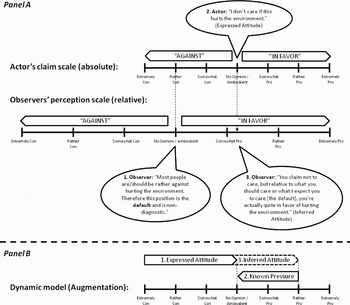
If you claimed at a dinner party to have no opinion about child abuse, you would get funny looks. In Knobe's analysis, because you should strongly oppose abuse, neutrality is tantamount to support. Similarly, expressing neutrality about women's suffrage, which our society supports, would appear sexist. Thus, observers do not take agents' claims at face value, but instead assess them relative to what Knobe calls a “default.” Observers essentially convert an agent's claim to their own metric, much like converting Celsius to Fahrenheit, based on the object of judgment (e.g., helping vs. hurting the environment) and the associated “default” attitude (see our Fig. 1, Panel A).
Figure 1.
Converting expressed attitudes into inferred attitudes by reference to a default (Panel A) or to known pressure (Panel B).
This “default,” defined in the target article as “what sort of attitude an agent could be expected to hold toward” an object (sect. 5.2, last para.), and elsewhere (Pettit & Knobe Reference Pettit and Knobe2009) as what any reasonable person “would” (p. 597) or “should” (p. 598) think, is thus a central part of Knobe's model. In this commentary, we aim to analyze and clarify this concept, which we believe is more complex than Knobe lets on. There is much to be gained from such analysis, especially from distinguishing the should and would aspects of default expectations.
What influences people's expectations about how others behave and think? Certainly, one factor, as Knobe points out, is personal moral judgment: we expect people to behave in (what we ourselves believe is) a moral fashion. However, two other social factors seem at least as important as personal moral judgment in determining defaults: prescriptive norms (how we think the group believes people should act) and descriptive norms (how we think group members actually act, regardless of how they should). Personal moral judgments do not always correspond to group prescriptive norms, and the default expectation often depends on the latter, as when an agnostic, hearing an American presidential candidate publicly espousing agnosticism, sees this as a forceful anti-religion stance given American norms, even if it accords with his own views. Similarly, a default based on descriptive norms explains why, even if I know that I (personal moral judgment) and my colleagues (prescriptive norm) believe it is better to take public transportation than to drive to work, my assessment of a colleague who drives (and whether that means she “supports” public transportation) still depends on whether I know my colleagues generally drive or not.
These examples illustrate that we evaluate other people's choices not just relative to the default of our own personal values (how they should act), but also relative to what we can reasonably expect from others given our knowledge of the world (how they would act). Knobe privileges the should aspect: For example, one version of the pen/professor study (sect. 3.4) pits moral judgment against descriptive norms, and the relative importance of moral judgment is taken to support the model. Although Knobe's issues (the environment; reasonable rules about pens) are fairly prescriptively consensual, perceived prescriptive norms could be divorced from personal moral judgment, in which case Knobe would still favor the latter. Imagine I feel strongly that eating meat is immoral, while realizing my view is the minority one. Knobe would say that I think others who express indifference are really in favor, because my should default is strong opposition, even though I would not reasonably expect a random stranger to share my view (would default).
While Knobe may be right that should factors matter in many circumstances, other evidence suggests the importance of would factors in evaluating attitudes. For example, people use prescriptive norms to infer situational pressure and correct expectations accordingly. Observers assuming strong pressures against expressing support for harming the environment can sensibly infer a suppressed pro-harm attitude behind an expression of indifference (Fig. 1, panel B). Similarly, a speaker advocating immediate action by a corporation to reduce pollution is perceived as more anti-environment when speaking to a pro-environment audience, where such a message is expected, than to a pro-business audience (Eagly et al. Reference Eagly, Wood and Chaiken1978). Here, assumed audience pressure changes the default, although participants' personal moral judgment presumably remains constant. Ironically, this is exactly the “augmentation” process described in Kelley's (1971) attribution theory, which Knobe dismisses as a wrongheaded “person-as-scientist” theory.
Another example where would matters is the impact of intergroup perceptions. A devout Catholic claiming no particular opinion on Roe v. Wade might seem more in favor than a staunch feminist making the same claim. Biernat (Reference Biernat2005) showed that expectations associated with different groups lead to such contrast effects. (Intriguingly, Biernat's research also suggests an assimilation effect with more objective measures – the Catholic would still seem less likely to get an abortion – suggesting that Knobe's might have found a different pattern using objective outcome measures.) Thus, group-specific descriptive norms evoked by agents' identities influence the default.
The value of distinguishing should and would influences on defaults is further suggested by research indicating possible interactions between them. For example, personal moral judgments affect perceived norms: Research on naïve realism and social projection (e.g., Ross & Ward Reference Ross, Ward, Reed, Turiel and Brown1996) shows that individuals generally believe their own judgments are rational, objective, and ethically appropriate, and therefore overestimate the similarity of others' attitudes. Also, norms can influence personal judgment: People's desire to fit in can lead them to change their own judgment to conform to perceived norms (e.g., Asch Reference Asch1956). Further, descriptive norms are sometimes inferred from prescriptive norms, and vice versa (Prentice & Miller Reference Prentice and Miller1996).
In summary, we believe Knobe's model makes a valuable addition to our understanding of defaults and social judgments, but it seems to be unreasonably limited to factors based on “should”; for a fuller understanding of what determines people's default expectations, the model could be enriched by including other factors based on “would,” such as group descriptive and prescriptive norms. Including these factors – which often have little to do with morality – might dilute the model's focus on how moral considerations suffuse social judgment, but such a change seems warranted given the important role of non-moral factors in determining default expectations. We hope future research will extend Knobe's model to include such factors.





 You have
Access
If you claimed at a dinner party to have no opinion about child abuse, you would get funny looks. In Knobe's analysis, because you should strongly oppose abuse, neutrality is tantamount to support. Similarly, expressing neutrality about women's suffrage, which our society supports, would appear sexist. Thus, observers do not take agents' claims at face value, but instead assess them relative to what Knobe calls a “default.” Observers essentially convert an agent's claim to their own metric, much like converting Celsius to Fahrenheit, based on the object of judgment (e.g., helping vs. hurting the environment) and the associated “default” attitude (see our Fig. 1, Panel A).
Converting expressed attitudes into inferred attitudes by reference to a default (Panel A) or to known pressure (Panel B).
This “default,” defined in the target article as “what sort of attitude an agent could be expected to hold toward” an object (sect. 5.2, last para.), and elsewhere (Pettit & Knobe Reference Pettit and Knobe2009) as what any reasonable person “would” (p. 597) or “should” (p. 598) think, is thus a central part of Knobe's model. In this commentary, we aim to analyze and clarify this concept, which we believe is more complex than Knobe lets on. There is much to be gained from such analysis, especially from distinguishing the should and would aspects of default expectations.
What influences people's expectations about how others behave and think? Certainly, one factor, as Knobe points out, is personal moral judgment: we expect people to behave in (what we ourselves believe is) a moral fashion. However, two other social factors seem at least as important as personal moral judgment in determining defaults: prescriptive norms (how we think the group believes people should act) and descriptive norms (how we think group members actually act, regardless of how they should). Personal moral judgments do not always correspond to group prescriptive norms, and the default expectation often depends on the latter, as when an agnostic, hearing an American presidential candidate publicly espousing agnosticism, sees this as a forceful anti-religion stance given American norms, even if it accords with his own views. Similarly, a default based on descriptive norms explains why, even if I know that I (personal moral judgment) and my colleagues (prescriptive norm) believe it is better to take public transportation than to drive to work, my assessment of a colleague who drives (and whether that means she “supports” public transportation) still depends on whether I know my colleagues generally drive or not.
These examples illustrate that we evaluate other people's choices not just relative to the default of our own personal values (how they should act), but also relative to what we can reasonably expect from others given our knowledge of the world (how they would act). Knobe privileges the should aspect: For example, one version of the pen/professor study (sect. 3.4) pits moral judgment against descriptive norms, and the relative importance of moral judgment is taken to support the model. Although Knobe's issues (the environment; reasonable rules about pens) are fairly prescriptively consensual, perceived prescriptive norms could be divorced from personal moral judgment, in which case Knobe would still favor the latter. Imagine I feel strongly that eating meat is immoral, while realizing my view is the minority one. Knobe would say that I think others who express indifference are really in favor, because my should default is strong opposition, even though I would not reasonably expect a random stranger to share my view (would default).
While Knobe may be right that should factors matter in many circumstances, other evidence suggests the importance of would factors in evaluating attitudes. For example, people use prescriptive norms to infer situational pressure and correct expectations accordingly. Observers assuming strong pressures against expressing support for harming the environment can sensibly infer a suppressed pro-harm attitude behind an expression of indifference (Fig. 1, panel B). Similarly, a speaker advocating immediate action by a corporation to reduce pollution is perceived as more anti-environment when speaking to a pro-environment audience, where such a message is expected, than to a pro-business audience (Eagly et al. Reference Eagly, Wood and Chaiken1978). Here, assumed audience pressure changes the default, although participants' personal moral judgment presumably remains constant. Ironically, this is exactly the “augmentation” process described in Kelley's (1971) attribution theory, which Knobe dismisses as a wrongheaded “person-as-scientist” theory.
Another example where would matters is the impact of intergroup perceptions. A devout Catholic claiming no particular opinion on Roe v. Wade might seem more in favor than a staunch feminist making the same claim. Biernat (Reference Biernat2005) showed that expectations associated with different groups lead to such contrast effects. (Intriguingly, Biernat's research also suggests an assimilation effect with more objective measures – the Catholic would still seem less likely to get an abortion – suggesting that Knobe's might have found a different pattern using objective outcome measures.) Thus, group-specific descriptive norms evoked by agents' identities influence the default.
The value of distinguishing should and would influences on defaults is further suggested by research indicating possible interactions between them. For example, personal moral judgments affect perceived norms: Research on naïve realism and social projection (e.g., Ross & Ward Reference Ross, Ward, Reed, Turiel and Brown1996) shows that individuals generally believe their own judgments are rational, objective, and ethically appropriate, and therefore overestimate the similarity of others' attitudes. Also, norms can influence personal judgment: People's desire to fit in can lead them to change their own judgment to conform to perceived norms (e.g., Asch Reference Asch1956). Further, descriptive norms are sometimes inferred from prescriptive norms, and vice versa (Prentice & Miller Reference Prentice and Miller1996).
In summary, we believe Knobe's model makes a valuable addition to our understanding of defaults and social judgments, but it seems to be unreasonably limited to factors based on “should”; for a fuller understanding of what determines people's default expectations, the model could be enriched by including other factors based on “would,” such as group descriptive and prescriptive norms. Including these factors – which often have little to do with morality – might dilute the model's focus on how moral considerations suffuse social judgment, but such a change seems warranted given the important role of non-moral factors in determining default expectations. We hope future research will extend Knobe's model to include such factors.