Background
Asymptomatic bacteriuria (ASB) is defined as a urine culture with ≥ 105 colony-forming units (CFU)/mL without accompanying symptoms of a urinary tract infection (UTI).Reference Nicolle, Gupta and Bradley1 ASB is a common finding in older adult males with a prevalence of up to 19%.Reference Nicolle, Gupta and Bradley1 Due to lack of benefit from antibiotic use, the 2019 Infectious Diseases Society of America (IDSA) ASB guidelines do not recommend screening for or treating ASB except in pregnant females or prior to an invasive urologic procedure.Reference Nicolle, Gupta and Bradley1 Despite guideline recommendations, clinicians commonly prescribe antibiotics for ASB in up to 40 to 78% of older men.Reference Rovelsky, Vu and Barrett2–Reference Petty, Vaughn and Flanders4 Unnecessary antibiotic use (AU) has well-established negative consequences including adverse drug events (ADEs) and increased antimicrobial resistance. The high rate of inappropriate AU in this disease state creates an area ripe for antimicrobial stewardship intervention.Reference Geller, Lovegrove and Shehab5,6
Several recent studies have affirmed similar or worse outcomes for patients with ASB who were treated with antibiotics compared to those who were not.Reference Rovelsky, Vu and Barrett2,Reference Krzyzaniak, Forbes and Clark7–Reference Cai, Mazzoli and Mondaini9 However, few studies have examined outcomes of antibiotic use for ASB in an older male population in the outpatient setting. Notably, a Veterans Health Affairs (VHA) study comprised of predominately males found that treatment of ASB with antibiotics was associated with worse outcomes, contributing to clinical failure and all-cause hospitalization within 30 days.Reference Rovelsky, Vu and Barrett2 The purpose of this study is to expand upon the previous VHA findings and evaluate male veterans with ASB who were untreated versus treated with antibiotics to assess the incidence of UTI over one year.
Methods
This is a multi-center, retrospective cohort study conducted by the five sites within the Veterans Affairs Midsouth Healthcare Network (VISN 9). All urine cultures with only 1 organism with ≥ 105 colony-forming units (CFU)/mL collected in the outpatient setting from January 1, 2021, through December 31, 2021, were eligible for inclusion. The cohort was stratified by facility with 200 cultures from each facility selected by random number generator for analysis. UTI was defined as a positive urine culture accompanied by one of the following symptoms per chart review: dysuria, frequency, urgency, suprapubic pain, acute gross hematuria, flank pain, costovertebral tenderness, pelvic discomfort, rigors, subjective fevers, or nausea/vomiting. ASB was defined as a positive urine culture without documentation of any of these symptoms. Exclusion criteria were non-urinary indication for antibiotic use, UTI, prostatitis, epididymitis, urological procedure within 7 days, death within 24 hours, or hospital admission 7 days prior to or within 24 hours. Patients with a history of transplant, spinal cord injury, dialysis, neutropenia, or urological complications such as ileal conduit, urinary stents, or nephrostomy tubes were also excluded.
The primary outcome was the comparison of UTI incidence at 30 days, 6 months, and 1 year in those untreated versus treated with antibiotics. Exclusion criteria were applied for each time period. Secondary outcomes were a comparison of hospital admissions due to UTIs, admissions with sepsis from UTI, and ADEs between the cohorts at 30 days. A subgroup analysis of the male population was performed for both the primary and secondary outcomes.
Variables were expressed as means. Continuous data were analyzed using a student’s t-test. Discrete data were analyzed using either a chi-squared or Fisher’s exact test. Significance was defined as P <.05, and all tests were two-sided.
The VISN 9 Institutional Review Board deemed this work quality improvement (QI), and approval was waived.
Results
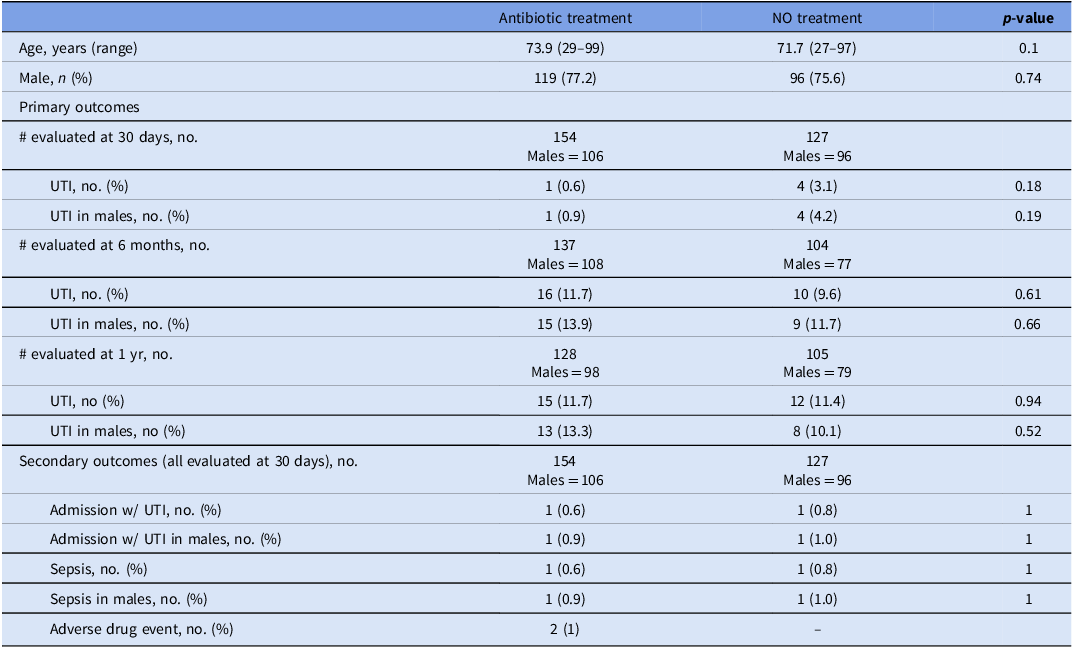
Of the 988 positive urine cultures collected between January 1, 2021, and December 31, 2021, 281 met inclusion criteria. Of the 281 urine cultures representing ASB, 154 (54.8%) were treated with antibiotics, while 127 (45.2%) were untreated. The study population was primarily older males with a similar distribution in age and sex between groups (Table 1).
Outcomes in patients with untreated versus treated asymptomatic bacteriuria within five VA facilities

UTI = urinary tract infection.
The incidence of UTI was 0.6% versus 3.1% (p = 0.18) at 30 days, 11.7% versus 9.6% (p = 0.61) at 6 months, and 11.7% versus 11.4% (p = 0.94) at 12 months in the treated and untreated cohorts, respectively. There was no significant difference in admissions for UTI or sepsis from UTI at 30 days between the cohorts. Two patients in the treatment group reported an ADE at 30 days. Both cases were allergic reactions to sulfamethoxazole/trimethoprim. There were no significant differences in any of the outcomes in the subgroup of male patients.
Discussion
The findings of this study in a predominately older male veteran population are consistent with studies of predominately younger female populations. Cai et al. evaluated the risk of UTI recurrence in young, healthy females with ASB who were treated with antibiotics and found that antibiotic use in ASB was associated with an increased risk of recurrent UTIs over a 1-year study period.Reference Cai, Mazzoli and Mondaini9 Similarly, our study found the incidence of UTI in males at 6 months and one year was numerically higher in the treatment group, although the numbers were small and did not reach statistical significance. Rovelsky et al. looked at a similar population to our study, completing a cohort analysis of 3255 urine cultures from 31 VA medical centers with a 76% male study population, and found veterans with ASB treated with antibiotics had significantly higher incidence of composite treatment failure at 30 days.Reference Rovelsky, Vu and Barrett2 While our study did not find worse outcomes, it does expand on the timeframe of Rovelsky et al. and finds no benefit of ASB treatment in a timeframe up to one year, thus affirming guideline recommendations to avoid antibiotic therapy in ASB in the male population.
These findings also highlight opportunities for both diagnostic and antimicrobial stewardship as 28.4% of cultures were collected in the absence of urinary symptoms and more than half of the patients with ASB were prescribed antibiotics. It has been well documented that inappropriate culture ordering leads to unnecessary AU.Reference Leis, Rebick and Daneman10 Moreover, it is well established that AU can lead to ADEs which can burden emergency departments.Reference Geller, Lovegrove and Shehab5,Reference Krzyzaniak, Forbes and Clark7 Although this study identified only two antibiotic-related ADEs, it is possible that less severe ADEs were unreported, or treatment for ADEs was sought outside the VA system so the true incidence may be higher.
This was a collaborative study across five Veterans Affairs Medical Centers (VAMCs) and, to the best of our knowledge, represents the first to evaluate ASB outcomes beyond 30 days in a predominantly male population. However, there are several limitations associated with this study. As classification of ASB versus UTI was dependent on appropriate encounter documentation, it is possible that incomplete or inaccurate documentation could have led to misclassification. Additionally, healthcare encounters from providers outside the VAMCs were not accounted for. The event rate was also low so larger studies will be useful to confirm these observations. Finally, confounders which could predispose patients to UTIs, such as UTI history, diabetes, or concomitant medications were not collected.
In conclusion, there was no difference in the development of symptomatic UTI in a predominately male veteran population with untreated ASB compared to those treated with antibiotics at 30 days, 6 months, and 1 year. These findings align with the 2019 IDSA ASB guidelines and support avoidance of unnecessary urine screening and antibiotic use in the veteran population.
Acknowledgements
Colleen Lewellyan, PharmD, for assistance with data extraction and study development.
Jordan Osborne, PharmD, Caroline Powers, PharmD, Caroline Williams, PharmD, and Dana Williams, PharmD, for assistance with data collection.
This material is the result of work supported with resources and the use of facilities in the VA MidSouth HealthCare Network. The contents of this manuscript do not represent the views of the US Department of Veterans Affairs or the United States Government.
Author contributions
K. Davis and J. Bennett contributed study conception, design, data analysis, data interpretation, and manuscript preparation.
A. Kaucher and H. Scheerenberger contributed with study conception, design, data acquisition, data interpretation, and manuscript preparation.
J. Bowden contributed to study conception, design, data acquisition, and manuscript preparation.
G. Fannin contributed study design, data acquisition, data analysis, data interpretation, and manuscript preparation.
B. DeJarnett contributed to data acquisition, analysis, and manuscript preparation.
A. Mitchell contributed study design, data acquisition, and manuscript preparation.
M. Johnson contributed study conception, design, and manuscript preparation.
Financial support
None reported.
Competing interests
Potential conflicts of interest. All authors report no conflicts of interest relevant to this article.