Introduction
Discussion on the process of convergence in economic literature typically stems from the neoclassical model of growth,Footnote 1 which has a number of relevant policy implications. In recent times, there has been a growing interest in convergence methodology in demography and public health (e.g. Wilson, Reference Wilson2001, Reference Wilson2011; McMichael et al., Reference McMichael, McKee, Shkolnikov and Valkonen2004; Moser et al., Reference Moser, Shkolnikov and Leon2004; Neumayer, Reference Neumayer2004; Dorius, Reference Dorius2008, Reference Dorius2010; Taylor, Reference Taylor2009). Theoretically, following homogeneous pre-transition phase of health transition, progressive transition generates multidimensional geographic and socioeconomic heterogeneity, until the reappearance of a homogeneous post-transition phase. The process through which heterogeneity of transition will become homogeneous over time is termed as ‘convergence’. The health transition model proposed by Omran (Reference Omran1971) provides a useful framework for studying many dimensions of health. Further, many of the classical analyses of the 1970s of long-term demographic and epidemiological trends maintained that, more significant gains in longevity in countries with low mortality is unlikely, but the death rates in countries with high mortality would fall, resulting in a worldwide convergence in mortality (Omran, Reference Omran1971; Preston, Reference Preston1976). The rising and converging life expectancy have been recognized by an increasing number of empirical research (e.g. McMichael et al., Reference McMichael, McKee, Shkolnikov and Valkonen2004; Moser et al., Reference Moser, Shkolnikov and Leon2004; Neumayer, Reference Neumayer2004; Becker et al., Reference Becker, Philipson and Soares2005).
However, the recent trend suggests that the expectation that emerged in the 1960s and 1970s of world gains in life expectancy at birth (LEB) does not guarantee convergence in population health status by a general deterministic process (McMichael et al., Reference McMichael, McKee, Shkolnikov and Valkonen2004). Furthermore, the progress of demographic and epidemiological transition in developing countries has resulted in a more skewed distribution of health, which considerably influenced the between- and within-group health inequalities (Ram, Reference Ram1998; Gwatkin, Reference Gwatkin2000; Wagstaff, Reference Wagstaff2000; Mackenbach and Stronk, Reference Mackenbach and Stronk2002; Victora et al., Reference Victora, Wagstaff, Schellenberg, Gwatkin, Claeson and Habicht2003; Goesling and Firebaugh, Reference Goesling and Firebaugh2004; Becker et al., Reference Becker, Philipson and Soares2005; Hosseinpoor et al., Reference Hosseinpoor, Doorslaer, Speybroeck, Naghavi, Mohammad, Majdzadeh, Delavar, Jamshidi and Vega2006). Previous studies suggest that such a situation arise because of three main reasons: first, the differential in health care seeking pattern by the poor and rich in transitional economies. Second, the newly arising combinations of social, economic and political conditions, and altered relations with the microbiological world that causes reversal in death rates. That is, gains in longevity could be less smooth and less certain than what earlier notions of global convergence had suggested (Moser et al., Reference Moser, Shkolnikov and Leon2004). This reflects deleterious socioeconomic and political conditions, often with unequal access to health care (Whitehead et al., Reference Whitehead, Dahgren and Evans2001). Moreover, the burden of injury, impaired and mental health problems; and deaths from violence, conflict and war are on the rise. There is also a rise in health risks a consequent to large scale environmental change caused by population pressure (World Health Organization (WHO), 2002; Neumayer, Reference Neumayer2004). Third, the health disparities in later life increase with the increasing proportion of the older population and the socioeconomic status disparities (Perlman, Reference Perlman2008). The studies on trends in health inequalities suggested that, in both the developing and the developed countries, health inequalities rise with rising per capita income (Wagstaff, Reference Wagstaff2000, Reference Wagstaff2002).
On the other hand, the optimistic view suggests that the current health trends toward divergence will rebound to convergence, possibly as soon as 2015 (Neumayer, Reference Neumayer2004). The debate of convergence in health is yet to be fully explored from both theoretical and methodological perspective. Given the importance of this question, recently few research studies have attempted to address the issue, but all of them focused typically on worldwide mortality [LEB and infant mortality rate (IMR)] trends or developed world context (e.g. Bloom and Canning, Reference Bloom and Canning2007; Montero-Granados et al., Reference Montero-Granados, Jimenez de Dios and Martin2007; Taylor, Reference Taylor2009; Dorius, Reference Dorius2010; Clark, Reference Clark2011; Gächter and Theurl, Reference Gächter and Engelbert2011; Wilson, Reference Wilson2011). In the developing countries, despite considerable progress in health, there is hardly any evidence-based testing of convergence models for various health indicators, especially at the sub-national or local level.
The context of this study is based on two critical issues: first, over the past two decades, there had been considerable improvement in life expectancy and average levels of several child health indicators in India (Office of Registrar General of India, 1981–2007, 2009). India's current phase of demographic transition is heading from third to the fourth stage (Visaria, Reference Visaria2004b). The country is also in the second phase of epidemiological transition (Visaria, Reference Visaria2004a). However, this transition is not uniform across the states and social stratum. Comparatively, the south India states are approaching lower mortality rates, whereas many of the north India states have just started catching up south India states (Office of Registrar General of India, 1981–2007, 2009; International Institute for Population Sciences (IIPS) and Macro-Internationals, 1992–2006). India, being the second largest populous country with enormous geographic and socioeconomic variations in health provides an ideal setting for testing convergence hypothesis. Nevertheless, there has been no formal attempt to estimate the volume and speed of convergence across the Indian states and socioeconomic groups.
Second, although most of the convergence studies in population and health studies focused on averages, particularly in developed countries, the current health policy challenge is to reduce inequality and not just to improve average health or lengthen the life span (Blas and Kurup, Reference Blas and Kurup2010). To our knowledge, this study is a first time quantitative assessment of convergence in health and health inequalities, in the Indian context. The assessment of how different states and socioeconomic groups are moving and converging in terms of health and health inequalities is crucial for understanding the challenges of future health policy. It is necessary to study, the extent to which improvements in national average health status over the last three decades have been accompanied by convergence in average health status and health inequalities across the states and socioeconomic groups. Therefore, the principal objective in this paper was to quantify the rate and speed of convergence in terms of both average health and health inequalities across geographical and socioeconomic divisions of India.
Materials
The study used data from the Sample Registration System ([SRS], 1981-2007, 2009) three rounds of the National Family Health Survey ([NFHS], 1992–2006), and government official statistics to assess convergence in health and health inequalities, in major states and socioeconomic groups of India.
SRS
SRS (1981–2007, 2009) data on IMR and LEB are used as summary indicators of the health status across the major states of India. Since the early 1970s, India's SRS has been the authoritative source of mortality and fertility estimates. The SRS is, in essence, a demographic sample survey based on a dual-record system, designed to provide reliable estimates of mortality and fertility indicators for India and states. It involves both continuous registration of births and deaths; and half-yearly surveys to record missed events. The SRS is based on a nationally representative sample of villages and urban blocks. The revision of SRS sampling frame is undertaken every 10 years based on the results of the latest census. For all the years, sample design and sample size were such that the outcomes based on it are comparable over time (for details on sampling see Office of Registrar General of India, 2007, 2009).
NFHS (1992–2005)
The three rounds of NFHS (1992–2006) data have been used to assess the trends in child health status and inequalities in child health across the major states and socioeconomic stratum. The NFHS is an equivalent of worldwide Demographic Health Survey (DHS), and a widely accepted source of data for estimating fertility, mortality and health trends in India. DHS is the standardized survey in nearly 80 countries and over 240 surveys, and the sampling procedures and questions in these surveys are in a standard format for all countries. Three rounds of NFHS were conducted by the IIPS and Macro International under the aegis of the Ministry of Health and Family Welfare, India. The NFHS collects information on fertility, mortality, morbidity, maternal and child health, with representative samples covering from all the 29 states of India, which comprises more than 99% of the population. All the three rounds of NFHS hold adequate sample size for the estimation of selected child health indicators (for details on sampling, see IIPS and Macro-Internationals, 1992–2006).
Other source of data
The literacy rate used in this study were from Census, 1981–2011 (Office of Registrar General of India and Census Commissioner, 1981–2011) and the poverty ratios were based on planning commission estimates of poverty, 1973–2006 (Government of India, 1973–2006). LEB for India and states during 2011 was taken from United Nations Development Programme's (UNDP's) Human Development Index India Report, 2011 (UNDP, 2011).
Methods
The health and convergence metric analyses of this study are performed using Stata 10.1 versions (strata crop LP, College Station, Texas, USA). The analyses of this study are modeled based on both health averages and inequality measures to overcome recent criticism of convergence estimates based on averages alone. Therefore, the analyses of the study were done in three stages. The first stage of analyses consisted of trend analyses of health status and health inequalities. Health status and health inequality were measured in terms of LEB, IMR, full immunization coverage of children aged 12–23 months and underweight of children under 5 years of age. While LEB is a widely accepted summary measure of overall health status and IMR, is the sensitive indicator of child and maternal health status. The full immunization coverage of children and children underweight are the progressive indicators of health status of a country (WHO, 2008; Blas and Kurup, Reference Blas and Kurup2010). Mean estimates and concentration index (CI), respectively, are used for measuring child health status and health inequalities by major states and socioeconomic groups. Second, convergences in average health status for all selected indicators were measured by both absolute and conditional β-convergence measure. Third, dispersion measure of mortality (DMM), Gini indices and CIs were, respectively, used to assess the convergence in absolute, relative and socioeconomic health inequalities. The percentage reduction in DMM and Gini are used to show the overall absolute and relative convergence in health inequalities. Moreover, the reduction in standard deviation (SD) is used to measure the convergence (σ convergence) of socioeconomic inequalities in health. In the following section, we discussed the rational and mathematical procedures of various convergence metrics tested in Indian context.
Convergence in averages: β- and σ-convergence measures
In the first stage, absolute β convergence was estimated for LEB, IMR, children fully immunized and children underweight for the major states of India. Additionally, conditional β convergence is estimated by adding two more explanatory variables: the proportion of illiterate population and poverty ratios of states in the regression model.
Absolute β-convergence measure
Absolute convergence is used where the gap between the rich and poor shrinks especially due to greater progress in poorer states and social strata, a concept that originated from the work of Barro and Sala-I-Martin (Reference Barro and Sala-I-Martin1991). In this study, absolute convergence was tested using the following linear regression model specified in Rely and Montouri (Reference Rely and Montouri1999):
 $${\rm{ln}}\:\left[ {\frac{{{{Y}_i}_{,} {{\,}_{t\, + \,k}}}}{{{{Y}_{i,t}}}}} \right]\, = \,\alpha \, + \,\beta .\ln ({{Y}_{i,t}})\, + \,{{{\epsilon}}_{it}},$$
where  $$)(--><$>{\rm{ln}}\left[ {\frac{{{{Y}_i}_{,} {{\,}_{t\, + \,k}}}}{{{{Y}_{i,t}}}}} \right]<$><!--$$
is the mean annualized growth rate of the variable Y in country i in the period (t, t + k), Yi,t is the value in the initial time t and εi,t are corresponding residuals.
The speed of convergence is computed as s = −1/T (ln (1 + Tβ), where s is the speed of convergence and Tβ is the β-convergence in T period.
Conditional β-convergence measure
When the analysis is to carry out at national level, it is not reasonable to assume that all states will share the same socioeconomic conditions. In order to disentangle the socioeconomic effects, Herbertsson et al. (Reference Herbertsson, Orszag and Orszag2000) focused on Conditional β-convergence measure. It may be detected with the inclusion of the Barro regression model of an additional set of explicative variables that account for varying socioeconomic conditions (Dorius, Reference Dorius2008). In this study, we have estimated conditional β convergence by adding proportion of illiterate and poverty ratios of states as additional covariates in the β-convergence model, the mathematical equation for this model can be written as
 $${\rm{ln}}\left[ {\frac{{{{Y}_i}_{,} {{\,}_{t\, + \,k}}}}{{{{Y}_{i,t}}}}} \right]\, = \,\alpha \, + \,\beta .\ln ({{Y}_{i,t}}{{Y}_{1,i,t}}{{Y}_{2,i,t}})\, + \,{{{\epsilon}}_{it}},$$
where  $$)(--><$>{\rm{ln}}\left[ {\frac{{{{Y}_i}_{,} {{\,}_{t\, + \,k}}}}{{{{Y}_{i,t}}}}} \right]\,<$><!--$$
is the mean annualized growth rate of the health variable Y in the state i for the period (t, t + T); Yi,t is the value in the initial time t and εi,t are the corresponding residuals. Similarly, Y 1 is the proportion of illiterate population in state i in period (t, t + k) and Y 2 is the poverty ratio in state i in period (t, t + k).
σ-Convergence measure
Young et al. (Reference Young, Matthew and Daniel2008) proved that β convergence is a necessary but not sufficient condition for σ convergence; on the contrary, σ convergence is sufficient but not a necessary condition for β convergence. While β-convergence measure estimates depict the catching-up process of poor states toward their richer counterparts, σ convergence is about whether states converging toward one another over time (rather than to their steady state levels)?
σ convergence was estimated for socioeconomic inequalities in child health across the major states of India. σ convergence postulates that convergence takes place when the dispersion of health status decreases. Over the years, we expect the gap between the states in terms of socioeconomic inequality in child health status to become smaller. This model was estimated as
 $${{\sigma }_{t\,}} \gt {{\sigma }_{t\, + \,T}},$$
where  $$)(--><$>{{\sigma }_{t\,}}<$><!--$$
is the SD (or assimilated measure) of the indicator at the time t. If the parameter
 $$)(--><$>{{\sigma }_{t\, + \,T}}<$><!--$$
declines over time implies convergence.
Convergence in absolute, relative and socioeconomic dispersion of health
Convergence in average health status is necessary but not sufficient condition for convergence in health inequalities; on the contrary, convergence in health inequalities is sufficient but not necessary condition for convergence in average health status. By this assumption, we used health inequality measures to test convergence in absolute, relative and socioeconomic dispersion of health across major Indian states.
DMM
The DMM measures the degree of dispersion that exists at any point of time in the mortality experiences of the countries in the world or states in a country. It is calculated as the average absolute interstate mortality difference in India, weighted by population size, between every pair of states. Change in the DMM over the time indicates whether mortality is becoming more or less similar across the country; decrease indicates convergence, whereas increase indicates divergence (Moser et al., Reference Moser, Shkolnikov and Leon2004). The DMM for LEB is measured in years of life, and the DMM for infant mortality is measured in terms of infant deaths per thousand live births (Shkolnikov et al., Reference Shkolnikov, Andreev and Begun2003). The DMM is obtained by means of the formula:
 $${\rm{DMM}}\,{\rm{ = }}\,\frac{{\rm{1}}}{{{\rm{2(}}{{W}_Z}{{{\rm{)}}}^{\rm{2}}} }}\mathop{\sum}\limits_i {\mathop{\sum}\limits_J {\left( {\left| {{{M}_i}{\rm{ - }}{{M}_j}} \right|\:\times \:{{W}_i}\:\times \:{{W}_j}} \right)} }, $$
where i, j are states, and 1 ⩽ i, j ⩽ 15, M is the mortality rate, W is the weighting, and  $$)(--><$>\mathop{\sum}\nolimits_{ij} {{{W}_i}\, = \,} \mathop{\sum}\nolimits_j {{{W}_j}\, = \,{{W}_Z}} ;<$><!--$$
Wz weight is the India.
When applied to LEB, M is the LEB of state i, WZ = 1 and Wi represents the relative population size of the state i. The similar procedure can also be adopted for IMR.
Gini coefficient
Another measure that we used to assess the relative interstate inequality in longevity and infant mortality is Gini coefficient (G). G is a measure of relative inequality that is equal to DMM divided by the average life expectancy (Shkolnikov et al., Reference Shkolnikov, Andreev and Begun2003):
 $$G\,{\rm{ = }}\,\frac{{{\rm{DMM}}}}{{\overline{{e_{{\rm{0}}}^{{\rm{0}}} }} }},\ \ {\rm{where}}\,\,\overline{{e_{{\rm{0}}}^{{\rm{0}}} }} \, = \,\left[ {\mathop{\sum}\limits_i {Pie_{0}^{i} } } \right]$$
When applied to LEB, DMM is the dispersion measure of mortality,  $$)(--><$>\overline{{e_{{\rm{0}}}^{{\rm{0}}} }} <$><!--$$
is the average LEB and adjusted by population proportion of the states i…in.
CIs
To assess the socioeconomic inequality in health, we used CI proposed by Wagstaff et al. (Reference Wagstaff, Pact and Doorslaer1991). The CI is computed as twice the (weighted) covariance of the health variables, and a person's relative rank in terms of economic status, divided by the variable mean according to the equation:
 $$C\, = \,\frac{2}{\mu }{\rm{co}}{{{\rm{v}}}_{\rm{w}}}({{Y}_i},{{R}_i}),$$
where Yi and Ri are, respectively, the health status of the ith individual and the fractional rank of the ith individual (for weighted data) in terms of the index of household economic status, μ is the (weighted) mean of the health variable of the sample and covw denotes the weighted covariance. The value of the CI can vary between −1 and +1. Its negative values imply that a variable is concentrated among disadvantaged people, while the opposite is true for its positive values. When there is no inequality, the CI will be zero.
Results
Trends in averages of health status
Health status trends among states and India is measured in terms of progress in key health indicators such as LEB, IMR, children full immunization and children underweight. Trend assessments from Figure 1 show that LEB in India and selected major states has improved over the last 25 years. However, the growth in LEB was slower during the recent decade (2001–2011) as compared with 1980s and 1990s. Therefore, since 2001, the trend lines of LEB are plateauing for India and the selected states. However, the trend lines for IMR display a different scenario indicating consistent declines in IMR during 1981–2008 for India and selected states. The gap between the states for IMR was narrowed substantially, which is greater during pre-2001 compared with post-2001. However, substantial gap exists between the demographically advanced states like Kerala and demographically weaker states like Bihar, Madhya Pradesh and Uttar Pradesh, both in terms of LEB and IMR.
Trends in life expectancy at birth (LEB), infant Mortality rate (IMR), children full immunization coverage1, children underweight2 in India and major states; 1981–2006. Note: 1. According to guidelines developed by the World Health Organization (WHO, 1998), children aged 12–23 months who received one vaccination against tuberculosis (BCG), three doses each of the diphtheria, whooping cough and tetanus (DPT) vaccine; three doses of poliomyelitis (polio) vaccine, and one dose of measles vaccine are considered fully immunized. 2. Underweight (weight-for-age) is a composite index of height-for-age and weight-for-height. It takes into account both acute and chronic malnutrition. Children are classified as underweight if their weight-for-age is below −2SD from the median of the reference population. The estimates were based on a new international reference population recommended by WHO in April 2006 (WHO Multicenter Growth Reference Study Group, 2006). The indices provide information about growth and body composition. Children in age 0–5 years were considered for analysis.

Two categories of trend lines were observed for children full immunization coverage: the first set relates to the demographically advanced states with higher levels of full immunization coverage with an increasing trend until 1998–1999, followed by a declining trend for later period. The second category relates to demographically lagging states, present a contrasting situation, as they showed a downward trend until 1998–1999 followed by a substantial increase. This suggests that those demographically backward states with higher growth of full immunization coverage rates were catching-up with the levels of demographically advanced states. This catching-up process represents a necessary condition for β convergence occurrence in these two groups of states.
However, the trends in children underweight showed dissimilar progress. All the states experienced a decline in children underweight during 1992–1999, however, from 1998–2006 indicate a mixed pattern: the trends in percentage of children underweight declined in the majority of the states but increased in a smaller number of states. Overall, trends in health indicators showed a steady state in LEB, a converging trend in IMR and a more or less converging trend in child full immunization rates and a recent setback in convergence trend for children underweight.
Trends in overall and socioeconomic inequalities in health
In this study, we have targeted to measure the convergence in two types of health inequalities: first, overall health inequality and second, socioeconomic inequality in health. Within the overall health inequality, we have measured overall absolute health inequality and overall relative health inequality by using DMM and Gini Index, respectively. DMM is based on estimated absolute interstate population health status, weighted by their population sizes. Gini coefficient shows the relative interstate inequality in health. Decrease or increase in DMM shows changes in absolute inequality in health among the population of selected states. Similarly, change in Gini coefficient indicates the relative change in inequality in health (Shkolnikov et al., Reference Shkolnikov, Andreev and Begun2003; Saikia et al., Reference Saikia, Jasilionis, Ram and Shkolnikov2011). Further, socioeconomic inequalities in child health were measured in terms of concentration indices (CIs).
Figure 2 displays the estimates of DMM and Gini Indices for LEB for major Indian states during 1981–2011. Results reveal that DMM decreased until 2001–2005, but signaled a rising trend thereafter. Similar trends were also observed for Gini index of LEB. The estimates of both indices thus confirm that the decrease in both absolute and overall relative inequality in LEB for earlier periods (1980s and 1990s) across Indian states was not sustained for recent time periods (2001–2011), as inequality in LEB indicated a rising trend since 2001. Unlike the trends in LEB, DMM and Gini coefficient trends in IMR indicate a more distinct pattern. DMM for IMR declined steadily during 1981–2008 but conversely, the Gini index values increased substantially. Such patterns of results suggest that though absolute inequality in health has been on the decline, relative health inequality continued to rise (Figure 3).
Trends in dispersion measure of mortality (DMM) and Gini Index measures for life expectancy at birth (LEB), India, 1980–2011. Note: (1) States: n = 15.
Trends in dispersion measure of mortality (DMM) and Gini Index measures for infant Mortality rate (IMR), India, 1981–2008. Note: States: n = 15.
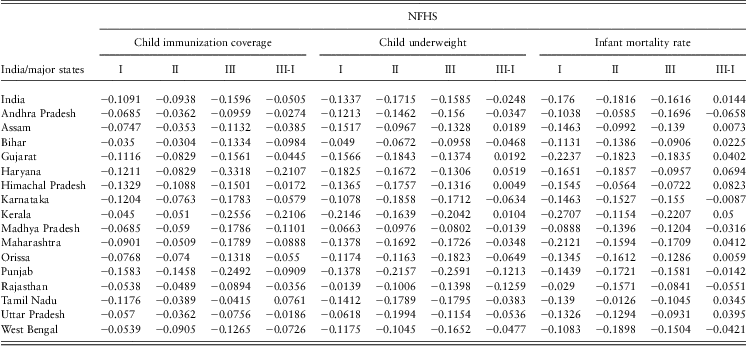
Socioeconomic inequality in health was measured in terms of health inequality among socioeconomic groups for selected major states of India (Table 1). The trends in socioeconomic inequality in health reveal a number of appealing findings. First, complementing the results of DMM, the trend assessment of CIs for IMR showed a declining trend for 11 out of the 16 selected states of India. However, it must be noted that four of the five states, that experienced an increase in IMR, were economically and demographically advanced states. Second, the socioeconomic inequality in full immunization of children showed an increase for India and states during 1992–1993 to 2005–2006. The increase was greater for most of the socially, economically and demographically developed states than for their less developed counterparts. Nevertheless, the socioeconomically and demographically weaker states of Bihar and Madhya Pradesh indicated a rise in health inequality. Third, socioeconomic inequality in children underweight increased in 11 states, but showed a reduction in four states. However, for India as whole, socioeconomic inequality in children underweight increased. In contrast to the trends in full immunization of children, socioeconomic inequality for children underweight was higher among the socioeconomically and demographically weaker states.
Trends in concentration index for selected child health indicators in India and major states, 1992–2006
NFHS = National Family Health Survey.
NFHS-I (1992–1993).
NFHS-II (1998–1999).
NFHS-III (2005–2006).
Overall, trend assessments of absolute, relative and socioeconomic inequalities evidently indicate that inequalities in IMR declined over time; however, inequalities increased for recent periods for all other three indicators of health: LEB, full immunization of children and children underweight. It is important to distinguish from the results that steady improvements in average health status over time may not necessarily guarantee a reduction in health inequalities. Therefore, in the following sections, we have assessed the convergence in average health status and health inequalities separately.
Convergence in averages of overall and child health status
Absolute β convergence in overall and child health status
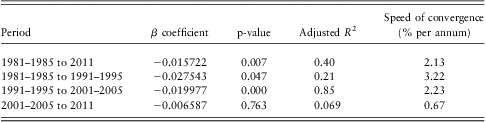
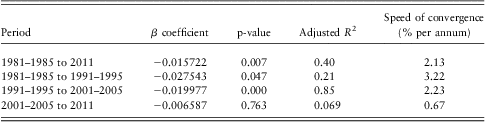
In this section, we have assessed the convergence in averages of overall and child health status. Convergence in overall health status was measured based on LEB. To measure the convergence in LEB, we have estimated both absolute and conditional β-convergence measures. Moreover, to explore the possibility of contra underlying trends during the 21-year period, piecewise convergence models were estimated. Piecewise convergence estimates indicate convergence process in the smaller intervals. The results of absolute β-convergence estimates showed statistically significant evidence of convergence in LEB during the period, 1981–2011 at the rate of 2.1% per annum. However, when convergence coefficient was disaggregated for three smaller intervals, the volume and speed of convergence (β = −0.027543, S = 3.2% per annum, p < 0.047) was higher during 1985-1995 compared with later periods, 1995–2011 (Table 2).
Absolute β convergence for life expectancy at birth across the major states in India, 1981–2006
States: n = 15, df = 14.
Convergence in child health status was measured based on three key child health indicators: IMR, full immunization coverage of children and children underweight. Similar to the estimates of convergence in overall health status (based on LEB), convergence in averages of child health status have been estimated by using both absolute and conditional β-convergence measures. Analogous to the process adopted for estimating convergence in LEB, the β-convergence models for child health indicators were estimated in two-stage analyses: the first-stage analyses dealt with β convergence between the beginning and end of the period under observation and, the second-stage analyses dealt with piecewise analyses: β convergence for the sub-periods.
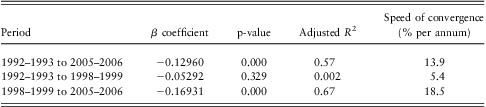
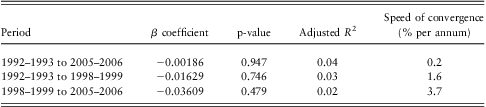
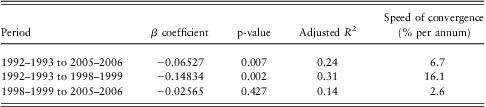
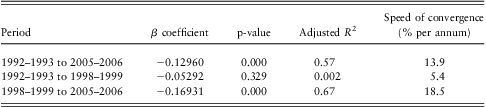
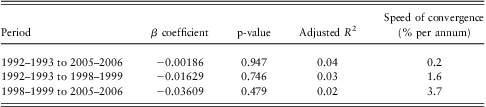
The results of absolute β-convergence estimates for child full immunization coverage were provided in Table 3. The results showed negative β coefficients for all the three selected periods implying that there was convergence among the states in full immunization coverage. However, the volume and speed of convergence is greater during 1999–2006 (S = 18% per annum) compared with 1992–1998 (S = 5% per annum). Commensurate with the results of full immunization coverage, the results of absolute β-convergence model estimates for children underweight showed the negative β coefficients during 1992–2005 and for the sub-periods. Further, the volume and speed of convergence in children underweight was also greater for recent periods compared with earlier periods. However, for children underweight, the model was statistically not significance and adjusted R 2 showed very poor goodness of fit (Table 4). Akin to other two indicators, absolute convergence estimates for IMR presented in Table 5 also revealed that the β value for IMR during 1992–2005 was statistically significant (β = −0.06527, p < 0.007) indicating convergence in IMR. However, piecewise regression models for disaggregated periods showed that the convergence was much greater during 1992–1998 (β = −0.14834, p < 0.002) than 1999–2005 (β = −0.02565, p < 0.427).
Absolute β convergence for full immunization of children aged 12–23 across the major states, India, 1992–2006
States: n = 24, df = 23.
Absolute β convergence for children underweight across the major states, India, 1992–2006
States: n = 24, df = 23.
Absolute β convergence for infant mortality rate across the major states, India, 1992–2006
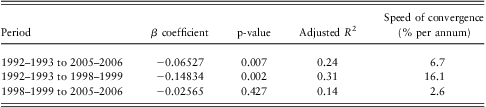
States: n = 24, df = 23.
A comparative assessment of the convergence estimates for three child health indicators during 1992–2005 revealed that the speed of convergence in underweight (S = 0.2% per annum) was smaller compared with full immunization coverage (S = 14%) and IMR (S = 7% per annum). The convergence was more for the recent period for children full immunization, whereas convergence was greater in the earlier period for children underweight and IMR.
Conditional β convergence in overall and child health status
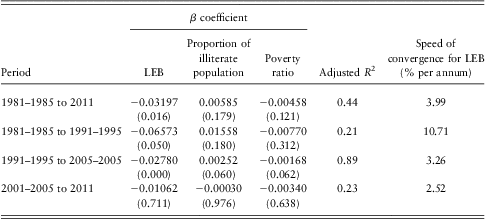
Although the absolute convergence model presented evidential support for unconditional convergence, it is not reasonable to assume that all the states do share same socioeconomic conditions. Therefore, to account for socioeconomic variability of the states, conditional β convergence was estimated by including two more explanatory variables: proportion of illiterate population and proportion of population in poor wealth quintile in the regression model. The conditional β-convergence estimates for LEB also showed evidence of convergence as indicated by negative β coefficient (β = −0.03197, p < 0.016) during 1981–2011 (Table 6). The estimates for shorter intervals within the larger intervals also support convergence hypothesis for all the three periods under consideration. Consistent with the pattern observed for absolute β-convergence model estimates, piecewise conditional β-convergence model estimates also showed greater volume and speed of convergence and statistical significance (β = −0.06573, S = 10% per annum, p < 0.050) during 1985–1995 than recent period, 2005–2011, (β = −0.01062, S = 2.5%). Overall, results imply that both absolute and conditional β-convergence estimates in terms of negative coefficient point to recognizable evidence of Indian states becoming similar in terms of the levels of LEB during 1981–2011. However, conditional β-convergence estimates revealed greater volume and speed of convergence compared with unconditional β-convergence estimates.
Conditional β convergence for LEB across the major states in India, 1981–2006
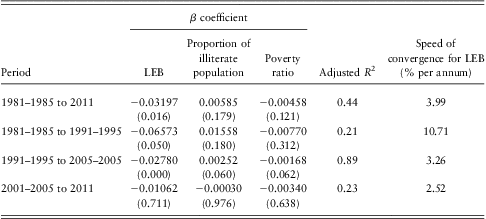
LEB = life expectancy at birth.
States: n = 15, df = 14.
p-value given in parentheses.
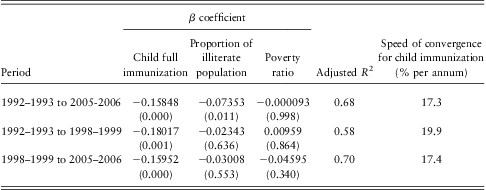
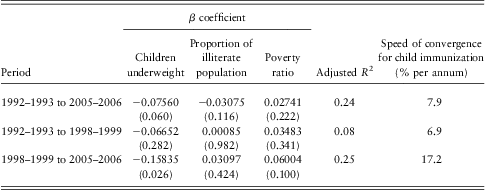
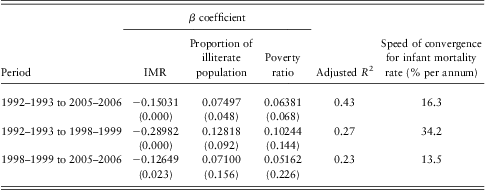
Commensurate with absolute β-convergence estimates, the conditional β estimates for child full immunization rates also showed negative β coefficients (β = −0.15848, p < 0.000, R 2 = 0.68) in the entire period, 1992–2006, thereby supporting convergence hypothesis. However, the piecewise conditional β-convergence model estimates for child full immunization coverage showed greater volume, speed of convergence and goodness of fit (β = −0.18017, p < 0.001, R 2 = 0.58) during 1992–1998 than (β = −0.15952, p < 0.000, R 2 = 0.70) 1998–2005 (Table 7). The conditional β convergence results for child underweight during 1992–2006 indicated convergence but the adjusted R 2 indicated the goodness of fit for the model. Nevertheless, the conditional β estimates for child underweight showed greater volume and speed of convergence (β = −0.15835, p < 0.026, S = 17% per annum) for the recent period than (β = −0.06652, p < 0.282, S = 06% per annum) previous period (Table 8). The conditional β-convergence estimates for IMR indicated that β values for all three periods were negative, thereby indicating convergence in IMR over time. Similar to absolute β-convergence estimates of IMR, conditional β-convergence estimates also suggests that the volume of convergence (β = −0.28982, p < 0.000) was higher during 1992–1998 than (β = −0.12649, p < 0.023) 1998–2006. Moreover, the estimates of speed of convergence and goodness of fit measured by adjusted R 2 also indicated the similar pattern (Table 9).
Conditional β convergence for full immunization of children in age 12–23 across the major states, India, 1992–2006
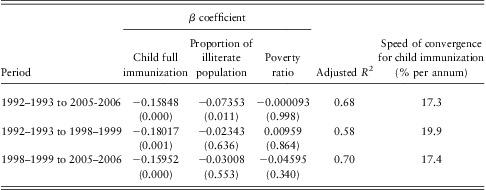
States: n = 24, df = 23.
p-value given in parentheses.
Conditional β convergence for children underweight across the major states, India, 1992–2006
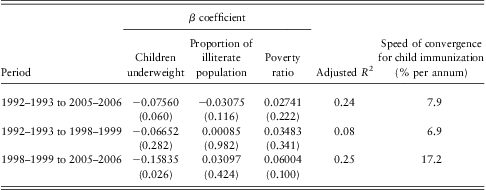
States: n = 24, df = 23.
p-value given in parentheses.
Conditional β convergence for IMR across the major states, India, 1992–2006
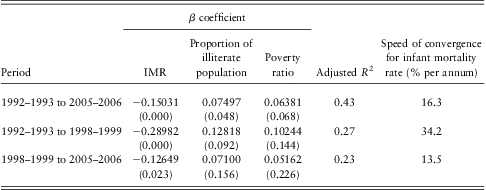
IMR = infant mortality rate.
States: n = 24, df = 23.
p-value given in parentheses.
However, a comparison of absolute and conditional β-convergence estimates showed that after controlling for state level proportion of illiterate population and poverty ratios, the volume and speed of convergence indicated greater conditional β convergence than unconditional β convergence. Moreover, comparison of pattern of convergence during 1992–2006 for different child health indicators revealed that child full immunization showed greater volume of convergence in comparison to other two indicators. However, piecewise regression estimates showed greater convergence in the recent period (1998–2006) for child full immunization compared with the greater volume of convergence was during 1992–1998 for IMR and underweight.
σ convergence in overall health status
As we have stated in the ‘Methods’ section that β convergence is necessary but not a sufficient condition for σ convergence. In other words, a country experiencing β convergence may not be experiencing a σ convergence; therefore, it is necessary to test for σ convergence alongside the β convergence. In this study, we have examined σ convergence based on change in SDs of health status indicators over time for the major states of India (Figure 4). The results for σ convergence in LEB indicated a clear convergence in average LEB for Indian states that the SD in LEB declined from 5.05 during 1981–86 to 4.33 in 2001–2005. However, increase in SD of (SD = 4.33 in 2001–2005 to SD = 4.41 in 2011) LEB for the recent period indicated the emerging divergence trend.
σ convergence in average life expectancy at birth (LEB) across the major states, India; 1992–2006.
Figure 5 shows the results for σ convergence in averages of child health status. In contrast to σ convergence results of LEB, the σ convergence results for child health indicators showed a mixed pattern: three out of two indicators indicated convergence trend in child health status. IMR indicated a convergent trend over the period that the dispersion in IMR declined from 25/1000 in 1992–1993 to 16/1000 live births in 2005–2006. The trend in children full immunization diverged until 1998–1999, but converged thereafter. However, children underweight indicated a divergent trend that the dispersion in percentage of underweight children gradually increased for recent periods (1992–1993) compared with earlier periods (1998–1999 and 2005–2006).
σ convergence in averages of child health indicators across the major states, India; 1992–2006.
Convergence in absolute and relative health inequalities
This section assesses the convergence in health inequalities across the states. The rate of convergence in overall health inequality was measured based on percentage reduction in dispersion of two key health indicators, LEB and IMR. To deal with equity and efficiency, we have measured two types of overall health inequalities: first, DMM was used to measure the absolute distribution of overall health and the calculation of this measure was based on an interval scale. Second, the relative distribution of health was measured with Gini coefficient and the calculation of Gini was based on a ratio scale. Therefore, convergence in absolute and relative health inequalities was measured based on percentage reduction in DMM and Gini: a positive percentage value indicate convergence and a negative value implies divergence. However, the convergence in socioeconomic inequality in child health was estimated using the σ-convergence measure.
Figure 6 reveals that the percentage reduction in absolute inequality, measured by DMM declined for LEB and IMR over the period. However, the decline in DMM was greater (15%) during the period 1980–1990 in LEB across Indian states but turns negative (−2.4%) during 2005–2011; hence, convergence trend was replaced with divergence trend in LEB for the recent periods. In contrast to LEB, the results of convergence in absolute inequality for IMR revealed a steady progress toward convergence across the states over last three decades. However, the volume of convergence in overall absolute inequality in IMR has slowdown during the recent decade: the volume of convergence in overall inequality during 1981–1991 was 31% compared with only 17% during 1991–2001 and 12% during 2001–2008 (Figure 7).
Absolute convergence rate (in percentage) for overall health inequality in life expectancy at birth (LEB) across the major states, India, 1980–2006. Note: Absolute convergence rate is calculated based on dispersion measure of mortality (DMM) estimates of LEB during 1980–2006.
Absolute convergence rate (in percentage) for overall health inequality in infant Mortality rate (IMR) across the major states, India, 1981–2008. Note: Absolute convergence rate is calculated based on dispersion measure of mortality (DMM) estimates of IMR during 1981–2008.
Comparative assessment between LEB and IMR indicated convergence in overall health inequality in both LEB and IMR was greater during the 1980s and 1990s followed by a slowdown in the recent period. In terms of overall inequality in LEB, divergence trend replaced convergence for the recent period. However, throughout the period IMR experienced convergence in absolute inequality across the states but with a slowdown in speed of convergence for the recent period.
Convergence in relative overall inequality in health was measured by Gini coefficient based on reduction in percentage of Gini for LEB and IMR. Compared with convergence estimates in absolute inequality, estimates of relative convergence showed greater divergence in IMR than in LEB: the rate of percentage reduction in Gini coefficient is negative for all three periods for IMR, whereas the rate of reduction in relative inequality in LEB was negative only for the recent period. However, there was a steady decline in the percentage reduction of relative inequality for LEB. In sum, the relative convergence in overall health inequality showed evidence of divergence than convergence, particularly for a period since 2001 (Figures 8 and 9).
Relative convergence rate (in percentage) for overall health inequality in life expectancy at birth (LEB) across the major states, India, 1980–2006. Note: Relative convergence rate is calculated based on Gini estimates of LEB during 1980–2006.
Relative convergence rate (in percentage) for overall health inequality in infant Mortality rate (IMR) across the major states in India, 1980–2008. Note: Relative convergence rate is calculated based on Gini estimates of IMR during 1981–2008.
σ-convergence model was used to estimate the convergence in socioeconomic inequality (CIs) for child health indicators. Results indicated convergent trends for all the three indicators during 1992–1999, thereafter, except for IMR, estimates for child immunization rates and child underweight showed evidence of divergence. However, the divergence was higher for child full immunization rates (SD rose by 0.04248 points) compared with child underweight (SD rose by 0.00284 points). This indicated that the recent shift to divergence in socioeconomic inequality was more evident in case of child full immunization rate than for child underweight. Overall, the evidences suggest diverging trend in socioeconomic inequality in child health for recent periods, pointing to dissimilar progress across the states (Figure 10). Therefore, the pattern of evidence suggests that greater convergence in average health status was not guaranteed with the convergence in socioeconomic inequalities as it was observed in children full immunization coverage.
σ convergence in socioeconomic inequality (concentration indices) in child health indicators across the major states in India; 1992–2006.
Discussion
In this study, we used both standard and inequality based convergence metrics to test the hypothesis of convergence in both averages and relative distribution of health in India focusing on 15 major states and socioeconomic groups for four key health indicators. The results of trend analyses for health averages and inequalities of selected indicators suggested varying patterns. The gap across the states in average health status in terms of IMR and full immunization of children is closing; however, the gap remains the same for LEB and showed a setback in convergence trend for children underweight in the recent period, 1998–2006. The trends in DMM and Gini coefficient suggested a decline in both absolute and relative dispersion initially, but indicated a reversal for the recent period, 2001–2011. The trends in socioeconomic inequalities in child health indicators suggested an increase in inequality in two out of three child health indicators.
A range of convergence metrics tested for health and health inequalities in this study revealed varying patterns of convergence by type of measure and time periods. The results indicate convergence in their averages, but with decreasing volume and speed of convergence for the recent period. The convergence in average was principally driven by greater progress in laggard states and resultant catching-up process. However, the results indicated evidence of some recent setback in convergence in absolute and relative health inequalities in LEB, socioeconomic inequalities in children full immunization and underweight and relative health inequalities in IMR. From the late 1990s, results suggest that progress in converging trend in health inequalities was being replaced by diverging trend. These anomalies may arise because of many reasons, but we point out here few important reasons. First, the divergence in LEB for recent periods is more likely to be the result of unequal rate of progress in reduction of adult mortality across the states for recent periods. Second, India adapted globalization, liberalization and privatization policies since 1991, and different states of India benefited differently from these policies. Such differences may have led to increase in the relative income inequality across states and socioeconomic groups in post-1990s and consequently widened the gaps in both child and adult health. Third, explanations can also be drawn from previous studies, for instance, Wagstaff (Reference Wagstaff2002) provided alternative reasons for such situation: ‘increasing per capita income and health averages also leads to increase in relative dispersion of health across the different population of the developing countries’ as India current experience suggests. Fourth, the difference in both absolute and relative convergence process across the indicators can be attributed to nature of the indicators and factors affecting them. For instance, it is easy to reduce IMR than improving overall life expectancy of the population. On the other hand, two progressive indicators: children full immunization and children underweight are very much sensitive to state-specific socioeconomic conditions, health care policies and programmes and their implementation strategies. India is a country of huge geographic, socioeconomic and cultural diversity, therefore, state specific-policies play a critical role in intra-state disparity between individual of various backgrounds. Hence, improving states average health status may not always results into convergence in relative health status.
Conclusions
The convergence hypotheses tested on India's health data in this paper have been tested previously only for health data of the world or western countries. To our knowledge, this is a maiden effort in India and even in the context of developing countries and therefore fulfills a critical gap in the field of public health research in India by contributing to the issues of progress in equity and efficacy objectives of health policy. The methodology adapted in this study will help in advancing the modeling methods for health progress assessment in India and its states. Findings of this study propel a number of important conclusions:
1. Convergence in average health does not provide a guarantee of convergence in relative and socioeconomic distribution of health. Similarly, the differences in unconditional convergence and conditional convergence foster the influence of dissimilar progress in socioeconomic conditions on health convergence across the states of India.
2. Stability in the convergence process is also not guaranteed. The divergence can replace convergence at any stage of the convergence process based on setbacks in progress or dissimilar progress of states in health indicators. However, these divergent health trends in states can also re-converge.
3. The findings reveal that the period of divergence is too small when compared with the earlier period of convergence and this is consistent with the findings by Moser et al. (Reference Moser, Shkolnikov and Leon2004) in the global context. The future trends of both health and health inequalities across the states and socioeconomic groups depend on the health policies and strategic approaches of the federal and state Government of India.
Further, the findings of this study assume importance, particularly when there is a worldwide debate that, the health policies is to focus on improvement of averages health or distributional dimensions of health such as absolute and relative distributions of health (Whitehead et al., Reference Whitehead, Dahgren and Evans2001; Wagstaff, Reference Wagstaff2002; Victora et al., Reference Victora, Wagstaff, Schellenberg, Gwatkin, Claeson and Habicht2003; Katherine et al., Reference Katherine, David, Blackman, Elliott, Greene, Harrington, Marks, Mckee and Williams2009; Blas and Kurup, Reference Blas and Kurup2010; Dorius, Reference Dorius2010). The outcome of the present study and other largely acceptable viewpoint is, for the fair society and healthy lives, there is a need to measure the health distribution beyond average health differentials (Marmot, Reference Marmot2010). Therefore, in terms of policy perspective, to add to equity and efficiency dimensions, we suggest that the process of convergence in health and health inequalities can be used as a critical assessment tool for monitoring the health progress in existing health policies and programmes. Convergence in health and health inequalities not only reflect a sense of equity across the states, regions and socioeconomic groups, but also can be an effective summary measure of overall (absolute, relative and socioeconomic distribution of health) health progress. Overall, the study fosters the importance of using effective health monitoring tools such as convergence models in countries such as India with huge socioeconomic and geographical disparities in the progress of health and health inequalities. The policy analyst can use convergence measures as tools for health policy evaluations in India and states.
Acknowledgements
We are grateful to Shawn F. Dorius for guidance and innumerable suggestions. We also thank Lalit Dandona and Christopher Wilson for very helpful advice.