





Introduction
Mummified human remains have long captivated both scientific communities and the wider public.Footnote 1 From mummy unwrapping parties of the nineteenth century through to modern museum exhibitions, mummification has fascinated audiences and has offered unique opportunities to explore ancient cultures, medical history, health and disease, funerary practices, and their own mortality.Footnote 2 However, the popularity of mummified human and faunal remains has presented notable challenges to their preservation throughout history. Their extraordinary nature has led some individuals to collect these bodies and parts thereof. For example, prior to the late 1970s, tourists visiting the Capuchin Catacombs in Palermo, Sicily, were known to take mementos of their visit, ranging from isolated fingers and hands to entire heads.Footnote 3 In one instance, in 2022, a skull that had been stolen in the past was returned to the friars from Clermont-Ferrand, France, bearing the alleged name of the deceased.
In the present day, private collectors of human remains are particularly enamoured with preserved bodies due to their rarity.Footnote 4 Today’s semi-clandestine, often illicit, trade and sale of mummified remains most commonly takes place via social media, personal websites, e-commerce platforms, and auction houses. Unregulated acquisition not only complicates legal frameworks,Footnote 5 but it also raises urgent health and safety concerns. Where mummified remains are transported without appropriate controls or documentation, the living are exposed to various risks, including the potential presence of toxic substances historically used to preserve the deadFootnote 6 and subsequent changes to the body and associated personal effects due to microbial growth. While these hazards have been touched upon in the literature,Footnote 7 and even in popular media,Footnote 8 there have been no known follow-up studies on the long-term health implications of handling mummified remains.
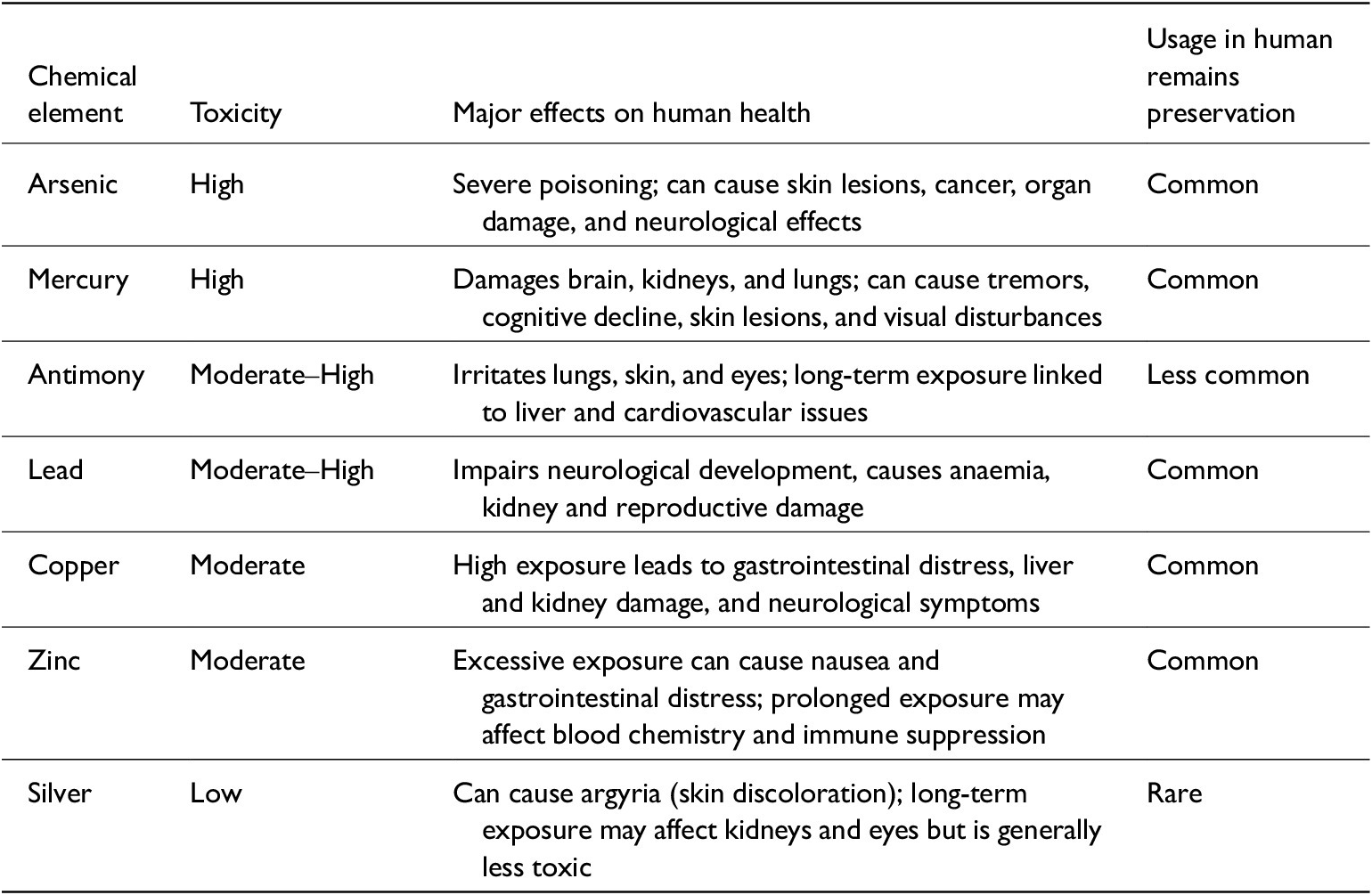
Mummification practices, whether artificial or natural, involve complex chemical and physical processes intended to retard decomposition.Footnote 9 Throughout history a range of toxic materials and substances have been employed to preserve tissues, including heavy metals such as arsenic, mercury, and lead, as well as organic compounds with antimicrobial properties and pigmentation qualities (Tables 1 and 2).Footnote 10 These agents, while effective in preservation, carry inherent dangers due to their toxicity and persistence.Footnote 11 Handling human remains that have been treated with embalming chemicals and preservatives without appropriate protective measures poses a tangible risk of exposure, potentially leading to acute or chronic health effects (Tables 1 and 2).Footnote 12
Chemical elements found in embalming fluids employed in the nineteenth and early twentieth centuries and their effect on human healthFootnote 17

Table 1. Long description
Seven chemical elements found in embalming fluids employed in the nineteenth and early twentieth centuries are noted in this table. These are organized based on their toxicity, from ’high’ toxicity at the top of the table through to ’low’ toxicity at the bottom of the table. The major health effects of these chemical elements are outlined, with their usage in preserving human remains ranging from ’common’ through to ’rare’.
Embalming preservatives widely used by ancient cultures in the mummification process and their effect on human healthFootnote 18

Table 2. Long description
Nine embalming preservatives are listed in this table alongside their geographical usage. The table is organized based on the risk of these preservatives to human health, with those of ’moderate’ risk at the top of the table and ’low’ risk preservatives at the bottom of the table. The major health effects of these chemical elements are outlined, with their usage in preserving human remains ranging from ’common’ through to ’rare’.
Mummified human and faunal remains can also harbor a wide variety of dormant microorganisms despite centuries of desiccation.Footnote 13 In fact, most bacteria, fungi, and yeasts survive, recolonize, and multiply by using the body’s available organic material, especially when remains have been manipulated and subjected to suboptimal storage conditions (Table S1).Footnote 14 These can result in additional biological hazards to the living. This is well illustrated by Łukaszuk et al., who recall the case of Ezzedin Taha from Cairo University.Footnote 15 In 1962, Taha found poisonous fungal spores in mummified individuals that, if inhaled by the living, could lead to inflammation of the respiratory tract, infections, and fever.Footnote 16 Fungal growth has also been identified on spontaneously mummified remains from Guanajuato, Mexico. Since 2021, concerns have been raised regarding the proliferation of fungal spores, uncertain hermetic sealing of display cases, handling and repositioning of bodies, and poor climate control.Footnote 19 Each of these factors ultimately threaten the long-term preservation of the collection and may expose the living to harmful spores. It is therefore essential that mummified remains are stored and displayed under controlled environmental conditions with regular monitoring and maintenance to prevent visible and invisible biodeterioration.
Professionals involved in the research, curation, storage, display, and conservation of mummified remains and associated materials are well-aware of the need to wear appropriate personal protective equipment (PPE), such as masks, gloves, and lab coats, when in contact with preserved bodies.Footnote 20 The use of PPE protects museum personnel and researchers from potentially dangerous embalming preservatives, bacterial and fungal spores, and pesticides applied to museum collections in the past.Footnote 21 Similarly, for those interacting with recently deceased individuals, including mummified remains from forensic contexts, safety precautions must be taken by all personnel due to concerns around the transmission of infectious diseases.Footnote 22 These protocols are initiated from the initial discovery, recovery, and examination of bodies, through to their transportation, funerary treatment (e.g., embalming, where appropriate), and final deposition.Footnote 23
Despite the notable health and safety risks associated with handling mummified remains, they are typically overlooked by sellers in this unregulated market. This may stem from limited awareness of biohazards posed by preserved soft tissues and/or from profit-driven motives that disregard human health and safety and stress caveat emptor. Sales posts do not regularly provide details on how these preserved bodies should be safely handled or stored. Instead, there is an emphasis on their distinctive nature, which is particularly attractive to those interested in unique cases that can be showcased in their private collections.Footnote 24 While previous research has addressed the broader commercial exchange of human remains, this article will specifically focus on mummified remains. Therefore, the aims of this paper are to (1) characterize the cross-platform commodification of mummified human and faunal bodies, and (2) analyze relevant postings for evidence of potential health-related hazards and dangerous practices arising from the sale and trade of preserved tissues and personal effects.
Method
Ethical approval to conduct this research was submitted to the University of Staffordshire’s Ethics Committee on May 30, 2025, and approved on June 2, 2025 (ref: DEF-KES3-024). Broader ethical approval for the monitoring and use of e-commerce and social media posts showing human remains trafficking was initially granted to DH and colleagues via Carleton University, the Social Science and Humanities Research Council of Canada, and the Canadian Tri-Council research ethics board. Footnote 25 Examples of recent sales posts attesting to the ongoing global market for mummified remains derive from several auction, e-commerce, and social media platforms. These include public and business pages on Facebook, sales posts within numerous Facebook groups, public Instagram pages, the Dutch e-commerce platform Marktplaats.nl, online webstores of specific brick-and-mortar businesses, and online auctioneers. Human remains sales, whether mummified or not, have been documented on each of these platforms in previous work.Footnote 26 The current study sample includes not only sales posts but content in which buyers display mummified remains, typically for social media clout. Their presence in the poster’s collection implies the original poster bought and possibly imported the item at some point. As with many categories of organized crime or illicit trafficking research where the site of activity is semi-private forums or social media, the use of “lurker” accounts has become an established method of performing “covert ethnography” and nonparticipant observation within these spaces.Footnote 27
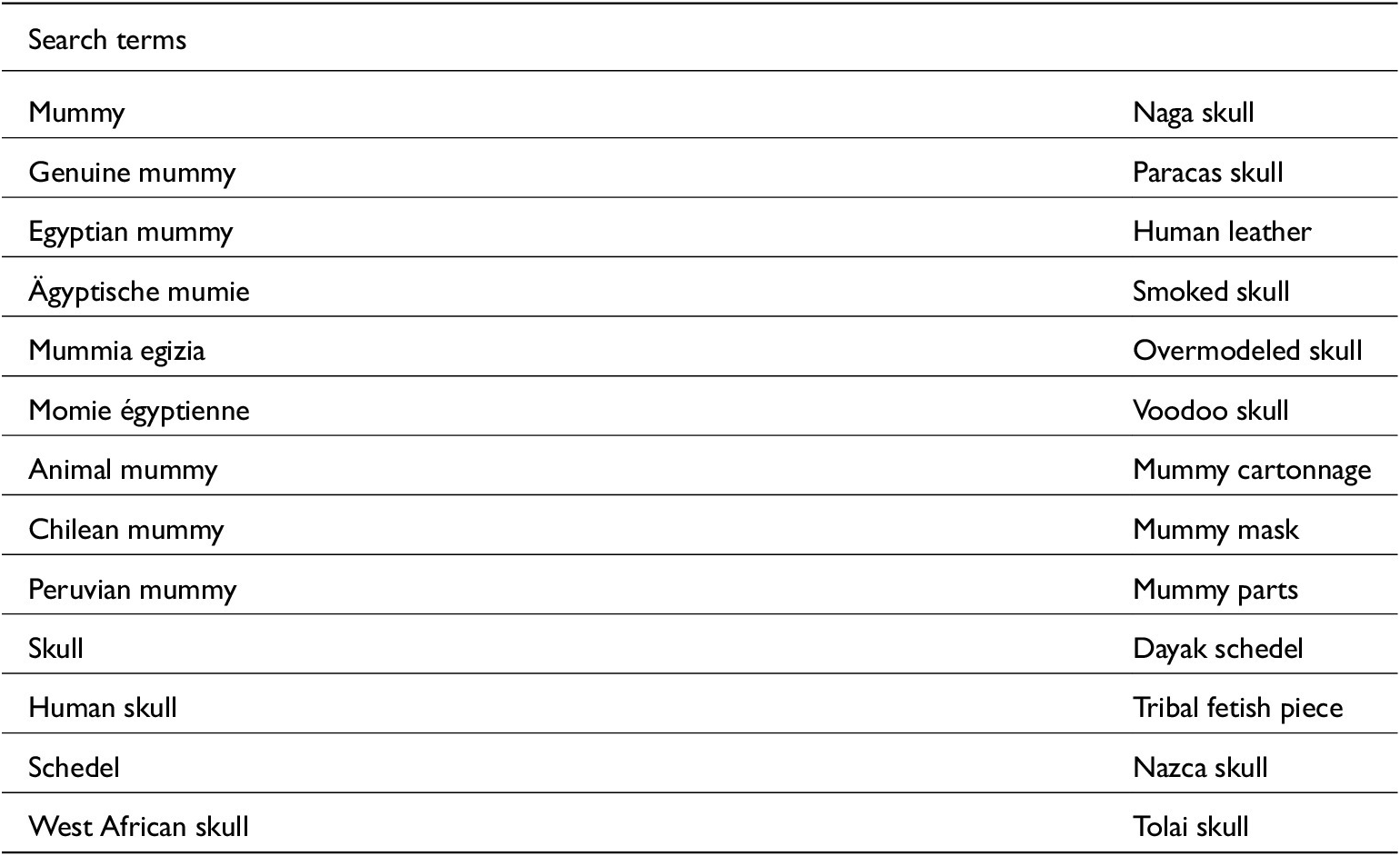
Many of the social media and e-commerce platform posts were selected from the personal screenshot archives of one the authors (DH), who has been monitoring the online human remains trade since 2014. Therefore, our illustrative sample includes posts from 2015 to 2025, selected according to topical relevance and state of preservation. For transparency, these archived social media posts were obtained opportunistically during weekly to fortnightly monitoring of cross-platform and within-group activity rather than through systemic searching. This approach was employed due to the irregular posting patterns of buyers and sellers. Additional examples came from keyword phrase searches of relevant online auction house listing aggregators, including Invaluable.com, Catawiki.com, and Live Auctions.com, as well as from Google Advanced Search queries, employing the same keyword phrases and permutations, such as [search term] for sale or purchase, or buy [search term] [country or region of interest] (Table 3). Countries targeted in these keyword searches included the USA, Canada, Australia, UK, Belgium, France, Germany, Italy, and Netherlands, adjusting output language accordingly. Archived posts indicate that these jurisdictions function as established markets or transit hubs and, in some cases, sources for the human remains trade. We acknowledge, however, that buyers and sellers may also operate in other countries. The method adopted in this research aligns with recent work investigating other forms of trafficking on the surface web, such as the illicit wildlife trade.Footnote 28 Taken together, 24 of the 128 posts in our sample derive from non-Meta platforms.
Examples of keywords queried across search engines and platforms; the search parameters adopted here follow Stringham et al.: [term] for sale or purchase; buy [term] [country]Footnote 29

Table 3. Long description
A total of 26 search terms are included in this table. These terms are primarily in English but there are some examples in German, French, and Italian. The search terms selected principally relate to ’mummies’ and ’skulls’ though there are exceptions, such as ’human leather’ and ’tribal fetish pieces’.
To ensure the ethical and secure storage and sharing of sensitive or personally identifiable data drawn from social media among members of the research team, we followed the layered approach to data hygiene as outlined by Davidson et al. and Graham et al.Footnote 30 All posts depicting mummified remains for sale, and any associated comment threads or price bids visible at the time of capture (both archived and collected for the purposes of this project), were entirely anonymized so that personally identifiable data were omitted. The unaltered original screen captures were stored both on the personal computer and external hard drives of DH, neither of which are connected to the cloud. All anonymized posts were stored in folders specific to their platform and given file names only indicative of the date of posting and the type of mummified remains. The identities of the personal profile pages or Facebook groups from which much of this dataset derives are known only to DH, ensuring that collaborative research can occur with the utmost concern to guard the online identities of all who engaged with these posts. This is especially important given that many commenters on Facebook or Instagram sales posts may not intend to purchase human remains; instead, they may provide relevant context through public or in-group visible discussions with the original poster.
Each post in the study sample was assessed to establish when it was made, the seller’s shipping location, any caveats to the sale (e.g., not sending to specific US states), and the type of mummified remains and body part(s) for sale. While it is widely acknowledged that any surviving soft tissue will be subject to biodeterioration, this is not always visible.Footnote 31 Buyers and sellers may also avoid photographing notably degraded tissue, as better-preserved items carry higher market value.Footnote 32 In the present study, posts featuring mummified remains with evident microbial growth were noted, though specific details (e.g., type of bacteria, fungi, or yeast) could not be ascertained due to the quality of photographs and inability to analyze physical remains. Safety precautions in posts were also recorded, for example where individuals wore gloves when handling preserved bodies.
Results and Discussion
In total, 128 posts or auction lots containing mummified human (n = 122, 95.3%) and faunal (n = 6, 4.7%) remains were included in the present study. Of the posts selling or displaying nonhuman mummified bodies, a bird (unstated species), a cat, a falcon, an ibis, a perch, and a primate skull (unstated species) were captured. Although an in-depth survey of the trade in mummified fauna lies beyond the scope of this paper, there appears to be an active market for such remains which warrants future investigation.
The data do not show clear patterns in terms of the number of posts over time (this includes posts that are both advertising mummified remains for sale or collectors displaying their collection) (Figure 1a). There are notable increases between 2017 and 2018 and then again in 2023–2024. It is unclear whether the COVID-19 pandemic had an effect on the number of online posts or whether this was influenced by sample selection. However, it is worth highlighting that Graham et al. observed a decline in the number of public social media accounts associated with the trade and sale of human remains, even as post volume stayed the same or increased over time.Footnote 33 While this trend may reflect the impact of the COVID-19 pandemic, it is possible that some users switched from public profiles, pages, or groups to private accounts, or temporarily took accounts down during this period. Data from the current study also revealed a higher frequency of display posts than clear sales posts in 2020, which was within the midst of this pandemic (Figure 1b). While some of these posts are likely to reflect individuals showing off their collections, clandestine sales tactics may be at play here, such as generic display posts aimed at a known audience of potential buyers who then send a direct message to discuss prices. Nonetheless, one must bear in mind that the number of these posts is small, and as such, it is not possible to ascertain whether these observations are statistically significant or not.
An overview of the study sample. (a) number of posts with mummified remains on display and/or on sale.Footnote 37 (b) Number of display posts versus sale posts. (c) Categories of mummified remains. (d) Provenance of remains (where this information is provided). (e) Countries where mummified remains are being sold. (f) A breakdown of US states where sellers are based. Please note that the data presented in panels (a) and (b) span 2011–2025 to illustrate broader trends over time. In contrast, panels (c) to (f) focus specifically on the period 2015–2025.

Figure 1. Long description
The figure consists of six panels labeled a through f.
Panel a is a vertical bar chart showing the number of posts per year from 2011 to 2025. The trend shows a general increase, starting at 1 in 2011, peaking at 18 in 2023 and 2024, and dropping to 9 in 2025.
Panel b is a line graph with three categories: Sale (blue), Display (orange), and Unknown or Other (green). The Sale line shows a significant rise starting in 2017, peaking at 13 in 2018, and maintaining high levels through 2024. The Display line fluctuates between 1 and 7. The Unknown line remains near zero.
Panel c is a horizontal bar chart of item categories. Isolated part is highest at 27, followed by Whole mummified head at 21, and Skull with tissue or hair at 19. The lowest is Whole mummy at 1.
Panel d is a horizontal bar chart of geographic origin. Egypt is the most frequent origin at 44, followed by Unknown at 26, and South America at 21. South Asia and Pacific are lowest at 1 each.
Panel e is a vertical bar chart of seller countries. The U S A has the highest count at 34, followed by Canada at 11, and the U K at 7. Belgium, Germany, and Spain each have 2.
Panel f is a map of the U S A showing the distribution of sellers by state. The highest concentration is in Colorado with 6 and Pennsylvania with 7. Other states including California, Texas, and Florida show lower counts between 1 and 3.
In the study sample, the range of mummified remains on sale was broad and was illustrative of the types and volumes of preserved bodies coming on to the market via various online platforms (Figure 1c). Isolated body parts, such as hands and feet, were most frequently identified (n = 27), followed by whole mummified heads (n = 21). Over half of the sample (n = 66; 51.6%) consisted of heads in varying states of completeness and preservation, including whole or partial mummified heads, skulls or crania with soft tissue and/or hair, and tsantsas (so-called shrunken heads produced by the Shuar people of northern Peru/eastern Ecuador). The continued popularity of mummified heads among present-day collectors and dealers is driven, in part, by colonial-era rhetoric, which is often invoked to justify their acquisition, display, and sale.Footnote 34 It was during the late colonial period (eighteenth to mid-twentieth century) that collectors of Indigenous and mummified remains primarily sought heads as “curios” or for “race science” purposes.Footnote 35 Consequently, mummified heads are frequently regarded as “high-status” items in contemporary collecting communities, valued as both “relics” of the past and as niche categories of “tribal art.”Footnote 36
Of the 128 data entries evaluated in this research, only one (0.8%) complete mummified human body (advertised for sale through a webstore) was recorded. Whole preserved bodies (regardless of their affiliated culture) and associated funerary artefacts, such as sarcophagi, typically sell for large sums of money as they are rarer than isolated body parts and are more likely to have provenance (real or imagined) and provenience, even if minimal details are provided in the post itself. Nevertheless, there is the risk of substantial financial losses to collectors and networks if such shipments are seized, at which point the damage to heritage and history has already been done.Footnote 38
In total, 102 (79.7%) posts specify the geographic origin of the depicted mummified remains (Figure 1d), most of which are linked to Egypt (n = 44; 43.1%), followed by South America (n = 21; 20.6%), suggesting links to ancient mummification practices and potential preservative-related health risks (Table 2). The predominance of Egyptian bodies in this sample may reflect both the long duration of this mortuary tradition and their desirability among collectors.Footnote 39 Examination of stated provenience, alongside the location of key markets, reveals notable colonial undertones in this trade – a point which has been raised when discussing human remains more broadly.Footnote 40 However, it must be stressed that when faced with isolated body parts, it can be difficult to ascertain where mummification originally took place. As we will discuss later, the reliability of provenience attributions in this market is highly questionable.
In 62 cases (48.4%), sellers noted the country of dispatch (Figure 1e). Over half (n = 34; 54.8%) of these posts were from individuals based in the United States, with smaller numbers in Canada and Europe. Within the United States, seller profile pages suggested residence in 12 different states (Figure 1f), with the highest numbers in Pennsylvania (n = 7; 20.6%), followed by Colorado (n = 6; 17.6%). There is no specific reason that these two states have the lion’s share of sellers within our sample, but long-term monitoring of online trade on social media has identified that several prominent collectors reside in relatively close proximity in Pennsylvania, and other known prominent dealers currently or previously resided in Colorado.Footnote 41 It could also be argued that certain states, such as Pennsylvania, potentially have more vulnerable historic cemeteries to exploit, as evidenced by the ongoing Jonathan Gerlach case.Footnote 42
Other than one seller, who explicitly mentions the United States Postal Service (USPS; see subsequent discussion), specific shipping details are excluded from posts. Instead, general information (e.g., “worldwide shipping included”) or shipping preferences (e.g., within the same country) is provided. Sellers are acutely aware of the issues associated with the sale of human remains as 11 separate posts state that they will not ship to Georgia, Louisiana, Minnesota, or Tennessee, while one auction house’s postings (n = 4), stipulate that they will not send lots to Georgia, New York, or Tennessee. This can be attributed to state laws in Georgia, Louisiana, Minnesota, and Tennessee, which have penalties for those found to be involved in the import, export, or interstate transfer of remains. In addition, licences are needed to ship human tissues to New York, although this refers only to New York’s interpretation of its Uniform Anatomical Gift Act (2006) and the regulation of Non-Transplant Anatomical Donation Organizations.Footnote 43 Buying, selling, ownership, import, export, and use of human remains in the United States are governed by an inconsistent patchwork of state-level legislation, though there is broad legality at the federal level.Footnote 44 Some states, such as Colorado, are actively working to strengthen laws around funeral home, crematorium, and body broker practices.Footnote 45 It is hoped that these proactive attempts to improve professional practice will also act as a deterrent to buyers and sellers of all human remains, including mummified bodies.
Postal and courier shipping policies are similar regardless of geographical location (Table 4). With few exceptions, sending human remains nationally and internationally is prohibited. Some organizations, such as the Royal Mail and United States Postal Service (USPS), do allow cremated remains to be sent, though specific rules must be followed.Footnote 46 While this information is available online, the guidance can be difficult to locate or is vague. For example, the Post Office and USPS say very little about human remains on their websites, and where the subject is addressed, there is a focus on cremated remains and ashes.Footnote 47 As a result, guidance can be misinterpreted and/or overlooked by sellers.Footnote 48 This is exemplified by one seller from Ohio (United States) who offered some shipping details with specific reference to a postal service, stating that “I only ship insured shipping with USPS, with tracking.” While there appears to be, largely, a blanket ban on transporting human remains in the post, the extent to which this is regulated and monitored is not addressed by postal companies. This is particularly concerning as there is evidence to show that mummified remains are being mailed to buyers, both nationally and internationally, with little (if any) consideration of the health and safety implications of these actions (Figure 2). Clearer, more prominent guidelines are needed to ensure buyers and sellers are unable to misinterpret or find loopholes in shipping policies.
A selection of postal and courier companies and their guidance on the transportation of human remainsFootnote 49

Table 4. Long description
A total of 22 international postal and courier companies are included in this table. These are organized alphabetically. Statements on shipping human remains are provided for each of these companies.
Photograph posted to Facebook from a buyer (in the United States) who purchased mummified human remains from the United Kingdom. It is clear from the postage stamps and stickers that this shipment was sent via Royal Mail. According to the company’s website, it is not permitted to send mummified human remains in the mail.Footnote 50 Edited image by KS.

Figure 2 Long description
Figure 2 contains a photograph posted to Facebook from a buyer (in the US) who purchased mummified human remains from the UK. It is clear from the postage stamps and stickers that this shipment was sent via Royal Mail. According to the Royal Mail website, it is not permitted to send mummified human remains.
Sellers of mummified remains do not openly declare shipment contents, as this would likely prevent dispatch or risk their seizure. In the United Kingdom, for example, customs declaration commodity codes (CDCC) that are loosely applicable are typically used. For instance, the consignment in Figure 2 employed a CDCC beginning with “9023,” which does not permit the shipment of human remains and is intended for the shipment of instruments, apparatus, and models for demonstrational purposes in an education or exhibition context.Footnote 50 Alternatively, shippers may use codes starting with “9705,” designated for collections and collectors’ pieces of archaeological, historical, and anatomical interest.Footnote 51 To prevent misuse and ambiguity, these classifications should explicitly address mummified remains so sellers understand the restrictions and postal and customs workers can identify potential misclassification or concealment of preserved bodies or body parts.
In the present day, where individuals have died overseas, the repatriation process is well-defined and health and safety practices are well-established.Footnote 52 Local officials, government bodies, emergency services, specialist repatriation funeral directors, and other relevant partners must liaise with each other to ensure all documentation and permits are obtained and the human remains are safe to transport. In cases where deceased individuals are partially decomposed or had transmissible infectious conditions at the time of death, biohazard sealed or zinc-lined caskets may be required, with some jurisdictions requiring embalming prior to repatriation.Footnote 53 This not only ensures the safe transportation of the deceased but also protects those working for airline carriers, shipping companies, and any other service provider that may come into contact with a casket containing human remains. While the likelihood of historical mummified remains spreading diseases to healthy persons is small,Footnote 55 the risk is greater for immunocompromised individuals (Table S1).
Upon reviewing each of the social media and e-commerce platform posts in the study sample, 13 entries (all of which were content from Facebook) presented remains with visible suspect fungal colonization, indicative of inappropriate and unstable environmental storage conditions (see subsequent discussion). This manifested in the form of potential diffuse colonization (n = 1), yellow spots (n = 1), white spots (n = 3), white spots on black patina (n = 2), white/gray spots (n = 1), grayish spots (n = 1), black spots (n = 1), black spots with diffuse white cotton-like growth (n = 1), black patina (n = 1), and black and pinkish patina (n = 1). In total, eight (61.5%) of these were sales posts, six (75.0%) of which exhibited extensive biodeterioration, posing a potential risk to those handling the remains. However, it cannot be stressed enough that all mummified remains that have surviving soft tissue will have some degree of microbial colonization, although this is not always visible to the naked eye.
In many cases, sellers fail to provide official provenance information and/or associated documentation. For example, in the present study 26 posts (20.3%) contained mummified remains where geographic origin was unknown, while the stated source of others lacks verifiable provenance (Figure 1d). This is problematic as it raises questions around where the remains were found, their storage conditions over the years, and any noted signs of biodeterioration (e.g., visible signs of fungal growth and stains), all of which could influence biohazardous risk for individuals who come into contact with mummified bodies.Footnote 56
Inadequate packaging and storage conditions of mummified remains can accelerate their biodeteriorationFootnote 57 and fungal growth.Footnote 58 The potential health hazards associated with mummified remains were made explicitly clear by Piñar et al.Footnote 59 Here, the authors include a statement at the end of their article that outlines the health risks associated with microbial growth and its impact on visitors to the Capuchin Catacombs (Palermo, Sicily), where hundreds of mummies are on display and for many years were subject to unstable environmental conditions. Likewise, Trojanowska et al. identified the presence of fungi (primarily Aspergillus, Penicillium, and Stachybotrys) on human remains, coffins, floors, ceilings, walls, and in the air in the crypts of the Church of St. Peter and Paul in Kraków (Poland).Footnote 60 These authors explicitly note that the spores may affect the health of workers involved in the renovation of the crypts. While there are no recorded cases of visitors or researchers falling ill at these sites, this is not the case elsewhere.
Exposure and inhalation of Aspergillus spores have been attributed to the deaths of 10 out of 12 (83.3%) conservation scientists who opened the tomb of King Casimir IV Jagiellon (Kraków) in the 1970s.Footnote 61 In addition, it is believed that a severe form of aspergillosis may have contributed to Lord Carnarvon’s death, possibly resulting from inhaling Aspergillus spores in Tutankhamun’s tomb.Footnote 62 In these cases, fungal spores lay dormant for hundreds of years, and once disturbed they became airborne and dangerous to human health.Footnote 63 In nineteenth-century investigations of Egyptian tombs, the dangers of dust had already been noted by Giovanni Belzoni, who recalled “[O]f some of these tombs, many persons could not withstand the suffocating air, which often caused fainting. A vast quantity of dust rises, so fine that it enters into the throat and nostrils, and chokes the nose and mouth to such a degree, that it requires great power of lungs to resist it and the strong effluvia of the mummies.”Footnote 64 Given the presence of mummified remains at these sites, it is likely that fungal spores were constituents of this agitated dust. When removed from archaeological sites, mummified remains and associated artifacts should be stored in appropriate facilities and subject to stable environmental conditions to minimize further microbial growth.Footnote 65 Dark, damp, and humid conditions with no ventilation cause fungal spores to thrive.Footnote 66 In one case, a museum worker was exposed to different molds (including Aspergillus and Penicillium species) due to inadequate storage practices of books in a private dwelling and subsequently in a museum store.Footnote 67 While this example does not involve mummified remains, it illustrates that dormant fungal spores on artifacts can become airborne when moved or disturbed, which pose health risks to the living.
A culmination of these factors means that sellers are putting themselves and those who interact with mummified remains in danger.Footnote 68 PPE would offer protection to the living, but this is not advertised as “good practice” to buyers by sellers. In our sample, there were 22 individual posts where gloves were not worn when handling mummified human remains. Even if this information was offered to the buyer, there may be instances where packaging becomes damaged in transit or customs officials open the package. Given that postal and courier companies are being used to transport mummified human remains (e.g., Figure 2), warehouse workers, drivers, transportation hub workers, and customs officials are all at risk as they are unlikely to wear the necessary PPE when they are initially in contact with these consignments (see subsequent discussion). The situation is made more challenging for these workers as sellers are not completing the required declarations and documentation, or using appropriate packaging and labelling required to transport “class 6.2 goods (infectious substances)” that could affect human health.Footnote 69 Indeed, shipments containing contaminated mummified human remainsFootnote 70 and/or associated personal effects, such as linens,Footnote 71 have been seized and investigated in the past.
Guidance on the identification and handling of suspect packages containing highly toxic biological and chemical agents (e.g., anthrax and ricin) is widely available for businesses and the general public.Footnote 72 However, it is more difficult to ascertain the presence of mummified tissues in a parcel, especially if the consignment is seemingly labelled correctly, remains unopened and is undamaged, and lacks other suspect signs, such as oily stains and powdery residues. In the United Kingdom, the Health and Safety ExecutiveFootnote 73 has produced a hazard rating system to grade biological agents. While some of those identified in this study are listed (see Table S1), the majority are not. In order to minimize and prevent infection risks, employers are thus expected to conduct their own risk assessments for potential biological agents.Footnote 74 Going forward it is crucial that custom officers, postal workers, and all relevant personnel are aware of the risks these items hold when handling, and opening, parcels that have a CDCC suggestive of archaeological and/or anatomical remains.
Conclusion
This article has highlighted that the unregulated global circulation of mummified remains through readily accessible, often public, platforms not only transcends losses to bioanthropological and archaeological knowledge and the loss of Ancestors to the neocolonial collector’s market but also represents a serious challenge to health and safety. While these uncontrolled transactions continue to take place, the living and the dead are both at risk. The condition of mummified remains in the present sample indicates that they may be stored in inappropriate environments that ultimately compromise their integrity and preservation. Analysis of the online posts reviewed in this study indicates that many sellers are failing to comply with courier, postal, and international regulations that govern the shipment of human remains, particularly those that may pose health risks to the living. This oversight could affect not only the buyer and seller but anyone with a compromised immune system who may encounter affected consignments. The failure to provide handling and storage guidelines in sales listings is highly irresponsible, particularly where mummified remains exhibit visible biodeterioration or evidence of embalming. This behavior could potentially reflect limited awareness of the health risks associated with inhalation or contact with preserved biological tissues, a view that is supported by photographs of sellers holding mummified remains without PPE.
So, what can be done? While this article paints a rather bleak picture concerning the sale and trade of mummified remains, there is ever-growing awareness of these illicit activities by specialists and the public more broadly.Footnote 75 As the first line of defense, transactions need to be stopped. It is recommended that screen captures of an offending post and all associated comments are taken at the time of observation. The social media post should then be reported to the platform. Unfortunately, however, one should not expect removal of the post or an individual’s account, especially on Meta platforms, where in January 2025 moderation efforts on harmful content were reduced.Footnote 76 Contacting local and/or international reporters may also be beneficial where the post, original profile links, and contextual information (e.g., the observer’s identity and their positionality in relation to encountering human remains sales posts) are provided, as media interest in this area continues to grow. If in the United Kingdom, or observing sales by purported UK-based sellers, reporters can notify the British Association for Biological Anthropology and Osteoarchaeology’s (BABAO) Trading and Sale of Human Remains Task Force about sales in auction houses and other brick-and-mortar stores.Footnote 77 The BABAO Task Force are then able to send formal correspondence to these establishments in the hope that items will be removed from sale.Footnote 78
It is also recommended that postal companies make their shipping policies and guidelines less ambiguous when referring to the transportation of human remains, including the distinction between permitted shipping for research or funerary purposes and private collecting. Stronger wording and more prominent online and in-store display would ensure customers and all front-desk staff are aware of current rules and regulations. By implementing these small changes, postal staff would be able to conduct more thorough checks and prohibit shipments containing mummified remains. In cases where customs officials flag suspect packages, for example where customs declaration codes indicate the shipment of archaeological mummified bodies or anatomical items marked for “educational purposes,” PPE should be worn at all times when handling and opening such consignments. These shipments should also be reported to law enforcement officials and the aforementioned Task Force.
We acknowledge that this sequence of events does occur occasionally, but we also attest that the duration, persistence, and volume of global sales of human remains (regardless of postmortem treatment) in recent years indicate that more enforcement action is required at source, transit, and market destinations. Where rarer mummified remains are involved, the likelihood of violating import/export restrictions or source-country cultural property laws is high. This arguably warrants investigation, even where destination-country legislation is patchy or absent. As illustrated by the US states with more stringent laws on the commodification and movement of human remains, tighter legislation at a state, national, and international level would undoubtedly make it more difficult for individuals to partake in this gray market. Ultimately, coordination between specialist organizations, courier and postal services, police and border forces, and lawmakers, taking into account health and safety protocols, ethical guidelines, and frontline enforcement practicalities, are needed to protect individuals, descendent communities, and the mummified dead themselves.
Supplementary material
The supplementary material for this article can be found at http://doi.org/10.1017/S0940739126100393.



 Open access

