1. Introduction
Cormorants (23 species) are aquatic birds at the top of the food webs in marine or estuarine ecosystems, and are skilled aquatic divers, feeding mainly on fish. The species move locally from overnight roosts to feeding areas, but may also undertake annual migrations (Weller, Reference Weller1999).
Nowadays, environmental conflicts are arising between cormorant species and fishery industries. Most documented conflicts have involved populations of Double-crested Cormorants (Phalacrocorax auritus) and Great Cormorants (Phalacrocorax carbo), but sometimes Neotropic Cormorants (Phalacrocorax brasilianus). The Double-crested and Great cormorants have been studied during the past three decades, and are still of increasing concern in North America and some European countries (Suter, Reference Suter1991; Orta, Reference Orta, del Hoyo, Elliot and Sargatal1992; Duffy, Reference Duffy1995).
Several studies have been carried out on these birds on different continents, and most demonstrably aim to give these species the status of pest or plague (Duffy, Reference Duffy1995). From another perspective, Suter (Reference Suter1991) revealed from a literature review on impacts of piscivorous birds on freshwater fish populations and fisheries that few rigorous studies on avian impacts exist, and several are based on poor scientific data (Wanink and Chifamba, Reference Wanink, Chifamba and Farina1999).
Some studies indicate that cormorants do not generate economic losses but contribute to the ecosystem in different ways: by performing density-dependent regulation of fish (Suter, Reference Suter1994, Reference Suter1995a, Reference Suterb); allowing captures of commercial-sized fish (Hustler, Reference Hustler1991); extracting sick individuals from farms (Nettleship and Duffy, Reference Nettleship and Duffy1995); indicating water quality (Keith, Reference Keith1995); and facilitating fish species diversity (Barbier et al., Reference Barbier, Burgess and Folke1994). Also, due to daily and longer migratory movements, cormorants may introduce organisms into other habitats, thus providing biodiversity. Organisms, such as invertebrate eggs and larvae, plants, seeds and algae, may be transported stuck to the bird's feet, feathers or in their digestive tract (Weller, Reference Weller1999).
Other studies, however, have shown that these birds cause economic losses for different reasons. On commercial fisheries they compete for marketable fish, they consume bait fish, affect aquaculture farms and, finally, may damage fishermen's nets (Glahn and Brugger, Reference Glahn and Brugger1995; Glahn and Stikley, Reference Glahn and Stickley1995; Nettleship and Duffy, Reference Nettleship and Duffy1995; Price and Nickum, Reference Price and Nickum1995; Weseloh et al., Reference Weseloh, Ewins, Struger, Mineau, Bishop, Postupalsky and Ludwig1995). The importance of cormorants as predators has been reported in several countries, due to their abundance and daily fish consumption, especially on aquiculture farms (Glahn and Brugger, Reference Glahn and Brugger1995; Glahn and Stickley, Reference Glahn and Stickley1995).
In relation to these differences of opinion, the presence of a Neotropic Cormorant population and artisanal fisheries in Venezuela provided an opportunity to study the contribution of cormorants to the ecosystem, and to determine the positive or negative effects of this species on fisheries. Do cormorants compete with artisanal fishermen?
The Neotropic Cormorant (Cotua Olivacea in Spanish) is the only cormorant species in Venezuela; it occurs in high numbers in many parts of the country, including estuarine areas of the Lake Maracaibo System, where many artisanal fishermen are also present. The species is broadly distributed from Texas and Mexico to Patagonia, in Argentina and Chile (Stotz et al., Reference Stotz, Fitzpatrick, Parker and Moskovits1996). Although the Neotropic Cormorant is common and remarkably versatile in its use of habitat, many of its life history aspects remain poorly known (Telfair and Morrison, Reference Telfair, Morrison, Poole and Gill1995). In Venezuela and neighboring countries, few references are available. These include the short accounts of Phelps, Jr. and de Schauensee (Reference Phelps and Meyer de Schauensee1978), Hilty and Brown (Reference Hilty and Brown1986) and Hilty (Reference Hilty2003); information on trophic level and diet in an estuarine environment (Muñoz et al., Reference Muñoz, Marín, Mata and Zavala2007, Reference Muñoz, Marín, Andrade and Alzola2009; Barquete et al., Reference Barquete, Bugoni and Vooren2008); impacts on recreational fish resources and local fish farms in Venezuela (Rodríguez and Lentino, Reference Rodríguez and Lentino2002) and Argentina (Casaux et al., Reference Casaux, Di Prinzio, Bertolin and Tartara2009); and blood parameters (Alzola et al., Reference Alzola, Muñoz, Marín, Prieto and Andrade2009).
Although this study is an important topic in a relatively new environmental–ecological field, there are some ecological–economic studies showing the importance of ecological functions of bird species under valuation or on plant species. Some of these include studies with cranes (Weitzman, Reference Weitzman1992, Reference Weitzman1993), wild geese (MacMillan et al., Reference MacMillan, Phillip, Hanley and Alvarez-Farizo2002) and species diversity based on species richness indices in agroecosystems (Brock and Xepapadeas, Reference Brock and Xepapadeas2003).
This valuation study quantifies the costs and benefits of the cormorant population via direct economic benefits (ecological functions) and indirect economic benefits (biodiversity) to the proper ecological functioning of the Los Olivitos mangrove ecosystem. This study analyzes the ecological role of several thousand of these fish-eating birds and their impact on artisanal fishermen, and finally this ecological–economic study determines the economic value of this species to the artisanal fishery. The analysis was based on identification of the most significant goods, services and attributes provided by Neotropic Cormorants in Los Olivitos Estuary, in the northern Lake Maracaibo System.
Our purpose is to make the above intuitive concept of cormorant population impacts on fisheries more precise, by measuring different cost-benefit values of cormorant ecological functions. In relating our findings to other parts of the world, we consider Neotropic Cormorants as examples, i.e., the general services provided by this species are the same as those provided by other cormorant species in many parts of the world, especially where fishery methods are similar. In our example, we have seen an increase in the number of cormorants roosting and foraging on fish and facing the same future management that other cormorants have been subject to in the world. However, to know the net value of the species, it is important to frame the problem to expose those population ecology aspects that must be properly understood. More specifically, our analysis will show how a large number of cormorants may impact fishermen and at the same time provide services to fishermen and society, due to the dynamic interactions of this species within the ecosystem.
2. Methodology
2.1. Study area
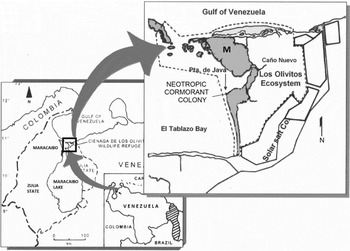
We selected Los Olivitos Estuary for this study, a mangrove ecosystem in the northern part of the Lake Maracaibo System, in Zulia State, western Venezuela (figure 1). The area supports one of the most productive artisanal fisheries in the country, and a large colony of migratory Neotropic Cormorants has roosted there since the 1980s (Clark Casler, personal communication, 2000). The size of Los Olivitos Estuary is about 30,000 ha, and at least 4,000 ha are mangrove forest.
Study area: Los Olivitos Estuary, Western Venezuela (155 km2)
Note: M, mangrove forest.

2.2. Data analysis
This analytical study of the economic valuation of the Neotropic Cormorant is based on the premise that the sum of all ecological functions of the species has an impact on the relative success of fishermen. Thus, the economic total value (TV) of the cormorant population (N) is defined as the economic effects of the cormorant on fishermen. Therefore, population changes in the species would imply changes in the economics of the local society. This economic valuation aims to identify those changes.
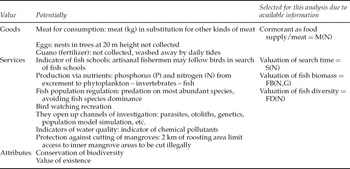
A literature review was done to determine all relationships between fish–cormorant populations, and to analyze these factors based on available information and analysis feasibility (table 1).
Identification and selection of goods, services and attributes provided by Neotropic Cormorants in Los Olivitos Estuary

The study was structured using the traditional cost-benefits approach, by identifying ‘use values’, ‘existence value’ and ‘option value’ as value sources (Krutilla, Reference Krutilla1967), although there are pros and cons to this approach (Goulder and Kennedy, Reference Goulder, Kennedy and Daily1997). However, choice of evaluation criteria, cost-benefits valuation, characteristics of services, and analytical steps used to integrate ecological and economic analyses have also been done by Bojo et al. (Reference Bojo, Maler and Unemo1992), Barton (Reference Barton1995), Metrick and Weitzman (Reference Metrick and Weitzman1998), Weitzman (Reference Weitzman1998), and Brock and Xepapadeas (Reference Brock and Xepapadeas2003).
The research was organized as follows: section 1 identifies and selects the most significant goods, services and attributes provided by Neotropic Cormorants in Los Olivitos Estuary to be valued and developed in the model. Section 2 develops an ecological analysis of selected ecological functions, based on available biological information. Section 3 develops an economic analysis and estimates monetary values for a number of attributes, ecological functions and other specific benefits. Section 4 estimates the value of cormorants via four ecological functions of the population, to make the model, and section 5 presents conclusions and recommendations.
The economic analysis for identification of the most significant goods, services and attributes provided by Neotropic Cormorants in Los Olivitos and the selection of those to be valued are presented in table 1.
To establish the ecological functions of Neotropic Cormorants in the ecosystem, it was essential to determine the location of the cormorant colony in the fishery area, and to ascertain the abundance, distribution and diet of the cormorants, because these are the ecological population parameters required to understand the use of fish resources by the birds. This information was obtained from studies undertaken at Los Olivitos Estuary from 1998 to 2000 and from 2000 to 2001 by Gil de Weir (Reference Gil de Weir2000) and Weir et al. (Reference Weir, Gil, Casler, Urbina, Andrade and Buonocore2006), respectively. General facts about fisheries in the Lake Maracaibo System were provided by the Autonomous Service of Fishery and Aquacultural Resources (SARPA, 1996).
‘Location’ provides the specific site of the cormorant colony or roost area. The site consists of a 2-km stretch of mangroves on the western edge of Los Olivitos Estuary, at Punta de Java (10° 53′ 48″ N; 71° 26′ 41″ W). Because most of Los Olivitos Estuary is a wildlife refuge and fishery reserve, the cormorant colony is protected and fishing is restricted. Fishing occurs in the large El Tablazo Bay, directly to the west of Los Olivitos (figure 1).
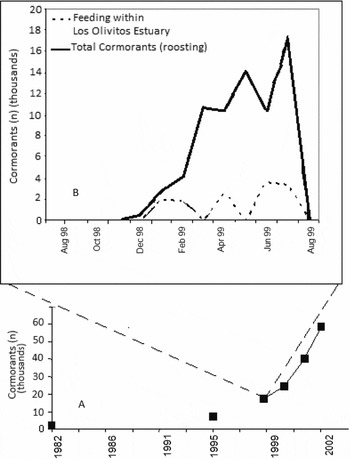
‘Abundance’ is the estimated number of cormorants (N) required to calculate the effect of the whole population in the ecosystem. N increased exponentially from 2,000 to 40,000 individuals between 1982 and 2002 (figure 2) (Gil de Weir, Reference Gil de Weir2000; Weir et al., Reference Weir, Gil, Casler, Urbina, Andrade and Buonocore2006).
(A) Neotropic Cormorant peak numbers roosting in Los Olivitos Estuary, Venezuela, from 1982 to 2002; (B) monthly censuses, from August 1998 to August 1999, with number of cormorants roosting and feeding within Los Olivitos Estuary

‘Distribution’ is a key factor for establishing areas of population impact, in relation to birds feeding within or outside Los Olivitos Estuary. During 1999, only 17% of the population fed in Los Olivitos Estuary, and 83% in other undetermined areas of the Lake Maracaibo System (figure 2; Gil de Weir, Reference Gil de Weir2000).
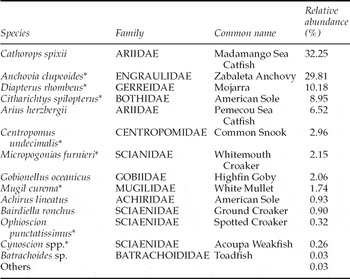
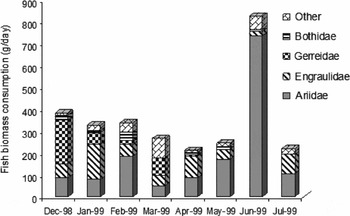
‘Diet’ is one of the most important factors used to estimate the real predatory effect on commercial and non-commercial fish species. Dietary composition was discerned from December 1998 to July 1999 via contents from 73 stomachs and 400 otoliths (inner ear bones in fish – regurgitated daily by cormorants at the roost site). Eighteen different fish species and one shrimp species were identified from a total of 74 fish species and four shrimp species reported in Los Olivitos Estuary (Weir et al., Reference Weir, Gil, Casler, Urbina, Andrade and Buonocore2006). The fish-to-shrimp consumption ratio was 88.5:11.4, and we identified eight species of commercial interest in the cormorant's diet from 14 species identified (table 2). Diet composition and average daily consumption (estimated at 225 g) varied monthly. In June, before migration, consumption increased to 800 g/bird (figure 3; Gil de Weir, Reference Gil de Weir2000).
Neotropic Cormorant diet: fish composition and relative abundance

*Commercial interest
Neotropic Cormorant monthly biomass consumption in Lake Maracaibo System, Venezuela (Gil de Weir, Reference Gil de Weir2000)

3. Economic valuation based on ecological functions
3.1. Ecological analysis
3.1.1. Valuation of harvesting cormorants for food, meat M(N)
Some aquatic birds generate economic benefits as game birds (ducks), or their eggs are consumed or feathers harvested. People may also value a species for its natural beauty via photography, etc. Cormorants can be considered relatively unproductive compared to other bird species for alternative economic use. Some references suggest that the first settlers of America hunted these birds for food. Cormorant populations were almost suppressed during the early 1900s due to egg collecting for human consumption and hunting by fishermen, who considered cormorants as competitors (Glahn et al., Reference Glahn, Tobin and Blackwell2000).
In the valuation of goods provided by cormorants, we presented their value as eggs, fertilizer and meat (table 1). Cormorant eggs are profitable goods, but at Los Olivitos Estuary they are in nests 15–20 m above ground and inaccessible. Thus, these goods were not evaluated. Cormorant guano or fertilizer containing phosphorus (P) and nitrogen (N) is exploited in other countries like Peru and some African countries, but this product was not evaluated, because it did not accumulate on the muddy ground washed by daily tides. However, cormorant meat can be evaluated for human consumption because some families in coastal communities consume this meat combined with shredded coconut (Karine Gil, unpublished data).
This study considers harvesting cormorants for food/meat consumption M(N) as the cost of opportunity when fishermen hunt cormorants based on the salary/h during fishing activities (i.e., while they have their fish net set in the water).
3.1.2. Value of the contribution to the maintenance of fish diversity FD(N)
Fish community diversity may be explained by the distribution of resources among species that are not completely superimposed. This argument is based on the following assumptions: (1) an interference (such as cormorant predation) on organisms that compete for limited resources may maintain population densities at a low level so that both species are able to coexist; (2) when competition is ongoing, species will inevitably exclude one another, but in the real world it is possible that competitive exclusion processes never reach a final stage, and any factor (like cormorant predation) that interrupts the competitive exclusion process may avoid extinction and maintain diversity (Begon et al., Reference Begon, Harper and Townsend2006); and (3) Neotropic Cormorants are generalist predators, feeding on commercial and non-commercial species (table 2; Gil de Weir, Reference Gil de Weir2000). They may take the most abundant prey in the Lake Maracaibo System, preventing the dominance of some species over others or increase the survival of other species, thus maintaining commercial fish diversity FD(N).
3.1.3. Value of cormorants as indicators of fish schools for fishermen S(N)
Cormorants concentrate in areas rich in nutritional resources, where phytoplankton and heterotrophic organisms take advantage of this food source. Large-scale world fisheries are located in these high productivity regions (Begon et al., Reference Begon, Harper and Townsend2006).
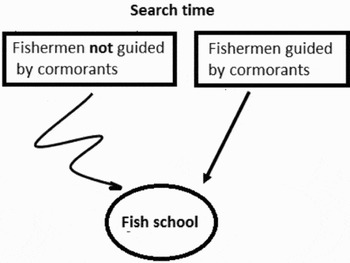
The presence of large flocks of Neotropic Cormorants over water areas indicates they may have detected a school of fish of commercial interest for fishermen. Therefore, their role as fish detectors in areas of the Lake system is valuable, because fishermen can save time and increase productivity (figure 4). Flocks with hundreds of individuals may form ‘black patches’ on the water surface, indicating a school of fish. Fish schools detected by cormorants S(N) could be bait fish, commercial fish or shrimp.
Representation of fishermen's movements with/without presence of Neotropic Cormorant flocks

The Los Olivitos cormorant population distribution shows a low proportion of the population (17%) foraging within Los Olivitos Estuary and the rest (83%) feeding in other areas of the Lake Maracaibo System (figure 2).
3.1.4. Valuation as contributor to fish biomass via guano production FB(N,G)
Pelicans and cormorants contribute significantly to nutrient cycling of phosphorous and nitrogen via guano production. In Los Olivitos Estuary these products are washed daily by tides. Both elements are either dissolved in the water column or washed and deposited on the bottom of marine waters (Johnsgard, Reference Johnsgard1993). Phosphorous, as phosphate ions (PO4 and HPO4), is an essential nutrient for plants and animals. Nitrogen enters the aquatic ecosystem as ammonium ions, and incorporation into the nitrogen cycle is achieved by organisms via several chemical pathways used to synthesize proteins, nucleic acids (as DNA and RNA) and other organic compounds that contain nitrogen (Miller, Reference Miller1994; Odum and Barrett, Reference Odum and Barrett2005).
There are some quantitative approaches using stable isotope methods to establish trophic interactions between cormorants and fisheries. However, these kinds of methods must be combined with biomass and conventional analyses to get the whole picture of food web interactions (Hobson, Reference Hobson2009), and patterns may vary from estuary to estuary (Hughes et al., Reference Hughes, Deegan, Petterson, Holmes and Fry2000).
To approximate guano contribution via the food web, we used the universal energy flow process, well described by Odum and Barrett (Reference Odum and Barrett2005) and Begon et al. (Reference Begon, Harper and Townsend2006).

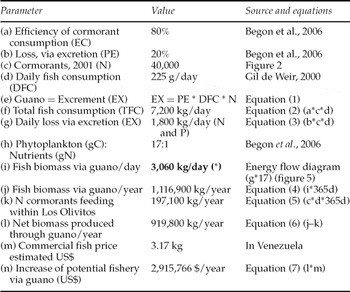
1(i) in table 3.
Gross primary productivity (GPP) is the total energy fixation by photosynthesis, and net primary productivity (NPP) represents the actual rate of new biomass production available for consumption by heterotrophic organisms.
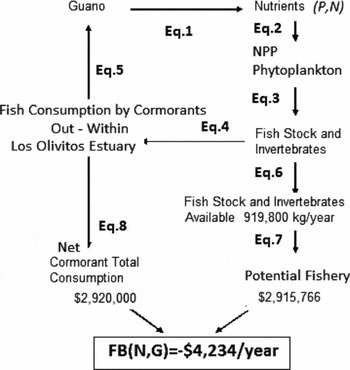
Cormorant nutrient input, as a function of their guano production (G), was estimated using the energy flow method of Odum and Barrett (Reference Odum and Barrett2005). Equations to estimate the amount of guano (kg) transformed into fish biomass are given in table 3, and these results are also presented in the nutrient cycle figure with equations (1)–(6), showing every step in the ecological process (figure 5).
Data to estimate contribution to fish biomass via guano production and nutrient cycle FB(N)

Note: Equations (1)–(7) are also indicated along the nutrient cycle in figure 5.
Neotropic Cormorant nutrient cycle and contribution to fish biomass via guano production

Several assumptions were used in this ecological analysis: biomass increases with the amount of nutrients, although the mechanisms are not clear (Begon et al., Reference Begon, Harper and Townsend2006).
(A) Molecular weights of minerals that compose humus are incorporated into diatoms and other plant material. It has been verified that these elements are part of them, and an increase in these products is translated into an increase of the biomass via biochemical and physiological processes (Cooksey, Reference Cooksey, Sneadaker and Sneadaker1984).
(B) We used 17:1 for the C:N (carbon:nitrogen) ratio for protein production. Based on this ratio, we assumed the same relationship for primary producers – phytoplankton (gC):nutrients (gN) = 17:1 (table 3; equations (3)–(4) in figure 5). Phosphorus (P) contribution was not estimated separately, and is a minimum general contribution based on gN. The amount of nitrogen (N) expressed as dry weight through gC has not been studied, but the relationship between levels of g and C and dry weight increase is 1 gC = 2 g dry weight (Cauffopé and Heymans, Reference Cauffopé and Heymans2005).
To estimate net fish biomass resulting from guano deposited in Los Olivitos Estuary, we subtracted the amount of biomass produced by an average number of cormorants feeding within the estuary (2,400 cormorants) from the total amount feeding in the whole system (table 3; equation (5) in figure 5). Based on this amount, we obtained a net biomass of fish stock and invertebrates of 919,800 kg/year produced via guano contribution (table 3; equation (6) in figure 5) required to estimate the economic contribution from this service, to be explained in the economic analysis of guano services FB(GN).
3.2. Economic analysis
3.2.1. Valuation of harvesting cormorants for food, M(N)
Data are not available to calculate the sustainable maximum yield of cormorant meat; therefore the economic analysis applied will be the Method of Real Net Income (Barton, Reference Barton1995). The method of evaluation of goods for direct uses is the method of Net Income Flow, and was considered the best option for our research, based on available data.

where Q is annual extraction of cormorant meat, P the retail market price of similar meat (US$) and Co the costs of having cormorant meat available for consumption (US$).
Q (kg) could be estimated through surveys and communication from people or families who take advantage of cormorants. P was estimated as the retail market price per kg of cormorant meat, in comparison with meat of similar quality, at approximately $1.15 per kg. Co was considered as the cost of cormorant meat available for consumption, based on the time invested for hunting, plus time for processing meat for consumption. Cost of time, based on minimum salary/boat/h, is close to zero, because hunting effort could take place while fishermen are near cormorant roosting or resting areas. For this analysis it was necessary to establish the maximum number of cormorants hunted or consumed, but that information was lacking.
In conclusion, although the M(N) value was not calculated due to lack of field data, we estimated the result as positive, representing a positive value in the final equation.
3.2.2. Value of the contribution to the maintenance of fish diversity FD(N)
The fishery and fishermen's welfare in Los Olivitos Estuary depend on the diversity of fish resources in the area. Neotropic Cormorants may help with this ecological ‘service’ by maintaining some minimal level of biodiversity to retain ecological functioning and resilience, conditions necessary, according to Barbier et al. (Reference Barbier, Burgess and Folke1994), for economic activity and human welfare.
FD(N) is defined as the contribution of cormorants to fish diversity maintenance, and therefore is a function of N. This would be one of the services of greater value, with a positive benefit to fishermen. This represents an economic value of the commercial fish diversity generated by the predation effect of the cormorant population. Without this predation effect in the Lake system, a non-commercial species could ‘win’ a two-species competition and make an impact on commercial fish harvests. An example of this could be an increase in the non-commercial Madamango Sea Catfish (Cathorops spixii) vs. a decrease in the commercial Pemecou Sea Catfish (Arius herzbergii), both in the diet of the Neotropic Cormorant (table 2). Cathorops spixii could dominate in the absence of cormorant predation. Although the number of cormorants is increasing, the population is migratory from July to October, and a potential negative effect of an extreme peak number disappears seasonally. In addition, this study showed that only a small proportion of the population feeds within Los Olivitos, and the impact on the fish community is widely distributed in the Lake Maracaibo System.
We understand that the value FD(N) is extremely important, but this was not calculated due to lack of field data and feasibility of experimentation in the Lake Maracaibo System. We believe the result would be positive, representing a positive value in the final equation.
3.2.3. Using cormorants as indicators of fish schools for fishermen S(N)
To compare effects on fisheries with and without cormorants, we studied the behavior of fishermen in terms of where they fish, amount of fish landed in Zulia State, commercial species harvested, number of fishermen/boat, salary, cost of boat maintenance, and price of fish for distribution.
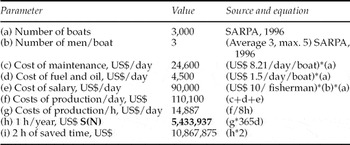
Economic valuation of work time was used, because it has an opportunity cost expressed in production terms. The salary (US$/h) and time saved were considered as factors to measure productivity, given the economic value of the time saved (table 4).
Data to estimate time saved S(N)

Notes: (c) is based on the price of a motor boat (new-reused, and annual maintenance by boat owners in Venezuela); (d) is based on the price of gas in Venezuela, cheapest in the world (US$0.12/gallon); (e) is based on the minimum annual salary in Venezuela, approximately US$ 3,360.
To carry out the valuation of this service, figure 4 shows how fishermen could go directly to the fish school with the help of cormorants, compared with those not helped by the birds. A preliminary diagnosis of artisanal fisheries in the Lake Maracaibo System was developed in 1998 (SARPA, 1996; Klein, Reference Klein1998) and general information was revised for our economic analysis.
S(N) measures the value of cormorants as indicators of fish schools. Fishing time is reduced due to the service provided by cormorants identifying where fish schools are located (table 4). The time saved S(N) = $5,433,937/year, if cormorants were helping 3,000 boats, and could result in greater wellbeing for fishermen. In addition to these savings, other items to consider are that less food would be consumed in the boat during fishing and the fishermen's reduced physical work.
An increase in cormorant numbers (N), in this case, could boost the fishermen's wellbeing, because the presence of cormorants in other areas of the Lake Maracaibo System will help indicate more fish schools. However, we are assuming cormorants do not migrate as they did during 2001, and that the fishermen search in areas used by the cormorants when the birds feed outside the refuge and fishery reserve.
3.2.4. Valuation as a contributor to fish biomass via guano production FB(N,G)
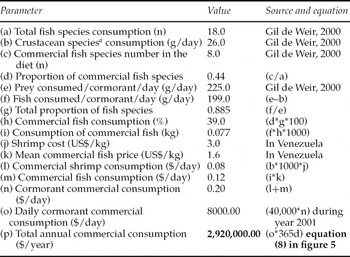
We developed an economic analysis on this function based on predation of commercial fish. From the list of commercial fish and crustaceans observed in the diet of the Neotropic Cormorant in Los Olivitos Estuary, and an analysis of diet composition (table 5), the following results were used to estimate commercial fish consumption. These data are included in table 5, equation (8), and are represented in the nutrient cycle in figure 5.
Data to estimate commercial fish consumption based on cormorant diet
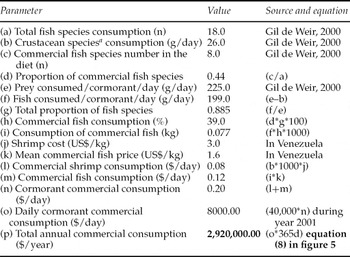
aCommercial interest (Litopenaeus schmitti).
The net impact of cormorant population on fish biomass FB(N,G), as a result of differences between a potential fishery of $2,915,766/year (table 3, equation (7)) and commercial fish consumption of $2,920,000 (table 5, equation (8)), shows a negative contribution via this service; FB(N,G) = –$4,234/year (figure 5). This negative value of the guano production function suggests that Neotropic Cormorants are making a negative impact through this ecological function.
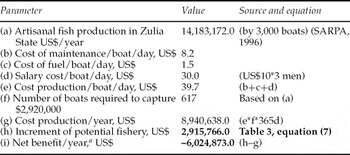
Gross income from fisheries in Zulia State was $14,183,172 (SARPA, 1996), and this income, without cormorants, could increase an additional $2,920,000/year, and represents the net benefit of fish captures consumed by cormorants. However, we were interested in estimating the impact of this commercial consumption on fishermen's wellbeing, via the fishermen's investment in order to capture the same amount of fish consumed by cormorants. For this objective, we developed an estimation of fishing effort based on the number of boats and costs (table 6).
Estimation of net benefit, based on an increase of the number of boats to capture the same amount of fish consumed by cormorants

aThe negative balance to capture the same amount of commercial fish captured by cormorants.
This exercise shows that to obtain $2,920,000/year from commercial fish consumed by cormorants, fishermen would need to use at least 617 boats and invest $8,940,638. This reflects a negative balance of −$6,024,873, and shows that fishery production would be the same without cormorants. Thus, Neotropic Cormorants do not actually compete with fishermen.
4. Final equation combining ecological and economic values
Using the analyzed data, it was possible to estimate the total value of cormorants, defined as:

and the result was

5. Conclusions
The value of cormorants as a food supply M(N) would probably be positive in the equation, due to the low costs of making cormorant meat available and because of the market price of meat.
The value of the cormorants’ contribution to maintaining fish diversity, FD(N), could be positive by increasing the survival of several species. These birds feed in high proportion on fish species that are very common in the Lake Maracaibo System, such as Ariidae and Engraulidae.
The value of cormorants as indicators of fish schools S(N), showed that fishing time is reduced due to the service provided by cormorants in locating fish schools. This allowed fishermen to save at least $5,433,937/year (from 1 h of work time saved daily $14,887).
The monetary impact of 40,000 cormorants on the fishery in the Lake Maracaibo System was estimated at ≤$2,920,000/year.
If fishermen attempt to capture the equivalent value of fish, this would require an additional investment of $8,940,638/year, and represent a negative balance of −$6,024,873/year). Thus, Neotropic Cormorants have a positive economic value for fishermen that exceeds the costs they generate.
The value of the cormorant's contribution to fish biomass via nutrient input, FB(N,G), estimated using energy flow, was negative (−$4,234/year), suggesting a decrease in fishermen's benefits via this ecological function.
Given that FD(N) and M(N) were not estimated but were expected to be positive, we are actually estimating a lower minimum value. Estimation of the economic value of Neotropic Cormorants (40,000 ind) in the natural area of Los Olivitos Estuary was $5,429,703/year, based on two measured variables.
Neotropic Cormorants and artisanal fishermen in the Lake Maracaibo System are not in competition. Although these results differ from those of other studies of similar cormorant species, our hypothesis is that the Neotropic Cormorant population was not yet at a critical level. For further studies, we recommend developing a simulation dynamic model of the population in Los Olivitos Estuary, to make population projections, including mangrove carrying capacity for roosts and potential effects on fisheries with exponential growth. We emphasize the importance of these results for the management policies of natural resources, namely that there is no conflict between Neotropic Cormorants and fishermen in the Lake Maracaibo System.
We hope this ecological–economical study serves as an example for other researchers to identify and quantify values of ecological services provided by fauna, thus helping put theoretical models into practice. In many cases, as in Venezuela, basic ecological information may be lacking, and will need to be generated during the study.