I. INTRODUCTION
Understanding order and system complexity has been fascinating scientists from fields extending from biology, cosmology, geoscience, and physics. Living organisms are the best examples of complex organization. Nonequilibrium has been seen as the source of order, the “order out of chaos,” extensively discussed by Prigogine and Stengers.Reference Prigogine and Stengers1 Systems with induced ordered morphology became essential for nanotechnology in fields such as lithography,Reference Tang, Lennon, Friedrickson, Kramer and Hawker2–Reference Park, Yoon and Thomas4 organic electronics, and photonics.Reference O’Neill and Kelly5 Self-organization and supramolecular chemistryReference Lehn6 has grown into a major field linking biology and physics and opening new areas in organometallic chemistry. LehnReference Lehn6,Reference Lehn7 proposed the design of innumerous sophisticated supramolecular architectures, by molecular recognition. Supramolecular chemistry and self-assembly are also the base of crystal engineeringReference Almarsson and Zaworotko8 with promising opportunities in the pharmaceutical industry. Well-organized networks formed by molecular species linked to metal ions form a myriad of solids labeled as metal–organic frameworksReference Rowsell and Yaghi9 with potential application in gas separation and storage. In polymer science, block copolymers are one of the most attractive tools to manufacture devices with controlled morphology. Their self-assembly is induced by thermodynamic balances of enthalpic interactions which usually favor the repulsion between blocks of different chemical compositions and hydrophilic–hydrophobic character and entropic constrains.Reference Bates, Hillmyer, Lodge, Bates, Delaney and Fredrickson10
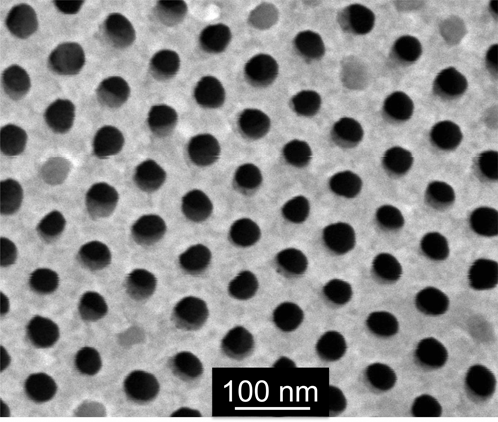
We proposed the integration of block-copolymer self-assembly and conventional methods of phase inversion for asymmetric membrane manufacture by solution casting and immersion in waterReference Peinemann, Abetz and Simon11–Reference Marques, Vainio, Moreno Chaparro, Calo, Bezahd, Pitera, Peinemann and Nunes16 and explained for the first timeReference Nunes, Sougrat, Hooghan, Anjum, Behzad, Zhao, Pradeep, Pinnau, Vainio and Peinemann12,Reference Nunes, Behzad, Hooghan, Sougrat, Karunakaran, Pradeep, Vainio and Peinemann13 how micelle assembly plays an essential role in the membrane formation. The main motivation was the achievement of membranes with exceptionally high porosity and sharp pore size distribution. Although polymeric membranes have been established in large-scale applications like hemodialysis, ultrafiltration in dairy industry, water treatment, and desalination,Reference Nunes and Peinemann17 their main drawback is the relatively broad pore size distribution, obtained by the phase inversion process. The proper use of block copolymers leads to very well defined pores practically with the same size, as shown in Fig. 1. We have been using different methods of microscopy, x-ray scattering, and computer simulation to fully understand the pore formation.Reference Nunes, Sougrat, Hooghan, Anjum, Behzad, Zhao, Pradeep, Pinnau, Vainio and Peinemann12–Reference Marques, Vainio, Moreno Chaparro, Calo, Bezahd, Pitera, Peinemann and Nunes16 At the same time, we have been working on the up-scaling of the membrane production. We present here an overview of the membrane formation process and the relevant aspects to be considered to tune pores and manufacture membranes in different configurations also in technical machines.
FESEM image of the PS-b-P4VP block copolymer membrane surface obtained by casting and immersion in water.

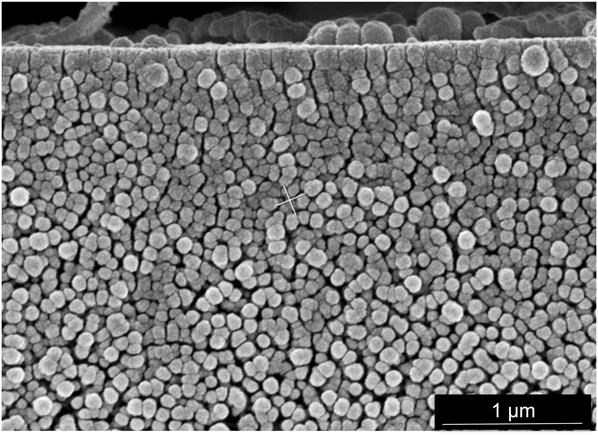
Cryo-FESEM image of a cross section of the PS-b-P4VP copolymer membrane (wet membrane) after freeze fracture. The membrane was manufactured by casting the solution and immersing it in water.
II. EXPERIMENTAL
A. Materials
Polystyrene-b-poly(4-vinyl pyridine) (PS-b-P4VP) block copolymers with 138,000-b-41,000 and 175,000-b-65,000 g/mol were purchased from Polymer Source, Canada. N,N-dimethyl formamide (DMF), tetrahydrofuran (THF), and dioxane were supplied by Sigma-Aldrich (Taufkirchen, Germany) and used without further purification.
B. Membrane preparation
Solutions with 16–20 wt% block copolymer concentrations were cast on glass or on polyester nonwoven and immersed in water at room temperature. Solvent mixtures with DMF/THF/dioxane (1:1:1 in weight) were used in most of the results presented here. In Fig. 2, the solvent mixture had DMF/THF 56:24 wt% with 0.15 wt% copper(II) acetate. The membranes were manufactured on a small scale on flat glass substrates in the laboratory. Larger areas (approximately 15 cm × 1 m) were cast on polyester nonwoven in a continuous machine shown in Fig. 3. Hollow fiber membranes were cast by using a spinneret shown in Fig. 4.
Membrane casting machine.
(a) Asymmetric hollow fibers (internal and external FESEM images) obtained by spinning the PS-b-P4VP solution with spinneret shown in (b) (right: spinneret internal needle) and collecting the fibers in water.
(a) FESEM image of a FIB-prepared cross section of PS-b-P4VP block copolymer membrane obtained by casting and immersion in water; (top) scheme representing block copolymer micelle assembly, forming ordered pores on the membrane surface layer; (b) representation of spinodal decomposition mechanism,Reference Hashimoto18 forming larger pores in the membrane bulk.
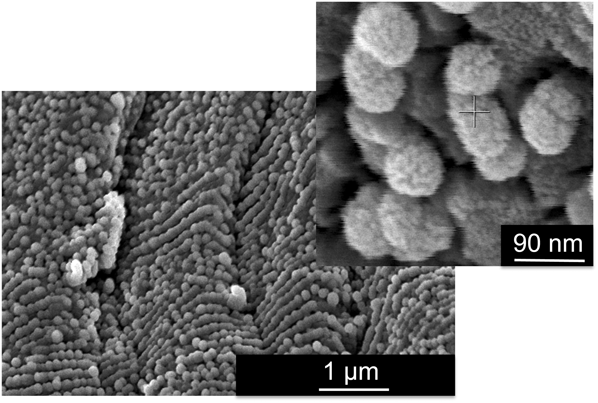
Cryo-FESEM image of freeze-fracture face of block copolymer showing micelle assemblies in the bulk of the PS-b-P4VP copolymer solution in DMF/THF/Dioxane.
C. Field emission scanning electron microscopy
An FEI Magellan SEM with a field-emission electron source and a through-lens electron detector was used to image the membrane surface. To prevent charging during SEM analysis, the membrane surface was coated with a thin layer of Au/Pd inside a K575X sputter coater (Qurorum Technologies, Newhaven, UK).
D. Cryo-field emission scanning electron microscopy
Low-temperature experiments were carried out using an FEI Nova Nano630 SEM (FEI, Eindhoven, Netherlands) with a field-emission electron source and through-lens electron detectors and equipped with a PP2000T cryo-transfer system (Qurorum Technologies, Newhaven, UK).
To prepare the freeze-fracture face of the block copolymer gel for SEM imaging, a drop of gel was placed between two rivets on the specimen holder. The sample was immediately plunged into liquid-nitrogen slush, transferred under vacuum to the preparation chamber maintained at −180 °C. The sample was fractured at −160 °C, sublimated at −90 °C, cooled again to −135 °C, sputter coated with platinum inside the cryo-preparation chamber and then transferred to the field emission scanning electron microscopy (FESEM) cryo stage at −140 °C for imaging.
E. Focused ion beam
An FEI Helios 400S small dual beam SEM was used (i) to reveal membrane cross section by focused ion beam (FIB)-induced milling and (ii) to image the milled face. A protective Pt layer was deposited on the membrane surface to minimize the membrane damage during milling. Through-the-lens electron detectors were used to image the milled face.
III. RESULTS AND DISCUSSION
Figure 1 demonstrates the exceptional regularity of pores and high porosity we can achieve by combining block copolymer self-assembly and phase inversion by solution casting and immersion in a nonsolvent bath (mostly water). The morphology is unique compared to any other commercially available polymeric membranes, but the manufacture process is simple enough to be adapted for technical production. The membranes are asymmetric so that the well-defined pores can be found on the top layer (less than 1 μm) and a gradient of pores with increasing size are formed in the sublayer to provide mechanical strength, without compromising the high fluxes.
The path to the unique morphology relies on choosing the right thermodynamic conditions and freezing nonequilibrium states, which would be the most appropriate for the separation goals. Two mechanisms of pore formation are combined and can be explained with the help of Fig. 5:
(i) block copolymer self-assembly and
(ii) macrophase separation by spinodal decomposition.
Block copolymers provide unparalleled opportunities for nanostructure design.Reference Bates, Hillmyer, Lodge, Bates, Delaney and Fredrickson10 Their morphologies are controlled by the molecular architecture and the thermodynamic interactions between blocks in the solid state. If a solvent is added, the structure versatility considerably increases. Assemblies in the form of cylinders, micelles, and lamellae can be particularly favored and will assemble themselves in complex morphologies if the right solvent mixture is chosen. Figure 5 shows how a morphology obtained in solution can be captured and used for pore formation and at the same time integrated in a synthetic membrane. At an appropriate concentration and solvent composition, supramolecular block copolymer micelle assemblies can be formed and remain stable. By immersion in water, solvent–nonsolvent exchange happens very fast, and the assembly can be immobilized as part of the membrane top layer in Fig. 5(a).
We have demonstrated for the first timeReference Nunes, Karunakaran, Pradeep, Behzad, Hooghan, Sougrat, He and Peinemann14 for this kind of membrane preparation that micelle assemblies are already formed in solution, as in Fig. 6. The morphology resembles the ion-induced crew-cut aggregates reported by Zhang et al.Reference Zhang, Yu and Eisenberg19 for the other class of amphiphilic block copolymers (PS-b-polyacrylic acid) in solution. When the micelle strings are packed together orthogonal to the membrane surface in a 2D-hexagonal distribution, they form the pores seen in Fig. 1. The connectivity between micelles, controlled by enough intercorona segment entanglement, will assure the membrane stability. Figure 2 shows a cryo-SEM freeze-fracture face of the hydrated block copolymer membrane. The micellar structure is clearly seen as part of the final membrane. We have demonstrated that the micelle order detected in solution is directly related to the final membrane porosity.Reference Dorin, Salomon Marques, Sai, Vainio, Phillip, Peinemann, Nunes and Wiesner15 Hexagonal micelle assembly in solution leads to the formation of membranes with hexagonal ordered pores. Triblock copolymers with body-centered cubic (BCC) ordered in solution lead to membranes with BCC pore order.Reference Dorin, Salomon Marques, Sai, Vainio, Phillip, Peinemann, Nunes and Wiesner15,Reference Phillip, Mika Dorin, Werner, Hoek, Wiesner and Elimelech20
We recently published a detailed investigation of the casting solution supramolecular order by small angle x-ray scattering.Reference Marques, Vainio, Moreno Chaparro, Calo, Bezahd, Pitera, Peinemann and Nunes16 The results have been supported by computer simulation based on dissipative particle dynamics. The assembly in solution is highly dependent on the copolymer concentration and the thermodynamic interaction between solvents and different blocks.
Block copolymer micelles remain integrated as part of the membrane, after the pores are formed. While the ordered micelle self-assembly is the phenomena leading to the pore formation on the membrane top layer, the predominant process, responsible for larger pores far from the surface, is the macrophase separation induced when the casting solution is immersed in water. As a result, an asymmetric porous structure is formed. This mechanism is also relevant when membranes based on homopolymers like polysulfone are formed in a similar process. Phase separation by spinodal decomposition is shown in Fig. 5(b). With immersion in water, solvent–nonsolvent exchange leads to a thermodynamic condition, which is poor enough to cause macrophase separation. The phase separation proceeds with concentration fluctuations and formation of co-continuous coexisting phases. The polymer-diluted phase can be seen as the pore precursor. If the phase separation continues, phase coalescence can take place destroying the pore connectivity. The key for a good membrane is to be able to stop the phase separation, by having a polymer-rich phase, which has low mobility and solidifies. We achieve then both a well-ordered structure due to block copolymer self-assembly and an asymmetric porous substructure with high porosity and mechanical stability.
Figures 3 and 4 show 2 possibilities of membrane manufacture and up-scaling, which have been demonstrated in our lab for the PS-b-P4VP system. Membranes have been cast in a flat sheet configuration in a continuous machine of Fig. 3. For that, the membranes have been cast on nonwoven polyester.Reference Nunes, Behzad, Hooghan, Sougrat, Karunakaran, Pradeep, Vainio and Peinemann13Figure 4 shows membranes prepared as hollow fibers using spinnerets in a similar way as applied to many industrial membranes produced on a large scale for desalination or hemodialysis. In both cases, stable membranes were manufactured and demonstrated to have water fluxes, which were at least as high as 70 kg/m2/h/bar for hollow fibers. Flat-sheet membranes were obtained with more than 10-fold higher water fluxes.