

Introduction
In April 1939, agricultural labourers on the coffee plantation El Retiro, in Soconusco, Chiapas, petitioned President Lázaro Cárdenas for assistance in their land reform struggle. Lázaro Avila, president of the Executive Agrarian Committee, appealed to Cárdenas as the man ‘who has erased our slavery and saved our right to repossess the land’. Workers claimed that the president's support of land reform would allow peasants to ‘breathe air full of liberty’, and would prove the government's commitment to rural workers. Scarcely 15 months later, however, when Agrarian Department officials finally distributed land to these peasants, El Retiro workers rejected the grant because ‘it did not satisfy [the community's] needs nor would it permit subsequent growth’. The Agrarian Committee complained that the land was ‘not what we had requested’; moreover, it was ‘not what the government initially promised’. Villagers objected to the agrarian engineer's decision to grant a portion of the land to a neighbouring village. After subsequent negotiations, the community received 716 hectares of the 898 hectares it had been promised.Footnote 1
Such questioning of government-sponsored agrarian reform programmes became widespread as rural Mexico experienced a period of campesino activism during the 1930s. Community members from El Retiro exemplify how active participation in rural organising changed campesino expectations of the emerging Mexican state. Why did campesinos participate in sustained campaigns demanding concessions from the state during the Cárdenas presidency? This article examines how campesinos negotiated with the expanding federal bureaucracies, regional authorities and elite coffee planters in order to implement and challenge agrarian reform. It is argued that campesinos fought for, accepted and modified agrarian reform policies, and in the process practised citizenship as members of the Mexican nation.
The confrontation on the El Retiro plantation brings into question the often repeated comment that ‘the Revolution never reached Chiapas’.Footnote 2 Historians writing in the 1980s and early 1990s provide foundational knowledge for the socio-economic and political trajectory of Chiapanecan history. These scholars emphasise the top-down nature of government programmes and the elites' ability to prevent substantive reform in Chiapas during the Mexican Revolution. Antonio García de León carefully outlines the complex socio-economic and political background of Chiapas, detailing a history of racism, paternalism and social inequality that the revolution failed to alter. Thomas Benjamin's important study of Chiapanecan political history focuses on relationships between landed elites and the government, yet his emphasis on mapping formal political landscapes largely obscures peasant activism. Daniela Spenser's thorough research highlights agrarian struggles in Soconusco. She argues that campesinos gained temporary reforms in the 1930s, but these improvements evaporated during the 1940s.Footnote 3
Recent trends in Chiapanecan historiography build upon the works of Alan Knight, Florencia Mallon and Gil Joseph. These historians, often referred to as post-revisionists and as being interested primarily in state formation and the role of subalterns, argue that campesinos, workers, elites, and local and national officials negotiated the meanings and practices of the emerging Mexican state.Footnote 4 Alan Knight's seminal essay, ‘Cardenismo: Juggernaut or Jalopy?’, challenges ideas of a post-revolutionary leviathan state. Knight argues that a relatively weak Cárdenas administration bargained with elites and the lower classes in order to implement government policies. Gil Joseph and Daniel Nugent's Everyday Forms of State Formation presents multiple essays highlighting ways in which elites, government authorities and the lower classes shaped government programmes. These authors argue that the negotiation process itself structured the Mexican state. Florencia Mallon's work connects state formation with explorations of how the lower classes experienced and practised citizenship.Footnote 5 Mallon shows that campesinos in Puebla used rhetorics of citizenship to make claims upon the emerging nineteenth-century Mexican nation.
Later studies of revolutionary Chiapas incorporate theoretical frameworks of state formation. Building on Mary Kay Vaughan's analysis of state formation through education, Stephen Lewis' Ambivalent Revolution examines how campesinos and rural schoolteachers had mixed success in forming revolutionary schools. His meticulous research incorporates debates within indigenous communities about the benefits and costs of cooperating with revolutionary teachers.Footnote 6 Similarly, Jan Rus' article on indigenous villagers from the central highlands shows how officials and pro-government campesinos used emerging institutions to create communities loyal to the post-revolutionary state.Footnote 7 The Soconusco region, located in the south-western corner of Chiapas along the Guatemalan frontier, has also become a focus of study for historians, in part due to its productive coffee-growing zone. Maria Eugenia Reyes Ramos details how Cardenista reforms created new social actors in Soconusco who initiated long-term rural reforms. Work by these scholars challenges assertions of limited revolutionary change in Chiapas.Footnote 8 The Soconusco case study fits squarely into post-revisionist discussions of peasant activism in Sonora, Michoacán, Puebla and the Yucatán.Footnote 9 From 1936 to 1940 Soconusco campesinos practiced similar bargaining tactics common in other areas of rural Mexico, significantly influencing revolutionary practices. As Reyes Ramos' work suggests, these changes continued through much of the 1940s.
Local archival research suggests that in Soconusco, emphasis on top-down dissemination of reform programmes has underestimated the role of regional rural activism. Steady commerce and migration between Guatemala and Mexico impeded the growth of strong local and regional political networks (camarillas). Although camarillas held power within labour organisations in the main city of Tapachula, rural workers and peasants did not participate in these networks. Instead, German planters held significant economic power on both sides of the border, while regional Mexican elites exercised political power. Workers migrated to fincas (coffee plantations) for both seasonal and permanent labour opportunities. In Soconusco the lack of strong, centralised power offers a unique opportunity to see how ordinary peasants influenced agrarian policies and practices.
Campesinos, planters and political officials created extensive paper trails through correspondence, reports, petitions and court cases found in national, state and local archives. State agrarian archives in Tuxtla Gutiérrez, Chiapas, contain ejido files (including campesinos' letters), meeting notes and petitions to landlords and officials. Tapachula's municipal archive includes court cases between campesinos and landowners over land distribution, mass layoffs of unionised workers and salary disputes. Interviews with former leaders of campesino organisations, community members and planters provide additional perspectives.Footnote 10 No source fully represents what all people thought or did; rather, these sources record a public performance of historical memory. Although each source favours a particular type of information, when they are taken together, patterns emerge which show that campesinos experienced some success with sustained rural activism.
The case of campesino activism in Soconusco contributes to state-formation studies by examining the role of federal bureaucracy and the mixed results of expanding national power. Although many regional studies have explored negotiation processes between the rural poor and government officials, the national government initially had little presence in southern Chiapas.Footnote 11 In order to implement revolutionary reforms, the federal government first needed to develop its bureaucratic infrastructure.Footnote 12 During Lázaro Cárdenas' presidency (1934–40), increasingly powerful bureaucratic agencies enacted social, political and economic reforms. As agrarian bureaucracy grew, it provided opportunities for social reforms that local and regional officials often resisted. The growth of federal bureaucracy flourished in Soconusco because of weaknesses in traditional power networks. Divisions among local economic and political elites facilitated stronger ties between federal officials and campesinos.
National and regional reform agencies grew in response to intense pressure from campesinos. Rural labour unions, agrarian committees and federally run public schools all became increasingly common, and powerful, during these years. Campesinos took advantage of changing federal attitudes, using bureaucratic institutions to challenge local officials and landlords. Partly in reaction to petitions and complaints from the lower classes, Cárdenas removed the repressive governor of Chiapas in 1936, replacing him with one who supported federal reform programmes.Footnote 13 Although campesinos experienced mixed success, their activism resulted in the growth of the Agrarian Department, ultimately causing significant regional land reform. Campesinos also influenced the nascent state's social programmes. Rural communities pressured the Secretaría de Educación Pública (Ministry of Public Education, SEP) to supply rural schoolteachers who suited villages' needs. In some cases the SEP assigned radicalised teachers to activist communities. In others, campesinos ignored the SEP's social reform messages, requesting teachers who brought particular skills, such as sewing or agronomy.Footnote 14 The communities' ability to influence how federal authorities enacted reform policies illustrates that exercising power did not occur in an exclusively top-down manner.
The study of agrarian reform in Soconusco shows how rural workers used the rhetoric of citizenship and revolution to influence government policies. The revolution opened dialogues between the lower classes and federal authorities that defined the post-revolutionary Mexican state. Agricultural workers and peasants from diverse ethnic and national backgrounds labelled themselves as Mexicans and campesinos, which legitimated their bargaining rights with the government and planters. Although actual agrarian reform remained uneven, campesinos' letters and petitions describe workers' support for Cardenista reforms. Peasants anticipated that official reform programmes provided them with a possibility for economic improvement and social respect. The widespread use of ‘strategic identity’ suggests that campesinos embraced the rhetoric of revolutionary justice, and that incorporation into the Mexican state had cultural meaning for the rural poor. By restricting revolutionary reforms to peasants who clearly identified themselves as supporters of the Mexican Revolution, officials of the Cárdenas administration disciplined campesinos into accepting state-defined values and behaviours, thereby establishing Mexican national identity. Even if campesinos did not ‘become’ Mexicans, some permanent finca workers and migrant labourers claimed Mexican nationality to gain government favours. Through the process of agrarian reform, multiple groups (peasants, planters and the government) created a shared language of revolution that acknowledged peasant concerns. Such revolutionary language compelled politicians and planters to address campesino claims because during the Cardenista era, government and planters had to maintain their legitimacy with the lower classes.
The Coffee Economy and Society in Soconusco, 1870s–1930s
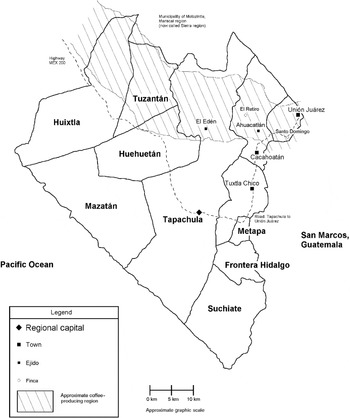
The Soconusco region starts roughly halfway down Chiapas' Pacific coast, ending at the Guatemalan border. The Sierra Madre spans the region and the climate varies from hot, humid coastal lowlands to increasingly temperate agricultural zones between 200 and 1,500 metres above sea level. Mexican and European planters took advantage of this excellent environment and began cultivating coffee on unexploited land in the 1870s. Officials signed a treaty demarcating the Guatemalan/Mexican border in 1882. The stable border encouraged German planters from Guatemala to migrate to the Soconusco frontier in search of cheaper land. Between 1897 and 1910, the number of private property holders grew from 1,236 to 2,040. Approximately 42 per cent of these new landowners established haciendas and grew coffee. Germans dominated the region economically because of their extensive ties with European markets. German immigrants often became naturalised Mexican citizens, but they retained close ties to German planters and merchants in both Guatemala and Germany.Footnote 15
Map 1.

Increasing numbers of coffee fincas drew indigenous workers to Soconusco. In 1892 indigenous people constituted 37 per cent of the total population of 20,928. By 1921 the population of Soconusco had more than trebled to 75,441. Census statistics did not record the ratio of indigenous to mestizos, but based on planters' need for labour, the percentage of indigenous people probably increased.Footnote 16 Finca workers performed multiple jobs, including planting, weeding, harvesting, and drying and sorting coffee. Labourers, often self-described as ‘campesinos’, also constructed and maintained finca infrastructure and machinery. In the documents consulted for this study, the term ‘campesino’ described disparate groups of impoverished people, including permanent workers on the coffee plantations, migrant (temporary) workers from indigenous regions of Guatemala and the Chiapas highlands, and sharecroppers and renters who farmed small plots owned by large planters.
Flows of immigrant settlers and migrant labourers depended upon the needs of finqueros and variations in labour markets. Planters recruited labourers from southern Chiapas or north-western Guatemala during the 1880s and 1890s. Jan Rus described how San Cristóbal elites and Soconusco coffee growers competed for indigenous workers (Chamulans) from the Chiapas highlands from 1892 until 1912. Although significant seasonal migration by Chamulans continued throughout the post-revolutionary era (1920–40), finqueros failed to control a sufficient amount of indigenous workers for the harvest. Coffee growers diversified their labour supply by recruiting from Mariscal (the region immediately north-east of Soconusco) and north-western Guatemala.Footnote 17 By 1910, the major coffee-producing municipalities (Cacahoatán, Tuzantán, Unión Juárez) had more than 70 per cent of their populations living on coffee fincas. Mam Indians who were dispossessed of their lands in Guatemala frequently migrated to Chiapas, where they became labourers on new coffee plantations and learned Spanish.Footnote 18 People relocated to the coffee fincas for diverse reasons. Some campesinos fled repressive labour requirements in Guatemala, others became ostracised from their villages for various reasons, and still others simply sought better economic opportunities.Footnote 19 On the fincas, the owners and government officials reinforced ethnic and labour divisions by encouraging separate living spaces for permanent and migrant workers.
Permanent workers on the coffee fincas consisted of two groups: peones acasillados, who lived on the finca, performed wage labour and received small plots for subsistence agriculture, and mozos, who lived in poblados and colonias agrícolas, villages established on national lands bordering coffee plantations. Mozos typically divided their time between farming (often as squatters on unclaimed land) and working on the fincas. Permanent workers identified themselves as labourers who lived and worked on particular fincas. They organised unions by fincas, not by particular types of labour. For permanent workers, connections to ‘place’ provided a common community framework, even though their jobs, ethnicity and nationality varied. In contrast, indigenous migrant workers from the Chiapas highlands organised separately with Mexican government support.Footnote 20 Guatemalans technically lacked rights to unionise, but Guatemalan immigrants often ‘passed’ as Mexicans.
Planters estimated that labour demands tripled during the harvest, although specific numbers of permanent workers and temporary workers cannot be accurately determined. Planters repeatedly complained of labour shortages, suggesting that the massive influx of workers could not keep up with rising demand.Footnote 21 Tzeltal or Tzotzil men from the Chiapas highlands worked the harvest, leaving families, livestock and milpas in their home villages. Temporary workers occasionally brought their families, and even young children picked coffee cherries. Migrant workers identified themselves by village, family or ethnicity, and often had little desire to become permanent finca workers.
Distinctions between mozos, peones acasillados and temporary workers became more important after rural reforms began in the 1930s. Agrarian reform laws stipulated that mozos in ‘poblados and agrarian colonies had the right to solicit land in an area of 7 km from the village’.Footnote 22 Because both permanent and temporary workers referred to themselves as campesinos, this ambiguous labelling caused confusion for owners and bureaucrats. It also provided opportunities for campesinos to claim themselves as legitimate recipients of labour or land reform programmes.
Against the backdrop of the Mexican Revolution and political upheaval between 1910 and 1934, finca life was characterised by stability. Planters cultivated ties with revolutionaries and opposition forces, appeasing both sides to protect their fincas. The relative isolation of Soconusco from the central areas of Chiapas insulated the area from the worst revolutionary skirmishes.Footnote 23 Increasing demand for coffee contributed to the fincas' stability. Although European markets declined following the First World War, planters increasingly exported to the United States and continued profitable production.Footnote 24 State and local officials accepted planters' requests for tax reductions, secure transportation and limited labour inspections because the government depended on coffee revenues for state funding. Finqueros relied on political influence to gain economic concessions from the state government, regardless of official political positions.Footnote 25 Chiapanecan governors rarely enforced revolutionary laws, and life on the fincas faced few substantive changes.
Since the early stages of Soconusco's coffee economy, local officials and immigrant (and Mexican) growers had developed paternalistic social structures to bind campesinos to plantations. One observer described the patrón as ‘like a father of all, [who] cared for his people from all points of view. He gave them food, he watched them, he cured them, he got drunk with them, and he beat them.’Footnote 26 Paternalism reinforced race and class divisions by setting ladino planters above indigenous workers. Day labourers and permanent settlers who migrated to Soconusco from Guatemala and the Chiapas highlands seemingly tolerated exploitative labour conditions because finca work sustained families and fostered local communities. For temporary workers, harvesting coffee supplemented their income, allowing them to maintain connections to their home villages. Jan Rus points out, however, that these paternalistic ties did not negate the repressiveness of the enganche system. Planters repeatedly complained about workers who fled the fincas. Rus offers two possible interpretations: either that workers took advantage of multiple wage advances from landowners, or that workers fled oppressive labour conditions.Footnote 27 Although the evidence is ambiguous about the cause of worker flight, lack of sustained complaints by indigenous labourers suggests that social ties sustained by paternalism ameliorated the oppressive labour system.
From 1910 to 1924, the efforts of revolutionary governments to implement labour reform and land redistribution failed on the Soconusco fincas because planters controlled workers by combining paternalistic relations with repression. Few radical revolutionaries existed because patriarchal society did not provide fertile ground for revolutionary ideology.Footnote 28 Economic growth reinforced hierarchical society, and regional elites ensured that few people challenged social continuity. An emergent socialist movement briefly gained strength in the late 1920s, but collapsed due to the assassination of its leader, Carlos Vidal, and other labour organisers. Ultimately the socialists failed to gain workers' support for a sustained movement of class resistance. Participants in radical movements met with swift and brutal repression.Footnote 29 Although the Mexican Revolution brought rural reform to many parts of Mexico prior to the 1930s, the revolution in southern Chiapas left social, economic and political systems virtually intact.
Repression of Early Labour Movements, 1932–6
In 1932 Victórico Grajales, a finquero from central Chiapas (and former counter-revolutionary activist), became governor. His state-level agrarian reform programme upheld the 1921 Agrarian Law that labelled landholdings measuring over 8,000 hectares as latifundia subject to expropriation. Grajales added a provision that placed no limit on landownership for plantations producing coffee, sugar, bananas or cattle. Landowners who had fallow land legally divided their property among family members, protecting landholdings. The governor decreed that planters who lost property would receive generous compensation.Footnote 30 Grajales thus protected Chiapanecan elites from threats of revolutionary reform.
From 1932 to 1936, the state governor initiated a repressive campaign against anyone who participated in popular organisations. Organised labour became an ‘enemy’ to Grajales' administration.Footnote 31 Campesinos asserted that they faced assault, unjust arrests and fines, forced labour, and even murder for participating in labour organisations. Labour organisers charged that state authorities worked with planters, blocking any efforts to resolve the violence. Members of the Cámara Regional del Trabajadores del Sureste detailed assassination attempts against agraristas (supporters of agrarian reform) ordered by a planter, Juan Luttman. Grajales responded that the information was ‘incorrect’. Luttman was also accused of threatening campesinos on Finca Islamapa. Again, Grajales denied that any abuses occurred.Footnote 32 Grajales targeted indigenous workers, particularly Mam communities in Soconusco and Mariscal, as obstacles to progress. Government officials labelled people who spoke Mam or wore ‘traditional clothing’ as Guatemalans and threatened them with deportation.Footnote 33 Under such conditions, campesinos had few options to protect their interests.
Several planters utilised the hostile labour climate to harass ordinary workers as well as labour organisers. Landlords routinely broke fences and let their cattle graze in campesinos' milpas, which threatened workers' subsistence.Footnote 34 In early 1936 the administrator of Finca El Retiro denied food rations to peones acasillados because they demanded the minimum wage. The administrator also fired all workers who participated in the finca union movement. When labourers protested, government officials backed the administrator's claim that he had fired unionised workers because of unfulfilled work quotas.Footnote 35 Later that year on Finca Santo Domingo, the planter arranged the arrest of the union president, expelled another leader from the finca and threatened to fire any worker who complained to authorities.Footnote 36 Landlords labelled troublesome workers as Guatemalan and deported them, or simply ordered authorities to fine, arrest or even beat workers in order to intimidate and prevent them from organising.Footnote 37 From 1932 to 1936 workers faced the united power of finqueros and state officials. Elites effectively limited union capacity to improve the working and living conditions of peones acasillados, curtailing the popularity of union membership.
The emergence of Lázaro Cárdenas as a reformist president provided organised labour in Chiapas with an opportunity to enlist the federal government for assistance in fighting Grajales and the planters. During the 1934 presidential campaign Cárdenas toured Soconusco to investigate unionised workers' complaints and promised to implement revolutionary change. By 1936 Cárdenas had successfully consolidated his power nationally and began removing political opponents. The gubernatorial campaign in Chiapas in 1936 gave the president the opportunity to move against Grajales, who scorned Cárdenas' affiliation with the lower classes and openly defied the federal government's calls for land redistribution, calling the policy ‘irresponsible’. Grajales also opposed Cárdenas' choice for the next state governor, Efraín Gutiérrez.Footnote 38 Throughout the election campaign Grajales persecuted Gutiérrez's supporters and argued that his ties with agraristas destabilised state politics. After Gutiérrez won the election, Grajales refused to relinquish power and Cárdenas called in the national army to force the governor from office.Footnote 39 The ousting of Grajales and his allies created a favourable environment for the emerging labour movement in Soconusco, opening a dialogue between workers and the Cárdenas government.
Agrarian Reform Bureaucracy and Campesinos
At the national level, the 1934 Agrarian Code built a federal agrarian bureaucracy that provided campesinos with increased opportunities to negotiate with the emerging national state; the bureaucracy became a cornerstone of the federal government's link with the rural poor. The Agrarian Department extended its power by coordinating reform programmes at local, state and national levels in order to implement two main goals. First, reformers in the Cárdenas government built federal power by establishing multiple state-run labour organisations and weakening the power of local elites. Second, officials began modernising rural sectors by creating ‘progressive’ peasants allied with the national government. The agrarian radicals in the Cárdenas government envisioned the ejido (community-owned land either farmed collectively or parcelled out into individual plots) as the main production unit in post-revolutionary Mexico. Campesinos would rely on the Banco Nacional de Crédito Ejidal (National Bank of Ejido Credit) for credit, technical and marketing advice.Footnote 40 By making campesinos dependent on the federal government, the Cárdenas administration strengthened its political base and maintained its goals of modernising agriculture and increasing production.
The Agrarian Code defined appropriate behaviour for both agrarian officials and rural workers in order to develop modern, highly productive agriculture for Mexico's small producers. The Agrarian Department hired agronomists, engineers, lawyers, doctors, architects and others with ‘field experience’ to improve rural life. Officials had diverse roles: to build camaraderie with campesinos, to teach innovative agrarian techniques, to resolve local problems, and to process land petitions.Footnote 41 Agrarian officials advocated collective labour to ejidatarios as a method of producing higher crop yields, as well as encouraging them to market their products. By drawing campesinos away from simple subsistence agriculture, the government hoped to relieve extreme rural poverty and turn campesinos into political allies of the emerging Mexican state.Footnote 42
Officially the new ejido leaders had to be literate and employed, and have good conduct and reputation; all necessary governing skills.Footnote 43 The Agrarian Department expected ejido officers to learn ‘modern, technical’ aspects of agriculture to promote more effective land use.Footnote 44 Ejido officers often became key mediators between the federal government's dictates and local communities' actions. They also handled conflicts within the ejido. Dissident villagers from Ejido Ahuacatlán, for example, complained to agrarian engineer José Manuel Fernández about the ejido's work officer. They explained that he had made ‘poor management [decisions]’ which had caused ‘serious discontent and disoriented the masses of ejidatarios’. The documents do not detail the work officer's management decisions, but the campesinos implied that they had concerns about their government loan payments.Footnote 45 Ejido leaders had to maintain the confidence of both the authorities and their fellow ejidatarios.
Agrarian Department bureaucrats held regulatory power over ejidatarios. Members of ejido executive committees could be punished for a variety of offences, including ‘causing, fomenting, or failing to prevent conflicts among communal landholders’ and ‘invading lands or enticing or tolerating’ communal land invasions. Community leaders could be penalised if children did not attend schools. Individuals could lose their land rights if they did not participate in collective work, if they allowed their plot to go fallow, if they failed to pay their taxes, or if their activities were ‘detrimental to the community or to another ejido member’.Footnote 46 The code of conduct for ejidatarios stressed governmental goals that limited peasant activism by preventing land invasions or harassment of landlords, while channelling campesino complaints for government mediation and resolution.
Ideally, local ejido leaders and agrarian bureaucrats would form an alliance benefiting all aspects of campesino life in rural Mexico. Along with other federal departments, the Agrarian Department sought holistic changes by advancing education, recreational sports and cultural festivals.Footnote 47 Various regulations concerning campesino behaviour reflected officials' desire to teach ‘better’ work and leisure habits. Implicitly, this emphasis on reforming lifestyles and cultural practices highlights the paternalism permeating agrarian legislation. The implementation of such changes often met with mixed results, however. Officials established Ligas Feminiles (Women's Leagues) to teach women how to improve their families' lifestyle. Government advisors helped women organise consumer cooperatives and gave technical and social support so that women could purchase grinding mills to make corn flour.Footnote 48 Ultimately, the success of the Women's Leagues varied widely. In Ejido Ahuacatlán, for example, women paid little attention to schoolteachers' organising efforts, preferring informal meetings to discuss their problems.Footnote 49 Other ejidos embraced more active Women's Leagues, writing letters on behalf of husbands and sons trying to obtain ejido lands.Footnote 50 By creating controlled economic and social conditions for campesinos, the government sought to create successful ejidos.
The new law encouraged campesinos to contact federal representatives directly when they faced problems with agrarian reform issues. Presidential resolutions decreed land grants, water access and even village location. Peasant communities, along with landowners, could appeal to Mexico's Supreme Court against these presidential resolutions, but court decisions could not be overturned.Footnote 51 The appeals process legally protected participants' rights to negotiate assertively with regard to establishing land reform. The impact of the bureaucracy increased contact between federal authorities and campesinos. Ultimately, lengthy bargaining among the various actors illustrates the way in which multiple groups shaped rural reform. By participating in the ‘dance of agrarian reform’, the rural poor practised a new form of citizenship. Campesinos linked citizenship to their power to influence the agrarian reform policies that most intimately affected their lives.
In Soconusco, the removal of Governor Grajales in 1936 enabled nascent peasant organisations to work with Cardenistas for land reform. In March 1938, pro-reform governor Efraín Gutiérrez linked the Liga de Comunidades Agrarias y Sindicatos Campesinos del Estado de Chiapas (League of Agrarian Communities and Peasant Unions of the State of Chiapas), which represented Chiapanecan agricultural workers and peasants, to the powerful Confederación Nacional Campesina (National Peasant Confederation, CNC), the national federation advocating land reform for rural workers. The governor's Confederación Obrera de Chiapas (Workers' Confederation of Chiapas) included the majority of unionised workers in Soconusco. In 1938 the national Confederación de Trabajadores de México (Confederation of Mexican Workers, CTM) integrated the Confederación Obrera de Chiapas, forming an umbrella union, the Federación de Trabajadores del Estado de Chiapas (Federation of Workers of Chiapas). Within two years the federation included 269 unions, including 42 sections of coffee workers and 34 sections of banana workers in Soconusco.Footnote 52 Workers and peasants used the multiple labour organisations to push the Cárdenas administration to the left, influencing officials to address regional campesino concerns.
Shifting political conditions provided opportunities for campesinos to implement agrarian reform. The number of ejido petitions quadrupled between the Grajales and Gutiérrez administrations. The pace of ejido petitions and land distribution highlights the campesinos' increasing success in pursuing agrarian reform once national institutional support had been acquired (see Table 1).
Agrarian Reform Petitions and Distribution, 1917–44

Source: Leo Waibel, La Sierra Madre de Chiapas (Mexico City, 1998 [originally published by Sociedad Mexicana de Geografía y Estadística, 1946]).
Note: Unfortunately the statistics do not show land distribution by district, but the table provides an overview of the pace of agrarian reform.
The realities of agrarian reform, however, rarely followed idealised expectations. Agrarian Department personnel faced an overwhelming response from campesinos nationwide who wanted land reform. Almost immediately the department struggled to meet internal labour shortages, petitioning for budget increases to expand its services. In Chiapas the number of agrarian personnel tripled from 14 people in 1935 to 48 people in 1936, but employee shortages plagued the department well into the 1940s.Footnote 53 Campesino demands for increased services led to an expanded bureaucracy, but the number of agrarian engineers never kept pace with land reform demands. Personnel statistics only appear in the 1935/6 Agrarian Department report, but it is known that campesinos themselves often complained about the lack of staff. One campesino wrote that the slow pace of agrarian reform made it a ‘fraud’.Footnote 54 Petitioners from El Horizonte struggled with the Agrarian Department over delays with their ejido request. After waiting 16 months the agrarian committee finally offered to send gasoline or ‘to prepare a saddled horse so that you [the agrarian engineer] can transfer yourself to … our residences’.Footnote 55 During the extended time that engineers spent enacting details of agrarian reform, campesinos constantly bargained with agrarian officials over the specifics of their case. In spite of the reforms' slow pace, the fact that government authorities and campesinos kept negotiating attests to how many peasants believed that the government listened to and tried to address their concerns.
Villages often bargained with agrarian bureaucrats to advance their ejido petitions. The Agrarian Committee from Ejido El Retiro complained to President Cárdenas that an agrarian engineer favoured another village, arguing that the landlords allegedly supported the competing community. They appealed to Cárdenas to ‘support our present petition’ so that they would not ‘suffer the rigours of hunger with our poor families, only for the reason that others [the competing ejidatarios] were favoured’.Footnote 56 These petitioners failed to sway the agrarian officials (or Cárdenas) and continued to struggle for land rights into the 1940s. The contentious case of two ejidos, Unión Roja and Salvador Urbina, highlights land struggles between villages. These two communities petitioned for the same fields, which were owned by a local coffee planter. The agrarian engineer attempted to convince villagers to combine and file a joint land request, but changed tactics when Unión Roja members adamantly refused to cede their independence to Salvador Urbina. The Unión Roja campesinos then convinced the engineer to dispatch a squad of soldiers, forcing Salvador Urbina members to abandon the disputed land. In this case, successful bargaining by Unión Roja gave ejidatarios temporary access to cultivable land.Footnote 57 Although most cases did not result in success for the petitioners, by pushing campesinos to use the official bureaucracy to request reforms the government tied the rural poor more closely to the post-revolutionary state. The fact that the rural poor kept using official channels to petition for agrarian reform indicates campesinos' expectations that the post-revolutionary state had sufficient power to ameliorate land tenure problems, and that state responsibilities included helping the lower classes to achieve reform.
Although some communities garnered support from larger labour confederations, the documents say little about political networks built by government-sponsored unions. Instead, community leaders produced the bulk of communications. One activist from Ejido Ahuacatlán explained that several workers heard about unions forming on other fincas: at night the men ‘crept into the coffee [grove] to talk about organising’. In Ejido El Edén the process began with a local teacher: ‘In 1926, when the teacher was here … [he] showed us the necessity of becoming independent of the finca … and when he left here [we] continued fighting’.Footnote 58 Local leaders rarely corresponded with regional or national labour networks, appealing directly to federal agencies or the president. The lack of documentation on political networks in Soconusco during the late 1930s suggests that camarillas held less power among coffee workers than in regions such as the Yucatán or Sonora, or even in the highlands of Chiapas.Footnote 59 For example, the authors of letters and petitions from particular ejidos and unions vary over time, implying that leadership regularly changed hands. The question about camarillas stems from debates about the ability of outsiders to ‘manipulate’ workers versus workers' individual choices to organise for reforms. In Soconusco, outsiders such as federal schoolteachers, union leaders and agrarian reform officials played important roles in organising campesinos into agrarian committees or rural unions, but the workers themselves sustained the organising process.
Rural Educational Bureaucracy and Campesinos
In addition to the agrarian bureaucracy, the Cárdenas administration used education to link campesinos to the state. Mary Kay Vaughan's Cultural Politics in Revolution has sparked critical evaluations of the SEP's strategies of state formation, leading to nuanced understandings of negotiations between campesinos, elites and government officials over the policies and practices that would define post-revolutionary Mexico.Footnote 60 In the case of Chiapas, Stephen Lewis' Ambivalent Revolution carefully examines educational policies, contrasting the SEP's programmes in the indigenous highlands with those in Soconusco. Lewis initially asserts that ‘Article 123 schools in the lowlands [Soconusco plantations] were doomed from the start’.Footnote 61 Campesino experiences call this negative characterisation into question, however. Lewis concedes that the associations between schoolteachers and campesinos paved the way for broad agrarian reform in 1939, but also asserts that SEP-established schools locked Soconusco's campesinos into emerging corporate state structures. For Lewis, the Mexican government's sequestration of German-owned coffee fincas during the Second World War led to the collapse of Article 123 schools and the loss of the SEP's influence in the region.Footnote 62 In contrast, it is argued here that even though campesinos used rural teachers' expertise to form unions and agrarian committees, campesinos themselves sustained actions and reforms that the teachers had initiated. While emerging bureaucracies tied campesinos to the Mexican state, the bureaucracies did not completely dominate the rural poor.
Cardenista officials expanded the powers of the SEP. The Article 123 schools that it established educated children and adults alike and became the government's revolutionary presence on coffee plantations. The SEP's ‘General Plan of Work for 1935’ directed instructors to organise campesino unions in all rural communities and fincas. The education agency reminded teachers to ‘strongly encourage’ members of labour or agrarian organisations to join the Partido Nacional Revolucionario (National Revolutionary Party, PNR).Footnote 63 Rural teachers from Article 123 schools taught ‘socialist education’, emphasising the benefits of collective life and revolutionary goals. Students learned about the advantages of modern agriculture, the benefits of cleanliness, the risks of alcohol and the dangers of Catholic ‘fanaticism’. The SEP's focus on ‘improving’ campesinos' behaviour mirrored paternalistic language in agrarian reform legislation. Cardenistas hoped that teachers and agrarian bureaucrats would create a loyal campesino class and a productive agricultural sector.
Teachers and campesinos worked together to organise unions and agrarian committees. The teachers helped the campesinos navigate state and national bureaucracies in order to register organisations, and the campesinos kept up the pressure for rural reform. Rural educators instructed labourers in revolutionary rhetoric, which campesinos used in hopes of gaining favourable government responses. Campesinos' letters to the government prior to 1935 only occasionally referred to the ‘imperialist bourgeoisie’ or ‘exploited masses’, but letters from communities where rural schoolmasters resided often used this sort of revolutionary language. This suggests that teachers either dictated or advised campesinos on wording their petitions and complaints to authorities. Similarly, the spelling and grammar of the letters improved when a community had a functioning Article 123 school. In one case local agrarian committee members, apparently with the instructor's help, used flowery language to complain about local landlords. The ‘reactionary’ planters were ‘foreign capitalists’ who performed ‘anti-revolutionary work’. After the SEP transferred the teacher from his position, the campesinos continued to use revolutionary rhetoric in their appeals to the government, but errors in spelling and grammar increased.Footnote 64 This adaptation of rhetoric demonstrates that schoolteachers helped to translate campesino grievances into petitions that prompted responses from the agrarian authorities.
Such use of revolutionary language exemplified the ways in which rural schoolteachers reinforced the ‘state capacity’ to provide practical support to the rural poor. Communities received concrete benefits from their association with teachers. Finca Germania's rural schoolteacher gained broad support by implementing public health programmes aimed at minimising mosquito-borne diseases like malaria.Footnote 65 The schoolmaster in Pavencul worked with community leaders to improve village drainage and sanitation. Together they campaigned to keep the streets clean of rubbish and animal droppings. Village leaders hoped that these combined changes would improve community health.Footnote 66 By focusing on providing immediate and visible assistance to pressing problems for worker communities on fincas, schoolteachers successfully drew campesinos into the government fold.
In addition to teaching, rural educators acted as watchdogs to ensure that finqueros followed labour laws. Teachers ‘oriented’ workers about their rights to unionise and reported violations of labour laws, including lack of medicines, inadequate housing (one teacher compared finca lodging to ‘pigsties’) and mistreatment of workers.Footnote 67 When the municipal president of Tapachula complained about SEP rural activism, one educator explained that because they ‘live with the working campesino class … teachers cannot remain indifferent … The Socialist School, as interpreted by the revolutionary teachers, is the soul of the current historical moment’.Footnote 68 Close interaction between the rural poor and SEP teachers, at least on some fincas, helped to forge emerging alliances between the federal government and the campesinos.
SEP schoolteachers expected campesinos to be appropriately ‘Mexican’. Authorities in Mexico City charged Chiapanecan educators with enacting ‘an intense Mexicanisation campaign’, especially in the frontier communities between Chiapas and Guatemala. Instructors sought to inculcate a sense of Mexican identity in large numbers of indigenous workers within Chiapas. They also tried to assimilate the Guatemalan peasants who migrated to Soconusco for finca jobs. Students learned the Mexican national anthem, the origin of the Mexican flag, the ‘glorious past’ of Maya civilisations in Mexico, and the value of the Mexican Revolution.Footnote 69 Civic holiday celebrations provided opportunities to incorporate indigenous and immigrant workers. For the Mexican Independence celebrations in 1938, the teacher at Finca El Retiro organised a three-day programme including revolutionary speeches, poetry recitations honouring Mexican heroes, flag ceremonies, musical numbers and dances, with the intention of creating community spirit.Footnote 70 Glorifying all things Mexican was a strategy to subsume the region into a national identity and expand federal power. The Mexicanisation campaign did not necessarily create a Mexican identity, but it did teach campesinos how to act and speak in certain ways, creating a ‘template’ of what it meant to be Mexican. Teachers narrowed the range of acceptable Mexican behaviour, repressing beliefs and cultural practices that failed to meet ‘Mexican’ ideals.
Although many villages welcomed teachers, some rural communities rejected Article 123 schoolmasters and programmes. The Cardenista anti-alcohol campaign attracted few regional followers, though teachers repeatedly presented skits outlining the evils of alcohol. On Finca San Gerónimo the instructor stopped trying to eliminate drinking on Sundays, which prompted the head of the local anti-alcohol campaign to ask the SEP to remove him.Footnote 71 The workers at San Gerónimo objected to the teacher on other grounds; they petitioned the SEP for a female educator because most students on the finca were young girls. Another community requested a woman because the villagers wanted someone to teach domestic skills like cleaning and sewing.Footnote 72 These communities put less emphasis on what they perceived as ‘artificial’ goals of socialist education and focused on needs that were more relevant to the community. Negotiations between campesinos and SEP officials mirror several state-formation studies that suggest that educational policy often responded to local concerns. Examples from Soconusco show that power relationships among peasants, schoolteachers and federal officials did not always flow from authorities to campesinos. Instead, peasants sometimes challenged federal power and influenced choices about teachers and curriculum.
Rural teachers sometimes exacerbated tensions within communities by fostering divisions among campesinos. When the instructor at Finca San Gerónimo attempted to organise the ‘Bloc of Revolutionary Youth’, the finca's existing union president charged the teacher with creating a competing union.Footnote 73 Workers occasionally attempted to remove schoolteachers because of community conflicts. On Finca México a landlord-sponsored labour committee attempted to oust a socialist teacher. The pro-landlord committee drafted a letter demanding the instructor's resignation, threatening campesinos who refused to sign with immediate job dismissal. The teacher learned of the plot to appoint a new schoolmaster when community members opposed to the pro-landlord faction came to offer him support.Footnote 74 On Finca El Retiro, unionised workers turned against pro-ejido campesinos after the agraristas received the schoolteacher's help on their ejido petition. Disputes between the groups turned violent when the planter asked local authorities to remove prospective ejidatarios from the finca. Police ransacked the school at gunpoint, arresting several men. Union workers charged that the teacher only concerned himself with the welfare of the agraristas, ignoring the needs of those who wanted to remain on the finca.Footnote 75 Community divisions led to bitter confrontations, illustrating divisions among members of the same socio-economic class.
Because the SEP emphasised the multiple duties of teachers, educators risked taking ownership of revolutionary organisations away from campesinos. Paternalistic attitudes often permeated relationships between campesinos and teachers. One schoolmaster, Amadeo Tercero, requested SEP officials to appoint an assistant for him. In addition to teaching, Tercero claimed to be the local union leader, local agrarian committee president and, interestingly, director of the local Women's League.Footnote 76 Although Tercero clearly took pride in his successes in organising permanent workers, his apparent reluctance to allow peones acasillados to assume leadership roles undermined the goal of creating a revolutionary rural class. In this case rural workers appeared to accept Tercero's domination because he provided valuable assistance to the campesinos' struggle for land reform.
Alliances between teachers and campesinos provoked a strong backlash by landed elites and local officials. Planters and municipal authorities accused educators of ‘disorienting’ workers by implementing a socialist curriculum. The administrator on Finca Mexiquito charged that the only goal of instructors and unions was the destruction of coffee fincas.Footnote 77 Finca Germania's owner successfully prevented unionisation by threatening to fire workers or deny them food rations if they joined. The finca's schoolteacher repeatedly explained to workers that these were illegal actions, but workers rejected his offers to help them organise.Footnote 78 The planters' intimidation tactics discouraged union activism, and landowners used local authorities to threaten workers and educators. The municipal government in Tapachula warned teachers to ‘abstain from involving themselves in matters of political interest or of intervening in cases of the workers of the region’.Footnote 79 Finqueros' efforts to block unionisation did intimidate some teachers and labourers, but overall, growers failed to break the alliances between finca workers and federal officials.
Limits of State Building through Bureaucracy
The state-led agrarian reform project faced multiple obstacles from coffee planters, local elites and deteriorating economic conditions. As federal officials retreated from agrarian activism, campesinos in Soconusco increasingly fought to maintain power. Landed elites used ties with local politicians to harass agrarian community leaders. In Ejido El Ocotal, villagers complained that the municipal president had replaced the elected police officer with a new official who was ‘an enemy of revolutionary principles’ known for his ‘previous bad conduct’.Footnote 80 Planters also wrote to the governor or regional military commander, or to the president directly, to solicit federal troops to protect property and prevent unrest. In 1934 one planter, Juan Pohlenz, complained that local authorities had acted too slowly when campesinos invaded his finca. Pohlenz requested that Cárdenas order the army's regional commander to use military force to clear the offending campesinos from his land. When national officials took too long to respond, Governor Grajales ordered the state militia to burn the people out of their village.Footnote 81 Landlords and local political authorities defied federal agrarian programmes by terrorising the ejidos. Planters used their military connections to protect their interests, and the unwieldy agrarian bureaucracy could not always protect the ejidatarios.
Local authorities also directly attacked government officials who supported land redistribution. Campesinos from Ejido Tapachula protested against community members' imprisonment for the assassination of an Agrarian Department engineer, Manuel Lazos. Ejidatarios claimed that a coffee planter, Señor Aceves, had masterminded the assassination because Lazos was preparing to redistribute land. Aceves had framed ejido leaders as Lazos' killers.Footnote 82 Later case documents originating from the public jail in Tapachula suggest that campesinos were punished for the murder. Local officials who opposed reform had two victories in this case: they slowed the pace of reform by killing the engineer and they eliminated the ejido's leaders. Other police intimidation tactics included arresting ejido organisers, their families and their associates.Footnote 83 The alliances between finqueros and local authorities often superseded federal officials' power to implement reform. Ultimately the finqueros' ability to protect their interests by using local authorities highlights both the planters' strength and the federal government's weakness in sustaining radical programmes. Even when campesinos and government officials tried to continue radical agrarian reforms, ties between conservative government authorities and planters gave the latter more power to discourage peasant claims.
Changes in the international coffee economy and the national political climate also weakened the alliance between Cardenistas, Chiapanecan reformers and campesinos. By 1938, political conflicts over oil industry expropriation, socialist education and agrarian reform had forced the president to retreat from most radical political programmes.Footnote 84 This political change coincided with sharply deteriorating coffee prices. In the mid-1930s, production costs for one quintal of coffee (equal to 46 kilos) in Soconusco varied between 40 and 42 pesos. In 1938 Brazil dumped its coffee surpluses on the world market, causing international prices for a quintal of coffee to fall to 25 pesos.Footnote 85 Dramatic price falls hurt Soconusco coffee growers, causing an economic recession that lasted into wartime. By June 1938 Cárdenas was attempting to sustain coffee production by forcing the Banco de México to release credit to growers. Governor Gutiérrez could not initiate tax relief for fincas because it would risk creating severe treasury shortfalls.Footnote 86 Factors weakening agrarian restructuring coincided with increasing campesino activism, creating uneven implementation of rural reform.
Planters responded to economic decline and rising worker activism by petitioning the Junta Central de Conciliación y Arbitraje (Labour Relations Board, JCCA) for permission to ‘readjust’ or reduce the fincas' labour force. Finqueros claimed they could no longer pay workers or invest in next year's crop because of credit shortages.Footnote 87 Campesinos hoped that the 1937 collective contract would protect them from economic downturn because it stipulated that the JCCA had to authorise all layoffs or firings of unionised labourers. Nevertheless, between 1938 and 1940, Soconusco planters repeatedly reduced their labour force. Labour boards included three representatives; one each from landlords, workers and state government officials. Since the JCCA accepted finqueros' claims that declining coffee prices made finca production virtually impossible, it seems likely that government representatives voted with the planters.
The response of workers to readjustments varied considerably. Some appealed directly to Cárdenas for assistance because Cárdenas' political style reinforced the view of government as ‘rescuer’ in times of crisis. When workers on Finca Hannover faced layoffs, they petitioned Cárdenas for ‘moral and material support’ because without his assistance they could not feed their families.Footnote 88 Women also wrote to the president to express concerns about their own jobs and on behalf of husbands and sons who participated in unions and agrarian committees.Footnote 89 On Finca Santa Rita, the owner completely stopped production, prompting labourers to petition Cárdenas as ‘the only salvation [for this intolerable situation] … We direct ourselves with all respect to you, Mr. President, so that you give us your valiant support in order to resolve this situation of anguish’.Footnote 90 The president's office forwarded the workers' petitions to the appropriate authorities, who then replied directly to the campesinos. Correspondence between government agencies and campesinos reinforced the perception that the government responded to people's needs.
Rural workers created new strategies to cope with the deteriorating conditions. On some fincas, labourers and owners negotiated alternate work schedules to conserve jobs. Campesinos expected growers to maintain worker housing and ensure access to subsistence plots during the crisis.Footnote 91 Workers even accepted wage suspensions because they recognised that planters were struggling financially.Footnote 92 Perhaps these finqueros fostered more paternalistic relationships with their workers; perhaps the peones acasillados saw deteriorating machinery, buildings or roads on fincas as evidence of legitimate financial difficulties. Documents are silent about why workers accepted layoffs on some fincas; in any event, unionised labourers on these plantations began looking for other ways to protect their interests.
On other fincas, workers rejected planters' attempts to limit the number of workdays or labourers. Peones acasillados from Finca El Retiro protested that readjustments reduced them to ‘hunger wages’, claiming that layoffs shifted the burden of the economic crisis from planters to labourers. Union members requested that the JCCA ‘readjust’ the pay rates of finca administrative personnel because management could tolerate reduced salaries without suffering.Footnote 93 On Finca Mexiquito, union officials claimed that growers were using readjustments to instil fear and to ‘teach a lesson’ to the finca workers. Even though Finca Mexiquito was financially sound, neighbouring growers had pressured the owner to petition for worker readjustments. These planters believed that readjustments would intimidate the workers, preventing the spread of unions to other plantations.Footnote 94 Labour activism generally declines during weak economic periods, but in Soconusco during the late 1930s unionised workers persistently fought landed elites and their allies.
Labour unions had mixed results in protecting workers from the economic downturn. Changing structural conditions gave planters additional opportunities to reverse union gains. Representatives from the large regional union Sindicato Unico de Trabajadores de la Industría de Café del Soconusco (the Only Union of Workers in the Coffee Industry of Soconusco, SUTICS) claimed that planters had fired the union's executive committee on Finca San José Nexapa, denied corn rations to unionised workers and refused to sign a new collective contract.Footnote 95 Labourers on Finca San Rafael objected to minimum-wage reductions that the governor forced upon them in May 1938. Workers claimed they had ‘been under the lash’ for four months because of workday reductions and could not tolerate further wage falls.Footnote 96 A similar readjustment led workers on Finca El Retiro to strike in August 1939; soldiers subsequently occupied the finca to protect the grower, drawing protests from SUTICS.Footnote 97 The owner's successful request for military force highlights the often conflicting positions of federal authorities. While the SEP teacher and agrarian officials supported the workers, General Antonio Rios Zertuche, commander of the 31st Military Zone, did not. General Zertuche owned Finca San Juan Chicharras in Soconusco and hesitated to support worker demands for better pay and job security.Footnote 98 Powerless to threaten planters with strikes because of deteriorating coffee prices, and unable to rely on the Cárdenas government for assistance, coffee workers focused on alternatives to labour reforms.
Labour readjustments provoked divisions between rural workers. Militant campesinos, disillusioned with the Cardenistas' inability to sustain reforms, complained that the national government had broken its promises to improve campesinos' lives. On Finca El Retiro, where the military intervened to keep order, unionised workers threatened to seize the finca and run it by themselves. The governor intervened and convinced workers to step back from their militant stance, but some permanent labourers continued to demand the immediate expropriation of the finca. They argued that the owner had fired workers involved in agrarian movements and that people had nowhere else to go. According to the campesinos, El Retiro already belonged to them because they had worked the land for years.Footnote 99 The El Retiro case demonstrates that labour movement participation radicalised some workers, who continued to express grievances through the unions, while others cooperated with the government bureaucracies.
The labour unions' inability to prevent massive wage readjustments led many workers to join agrarian committees. Union members realised that the federal authorities could not shield them from international fluctuations in the coffee economy. Fincas could not run profitably and pay workers a decent wage. For campesinos, ejidos became the only option to ensure economic security.Footnote 100 Union leaders now headed agrarian committees, and members petitioned for finca expropriations. Campesinos urged agrarian officials to deliver fincas to labour organisations so that peones acasillados could work the property collectively.Footnote 101 The alliance between federal authorities and campesinos ultimately provided some workers with agrarian reform options when labour reform became untenable.
In response to the campesinos' demands for ejidos and because of declining coffee revenues, the Agrarian Department announced a major land redistribution campaign in Soconusco in March 1939. Planters fiercely opposed the new wave of ejido petitions and government-supported expropriations. Coffee elites argued that rural workers had failed to follow proper legal procedures in ejido petitions or labelled potential ejidatarios as Guatemalans, provoking lengthy nationality investigations of each community member. These procedural and nationality-based complaints slowed the progress of the petitions, but ultimately the agraristas and campesinos benefited from the agrarian reform initiative. One planter allegedly offered a bribe of 300,000 pesos to agrarian officials to protect his property from expropriation, but the authorities rejected the money and confiscated his land – the agrarian law allowed him to keep 300 hectares of coffee groves and machinery, however.Footnote 102 Overall, officials divided more than 8,000 hectares into six ejidos that campesinos would work collectively. During Governor Gutiérrez's term in office between 1936 and 1940, state agrarian reform programmes delivered 349,130 hectares of land to 29,398 campesinos. The government resolved 261 of 424 petitions for agrarian reform (see Table 1).
Land redistribution, which seemed inconceivable in Soconusco in the 1920s, demonstrates that agrarian committees and unions had some successes in creating a more radical state during the 1930s. Yet Cárdenas' grand gesture of regional agrarian reform in 1939 marked a new phase of campesino activism as a result of problems in its implementation. Ejidatarios and agrarian officials became mired in conflicts over mapping ejido boundaries, often because initial land grants gave multiple villages the same plot of land. Inter and intra-community conflicts developed over who qualified as a land reform recipient. As Mexico entered the 1940s, the federal government retreated from radical Cardenismo.Footnote 103 Federal teachers and agrarian authorities no longer provided strong support networks for the rural poor. As federal involvement declined, campesinos increasingly organised at the community level to agitate for land distribution and labour law enforcement. The agrarian reform process in Soconusco continued through the Second World War with decidedly mixed results.Footnote 104 Campesino activism did not break the bonds of rural poverty, but it did create opportunities for an impoverished ejidatario class to participate as active Mexican citizens.
Conclusions
Why did rural workers and peasants in Soconusco support the post-revolutionary Mexican state, despite receiving scant economic benefits from labour and agrarian policies? Did campesinos create a Mexican state responsive to their needs? A study of rural activism in the region shows that dialogues among campesinos, Cardenista officials and planters produced a system in which workers and peasants gained at least some power to shape rural reforms.Footnote 105 The growing federal bureaucracy provided opportunities for impoverished campesinos to confront coffee growers. Campesinos collaborated with government-supported organisers, including rural schoolteachers, labour union leaders and agrarian reform agents. Article 123 schoolteachers taught rural workers the language of revolutionary ideology and justice, which workers then adapted to reflect their own concerns. They used such revolutionary rhetoric to emphasise their right to bargain with planters, local officials and emerging federal agencies for labour and land reform.
In the absence of strong regional camarillas and with few rural caciques in Soconusco, government representatives and peasants often communicated directly. Local or regional networks of power rarely mediated these linkages. This contrasts with the experiences of indigenous villagers in the central highlands of Chiapas, where revolutionary programmes created new community leadership directly tied to the state. As Jan Rus details, these ‘Institutionalized Revolutionary Communities’ ultimately undermined indigenous autonomy by inserting state power into Tzeltal and Tzotzil villages. Camarillas and caciquismo also continued in northern Chiapas. When foreign growers lost land and political power, local ladino elites stepped into the void, continuing the cycle of isolating and exploiting the Chol.Footnote 106 Continual labour migration, coupled with divisions between local políticos and predominantly foreign economic elites, may have contributed to limited caciquismo in Soconusco.
Proximity to the Guatemalan border, coupled with persistent migration related to coffee production, caused the federal government to tie the Soconusco border region more firmly to central Mexico, both economically and ideologically. Various representatives of the Cárdenas government linked Mexican revolutionary ideals of social justice to Mexican national identity. The relationship between campesinos and agrarian reform officials challenges perceptions that the Agrarian Reform Department primarily protected landlords' interests.Footnote 107 In Soconusco, peasants created their own definition of ‘revolutionary Mexican campesinos’ by merging local needs and federal bureaucracy requirements. This mirrors Christopher Boyer's argument that Michoacán peasants defined an ‘agrarista identity’ by merging local practices with government-defined revolutionary behaviour.Footnote 108 Rural workers attempted to meet community needs by identifying themselves as ‘revolutionary Mexican campesinos’ in order to influence various government officials and planters.
Cardenista reforms, however, fell short of reorganising political and economic systems to favour the rural poor. Structural and ideological constraints within the government, along with changing international economic conditions, limited radical agrarian reform. Local governments and planters often used agrarian bureaucracy to delay reforms until campesinos conceded to less radical programmes. Additionally, the 1938 economic crisis restricted rural workers' ability to influence discussions on the post-revolutionary state. Strikes became less effective, and workers lost power to pressure authorities to enforce labour reforms. Massive layoffs in 1938, coupled with renewed repression by planters, also weakened the labour movement. Faced with deteriorating economic conditions on the plantations, rural labourers increasingly demanded land reform to protect their long-term economic and social interests. Labour reform limitations resulted in new waves of negotiations among campesinos, government agencies and planters over land reform.
This pattern of negotiation continued until well after Cardenismo had ended. Structural changes in the 1940s, including those resulting from the Second World War and Mexico's decision to sequester German-owned coffee fincas, led to new waves of labour activism and negotiations with the Mexican state, particularly during 1942–3.Footnote 109 Many ejidatarios cemented their land rights, but rural workers struggled to maintain wages and improved working conditions. After the Second World War, federal authorities returned much of the sequestered land to the original German owners in order to revive the coffee industry. These planters naturalised as Mexican citizens but remained a distinct economic elite, and they returned to a different rural landscape that included ejidos, labour unions and government regulators. The rhetoric of revolutionary social justice provided legitimacy to rural reform programmes, and planters were forced to adapt to new laws. Aaron Bobrow-Strain described how this process also occurred in northern Chiapas, weakening rural elites.Footnote 110 In contrast, coffee elites in Soconusco maintained economic power and generally protected their interests by bargaining with authorities. Planters' resources, coupled with campesinos' cooperation with federal negotiating processes, reinforced unequal bargaining relationships.
Land and labour reforms, though slight, effectively legitimated the post-revolutionary state well into the 1960s. Campesinos willingly participated in uneven negotiations with the government and planters for social and economic justice, even though they received few economic benefits from the reform programmes. General consent over government legitimacy was reinforced by periodic violence by planters and the state. The 1994 Zapatista uprising failed to garner major support from Soconusco campesinos, illustrating the way in which the balance between consent and coercion supported the Mexican state. Landlords and the Mexican military used intimidation, threats and violence against activist campesinos, but more importantly, Soconusco campesinos continued to see the Mexican state as legitimate. Recently ejidatarios have used state-sanctioned channels to express discontent by supporting opposition political parties such as the Partido de la Revolución Democrática (Party of the Democratic Revolution, PRD). Yet even this acceptable ‘challenge’ to the revolution seemed inappropriate to one founder of Ejido Ahuacatlán. He remarked that younger ejidatarios ‘lacked respect’ for the revolution because it was the PRI (Partido Revolucionario Institucional, Institutional Revolutionary Party) who gave campesinos land.Footnote 111 The presence of ‘foreign’ workers has also helped to sustain loyalty to the Mexican state. Guatemalans who cross the Mexican border into Soconusco for coffee harvesting and day-labour jobs have generated negative discourses similar to those on the US–Mexican border. Mexican campesinos define themselves against the Guatemalan ‘other’, thus strengthening their national identity.
Cardenista reforms left a mixed revolutionary legacy in Soconusco. Federal authorities did not impose a top-down rural reform programme, nor did the lower classes dictate radical policies to officials and planters. Instead, government bureaucrats, planters and campesinos negotiated rural policies, with each group making concessions. Perhaps the most significant change for the rural poor came from identifying themselves as Mexican campesinos, cementing their position as national citizens who deserved guaranteed rights from the state. By demanding inclusion in negotiations on rural reforms, peasants and agricultural workers in Soconusco established themselves as legitimate members of the national community and inheritors of the Mexican Revolution.