Introduction
In 1941, Scottish Film Productions and GB Instructional released a film entitled Fighting Fields.Footnote 1 Produced for the Ministry of Information (MoI) and the Department of Agriculture for Scotland, the film showcased the ways Scotland was feeding its population during the war, and the methods and adaptations employed in the drive to increase production. Focusing on the contributions of rural workers, footage showed labourers and volunteers cultivating, growing and harvesting food, and rapidly increasing production yields to meet the needs of war. The film finished with these words:
In the old fields of Scotland and in the new fields … the farmers work side-by-side with the Scottish seamen, and the men that clear the sea in the armed trawlers, side-by-side with the men of the air force and with the men of the army. These men and women, these old people and children who are working on the land, together with the fighting services, are defending Scotland. They are striking their blow for freedom on Scotland’s fighting fields.Footnote 2
The underlying message of this short but stirring clip was that rural work was as valuable as that undertaken by the armed forces. In essence, the turnip fields were as essential to the war effort as the deserts of North Africa.
Aspects of the valuable contribution the rural sector made to Britain’s war effort have been discussed in a number of historical texts.Footnote 3 Academics such as Brian Short and Angus Calder have considered government targets and yields, mechanisation, and Agricultural Executive Committees.Footnote 4 Further, female labour in the Women’s Land Army and Women’s Timber Corps has received a small but significant amount of attention, including in works by Geoffrey Field and Emma Vickers, and in popular histories such as those by Bob Powell, Nicola Tyrer, and Joanna Foat.Footnote 5 In addition, the contributions of a range of other rural workers have also been foregrounded, including male farmers by Linsey Robb, child and adult volunteers by R. J. Moore-Colyer, and prisoners of war by Johann Custodis and Alan Malpass.Footnote 6 With regards to Scotland, there is a similarly small though insightful historiography. This includes studies by Brian Short and Ewen Cameron, who examined the wartime modernisation of agriculture, while Elaine Edwards and Affleck Gray compiled histories of the Scottish Women’s Land Army and Scottish Women’s Timber Corps, respectively.Footnote 7 In addition, Trevor Royle and Angus Calder briefly touched upon wartime agriculture in their histories of the home front, and T. M. Devine in his influential text, The Scottish Nation: A Modern History.Footnote 8
Building upon this small but growing body of research on the rural sector during the Second World War, this article further examines the mobilisation of the rural workforce. It investigates four groups of workers who ‘struck their blow for freedom’ by toiling in the fields and forests of Scotland: compelled labourers, volunteers, women, and forestry workers. The article examines the mobilisation and contribution of this diverse groups of labourers, and assesses the challenges they faced in adapting to life in rural Scotland. The research presented here is supported by fresh and illuminating evidence, which adds significantly to our understanding of rural labour on the British home front. This original archival work includes official sources from the Scottish Education Department and Department of Agriculture and Fisheries, Whitehall, and Mass-Observation (M-O). It also utilises published material from newspapers and magazines, and a selection of life writings that provide a valuable window into worker experiences of war. Further, intelligence documents from the Scottish constabulary, a previously untapped source, are used to illuminate community responses to these migrant workers, and showcase areas of friction. The article begins with an overview of British food and forestry supply on the eve of war, and touches upon the bleak history of rural Scotland.
I
The First Lord of the Admiralty, addressing Parliament in March 1941, warned that with the collapse of France, and Italy’s subsequent entry into the war, Britain had lost a powerful naval ally and Germany had gained one. ‘The collapse of France did more than turn Mussolini into the accomplice of a pirate; it gave the pirate himself new lairs from which to sally forth against us’, A. V. Alexander, political head of the Royal Navy, announced to the House of Commons.Footnote 9 The German conquest of French ports on the Channel and Atlantic coast enabled German submarines to more than halve the distance to their ‘hunting grounds’ in the Atlantic, and allowed German aircraft to reach British shipping convoys further out to sea.Footnote 10 This signalled the start of a new phase of war: that of unrestricted submarine warfare. It could prove catastrophic for the British population, potentially starving the country into submission.
On the eve of the Second World War, Britain was heavily reliant on overseas food supplies. Meat was procured mainly from the Dominions, eggs often from Europe, and butter from New Zealand and Australia.Footnote 11 In addition, 96 per cent of timber supplies – used in important industries such as transport, mining, and communications – came from overseas producers.Footnote 12 A large amount of material to be used as feedstuff for animals was also imported.Footnote 13 This over-reliance on international markets put Britain in a position of extreme vulnerability. In the three months to May 1941, U-boats sank 142 allied merchant ships and a further 179 were lost to air attack.Footnote 14 In April this resulted in losses of nearly 700,000 tonnes of shipping. By way of comparison, prior to December 1940 the average tonnage lost per month was under 300,000.Footnote 15 According to R. J. Moore-Colyer, this German barrage reduced Britain’s imported food supplies by 85 per cent over prewar levels.Footnote 16 Britain’s self-sufficiency and ability to feed its population were under threat. The over-reliance on imported supplies was a dangerous risk when merchant ships were at the mercy of German U-boats. With the threat of potential famine looming, the need to secure domestic food supplies, along with timber, was critical. But coming on the back of a severe economic depression and combined with shortages of labourers, it was unclear if British primary industries could rise to the challenge.
In Scotland, specifically, the prospect of addressing this challenge looked slim. From the late 1700s onwards, Scotland had been a place of ‘rapid, profound and comprehensive’ transformation.Footnote 17 Industrialisation, urbanisation, and the Clearances had resulted in the ‘abandonment’ of large tracts of rural Scotland, along with mass migration pushed by rent increases, famine, and land dispossession.Footnote 18 After the land evictions ceased, the depopulation of rural areas continued. Population decline was severe, and more than 230,000 residents left the Highlands between 1861 and 1931, taking the region’s population from 16.4 per cent of the total Scottish population in 1861 to 6.1 per cent in 1931.Footnote 19 With industrial jobs providing a powerful lure, Scotland’s cities beckoned to agricultural workers ‘driven by desperation and self-preservation’.Footnote 20 In 1851, 30 per cent of Scotland’s male employed population worked in agriculture. By 1911, this figure had dropped to 11 per cent.Footnote 21 Rural population decline was further exacerbated by the Great War, in which an estimated 100,000 Scotsmen perished.Footnote 22
On the eve of the Second World War, rural Scotland lay in a state of dereliction. Communities had been slowly drained of their lifeblood over nearly two hundred years of land clearances, famine, failed government interventions, economic depression, and mass migration. It would take a drastic change for Scottish agriculture and forestry to reach ambitious government targets for wartime food and timber production. With the rural workforce depleted, a mass mobilisation of workers would be required, but from where would they come?
Officials quickly turned to compulsion as a means of gaining labourers to undertake vital farming, forestry, and construction work. The two main groups forced into rural work across Britain were conscientious objectors (COs) and prisoners of war (POWs). After the National Services (Armed Forces) Act was passed in September 1939, it became compulsory for men aged 18 to 41 to make themselves available for military service.Footnote 23 If a citizen objected on grounds of conscience, they could apply to be placed on the Register of Conscientious Objectors, and a tribunal would consider their case. Tribunals that accepted a claim of conscientious objection could grant the applicant unconditional exemption from military service, or they could be ordered to undertake civilian work or non-combatant duties in His Majesty’s Forces.Footnote 24 In 1940, numbers of Scottish COs were comparable with those in England and Wales, and this trend continued throughout the war years.Footnote 25 Between 1939 and 1945, 6,047 Scotsmen applied to be registered as COs, out of a British total of 59,000.Footnote 26 Numbers of women were significantly fewer, with only 1,056 applications across Britain, the majority of whom were ordered to undertake civilian work or training.Footnote 27
Of the Scots who applied to be registered as COs, 46 per cent were rejected. A third of applicants appealed this decision, and just over half of those appeals were changed to orders of work or non-combatant duties in the Services.Footnote 28 In total, 38 per cent of Scots who objected to military service on grounds of conscience were compelled to undertake work of national importance. This meant that between 1939 and 1944, just over two thousand Scottish COs were ordered into the workforce, often in hospitals or ambulance units as civil defence workers, or as industrial or agricultural labourers.Footnote 29 A variety of motivations for conscientious objection were expressed. These fell roughly into four groups: pacifists; those who were opposed on grounds of religion; those who had humanitarian or moral objections; and those who were politically opposed to war.Footnote 30 According to historian Tobias Kelly, in Britain the ‘vast majority’ of COs applying to tribunals objected to military service on religious or moral grounds.Footnote 31
An analysis of newspaper reports reveals that in Scotland, justifications provided by applicants to CO Tribunals fell along similar lines. These included that war was against Christian principles of peace and love, objections over the state’s role in a foreign conflict, and resistance to guns and the killing of living beings.Footnote 32 One young man from Falkirk even explained that he had visited the First World War battlefields in Belgium and, touched by the associated sacrifices, had turned to pacifism as a result.Footnote 33 Officials from Mass-Observation (M-O), a social history organisation, claimed that many Scottish COs were members of the No Conscription League and the Young Communist League, and came from Glasgow ‘in which the Communist party is particularly strong’.Footnote 34 The officials also noted, though, that political objectors made up only 3 per cent of total Scottish COs. The most common objections in Scotland were attributed to ‘religious feelings’, which made up over half of all applications.Footnote 35 Of this group, one third were ‘Presbyterians, Methodists, etc.’, the next most common were members of sects such as the Jehovah’s Witnesses and Brethren, and one quarter were from a group entitled ‘the Church of Scotland, the Church of England, or the Roman Catholic Church’. Of the remainder of applications, one third of Scottish COs applied on moral grounds.Footnote 36
Those who worked in Scotland’s ‘Fighting Fields’ were not always willing – or skilled – workers. Sentences of agricultural work were particularly challenging for COs who had neither skill nor desire to help the rural war effort. Examples from tribunals included a Seventh Day Adventist, who refused to work on his Sabbath, Saturday, and a member of the Order of Christ who ‘had vegetarian principles’ and would not kill man or beast.Footnote 37 Despite their unsuitability and objections, the appeals of both Scots were declined, and both were sentenced to agricultural work. Similarly, Miss Janet Clark from Glasgow was ordered by an Edinburgh CO Tribunal to undertake agricultural work. Miss Clark refused, due to objections over the uniform of the Women’s Land Army. At her appeal hearing, Miss Clark told the Appellate Tribunal that she would not undertake any agricultural work primarily because ‘breeches are an abomination unto God’.Footnote 38
While Scottish COs found it difficult to put aside religious and moral principles, it could also be a challenge to adapt to the rural lifestyle. Duncan Watson, a student from Aberdeen, was a vegetarian with a self-proclaimed ‘overweening horror at killing people’.Footnote 39 He and a number of his university friends had pacifist sentiments, and while his friends did not register officially as COs, Mr Watson did, and was sentenced to farm labour. Unused to physical work, he developed bodily ailments and an old rugby injury struggled to heal. He also found the physical isolation from friends and acquaintances to be difficult, suffering depression and low self-esteem. Further, Mr Watson struggled to fit in with the coarse farm labourers, from a lower social class.Footnote 40 In June 1944 he expressed his frustration with farm work, stating, ‘I am dumped in a job which doesn’t suit me, I don’t like, and can’t do, with very long hours and very poor pay … I’m certainly going to quit this one the moment I can.’Footnote 41 While this Scotsman complied with his sentence, he struggled to adapt to his new life as an agricultural worker in rural Scotland.
While Duncan Watson is the only CO in contemporary life writings examined for this article, it is unlikely his sentiments were unique. As discussed above, many other COs who ended up as agricultural labourers in Scotland did not do so by choice. An examination of newspaper reports reveals that those who appeared in CO Tribunals were generally around the age of twenty, and many were university educated, middle or lower-middle class and came from urban backgrounds.Footnote 42 It is likely that these compelled labourers, similarly to Mr Watson, found the work difficult, missed their friends and family, and struggled to adapt to a life they had not chosen. Until additional writing is located that records the experiences of other Scottish COs working as agricultural labourers, Mr Watson’s voice remains one of few glimpses into life as a compelled labourer in rural Scotland during the Second World War.
‘Italians cause fracas’: POW labour in Scotland
Prisoners of War (POWs) were also required to fill labour shortages in Britain during the Second World War. Predominantly German and Italian men, POWs in Scotland were initially the crew of downed aircraft or seamen from captured or sunk vessels.Footnote 43 As war progressed, prisoners captured in the Mediterranean, North Africa, and Italy were transported to internment camps in places such as Canada and Australia. This practice was halted after the Arandora Star was torpedoed in July 1941. The ship, carrying POWs and enemy aliens to Canada, sank and 865 lives were lost.Footnote 44 From then onwards, the number of German and Italian POWs kept in Britain increased, with the numbers of Italians peaking in early 1945, and Germans in August 1946.Footnote 45 In Scotland, by 1945 there were up to 12,000 Italians and 8,000 German POWs, accommodated in forty-five camps.Footnote 46 Camps were located across Scotland, from Orkney in the north to Wigtownshire in the south, and often situated in places where POWs could be of most use as labourers in agriculture and construction projects.Footnote 47
Primary sources reveal tension in rural communities between locals and Italian POW workers. One reason for this was that the Italians quickly earned a reputation for being somewhat troublesome and provocative. One such incident occurred in October 1942 and involved Italian prisoners working on a farm ‘somewhere in central Scotland’. Reports claimed that, when travelling to work through the local town, the prisoners flew a swastika from the POW lorry. Townsfolk were further incensed by the men calling out ‘Duce, Duce’, and making jest of the popular ‘V’ sign.Footnote 48 In response to this provocation, an irate local coalman held up the lorry one morning and threatened the occupants with a chair leg. After details of the incident appeared in The Scotsman, it quickly spread across the country, causing ‘considerable’ public comment.Footnote 49 That same week, British newspapers had reported that Germany was manacling a group of POWs, Allied servicemen captured in Dieppe.Footnote 50 Public ‘anger and consternation’ was expressed across Britain, and in Scotland the sight of Italian agricultural workers brazenly flying a swastika as they travelled, in relative comfort, to employment on local farms must have rubbed salt into the wounds.Footnote 51
Throughout the war, Italian agricultural workers continued to cause friction in rural Scottish communities. One incident occurred in May 1943, when two Italian prisoners refused to work on a Dundee farm. Unimpressed, the farmer asked the men not to return, but three of their comrades quit in consternation. As a result of this poor conduct, the Dundee branch of the National Farmers’ Union requested that the county AEC do a better job of enforcing discipline among POW workers.Footnote 52 On occasion, Italian workers also tried to demand payment from Scottish farmers for work done. Authorities condemned the practice, reminding POWs that they could be tried by a military court, and advising farmers that payment of POW workers would result in the labour being withdrawn.Footnote 53 Rumblings about Italian POWs also came from Berwickshire and Ayrshire, where the Italians were criticised for their ‘considerable latitude’ in freedom of movement, and accused of bringing ‘a little trouble’ through their relationships with local women.Footnote 54
Italian POW workers also raised resentment among servicemen home on leave from the Italian theatre of war. This was commented on by the chief constable of Berwickshire. He also detailed the case of one Scottish soldier, who was home on leave from the Italian city of Pescara, in 1944. The man had lost a comrade – ‘treacherously shot by a Fascist’ – and when out walking in his Scottish hometown had come across a group of Italians. The soldier was enraged to see enemy POWs freely roaming the streets of Scotland.Footnote 55 In some cases, these tense undercurrents spilled over into brawls. During 1945, three Italians were admonished at Tayport Police Court for an altercation with local men.Footnote 56 Later that year, an Italian POW faced a serious assault charge. Following an argument, and some amount of provocation, the POW had stabbed a Cowdenbeath man in both arms with a table knife.Footnote 57 These incidents, and those described earlier, reveal the simmering tension between Italian POWs and rural Scots.
In contrast, German POWs experienced less friction with local communities. During 1945, the Scottish constabulary was asked to report on POW workers in rural areas of Scotland. The most common comment about Italians was that they were ‘satisfactory’.Footnote 58 In contrast, German workers were lauded, frequently praised for their work and temperament. Farmers spoke highly of the men, their work was considered ‘highly satisfactory’, and they were ‘excellent workmen’, ‘docile and obedient’.Footnote 59 Unfortunately for Italians working in rural Scotland, their conduct and work effort paled in comparison with that of the Germans. In both Berwickshire and Kirkcaldy, farmers said German workers were ‘preferred to Italians’, in Perthshire and Kinross-shire Germans were regarded as ‘far better workers than Italians’, and in Kincardineshire, Germans were working well, ‘far ahead of the Italians’.Footnote 60 The German labourers had clearly impressed locals with their work ethic.
While archives reveal strong evidence of antipathy between Italian POWs and locals, some prisoners working in rural areas also had positive relationships with employers and their families.Footnote 61 For example, in a memoir on the BBC People’s War website, one Scot remembered his mother being moved by the sight of the POW group undertaking work on a local spot, and ‘Many a full teapot and batch of scones, or whatever could be spared from our rations, was handed over the hedge.’Footnote 62 Such activities, though, were often frowned upon by authorities. In 1945, the Secretary of State for Scotland wrote to the president of the NFU and Chamber of Agriculture for Scotland, reminding farmers that the giving of food was an offence, and that those who did this were ‘injuring the interests of the people of this country’.Footnote 63
This comment reminds us of the complex nature of public feeling towards Italy at the time of the described interactions. Intelligence reports noted that the British public often viewed Italy with bitterness and distrust, considering the country to be a friend that had stabbed them in the back.Footnote 64 In addition, Italy was perceived as traitorous for choosing to ally itself with Germany, and then capitulating and offering to fight alongside Britain when things were going the Allies’ way.Footnote 65 These negative perceptions may have coloured interactions with Italian POWs. It may also be possible that resentment towards Italian workers, who were often Catholic, was linked to pre-existing sectarianism. Religious tension was a common feature of prewar life in Scotland, and hostility between the Kirk and Catholicism had increased in intensity during the interwar period.Footnote 66 At this time, Catholics were criticised for being a ‘menace’ and for subverting Presbyterian values, and grass-roots anti-Catholic leagues sprang up.Footnote 67 As Wendy Ugolini has discovered, this may have been a factor in the treatment of Scottish Italians, who were often ridiculed for their Catholicism, subjected to xenophobic prejudice, and labelled as fascists or ‘desperate characters’.Footnote 68 When faced with an influx of Italian labourers, such pre-existing sentiment may have inflamed tensions in rural communities of Scotland.
II
In addition to compelled labourers, volunteers also responded to the call of arms to assist in Scotland’s fields and forests. The Ministries of Agriculture in both Scotland and England campaigned vigorously to get the public involved in voluntary farm labour.Footnote 69 As a result, many child and adult volunteers surrendered vacation time to help on farms, especially with tasks such as sowing potatoes, berry picking, and ‘shawing the neeps’ (cutting the leaves and tops off turnips). University students were encouraged to join Land Clubs, in which members donated spare time to help on local farms, or to give up holidays and assist with harvests.Footnote 70 For example, some Scottish university students became members of the Women’s Auxiliary Land Army. A photograph of three smiling members spending their autumn vacation on farms in Berwickshire was featured in SMT Magazine and Scottish Country Life, the magazine of the Scottish Motor Traction group, in October 1940.Footnote 71 Similarly, other adults were also encouraged to sacrifice their vacations by volunteering for Harvest Camps, on which they would have a ‘holiday’ in rural hostels and spend their days working on local farms. One Scottish advertisement for working holidays was produced by the Department of Agriculture for Scotland. It featured young men and women happily helping with the harvest under azure Scottish skies, overwritten with text promoting the idea as ‘not a lazy but a healthy holiday’.Footnote 72
Youths and schoolchildren also volunteered their labour in fields and forests. A number of unofficial and semi-official schemes were implemented across England and Wales to address the labour shortfall.Footnote 73 In Scotland, this was also the case. Clubs such as the Girl Guides took an active part in promoting voluntary work. For example, during 1944 the South-East Edinburgh Division of the Girl Guides took 170 girls on four berry-picking camps.Footnote 74 In addition, the Division’s Cadets attended a forestry camp, and Rangers helped with harvests. Boy Scouts and the Young Communists League also undertook agricultural labour when required.Footnote 75
Schools also encouraged youngsters to volunteer as labourers in Scotland’s fighting fields. For example, on the Isle of Lewis, secondary schoolboys from the Nicholson Institute sent teams to assist on local crofts with harvest work. In 1941, over sixty boys were sent from the school, and Secretary of State Tom Johnson referred to their initiative as ‘a first-class example of co-operation’.Footnote 76 Boys from Stirlingshire were also sent by their school to work on local farms during 1941.Footnote 77 An additional group helped with berry picking and another one hundred lads attended forestry camps. ‘There appears to be no doubt that the assistance given was of great value’, reported education authorities.Footnote 78 An example of these youth forestry camps can be seen in a film by the Scottish Educational Film Association. Entitled Youth Takes a Bough!, the film shows a group of teenage boys camping in a Scottish forest during 1940, and spending their day felling, sawing, laying, and snedding trees, before making and stacking pit-props.Footnote 79
In many cases, war resulted in the vacation time of schoolchildren being altered so they could volunteer as agricultural labourers. Many local authorities across Britain fixed school holidays to coincide with harvest times, in order that children could assist with labour shortages. In some rural parts of Scotland, it was already common practice for children to absent themselves from school to assist with agricultural tasks such as ‘lifting the tatties’.Footnote 80 At least during wartime many could now do so as part of their school holidays, rather than losing school time. During 1941 the Scottish Education Department (SED) assessed the impacts of adjusting holidays for agriculture. In Fife, potato growing ‘is an important part of agriculture [and] adult labour is scarce’, authorities noted.Footnote 81 As a result, all school holidays during 1941 were adjusted to coincide with potato digging. In Perth and Kinross-shire, authorities reported that eighty-six schools had adjusted for berry picking during July, and for potato gathering in September and October. ‘The children’s help has been much appreciated. Without it, ingathering of crops would have been difficult’, read the report.Footnote 82
While farmers were happy to receive this assistance, the move caused some tension among parents and teachers who were less pleased about the disruption of education. An enquiry by the SED in 1941 found that there had been many complaints from north-east Scotland over the changes to holiday timing. Parents from Aberdeenshire were said to be ‘indignant’ about the staggering of the holidays for all children, not just those who would be doing the work.Footnote 83 Teachers also observed parental reluctance to let the older children help with agriculture. ‘I’m damned if my children are going to be allowed to work when they should be in school’, said one, while another reportedly said they would ‘not let their bairns overtax their strength in the harvest field’.Footnote 84
Concerns over youth undertaking war work led to friction in local communities. During 1942, the Perth County Council investigated infringements of by-laws relating to the employment of schoolchildren.Footnote 85 This problem had emerged in the town of Crieff, where 150 infringements were alleged. At that time, the existing by-law forbade children under twelve from being employed, except where accompanied by a parent or guardian. Breaches of this law had led to a standoff between farmers and school management committees, a dispute said to be ‘conducted with intensified bitterness’.Footnote 86 Parents had also engaged in a mass protest after a holiday was declared for children to assist with the potato harvest, and a school headmaster was forbidden from trying to rent rooms to teach children ‘who had no intention of going to potato lifting’.Footnote 87 Local farmers were said to welcome the investigation by the county council, hoping that publicity would ‘compel attention to their own sorry plight’ and result in suspension of the by-law, enabling more children to help with harvests. ‘Without the help of children of all ages’, claimed central Perthshire farmers, ‘it will be utterly impossible to harvest all [the] crops’.Footnote 88 It is not known what the investigation concluded, but this dispute illustrates the tension between officials, parents, education authorities, and farmers over wartime agricultural labour.
While the mobilisation of children was a point of contention, historian R. J. Moore-Colyer points out that schoolchildren played ‘a pivotal role’ in the wartime struggle for food production.Footnote 89 He notes that in regards to England, without child assistance, ‘it is doubtful whether the one million acres of potatoes grown annually between 1941 and 1944 would have been planted, let alone harvested.’Footnote 90 Certainly, the scale of the problem facing Scottish officials can be seen in the statistics for 1943, which was set to be a bumper harvest with production of wheat and barley double what it had been in 1939.Footnote 91 The upcoming harvest was ‘a national concern’, according to the Joint Under-Secretaries of State for Scotland, and the grain harvest would require an additional ten thousand volunteers, hopefully made up of university students, boys aged over sixteen, and volunteers from the civil service.Footnote 92 In addition, potato lifting would depend on the assistance of 55,000 children aged over twelve years, and up to four thousand additional children would be required to help with berry picking.Footnote 93 The response to this call to service is referenced in an October 1943 article in SMT Magazine. The magazine reported that there had been ‘a fine response’ to the government call for farm volunteers, and ‘all over the country teachers, factory hands, office workers, students, school children, soldiers, and many others joined in the great drive to gather in the fifth war-time harvest.’Footnote 94
The pivotal role of voluntary labour can also be observed in language used in respect of the 1945 harvest. ‘The great importance of the Victory Harvest cannot be overstressed’, proclaimed a Department of Agriculture for Scotland advertisement in The Scotsman in July 1945.Footnote 95 That year’s harvest would be ‘undoubtedly the vital year in home food production’, and the public was urged to ‘spend a happy holiday in invigorating surroundings … as a volunteer in the army of helpers so urgently needed to gather in the harvest’.Footnote 96 An accompanying government propaganda campaign was enacted. In England this was entitled ‘Lend a Hand on the Farm’, while in Scotland, volunteers were asked to help with bringing in ‘the Victory Harvest’.Footnote 97 The Department of Agriculture for Scotland called for ‘thousands’ to help with the harvest, as ‘this year we face one of the greatest crises since 1939 … a food crisis’.Footnote 98 The public was told that their help was vital, and that the 1945 harvest would mean ‘more than ever a harvest meant before’.Footnote 99 Perhaps these messages, promoting the vital importance of wartime agricultural work, helped to soothe some of the tensions this work created within rural communities.
III
Female labour was also a crucial part of wartime farming and forestry efforts. The chief source of women workers was through the Women’s Land Army (WLA). Initially formed late in the First World War after fears of food shortages, the organisation was resurrected in 1939 to alleviate a similar situation.Footnote 100 The WLA was essentially a semi-private organisation administered by Lady Denman, the president of the National Federation of Women’s Institutes. In Scotland, the group came under the purview of the Department of Agriculture for Scotland and much of the administration was carried out via Agricultural Executive Committees (AECs).Footnote 101 The WLA reached peak membership in 1943, largely as a response to pleas for more women to register to address continuing labour shortages. In February 1943, Sir Patrick Laird from the Department of Agriculture for Scotland issued a statement calling for more women to help on Scottish farms. Laird complimented Land Girls on their efforts, but he explained that the strain on manpower was ‘growing more severe’ and that the war at sea meant thousands of extra tonnes of grain were required.Footnote 102 Laird said that although farmers ‘were commonly accused of being old-fashioned and suspicious of new-fangled methods’, they had proved themselves capable of adapting ‘in an amazing degree’ to new conditions.Footnote 103
It was not always easy for women to adapt to life in rural society. Some were accommodated in hostels, while others boarded with families or in properties on farm steadings. Wages were low, and for those accommodated on farms, a portion of the pay-packet was given directly to the farmer for food and board. According to the research of Elaine Edwards, at that time male agricultural workers in Scotland earned less than half of what other unskilled labourers earned, bringing in an average of 38 shillings a week, while Land Girls were entitled to 28 shillings per week.Footnote 104 The incoming women workers were often given tasks such as hoeing, spreading manure, pulling turnips, and digging potatoes, and these jobs were physically difficult for those who had come from urban backgrounds requiring little physical labour. It was difficult for city girls to ‘accustom themselves to country life’, Church of Scotland staff found; tasks such as lifting root crops could be ‘backbreaking’; and serious accidents were all too common.Footnote 105
Adapting to rural life was a challenge, especially for those accommodated in hostels where living conditions were basic. Wartime correspondence between the Department of Agriculture for Scotland and the Ministry of Works regularly noted problems with hostel accommodation, and requests for alterations and improvements. One hostel in Dalrymple had a leaking roof, one in Fife had had its washtub removed and ‘the girls now have nowhere to wash their personal belongings’, and all four radiators at one hostel were recorded as ‘defective’ by a Ministry inspector.Footnote 106 Another hostel in Ayrshire was ‘very cold and inclined to be slightly damp’, and at hutments in Wigtownshire and South Ayrshire, no floor coverings had been provided.Footnote 107 Furthermore, a hostels organiser from the YWCA remarked that while new hostels in Inverness-shire and Aberdeen were ‘very bright and attractive’, she was ‘very sorry to say appear to have been planned by someone who has no practical knowledge of running a hostel or of what is really required.’Footnote 108
Rural life also proved challenging when women were not given adequate or correct equipment for the tasks they faced. Workers from the WLA were reliant on AECs and the Department of Agriculture for Scotland for personal supplies including clothing. When clothing allocation did not run smoothly, members could be left without suitable footwear or coats to endure harsh winters. Working on a farm in Mid Lothian, Elizabeth Robson requested a pair of leather boots in July 1941, as the supplied gumboots had given her ‘terribly sore feet’.Footnote 109 Over three months later, Miss Robson had received only one of the boots sent in response to her request, and had to pay to send it back by bus as its twin never arrived.Footnote 110 In December, she again wrote to the Department of Agriculture for Scotland, this time requesting a great coat to get her through the Scottish winter. Robson was told, however, ‘We regret to inform you there will be no great coat at present, as there are none of your size in stock.’Footnote 111 As former Land Girl Mona McLeod pointed out, most of the Scottish winter was spent with chilblains on various extremities. ‘You’ve just got to suffer to win the war’, she explained.Footnote 112
Primary sources also reveal some friction between WLA workers and farmers. There was often an initial period of adjustment, such as that experienced by Sheila Watson, who wrote a column in the Glasgow Herald. ‘On the first day the farmer regarded “the government wench” with covert suspicion’, Miss Watson wrote in July 1940. ‘He still insists that no woman can learn much about farming. At the same time, he overcomes this prejudice enough to produce a line of jobs … which keep me trotting around from dawn till dusk.’Footnote 113 Similarly, an article in The Scotsman claimed, ‘Scottish farmers were slow at first to believe that the land girl could be of value.’Footnote 114 The newspaper reported that despite this initial hesitancy, by the end of February 1943, 5,500 women were working the land on 3,500 Scottish farms. Of these women, three thousand had earned long-service badges, proof, according to The Scotsman, ‘that their powers of endurance are sufficient to enable them to “stick it” through all the vagaries of the climate and varying conditions of employment’.Footnote 115
Members of the WLA were also vulnerable to the temperament of farmers and their wives. After employing the same Land Girl for over three years, one Scottish farmer unexpectedly telephoned the WLA to end the employment arrangement. In May 1943, Mr Munro from a poultry farm at Muirhouse, north of Edinburgh, told a WLA representative that the female worker they had supplied was ‘dumb stupid’ and it was ‘quite impossible for her to take any responsibility unless she [was] very carefully watched’.Footnote 116 This came after three years of employment with the same girl. In response, the Land Girl expressed surprise at being asked to leave, noting that she ‘worked hard and did everything she could’ to please the farmer’s wife, who was considered ‘very difficult and always nagging, constantly changing her mind about how the work should be done’.Footnote 117
Despite these challenges and the evidence of friction between workers and farmers, memoirs and oral histories of the WLA have tended to emphasise the fun and camaraderie experienced by women who served with the group. Historian Geoffrey Field has noted that such narratives tend to ‘foreground individual adaptability to new ways of life’, through themes such as rapid maturation, gaining in confidence, and meeting new people.Footnote 118 Scotswoman Mona McLeod said, ‘The Land Army opened up a whole new world for me. The long-term effect of this was a wonderful escape from the very narrow life in which I had been brought up.’Footnote 119 In the view of one historian, oral histories tend to be, primarily, the record of those who ‘stuck with it … the survivors, and the pictures painted must be seen in that light’.Footnote 120 This was observed by Elaine Edwards when interviewing former Land Girls. Edwards noted, ‘those who responded to my appeal for information tend to be the ones that enjoyed their time in the Women’s Land Army.’Footnote 121 One such Scottish Land Girl was Jean Forbes Paterson, who reflected, ‘even when doing the most mundane jobs, we managed to sing, laugh and enjoy life with all its ups and downs.’Footnote 122
In 2012, a memorial to the SWLA was unveiled by HRH Prince Charles. Situated in Moray, the steel sculpture features seven young women standing on a gate, smiling and waving.Footnote 123 Mrs McLeod was one of the former Land Girls consulted over the memorial’s design, but she was unimpressed, feeling that the chosen design was ‘a false picture … an insult’.Footnote 124 Shovelling manure was neither romantic nor fun, ‘but that was the reality of the Land Girls’, Mrs McLeod added. As Field noted, the reality of harsh or monotonous work and frequent prejudice has been overshadowed by memoirs and oral histories, written decades after the fact, which emphasise companionship and maturation.Footnote 125 Time, perhaps, has helped to gloss over the less attractive aspects of this form of wartime mobilisation.
‘See what it does to the dimples’: The Scottish Women’s Timber Corps
As in agriculture, the Scottish forestry industry was equally short of workers to meet ambitious wartime production targets. Timber was crucial to both the military and industry, being used for a range of purposes such as pit props, telegraph poles, and for houses or air-raid shelters.Footnote 126 As a result of the First World War, half of Britain’s best trees had been used for wartime production. While replacements had been planted, by the eve of the Second World War few were of adequate size to be much use.Footnote 127 By 1939, Britain produced on home soil only 4 per cent of its timber needs, importing the remainder from overseas producers.Footnote 128 This was unsustainable and risky during war, especially as Atlantic shipping routes came under increasing levels of attack from German naval forces. To add to the problem, home-grown timber was reliant on the availability of labour, which was in short supply as forestry workers enlisted or moved into essential industries. It soon became clear that additional labourers would be needed to meet the needs driven by war.
Women responded to this wartime need by enlisting in the Women’s Timber Corps (WTC). Established by the Ministry of Supply during April 1942 in England, and in Scotland the following month, the WTC came under the auspices of the Home Grown Timber Department. These women quickly had to adapt to rural life and the demands of forestry work. In Scotland, women were recruited from age seventeen and worked in the physically demanding jobs of felling, snedding (stripping off the side branches from a felled tree), loading of lorries and trains, and in sawmills.Footnote 129 The volunteers were often billeted in huts or hostels, which were generally of an austere standard. Former lumberjills, as they were known, spoke of basic camp conditions such as having only one bathroom between ten girls, and only enough water for three girls to take a bath per day.Footnote 130 Tibby Scotland, another former lumberjill, said the work left her ‘hungry, sore and tired’, but ‘I felt I was doing a good job … something worthwhile.’Footnote 131 One member who spent time working in Aberdeenshire, Margaret Lynch, summed up her service with fondness: ‘I loved working in the woods. I’m glad I joined the Timber Corps. I loved every minute of it. It was great. I often return to Banchory on holiday. I go back to the woods we felled.’Footnote 132
Estimates vary regarding the number of women who served in the WTC during the Second World War. Emma Vickers has suggested a figure of six thousand across Britain, while Kate Schaefer puts the total closer to 8,500.Footnote 133 Joanna Foat’s research found that 1,400 women served in Scottish forests, though other sources suggest membership may have been closer to four thousand.Footnote 134 All government files relating to the WTC were destroyed, so it remains difficult to know the finer details of the Corps and its members.Footnote 135 One archive that survives, though, is a film about the WTC in Scotland, entitled Jolly Good Fellers. Produced by film company British Pathé in December 1942, the film shows lumberjills going about their work ‘somewhere in Scotland’.Footnote 136 ‘Felling trees may harden the muscles, but see what it does to the dimples’, the cheerful voiceover intones over film of smiling women sharpening their axes. The short film is heavy on gender stereotype, also telling the viewer: ‘There’s a knack and a great deal of effort in swinging an axe. Especially for a girl who’s never swung anything heavier than a handbag.’ Often such films were produced for the Ministry of Information, in order to encourage women to enlist, or to keep up public support for the war effort by revealing the contributions of fellow citizens. In this case, there is no surviving bibliographical information to reveal clues of why or for whom this specific film was produced. The film does, however, show the methods used by the women to chop and prepare trees for milling, giving a valuable insight into the demanding conditions of forestry work for women of the WTC in Scotland.
IV
Alongside the women of the WTC, foreign males volunteered their labour to assist with wartime timber supply in Scottish forests. This was a tradition that had been established during the First World War, when Canadians and Newfoundlanders had worked as lumberjacks in British forests.Footnote 137 Soon after the outbreak of the Second World War, British Government officers asked authorities in Newfoundland if the former dominion could spare ‘suitable men’ to assist the British forestry industry, by working as lumberjacks for at least six months, ‘or preferably for the duration of the war’.Footnote 138 In total, over 3,400 Newfoundlanders volunteered to go to Britain, with sixty-nine out of seventy-one camps of men based in Scotland.Footnote 139 ‘They are needed here on work of national importance, and cannot be replaced’, said the manager of the Newfoundland Overseas Forestry Unit (NOFU) in 1941.Footnote 140 ‘Moreover’, he added, ‘it is not easy to train a man, however strong and fit he may be, to become a good lumberjack.’
By 1943, authorities in Moray and Nairn were reporting that six new forestry camps had been opened for the Newfoundlanders. ‘Work in this area has never been so plentiful’, reported the region’s chief constable.Footnote 141 Like the camps of female forestry workers, NOFU accommodation was basic. A former Newfoundland lumberjack, Lewis Jenkins, remembered cold sleeping huts, with frost forming on interior walls in winter, no heating, and only paraffin lamps for lighting.Footnote 142 In their spare time, many of the men joined local Home Guard battalions. In Inverness-shire, though, there were so many Newfoundland workers that the men were able to form their own grouping. The 3rd Inverness (Newfoundland Forestry) Battalion Home Guard was formed in September 1942, and the response was ‘quick and excellent’, with 750 members enrolling by the end of the year. Training was undertaken at weekends, as work duties permitted.Footnote 143
In addition to Newfoundlanders, Canadians also came to work in Scottish forests to help with wartime timber supply.Footnote 144 In comparison with the civilian NOFU, these lumberjacks were part of the Canadian Forestry Corps, which came under the authority of the Canadian Military. Thirty companies and nearly seven thousand men were deployed to Scotland over the course of the war.Footnote 145 ‘A large percentage’ of the men were of Scottish descent, and in reflection of this, the Corps had its own pipers.Footnote 146 Some of the lumberjacks were fortunate to meet with the King and Queen at Balmoral Castle during summer 1941, the King donning his kilt for the occasion.Footnote 147
Unlike the women of the WTC, these men were lumberjacks in their own country and life in rural Scotland did not require too much adaptation. The men were already experienced lumbermen, and brought with them modern equipment and new methods of lumbering.Footnote 148 The Canadians also impressed locals with their work ethic and skills. One commander, Major F. J. Dawson, told The Canadian Press, ‘The Scots around these parts are amazed at us. They say we no sooner get into a piece of timber than it’s gone.’Footnote 149 The war correspondent for The Canadian Press was also impressed with the men’s work, after visiting a number of Canadian mills across Scotland. He observed that the workers were ‘hard-working’, worked with ‘team-like precision’, and were able to keep a mill going ‘even during a terrific snowstorm’.Footnote 150
Unlike some other groups of wartime labourers in rural Scotland, these North American lumberjacks were generally welcomed into local communities. The men frequently drank at nearby public houses and attended local dances. The Canadians were popular with local women, so much so that a number of marriages took place during the course of their service in Scotland. A unique example of this came from the No. 4 Company of the Canadian Forestry Corps, based near the Moray town of Forres. When reaching the end of its stay in Scotland, the Corps’ war diarist noted on 4th April that eight men had recently been married, ‘seven with permission and one without’.Footnote 151 He also noted that over the previous twelve months, 33 out of 180 men had married local Scottish women. The diarist added, ‘perhaps it is well for the sake of those who still remain unmarried that the unit is leaving Scotland tomorrow.’Footnote 152
While relations with locals were generally warm, the lumberjacks received a much frostier response when drunkenness got the better of them. Throughout their time in Scotland, both Canadians and Newfoundlanders became known as heavy drinkers, and authorities regularly noted their ‘considerable’ and ‘excessive’ drunkenness.Footnote 153 During 1941, police in Inverness-shire commented on the ‘increased drunkenness’ of Newfoundland lumbermen, especially on Sundays, while those from the Canadian Forestry Corps aroused the ire of police in both Inverness-shire and Ross and Cromarty.Footnote 154
Friction between the foreign forestry workers and local authorities was a regular occurrence between 1941 and 1944. During these years, constabulary across the Highland regions of Inverness-shire, Ross and Cromarty, Perth, and Moray and Nairn repeatedly raised concerns over the drunken behaviour of forestry workers. Reports noted excessive drunkenness at weekends and on pay nights, there were ‘numerous complaints’ from the public, and police reported receiving ‘very adverse criticism’ of the drunken antics of the lumberjacks. As a result, local officers had to undertake extra patrols and increase their vigilance in Highland towns such as Tain.Footnote 155 The village of Strathpeffer, north-west of Inverness, was a particular hot spot for the ‘drunk and disorderly behaviour’ of Newfoundland lumberjacks.Footnote 156 In June 1943, the region’s chief constable complained that there was ‘a certain amount’ of ill-feeling between the Newfoundlanders, who travelled to the town to drink at weekends, and members of the Canadian Forestry Corps, stationed nearby. ‘[I]n drink they quarrel and sometimes fight’, he commented.Footnote 157 This behaviour and the higher level of police activity required to deal with it somewhat soured the relationship between these workers and their local Scottish communities.
‘A great bunch of boys’: lumberjacks from British Honduras (Belize)
Workers from Central America also supplemented Scottish rural labour during the Second World War. In total, around eight hundred foresters from British Honduras came to Scotland to work, with the first contingent arriving in August 1941.Footnote 158 The group was privately recruited by a Scottish timber importer, Mr. W. Robertson, who told the Glasgow Herald he had been to British Honduras to personally recruit the men, who were ‘a great bunch of boys’.Footnote 159 The country, now known as Belize, was well known for its mahogany industry, and the workers who arrived in Scotland were expert axemen, who had brought with them their own axes, handles, and hatchets. Their equipment was suitable for cutting down large mahogany trees, and considered superior to that available in Scotland.Footnote 160 The recruits were initially destined for the south of Scotland where, it was thought, the climate would better suit the men. In time, later contingents were sent to camps in the Highland regions of Sutherland and Ross-shire, which must surely have come as a shock to these men from the subtropics.
These new arrivals struggled to adapt to Scottish rural life and conditions. In 1942, a group of the men wrote to the Ministry of Supply in Edinburgh expressing a grievance about conditions in the forestry camps.Footnote 161 The men’s concerns were not taken seriously by the Ministry, however, and the resulting investigation concluded their allegations were ‘largely unjustified’.Footnote 162 An intelligence officer for the Ministry of Information (MoI) took up the case and his solution was to introduce a programme of films and speakers to ‘help to break the monotony of life’ for the Hondurasians.Footnote 163 When he visited with a film projectionist months later, the official reported that conditions in the forestry camps were ‘according to our standards … bad’.Footnote 164 The road into one of the camps was ‘a quagmire’, and the MoI film van had to be towed in by a tractor; there was no electric light; the huts were described as full of ‘chaos, dirt and confusion’; and – in the middle of a Scottish winter – onsite canteens did not supply hot drinks, only aerated water. Moreover, in response to ‘many’ complaints the MoI intelligence officer sampled the camp food, finding it to be ‘ill-cooked, unappetising, and difficult to analyse’.Footnote 165 One can only imagine how these lumberjacks felt working far from home, living in cold and primitive conditions, deep in the wilds of Scotland.
Early historiography of the British Honduran Forestry Unit (BHFU) concluded that the ‘appalling’ conditions and treatment of the men was largely due to government and individual racism.Footnote 166 In 2015, Angela Forbes undertook a comparative study of the NOFU and the BHFU during the Second World War, seeking to understand the part race had played in the men’s treatment while in Britain. Ultimately, Forbes discovered that experiences of both groups of men were relatively similar, with both camps poorly fitted out and conditions ‘leaving much to be desired’.Footnote 167 Forbes also concluded that the Hondurasians had ‘largely positive’ relations with the local population, while those of the Newfoundlanders were ‘comparatively negative’, the men being subjected to taunting and regularly getting into fights with locals.Footnote 168
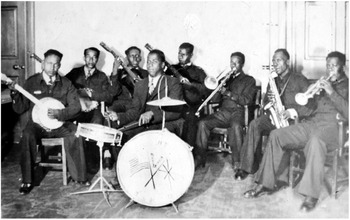
The research in this present article buttresses Forbes’s findings, and the selected archival sources generally portrayed British Hondurasian lumberjacks as being welcomed into local villages. The men were well liked by locals, and, when asked, expressed ‘delight’ that white women wanted to associate with them.Footnote 169 Government investigators noted that the ‘dance mad’ men regularly attended dances, enjoyed mixing with locals at pubs, and some were welcomed into evening classes in nearby villages.Footnote 170 Many had musical talent and some had brought handmade instruments with them from British Honduras, which they used to play in local bands (Figure 1).Footnote 171 At Kirkpatrick Fleming, a group of the lumberjacks formed their own dance band, which was invited to play at local engagements in the nearby town.Footnote 172
A band formed from the Honduran Timber Corps playing in Tranet.

While relations were often positive, there were also elements of tension between the Hondurasian migrants and local Scottish communities.Footnote 173 Like the Canadians and Newfoundlanders, the lumberjacks from Central America were known for their drinking behaviour. When under the influence of alcohol, the men became ‘very excitable’, and in the town of Duns in Berwickshire so many disturbances had taken place that some pubs and hotels in the town refused to serve the lumbermen.Footnote 174 An MoI intelligence officer heard talk of ‘wild scenes’ in pubs, and instances where the men had become involved in altercations that resulted in police laying charges. ‘We were well liked until we started drinking’, commented one lumberjack from the camp at Duns.Footnote 175 The Hondurasians were also dogged by rumours of local women abandoning their husbands to move in with the men, and of prostitutes from as far away as Newcastle arriving ‘regularly, and especially on pay nights’.Footnote 176 In response, MoI investigators suggested that the problem lay with the women, not the Hondurasians, and that officials were ‘considering getting powers to keep women out of the camps, especially at night’.Footnote 177
Despite these tensions, like the Canadians some Hondurasians stayed on in Scottish communities. Sam Martinez was one wartime migrant who remained, living in Edinburgh until his death in 2016. In an interview with The Herald in 2006, Martinez said, ‘we were very willing and happy to come here during the war and do our bit for the mother country. We heard about the war and the destruction that was going on, and didn’t hesitate. We volunteered to come in good spirit, prepared for anything. We knew the soldiers had suffered and we were prepared to suffer the same.’Footnote 178 Martinez spoke positively of his time working as a lumberjack during the Second World War, and of the ‘very nice’ people in local rural communities such as Ullapool.Footnote 179
***
By the end of 1943, Scotland’s harvest was said to be the largest that the country had ever known, and crops of both potato and sugar beet among ‘the best ever grown’.Footnote 180 By July 1944, a debate in the House of Commons revealed that there was a 43 per cent increase in Scottish acreage under crops compared to 1938, and, as a result, Scotland was producing 14 per cent of the total UK food production yield.Footnote 181 This was truly a remarkable achievement in under six years. While partly a result of intensive investment, mechanisation, and greater cropping acreage, this feat was also due to the large increase in manpower. The mobilisation of foreign lumberjacks, women, volunteers, and compelled labourers allowed the Scottish agricultural and forestry sectors to make a significant contribution to Britain’s wartime production needs.
This article seeks to integrate worker experiences in Scotland into the historiography of rural Britain during war. By bringing to light original research on labourers who toiled in Scotland’s fighting fields, it is hoped that the contributions of these diverse groups of men, women, and children will add to our understanding of the rural workforce during the Second World War. The research presented in this article also illuminates tension in rural communities that were reshaped by wartime migration. The limited evidence put forward here suggests that war’s effect on rural communities was mixed: while wartime labour went some way towards redressing prewar depopulation and depression, it also provoked animosities related to gender, ethnicity, and behavioural norms. Further investigation of wartime migration and worker experiences in rural Britain is likely to deepen our understanding of the ways war shaped the land, its workers, and surrounding communities.
Acknowledgements
The author wishes to acknowledge the Trustees of the Mass Observation Archive, University of Sussex, for extending permission to reproduce material from the Archive.