Introduction
Inverse problems posed by the mechanical characterization of materials
Identification of mechanical properties is crucial for all kinds of materials in order to develop faithful models of solids and structures, predict their mechanical response to a given loading, or assess their integrity and monitor their health. The mathematical problems posed by the identification of material properties are often referred to as inverse problems.
To define an inverse problem, it is convenient to first define its opposite: a forward problem.Reference Avril, Bonnet, Bretelle, Grédiac, Hild, Ienny, Latourte, Lemosse, Pagano, Pagnacco and Pierron1 In mechanics, solving a forward problem means predicting the result of a mechanical action on a solid (displacement, strain, and stress) from knowledge of the material model and boundary conditions, which are combined in a boundary-value problem of partial differential equations based on the local mechanical equilibrium. On the other hand, an inverse problem is posed when the result of the mechanical action is partly or fully measured and one wants to employ these measurements to determine unknown parameters of the material model, unknown elements of the boundary conditions, or the unknown initial geometry of the solid before the mechanical action.Reference Riveros, Chandra, Finol, Gasser and Rodriguez2
Inverse problems should not be confused with semi-inverse problems, which are a sub-category of forward problems. Semi-inverse problems have an exact analytical solution, whereas the majority of forward problems have only approximate solutions that can be computed numerically using (e.g., the finite-element method). Semi-inverse problems occur especially when predicting the result of a mechanical action on solids with simple geometries.Reference Criscione3 When the result of the mechanical action on such solids is measured and one wants to employ these measurements to determine unknown parameters of the material model, the closed-form expressions of the mechanical fields allow a simpler identification of the unknown material parameters. This subcategory of inverse problems may be classed as semi-forward problems. Semi-forward problems occur in a number of traditional mechanical tests, often called statically determined tests, where the parameters can be estimated by best-fit determination from the data.
Solving inverse problems implies the definition of a cost function, estimating the distance between the model predictions and measurements. The cost function is minimized using either a least-squares technique (such as the Levenberg-Marquardt algorithm) or a genetic algorithm, except in the case of semi-forward problems and linear least-squares which exhibit an explicit solution. In general situations, the model is solved numerically using a finite-element model updating technique (FEMU). In specific situations, when full-field measurements are available, an alternative to FEMU is possible in the form of the virtual fields method, which has been shown to be more robust and efficient in these situations.Reference Avril, Badel and Duprey4,Reference Grediac, Pierron, Avril and Toussaint5
Contrary to forward problems, a common difficulty of inverse problems is their ill-posed character, which means that the existence and uniqueness of the solution are not always guaranteed.Reference Barbone and Gokhale6 The character may be due to a lack of reliable data and/or overcomplexity of the model. When access to more reliable data and complexity reduction of the model are not possible in practice, ill-posed character may be overcome mathematically by resorting to regularization approaches.Reference Tikhonov and Arsenin7
Specific context of blood vessels
The inverse problems, including the semi-forward problems, posed by the identification of material properties in soft biological tissues are not straightforward, due to the complex microstructure of soft biological tissues, large deformations, response variation by sample and by patient, anisotropy, point-dependent, nonlinear behavior, and permanent functional adaptation of the tissue to the environment.
Determining the mechanical properties of such tissues has been a field of intense research for the last twenty years, since stress analysis of tissues has been shown to be meaningful for diagnosis in a number of medical applications (e.g., in the context of vascular medicine), indicating the risk of rupture of an aneurysmReference Fillinger, Marra, Raghavan and Kennedy8 or the risk of stroke.Reference Li, Howarth, Tang and Gillard9 This article focuses on the mechanical properties of elastic arteries, which are the largest arteries in the body located closest to the heart (e.g., the aorta and carotid arteries) and contain a large amount of elastic fibers, increasing their compliance and allowing the damping of blood pressure fluctuation over a cardiac cycle.
Existing experimental studies for inducing a mechanical stimulus on arterial tissues and measuring their response are numerous, though outside of the scope of this article. In vitro, many experiments have been developed to characterize pieces of artery after collection from animals or human donors; the most commonplace are the uniaxial tensile, biaxial tensile, tension-inflation, and bulge inflation tests. The deformation may be measured at a single point or as a whole field using an optical technique. In vivo, non-invasive stimuli have to be employed, the most common being the natural blood action on the arterial wall (pressure variations). A number of techniques have been developed to image the response of arteries to this mechanical action, such as intravascular ultrasound imaging (IVUS),Reference Nishimura, Edwards, Warnes, Reeder, Holmes, Tajik and Yock10–Reference Tobis, Mallery, Mahon, Lehmann, Zalesky, Griffith, Gessert, Moriuchi, McRae and Dwyer12 magnetic resonance imaging (MRI),Reference Woodrum, Romano, Lerman, Pandya, Brosh, Rossman, Lerman and Ehman13 and intravascular optical coherence tomography (OCT).Reference Yabushita, Bouma, Houser, Aretz, Jang, Schlendorf, Kauffman, Shishkov, Kang, Halpern and Tearney14 Some of these techniques are available in current clinical practice and allow an elastography mode, which means they allow mapping of strains at different stages throughout a cardiac cycle.
In these situations where elements of the response of an artery subjected to mechanical stimuli are measured, access to the mechanical parameters is never direct, and semi-forward or even inverse problems have to be posed and solved. The rest of this article is devoted to a survey of these inverse problems in vascular biomechanics, attempting to highlight the salient features but also the limits of the various identification approaches published so far. After a brief review of the main characteristics of elastic arteries and their constitutive models, the survey is divided into three parts corresponding respectively to three major objectives that researchers try to attain in vascular biomechanics and simultaneously to three different length scales of the tissue:
(1) Focusing on the macroscopic scale, the first part relates to the general objective of performing (patient-specific) stress analyses on blood vessels to predict their possible risk of rupture in the context of disease (such as aneurysms or atherosclerotic plaque) or their response to the implantation of a device (e.g., a stent or graft). Macroscopic constitutive equations are necessary to reach this objective. Arteries are usually modeled by a phenomenological hyperelastic strain energy function involving different numbers of parameters depending on the complexity of the observed behavior. This has been the subject of extensive research because of the challenge to identify parameters that are needed for the sophisticated constitutive equations employed.Reference Avril, Badel and Duprey4,Reference Badel, Avril, Lessner and Sutton15–Reference Zulliger, Fridez, Hayashi and Stergiopulos32
(2) Looking at the mesoscopic scale, the second part relates to the objective of characterizing regional variations in mechanical properties, often for comparative qualitative purpose. The inverse problem is posed here by considering heterogeneous distributions of material properties at the scale of the tissue (for instance, considering several different layers in the artery). Characterizing these regional variations is particularly useful for medical diagnoses (since the presence of stiffened regions may indicate a lesion) but also in understanding the progression of diseases and monitoring lesions.
(3) Finally, at the microscopic scale, the third part relates to the objective of tracking the separate contributions of different microconstituents in the global mechanical response, as subtle changes in the micromechanical distribution of stresses and strains may alter the basic activity of cells (expression of particular genes and production of particular enzymes and proteins). Due to this continuous growth and remodeling activity, the tissue is never stress-free and mechanobiology tries to understand the related governing processes.
Inverse problems posed by the complexity of the mechanical behavior at the macroscopic scale
Generalities about the biomechanics of elastic arteries
Elastic arteries are soft biological tissues, which can be described in terms of their constituents (histological description), the arrangement of the latter in the microstructure (morphological description), and also as a macroscopic structure subjected to mechanical loading. In terms of histology, elastic arteries are composed of three main types of cells:Reference Fung33,Reference Humphrey34 endothelial cells, smooth muscle cells (SMCs), and fibroblasts, embedded in an extracellular matrix made up mainly of collagen, elastin (in the form of elastic fibers), and a fluid-like ground substance containing proteoglycans among other things.
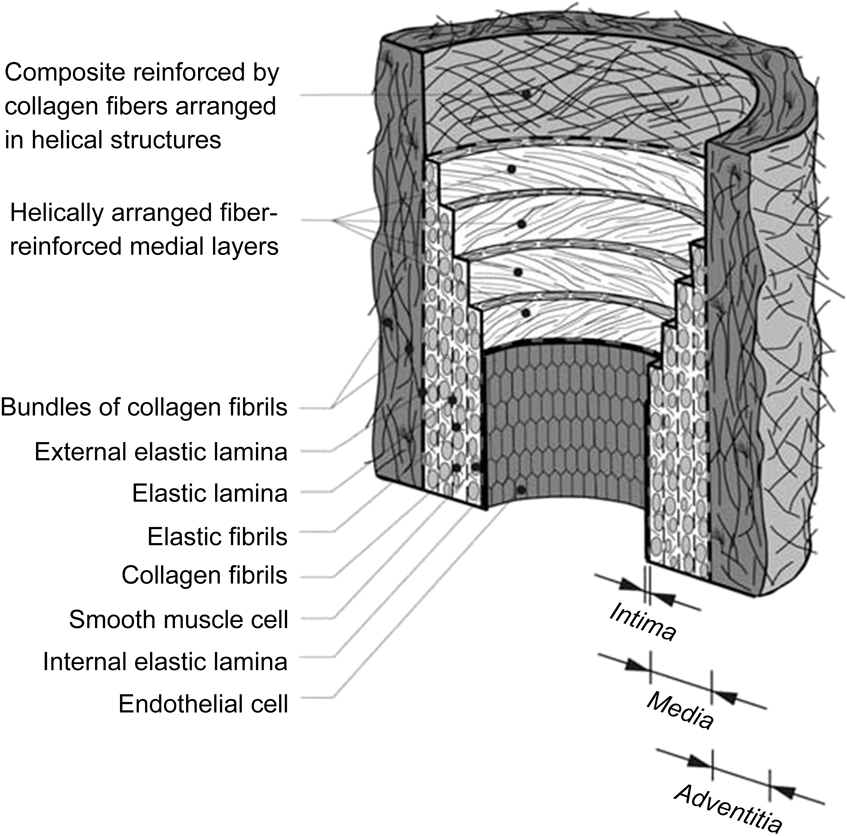
In terms of morphology, arteries are usually arranged in three distinct layersReference Humphrey34 (see Figure 1). The innermost layer of the vascular wall, called the tunica intima, is delimited from the inside space of the artery (the lumen) by a layer of endothelial cells and from the rest of the artery by a fenestrated (perforated) sheet of elastin called the internal elastic lamina. The intermediate layer, called the tunica media, is made up of SMCs embedded in an extracellular matrix consisting of elastin, collagen, and the ground substance. These SMCs are organized in concentric layers separated by fenestrated elastin sheets. Finally, the outermost layer, called the tunica adventitia, is made of a dense network of collagen fibers, mechanically preventing the wall from over-distension.
Schematic representation of the arterial wall, showing the three different arterial layers and their composition. Reprinted with permission from Reference 39. © 2000 Springer.

Structurally, an elastic artery in vivo is a pre-stretched pipe under an internal pressure load, able to stretch in response to each heart pulse and still able to undergo finite deformations far beyond the ones induced by the pressure variations in the body. While the diameter change over a cardiac cycle is about 10%,Reference Dobrin35 a segment of artery may shrink from 50% to 80% of its length when it is removed from the bodyReference Fung, Fronek and Patitucci21,Reference Doyle and Dobrin36,Reference Van Loon, Klip and Bradley37 from elastic recoiling alone.
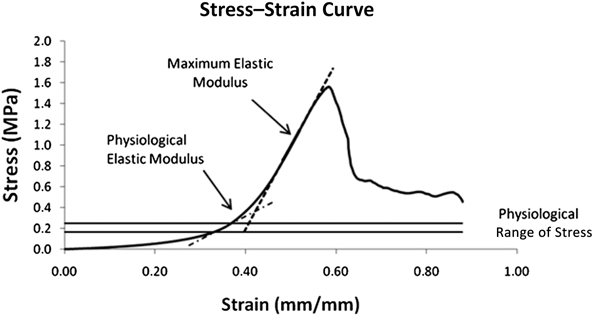
The different mechanical and organizational features of the arterial wall have been incorporated in diverse phenomenological, macroscopic constitutive models. A comprehensive review of the arterial wall constitutive models has been published by Kalita and Schaefer.Reference Kalita and Schaefer25 Most of the models focus on the passive behavior of arteries (in other words, they neglect the mechanical actions of cells) and neglect the viscous effects. While a typical tensile stress–strain response of an aortic sample is shown in Figure 2, here, we recall the principal characteristics of the arterial wall models.
Uniaxial tensile stress–strain response of a human aortic sample.Reference Duprey, Khanafer, Schlicht, Avril, Williams and Berguer17
Because of the large deformability of elastin, the constitutive models for elastic arteries are usually developed within the finite-strain theory and are based on the definition of a strain energy function. Complex coupling between axial and circumferential responses has always been observed in in vitro experiments. Accounting for that observation, the strain energy function can either be an orthotropic exponential strain energy functionReference Fung, Fronek and Patitucci21 or be defined as a fiber-reinforced composite, where each term of the strain energy function accounts for the contribution of a specific constituent.Reference Holzapfel and Weizsäcker23,Reference Zulliger, Fridez, Hayashi and Stergiopulos32,Reference Holzapfel, Gasser and Stadler38 In these models, elastin and the ground substance are taken into account as the same phase, considered as a neo-Hookean matrix (exhibiting a nonlinear elastic behavior and possible large stretches), and different numbers of collagenous fiber families and SMCs are accounted for by the introduction of polynomial or exponential terms in the strain energy function. The large amount of fluid makes the tissue almost incompressible.Reference Chuong and Fung16 Since different tissue layers exhibit different mechanical behaviors, a layer-specific strain energy function is sometimes introduced.Reference Badel, Avril, Lessner and Sutton15,Reference Pandit, Lu, Wang and Kassab29,Reference Holzapfel, Gasser and Ogden39
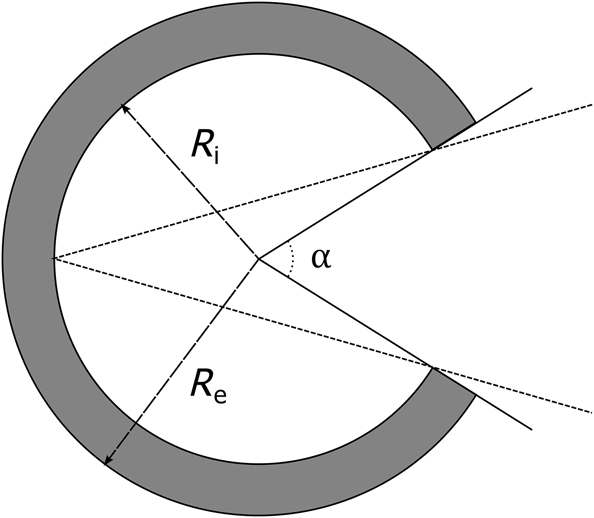
Due to their permanent functional adaptation, residual stresses sit within the arterial wall. The presence of residual stresses has been evidenced by the observation of the arterial wall opening up in response to a radial cutReference Zeller and Skalak40–Reference Takamizawa and Hayashi44 (see Figure 3 for the definition of the opening angle). However, empirical observations are not sufficient to measure residual stresses since they are self-equilibrating and complex inverse problems can arise.Reference Badel, Genovese and Avril45
Opening of an arterial wall segment due to a radial cut (R e, external radius; R i, internal radius; α, opening angle).
Inverse problems for characterization of mechanical properties at the macroscopic scale
In most cases, statically determined experimental tests are used to characterize the arteries, leading to semi-forward (inverse) problems. But as stated previously, due to the complexity of their mechanical behavior, identification of the material parameters of a constitutive model is rarely direct. Different inverse approaches and best-fit methods exist for their identification depending on the experimental tests available, whilst it has been shown that the choice of the cost function can also influence the results.Reference Zeinali-Davarani, Choi and Baek46
The identification of the parameters of an anisotropic hyperelastic strain energy function requires measuring the response of the material to multiaxial stress loading for different loading paths. The most appropriate tests for arteries are the tension inflation tests, which consist of pressure loading the artery at different axial stretches. Auricchio et al.Reference Auricchio, Conti and Ferrara47 compared the reliability of two isotropic phenomenological models and four structural invariant-based constitutive models, commonly used to describe the passive mechanical behavior of arteries, to perform best-fit estimations from the curves of tension inflation tests. The conclusion is that each domain may be reliable depending on the level of local anisotropy in the tissue.
Identification may appear simpler when using uniaxial tests; however, they provide no sensitivity to the mechanical behavior in the other directions of the tissue. In that case, most of the parameters have to be bound in narrow ranges of values in order to overcome the lack of sensitivity. A good example is the study from Masson et al.Reference Masson, Boutouyrie, Laurent, Humphrey and Zidi28 who identified the 13 parameters of a material model from dynamic pressure measurements on the inner side of the arterial wall. Another elegant contribution introducing the notion of state constraints in the minimization problem was performed on a human aorta by Stålhand et al.Reference Stalhand, Klarbring and Karlsson30
A concern is the material parameters of the tissue in the regime just preceding its rupture.Reference Volokh48Reference Balzani, Schröder and Gross51 They usually induce a complex identification due to the localized effects of damage preceding the rupture, but most of the experimental approaches dedicated to this problem have assumed homogeneous strains in order to keep the semi-forwardness of the inverse problem.
Inverse problems posed by regional variations of materials properties at the mesoscopic scale
Elastography is widely used as a tool for medical diagnosis of different arterial pathologies, as indicated earlier. Some pathologies such as atherosclerosis are characterized by localized arterial stiffening. In other cases, since the mechanical properties are related to the composition of the tissue, their determination helps doctors assess the risk of rupture, so as to avoid a stroke or a heart attack. However, elastography only allows for mapping of the strain field, and inverse problems must be solved to determine maps of the mechanical parameters.
In many situations, researchers are only interested in the small deformations of arteries occurring in vivo around a mean static pressure, chosen as the average reference configuration. Small deformations are induced by the pressure changes in the lumen of the artery over a cardiac cycle or externally induced by an appropriate medical device. In these situations, the mechanical behavior of the artery is linearized around the reference configuration in such a way that any stress change Δσ in the artery may induce a strain change such as: Δε = C –1 Δσ. Rigorously, the stiffness tensor C should be an anisotropic tensor, tangent to the stress–strain curve at the reference configuration point, and the equation should only be used for small variations of the strain: ||Δε|| < 0.05, for proper equivalence with the constitutive equations that are characterized from the in vitro bench tests. For larger strains, a polynomial Taylor series expansion is still possible. In a large number of cases, transverse isotropy is assumed and only the mechanical properties of the artery perpendicular to the main direction of blood flow are sought. Since the tissue is almost incompressible, a Poisson’s ratio is commonly prescribed, with values varying from 0.45 to 0.49. Only an elastic modulus E has to be identified for a complete material characterization. We named this the tangent elastic modulus.Reference Holzapfel and Weizsäcker23
Many researchers have tried to estimate the regional variations of this parameter, for instance at different sites along the length of an artery or even mapping its distribution across the whole cross-section of atherosclerotic plaques in the coronary arteries (using OCT or IVUS) or in the carotid arteries using MRI; FEMU methods were specifically developed to solve these inverse problems.Reference Le Floc’h, Ohayon, Tracqui, Finet, Gharib, Maurice, Cloutier and Pettigrew52 Nevertheless, identifying E is not sufficient to perform a stress analysis on the artery. As the loading applied to the artery may be dynamic, this may permit characterizing a viscoelastic model.Reference Eskandari, Salcudean, Rohling and Ohayon18
Note that some authors have also extended the problem of identifying a tangent elastic modulus to configurations of the artery other than the average in vivo configuration. For instance, some authors have carried out tests in vitro, such as indentationReference Chai, Speelman, Oomens and Baaijens53 or micropipette aspiration,Reference Boudou, Ohayon, Arntz, Finet, Picart and Tracqui54 on pieces of arteries collected from human donors or animal models. An inverse problem has to be solved to derive the homogeneous or heterogeneous elastic moduli involved in the mechanical response to these tests. However, the obtained values cannot be compared to the in vivo ones as they correspond to linearization of the stress–strain response around different reference configurations (a load-free stress state and one subjected to the mean arterial blood pressure). The main interest of these tangent elastic moduli in configurations different from the in vivo ones is to compare different tissues in the same configuration or different locations in the same tissue.
Regional variations of hyperelastic (nonlinearized) parameters involved in the complete strain energy functions have rarely been characterized. Variations of material properties across the arterial wall thickness are commonly reported from experiments: independent characterization of the different layers (intima, media, and adventitia) has revealed, their different mechanical properties that influence the global response of the artery.Reference Holzapfel, Sommer, Gasser and Regitnig55 Indeed, HumphreyReference Humphrey34 reported normal and upside-down tension inflation tests on arteries, which evidenced their different responses. However, only a few studiesReference Badel, Avril, Lessner and Sutton15 have attempted to solve an inverse problem where both the media and adventitia have unknown material properties that have to be extracted from the response of the complete artery. The regional variations of hyperelastic material parameters along the circumferential and axial directions of arteries constitute a new class of inverse problems with recent interest.
By modeling the arterial wall as a membrane and taking advantage of the isostaticity of a pressurized membrane, it is possible to reconstruct the (possibly heterogeneous) pointwise stress distribution without the assumption of known constitutive behavior.Reference Lu, Zhou and Raghavan56 Furthermore, the strain distribution across the artery can be measured by digital image correlation. It therefore becomes possible to plot pointwise stress–strain curves and to identify the material parameters pointwise in a semi-forward manner by simple curve fitting. This simplifies the problem considerably, avoiding the repeated resolution of finite element models, which is required in other approaches.Reference Kroon and Holzapfel27,Reference Khalil, Bouma and Kaazempur Mofrad57,Reference Seshaiyer and Humphrey58 Such an approach has been developed especially for understanding aneurysm rupture, showing the development of localized damaged zones in the tissue prior to its rupture.Reference Romo, Badel, Duprey, Favre and Avril59
Inverse problems posed by functional adaptation of arterial tissue at the microscopic scale
In vascular tissues, as in many biological tissues, the physiological properties are closely related to the mechanical environment sensed by the tissues. Indeed, biological tissues have the ability to grow and remodel due to mechanosensitive cells, and to adapt their microstructure to new mechanobiological demands. It is also generally agreed upon that the development of vascular pathologies (e.g., aneurysms and thrombi) is highly linked to the remodeling properties of the vascular tissue and to changes in its mechanical environment. Among the different constituents of the vascular wall, collagenous fibers are regularly renewed, while the only period of elastin synthesis by the organism is the perinatal and childhood period, making elastin degradation an irreversible process. Also, the mechanical behavior of vascular tissue is highly complex: reorganization of the microstructure, such as progressive decrimping and reorientation of the elastic and collagenous fibersReference Roy, Boss, Rezakhaniha and Stergiopulos60–Reference Schrauwen, Villanova, Rezakhaniha, Stergiopulos, van de Vosse and Bovendeerd62 happens in vascular tissues which are subjected to mechanical loading (Figure 4). In order to correctly capture this complex behavior, account for the remodeling process, and predict its effect on the overall mechanical behavior, it is necessary to quantify the specific contributions of the mechanically significant constituents to the overall mechanical behavior.
Progressive decrimping of collagen fibers in the adventitia of a rabbit carotid artery. Adapted with permission from Reference 62. The same area was imaged using confocal microscopy for different pressure steps from 0 mmHg to 140 mmHg. The rabbit mean physiological pressure is 70 mmHg.
The following question can therefore be addressed: What are the predictive capabilities of the available constitutive models to reliably account for separate contributions of the diverse arterial wall constituents on the macroscopic mechanical response?Reference Humphrey63 Here, we restrict the discussion to the passive behavior of arterial wall tissue. We are mainly interested in the two main constituents that contribute to the mechanical response of arterial wall tissues, namely collagen and elastin.
Tracking the contribution of collagen fibers
The arterial wall owes its main mechanical characteristics, such as progressive stiffening and anisotropy, to collagen fibers and their orientations.Reference Holzapfel, Gasser and Ogden39 In most of the available constitutive models,Reference Gasser, Ogden and Holzapfel22,Reference Zulliger, Fridez, Hayashi and Stergiopulos32,Reference Lanir64 fiber families are characterized by their orientation angles while their progressive stiffening is modeled through exponential functions of the stretch. Determination of their orientations can be carried out in two ways: either by histological examination of the tissue or by an inverse method, searching for the orientation angles that best fit the macroscopic behavior of the tissue. A comparison of the two methods shows that the optimal orientation angles stemming from the inverse method are not always consistent with the histological estimations of the fiber orientations both in healthyReference Auricchio, Conti and Ferrara47 and aneurysmal tissues, for which the inverse method leads to overestimation of the orientation angles.Reference Kim, Avril, Duprey and Favre65 Even though some authors have introduced more complex models including a distribution function of orientations,Reference Zeinali-Davarani, Choi and Baek46 the majority of models have a maximum of four fiber families: one circumferentially oriented,Reference Wolinsky and Glagov61 one axially oriented, and two diagonally oriented fiber families. Histological observations highlight the difficulty in clearly defining fiber families by allocating a precise orientation angle to them.Reference Auricchio, Conti and Ferrara47
Modeling the progressive recruitment of collagen fibers is another important question that needs to be addressed. In the ex vivo load-free configuration, microscopic observations show crimped fibers with different orientations that the mechanical loading tends to stretch and reorient along the principal strain directionsReference Holzapfel24 (also see Figure 4). This progressive reorientation process is generally named the recruitment of collagen fibers. For large stretching, the collagen fibers are perfectly straight and parallel to each other. However, the physiological load lies between these two extreme situations and poses the problem of collagen fiber engagement under physiological conditions. Different experimental studiesReference Roy, Boss, Rezakhaniha and Stergiopulos60,Reference Bank, Wang, Holte, Mullen, Shammas and Kubo66–Reference O’Connell, Murthy, Phan, Xu, Buchanan, Spilker, Dalman, Zarins, Denk and Taylor68 showed that only partial engagement of collagen fibers is reached at physiological pressure: only 5–10% of the fibers actively participate in the mechanical behavior of vascular tissues at these pressures. This progressive recruitment is the physical origin of the nonlinear character and progressive stiffening of the response of vascular tissues. In general, it is implicitly accounted for through the introduction of exponential functions in the constitutive models,Reference Fung, Fronek and Patitucci21,Reference Holzapfel24,Reference Zulliger, Fridez, Hayashi and Stergiopulos32,Reference Holzapfel, Gasser and Ogden39 but in some specific models, a probability distribution function for the engagement strain of the fibers has been introduced.Reference Zulliger and Stergiopulos69 Such a function simplifies the identification of mechanical properties related to collagen and elastic fibers (through the use of variable recruitment stages).
Tracking the contribution of elastic fibers
In general, mechanical models only account for the role of elastic fibers (mainly made of elastin) through a neo-Hookean isotropic contribution in the strain energy function. However, biological studies show the importance of elastic fibers in maintaining the shape and the functions of arteries. For instance, arteries with degraded elastin are more prone to local enlargements such as aneurysms.Reference Anidjar, Salzmann, Gentric, Lagneau, Camilleri and Michel70 The following question can therefore be posed: Which characteristics of the mechanical behavior of elastic fibers can be retrieved from existing models and which ones are missing?
Concerning the mechanical properties of elastic fibers, they are generally assimilated in the initial tangent elastic modulus of the arterial stress–strain response. However, evaluation of the neo-Hookean parameter by means of inverse methods and a curve fitting algorithmReference Zulliger, Fridez, Hayashi and Stergiopulos32 leads to an elastic modulus for the matrix, which is far below the elastic modulus measured on isolated elastic fibers.Reference Fonck, Prod'hom, Roy, Augsburger, Rüfenacht and Stergiopulos20,Reference Aaron and Gosline71 This can be explained by at least two phenomena. First, the matrix in which the collagenous fibers are embedded is not only made of elastic fibers but also of a ground substance, which contributes to the mechanical behavior at low stretching.Reference Aaron and Gosline71 Second, progressive unfolding of the elastic fibers has also been observedReference Wolinsky and Glagov61 impacting the recruitment of collagen fibers. This elastic fiber unfolding occurs before the decrimping of collagenous fibers, which subsequently undergo less decrimping, endowing arterial walls with a more compliant response to pressurization.Reference Ferruzzi, Collins, Yeh and Humphrey72 This was confirmed by observations of elderly people’s arteries: Their elastin is degraded, and the decrimping of collagenous fibers is more pronounced and occurs earlier.Reference Zeinali-Davarani, Chow, Turcotte and Zhang73,Reference Samila and Carter74 The latter observations indicate strong interactions between elastic and collagenous fibers. This interaction is not limited to the low-stretch regime, but is also visible at high stretching. Models tend to simplify the real behavior of arteries and identify the high-stretch tangent modulus with that of collagen fibers. However, experiments on arteries with chemically degraded elastin fibers show a larger elastic modulus for these arteries than for healthy ones, evidencing the contribution of elastic fibers to the mechanical behavior at high stretching.Reference Fonck, Prod'hom, Roy, Augsburger, Rüfenacht and Stergiopulos20
It must however be stated that inverse determination of the neo-Hookean parameter can be useful for estimating the quality of elastic fibers, a very low elastic modulus being associated with degraded (nonfunctional) elastin. In particular, aneurysmal arteries, whose elastin is known to be degraded,Reference Campa, Greenhalgh and Powell75 exhibit a low initial tangent modulus, as compared to healthy arteries.Reference Scott, Ferguson and Roach76 The importance of considering the contribution of all the components at the microscale and not just that of the collagen is emphasized by the existence of internal stresses in the tissue that biomechanists sometimes try to identify.Reference Zeinali-Davarani, Chow, Turcotte and Zhang73 This constitutes another class of inverse problems for which experimental data is not available yet. For instance, if it would be possible to take the collagen fibers out of the tissue and measure the deformation that this would induce, evaluating internal stresses would be permitted.Reference Bellini, Ferruzzi, Roccabianca, Martino and Humphrey77
Conclusion
This article demonstrated that inverse problems posed by mechanical characterization of arteries are numerous and diverse, and it would be an enormous task to exhaustively review all the existing contributions. The more modest purpose of this article is to synthesize the main objectives usually motivating such contributions. Three groups of objectives were found: to have a set of relevant parameters to perform numerical simulations; to characterize regional variations of material properties in order to track the effects of functional adaptation or lesions; and to identify the contribution of microconstituents to the mechanical response.
Even if a relevant theory that can satisfactorily explain the mechanical behavior of soft tissues on the basis of its internal structure and composition is still lacking, great effort has been made so far to relate the complex mechanical behavior of arteries to their microstructure and this has motivated numerous inverse problems. The current perspective, however, is elsewhere, as the proper calibration of growth and remodeling models represents a new challenge. This is a new class of inverse problems related to the mechanobiological characterization of arteriesReference Cyron and Humphrey78–Reference Azeloglu, Albro, Thimmappa, Ateshian and Costa80 instead of purely mechanical characterization.