Endobronchial ultrasonography (EBUS) is a minimally invasive diagnostic technology that allows real-time visualization and sampling of tracheobronchial tree and associated lymph node stations. It was introduced in 1992, and many centers throughout the world now use EBUS-transbronchial fine needle aspiration (TBNA) as the procedure of choice to sample intrathoracic adenopathy (Reference Feller-Kopman, Brigham and Lechtzin1–Reference Jose, Shaw and Taylor3). Rapid on site evaluation (ROSE) allows immediate processing of the transbronchial fine needle aspirate in the procedural suite and interpretation by a cytopathologist (PA). It aims to classify a sample as adequate and to provide a preliminary diagnosis. ROSE is believed to be necessary for optimal outcome of the diagnostic procedure. The reported benefits include increased rate of specimen adequacy, improved diagnostic yield, decreased sampling need, appropriate triaging of sample for complementary testing, immediate treatment decisions, optimizes resource usage and can decrease overall costs (Reference Layfield, Bentz and Gopez4–Reference Baram, Garcia and Richman11). The use of rapid on site cytopathology evaluation (ROSE) has been well described with a variety of sampling techniques including bronchoscopy and computed tomography guided lung biopsies (Reference Clementsen, Skov, Vilmann and Krasnik12–Reference Fassina, Corradin and Zardo14). Although ROSE has been shown to increase diagnostic accuracy for other sites, its impact and usefulness with EBUS guided TBNA (EBUS-TBNA) remain uncertain due to the high reported diagnostic accuracy with EBUS alone (Reference Schmidt, Witt and Matynia8;Reference Jhala, Eltoum and Eloubeidi15).
Introduction of any new technology can have a distinct impact on healthcare costs. It has become increasingly important for any new technology to undergo rigorous clinical and economic analysis before its adoption. The ever decreasing healthcare budget and cost containment policies underscore the need for economic evaluation of impact of such technologies on patient care. EBUS-TBNA is recommended as the initial investigative tool for patients with enlarged mediastinal lymph nodes, lung cancer, and sarcoidosis (16;Reference Nakajima, Yasufuku and Kurosu17). Changes to the EBUS procedure will have large scale impact on population wide testing. Lung cancer estimated incidence rate in Alberta is 59 and 48/100,000 in 2014 (18). Although there is increasing use of the ROSE with EBUS-TBNA, there are limited data on its economic impact (Reference Gu, Zhao and Jiang19;Reference Ost, Ernst and Lei20). The aim of our study was to evaluate the economic impact of EBUS-TBNA with simulated ROSE and without ROSE using a hospital diagnostic unit perspective in a Canadian (Alberta) healthcare environment.
METHODS
We developed an economic model with two arms, no ROSE (current practice) and simulated ROSE, for EBUS-TBNA for a cost analysis study. During the study period, in patients undergoing EBUS bronchoscopy at our institution, we sampled nodes with size greater than 1 cm in depth on ultrasound per station. The specimens were obtained by fine needle aspiration (FNA) using a specially designed 22G needle by means of the EBUS bronchoscope (Olympus). Three passes were made per lymph node station. Each pass yielded two slides of the aspirate: one air dried and the other fixed in alcohol. An additional pass was collected for cell block. The lymph node station sampled included a combination of right paratracheal (4R), left paratracheal (4L), subcarinal (Reference Bruno, Ricci and Esposito7), right and left hilar (10R,10L-11R, 11L). The procedure generated eighteen to twenty-four slides per patient. All processed aspirate was then sent to pathology for diagnosis. The review time was approximately 5–10 min per slide. Sampling an additional nodal station required an extra 30–60 min of review time for the pathologist (PA) in addition to the extra preparation time by the cytotechnologist, bronchoscopy and personnel time.
Simulated ROSE
To simulate ROSE, slides were retrieved from the archives and a PA reviewed the slides to identify the first pass and lymph nodes (LN) station at which the diagnosis could have been made if there was intra procedural cytopathology available. A total of ninety-five cases were reviewed.
Model Structure
Our model included two arms, suspected cancer and sarcoidosis. This is based on our referral pattern, 90.5 percent of cases were referred with suspected diagnosis of sarcoidosis or lung cancer. Reactive adenopathy was not modeled as there were no cases referred with “suspected reactive lymphadenopathy.” As only sarcoidosis patients needed extra tests (mucosal biopsies and transbronchial lung biopsies (TBB) to confirm diagnosis, cancer and sarcoidosis patients were analyzed separately.
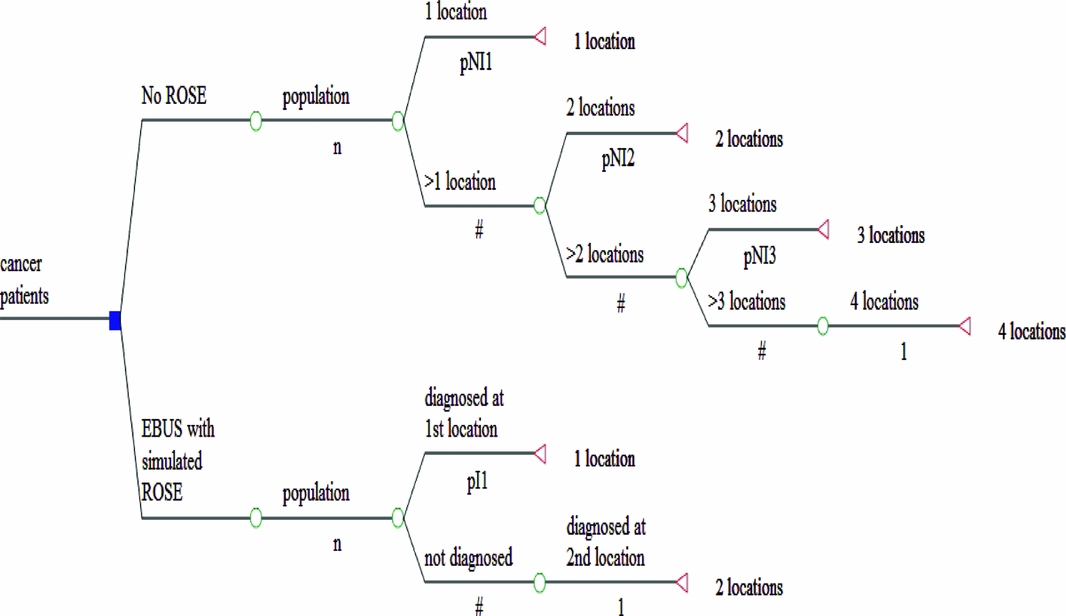
Figure 1 and Supplementary Figure 1 show the flows of cancer and sarcoidosis patients, respectively. In the current practice (no ROSE) arm, a patient (regardless of diagnosis) may have one to four locations sampled (LN). All sarcoidosis patients underwent additional testing regardless of the number of LN, while no extra tests for any cancer patients were added to the model because ROSE is not applicable to them.
Model structure for cancer patients (n = number of patients; pNI1 = Probability of one location if no ROSE; pNI2 = Probability of two locations among those who have more than one locations if no ROSE; pNI3 = Probability of three locations among those who have more than two locations if no ROSE; pI1 = Probability of being diagnosed at the 1st location with simulated ROSE).

In the simulated ROSE arm, a cancer patient could be diagnosed and staged at either the 1st or the 2nd LN without the need of extra tests at bronchoscopy. A sarcoidosis patient would be diagnosed at the 1st, the 2nd, or the 3rd LN. If the lymph node sampling was nondiagnostic, extra tests were performed.
Model Inputs
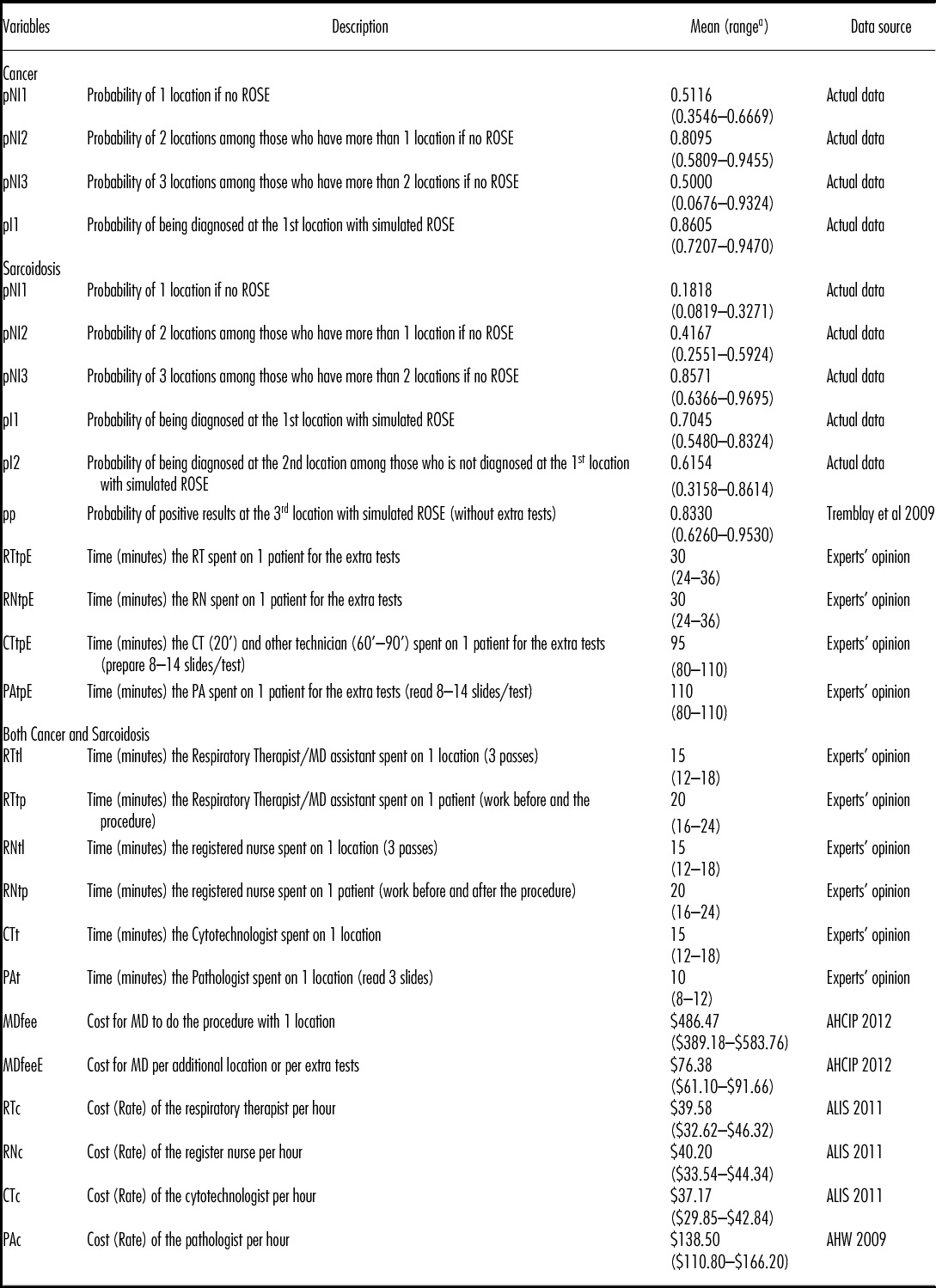
Inputs for the models are presented in Table 1. Of note, there are separate inputs for cancer model, sarcoidosis model, and common inputs for both.
Model Inputs

aRanges of the probabilities are 95% confident intervals, ranges of RTc and RNc are the ranges reported in the reference, and the remaining variables are varied by ±20%.
Generally, all the transitions probabilities were estimated based on a retrospective chart review of ninety-five patients who underwent EBUS-TBNA at the University of Alberta Hospital. For the sarcoidosis group, the diagnostic yield of EBUS-TBNA was retrieved from literature (Reference Tremblay, Stather, Maceachern, Khalil and Field21).
Probabilities
Of cancer patients, if ROSE is unavailable, 51.16 percent will have only 1 LN and the remaining will have more than 1 LN. Of the patients who have more than 1 LN, 80.95 percent will have 2 LNs and the remaining will have more than 2 LNs. Of the patients who have more than 2 LNs, 50 percent will have 3 and 50 percent will have 4 LNs. If ROSE is available, 86.05 percent of cancer patients will be diagnosed at the 1st LN and the remaining will be diagnosed at the 2nd.
Of sarcoidosis patients, if ROSE is unavailable, 18.18 percent will have only 1 LN and the remaining will have more than 1 LN. Of the patients who have more than 1 LN, 41.67 percent will have only 2 and the remaining will have more than 2 LNs. Of the patients who have more than 2 LNs, 85.71 percent will have 3 and the remaining will have 4 LNs. If ROSE is available, 70.45 percent of sarcoidosis patients will be diagnosed at the 1st LN and the remaining will not. Of the patients who are not diagnosed at the 1st LN, 61.54 percent will be diagnosed at the 2nd LN and the remaining will not. Of the patients who are not diagnosed at the 2nd LN, 83.3 percent will be diagnosed at the 3rd LN without extra tests and the remaining will undergo extra tests for diagnosis.
Times Spent on Procedure
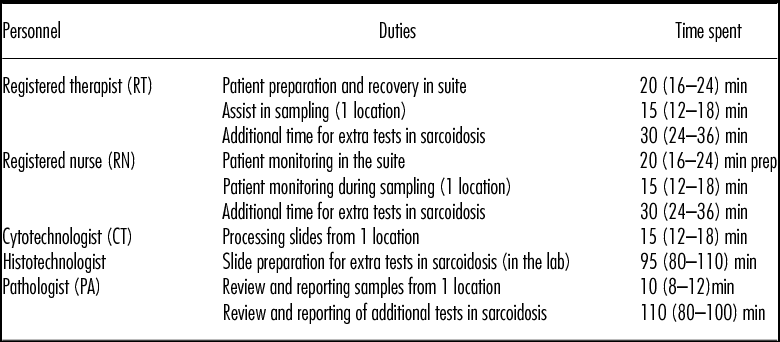
Most respirologists in Alberta are fee for service; the costs of medical doctor (MD) are not based on time. Therefore, the time of MDs is not described here. We did not include the costs associated with patient preparation and recovery time as it is unlikely to be different with or without ROSE. Other staff time estimates are presented in Table 2.
Time Spent by Various Personnel per Patient in Cancer Mediastinal Staging and Sarcoidosis Sample Collection and Review

Cost
Based on the Medical Price List (AHCIP 2012), the fee for MDs to perform the procedure with 1 LN is CAD 486.47(USD 394.47). This fee includes consultation (CAD 112.64; USD 91.49), bronchoscopy (CAD 128.87; USD 104.67), EUS equivalent (CAD 168.58; USD 136.87), and 1 TBNA or biopsy site-lymph node station (CAD 76.38; USD 62.04). If the patient needs additional LNs and/or extra tests, the fee for MDs is CAD 76.38 (USD 62.04) per additional LN or per extra tests.
Hourly rates were estimated at CAD 39.58(USD 32.17) for a respiratory therapist (RT), CAD 40.20(USD 32.67) for a registered nurse (RN), CAD 37.17(USD 30.21) for a cytotechnologist, and CAD 138.50(USD 112.45) for a PA. The rates of PAs were derived from Alberta Health data (AHW 2009) with confirmation of experts in the field (E.W. and M.K.). The other rates were retrieved from Alberta Wage and Salary Survey in 2011 (ALIS 2011). Rates per minute were estimated by dividing the rates per hour by 60. All the costs were converted to 2012 Canadian dollars using the Bank of Canada inflation calculator (22).
Number of Patients
Lung cancer incidence in Alberta is 2200 cases/year. Patients with localized and regional metastasis would likely be referred to EBUS-TBNA. This is estimated to be 37 percent in the SEER 18 2003–2009 Web publication (16). It is estimated that there will be annually 800(640–960) cancer patients and 200(160–240) sarcoidosis patients who undergo the procedure in the province of Alberta. There are no data for sarcoidosis incidence in Alberta and the number is estimated from local experience. The population of Alberta in 2014 was 4,025,074 (23).
Sensitivity Analysis
A one-way sensitivity analysis was performed on all the input parameters and the results are represented by tornado graphs. The probability inputs were varied from the lower to the upper value of the 95 percent confidence intervals. The salary ranges of RTs and RNs were the ranges reported by the Alberta Wage and Salary Survey (ALIS 2011). A separate analysis was done after excluding extra tests for sarcoidosis as recent literature indicates that additional testing may not increase the yield of EBUS-TBNA diagnosis.
RESULTS
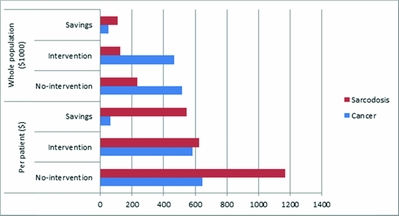
Our models showed in the current practice (ROSE is unavailable), the procedure cost CAD 646.00(USD 523.32) per cancer patient and CAD 1,170.00(USD 947.73) per sarcoidosis patient. If ROSE was available, the costs would decrease to CAD 583.00(USD 473.85) per cancer patient and to CAD 626.00(USD 508.20) per sarcoidosis patient. These indicate that the intervention could save CAD 63.00(USD 51.04) per cancer patient and CAD 544.00(USD 440.65) per sarcoidosis patient (Figure 2).
Cost and savings for lung cancer and sarcoidosis for whole population and per patient.

For the whole province, in the current practice, our models estimated that the procedure cost would be CAD 517,000.00(USD 42,0205.65) for cancer patients and CAD 234,000.00(USD 190189.79) for sarcoidosis patients. With simulated ROSE was in place, these numbers would be CAD 467,000.00(USD 379566.81) and CAD 125,000.00(USD 101599.17), respectively. These indicate ROSE could save province CAD 50,000.00(USD 40,638.84) and CAD 109,000.00(USD 88592.68) for cancer and sarcoidosis patients, respectively (Figure 2).
Sensitivity Analysis Results
Results from the sensitivity analysis are shown in supplement (Supplementary Figures 2–5). The savings per cancer patient varied from CAD 37.00(USD 29.97) to CAD 89.00(USD 72.10). The most, second, and third sensitive variables were the probabilities of having 1 or 2 LNs in the current practice, and the probability of diagnosis at the 1st LN if ROSE is available, respectively (see Supplementary Figure 2).
The savings per sarcoidosis patient varied from CAD 490.00(USD 397.05) to CAD 598.00(USD 484.44). The most, second, and third sensitive variables were the salary of PAs, the fee for MDs to perform an additional location or extra tests, and the probability of diagnosis at the 1st LN if ROSE is available, respectively (see Supplementary Figure 3).
The savings for all cancer patients in the province varied from CAD 30,000.00(USD 24364.49) to CAD 71,000.00(USD 57662.63). The most, second, and third sensitive variables were the probability of having 1 or 2 LNs in the current practice, and the probability of diagnosis at the 1st LN if ROSE is available, respectively (see Supplementary Figure 4)
The savings for all sarcoidosis patients in the province varied from CAD 87,000.00 to CAD 130,000.00(USD 70,657.03 to 105579.47). The most, second, and third sensitive variables were the number of sarcoidosis patients who undergo the procedure in the province per year, the salary of PAs, and the fee for MDs to perform an additional location or extra tests, respectively (see Supplementary Figure 5). After excluding extra tests for sarcoidosis, the savings per patient would be CAD 115.00(USD 93.40) and for province would be CAD 23,000.00(USD 18679.44).
DISCUSSION
Although both EBUS and ROSE independently have been shown to have clinical effectiveness and cost-effectiveness, to our knowledge this is the first study to look at the economic impact of simulated ROSE with EBUS-TBNA (Reference Sharples, Jackson and Wheaton24). A review of the literature identified 18 relevant studies from 1996 to 2014 (week 4) describing the use of ROSE with EBUS-TBNA. When used in nodal staging for lung cancer, there is a high agreement between the onsite and final diagnosis and also a low rate of nondiagnostic sampling (4 percent) (Reference Collins, Chen, Wang, Bernadt and Sanati9). Diagnostic accuracy of ROSE compared with histological diagnosis is 98.2 percent.
Plit et al. (Reference Plit, Havryk and Hodgson25) prospectively studied EBUS-TBNA with ROSE in suspected sarcoidosis patients. In addition to a high diagnostic accuracy, they showed that it can be used to determine if TBB is needed. Data from the Aquire registry suggest that the only complication with EBUS occurred when TBB was combined with TBNA. The diagnosis of pneumothorax led to changes in level of care (Reference Eapen, Shah and Lei26). The use of ROSE may lead to reduction in this complication rate. It is suggested that EBUS-TBNA with ROSE should be considered as the first line investigation for sarcoidosis.
The diagnostic yield of EBUS-TBNA without ROSE in lung cancer staging and sarcoidosis is reported to be 88–93 percent and 83–94 percent, respectively (Reference Ost, Ernst and Lei20;Reference Plit, Havryk and Hodgson25;Reference Lee, Kim and Lim27). The impact of ROSE would therefore arise not from the improved diagnostic yield but from cost savings from reduced usage of resources. In some studies of ROSE with EBUS-TBNA, it was reported to have no impact on clinical decision making and diagnostic yield (Reference Griffin, Schwartz and Baloch28–Reference Schwartz, Yu and Baloch30). Our review indicates that prior studies do not address cost savings after taking into account the downstream cytopathology resource usage. To fully understand the cost of ROSE with EBUS-TBNA to the healthcare system, we need to include the full range of costs of resources used beyond bronchoscopy procedure. Our economic model showed that there is a 10 percent savings per cancer patient and 40 percent per sarcoidosis patient by adding ROSE to EBUS-TBNA bronchoscopy. Our study did not assess the sensitivity or diagnostic accuracy of adding ROSE but assessed only its economic impact on cost related to sample acquisition, processing, and reporting. Based on the projected incidence rates the estimated cost savings for cancer and sarcoidosis cases were CAD 50,000.00(USD 40,501.24) and CAD 109,000.00(USD 88,337.07), respectively, for the province of Alberta for 1 year. The sensitivity analysis shows that the cost savings vary between CAD 30,000.00(USD 24,364.49) and CAD 71,000.00(USD 57,531.34) for cancer mediastinal lymph node staging and between CAD 87,000.00(USD 7546.45) and 130,000.00(USD 105,313.04) for sarcoidosis. If extra tests for sarcoidosis are excluded, the savings for province significantly decrease, but are still positive (CAD 23,000.00; USD 18,682.48).
The one way sensitivity analyses suggest that even in the worst scenario, the intervention is still cost-saving. The intervention is also beneficial in terms of reduced procedural risk for the patients as it reduces the number of locations sampled if ROSE was used in both groups. For cancer, the most important variable affecting the cost was the number of lymph node stations sampled. The use of ROSE led to an earlier diagnosis in our model and increased cost savings. Collins et al. showed a 47.8 percent reduction in total lymph nodes biopsied when ROSE was in place (Reference Collins, Chen, Wang, Bernadt and Sanati9). ROSE during EBUS-TBNA was associated with a significantly lower need for additional bronchoscopic procedures and puncture number in a recent study by Oki et al. (Reference Oki, Saka and Kitagawa31). Variable EBUS-TBNA sampling protocols for mediastinal staging in lung cancer across institutions will result in a wider range of savings.
For sarcoidosis, the top three variables were the number of patients who underwent the procedure in the province per year, the salary of pathologist, and the bronchoscopist's cost to perform an additional nodal station or extra tests. These suggest that any intervention on these variables would have a significant impact on the savings. This is supported by a study that showed with ROSE in place additional lymph node sampling and extra sampling like TBB and mucosal biopsy can be avoided (Reference Plit, Havryk and Hodgson25;Reference Oki, Saka and Kitagawa31). Our study also suggests that the extra testing adds to cost and with the use ROSE, the bronchoscopist can triage only the patients with nondiagnostic TBNA to undergo additional biopsies.
One of the barriers to availability of ROSE in practice is insufficient laboratory support in part due to shortages in laboratory human resources. The use of telehealth systems may help address this issue while also reducing costs. Microscope images can be dynamically transmitted to remotely located PAs during the EBUS-TBNA procedure. Remote interpretation may decrease their time spent in the suite, thereby saving cost. Dynamic telecytopathology evaluation with EBUS-TBNA appears to be reliable, practical, feasible, and affordable at low cost (Reference Khurana, Kovalovsky, Wang and Lenox32). But to implement such a system where none yet exist would generally require a substantial investment in terms of cost, time, and effort involved that might outweigh the possible benefits. However, these are important considerations in healthcare systems where pathology resources are limited.
Another option is to train the bronchoscopist to take on the role of a PA for assessing and rendering diagnosis on site. In a recently published study, with 3 months of training a bronchoscopist was able to assess adequacy of samples in the suite and the overall agreement between the bronchoscopist and PA was high (Reference Bonifazi, Sediari and Ferretti33). Further studies are needed to investigate its feasibility and reliability. We also need to assess whether the extra time required by the bronchoscopist to evaluate the samples would lead to cost savings.
Application of ROSE to EBUS-TBNA has another advantage in an era of personalized medicine in lung cancer chemotherapy. With the availability of targeted therapy for specific mutation profiles, there is a need to obtain adequate tissue for molecular diagnosis. When a minimum of four needle passes is performed, EBUS-TBNA with ROSE has been shown to provide adequate sampling for ancillary testing in suspected lung cancer cases (Reference Yarmus, Akulian and Gilbert34). As liquid based cytology (LBC) methods currently use ethanol and methanol based fixatives, at our institution, we use conventional direct smears for ROSE and cell blocks fixed only in formalin to ensure that all immunohistochemistry and molecular testing is appropriately validated (Reference Bruno, Ricci and Esposito7;Reference Bohm, Boisdur and Elze35). The use of ROSE with EBUS-TBNA can help guide further sample triaging for flow cytometry and microbiology when indicated.
We limited our sampling frame to a single tertiary care center. But our model is based on lung cancer and sarcoidosis which are diagnoses commonly associated with mediastinal lymphadenopathy. Therefore, we believe our results are generalizable in this regard. In cases of reactive lymphadenopathy, the use of ROSE may reassure the bronchoscopist of adequate sampling and appropriate triaging of samples. This was not included in our model and cost impact of ROSE in this situation cannot be estimated here. But we do believe that the use of ROSE even in this situation will lead to cost savings by potentially reducing the number of stations sampled. We also did not include the costs of additional tests required to establish a tissue diagnosis in cases when EBUS was nondiagnostic in cancer and sarcoidosis. Other issues such as the possibility of misdiagnosis at centers with less expertise and exclusion of overhead costs were not modeled.
In the available literature, there is variable description of the specific EBUS-TBNA sampling protocol, ROSE protocols and specimen management protocols (use of slides versus LBC versus cell blocks) in current practice. It is likely that they are quite variable across institutions. Therefore, the range of cost savings may be wide based on the local practice and cost structure. Lastly, the success of ROSE depends greatly on the cytopathology expertise. The pathologist (PA) who reviewed our slides is an experienced PA. This kind of expertise may not always be readily available and may vary from one center to another. However, we think that most trained PAs will be readily able to identify the diagnoses in question and this will not detract from our cost savings.
In conclusion, our study showed that the use of ROSE with EBUS-TBNA does have cost savings effect. It is projected to save CAD 30,000.00–71,000.00(USD 24,372.41–57,672.00) for cancer and CAD 87,000.00–130,000.00(USD 70,546.45–105,313.04) for sarcoidosis (with extra testing) cases in Alberta over a year. As the EBUS technology gains more widespread use, the potential cost savings with the use of ROSE could increase significantly. ROSE practices are different across institutions, so are cost and the payment structure for healthcare reimbursement. Further studies are needed to determine optimal usage of ROSE to improve healthcare resource use in other settings.
SUPPLEMENTARY MATERIAL
Supplementary Figures 1–5 http://dx.doi.org/10.1017/S0266462315000513
CONFLICTS OF INTEREST
Drs. Kalluri, Puttagunta, Ohinmaa, and Thanh have no conflicts of interest to disclose. Dr. Wong reports grants from MSI Foundation, during the conduct of the study.