The position of music among the Yorùbá
Lucy Kamau, a cultural anthropologist, observes that ‘the Yoruba of southwestern Nigeria are among the most extensively studied group of people in Africa’.Footnote 1 Their rich yet complex culture is one of the reasons why they have attracted such scholarly interest. Music is the ultimate embodiment of their cultural value. It is an integral and fundamental part of their daily activities and professions. One of the reasons is that music has the ability to integrate several culturally valued modes of expression – song, verbal recitation, poetry, dance, religious worship, drama and the visual. Music can be ‘integrated not only to the arts but [also] with life’.Footnote 2 It can be made alongside other occupations, which makes Yorùbá music ‘part of the organic whole’.Footnote 3 Important ceremonies – funerals, marriages and traditional religious festivals – often feature music.
Music helps define the role of the individual and the group within the community. Every age group and gender has their own distinctive music and songs appropriate to their status. Children may form their own bands in training for membership in adult societies. The transition from one age group to the next may be marked by rites and festivities. During Obitun initiation rites for girls, music is part of their preparation for womanhood. Music is the ‘intensive language of transition’,Footnote 4 and dance is ‘the movement of transition’.Footnote 5
Religious observances also occur in the context of music because of its ‘ability to transport the [devotees] to . . . “another world”’.Footnote 6 In the Yorùbá world view, there are three worlds and they represent the past, the present and the future. The first is the world of the dead, comprising the Òrìsà (deities), ancestors and spirit beings. The second is the world of the living – humans, animals, plants and other living objects. The third is the world of the unborn (babies in their mothers’ wombs). The worlds of the dead and unborn exist on the spiritual plane and the world of the living exists on the physical. Nonetheless, ‘the Yorùbá do not make too clear a distinction between them’.Footnote 7 They are mutually complementary and dependent: ‘the natural world, the social world, and the cosmological world are seen by the Yoruba as being equivalent’.Footnote 8 The Yorùbá believe that the inhabitants of the world of the dead are divine, and therefore can influence human events. Hence every Yorùbá man ‘accepts and celebrates the primacy and supremacy of the world of the dead over the world of the living’.Footnote 9 Rituals, which are ultimately bound up with music, are the medium through which the Yorùbá negotiate with the inhabitants of the world of the dead. The spiritual rhythms ‘stimulate the devotees into action-singing, dancing till some find themselves in a state of trance’.Footnote 10 The devotees, who are sensitive to vibrations from the spirit world, go into a trance and then establish contact with the Òrìsà.
Yorùbá drum ensembles can be divided into two groups. The first is the unimembranophonic, single-headed drums with a fixed membrane head on one end of the carved wood. The membrane is usually held tightly to a single permanent tension with pegs. The Yorùbá ritual drums, such as àgbá, ìgbìn, àg  r , òshùgbó, ap
 p , àpèsìn, gb du, àgbá-ọbalùf
 n and
 jùgb nà, belong to this group. According to Ademola Adegbite, an ethnomusicologist, ‘this drum group is said to be the group [a] particular deity enjoyed, danced, or listened to during his earthly life’.Footnote 11 They are made from special materials, bound up with ritual values. Hence they are restricted to the shrine of the Òrìsà. The rigidity placed on them becomes a source of empowerment for the dùndún.
The second group is bi-membranophonic drums, with a wooden body of hourglass or cylindrical shape. The bàtá is a bi-membranophonic and ambipercussive instrument that is hit on both membranes with a combination of the hand and a leather strap. The drum skins are held in permanent tension by strips made from deer or antelope skins. They are fastened and pulled tightly across the body of the drum to increase its bi-tension. The bàtá is believed to be the sacred drum of Sango, who later became the Yorùbá god of thunder and lightning.
The most popular drum in this group is the dùndún, a set of a double-headed hourglass drums commonly called the ‘talking drum’. Its family consists of ìyáàlù (also called the dùndún), kẹríkẹrì, ìsáájú, ìkehìn, kànnàngó, gángan, àdàmò and gúdúgúdú, the only single-headed drum in the ensemble, with a kettledrum shape. Àyàn Àganlú is believed to have created the dùndún in Saworo in Ìbàrìbáland. According to Oba Laoye 1, a traditional ruler and a dùndún practitioner, ‘Àyàn taught some Yorùbá people the art of drumming and he was so loved that they deified him after his death’.Footnote 12 Àyàn Àganlú was not deified by Yorùbá people because he did not play any part in the creation of Yorùbá as a nation. He is not one of the Òrìsà; he is not worshipped like other Òrìsà. There is no shrine erected in his name and no festival is dedicated to his worship. He was deified by the practitioners he taught the art of drumming, hence they ‘form part of their identity around Àyàn Àganlú by carrying the prefix “Àyàn” in their names to denote their profession’.Footnote 13
However, since drums are virtually everywhere, the Yorùbá have come to believe that all traditional and professional drummers must be Àyàn, irrespective of the drum they play and whether they come from drumming families or not. The significance of the title is also placed on the art of drumming: ‘Àyàn is a name as well as a title’.Footnote 14 I am not from a dùndún drumming family, but it has become part of my identity through usage.
The dùndún has no religious connotations; its music is not restricted to any specific occasion – virtually any occasion on which music is allowed is potential for the dùndún. And because the Yorùbá musical culture revolves around it, the dùndún and its practitioners are dominant. The dùndún has been integrated into many musical styles, e.g. jùjú, fújì, àpàlà, and so on, reducing the role of other leading instruments to mere musical backing. In Ọba Kòso, an epic drama about Sango by Duro Ladipo, the musical role of the bàtá was reduced despite the fact that it is the ritual drum of Sango.
Akin Euba, an ethnomusicologist, notes that ‘the ability of the ìyáàlu drummer to talk with his instrument means that he can impart his drum with a dramatic role’.Footnote 15 The dùndún is more likely to convey the spoken word than the bàtá. Furthermore, the dùndún drumming tradition contains some dramatic elements – dance, poetry, miming, dance–drama and storytelling – and these give the dùndún tradition the edge over other drumming traditions. Wole Soyinka explores these elements in Death and the King's Horseman, leading Martin Rohmer, a theatre scholar, to suggest that the success or failure of the play will in part depend on how the dùndún music and other patterns of communication – dance and dialogue – are integrated.Footnote 16
The dùndún has also been integrated into church music in Nigeria. Christianity came into Yorùbáland in 1842 by way of Badagry, and within a few years many Yorùbás were Christians.Footnote 17 The Yorùbá wanted to integrate the dùndún drumming tradition into Christian services. This was rejected by the missionaries, who concluded that it was incompatible with their Christian values.Footnote 18 They stigmatized the dùndún, ‘calling it pagan, evil, and unworthy for holy use’.Footnote 19 This cultural misrepresentation made the Yorùbá priests and converts leave missionary churches to create indigenous churches, leading to ‘Yorùbánization’ of the liturgy. One of the vital steps towards this was ‘the introduction of drums to service’.Footnote 20
The dùndún practitioners re-established themselves and ‘members of the church, including African priests, advocated the indigenisation of theatrical entertainment by drawing on indigenous cultural and artistic resources, such as dance and drumming’.Footnote 21 The congregation formed different societies in the Church which paralleled their everyday life. Thus some were only for women, some only for men and some a mixture of both; ‘during the harvest festival, for example, the various church societies were called one by one to the altar to make offerings. The procession to and from the altar by members of the society was usually accompanied by singing, drumming and dancing’.Footnote 22 This usually provided great opportunities for theatrical and musical display, turning the church to another space for alternative or popular theatre.
The influence of the ‘Yorùbánized’ churches extended to the churches founded by the Europeans missionaries, but presided over by Yorùbá priests in Nigeria. The hybridity of European and Yorùbá musical cultures, for me, is ‘authentic church music’. I originally joined a church choir so that I could play the dùndún drum; I attended regularly because the experiences that the church provided me paralleled the ones I had at community events. It was this experience that I was looking for in Hampshire. The two churches I tried to join had many Western musical instruments. My effort to add the dùndún to two different church communities and their liturgies in order to create ‘authentic church music’, however, was unfulfilled. I will argue that this was due to a legacy of misrepresentation from colonial missionaries by looking at the hierarchal decision-making structures of the churches themselves, at their gender and racial politics, as well as reflecting on my personal thoughts at the time. I quote from my own personal journal (extracts in italics), as well as scholarly sources, in order to investigate both the effect and the affect of trying to find and invest in a community through my music.
The Church of Hampshire (TCH)
The Church of Hampshire is in Winchester, the seat of the Hampshire County Council and Winchester City Council in south-east England. Winchester, a culturally rich medieval city, is about sixty eight miles (109 kilometres) from London. The residents are predominantly white: ‘94.84% of the people are white British; 0.70% is white Irish and 2.30% is other white; Black or Black British: Caribbean is 0.11% and Black or Black British: African is 0.12%’.Footnote 23 The congregation in TCH reflected this demography.
I first went to TCH in 2004. The congregation was predominantly white middle-class people. The church had a proscenium arch and there was a pulpit on the altar with some musical instruments. The atmosphere was lively. A group of people went to the altar to lead the worship. There was no church choir; they had a band which consisted of a young vocalist, who also played an amplified guitar, backed up by two other guitarists, one keyboardist, one drummer and two white ladies as chorus. The ‘praise and worship’ session was touching. This made me decide that I would attend the church regularly.
The church leaders had been brought up in the tradition of the Church of England, but they had modified their liturgical structure – there were no hymn books, and they did not use the term ‘pastor’ but ‘leader’ instead. The music was elaborate, but dancing was on the periphery. This may be due to the fact that Winchester is a relatively quiet city. The service went according to schedule, meaning there was no ‘African time’.
Wades Nobles, an American scholar, observes that ‘the African time concept was (is) very elastic . . . in order to make sense or be real, time had to be experienced’.Footnote 24 For many Africans, time is reckoned by phenomena, and the events that constitute time are reckoned and considered in their relation to one another as they happen.Footnote 25 These phenomenal changes of environment and events constitute time. Therefore ‘for most Africans time was meaningful at the point of the event and not at the mathematical moment’.Footnote 26 In many African churches, time is not measured; since coming to Europe, I have noticed the practice in many churches presided over by people of African descent.
I attended the Church of Hampshire intermittently for almost two years, studying how I might fit in as a dùndún practitioner. I talked to Matt, the band leader, about the dùndún. When I saw his reaction, I quickly said a talking drum, thinking he would understand it, but he did not. He asked me to explain what I meant, which I did. He asked what the drum was made from. Suddenly, he asked me to put everything I have said in writing and also send him some pictures of the drum. In his reply to my email, he wanted to know a little bit about my Christian life; how long I had been a believer and where I was before joining the church. He wanted to know the context in which the drum is used. He also wanted to know whether I belonged to a community group in the church.
Matt acted as the gatekeeper in the band. The term ‘gatekeeping’ has been researched by many scholars.Footnote 27 Tushman and Katz explain, ‘gatekeepers are those key individuals who are both strongly connected to internal colleagues and strongly linked to external domains’.Footnote 28 Organizations and external contacts can have separate gatekeepers. A single gatekeeper can also act on behalf of both the organization and the external contact. The support the external contact needs in order to succeed is the ‘gate’ that the gatekeeper keeps. I had no separate gatekeeper, and I had no connection with Matt – who had a specific role – to admit or not admit people who would like to enter the gate that he kept. Matt was obliged to keep the gate shut against anything that might contradict it. One of the strategies that he employed was a series of questions.
One Sunday, I took one gángan drum to show Matt because it is small and easy to carry. I played it for him so that he could understand the talking drum concept. Matt seemed unimpressed. He looked at it and gave it to the person who played a drum set. ‘It looks interesting’, they said. They were amazed when I played the two conga drums. ‘So you can play conga as well,’ said Matt. ‘I can play any percussion,’ I said. He replied, ‘Like I said before, keep coming to church, maybe sometimes you can play conga with us.’ ‘And my talking drum,’ I said. He replied, ‘Just keep coming to church.’
‘It looks interesting’ carried added values. The drum was made of pure animal skin and unpolished wood. These characteristics, coupled with the talking drum concept, might have created an impression that it was a ritual drum. The missionaries also thought that
the drum was a medium of communication between the traditional healer and the ancestors. The sound of the drum is believed to arouse the ancestral spirits. It is believed that through the sound of the drum together with the accompanying rhythmic dancing and the clapping of hands, the traditional healer can bring about the presence of the ancestral spirits.Footnote 29
The colonial missionaries also thought that ‘there was evil in the drum’.Footnote 30 The obvious question is: what makes the dùndún drums evil and Western instruments holy? The simple answer is the physical appearance of the dùndún. Matt suggested conga, a drum that had already taken on a new identity.
The conga is believed to have originated from Africa. In his 2005 article ‘A History of the Conga Drum’, Nolan Warden, a percussionist, traces the origin of the conga drum to Bantu provenance in Africa. Bantu languages are spoken by many ethnic groups in Africa, notably in Congo. Warden believes that ‘the majority of Cuban slaves were from Bantu-speaking nations in the area known as the Congo’, and conga ‘is a linguistic feminization of the word Congo, referring to the geographic origins of the drums’.Footnote 31 Warden explains that the word conga is usually applied to a drum and rhythm played during Carnaval in Cuba, but tumbadora is a more accurate term for the drum. This means that tumbadora and conga refer to the same type of drum, a claim affirmed by Dominique Cyrille, an ethnomusicologist who specializes in Afro-Caribbean music: ‘the conga is an Afro-Cuban barrel-shaped drum with one skin that is frequently used in dance bands (also called tumbadora)’.Footnote 32 In Cuba, ‘the word tumbadora is used out of respect for that setting as opposed to conga, which is a more commercial term’.Footnote 33
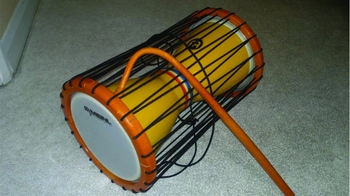
The conga has gone through several changes in form, shape and materials; ‘drum makers in the United States have had quite a hand in using new technologies to construct tumbadoras’.Footnote 34 It is on this basis that conga made it to TCH and many churches in Europe. Perhaps if I had taken the replica of the dùndún that was made using modern technologies to the church (see Fig. 2), Matt might have allowed me to play with the band. But my drum was not disguised by current technology; it may have been associated with an alien belief system – paganism – as a result of its ‘natural’ appearance. This misconception made me try the Cosmopolitan Church of Hampshire that had a large number of Africans and indeed Yorùbás in the congregation.
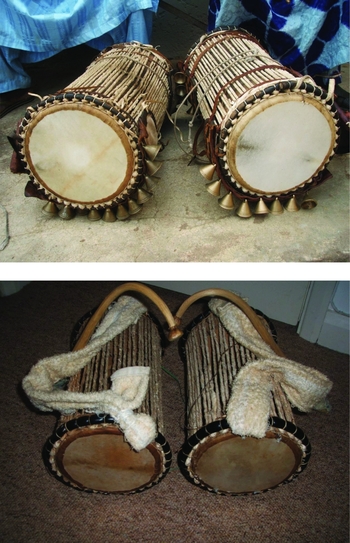
Two dùndún drums and two gángan drums with two drumming sticks.

A replica of the Yorùbá dùndún drum with a stick.

The Cosmopolitan Church of Hampshire (CCH)
The Cosmopolitan Church of Hampshire is located in Southampton, which is about seventy-five miles (121 kilometres) south-west of London. Southampton is culturally diverse; 88.74% of the people are white British; 1.06% white Irish and 2.57% other white; mixed white and black Caribbean constitute 0.46%; mixed white and black African 0.22; other mixed 0.33%; black or black British comprise Caribbean, 0.48%, and African 0.48%.Footnote 35 The CCH congregation reflected this diversity. In 2007, a well-known Yorùbá of my acquaintance introduced me to CCH.
One man in a navy blue suit ushered me into the auditorium. The atmosphere was lively, children running up and down and the band doing the sound test. They found me a seat opposite the platform. There were people from different cultural backgrounds. There were many Africans, mostly in their native dress. Despite the fact that 88.74% of the people living in Southampton are white British, Africans in CCH outnumbered their non-African counterparts. The senior pastor who founded the church welcomed everybody with this message: ‘Whatever your problem today, you will never go back the same’. The choir were predominantly Africans but there were no Africans among the instrumentalists. The choir played their special number before the message. I knew I could fit into their musical structure.
The Cosmopolitan Church of Hampshire was founded by a British family who were brought up in the tradition of the Church of England. However, the church was not influenced wholly by this. They played many Western instruments such as guitars, synthesizers, and two sets of drums – manual and electronic. They encouraged dancing; the choir acted out the lyrics of the songs through facial expressions and hand movements. They got the whole congregation on their feet and the service was electrifying.
I observed and studied the church every Sunday. I noticed that there was a strong sense of friendship among the congregation. There were different small groups, comprising people with similar interests. These groups were not formally set up like at the Church of Hampshire, and the friend who introduced me to the church confirmed this. They were based on mutual friendship. At the end of every service, people would look for their friends. While some left the church together, others would stay behind for a while and talk. I gathered that the church was not their only meeting place. Some of them were living in the same area or working or studying together or had been in the church together for a long time. One Sunday, whilst I was waiting for my friend to finish with the children in the Sunday school, I helped others put away the chairs. Though they were friendly, none of them invited me to join their group. While I found it difficult to find my place in the community groups at TCH because of the cultural/racial homogeneity and bureaucracy, social ties turned out to be just as much obstacles to integration in CCH.
Among internal factors examined in church growth studies, friendships play a crucial role. Daniel Olson, an American sociologist, observes that ‘friendships with fellow attendees significantly influence churchgoers’ decision to join a congregation’.Footnote 36 People are more likely to attend the church where their friends go.Footnote 37 Studies of unconventional religious movements also suggest that converts sometimes join churches in order to satisfy their social needs.Footnote 38
In CCH, I observed that the congregation formed cohesive communities within and outside the church and also organized non-religious programmes. They congregated before and after the service to discuss common interests. This level of friendship among the existing members of the church made it difficult for new members to assimilate easily into the church culture. Olson explains:
High-tenure members have as many church friends as they desire or have time for. Their church friendship needs are met almost exclusively by other high-tenure members. They become satisfied and lose interest in making friends with newcomers. Cliques develop, and newcomers leave because they feel unwanted. For newcomers, it may be hardest to make friends in ‘friendly’ congregations. Such high-tenure churches are effective in retaining current members but poor at assimilating newcomers.Footnote 39
Despite the fact that many groups in the church consisted of Nigerians or Yorùbás, I was not able to break into any of them. What tied them together were not just racial, cultural, ethnic, or national identities and values, but also social values, which are, in some cases, stronger than other values. As I did not live in Southampton, it was difficult for me to integrate myself into their social structures.
On one particular Sunday, the senior pastor asked us to watch a video of the activities of the church they founded in Gambia. The choir had one synthesizer and a number of African upright and pegged drums with animal fur on the covered skin. They sang songs in their native language; the drumming was accompanied with clapping. The senior pastor was dancing and sweating. After watching the video, the senior pastor made a reference to it and the forthcoming international day. I particularly noted his statement: ‘I like the way Africans worship God; they dance, they sing. So, you Africans here don't be Europeans, worship God as Africans.’ This statement made me assume that the senior pastor would welcome my idea.
After the service I told one Nigerian lady who was a member of the choir about my idea. She was excited; she replied in a mixture of Yorùbá and English; ‘Oh God! Sister ò d wá lónìí o, sé má a wá ní next week’? (Oh God! Sister did not come today, would you come to the service next week?) I said yes. Yemi, the choir leader and a Yorùbá lady, was the ‘Sister’. The lady asked me to talk to the second pastor, the son of the founder who ran the church. She stopped the pastor for me, but left once I started to talk to him.
The pastor handed me over to John, the band leader who played the drum set. John later asked me to bring the drum to the choir practice the following Sunday at eight o'clock. Yemi was not there, so I gave the drum to John. The pastor came in, looked at the drum, and gave it back to John. John then asked me to wait. I went back to John before the service started at nine o'clock, but he told me that there was no extra microphone for me to use, but I could see there were microphones. I went to the pastor but he asked me to wait for the second service at twelve o'clock. I went back home instead. I told Yemi the story, but she said she could not have helped. She said she was in charge of the people singing only because the majority of them were Africans, and John ran the affairs of the choir. This ended my dream of playing in CCH. Nonetheless, I continued to attend CCH, hoping that I would be able to play my drum. Moreover, I was interested to know why, despite the active roles of black people in the church and the fact that they were in the majority, a hegemonic ideology still operated around church music.
Cultural imperialism
Cultural imperialism is ‘the universalization of a dominant group's experience and culture, and its establishment as the norm’.Footnote 40 Cultural imperialism can take place within a family, political group, community, church or organization. It takes place when a country imposes, for example, its own ideologies, such as democracy, on another country. Under cultural imperialism, the world views of those who are not in the dominant group are invalidated.
African cultures are usually at the receiving end of imperial representation. The earlier writings about African cultures and the perceptions of the imperialists have ‘rendered the history and cultural traditions of Africans particularly vulnerable to vilification from cultural oppression’.Footnote 41 This legacy has contributed to the disproportionately small representation of African cultures in the hierarchy of many institutions, preventing the voices of the minority being heard in the corridors of power. Elmer Martin and Joanne Martin, historians and educators, use the term ‘cultural amnesia’, meaning that when a group of people are suppressed culturally, they collectively lose the content and character of the group's history and traditions.Footnote 42
In CCH, the continued exposure of Africans to the values of the dominant culture and their inability to have a voice in the affairs of the church can diminish their cultural memories over time. This may not necessarily mean that they will not have cultural references, but their cultural reference could be that of the dominant culture. This was the intention of the missionaries during the colonial time. This was, perhaps, Matt's intention when he advised me to play conga instead of my talking drum, to replace my Yorùbá particularity with colonial values. The Africans in CCH, as a result of cultural imperialism, could lose the potential for developing maximum individual and group self-confidence and self-pride, leading to low cultural, ethnic or racial esteem.Footnote 43
Notions of identity
Anthony Cohen, a cultural anthropologist, defines identity ‘as the way(s) in which a person is, or wishes to be, known by certain others’, and also as an ‘attempt to represent the person or group in terms of a reified and/or emblematized culture’.Footnote 44 Identity is how we want to present ourselves to other people. Identity can also be defined collectively on the basis of shared cultural values, including music; ‘music can be used increasingly as a means by which we formulate and express our individual identities’.Footnote 45 The dùndún, both the drum and the music, is a potent source in the construction of the musical–cultural identity of the Yorùbá.
However, both John and Matt had a fixed notion of identity. They used the Western system of identity construction, where a musical instrument is simply an adjunct and not a central feature of one's identity. Theirs was not an open system that allowed for the inclusion of new elements (in this case, instruments). The churches saw the main identity of the congregations as residing in the presence of people who embraced a particular form of Christian belief. As such, they could only embrace a variety of different ethnic identities by having people from different places seated in their worship.
For them, identity, at least superficially, had nothing to do with instruments. Indeed, people might be expected to play whatever instruments the church asked them to play. Matt offered me a compromise – the conga drums – which I could not accept. I might have adopted a Foucauldian strategy of resistance through persisting in being a member of the church band playing the conga as required. This would have demanded fluidity on my part in the area of identity construction. I asked myself if I could agree to play a conga drum as a prelude to being able to play the dùndún. I would gain acceptance and then have more chance to manoeuvre. It was a strategy that might or might not have been successful. However, my self-examination led me to the point of understanding how central playing the dùndún was to the construction of my identity. By offering me a compromise, Matt failed to see that it was not just any drum that was central to my identity but the dùndún drum. I was not just a drummer but a dùndún drummer. The dùndún was not simply an addition to my Christian or musical identity but a central part of my self-identification.
The two churches did not have any problem with me as a member of the congregation provided I could leave the drum behind outside the church. But for me, my identity was too greatly diminished by leaving the dùndún outside the church. During the colonial period in Nigeria, practitioners who wanted to take their practice to the missionary churches were asked to destroy an important part of their identity: ‘in the past, the tearing of the skin of the drum was a symbol of conversion to Christianity’.Footnote 46 Those who objected to this were denied the opportunity to worship in the church. Although I was not denied this opportunity, I could be turned into a passive churchgoer rather than a dùndún practitioner who has always played an active role in church music.
Hierarchical structure
The hierarchical structures of the two churches were mapped out along lines of race, gender, culture, spirituality and class. Although these were not enunciated, I observed them in the behaviour of some people in the two churches. Their structures perpetuated and maintained the power and influence of one cultural value over another. European colonizers in Africa placed the highest value on race; this still continues:
It is worth recalling that the modern missionary movement was inheritor not only of the notion of a territorial Christianity which saw Europe, and such extensions of its ways of life as existed, as the embodiment of the Christian religion; it was heir also to the idea of a ‘great chain of being’, which ranked ‘White’, ‘Red’, ‘Yellow’ and ‘Negro’ races in that descending order in a grand schema of humanity.Footnote 47
The colonial missionaries believed in the racial superiority of Europeans in the conviction that they had the most civilized culture. The black is stereotyped, making it a metaphor for evil and the epitome of badness. I belong to the group of people with the lowest rank, Negro – black. Hence Matt was not convinced of the validity of my Christian faith, which prompted him to ask me, ‘how long have you been a believer?’Footnote 48
I also observed, especially in CCH, that Africans, who were in the majority, held minority status within the church structure. There was only one African among the pastoral team. In the choir, the views of Africans, who were in the majority, were not valued. This can create a permanent race schism, as it did in the missionary churches in Nigeria, which eventually led to the departure of the African priests and the creation of indigenous churches:
the persistent ill-treatment of the Nigerian clergy in the Anglican Church Missionary Society (CMS), the exclusion of competent Nigerians from high ecclesiastical positions, and the contemptuous manner in which Nigerian customs were perceived by the European clergy gradually brought the educated converts into conflict with the missionaries.Footnote 49
The dùndún was also rated lower than the Western instruments in the two churches. They did not dispute the fact that a drum could be played in a Christian church, but there was no room for the dùndún in either church. Gender also rated lower in CCH. The structure of the church reminded me of the early churches, in which patriarchy was dominant. Yemi's role as a ‘choir master’ did not make her a ‘master’. By taking up the role, she subscribed to ‘a rigidly coded set of behaviour’.Footnote 50 Yemi could not object to any decisions even if they were against her interests: ‘when one is perceived as a token and is entitled to speak only in a clearly delimited space, one is paradoxically silenced in a particular way’.Footnote 51 Yemi had to conform to the patriarchal (or even repressive) realities of church hegemony.
Power was also an issue in the two churches. Bertrand Russell, a social critic, said, ‘power is the production of intended effects’.Footnote 52 Power precludes intention and it is ‘the capacity of some persons to produce intended and foreseen effects on others’.Footnote 53 Matt and John used their power as gatekeepers with intention, which produced effects on me. Michel Foucault, the French philosopher, argues that power is not something that people do or do not possess, but an effect of discourse. For Foucault, power resides in institutions and not in the individuals who make institutions function.Footnote 54 Matt and John drew upon the discourses that allow their action to be represented in an acceptable manner. Matt and John could choose not to use their power, but that could undermine the discourses they represented. The musical style of both churches also represented power and authority. Had the dùndún been integrated successfully, the power vested in Matt and John would have had to be shared with me. I can only speculate that the fear of losing their power was part of their concern.
Integration, however, can take place through mutually agreeable contact, which can lead to interdependencies that require no loss of power. The view of some scholars is that an organization can grow effectively if the superiors share power with their subordinates.Footnote 55 Perhaps, if John and Matt had shared power with me, the contribution of the dùndún could have made the church music stronger. This was my experience in Nigeria and Hungary. The dùndún and the other Western instruments might have continued to develop concurrently, acting in mutually reinforcing ways even though they might be culturally unrelated. The role of each instrument could have been mutually agreed through dialogue. The usual role of the dùndún as a principal instrument in most of the Nigerian bands could have been reduced, a step I was willing to take.
The underpinning element in my rich experience of church music in Nigeria was the fusion of European and Yorùbá musical cultures. This did not happen in either church due to ‘a dialogue of the deaf’Footnote 56 – a dialogue that yielded no positive result. This happened on my side when I refused to play the conga instead of my dùndún drum because of the fixed place of the dùndún in my identity construction. For Matt and John, this happened when they refused to embrace a new discourse about my culture, identity and the dùndún. The scale and scope of modern Eurocentricism, which includes racial domination, mean that colonialism is still a contemporary phenomenon. The structure of the two churches illuminates the way in which the practice of the earlier colonialism influences relationships between different races.
What are the strategies for meaningful cultural integration? First, for a cultural dialogue to take place, a cultural forum may be necessary, so that cultural understanding can take place. The danger in this approach is that the affairs of the forum may fall into the hands of the dominant culture, creating a power struggle among those who may want to turn themselves into guardians of tradition, and appropriate and define the content of cultures and civilizations for the rest of the society. Therefore, only through meaningful cultural dialogues can cultural integration take place. Second, it is important for all cultures to meet on the basis of equality and independence, ensuring the rights of sovereign cultures to exist without intimidation. Since moving to London, I have played my gángan drum in a church presided over by a white British priest. Having lived in Ghana for over twenty years, he had learnt to appreciate ‘authentic church music’.