Over the past decade, researchers have become increasingly interested in examining the emotional and cognitive factors that underlie or maintain risky behaviours (i.e., any behaviour that puts one at risk for a negative outcome, be it physical, emotional, social, or financial), with a particular focus on behaviours that place an individual at risk for negative health or safety outcomes (e.g., substance use and violence; Lejuez et al., Reference Lejuez, Aklin, Jones, Richards, Strong, Kahler and Read2003; Webster & Jackson, Reference Webster and Jackson1997). Literature suggests that engagement in risky behaviours, such as unprotected sex, substance use and risky driving behaviours, peaks during emerging adulthood (i.e., ages 18–25; Arnett, Reference Arnett1992; Bachman, Johnston, O'Malley, & Schulenberg, Reference Bachman, Johnston, O'Malley, Schulenberg, Graber, Brooks-Gunn and Petersen1996). Further, there is some evidence to suggest that these risks might be particularly pronounced among African American individuals, with past studies demonstrating greater rates of some risky behaviours among African American (vs. White and Latino/a) young adults (e.g., risky sexual behaviour and problematic alcohol use; Dariotis, Sifakis, Pleck, Astone, & Sonenstein, Reference Dariotis, Sifakis, Pleck, Astone and Sonenstein2011; Mulia, Ye, Greenfield, & Zemore, Reference Mulia, Ye, Greenfield and Zemore2009). Given the clinical relevance and public health significance of these behaviours, as well as their demonstrated relations to other negative clinical outcomes (e.g., physical injury, criminal behaviour, legal problems; Wechsler, Davenport, Dowdall, Moeykens, & Castillo, Reference Wechsler, Davenport, Dowdall, Moeykens and Castillo1994), investigation of the mechanisms underlying risky behaviours among African American emerging adults is needed. Two mechanisms worth investigating in this regard are emotion dysregulation and impulsivity, both of which have been found to be associated with risky behaviours within clinical and non-clinical populations (e.g., Cyders, Flory, Rainer, & Smith, Reference Cyders, Flory, Rainer and Smith2009; Donohew et al., Reference Donohew, Zimmerman, Cupp, Novak, Colon and Abell2000; Messman-Moore, Walsh, & DiLillo, Reference Messman-Moore, Walsh and DiLillo2010; Ryb, Dischinger, Kufera, & Read, Reference Ryb, Dischinger, Kufera and Read2006; Tull, Weiss, Adams, & Gratz, Reference Tull, Weiss, Adams and Gratz2012; Weiss, Tull, Viana, Anestis, & Gratz, Reference Weiss, Tull, Viana, Anestis and Gratz2012).
As defined here, emotion dysregulation is a multifaceted construct involving: (a) a lack of awareness, understanding, and acceptance of emotions; (b) difficulties controlling behaviours when experiencing emotional distress; (c) lack of access to adaptive strategies for modulating the duration and/or intensity of aversive emotional experiences; and (d) an unwillingness to experience emotional distress as part of pursuing meaningful activities in life (Gratz & Roemer, Reference Gratz and Roemer2004). Recent evidence highlights the role of emotion dysregulation in risky behaviours (Tull et al., Reference Tull, Weiss, Adams and Gratz2012; Weiss et al., Reference Weiss, Tull, Viana, Anestis and Gratz2012). Individuals may come to rely on risky behaviours that function to immediately reduce or distract attention away from aversive emotions (Heatherton & Baumeister, Reference Heatherton and Baumeister1991). However, risky behaviours are likely to exacerbate distress in the long term. For example, reliance on risky behaviours to reduce or escape emotional distress may reduce experiences in which the adaptive modulation of emotions is reinforced (Fischer, Smith, Spillane, & Cyders, Reference Fischer, Smith, Spillane, Cyders and Clark2005). Risky behaviours may also contribute to the experience of more negative emotions (e.g., guilt, shame) that further drive risky behaviours. Finally, because risky behaviours may exacerbate distress in the long term, individuals may perceive themselves as having less access to effective emotion regulation strategies. Consistent with this theoretical literature, empirical studies have found emotion dysregulation to be positively associated with deliberate self-harm (Gratz & Roemer, Reference Gratz and Roemer2008; Gratz & Tull, Reference Gratz and Tull2010a), binge eating (Whiteside et al., Reference Whiteside, Chen, Neighbors, Hunter, Lo and Larimer2007), risky sexual behaviour (Messman-Moore et al., Reference Messman-Moore, Walsh and DiLillo2010; Tull et al., Reference Tull, Weiss, Adams and Gratz2012), substance use (Bonn-Miller, Vujanovic, & Zvolensky, Reference Bonn-Miller, Vujanovic and Zvolensky2008), and aggressive behaviour (Gratz, Paulson, Jakupcak, & Tull, Reference Gratz, Paulson, Jakupcak and Tull2009).
An extensive body of literature has also identified impulsivity as one factor that places individuals at risk for engagement in risky behaviours (e.g., Eysenck & Eysenck, Reference Eysenck and Eysenck1977; Zuckerman, Reference Zuckerman1984). Although multiple definitions of impulsivity have been proposed in the literature (see Evenden, Reference Evenden1999; Perry & Carroll, Reference Perry and Carroll2008), recent literature suggests that impulsivity is best defined as a multifaceted construct consisting of five dimensions: (a) negative urgency (the tendency to act impulsively when experiencing negative affect); (b) positive urgency (the tendency to act impulsively when experiencing positive affect); (c) lack of premeditation (failure to reflect on the consequences of an act before engaging in that act); (d) lack of perseverance (an inability to focus or follow through on difficult or boring tasks); and (e) sensation seeking (the tendency to enjoy and pursue activities that are exciting and an openness to trying new experiences; Cyders et al., Reference Cyders, Smith, Spillane, Fischer, Annus and Peterson2007; Whiteside & Lynam, Reference Whiteside and Lynam2001). These dimensions of impulsivity have been found to be positively associated with a range of risky behaviours (e.g., risky sexual behaviour and substance abuse; Cyders et al., Reference Cyders, Smith, Spillane, Fischer, Annus and Peterson2007; Whiteside & Lynam, Reference Whiteside and Lynam2001, Reference Whiteside and Lynam2003; Whiteside, Lynam, Miller, & Reynolds, Reference Whiteside, Lynam, Miller and Reynolds2005). Notably, however, recent investigations have found that emotion-related dimensions of impulsivity (i.e., negative and positive urgency) are more strongly associated with risky behaviours than other dimensions of impulsivity (Cyders et al., Reference Cyders, Flory, Rainer and Smith2009; Cyders & Smith, Reference Cyders and Smith2008a; Cyders et al., Reference Cyders, Smith, Spillane, Fischer, Annus and Peterson2007; Zapolski, Cyders, & Smith, Reference Zapolski, Cyders and Smith2009). Together, these aforementioned findings suggest that risky behaviours may be more strongly related to maladaptive ways of responding to emotions or difficulties controlling behaviours in the context of emotional distress.
The goal of the present study was to extend extant literature on the role of emotion dysregulation and impulsivity in risky behaviours by using an innovative prospective experimental design. Notably, no studies to date have concurrently examined the effect of emotion dysregulation or impulsivity on risky behaviours, precluding determination of the causal role of these mechanisms in such behaviours. Thus, this study sought to examine the unique effects of emotion dysregulation and impulsivity on risky behaviours over time by randomly assigning participants to one of two brief empirically supported skills training modules (i.e., emotion modulation [EM] or impulsivity reduction [IR]). Use of these skills-training modules as experimental manipulations may elucidate the nature and direction of the relationships between emotion dysregulation, impulsivity, and risky behaviours (see Coffey, Stasiewicz, Hughes, and Brimo, Reference Coffey, Stasiewicz, Hughes and Brimo2006, for a similar methodological approach).
We predicted that participants assigned to the EM (vs. IR) condition would report greater reductions in emotion dysregulation (both overall and across specific dimensions of emotion dysregulation), as well as the impulsivity dimensions of negative and positive urgency (which overlap considerably with the conceptual definition of emotion dysregulation used here and have been found to be closely related to emotion dysregulation; Cyders & Smith, Reference Cyders and Smith2007, Reference Cyders and Smith2008b; Gratz & Roemer, Reference Gratz and Roemer2004; Weiss, Tull, Anestis, & Gratz, Reference Weiss, Tull, Anestis and Gratz2013). Given that the skills taught in the IR condition focus on reducing rash action (e.g., examining short- and long-term consequences of risky behaviours), we predicted that individuals assigned to the IR (vs. EM) condition would report significantly greater reductions in lack of premeditation. No a priori hypotheses were made regarding the effect of EM and IR conditions on the impulsivity dimensions of sensation seeking and lack of perseverance. Finally, we predicted that participants would report significantly fewer past-week risky behaviours 1 week after the experimental manipulation (compared to the week before the manipulation), and that changes in emotion dysregulation and impulsivity from pre- to post-manipulation would account for the observed reduction in risky behaviours over time.
Method
Participants
Participants were 23 African American women attending an urban historically Black university in the southern United States. Participants ranged in age from 18 to 27, with an average age of 20.74 (SD = 2.00). Approximately half the participants (52%) reported an annual household income under $40,000, and 61% were not employed. All participants were full-time students.
Experimental Manipulations
The EM and IR manipulations were adapted from an empirically supported, acceptance-based emotion regulation group therapy (ERGT) for self-harm among women with borderline personality pathology (Gratz & Gunderson, Reference Gratz and Gunderson2006; Gratz & Tull, Reference Gratz and Tull2011). ERGT is a 14-week group therapy designed to teach patients adaptive ways of responding to emotions, with an emphasis on the control of behaviours in the presence of emotions (vs. the control of emotions themselves). Specific skills focus on increasing the: (a) awareness, understanding, and acceptance of emotions; (b) ability to engage in goal-directed behaviours and control impulsive behaviours when experiencing negative emotions; (c) flexible use of situationally appropriate strategies to modulate the intensity and/or duration of emotional responses (vs. eliminating emotions entirely); and (d) willingness to experience negative emotions in pursuit of meaningful activities (Gratz & Gunderson, Reference Gratz and Gunderson2006; Gratz & Roemer, Reference Gratz and Roemer2004). ERGT has been shown to significantly reduce deliberate self-harm and other impulsive behaviours among women with borderline personality pathology (Gratz & Tull, Reference Gratz and Tull2011).
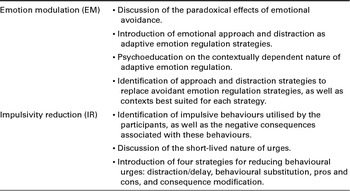
EM and IR manipulations covered material presented in single ERGT sessions and were adapted by author NHW (with assistance from MTT and KLG) for use in a sample without a known history of deliberate self-harm (i.e., the focus of the sessions was on strategies for modulating emotions and reducing impulsive behaviour more broadly vs. focusing on deliberate self-harm in particular). Single ERGT modules targeted distinct factors (see Gratz & Gunderson, Reference Gratz and Gunderson2006) and did not overlap (see Table 1). The EM condition was comprised of strategies to modulate the intensity and/or duration of emotional arousal in a flexible, situationally appropriate manner, including distraction (i.e., noticing intense and/or aversive emotions and then temporarily directing attention toward something other than the distressing emotion) and emotional approach (e.g., getting in touch with emotions, allowing oneself to experience emotions, and paying attention to the information being provided by emotions). The IR condition taught skills for decreasing rash action and impulsive behaviour, including distraction/delay (i.e., directing attention away from urges to engage in impulsive behaviour as a means of allowing the urge to pass), behavioural substitution (i.e., replacing impulsive behaviours with healthier behaviours that serve a similar function), pros and cons (i.e., attending to the long-term consequences of impulsive behaviour), and consequence modification (i.e., changing the contingencies of impulsive behaviour by rewarding attempts to resist urges for impulsive behaviour and eliminating rewards associated with engagement in impulsive behaviour). Notably, skills presented in the EM and IR conditions closely map on to our definitions of emotion regulation and impulsivity, respectively, such that EM skills targeted the flexible use strategies to modulate emotional responses in order to meet individual goals and situational demands, whereas IR skills aimed to increase awareness of the negative consequences and long-term effects of rash, unplanned actions.
Content of the 1-Hour Emotion Modulation and Impulsivity Reduction Manipulations

To reduce experimenter bias, detailed experimental manipulation scripts were developed for the EM and IR conditions. Authors NHW and LTD (clinical psychology graduate students with over 3 years of clinical training) delivered the EM and IR manipulations after being trained to adherence by MTT and KLG. All manipulations were provided to participants in an individual format. Weekly meetings throughout the study ensured experimenters did not deviate from the EM and IR manipulation protocols. Authors NHW and LTD completed an equal number of EM (5) and IR (5) sessions once study dropout was accounted for. Both EM and IR sessions lasted approximately 60 minutes (M EM = 58.09, SD EM = 6.58; M IR = 60.83, SD IR = 6.53), and were followed by 1 week of daily skills practice specific to the skills training module. Participants were given explicit instructions on using skills outside of the lab. A manipulation check was included to ensure validity of the experimental protocols (see results).
Measures
Self-report measures of emotion dysregulation, impulsivity, and past-week engagement in risky behaviours were administered before the experimental manipulation and 1 week post-manipulation.
The Difficulties in Emotion Regulation Scale (DERS; Gratz & Roemer, Reference Gratz and Roemer2004) is a 36-item self-report measure that assesses individuals’ typical levels of emotion dysregulation across six domains: non-acceptance of negative emotions, difficulties engaging in goal-directed behaviours when distressed, difficulties controlling impulsive behaviours when distressed, limited access to emotion regulation strategies perceived as effective, lack of emotional awareness, and lack of emotional clarity. The DERS has been found to demonstrate good test–retest reliability (ρI = .88, p < .01) and adequate construct and predictive validity (Gratz & Roemer, Reference Gratz and Roemer2004; Gratz & Tull, Reference Gratz, Tull and Baer2010b), and to be significantly associated with objective measures of emotion regulation, including behavioural (Gratz, Bornovalova, Delany-Brumsey, Nick, & Lejuez, Reference Gratz, Bornovalova, Delany-Brumsey, Nick and Lejuez2007; Gratz, Rosenthal, Tull, Lejuez, & Gunderson, Reference Gratz, Rosenthal, Tull, Lejuez and Gunderson2006; Tull, Gratz, Latzman, Kimbrel, & Lejuez, Reference Tull, Gratz, Latzman, Kimbrel and Lejuez2010) and physiological (Vasilev, Crowell, Beauchaine, Mead, & Gatzke-Kopp, Reference Vasilev, Crowell, Beauchaine, Mead and Gatzke-Kopp2009) measures. Items were recoded so that higher scores indicate greater emotion dysregulation, and a sum was calculated. Internal consistency in the current sample was good for the overall scale (αs ≥ .96) and for the subscales (αs =.82 to .95).
The UPPS-P Impulsive Behavior Scale (UPPS-P; Cyders et al., Reference Cyders, Smith, Spillane, Fischer, Annus and Peterson2007) is a 59-item self-report measure that assesses five distinct facets of impulsivity: lack of perseverance, negative urgency, positive urgency, lack of premeditation, and sensation seeking. Participants rate the extent to which each item applies to them on a 4-point Likert-type scale (1 = rarely/never true, 4 = almost always/always true). Scores are provided for each of the five dimensions of impulsivity. The five scales have been found to have good convergent validity and good discriminant validity from each other (Cyders et al., Reference Cyders, Smith, Spillane, Fischer, Annus and Peterson2007). Internal consistency coefficients in the current sample were adequate (αs = .69 to .92).
The Impulsive Behavior Scale (IBS; Rossotto, Yager, & Rorty, Reference Rossotto, Yager, Rorty, Vanderlinden and Vandereycken1998) is a 25-item, self-report questionnaire that assesses past-week engagement in a variety of risky behaviours, including consuming large quantities of alcohol, engaging in unprotected sexual intercourse, deliberate self-harm, driving while under the influences of drugs and/or alcohol, and impulsive spending. Participants report the frequency of each behaviour during the past week. Items are summed to create a measure of overall frequency of past-week risky behaviours. The IBS has been found to have adequate reliability and validity (Bender, Gordon, Bresin, & Joiner, Reference Bender, Gordon, Bresin and Joiner2010; Peñas-Lledó & Waller, Reference Peñas-Lledó and Waller2001).
Finally, all participants completed a demographics form assessing age, education, employment, and family income in the past year. These characteristics were examined as potential covariates.
Procedure
All study procedures were conducted in compliance with the university's Institutional Review Board. A study announcement was made in undergraduate psychology courses at Jackson State University. African American women interested in participating were asked to provide their contact information to a graduate research assistant. Of the 30 women who provided their information, 4 could not be reached and 3 withdrew interest. Thus, a total of 23 participants were randomly assigned to receive the EM or IR manipulation, and scheduled for the first of two sessions. Following provision of written informed consent at the beginning of Session 1, participants completed a series of questionnaires (see Measures) and then received an hour-long skills-training session. Participants were then scheduled to complete the follow-up assessment 6–8 days later (M days = 6.90, SD days = 0.45). Participants were also provided with explicit instructions for using the skills outside of the lab, which included daily monitoring of strategies employed (e.g., distraction, behaviour substitution), as well as antecedents (e.g., emotion) and consequences (e.g., effectiveness of the strategy) of skilful behaviour. The monitoring form was collected at post-assessment and scored (with scores ranging from 0–100% [i.e., 0–1] complete). No significant between-group differences in homework completion were detected, M EM = .55, SD EM = .45; M IR=.68, SD IR=.43; t = −.64, p = .53. Three participants withdrew from the study prior to completing Session 2 (resulting in a final sample of 20 participants; 10 per condition). Session 2 was conducted by graduate research assistants blind to condition. During this session, participants completed the same questionnaires presented in Session 1 (i.e., DERS, UPPS-P, and IBS). Participants were compensated $10 at the end of the session.
Results
Preliminary Analyses
Prior to conducting the primary analyses, t tests and chi-square analyses were conducted on demographic factors (i.e., age, income, and employment) and pre-manipulation scores on the primary dependent variables (i.e., DERS, UPPS-P, and IBS) to determine equivalence across conditions. Results indicate no significant between-group differences (ts < 1.71, χ2s < 7.50, ps > .10), with one exception: the EM condition reported significantly higher scores than the IR condition on negative urgency (t = 2.91, p < .05, Cohen's d = 2.91).
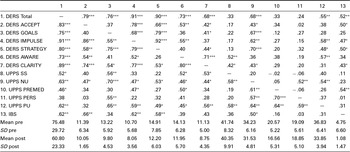
Participants reported an average of 4.75 (SD = 6.60) risky behaviours during the week prior to the pre-manipulation assessment. Descriptive data, as well as intercorrelations between the primary variables of interest, are presented in Table 2.
Intercorrelations and Descriptive Data for the DERS, UPPS, and IBS at Pre- and Post-Manipulation

Note: DERS = Difficulties in Emotion Regulation Scale; DERS ACCEPT = DERS Emotional Nonacceptance Subscale; DERS GOALS = DERS Difficulties Engaging in Goal-Directed Behavior When Distressed Subscale; DERS IMPULSE = DERS Difficulties Controlling Impulsive Behaviors When Distressed Subscale; DERS STRATEGY = DERS Lack of Effective Emotion Regulation Strategies Subscale; DERS AWARE = DERS Lack of Emotional Awareness Subscale; DERS CLARITY = DERS Lack of Emotional Clarity Subscale; UPPS-P = UPPS-P Impulsive Behavior Scale; UPPS SS = UPPS-P Sensation Seeking Subscale; UPPS NU = UPPS-P Negative Urgency Subscale; UPPS PREMED = UPPS-P (lack of) Premeditation Subscale; UPPS PERS = UPPS-P (lack of) Perseverance Subscale; UPPS PU = UPPS-P Positive Urgency Subscale; IBS = Impulsive Behavior Scale. Correlations at pre-assessment appear above the diagonal and correlations at post-assessment appear below the diagonal.
* p ≤ .05. **p ≤ .01. ***p ≤ 001.
Manipulation Check
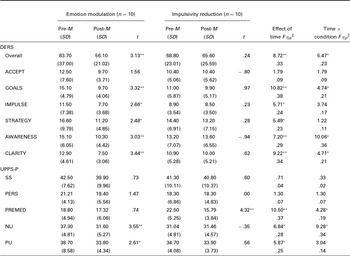
A series of two (condition: EM vs. IR) × 2 (time: pre- vs. post-manipulation) repeated measures analyses of variance (ANOVAs) were conducted to examine between-group differences in changes in emotion dysregulation and impulsivity over time (see Table 3). Results revealed a significant main effect of time on emotion dysregulation (both overall and across all specific dimensions other than emotional non-acceptance), as well as a significant time × condition interaction for overall emotion dysregulation and the specific dimensions of difficulties engaging in goal-directed behaviours when distressed, lack of emotional awareness, and lack of emotional clarity. Post-hoc paired sample t tests revealed that whereas participants in the EM condition reported significant decreases over time in overall emotion dysregulation and all specific dimensions other than emotional non-acceptance (see Table 3; Cohen's ds ranging from .78 to 1.09), participants in the IR condition evidenced no significant changes over time on any dimension of emotion dysregulation (and all effect sizes were small; Cohen's ds ranging from .07 to .30).
Means, Standard Deviations, Repeated Measures Analyses of Variance, and Post-Hoc Paired Sample t Tests Exploring Changes in Emotion Dysregulation and Impulsivity Dimensions Over Time

Note: DERS = Difficulties in Emotion Regulation Scale (Gratz & Roemer, Reference Gratz and Roemer2004); ACCEPT = Nonacceptance of negative emotions; GOALS = Difficulties engaging in goal-directed behaviours when distressed; IMPULSE = Difficulties controlling impulsive behaviours when distressed; STRATEGY = Limited access to emotion regulation strategies perceived as effective; AWARENESS = Lack of emotional awareness; CLARITY = Lack of emotional clarity; UPPS-P = UPPS-P Impulsive Behavior Scale; SS = Sensation seeking; PERS = Lack of perseverance; PREMED = Lack of premeditation; NU = Negative urgency; PU = Positive urgency.
* p ≤ .05. **p ≤ .01. ***p ≤ .001.
Results also revealed a significant main effect of time on negative urgency, positive urgency and (lack of) premeditation, as well as a significant time × condition interaction for (lack of) premeditation and negative urgency (see Table 3). Post-hoc paired samples t tests revealed that participants in the IR condition reported significant decreases over time in (lack of) premeditation (Table 3; Cohen's d = 1.36), whereas participants in the EM condition reported significant decreases in both negative urgency (Cohen's d = 1.12) and positive urgency (Cohen's d = .83). Of note, all non-significant effects in these analyses were accompanied by small to medium effect sizes (Cohen's ds ≤ .46).
Primary Analyses
A 2 (condition: EM vs. IR) × 2 (time: pre- vs. post-manipulation) repeated measures ANOVA was conducted to examine between-group differences in changes in risky behaviours over time. Results revealed a significant main effect of time, Wilkes λ =.72, F = 7.18, p = .02, np 2 = .29, such that participants reported a significant decrease in risky behaviours from pre- to post-manipulation, M(SD)Pre-manipulation = 5.11(6.90), M(SD)Post-Manipulation = 1.08(1.47), Cohen's d = .62. The time × condition interaction was not significant, Wilkes λ = 1.00, F = .002, p = .97, np 2 < .001.
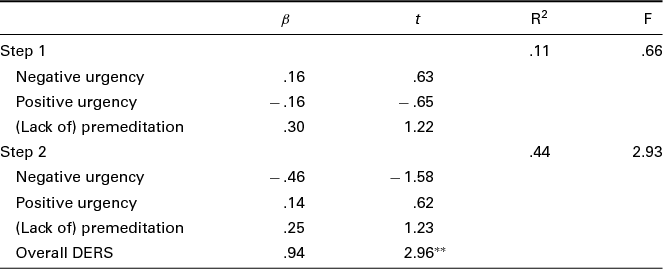
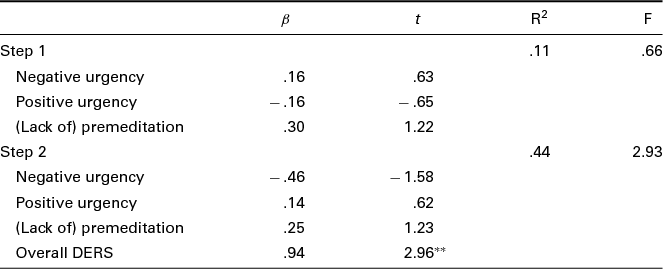
Finally, we examined whether changes in emotion dysregulation and/or impulsivity accounted for the reduction in risky behaviours over time. First, residualised gain scores (Tucker, Damarin, & Messick, Reference Tucker, Damarin and Messick1966) were calculated for pre- and post-manipulation scores on risky behaviours, overall emotion dysregulation, and the UPPS-P impulsivity dimensions of (lack of) premeditation, negative urgency, and positive urgency. Next, a hierarchal multiple regression analysis was conducted with the impulsivity residual scores entered in the first step of the model, the overall emotion dysregulation residual score entered in the second step of the model, and the risky behaviours residual score serving as the dependent variable. Changes in impulsivity accounted for 11% of the variance in change in risky behaviours over time, F = .66, p = .59; however, none of the impulsivity dimensions emerged as significant unique predictors in this step (see Table 4). The final model including change in overall emotion dysregulation accounted for 44% of the variance in change in risky behaviours, F = 2.93, p = .06. In this step, change in overall emotion dysregulation accounted for unique variance in the change in risky behaviours over time, above and beyond changes in (lack of) premeditation, negative urgency, and positive urgency (see Table 4).
Hierarchal Regression Analysis Examining the Unique Contributions of Changes in Overall Emotion Dysregulation, Negative Urgency, Positive Urgency, and (Lack of) Premeditation in Changes in Risky Behaviours Over Time
Note: **p ≤ .01.
Discussion
Findings of the present study extend the literature on the mechanisms underlying risky behaviours by examining the effects of experimental manipulations targeting a reduction in emotion dysregulation and impulsivity on risky behaviours. The results of this study provide preliminary experimental support for the role of emotion dysregulation in risky behaviours, revealing that improvements in emotion dysregulation from pre- to post-manipulation accounted for the significant reduction in risky behaviours observed over time. This finding suggests that maladaptive ways of responding to emotions, such as difficulties controlling behaviours when distressed and lack of access to adaptive strategies for modulating the duration and/or intensity of aversive emotional experiences, may lead to greater engagement in risky behaviours. For example, individuals who are unwilling or unable to approach or modulate emotional distress may engage in risky behaviours to obtain short-term relief from emotional states perceived as aversive. Likewise, individuals who experience difficulties controlling their behaviours in the context of emotional distress may be more likely to engage in risky behaviours when experiencing intense emotions.
Results of the present study also highlight the utility of these EM and IR skills training modules as experimental manipulations. Specifically, and consistent with expectations, 1 week post-manipulation, individuals in the EM condition reported significant decreases in overall emotion dysregulation (as well as all specific dimensions of emotion dysregulation other than emotional nonacceptance), as well as the related UPPS-P dimensions of negative and positive urgency. Conversely, individuals in the IR condition reported a significant decrease in (lack of) premeditation 1 week post-manipulation. Importantly, results suggest that EM and IR manipulations successfully targeted specific, non-overlapping constructs.
Although the results of the present study add to the growing body of literature on the mechanisms underlying risky behaviours, several limitations must be considered. First, this study represents the first step in identifying potential mechanisms that may underlie risky behaviours in African American women; consequently, this study involved a small, homogeneous, non-clinical sample of participants, limiting both our statistical power and the statistical conclusion validity and generalisability of our findings. As such, non-significant findings should be interpreted with caution. Furthermore, replication of these findings in larger, more diverse samples of African American women in community and clinical settings is needed. Likewise, whereas the focus on risky behaviours among African American women may be considered a strength of this study, future studies would benefit from examination of these mechanisms in populations with heightened rates of emotion dysregulation and impulsivity, such as substance dependent patients (e.g., Fox, Axelrod, Paliwal, Sleeper, & Sinha, Reference Fox, Axelrod, Paliwal, Sleeper and Sinha2007; Fox, Hong, & Sinha, Reference Fox, Hong and Sinha2008).
In addition, although a growing body of theoretical and empirical literature suggests that emotion dysregulation may underlie risky behaviours (Tull et al., Reference Tull, Weiss, Adams and Gratz2012; Weiss et al., Reference Weiss, Tull, Viana, Anestis and Gratz2012), it is also possible that this association is bidirectional, with regular involvement in risky behaviours leading to or exacerbating emotion dysregulation. Larger-scale prospective investigations may improve our understanding of the interrelations of risky behaviours and emotion dysregulation over time. Studies utilising experience sampling methods may provide further evidence of the emotion-regulating function of risky behaviours.
An additional limitation is the exclusive reliance on a self-report measure of emotion dysregulation, responses to which may be influenced by an individual's willingness and/or ability to report accurately on emotional responses. However, it is important to note that the measure of emotion dysregulation utilised in this study is strongly correlated with objective measures of emotion regulation (see Gratz et al., Reference Gratz, Rosenthal, Tull, Lejuez and Gunderson2006; Gratz & Tull, Reference Gratz, Tull and Baer2010b). Nonetheless, future studies would benefit from multimodal assessment of emotion dysregulation. Similarly, risky behaviours were assessed through a self-report questionnaire, which may be limited by participants’ willingness or ability to report on these behaviours. However, there is evidence that self-report measures may provide more accurate reports of risky behaviours (e.g., risky sexual behaviour) than other assessment methods (Fenton, Johnson, McManus, & Erens, Reference Fenton, Johnson, McManus and Erens2001; Johnson et al., Reference Johnson, Fisher, Montoya, Booth, Rhodes, Andersen and Williams2000). Nonetheless, future studies would benefit from the inclusion of other methods of assessing risky behaviours, such as timeline follow-back procedures (Weinhardt, Carey, & Carey, Reference Weinhardt, Carey and Carey2000).
Despite these limitations, results of the present study add to the literature on the role of emotion dysregulation and impulsivity in risky behaviours, providing preliminary experimental evidence for the effect of emotion dysregulation on risky behaviours. As such, the findings from this study highlight the potential utility of targeting emotion dysregulation in interventions aimed at reducing risky behaviours. Although treatments that include emotion regulation skills training have been found to reduce risky behaviours (e.g., ERGT and dialectical behavior therapy; Gratz & Tull, Reference Gratz and Tull2011, and Linehan, Reference Linehan1993, respectively), few studies have examined the effects of these treatments outside the context of borderline personality pathology. Future investigations are needed to examine the utility of these treatments in reducing risky behaviours within other populations.
Acknowledgments
The research described here was supported, in part, by a grant from the National Institutes of Health (T32 DA019426).