INTRODUCTION
Colonial tunicates frequently appear on lists of invasive species and they are known to colonize and establish themselves on a diverse range of natural and artificial substrata (Dijkstra et al., Reference Dijkstra, Harris and Westerman2007; Gittenberger, Reference Gittenberger2007; Lambert, Reference Lambert2007; Osman & Whitlatch, Reference Osman and Whitlatch2007). The extent of these colonies can be considerable. For example, Bullard et al. (Reference Bullard, Lambert, Carman, Byrnes, Whitlatch, Ruiz, Miller, Harris, Valentine, Collie, Pederson, McNaught, Cohen, Asch, Dijkstra and Heinonen2007) describe a 230 km2 area near Georges Bank, USA, where between 50% and 90% of the available substratum between 45 and 60 m depth was dominated by the colonial tunicate Didemnum sp. during 2004–2005.
Most colonial tunicates are unpalatable to predators (Vervoort et al., Reference Vervoort, Pawlic and Fenical1998; Pisut et al., Reference Pisut and Pawlik2002) and can reproduce and grow rapidly compared to other fouling species (Bullard et al., Reference Bullard, Whitlatch and Osman2004, Reference Bullard, Lambert, Carman, Byrnes, Whitlatch, Ruiz, Miller, Harris, Valentine, Collie, Pederson, McNaught, Cohen, Asch, Dijkstra and Heinonen2007) which gives them the potential to invade and substantially alter benthic ecosystem structure and function (Gittenberger, Reference Gittenberger2007).
This paper reports ecological observations of a recent, localized invasion of Diplosoma listerianum on the east coast of the UK. Diplosoma listerianum is currently well established on the south and west coasts of the UK but is rare on the east coast. There is no historical record of its presence in Sunderland Marina, which had been used as a field site for fouling assemblage ecology experiments since 2005 (H. Sugden, personal communication). There is also no record of D. listerianum growing within approximately 112 km of the present study site according to the National Biodiversity Network 2007, yet the species has since been identified at Hartlepool Marina, 40 km south of Sunderland (T. Vance, unpublished data).
The rapid growth rates and ecological interactions of D. listerianum in a new environment were documented and we investigated resident assemblage properties with the potential to influence the ascidian's lateral growth.
MATERIALS AND METHODS
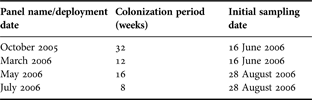
In 2006, as part of an ongoing recruitment monitoring programme, settlement panels were suspended in Sunderland Marina on the north-east coast of England (54°55′05.47″N 01°22′02.10″W). Panels were 15 × 15 cm PVC, roughened with coarse sand paper, and spaced 7 cm apart on ropes attached to floating pontoons. All panels were deployed vertically in a depth of 1 m. Twelve panels per date were exposed to natural fouling in October 2005, March, May and July 2006, respectively. Panels submerged in October were left to be colonized for 32 weeks, March panels for 12 weeks, May panels for 16 weeks and July panels for eight weeks (Table 1).
Panel name and deployment date, duration of colonization period and initial sampling date of settlement panels.

After the respective colonization time, all panels were briefly removed from the water and the side facing away from the pontoon was photographed, using a high resolution digital camera (Canon G3, 4 × 106 pixels), every two weeks from 16 June 2006 to 31 October 2006. The digital images were subsequently analysed (ImageJ, 2007) to obtain percentage cover data of all macrofouling species residing on the panels. The image of the sampling area was cropped to 13 × 13 cm prior to analysis to prevent the influence of edge effects.
Data obtained after panel colonization were analysed with linear regression to explore relationships between D. listerianum growth rates and fouling community diversity, richness, species identity and amounts of open space.
RESULTS
After their respective colonization periods, all panels supported early successional fouling communities typical of Sunderland Marina: (Balanus crenatus and Chthamalus montagui), tubeworms (Pomatoceros triqueter), a bryozoan (Umbonula littoralis), hydroids (Laomedea flexuosa and Obelia dichotoma), a tunicate (Ascidiella aspersa) and large areas of biofilm. At the start of the sampling phase (6 June 2006), Diplosoma listerianum was absent from all experimental panels. In addition, artificial substrates around the marina such as pontoons, ropes, old buoys, and the hulls of small boats were searched for the presence of D. listerianum, however it was not found.
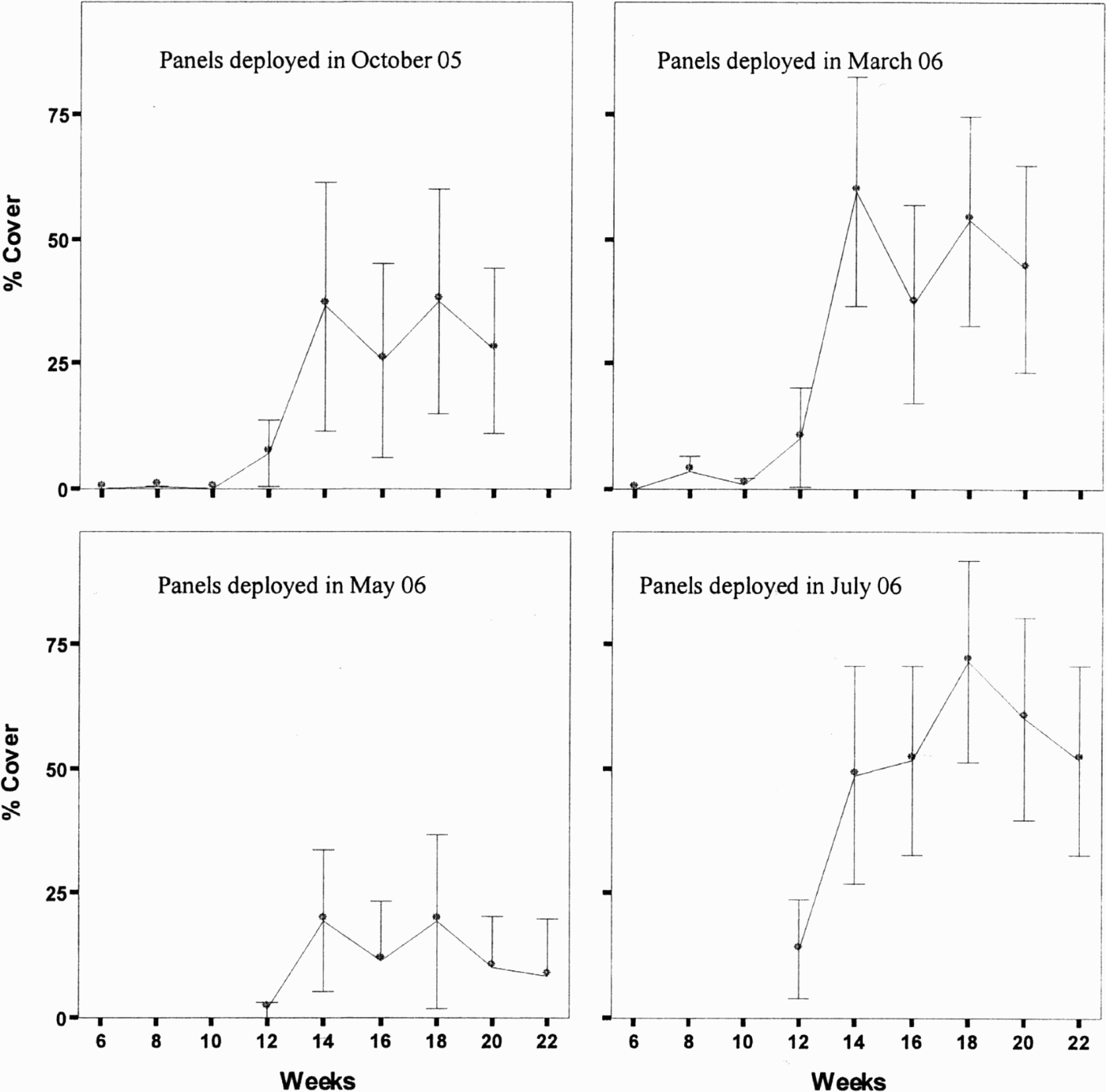
On the 27 July 2006, eight weeks after the initial sampling, the first occurrence of D. listerianum was recorded on October and March panels (Figure 1). The species displayed variation in colour and distinct boundaries became apparent where one colour type grew up to, but not over, another (Figure 2A).
Mean (±95% CI) percentage cover of Diplosoma listerianum on settlement panels, N = 12. The X axis is the number of weeks after initial sampling in May.

(A) Artificial settlement panel (13 × 13 cm) encrusted with an eight-month old fouling assemblage. Near total overgrowth of Diplosoma listerianum consisting of two colour morphs (1). Three isolated bryozoan (Umbonula littoralis) colonies remain uncovered (2); (B) D. listerianum overgrowing the solitary ascidian Ciona intestinalis (3) and bubbles formed from a thin layer of zooids (4).

When first discovered, the abundance of D. listerianum was low and patchy, and remained so until week 12 (Figure 1). Between weeks 12 and 14 (7–21 September 2006) D. listerianum grew rapidly on all panels where the species had initially recruited: mean percentage coverage increased five-fold from 6.8% to 36.5% on the October panels, and six-fold from 10.35% to 59.5% on the March panels, in two weeks (Figure 1).
Between weeks 12 and 18 (7 September 2006–17 October 2006) D. listeranium also appeared on the panels deployed in May and July. In general, the period of most rapid tunicate growth occurred between 12 and 18 weeks, and the fastest growth and highest abundances of D. listerianum was measured on panels deployed in July (Figure 1).
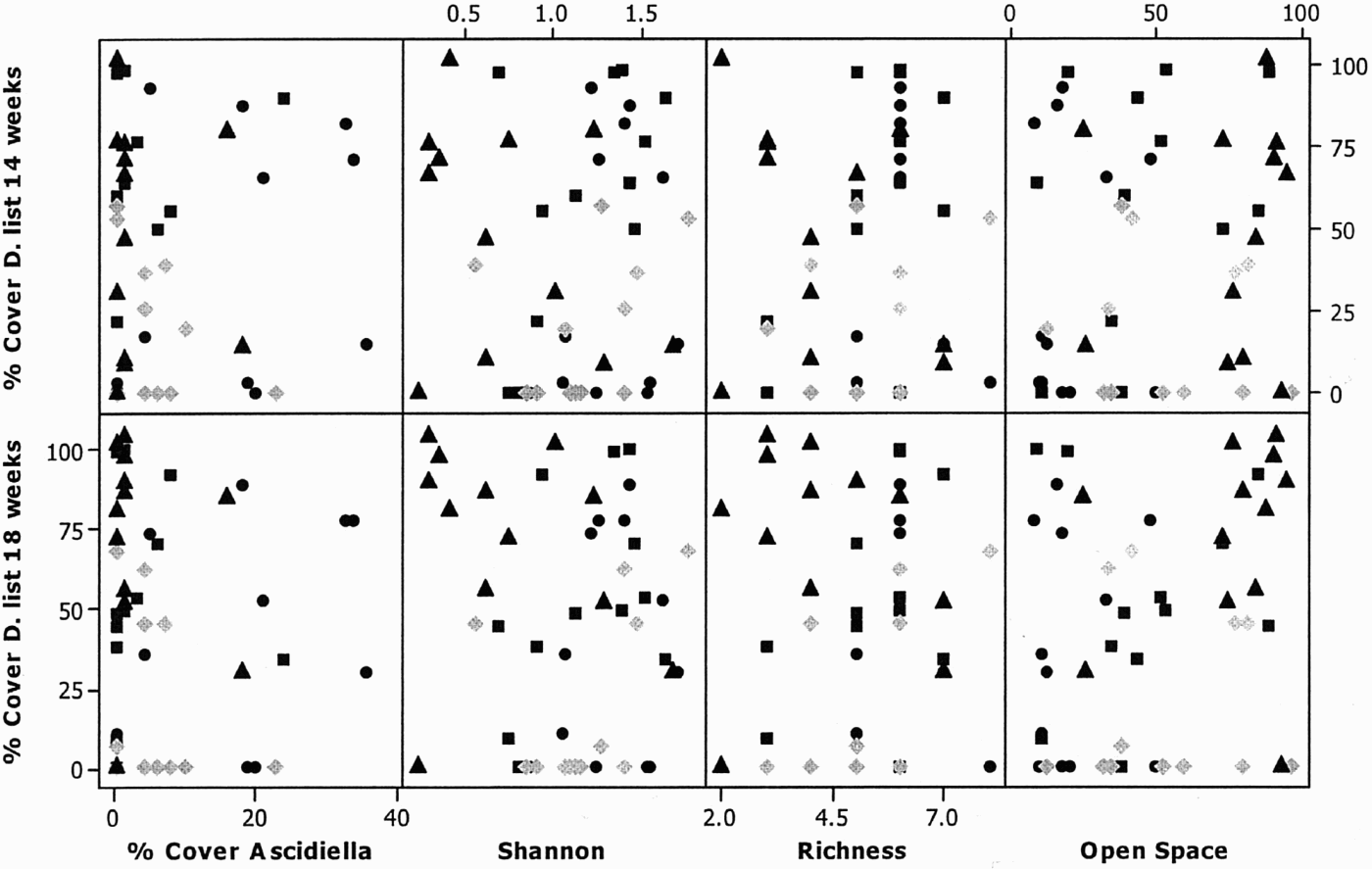
To identify whether resident assemblage properties were influencing D. listerianum growth rates, we collected data representing species richness, the Shannon index, abundances of Ascidiella aspersa and the amount of open space from all assemblages at week 12 (7 September 2006), just prior to the period of rapid D. listerianum growth. These data were regressed against abundances of D. listerianum after 14 and 18 weeks (21 September 2006–17 October 2006), but none of the predictors explained a significant amount of the variance in tunicate cover (Figure 3).
Scatter plot of percentage cover of Diplosoma listerianum at 14 and 18 weeks after initial sampling (21 September 2006 and 17 October 2006) plotted against open space, richness, Shannon and percentage cover of Ascidiella aspersa from week 12 (7 September 2006). No significant relationships found. •, October panels; ■, March panels; ⋄, May panels; ▴, July panels.

During the period of rapid growth, D. listerianum overgrew and eventually excluded many other macrofouling species from the panels. Two species were able to resist overgrowth by D. listerianum, the bryozoan Umbonula littoralis (Figure 2A) and the solitary tunicate Ascidiella aspersa (Figure 4). Both species grew and increased their mean percentage cover during weeks 12 to 18 (7 September 2006–17 October 2006) at a time when most other competitors decreased in abundances (Figure 4).
Mean percentage cover of all species on settlement panels, N = 12. The X axis is number of weeks after initial sampling in May.

During weeks 14 and 18 (21 September 2006–17 October 2006) when the fastest growth of D. listerianum was measured, bubble-like, gas-filled structures appeared in dense D. listerianum colonies (Figure 2B), which were 2–3 cm in diameter and were formed from a sheet of single layer zooids. The zooids were oriented upwards and the bubbles being positively buoyant, appeared to be pulling themselves free from the main colony. However, no completely detached bubbles were observed.
From week 18 until the end of the experiment (17 October 2006–31 October 2006) the percentage cover of D. listerianum decreased on all panels and the zooids appeared to lose pigmentation, adhesion, and become fragmented. Despite its decrease in abundance, D. listerianum remained the dominant species at the end of the study on panels deployed in October, March and July (Figure 4).
Sunderland Marina was revisited in February and March 2007, four and five months after the end of the sampling regime. Diplosoma listerianum was not found on any settlement panels or surrounding substratum.
DISCUSSION
Our results indicate that Diplosoma listerianum is capable of rapid growth that enables it to overgrow and out-compete other fouling species in short periods of time. It can therefore rapidly establish itself as a dominant denizen in previously unoccupied habitats. Here we discuss resident assemblage properties and their combined effect on the success of D. listerianum as an invader.
During this study, it became apparent that D. listerianum is capable of extending its local distribution in several ways. Previous descriptions of asexual reproductive strategies of the colonial tunicate Didemnum sp. reported large lobes or strands of zooids becoming detached from the main colony and falling onto the surrounding substrate (Bullard et al., Reference Bullard, Lambert, Carman, Byrnes, Whitlatch, Ruiz, Miller, Harris, Valentine, Collie, Pederson, McNaught, Cohen, Asch, Dijkstra and Heinonen2007). This behaviour was also observed in the current study.
The observation of bubble formation in the tunic as previously described, was made ~1 m underwater in the static, bubble-free waters of a marina. We therefore suggest that D. listerianum might form its own bubbles, perhaps by filling cavities with respiratory waste gases.
This behaviour appears to differ from the only other record of colonial tunicates being associated with bubbles, where Didemnum sp. was seen to attach to bubbles produced by aquarium water pumps at the water/atmosphere interface (R. Whitlatch, unpublished data).
This observation may be the first evidence that a colonial tunicate can accelerate zooid dispersal by the formation of vesicles that either burst and release zooids, or fully detach from the main colony and are subsequently driven by surface currents and local hydrodynamics to assist in the colonization of new habitats. However, future investigation is required to substantiate these suggestions.
After the initial recruitment and establishment of D. listerianum, most of the increase in cover was attributed to lateral growth rather than to further larval recruitment or settlement from water-borne zooids. Figure 5 shows an increase in cover produced by the lateral growth of existing colonies, rather than new colonies recruiting and growing in previously uncolonized space.
Time series pictures of the same settlement panel, originally deployed in March 2006. Pictures are 14 weeks (21 September 2006), 18 weeks (17 October 2006) and 20 weeks (26 October 2006) after first sampling session. Rapid lateral growth of Diplosoma listerianum in two colour morphs occurred between 14 and 18 weeks, with further changes in cover obvious at 20 weeks.

Once established, D. listerianum spread rapidly on settlement panels from all deployment dates, and was able to overgrow other fouling species indicating that it has competitive abilities which make it a potentially successful invader (Rocha & Kremer, Reference Rocha and Kremer2005; Altman & Whitlatch, Reference Altman and Whitlatch2007) (Figures 2A & 5).
The solitary ascidian Ascidiella aspersa was present on many panels prior to the D. listerianum invasion and displayed resistance to overgrowth and displacement by persisting in relatively high abundances through the period of rapid D. listerianum growth (Figures 2A & 4). However, our analysis indicates abundances of Ascidiella aspersa did not exert any measurable influence on the growth rate of D. listerianum (Figure 3).
Furthermore, intrinsic assemblage properties, such as richness, diversity and open space, which are widely associated with community stability or resistance to invasion, appeared not to influence D. listerianum growth rates in our study. Small scale larval dispersal ranges, local hydrodynamics and environmental variables such as temperature, which we did not measure in sufficient detail, may be important in controlling D. listerianum abundance at Sunderland Marina.
Diplosoma listerianum considerably modified the local structure and dynamics of fouling assemblages at the study site by becoming a dominant species within months. Future studies that also quantify the environmental parameters highlighted above may assist in understanding which factors control D. listerianum growth rates. This could result in invasion susceptibility ratings of non-invaded environments and facilitate the successful management of non-indigenous colonial ascidians.