Introduction
Grammatical gender is an inherent lexical feature of nouns that exists in many languages (Corbett, Reference Corbett1991) and is stored at a level different from conceptual and phonological representations (Levelt, Roelofs & Meyer, Reference Levelt, Roelofs and Meyer1999). Recent evidence suggests that this property is automatically activated in the process of lexical access (Alario, Ayora, Costa & Melinger, Reference Alario, Ayora, Costa and Melinger2008; Cubelli, Lotto, Paolieri, Girelli & Job, Reference Cubelli, Lotto, Paolieri, Girelli and Job2005; Paolieri, Lotto, Morales, Bajo, Cubelli & Job, Reference Paolieri, Lotto, Morales, Bajo, Cubelli and Job2010b; but see Schiller & Caramazza, Reference Schiller and Caramazza2003). For instance, in a picture–word task, Paolieri et al. (Reference Paolieri, Lotto, Morales, Bajo, Cubelli and Job2010b) asked Italian and Spanish monolingual speakers to produce the bare noun of a picture (e.g. in Spanish, perro (MAS) “dog”) while ignoring a distractor word that could be of the same grammatical gender (e.g. cuchillo (MAS) “knife”; gender congruent), or of different grammatical gender (e.g. alfombra (FEM) “carpet”; gender incongruent). Results showed that both Italian and Spanish monolinguals were slower in naming the pictures in the congruent condition relative to the incongruent condition. Thus, lexical access to the pictures’ names was affected by gender congruency, suggesting that grammatical gender is an intrinsic lexical property of nouns and that its selection is mandatory in the process of lexical access, even when the noun is produced outside a sentential context (we will go back to this issue in the discussion).
Grammatical gender also has important effects on bilingual lexical access. Most evidence from bilinguals suggests that the non-target language is activated in parallel with the target language during reading, speaking and listening (Dijkstra, Reference Dijkstra, Kroll and de Groot2005; Hoshino & Thierry, Reference Hoshino and Thierry2011; Kroll, Sumutka & Schwartz, Reference Kroll, Sumutka and Schwartz2005; Marian & Spivey, Reference Marian and Spivey2003). Specifically, there are a large number of studies demonstrating that grammatical gender interacts between languages in bilingual speech production (Bordag & Pechmann, Reference Bordag and Pechmann2007, Reference Bordag and Pechmann2008; Lemhöfer, Spalek & Schriefers, Reference Lemhöfer, Spalek and Schriefers2008; Morales, Paolieri & Bajo, Reference Morales, Paolieri and Bajo2011; Paolieri et al., Reference Paolieri, Cubelli, Macizo, Bajo, Lotto and Job2010a; Salamoura & Williams, Reference Salamoura and Williams2007). For instance, Bordag and Pechmann (Reference Bordag and Pechmann2007) explored processes underlying gender retrieval. In their experiments, the authors asked Czech–German bilinguals (two languages with a three-gender system) to name a series of pictures in the second language (L2), producing either a bare noun or a noun phrase including an adjective that had to agree with the noun in gender. Importantly, the corresponding nouns could be either of the same (e.g. Hund (MAS), pes (MAS) “dog”, in German and Czech, respectively) or different gender (e.g. Burg (FEM), hrad (MAS) “castle”) as their first language (L1) Czech translation equivalent. Results evidenced a gender congruency effect with faster responses in the congruent condition. Similarly, the same between-language gender interaction has been found in Italian–Spanish speakers, whose two languages are both Romance and have two gender values: masculine and feminine (Paolieri et al., Reference Paolieri, Cubelli, Macizo, Bajo, Lotto and Job2010a). The authors asked participants to name pictures using either the bare noun or the article+noun combination in the L2. Their results also revealed a significant gender effect with faster naming latencies in the congruent condition regardless of the type of response. These findings suggest that bilingual speakers are not exempt from the influence of gender in their native language when performing a task in their L2 and that this effect is not limited to gender-marked utterances.
It is important to note that gender congruency leads to facilitation in the context of bilingual translation or picture naming, but to interference in the context of monolingual picture–word interference. In the case of bilinguals, gender effects can be explained by assuming that lexical entries in the L1 are automatically activated by pictures, which in turn spread their activation to the corresponding L2 lexical representations. Gender compatibility between the two entries would cause facilitation when selecting the appropriate noun and, consequently, naming or translation latencies would speed up relative to conditions where the two translation equivalents do not share gender. On the other hand, gender congruency produces interference effects in monolingual picture–word tasks (Paolieri et al., Reference Paolieri, Lotto, Morales, Bajo, Cubelli and Job2010b). In the picture–word procedure participants are asked to name the picture and to ignore the superimposed distractor word. When target and distractor pairs share the same grammatical gender, longer naming latencies are obtained, either because the competition between the picture name and the distractor word is greater relative to the gender incongruent conditions (Levelt et al., Reference Levelt, Roelofs and Meyer1999) or because the active inhibition of the distractor word requires additional time (Mahon, Costa, Peterson, Vargas & Caramazza, Reference Mahon, Costa, Peterson, Vargas and Caramazza2007).
Contrary to languages with a grammatical gender system, English is a language that lacks gender-based noun classes. In our study, we explored whether bilingual speakers transfer grammatical gender properties from a language based on a gendered system – Spanish – to another not based on such a system – English. Although there is some evidence suggesting that gender features of the L1 can be transferred to languages without this type of representation during recognition and comprehension tasks, there is no data regarding gender interactions during language production. In an event related potential (ERP) study, Midgley, Wicha, Holcomb and Grainger (Reference Midgley, Wicha, Holcomb and Grainger2007) explored the influence of the native grammatical gender during sentence comprehension in bilinguals. French learners of English were presented with sentences in their L2 and were asked to read for comprehension. Crucially, nouns were preceded by possessive determiners that either agreed (e.g. his shoe, both “his” and “shoe” being masculine in French) or disagreed (e.g. her shoe) with the translation equivalents in French in gender. Results revealed a positivity between 400 and 700 ms post-noun onset in gender violation trials, similar to the P600 component sensitive to gender violation in monolinguals (Foucart & Frenck-Mestre, Reference Foucart and Frenck-Mestre2011). A recent study by Boutonnet, Athanasopoulos and Thierry (Reference Boutonnet, Athanasopoulos and Thierry2012) has shown similar results in a semantic categorization task. Thus, the grammatical gender of the L1, Spanish, affected categorization of a series of objects performed in English-L2. Results for ERPs showed a LAN modulation effect (Left Anterior Negativity; an ERP marker considered to reflect detection of grammatical violations: Friederici & Jacobsen, Reference Friederici and Jacobsen1999) when the objects to be categorized did not match each other in gender. The presence of this ERP effect suggests that the grammatical gender of nouns in the native language influences comprehension even in a context that requires no access to such information (see also, Ganushchak, Verdonschot & Schiller, Reference Ganushchak, Verdonschot and Schiller2011; Sabourin, Stowe & de Haan, Reference Sabourin, Stowe and de Haan2006).
Altogether, this evidence suggests that L2 comprehension partly depends on the structure of the L1, since some properties of the native language seem to affect language processing in the L2. Our aim was to explore whether L1 grammatical gender also affects L2 processing during production. In addition, we wanted to investigate if cross-language gender influences are modulated by language immersion. Linck, Kroll and Sunderman (Reference Linck, Kroll and Sunderman2009) provided evidence that immersion improves L2 learning by attenuating the negative influence of the L1. In their study, English–speaking learners of Spanish, who were immersed in an L2 context during the time of the study, had to complete both a production and comprehension task. The results revealed that this immersed group outperformed classroom learners of Spanish not immersed in a Spanish context. But, more importantly, their results also showed that immersed learners inhibited their L1 while living in the L2 context, supporting the notion that bilinguals must launch inhibitory processes to suppress one of the languages when using the other (Abutalebi & Green, Reference Abutalebi and Green2008; Levy, McVeigh, Marful & Anderson, Reference Levy, McVeigh, Marful and Anderson2007; Macizo, Bajo & Martín, Reference Macizo, Bajo and Martín2010; Meuter & Allport, Reference Meuter and Allport1999). Therefore, it is possible that bilingual speakers immersed in a second language context for a long period of time are relatively less affected by their native grammatical gender than non-immersed bilinguals.
In sum, we hypothesized that, similar to phonological features (see Hoshino & Thierry, Reference Hoshino and Thierry2011), grammatical gender might also show transfer effects during bilingual production. Thus, we predict that Spanish–English bilinguals might be affected by the gender properties of the Spanish language (L1) when using the English language (L2), even though this property is absent in English. In our study, Spanish–English speakers performed a picture-naming task during which they were asked to name pictures in English while ignoring Spanish distractor words printed on them. Although in this experimental context participants are not in a purely monolingual mode (Costa, Heij & Navarrete, Reference Costa, Heij and Navarrete2006), we consider that it is relevant to explore whether the gender representations of the non-response language are activated in the course of producing the target language, as has been established for semantic and phonological features (e.g. Costa & Caramazza, Reference Costa and Caramazza1999; Hermans, Bongaerts, de Bot & Schreuder, Reference Hermans, Bongaerts, de Bot and Schreuder1998). Therefore, if English lexical entries automatically activate their corresponding L1 entries with their grammatical representations, we should observe slower naming latencies when target noun and distractor word are similar in gender across translations (e.g. bear (MAS) and clown (MAS)) compared to the dissimilar condition (e.g. bear (MAS) and suitcase (FEM)). Additionally, participants were immersed in either a L1 (Granada, Spain) or L2 (State College, Pennsylvania, USA) language context. Given that previous research has shown that immersion experience constrains lexical access to the L1 because it is inhibited during immersion (Linck et al., Reference Linck, Kroll and Sunderman2009), we predicted that gender effects would only be observed in the group of non-immersed bilinguals.
Method
Participants
Two groups of 24 participants volunteered to take part in this study. The first group was composed of Spanish–English bilinguals who were tested at the University of Granada, where Spanish is the dominant language and therefore they were immersed in a purely L1 context (non-immersed bilinguals). The second group was also composed of Spanish–English bilinguals, but they were immersed in an L2 context (immersed bilinguals) since the experiment was carried out at Penn State University. We selected participants who were immersed in the L2 country for a period of at least two years. The English proficiency of the bilingual participants was assessed through the Language Experience and Proficiency Questionnaire (Marian, Blumenfeld & Kaushanskaya, Reference Marian, Blumenfeld and Kaushanskaya2007). Previous studies have shown reliable relationships between self-reported and behavioral measures (see, for instance, Colzato et al., Reference Colzato, Bajo, Wildenberg, Paolieri, Nieuwenhuis, Heij and Hommel2008; Costa, Kovacic, Franck & Caramazza, Reference Costa, Kovacic, Franck and Caramazza2003, for studies that also use self-reported measures of language proficiency), suggesting that this questionnaire is an efficient tool for assessing bilingual language status in research settings.
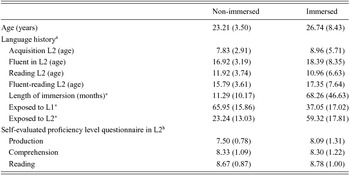
As can be seen in Table 1, the two groups of bilinguals did not differ (all ps > .05) in any measure related to proficiency or language use except for language immersion.
Language history and self-evaluated proficiency scores of the Spanish–English bilinguals for both non-immersed and immersed groups (means are shown with corresponding standard deviations in parentheses).

* = significant statistical differences (p < .05) between the two groups
a Acquisition L2 = age at which L2 acquisition began; fluent in L2 = age at which fluency in L2 was achieved; reading L2 = age when reading in L2 began; fluent-reading L2 = age when reading in L2 became fluent; length of immersion = number of months living in a country where L2 is the official spoken language; exposed to L1/L2 = percentage of daily time on average exposed to each language
b The scores are on a 10-point scale: 10 = native-speaker level: 1 = complete lack of knowledge of the language.
Design and materials
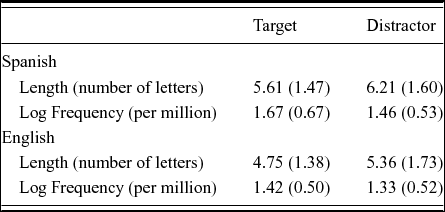
Participants performed a picture–word naming task in which they were asked to name the pictures in English-L2 while ignoring a superimposed distractor word written in Spanish-L1. Twenty-eight pictures were selected from the picture databases by Snodgrass and Vanderwart (Reference Snodgrass and Vanderwart1980) and Lotto, Dell’Acqua and Job (Reference Lotto, Dell’Acqua and Job2001), half with masculine names and half with feminine names in Spanish (see Appendix). Each picture was paired with a distractor noun of the same grammatical gender (Congruent condition; e.g. CEPILLO (MAS) “brush”, gusano (MAS) “worm”) and a distractor noun of different grammatical gender (Incongruent condition; e.g. CEPILLO (MAS), naranja (FEM) “orange”). Both conditions were created by reassigning the distractors from the congruent condition to different targets in the incongruent condition. This resulted in 28 picture–word pairs per condition that were semantically and phonologically unrelated. Target as well as distractor nouns had transparent gender suffixes (i.e. ending in the vowels -a for feminine gender and -o for masculine gender). The names of the target and distractor pairs were matched for length, frequency (Alameda & Cuetos, Reference Alameda and Cuetos1995; Brysbaert & New, Reference Brysbaert and New2009), and phonological/orthographic overlap (all ps > .05) in Spanish and English (cognate words were excluded; see Table 2).
Means and standard deviations (in parentheses) for the variables concerning the pictures’ nouns and distractors’ words by language.

Four experimental lists were created and counterbalanced across participants. The order of the pairs within the lists were pseudorandomized so that: (i) no more than three congruent or incongruent pairs appeared consecutively; (ii) the lag between repetitions of a particular picture or distractor word was at least three trials; and (iii) there was no semantic or phonological relationship between pictures or distractor words in consecutive trials. Two additional filler pairs were included as warm-up trials at the beginning of each list.
Procedure
Participants were tested individually in a quiet room and were asked to name the pictures in English-L2 as quickly and accurately as possible while ignoring the L1 distractor word. The stimuli were presented using E-Prime experimental software, version 1.1 (Schneider, Eschman & Zuccolotto, Reference Schneider, Eschman and Zuccolotto2002). Pictures were centered at fixation (included in a virtual square of about 6 × 6 cm) with the distractor words simultaneously presented (0 ms SOA) at the center of the pictures. A trial consisted of the following events: A fixation point presented at the center of the screen for 500 ms; the presentation of the picture–word pair until the participants’ response or for a maximum of 4000 ms; and a blank interval for 1000 ms before the next trial. Response latencies were measured from the onset of the stimulus until the beginning of the response. Previous to the experimental session, a practice block of sixteen trials was administered. Finally, the LEAP-Q (Marian et al., Reference Marian, Blumenfeld and Kaushanskaya2007) was administered to evaluating L2 proficiency.
Results
Naming latencies exceeding two standard deviations above or below the participant's mean, naming errors, missed trials, and verbal dysfluencies were excluded (overall, 16% of the trials for the non-immersed group of bilinguals and 14% for the immersed group). In addition, one participant from the immersed group was excluded from the final analysis because his overall response times exceeded two standard deviations from the group mean and because his responses to the language history questionnaire revealed that daily he used L1-Spanish up to 90% of the time, despite being immersed in an L2 context. Because of the low error rates for naming (less than 4% of the trials per condition and group), an analysis based on naming errors was not performed. Nevertheless, the item tapadera (FEM) “lid” was removed from the global analysis because of its high percentage of null and wrong responses (85% of the trials). To maintain the same number of items across gender (i.e. masculine and feminine) in the final analysis, the masculine item with the highest rate of errors was also removed (zorro (MAS) “fox”, 25% of the trials).
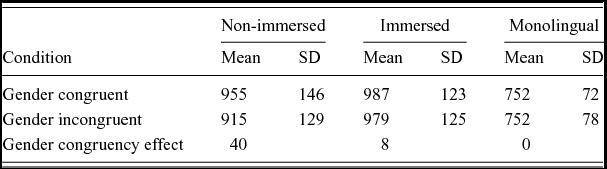
Separate analyses were carried out for participants and items, yielding F1 and F2 statistics. We performed ANOVAs with the variable Group (immersed bilinguals and non-immersed bilinguals) as between-subjects factor, and Condition (congruent and incongruent) as within-subject factor.Footnote 1 The mean response times are reported in Table 3. The main effect of condition (F1 (1,45) = 9.870, MSE = 1432.64, p = .003, η p 2 = .180; F2 (1,50) = 1.883, MSE = 9461.42, p = .17, η p 2 = .036) and the interaction of condition and group were significant by participants (F1 (1,45) = 4.165, MSE = 1432.64, p = .047, η p 2 = .085; F2 (1,50) = 2.003, MSE = 9461.42, p = .163, η p 2 = .039). The effect of Group was not significant (F1 (1,45) = 1.645, MSE = 33167.06, p = .206, η p 2 = .035; F2 (1,50) = 2.646, MSE = 13538.89, p = .11, η p 2 = .05). As expected, a closer look at the interaction showed a significant gender effect in the group of non-immersed bilinguals (F1 (1,23) = 12.145, MSE = 1618.52, p = .002, η p 2 = .346; F2 (1,25) = 4.179, MSE = 8797.88, p = .05, η p 2 = .143), while no gender effects were observed for the group of immersed bilinguals (F1 (1,22) = .687, MSE = 1238.30, p = .416, η p 2 = .03; F2 (1,25) = .001, MSE = 10124.96, p = .977, η p 2 = .0001).
Mean response latencies (in milliseconds) and standard deviations in the different experimental conditions through the test groups: non-immersed Spanish–English bilinguals, immersed Spanish–English bilinguals and English monolingual speakers.

Finally, to make sure that the data patterns obtained in the two groups were not due to specific characteristics of the items in the experimental conditions, we decided to run the same experiment with a group of 24 monolingual English–speaking participants from Penn State University (mean age of 23 years, SD = 5.23; none of them reported having a knowledge of, or being proficient at, any other language besides English). Because grammatical gender is not present in English, their naming latencies should not be influenced by this property, and we expected to find no differences between Congruent and Incongruent stimuli conditions. Indeed, the results showed similar response times between the two conditions (752 ms (SD = 72) and 752 ms (SD = 78); F1 (1,23) = .008, MSE = 513.55, p = .93, η p 2 = .000; F2 (1,25) = .009, MSE = 2428.74, p = .92, η p 2 = .000), indicating that the results found across immersed and non-immersed speakers cannot be attributed to specific features of the materials.
Discussion
In this study we aimed to investigate whether grammatical gender in the native language influences language production in bilinguals when speaking in a language lacking this property. Spanish–English bilinguals named pictures in English-L2 while ignoring L1 distractor words that had the same or different gender as the target L1 translation. In addition, we varied language immersion by including a group of bilingual speakers who were immersed in an L1 context at the time of the experiment (Spain), and another group that were immersed in a country where L2 was the dominant language of use (USA). The results showed that the non-immersed speakers were influenced by gender information from their native language even when they were asked to name the pictures in English, a language in which nouns have no grammatical gender. The same pattern of results was not observed in the group of immersed bilinguals, suggesting that access to the L1 is attenuated during language immersion. Similarly, no congruency effects were observed in monolinguals, indicating that the materials themselves did not account for the results in the bilingual groups. Although transfer of grammatical gender properties has been reported for recognition and comprehension processes in bilinguals (Boutonnet et al., Reference Boutonnet, Athanasopoulos and Thierry2012; Ganushchak et al., Reference Ganushchak, Verdonschot and Schiller2011; Midgley et al., Reference Midgley, Wicha, Holcomb and Grainger2007; Sabourin et al., Reference Sabourin, Stowe and de Haan2006), there are no previous studies showing transfer of grammatical gender to non-gendered languages during production. In this respect, this study supports the notion that (i) the two lexical systems are simultaneously activated and interacting during production in the bilinguals’ minds (Dijkstra, Reference Dijkstra, Kroll and de Groot2005; Kroll et al., Reference Kroll, Sumutka and Schwartz2005) and (ii) grammatical gender properties of the native language can affect L2 production even when these properties are absent in the language of production.
The transfer of the gender congruency effect in Spanish (e.g. Paolieri et al., Reference Paolieri, Lotto, Morales, Bajo, Cubelli and Job2010b) to English can be explained by assuming that the lexical entry corresponding to the target noun in the L1 is active along with its corresponding translation during the production of the noun in the L2, thus interfering with the distractor word. Because grammatical gender is not present in English, only the gender information of the L1 can account for the difference found in the naming latencies between the Congruent and Incongruent conditions. Therefore, when target and distractor share gender, the interference delays the selection of the target noun and naming latencies are prolonged.
Evidence regarding cross-language transfer effects is not new in the study of bilingualism. Hoshino and Thierry (Reference Hoshino and Thierry2011) demonstrated that the transfer of native phonology information is present during word production in the L2. The authors asked Spanish–English bilinguals to name pictures in the L2 while ignoring distractor words also presented in the L2. Results revealed that naming responses were slower when the distractor was either semantically or phonologically related, suggesting that lexical alternatives of both languages compete for selection in the process of L2 speech planning. We propose that a similar transfer of grammatical gender properties from L1 to L2 occurred in our study.
The presence of cross-language influences at this level also provides evidence regarding the proposal that grammatical gender is a property of nouns that is automatically accessed and subject to competitive processes during lexical access and production of bare nouns (Cubelli et al., Reference Cubelli, Lotto, Paolieri, Girelli and Job2005; Paolieri et al., Reference Paolieri, Lotto, Morales, Bajo, Cubelli and Job2010b). However, this effect is difficult to explain, with some theories of speech production (Caramazza, Reference Caramazza1997; Levelt et al., Reference Levelt, Roelofs and Meyer1999) proposing that gender is selected only in the production of gender-marked utterances. This last proposal is based on the fact that gender effects are not observed in bare noun production in Germanic languages (La Heij, Mak, Sander & Willeboordse, Reference La Heij, Mak, Sander and Willeboordse1998; Starreveld & La Heij, Reference Starreveld and La Heij2004). However, our results and those of others (Cubelli et al., Reference Cubelli, Lotto, Paolieri, Girelli and Job2005; Paolieri et al., Reference Paolieri, Lotto, Morales, Bajo, Cubelli and Job2010b) clearly show gender effects in bare-noun tasks in Spanish and Italian, suggesting that gender congruency effects may depend on the specific, formal, morphosyntactic properties of individual languages.Footnote 2
In addition, the current experiment adds to the evidence showing that language immersion modulates lexical access of the L1 (Linck et al., Reference Linck, Kroll and Sunderman2009; but see Hoshino & Thierry, Reference Hoshino and Thierry2011). For example, Linck et al. (Reference Linck, Kroll and Sunderman2009) compared the performance of two groups of Spanish learners that differed in their immersion context (immersed in a Spanish speaking environment versus classroom learning) in a translation recognition task including incorrect translations (distractors) that were similar to the corresponding Spanish words in meaning or phonology. Immersed learners were less susceptible to interference from lexical-neighbor distractors than were non-immersed students, although they showed more interference to semantic-neighbor distractors. In addition, they produced fewer L1 and more L2 exemplars than the non-immersed students in a verbal fluency task. Overall, the authors interpreted these findings as suggesting that immersed learners have an advantage in L2 learning as a result of the reduced influence of their native language, which is inhibited during immersion. The results of our experiment also support this idea because the group of L2 immersed bilinguals was not influenced by their L1 gender knowledge while performing the picture-naming task: they outperformed the non-immersed group because their access to the L1 was reduced due to the L2 immersion. Moreover, the pattern of results reported by Linck et al. (Reference Linck, Kroll and Sunderman2009) also has implications for the level on which interference occurs. As we have pointed out, in their study, lexical (phonological/orthographic) interference was attenuated for the immersed participants, whereas semantic interference was increased. Taken together with our findings, these results seem to indicate that cross-language competition permeates across levels, including specific properties of nouns such as grammatical gender. But, more interestingly, the insensitivity to lexical-form overlap shown by the immersed speakers from Linck et al.'s study, together with the insensitivity to grammatical gender shown by our immersed participants, may be related to an attenuated L1 activation during L2 immersion. This would imply that it is not only that grammatical gender becomes less relevant in an L2-English context (by becoming less active when immersed in a second-language context), but also that the more general L1 lexical system is attenuated while immersed.
However, other theoretical explanations are also compatible with our results. In this sense, according to the weaker-link hypothesis (Gollan, Montoya, Fennema-Notestine & Morris, Reference Gollan, Montoya, Fennema-Notestine and Morris2005), being in an L2 environment may reduce the frequency of use of the native language, so that L1 becomes less accessible – but not completely inhibited – during L2 immersion. In favor of this view, a recent study by Baus, Costa and Carreiras (Reference Baus, Costa and Carreiras2013) showed that German speakers were slower in naming pictures in their native language after 6 months of immersion in Spain. Importantly, this result was only observed for lower-frequency non-cognate nouns, suggesting that the decline in accessibility of the L1 is a result of the reduced use of the native language during an L2 immersion period. Indeed, data regarding our participants’ language history (see Table 1) indicate that on average, immersed speakers were exposed to the L2 for significantly longer than were the non-immersed bilinguals, suggesting that frequency might be an important factor in language immersion environments.
To summarize, although our immersion findings cannot provide an unequivocal interpretation of the observed effects in terms of frequency of use (Baus et al., Reference Baus, Costa and Carreiras2013) or language inhibition (Linck et al., Reference Linck, Kroll and Sunderman2009), we can conclude that access to the native language is prevented at a lexical level during immersion in an L2 context, and that this effect extends to specific properties of nouns such as grammatical gender. Finally, this study demonstrates that L2 language production is influenced by syntactic features that are particular to participants’ native language, even though they are irrelevant for L2 processing, and that this cross-language transfer effect is modulated by language immersion.
Appendix Stimulus material
Spanish translations of the English nouns are in parentheses.