Introduction
There is growing interest among researchers in counterproductive knowledge behaviour (see Serenko, Reference Serenko2019) because failure to share knowledge could create serious and costly problems for organisations (Babcock, Reference Babcock2004; Feldman, Reference Feldman2004). Accordingly, a separate stream of research has developed in the past decade that focuses on the behaviour associated with knowledge withholding (KW). The phenomena of knowledge sharing (KS) and KW should be considered separately because KW is not simply the lack or the opposite of KS – they are separate concepts that have different motivational factors and influence in different ways (Connelly, Zweig, Webster, & Trougakos, Reference Connelly, Zweig, Webster and Trougakos2012; Kang, Reference Kang2016; Lin & Huang, Reference Lin and Huang2010). As Connelly et al. (Reference Connelly, Zweig, Webster and Trougakos2012) noted, the lack of KS stems from an absence of knowledge. If employees do not transfer knowledge because they do not have appropriate knowledge, then this is a lack of KS, not KW. However, if employees have the requested knowledge and, for various reasons (such as laziness) hide this knowledge (e.g., by playing dumb), then this is an example of KW. However, the direct effect of the lack of KS as well as KW is similar – no knowledge transfer between employees. While there is a lot of literature on the causes and consequences of KS in an organisation (e.g., Kmieciak & Michna, Reference Kmieciak and Michna2018; Le & Lei, Reference Le and Lei2018; Michna, Reference Michna2018), KW has attracted less research attention (Xiao & Cooke, Reference Xiao and Cooke2019). Nevertheless, it has been found that KW behaviours negatively affects the knowledge hider's creativity (Černe, Nerstad, Dysvik, & Škerlavaj, Reference Černe, Nerstad, Dysvik and Škerlavaj2014) and the relationship between the knowledge hider and the knowledge seeker (Connelly & Zweig, Reference Connelly and Zweig2015).
KW is particularly important among knowledge workers and in knowledge-intensive industries, including information technology (IT) (Han, Yoon, Suh, Li, & Chae, Reference Han, Yoon, Suh, Li and Chae2018; Jha & Varkkey, Reference Jha and Varkkey2018). IT specialists in IT companies are perceived as knowledge workers who are responsible for providing innovative services to clients and, consequently, the success of the entire organisation (Gope, Elia, & Passiante, Reference Gope, Elia and Passiante2018). Therefore, managing their knowledge, including reducing KW, is a major challenge for managers in the IT sector. KW can disrupt the work of the project team, cause difficulties in project implementation and meeting deadlines, which may increase the costs of the IT project. Reducing KW behaviours is an opportunity to reduce the amount of time wasted on trial and failure. Therefore, it is important for practitioners to know the causes of KW, as this will make it easier for them to manage these behaviours. However, the problem of KW among IT specialists has not yet been sufficiently explored, with a few exceptions (Chawla & Gupta, Reference Chawla and Gupta2018; Ishaq & Attar, Reference Ishaq and Attar2019; Peng, Reference Peng2013).
A literature review suggests that some factors assessed by the employee subjectively might be related to KW. Those factors included perceived job insecurity (PJI) (Jha & Varkkey, Reference Jha and Varkkey2018; Serenko & Bontis, Reference Serenko and Bontis2016), work overload (De Clercq, Dimov, & Belausteguigoitia, Reference De Clercq, Dimov and Belausteguigoitia2016) and social support (Tsay, Lin, Yoon, & Huang, Reference Tsay, Lin, Yoon and Huang2014). Recent studies suggest that job insecurity is insignificantly related to knowledge hiding from co-workers (Ali, Ali, Albort-Morant, & Leal-Rodríguez, Reference Ali, Ali, Albort-Morant and Leal-Rodríguez2021), but significantly and positively related to knowledge hiding from subordinates (Butt & Ahmad, Reference Butt and Ahmad2019). However, the relationships between job insecurity and concealment of knowledge from supervisors have been under-investigated and require research. Employees may intentionally differ their communication styles with targets from different hierarchal levels (such as supervisors, co-workers and subordinates). These differences may arise from the desire for social or career gain (Law & Du-Babcock, Reference Law and Du-Babcock2017). Therefore, it is necessary to differentiate the relationship between the actors when examining a phenomenon such as KW. Moreover, previous studies have examined the relationship between supervisor or organisational support and KW in general (Onderwater, Reference Onderwater2017; Tsay et al., Reference Tsay, Lin, Yoon and Huang2014), but were not focused on the concealment of knowledge from supervisors. Finally, time pressure was found to be responsible for employees' knowledge-hiding behaviours (Škerlavaj, Connelly, Cerne, & Dysvik, Reference Škerlavaj, Connelly, Cerne and Dysvik2018), but the question of whether the same relationship exists between work overload – which is closely related to time pressure – and concealment of knowledge from supervisors remains unanswered.
The present study addresses these research gaps by exploring the role of PJI, work overload and supervisor support (SS) in explaining IT specialists' KW from their supervisors. This study considers the relation between a subordinate and a supervisor. Consequently, the analysis of social support is limited to SS. Moreover, the two types of KW are distinguished in this paper by focusing on vertical (concealment of knowledge from supervisors) as opposed to horizontal (concealment of knowledge from co-workers) KW. This approach makes it possible to examine the relationship between supervisor behaviour (i.e., support) and subordinate's knowledge concealment from a supervisor. In order to develop a conceptual model of the relationships between these constructs, psychological contract theory, social exchange theory, the Conservation of Resources theory and the Job Demands-Resources model were used. Research results can help researchers and practitioners better understand the causes of KW and reduce the risk of its occurrence among knowledge workers.
Literature review and hypotheses development
Knowledge withholding
Positive and negative knowledge-related behaviours are distinguished in the literature. The positive (or proactive) behaviours include KS, while the negative behaviours include disengagement from KS, KS ignorance, partial KS, counter-KS, knowledge sabotage and KW (see Kang, Reference Kang2016; Serenko, Reference Serenko2019). In conceptual terms, KW includes both knowledge hiding and knowledge hoarding (Kang, Reference Kang2016). What distinguishes knowledge hiding from knowledge hoarding is a matter of request – knowledge is hiding as a reaction to someone's request for knowledge, whereas such a request is not necessary in the case of knowledge hoarding (Connelly et al., Reference Connelly, Zweig, Webster and Trougakos2012). Also, according to Connelly et al. (Reference Connelly, Zweig, Webster and Trougakos2012), knowledge hiding is more intentional than knowledge hoarding and covers a wider range of behaviours used by the knowledge holder. Among behaviours that help to hide knowledge, Connelly et al. (Reference Connelly, Zweig, Webster and Trougakos2012) distinguished playing dumb, evasive hiding, and rationalised hiding. However, the issue of intentionality is disputable. Most researchers recognise that knowledge hoarding is unintentional (see Shen, Li, Sun, Chen, & Wang, Reference Shen, Li, Sun, Chen and Wang2019), although there are also opposing opinions that knowledge hoarding is deliberate accumulation and concealment of information (e.g., Evans, Hendron, & Oldroyd, Reference Evans, Hendron and Oldroyd2015; Serenko & Bontis, Reference Serenko and Bontis2016).
This study adopts the definition of KW proposed by Serenko and Bontis (Reference Serenko and Bontis2016): ‘knowledge withholding is intentional concealment and unintentional hoarding of knowledge for personal gain or contributing less knowledge than is needed’ (p. 1201). However, relationships between co-workers differ from those between subordinates and supervisors. These relationships can have different motivations, depending on factors such as support and trust. Therefore, the literature distinguishes co-worker and SS (Liaw, Chi, & Chuang, Reference Liaw, Chi and Chuang2010), and horizontal and vertical trust (Hughes, Rigtering, Covin, Bouncken, & Kraus, Reference Hughes, Rigtering, Covin, Bouncken and Kraus2018). Similarly, this study distinguishes horizontal and vertical knowledge withholding (VKW). Horizontal KW regards the withholding of knowledge from co-workers, while vertical KW can be defined as the withholding of knowledge between a subordinate and a supervisor. Hence, vertical knowledge transmission is bidirectional; subordinates can withhold knowledge from their superiors and superiors can withhold knowledge from their subordinates.
Relations between a subordinate and a supervisor differ from the relations between employees at the same organisational level, also in the context of motivation for sharing or withholding knowledge. Sharing knowledge with a supervisor may be motivated by the desire to increase salary or get promoted (Law & Du-Babcock's, Reference Law and Du-Babcock2017). As noted by He, Sun, Zhao, Zheng, and Shen (Reference He, Sun, Zhao, Zheng and Shen2020) ‘offering high-quality knowledge is the most immediate and effective way to support supervisors’. On the other hand, hiding knowledge from the supervisor may result from a sense of injustice experienced by the employee from the organisation embodied by the supervisor. Moreover, Arain, Bhatti, Ashraf, and Fang (Reference Arain, Bhatti, Ashraf and Fang2020) suggested that vertical knowledge hiding might be more devastating for the workplace outcomes than horizontal knowledge hiding.
Previous studies have focused mostly on horizontal KW. Only a few previous studies have focused on concealing knowledge from subordinates and referred to it as top-down knowledge hiding (Arain et al., Reference Arain, Bhatti, Ashraf and Fang2020; Butt, Reference Butt2021; Butt & Ahmad, Reference Butt and Ahmad2019). Concealing knowledge from supervisors – that is, down-top KW – is an unexplored area of research, therefore this paper has focused on this issue
Perceived job insecurity
While job loss is immediate, job insecurity (JI) is ‘an everyday experience involving prolonged uncertainty about the future’ (Sverke, Hellgren, & Näswall, Reference Sverke, Hellgren and Näswall2002, p. 243). According to this approach, job insecurity is defined as ‘the subjectively perceived likelihood of involuntary job loss’ (Sverke et al., Reference Sverke, Hellgren and Näswall2002, p. 243). Job insecurity has also been defined as ‘the perceived powerlessness to maintain desired continuity in a threatened job situation’ (Greenhalgh & Rosenblatt, Reference Greenhalgh and Rosenblatt1984, p. 438), ‘an overall concern about the future existence of the job’ (Rosenblatt & Ruvio, Reference Rosenblatt and Ruvio1996, p. 587), and ‘a person's perception of uncertainty about future job continuity in an organization’ (Ma, Liu, Lassleben, & Ma, Reference Ma, Liu, Lassleben and Ma2019, p. 595).
Some definitions emphasise the subjectivity of job insecurity. This is due to the belief that, in the same circumstances, two employees may interpret the situation differently and therefore experience different levels of job insecurity (Sverke et al., Reference Sverke, Hellgren and Näswall2002). Although job insecurity is assessed in the context of the current professional position, job position and employer, rather than overall career or previous jobs, it is also influenced by macro-level social and economic factors (Lee, Huang, & Ashford, Reference Lee, Huang and Ashford2018).
Perceived job insecurity and vertical knowledge withholding
Employee responses to job insecurity can be explained through psychological contract theory. If the employer is not able to provide job security, then he or she breaks the unwritten contract with the employee – a contract in which, in exchange for the effort of the employee, the employee is awarded the prize in the form of work safety. The absence of this security represents an imbalance between effort and reward (De Witte, Pienaar, & De Cuyper, Reference De Witte, Pienaar and De Cuyper2016). Therefore, since the employer fails to comply with the contract and does not ensure job security, the employee may reduce his/her loyalty to the employer and commitment to the work performed. Furthermore, undesirable, counterproductive or even deviant work behaviours may appear. As Staufenbiel and König (Reference Staufenbiel and König2010, p. 104) noted, ‘as a hindrance stressor, job insecurity should increase withdrawal behavior’. For example, previous studies have confirmed that job insecurity reduces organisational commitment (Furåker & Berglund, Reference Furåker and Berglund2014; Urbanaviciute, Lazauskaite-Zabielske, Vander Elst, Bagdziuniene, & De Witte, Reference Urbanaviciute, Lazauskaite-Zabielske, Vander Elst, Bagdziuniene and De Witte2015). It can also be assumed that, in response to job insecurity, the employee's propensity to engage in KS within the organisation decreases and the propensity to KW increases. Accordingly, Riege (Reference Riege2005) noted that for many employees the fear of reducing job security may be a barrier to KS. Based on interviews conducted among R&D professionals, Jha and Varkkey (Reference Jha and Varkkey2018) concluded that perceived career insecurity triggers knowledge-hiding behaviour. Based on a study conducted among 691 knowledge workers, Serenko and Bontis (Reference Serenko and Bontis2016) concluded that job insecurity motivates knowledge hiding; this is because, in the face of threat of dismissals, employees start to hide their knowledge to show that they have unique and valuable knowledge for the employer. Similarly, a multiple case study conducted by Butt and Ahmad (Reference Butt and Ahmad2019) revealed that senior managers hide knowledge from their subordinates because they are concerned about their job security. On the other hand, surprisingly, the results of a study conducted by Han and Anantatmula (Reference Han and Anantatmula2007) in two large IT organisations indicate that the loss of job security by employees is not a barrier to KS with co-workers. In turn, Ali et al. (Reference Ali, Ali, Albort-Morant and Leal-Rodríguez2021) found no significant relationship between job insecurity and both KS with co-workers and knowledge hiding from co-workers. Hence, the few studies that exist on the relationship between job insecurity and KS or KW do not provide clear conclusions. Therefore, empirical studies should distinguish horizontal and vertical KW. While the relationship between job insecurity and knowledge hiding from co-workers is not significant (Ali et al., Reference Ali, Ali, Albort-Morant and Leal-Rodríguez2021), the relationship between job insecurity and knowledge hiding from supervisors can clearly be stronger. Superiors are seen as agents of the organisation who represent its interests. If the organisation does not provide employees with a sense of security, then, according to the psychological contract theory, employees do not feel obliged to be fully committed and loyal to the organisation, and thus to their superiors, who are its manifestation. Given the above arguments, the following hypothesis was put forward:
H1. PJI is positively related to VKW.
Perceived work overload
Perceived work overload (PWO) refers to the employee's belief that he/she does not have time to perform the tasks assigned to him/her (De Clercq et al., Reference De Clercq, Dimov and Belausteguigoitia2016; Engelbrecht, de Beer, & Schaufeli, Reference Engelbrecht, de Beer and Schaufeli2020). This belief results from a subjective comparison of the expected effects of work with the expenditure incurred for the work, including in particular the necessary time resources. As a result of this comparison, the employee is convinced that, given the time constraints, it is not possible to carry out the tasks within the prescribed period or that he/she would have to make an excessive effort to complete the tasks. Consequently, the employee may perceive expectations about work as unreasonable and excessive (De Clercq et al., Reference De Clercq, Dimov and Belausteguigoitia2016). Excessive effort may be associated with an extended scope of duties, with more intensive work, longer working hours and pressure to work overtime. Hence, qualitative (being too difficult) and quantitative (having too much to do) work overload can be distinguished (Cooper, Reference Cooper1983).
Perceived work overload and perceived job insecurity
Work overload is one of the main work-related stressors (Rose et al., Reference Rose, Seidler, Nübling, Latza, Brähler, Klein and Wiltink2017) and can trigger an employee's sense of being unfairly treated at work (Chipunza & Samuel, Reference Chipunza and Samuel2012). Consequently, an employee can change his/her attitude to work and increase the level of job insecurity. It can be assumed that if an employee is overloaded with work, works under time pressure, and has problems with the pace of work and arrears, then his/her fear that he/she will have to leave work will increase. Leaving work in such conditions may result from both employee decisions and superiors' decisions. The employee may conclude that in conditions of high workload and the resulting health and family consequences, he/she does not want to or cannot perform this work. On the other hand, the supervisor may state that the employee cannot cope with the tasks assigned to him/her and should be replaced by another employee.
Previous research has confirmed that work overload is related to intention to leave (Harden, Boakye, & Ryan, Reference Harden, Boakye and Ryan2018). A number of studies have also confirmed that job insecurity is positively related to intention to leave (Lee & Jeong, Reference Lee and Jeong2017; Rajput & Talan, Reference Rajput and Talan2018), and negatively with intention to remain with the employer (Cavanaugh & Noe, Reference Cavanaugh and Noe1999). Moreover, based on research on IT professionals, Shropshire and Kadlec (Reference Shropshire and Kadlec2012) found a positive relation between job insecurity and intention to leave the IT field. A meta-analysis conducted by Cheng and Chan (Reference Cheng and Chan2008) found that the estimated true correlation between job insecurity and turnover intention was .32.
Thus, both work overload and job insecurity are positively related to intention to leave, although the relationship between PWO and PJI remains largely unexamined. Blackmore and Kuntz (Reference Blackmore and Kuntz2011) found a negative relationship in restructuring organisations between role overload and job insecurity, which refers to the probability of negative changes to job features, including job loss. This means that employees with a higher perception of role overload were less prone to believe that ‘valued features of their jobs would be lost as a result of organizational change, or that negative changes to the current job would be introduced’ (Blackmore & Kuntz, Reference Blackmore and Kuntz2011, p. 12). Such a finding can be explained by the fact that employees with greater role overload, performing complex and challenging jobs, are usually the most valued individuals and an organisation is not willing to dismiss them, particularly in restructuring contexts. On the other hand, Chipunza and Samuel (Reference Chipunza and Samuel2012) claimed that in the condition of downsizing, when employees who remain (survivors) perceive work overload, their perceptions of job insecurity increase. Interestingly, another direction of this relationship was presented by Richter, Näswall, and Sverke (Reference Richter, Näswall and Sverke2010), who suggested that PJI may motivate employees to work harder in order to convince supervisors that they are valuable to the organisation and thus dismiss the risk of losing their job.
Considering the above considerations, it can be assumed that there is a positive relationship between PWO and job insecurity, while the direction of this relationship is not obvious. IT specialists are sought after and appreciated on the labour market in Poland and their fear of losing their job is not too great. Therefore, in that professional group the risk of losing a job will not be such an important motivator for hard work. Rather, arrears at work and failure to meet deadlines can increase the feeling of uncertainty for continued employment with a current employer. Therefore, it can be assumed that, for IT specialists, it is supposed that greater work overload leads to job insecurity, and not the other way around. Hence, the following hypothesis was stated:
H2. PWO is positively related to PJI.
Perceived work overload and vertical knowledge withholding
The negative consequences of work overload can be explained by the Conservation of Resources (COR) theory (Hobfoll, Reference Hobfoll1989) and the Job Demands-Resources (JD-R) model. According to COR theory, ‘people strive to retain, protect, and build resources and that what is threatening to them is the potential or actual loss of these valued resources’ (Hobfoll, Reference Hobfoll1989, p. 513). The prospect of losing resources causes stress, fear and anxiety. According to the JD-R model, extreme job demands lead to exhaustion and burnout, whereas a lack of resources leads to withdrawal behaviour and, consequently, disengagement from work (Demerouti, Bakker, Nachreiner, & Schaufeli, Reference Demerouti, Bakker, Nachreiner and Schaufeli2001). One highly valued resource is time. However, work overload means that this valuable resource is at risk. In addition to the possibility of losing employment, work overload also causes a loss of employee energy resources. Energy loss can take forms such as greater exhaustion (Ahuja, Chudoba, Kacmar, McKnight, & George, Reference Ahuja, Chudoba, Kacmar, McKnight and George2007) and burnout (Gabel Shemueli, Dolan, Suárez Ceretti, & Nuñez del Prado, Reference Gabel Shemueli, Dolan, Suárez Ceretti and Nuñez del Prado2016). Related to this is stress, which by definition leads to efforts to address threats or challenges through coping processes (Robinson & Griffiths, Reference Robinson and Griffiths2005). Employees' reactions to work overload stress may include withdrawal from stressful situations (Ashford, Lee, & Bobko, Reference Ashford, Lee and Bobko1989), redirecting their reduced energy resources away from their current work and attempting to find less stressful work conditions. Therefore, work overload, as a source of stress, needs to engage in coping efforts. Those efforts consume a great deal of energy that, in other conditions, could be used for other work-related purposes. This suggests that employees who are overloaded with work may not have time and energy to create KS activities (Jacobs & Roodt, Reference Jacobs and Roodt2007). As De Clercq et al. (Reference De Clercq, Dimov and Belausteguigoitia2016) noted, employees with extreme workloads may accept reduced performance, show less interest in organisational improvements, and exhibit less engagement in innovative behaviour. Therefore, work overload may release counterproductive behaviour such as KW. On the other hand, it should be noted that, with a heavy workload, it is important to share knowledge to reduce the time needed to acquire the necessary knowledge and the time wasted on trial and error. However, given the above arguments, the following hypothesis was made:
H3. PWO is positively related to VKW.
Supervisor support
SS refers to the concept of social support and organisational support theory. Social support assumes positive interaction between people, particularly providing help to a person in need of support (Hupcey, Reference Hupcey1998). In the workplace context, it can be defined as ‘the degree to which individuals perceive that their well-being is valued by workplace sources, such as supervisors and the broader organization in which they are embedded’ (Kossek, Pichler, Bodner, & Hammer, Reference Kossek, Pichler, Bodner and Hammer2011, p. 292). Support can be directed to both the general well-being of the employee at work and specific tasks and roles (Kossek et al., Reference Kossek, Pichler, Bodner and Hammer2011). In addition, social support is an important resource that facilitates employee proper functioning, adaptation and attachment to the organisation, as well as coping with stress (Ng & Sorensen, Reference Ng and Sorensen2008). In turn, organisational support theory assumes that employees are generally convinced of the extent to which the organisation appreciates their contributions and cares about their welfare and well-being (Eisenberger, Singlhamber, Vandenberghe, Sucharski, & Rhoades, Reference Eisenberger, Singlhamber, Vandenberghe, Sucharski and Rhoades2002). In the opinion of employees, the organisation's attitude to its employees can be positive or negative, and one of its manifestations is the behaviour of superiors who act as agents of the organisation. Thus, a supervisor's orientation reflects the organisation's orientation toward subordinates (Eisenberger et al., Reference Eisenberger, Singlhamber, Vandenberghe, Sucharski and Rhoades2002). Consequently, perceived SS might be defined as ‘employees’ perception that their supervisor valued their contribution and cared about their well-being’ (Eisenberger et al., Reference Eisenberger, Singlhamber, Vandenberghe, Sucharski and Rhoades2002, p. 567).
Supervisor support and vertical knowledge withholding
The relationship between SS and VKW can be explained through social exchange theory (SET), which is one of the most influential conceptual paradigms for understanding behaviours in the workplace (see Cropanzano & Mitchell, Reference Cropanzano and Mitchell2005). SET suggests that social behaviours are a consequence of exchange processes that involve interpersonal transactions and generate obligations. One of the main exchange rules is reciprocity or repayment in kind (Cropanzano & Mitchell, Reference Cropanzano and Mitchell2005). This means that good gestures and providing benefits are expected to be reciprocated in the future. Hence, employees willingly reciprocate their knowledge with people who share their knowledge with them. In this context, questions arise whether the social exchange is honest and fair, whether a co-worker, superior or subordinate hides knowledge or transfers only part of the knowledge. Therefore, one of the key issues is the identification of the knowledge possessed by the employee. If it is difficult to identify the knowledge that the knowledge-sharing partner has, then it creates uncertainty in the social exchange relationship. There are doubts as to whether the transmitted knowledge is complete or fragmentary. These doubts can disturb knowledge exchange and provoke KW. Therefore, mutual trust is one of the key factors influencing the tendency to share knowledge (Kmieciak, Reference Kmieciak2020; Lin & Huang, Reference Lin and Huang2010) and hide knowledge (Connelly et al., Reference Connelly, Zweig, Webster and Trougakos2012). According to SET, well-treated employees will reciprocate with a more favourable attitude towards the organisation. For example, an employee who receives support from a supervisor will feel obliged to reciprocate in a similar way. Therefore, getting support from a supervisor should trigger positive employee behaviour while inhibiting unwanted behaviour.
In line with this approach, a positive correlation was observed between SS and KS behaviours among subordinates (Chae, Park, & Choi, Reference Chae, Park and Choi2019; Han & Anantatmula, Reference Han and Anantatmula2007), while a negative correlation was found between the SS and turnover intention (Ng & Sorensen, Reference Ng and Sorensen2008). Only a few studies have analysed the relationship between perceived organisational support and knowledge hiding and found a significant negative (Onderwater, Reference Onderwater2017) or insignificant (Alnaimi & Rjoub, Reference Alnaimi and Rjoub2019) relationship between these constructs. Tsay et al. (Reference Tsay, Lin, Yoon and Huang2014) found that perceived organisational support is negatively related to KW intentions among information system development team workers. Han et al. (Reference Han, Yoon, Suh, Li and Chae2018) confirmed that perceived organisational support enhances KS intentions in IT companies. Taken together, it can be assumed that there is a negative relationship between supervisors support and VKW. Hence, the following hypothesis was stated:
H4. SS is negatively related to VKW.
Research method
Data collection and sample
The present study focuses on IT specialists from a Polish software industry. Polish software companies are experiencing rapid growth and a high rate of internationalisation (SoDA and Fundacja Citi Handlowy im. L. Kronenberga, 2019). The work of IT specialists in a software company is usually project-based, complex and involves highly technical knowledge (Ali, Musawir, & Ali, Reference Ali, Musawir and Ali2018) and close cooperation with the client (Segelod & Jordan, Reference Segelod and Jordan2004). Therefore, the success of software projects depends heavily on effective KS and reducing KW (Ghobadi & Mathiassen, Reference Ghobadi and Mathiassen2016; Labafi, Reference Labafi2017). This makes IT specialists from a Polish software industry suitable respondents for this study.
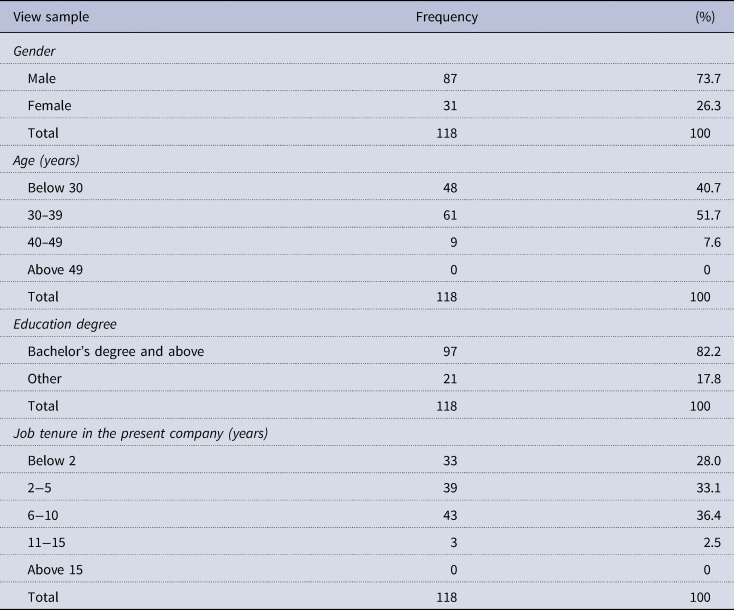
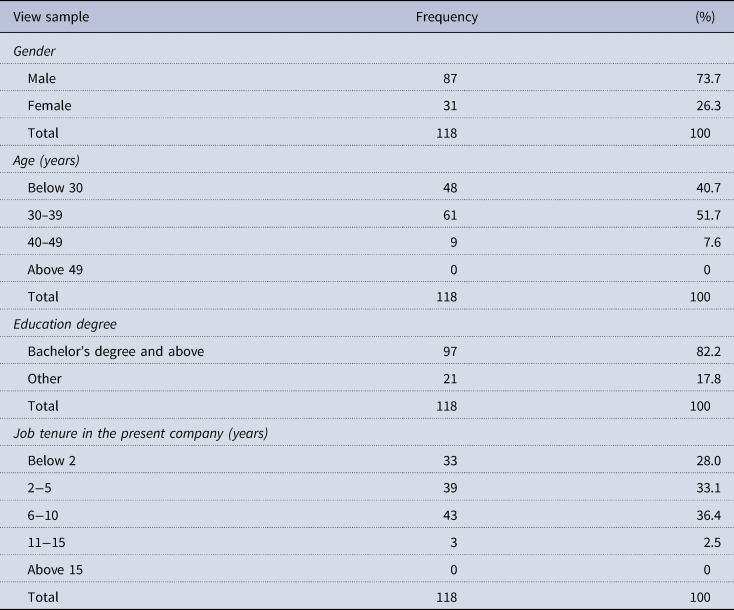
The link to the anonymous questionnaire in the electronic version was sent in November 2019 to 788 employees of a large and dynamically developing software company. Data collection was conducted with the consent of the company's management and all employees received an invitation to participate in the survey. Two weeks later, a request was repeated to employees to complete the questionnaire. Finally, the completed questionnaire was obtained from 118 IT specialists. The characteristics of the sample are presented in Table 1.
Demographic characteristics of the sample
Due to the subjective nature of the studied variables (PJI, PWO, SS, VKW), it is appropriate to measure them with self-reported responses from the individuals concerned. Such approach was also applied in previous research on knowledge hiding (e.g., Connelly et al., Reference Connelly, Zweig, Webster and Trougakos2012; Huo, Cai, Luo, Men, & Jia, Reference Huo, Cai, Luo, Men and Jia2016). However, because self-reported responses were collected using a single questionnaire, the common method bias (CMB) could be present in this study. In order to reduce CMB, respondents were given anonymity and the items used in the study were included in a multi-scale questionnaire, thus disguising the main purpose of the study. After data collection, in order to assess possible CMB, a Harman single-factor test was applied (Podsakoff, MacKenzie, Lee, & Podsakoff, Reference Podsakoff, MacKenzie, Lee and Podsakoff2003). The result of the test four-factor solution (with eigenvalues >1.0) was obtained and the first factor accounted for 31.2 per cent of the total variance, which was below the threshold of 50 per cent. Given the above test, it can be concluded that the data are free of CMB.
Measures
The survey questions for all studied constructs used seven-point Likert scales, ranging from 1 = strongly disagree to 7 = strongly agree.
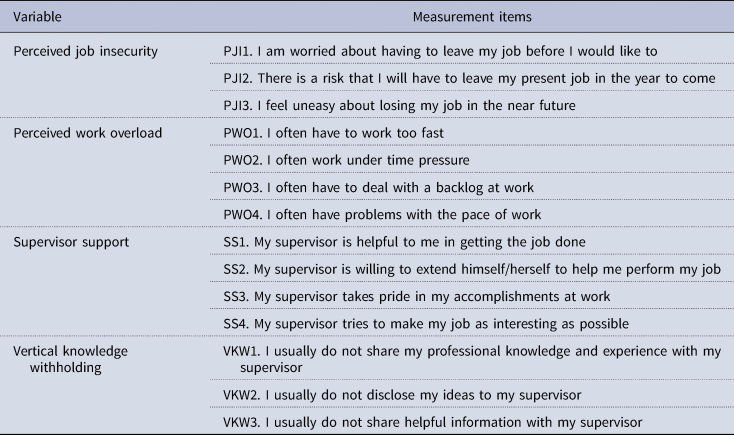
The full original scales for measuring PJI, PWO and SS were used. The original items were translated into Polish with the use of the back-translation procedure (Brislin, Reference Brislin, Lonner and Berry1986). PJI was measured with three items taken from Hellgren and Sverke (Reference Hellgren and Sverke2003). For PWO, four items were used from De Clercq et al. (Reference De Clercq, Dimov and Belausteguigoitia2016). To assess SS, four items were derived from Smith et al. (Reference Smith, Fisher, Ryan, Clarke, House and Weir2013).
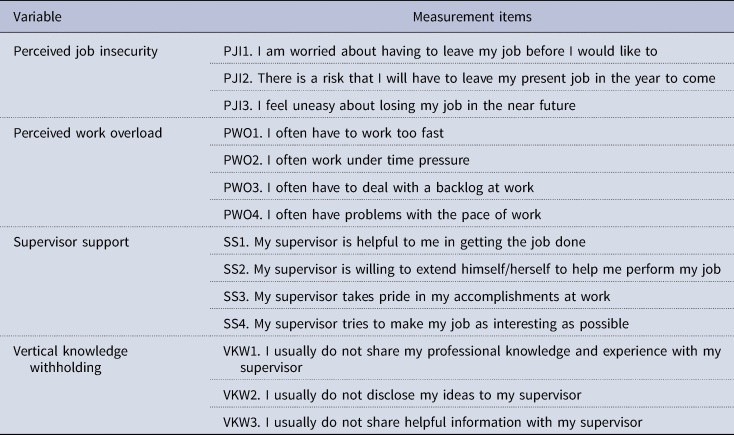
To generate the scale for VKW, two validated scales for KW were assessed; one from Peng (Reference Peng2012) and one from Stenius, Hankonen, Ravaja, and Haukkala (Reference Stenius, Hankonen, Ravaja and Haukkala2016). On this basis, three items were formed. Each item for VKW stated clearly that it concerned behaviour towards a superior. Table 2 shows the items used in this study.
Measurement items
Statistical analyses
In order to evaluate relationships between PJI, PWO, SS and VKW, partial least-squares path modelling (PLS-PM) was used. PLS-SEM requires two steps: (1) the assessment of the measurement model and (2) the assessment of the structural model. These analyses were performed using SmartPLS 3.2.9 (Ringle, Wende, & Becker, Reference Ringle, Wende and Becker2015).
Empirical results and analysis
Measurement model
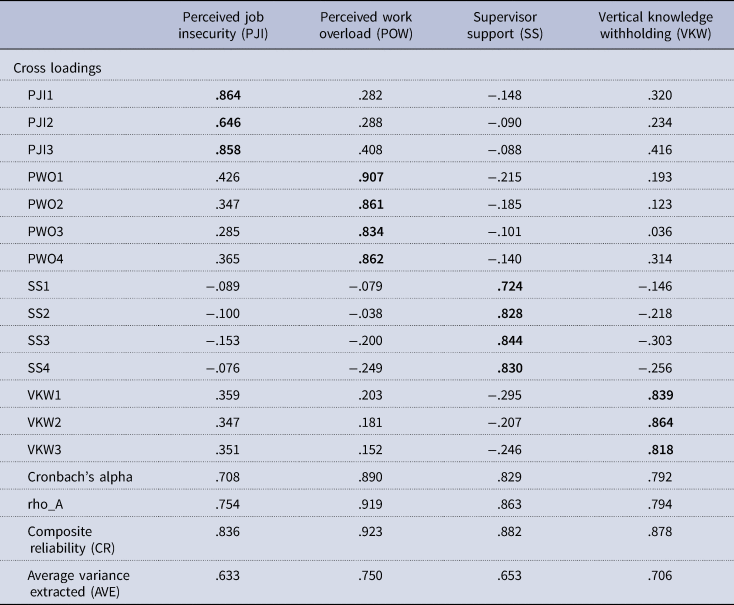
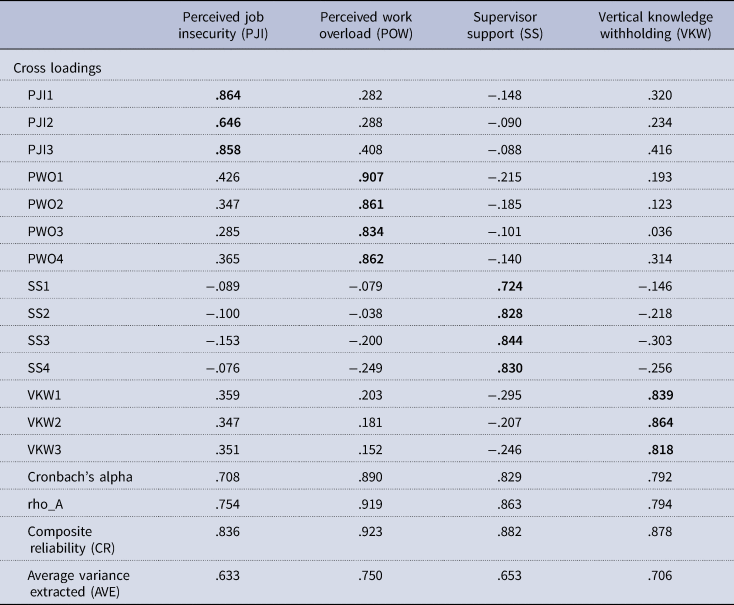
The measurement model in this study only involved constructs with reflective indicators. The PLS analysis was conducted to assess the reliability and validity (convergent and discriminant) of these constructs. The following statistics were calculated: Cronbach's alpha, rho_A, composite reliability (CR) and average variance extracted (AVE). The results in Table 4 show that all values reach the threshold levels: Cronbach's alpha > .7 (Straub, Boudreau, & Gefen, Reference Straub, Boudreau and Gefen2004), rho_A > .7 (Dijkstra & Henseler, Reference Dijkstra and Henseler2015), CR >.7, and AVE >.5 (Hair, Ringle, & Sarstedt, Reference Hair, Ringle and Sarstedt2011). The AVE values are between .633 and .750, which indicates that each construct has a satisfactory level of convergent validity. To assess discriminant validity of the variables, cross-loading, Fornell–Larcker criterion and the heterotrait−monotrait ratio of correlations (HTMT) have been applied. As results of cross-loading presented in Table 3 show, all items are loaded higher on their respective latent variables than on other latent variables. In accordance with Fornell–Larcker criterion, the square root of the AVE for each construct is greater than the correlation values (Table 4). The HTMT values are below the conservative cut-off value of .85 (Henseler, Ringle, & Sarstedt, Reference Henseler, Ringle and Sarstedt2015). In summary, the results for reliability and validity of constructs are satisfactory and the measurement model has a good psychometric quality.
Measurement model evaluation results
Descriptive statistics

Notes: *p < .05; **p < .01. The italic diagonal elements represent the square root of AVE.
Construct correlations and square root of average variance extracted.
Structural model
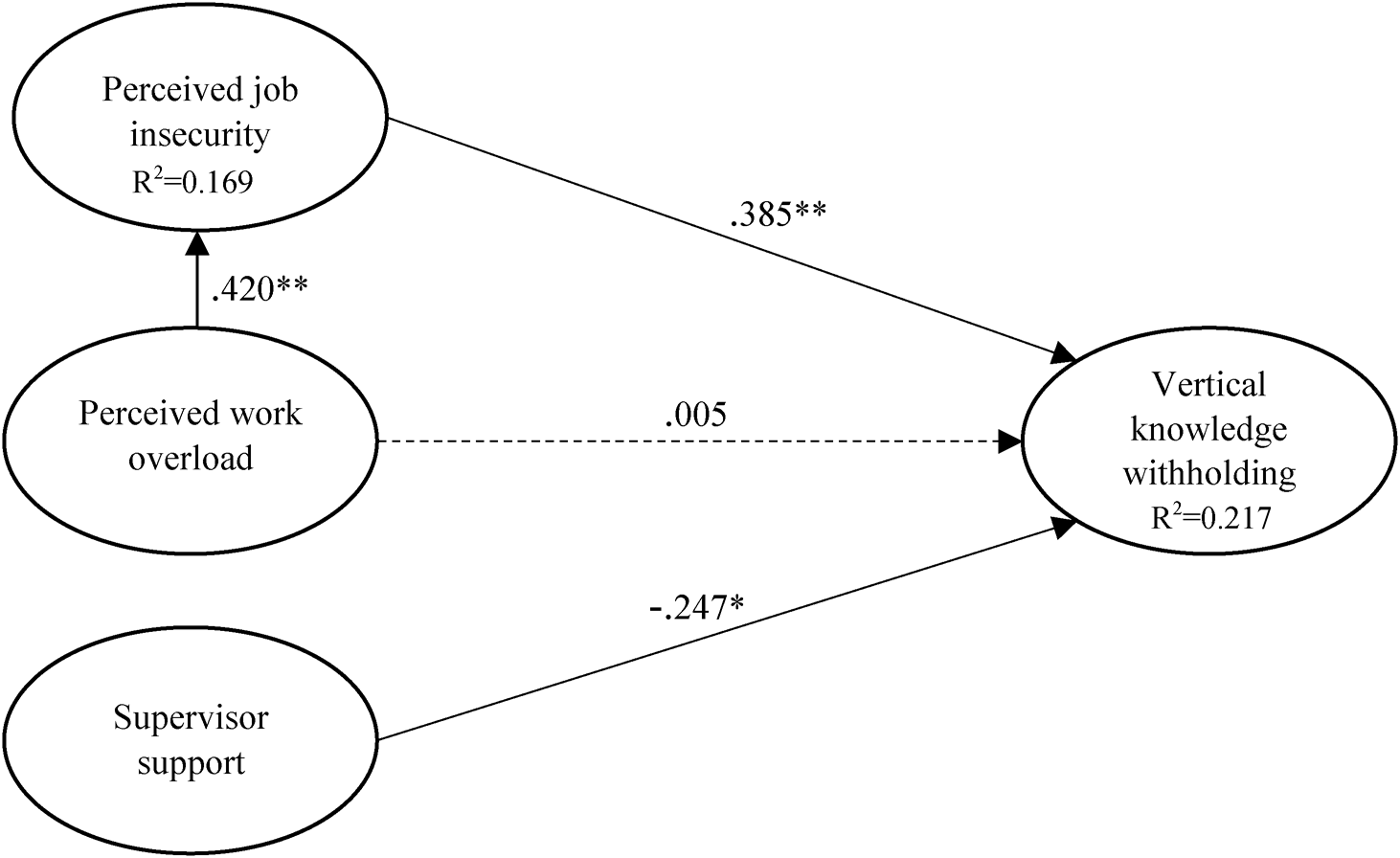
The adjusted R 2 determination coefficient, Q 2 predictive relevance and fit indices were examined to assess the quality of the structural model. The adjusted R 2 values are .169 for PJI and .217 for VKW (Figure 1). This means that the R 2 values in this model were low (R 2 < .3; Sanchez, Reference Sanchez2013). The Q 2 values were obtained using blindfolding procedure. The Q 2 value for PJI is .094 and for VKW is .145, which is above the threshold value of 0 and means that the model has predictive relevance (Chin, Reference Chin, Esposito Vinzi, Chin, Henseler and Wang2010). The following general model fit indices were calculated: SRMR = .088 (acceptable if <.1; Schermelleh-Engel, Moosbrugger, & Müller, Reference Schermelleh-Engel, Moosbrugger and Müller2003), d_ULS = .812, d_G = .357, chi-square = 256.136, NFI = .698, and RMS theta = .235.
Results of the structural model. Note: *p < .05; **p < .01. The dotted line shows that the coefficient was not significant. R square adjusted.
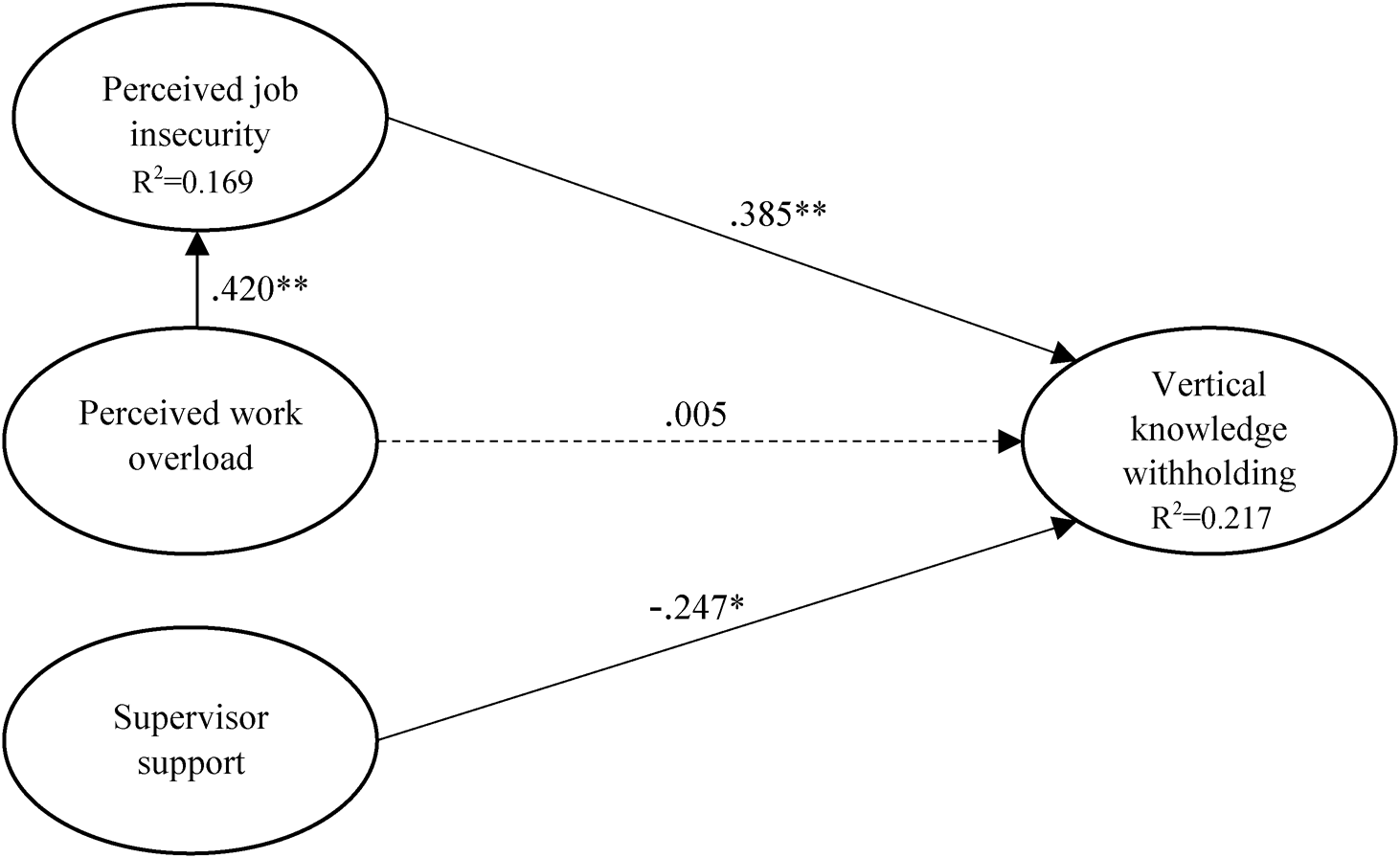
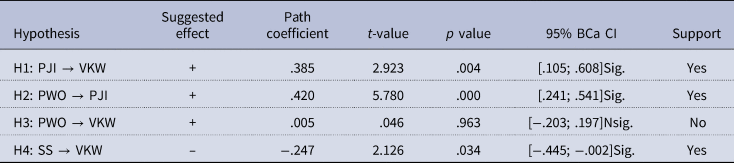
A bootstrapping technique with 2000 re-sampling was used to test the structural model. The statistical significance of the path coefficients is evaluated based on t-statistics, p values and bias corrected confidence intervals. The results presented in Table 5 show that the influence of both PJI (β = .385; p < .01) and SS (β = −.247; p < .05) on VKW is significant. Moreover, the path coefficient between PWO and PJI is significant and amounts to .42 (β = .420; p < .001). These results support hypotheses H1, H2 and H4. However, contrary to expectations, the impact of PWO on VKW is insignificant (β = .005; p = .963) and, consequently, hypothesis H3 is not supported. Additionally, it was examined whether PJI might be a mediator between PWO and VKW. An alternative structural model without a relationship between PJI and VKW was tested. In the alternative model the impact of PWO on VKW has increased but is still insignificant (β = .060; p = .603). Therefore, there is no basis to claim that PJI mediates the relationship between PWO and VKW.
Structural model results
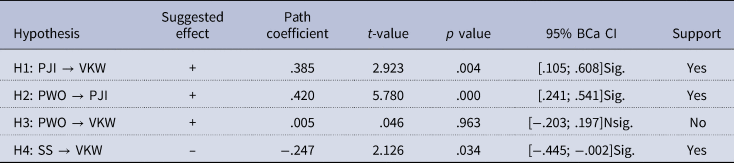
Note: BCa CI = bias corrected confidence interval; Sig. = a significant direct effect at .05; Nsig. = a non-significant direct effect at .05. Bootstrapping based on n = 2,000 subsamples.
Discussion and conclusions
Implications
The paper used IT specialists from a large software company as research objects and developed a model of relationships between PJI, work overload, SS and VKW. The results of this study provide several interesting findings.
Implication 1. Job insecurity contributes to knowledge withholding
The study confirmed that PJI is positively related to VKW (H1). This finding is consistent with the conclusion drawn by Serenko and Bontis (Reference Serenko and Bontis2016), and inconsistent with some other studies (Ali et al., Reference Ali, Ali, Albort-Morant and Leal-Rodríguez2021; Han & Anantatmula, Reference Han and Anantatmula2007). This result supports Law and Du-Babcock's (Reference Law and Du-Babcock2017) argument for examining vertical and horizontal KW separately. The results of the present study and that of Butt and Ahmad (Reference Butt and Ahmad2019) indicate a significant relationship between job insecurity and vertical KW, while Ali et al. (Reference Ali, Ali, Albort-Morant and Leal-Rodríguez2021) suggests no link between job insecurity and horizontal KW.
It is likely that, in the perspective of losing a job, employees start to protect and hide their knowledge, assuming that their unique knowledge makes them valuable and irreplaceable employees, thus reducing the chance of them being fired. Another explanation is grounded in the psychological contract theory. Since the organisation does not provide the employee with a sense of job security, the employee does not feel obliged to share his/her knowledge with the supervisor who is the representative of the organisation. The above finding has practical implication for managers who want to reduce KW. In order to provide employees with a sense of job security and in turn to reduce instances of KW, managers should improve organisational communication, organisational justice and employment involvement practices (see Lee et al., Reference Lee, Huang and Ashford2018). Managers should treat employees fairly and respectfully and inform them about decisions or policies that can impact their relationships with the company. This is especially important in the face of major organisational changes. Moreover, the employees' sense of job security can also be increased by signing an appropriate type of employment contract with them (e.g. permanent vs. temporary contracts).
Implication 2. Work overload is associated with job insecurity
The results of this study support the hypothesis that PWO is positively related to PJI (H2). Previous research in this field has provided mixed findings (Blackmore & Kuntz, Reference Blackmore and Kuntz2011; Chipunza & Samuel, Reference Chipunza and Samuel2012), which may be the result of specific organisational and environment contexts, such as downsizing or restructuring. In this study, conducted among IT specialists from a large and developing software company, it is likely that work overload in terms of high pace of work, time pressure and backlogs will have an impact on voluntary or involuntary turnover.
Implication 3. Work overload has no impact on knowledge withholding
In contrast to the expectations stated in Hypothesis 3, the present study found no evidence that PWO increases the level of VKW. The lack of a significant relationship between these constructs may be explained by two balancing arguments. On one hand, work overload reduces employees' incentive to undertake additional activities at workplace as engagement in KS and innovative behaviour (De Clercq et al., Reference De Clercq, Dimov and Belausteguigoitia2016; Jacobs & Roodt, Reference Jacobs and Roodt2007). On the other hand, withholding knowledge from a superior may backfire on the employee, because the employee exposes himself/herself to similar actions on the part of the superior. Receiving insufficient knowledge from the supervisor may result in delays in the implementation of tasks by the employee. Acquiring knowledge necessary for work is time-consuming, especially when this knowledge is not clearly and quickly communicated by the supervisor. This seems to be particularly important in knowledge-intensive professions, including IT specialists, where the implementation of IT projects requires cooperation and KS. As the above results show, work overload is not a reason to withhold knowledge.
Implication 4. Supervisor support reduces vertical knowledge withholding
Organisational and SS have been traditionally regarded as important facilitators of KS behaviours (Chae et al., Reference Chae, Park and Choi2019). The present study has shown that SS is also negatively related to counterproductive knowledge behaviour, particularly VKW (H4). This finding is in line with some previous studies on organisational support (Onderwater, Reference Onderwater2017; Tsay et al., Reference Tsay, Lin, Yoon and Huang2014). In accordance with social exchange theory, when an employee receives SS, he/she may feel obligated to reciprocate in a similar way and decrease the level of concealment of knowledge from a supervisor. In contrast, a lack of SS may trigger withdrawal behaviours (van Knippenberg, van Dick, & Tavares, Reference van Knippenberg, van Dick and Tavares2007), including knowledge hiding and hoarding.
Theoretical implications
The present study contributes to literature in several ways. First, it distinguishes between vertical and horizontal KW, assuming that motivations and consequences for these two types of KW may be different. Such a distinction is not present in the literature, although researchers have distinguished other interpersonal phenomena in the workplace, such as vertical and horizontal trust, in a similar way (Hughes et al., Reference Hughes, Rigtering, Covin, Bouncken and Kraus2018). Vertical KW may be bidirectional; subordinates may withhold knowledge from their superiors and vice versa. Few previous studies have focused on the latter direction and referred to it as top-down knowledge hiding (Arain et al., Reference Arain, Bhatti, Ashraf and Fang2020; Butt, Reference Butt2021; Butt & Ahmad, Reference Butt and Ahmad2019). The present study has focused on the opposite direction – concealing knowledge from supervisors.
Second, the results of this study demonstrate the interrelationships between PWO, PJI and VKW among IT specialists. PWO was found to have an impact on PJI, which in turn has an impact on VKW. PWO has no direct or indirect (via PJI) effect on VKW. Previous research has not investigated the relationships between these constructs in such a configuration.
Third, this study highlights the impact of perceived SS on a subordinate concealing knowledge from a supervisor. Previous research has examined the impact of organisational support on KS and KW (Ford & Staples, Reference Ford and Staples2010; Tsay et al., Reference Tsay, Lin, Yoon and Huang2014). Moreover, some researchers have investigated the relationship between abusive supervision (a concept contrary to SS) and KW (Feng & Wang, Reference Feng and Wang2019; Ghani et al., Reference Ghani, Teo, Li, Usman, Islam, Gul and Zhai2020; Pradhan, Srivastava, & Mishra, Reference Pradhan, Srivastava and Mishra2019). However, the interaction between SS and concealing knowledge from supervisors has received insufficient attention. Based on the social exchange theory, the present study has theoretically justified the negative relationship between SS and subordinate's KW. This negative relationship has then been confirmed empirically.
Limitations and future directions
This study has certain limitations. The study was conducted in a fairly homogeneous research sample; this is both a strong point of the research and a limitation. Respondents were knowledge workers – IT specialists from large and developing software company – and the results reflect the relationships in this occupational group. However, generalising these results for employees of other professions and industries may lead to erroneous conclusions. Furthermore, conducting similar research among IT specialists working in specific conditions, such as in conditions of downsizing, may also provide different results.
Further limitations result from the applied research methodology. Respondents completed an anonymous questionnaire based on their feelings. This research method resulted from the subjective nature of all the variables studied, such as PWO and PJI. Therefore, the answers given are burdened with a large degree of subjectivity. In future studies, employee perceptions could be confronted with supervisor assessments or objective indicators, such as turnover rate.
This study focused on the relationship between SS and VKW. Subsequent studies could extent the research model to include co-worker support and horizontal KW. It would be interesting to examine whether a negative relationship also exists between co-worker support and horizontal KW and which type of support – supervisor or co-worker – has a greater impact on KW.
In further research, it would be worth examining the mutual exchange of knowledge between the supervisor and the subordinate. According to the social exchange theory, the more knowledge we pass on to other people, the greater the chance of reciprocation. The question is whether there is such a relationship between supervisor and subordinate. Another aspect is determining whether the employee really has knowledge and to what extent he/she withholds this knowledge. It may be problematic to determine this, since it is difficult to identify what or how much knowledge an individual holds. However, the employee's education, received trainings and confirmed experience, such as that gained during IT project implementation, may help identify what and how much knowledge the employee has.
The results of this study show that PJI is significantly related to VKW. Previous studies have indicated that job insecurity is related to higher turnover intention (see Sverke et al., Reference Sverke, Hellgren and Näswall2002). An interesting question is whether an employee who experiences job insecurity and intends to leave the organisation begins to withhold his/her knowledge. Therefore, the research model could take into account the mediating effect of turnover intention in the relationship between job insecurity and VKW.
Conclusions
This study examined which factors are related to IT specialists' concealment of knowledge from their supervisors. The findings indicate that PJI increases vertical KW, whereas SS reduces vertical KW. PWO has no direct impact on KW. This study extends the research on negative knowledge-related behaviours in an IT specialist context and distinguishes between vertical and horizontal KW. Research results can help researchers and practitioners in a deeper understanding of KW behaviours and reduce its occurrence among knowledge workers. This study is expected to encourage continued research on factors that have a significant impact on vertical KW.