Introduction
Dementia is a progressive life-limiting illness that requires a palliative approach to care in its advanced stage (van der Steen et al., Reference van der Steen2014). People with advanced dementia have unique clinical needs and limited capacity to effectively communicate their needs and participate in decisions about care (Mitchell, Reference Mitchell2015). Palliative care for people with advanced dementia should be tailored to the illness trajectory and address the needs of each individual and their family (Mitchell et al., Reference Mitchell2009; van der Steen et al., Reference van der Steen2014). However, many nursing home staff and other health professionals lack awareness that a palliative approach is required, or else find it difficult to apply this approach in the context of dementia (Birch and Draper, Reference Birch and Draper2008). There may also be sub-optimal communication between health professionals, nursing home staff and families, and inadequate care planning. Symptoms and other care needs may go unrecognized and unmanaged (McAuliffe et al., Reference Mcauliffe, Nay, O'donnell and Featherstonehaugh2009). Medical problems may be inappropriately managed with aggressive treatments (e.g. intravenous antibiotics/hydration, tube feeding) or inappropriate transfer to hospital (Mitchell et al., Reference Mitchell, Kiely and Hamel2004), compromising comfort for little survival benefit and reducing family satisfaction with end of life (EOL) care (Engel et al., Reference Engel, Kiely and Mitchell2006; Givens et al., Reference Givens, Jones, Shaffer, Kiely and Mitchell2010).
Case conferencing offers a promising approach for addressing these challenges by bringing together key decision-makers to discuss each individual resident's needs, reach a shared understanding regarding the goals of care, and develop a consensus plan for future care. Two systematic reviews concluded that case conferencing can reduce behavioral and psychological symptoms of dementia and enhance medication management and palliative symptom management for people with dementia living in nursing homes, as well as improve the competence, attitudes, and job satisfaction of staff (Reuther et al., Reference Reuther2012; Phillips et al., Reference Phillips, West, Davidson and Agar2013). However, there is little consensus on the key elements of a nursing home case conference, and regulatory and reimbursement approaches vary internationally. The United States, Canada, England, Scotland, Wales, and New Zealand do not mandate case conferencing. Nursing homes in Ireland and the Netherlands are required to plan, deliver, and evaluate care for residents in a multi-disciplinary fashion, but only the Republic of Ireland requires that residents/families are consulted in the care plan (Department of Health Social Services and Public Safety, 2015; Health Information and Quality Authority, 2016). Several German states mandate case conferences but do not specify who should attend, and in some cases limit the requirement to nursing homes that participate in a defined model of integrated care (Kassenaerztliche Vereinigung Berlin et al., 2011). In Australia, everyone with a terminal condition and/or complex care needs is eligible for medically led case conferencing, but there is little specification of what the case conference should comprise (Australian Government Department of Health, 2013), and frequency and quality are likely to vary between nursing homes (Halcomb et al., Reference Halcomb, Shepherd, Griffiths, Halcomb, Shepherd and Griffiths2009b).
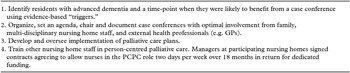
The current authors conducted an Australian cluster randomized controlled trial (RCT) (the “IDEAL Study”) to evaluate the cost-effectiveness of facilitated case conferencing with family decision-makers for improving the quality of EOL care in nursing home residents with advanced dementia (Agar et al., Reference Agar2015). The intervention was designed to implement critical elements of case conferencing as identified by research in the community palliative care setting, namely: development of staff knowledge and motivation; engagement of general practitioners (GPs); provision of detailed guidance for care planning; and securement of organizational support (Mitchell et al., Reference Mitchell, De Jong, Del Mar, Clavarino and Kennedy2002, Reference Mitchell2005; Abernethy, Reference Abernethy2007). These elements were operationalized by training and funding existing registered nurses at each of ten nursing homes to work in the role of Palliative Care Planning Coordinator (PCPC) two days per week or equivalent for 18 months. See Table 1 for a summary of PCPC duties.
Duties of registered nurses trained and funded to work as palliative care planning coordinators (PCPCs) two days per week for 18 months in ten nursing homes in the intervention arm of the IDEAL study

The current paper reports on a qualitative sub-study of the IDEAL Study that aimed to explore the benefits of facilitated case conferencing and the PCPC role in particular as well as factors influencing implementation, as perceived by PCPCs themselves and the health professionals who participated.
Method
The sub-study reported in this paper used a qualitative approach to allow for an in-depth understanding of perceptions regarding facilitated case conferencing and the PCPC role in particular. Qualitative research provides insights into contexts, attitudes, beliefs, and behaviors which are of unique value when developing complex healthcare interventions that will require tailoring to individual contexts (Medical Research Council, 2006). The qualitative sub-study was approved as part of the larger cluster RCT by the University of New South Wales Human Research Ethics Committee. Reporting has been guided by the Consolidated Criteria for Reporting Qualitative Research (Tong et al., Reference Tong, Sainsbury and Craig2007).
Participants approached to take part in the qualitative sub-study included PCPCs across the ten intervention nursing homes, physicians who had participated in case conferences and a convenience sample of nursing and allied health staff. Inclusion criteria for staff were experience of participating in at least one facilitated case conference and willingness to give informed consent to be interviewed in English. Nursing home staff was approached through presentations to staff meetings, email lists, and word of mouth and were invited to contact the research team if interested. Physicians were advised of the study by the PCPCs, who were typically their key point of contact within the nursing home.
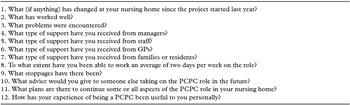
Interviews were conducted towards the end of the 18 month intervention period over which PCPCs had been working. Interviews were semi-structured and used topic guides focused on perceptions regarding the impacts of facilitated case conferencing and barriers and facilitators to this as a means of improving resident care (see Tables 2 and 3). They were conducted either face-to-face or via telephone by one of two authors (TL/JC). Face-to-face interviews took place in a quiet room at each nursing home and were attended only by the interviewer and interviewee. Interviewers encouraged interviewees to speak frankly and offered assurance that information would be treated confidentially. PCPCs were also asked to rate on a three-point scale whether they thought two days per week in the role was “not enough,” “about right,” or “too much.” Our special interest in the novel aspect of the intervention – the PCPC role – meant that PCPC interviews were more in-depth than those with staff and were audio-recorded and transcribed verbatim for analysis. Staff interviews were documented via notes taken by the interviewer, with statements being copied down verbatim where these were considered illustrative.
Interview guide for PCPCs (palliative care planning coordinators)

Interview guide for nursing and allied health nursing home staff members

A thematic framework approach was used to allow for analysis to be informed both by the aims of the research and structure of the interview guide and by the responses of the participants. PCPC transcripts were imported into a software program (EPPI-Reviewer 4) to assist in the organization and coding of data. Anonymized transcripts or notes were read and reflected upon independently by two of the authors (DB and JC) who identified provisional themes, which were then discussed with a third (TL). These researchers all contributed to project management of the IDEAL Study, had backgrounds in psychology and allied health at undergraduate and post-graduate levels, and were experienced in interviewing and qualitative analysis. A constant comparative method (Strauss and Corbin, Reference Strauss and Corbin1998) was used in the application of the coding frame. Any differences in coding were subsequently discussed and resolved either by choosing one interpretation which both authors considered to be more accurate or accepting both as equally valid. A summary of each participant's views by identified theme was then produced within an Excel spreadsheet. This provided a transparent overview of the analysis and enabled comparisons to be made across professional disciplines.
Results
Participants
Interviews were conducted with PCPCs from each of the ten intervention nursing homes, including two who transferred the role between them at one of the nursing homes (N = 11). Between two and eight clinical staff were interviewed from seven of the ten nursing homes (N = 26), including 18 nursing and direct care staff and eight allied health staff. Nursing and direct care staff included one assistant director of nursing, one clinical manager, five RNs, one enrolled nurse, and ten assistants in nursing (AINs). Allied health staff included three physiotherapists or aides, four diversional therapists, and one dietician. Participants’ experience of facilitated case conferences varied from one to more than ten. We also interviewed three physicians (a GP, medical officer, and geriatrician), each with experience at a different nursing home. Interviews lasted between 10 and 30 min.
Themes
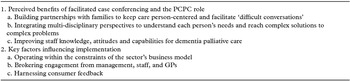
Analysis of the data revealed three main beneficial impacts of introducing facilitated case conferencing as well as three key factors influencing implementation. These themes are shown in Table 4 and described in further detail below.
-
1. Perceived benefits of facilitated case conferencing and the PCPC role
-
a. Building collaborative partnerships with families to keep care person-centered and facilitate “difficult conversations”
-
Themes

Facilitated case conferencing
The most commonly perceived benefit was improvement in family–nursing home communication. Case conferences enabled the team to broach care planning earlier in the disease trajectory, ensuring that family members had time to absorb information, reflect on what their loved one would have wanted, and discuss with others in between discussions, thereby having a greater involvement in decision-making.
Families have been involved in decisions earlier than previously. This has enabled a softer approach to advance care planning. (AIN)
Better communication was also perceived to lead to “light bulb” moments whereby staff and family understanding was mutually improved, leading to a more person-centered approach to care.
Attending the case conferences I found interesting in that I found out things I didn't know about the resident. They could benefit more from a massage or walking rather than an exercise class. (Physiotherapist Aide)
PCPC role
PCPC training and dedicated time in the role allowed one RN at each nursing home to develop expertise in facilitating ACP discussions over time. Experience enabled PCPCs to understand when to pursue EOL conversations to the end versus “sow a seed” for returning to at a later time after giving families time to move towards acceptance that their loved one was dying.
We are closer to family members . . . . It has improved the quality of care, and these changes have come about because of the way the PCPC organizes the case conference. We talk to the family and find out more about everything. (AIN)
What I learnt from it was picking when people were ready for the information. It was all about the timing of it and you sort of got a sense of that after doing it a few times. Because you could pick up when you were talking to them where they were at with their family member. (PCPC)
-
b. Integrating multi-disciplinary perspectives to understand each person's needs and reach complex solutions to complex problems
Facilitated case conferencing
Across nursing homes, an increase in multi-disciplinary input to case conferences was reported to enrich information exchange and interpretation of needs and solutions. Involvement of AINs/personal carers who worked closely with residents every day was considered especially useful in gaining a better understanding of their changing needs. Prior to the IDEAL Study, case conferencing had largely been absent or else a “check box” undertaking with minimal involvement of staff and external health professionals and little engagement of families in decision-making.
They did a three monthly follow up but just like over the phone and you know just ask if you're OK with the resident's care but not really case conferencing. (PCPC)
PCPC role
The availability of dedicated time on coordinating case conferences enabled a concerted effort in engaging physicians to attend. The involvement of GPs and other medical specialties in case conferences allowed symptoms and medical concerns to be actioned in a more timely manner.
We've got the GPs involved and that's helped because . . . the pain gets addressed straight away. (PCPC)
While two physicians felt participating in case conferences allowed a greater understanding of the resident's needs, the third felt he gained sufficient insights through regular visits.
[A case conference provides] a great deal of value. It gives you a full picture of the family and the person. (Geriatrician)
-
c. Improving staff knowledge, attitudes, and capabilities for dementia palliative care
Facilitated case conferencing
As well as providing an opportunity for nurses and other staff to learn more about individual residents, participants reported case conferences to have educational potential regarding the principles of dementia palliative care. Nurses and especially AINs reported feeling more empowered in their capacity to contribute meaningfully to care of residents who they previously felt were beyond the limits for quality of life improvement.
There is more openness, ownership, whole-care-team . . . People are not afraid to talk about death and dying, and that these people are not going to get better. We can make it better, but we cannot cure. We must accept this. (RN)
PCPC role
As well as modeling at case conferences, PCPCs impacted staff knowledge and attitudes through structured education. PCPCs ran sessions targeting staff knowledge and awareness of dementia progression and a palliative approach, increasing staff confidence in discussing EOL issues with families, and improving staff attitudes towards residents. Sessions were variously targeted at both RNs and unregistered staff.
Staff can identify [when residents with dementia are palliative] now and they start to modify their care as well whereas before when they were just in with the other residents they would still put them in a chair when they're completely bedfast. They didn't have that demarcation where they know this resident is now palliative. (PCPC)
Even senior nurses remarked on development in their skills and confidence and the change in the culture of care towards a palliative approach integrated into usual care.
I didn't have palliation on my horizon but now it is central. Having this palliation team is something that will be a great strength for us to have. (Assistant Director of Nursing)
Further innovations facilitated by PCPCs included the development, provision, and integration of palliative care resources in several nursing homes, such as; establishment of a palliative care room for the dying resident; the development of palliative care toolkits; and, in one nursing home, the introduction of an in-house palliative care team.
PCPCs also reported that the role had been beneficial to them personally in terms of learning about palliation and giving them the skills and confidence to communicate with families and staff about EOL.
From a personal point of view just a greater understanding and greater empathy but also just being able to share that too, mentor other people, as time went on. You know no matter where you work. (PCPC)
-
2. Key factors influencing implementation
-
a. Operating within constraints of the nursing home business model
-
Short staffing and time pressures were the most widely reported barriers to implementation, highlighted to a varying degree across all participating nursing homes. Attending case conferences was sometimes felt to be a diversion that nurses could ill afford given time commitments to task-oriented care. This problem was exacerbated during holiday periods or when staff was sick. Most RNs in the PCPC (n = 11) role perceived that working two days per week was “about right” in terms of time allocation. However, when asked to rate their ability to work two days per week on their role, PCPC responses ranged from “a large extent” (N = 5), to “a moderate extent” (N = 2) and “a lesser extent” (N = 4).
Every week I would be rostered to do the project on two days and then it would be the case that somebody's gone off sick and so the person who was going to replace me could no longer replace me so I'd end up not being able to dedicate my time to the project. (PCPC)
Further problems were experienced in terms of resignations or transfers, including PCPCs, directors, and other nursing home staff. Changes in PCPC availability resulted in discontinuation of the role in one nursing home, and replacement of staff in the role at three nursing homes (one of which moved to a contract where salary was paid on an hourly basis for limited time work rather than the two days per week initially agreed).
Staff turnover is always an issue and trying to keep education ongoing with new staff . . . to bring them up to speed, which is just a time constraint. (PCPC)
Funding of the PCPC role was considered to be one of the most important factors in the success of case conferencing and a cultural change more broadly.
Having a directive, someone to lead, someone to help others understand dementia care and to have the best resources available when you need them. Now there is someone to go to and get an answer. (Physio Aide)
The likelihood of sustaining the intervention after the funding period ended was considered to be limited, with only half indicating that plans were underway at their nursing home to continue implementing a palliative approach and a third that facilitated case conferences would be likely to continue.
-
b. Brokering engagement from management, staff, and GPs
In two of the 11 nursing homes, PCPCs perceived that resistance from management, nurses, and GPs presented a serious barrier to implementation of facilitated case conferencing and their own role in particular. PCPCs attributed this to a lack of ownership and reported the remedy to be involvement in case conferences so the benefit could be witnessed first-hand.
From management and the staff seeing that they were reluctant to give help as much as they should have and to listen in, but . . . as it went on they – when they started coming to the case conferencing they realized how important it was and it got a little bit easier, but still a bit of resistance every now and again. But it could have gone a lot more smoothly if I had total support from both management and from the staff. (PCPC)
Fortunately, most PCPCs found management provided trust and flexibility for the role, encouragement for staff and families to participate in case conferences, and access to resources. These factors were felt to be important in facilitating implementation.
I think I had immense support from both managers in doing my role successfully; like, at no point I felt that I was being stressed or because I had other roles to play as well . . . Absolutely freedom, flexibility, freedom. And they trusted me. They knew that I was doing my job alright. (PCPC)
Support from nurses and other staff were also considered to be instrumental, with most PCPCs reporting these to find value in participating in case conferences and education sessions, even after some initial misgivings.
I'll actually include them right at the beginning and then they felt empowered because they were giving me their feedback and I was actually addressing that at the case conference and they were actually sitting at the case conference. So when they knew their role in it I got more compliance but initially it was: “Do I have to do that? Do I have to do this?” (PCPC)
Perceived resistance by some GPs to attend case conferences, particularly when residents were relatively stable, was attributed mostly to time pressures but in some cases to lack of interest and expertise.
Half of them [GPs] were really keen and the other half were boo-hooing the whole thing. We did get all of them involved to a certain extent but we found one of them that was, you know, not that keen. We had a death . . . that wasn't terribly well managed. Even though we had asked for crisis meds, end stage meds, to be ordered they weren't. And it was difficult for the staff because we knew how much better we could have done . . . And this resident ended up having to go to hospital, and we were quite devastated, and she died there. (PCPC)
PCPCs reported that GPs became more willing to engage in case conferences once they realized these had clear agendas that included issues they could usefully provide input to. GP engagement was further facilitated by systems and processes to ensure their involvement would be an efficient use of time and establishment of trust through an ongoing relationship with the PCPC. Specific strategies used by PCPCs to engage GPs included scheduling around their routine visits or enabling teleconferencing; structuring the agenda to enable participation for only part of the case conference; and offering advice to GPs on obtaining remuneration. PCPCs tried to find ways for GPs to contribute to decision-making and follow-up even when they were unable to attend case conferences. Follow-up with families by the GP after a case conference was felt to be especially valuable because it presented an opportunity to reinforce a message and check for understanding by someone viewed as authoritative.
Even though where the GP can't be present we have passed on for the GP to ring the family and . . . go through what we've said with them again so that they're hearing it from the GP as well. (PCPC)
-
c. Harnessing consumer feedback
All PCPCs reported that positive feedback from families was essential in reinforcing the importance of case conferencing to themselves, other staff, and management.
I think the feedback from the families was just so overwhelming . . . the families’ response afterwards [residents’ deaths] about how they felt nurtured and supported, and they felt their loved ones were actually cared for as individuals was, you know, really heart-warming.(PCPC)
Two nurses also noted that there had been fewer complaints from families as a result of the case conferences and that positive feedback had an important influence on the likelihood of case conferencing continuing after the study.
Discussion
The qualitative study reported in this paper identified perceived benefits from facilitated family case conferencing and the PCPC role, as well as barriers and facilitators to its implementation. It is the first study to focus on implementation of a facilitated approach to case conferencing for nursing home residents with advanced dementia requiring a palliative approach to care, including not only support from a clinical champion (the PCPC) but also protocols for identifying residents likely to benefit from a case conference, planning case conferences with optimal participation, setting agendas inclusive of advance care planning, documenting decisions, and overseeing implementation of ensuing care plans. It is also among the first to involve families in case conferencing rather than focus exclusively on multi-disciplinary health professionals. The facilitated approach, led by PCPCs, seems to have been successful in overcoming many of the barriers found to impede less structured case conferencing, described in detail as follows.
Two previous qualitative studies have focused on case conferencing for nursing home residents with dementia, albeit not with a palliative focus (Halcomb et al., Reference Halcomb, Shepherd and Griffiths2009a; Holle et al., Reference Holle, Kruger, Halek, Sirsch and Bartholomeyczik2015). The first of these examined the views of staff and GPs with varying experience in case conferencing recruited through two Australian nursing homes (Halcomb et al., Reference Halcomb, Shepherd and Griffiths2009a). This study found barriers to case conferencing included staff confusion about the purpose of case conferencing and its role in healthcare, uncertainty about the role of different disciplines, and a lack of a collaborative culture. While the facilitated approach attempted to address all these problems, it struggled to encourage a collaborative culture where this was lacking at the outset, especially where support from management was limited. The second study explored the views of nurses involved in case conferencing for nursing home residents with dementia and behavioral and psychological symptoms in Germany (Holle et al., Reference Holle, Kruger, Halek, Sirsch and Bartholomeyczik2015) and has been used to inform the protocol for an RCT (Holle et al., Reference Holle, Roes, Buscher, Reuther, Muller and Halek2014). That study found the usefulness of case conferencing to be limited by a lack of sufficient information about individual residents, staff knowledge about dementia, multi-disciplinary involvement, and staff time. The facilitated approach seemed largely successful in overcoming the first three of these barriers through its formal protocol for preparation, education, and engagement of different disciplines. However, it was only partially successful in addressing lack of staff time, despite the provision of funding for an RN to plan, coordinate, conduct, and document case conferences two days per week. While interviewees perceived funding of the PCPC role to be an important facilitator for case conferencing, only half the PCPCs were able to consistently work the time allocated because of short staffing. This problem was exacerbated at nursing homes where management placed less priority on case conferencing and the PCPC role compared with competing nursing duties. These findings highlight the structural challenges that confront case conferencing from the sector's revenue-driven business model and restricted funding options. In Australia, there are no mandated staff/resident ratios or skill-mix in the nursing home sector, and recent reductions in government funding to complex needs nursing homes mean that initiatives of the kind trialed in the IDEAL Study are likely to face increasing human resource barriers in the future (New South Wales Nurses and Midwives' Association, 2016). International research suggests that nursing homes in many other countries similarly face a shortage of nursing staff (Harrington et al., Reference Harrington2012), despite consistent evidence that adequate nurses are necessary for high quality care (Bostick et al., Reference Bostick, Rantz, Flesner and Riggs2006).
These findings also highlight the importance of establishing support for case conferencing and a positive environment within which it can grow. While most PCPCs engaged with the role of “clinical leader,” executive commitment and staff ownership may be further essential components of clinical leadership interventions that were less well established in some nursing homes (Clay-Williams et al., Reference Clay-Williams, Nosrati, Cunningham, Hillman and Braithwaite2014). Lack of support for nurse leadership roles in the nursing home sector has been documented by other studies in the international literature (Dwyer, Reference Dwyer2011; Hakanson et al., Reference Hakanson, Cronfalk, Henriksen, Norberg, Ternestedt and Sandberg2014).
Other previous qualitative research on case conferencing has provided insight into how to engage Australian GPs but lacked specificity to the nursing home setting. One such study interviewed GPs and multi-disciplinary palliative care staff who were involved in case conferencing for patients referred to three palliative care units (Mitchell et al., Reference Mitchell2005). Like the current study, this research found health professionals valued the opportunity that case conferences offered to exchange information and better understand perspectives and contributions available from disciplines other than their own. Other shared findings were that GPs prioritized case conference involvement at time-points in the patient's illness where multi-disciplinary input was required; they were less keen to participate in routine case conferences where their role was less clear, and they needed to be persuaded into realizing the time efficiency of case conferencing versus other methods of communication. One GP felt that case conferences were unnecessary because he reviewed residents and liaised with nursing staff on his routine visits to the nursing home. However, many GPs in Australia do not routinely visit nursing homes because of distance, time constraints, and difficulty in receiving appropriate remuneration (Australian Medical Association and Royal Australian College of General Practitioners, 2006). While some nursing homes appoint sessional medical officers to provide their patients’ primary medical care, the proportion that do so is unknown. Moreover, the intervention trialed in the IDEAL Study was designed on the premise that a more formal process for planning and documentation of case conferences would lead to agendas centered on family priorities, optimal multi-disciplinary involvement, and implementation of care plans; objectives which at least some nursing staff perceived to have been met.
Two further previous qualitative studies with GPs identified confusion about how to claim remuneration for attending case conferences and concern regarding the bureaucratic process involved (Blakeman et al., Reference Blakeman, Harris, Comino and Zwar2001; Mitchell et al., Reference Mitchell, De Jong, Del Mar, Clavarino and Kennedy2002). The current study sought to address this by means of explicit advice on how to seek remuneration. Even so, physicians perceived the available reimbursement to be insufficient to justify the time spent, especially given opportunity costs involved in participating. Our findings highlight the need to plan and structure case conferences to derive optimal benefit from GP attendance and to communicate this by means of a formal agenda that will encourage GPs to attend. There is also a need to schedule case conferences to fit with GP availability, ideally during a routine visit to the nursing home or else via teleconference to avoid wasting time on travel. These strategies were included in the facilitated approach and met with positive feedback from both doctors and PCPCs. Establishing strong ongoing relations and ways of working with GPs and other external health professionals may be essential for embedding case conferencing into nursing home culture (Goodman et al., Reference Goodman2016). On a policy level, provisions for remuneration and collaboration between nursing homes should be adjusted to facilitate case conferencing, as demonstrated by the integrated care model in Berlin, Germany, where GPs are mandated to participate in case conferences (Kassenaerztliche Vereinigung Berlin et al., 2011). In the Dutch model, where nursing home physicians are employed by the residential care provider, participation in case conferencing is not only required by a government regulation, but physicians have also embraced them in their professional standards (Verenso, 2015).
The study's main limitations concern its small sample size compared with how many people participated in case conferences during the 18-month study and the fact that sampling relied on volunteers, so may have been biased towards staff and physicians who were favorably disposed. Invitations made it clear that the researchers were interested in hearing negative as well as positive perceptions of case conferencing and the PCPC role. However, the views expressed by informants where overwhelmingly positive, with only one participant (a GP) being equivocal about the benefits of case conferencing versus other methods of communication. The fact we used a convenience sampling method also meant we could not be sure that analysis reached theoretical saturation, and we did not seek participant feedback on the themes derived. A focus on health professional rather than family perspectives is a limitation common to all qualitative studies on case conferencing to date except one, which canvassed family perceptions in a minimal way (Halcomb et al., Reference Halcomb, Shepherd and Griffiths2009a). The fact researchers who conducted the interviews and analysis had provided ongoing support to the PCPCs and nursing homes over the 18-month period meant they were able to contextualize statements by interviewees within more informal feedback received throughout the IDEAL Study. This reduced the risk that unrepresentative attitudes or beliefs might be unduly emphasized but also meant that interviews and analysis may have been influenced by opinions formed over the study period rather than interviewee statements alone. Involvement in the analysis by both female and male researchers should have guarded against gender bias. Finally, analysis of interviews with staff other than PCPCs relied on notes made by the interviewer, which may have introduced bias and/or have missed nuances that would have been available from verbatim recordings and transcripts.
Conclusion
The facilitated approach to case conferencing explored in the current study appeared to overcome most of the barriers identified by previous qualitative research. Important exceptions were a lack of organizational support and staff time, which remained barriers at some nursing homes despite substantial funding. Further studies are needed to document families’ perceptions of benefits arising from case conferencing, as consumer advocacy is likely to increase the priority given to case conferencing within the sector.
Conflict of interest
None.
Description of authors’ roles
All authors contributed to the design of the study, interpretation of the results, and writing of the report. Data were collected by TL, DB, and JC. Analysis was conducted by TL, DB, and JC.
Acknowledgments
The IDEAL Study was funded by the Australian Department of Health (previously Department of Health and Ageing). The funder played no role in the research.