As a language learning environment, online instruction is just beginning to enjoy the same popularity already experienced within other disciplines for some time now (Goodfellow & Lamy, Reference Goodfellow and Lamy2009; Lamy & Hampel, Reference Lamy and Hampel2007; Meskill & Anthony, Reference Meskill and Anthony2010). The term online language learning (OLL) can refer to a number of learning arrangements: a Web-facilitated class, a blended or hybrid course, or a fully virtual or online course. These delivery formats, along with the mix of the technological tools employed therein, overlap in many cases with the differences in nomenclature having more to do with the percentage of content that is delivered online (for a detailed classification, see Kraemer, Reference Kraemer, Goertler and Winke2008). Fully online language courses might have students never meeting with each other in a face-to-face context. To add to the confusion, the term distance learning has also been used to refer to some of these online learning environments as well as to the mix of more traditional methods such as correspondence courses and teleconferencing, teaching techniques long employed in the U.S. educational system. In this study, I focus on online language courses as previously defined here—Web-facilitated, hybrid, or totally virtual—although these three formats can also incorporate desktop videoconferencing or audioconferencing as well, as will be examined more fully.
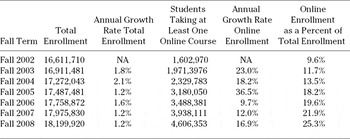
Recent trends in online learning are sparking a lively debate in educational circles. In the period from 2002 to 2008, postsecondary online course enrollments reached 4.6 million, mostly as a result of undergraduate offerings, which were 82% of the total online offerings (Allen & Seaman, Reference Allen and Seaman2010). The growth rate for online courses averaged 19% over this last decade, while total enrollments have only grown by 1.5%; these trends in favor of online learning show no signs of abating. As can be seen in Table 1, online enrollments in 2008 represented approximately a quarter of the U.S. total postsecondary fall enrollment figures, mostly as a result of courses offered by large, public universities and junior colleges.
Postsecondary Total and Online Enrollments for Fall 2002 Through Fall 2008 (Adapted from Allen & Seaman, Reference Allen and Seaman2010)

PREVIOUS STUDIES ON EFFICACY OF ONLINE LEARNING
Some educators and parents worry that these trends in increased online learning will degrade educational quality, represented for many by the gold standard of traditional face-to-face instruction (e.g., see concerns expressed in the report, “Remote and Online Learning in the University of California System,” 2010; also Sanders, Reference Sanders2006). Ironically, few people stop to reflect on the fact that traditional classroom practices can vary widely with respect to techniques, class sizes, individual student attention, and teacher talents in ways that can often tarnish the privileged status normally accorded to the face-to-face classroom experience. By the same token, online courses also differ wildly not only in terms of their format but also in terms of their use of particular technological tools and pedagogies, making comparisons with other online courses or other traditional courses extremely difficult (with reference to language comparisons, see discussion in Blake, Wilson, Pardo Ballester, & Cetto, Reference Blake, Wilson, Pardo Ballester and Cetto2008). Duly noting these research problems, the Department of Education recently engaged SRI International to do a meta-analysis of the reported results concerning online learning (U.S. Department of Education, 2009). Surprisingly, researchers for this meta-study found almost no studies that rigorously compared online learning with face-to-face instruction at the K–12 level, but there did exist a basis of comparison with postsecondary courses. The authors concentrated on postsecondary Web-based courses (N = 51 effect sizes drawn from 46 separate studies) and eliminated from consideration other video- or audio-based courses and stand-alone computer materials. The findings showed that students who took all or part of their classes online performed better than those in traditional face-to-face learning environments (p < .01); furthermore, students involved in blended/hybrid learning environments did better than those in purely online courses (p < .001). The authors concluded that online learning offered a modest advantage over traditional classroom instruction, but the results appeared to be highly sensitive to the amount of time on task and did not directly address the issue of OLL. Not surprisingly, learners taking online courses who spent more time working on their own did better than those in a face-to-face situation (with respect to language study only, see the online Iowa State database compiled by Grgurovic, Reference Grgurovic2007).
Perhaps this last factor alone constitutes the most important value added with respect to online learning: The medium stimulates students to spend more time engaged with the second language (L2) materials, which ultimately promotes greater learning. The U.S. Department of Education report (2009) stated, “one should note that online learning is much more conducive to the expansion of learning time than is face-to-face instruction” (p. xvii).
With reference to OLL and L2 learning, again few comparative studies exist (for a brief review, see Blake, Reference Blake2009; Blake et al., Reference Blake, Wilson, Pardo Ballester and Cetto2008; Sanders, Reference Sanders, Crawford, Willis, Carlsen, Gibson, McFerrin, Price and Weber2005), despite the clear progress made in the area of materials creation and course design within the field of computer-assisted language learning (CALL). With respect to CALL design, two areas have flourished: tutorial CALL and social computing or computer-mediated communication (CMC). Only recently have OLL practitioners begun to think in terms of integrating both tutorial CALL and CMC together. Some CALL researchers have advocated the mixing of these two types of materials through a computer gaming approach to language learning. In what follows, each of these themes will be reviewed separately: tutorial CALL, social computing CALL, and CALL gaming.
TUTORIAL CALL
Exercises for Grammar, Vocabulary, Pronunciation, and Beyond
The name tutorial CALL is very often associated with grammar exercises of the mechanical type or what people have often referred to in pejorative terms as drill-and-kill. These exercises offer language students a relatively low level of interactivity and a limited ability to construct meaning independently (Blake, Reference Blake2009; Garrett, Reference Garrett1991). Nevertheless, mechanical grammar exercises also have a place in the L2 curriculum (Hubbard & Bradin Siskin, Reference Hubbard and Bradin Siskin2004), especially when one contemplates the importance of time on task, as has already been discussed here in connection with the U.S. Department of Education meta-analysis report (2009). Peters, Weinberg, and Sarma (Reference Peters, Weinberg and Sarma2009) have shown in their study of students learning languages in five Canadian universities that the students themselves appreciated the more individually oriented tutorial CALL approach over the social computing activities that involve newer Web 2.0 technologies such as blogs, wikis, and online chatting (Warschauer & Grimes, Reference Warschauer and Grimes2007).
Fortunately, language instructors now have at their disposal a plethora of tools to help them create or customize these types of exercises for online postings, such as Quia (http://www.quia.com/) and Hot Potatoes (http://hotpot.uvic.ca/), to name only a few. Commercial publishers for the more commonly taught languages are increasingly catering to market demands by providing extensive online grammar exercises as part of their regular textbook packages.
Although grammar may continue to be the principal teaching focus for many language instructors, L2 researchers have shown that lexical issues are just as important, if not more so, when it comes to reading and listening comprehension, especially as students progress beyond the novice level of about 1,000 to 2,000 words (Chun Reference Chun, Ducate and Arnold2006; Cobb, Reference Cobb2007; Nation, Reference Nation2001; Nation & Waring, Reference Nation, Waring, Schmitt and McCarthy1997). From the students’ perspective, then, developing an adequate L2 lexicon will not happen without some form of explicit instruction or graded reading program (Cobb, Reference Cobb2008). This viewpoint contradicts Krashen's (Reference Krashen1989) insistence that incidental vocabulary learning from extensive amounts of reading will suffice. As explained by Cobb (Reference Cobb2007), the computer can play a pivotal role in L2 lexical acquisition by tracking students’ lexical problems and providing them with multiple exposures to new words through graded texts, glossing, or explicit instruction:
The key problems of learning through extensive reading are clear. Corpus analysis shows that words beyond the 2,000 most frequent are unlikely to be encountered in natural reading in sufficient numbers for consistent learning to occur. Lexical profile analysis shows that the amount of new vocabulary in natural texts is at odds with both the lexical level and learning capacity of most learners. Text comparison analysis further shows that the rate of new word introduction in a text designed for native speakers is far more than most L2 learners will be able to cope with. And yet these same tools can also be employed positively to multiply learning opportunities, whether by facilitating the adaptation of texts that learners can read and learn from, or by habilitating unadapted texts through external resourcing. (Cobb, Reference Cobb2007, p. 60)
CALL researchers have long been convinced that multimedia word glosses make a difference in L2 lexical growth, as can be seen in Chun's (Reference Chun, Ducate and Arnold2006) excellent overview of previous research on this topic. Chun is careful to distinguish between lexical knowledge and reading comprehension, the latter being affected by many additional factors. She asserts that lexical knowledge, rather than grammatical knowledge, is significantly related to both reading and listening comprehension. The research shows that explicit instruction, including tutorial CALL (see Lafford, Lafford, & Sykes, Reference Lafford, Lafford and Sykes2007; Ranalli, Reference Ranalli2009), has a significant impact on vocabulary acquisition, but reading comprehension is more complicated and subject to a number of additional factors, including prior or background knowledge of the topic at hand. For example, Fukkink, Hulstijin, and Simis (Reference Fukkink, Hulstijin and Simis2005) have demonstrated that L2 learners retrieve unfamiliar words faster and with less variation when they are dealing with words they have trained on. In the same vein, Yanguas (Reference Yanguas2009) found that students with access to multimedia glosses (i.e. text plus picture) outperformed all other groups, including those with only textual glosses, on measures testing reading comprehension. (For a review of work done on listening or video comprehension and with bimodal input, i.e., subtitles in the target language, see Sydorenko, Reference Sydorenko2010).
With respect to commercial applications and glossing, LeLoup and Ponterio (Reference LeLoup and Ponterio2005) reviewed two free Internet software programs, WordChamp and UltraLingua, which allow users to control their word searches while reading on the Web for a large number of languages. The user rolls the cursor over a word on the Web or any textual passage pasted into their special text field in order to look up the words and, in most cases, hear them pronounced correctly. WordChamp allows students to assemble a list of difficult words in flashcard fashion in order to continue practicing them. An interesting line for the design of future tools would be to connect the learner not only with lexical entries but also with corpora data that offer collocation information, too.
In a similar fashion to the benefits cited earlier for vocabulary growth, computer programs that focus on improving L2 pronunciation have shown some promise. Cucchiarini, Neri, & Strik (Reference Cucchiarini, Neri and Strik2008) examined the effectiveness of using an automatic speech recognition (ASR) system to give feedback on L2 Dutch pronunciation. Thirty immigrants studying Dutch were assigned to three groups that had access to (a) an ASR-based system for pronunciation training with automatic feedback, (b) an ASR-based system without feedback, or (c) no computer-assisted pronunciation training whatsoever. According to the human experts who evaluated overall segmental quality, the first group, which received ASR-based feedback, posted the largest mean improvement, although overall the means for these three groups did not differ significantly. The group receiving ASR-based feedback showed a significantly larger improvement than the no-feedback group in terms of the segmental quality of the problematic phonemes targeted.
Many commercially available language programs tend to include a section dedicated to pronunciation along with exercises, with the program Tell Me More from Auralog being one of the leading contenders because of its ASR-based feedback (see review by Lafford, Reference Lafford2004). This program is organized into 12 lessons, each with an abundant array of activities and exercises that deal with vocabulary development and pronunciation that can be undertaken in three modes: guided, free-to-roam, and dynamic (which promotes or demotes the students according to their progress). The program's oral workshop provides waveforms and pitch contours for both words and sentences based on the correct native speaker forms that serve as a basis of comparison for the learner's own speech production. In the phonetics exercises, the program offers learners not only waveforms and pitch curves but also a 3-D animation of the correct pronunciation that focuses on the action of the lips and tongue. Both the “Picture-Word Association” and “Word Order” exercises both employ the Auralog ASR-tool where students can compare their pronunciation contours with those of native speakers.
CALL programs that tackle teaching pragmatics are relatively rare, with the notable exception being the work of Sykes and Cohen (Reference Sykes, Cohen and Dreyer2009) and Sykes (Reference Sykes, Lomika and Lord2009). These researchers have created CALL materials for teaching Spanish pragmatics on the Web called Dancing with Words (http://www.carla.umn.edu/speechacts/sp_pragmatics/home.html). The Web site is organized by pragmatic functions such as expressions of gratitude, leave-takings, requests, apologies, invitations, advice, suggestions, complaints, and reprimands. Each topic provides a detailed pragmatic explanation, a possible situation, video illustrations that provide a correct model, and self-correcting activities. The site is designed with both teachers and students in mind.
They have also collaborated to produce a synthetic immersive learning environment called Croquelandia to teach pragmatics that will be examined in the next section on games. However, progress in pragmatic knowledge for students using these materials appears to have been rather modest by the authors’ own admission (Cohen & Sykes, Reference Cohen and Sykes2010). Clearly, this will remain an active and promising area for future CALL research.
Intelligent CALL (iCALL)
Another avenue within tutorial CALL employs the use of natural language processing and a modicum of artificial intelligence in order to enhance the type of feedback provided to the student working alone online (Nerbonne, Reference Nerbonne and Mitkov2003). This approach is known as intelligent CALL, or iCALL, because it seeks to individualize instruction by providing a system of responses and interactions based on an extensive record of each user's exchanges with the tutorial CALL system (Heift, Reference Heift2010a). iCALL systems should be designed to anticipate students’ mistakes, offer helpful suggestions, and keep track of their behavior while using the program. Accordingly, one of the key features of an iCALL system resides in the detailed and individualized level of feedback that the program offers the student, along with keeping track of each student's most common mistakes.
To date, only three iCALL systems have been fully implemented with similar types of activities: E-Tutor for German, described earlier (Heift, Reference Heift2010a); Tagarela for Portuguese (Amaral & Meurers, Reference Amaral and Meurers2009); and Robo-Sensei for Japanese (Nagata, Reference Nagata2010). One of the advantages of an iCALL approach to language learning is that the increased level of feedback significantly raises the students’ grammatical awareness, sometimes by providing preemptive feedback (Ellis, Basturkmen, & Loewen, Reference Ellis, Basturkmen and Loewen2001).
In the specific case of E-Tutor (Heift, Reference Heift2010a), the program logs have compiled a learner corpus over 5 years that has tracked over 5,000 students. Each of the 15 chapters includes 70 to 80 individual exercises that practice grammar, vocabulary, listening and reading comprehension, and cultural knowledge. Sentence building is one of E-Tutor's trademark activities because of the extensive feedback offered to each student response. Not only can students access and compare their own interlanguage with that of their peers, but instructors can also use these logs to guide the design of the L2 curriculum with an increased sensitivity to what constitutes difficulty for the L2 learner. Such an L2 learning corpus has allowed Heift (Reference Heift2010a, Reference Heift2010b) to discover that the more specific the feedback—and, possibly, the easier it is to correct an error—the more likely students are to engage in the error-correction process by showing an increase in learner uptake. Clearly, the iCALL approach holds great promise for the CALL field, but the time it takes to develop such a system in not significant by any means.
SOCIAL COMPUTING CALL
Textual-Based Chat, Asynchronous and Synchronous CMC
For several decades now (see Garrett, Reference Garrett1991), CALL researchers have joined other educators in demanding a more learner-centered classroom where students can exercise their own agency. Without a doubt, social computing and other forms of CMC constitute the single most influential technological response to this call for more learner control, because CMC gives both the instructors and students the ability to direct the conversational flow (Chapelle, Reference Chapelle2008; Kern & Warschauer, Reference Kern, Warschauer, Warschauer and Kern2000). Not all researchers regard the terms CMC and social computing as synonymous, because the latter implies the idea of social networks and a greater communicative depth (Brown & Adler, Reference Brown and Adler2008; Warschauer & Grimes, Reference Warschauer and Grimes2007).
CMC, however, is a broad term that could refer to asynchronous CMC (ACMC) using e-mails, forums, blogs, wikis, or synchronous CMC (SCMC) such as instant messenger programs or Skype, with or without voice or video (for a review of CMC tools, see Lafford & Lafford, Reference Lafford and Lafford2005). Some CMC formats, such as Wave (soon to be abandoned by Google), are hard to categorize, but still belong somewhere in the mix of social computing tools. Chat is another slippery term that is often used to refer to just textual exchanges, but it also is used to refer to more elaborate audio and video exchanges such as with Skype. This array of tools has made social computing providers such as Facebook, MySpace, and LinkedIn an integral part of our society, especially among our youth, by facilitating the growth of social networks via the computer. A Wikipedia search for social networking sites yields a staggering list of servers aimed at all age groups and interests.
With respect to L2 instruction, CMC allows instructors and learners to engage in meaningful negotiations with all of the positive benefits associated with scaffolding that have been reported in the literature for face-to-face exchanges (Smith, Reference Smith, Mackey and Polio2009). Typically, foreign language teachers have set up tasks that their students accomplish by helping each other in pairs through CMC chat, with or without sound or video. As the participants encounter linguistic structures that they fail to understand, they may request the assistance of their partner in order to continue working on a common solution to the assigned task. This type of CMC-assisted curriculum has been employed with native speakers and learners, as well as peer groups of learners, with proven benefits for all parties concerned. Some teachers have even used Facebook to stimulate their students to interact with each other, but not without awakening certain concerns about mixing personal networks with more academic ones. But as mentioned earlier, there are many CMC tools to choose from that do not invade the more personal realm of social networking while still allowing teachers to take advantage of the power of social computing.
RESEARCH ON CMC USE AND EFFECTIVENESS
Recently, the CALL field has witnessed a veritable explosion in the number of studies examining the use and effectiveness of CMC (e.g., Hample & Hauck, Reference Hample and Hauck2004; Lomicka & Lord, Reference Lomicka and Lord2009; Meskill, Reference Meskill2009). Researchers have analyzed the use of CMC from either an interactionist (Smith, Reference Smith, Mackey and Polio2009) or sociocultural perspective (Belz & Thorne, Reference Belz and Thorne2006; Lomicka, Reference Lomicka, Ducate and Arnold2006). Both approaches have their roots in Vygotsky's (Reference Vygotsky1962) notions of scaffolding or, to be more precise, the zone of proximal development, which refer to the difference between what learners can do with or without assistance.
The interactionist approach has focused more on how L2 learners negotiate meaning with their peers or with more expert interlocutors (i.e., advanced learners or native speakers) in the course of carrying out meaningful exchanges of information, especially jigsaw tasks. In general, researchers within this paradigm have followed a coding system developed more than 20 years ago by Varonis and Gass (Reference Varonis and Gass1985) that labels the scaffolding that occurs as part of the negotiations of meaning according to the following sequence: <trigger ➔ indicator ➔ response ➔ reaction to the response>. Earlier CMC interactionist studies found that negotiations of meaning occurred in ACMC in ways similar to those exhibited in face-to-face exchanges and with the same learning outcomes (Blake Reference Blake2000; de la Fuente, Reference de la Fuente2003; Pellettieri, Reference Pellettieri, Warschauer and Kern2000; Smith, Reference Smith2003; Sotillo, Reference Sotillo2000). More recently, Yanguas (Reference Yanguas2010) has provided data to support the notion that SCMC with video capabilities also allows students to carry out negotiations of meaning with the same success as students working in a face-to-face format. Smith (Reference Smith, Mackey and Polio2009), however, has urged researchers to improve their methodology by supplementing text logs with video recordings in order to capture the dynamics of these online exchanges, especially with an eye to revealing students’ self-initiated repairs. Sauro (Reference Sauro2009) reported that metalinguistic feedback given during CMC session had a positive effect on grammatical accuracy, at least in the short run—results that concur with the findings from Heift's (Reference Heift2010b) longitudinal study (see also Lee [Reference Lee2007] for a more sociocultural approach).
Finally, Sauro's (Reference Sauro2008) case study of dyad online communication showed how one student preferred to use textual chat as opposed to voice chat as a means of regaining control of the conversational dynamics as a way to equalize the power relationships in play during the completion of the task. Clearly, interactionist CMC studies still have more to say to the CALL field in the future, especially with respect to tracking the effect of feedback and charting the preferred CMC tools and their respective affordances.
Researchers using sociocultural theory (SCT) have focused on CMC more by looking at how L2 learners participate in new communities of practice—with different levels of success in using the target language and gaining an understanding of the new culture. In many cases, the central issue within SCT deals with the construction of an emerging L2 identity within a learning environment that provides interpersonal and interactive scaffolding (Kramsch, Reference Kramsch2009). Some instructors use telecollaborations or teleconferenced tandem learning with students from different countries who are learning each other's language and culture (Darhower, Reference Darhower2007; O'Dowd, Reference O'Dowd, Belz and Thorne2006; Ware & Kramsch, Reference Ware and Kramsch2005). The Massachusetts Institute of Technology project Cultura (Furstenberg, Levet, English, & Maillet, Reference Furstenberg, Levet, English and Maillet2001) is perhaps the most widely known application of this concept of tandem learning where German, French, or Spanish students from an overseas L2 English class carry out a discussion of cultural topics in conjunction with a corresponding group of American L2 language learners. Students share their opinions on broad cultural issues using their native language to leverage maximum expressiveness and clarity, but then use their counterparts’ comments phrased in the target language as classroom linguistic fodder to further their knowledge of new L2 vocabulary and structures. Understandably, these tandem exchanges will sometimes produce a number of cultural misunderstandings, precisely because L2 learners have an incomplete knowledge of the target culture. These types of electronic exchanges provide a forum to expand cultural awareness, provided that the teacher is skillful enough to keep students from becoming bogged down in cultural and ethnic stereotypes (Belz & Thorne, Reference Belz and Thorne2006).
Within the same classroom, Oskoz (Reference Oskoz2009) has explored how learner–learner exchanges can foster the students’ linguistic improvement (i.e., microgenetic growth) as a result of the shared performance that takes place while working together on an assigned task. Lee (Reference Lee2007) explored a similar theme with a variety of tasks: jigsaw, spot-the-differences, and open-ended questions.
Both CMC approaches, interactionist and sociocultural, promise a rich line of investigation for the future since social computing shows no sign of losing its importance in our society.
GAMES FOR LANGUAGE LEARNING
The Nature of Language Learning Games
CALL researchers and curriculum developers have recently begun to turn to the gaming environment and the notion of play as a viable way to stimulate learning a second language (Gee, Reference Gee2007; Peterson, Reference Peterson2006, Reference Peterson2010; Sørensen & Meyer, Reference Sørensen and Meyer2007; Thorne & Black, Reference Thorne and Black2007). Games have the potential to combine the best of what has been developed over recent years in tutorial CALL programs with the attractive affordances provided by social computing (Thorne, Reference Thorne and Magnan2008). Accordingly, students can work individually but also share their results by working in teams using chat programs to facilitate textual and/or audio exchanges. Usually, the visual representation of the students’ personae is mediated through the use of an avatar (Peterson, Reference Peterson2010). Games are always task oriented or focused on play and often are accomplished by working in groups. For instance, in World of Warcraft (whether in Spanish, French, English, or another language), online players navigate through a fantasy world of beasts and warriors in pursuit of different quests or battle goals. In Second Life (SL), people dress in whimsical costumes in order to pursue their own social or academic agendas. In the Forgotten World, English learners participate in an online comic-strip drama that develops new linguistic skills while helping to solve the adventure story at hand.
Understandably, then, not all games are the same: There are single-player games, cooperative or two-player games, and massively multiplayer online role-playing games (MMOs). Each has its own rhythms, affordances, and dynamics. Multiple-player games often provide online chat during play, either through textual and/or audio exchanges. Thorne, Black, and Sykes (Reference Sykes, Lomika and Lord2009) used a tripartite classification: (a) social virtualities, such as Second Life or Active Worlds (Peterson, Reference Peterson2006, Reference Peterson2010); (b) commercial MMOs, such as World of Warcraft (Soares, Reference Soares2010; Thorne, Reference Thorne2003); and (c) made-for-education synthetic immersive environments, such as Croquelandia (Sykes, Reference Sykes, Vincenti and Braman2011; Sykes, Oskoz, & Thorne, Reference Thorne and Magnan2008). These different gaming platforms are all part of the virtual environment and gaming spaces that can be harnessed in the service of OLL.
What do games do that might assist students in learning in general (Gee, Reference Gee2007; Prensky Reference Prensky2000; Squire & Jenkins, Reference Squire and Jenkins2004; Steinkuehler, Reference Steinkuehler, Kafai, Sandoval, Enyedy, Nixon and Herrera2004, Reference Steinkuehler2006) and in language learning in particular? First and foremost, games allow people to play, and language games are no exception. But games are not entirely free or unstructured play; they are designed experiences, as Squire (Reference Squire2006) described them, with defined goals and rules. Learners submit to these goals, but only if they can continue to be playful (Klopfer, Osterweil, & Salen, Reference Klopfer, Osterweil and Salen2009). Playfulness itself is rather like an act of faith that invests the game with special meaning. Players accept the rules of the designed experience just as people accept the protocols of the live stage, thereby allowing the game to have verisimilitude along with variety. Verisimilitude constitutes the very essence of play—the game has to seem real, feel real, or at least allow us to pretend it is real in order to suspend disbelief.
Role-playing is another way to think about play and verisimilitude; games allow students to explore new identities in a unique state of relative pseudonymity in a persistent or ever-present game world. This quality parallels what language instructors are trying to get their students to do when they learn a second language: Expand into a new bilingual or multilingual self, something akin to what Kramsch (Reference Kramsch2009) has described with references to the multilingual subject.
The environment of Second Life constitutes a good example of a learning environment where play-acting can take place, although SL play may not constitute a game in the strict sense of the term. All this play-acting, however, has an effect on language as well. Yee and Bailenson (Reference Yee and Bailenson2007) have called this the “Proteus effect”: An individual's verbal behavior is affected by his or her digital self-presentation. In other words, the ways in which students play crucially affect how they learn.
Second, and closely related to the idea of role-playing, games foster agency, allowing players to do something and construct meaning. Games make the users feel that they are being competent and independent problem solvers. Games encourage a participatory culture with different rates and learning paths in response to the gamers’ interests and abilities. Within these designed experiences, the participants enjoy the freedom to fail with low risks, experiment, fashion identities, exert varying degrees of effort, and interpret. Gee (Reference Gee2007) concluded that games let players be producers, not just consumers, by promoting agency, control, and ownership. Game players have to think like scientists because they must hypothesize, probe the micro world, get a reaction, reflect on the results, and then probe again in order to get better results.
This last phase of the process really is a reference to practice. Purushotma, Thorne, and Wheatley (Reference Purushotma, Thorne and Wheatley2008) insisted that game design must dedicate at least as much thought about failure states as to success states—a trait that shares much in common with the stated goals of iCALL programs. In other words, repetitive practice, with instructive feedback, has to be an integral part of the game design and the learning cycle. Again, this sounds very similar to what students need to go through when learning a second language and should be part of any CALL design.
Language Games, Language Play: Research, Caveats
To date, there have been few experimental studies that examine how L2 learners fare within a virtual learning environment. Soares (Reference Soares2010) has begun the exploration of World of Warcraft as a learning platform for Spanish, using an ethnographic approach that looks at her own behavior and that of a friend. Peterson (Reference Peterson2010) reported on six studies dealing with a German-language multiuser object-oriented domain (MOO), an English-language SimCopter, an ESL-based SimCity, a Japanese-based application programmed in Active Worlds, an ESL (English as a second language) example realized in World of Warcraft, and an Arabic language multimedia tutorial/simulation called Tactical Iraqi. Peterson described these six gaming experiences in positive terms, especially because they helped learners increase their target language production, negotiations of meaning, and good learner reception. Ranalli (Reference Ranalli2008) used SimCity to teach vocabulary and included a rigorous set of assessment measures, but only nine students participated. The use of Croquelandia as a learning medium has already been discussed here (Thorne et al., Reference Thorne, Black and Sykes2009), but Cohen and Sykes (Reference Cohen and Sykes2010) reported limited progress in developing strategic competence in L2 pragmatics competence or students working in this medium.
Curriculum development for language learning games is proceeding ahead on many fronts. With their online publication of the Forgotten World <http://www.theforgottenworld.net> and the Xenos platform, the Learning Games Network (http://www.learninggamesnetwork.org) has effectively employed games in China to teach ESL online, with an eye to expanding this environment to other languages in the near future. Languagelab.com has an extensive ESL presence in Second Life and has also launched Ciudad Bonita as a locus for teaching Spanish. Likewise, there are other locations in SL where speaking in languages other than English can take place spontaneously (e.g., Barcelona, SL coordinates: 169, 68, 23).
Without a doubt, using games for learning languages opens up an exciting new area for future research but its curricular development faces serious caveats. The literature often refers to environments such as Second Life as “digital dollhouses,” where people just dress up and act out without much significant learning taking place. Likewise, the school-age population is increasingly intolerant of unsophisticated graphics, which increases the possibility that incursions into the gaming curriculum will become an expensive proposition. Pedagogically sound games should be able to exist in black-and-white or color, with more or fewer pixels, but ultimately, the students themselves will have to determine the limits of visual acceptability. Finally, programming games, whether stand-alone or online, such as for an adventure in Croquelandia or SL, remain a thoroughly time-consuming and, consequently, expensive endeavor for most, leaving the development process accessible only to well-financed commercial ventures that have little stake in the educational curriculum or highly collaborative research groups, which are hard to maintain.
Clearly, more research is needed with respect to using games for OLL, but the fact that $125 million was spent on the first day of the release of Halo 2 on November 9, 2004, should give our profession reason alone to be interested in games for the purposes of language learning (Squire, Reference Squire2006). Games have captured the attention of today's students and, to a greater degree, the new generation coming up from the elementary ranks, as has been well documented in the forward-looking recommendations contained in the federal report Transforming American Education from the U.S. Department of Education (2010).
CONCLUSIONS
Fortunately, the CALL field has matured beyond the dilemma of choosing either tutorial CALL or social computing, as long as the curricular choices support activities that contribute to L2 learning (Chapelle, Reference Chapelle2009). Both types of CALL have their place in the OLL curriculum. No doubt, the role of explicit feedback either through iCALL or CMC will continue to be a major focus for CALL researchers.
The gaming world, as described here, has not been burdened with this traditional dichotomy and simply employs both techniques when warranted in order to maintain student interest. Perhaps therein lies the importance of all activities carried out through OLL: These learning environments and tools help students maintain their interest in learning a language over a long period of time. And like it or not, learning another language to a minimal professional level (i.e., level 3 on the Interagency Linguistic Roundtable scale) is a very time-consuming activity (Blake, Reference Blake2008).
Given the enthusiasm with which today's young people engage in social networking, it is quite possible that language students feel particularly comfortable connecting digitally with members of the target culture, which would enhance their digital communicative competence at the very least. The same channel might also be leveraged to connect the language classroom with other language-use areas, so that L2 students can become lifelong language learners, rather than dead-end students, at the completion of the language requirement.