Introduction
Chinstrap penguins (Pygoscelis antarcticus (Forster)) are an Antarctic species that breeds during the summer in colonies on ice-free areas of the coast, mainly on sub-Antarctic islands and the Antarctic Peninsula. In the South Shetland Islands, the total breeding population was estimated to be 1 248 350 pairs (Harris Reference Harris2006). As in other penguin species, they show little sex-linked size and plumage dimorphism, although males are usually bigger than females (Davis & Speirs Reference Davis and Speirs1990, Zavalaga & Paredes Reference Zavalaga and Paredes1997, Bertellotti et al. Reference Bertellotti, Tella, Godoy, Blanco, Forero, Donázar and Ceballos2002, Valenzuela-Guerra et al. Reference Valenzuela-Guerra, Morales-Moraga, González-Acuña and Vianna2013).
Knowing the sex of individuals is essential for measuring several parameters of interest to the Commission for the Conservation of Antarctic Marine Living Resources (CCAMLR) and the Ecosystem Monitoring Program (CEMP). For chinstrap penguins, weight on arrival at the breeding colony and age-specific annual survival and recruitment are important population parameters that involve a knowledge of the penguin’s sex (CCAMLR 2004). Moreover, sex classification is important in studies of life history, ecology, behaviour, demography, conservation and evolutionary change.
Previous studies have determined the sex of penguins using morphometric measurements and discriminant functions (Amat et al. Reference Amat, Viñuela and Ferrer1993, Zavalaga & Paredes Reference Zavalaga and Paredes1997, Bertellotti et al. Reference Bertellotti, Tella, Godoy, Blanco, Forero, Donázar and Ceballos2002, Hart et al. Reference Hart, Fitzcharles, Trathan, Coulson and Rogers2009, Poisbleau et al. Reference Poisbleau, Demongin, van Noordwijk, Strange and Quillfeldt2010, Polito et al. Reference Polito, Clucas, Hart and Trivelpiece2012, Valenzuela-Guerra et al. Reference Valenzuela-Guerra, Morales-Moraga, González-Acuña and Vianna2013). However, as is common for philopatric seabirds, many penguin species show considerable geographic variation in body size (Williams Reference Williams1995), which makes it difficult to apply discriminant functions in locations other than where they were developed. Moreover, morphometric tests are potentially prone to a bias because males that are unusually small or late to develop may be scored as female (Hart et al. Reference Hart, Fitzcharles, Trathan, Coulson and Rogers2009). Immature penguins have smaller measurements than adults (Minguez et al. Reference Minguez, Fargallo, de Leon, Moreno and Moreno1998), thus immature males may be misclassified as adult females.
Other methods, such as observing mating behaviours are also used. However, this only covers a small window of the breeding season (Bertellotti et al. Reference Bertellotti, Tella, Godoy, Blanco, Forero, Donázar and Ceballos2002). A potential alternative for accurately sexing penguins is a DNA-based method that uses polymerase chain reaction (PCR) to target CHD1-Z and CHD1-W genes using the primers P2/P8 (Griffiths & Tiwari Reference Griffiths and Tiwari1993, Griffiths Reference Griffiths2000). This tool has been broadly applied to birds (except ratite species) (Griffiths & Tiwari Reference Griffiths and Tiwari1993, Griffiths Reference Griffiths2000). The P2/P8 primer pair gives high concordance with the results of morphometric sexing, improving the certainty of sexing birds (Hart et al. Reference Hart, Fitzcharles, Trathan, Coulson and Rogers2009). Although genetic procedures have been applied to some species of penguins (Costantini et al. Reference Costantini, Guaricci, Laricchiuta, Rausa and Lacalandra2008, Hart et al. Reference Hart, Fitzcharles, Trathan, Coulson and Rogers2009, Poisbleau et al. Reference Poisbleau, Demongin, van Noordwijk, Strange and Quillfeldt2010, Valenzuela-Guerra et al. Reference Valenzuela-Guerra, Morales-Moraga, González-Acuña and Vianna2013), these techniques have only been tested once in chinstrap penguins (Polito et al. Reference Polito, Clucas, Hart and Trivelpiece2012). An earlier study investigated sexual dimorphism in chinstrap penguins but only through the use of a morphometric discriminant function (Amat et al. Reference Amat, Viñuela and Ferrer1993). Temporal attendance during incubation has also been used to determine sex in chinstrap and other penguin species (Williams Reference Williams1995). Nevertheless, previous studies show that molecular sexing can complement methods based on discriminant function analysis in species with weak size dimorphism (Genovart et al. Reference Genovart, McMinn and Bowler2003, Jakubas & Wojczulanis Reference Jakubas and Wojczulanis2007, Hart et al. Reference Hart, Fitzcharles, Trathan, Coulson and Rogers2009, Calabuig et al. Reference Calabuig, Green, Ferrer, Muriel and Moreira2011).
The goals of this study were, first, to identify male and female adult chinstrap penguins using a DNA-based molecular sexing technique at Stinker Point, Elephant Island. Second, sexual dimorphism between males and females was evaluated using morphological characteristics previously assessed in the literature. Third, a discriminant function, based on the characteristics that best identify the sex of chinstrap penguins, was obtained. In addition, the measures were compared with those described by Amat et al. (Reference Amat, Viñuela and Ferrer1993) and Polito et al. (Reference Polito, Clucas, Hart and Trivelpiece2012) to evaluate sexual dimorphism between breeding locations and to test the performance of the discriminant function.
Methods
Chinstrap penguin breeding adults were captured by hand near their nests at Stinker Point (Elephant Island; 61°13'20"S, 55°21'36"W), South Shetland Islands, Antarctic, in the 2011–12 and 2012–13 breeding seasons. Four morphological measurements were taken using a calliper. Bill (culmen) length (BL) and commissure width (CW, taken at the base of the bill where the mandibles join) were measured to an accuracy of 0.1 mm. Bill depth (BD) was measured through the centre of the nostrils. Flipper length (FL) (average of right and left flippers) was measured with a graduated rule. All measurements were conducted by the same person. In total, 35 birds (for BD, n=31) were measured (November 2011 and 2012, laying stage) and blood samples were taken from the foot.
Molecular sexing
Genomic DNA was isolated from blood samples through a standard phenol/chloroform technique with digestion by Proteinase K. Blood samples were refrigerated and stored in a sample bank at Laboratório de Biologia Molecular, Universidade do Vale do Rio dos Sinos. The CHD region of the sex chromosomes was amplified by PCR using the primers P2 and P8 (Griffiths & Tiwari Reference Griffiths and Tiwari1993, Griffiths Reference Griffiths2000). The PCR products were analysed by electrophoresis in 3% agarose gels stained with ethidium bromide and visualized under ultraviolet transillumination. Females are the heterogametic sex with both CHD-Z and CHD-W genes, which differ in length and appear as two bands on the gel. Males are homogametic and thus show a single band (Griffiths & Tiwari Reference Griffiths and Tiwari1993, Griffiths Reference Griffiths2000). The P2/P8 primers may, in some species, produce only one fragment in both males and females; therefore, females may be misidentified as males. Independent PCR amplification was made for all individuals who had only one fragment for sex identification.
Statistical analysis
Dimorphism between males and females was calculated for each measurement using the adapted Storer’s index (SI):
 $${\rm SI}\,{\rm =}\,\left[ {\left( {{\rm Vm\,{\hbox{-}}\,Vf}} \right){\rm /}\left( {\left( {{\rm Vm{\plus}Vf}} \right){\rm {\times}0}{\rm .5}} \right)} \right]{\rm {\times}100,}$$
where, Vm corresponds to the mean value for males and Vf to the mean value for females of the variable considered (Storer Reference Storer1966, Blondel et al. Reference Blondel, Perret, Anstett and Thebaud2002, González-Solís Reference González-Solís2004, Mariano-Jelicich et al. Reference Mariano-Jelicich, Madrid and Favero2007). Morphological measurements were compared between sexes and breeding locations (Stinker Point, Elephant Island and Admiralty Bay, King George Island), and interactions were assessed using two-way analyses of variance (ANOVAs). Pearson’s correlations were used to examine the relationships among the morphometric characteristics.
A stepwise discriminant function analysis was performed to assign individuals to a sex based on morphological measurements (BD, BL, CW and FL) that had significant influence on the classification of males and females (F-test of Wilk’s Lambda, test of equality of group means). A cross-validation technique (leave-one-out test) was used to verify the accuracy of the discriminant function. This algorithm chooses the function that has the lowest percentage of misclassification. All data satisfied the Bartlett test of normality. The cut-off point was calculated as the weighted average of values of discriminant scores (i.e. average value of the mean of each sex; means were weighted by the number of males and females). Adults with discriminant scores greater than the cut-off point were classified as male and those with lower scores were classified as female. The discriminant functions from Amat et al. (Reference Amat, Viñuela and Ferrer1993) and Polito et al. (Reference Polito, Clucas, Hart and Trivelpiece2012) were applied to the penguins from Stinker Point. With the raw measurement data that were available, the discriminant function from Amat et al. (Reference Amat, Viñuela and Ferrer1993) was also applied to the data of Polito et al. (Reference Polito, Clucas, Hart and Trivelpiece2012) to assess the efficiency of the discriminant function. This allowed us to quantify how transferable the discriminant equation was to other breeding sites.
All statistical analyses were performed using SPSS 18.0 (SPSS 2009). All tests were two-tailed and differences were considered significant at P≤0.05 level.
Results
Molecular sexing
Of 35 penguins at Stinker Point, Elephant Island, 19 were male and 16 were female. PCR produced a single band of about 375 base pairs (bp) for males and two bands of about 375 and 390 bp for females.
Morphometric differences between sexes and breeding locations
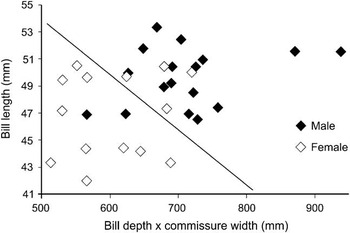
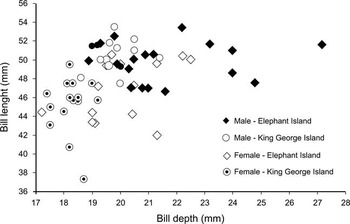
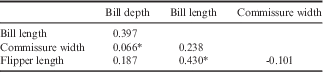
The BD, BL, and CW differed significantly between sexes, with males being 6.0–9.4% larger than females, even though there was overlap in some morphological measurements (Table I, Fig. 1; for all the measurements see a supplemental table at http://dx.doi.org/10.1017/S0954102014000820). The SI for CW, BD and BL were 9.9%, 8.5% and 6.2%, respectively (Table I). Males also had a greater FL (1.5%), but this difference was not significant (Table I). There were significant effects of breeding location and sex on BD; even if the interaction between location and sex was not significant (Table I, Fig. 2). For BL, there were significant differences between males and females, but not between breeding locations (Table I, Fig. 2). Pearson’s correlations among morphometric measurements are shown in Table II. Furthermore, the variance inflation factors (VIF) test showed that there is no multicollinearity between the morphometric measurements (BD=1.188, CW=1.205, BL=1.728 and FL=1.513).
Discriminant function separating male (n=17) and female (n=14) chinstrap penguins using bill length, bill depth and commissure width at Stinker Point, Elephant Island. The solid line represents the statistical boundary between males and females, derived from the discriminant function. True sexes were determined by a molecular technique: male n=17 and female n=14.

Bill length and bill depth for breeding adult chinstrap penguins at Admiralty Bay, King George Island (Polito et al. Reference Polito, Clucas, Hart and Trivelpiece2012) and Stinker Point, Elephant Island.

Morphological measurements for adult chinstrap penguins at Stinker Point, Elephant Island. Sexes and breeding locations were compared between Admiralty Bay, King George Island (Polito et al. Reference Polito, Clucas, Hart and Trivelpiece2012) and Stinker Point, Elephant Island using a two-way analysis of variance (ANOVA).

SI=Storer’s index, SD=standard deviation.
Pearson’s correlation coefficient (r) among morphometric measurements for chinstrap penguins (n=31) from Stinker Point, Elephant Island.
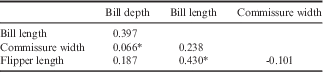
*P<0.05.
Discriminant function analysis
For the discriminant function analysis, BD, BL and CW had the highest canonical correlations (0.629) and best classified breeding male and female adults at Stinker Point (Fig. 1). The accuracy of the classification of chinstrap penguins was 80.6% after cross-validation. The discriminant function was:
 $${\rm 0}{\rm .301BD{\plus}0}{\rm .207BL{\plus}0}{\rm .191CW\,{\hbox{-}}\,22}{\rm .349,}$$
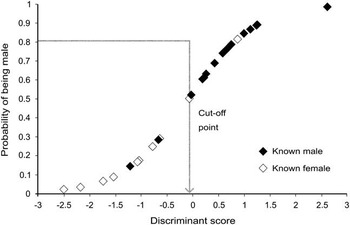
where all measurements are in mm. The resulting cut-off point for the discriminant function was D=-0.076. Chinstrap penguins with a discriminant score greater than this were classified as male and those with a lower score were classified as female (Figs 1 & 3). In general, misclassifications occurred when females were larger.
Probability of a chinstrap penguin being male in relation to discriminant score at Stinker Point, Elephant Island.

Discussion
For chinstrap penguins, the results showed that males were significantly larger than females for three morphological measurements (BD, BL and CW) (Table I, Fig. 1). This shows that there is sexual dimorphism in this species, and it is possible to obtain information about sex in the field. Other authors have found similar results for seabirds (Amat et al. Reference Amat, Viñuela and Ferrer1993, Serrano-Meneses & Székely Reference Serrano-Meneses and Székely2006, Polito et al. Reference Polito, Clucas, Hart and Trivelpiece2012). In socially monogamous seabirds, sexual size dimorphism is correlated with sexually selected male displays, such that males are typically larger than females in those species in which the males display on the ground rather than in the air (Serrano-Meneses & Székely Reference Serrano-Meneses and Székely2006). Other functional explanations that may account for male penguins being larger are intrasexual competition (males compete for access to females or for control of a resource) and intersexual competition (competition for food is reduced by males and females exploiting prey of different sizes) (Davis & Speirs Reference Davis and Speirs1990). Male chinstrap penguins are more aggressive in nest defence towards potential stone thieves than females; males also collect more and larger stones for nest maintenance (Moreno et al. Reference Moreno, Bustamante and Viñuela1995). Nevertheless, when it comes to feeding, there is no difference in meal size between male and female chinstrap penguins (Leon et al. Reference De Leon, Fargallo and Moreno1998).
At Stinker Point, Elephant Island, BD, BL and CW were the most reliable morphological measurements for assessing sex, and enabled us to sex birds with an accuracy of 80.6% (Figs 1 & 3). Additionally, BD and BL are the most useful measurements for distinguishing between males and females, and are often highly dimorphic in a variety of penguin species (Amat et al. Reference Amat, Viñuela and Ferrer1993, Zavalaga & Paredes Reference Zavalaga and Paredes1997, Poisbleau et al. Reference Poisbleau, Demongin, van Noordwijk, Strange and Quillfeldt2010, Polito et al. Reference Polito, Clucas, Hart and Trivelpiece2012). Morphometric sexing is useful when there is limited time to manipulate birds, and can provide instant information in field studies (Zavalaga & Paredes Reference Zavalaga and Paredes1997, Poisbleau et al. Reference Poisbleau, Demongin, van Noordwijk, Strange and Quillfeldt2010).
Previous studies claim that the chinstrap penguin does not display geographic variation (Marchant & Higgins Reference Marchant and Higgins1990, Amat et al. Reference Amat, Viñuela and Ferrer1993). In our study, this species exhibited morphological variation among breeding locations for one of our variables, BD, which differed significantly between Admiralty Bay and Stinker Point (Table I). However, the interaction between location and sex was not significant for CW, and there was only a significant difference for BL between males and females, but not between locations (Table I). Despite this, chinstrap penguins at Stinker Point appeared to have a tendency to have larger morphometric measurements (Fig. 2). However, this trend should be considered with caution, as there is a need for a longer period of sampling. As highlighted by Zavalaga & Paredes (Reference Zavalaga and Paredes1997), the results of a discriminant function based on one breeding location are not necessarily widely applicable.
Several authors have found discriminant functions that classified adult penguins more accurately. Amat et al. (Reference Amat, Viñuela and Ferrer1993) correctly classified 94.6% of chinstrap penguins on Deception Island and Polito et al. (Reference Polito, Clucas, Hart and Trivelpiece2012) correctly classified 96.7% of chinstrap penguins on King George Island. Similarly, Poisbleau et al. (Reference Poisbleau, Demongin, van Noordwijk, Strange and Quillfeldt2010) correctly classified 96.2% of rockhopper penguins, and Bertellotti et al. (Reference Bertellotti, Tella, Godoy, Blanco, Forero, Donázar and Ceballos2002) correctly classified 97.0% of magellanic penguins. Our discriminant function classified 80.6% of birds correctly; however, applying the discriminant functions of Polito et al. (Reference Polito, Clucas, Hart and Trivelpiece2012) and Amat et al. (Reference Amat, Viñuela and Ferrer1993) to our data classified even fewer individuals correctly (67.7% and 71.0% of birds, respectively). Moreover, both discriminant functions also gave a bias towards identifying true females as males. Therefore, the reliability of sexing adults through biometry may be questioned, especially when applying a discriminant function to a region other than where it was developed. Large females, or males that are unusually small or late to develop, will be miscategorized. Despite these limitations, our discriminant function may be useful in the field. It is a fast technique, practical and cost-effective, especially if there is the need to sex a large number of adult penguins at any stage of the breeding season. For individuals in which the value of discriminant score is very close to the cut-off point of D=-0.076 or where the researcher has doubts regarding the sex, it is important to use another reliable technique such as molecular sexing. As has been reported previously (Bertellotti et al. Reference Bertellotti, Tella, Godoy, Blanco, Forero, Donázar and Ceballos2002, Costantini et al. Reference Costantini, Guaricci, Laricchiuta, Rausa and Lacalandra2008, Hart et al. Reference Hart, Fitzcharles, Trathan, Coulson and Rogers2009, Polito et al. Reference Polito, Clucas, Hart and Trivelpiece2012), molecular analysis, which is now becoming a relatively easy and inexpensive technique (Costantini et al. Reference Costantini, Guaricci, Laricchiuta, Rausa and Lacalandra2008, Quintana et al. Reference Quintana, López and Somoza2008), was found to be quite an effective and reliable method for sexing chinstrap penguins.
As a result of the molecular techniques used to determine the sex of chinstrap penguins it was possible to confirm the usefulness of a discriminant function constructed from morphological measurements at Stinker Point, Elephant Island. It is important to remember that discriminant function analyses should be used in the field with caution; where there is doubt, researchers should employ molecular sexing.
Acknowledgements
The Brazilian data were made possible through financial projects like INCT-APA (Instituto Nacional de Ciência e Tecnologia Antártico de Pesquisas Ambientais), (CNPq Process No. 574018/2008-5, FAPERJ E-26/170.023/2008) and were supported by Ministério do Meio Ambiente, Ministério da Ciência, Tecnologia e Inovação and Secretaria da Comissão Interministerial para os Recursos do Mar (SeCIRM) and Coordenação de Aperfeiçoamento de Pessoal de Nível Superior (CAPES). The authors are grateful to Roberta da Cruz Piuco (UNISINOS) who conducted all morphological measures in the field activities, and laboratory operators Igor Radamés de Oliveira and Guilherme Pinto Cauduro (UNISINOS) for the technical support provided. The authors are also grateful to Dr Juliano Morales de Oliveira (UNISINOS) for his helpful suggestions and discussions. The authors also extend thanks to the reviewers for their valuable comments.
Author contribution
All authors authorize the publication of this paper and have reviewed the final version.
INCT-APA Project: MVP. Research design: JB, MVP and VHV. Data analysis: JB and VHV. Writing and intellectual contribution: JB and VHV.
Supplemental material
A supplemental table will be found at http://dx.doi.org/10.1017/S0954102014000820.