




No CrossRef data available.
Article contents
Opinion: Projecting the effects of environmental change on Antarcticseals
Published online by Cambridge University Press: 16 May 2008
Abstract
We consider how Antarctic seals may respond to changes in climate, realizing thatanthropogenic alteration of food webs will influence these responses. Thespecies considered include the ice-obligate - crabeater (Lobodon carcinophaga), Weddell (Leptonychotes weddellii), Ross (Ommataphoca rossii) and leopard (Hydrurga leptonyx) seal - and the ice-tolerant Antarctic furseal (Arctocephalus gazella) and southernelephant seal (Mirounga leonina). The dataanalysed are from long-term censuses of Weddell seals in McMurdo Sound(1997–2006), and of Weddell, fur and elephant seals at ArthurHarbour, Antarctic Peninsula (1974–2005). After considering theirresponses to recent changes in environmental features, as well as projected andcurrent changes to their habitat our conclusions are that the distribution andabundance of 1) crabeater and Weddell seals will be negatively affected bychanges in the extent, persistence and type of annual sea ice, 2) Ross andleopard seal will be the least negatively influenced by changes in pack icecharacteristics, although, as may be the case for crabeater and Weddell,population size and distribution may be altered through changes in food webdynamics, and 3) southern elephant and fur seals will respond in ways oppositeto the pack ice species, but could also be influenced most immediately bychanges in their food resources due to factors other than climate.
Keywords
Information
- Type
- Opinion
- Information
- Copyright
- Copyright © Antarctic Science Ltd 2008
References
Ackley, S.F., Bengtson, J.L., Boveng, P., Castellini, M., Daly, K.L., Jacobs, S., Kooyman, G.L., Laake, J., Quetin, L., Ross, R., Siniff, D.B., Stewart, B.S., Stirling, I., Torres, J. & Yochem, P.K. 2003. A top-down, multidisciplinary study of the
structure and function of the pack ice ecosystem in the eastern Ross Sea,
Antarctica. Polar Record,
39,
219–230.Google Scholar
Ainley, D.G., Ballard, G., Karl, B.J. & Dugger, K.T. 2005a. Leopard seal predation rates at penguin colonies
of different size. Antarctic
Science, 17,
335–340.CrossRefGoogle Scholar
Ainley, D.G., Clarke, E.D., Arrigo, K., Fraser, W.R., Kato, A., Barton, K.J. & Wilson, P.R. 2005b. Decadal-scale changes in the climate and biota of
the Pacific sector of the Southern Ocean, 1950s to the 1990s.
Antarctic Science, 17,
171–182.CrossRefGoogle Scholar
Ainley, D.G., Toniolo, V., Ballard, G., Barton, K., Eastman, J., Karl, B., Focardi, S., Kooyman, G., Lyver, P., Olmastroni, S., Stewart, B.W., Testa, W.P. & Wilson, P. 2006. Managing ecosystem uncertainty: critical habitat
and dietary overlap of top-predators in the Ross Sea.
CCAMLR WG-EMM-06/29,
Hobart, Australia.Google Scholar
Ainley, D.G., Ballard, G., Blight, L., Eastman, J.T., Lescröel, A., Olmastroni, S., Townsend, S.E., Wilson, P.R. & Woehler, E. 2007. Paradigm lost, or is top-down forcing no longer an
element of the Antarctic marine ecosystem? Antarctic Science, 19,
283–290.CrossRefGoogle Scholar
Arrigo, K.R. & Van Dijken, G.L. 2004. Annual changes in sea ice, chlorophyll a, and primary production in the Ross Sea,
Antarctica. Deep Sea Research II,
51,
117–138.Google Scholar
Arrigo, K.R., Van Dijken, G.L., Ainley, D.G., Fahnestock, M.A. & Markus, T. 2002. The impact of the B-15 iceberg on productivity and
penguin breeding success in the Ross Sea, Antarctica.
Geophysical Research Letters, 29
(7), 10.1029/2001GL014160.Google Scholar
Atkinson, A., Siegel, V., Pakhomov, E. & Rothery, P. 2005. Long-term decline in krill stock and increase in
salps within the Southern Ocean.
Nature, 432,
100–103.Google Scholar
Barbraud, C. & Weimerskirch, H. 2001. Emperor penguins and climate
change. Nature, 411,
183–186.CrossRefGoogle ScholarPubMed
Bester, M. & Hofmeyr, G. 2007. Seals. In Riffenburgh, B.
, ed. Encyclopedia of the Antarctic. New
York: Taylor & Francis,
877–880.Google Scholar
Bester, M.N. & Odendaal, P.N. 2000. Abundance and distribution of Antarctic pack ice
seals in the Weddell Sea. In Davison, W., Howard-Williams, C. & Broady, P., eds. Antarctic ecosystems: models for wider ecological understanding Christchurch: Caxton
Press, 51–55.Google Scholar
Bester, M.N., Hofmeyr, G.J.G., Kirkman, S.P., Chauke, L.F., De Bruyn, P.J.N., Ferreira, S.M., Makhado, A.B., Maswime, T.A.M., McIntyre, K.T., Mulaudzi, T.W., Munyai, F.M., Pistorius, P.A., Radzilani, P.M., Ramunasi, A.J., Tshithabane, N.H. & Wilkinson, I.S. 2006. The leopard seal at Marion Island, vagrant or
seasonal transient? South African Journal of Wildlife Research,
36,
195–198.Google Scholar
Blix, A.S. & Nordoy, E.S. 2007. Ross seal (Ommatophoca
rossii) annual distribution, diving behavior, breeding and
moulting, off Queen Maud Land, Antarctica. Polar
Biology, 30,
1449–1458.Google Scholar
Bonner, W.N. 1985. Impact of fur seals on the terrestrial environment
at South Georgia. In Siegfried, W.R., Condy, P.R. & Laws, R.M., eds. Antarctic nutrient cycles and food webs Berlin: Springer,
641–646.CrossRefGoogle Scholar
Bonner, W.N. 1990. The natural history of seals New York: Facts on File
Press, 196 pp.Google Scholar
Bornemann, H., Kreyscher, M., Ramdohr, S., Martin, T., Carlini, A.R., Sellmann, L. & Plötz, J. 2000. Southern elephant seal movements and Antarctic sea
ice. Antarctic Science,
12, 3–15CrossRefGoogle Scholar
Burns, J.M., Castellini, M.A. & Testa, J.W. 1999. Movements and diving behavior of weaned Weddell
seal (Leptonychotes weddellii)
pups. Polar Biology,
21, 23–36.CrossRefGoogle Scholar
Burns, J.M., Trumble, S.J., Castellini, M.A. & Testa, J.W. 1998. The diet of Weddell seals in McMurdo Sound,
Antarctica as determined from scat collections and stable isotope
analysis. Polar Biology,
19, 272–282.CrossRefGoogle Scholar
Boyd, I.L. 1993. Pup production and distribution of breeding
Antarctic fur seals (Arctocephalus gazella)
at South Georgia. Antarctic
Science, 5,
17–24.CrossRefGoogle Scholar
Cameron, M.F. & Siniff, D.B. 2004. Age-specific survival, abundance, and immigration
rates of a Weddell seal (Leptonychotes
weddellii) population in McMurdo Sound, Antarctica.
Canadian Journal of Zoology, 82,
601–615.Google Scholar
Condy, P.R. 1978a. The distribution and abundance of southern
elephant seals, Mirounga leonina, on the
Prince Edward Islands. South African Journal of
Antarctic Research, 8,
42–48.Google Scholar
Condy, P.R. 1978b. The distribution, abundance and annual cycle of
fur seals Arctocephalus spp. on the Prince
Edward Islands. South African Journal of Wildlife
Research, 8,
159–168.Google Scholar
Condy, P.R. 1979. Annual cycle of the southern elephant seal
Mirounga leonina (Linn.), at Marion
Island. South African Journal of
Zoology, 14,
95–102.CrossRefGoogle Scholar
Costa, D.P., Croxall, J.P. & Duck, D. 1989. Foraging energetics of Antarctic fur seals in
relation to changes in prey availability.
Ecology, 70,
596–606.CrossRefGoogle Scholar
Croxall, J.P. 1992. Southern ocean environmental changes: effects on
seabird, seal and whale populations.
Philosophical Transactions of the Royal Society of
London, B338,
319–328.Google Scholar
Croxall, J.P., Trathan, P.N. & Murphy, E.J. 2002. Environmental change and Antarctic seabird
populations. Science,
297,
1510–1514.CrossRefGoogle ScholarPubMed
Danieri, G.A. & Coria, N.R. 1992. The diet of Antarctic fur seals, Arctocephalus gazella, during the summer-autumn
period at Mossman Peninsula, Laurie Island (South Orkneys).
Polar Biology, 11,
565–566.Google Scholar
Dayton, P.K. 1989. Interdecadal variation in an Antarctic sponge and
its predators from oceanographic climate shifts.
Nature, 245,
1484–1486.Google Scholar
Ducklow, H.W., Baker, K., Martinson, D.G., Quetin, L.B., Ross, R.M., Smith, R.C., Stammerjohn, S.E., Vernet, M. & Fraser, W. 2007. Marine pelagic ecosystems: the West Antarctic
Peninsula. Philosophical Transactions of the
Royal Society of London, B362,
67–94.CrossRefGoogle Scholar
Emslie, S.D. & McDaniel, J.D. 2002. Adélie penguin diet and climate change
during the middle to late Holocene in northern Marguerite Bay, Antarctic
Peninsula. Polar Biology,
25,
222–229.CrossRefGoogle Scholar
Erickson, A.W., Siniff, D.B., Cline, D.R. & Hofman, R. 1971. Distributional ecology of Antarctic
seals. In Deacon, G.
, ed. Symposium on Antarctic ice and watermasses.
Cambridge: SCAR,
55–75.Google Scholar
Forcada, J., Trathan, P.N., Reid, K. & Murphy, E.J. 2005. The effects of global climate variability in pup
production of Antarctic fur seals.
Ecology, 86,
2408–2417.CrossRefGoogle Scholar
Fraser, W.R. & Hofmann, E.E. 2003. A predator's perspective on causal
links between climate change, physical forcing and ecosystem
response. Marine Ecology Progress
Series, 265,
1–15.CrossRefGoogle Scholar
Fraser, W.R. & Trivelpiece, W.Z. 1996. Factors controlling the distribution of seabirds:
winter-summer heterogeneity in the distribution of Adélie penguin
populations. Antarctic Research
Series, 70,
257–272.CrossRefGoogle Scholar
Gian-Reto, W., Post, E., Convey, P., Menzel, A., Parmesan, C., Beebee, T.J.C., Fromentin, J.-M., Hoegh-Guldberg, O. & Bairlein, F. 2002. Ecological responses to recent climate
change. Nature, 416,
389–395Google Scholar
Gilbert, J.R. & Erickson, A.W. 1977. Distribution and abundance of seals in the pack
ice of the Pacific sector of the Southern Ocean. In Llano, G.A.
, eds. Adaptations within Antarctic ecosystems.
Washington, DC: Smithsonian
Institution,
703–740.Google Scholar
Goldsworthy, S.D., Hindell, M.A. & Crowley, H.M. 1997. Diet and diving behaviour of sympatric fur seals
Arctocephalus gazella and A. tropicalis at Macquarie Island.
In Hindell, M.A. & Kemper, C., eds. Marine mammal research in the Southern Hemisphere. Vol.
1. Status, ecology and medicine. Chipping Norton: Surrey Beatty,
151–163.Google Scholar
Gon, O. & Heemstra, P.C. 1990. Fishes of the Southern Ocean Grahamstown, South Africa: J.L.B.
Smith Institute of Ichthyology, 462 pp.CrossRefGoogle Scholar
Green, K., Burton, H.R. & Williams, R. 1989. The diet of Antarctic fur seals Arctocephalus gazella (Peters) during the breeding
season at Heard Island. Antarctic
Science, 1,
317–324CrossRefGoogle Scholar
Green, K., Williams, R. & Burton, H. 1991. The diet of the Antarctic fur seals Arctocephalus gazella during the late autumn and
early winter around Heard Island. Antarctic
Science, 3,
359–361.CrossRefGoogle Scholar
Hadley, G.L. 2006. Recruitment probabilities and reproductive costs for
Weddell seals in Erebus Bay, Antarctica
PhD thesis, Montana State
University, Bozeman,
128 pp. [Unpublished].Google Scholar
Hadley, G.L., Rotella, J.J. & Garrott, R.A. 2007a. Evaluation of reproductive costs for Weddell
Seals in Erebus Bay, Antarctica. Journal of
Animal Ecology, 76,
448–458.Google Scholar
Hadley, G.L., Rotella, J.J. & Garrott, R.A. 2007b. Influence of maternal characteristics and
oceanographic conditions on survival and recruitment probabilities of Weddell
seals. Oikos 116, 601–613.Google Scholar
Hall, B.L., Hoelzel, A.R., Baroni, C., Denton, G.H., Le Boeuf, B.J., Overturf, B. & Töpf, A.L. 2006. Holocene elephant seal distribution implies
warmer-than-present climate in the Ross Sea.
Proceedings of the National Academy of Sciences of the United
States, 103,
10213–10217.CrossRefGoogle ScholarPubMed
Hindell, M.A., Bradshaw, C.J.A., Sumner, M.D., Michael, K.J. & Burton, H.R. 2003. Dispersal of female elephant seals and their prey
consumption during austral summer: relevance to management and oceanographic
zones. Journal of Animal Ecology,
40,
703–715.Google Scholar
Hiruki, L.M., Schwartz, M.K. & Boveng, P.L. 1999. Hunting and social behaviour of leopard seals
(Hydrurga leptonyx) at Seal Island, South
Shetland Islands, Antarctica. Journal of Zoology
London, 249,
97–109.Google Scholar
Ingolfsson, O., Hjort, C., Berkman, P.A., Bjorck, S., Colhoun, E., Goodwin, I.D., Hall, B., Hirakawa, K., Melles, M., Moller, P. & Prentice, M.L. 1998. Antarctic glacial history since the last glacial
maximum: an overview of the record on land.
Antarctic Science, 10,
326–344.CrossRefGoogle Scholar
IPCC
. 2007. Climate Change 2007 - the physical
science basis. Ch. 4. Observations: snow, ice and
frozen ground. Cambridge:
Cambridge University Press,
337–385.Google Scholar
Jacobs, S. 2006. Observations of change in the Southern
Ocean. Philosophical Transactions of the Royal
Society, A364,
1657–1681.Google Scholar
Jacobs, S.S. & Comiso, J.C. 1989. Sea ice and oceanic processes on the Ross Sea
continental shelf. Journal of Geophysical
Research, 94,
18195–18211.Google Scholar
Jacobs, S.S. & Giulivi, C.F. 1998. Interannual ocean and sea ice variability in the
Ross Sea. Antarctic Research
Series, 75,
135–150.Google Scholar
Jonker, F.C. & Bester, M.N. 1994. The diving behaviour of adult southern elephant
seal, Mirounga leonina, cows from Marion
Island. South African Journal of Antarctic
Research, 24,
75–93.Google Scholar
Keith, M., Bester, M.N., Bartlett, P.A. & Baker, D. 2001. Killer whales (Orcinus
orca) at Marion Island, Southern Ocean.
African Zoology, 36,
163–175.CrossRefGoogle Scholar
Kim, S.L., Conlan, K., Malone, D.P. & Lewis, C.V. 2005. Possible food caching and defense in the Weddell
seal: observations from McMurdo Sound, Antarctica.
Antarctic Science, 17,
71–72.CrossRefGoogle Scholar
Kirkman, S.P., Bester, M.N., Pistorius, P.A., Hofmeyr, G.J.G., Jonker, F.C., Owen, R. & Stryydom, N. 2003a. Variation in the timing of moult in southern
elephant seals at Marion Island. South African
Journal of Wildlife Research, 33,
79–84.Google Scholar
Kirkman, S.P., Bester, M.N., Makhado, A.B. & Pistorius, P.A. 2003b. Female attendance patterns of Antarctic fur seals
at Marion Island. African
Zoology, 38,
402–405.Google Scholar
Kirkman, S.P., Bester, M.N., Hofmeyr, G.J.G., Jonker, F.C., Pistorius, P.A., Owen, R. & Stryydom, N. 2004. Variation in the timing of the breeding haulout of
female southern elephant seals at Marion Island.
Australian Journal of Zoology,
52, 379–388CrossRefGoogle Scholar
Klages, N.T.W. & Bester, M.N. 1998. The fish prey of fur seals Arctocephalus spp. at subantarctic Marion
Island. Marine Biology,
131, 559–566.CrossRefGoogle Scholar
Kock, K.-H. 1992. Antarctic fish and fisheries Cambridge: Cambridge University
Press, 359 pp.Google Scholar
Laidre, K.L., Stirling, I., Lowry, L.F., Wiig, Ø., Heide-Jørgensen, M.-P. & Ferguson, S.H. In press. Quantifying the
sensitivity of Arctic marine mammals to climate-induced habitat
change. Ecological ApplicationsGoogle Scholar
La Mesa, M., Eastman, J.T. & Vacchi, M. 2004. The role of notothenioid fish in the food web of
the Ross Sea shelf waters: a review. Polar
Biology, 27,
321–338.CrossRefGoogle Scholar
Laws, R.M. 1956. The elephant seal (Mirounga leonina Linn.). II. General, social and reproductive
behaviour. Falkland Islands Dependencies Survey,
Scientific Reports, No. 13,
1–88.Google Scholar
Laws, R.M. 1977. The significance of vertebrates in the Antarctic
marine ecosystem. In Llano, G.A.
, ed. Adaptations within Antarctic ecosystems Washington, DC: Smithsonian
Institution,
411–438.Google Scholar
Learmonth, J.A., Macleod, C.D., Santos, G.L., Pierce, M.B., Crick, H.Q.P. & Robinson, R.A. 2006. Potential effects of climate change on marine
mammals. Oceanography and Marine
Biology, 44,
431–464.Google Scholar
LeBoeuf, B.J., Ainley, D.G. & Lewis, T.J. 1974. Elephant seals on the Farallones: population
structure of an incipient breeding colony.
Journal of Mammology, 55,
370–385.CrossRefGoogle Scholar
Ledley, T.S. 1997. A possible ENSO signal in the Ross
Sea. Geophysical Research Letters,
24,
3253–3256.Google Scholar
Lescroël, A. & Bost, C.-A. 2006. Recent decrease in gentoo penguin populations at
Iles Kerguelen. Antarctic
Science, 18,
171–174.Google Scholar
Matthews, L.H. 1977. Penguins, whalers and sealers: a voyage of discovery New York: Universe
Books, 165 pp.Google Scholar
McMahon, C.R. & Burton, H.R. 2005. Climate change and seal survival: evidence for
environmentally mediated changes in elephant seal, Mirounga leonina, pup survival.
Proceedings of the Royal Society of London,
B272,
923–928.Google Scholar
Murphy, E.J., Watkins, J.L., Trathan, P.N., Reid, K., Meredith, M.P., Thorpe, S.E., Johnston, N.M., Clarke, A., Tarling, G.A., Collins, M.A., Forcada, J., Shreeve, R.S., Atkinson, A., Korb, R., Whitehouse, M.J., Ward, P., Rodhouse, P.G., Enderlein, P., Hirst, A.G., Martin, A.R., Hill, S.L., Staniland, I.J., Pond, D.W., Briggs, D.R., Cunningham, N.J. & Fleming, A.H. 2007. Spatial and temporal operation of the Scotia Sea
ecosystem: a review of large-scale links in a krill centered food
web. Philosophical Transactions of the Royal
Society, B362,
113–148.Google Scholar
Nordøy, E.S. & Blix, A.S. 2001. The previously pagophilic Ross seal is now rather
pelagic. Proceeding VIII International Biology
Symposium, Amsterdam,
the Netherlands, August 27–September
1, S5014.Google Scholar
Pakhomov, E.A. & Perissinotto, R. 1996. Antarctic neritic krill Euphausia crystallorophias: spatio-temporal distribution, growth
and grazing rates. Deep-Sea Research
I, 43,
59–87.Google Scholar
Parkinson, C.L. 2002. Trends in the length of the Southern Ocean sea ice
season, 1979–99. Annals of
Glaciology, 34,
435–440.Google Scholar
Pauly, D., Christensen, V., Dalsgaard, J., Froese, R. & Torres, F. Jr 1998. Fishing down marine food webs.
Science, 279,
860–863.Google Scholar
Pauly, D., Watson, R. & Alder, J. 2005. Global trends in world fisheries: impacts on
marine ecosystems and food security.
Philosophical Transaction of the Royal Society of
London, B360,
5–12.Google Scholar
Pitman, R.L. & Ensor, P. 2003. Three forms of killer whales (Orcinus orca) in Antarctic waters.
Journal of Cetacean Research and Management,
5, 1–9.Google Scholar
Ponganis, P.J. & Stockard, T.K. 2007. The Antarctic toothfish: How common a prey for
Weddell Seals? Antarctic Science, 19,
441–442.Google Scholar
Proffitt, K.M., Garrott, R.A., Rotella, J.J., Siniff, D.B. & Testa, J.W. 2007. Exploring linkages between abiotic oceanographic
processes and a top-trophic predator in an Antarctic ecosystem.
Ecosystems, 10,
119–126.CrossRefGoogle Scholar
Reid, K. & Croxall, J.P. 2001. Environmental response of upper trophic level
predators reveals a system change in an Antarctic marine
ecosystem. Proceedings of the Royal Society of
London, B268,
377–384.CrossRefGoogle Scholar
Reid, K., Davis, D. & Staniland, I.J. 2006. Spatial and temporal variability in the fish diet
of the Antarctic fur seal (Arctocephalus
gazella) in the Atlantic sector of the Southern
Ocean. Canadian Journal of Zoology,
84,
1025–1037.Google Scholar
Reid, K., Hill, S.L., Diniz, T.C.D. & Collins, M.A. 2005. Mackerel ice fish Champsocephalus gunnari in the diet of upper trophic level
predators at South Georgia: implications for fisheries
management. Marine Ecology Progress
Series, 305,
153–161.Google Scholar
Ribic, C.A., Fraser, W.R. & Ainley, D.G. 1991. Habitat selection by marine mammals in the
marginal ice zone. Antarctic
Science, 3,
181–186.Google Scholar
Riedman, M. 1990. The pinnipeds, seals, sea lion, and walruses Berkeley, CA: University of
California Press, 439 pp.CrossRefGoogle Scholar
Robinson, S.A., Goldsworthy, S.G., Van Den Hoff, J. & Hindell, M.A. 2002. The foraging ecology of two sympatric fur seal
species, Arctocephalus gazella and Arctocephalus tropicalis, at Macquarie Island
during the austral summer. Marine and Freshwater
Research, 53,
1071–1082.CrossRefGoogle Scholar
Rogers, T., Hogg, C. & Irvine, A. 2005. Spatial movement of adult leopard seals (Hydrurga leptonyx) in Prydz Bay, eastern
Antarctica. Polar Biology,
28, 456–463.CrossRefGoogle Scholar
Ross, P.S. 2002. The role of immunotoxic environmental contaminants
in facilitating the emergence of infectious diseases in marine
mammals. Human and Ecological Risk
Assessment, 8,
277–292Google Scholar
Russell, J.L., Dixon, K.W., Gnanadesikan, A., Stouffer, R.J. & Toggweiler, J.R. 2006. The Southern Hemisphere westerlies in a warming
world: propping open the door to the deep ocean.
Journal of Climate, 19,
6382–6390.CrossRefGoogle Scholar
Siniff, D.B. & Bengtson, J.L. 1977. Observations and hypotheses concerning the
interactions among crabeater seals and leopard seals and killer
whales. Journal of Mammalogy,
58,
414–416.CrossRefGoogle Scholar
Siniff, D.B., Stirling, I., Bengtson, J.L. & Reichle, R.A. 1979. Social and reproductive behaviour of crabeater
seals (Lobodon carcinophagus) during the
austral spring. Canadian Journal of
Zoology, 57,
2243–2255.CrossRefGoogle Scholar
Siniff, D.B. & Stone, S. 1985. The role of the leopard seal in the trophodynamics
of the Antarctic marine ecosystem. In Siegfried, W.R., Condy, P.R. & Laws, R.M., eds. Antarctic nutrient cycles and food webs Berlin: Springer,
498–515.Google Scholar
Smith, R.C., Ainley, D., Baker, K., Domack, E., Emslie, S., Fraser, B., Kennett, J., Leventer, A., Mosley-Thompson, E., Stammerjohn, S. & Vernet, M. 1999. Marine ecosystem sensitivity to climate
change. BioScience,
49, 393–404.CrossRefGoogle Scholar
Smith, T.G., Siniff, D.B., Reichle, R. & Stone, S. 1981. Coordinated behavior of killer whales (Orcinus orca) hunting a crabeater seal, Lobodon carcinophagus.
Canadian Journal of Zoology, 59,
1185–1189.CrossRefGoogle Scholar
Stammerjohn, S.E., Martinson, D.G., Smith, R.C., Yuan, X. & Rind, D. 2008. Trends in Antarctic annual sea ice retreat and
advance and their relation to ENSO and Southern Annular Mode
variability. Journal of Geophysical
Research, 113, 10.1029/2007JC004239.CrossRefGoogle Scholar
Stirling, I. & Parkinson, C.L. 2006. Possible effects of climate warming on selected
populations of polar bears (Ursus maritimus)
in the Canadian Arctic. Arctic,
59,
261–275.Google Scholar
Testa, J.W., Oehlert, G., Ainley, D.J., Bengston, J.L., Siniff, D.B., Laws, R.M. & Rounsevell, D. 1991. Temporal variability in Antarctic marine
ecosystems: periodic fluctuations in the phocid seals.
Canadian Journal of Fisheries and Aquatic
Sciences, 48,
631–639.CrossRefGoogle Scholar
Testa, J.W., Siniff, D.B., Croxall, J.P. & Burton, H.R. 1990. A comparison of reproductive parameters among
three populations of Weddell seals (Leptonychotes
weddellii). Journal of Animal
Ecology, 59,
1165–1175.CrossRefGoogle Scholar
Thomas, J., Demaster, D., Stone, S. & Andriashek, D. 1980. Observations of a newborn Ross seal pup (Ommatophoca rossi) near the Antarctic
Penninsula. Canadian Journal of
Zoology, 58,
2156–2158.Google Scholar
Van Den Hoff, J. & Morrice, M.G. 2008. Sleeper shark (Somniosus
antarcticus) and other bite wounds observed on southern elephant
seals (Mirounga leonina) at Macquarie
Island. Marine Mammal Science,
24,
239–247.Google Scholar
Visser, I.N., Smith, T.G., Bullock, I.D., Green, G.D., Carlsson, O.G.L. & Imberti, S. 2008. Antarctic peninsula killer whales (Orcinus orca) hunt seals and a penguin on floating
ice. Marine Mammal Science,
24,
225–234.Google Scholar
Ward, J.R. & Lafferty, K.D. 2004. The elusive baseline of marine disease: are
diseases in ocean ecosystems increasing? PLoS Biology, 2,
e120.Google Scholar
Weimerskirch, H., Inchausti, P., Guinet, C. & Barbraud, C. 2003. Trends in bird and seal populations as indicators
of a system shift in the Southern Ocean.
Antarctic Science, 15,
1–8.Google Scholar
Worm, B. & Meyers, R.A. 2003. Meta-analysis of cod-shrimp interactions reveals
top-down control in oceanic food webs.
Ecology, 84,
162–173.Google Scholar
Zwally, H.J., Comiso, J.C., Parkinson, C.L., Cavalieri, D.J. & Gloersen, P. 2002. Variability of Antarctic sea ice
1979–1998. Journal of Geophysical
Research, 107, 10.1029/2000JC000733.Google Scholar
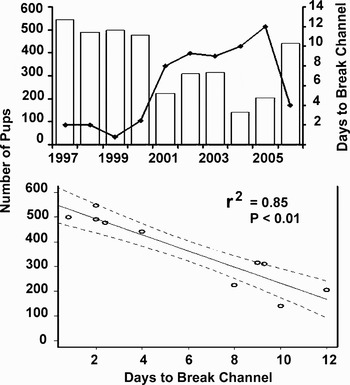
Fig. 1. Top, the number of pups born to Weddell seals in southern McMurdo Sound, an index to the number of females present, 1997–2006, and the number of days required to break the ice channel to McMurdo Station (dark line). Bottom, the relationship between ice thickness (as depicted by the number of days to open the ship channel to McMurdo Station) and number of pups born into the population (r = −0.93, P < 0.01).
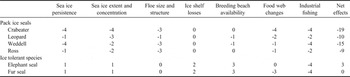
Table I. A matrix summarizing how environmental change may influence life-history patterns and, ultimately, the population dynamics of Southern Ocean seals. Arbitrary values between ± 4 were chosen to show the predicted degree of effect. Positive values indicate improved conditions because of climate change, while negative values indicate detrimental effects. “Food web changes” relate only to the effect of climate change on the pack ice ecosystem and ultimately krill availability.
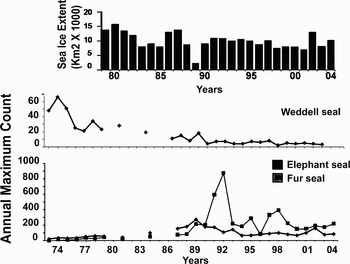
Fig. 2. Ice area in the “Long Term Ecological Research (LTER) study area,” west coast of Antarctic Peninsula, 1979–2004, as determined by satellite imagery (Spearman correlation, ice vs year: r = -0.43; p = 0.03; data from Ducklow et al.2007). The maximum number of pinnipeds of three species counted among all censuses in a given year on the islands within that study area: Arthur Harbour, Anvers Island, 1974–2005 (see text for statistical relationship between ice and seal numbers).
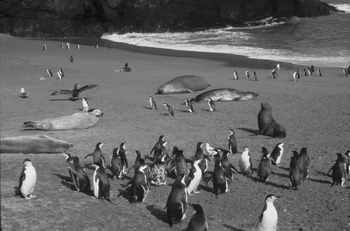
Fig. 3. A beach scene that includes four species of seals (Weddell, elephant, leopard, and fur), that was photographed at Seal Island in the Antarctic Peninsula Region. This scene is probably a look into the future of seal habitat use as sea ice areas decline. (Photo: John L. Bengtson)
 You have
Access
- 134
- Cited by
Introduction
It is well documented that the earth's atmosphere, on average, is warming, causing regional adjustments in temperatures, winds and precipitation, and that these effects are amplified in polar regions (IPCC 2007). The latter changes have much to do with sea ice and its reflective properties in a positive feedback loop: higher temperature, less ice, less reflection of the sun's energy, more heat absorption by the increasing area of dark ocean, etc. (e.g. Russell et al. Reference Russell, Dixon, Gnanadesikan, Stouffer and Toggweiler2006). While changing climate is affecting vertebrate species directly or indirectly in many parts of the world, the changing sea ice regime is likely to have direct effects on ‘pagophilic’ species, such as polar bears (Ursus maritimus Phipps) in the Arctic (Stirling & Parkinson Reference Stirling and Parkinson2006) and, as we argue here, pinnipeds in the Antarctic. The four species of pack ice seals (crabeater, Lobodon carcinophagus (Hombron & Jacquinot), Weddell, Leptonychotes weddellii Lesson, Ross, Ommatophoca rossii (Gray), and leopard, Hydruga leptonyx (Blainville)) rely on sea ice for most or at least critical portions of their life-history and demonstrate particular sensitivity to even small changes in the sea ice physical and biological environment (see summaries in Erickson et al. Reference Erickson, Siniff, Cline, Hofman and Deacon1971, Gilbert & Erickson Reference Gilbert, Erickson and Llano1977, Bester & Hofmeyr Reference Bester, Hofmeyr and Riffenburgh2007). On the other hand, two species are ice tolerant (Antarctic fur seal, Arctocephalus gazella (Peters 1875) and related spp., and southern elephant seal, Mirounga leonina L.), in that they occasionally occur in the vicinity of sea ice and may haulout onto its surfaces, but, although elephant seals have been reported to breed on ice (Laws Reference Laws1956), reproduction is usually dependent on the availability of land. Elsewhere, other members of these genera are successful in the total absence of ice. In light of potential changes in the environment of these species, we consider the importance of life-history patterns as the basis for predicting which of these species will be most affected initially, and what we might expect if climate continues to change as projected by the IPCC. Our effort here is similar to that of Croxall et al. (Reference Croxall, Trathan and Murphy2002) who explored the consequences of climate change on three Antarctic seabird species. It is possible that the pack ice seals are more sensitive to changes in sea ice patterns than are seabirds (with the exception of the emperor penguin, Aptenodytes forsteri Gray) as these seals depend on sea ice for critical parts of their reproductive activities.
We develop our argument by describing responses of pinnipeds to ice conditions using existing observations and by creating a sensitivity index (Laidre et al. in press), the results of which provide our collective assessment of how the different seal species probably will be influenced by physical and biological changes as climate change proceeds. We first consider the changes in the environment relevant to Antarctic seal species that have been well documented. Then we discuss changes that are likely in the near future, and suggest how these have been and will be interacting with the known life-history traits of the six seal species. The predictions made here regarding seal responses to environmental change are based on the fact that these species have evolved traits that are highly dependent, at least at the large scale, on a very stable, predictable physical environment (Ingolfsson et al. Reference Ingolfsson, Hjort, Berkman, Bjorck, Colhoun, Goodwin, Hall, Hirakawa, Melles, Moller and Prentice1998, Smith et al. Reference Smith, Ainley, Baker, Domack, Emslie, Fraser, Kennett, Leventer, Mosley-Thompson, Stammerjohn and Vernet1999). The annual cycle of pack ice development, though quite variable seasonally and inter-annually, has been extremely predictable at a longer time scale with respect to important physical features such as ice development, persistence, and extent. The Antarctic seal species have evolved traits that depend on this larger-scale predictability.
Methods
Recent environmental changes
Changes in sea ice extent and persistence during the past few decades have been recorded by satellite remote sensing. Zwally et al. (Reference Worm and Meyers2002) and Parkinson (Reference Parkinson2002) have considered the trends in sea ice for all the major sectors of the Southern Ocean (see also Jacobs Reference Jacobs2006). Major contrasting, but complementary, changes have been occurring in the Ross Sea and Bellingshausen regions during the most recent three decades, in large part mediated by the Southern Annular Mode (Jacobs Reference Jacobs2006, Stammerjohn et al. Reference Stammerjohn, Martinson, Smith, Yuan and Rind2008). That is, sea ice extent has been increasing in the Ross Sea but decreasing in the Antarctic Peninsula sectors. Further, the sea ice season in the Ross Sea region has been lengthening, but coastal polynyas within the larger-scale ice field all around the continent have been expanding (Parkinson Reference Parkinson2002). These changes during late autumn to early spring, influence the length of time it takes sea ice to recede during summer. Thus, in regions where the persistence and extent of winter ice has declined (Bellingshausen and southern Scotia seas), spring-summer ice has become much reduced over major areas. Where sea ice has expanded in persistence, the ice edge is also further away from the continent and takes more time to recede to summer locations (see also Jacobs & Giulivi Reference Jacobs and Giulivi1998, Bester & Odendaal Reference Bester, Odendaal, Davison, Howard-Williams and Broady2000, Stammerjohn et al. Reference Stammerjohn, Martinson, Smith, Yuan and Rind2008). In recent years the summer sea ice in the northern Bellingshausen and Antarctic Peninsula regions has been virtually absent (Fig 1a; Ducklow et al. Reference Ducklow, Baker, Martinson, Quetin, Ross, Smith, Stammerjohn, Vernet and Fraser2007). Off East Antarctica it has changed little, but in the Ross Sea sector, except for coastal polynyas, the sea ice field in spring is larger and more concentrated, leaving less space between ice floes. As a result, it recedes more slowly during summer. In addition, high latitude McMurdo Sound has recently experienced a short-term ‘natural experiment’ of markedly changed sea ice invoked by the grounding of major icebergs that have broken from the nearby Ross Ice Shelf (Arrigo et al. Reference Arrigo, Van Dijken, Ainley, Fahnestock and Markus2002). This event instantly altered the seasonal sea ice patterns and growing polynya (see below).
Top, the number of pups born to Weddell seals in southern McMurdo Sound, an index to the number of females present, 1997–2006, and the number of days required to break the ice channel to McMurdo Station (dark line). Bottom, the relationship between ice thickness (as depicted by the number of days to open the ship channel to McMurdo Station) and number of pups born into the population (r = −0.93, P < 0.01).
Developing a sensitivity index
To summarize and compare our conjectures on the probable response of seals to habitat change, we used the type of sensitivity index developed for Arctic marine mammals by Laidre et al. (in press). Our version of the index focuses mostly on sea ice and the subsequent consequences of its changes to the ecosystem and its food webs using six factors that, depending on region, are currently responding to climate change: 1) sea ice persistence, 2) sea ice extent, 3) ice floe size and structure, 4) ice shelf breakage, 5) changes in food resources, and 6) changes in accessible beach areas. We also included a seventh category representing food web changes related to industrial fishing. Each factor was scored between +4 and -4. Negative changes were inferred to be detrimental and positive ones beneficial to a given life history. Ranking was initially calculated by each author, with the agreed-upon final rating a consensus finding. In the paragraphs that follow, we provide the logic used to reach a final consensus regarding the influence of environmental change on each seal species' population and distribution. Obviously, this exercise only serves to illustrate and summarize the relative importance of environmental changes and the final tallies of scores cannot be taken just at face value. A case in point is the fur seal, which probably is mostly benefiting from a warming Antarctic Ocean (ocean south of the Polar Front; less ice, positive scores), but would be hard hit by industrial fishing (negative scores). Thus its final score comes to zero, which points to its situation being more complex than for the other species and not that it will be unaffected by environmental change.
Ice definitions
Fast ice is sea ice locked in place late into the summer by capes, islands or grounded ice bergs. Sea ice extent (SIE) refers to the large-scale spread of ice, usually viewed from the coast to its northernmost edge, at maximum in late winter 100s if not 1000s of kilometres away from the coast. Sea ice concentration refers to the proportion of the region that is covered by ice relative to open water (leads, polynyas); ice concentration at the large scale co-varies with SIE (Jacobs & Comiso Reference Jacobs and Comiso1989, Zwally et al. Reference Worm and Meyers2002). Ice area is the amount of ice in a region, minus any leads or polynyas between ice floes, i.e. minus any open water. Ice thickness refers to the measurement between the air-ice and the water-ice boundaries of ice. Finally, a polynya is an area within the pack ice that is ice free or of significantly reduced ice concentration relative to the surrounding ice. Polynya size in the Ross Sea Polynya, as an example, co-varies directly with large scale sea ice extent, as both are wind generated (Jacobs & Comiso Reference Jacobs and Comiso1989). Pack ice is sea ice broken into ice pieces (floes) from metres to kilometres in area, with water (leads) between the floes.
Results
Pack ice seal life histories
In this section of the paper we examine the general life-history characteristics of the four species of pack ice seals concentrating on those traits that are likely to become maladaptive as a result of changing sea ice attributes.
Crabeater seal
The crabeater is the most abundant seal species in the world (Laws Reference Laws and Llano1977). It has evolved to be a specialist in its foraging habits and feeds almost exclusively on Antarctic krill (Euphausia superba Dana) in pelagic and slope areas, and crystal krill (E. crystallorophias Holt & Tattersall) in neritic areas. So important have krill become to its diet that its dentition has evolved to filter krill from sea water. The mating and pupping season begins in October and probably continues to early November, with the exact timing varying by region (Southwell et al. Reference Testa, Oehlert, Ainley, Bengston, Siniff, Laws and Rounsevell2003). During this period females occupy ice floes that are selected for their size and physical characteristics (Siniff et al. Reference Siniff, Stirling, Bengtson and Reichle1979). Here, a female gives birth to a pup and is soon joined by a male, who is apparently waiting for the pup to be weaned and the female to enter oestrus and become available for mating. The ice floe occupied must be large enough that it does not break up until the pup is weaned in about 4–6 weeks. Also, the selected floes usually have some structure that the female uses to advantage in order to thwart the advances of the male who constantly attempts to separate her from the pup (forced weaning), thus, to advance the onset of oestrus. The surface relief may also provide a visual shield against both leopard seals and killer whales (Orcinus orca (L.)), which are major predators (Siniff & Bengtson Reference Siniff and Bengtson1977). Killer whales have been known to create waves that displace seals from floes (Smith et al. Reference Smith, Siniff, Reichle and Stone1981, Pitman & Ensor Reference Pitman and Ensor2003, Visser et al. 2008). Of the four species of pack ice seals, the crabeater may be the most vulnerable to predation. Leopard seals focus particularly on pups, and killer whales are a constant threat to all age classes. In nearly every region of the Antarctic Ocean, a significant proportion (60–70%) of crabeater seals show scars that indicate escape from a leopard seal (Siniff & Stone Reference Siniff, Stone, Siegfried, Condy and Laws1985). Thus, the structure and size of ice floes are very important to protect this species from predation.
Any environmental changes that will affect the availability of Antarctic krill will probably have an impact on crabeater seals (see similar comments for certain seabirds in Croxall et al. Reference Croxall, Trathan and Murphy2002). It is well known that Antarctic krill are highly dependent on sea ice, particularly during winter, when juvenile krill feed on under-ice microbial organisms and escape predation; as sea ice disappears so has the local abundance of Antarctic krill (Fraser & Hofmann Reference Fraser and Hofmann2003, Atkinson et al. Reference Atkinson, Siegel, Pakhomov and Rothery2005). On the other hand, on more restricted continental shelf areas, more persistent and growing coastal polynyas should lead to increased prevalence of crystal krill (see Pakhomov & Perissinotto Reference Pakhomov and Perissinotto1996).
Areas where sea ice has and will continue to exhibit the above changes should exhibit a decline in crabeater abundance due to direct (pupping platform and protection from predators) and indirect (food supply) influences. On the other hand, as some changes may initially increase the availability of crystal krill, regional contradictions in population trends could become evident.
Leopard seal
The leopard seal has a diverse diet and is a major predator on many vertebrate species in the sea ice regions (Laws Reference Laws and Llano1977). Its diet choice varies seasonally and spatially, with krill sometimes dominating during winter, switching to crabeater seal pups during spring, and focusing on fledgling penguins as they go to sea in late summer. Fish are also a common prey item and can be taken throughout the annual cycle. The leopard seal is known to visit islands in the lower latitudes, and sometimes remains there throughout the year. Many of these are juveniles and often in poor condition. Whether more adults would join this trend as climate change proceeds is unknown, but such behaviour modification should be considered (Bester et al. Reference Bester, Hofmeyr, Kirkman, Chauke, De Bruyn, Ferreira, Makhado, Maswime, McIntyre, Mulaudzi, Munyai, Pistorius, Radzilani, Ramunasi, Tshithabane and Wilkinson2006). In spite of this general trophic pattern (Siniff & Stone Reference Siniff, Stone, Siegfried, Condy and Laws1985), some individuals become specialists and remain in one region, concentrating on a particularly vulnerable prey such as penguins (Kooyman Reference Kooyman1965). Such behaviour has been documented also in the case of predation on fur seal (A. gazella) pups (Hiruki et al. Reference Hiruki, Schwartz and Boveng1999).
The pupping season occurs in spring, but few observations have been made of pups with females (Siniff & Stone Reference Siniff, Stone, Siegfried, Condy and Laws1985, Southwell et al. Reference Testa, Oehlert, Ainley, Bengston, Siniff, Laws and Rounsevell2003). Based on appearance, it is hypothesized that the pup can enter the water fairly early in the lactation period and may accompany the female as she forages. Breeding may not follow weaning immediately, as is the case with the other pack ice species, but may be postponed, perhaps as much as a month after weaning has occurred (Siniff & Stone Reference Siniff, Stone, Siegfried, Condy and Laws1985). However, the exact timing of oestrus and breeding needs further data.
Leopard seals are known to use many different types and sizes of ice floes for resting, pupping and moulting. They are seen on bits of ice bergs as well. They are preyed upon by killer whales (see Ainley et al. Reference Ainley, Ballard, Karl and Dugger2005a), so larger, more protective ice floes are probably selected if available. Satellite telemetry shows that individuals may stay within one general area for extended periods (Rogers et al. Reference Rogers, Hogg and Irvine2005).
In considering the four factors concerned with ice in our sensitivity matrix, we predict that changes in any of them will not have a large influence on this species. Sea ice persistence and floe size and structure would seem to have little effect because of the ability of this species to use many different ice floe types and move location if ice floe availability becomes limited. Because of their diverse diet, food shortages may not be a problem and thus we have lowered the degree of negative impact (Table I). However, we offer a caveat to this assessment as there is a lack of information on the diet of juveniles, and juvenile survival may be a critical life-history stage.
A matrix summarizing how environmental change may influence life-history patterns and, ultimately, the population dynamics of Southern Ocean seals. Arbitrary values between ± 4 were chosen to show the predicted degree of effect. Positive values indicate improved conditions because of climate change, while negative values indicate detrimental effects. “Food web changes” relate only to the effect of climate change on the pack ice ecosystem and ultimately krill availability.
Weddell seal
This species spends much of its time close to the Antarctic continent, where colonies form in early spring along predictable cracks in the persistent fast ice. In late winter and early spring, prior to pupping, these seals spend much of their time under this fast ice and use their teeth to keep breathing holes open where the ice is thin near perennial tide cracks. At high latitudes, e.g. McMurdo Sound (78°S), females haulout in late October and early November to give birth; at lower latitudes, e.g. the South Orkneys (60°S), pupping is in September (Testa et al. Reference Thomas, Demaster, Stone and Andriashek1990). The pups are weaned 6–7 weeks after birth, and copulation occurs under the ice. As the fast ice begins to deteriorate, adults and newly-weaned pups disperse. Satellite tracking of McMurdo Sound animals shows that some individuals move north into the Ross Sea (Burns et al. Reference Burns, Castellini and Testa1999, Ainley et al. Reference Ainley, Toniolo, Ballard, Barton, Eastman, Karl, Focardi, Kooyman, Lyver, Olmastroni, Stewart, Testa and Wilson2006). Weddell seals are known to feed principally on Antarctic silver fish (Pleuragramma antarcticum Boulenger), the Antarctic toothfish (Dissostichus mawsoni Norman) and several species of cephalopods (Burns et al. Reference Burns, Trumble, Castellini and Testa1998, La Mesa et al. Reference La Mesa, Eastman and Vacchi2004, Kim et al. Reference Kim, Conlan, Malone and Lewis2005, Ainley et al. Reference Ainley, Toniolo, Ballard, Barton, Eastman, Karl, Focardi, Kooyman, Lyver, Olmastroni, Stewart, Testa and Wilson2006, Pongannis & Stockard Reference Ponganis and Stockard2007).
In McMurdo Sound, where all pups born to this population have been marked since the 1970s and annual estimates of adults present have been made, relationships to several ice-related factors that affect population trends, behaviour and physiology have become obvious (Cameron & Siniff Reference Cameron and Siniff2004). Testa et al. (Reference Testa, Siniff, Croxall and Burton1991), linking climatological patterns to the dynamics of this population, found a relationship to El Niño–Southern Oscillation (ENSO), probably mediated through changes in ice extent and concentration (lower extent during ENSO; see Ledley Reference Ledley1997, Jacobs & Giulivi Reference Jacobs and Giulivi1998). More recently, elaborating on this relationship and with a longer time series, Hadley et al. (Reference Hadley, Rotella and Garrott2007a) reported that pup incidence among females tended to be lower when sea ice was more extensive in the previous year's post-weaning period and hypothesized that more sea ice in that period would lead to decreased foraging success for pregnant females. Possibly the decreased foraging success with more pack ice is related to the reduced amount of open water available for phytoplankton blooms and primary productivity (Arrigo & van Dijken Reference Arrigo and Van Dijken2004), which ultimately should affect fish availability. In support of this explanation, Proffitt et al. (Reference Proffitt, Garrott, Rotella, Siniff and Testa2007) demonstrated that foraging success of pregnant Weddell seals (reflected by the weaning mass of their eventual pups) decreased during summers characterized by extensive sea ice. Further, Hadley (Reference Hadley2006) found modest evidence that years of extensive winter sea ice were followed by years of higher survival among adult females. This is in accord with the increased productivity hypothesis, in that winters of extensive ice (which tend also to have more concentrated ice) are followed by summers of minimal ice (Jacobs & Comiso Reference Jacobs and Comiso1989). Finally, Hadley et al. (Reference Hadley, Rotella and Garrott2007b) reported that females were more likely to give birth to their first pup during a spring following a winter with more sea ice in the Ross Sea region, i.e. a winter often following a summer of minimal ice.
For Weddell seals, insight into the possible demographic consequences of long-term fluctuations in fast ice persistence was provided when a large portion of the Ross Ice Shelf broke off in late 2000. The resulting iceberg blocked the usual advection of sea ice from McMurdo Sound until winter 2006. As a result, the fast ice increased in extent, thickness, and seasonal persistence. This is indicated by the relative difficulty for an icebreaker to make a channel to McMurdo Station (Fig. 1a). Weddell seals were directly affected, presumably from the increased ice thickness, which in some cases closed off cracks that had been predictably present in previous years. As a result, fewer adults showed up for breeding and fewer pups were born (Fig. 1b). It is unknown whether McMurdo Sound females pupped elsewhere. This could certainly be the case, but, if so, based on normally high philopatry, it seems likely that pupping elsewhere would result in higher pup mortality. Over a 10-year period a strong negative relationship existed between the proxy of ice thickness and the number of pups born (r = -0.93, P < 0.01; Fig 1b). However, it is interesting to note how quickly the number of pups born to this population returned to previous levels when the effect of the iceberg was removed. This suggests that the seals were in the vicinity but, in the situation of reduced productivity owing to regionally more extensive, concentrated, and persistent pack ice (Arrigo & van Dijken Reference Arrigo and Van Dijken2004), were “choosing” not to breed. No doubt other species in the fast ice ecosystem, which have evolved to take advantage of the stable conditions that exist in fast-ice areas, were also affected (e.g. Dayton Reference Dayton1989).
In contrast, in the Antarctic Peninsula region over the past few decades, sea ice has diminished in extent, concentration, and especially persistence (Zwally et al. Reference Zwally, Comiso, Parkinson, Cavalieri and Gloersen2002, Parkinson Reference Parkinson2002, Stammerjohn et al. Reference Stammerjohn, Martinson, Smith, Yuan and Rind2008; Fig. 2a). Weekly counts of seals instituted in 1974 from various shore locations in Arthur Harbour (vicinity of Palmer Station) show that the number of Weddell seals has gradually declined (Fig. 2b; seals vs year, rs = -0.896, P < 0.001). We do not know the exact reason for the decline but presume it has to do with the reduction in the region of the amount of fast ice necessary for breeding (Fig. 1a, ice extent, rs = 0.457, p = 0.07). The general picture that emerges for Weddell seals with respect to the sensitivity matrix suggests that this species will be influenced either by increasing thickness of near-shore ice, or change in prevalence or persistence of fast ice areas. That is, any environmental event that holds potential to alter what historically have been seasonally predictable fast ice areas will greatly influence this species through the pupping and breeding seasons and thus we scored the maximum effect for sea ice persistence (Table I). We predict that both sea ice extent and ice floe size and structure would have less effect upon this species. In this case we felt that floe size and structure would be most important for protection from killer whale predation. In neritic areas, larger polynyas could mean enhanced productivity and availability of prey, mediated through crystal krill.
Ice area in the “Long Term Ecological Research (LTER) study area,” west coast of Antarctic Peninsula, 1979–2004, as determined by satellite imagery (Spearman correlation, ice vs year: r = -0.43; p = 0.03; data from Ducklow et al. Reference Ducklow, Baker, Martinson, Quetin, Ross, Smith, Stammerjohn, Vernet and Fraser2007). The maximum number of pinnipeds of three species counted among all censuses in a given year on the islands within that study area: Arthur Harbour, Anvers Island, 1974–2005 (see text for statistical relationship between ice and seal numbers).
Ross seal
This species is much less abundant than the other pack ice seals. It is highly pelagic, seldom seen, and large concentrations have never been noted. Few pups have been sighted, but the occasional records suggest pupping occurs on ice floes in spring, with exact timing dependent on the region of the Antarctic (Thomas et al. Reference Van Den Hoff and Morrice1980, Southwell et al. Reference Testa, Oehlert, Ainley, Bengston, Siniff, Laws and Rounsevell2003). Like the other species, the pupping season probably varies with location. During a cruise into the Amundsen Sea sector during late 1999 and early 2000 (Ackley et al. Reference Ackley, Bengtson, Boveng, Castellini, Daly, Jacobs, Kooyman, Laake, Quetin, Ross, Siniff, Stewart, Stirling, Torres and Yochem2003), Ross seals were found moulting on very large ice floes, often a kilometre across (Siniff, personal observation). Their appearance at this time was of sloughing skin similar to elephant seals. These large floes may be very critical at this time, as the seals may be at a disadvantage energetically if forced to enter the water. In regard to diet, analyses indicate that Ross seals feed predominantly on cephalopods. Recent satellite tracking indicates that this species may move north and beyond 60oS, and remain in ice-free waters for some time (Blix & Nordoy Reference Blix and Nordoy2007).
With respect to our sensitivity matrix, only ice floe size during pupping and moulting is probably important to this species, and we have ranked this factor the most detrimental. Sea ice concentration co-varies with ice floe size and thus we considered this factor next most important (Table I). The effects of changes in sea ice on Ross seal foraging seems unlikely to be detrimental since they often forage at considerable distances from the continent, beyond the sea ice, and thus may be preying on species not particularly tied to the pack ice ecosystem.
Ice tolerant seal life histories
Southern elephant seals and sub-Antarctic (A. tropicalis Gray) and Antarctic (A. gazella) fur seals were hunted during the 1700–1800s, exterminating some island populations completely and bringing others to near extinction (Matthews Reference Matthews1977, Croxall Reference Croxall1992). Since then, both have returned to virtually all former sub-Antarctic and low latitude Antarctic breeding colonies, with some populations fully recovered by the 1970s (Laws Reference Laws and Llano1977, Croxall Reference Croxall1992, Weimerskirch et al. Reference Ward and Lafferty2003). At some locations, as at South Georgia, fur seals are beginning to crowd out other species (e.g. Bonner Reference Bonner, Siegfried, Condy and Laws1985). However, in recent decades, beginning in the 1970s, elephant seals have been declining, including populations at Macquarie, Heard, Marion, Kerguelen and Crozet islands (Weimerskirch et al. Reference Ward and Lafferty2003, McMahon & Burton Reference McMahon and Burton2005); at South Georgia, where half the world population breeds, they've been stable, and at Valdés, Argentina, in temperate waters (outside of the Southern Ocean), they have been increasing (McMahon & Burton Reference McMahon and Burton2005). At South Georgia their population stability is probably related to a limited amount of available breeding space (Boyd Reference Boyd1993). Both species have been increasing further south, e.g. at Anvers Island (Fig. 2b). In regard to feeding, the two species differ markedly. Like the Weddell seal, the elephant seal is a deep diver, capable of reaching several hundred metres (Jonker & Bester Reference Jonker and Bester1994); the fur seal, like the crabeater and leopard seal, feeds within 200 m of the surface (Robinson et al. Reference Robinson, Goldsworthy, Van Den Hoff and Hindell2002).
Southern elephant seal
This species breeds on beaches, including pebble, cobble and boulder beaches, as well as on vegetated areas behind landing beaches, and exceptionally on ice (e.g. Laws Reference Laws1956, Condy Reference Condy1978a). As the females come ashore, groups coalesce, sometimes with several hundred on one beach. Meanwhile, males compete for supremacy to insure access to females. One “beachmaster” might control 40–50 females depending on structure of the beach. Females give birth to pups within a few days after arriving. They enter oestrus about 19 days after giving birth and are receptive for breeding for about four days. They often copulate with the dominant male of the area, although low ranking males may also participate in the breeding. Females remain with the pup until weaning (23 days after being born), which usually occurs in about 30 days after hauling out. At this time females leave the beach to feed and recover weight lost during lactation, after which they return to moult. Males return to moult later than females; younger animals return to moult before the adults (Condy Reference Condy1979, Kirkman et al. Reference Kirkman, Bester, Pistorius, Hofmeyr, Jonker, Owen and Stryydom2003a, Reference Kirkman, Bester, Hofmeyr, Jonker, Pistorius, Owen and Stryydom2004). The moulting process takes a few weeks during which they seldom go to sea; at other times of the year elephant seals are pelagic in mostly ice free waters (Bonner Reference Bonner1990, Borneman et al. Reference Bornemann, Kreyscher, Ramdohr, Martin, Carlini, Sellmann and Plötz2000). Elephant seals feed on squid and fish, including toothfish (summarized in Hindell et al. Reference Hindell, Bradshaw, Sumner, Michael and Burton2003). They are preyed upon by killer whales (Keith et al. Reference Keith, Bester, Bartlett and Baker2001), and in sub-Antarctic latitudes by white sharks (Carcharodon carcharias; van der Hoff & Morrice 2008).
We predict that southern elephant seals may benefit from regional climate change. Warming in the Antarctic Peninsula, with disappearance of sea ice as well as retreat of ice fields and glaciers, has already created additional beach areas for moulting, pupping and breeding and their populations are expanding into these areas, e.g. on Anvers Island (Fig. 2b; seals vs year, rs = 0.454, P < 0.02). The relationship between seals and ice extent and ice area is inverse (rs = -0.221, rs = -0.257), but statistically weak, indicating that other factors besides large-scale sea ice are involved in trends. Establishment of breeding at Arthur Harbour, Anvers Island, as was the case in the re-invasion of the northern elephant seal's (M. angustirostris (Gill)) former colonies, began with several years of increasing numbers of moulting individuals (e.g. LeBoeuf et al. Reference LeBoeuf, Ainley and Lewis1974, for a particularly well documented case). Although the evidence is somewhat controversial, elephant seals may have bred on the coast of Victoria Land during a warm period in the mid-Holocene (Hall et al. Reference Hall, Hoelzel, Baroni, Denton, Le Boeuf, Overturf and Töpf2006). We have indicated (Table I) favourable reactions to decreases in the first five factors dealing with loss of sea ice and shelf ice, which will result in the exposure of more beach areas. The major uncertainty here is how changes in the Antarctic food webs will influence their populations.
Fur seal
The Antarctic fur seal (and closely related taxa) breeds on sand or cobbled beach as well as on rocky headlands at South Georgia, Macquarie, Heard, Kerguelen and the South Shetland islands (Condy Reference Condy1978b). Adult males hold territories, beginning October to December, and may have 10–120 females within the defended boundaries. Females give birth within these territories over a three-week period in November and December, suckling the pup intermittently for four months and making repeated trips to sea to feed (Robinson et al. Reference Robinson, Goldsworthy, Van Den Hoff and Hindell2002, Kirkman et al. Reference Kirkman, Bester, Makhado and Pistorius2003b). Females enter the period of oestrus 6–7 days after giving birth. Fur seals during the non-breeding season are pelagic for long periods; in higher latitudes males, especially, haulout regularly on beaches (e.g. Riedman Reference Riedman1990, Green et al. Reference Green, Williams and Burton1991, Daneri & Coria Reference Danieri and Coria1992). Antarctic fur seals feed on krill (at high latitudes), myctophid fish, and mackerel icefish (Champsocephalus gunnari Lönnberg) in near-surface waters (Green et al. Reference Green, Burton and Williams1989, Goldsworthy et al. Reference Goldsworthy, Hindell, Crowley, Hindell and Kemper1997, Klages & Bester Reference Klages and Bester1998, Reid et al. Reference Reid, Hill, Diniz and Collins2005, Murphy et al. Reference Murphy, Watkins, Trathan, Reid, Meredith, Thorpe, Johnston, Clarke, Tarling, Collins, Forcada, Shreeve, Atkinson, Korb, Whitehouse, Ward, Rodhouse, Enderlein, Hirst, Martin, Hill, Staniland, Pond, Briggs, Cunningham and Fleming2007). The lanternfish are caught during night when the fish rise to near the surface. During their pelagic phase, individuals in the high latitudes haulout on ice floes near the large-scale edge of the sea ice (Ribic et al. Reference Ribic, Fraser and Ainley1991).
Antarctic fur seals at high latitudes will probably be disadvantaged the most from the lack of krill offshore of their pupping and breeding beaches. At South Georgia foraging energetics and pup survival have been shown to depend on the availability of krill for foraging females during lactation (e.g. Costa et al. Reference Costa, Croxall and Duck1989, Forcada et al. Reference Forcada, Trathan, Reid and Murphy2005). Thus, we have predicted that changes in the food web will have the most effect on this species. At Anvers Island, the fur seals have been increasing (rs = 0.719, P < 0.001). As with elephant seals there, the relationship to ice extent and area is inverse but weak (rs = -0.390, rs = -0.261) indicating other factors are also involved in the trends and probably could involve krill prevalence. At lower latitudes, fur seals prey heavily on fish (references above), which increases our uncertainty about the effect of lower krill availability over the long term. Loss of sea ice is predicted to have little effect (except as previously noted via its negative consequences on krill abundance), but increased beach availability could provide additional pupping and breeding areas (Table I).
Discussion
Each of the Antarctic pack ice seals relies on certain species-specific sea ice characteristics to complete its annual cycle as part of its respective life-history strategy (Erickson et al. Reference Erickson, Siniff, Cline, Hofman and Deacon1971, Gilbert & Erickson Reference Gilbert, Erickson and Llano1977). Our predictions about probable sensitivity to climate-change related alterations in habitat (Table I) suggest that the crabeater seal will be the most affected, with the Weddell seal following closely behind. Any environmental change that would decrease the size and thickness of floes (IPCC 2007) would probably increase competition among (and predation on) seals, especially crabeaters because females require floes that do not melt before the period of lactation is complete.
Leopard and Ross seals may be less influenced by these factors and we suggest that changes in sea ice extent, thickness or persistence will have little effect on the two ice-tolerant species; however, this is suggested without implying major changes in their food resources. The mix of species depicted in Fig. 3 illustrates a possible look into the future, and what we might expect as sea ice diminishes. More beach space, unless decreased by rising sea levels, will become available, but the competition for this space will become more intense. Further, this picture depicts that the crabeater, because of its especially strong reliance on sea ice, and the Ross seal, because of its pelagic nature, will probably not adapt, or lose out in the competition among species for the use of beach space to satisfy life-history needs. Learmonth et al. (Reference Learmonth, Macleod, Santos, Pierce, Crick and Robinson2006) briefly consider the Antarctic seals in their review of effects of climate change on marine mammals. Our findings are similar to theirs (as presented in their Table I), but differ in details about the species involved. They suggest, incorrectly (p. 452), that Weddell, crabeater, and Ross seals are highly philopatric, and thus will be severely affected. However, both the crabeater and the Ross seal carry out pupping and breeding in the drifting pack ice. Thus, only the Weddell, as is evident in their response to the ‘iceberg natural experiment’ (see Results), will probably be affected by loss of site-specific breeding locations.
A beach scene that includes four species of seals (Weddell, elephant, leopard, and fur), that was photographed at Seal Island in the Antarctic Peninsula Region. This scene is probably a look into the future of seal habitat use as sea ice areas decline. (Photo: John L. Bengtson)
Prey, other than krill, has seldom been recorded for crabeater seals and Antarctic krill is an important component of the diet of Antarctic fur seals in the Scotia Sea region, particularly during the period of lactation. As the sea ice in continental slope regions becomes less extensive or persistent, Antarctic krill abundance probably will diminish (Fraser & Hoffman 2003, Atkinson et al. Reference Atkinson, Siegel, Pakhomov and Rothery2005) and, hence, food shortages for these pinnipeds may occur (see also Murphy et al. Reference Murphy, Watkins, Trathan, Reid, Meredith, Thorpe, Johnston, Clarke, Tarling, Collins, Forcada, Shreeve, Atkinson, Korb, Whitehouse, Ward, Rodhouse, Enderlein, Hirst, Martin, Hill, Staniland, Pond, Briggs, Cunningham and Fleming2007). Given that neritic areas are rather limited in the Antarctic, any increase in persistence and size of coastal polynyas, and resulting increases in crystal krill, probably cannot make up for the loss of Antarctic krill, at least in regard to the large scale of seal population change. Indirectly, then, although there is uncertainty in the degree to which they can switch to fish, such as myctophids in the case of fur seals, changes in food availability will probably have an important net effect. We hypothesize that the reversing trend in fur seal numbers at Arthur Harbour after 1993 (Fig. 2b) is related, at least in part, to the decline in krill that has been observed in this region (cf. Atkinson et al. Reference Atkinson, Siegel, Pakhomov and Rothery2005). An inflection point in population trajectory of fur seals at South Georgia, with the population there initially recovering from exploitation but then declining, occurred at about the same time as that at Arthur Harbour. Reid & Croxall (Reference Reid and Croxall2001) attributed the pattern at South Georgia to a change in the availability of krill in the region.
The Weddell seal is the other species that is highly sensitive to changes in sea ice. Both decreasing and increasing fast ice extent and thickness influence pupping success in this species. The decline in sea ice persistence in the Peninsula region seems to have negatively affected this species, as did the short-term increase in fast ice thickness and extent in McMurdo Sound. This two-sided pattern is analogous to the relationship between pack ice and Adélie penguins (Pygoscelis adeliae (Hombron & Jacquinot)), wherein too much or too little sea ice has negative effects on population dynamics and occurrence (Fraser & Trivelpiece Reference Fraser and Trivelpiece1996, Smith et al. Reference Smith, Ainley, Baker, Domack, Emslie, Fraser, Kennett, Leventer, Mosley-Thompson, Stammerjohn and Vernet1999). Decrease in the persistence of fast ice has been documented to negatively affect the Antarctic's other fast ice breeding vertebrate, the emperor penguin (cf. Barbraud & Weimirskirch Reference Barbraud and Weimerskirch2001, Ainley et al. Reference Ainley, Clarke, Arrigo, Fraser, Kato, Barton and Wilson2005b).
Over the past recent decades, changing climate patterns have been very different in different sectors of the Antarctic (e.g. Zwally et al. Reference Worm and Meyers2002, Parkinson Reference Parkinson2002, Stammerjohn et al. Reference Stammerjohn, Martinson, Smith, Yuan and Rind2008). Overall, large, contrasting changes in the distribution and abundance of seals should have resulted. As shown by Weddell seals in the McMurdo region, their responses to sea ice change can be rapid. Cascading effects may also occur, where some dominant physical change could cause major shifts at several ecosystem levels. For instance, declining sea ice presence off the western Antarctic Peninsula has not only affected the physical environment but the food web as well (Emslie & McDaniel Reference Emslie and McDaniel2002, Atkinson et al. Reference Atkinson, Siegel, Pakhomov and Rothery2005, Ducklow et al. Reference Ducklow, Baker, Martinson, Quetin, Ross, Smith, Stammerjohn, Vernet and Fraser2007).
For the elephant and fur seals their critical habitat needs involve breeding/pup-rearing space and food. As ice shelves disintegrate ever farther south, but more importantly as sea ice recedes, these ice tolerant species should continue to expand southward, as evidenced by the population trends observed at Arthur Harbour and in Marguerite Bay (see also Hall et al. Reference Hall, Hoelzel, Baroni, Denton, Le Boeuf, Overturf and Töpf2006).
Although changing climate has altered the susceptibility of marine mammals to disease in warmer regions (Gian-Reto et al. Reference Gian-Reto, Post, Convey, Menzel, Parmesan, Beebee, Fromentin, Hoegh-Guldberg and Bairlein2002, Ross Reference Ross2002, Ward & Lafferty Reference Visser, Smith, Bullock, Green, Carlsson and Imberti2004), at present there is no way to gauge the potential for this effect in the Antarctic.
One important potential confounding factor to predicting future trends in Antarctic pinniped populations is the profound alteration of food webs that has occurred or is occurring by industrial fishing (e.g. Gon & Heemstra Reference Gon and Heemstra1990, Kock Reference Kock1992, Pauly et al. Reference Pauly, Christensen, Dalsgaard, Froese and Torres1998, Reference Pauly, Watson and Alder2005, Worm & Meyers Reference Weimerskirch, Inchausti, Guinet and Barbraud2003, Ainley et al. Reference Ainley, Ballard, Blight, Eastman, Lescröel, Olmastroni, Townsend, Wilson and Woehler2007). Food-web alterations owing to fish depletion may have been as important as climate-change effects for some seal species, thus in our opinion complicating study of climate change effects on Southern Ocean vertebrates. The mackerel ice fish, an important prey of fur seals, elephant seals and other top predators, was long ago seriously depleted from lower-latitude sites (e.g. Gon & Heemstra Reference Gon and Heemstra1990, Kock Reference Kock1992, Reid et al. Reference Reid, Davis and Staniland2006, Lescroël & Bost Reference Lescroël and Bost2006), probably reducing the diet options for these predators. Whether or not a greater reliance on krill in recent decades has become a factor in the increased responses of these species to climate change will not soon be known. Moreover, and unfortunate for the investigation of climate effects on Weddell seals, commercial fisheries have recently begun to exploit the Antarctic toothfish in the Ross Sea (Ainley et al. Reference Ainley, Toniolo, Ballard, Barton, Eastman, Karl, Focardi, Kooyman, Lyver, Olmastroni, Stewart, Testa and Wilson2006). Such commercial ventures will no doubt complicate future interpretations of the causes of change in Antarctic seal populations.
Finally, we fully realize that the projections we have made about the future fate of the Antarctic seals are mostly guesses based on our combined Antarctic experiences and observations, and on the data that have been collected as certain environmental events have taken place. Therefore, we welcome comments others might have about these predictions of future trends.
Acknowledgements
We are especially indebted to David Parmelee for initiating studies of marine birds and mammals at Palmer Station in the early 1970s; he initiated a wonderfully long data series. Katie Dugger advised us on statistics, and the US Coast Guard provided data on breaking the McMurdo ice channel. Our special thanks to Dr John L. Bengtson for permission to use Fig. 3. Three anonymous reviewers provided comments of great value to revising the manuscript. Finally, we received support to write this paper from the National Science Foundation, for which we are thankful, grants OPP 0217282, OPP OPP-0225110, OPP-9632763, OPP-0120525, OPP-0224727 and OPP-0440643.