




No CrossRef data available.
Article contents
Emotion-related abilities and depressive symptoms in Latina mothers and their children
Published online by Cambridge University Press: 13 April 2004
Abstract
This study examined the abilities of 40 Latina mothers and their 6- to 11-year-old children (20 girls, 20 boys) to recognize and produce emotion expressions and how these abilities differed as a function of maternal depressive symptoms. The results indicated that depressively symptomatic mothers were less accurate at recognizing basic emotions (e.g., happy, sad, etc.) and some mixed emotions (e.g., scared/ok combinations) than nonsymptomatic mothers, but there were no group differences for emotion production. In contrast, children of symptomatic mothers posed fewer recognizable sad expressions than their peers. Error pattern analyses also revealed that children of symptomatic mothers were more likely to mistakenly recognize happiness and to avoid posing sadness (across all basic emotions). Children's ability to pose emotions was related to their mothers' emotion production, and this was not moderated by maternal depressive symptoms. The discussion focuses on the possible interpersonal consequences of these biases and deficits in the emotion-related abilities of symptomatic mothers and their children and on the need to conduct research on the familial and cultural processes that might underlie these findings.Portions of this article are based on a dissertation by Maria Sesin submitted in partial fulfillment of the requirements for the doctoral degree at Ferkauf Graduate School of Psychology, Yeshiva University. We would like to thank the mothers and children who made this research possible, as well as Marjorie Melendez and Craig Indellicati for their help in preparing the emotion recognition stimuli.
Information
- Type
- Research Article
- Information
- Copyright
- © 2004 Cambridge University Press
Children of depressed parents are more likely than their peers to develop a range of emotional disorders (Hay, Vespo, & Zahn–Waxler, 1998), including up to a threefold greater chance of becoming depressed and a nearly 40% risk of experiencing a depressive episode before age 18 (Garber & Flynn, 2001). Although biological influences play an important role in these connections, there is a growing awareness that parental socialization practices both interact with biological influences and play a unique role in the associations between parental depression and children's maladjustment (Zahn–Waxler, Klimes–Dougan, & Slattery, 2000). The primary goal of the present study was to examine two core emotion abilities (i.e., emotion recognition and production; Halberstadt, Denham, & Dunsmore, 2001) that might underlie some of these links between disrupted parenting and negative developmental outcomes for children. In addition, this research focused on a population that has an increased risk for depression (Hammen, 2001) but is still relatively understudied, namely, Latina mothers and their school-aged children.
To date, much of the research on the specifically emotion-related aspects of depressed parents' and their children's interactions has focused on infants and toddlers. For example, Cohn, Campbell, Matias, and Hopkins (1990) found that, compared with nondepressed mothers,1
Although most of the existing literature focuses on maternal depression, there is an increasing awareness that paternal depression is also likely to have a significant influence on children's development (Cummings & Davies, 1994), both directly and as it affects the larger family system.
Although less is known about emotions per se in depressed mothers and their older children, research has supported the importance of affectively salient aspects of these subsequent interactions. In general, depressed mothers are more likely to be punitive, retaliatory, and even physically abusive with their children (Cummings & Davies, 1994; Goodman & Gotlib, 1999). Depressed mothers are also more likely than nondepressed mothers to be inconsistent in their child rearing with their toddlers leading these children to become more aggressive than their peers by age 5 (e.g., Zahn–Waxler, Iannotti, Cummings, & Denham, 1990) and to display more distorted and unresolved guilt themes in their social reasoning by elementary school (Zahn–Waxler, Kochanska, Krupnick, & McKnew, 1990).
Overall, much of what has been learned about the affective nature of depressed mother–child interactions highlights both the strong negative emotions associated with depression and the affective nature of parenting in general (Dix, 1991). Yet, despite the numerous studies in this area, several major gaps remain. One such gap is best described by comparing the maternal depression literature with recent work on emotion socialization. Both have shown that parental modeling and contingent responsiveness influence the affective dispositions of their children (e.g., Cummings & Davies, 1994; Denham, 1998; Downey & Coyne, 1990). The emotion socialization literature, however, has also shown that parents influence multiple aspects of children's emotion understanding as well.
Dunn, Brown, and Maguire (1995), for example, found that mother–toddler discussions about emotions were subsequently related to children's understanding of emotions and beliefs regarding moral transgressions at age 6. In a related vein, several studies (e.g., Denham, Zoller, & Couchoud, 1994; Jones, Eisenberg, Fabes, & MacKinnon, 2002) have shown that parents who are moderately emotionally expressive and not overly punitive or minimizing regarding children's negative emotions have children with relatively higher levels of emotion knowledge and understanding (including emotion recognition abilities). Moreover, research by Garner and colleagues (e.g., Garner, Jones, & Miner, 1994; Garner & Spears, 2000) has found generally similar results for lower socioeconomic status, mostly African American children and their mothers. In reviewing this literature Denham (1998, p. 131) concluded that “parents' talking about emotion-laden experiences in daily life, their encouragement of emotional expression in children, and their own expression of predominantly positive emotions all promote children's emotion knowledge.”
These findings for emotion knowledge are potentially important for depressed mothers and their children for several reasons. Depressed mothers are not likely to engage in the emotion socialization practices associated with increased emotion knowledge in the children of nondepressed mothers (i.e., positive adult emotionality, parent–child “emotion talk,” and encouragement of children's emotionality). The literature described above on depressed mother–child interactions and other research indicating that depressed mothers experience more occupational and financial difficulties, greater marital discord, and higher levels of negative events in general (Hammen, 2001) clarify why this emotionally positive child focus is unlikely.
A second reason that the literature on emotion knowledge is important for depressed mothers and their children involves the developmental consequences of that knowledge. Studies have shown that children's emotion knowledge has important associations with both preschoolers' (Arsenio, Cooperman, & Lover, 2000; Denham, McKinley, Couchoud, & Holt, 1990; Walden & Field, 1990) and school-aged children's (Mostow, Izard, Fine, & Trentacosta, 2002) social skills and peer acceptance. A recent longitudinal study revealed that children's emotion knowledge at age 5 predicted both their social behavior and academic competence at age 9, even after controlling for the potential influence of children's verbal ability and temperament on these associations (Izard, Fine, Schultz, Mostow, Ackerman, & Youngstrom, 2001). Perhaps most directly relevant are recent studies involving community samples that have shown that lower levels of children's emotion knowledge are linked with higher teacher ratings of children's social withdrawal and depressive symptoms (Schultz, Izard, Ackerman, & Youngstrom, 2001) and higher child self-reports of hopelessness and loneliness (Fine, Izard, Schultz, & Ackerman, 2000, as cited in Izard et al., 2001).
To date, there is no comparable research on emotion knowledge in children of depressed parents, even though these children are clearly at increased risk for the emotional and behavioral problems associated with difficulties in emotional knowledge observed in community samples. There are, however, a few studies on emotion recognition biases and impairments (which are aspects of emotion knowledge) in depressed adults. One study (Gur, Erwin, Gur, Zwil, Heimberg, & Kramer, 1992) found no overall difference in depressed and nondepressed adults' abilities to recognize emotions, but more dysphoric participants had difficulties in recognizing sad faces in particular. In contrast, Persad and Polivy (1993) found that depressed adults had more overall difficulties in recognizing emotions (i.e., across all emotion) than nondepressed college students. However, the larger implications of these adult studies are unclear because of the mixed findings (e.g., overall vs. more specific emotion recognition difficulties) and because of a number of methodological limitations such as extremely small samples and the inclusion of mixed inpatient and outpatient depressive populations (confounding depressive status and institutionalization).
Consequently, the primary goal of the present study was to address these gaps in our understanding of the emotion knowledge of depressed mothers and their children. Two core emotion-related abilities were assessed: the abilities of mothers and children to recognize and produce recognizable emotions. Emotion recognition, particularly of discrete emotions (happiness, anger, etc.), is routinely assessed as one aspect of emotion knowledge (e.g., Denham et al., 1990; Izard et al., 2001). In addition, this study assessed participants' recognition of ambiguous or “mixed” emotion expressions (i.e., combining aspects of multiple emotions). At a theoretical level, it has been argued (e.g., Lemerise & Arsenio, 2000) that ambiguous affective stimuli are especially likely to capture the social cognitive biases shown by individuals at risk for psychopathology. The results from a separate study using the present mixed emotion stimuli (see Methods section) support this claim: Latino elementary school children who were rated by teachers as having more internalizing problems also had more difficulties in recognizing mixed emotions than their peers (Arsenio & Maloney, 2003). Finally, an emotion production task was included, because of the theoretical significance of producing recognizable emotions (the “sending” part of sending and receiving emotional signals) and because of evidence that more skilled producers of emotion are more socially competent than their peers (see Halberstadt et al., 2001, on both points). Overall, it was expected that depressed mothers and their children would be less proficient than nondepressed mothers and their children in both the emotion recognition and production tasks.
Another goal of this study was to begin to address some of the associations between the emotional abilities of depressed and nondepressed mothers and children. Although there is little directly relevant research, studies of the emotion-related abilities of maltreated children suggests some ways of addressing this gap. Studies have shown that, compared to their peers, maltreated children have difficulties recognizing and understanding emotions (e.g., Camras, Grow, & Ribordy, 1983) and these difficulties are partly responsible for maltreated children's hostile and incompetent peer interactions (Camras, Sachs–Alter, & Ribordy, 1996). Furthermore, one influential study (Camras, Ribordy, Hill, Martino, Spaccarelli, & Stefani, 1988) specifically addressed the associations among the emotion recognition and production skills of maltreated and nonmaltreated children (ages 3–7 years) and their mothers. It was found that maltreated mothers and their children posed less recognizable emotion expressions than nonmaltreated children and their mothers and that maltreated children were less accurate than nonmaltreated peers in their emotion recognition. Furthermore, mothers who posed more recognizable emotions had children who were better able to both produce and recognize emotions, a result that is consistent with models of the parental socialization of children's emotion.
This research on maltreated children and their mothers underscores the importance of examining basic emotion recognition and production abilities in children at risk for psychopathology because of parental dysfunction. Camras et al.'s (1988) study also demonstrates the utility of examining the broad correlational associations between parent and child abilities prior to focusing on more specific processes involved in parent–child emotion socialization (e.g., Camras, Ribordy, Hill, Martino, Sachs, Spaccarelli, & Stefani, 1990). Because so little is known about emotion knowledge in either depressed mothers or their children, we adopted a similar approach in the present study. Extrapolating from Camras et al. (1988), it was expected that there would be associations between mothers' and children's abilities, including links between mothers' emotion production and children's emotion recognition and production.
A final focus of the present study was to examine the above hypotheses with participants from a Latino community located in a major urban area. Several considerations informed this decision. Despite recent efforts to make developmental research samples more heterogeneous, few studies have focused on the more than 35 million Latinos who now comprise the largest ethnic minority group in the United States (comparable in number to African Americans, Schmitt, 2001). Furthermore, more than one-third of Latino children are living below the poverty line and, unlike in African American families, the level of child poverty has not dropped in the last 20 years (Seccombe, 2000). In terms of depression, the Latino families in the present study were at special risk given that, “Hispanic ethnicity, younger age, lower education, and separated divorced status are all significantly associated with higher rates of MDE” (i.e., major depressive episodes; Hammen, 2001, p. 229). Collectively, then, these multiple considerations underscored the importance of studying depressive symptoms and their associations with emotion-related abilities in these developmentally at-risk Latino school children and their mothers.
Numerous cross-cultural researchers have also emphasized the need to conduct research within cultural groups in order to assess the cultural relevance of certain constructs prior to engaging in research between cultural groups (e.g., Garcia Coll, Akerman, & Cicchetti, 2000; Mendez, Fantuzzo, & Cicchetti, 2002). The present study followed this emic approach by focusing on the potential heterogeneity of emotion-related abilities in Latino families with depressively symptomatic and nonsymptomatic mothers and their children. (Please see the Results section on the use of “symptomatic vs. nonsymptomatic” rather than “depressed vs. nondepressed.”) Although this within-cultural focus is essential in its own right, it should also be noted that recent work on the emotion knowledge of young at-risk African American children (e.g., Garner et al., 1994; Izard et al., 2001) has found associations between emotion knowledge and social competence that are similar to those observed in more middle class, largely European American samples.
In summary, this research was designed to assess emotion recognition (basic and mixed emotions) and production in depressively symptomatic and nonsymptomatic Latina mothers and their children. It was expected that, overall, symptomatic mothers and their children would be less proficient than their peers at these tasks and that there would be associations among mothers' and children's emotion-related abilities. The lack of comparable research makes it difficult to offer more specific symptom-related hypotheses, especially regarding the potential influence of children's age or gender. However, it was expected that, regardless of maternal depression symptom status, older children would be better at recognizing and producing emotions than younger children (Gross & Bailif, 1991; Saarni, 1999). In terms of child gender, there is evidence that girls are more proficient than boys in their emotion-related abilities (Brody & Hall, 2000), although research on child gender and depression (Zahn–Waxler et al., 2000) prior to adolescence is more mixed. Consequently, it was expected that girls might be more proficient than boys at recognizing and producing emotions but maternal depression symptom status would not influence these differences.
Method
Participants
A total 40 mothers and their 6- to 11-year-old children (20 girls, 20 boys) participated. The 40 child participants were divided into two age groups, younger (6–8.5 years) and older (8.5–11 years), based on previous research indicating that children's understanding of emotions becomes more differentiated during these age periods (e.g., Harris, 1989). One-half of the adult participants were recruited from an outpatient mental health facility serving a Latino community in a major Northeast metropolitan area. All of these participants were initially referred for problems involving depression. The other half of the participants were recruited from the same community that was served by the mental health facility. Nearly all mothers were born outside the United States (in Puerto Rico, the Dominican Republic, Mexico, or Colombia), but all children were born in the United States. Mothers were the primary caretakers for all children, and all but two mothers were single parents.
Measures
Beck Depression Inventory (BDI)
The BDI (Beck, 1996) is a self-report instrument for assessing adult depressive symptoms. It is commonly used for diagnostic purposes and it has been used in several hundred published studies. Participants complete 21 items using a 4-point scale (0 = never to 3 = always) and a total score is derived reflecting the severity of depressive symptoms. Scores of 0–9 are seen as reflecting no depressive symptoms, 10–15 reflect mild depression, 16–19 reflect mild to moderate depression, 20–29 reflect moderate to severe depression, and 30 and higher reflect severe depression. The BDI is available in both English and Spanish versions. Moreover, the reliability and validity of the Spanish version of the BDI has been supported by research conducted in several Spanish speaking countries (e.g., Canals, Blade, Carbajo, & Domenech–Llaberia, 2001), as well as by research conducted with Latino populations in the United States (e.g., Daza, Novy, Stanley, & Averill, 2002).
Children's Depression Inventory (CDI)
The CDI (Kovacs, 1985) is a 27-item self-rated scale suitable for assessing depressive symptoms in school-aged children. This scale assesses a range of depressive symptoms including disturbed mood, hedonic capacity, vegetative function, self-evaluation, and interpersonal behavior. Each CDI item is scored on a 3-point scale (0–2) with higher scores indicating greater severity. The CDI total scores range from 0 to 54. This scale is one of the two most commonly used assessments for measuring depression in children (Garber & Flynn, 2001). Moreover, the CDI has been used in numerous studies in which Latino children have participated (Twenge & Nolen–Hoeksema, 2002) and variations in Latino children's CDI scores have been linked with other aspects of their psychosocial functioning (e.g., Alva & Reyes, 1999).
Emotion recognition task
An original set of more than 700 photos was taken of 20 Latino boys and girls between the ages of 7.5 and 12 years. This pool of photos was generated from individual sessions in which children posed a number of standardized emotions (happiness, sadness, anger, fear, and neutral affect) using techniques originally outlined in a study by Ekman, Roper, and Hager (1980). Camera distances, background conditions, and camera angles were standardized across emotion photos.
The final subset of 40 photos was selected using 14 naive raters (psychology graduate students: 10 female, 4 male) who employed a forced choice technique to decide whether the emotions depicted in each photo most depicted happiness, sadness, anger, fear, or neutral affect. A decision to use naive raters rather than a standardized emotion coding system (e.g., EMFACS, see Friesen & Ekman, 1984) was made for two reasons: (a) some studies have shown that, compared to ratings using standardized emotion coding systems, photo ratings using naive raters are more predictive of other aspects of study participants' functioning (e.g., emotion production and maltreated vs. nonmaltreated status; Camras et al., 1988); and (b) naive raters' judgments may more closely approximate naturalistic conditions (“is this person's emotion expression recognizable”) than ratings using more microanalytical, time intensive judgments. Furthermore, raters have been used in numerous studies of children's and adults' emotion-related abilities (e.g., Gottman & Krokoff, 1989; Gross & Levenson, 1993; Hubbard, 2001).
A decision was made to select photos recognized by about two-thirds to four-fifths of all raters (i.e., 9–11 of the 14 raters) because such photos were expected to be generally recognizable while still presenting participants with enough ambiguity to elicit potential individual differences in recognition ability (see, e.g., Reichenbach & Masters, 1983). Twenty of the 40 selected photos depicted four discrete emotions as well as neutral affect (i.e., 4 photos each of happy, sad, mad, scared, and neutral [called “ok”]). The 20 remaining photos depicted five “mixed” emotion (i.e., 4 photos each for sad/mad, sad/ok, mad/ok, scared/ok, and a “blend,” which included elements of sadness, fear, and anger). These mixed emotions were selected to be more ambiguous than basic emotions while still presenting participants with systematic rather than completely open-ended stimuli. The same initial criterion that was used to select basic emotion photos was used for mixed emotion photos, that is, the mixed photos had to be recognized by between 9 and 11 of the 14 raters. However, for all of these mixed emotions (except for blends) the raters' judgments were split between the two focal emotions, and the difference in the rater scores could not exceed 2 (e.g., a sad/mad photo was included because it was judged as sad or mad by 10 of the 14 raters, with 4 raters judging it as sad and 6 as mad). The final mixed blend was a combination of all three negative emotions (e.g., 4 sad, 3 scared, 3 mad).
It should be noted that there was very little variability in the expected base rates for participants' recognition of the 10 emotion categories (5 basic and 5 mixed emotions). Although each individual stimulus photo was initially chosen because it was recognized by between 9 and 11 of the 14 raters (i.e., 64–79% accuracy), the overall mean accuracy for the four photos within each of the 10 emotion categories varied much less (i.e., from 9.50 to 10.50 of 14 or 68–75%).
This emotion recognition task was used in a separate study on the associations between Latino children's emotion-related abilities and their subclinical school adjustment difficulties (Arsenio & Maloney, 2003). Overall, children with lower emotion recognition scores for both basic and mixed photos (taken separately) were more likely to be referred for school support services and to be rated by teachers as having internalizing problems, thus providing initial support for the predictive validity of this task.
Emotion production task
For the production task each participant was asked to generate 10 facial expressions including 2 each for happiness, sadness, anger, fear, and neutral affect. The participant was presented with a mirror to provide facial feedback, and he or she was told that it might help to think of an event that was likely to elicit the particular emotion (see Ekman et al., 1980). Once the participant produced an emotional expression to his or her satisfaction, a Polaroid photograph was taken. The resulting photo was then shown to the participant, and the participant was asked whether the photo captured his or her intended expression. Participants who were not satisfied with the photo were given another opportunity. No participant asked for more than a single retake of an expression, and fewer than 2% of all final photos were retakes.
Although this task could be criticized for its lack of ecological validity, it is important to note that posed expressions (both photos and videotapes) have been used in a number of studies involving children (Halberstadt et al., 2001, p. 90), “… and more accurate senders in the laboratory were rated by their teachers as more extroverted, more positive affectively, more popular with peers, and/or better adjusted (Custrini & Feldman, 1989; Walden & Field, 1990 …).” Moreover, Camras et al. (1988) used the same Polaroid photo approach that we employed in this study, and they found that both maltreated mothers and their children were less accurate at posing recognizable photos. Despite potential limitations, then, it appears that posed emotion tasks capture meaningful individual differences in participants' ability to send affective messages.
Procedure
Mothers and children were interviewed by an assistant who was blind to the status of the mother (i.e., attending clinic vs. not attending clinic). Interviews were conducted in the dominant language of the participant; all but three of the maternal interviews were conducted in Spanish, whereas only one of the child interviews was conducted in Spanish. The remainder of the interviews were conducted in English. Mothers and children were interviewed separately. In the first part of the interview mothers were asked a few questions regarding demographics (age, years of education, child age). Mothers were then administered the BDI, whereas children were administered the CDI. Following these assessments, mothers and children were presented with either the emotion recognition task or the emotion production task; the order of these two tasks was determined randomly. Moreover, both the order of photos presented within the emotion recognition task and the order in which participants posed emotions were randomized (except that they never posed the same emotion in two successive trials, e.g., posing happiness and then immediately posing happiness again).
Training task
Prior to receiving the emotion recognition or production task, all participants were presented with cartoon pictures of five emotion expressions (happy, sad, mad, scared, and neutral affect, which was described as feeling “not sad or happy or anything, just ok”). Participants were asked to provide labels for each picture and errors were corrected. Nearly all participants could label the expressions on the first try, and the few children who needed corrections were able to label all expressions on a subsequent trial (procedure adapted from Arsenio, 1988).
After labeling the cartoons, participants were presented with six training photos including one that had previously been rated as a blend (3 or more negative emotions) and one each for happy, sad, mad, scared, and ok. Participants were instructed that some emotion photos would be more difficult to label than others, but they were to select the single emotion label that best described the depicted expression. All participants correctly labeled the five discrete emotions.
Emotion recognition and production scoring
For the recognition task, participants' scores for each of the five basic emotions (happy, sad, mad, scared, and ok) and five mixed emotions (mad/sad, mad/ok, sad/ok, scared/ok, blend) varied from 0 to 4, depending on the number of photos out of four that they could correctly identify for each emotion. Scoring for the emotion production task was based on the judgments of 10 naive raters (psychology graduate students who did not participate in the initial ratings of the recognition photo stimulus materials). The rationale for using naive raters rather than other more microanalytical approaches was outlined above in the section describing the selection of recognition photos (see also Hubbard, 2001; Gross & Levenson, 1993, on the validity and utility of using raters). The production score for each emotion (happy, sad, mad, scared, and ok) was based on the number of raters (out of 10) who correctly identified the participant's intended expression. As expected, scores for the two photos of each emotion were highly related (r = .69) and consequently the production scores for the two photos were combined. Final emotion production scores ranged from 0 to 20 for each of the five emotions.
Results
Initial analyses revealed that there were very few differences in clinic versus nonclinic attending mothers' emotion-related abilities. However, an inspection of maternal BDI scores indicated that 4 of the 20 clinic-attending mothers reported either mild or no depressive symptoms whereas 4 of 20 of the nonclinic mothers reported moderate to severe levels of depressive symptoms. Consequently, a decision was made to form maternal depression related groups on the basis of their BDI scores rather than their clinic versus nonclinic status. Given the high levels of reported depressive symptoms, the groups were formed as follows: the symptomatic group had moderate to severe levels of depressive symptoms (20 and above on the BDI, N = 20); the nonsymptomatic group had no to mild levels of depression symptoms (15 and below on the BDI, N = 20; none of the sample scored in the 16–19 range of mild to moderate symptoms). This group designation, symptomatic versus nonsymptomatic, was selected because it more accurately reflects the composition of groups based on BDI scores than does the designation depressed versus nondepressed.
Preliminary analyses indicated that symptomatic and nonsymptomatic mothers did not differ significantly in terms of age, F (1, 38) = 2.54, ns, M = 37.30 versus 34.75 years, respectively, or years of education, F (1, 38) = 1.18, ns, M = 6.25 versus 7.90 years, respectively. Furthermore, the children of symptomatic and nonsymptomatic mothers did not differ in terms of gender (exactly half boys and girls in each group, χ2 (1, N = 40) = .00, ns), or age, F (1, 38) = 1.86, ns, M = 8.70 and 8.12 years for children of symptomatic and nonsymptomatic mothers, respectively. Additional analyses indicated that children of symptomatic and nonsymptomatic mothers also did not differ in their CDI scores, F (1, 38) = .20, ns, M = 11.00 and 10.1, respectively, and that children's CDI scores had no significant effect on any of the emotion abilities reported below. Consequently, no further mention will be made of the CDI. Finally, preliminary analyses revealed that the order in which participants were administered recognition and production tasks had no influence on any of the results reported below.
Emotion recognition
Recognition accuracy was assessed somewhat differently for basic (happy, sad, mad, scared, and ok) and mixed emotions (sad/ok, mad/ok, scared/ok, sad/mad, and the blend). For basic emotions only the single target emotion choice was scored as correct, whereas for mixed emotion choices participants could choose either of the two emotions included in that mixed stimuli (e.g., saying ok for a sad/ok mix) and be scored correct. (For the blend mixed emotion, any of the three negative emotions was considered correct.) Consequently, separate analyses were needed to assess participants' emotion choices for basic and mixed emotion stimuli.
Children's recognition of basic emotions
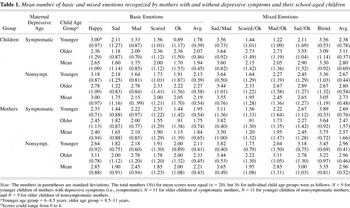
Children's recognition of basic emotions (see Table 1) was assessed in a 2 (Child Age Group, i.e., younger vs. older) × 2 (Maternal Symptom Status, i.e., symptomatic vs. nonsymptomatic) × 2 (Gender) × 5 (Target Emotion, i.e., happy, sad, mad, scared, and ok) repeated measures analysis of variance (ANOVA) with age group, gender, and maternal symptom status as between groups factors and emotion as a within group factor. A main effect was found for emotion, F (4, 128) = 6.01, p < .001; overall, some emotions were easier to recognize than others.2
Main effects for emotion were found in all of the analyses involving recognition and production (i.e., some emotions were more recognizable or easy to produce than others). These overall differences are described elsewhere (see, e.g., Denham, 1998) and were not theoretically relevant for the present purposes. Consequently, the main effects of emotion are not reported for any subsequent analyses (although it should be noted that all interactions involving emotions are included).
Mean number of basic and mixed emotions recognized by mothers with and without depressive symptoms and their school-aged children

Children's recognition of mixed emotions
Children's recognition of mixed emotions was also assessed in a 2 (Child Age Group) × 2 (Maternal Symptom Status) × 2 (Gender) × 5 (Target Emotion) repeated measures ANOVA. A main effect was found for age, F (1, 32) = 7.04, p < .02, but this was qualified by an Age × Emotion interaction, F (4, 128) = 3.86, p < .001. Follow-up analyses revealed that, compared to younger children, older children were better at recognizing sad/ok, mad/ok, and scared/ok mixed emotions: sad/ok, older M = 3.25 versus younger M = 2.30; mad/ok, older M = 2.70 versus younger M = 1.80; and scared/ok, older M = 2.55 versus younger M = 1.55, all F (1, 38), p < .05.
Mothers' recognition of basic emotions
Mothers' recognition of basic emotions was also assessed using a repeated measures ANOVA. Although child age and gender are not directly applicable to mothers, it seemed possible that mothers' emotion abilities could be affected by their children's characteristics, and consequently these child factors were retained for all maternal analyses. A main effect emerged for maternal depression symptom status, F (1, 32) = 4.51, p < .05: symptomatic mothers had more overall difficulties than nonsymptomatic mothers in recognizing basic emotions (M = 1.84 vs. 2.21, respectively).
Mothers' recognition of mixed emotions
A main effect emerged for maternal depression symptom status, F (1, 32) = 4.23, p < .05, with symptomatic mothers having more difficulty recognizing mixed emotions than nonsymptomatic mothers (M = 2.96 vs. 2.57, respectively). This main effect was qualified, however, by a Maternal Symptom Status × Emotion interaction, F (4, 128) = 2.63, p < .05. Follow-up analyses indicated that symptomatic mothers were worse than nonsymptomatic mothers only at recognizing mad/ok, F (1, 38) = 4.19, p < .05, M = 1.95 versus 2.85 respectively, and scared/ok mixes, F (1, 38) = 3.95, p < .05, M = 1.20 versus 1.95, respectively.
Emotion production
Children's production
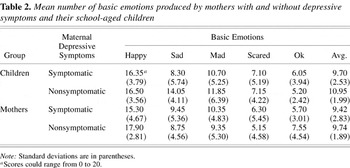
A repeated measures ANOVA (with the same factors as above) revealed a significant Maternal Symptom Status × Emotion interaction, F (4, 128) = 3.46, p < .01 (see Table 2). The follow-up analyses indicated that children of symptomatic and nonsymptomatic mothers differed only in their production of sad expressions; children of symptomatic mothers were worse at posing sad expressions than children of nonsymptomatic mother (M = 8.30 vs. 14.05, respectively).
Mean number of basic emotions produced by mothers with and without depressive symptoms and their school-aged children

Mothers' production
The analyses revealed no significant main effects or interactions (other than the emotion effect observed in all analyses; see footnote 2).
Recognition preferences for mixed emotions
Participants' recognition of mixed emotions was considered correct if they selected either of the two relevant mixed emotions (e.g., selecting either sadness or anger for the sad/ mad mix). Consequently, analyses were conducted to examine whether participants' systematically preferred one of the two correct choices for each of the mixed emotions. However, it was found that neither maternal symptom status nor children's age or gender had any influence on children's or mothers' emotion preferences regarding mixed emotions.
Analyses of error patterns
It is possible for two groups to be quite similar (or dissimilar) in the accuracy of their emotion judgments and yet still differ in the distribution or pattern of their inaccurate emotion judgments. For example, two groups both correctly recognize happy photos 70% of the time; however, when one group is wrong it nearly always selects sadness, whereas the other group nearly always selects anger (Gur et al., 1992; Reichenbach & Masters, 1983). Furthermore, the same holds for emotion production, where inaccurate scores reflect participants' tendency to produce particular types of emotions whenever they are unable to pose the target emotion. To address this issue, analyses were conducted of children's and mothers' emotion recognition (basic and mixed) and production errors using a 2 (Maternal Symptom Status) × 2 (Younger vs. Older Children) × 2 (Child Gender) × 5 (Emotion Type) repeated measures ANOVA for each analysis.
Errors for emotion recognition in children
For basic emotions, there was a significant Emotion × Maternal Symptom Status interaction, F (4, 128) = 2.82, p < .05. Follow-up analyses revealed a difference for happiness only: children of symptomatic mothers were more likely to mistakenly judge basic emotions as being happy expressions than their nonsymptomatic peers (19 vs. 8%). No significant findings emerged for children's errors involving mixed emotion recognition.
Errors for emotion recognition in mothers
There was a significant Child Age × Maternal Symptom Status × Emotion interaction, F (4, 128) = 2.73, p < .05. Our follow-up analyses revealed a difference for anger only; symptomatic mothers of young children were less likely to mistakenly recognize expressions as anger than were symptomatic mothers of older children (17 vs. 32%). In addition, symptomatic mothers of older children were more likely to mistakenly recognize expressions as anger than were nonsymptomatic mothers of older children (32 vs. 20%). Again, there were no significant findings for mixed emotion recognition.
Errors for emotion production in children
An Emotion × Maternal Symptom Status interaction emerged for emotion production, F (4, 128) = 3.06, p < .05. Follow-up analyses revealed that, compared to their peers, children of symptomatic mothers were significantly less likely to have their posed emotion expressions mistakenly judged as sad (24 vs. 39%) and somewhat more likely to have their posed expressions emotion mistakenly judged as happy (26 vs. 15%).
Errors for emotion production in mothers
A significant Emotion × Maternal Symptom Status × Child Gender interaction was observed for emotion production, F (4, 128) = 2.90, p < .05. The follow-up analyses revealed differences for sadness only: symptomatic mothers of boys were more likely to have their posed expressions mistakenly judged as sad than were nonsymptomatic mothers of boys (39 vs. 17%). Furthermore, symptomatic mothers of boys were more likely to have their expressions judged as sad than were symptomatic mothers of girls (39 vs. 18%).
Associations among mothers' and children's emotion-related abilities
The initial correlational analyses assessed the associations between participants' emotion-related abilities for basic and mixed emotions. Children's recognition of basic and mixed emotions were significantly related (r = .48, p < .001) and this correlation did not differ significantly for the children of symptomatic and nonsymptomatic mothers. Similarly, mothers' recognition of basic and mixed emotions was significantly related (r = .46, p < .001) and these abilities did not differ in symptomatic and nonsymptomatic mothers.
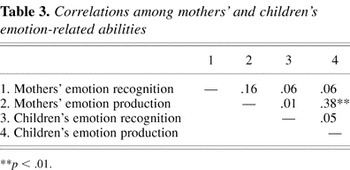
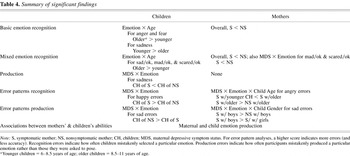
Analyses revealed that none of the associations between mothers' and children's emotion-related abilities were significantly moderated by maternal symptom status (Baron & Kenny, 1986). Consequently, subsequent correlational analyses assessed the overall associations among participants' emotion-related abilities. (Given the significant correlation between participants' recognition of basic and mixed emotions, a composite recognition score was formed.) A single significant association was found (see Table 3, and for a summary of all findings see Table 4): mothers who produced more recognizable emotions had children who produced more recognizable emotions.
Correlations among mothers' and children's emotion-related abilities

Summary of significant findings

Discussion
The present study extends the limited literature on emotion-related abilities in depressively symptomatic mothers and their school-age children in several ways. Most generally, symptomatic mothers and their children differed from nonsymptomatic mothers and their children in two core affective abilities (Halberstadt et al., 2001), that is, the recognition and production of emotion expressions. As noted below, these differences depended somewhat on the particular emotion, the ability (recognition vs. production), and whether the mother or child was being assessed. Yet, taken collectively, these emotion-related deficits and biases seem likely to create significant interpersonal difficulties both between symptomatic Latina mothers and their children and in their interactions with others.
One interesting set of findings involves the specific group differences in children's emotion-related abilities: children of symptomatic mothers had particular difficulties in posing recognizable expressions of sadness, and in their errors for emotion production (across all posed expressions) they were less likely to have their expressions inaccurately judged as sad (i.e., when they had problems producing emotions they avoided posing sadness). Furthermore, although children of symptomatic mothers were no less accurate than their peers in recognizing basic emotions, when they made mistakes they incorrectly “saw” more happiness than their peers. In other words, children of symptomatic mothers did not have difficulties with all emotions, just with sadness and happiness, and these difficulties suggest a tendency to avoid negative emotions.
These findings lend themselves to two quite different interpretations. Children of symptomatic mothers were no different than their peers in their ability to recognize emotions accurately; and, compared to their peers, children of symptomatic mothers could even appear slightly happier (or at least less sad) and perhaps more likely to look on the “bright side.” On one hand, it could be argued that this optimistic bias is a highly adaptive strategy that children of mothers with depressive symptoms can use to cope with aversive negative maternal affect and to elicit more positive emotional interactions with others. On the other hand, these subtle emotion differences could cause difficulties in these children's interactions with others. For example, other people may be less able to recognize that such children are feeling sad and as a result may sometimes fail to provide them with needed support and comfort.
The present results for the children of symptomatic mothers differ from previous findings regarding the emotion knowledge of children with internalizing symptoms (i.e., social withdrawal and depressive symptoms; Izard et al., 2001; Schultz et al., 2001). Unlike children with internalizing difficulties, children of symptomatic mothers did not have difficulties in the accuracy of their emotion recognition; and the difficulties that children with symptomatic mothers did have involved sadness and happiness only and not emotions overall. It is interesting, however, that evidence of a specific association between internalizing symptoms and a positive emotion error bias did emerge in another recent study (Arsenio & Maloney, 2003). In that research two groups of Latino elementary school children, one with elevated but subclinical internalizing symptoms (assessed with the Child Behavior Checklist) and a comparison group, were presented with several emotion knowledge tasks (including the assessments of basic and mixed emotion recognition used in the present study). In addition to an overall difference in the accuracy of the groups' emotion knowledge, a single significant difference emerged in their error patterns: across all tasks children with higher internalizing symptoms were more likely to mistakenly select happiness than their peers. This finding lends initial support to the view that the “optimistic bias” of the children of symptomatic mothers in the present study may be more problematic than adaptive.
More generally, the present findings are broadly consistent with studies indicating that children with internalizing difficulties (Arsenio & Maloney, 2003; Izard et al., 2001; Schultz et al., 2001) exhibit a number of biases and deficiencies in their emotion-related abilities. The present findings, however, are also unique because they suggest that the children of symptomatic mothers may display such difficulties prior to the emergence of clinical symptoms (at least based on CDI scores). Additional longitudinal research is needed to determine whether the nonsymptomatic children of depressively symptomatic mothers will display more depressive symptoms over time and whether these symptoms become associated with more extensive emotion-related biases and deficits (especially whether the “positivity bias” emerges as a risk or a protective factor for depression).
As might be expected, depressively symptomatic mothers' emotion-related difficulties were even more pervasive and potentially severe than those of their children. The finding that symptomatic mothers were significantly worse than nonsymptomatic mothers in their overall recognition of basic emotions (rather than having difficulties with specific basic emotions) was also observed by Persad and Polivy (1993) and contrasts with Gur et al.'s (1992) results (but with only 28 participants). The present error pattern analyses also support the idea that symptomatic mothers' difficulties in recognizing basic emotions are quite general: there was no systematic tendency for symptomatic mothers to incorrectly choose one emotion rather than another (with one exception involving children's age). In contrast, symptomatic mothers' deficits for mixed emotions were less general. However, it is unclear whether this difference stemmed from the less restrictive methodology used for mixed emotion (with two emotion choices considered correct rather than one), especially given that the mixed emotion findings for both mothers and their children were less revealing overall than those for basic emotions.
Although few studies have examined emotion recognition in depressed adults, additional work has been conducted using an “emotional” version of the Stroop task (assessing the speed/latency of adults' ability to name the colors of depression-related words by, e.g., ignoring the content of words like “gloomy” and focusing on the color). In addition, in six of seven studies it was found that depressed adults were slower than nondepressed adults at naming the color of affectively charged depression-related words (see William, Matthews, & MacLeod, 1996, for a review). Moreover, there was no evidence for any specific emotion effects (e.g., anger vs. sadness) involving depressed or other adult clinical groups.
Taken together, our adult emotion recognition results and the related Stroop findings (i.e., longer latencies for depression-related words) suggest that depressed adults and those with depressive symptoms have difficulty accessing emotionally charged, mostly negative representations. The present findings (like those of Persad and Polivy, 1993), however, also suggest that these difficulties extend beyond clearly depression-related themes (gloomy, lonely, hopeless) to include the recognition of emotions having no explicit connection with depression. These results are consistent with Bradley's (2000, p. 180) observation that the “avoidance of negative affect is common in both anxiety and depression.” Although such a strategy may be effective for controlling immediate negative arousal by reducing the recognition of negative emotional signals from others, this bias may also help to promote the problematic long-term emotional relationships that have been observed both within (e.g., Gotlib & Beach, 1995) and outside these families (Gotlib & Whiffen, 1991).
In terms of the associations between mothers' and children's emotion-related abilities, the expected link between maternal production and child recognition was not found. By contrast, the expected link between children's and mothers' emotion productions was found and it was not moderated by maternal depression symptom status. Although this significant association between maternal and child emotion production does not clarify the specific processes responsible for such a link, it is consistent with other theoretical (Halberstadt, 1991) and empirical work (e.g., Denham, 1993) indicating that “children's expressiveness reflects their parents' own total emotional expressiveness” (Denham, 1998, p. 110). Moreover, similar modeling influences have also been observed in depressed mothers and their infants and toddlers (e.g., Field et al., 1990).
The present findings are, to our knowledge, unique in that they reveal associations between the emotion production of mothers with depressive symptoms and their older children while also suggesting that such associations are not fundamentally different from those observed in nonsymptomatic mothers and their children. Admittedly, however, this first step raises many questions that need to be addressed by future research. Despite the clear predictive utility of the posed emotion task (e.g., Camras et al., 1988; Walden & Field, 1990), little is known about how it relates to spontaneous emotional displays. Thus, for example, even though the posed emotions of symptomatic and nonsymptomatic mothers in this study did not differ, it seems unlikely that their spontaneous emotion displays are similar. It is also unclear why symptomatic mothers' pervasive difficulties in recognizing emotions had no specific associations with either of their children's emotion abilities.
In addition to these more general results, some age-related findings were found in children's recognition of emotion. As might be expected (Saarni, 1999), older children were better than younger children at recognizing many of these basic and mixed emotions. Moreover, the fact that older children were better than younger children at recognizing anger and fear, as well as the more “subtle” mixed emotions (i.e., those including neutral affect and a negative emotion) is consistent with work suggesting that young children are first able to distinguish between positive and negative expressions and only later can differentiate anger, fear, and more complex emotions (Denham, 1998; Denham et al., 1990). The much later differentiation in the present study (younger vs. older elementary school children rather than younger and older preschoolers) is probably a result of using less than perfectly prototypical photos rather the simpler line drawing often used in work with younger children. In any case, the present findings suggest that improvements in children's emotion recognition continue into their elementary school years.
Underlying all of these findings is the specifically emic nature of this study, with its focus on group differences in symptomatic and nonsymptomatic Latina mothers and their children. Recent evidence indicates that, compared to other ethnic minority groups, Latinos are at increased risk for depressive symptoms both as adults (e.g., Blazer, Kessler, McGonagle, & Swartz, 1994) and as children (Twenge & Nolen–Hoeksema, 2002). Given the high, stable levels of Latino child poverty over the last 20 years (Seccombe, 2000) and the high levels of acculturative stress faced by many Latino immigrants (including nearly all of the mothers in this study), this increased risk is not surprising (see, e.g., Garcia Coll & Garrido, 2000). Yet, despite this overall increased risk for Latino depression, the present study revealed important within group differences both in the tendency to exhibit depressive symptoms and in the emotion-related abilities that may underlie or at least perpetuate these depressive tendencies.
Additional research is needed to examine the specific familial and cultural processes underlying these results. For example, studies of mostly African American lower socioeconomic status families (e.g., Garner et al., 1994; Garner & Spears, 2000) have shown that negative maternal emotionality, inappropriate family affect, and discouragement of children's negative emotion expression are related to lower levels of children's emotion knowledge and social competence. Given the scant research on emotions and family influences in Latino families, it is unclear whether similar patterns will emerge or whether unique familial factors may play a role. For example, it has been suggested that Latino families tend to emphasize mutual respect, interpersonal relatedness, and somewhat traditional gender role divisions, although heterogeneity in Latino cultures and different levels of acculturation probably influence these patterns as well (Garcia Coll, Meyer, & Brillon, 1995). Still, compared to some groups, children in Latino families may be especially attuned to maternal emotional cues and consequently may be at greater risk for disruptions in their emotion abilities if their mothers begin to exhibit depressive symptoms.
Finally, several limitations of the present study need to be mentioned. Two have already been discussed, namely, the use of posed rather than spontaneous emotion expressions to assess participants' abilities to produce recognizable emotions and the use of a correlational approach for examining the associations between mothers' and children's emotion-related abilities. Both approaches have been successfully used in previous research, but each also has its own obvious constraints. In addition, differences in the scoring for mixed and basic emotion recognition made it necessary to conduct separate analyses for each type of recognition and made it difficult to compare across these two forms of recognition. This limitation also increased the total number of analyses conducted and consequently increased the probability of committing type I errors. Although the overall pattern of significant results adds strength to the core findings discussed above, replication with larger more process-focused designs is needed.
References
REFERENCES
Alva, S., &
Reyes, R.
(1999).
Psychosocial stress, internalized symptoms, and academic
achievement of Hispanic adolescents.
Journal of Adolescent Research
14,
343–358.Google Scholar
Arsenio, W.
(1988).
Children's conceptions of the situational affective
consequences of sociomoral events.
Child Development
59,
1611–1622.Google Scholar
Arsenio, W.,
Cooperman, S., &
Lover, A.
(2000).
Affective predictors of preschoolers' aggression and peer
acceptance: Direct and indirect effects.
Developmental Psychology
36,
438–448.Google Scholar
Arsenio, W., &
Maloney, A.
(2003, April).
Emotion-related abilities and adjustment in Latino elementary
school children.
Poster session presented at the Biennial Meeting of the Society
for Research in Child Development, Tampa, FL.
Baron, R., &
Kenny, D.
(1986).
The moderator–mediator variable distinction in social
psychological research: Conceptual, strategic, and statistical
considerations.
Journal of Personality and Social Psychology
51,
1173–1182.Google Scholar
Beck, A.
(1996).
Beck Depression Inventory.
San Antonio, TX:
Harcourt.
Blazer, D.,
Kessler, R.,
McGonagle, K., &
Swartz, M.
(1994).
The prevalence and distribution of major depression in a national
community sample: The National Comorbidity Study.
American Journal of Psychiatry
151,
979–986.Google Scholar
Bradley, S.
(2000).
Affect regulation and the development of psychopathology.
New York:
Guilford Press.
Brody, L., &
Hall, J.
(2000).
Gender, emotion, and expression. In
M. Lewis &
J. Haviland–Jones (Eds.),
Handbook of emotion
(2nd ed., pp.
338–349).
New York:
Guilford Press.
Camras, L.,
Grow, C., &
Ribordy, S.
(1983).
Recognition of emotional expressions by abused children.
Journal of Clinical and Child Psychology
12,
325–328.Google Scholar
Camras, L.,
Ribordy, S.,
Hill, J.,
Martino, S.,
Sachs, V.,
Spaccarelli, S., &
Stefani, R.
(1990).
Maternal facial behavior and the recognition and production of
emotional expression by maltreated and nonmaltreated children.
Developmental Psychology
6,
304–312.Google Scholar
Camras, L.,
Ribordy, S.,
Hill, J.,
Martino, S.,
Spaccarelli, S., &
Stefani, R.
(1988).
Recognition and posing of emotional expressions by abused children
and their mothers.
Developmental Psychology
24,
776–781.Google Scholar
Camras, L.,
Sachs–Alter, E., &
Ribordy, S.
(1996).
Emotion understanding in maltreated children: Recognition of
facial expressions and integration with other emotion cues. In
M. Lewis &
M. W. Sullivan (Eds.),
Emotional development in atypical children (pp.
203–225).
Mahwah, NJ:
Erlbaum.
Canals, J.,
Blade, J.,
Carbajo, G., &
Domenech–Llaberia, E.
(2001).
The Beck Depression Inventory: Psychometric characteristics and
usefulness in nonclinical adolescents.
European Journal of Psychological Assessment
17,
63–68.Google Scholar
Cohn, J.,
Campbell, S.,
Matias, R., &
Hopkins, J.
(1990).
Face-to-face interactions of postpartum depressed and nondepressed
mother infant pairs at 2 months.
Developmental Psychology
26,
15–23.Google Scholar
Custrini, R., &
Feldman, R.
(1989).
Children's social competence and nonverbal encoding and
decoding of emotions.
Journal of Clinical Child Psychology
18,
336–342.Google Scholar
Cummings, M., &
Davies, P.
(1994).
Maternal depression and child development.
Journal of Child Psychology and Psychiatry
35,
73–112.Google Scholar
Daza, P.,
Novy, D.,
Stanley, M., &
Averill, P.
(2002).
The Depression Anxiety Scale—21: Spanish translation and
validation with a Hispanic sample.
Journal of Psychopathology and Behavioral Assessment
24,
195–205.Google Scholar
Denham, S.
(1993).
Maternal emotional expressiveness and toddlers'
social–emotional functioning.
Journal of Child Psychiatry and Psychology
34,
725–728.Google Scholar
Denham, S.
(1998).
Emotional development in young children.
New York:
Guilford Press.
Denham, S.,
McKinley, M.,
Couchoud, E., &
Holt, R.
(1990).
Emotional and behavioral predictors of preschool peer ratings.
Child Development
61,
1145–1152.Google Scholar
Denham, S.,
Zoller, D., &
Couchoud, E.
(1994).
Socialization of preschoolers' understanding of emotion.
Developmental Psychology
30,
928–936.Google Scholar
Dix, T.
(1991).
The affective organization of parenting.
Psychological Bulletin
110,
3–25.Google Scholar
Downey, G., &
Coyne, J.
(1990).
Children of depressed parents: An integrative review.
Psychological Bulletin
108,
5–76.Google Scholar
Dunn, J.,
Brown, J., &
Maguire, M.
(1995).
The development of moral sensibility: Individual differences and
emotion understanding.
Developmental Psychology
31,
649–659.Google Scholar
Ekman, P.,
Roper, G., &
Hager, R.
(1980).
Deliberate facial movement.
Child Development
51,
886–891.Google Scholar
Field, T.,
Healy, B.,
Goldstein, S., &
Guthertz, M.
(1990).
Behavior-state matching and synchrony in mother–infant
interactions of nondepressed versus depressed dyads.
Developmental Psychology
26,
7–14.Google Scholar
Fine, S.,
Izard, C.,
Schultz, D., &
Ackerman, B.
(2000).
Emotion knowledge as a predictor of children's self-reports of
internalizing.
Unpublished manuscript.
Friesen, W., &
Ekman, P.
(1984).
EMFACS: Emotion facial coding system.
Available from W. Friesen,
Department of Psychiatry, University of California, San Francisco.
Garber, J., &
Flynn, C.
(2001).
Vulnerability to depression in childhood and adolescence. In
R. Ingram &
J. Price (Eds.),
Vulnerability to psychopathology: Risky across the life span (pp.
175–225).
New York:
Guilford Press.
Garcia Coll, C.,
Akerman, A., &
Cicchetti, D.
(2000).
Cultural influences on developmental processes and outcomes:
Implications for the study of development and psychopathology.
Development and Psychopathology
12,
333–356.Google Scholar
Garcia Coll, C., &
Garrido, M.
(2000).
Minorities in the United States: Sociocultural context for mental
health and developmental psychopathology. In
A. Sameroff,
M. Lewis, &
S. Miller (Eds.),
Developmental Psychopathology
(2nd ed., pp.
177–195).
Garcia Coll, C.,
Meyer, E., &
Brillon, L
(1995).
Ethnic and minority parenting. In
M. Bornstein (Ed.),
Handbook of parenting: Vol. 2. Biology and ecology of parenting (pp.
189–289).
Mahwah, NJ:
Erlbaum.
Garner, P.,
Jones, D., &
Miner, J.
(1994).
Social competence among low-income preschoolers: Emotion
socialization practices and social cognitive correlates.
Child Development
65,
622–637.Google Scholar
Garner, P., &
Spears, F.
(2000).
Emotion regulation in low-income preschoolers.
Social Development
9,
246–264.Google Scholar
Goodman, S., &
Gotlib, I.
(1999).
Risk for psychopathology in the children of depressed mothers: A
developmental model for understanding mechanisms of transmission.
Psychological Review
106,
458–490.Google Scholar
Gotlib, I., &
Beach, S.
(1995).
A marital/family discord model of depression: Implications for
therapeutic intervention. In
N. Jacobson &
A. Gurman (Eds.),
Clinical handbook of couple therapy (pp.
411–436).
New York:
Guilford Press.
Gotlib, I., &
Whiffen, V.
(1991).
The interpersonal context of depression. In
W. Jones &
D. Perlman (Eds.),
Advances in personal relationships
(Vol. 3, pp.
177–206).
London:
Kingsley.
Gottman, J., &
Krokoff, L.
(1989).
Marital interaction and satisfaction: A longitudinal view.
Journal of Consulting and Clinical Psychology
57,
47–55.Google Scholar
Gross, A., &
Bailif, B.
(1991).
Children's understanding of emotions from facial expressions
and situations.
Developmental Review
11,
368–398.Google Scholar
Gross, J., &
Levenson, R.
(1993).
Emotional suppression: Physiology, self-report, and expressive
behavior.
Journal of Personality and Social Psychology
64,
970–986.Google Scholar
Gur, R. C.,
Erwin, R.,
Gur, R. E.,
Zwil, A.,
Heimberg, C., &
Kramer, H.
(1992).
Facial emotion discrimination: II. Behavioral findings in
depression.
Psychiatry Research
42,
241–251.Google Scholar
Halberstadt, A.
(1991).
Socialization of expressiveness: Family influences in particular
and a model in general. In
R. Feldman &
S. Rime (Eds.),
Fundamentals of emotional expressiveness (pp.
106–162).
Cambridge:
Cambridge University Press.
Halberstadt, A.,
Denham, S., &
Dunsmore, J.
(2001).
Affective social competence.
Social Development
10,
79–119.Google Scholar
Hammen, C.
(2001).
Vulnerability to depression in adulthood. In
R. Ingram &
J. Price (Eds.),
Vulnerability to psychopathology: Risk across the life span (pp.
226–257).
New York:
Guilford Press.
Harris, P.
(1989).
Children and emotion: The development of psychological
understanding.
Oxford:
Basil Blackwell.
Hay, D.,
Vespo, J., &
Zahn–Waxler, C.
(1998).
Young children's quarrels with their siblings: Links with
maternal depressions and bipolar illness.
British Journal of Developmental Psychology
16,
519–538.Google Scholar
Hubbard, J.
(2001).
Emotion expression processes in children's peer interactions:
The role of peer rejection, aggression, and gender.
Child Development
72,
1426–1438.Google Scholar
Izard, C.,
Fine, S.,
Schultz, D.,
Mostow, A.,
Ackerman, B., &
Youngstrom, E.
(2001).
Emotion knowledge as a predictor of social behavior and academic
competence in children at risk.
Psychological Science
12,
18–23.Google Scholar
Jones, S.,
Eisenberg, N.,
Fabes, R., &
MacKinnon, D.
(2002).
Parents' reactions to elementary school children's
negative emotions: Relations to social and emotional functioning at
school.
Merrill–Palmer Quarterly
48,
133–159.Google Scholar
Kovacs, M.
(1985).
The Children's Depression Inventory (CDI).
Psychopharmacology Bulletin
21,
995–998.Google Scholar
Lemerise, E., &
Arsenio, W.
(2000).
An integrated model of emotion processes and cognition in social
information processing.
Child Development
71,
107–118.Google Scholar
Mendez, J.,
Fantuzzo, J., &
Cicchetti, D.
(2002).
Profiles of social competence among low-income African American
preschool children.
Child Development
73,
1085–1100.Google Scholar
Mostow, A.,
Izard, C.,
Fine, S., &
Trentacosta, C.
(2002).
Modeling emotional, cognitive, and behavioral predictors of peer
acceptance.
Child Development
73,
1775–1787.Google Scholar
Persad, S., &
Polivy, J.
(1993).
Differences between depressed and non-depressed individuals in the
recognition of and response to facial emotional cues.
Journal of Abnormal Psychology
102,
358–368.Google Scholar
Reichenbach, L., &
Masters, J.
(1983).
Children's use of expressive and contextual cues in judgments
of emotion.
Child Development
53,
993–1004.Google Scholar
Saarni, C.
(1999).
The development of emotional competence.
New York:
Guilford Press.
Schmitt, E.
(2001, April 1).
U.S. now more diverse, ethnically and racially.
The New York Times, p.
A 18.Google Scholar
Schultz, D.,
Izard, C.,
Ackerman, B., &
Youngstrom, E.
(2001).
Emotion knowledge in disadvantaged children: Self-regulatory
antecedents and relations to social difficulties and withdrawal.
Development and Psychopathology
13,
53–67.Google Scholar
Seccombe, K.
(2000).
Families in poverty in the 1990s: Trends, causes, consequences, and
lessons learned.
Journal of Marriage and the Family
62,
1094–1113.Google Scholar
Twenge, J., &
Nolen–Hoeksema, S.
(2002).
Age, gender, race, socioeconomic status, and birth cohort
differences on the Children's Depression Inventory: A
meta-analysis.
Journal of Abnormal Psychology
111,
578–588.Google Scholar
Walden, T., &
Field, T.
(1990).
Preschool children's social competence and production and
discrimination of affective expressions.
British Journal of Developmental Psychology
8,
65–76.Google Scholar
William, J.,
Matthews, A., &
MacLeod, C.
(1996).
The emotional Stroop task and psychopathology.
Psychological Bulletin
120,
3–24.Google Scholar
Zahn–Waxler, C.,
Iannotti, R.,
Cummings, M., &
Denham, S.
(1990).
Antecedents of problem behaviors in children of depressed mothers.
Development and Psychopathology
2,
271–291.Google Scholar
Zahn–Waxler, C.,
Klimes–Dougan, B., &
Slattery, M.
(2000).
Internalizing problems of childhood and adolescence: Prospects,
pitfalls, and progress in understanding the development of anxiety and
depression.
Development and Psychopathology
12,
443–467.Google Scholar
Zahn–Waxler, C.,
Kochanska, G.,
Krupnick, J., &
McKnew, D.
(1990).
Patterns of guilt in children of depressed and well mothers.
Developmental Psychology
26,
51–59.Google Scholar
Mean number of basic and mixed emotions recognized by mothers with and without depressive symptoms and their school-aged children
Mean number of basic emotions produced by mothers with and without depressive symptoms and their school-aged children
Correlations among mothers' and children's emotion-related abilities
Summary of significant findings
 You have
Access
- 4
- Cited by