1 Introduction
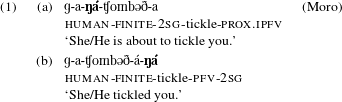
As morphologists, we expect the relative order of morphs in a word to be constant. That is, whenever two morphs co-occur within a word expressing the same content, we expect them to appear in the same relative order. This is however not always the case. Consider the following example from Moro (from Rose Reference Rose, Blench and Schadeberg2013: 38). In the proximal imperfective, object markers such as 2sg  are realised as prefixes adjacent to the stem, as seen in (1a). In the perfective, the same markers are realised as suffixes at the very end of the word, as seen in (1b).Footnote [2]
Such situations of variable ordering challenge the basic intuition about morphotactics captured by the traditional notion of a template of position classes: within a word, affixes are arranged in a strict sequence, with elements in paradigmatic opposition all targeting the same position. While the perspicuity of postulating arbitrary templates has been challenged by many (inter alia, Baker Reference Baker1985, Rice Reference Rice2000, Aronoff & Xu Reference Aronoff and Xu2010), the intuition of strict linear arrangement is still at the basis of most if not all contemporary approaches to morphological structure, even where it is derived from the order of terminals in a syntactic tree (Selkirk Reference Selkirk1982, Halle & Marantz Reference Halle, Marantz, Hale and Keyser1993, Rice Reference Rice2000) or the sequencing of morpholexical rules organised into blocks (Anderson Reference Anderson1992, Stump Reference Stump2001).
There is a growing body of literature on the proper analysis of fixed and variable order in the context of derivational morphology, where the crucial research question is whether variation in order correlates with variation in the order of application of morphological operations, as witnessed by intuitions on semantic scope (see among many others Rice Reference Rice2000, Hyman Reference Hyman2003, Paster Reference Paster, Booij and Marle2005, Ryan Reference Ryan2010). The issue however takes a very different character in the context of inflection, where affixes are typically seen as exponents of (combinations of) morphosyntactic properties and often do not directly express semantic content.
The goal of this paper is to construct a formal theory of inflection that puts the modelling of variable morph ordering at its core. Specifically, we argue that a template of fixed positions provides the fundamental concept on which to build order, but that individual morphs need not be tied to a single position; rather, different types of variable associations between morphs and positions are allowed. Thus, we aim to develop the templatic model, renown for its presentational parsimony, into a flexible and formally precise theory of morphotactics.Footnote [3] We develop this idea in the context of an inferential-realisational (Stump Reference Stump2001) model of inflection formalised using the logic of typed feature structures (Carpenter Reference Carpenter1992) familiar from Head-driven Phrase Structure Grammar (HPSG; Pollard & Sag Reference Pollard and Sag1994); the feature logic crucially allows us to treat order variability as partial underspecification of order and places our approach in the general family of model-theoretic (as opposed to generative-enumerative) frameworks (Pullum & Scholz Reference Pullum, Scholz, de Groote, Morrill and Retoré2001).
The paper is organised as follows. In Section 2 we propose a preliminary typology of variable morph ordering in inflection, distinguishing as precisely as possible different structural types of variable order. In parallel to the construction of the typology, we establish schematic visual representations of the systems under investigation which extend the traditional notion of a morphological template and which lay the groundwork for the formal analysis. In Section 3, we provide motivation for the template as an empirically adequate and theoretically motivated representation of word structure. We show that the postulation of arbitrary conventionalised linear structure is an unavoidable feature of a viable approach to morphology, and then argue that a template of indexed positions is a better fit to what is known on the diversity of variable order than more complex hierarchical structures. More specifically, we shall contrast, in Section 3.2, the templatic view with the stem-centric view that characterises a majority of generative approaches and demonstrate that the latter makes cross-linguistically questionable predictions, suggesting, contrary to fact, that mirroring of affix sequences should be more usual than shifting of affix clusters. Finally, in Section 4, we present Information-Based Morphology, an inferential-realisational approach to inflection that crucially builds on multi-dimensional inheritance type hierarchies (Koenig & Jurafsky Reference Koenig and Jurafsky1994) to generalise about properties of order and shape; we show that this new framework adequately captures the types of variable order we identified in Section 2.
2 On the typology of variable morph ordering
In order to elucidate the diversity of morphotactic systems, we will start by setting up a canonical typology of morphotactics. Following the lead of Corbett (Reference Corbett2003, Reference Corbett2007, Reference Corbett2012), Brown, Chumakina & Corbett (Reference Brown, Chumakina and Corbett2013) and others, we attempt to characterise what morphologists of all persuasions would presumably agree is a simple and clear inflection system, and observe different kinds of deviations from that canonical ideal. This allows us to get a grasp of the diversity of variable morphotactics, which will be crucial both to the evaluation of existing theories of morphotactics in Section 3 and to the design of a theory that does justice to that diversity, in Section 4. In addition, the exploration of the typology will provide key data sets whose analysis will allow us to illustrate the workings of Information-Based Morphology in Section 4.
We will use the descriptive vocabulary set forth in Matthews (Reference Matthews1974). We take an inflected word to be the realisation of a morphosyntactic property set of a lexeme. The paradigm of a word is the structured set of words realising it, that is, the set of well-formed associations between a lexeme, a word form, and a morphosyntactic property set. A string that is present only in word forms filling paradigm cells sharing a morphosyntactic property is an exponent of that property. We use morph as a cover term for recurrent partials that are identifiable within the paradigm of one lexeme. On this definition there are only three kinds of morphs: stems, affixal exponents, and discontinuous stem formatives. The fact that stems of derived lexemes can be further segmented will be ignored, as this plays no role in the current discussion.
For the purposes of this paper, we presuppose that words can be exhaustively segmented into morphs, and that a consensual segmentation of word forms into morphs can be attained. Of course this is an idealisation, and for some systems such a presupposition is ill-advised (see e.g. Blevins Reference Blevins2006). We will decidedly ignore these, or focus on sub-parts of the systems where this presupposition is not problematic. The motivation for this choice is simply to avoid blur in the typology due to issues orthogonal to morphotactics – where segmentation is not possible, there are no morphotactic issues to address. For the same reasons, we will focus on concatenative aspects of inflection.
2.1 Templatic descriptions
As we stated in the introduction, one main goal of this paper is to take the notion of a template of positions at face value. We will thus use (informal) templatic descriptions as our main descriptive device for making sense of the typology of morphotactic systems. In general, we take a templatic description to have the following characteristics:
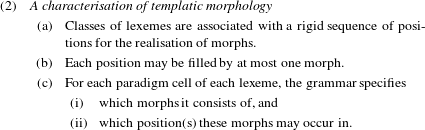
This characterisation is intended to be extremely general. Purposefully, we do not state that a morph should always occupy the same position, or that the number of positions should be minimal – in principle, there could be more positions than there are morphs in the system. Clearly then, any inflection system may be given a templatic description, and most systems may be given more than one.
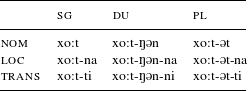
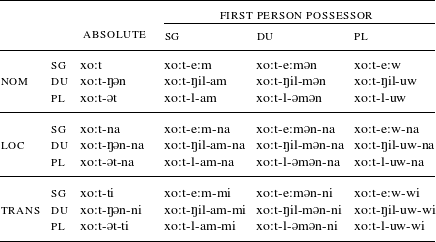
Despite this, there is a strong intuition that some templatic descriptions are simpler than others, and that some systems are amenable to simpler templatic descriptions. For illustration, let us consider the declension of nouns in Ostyak,Footnote [4] starting with the absolute sub-paradigm, exemplified in Table 1.
The absolute declension of the Ostyak noun xo:t ‘house’ (Nikolaeva Reference Nikolaeva1999).
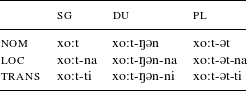
One can easily identify, in columns, a dual suffix  and a plural suffix -t; in rows, a locative suffix -na and a translative suffix -Ci, where C assimilates to the preceding consonant (compare
 ‘top’, trans
 Both number suffixes always precede both case suffixes, and vice versa.
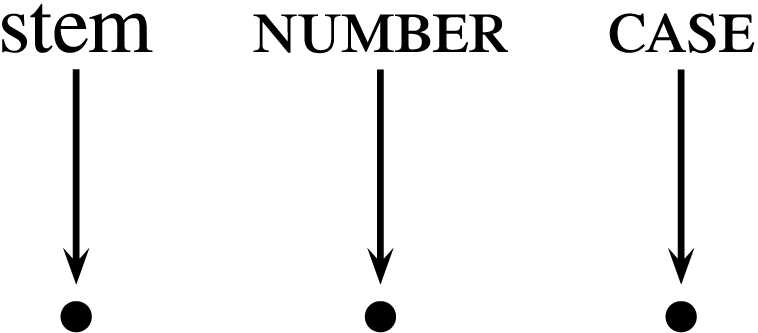
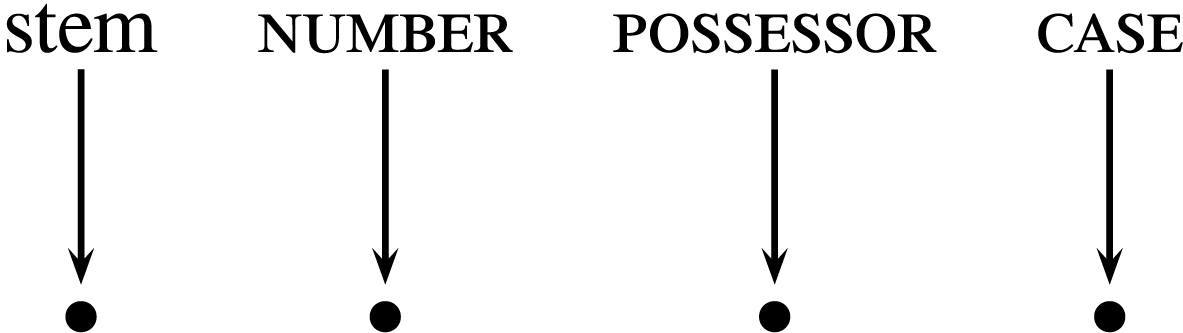
A clear characteristic of this system is that affixes expressing different values of the same feature always occur in the same order. Because of this, there clearly is one most simple templatic description of the system, which assigns morphs to positions on the basis of the features they realise; there are as many positions as there are independent dimensions of variation in the paradigm of a noun. Such a simple templatic description can be schematised as in Figure 1.
Templatic description of the morphotactics of Ostyak absolute nouns.
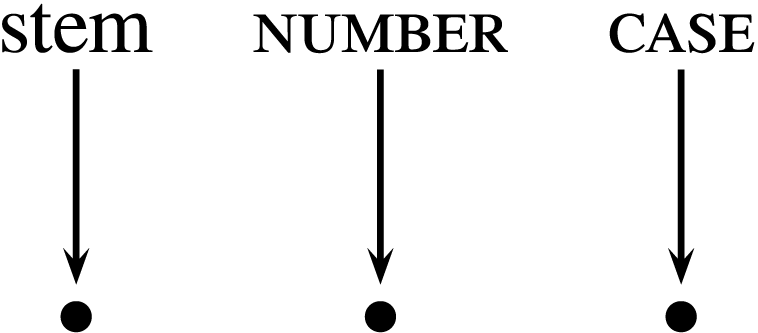
We take the Ostyak declension to illustrate a morphotactically canonical system of exponence, precisely because it is associated with such a simple templatic description. To guide the exploration of non-canonical morphotactics, we will consider which factors preclude such simple statements.
2.2 Canonical morphotactics
The simplicity of the description of Ostyak may be attributed to the combination of two properties, which we call paradigmatic alignment and stable placement of morphs.
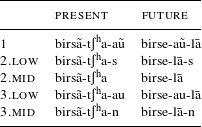
To illustrate what paradigmatic alignment amounts to, let us examine the partial paradigm of a Nepali verb,Footnote [5] shown in Table 2.
Masculine singular forms of the Nepali verb birsanu ‘forget’.
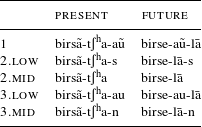
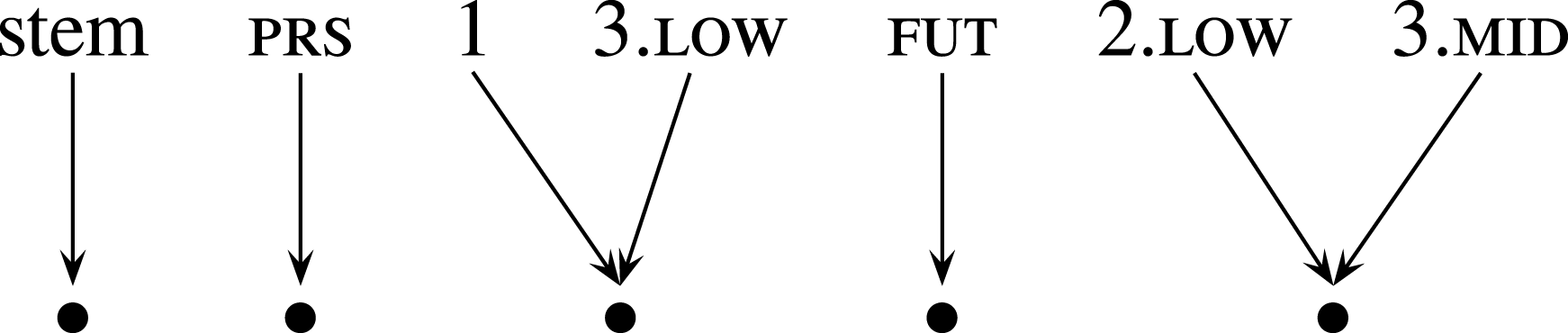
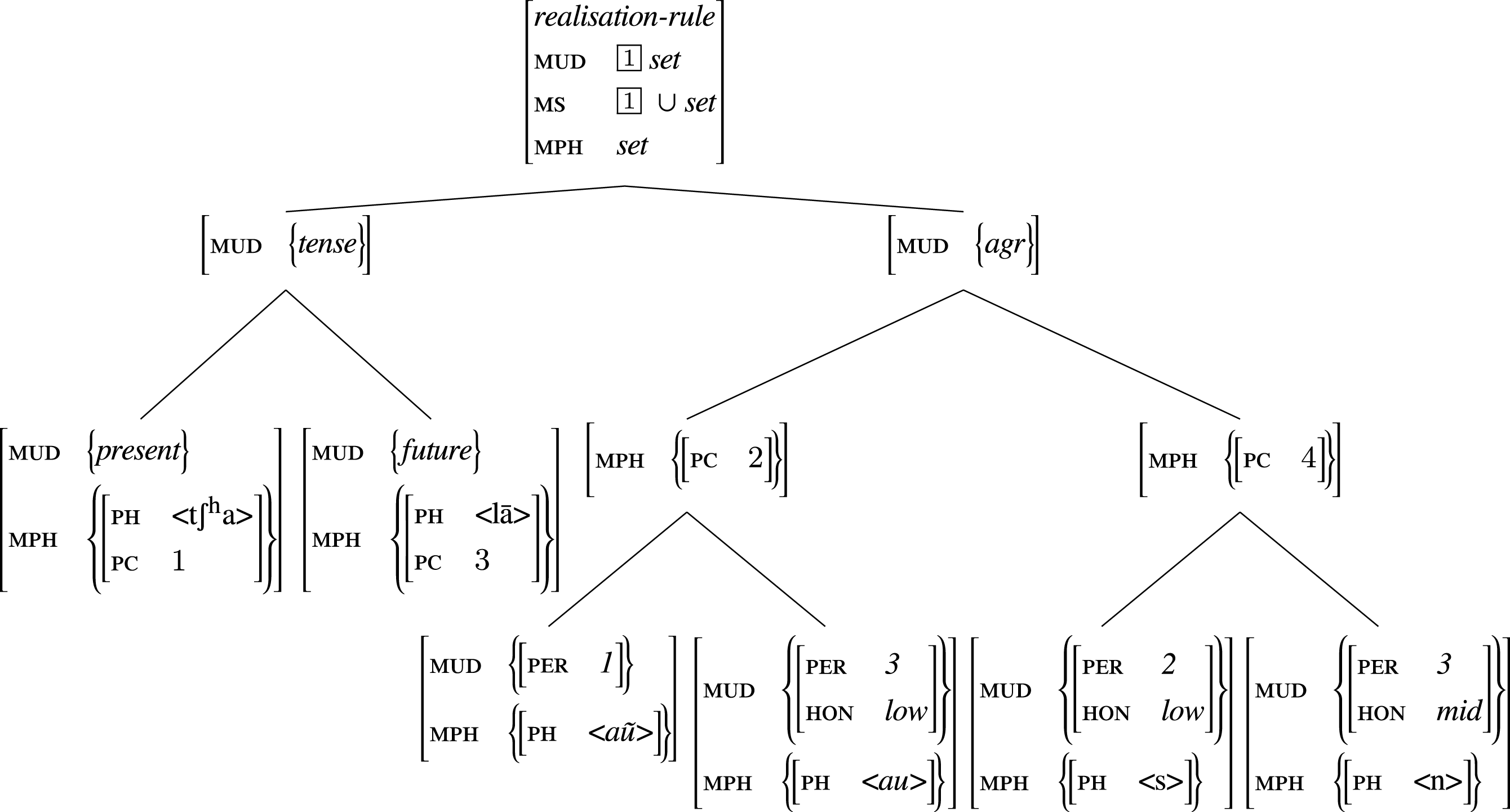
As the segmentation highlights, the positive simple present is realised by  and the future by -lā; these two affixes are evidently in complementary distribution. Person markers are constant across the two tenses, and take the following forms: 1-aũ, 2.low-s, 2.mid no exponent, 3.lowau, 3.mid-n.Footnote [6] These are again in complementary distribution. From a morphotactic point of view, the notable property of this subsystem is that the relative order of the tense and person markers varies depending on the markers: whereas the present marker always comes first, the future marker comes first in the 1 and 3.low but last in the 2.low and 3.mid. This is schematised in Figure 2.
Schematic representation of Nepali verbs.

As Figure 2 illustrates, it is not possible to state the placement properties of all morphs realising different values of the same feature uniformly. However, it is still possible to assign each morph to a single position.
We call the situation illustrated by Nepali misaligned placement of morphs, and we call paradigmatic alignment of morphs the criterion for canonical morphotactics it violates. In the interest of clarity, we propose an explicit definition of paradigmatic alignment based on the notion of syntagmatic equivalence:
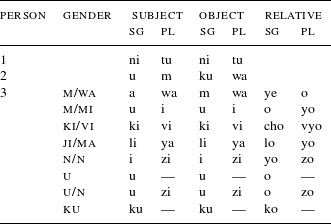
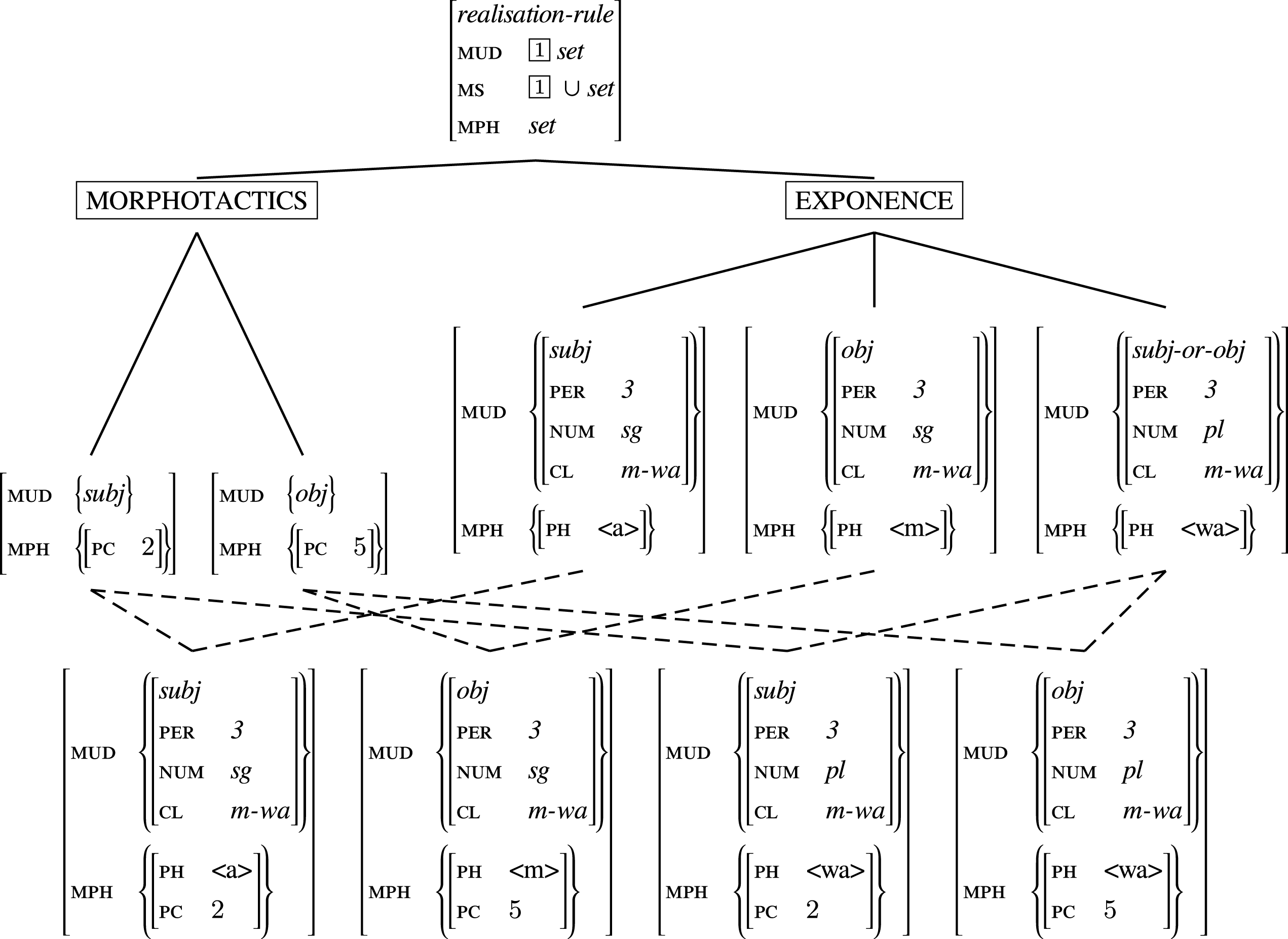
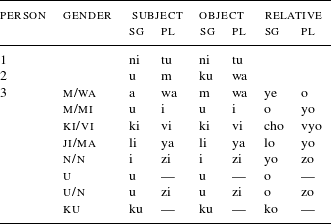
Swahili person markers.
The Nepali data from Table 2 clearly violate paradigmatic alignment of morphs: for instance, the 2.low marker -s and the 3.low marker -au stand in paradigmatic opposition, but they are not syntagmatically equivalent, since one follows and the other precedes the fut affix lā.
Stable placement of morphs is a second, independent property characterising canonical systems. Once again this is best understood by looking at an example. In Swahili, for some tam/polarity combinations, relativisation is marked by the presence of an affix within the verb agreeing in class with the relativised element. Although the relativised element necessarily corresponds to a subject or an object in this construction, both the shape and the position of the affix distinguish it from subject and object markers, with which they co-occur. The various person markers of Swahili are listed in Table 3 to highlight this point.
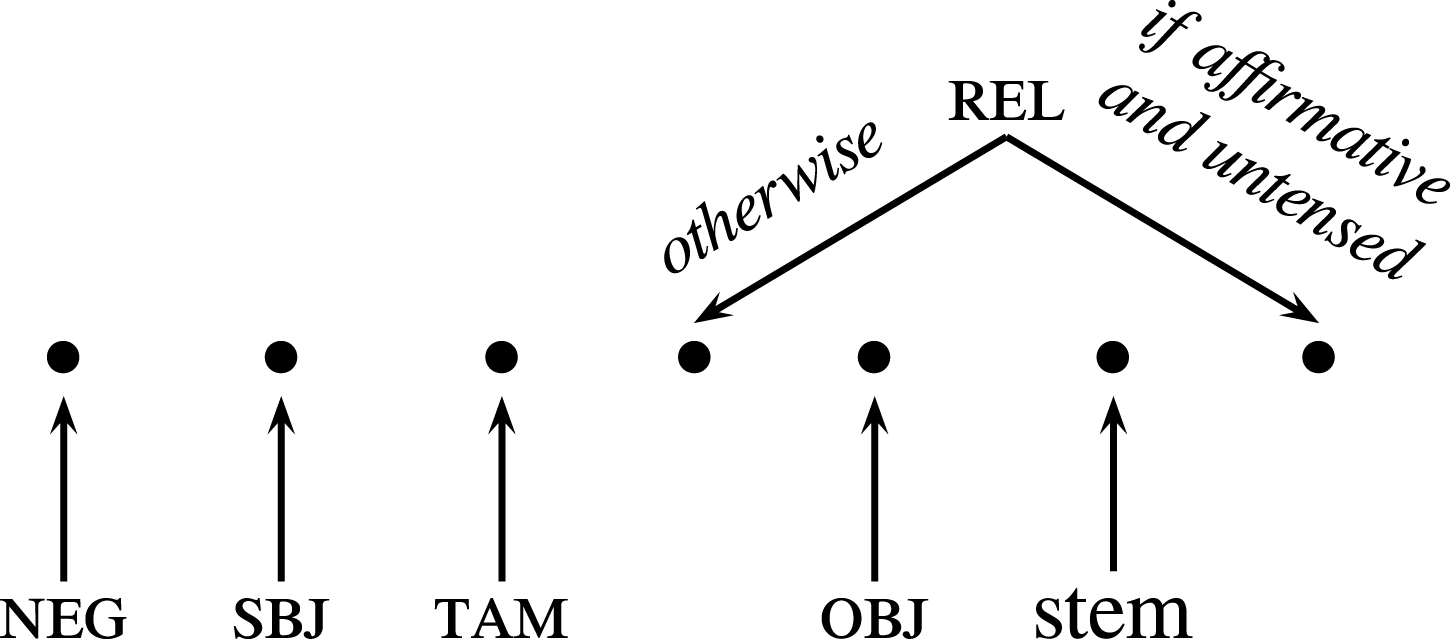
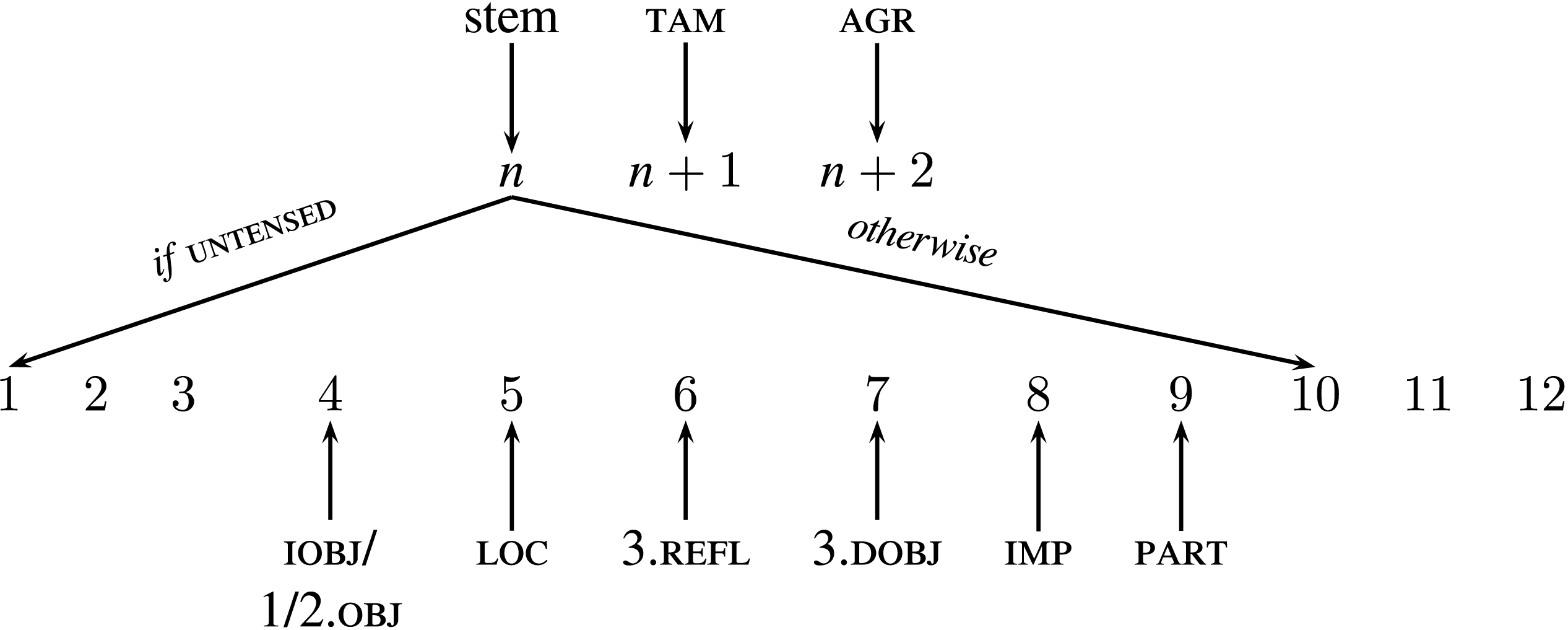
While the shape of Swahili relative markers is constant across the paradigm, their placement is variable: in the positive present progressive, simple past and future, and in the negative general present, they are realised as prefixes, linearly between the TAM and object marker, as in (6) below. In the positive general present however, they are realised as suffixes adjacent to the stem, see (7).

Schematic representation of Swahili conditioned placement.
The situation found in Swahili deviates from the situation found in Ostyak in a new manner. In Nepali, the relative order of tense and person markers is not constant, but each individual pair of morphs occurs in a fixed order. In Swahili, by contrast, the very same pair of morphs (the stem and the relative marker) are found in alternate orders depending on independent factors. Because of this, it is not possible to write a templatic description assigning each morph to a fixed position; rather, it must be acknowledged that one and the same morph may be placed differentially. We schematise this by having two arrows linking a family of morphs to two positions, annotating the arrows with conditions as appropriate. Figure 3 illustrates.
The criterion that is violated by Swahili is spelled out in (8).

Paradigmatic alignment and stable placement are orthogonal properties: paradigmatic alignment governs the placement properties of morphs standing in complementary distribution, while stable placement governs the co-occurrence of morphs. The reader can easily check that the subsystem of Nepali presented above satisfies stable placement of morphs, while the subsystem of Swahili satisfies paradigmatic alignment. To complete the typology, we briefly discuss a system violating both criteria simultaneously.
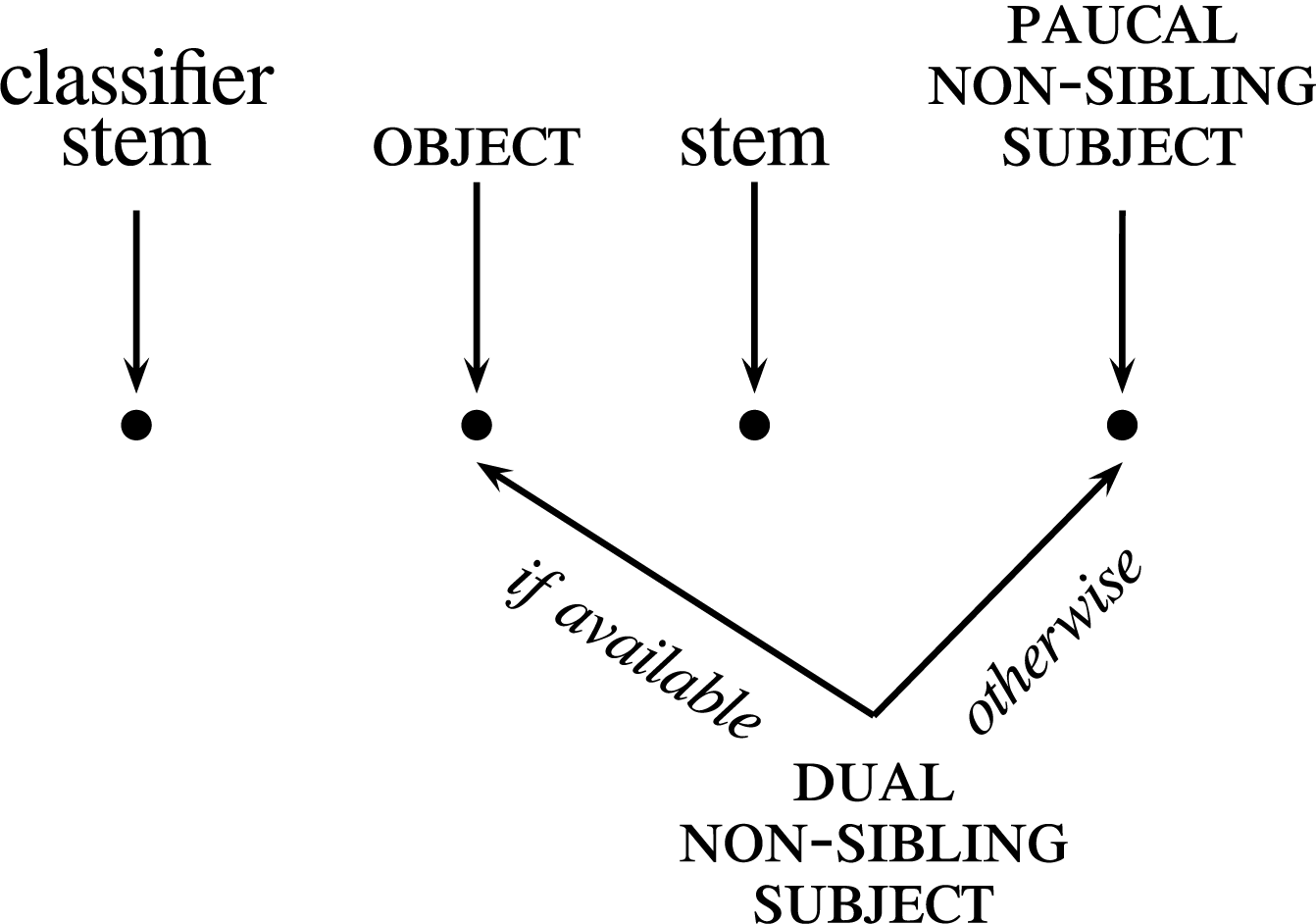
In Murrinh-Patha, subject agreement is primarily marked by an intricate system of classifier stems (Nordlinger Reference Nordlinger2010, Reference Nordlingerin press). In addition however, dual and paucal non-sibling subjects are marked by the separate morphs -ngintha (f)/-nintha (m) and -ngime (f)/-neme (m), respectively. These four morphs are evidently in paradigmatic opposition. As the examples in (9) illustrate, the paucal markers have a fixed post-stem position. On the other hand, the contrast shown in the examples in (10) shows that the dual markers alternate between a post-stem and a pre-stem position, depending on whether or not an object marker is present.Footnote [8]

Thus, we have both unstable placement of the dual markers, and misaligned placement of number markers in sub-parts of the paradigm. The situation is schematised in Figure 4.
2.3 Morphotactics within canonical inflection
In this paper we present morphotactics as one dimension of a general canonical typology of inflection. Other dimensions are more familiar. Corbett (Reference Corbett2007) focuses on the uniformity of an inflection system, both within lexemes and across lexemes: in a canonical inflection system, the stem should be constant across cells of a given lexeme but differ from lexeme to lexeme; whereas the exponents should be different across cells of a given lexeme but uniform, for a given cell, from lexeme to lexeme. Violations of these expectations give rise to familiar morphological phenomena such as stem allomorphy, homophony, syncretism, and inflection classes. Corbett’s criteria for canonical inflection treat all non-stem material as an unsegmented whole, and thus have little to say on morphotactics; we will treat them here as orthogonal to our concerns. Footnote [9]
Schematic representation of Murrinh-Patha misaligned/conditioned placement.
A distinct dimension of variation that is of more direct relevance to morphotactics concerns the complexity of the inventory of morphs within a word: since the purpose of inflection is to express features, one expects that within each word all relevant features will be expressed transparently. This is captured by the criteria in (11).

Violations of these criteria correspond to well-established types of complex exponence (Matthews Reference Matthews1974). Zero exponence is the situation where some feature has no realisation, while extended or multiple exponence is the situation where it has more than one; both are violations of (11a). Fused or cumulative exponence is the situation where a morph realises more than one feature; this violates (11b), as does the situation where a morph realises no feature (such morphs we may call expletive, but are usually called a thematic vowel, a thematic affix, or a discontinuous stem formative). Finally overlapping exponence is the situation where both criteria (11a) and (11b) are violated.
There is an obvious connection between canonical morphotactics and canonical exponence: complex morphotactics only arises where exponents are numerous. The definition of paradigmatic alignment of morphs in (5) above is designed so as to keep the two dimensions as separate as possible. Zero exponence does not lead to a violation of canonical morphotactics, as (5) and (8) regulate the distribution of morphs, rather than the realisation of features: since there is no morph in zero exponence, there is no distribution to be regulated.
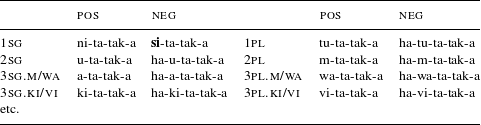
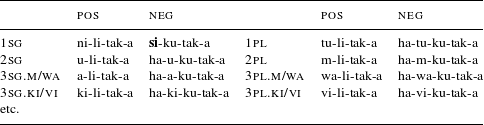
Fused exponents do not lead to violations either, as long as their distribution is regular. To illustrate this, let us consider the portion of the Swahili conjugation system shown in Table 4 (Ashton Reference Ashton1947).
Future forms of the Swahili verb taka ‘want’.
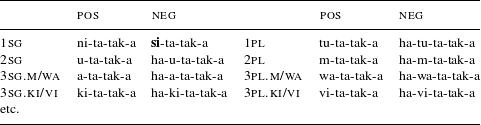
The morph si- is a positional portmanteau (Stump Reference Stump, Booij and van Marle1993): a single morph that takes over the role played by a combination of two morphs in other paradigm cells. This is usually taken to challenge a simple templatic analysis, and thus (under our intuitive interpretation) canonical morphotactics. Careful examination however shows that it does not. According to definition (3), si- is paradigmatically opposed both to the default negation marker ha- and to all subject markers. It is also syntagmatically equivalent to both: like ha-, it occurs before any other morph; and there is no morph that can co-occur both with si- and with subject markers and that does not follow them. As this example illustrates then, fused exponents do not challenge paradigmatic alignment.Footnote [10]
Extended and overlapping exponence may but need not lead to violations of canonical morphotactics. First, overlapping exponents occurring in the same word are not in paradigmatic opposition, and hence can not lead to misalignment. Second, there can be situations where, intuitively, two exponents targeting different positions are in paradigmatic opposition; this however does not entail a violation of paradigmatic alignment. We illustrate this by looking at a fuller version of the Ostyak nominal declension. In Table 5 we compare the absolute forms already shown in Table 1 with first person possessed forms, which are illustrative of the possessed sub-paradigm in general.
Partial possessed declension of the Ostyak noun xo:t ‘house’ (Nikolaeva Reference Nikolaeva1999).
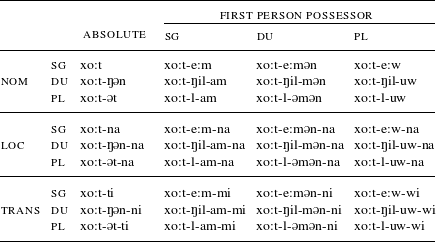
Possessed nouns use number suffixes distinct from those used in absolute nouns (du.abs  vs. du.poss
 pl.abs-t vs. pl.poss-l) followed by a possessor suffix and then the same case markers as the ones used in absolute forms. The shape of the possessor suffix is sometimes dependent on the number of the possessed noun, with a different suffix for singular and non-singular number (sg.1sg-e:m vs. nonsg.1sg-am; sg.1du
 vs. nonsg.1du
 sg.1pl-e:w vs. nonsg.1pl-uw). Possessor suffixes restricted to the singular stand in paradigmatic opposition to all number suffixes (absolute or possessed), since there is no singular marker. However, this does not lead to a violation of paradigmatic alignment, since possessor and number affixes have the same placement properties relative to all other morphs. This observation coincides with the fact that there clearly is a most simple templatic analysis for the system, which amounts to aligning all morphs realising person–number features of possessors, as shown in Figure 5.
Schematic representation of the morphotactics of Ostyak absolute nouns.
The situation in Ostyak contrasts with that exhibited by the Swahili past sub-paradigm presented in Table 6.
Past forms of the Swahili verb taka ‘want’.
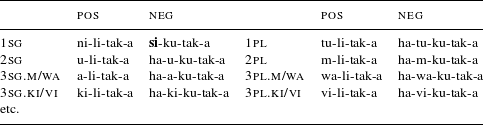
As this table shows, in the past, negation is jointly expressed by the general negative marker ha- in initial position (replaced by portmanteau si- in the 1sg, as discussed above) and by the selection of the past marker ku- instead of li- which is used in the positive form. We thus have overlapping exponence of negation and past. This does affect paradigmatic alignment: ha- is in complementary distribution with li-, but these two affixes have distinct placement properties with respect to subject markers; thus the criterion in (5) is violated. The crucial difference between the Ostyak and Swahili subsystems just discussed is the presence in Swahili of an intervening position between the two positions that jointly constitute the locus of extended exponence.
We therefore conclude that canonical morphotactics and canonical exponence can indeed be taken to be two independent dimensions of variation in a typology of inflection systems, although there is some interaction between the two dimensions in cases of overlapping exponence across non-adjacent positions.
2.4 Varieties of unstable placement
In Section 2.2 we presented two cases of violations of stable placement of morphs: Swahili relative markers, and Murrinh-Patha subject markers. In both cases, although the placement of some morphs is variable, it obeys a strict conditioning: for any given morphosyntactic context, there is a single affix placement strategy. We say that such systems exhibit conditioned placement of morphs.Footnote [11]
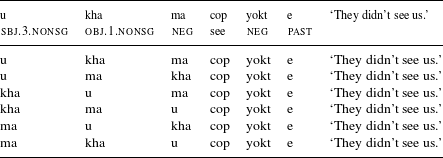
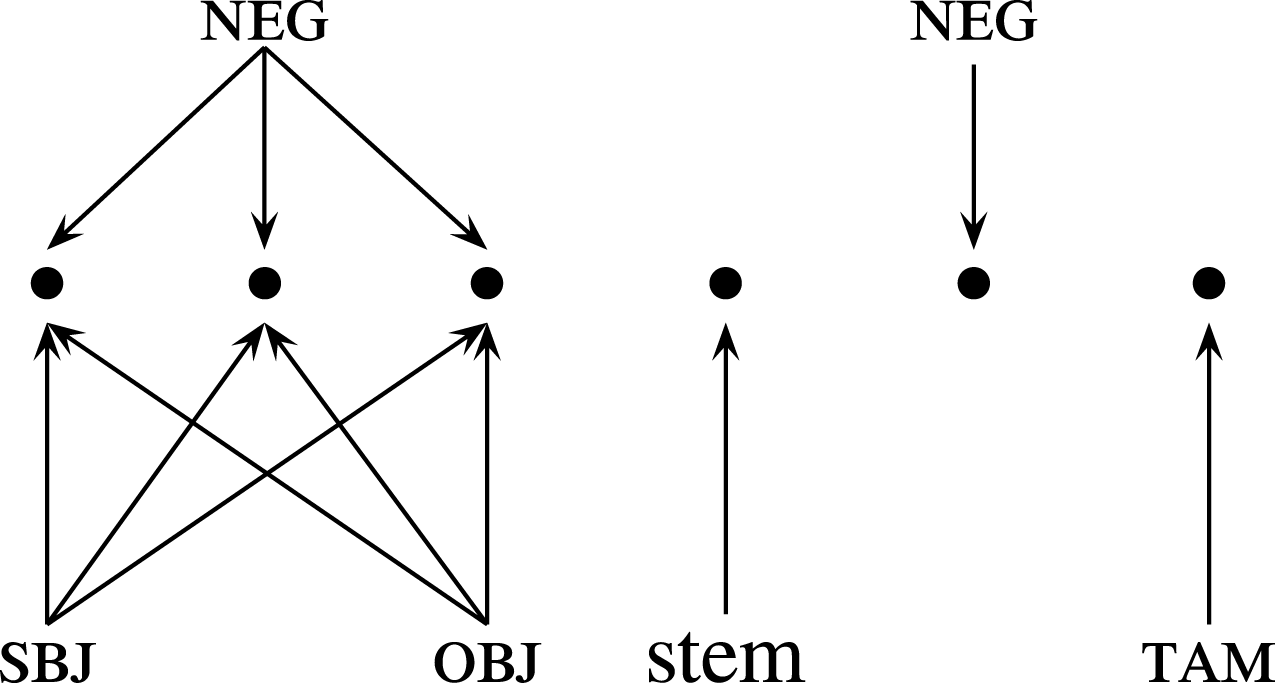
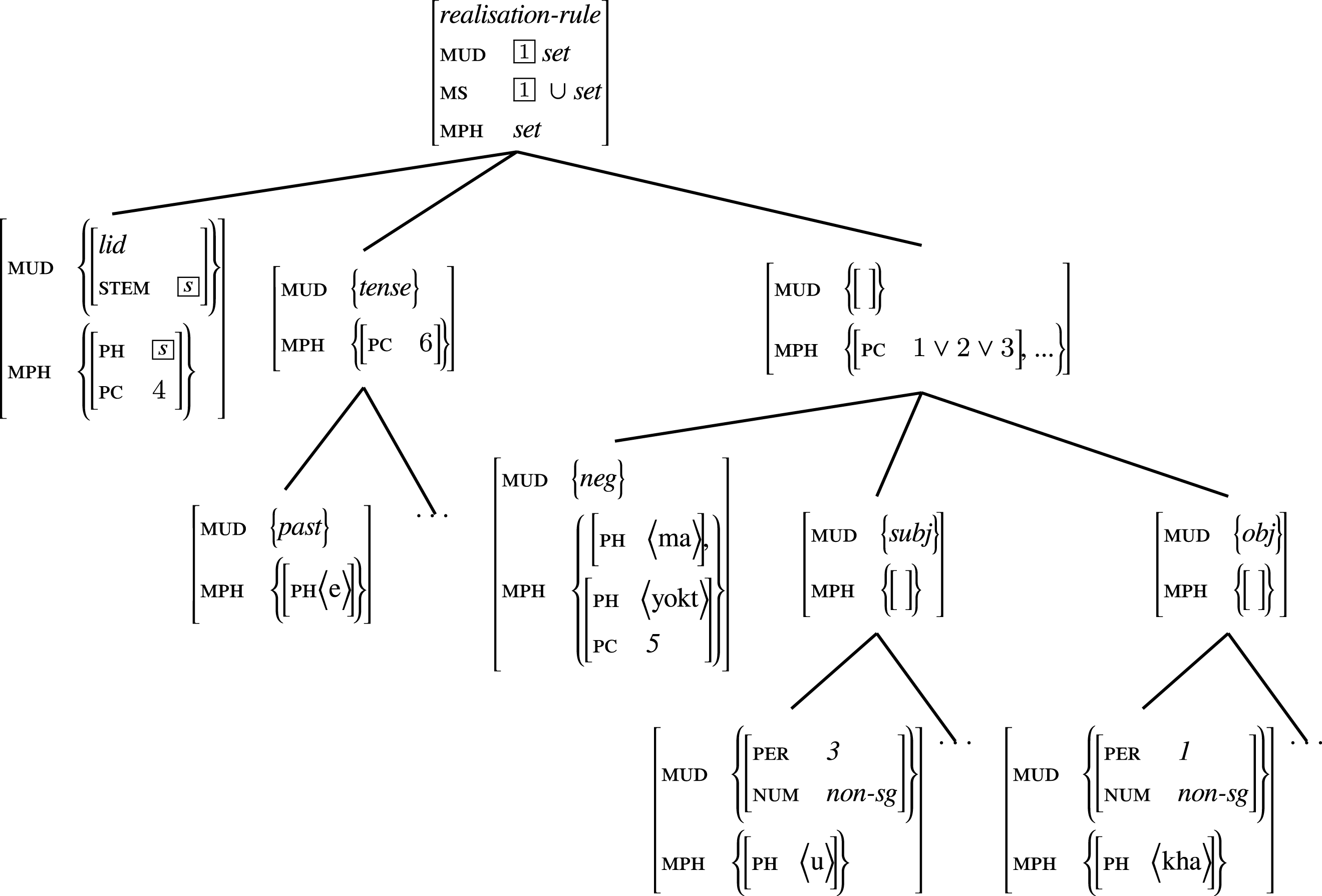
A different type of unstable placement relates to free variation in the relative order of some pairs of affixes, leading to a situation of overabundance (Thornton Reference Thornton2012). We call this situation free placement of affixes. A most spectacular example is documented by Bickel et al. (Reference Bickel, Banjade, Gaenzle, Lieven, Paudya, Rai, Manoj, Rai and Stoll2007) in Chintang conjugation. As Table 7 illustrates, subject markers (here 3.nonsgu-) and object markers (here 1.nonsgma-) are prefixes whose relative order is not fixed, but varies freely, with no semantic, pragmatic, discourse, or sociolinguistic conditioning. In addition, negation is expressed by two exponents, one prefixal (kha-), one suffixal (-yokt). While the suffixal exponent exhibits stable placement, the prefixal exponent of negation again is freely ordered with respect to the subject and object markers; this leads to six equally grammatical realisations for many paradigm cells.Footnote [12]
Chintang verb prefixes (Bickel et al. Reference Bickel, Banjade, Gaenzle, Lieven, Paudya, Rai, Manoj, Rai and Stoll2007: 44).
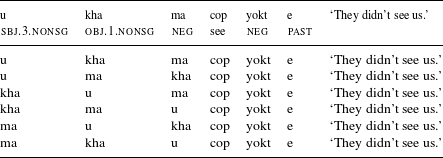
To accommodate free placement in a templatic description, one needs to allow for the possibility that multiple morphs may target the same set of positions in one and the same morphosyntactic context. We may therefore schematise the Chintang situation as in Figure 6. Arrows linking features to multiple positions carry no annotations, highlighting the absence of any condition on the variability of order. The repetition of neg is intended to capture multiple exponence: negation has to be realised exactly twice, once in one of the prefixal positions, and once right after the stem.
Schematic representation of Chintang free ordering.
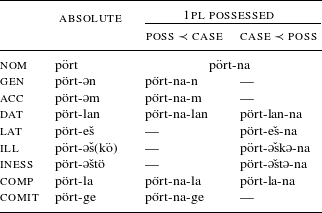
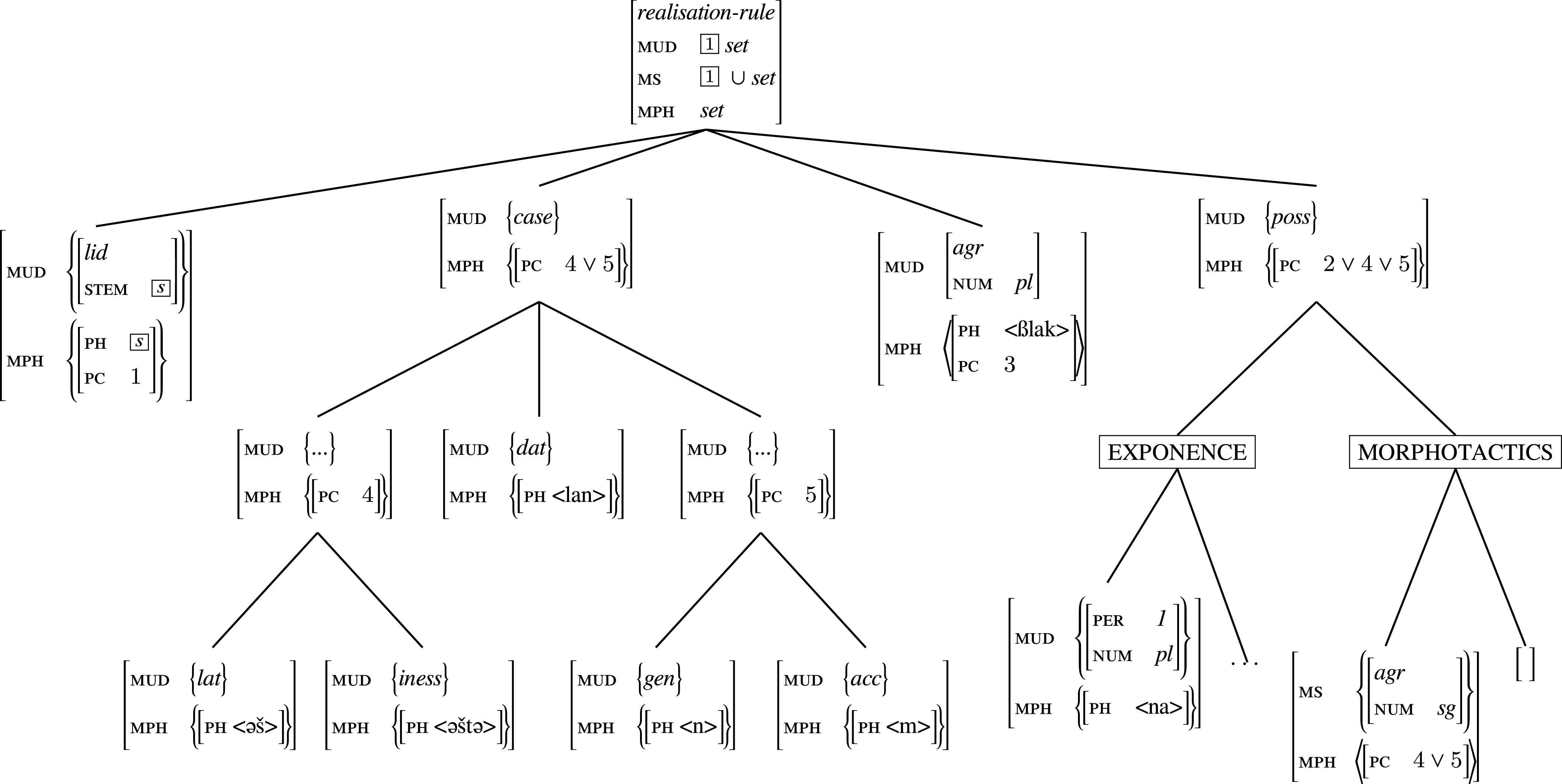
Once again it is important to note that different dimensions of variability may combine in a single system. As an interesting case study we may look at Mari declension (Luutonen Reference Luutonen1997).Footnote [13] Let us first examine the subsystem of singular nouns, exemplified in Table 8. If we compare possessed forms in the genitive, accusative and comitative to those in the lative, illative and inessive, a clear case of misaligned placement emerges: different case values give rise to differently linearised suffixes. On the other hand, in the dative and the comparative, we rather have a situation of free placement: both ordering possibilities are available. This data-set thus shows that free and misaligned placement may integrate seamlessly within a single system.
Selected singular forms of the Mari noun pört ‘house’.
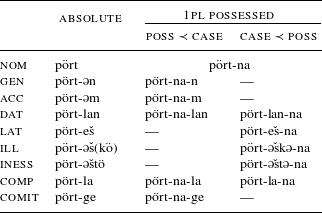
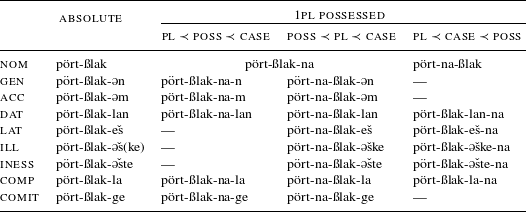
The situation is more intricate and interesting if one takes into account plural forms, exemplified in Table 9. The following generalisations emerge: (i) In all plural forms, the plural marker precedes the case suffix (if any is present). (ii) In the nominative, the possessor and plural suffix freely alternate. (iii) We know from Table 8 that in the genitive, accusative and comitative, the possessor suffix precedes the case suffix. In the absence of further constraints, these three observations lead us to expect precisely the attested distribution for the plural possessed forms in these four cases: free alternation between possessor and plural, both realised before case. Similarly, (iv), in the singular, in the dative and comparative, the relative order of possessor and case markers is free. Thus, in the plural, we expect the only constraint on order to be that plural precedes case: this is indeed what we observe, with the three relevant possible orders being grammatical. The last situation is the more surprising one. For local cases, in the singular, the case marker precedes the possessor marker. In combination with generalisation (i) above, this leads us to expect a single order to be possible: pl $\prec$case
 $\prec$poss. This order is attested, but, unexpectedly, not unique: the order poss
 $\prec$pl
 $\prec$case is also available.
Selected plural forms of the Mari noun pört ‘house’.
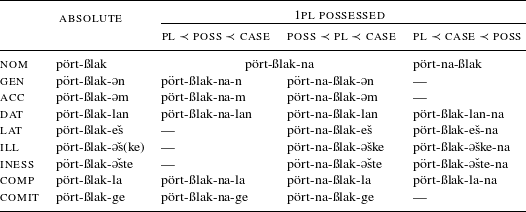
This set of observations shows that the Mari system cannot be described by a simple conjunction of pairwise order constraints between affixes – to use Ryan’s (Reference Ryan2010) terminology, order is not a transitive relation in this system. Specifically, the presence of a plural suffix correlates with an ordering possibility between possessor and case markers that is unattested in its absence; thus it is necessary to recognise the possibility of partially conditioned placement: a morphosyntactic condition may constrain the placement of an affix without confining it to a specific position.
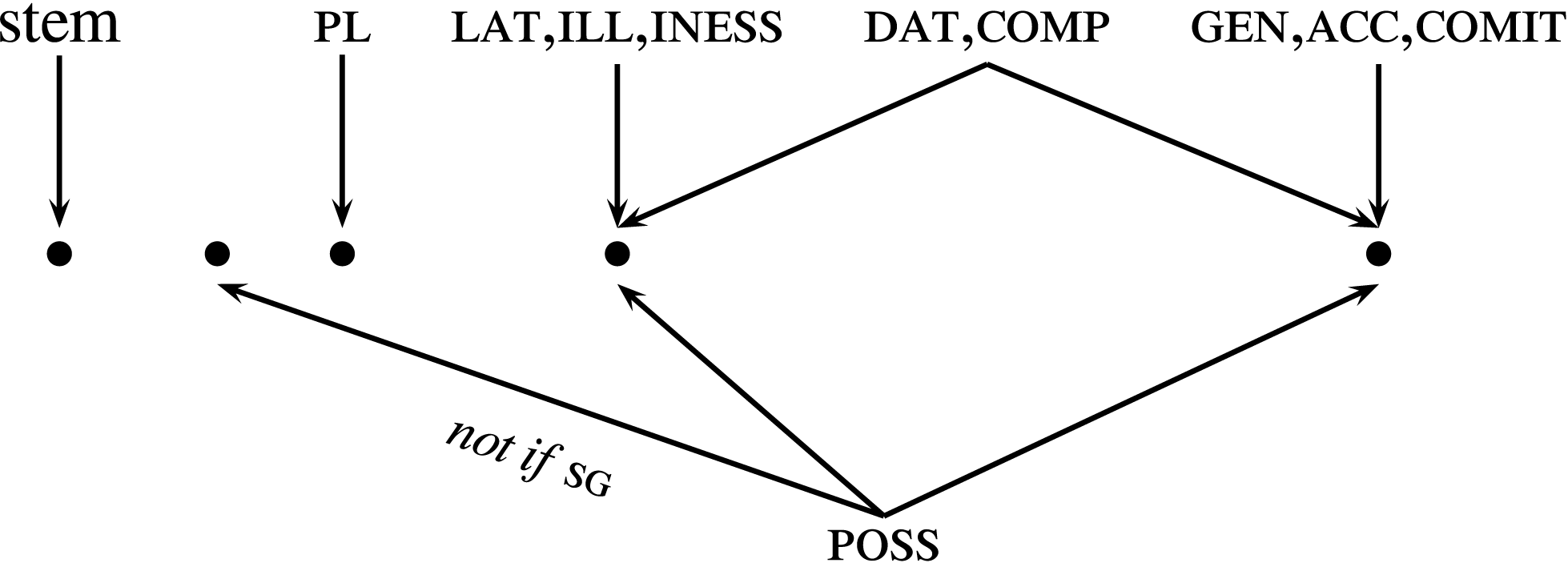
The schematic representation in Figure 7 attempts to do justice to the Mari situation. First, case markers are split in three groups: local cases are constrained to be strictly adjacent to the plural marker (if there is one), which forces the possessor to be in some other position; acc, gen and comit markers are constrained to be word-final, forcing again the possessor to be in some other position. The dat and comp markers are only constrained to be to the right of the possible plural marker. Second, a new type of condition constrains the placement of the possessor marker: it may occur in an early position only in the plural, but there is no ‘elsewhere’ constraint on other placement possibilities; the net effect is that the possessor marker can be linearised in any position not already occupied or barred by a condition.
Schematic representation of Mari partial ordering.
2.5 Placement relative to the stem
In previous sections we characterised unstable placement of morphs purely by looking at the relative order of pairs of morphs, with no attention to the position of other morphs in the word. In this section we look more closely at the positioning of morphs relative to the stem. This will prove important for the discussion of theoretical models of morphotactics in Section 3.2, where we will contrast stem-centric models, which see all morphotactic constraints as constraints on placement relative to the stem, and templatic models, which are agnostic as to the role of the stem in the system.
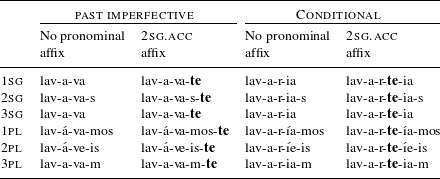
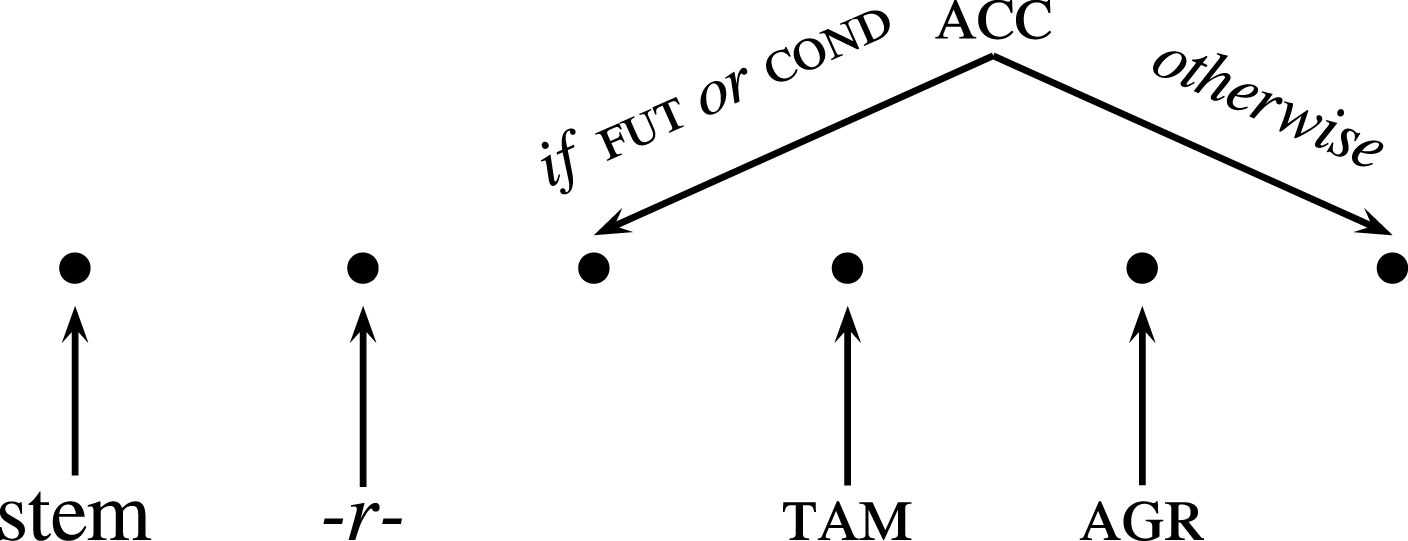
The two examples of conditioned placement discussed up to now (Swahili person markers, Murrinh-Patha subject markers) have a feature in common: the mobile markers hop around the stem depending on a condition. While this is a common situation, conditioned placement can also occur on one side of the stem. European Portuguese pronominal affixes provide a prime example of such a case (see Crysmann Reference Crysmann, Cann, Grover and Miller2000, Luís & Spencer Reference Luís, Spencer, Booij and van Marle2005 for a concise statement of the facts). European Portuguese weak form pronouns are realised by default as suffixes on the verb, exhibiting various morphophonological effects that preclude an analysis as postlexical clitics.Footnote [14] The position of these affixes relative to subject agreement, however, is variable, as witnessed in Table 10. In most sub-paradigms, as illustrated here with the past imperfective, the pronominal affixes are word-final. In the future and conditional, however, they occur between two TAM markers – here -r- and conditional -ia-. Clearly, we are dealing with conditioned placement of the pronominal affix with respect to the agreement markers -s, -mos, -is, -m depending on TAM, but the relative placement of the stem is unaffected. The situation is schematised in templatic terms in Figure 8.Footnote [15]
Partial conjugation of the European Portuguese verb lavar ‘wash’.
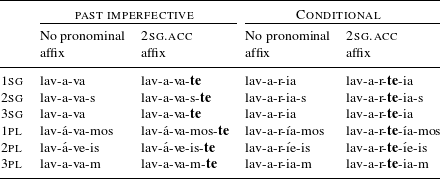
Schematic representation of European Portuguese conditioned placement.
The Portuguese facts show that the stem may but need not play a pivotal role in cases of conditioned placement. Given this situation, it is useful to explore, in general, which morphs are in a stable position with respect to the stem. We do this using the idea of the stable core of a system. The intuition here is that a system may consist of a core sub-part of morphs that stand in a stable relative order among themselves and with the stem. Any morph that does not exhibit stable positioning with respect to the stem is outside the core. We adopt the following definitions:

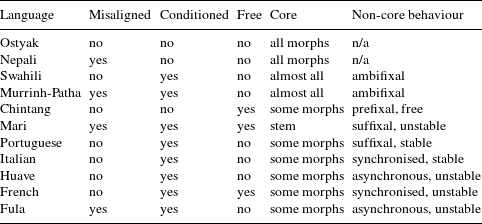
In a fully canonical system, the whole system forms the stable core. At the opposite end of the spectrum, it can be the case that the stable core consists of just the stem. Let us review quickly what the stable core is for each inflection system discussed up to now. In Ostyak nouns and Nepali verbs, since all morphs are stable, the whole system is the core. In Swahili verbs, only relative markers are outside the core, and in Murrinh-Patha, only the number markers are. In European Portuguese verbs, in the subsystem presented here, the stable core includes everything except the pronominal affixes. In Chintang verbs, the stable core consists of the verb plus the suffixal subsystem. Finally, in Mari nouns, the stable core coincides with the stem: there is no other single class of markers that one could pick out as ‘more stable’ than the others with respect to the stem.
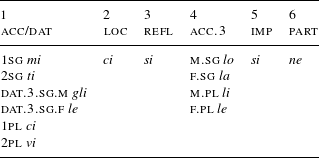
The notion of a stable core is useful to explore the properties of systems where the core’s complement has a non-trivial size. Up to now Chintang and Mari are the only two systems we have examined that exhibit this property. Let us add for comparison the Italian conjugation system, including pronominal affixes (see Monachesi (Reference Monachesi1999) for extended discussion). The analysis of Italian verbs requires the identification of at least 9 position classes, for the stem, exponents of TAM, subject agreement markers, and six classes of pronominal affixes, as indicated in Table 11.
Positional inventory of Italian pronominal affixes (Monachesi Reference Monachesi1999: 23).
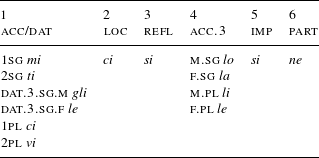
While the relative order of the stem, TAM and agreement markers is constant, pronominal affixes are linearised before the stem by default, and after the stem in imperatives and infinitives. Where more than one pronominal affix is present, the relative order among them is unaffected by their relative position with regard to the stem, as (13) illustrates.
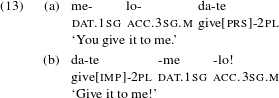
According to our terminology, we are clearly dealing with a case of conditioned placement, with the pronominal affixes occurring on one or the other side of the stem depending on TAM properties. The stable core of the system consists of the stem, TAM and agreement markers. When one compares the properties of the core to that of its complement, three striking properties arise, listed below in (14).

Properties (14a) and (14c) distinguish Italian from Chintang and Mari, where non-core elements exhibit variable placement among themselves, but not with respect to the core. Property (14b) presupposes that variable placement is stem-relative, and thus can not be counter-exemplified with the systems exhibited thus far. One system that is described as not observing (14b) is Huave conjugation (Kim Reference Kim2010). Verbs in this language exhibit variable placement of some affixes on either side of the stem, depending on phonological conditions: mobile affixes are prefixed to avoid vowel epenthesis, and suffixed otherwise. The completive marker t in (15) and the 1st person marker s (palatalising to x before front vowels) in (16) exemplify. As a consequence of this phonological condition, the placement of non-core elements is not synchronised: the same word may contain both a prefixal and a suffixal realisation of mobile affixes, as exemplified in (17).Footnote [16]

As a final example, Italian contrasts with French with respect to property (14c). In French as in Italian, the system of pronominal affixes is outside of the stable core of conjugation;Footnote [17] all pronominal affixes exhibit conditioned placement, depending on both TAM and polarity (namely positive imperative vs. otherwise); thus (14a) and (14b) are fulfilled. However, both the exact inventory and the relative placement of pronominal affixes is different in prefixal and suffixal position. In prefixal position, the order is clearly fixed, as in example (18).

In suffixal position, although prescriptive grammars insist on a fixed order, both careful observers of usage (e.g. Grevisse & Goosse Reference Grevisse and Goosse2011) and native speaker intuitions agree that there is considerable variability, as witnessed in example (19).

A thorough analysis of all occurrences of pronominal affix sequences in the French Subtitles Corpus (New & Spinelli Reference New and Spinelli2013) confirms native speaker intuitions that in informal Parisian French, for combinations of two pronominal suffixes, there is almost always free relative placement. The conclusion is thus that in this variety of French, placement of non-core elements is stable in prefixal contexts, but (mostly) free in suffixal contexts.
The examples discussed here certainly do not exhaust the inventory of types of interactions between co-occurring non-core elements. The usefulness of this partial inventory is that it shows how the various types of variable placement identified in previous sections may combine in an individual system. We saw earlier how Mari declension combined types of variable placement exemplified separately in the conjugation systems of Chintang (free placement), Nepali (misaligned placement), and European Portuguese (conditioned placement on one side of the stem). French now combines properties exemplified separately in Italian (synchronised conditioned placement around a stable core) and Mari (partially conditioned placement). A major challenge for a theory of morphotactics is to account for the seamless integration of these various types of violations of canonical morph ordering.
3 Affix placement and morphological theory
3.1 Templates in morphological theory
The template, as we have used it so far, has a long and successful tradition as a purely descriptive device in the analysis of languages with complex morphotactics.Footnote [18] In contrast to its popularity, morphologists, however, are divided as to the theoretical status of the template. While it has been widely accepted ever since Simpson & Withgott (Reference Simpson, Withgott and Borer1986) that position class systems as witnessed by Warlpiri or Waramunga are better understood in linear rather than in hierarchical terms, using a system of pre-defined slots for which exponents compete, and despite the growing body of descriptions of templatic systems (Inkelas Reference Inkelas1993, Hyman Reference Hyman2003, Nordlinger Reference Nordlinger2010), there is very little consensus as to how such systems should be theoretically understood, let alone be formally modelled.Footnote [19] On the purely empirical side, the phenomena we have described in the previous section contribute additional evidence to the reality of arbitrary morphological conditions on order, essentially characterised by ordering constraints that have ‘no apparent connection to syntactic, semantic or even phonological representation’ (Inkelas Reference Inkelas1993: 560).
More recently, Rice (Reference Rice2000) has challenged the traditional view of Athabaskan languages as position class systems: building on the Mirror Principle (Baker Reference Baker1985), Rice suggests that many aspects of order in complex position class systems can be captured by reference to grammatical factors external to morphology; an assumption she shares with Distributed Morphology (Halle & Marantz Reference Halle, Marantz, Hale and Keyser1993, Embick & Noyer Reference Embick, Noyer, Ramchand and Reiss2007), where the single contributing (non-morphological) factor is assumed to be word-internal syntactic structure. Most notably, Rice claims that in addition to phonological constraints on morph order, linear position is governed by semantic scope, essentially opening a debate as to whether or not semantic relations need to be integrated into synchronic morphological description. Although we cannot do justice to this debate in its entirety, we shall briefly comment on some of the basic claims associated with a scope-based theory of morphotactics and evaluate them for their implications regarding a unified theory of morphological order.Footnote [20]
Before we enter into a more detailed discussion of these two general approaches, let us briefly comment on the logic of the argument. While the mere existence of arbitrary purely morphologically conditioned order constitutes sufficient evidence for a templatic view of morph placement, the inverse does not hold, since instances of externally motivated ordering may still be descriptively compatible with a templatic approach. The issue to be decided is thus not so much arbitrariness or motivatedness of order, but rather whether semantic scope factors must be considered as synchronically active: if affix ordering is the historical product of syntactic order (Givón Reference Givón1971), recurring patterns in synchronic morphotactics may just as well be traced to their diachronic heritage (Bybee Reference Bybee1985, Stump Reference Stump2001, Spencer Reference Spencer2003). Thus, in order to assess the validity of Rice’s arguments, we need to carefully examine the degree of synchronic activity. In order to refute the historical perspective of morphology as frozen syntax, one has to show that variation in order actually corresponds to variation in scopal information. Evaluating the kind of data discussed in Rice (Reference Rice2000, Reference Rice2011) and Aronoff & Xu (Reference Aronoff and Xu2010), one can notice a strikingly recurring pattern: although a few clear-cut cases do exist of semantic scope being reflected in morphotactics, the bulk of so-called scope facts do not correspond to well-defined and empirically testable observations about semantics. Rice’s (Reference Rice2000: 24–25) initial definition is telling, where she gives as her prime example of semantic scope a purported observation that subjects scope over objects. To state the obvious, while some (definitely not all) syntactic theories assume a universal c-command asymmetry between subjects and objects that could be interpreted as “syntactic scope”, there is a general consensus that this asymmetry has no semantic correspondent: subjects and objects are usually taken to correspond to two argument positions of the same predicate,Footnote [21] realised by quantifiers that may stand in both possible relative scope relations. Turning to a more subtle example, while discussing morph order in Lezgian, Aronoff & Xu (Reference Aronoff and Xu2010) claim that the peripheral realisation of case markers with respect to number marking reflects scope. While this order is arguably iconic to the morphosyntactic distinction between inherent and contextual inflection (Booij Reference Booij, Booij and van Marle1996), to the extent that case is semantically potent, number and case realise properties of co-arguments of the same generalised quantifier, thus not standing in any semantic scope relation. Finally, the great majority of evidence cited in Rice’s (Reference Rice2011) recent survey revolves around argument structure, noting that ordering of markers relating to grammatical function mirror the causal chain (Smith Reference Smith1997) or the Thematic Hierarchy (Keenan & Comrie Reference Keenan and Comrie1977). However, since the Thematic Hierarchy is operative in the syntax of the languages of the world anyway, manifesting a great influence on word order and binding, the influence of synchronic semantics vs. diachronic syntax are difficult to tell apart.
A methodologically more serious concern regarding the Scope Hypothesis pertains to the invariance of placement that characterises the great majority of the evidence purported in favour of this hypothesis: without the possibility of order variation, there is just no way to encode structurally different semantic interpretations by means of morph order. In the overwhelming majority of cases, the evidence contributed by Rice (Reference Rice2000, Reference Rice2011) displays no placement variation at all. Thus, if order is conventionalised, synchronic and diachronic perspectives on motivation of morphotactics will be indistinguishable.
There are a number of cases, though, where true semantic scope can be identified, because a difference in placement is associated with a difference in interpretation. These are called ab/ba orderings in Rice (Reference Rice2011). Interestingly enough, this kind of evidence is not found in inflectional morphology proper, but rather pertains to incorporated modifiers (Yup’ik; Mithun Reference Mithun1999), complex predicate formation, e.g. Algonquian pre-verbs (Oji-Cree; Slavin Reference Slavin2005), or grammaticalised derivational morphology, such as the Bantu causative, applicative and reciprocal markers (Hyman Reference Hyman2003), to cite just three examples from Rice (Reference Rice2011). The relevance of such data for morphological theory cannot be overstated: just as much as the plethora of arbitrary ordering phenomena is a yet unaddressed challenge to the Scope Principle, a theory of morphotactics based on a formal understanding of position class must remain incomplete, if it cannot address the few, but still indisputable cases where order variation truly encodes semantic differences. A possible way to integrate such cases is to make scopal relations part of the morphosyntactic property set, as suggested in Spencer (Reference Spencer2003). It is of note, however, that even in systems with iconic order, arbitrary anti-iconic ordering can also be observed: in Fox (Mesquakie), linearisation of pre-verbs may contradict semantic relations, giving rise to a bracketing paradox (cf. example (20), from Goddard Reference Goddard1990: 479).

The situation in Chichewa is particularly telling. Here scopal and templatic placement coexist, giving rise to a highly intricate pattern: as discussed in Hyman (Reference Hyman2003), the templatic C–A–R–P order (=Causative–Applicative–Reciprocal–Passive) is open to all possible scopal interpretations, iconic scope effects being restricted to anti-templatic orders. What is more, some anti-templatic orders are ruled out altogether (e.g. *A–C), whereas others, like iconic anti-templatic R–A require the templatic reciprocal marker in addition to the iconic reciprocal marker (R–A–R). Under the perspective of a Scope Principle, it must appear as somewhat surprising that from amongst the logically possible scope markings, it is only ever the reciprocal that is involved in Chichewa, and even there, scopal order coexists with templatic order, either as an alternative realisation (i.e. flipping the order of exponents), or as an additional one (i.e. adding a scope-iconic marker alongside a templatic one).
It should be clear from this brief discussion that the real theoretical concern is not about whether or not morphotactics is motivated or arbitrary – even Rice (Reference Rice2011) concedes that there is an arbitrary residue – but rather as to how instances of semantically potent order variation can be integrated with the otherwise templatic nature of morphotactic variation. Representing scopal constraints as part of the morphosyntactic property set will provide a way to integrate, e.g. the Chichewa data into a theory based on the notion of position class: scope-determined placement will just be another constraining factor in a system that already determines morphotactics based on morphosyntactic properties.
In an attempt to synthesise templatic and non-templatic views, Rice (Reference Rice2011) suggests that templatic orderings are a kind of last resort solution that is relevant only when factors external to morphology fail to make any order-related predictions. By putting the emphasis on scopal factors, Rice relegates to the periphery all placement phenomena that are purely morphological. However, as we have seen, most of the scopal factors Rice alludes to are neither semantically potent nor synchronically active, and, in case they are, they still heavily interact with templates. We thus contend that the perspective should be reversed: morph order is templatic in general, which in no way precludes recognising correlations between morph order and extra-morphological factors wherever they are indeed attested.
A family of approaches that tries to mitigate between universal tendencies regarding morph placement and language specific deviations from a pre-conceived canonical order have been developed within the broader framework of Optimality Theory (OT). In essence, OT accounts resolve the conflict between motivated and arbitrary order by means of ranked violable constraints, thereby dispensing with the assumption that generalisations need to be both surface-true and surface-apparent. While it appears conceivable to us to model the morphotactics of optional markers by means of placement optimisations, given the fact that, in this specific case, any marker will have a chance of winding up in optimal position, explanation of invariable arbitrary order for sequences of obligatory markers somewhat overstretches the notion of optimisation, if constraint satisfaction can never be shown to hold for surface distributions: in these cases, constraint rankings and the number of constraint violations they entail are nothing more than a template in disguise. However, there are more serious arguments that can be raised against standard OT approaches to variable morphotactics: as discussed by Ryan (Reference Ryan2010), alignment-based OT approaches (Prince & Smolensky Reference Prince and Smolensky1993) to morphotactics (Legendre Reference Legendre, Dekkers, van der Leeuw and van de Weijer2000, Trommer Reference Trommer, Booij and van Marle2003) cannot account for free ordering of affixes in non-adjacent positions, even if partial ordering is admitted, “since that would require the alignment constraint of the variable affix to float freely between non-adjacent positions in the hierarchy” (Ryan Reference Ryan2010: 776). He further notes that alignment fails to capture cases where free reordering is conditioned on an independent property, as illustrated by the French data in Section 2.5. Alternatives to alignment constraints do not fare much better: as Ryan notes, OT analyses based on pairwise order statements (see e.g. Caballero Reference Caballero2010) fail to capture situations of non-transitivity of order constraints, as exemplified in the present paper by the distribution of Mari possessive markers (see section). Ryan’s own proposal uses bi-gram constraints, stating an ordered pair of any two morphs’ preference to surface adjacently. While this approach does not suffer from the exact same limitations, it is still unable to address cases where the same combination of morphs in different orders are equally grammatical, but for the expression of different content, as exemplified by Italian present indicative vs. imperative forms in (13) above.
Finally, considering the fact that ordering in inflectional morphology is often semantically inert, giving up on surface-true and surface-apparent generalisations appear to us as too high a methodological price to pay, just to maintain synchronic prediction of what may equally well be understood as the product of a diachronic process.
To summarise, a theory of morphotactics couched in terms of templatic ordering can in principle achieve observational, descriptive, and explanatory adequacy, the latter with the help of historical linguistics. A theory of morphotactics focused on cases where order is motivated without incorporating the (typically large) arbitrary residue, such as Rice (Reference Rice2000), will inevitably fail on observational and descriptive adequacy, thereby severely limiting the scope of its explanatory potential.
3.2 The template and morphological structure
We have established that modelling of affix placement necessitates the use of a purely morphological linear structure from which the order of affixes can be deduced. The simplest structure in common use is a flat linear template, where affixes are directly assigned to indexed positions. However, this is of course not the only possibility: in syntax, for instance, we are used to deduce the linear structure of sentences from the yield of a phrase-structure tree, a much more elaborate abstract structure. In this subsection we therefore review the typological predictions made by either linear or tree-based approaches and show in particular that stem-centric approaches privilege patterns of variable morphotactics that are cross-linguistically hard to find.
The space of possibilities is strongly influenced by independent theoretical assumptions. Stump (Reference Stump2001) highlights the fact that a theory of morphology can be either incremental or realisational: in an incremental theory, the morphosyntactic content of a word is built compositionally as exponents are added to the basic stem; whereas in a realisational theory, the input to morphology is a complete morphosyntactic description, which then licenses the introduction of various exponents. Both classical Item-and-Arrangement and Item-and-Process approaches are incremental. On the other hand, most contemporary approaches to morphology, including Distributed Morphology (Halle & Marantz Reference Halle, Marantz, Hale and Keyser1993), A-morphous Morphology (Anderson Reference Anderson1992), Paradigm Function Morphology (Stump Reference Stump2001) and Network Morphology (Brown & Hippisley Reference Brown and Hippisley2012) are realisational.
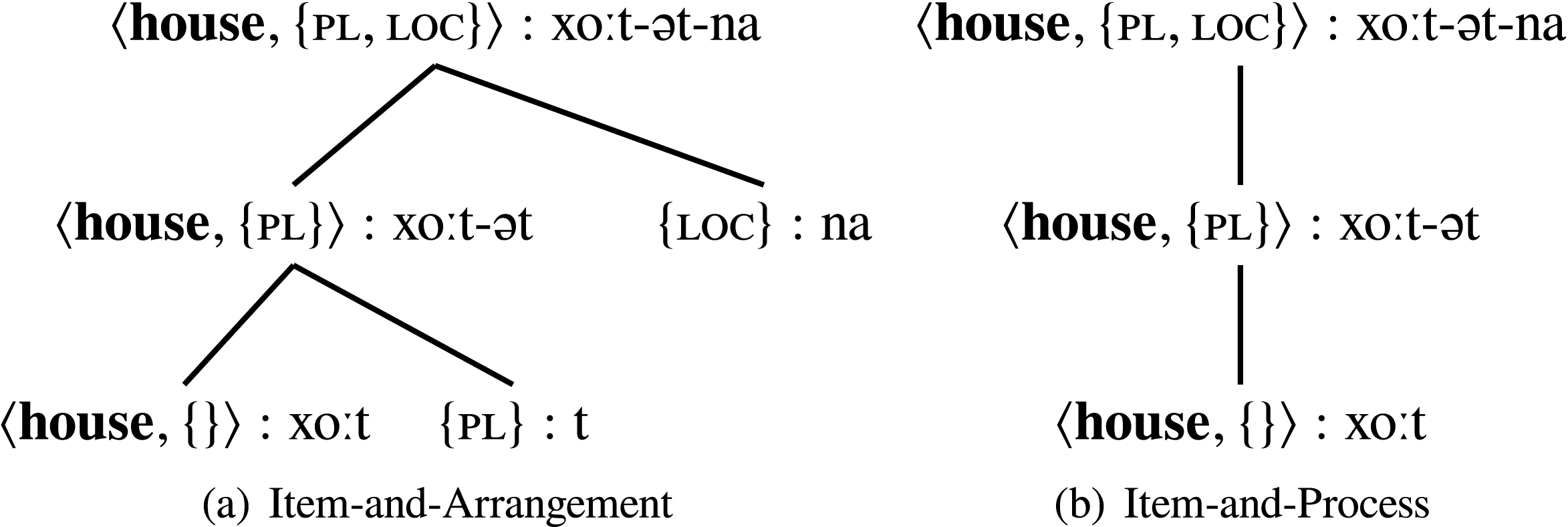
The incremental view of morphology entails a particular view of morphological composition, which we will call stem centric: since morphology is about the addition to or the modification of the content of stems by exponence, words exhibit a recursive composition structure recording the steps in this process. If the approach is in addition morpheme-based, this recursive structure can be seen as a tree whose nodes are signs, as outlined for the Ostyak pl.loc noun  in Figure 9a; Selkirk (Reference Selkirk1982) and Lieber (Reference Lieber1992) are representative of such a view. If it is rather an Item-and-Process approach, the recursive structure reflects the application of successive processes, and can be represented by a unary tree (Figure 9b); Koenig (Reference Koenig1999) and Orgun (Reference Orgun1996) can be counted as more recent representatives of such a view.Footnote [22]
Morphological composition in incremental approaches to morphology.
The realisational view of morphology on the other hand does not entail such a stem-centric view of composition: since the business of inflection is to spell out a fully specified morphosyntactic description, content does not drive order of combination. Thus, in Distributed Morphology, the order of morphemes is read off a syntactic tree, possibly enriched by PF processes; the stem does not play any privileged role in this tree structure. A-morphous Morphology is not committed to any particular order of application of morpholexical rules, as long as they are organised into ordered blocks;Footnote [23] in fact Crysmann & Bonami (Reference Crysmann, Bonami and Müller2012) exhibit an a-morphous approach to inflection where morpholexical rules apply from left to right, starting with the empty string. In Paradigm Function Morphology (Stump Reference Stump, Booij and van Marle1993, Reference Stump2001), on the other hand, the composition structure of a word is definitely stem-centric: a word is built starting from a basic stem by successively applying realisation rules, i.e. rules pairing morphosyntactic properties with the exponents that express them. The set of realisation rules is partitioned into successive rule blocks within each of which the most specific applicable rule is chosen according to Pāṇini’s Principle. Notice that the existence of a morphological composition structure, reflecting the derivation history, is separate from the property of (a-)morphousness: amorphousness merely entails that the object constructed at each step in the derivation be a simple phonological string. This is not the same thing as claiming that this object is constructed in a single step.Footnote [24]
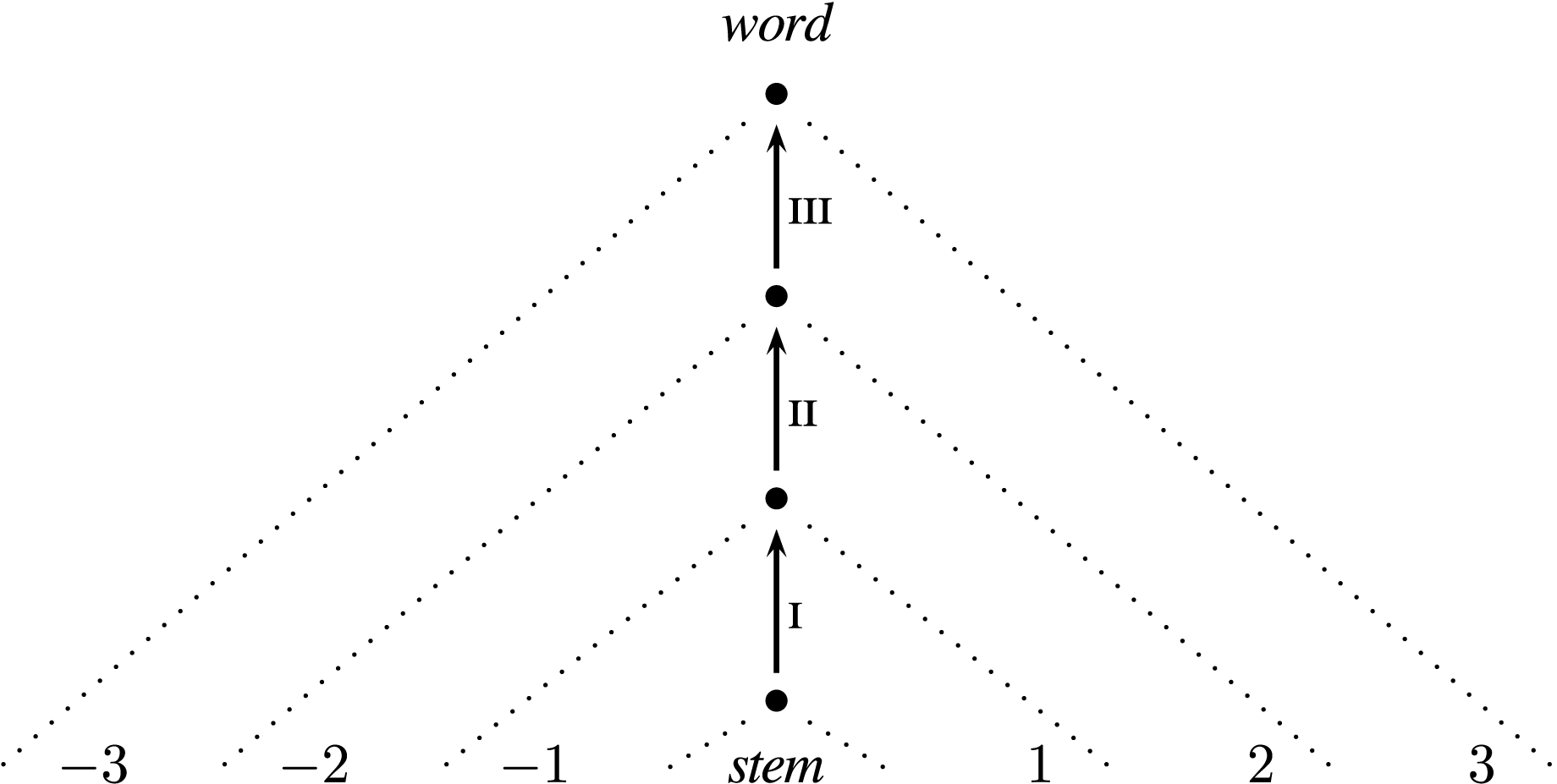
This stem-centric view of morphological composition has direct consequences for morphotactics, which are illustrated in Figure 10. Since exactly one rule can be chosen from each rule block, and the same rule block may contain prefixing as well as suffixing rules, each block is associated with two potential positions on either side of the stem. These positions are at an equal distance from the stem, in the sense that they could in principle be separated from the stem by exactly the same number of affixes.
The relation between rule blocks and positions in Paradigm Function Morphology (Stump Reference Stump, Booij and van Marle1993).
Such a view of morphological composition is strikingly more elaborate than the simple, purely templatic view that we used informally in the description of various morphotactic systems in Section 2. Still, as we will show in detail in Section 4, a templatic view is fully compatible with a realisational approach to morphology. Thus, it is worth asking what the benefits are, if any, of preferring a stem-centric approach. As we will see shortly, this approach is empirically severely under-motivated, making barely attested patterns, like mirroring easy to describe, while exhibiting some difficulty at capturing more readily attested phenomena, such as mobile clusters. The linear approach that we are advocating here (see Section 4), however, does not suffer from these conceptual problems.
Although most, if not all, variable morphotactic phenomena can presumably be modelled within either a stem-centric or a templatic view of morphological composition, the structure of the theory embodies some expectations as to what constitutes a natural morphotactic system. First, notice that Paradigm Function Morphology makes no distinction between a rule block containing only prefixes or only suffixes and a rule block containing both – what Stump (Reference Stump, Booij and van Marle1993) calls an ambifixal position class. Thus, misaligned placement should be cost-free, as long as it were a matter of contrasting property sets being realised as either prefixes or suffixes. But as far as we can tell, this is not the observed situation: misaligned exponence on one side of the stem is quite common and shows no sign of being less common or natural than ambifixally misaligned exponence.
Second, there is one kind of conditioned placement that is very easily modelled under the stem-centric view. Remember from Section 4.2.2 that Swahili relative markers occur adjacent to the stem as either prefixes or suffixes, depending on tense and polarity. The stem-centric view provides a very natural analysis for this type of conditioned statement: there is a single set of affixes introduced in a single rule block at a constant distance from the stem, and a morphosyntactic parameter decides whether they should be prefixed or suffixed.Footnote [25] On the other hand, the stem-centric view in itself makes no proviso for conditioned placement on one side of the stem, which can only be dealt with by the addition of further ad-hoc mechanisms. We are thus led to expect that ambifixes are the only, or at least the prevalent type of morphs exhibiting conditioned statement. But our exploration of the data does not provide any support for this. We saw in Section 2.5 that Portuguese pronominal affixes reliably exhibit conditioned suffixal placement, and we see no reason to judge them more exceptional than Swahili relative markers.
Third, where conditioned placement indeed involves a stem-relative alternation, there is no evidence that this is preferably at the same distance from the stem. In systems with a single syntagmatic class of unstable affixes, there can hardly be any evidence deciding whether an ambifixal analysis truly makes sense, because there is no way of evaluating whether the distance between an affix and the stem in terms of rules blocks is the same. Thus, the crucial test is that of systems with two syntagmatic classes of mobile affixes. Under the stem-centric view, we expect the distance between the stem and the affixes to stay constant, and thus the relative order of two mobile affixes to be reversed depending on which side of the stem they occur on.
Again, the empirical evidence provides little support for the stem-centric view. While there definitely are systems with more than one syntagmatic class of mobile affixes, such as the Italian and French systems discussed in Section 2.5, none of the ones we know of seems to confirm the stem-centric analysis. In Italian, the relative order of pronominal affixes is constant irrespective of their prefixal or suffixal status (Luís & Spencer Reference Luís, Spencer, Booij and van Marle2005 should be credited for first raising this point in connection to PFM, on the basis of data from European Portuguese). In French, the order is mostly free on one side of the stem. Other systems that have been discussed in the literature in connection to this issue are inconclusive. For instance, Huave has two sets of mobile affixes (see examples (15)–(17) above), but the phonological conditions presiding to their distribution and the inventory of affixes conspire to make it impossible for any pair of such affixes to occur together both before and after the stem.
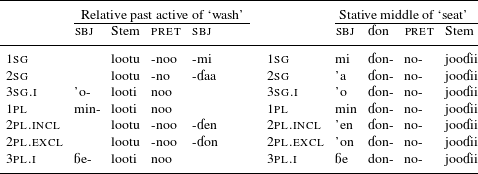
Fula, which was initially discussed in this connection by Stump (Reference Stump, Booij and van Marle1993), is the system we know that comes closest to providing support for a stem-centric view. Under the description of Arnott (Reference Arnott1970), Gombe Fula verbs consist of a basic stem and a TAM suffix, combining with subject and object markers, and a preterite affix. In the indicative, some subject markers (specifically the 1sg, 2sg, 2pl.inc and 2pl.exc) have both prefixal and suffixal uses, while the remaining 26 markers are always prefixes (Fula has 25 nominal classes, and subject markers for each class in the 3rd person). The suffixes are used in so-called relative tenses; elsewhere in the indicative all subject markers are prefixal. Likewise, the preterite affix, which is compatible with most tenses and carries aspectual information, is prefixal in TAM combinations which Arnott refers to as ‘Group A (ii)’, and suffixal elsewhere. This leads to a situation where both series of mobile affixes are suffixal in relative tenses, while both are prefixal in the stative and the continuous tense. Under these circumstances, the relative order of the two affixes on one side of the stem is opposite from their order on the other side of the stem, as illustrated in Table 12.Footnote [26] As Stump (Reference Stump2012b) notes, this initially seems to lend support to a distance-based account of the distribution of these affixes, as made possible by stem-centric composition.
Partial Fula paradigms (Arnott Reference Arnott1970: 216–222).
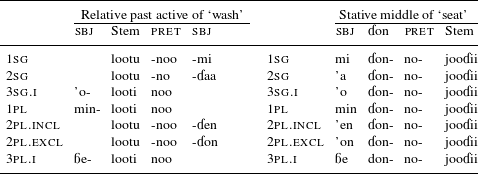
This is however not the full story. Arnott (Reference Arnott1970: 209–215) documents another placement alternation, this time between subject and object markers. Object markers are standardly found in word-final position (21a, b, c). However, in relative tenses, if the subject is 1sg and the object is 2sg or 3sg.i, the object comes before the subject (21d, e).
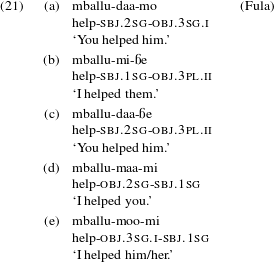
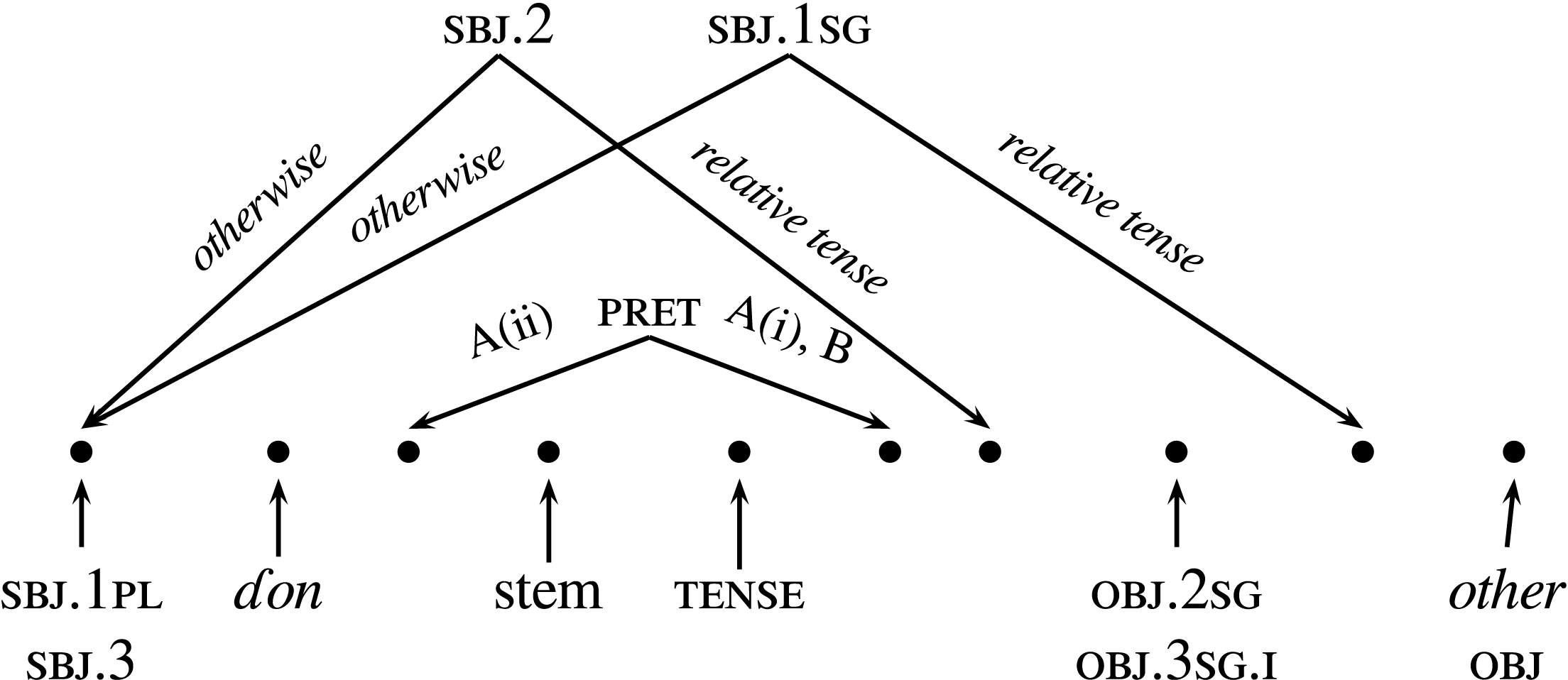
We are clearly dealing with a morphotactically quite complex system. In terms of the distinctions introduced in Section 2, we see a combination of misaligned placement of suffixal subject and object markers, combined with conditioned placement of some subject markers and the preterite affix. Figure 11 summarises the distribution of morphs. Given this complex distribution, subject markers cannot be said to be uniformly linearised at a fixed distance from the stem: in suffixal use, their distance from the stem varies, while in prefixal use there is no evidence for such variation. Indeed, this very data set is used by Stump (Reference Stump, Booij and van Marle1993, Reference Stump2001, Reference Stump2012b) to justify the introduction of mechanisms that disrupt the normal order of rule application,Footnote [27] thus conceding that the Fula system does not provide the simple variable morphotactic system that stem-centric morphological composition would lead us to expect.
Schematic representation of morph order in Fula indicative verbs.
To sum up then, no system discussed in the literature reviewed in this paper exhibits the type of conditioned placement that should be most natural under a stem-centric approach: among the systems where conditioned placement involves a stem-relative alternation, few allow for the diagnostic situation where two mobile affixes can simultaneously occur on either side of the stem. Among those that do allow such a situation, the more common situation is to have a fixed relative order of the affixes (Italian). In the one purported case where this is not true (Fula), there is ample independent evidence that the two positions are not at an equal distance from the stem. Overall, there is no support from variable morphotactics for the postulation of the type of morphological structure entailed by a stem-centric approach.
Given the vast diversity of morphotactic systems, there is an a-priori probability that some language should exhibit the clear-cut mirror image distribution of morphs that the stem-centric approach entails to be most natural; in fact, a template-based approach such as the one advocated here would have no difficulty addressing such a system. The issue under debate is not empirical adequacy: probably a stem-centric analysis could be designed for all the systems discussed in this paper, although some of them (e.g. Mari and FrenchFootnote [28]) have never been successfully modelled and would probably be particularly challenging. Rather, we claim that a purely linear view of morphological combination provides for a realisational theory of morphotactics with a much better fit to the attested diversity.
4 A formal approach to variable morphotactics
Having explored an extended set of challenging cases of variable morphotactics, together with an informal presentation of the kind of analysis we envisage, we are now in a position to present a formal theory of morphotactics that overcomes the limitations of previous approaches to morph ordering and that will be able to capture, in a formally explicit way, a wide range of canonical and non-canonical morphotactic systems.
The aim of this section is two-fold: First and foremost, we shall present a formal theory of variable morphotactics that crucially builds on the notion of position class as a descriptive primitive and show how generalisations within such a system can be easily captured by drawing systematically on the concepts of underspecification and cross-classification in an inheritance hierarchy of morphological rules. Second, we will show how the extended set of deviations from canonical position class systems can be modelled parsimoniously using a formal notion of templatic morphology. Moreover, we will show how complex systems that are characterised by the combination of orthogonal deviations from the canon can be modelled by simple accumulation of constraints from simpler types. We shall argue, in particular, that our approach not only provides for a more flexible and intuitive way to talk about order, but that it also eliminates some undesirable properties of previous realisational approaches to morphology, most notably extrinsic ordering, and replaces them with a purely information-based view of realisation and competition. Finally, we shall highlight how the relative (non-)canonicity of the morphotactic systems we explore is manifest in the layout of the type hierarchy of rules.
4.1 An information-based approach to realisational morphology
The formal theory of morphotactics that we shall develop in this section shares a number of properties with previous inferential-realisational approaches, most notably, Paradigm Function Morphology (PFM; Stump Reference Stump2001) and A-morphous Morphology (Anderson Reference Anderson1992), both on a conceptual, as well as an architectural level: it is inferential, rather than lexical, in that we do not recognise lexical elements, such as morphemes, as the building blocks of morphology, but rather employ rule schemata to pair morphosyntactic features with their exponents. It is also realisational, rather than incremental, as rules of exponence do not add or remove information, but are merely constrained by the word’s morphosyntactic features to be expressed. These two conceptual properties are obtained by assuming that inflectional morphology operates on morphosyntactic property sets (ms), employing a set of realisation rules that pair a subset of the morphosyntactic property set with a set of exponents that express this subset.
Still in accordance with PFM, we assume a purely information-based notion of Pāṇini’s Principle: thus competition between rules for expression of a feature is determined intrinsically on the basis of the specificity of the description, with more specific rules bleeding more general ones. This is in contrast to A-morphous Morphology, where the Elsewhere Condition is formulated in terms of extrinsic rule ordering.
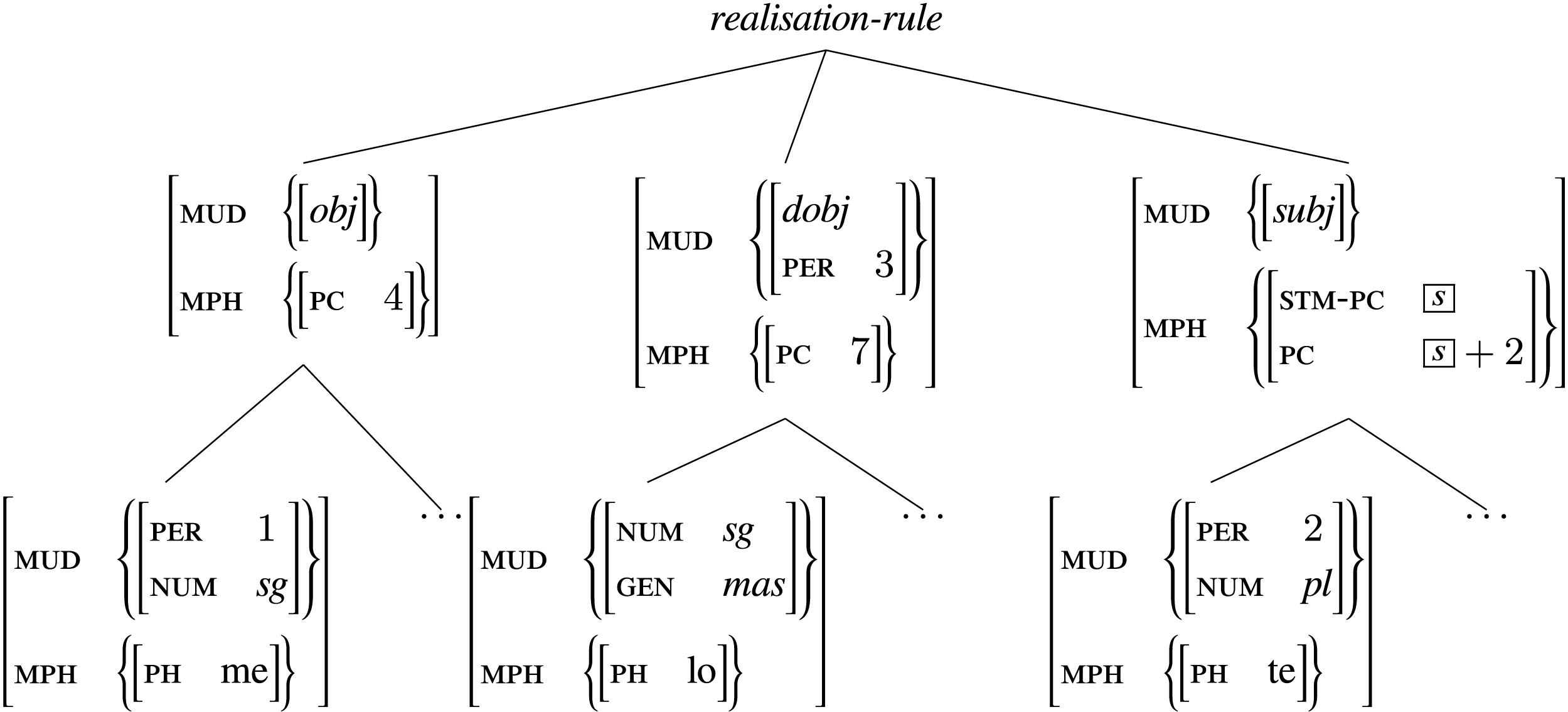
Despite these similarities, there are, however, several aspects that set the present approach apart from both PFM and A-morphous Morphology: to start with, we do not regard order as derivative of ordered rule blocks. In fact, under the present approach, there is no notion of a rule block at all. As a logical consequence, extrinsic ordering of rule block indices or similar constructs is simply impossible. Similarly, paradigm functions, which, in PFM, are defined over rule blocks, are replaced by a general unparametrisable principle of morphological well-formedness (see Figure 19 below) which guarantees that all expressible properties must indeed be expressed.
Essentially, we build on the following three major design features. First, and foremost, our approach is morphous. Thus, we recognise segmentable formatives as first class citizens, complete with phonological and position class information; these however are morphs, not morphemes, since they lack content. Furthermore, the rules that introduce these morphs can do so in a variety of ways: besides single morphs, realisation rules may also introduce multiple, possibly discontinuous morphs, or no morphs at all. Thus, rather than indexing rule blocks for position, and manipulating the way these blocks apply (see Section 3.2), we associate position class information directly with the pieces of inflection to be ordered.
Second, we draw a distinction between expressing a feature and being conditioned by a feature, as previously proposed within morphological theory by Carstairs (Reference Carstairs1987) and Noyer (Reference Noyer1992), which is similar in spirit to the use of defining equations and constraining equations in Lexical Functional Grammar (Bresnan Reference Bresnan1982). Thus, realisation rules specify which features they express as the value of the feature mud (=morphosyntax under discussion). In addition, these rules may be constrained by other features in the morphosyntactic property set (ms). Unlike Carstairs and Noyer, however, we do not assume that the distinction between realisation and conditioning correlates with peripherality of exponence, nor that it is destined to explain away all multiple exponence. Rather, the distinction is meant to partition the set of morphs that signal some morphosyntactic property into those that are in competition for realisation (and may thus block each other) and those that may be realised simultaneously (leading to extended exponence).Footnote [29]
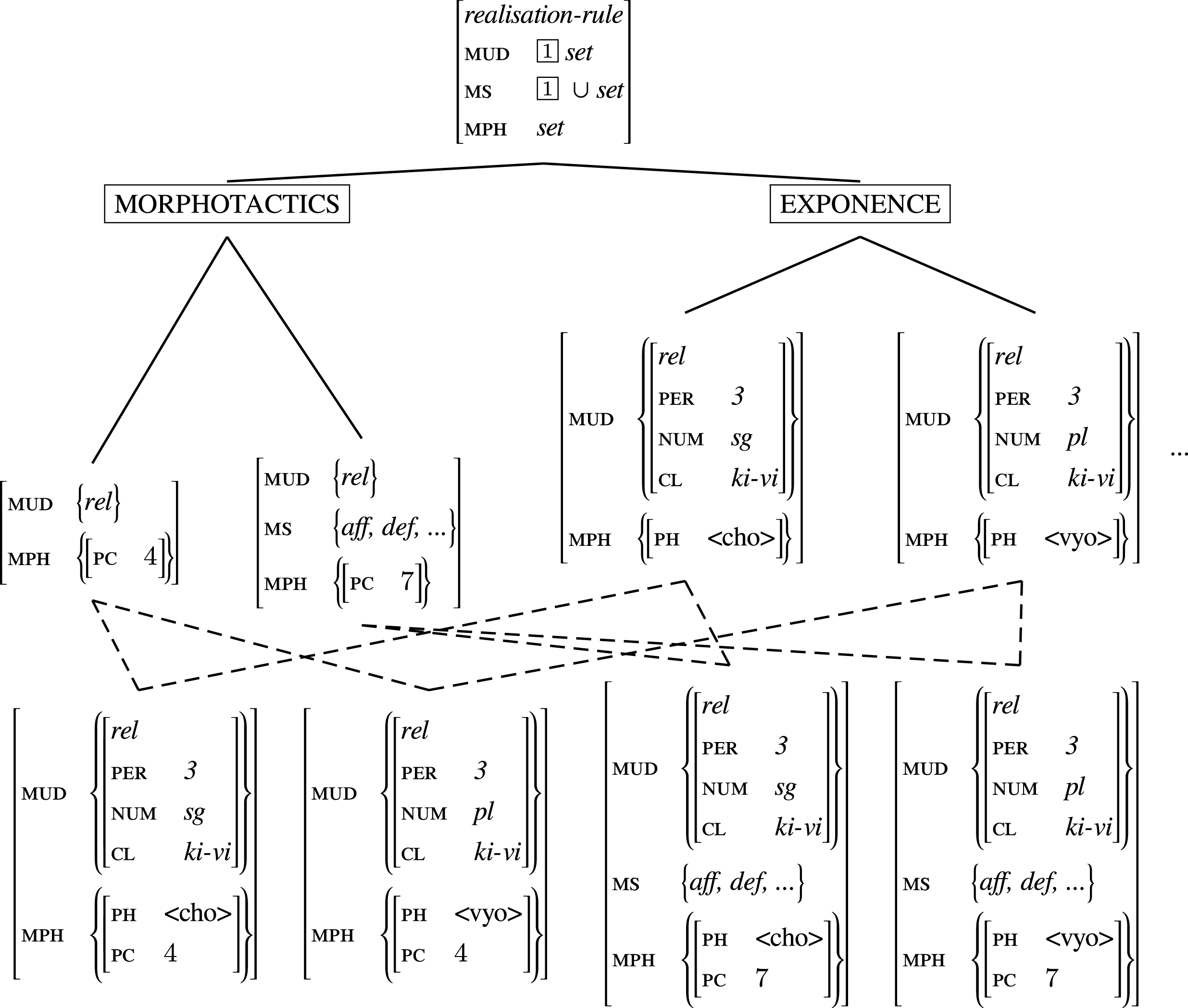
Finally, the formalism underlying our approach is the logic of typed feature structures (Carpenter Reference Carpenter1992) that is employed in HPSG (Pollard & Sag Reference Pollard and Sag1994). This provides us with a sound basis for underspecification and inheritance.Footnote [30] More specifically, we shall employ Online Type Construction, as proposed by Koenig & Jurafsky (Reference Koenig and Jurafsky1994) and Koenig (Reference Koenig1999), to dynamically derive fully specified realisation rules by means of systematic cross-classification of partially specified rule schemata.
4.1.1 Realisation rules
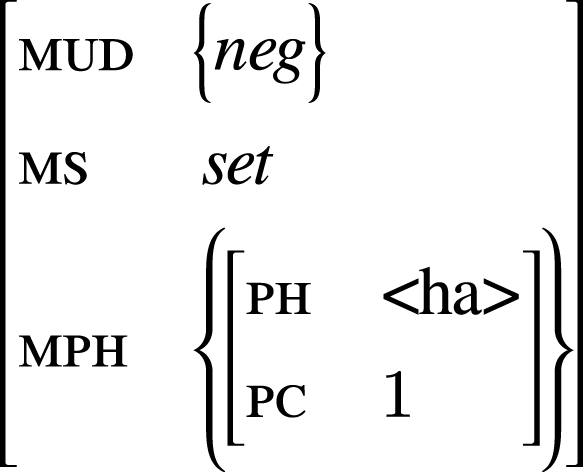
Let us introduce the basic parts of our theory in a step-by-step fashion. The fundamental building blocks are realisation rules, described in terms of typed feature structures. As shown in Figure 12, a typical realisation rule specifies which features it realises (mud), and a set of morphs (mph) that are exponents of these features. These morphs consist of a description of their phonological contribution (ph), together with a position class index (pc).
Swahili default negative marker.
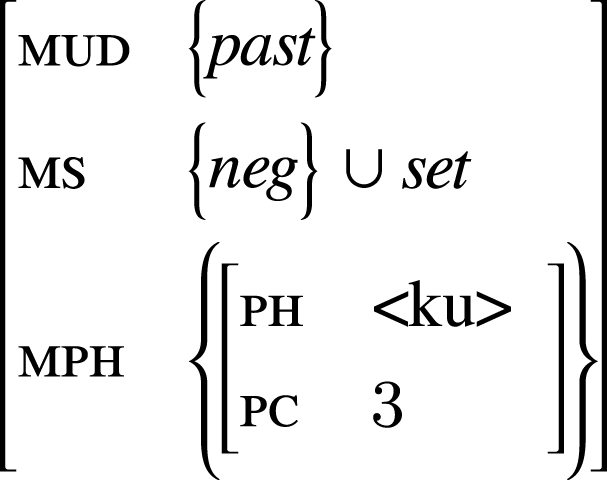
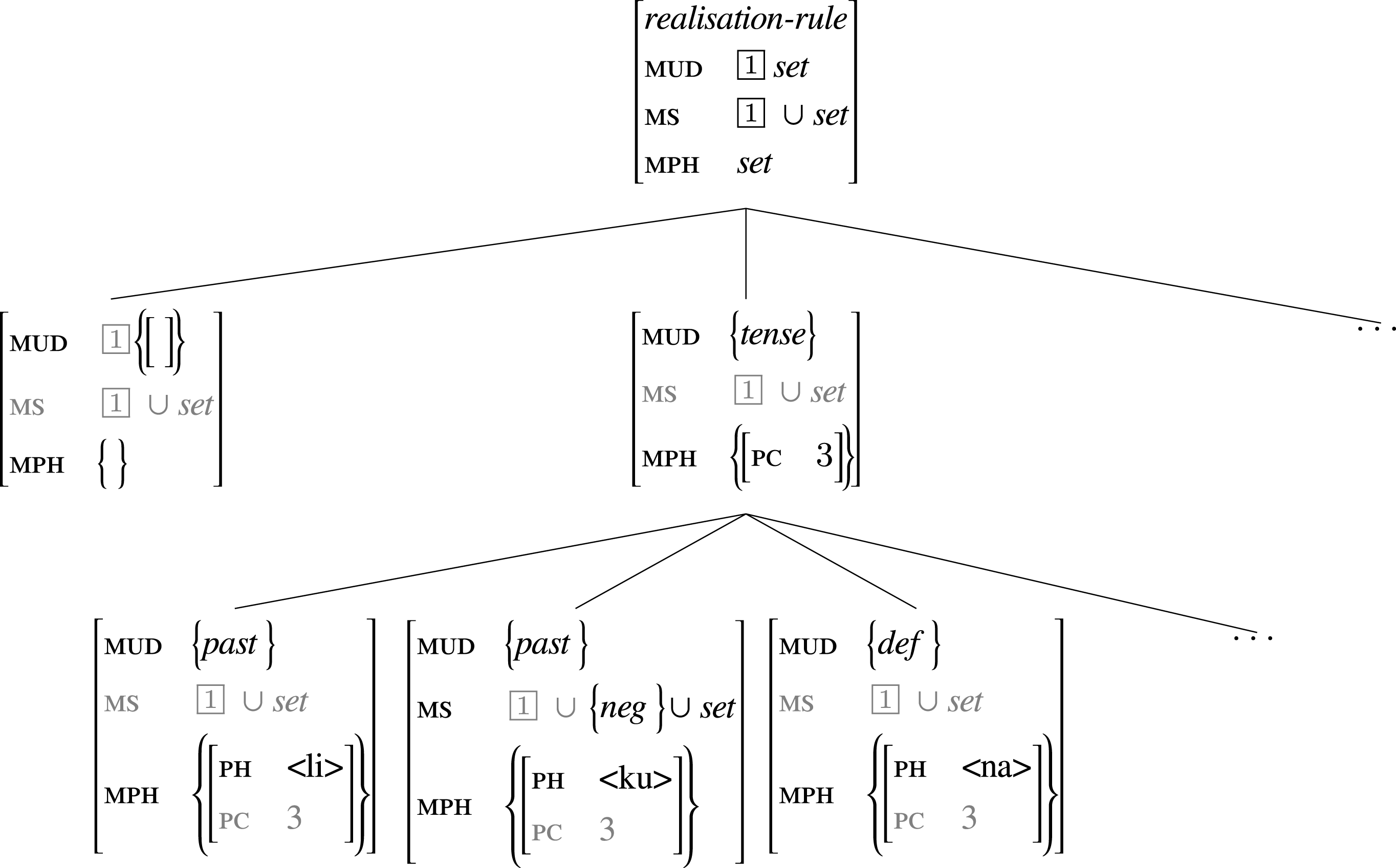
In addition to specifying morphosyntactic features to be expressed, realisation rules can be conditioned on additional properties of the morphosyntactic property set. For example, in Swahili, the marker of past is subject to allomorphy depending on the presence of negation: the regular marker li is replaced by ku in the context of negation. The appropriate rule is shown in Figure 13.
Swahili negative past marker.
This rule specifies that ku is a realisation of the property past in mud that is allomorphically conditioned on the presence of the property neg (in ms). Because it realises a distinct mud however, ku is not in paradigmatic opposition with ha, which correctly captures the fact that the two morphs obligatorily co-occur in past negative forms.Footnote [31]
So far, we have only considered realisation rules where exactly one morphosyntactic property was expressed by exactly one morph. While this is certainly the canonical case, rules are in no way limited to such simple cases.
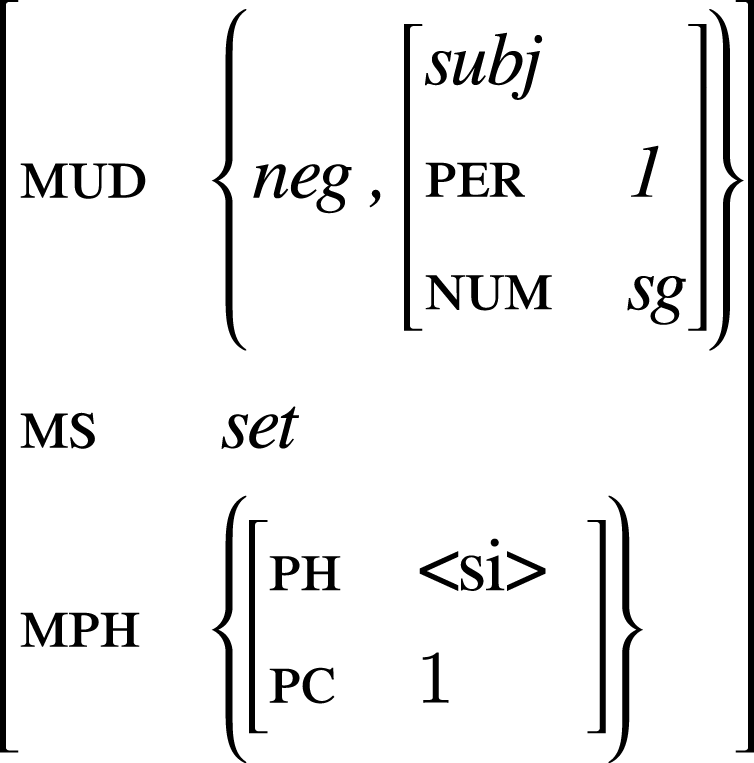
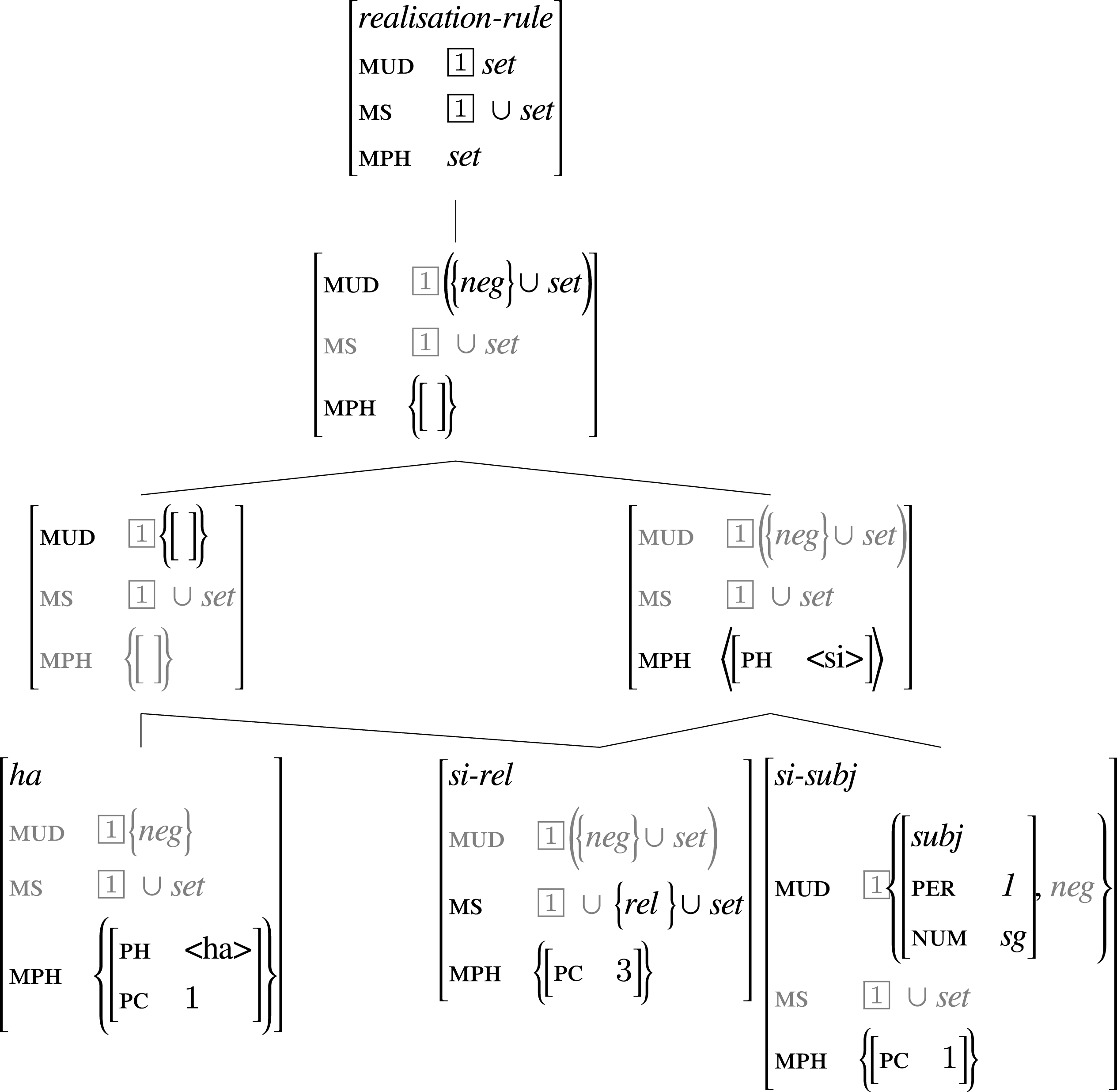
Portmanteaus represent a situation where more than one morphosyntactic property is expressed by a single morph, and that particular morph is an alternative to corresponding non-cumulative exponents. Recall from Table 4 in Section 2.2 that in Swahili, the negative 1st singular is realised by the portmanteau morph si (in slots 1 and 2), rather than by an analytic combination of negative ha and 1st singular subject agreement ni. The portmanteau rule in Figure 14 captures this situation straightforwardly by associating a two-element mud set with a single exponent.Footnote [32]
Swahili 1st singular negative portmanteau.
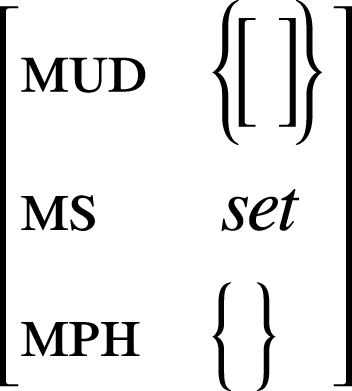
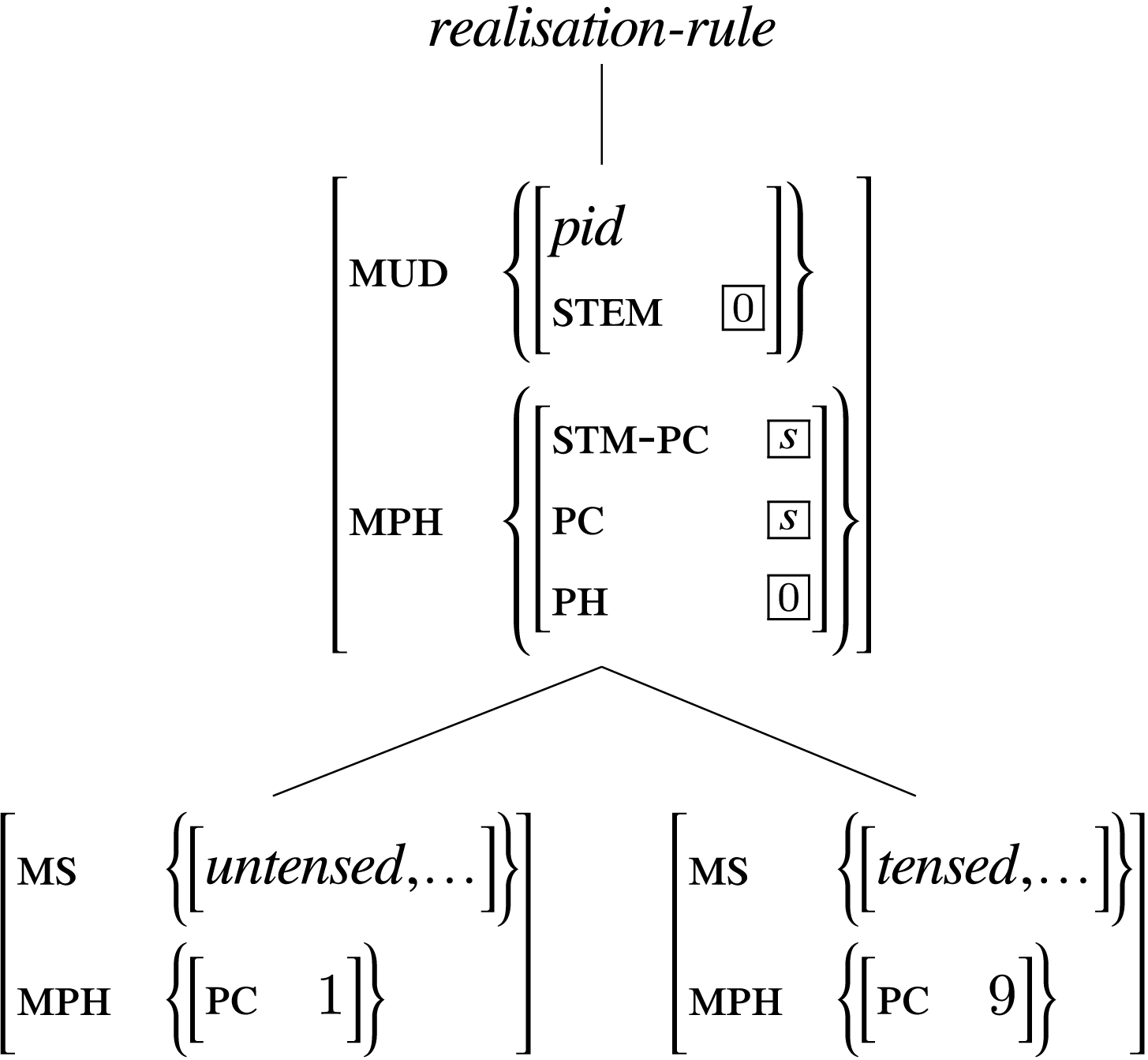
A realisation rule may introduce no exponent at all. In line with (Zwicky Reference Zwicky, Dressler, Luschützky, Pfeiffer and Rennison1990, Stump Reference Stump2001), we assume a default non-realisation for every morphosyntactic property that fails to have an overt exponent, akin to the identity function default in PFM. As shown in Figure 15, the default non-realisation rule constrains its mph value to be the empty set. Since this rule assumes the status of a default, the mud value is underspecified, i.e. it merely specifies a singleton set where the only element is the most general feature structure ([]). Adopting a morphological blocking principle, such as Pāṇini’s Principle or the Elsewhere Condition, application of this rule is constrained to exactly those cases for which no specific realisation rule exists (see below).
Default non-realisation.

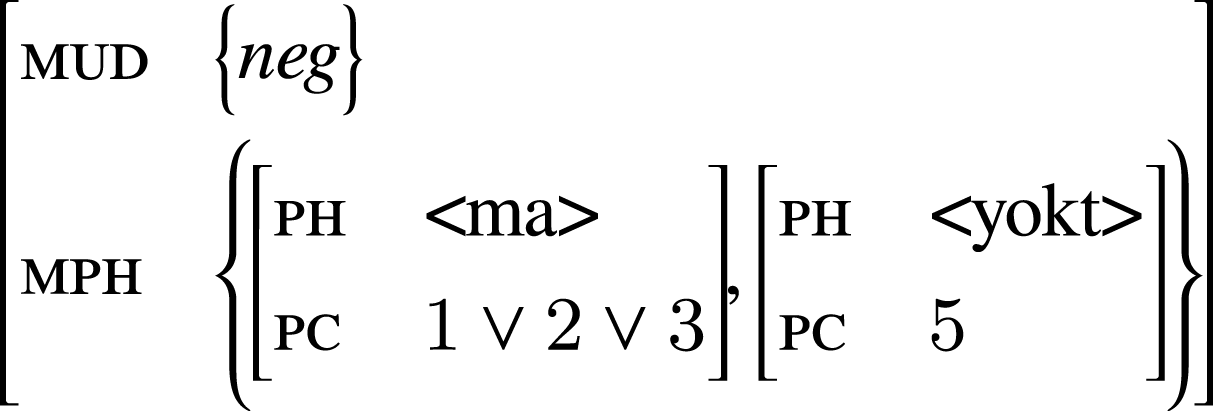
A realisation rule may also introduce more than a single morph. While in principle this may be used even for adjacent morphs, its main advantage becomes most obvious for discontinuous exponents, as witnessed in circumfixation: e.g. in Chintang, regular negation is expressed by means of the circumfix ma- ... -yokt (see Table 7). As shown in Figure 16, realisation of the neg property is related to the presence of two morphs with non-contiguous position class indices.
Discontinuous morphs: Chintang circumfixal negative markers.
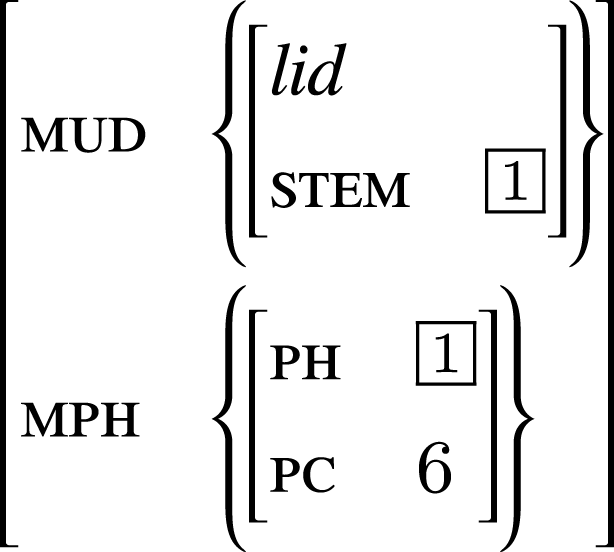
Finally, our approach relies on explicit stem introduction rules, which assign the stem to a specific position. In systems with no unpredictable stem allomorphy, a single, very general rule is sufficient, indicating in which position the lexically-specified stem shape is to be introduced.Footnote [33]Figure 17 gives the relevant rule for Swahili verbs: the stem introduction rule realises just the lexical identity (lid) of the lexeme to be inflected by placing the stem shape recorded as part of this lexical identity in position 6: as captured by the boxed coreference tag  the morph’s ph(onology) value is shared with the value of the stem feature.Footnote [34]
Stem introduction in Swahili verbs.
Having illustrated how realisation rules corresponding to interesting exponence situations are formulated, we will now discuss how these basic units of morphological realisation are combined in the analysis and generation of complex forms.
4.1.2 Morphological well-formedness
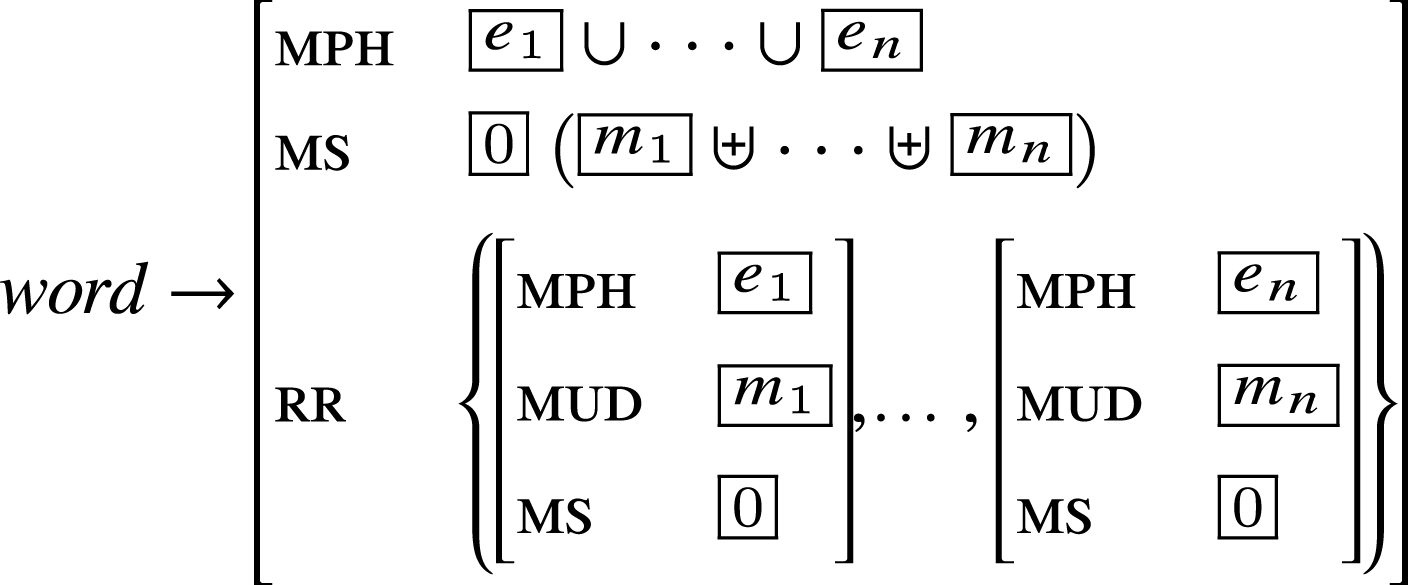
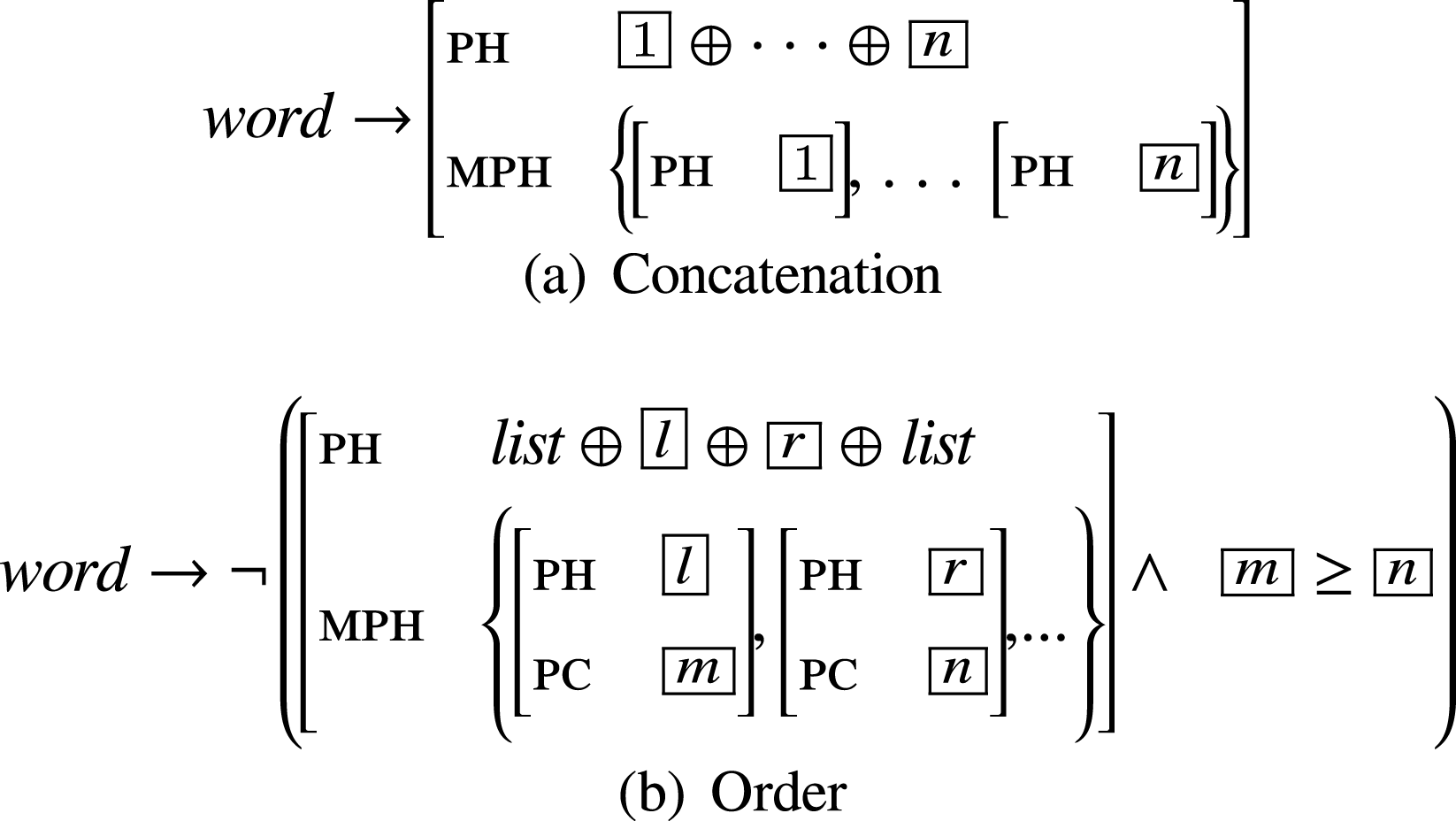
We have seen so far how realisation rules provide recipes for the expression of certain features or combinations of features by means of (possibly empty) sets of morphs indexed for position class. Up to this point, however, nothing ensures that these recipes be in fact applied. Similarly, the morphs thus introduced do carry position class information, but, again, nothing so far tell us how these indices are to be interpreted. In order to address this issue, we shall formulate two general principles of morphological well-formedness: one that ensures actual application of realisation rules, and another one that relates position class indices to surface order.
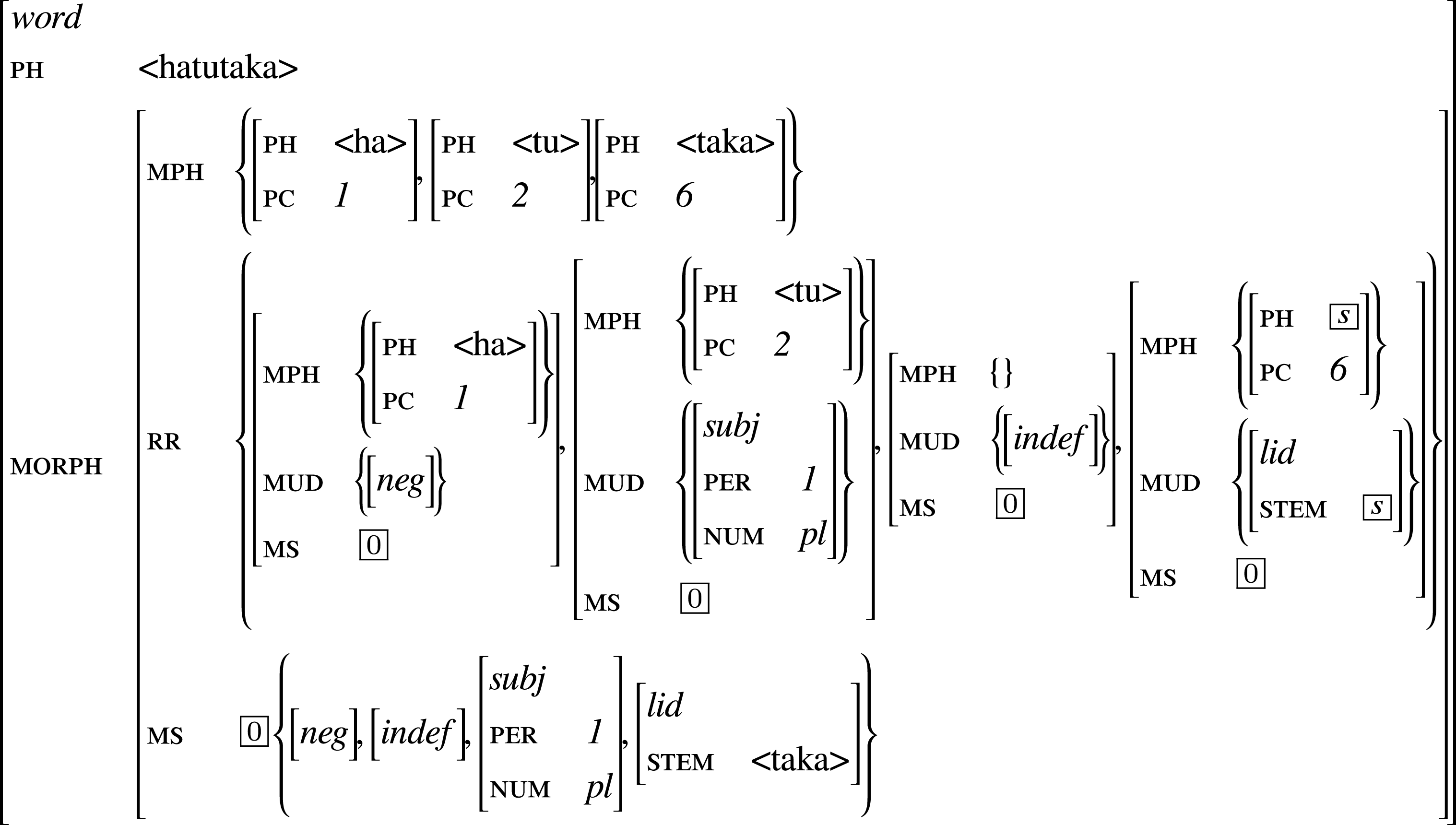
In order to illustrate how realisation rules are used to license fully inflected words, let us start with a sample analysis of the Swahili word hatutaka ‘we do not want’. As illustrated in Figure 18 below, inflectional morphology is represented as a complex feature structure that is the value of the attribute morph. The value of morph specifies the relation between three sets: a morphosyntactic property set (ms), a set (rr) of realisation rules that pair parts of the morphosyntactic property set with exponents, and a set (mph) of morphs indexed for position.
Sample analysis: Swahili hatutaka ‘we do not want’.
The morphosyntactic property set ms of hatutaka consists of four elements that need to be expressed: negation, indefinite tense, subject agreement, and lexemic identity. The realisation rules (on rr) invoked to license the fully inflected word each specify as their mud value which of these properties they can express and pair them with a set of exponents they introduce (if any). These exponents are gathered together on the word’s mph set, from where the word’s phonology (ph) is computed by concatenating the phonological contributions of the morphs in the order of their position class indices (pc). Among the four realisation rules that license this word, there is one that deserves our special attention: owing to the absence of any more specific rule to realise indefinite tense, we see an instance of default non-realisation (Stump’s identity function default; recall Figure 15), a rule type which pairs any property with the empty set of morphs. This rule highlights an important property of the templatic approach we propose: since this rule specifies the empty set of morphs, non-realisation will have no morphotactic or morphophonological representation at all, i.e. our theory does not recognise any meaningful notion of “zero morphs”. Related to this is the status of position class indices: in contrast to static slots, these indices merely define positional equivalence classes. Thus, while the order of indices ultimately defines the sequencing of phonological contributions, there is no meaningful concept of an empty slot either. As shown in Figure 18, the templatic representation is exhaustively determined by overt morphs consisting of phonological and positional information.
With this example in place, we can now turn to well-formedness constraints on morphological representations. In essence, all that it takes to ensure morphotactic well-formedness is to ensure that all and only the morphs licensed by some rule invocation will have their phonological contribution wind up on the phonological contribution of the word, in the order of their positional indices. Similarly, in order to ensure morphosyntactic well-formedness we need to guarantee that all rules that can express some morphosyntactic property must apply and, conversely, no other rule may apply. For instance, we will want to ban both over-application like hatuvitaka ‘we do not want them.ki/vi’ and under-application like tutaka ‘we want’ as legitimate realisations of the morphosyntactic property set in Figure 18.
Morphological well-formedness: completeness and coherence.
Morphosyntactic well-formedness is imposed by the principle in Figure 19. By means of constraining the word’s ms value as the union of the rules’ mud values we achieve completeness (“no under-application”): every morphosyntactic property must be realised by some rule. The use of non-trivial set union ( $\uplus$) rather than ordinary set union implements coherence (“no over-application”): it ensures that identical mud values cannot be collapsed on the the word’s ms set. In other words, every mud value can only ever be added once, thereby eliminating repeated application of the same rule that may otherwise lead to spurious ambiguity or “morphological stuttering”.
In addition to ensuring these two central aspects of morphological well-formedness, the principle in Figure 19 performs two additional functions: first, it distributes the word-level ms value across the ms features of the rules applied. By doing so, any conditioning imposed by a realisation rule will have to hold at the word level as well. Conversely, the entire morphosyntactic property set will be made visible on every rule being invoked, such that conditions can be evaluated local to that rule. Second, alongside resource management for morphosyntactic features, this principle stipulates that the mph set of the entire word must consist exhaustively of morphs contributed by the realisation rules (recall that the stem itself is introduced by a realisation rule). The second major principle that we will introduce at this point concerns the interpretation of position class indices. We assume that position class systems are best conceived of as sequences of strictly ordered classes of morphs. Thus, not only must the order of morphs correspond to their position class indices, but any position can at most be uniquely “filled”. This rather standard interpretation of a position class system (see Simpson & Withgott Reference Simpson, Withgott and Borer1986, Inkelas Reference Inkelas1993) can be formalised along the lines of the Morph Ordering Principle shown in Figure 20.
Morph Ordering Principle (MOP).
While clause (a) of the MOP regulates that the word’s phonology must be some concatenation of the phonologies contributed by the set of morphs, clause (b) bans any situation where two adjacent phonologies are contributed by elements of mph whose pc indices are not in strictly ascending order: this not only ensures that the order on the word’s ph list must respect the order implied by the positional indices (ascending from left to right), but it also implements “slot competition”, ultimately disallowing any two elements on a word’s mph list to resolve to the same positional index.
The information-based approach to realisational morphology already displays some desirable properties: first, instead of having to postulate a static number of rules (or rule blocks) that need to be processed for any paradigm, the system is dynamic, in that the number of rules to be applied is a direct function of the cardinality of the entire morphosyntactic property set and the cardinality of the realisation rules’ mud values. Thus, if some realisation rule, e.g. a portmanteau rule, expresses more than one property, the number of rules being applied will automatically be reduced. Second, the rule system is non-recursive and non-layered, which models quite neatly the finite character of inflectional morphology. Thus, the slight increase in internal structure incurred by the adoption of a morphous model is more than compensated by the reduced structure in the derivation history.
4.1.3 Inheritance
Having outlined the fundamental workings of Information-based Morphology, we shall address now how generalisations over classes of rules can be expressed by means of organising realisation rules into inheritance type hierarchies.
As the formal basis for our theory, we draw on a logic of typed feature structures (Carpenter Reference Carpenter1992) as commonly used within HPSG (Pollard & Sag Reference Pollard and Sag1987, Reference Pollard and Sag1994). Type inheritance hierarchies in these formalisms are semi-lattices, i.e. in contrast to inheritance trees, multiple inheritance is generally allowed. Furthermore, we use monotonic (or in other words, non-default) type hierarchies: that means that any information that holds for a supertype must also hold for its descendants. If a type inherits from more than one supertype, information from every supertype must be preserved. Since preservation of information is a general property of type hierarchies, any information present on a supertype can be directly inferred, obviating redundant statement as a property of the subtype.Footnote [35]
Hierarchy of tense realisation rules in Swahili.
Figure 21 gives an example hierarchy of tense realisation rules in Swahili. While the leaves of the hierarchy specify the phonological contribution of each rule, which is specific to the concrete tense category to be expressed, shared information pertaining to position class, i.e. the generalisation that tense is always realised in slot 3 in Swahili, is abstracted out into a common supertype. To highlight how information introduced on a super-type is inherited by all its subtypes, we redundantly represent this information in grey in Figure 21. In the remainder of the paper, we will usually omit inherited information from the hierarchy, in the interest of space and readability. A piece of information shared by every realisation rule concerns the structure sharing  represented on the type realisation-rule at the top of the hierarchy, which actually constrains the mud value to be a subset of the entire ms set.
Similarly to sharing position class information, there are also situations where we would want to abstract out identity of shape across different position classes. The example in Figure 22 captures realisation rules for Swahili negation (see Table 6 above).
Sub-hierarchy of realisation rules for Swahili negative marking.
As shown at the top of the rule hierarchy in Figure 22, the rules share the property that they all minimally express negation. The leaves of the rule hierarchy capture what is specific to each of the three ways of Swahili negative marking, most notably, position class information: slot 1 for the default marker ha, slot 3 for relative si and slots 1 for first singular subject portmanteau si. The two intermediate types abstract out interesting properties shared by some of the leaves: while the type on the right generalises the shape of the exponents (si), the one on the left captures the fact that both ha and relative si exclusively realise negation, i.e. they are not portmanteaus.Footnote [36] The present hierarchy of negative marking in Swahili witnesses a case of multiple inheritance: the rule type for the relative negative marker is a subtype of both intermediate types, so it inherits all the information of either type, including shape of the exponent, cardinality of the mud set (=singleton), as well as the properties of its parents’ supertype(s). The fully expanded rule is found as a leaf type in Figure 22, with inherited information represented in grey.
4.1.4 Online type construction
Static inheritance hierarchies like the ones we have considered so far are sufficient to abstract out properties shared by classes of realisational rules into a common supertype, also known as elimination of vertical redundancy. What they fail to capture, though, are cases of systematic alternation, also known as elimination of horizontal redundancy. Let us illustrate this on the basis of Swahili parallel position classes, one of the classical challenges of position class systems put onto the research agenda in Stump (Reference Stump, Booij and van Marle1993). As Stump observes, Swahili subject and object marker paradigms are mostly identical (see Table 3), so that separate listing of two sets of markers leads to significant redundancy. However, the two sets of markers still need to be distinguished, since subject and object marking differ for a few person–number combinations in the m-wa class.
The problem of eliminating horizontal redundancy is beyond the power of inheritance hierarchies as we have considered them so far: while it is possible to abstract out shared properties both for morphotactics and shape, one would still have to specify all combinations manually. Fortunately, the concept of online type construction (Koenig & Jurafsky Reference Koenig and Jurafsky1994) provides the desirable solution, since it turns otherwise static type hierarchies into a generative device, essentially making them dynamic. In order to address similar problems within the lexicon (i.e. systematic alternation traditionally captured by means of lexical rules), Koenig & Jurafsky (Reference Koenig and Jurafsky1994) revise the status of lexical inheritance type hierarchies: instead of describing lexeme categories directly, these categories are obtained by means of a closure operation on a type underspecified hierarchical lexicon, partitioned into orthogonal dimensions. According to their definition, a well-formed lexical category is obtained by systematic intersection (conjunction) of leaf types. Assuming that leaf types within one dimension are disjoint while dimensions are conjunctive, the full set of well-formed categories is obtained by combining, under unification, each leaf type from one dimension with each leaf type from all other dimensions.
Their approach can be straightforwardly applied to the problem at hand: instead of regarding (leaf) types in our rule type hierarchy as well-formed rules by themselves, we shall assign them the status of underspecified rule schemata or partial description of rules. The set of well-formed realisation rules is then obtained by pairwise combination of leaf rule types from the dimensions of MORPHOTACTICS and EXPONENCE.
As captured in Figure 23, rule types in the EXPONENCE dimension pair morphosyntactic properties to be expressed with exponents, or, more precisely, description of their phonological shape. While some of these rule types specify grammatical function (either subj or obj), the majority of rule types actually has this piece of information underspecified (recall the paradigms in Table 3). The two types in the MORPHOTACTICS dimension, by contrast, abstract out the systematic relation between position class and grammatical function.
Rule type hierarchy for Swahili parallel position classes.
As indicated by the dashed lines, pairwise combination of leaves in the EXPONENCE dimension with those in the MORPHOTACTICS dimension yields the set of fully expanded realisation rules. If an EXPONENCE rule type is already constrained as to grammatical function (e.g. third singular m-wa class a or m), it will only combine with the appropriate type in the MORPHOTACTICS dimension, the other combination being ruled out by unification failure, effectively fixing position class information. For the majority of Swahili subject and object markers, where grammatical function is underspecified for EXPONENCE rule types, pairwise combination with MORPHOTACTICS rule types will yield two maximally specific types: one that constrains the exponent to position class 2 and disambiguates its function to subj, and another that constrains it to position class 5, disambiguating grammatical function to obj.
In essence, intersection of EXPONENCE types with either type from the MORPHOTACTICS dimension will model positional disambiguation, whereas underspecification within the EXPONENCE hierarchy will capture parallelism of exponence.
4.1.5 Pāṇinian competition
The last general aspect of Information-based Morphology we would like to discuss concerns the implementation of Pāṇini’s Principle, also known as the Elsewhere Condition (Kiparsky Reference Kiparsky1985). Essentially, this principle preempts selection of a general rule in case a rule with a narrower description can be applied. In monotonous constraint-based formalisms, such as the one assumed here, this notion of competition between descriptions is not built in: instead of competition one would get (partial) ambiguity, since satisfaction of a set of constraints only depends on this very set itself, rather than on any alternative sets of constraints that may be applied. Pāṇinian competition, as it is commonly used in morphology, makes the assumption that any pair of rules models not only distinct but disjoint sets of objects. In the limiting case of two rules standing in a proper subsumption relation, i.e. where one rule is more general than the other, it is understood that the more general rule only describes those objects which are not already described by the more specific rule, yielding two disjoint sets of objects being described by each rule.
While it is of course possible, using negation and disjunction, to write rules so that their descriptions are disjoint, this makes for rather cumbersome representations. Moreover, it fails to capture the very spirit of Pāṇini’s Principle as a division of labour between the general case and specific exceptions.
Building on previous work regarding this issue within constraint-based grammar (Andrews Reference Andrews1990, Koenig Reference Koenig1999), we adopt a general principle of morphological competition that automatically adds Pāṇinian inference to standard typed feature structures. In order to implement this, one has to establish first which rule types should be considered competitors, and second, ensure disjoint interpretation on these competitors based on the informational difference in the descriptions.
Given our distinction between mud and ms, we hypothesise that it is expression of a feature that assumes a pivotal role in defining competition. Intuitively, what we want to establish is competition between any rules that realise either the same features, or where one rule realises more features than the other, as with portmanteaus. This is captured by the definition in (22).

Once we have identified competitors, the only task that remains is to make the denotations disjoint. Since application of a rule not only depends on the features being realised (mud) but also on constraining features, we use the complement of the informational difference between the ms descriptions to make the application context of the more general rule specific enough to only apply whenever the more specific rule cannot. This operation of Pāṇinian inference is defined in (23).

Let us briefly illustrate the workings of Pāṇinian inference as defined here on the basis of examples from Swahili negation. Consider the leaf types of the hierarchy of negative realisation rules in Figure 22. For ease of exposition, all types, and in particular the leaf types have been expanded with inherited information (in grey).
According to definition (22), ha in Figure 22 is in competition with the first singular negative Portmanteau si-subj, since the mud value of ha is a (proper) subset of the mud value of the negative first singular portmanteau rule si-subj, thereby establishing ha as the more general type ( $t_{1}$). Since mud is necessarily contained in ms, Pāṇinian inference as stated in (23) will expand the ms of ha with negation of the informational surplus of si-subj (
 $t_{2}$), i.e. the description in (24). Effectively, application of ha will be restricted to exactly those cases where si-subj cannot apply.
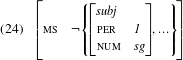
The second case to be considered involves the pair ha and si-rel, an instance of what Noyer (Reference Noyer1992) terms “discontinuous bleeding”: a rule targeting one position bleeds a rule targeting a distinct position. The definition of Pāṇinian competition in (22) identifies both descriptions as competitors, owing to the fact that their mud values are identical. Taking ha again as  $t_{1}$ and si-rel as
 $t_{2}$, Pāṇinian inference as defined in (23) will expand ha’s ms (
 ${\it\sigma}=\{neg,...\}$) with ¬
 $({\it\sigma}\wedge \{rel,...\})$, simplifying to (25) following standard laws of statement logic.

We have so far tacitly assumed that Pāṇinian competition is established primarily on the basis of expression of features (mud), rather than the entire set of conditioning features (ms). The main motivation behind this is that it reconciles the idea of global competition with extended exponence. Consider the negative past tense marker ku and its representation in Figure 21: expression of past tense, conditioned on negation. Since this marker actually co-occurs with regular negative ha, competition defined on ms would be detrimental, unintentionally ruling out the marker of negation. However, if Pāṇinian inference is conditioned on the features being expressed, as we do assume here, cases of multiple exponence such as this will not even register as competitors, given that  $\{neg\}$ and
 $\{past\}$ do not stand in a subset relation. To summarise, mud-based competition just strikes the right balance between Pāṇinian inference and multiple exponence under a global view of competition.
An important case of Pāṇinian inference is the one that affects the rule of default non-realisation shown in Figure 15. Since the mud value consists of a single fully underspecified element, and since there are no further restrictions on its ms, it will be in competition with every other rule. Thus, its application will be restricted, by way of Pāṇinian inference, to exactly those situations where no overt realisation rule can apply. Note that since Pāṇinian competition is global (not restricted to rule blocks), a single rule is sufficient to deal with default non-realisation, contrary to PFM, where a separate instance of the Identity Function Default rule has to be stipulated in each rule block. In light of the universal default status of this rule type, this is certainly a desirable result.
4.2 Modelling variable morphotactics
Having laid out a formal realisational theory of morph order, together with sample accounts of morph ordering in Swahili (including Stump’s portmanteau and parallel position classes), we are now in a position to study the diverse deviations from canonical order we have laid out in Section 2.
4.2.1 Misaligned placement in Nepali
The first deviation we are going to address is misaligned exponence: as shown schematically in Figure 2 above, agreement markers linearise in different positions. Similarly, present and future tense markers do not target the same slots either, with the present marker preceding the slots of any agreement markers, while the future marker is assigned a slot in between the slots for agreement marking. As a net effect, misalignment between paradigmatic opposition and surface position gives rise to reversal of order.
Sub-hierarchy of realisation rules for Nepali tense and agreement marking.
As shown in Figure 24, position is associated with classes of morphs, but crucially not with the most general inflectional value for any morphosyntactic property: Within the rule sub-hierarchies for both tense and agreement there are two position classes to which the realisation rules will be assigned.
Comparing the analysis of non-canonical placement of tense markers in Nepali to that of Swahili tense markers (see Figure 21), the added complexity resulting from misaligned placement becomes immediately apparent: in the canonical case, position can be paired with the general type of the class being expressed, e.g. tense in Swahili, whereas in misaligned placement, generalisation over position will be a property of sub-classes, or, in the delimiting case, of individual exponents.
4.2.2 Conditioned placement
As a representative for the second type of deviation from the canon, we shall discuss the formal treatment of Swahili relative markers. In contrast to misaligned placement, as illustrated by Nepali, conditioned placement does not merely depend on morphosyntactic properties being expressed, but rather on some additional properties, which typically receive independent realisation. Recall that in Swahili, placement of relative agreement markers depends on tense and polarity: in the affirmative definite tense, the relative marker follows the stem, whereas in the negative and all other tenses, it is realised in slot 4 instead, preceding the stem.
Drawing on our distinction between realising a feature (mud) and being conditioned on a feature (ms), we can capture conditioned placement by means of reference to additional features in ms.
Partial hierarchy of Swahili relative markers.
As illustrated by the partial type hierarchy in Figure 25, rules of exponence for Swahili relatives are systematically underspecified with respect to position, essentially pairing relative features to be expressed with constraints on the shape of the exponent. Systematic conditioned placement alternation, however, is captured by the two rule types in the MORPHOTACTICS dimension: while affirmative definite tense restricts position of the relative marker to slot 7, the alternative position 4 represents the elsewhere case, subject to Pāṇinian inference. Intersection of leaf types from both dimension, as required by online type construction, finally yields the set of fully well-formed realisation rules, thereby modelling the systematic placement alternation of the entire class of formatives.
Compared to canonical placement, the added complexity of conditioned placement can again be localised in the geometry of the type hierarchy: while vertical abstraction of position information is sufficient for canonical morphotactics and misaligned placement alike, conditioned placement calls for horizontal abstraction of position, ultimately increasing the number of inferrable leaf types.
4.2.3 Free ordering in Chintang
Recall from Section 2.4 that in Chintang verbs, subject and object markers, as well as the pre-stem part of negation, all occur in one of three initial slots, without any constraints on order amongst each other.
Partial hierarchy of Chintang conjugation rules.
As captured by our analysis in Figure 26, rules of exponence for subject and object agreement, as well as negation, all inherit position information regarding the first (if only) exponent from a common supertype. Position information is disjunctive at this level, and, owing to the absence of any more specific constraints further down the hierarchy, it will remain disjunctive for every leaf rule. Besides selecting particular exponents, rules for subject and object marking restrict the number of exponents they introduce to one. A case that deserves special attention is multiple exponence of negation: as shown in Figure 26, the realisation rule expressing negative polarity introduces two exponents simultaneously. While the suffixal marker is constrained by the rule itself to a fixed slot, position class information for the permutable prefix is inherited from the supertype which requires an exponent in one of the first three slots.
Non-canonicity of free permutation is essentially captured by two properties in the type hierarchy: the disjunctive or underspecified nature of position class information itself, and the way this information is associated with a realisation rule, generalising pure positional information across heterogeneous rule types.Footnote [37]
4.2.4 Partial ordering in Mari
The analysis of Mari, a language which combines free permutation with misaligned and conditioned placement, finally features all of the properties we studied in isolation when dealing with variable order of Chintang prefixes, Nepali agreement and Swahili relatives, respectively.
Partial hierarchy of realisation rules for Mari declension.
The core of our analysis is represented in Figure 27. Free permutation, which characterises part of the system, is captured by disjunctive position class statements high in the hierarchy, targeting a heterogeneous class of morphs, i.e. exponents of case and possessive marking, which are characterised by overlapping position class specifications. Further down the case sub-hierarchy, however, we find sub-classes of case markers, namely the lative/inessive and genitive/accusative which are further restricted with respect to positions 4 and 5, respectively: ignoring the dative for a moment, the sub-hierarchy of case realisation rules strongly resembles those of tense and agreement markers in Nepali, thereby modelling the misaligned placement properties that partially characterise Mari. Since possessive markers include slots 4 and 5 among their placement options, realisation of a slot 5 marker like accusative or genitive will preempt realisation of the possessive in that very slot, restricting realisation to slot 4. Adding the dative to the picture, which is underspecified for slots 4 and 5, we get the Chintang-like free permutation.
To complete the picture of Mari, let us finally consider the placement of the possessive markers in the plural. Recall from Section 2 that in the singular, Mari possessive markers compete with case markers for positions 4 and 5, but that the plural marker in slot 3 opens up an additional placement possibility to its left (in slot 2), preceding the plural marker in position 3. In essence, this difference in placement possibilities is just another case of conditioned placement, as already observed with Swahili relatives and Portuguese mesoclisis. Consequently, the conditioned placement possibilities shared by all possessive markers are abstracted out into a dimension of its own (MORPHOTACTICS), with constraints on shape stated in an independent, cross-cutting rule type hierarchy (EXPONENCE). What is of most interest here are the two rule types in the MORPHOTACTICS dimension: while the left hand type pairs an additional condition regarding singular number of the possessum with a restricted set of placement possibilities, the right-hand rule type represents the elsewhere case, merely inheriting any constraints present on the super-type. Pāṇinian competition between these two types will restrict the more general right-hand one to the complement of the more specific left hand one, effectively reserving the extended placement option (in position 2) to non-singular possessed nouns. Just like Swahili conditioned placement of relative markers, the and/or logic of Online Type Construction will distribute the two MORPHOTACTICS constraints over the six EXPONENCE constraints to yield the set of fully well-formed rules.
To summarise, our analysis of Mari captures the three-way deviation from the canon by systematically combining the independently established analyses of free, misaligned and conditioned placement in a single morphological system.
4.2.5 Mobile stems in Italian
The last sample formal analysis we are going to provide in this paper targets Italian, where placement alternation involves entire sequences of morphs. As discussed in Section 2.5, Italian verbs consists of two templatic zones, both of which are rigidly ordered internally: a stable core of 3 positions, consisting of the stem as well as TAM and agreement affixes, and a sizeable stable subsystem of 6 slots for pronominal affixes. While order within each of these two subsystems is stable, order of these subsystems with respect to each other is variable, and can be seen as an instance of conditioned placement: in the imperative and infinitive, the pronominal affix cluster is linearised to the right of the core, whereas in finite tenses, it is found to the left of the core.
There are in principle two possible perspectives on the problem at hand: either, position of the core is fixed and position of the cluster is variable, or the other way around. In a formal theory of morphotactics such as ours which only recognises individual indexed positions, but no constituency, a simple-minded approach may simulate variable placement of the core or the cluster by underspecifying placement of the individual elements in the core or the cluster. However, even if the number of disjunctive statements can be minimised by taking the core as mobile, rather than the cluster, such an approach will have the drawback that it pictures it as entirely coincidental that order within each zone remains constant.
Fortunately, an alternative perspective is available: suppose the cluster of pronominal affixes is fixed, but positioning of the stem is variable, the only remaining thing to do is to ensure that TAM and agreement markers are always placed in the same position relative to the stem, wherever the stem happens to be realised. To this end, we shall introduce a special pivot feature into our representation that makes accessible the position class information of a privileged morph: the stem. This analysis is shown schematically in Figure 28.
Schematic representation of Italian mobile stems.
We therefore extend our current formal representation of morphs with an additional feature stm-pc the value of which is reentrant with the pc value of the stem. In order to make this information available to all rules, we propose the following general constraint on morph sets, which can be represented informally as follows:

As shown in Figure 29, stem introduction rules crucially identifies the pc value of the morph they introduce with its stm-pc value. Since the stm-pc feature is distributed across the entire mph set of the word, the positional index of the stem will be accessible to all other rules applying in the formation of this word. Accordingly, we can now specify the position of affixal morphs either in absolute terms as before, or relative to the value of stm-pc.
Partial hierarchy of Italian stem realisation rules.
The partial type hierarchy illustrates introduction of stem forms in variable position in Italian:Footnote [38] while stems of untensed words will be assigned to the initial slot 1, the stems are realised in slot 9 in tensed words.
Placement of affixes is illustrated in Figure 30. As discussed above, we regard the positioning of elements of the pronominal affix cluster as independent. Therefore, their surface position is described in absolute terms, just like placement of morphs was done in the previous sections. By contrast, TAM and agreement markers exploit stem-relative positioning: realisation rules for subject agreement markers do not provide an absolute position as the value of the pc feature, but rather constrain it relative to the stm-pc feature. Thus, whenever the stem is assigned to slot 1, namely a position preceding the cluster occupying slots 4–8, the agreement marker will go along, surfacing in slot 3. Likewise, in tensed words, the stem will wind up in slot 9, taking along the agreement marker (in slot 11). Placement of TAM markers, which sit in the position between stem and agreement markers, will work in fully analogous fashion.
Partial hierarchy of Italian affixal realisation rules.
To summarise our discussion of Italian, we have shown that the introduction of a simple feature that provides a key to a pivotal position was sufficient to model variable placement of sequences of otherwise rigidly ordered stable subsystems. In essence, simple propagation of the stem’s position obviates the need for (recursive) constituent structure in inflectional morphology. The introduction of the stm-pc feature raises of course the important typological question as to what other pivotal key features will be required to capture variable morphotactics in the languages of the world. An interesting case is that of Wackernagel affixes, as documented by Nevis & Joseph (Reference Nevis, Joseph, Booij and van Marle1992).Footnote [39] In Lithuanian, the reflexive marker - $s(i)$ is normally attached as a suffix to the verb stem, as seen in (27a) below. However, when a pre-verb is present, the same affix is linearised between the pre-verb and the stem, see (27b). In verbs with two pre-verbs, the marker occurs between them, see (28). The clear generalisation is that the reflexive marker is realised after the first morph in the word.
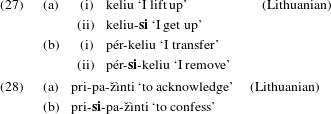
It should be clear that a constituency-based approach, while viable for Italian, will make highly unorthodox assumptions about morphological structure in such a case: in Italian, the stable core can be defined by reference to the stem and to the exponents of two general inflectional dimension (TAM and agreement), whereas, in Lithuanian, the definition of what element precedes the Wackernagel affix is a haphazard collection of items, only sharing the property to happen to surface in absolute first position, which provides very little basis for a suitable morphological constituent. As shown in Bonami & Crysmann (Reference Bonami, Crysmann and Müller2013), however, the idea of providing keys to pivotal positions for the purposes of relative placement, as we use it here for Italian, can be fruitfully extended to provide reference to other privileged positions in morphology, such as the left edge.Footnote [40] Finally, since the distribution of pivot features across mph is regulated by principle, in contrast to the language specific hierarchy rule types, establishing what is the range of universally available pivots may ultimately model why there is stem-relative placement and Wackernagel affixation, but generally no penultimate placement in morphology.Footnote [41]
5 Conclusion
In this paper, we have argued for a reappraisal of the templatic view on order in inflectional morphology. Apart from constituting a highly parsimonious representation regularly used by descriptive linguists working on morphotactically complex languages, we have proposed specifically (Section 2) that the notion of a template also enjoys a pivotal role in the development of a canonical typology of variable morphotactics: in fact, it provides an ideal against which different types of deviations can be calibrated (see Table 13 for a synopsis).
We contrasted two ways of deviation from the canon: misaligned placement, where different values of the same feature are realised in different positions, and unstable placement, where one and the same morph occurs in variable positions. Cases of unstable placement can then be subdivided into conditioned and free placement, depending on whether the alternation is triggered by some condition or is just free variation. An independent dimension of variability in systems with unstable placement is placement relative to the stem: using the notion of a stable morphotactic core around the stem, we illustrated the diversity of the organisation of non-core elements: in particular, the non-core elements may or not be ambifixal, that is, occur on both sides of the stem. When there are multiple ambifixes, these may or not be synchronised, that is, obey the same conditioning (if any). Finally, non-core elements can be stable among themselves, even when they are unstable with respect to the core. We have found that synchronised conditioned placement is (nearly) always of this latter type, preferring shifting of affix sequences over mirroring.
Summary of the morphotactic properties of inflection systems explored in this paper.
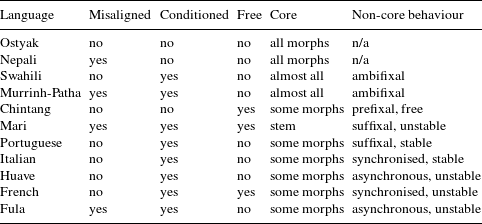
A template of linear position classes also constitutes one of the formally most simple models to describe order in morphology. However, within the generative literature this model has often been rejected owing to two reasons: the fact that it presents order as purely conventional, i.e. unmotivated (e.g. Rice Reference Rice2000), and the fact that it does not recognise more elaborate layered structures (e.g. Stump Reference Stump, Booij and van Marle1997). In Section 3, we have first discussed the literature on morph ordering that attempts to derive order from semantic scope and have argued that for most of the facts discussed in the literature, there is little if any support for a synchronically active motivation of order. Cases where actual support can be found, because variation of scope correlates with variation of order, almost always pertain to lexeme formation rather than inflection; crucially, most cases of variation of order do not correlate with extra-morphological properties. We concluded that a realistic theory of morphotactics should not take unmotivated order to be an embarrassing residue, but, quite to the contrary, assume it to represent the standard case. Second, we discussed the issue of morphological structure. Most theories of morphotactic are stem-centric: the word is build in a step-by-step fashion, starting from the stem, and adding morphs in an onion-like structure. We argued that the typology of morphotactics observed in Section 2 provides no support for such a view: deviations from strict ordering typically do not make reference to the stem. On the other hand, a slightly enriched templatic view, where morphs are not always rigidly assigned to a single position, captures the whole typology.
Finally, in Section 4 we substantiated our plea for the templatic view by detailing a formal theory of morphology that is built around a templatic backbone, which we call Information-based morphology. While this theory shares many design features of other inferential-realisational approaches, it differs in two crucial aspects. First, words are described as flat sequences of morphs, rather than recursive tree structures labeled by amorphous strings. Second, the underlying formalism is the logic of typed feature structure familiar from HPSG (Pollard & Sag Reference Pollard and Sag1994). This allows us to redeploy underspecification techniques familiar from unification-based approaches in the domain of morphotactics, most notably monotonous multiple inheritance hierarchies. We illustrated how the theory accounts for the diversity of morph ordering by outlining grammar fragments for Swahili, Chintang, Mari, and Italian. A major virtue of the theory is that it explicitly captures intuitions about the relative complexity of morphotactic systems: different violations of canonical morphotactics correspond to different deviations from a simple hierarchical organisation of realisation rules; maximally complex systems simultaneously implement different types of deviations, which are simply modelled by accumulation of constraints.Footnote [42]
To conclude, we have shown that the notion of a linear template lends itself most naturally to both typological comparison and explicit formal modelling of complex morphotactic systems. Furthermore, the parsimony of the linear description is readily preserved in the formal model we propose, rendering the empirical generalisations much more transparent compared to models invoking conspiracies of cascaded rules or ranked constraint. Finally, we have argued that the source of relative typological complexity is directly reflected in the complexity of the rule type hierarchies. Thus, we believe that the information-based approach to morphotactics and more generally, inflectional morphology will provide a suitable formal framework for field linguists and typologists alike.