Given the ubiquity of private schools in colonial societies, it is surprising that few scholars have endeavored to disentangle the intersections between nonstate schools and colonial rule—the relationships of domination imposed by a minority of invaders on an indigenous majority.Footnote 1 To date, the literatures on colonial education provide two views of private schooling and colonialism. Some suggest that private schools under colonialism resulted from the colonizers’ limited commitment to providing education, which was caused by the detached relations between the invaders and the subordinated. Colonized subjects, unlike citizens in sovereign nations, were commonly treated as alien subjects and given limited political and social rights. The ruling elites of colonial states, therefore, cared neither about winning the colonized people support nor about transforming them culturally and politically through education. In this kind of relationship, colonizers operated a small number of schools to groom a limited group of collaborators, leaving the rest of the population to be schooled privately. As a result, in many imperial outposts, the colonial state's limited involvement in education led to the proliferation and predominance of schools run by missionaries and other nongovernmental bodies.Footnote 2
In a contrasting view, other scholars suggest that private schools within colonial states have an inherently conflicting relationship with the colonizers. The colonized used nonstate academies in many colonial societies—such as the free schools in French Vietnam, wildescholen (unofficial academies) in the Dutch East Indies, sodang (premodern educational institutions) and modern private schools run by Koreans and Western missionaries in Korea under Japanese rule, and Kikuyu independent schools in British Kenya—to preserve their cultural heritage and identities, to resist the cultural hegemony imposed by the colonists, and to spread political ideologies that challenged the colonial status quo.Footnote 3 These institutions prompted confrontations and provoked suppression from the imperialists. The size and form of private schooling under colonialism therefore was a function of these conflicts.
Although the existing literatures provide valuable insights into imperialism and education, in viewing colonialism as an exclusionary form of power, we may fail to see the role of nonpublic schools in producing more complicated and subtler forms of colonial domination. Perceiving the relationship between the colonizers and their subordinated as either separate or antagonistic, these researchers treat private schooling in colonial settings as determined chiefly by the colonists’ indifference to or hostility toward the colonized. These perspectives have limited applicability in settings where the invaders, while undertaking to subordinate the colonized, also sought to integrate them as citizens of the colonizers’ nation. Under this form of colonial domination, which I call national colonialism, the projects of nation-building and colonization are symbiotically connected; domination is reproduced through inclusionary practices as well, and the ruling regime is strongly compelled to win its subjects’ identification and to remake their culture and political identities through state education. Colonizers under national forms of colonial rule, therefore, are keen to provide education to the indigenous; the metamorphoses of private schooling are unlikely to be determined by the indifference of the colonizers; and the colonizers tend to use less oppressive measures to handle schools run by nonstate entities. To explore private schooling under national colonialism, therefore, this paper will discuss the case of private junior middle schools (secondary institutions serving from seventh to ninth grades) in Taiwan from the mid-1940s through the mid-1960s.
After World War II, the Kuomintang (KMT), which retreated to Taiwan after being defeated by the Communist Party in the Chinese Civil War (1945–1949), imposed colonial rule on the island. Before Taiwan was democratized in the 1980s, the indigenous majority was dominated by this invading group, and political power was largely monopolized by waishengrens (or mainlanders, ethnic Chinese exiled to Taiwan along with the KMT around 1949). The benshengrens (Taiwanese, or islanders, the Han Chinese who had migrated to Taiwan long before 1949) were excluded from many important positions in the government and the ruling party, and the use of Hok-lo, a dialect originating in Fujian Province of China and spoken by most benshengrens, was suppressed.Footnote 4 Unlike colonialism in many other places, however, the KMT's colonial rule was a nationalistic one entwined with the regime's project of nation-building in three ways.
First, although the islanders in postwar Taiwan were politically and culturally subordinated to waishengrens, constitutionally they were citizens of the Republic of China. Including the benshengrens as Chinese nationals made it imperative for the KMT to forge a strong bond with them and to remake them into “genuine” Chinese—regardless of the animosity between the two groups resulting from different prewar historical experiences and postwar conflicts. Second, the KMT's colonial endeavors played a pivotal role in its nation-building program. Many of the regime's Chinese nationalistic campaigns—such as transforming Taiwan into a base for retaking mainland China and restoring it as one of the most prominent nations in the world—would be impossible to mount without suppressing the benshengrens both politically and culturally. Third, the KMT's colonial plan had to be buttressed by Chinese nationalism. Many vital policies privileging mainlanders at the expense of islanders were justified by such nationalistic pretexts as ensuring that the government represented the whole of China and couched as measures to advance the interests of the Chinese nation. These measures included suspending reelection of the National Assembly and the Legislative Yuan (the two paramount lawmaking bodies whose members were predominantly mainlanders elected in China in 1947), reserving a disproportionately large number of public sector positions for waishengrens, and imposing Mandarin as the official language.
Taking the second and third points together, the KMT's nation-building depended on the successful colonialization of Taiwan, which in turn hinged on the widespread and effective inculcation of Chinese nationalistic ideologies in the Taiwanese people. The need to instill state ideology, coupled with the fact that the KMT could not ignore the education demands of colonial subjects because the latter were also citizens of the Republic of China, propelled the colonizers to erect an extensive and highly centralized system of public education.
After relocating to Taiwan in 1949, therefore, the beleaguered KMT endeavored to expand the public education sector to create patriotic Chinese nationals, while suppressing private schools. However, financial necessities soon compelled the regime to allow the establishment of nonstate institutions. To ensure that private schools faithfully performed the functions of the state ideological apparatus, the KMT monitored them closely. It kept guomin jiaoyu—national education, the level of schooling especially tasked with creating patriotic and loyal citizens—as the prerogative of public schools. Thus, before 1968, when the national education covered six years of elementary education, the KMT generally banned private primary schools and permitted only a few nonstate secondary institutions. It also imposed state-mandated educational missions and curricula on private academies, preventing them from spreading ideologies that the regime deemed objectionable. Moreover, as the number of private schools increased, the nonpublic sector became increasingly controlled by state power, as a growing proportion of private institutions became maintained by the waishengren. The KMT's policies created the ironic outcome that many schools the colonizers initially sought to subdue ended up preaching state ideology under the reign of the invaders.
The following sections will first delineate the background of postwar Taiwan's private schools, explaining how the project of national colonialism limited the growth of private schools yet at the same time forced the colonizers to allow them. After this historical background, the article will proceed to explicate the regime's attempts to control private middle schools. Since the KMT's educational policies in Taiwan originated from those that had existed in mainland China before 1949, this article's historical narrative begins there.
The Education Debacle, Postwar Upheavals, and the Marginalization of Private Schools
China has a long history of private education. In the long imperial period, the central government regulated education chiefly by administering the imperial examination but left education provision to various private agents—families, clans, temples, and elites—at the local level.Footnote 5 Although the government was more active in education in the closing decades of the imperial period, around the turn of the 20th century, the state's role in running schools remained limited. The Qing regime directly sponsored only a small number of academies to produce experts in such fields as the military, engineering, and diplomacy.Footnote 6 Most schools continued to be funded and run privately, which since the mid-nineteenth century also included Western missionaries, reform-minded gentry, intellectuals, and merchants at regional and local levels.Footnote 7
After the Qing dynasty collapsed in 1912 in the wake of the Chinese Republican Revolution the prior year, the goal of nation-building spurred successive regimes to become more involved in education.Footnote 8 The movement to use schools to further the state's agenda reached a climax after the KMT defeated warlords in the north and unified China in 1928. Believing that only a highly centralized state based on the Leninist model could make China great again, Nationalist Republic of China leader Chiang Kai-shek and his associates embraced San Min Zhu Yi (the Three Principles of the People, the party's official doctrine) as the guiding principle of nation-building. The Nanjing, China-based KMT regime thus redoubled its efforts to “partify” education through such actions as planting party cells in academies, interjecting political topics in the school curriculum, and forcing principals, teachers, and students to join the party.Footnote 9 The party's goal of controlling education led to a series of ordinances and plans for building a national education system from the early to mid-1930s.Footnote 10 It also brought about the enactment of the Regulations for Private Schools (sili xuexiao guicheng) in 1928, which mandated all private schools to register with the Ministry of Education, restricted religious activities in missionary institutions, and stipulated specific rules for school management and curricula.Footnote 11
These moves notwithstanding, the KMT's grip on the school system was curtailed by its limited capabilities. First, public schools built by the regime were never sufficient to supplant private schools. During the Nanjing decade (1928–1937), 50 percent, 40 percent, and 20 percent of students in higher, secondary, and elementary education, respectively, attended private institutions.Footnote 12 Moreover, many private schools, notably those run by missionary bodies, routinely disregarded state regulations and imbued values and ideologies to which the regime objected, even after registering with the educational authorities.Footnote 13 Even worse, many “public schools” were not genuinely within the KMT's orbit. As the regime could never devote enough financial resources to education below the tertiary level, public elementary and secondary schools were generally funded and controlled by authorities at the provincial, municipal, county, or lower levels, which oftentimes were only nominally under Nanjing's authority.Footnote 14 Partly because of the regime's inability to control schools, during the Sino-Japanese War (1937–1945) and the Chinese Civil War (1945–1949) many teachers and students did not support the KMT.Footnote 15 This education failure, which Chiang Kai-Shek blamed for his downfall in China, coupled with the KMT's suspicion of the Taiwanese people, who had been ruled by the Japanese from 1895 to 1945, solidified Chiang's belief in the importance of school control to the KMT's nation-building-cum-colonialization project in Taiwan.
At the Cairo Conference in November 1943, US President Franklin Delano Roosevelt, Generalissimo Chiang Kai-Shek of the Republic of China, and British Prime Minister Winston Churchill discussed anti-Japanese policies and made decisions about postwar Asia. On December 1, 1943, the three allies jointly declared that “all the territories Japan has stolen from the Chinese, such as Manchuria, Formosa, and the Pescadores, shall be restored to the Republic of China.”Footnote 16 With Washington and London endorsing Taiwan's return to China after defeating Japan, Chiang commissioned the Taiwan Investigation Committee in 1944 to organize the island's integration into the Chinese nation after the war. Bemoaning the Taiwanese people's prolonged subjugation to Japanese imperialism, the body suggested a large-scale reeducation campaign to eradicate what it saw as the poisonous effects of Japanese colonialism and to cultivate Chinese patriotism after retaking Taiwan.Footnote 17 Nanjing hoped to remake the Taiwanese into Chinese nationals who spoke Mandarin; revered Sun Yat-sen, the first president of the Republic of China and leader of the KMT; and followed Chiang's campaign of nation-building.
The massive re-Sinicization program in Taiwan required an extensive system of public education that would be firmly under state control with minimal infringement from nonstate agents. The KMT's desire to control schools, as will be seen, intensified in the second half of the 1940s, when successive setbacks on both sides of the Taiwan Strait—the disturbances in Taiwan in early 1947, military reversals during the Chinese Civil War, and, finally, the enforced withdrawal to Taiwan after defeat by the Communists in 1949—prompted the regime to tighten colonial rule in Taiwan.
After Japan surrendered in August 1945, the KMT swiftly installed the Taiwan Provincial Administrative Executive Office (TPAEO) and imposed colonial rule on the island. It appointed mainlanders—and a small number of Taiwanese who had lived many years in China and returned to the island in 1945—to head almost all departments of the TPAEO as well as many cities, districts, and townships.Footnote 18 It posted more than a hundred cadres, predominantly mainlanders groomed by the Taiwan Administration Cadres Training Class—a program launched in 1944 in Chungking, China's wartime capital—to Taiwan for managerial positions in the public sector.Footnote 19 The TPAEO also decreed Chinese the official language of administration and education; acted fervently to promote learning of Mandarin in and outside schools; restricted the use of Japanese (a language many educated Taiwanese spoke), banning its teaching and use as a medium of instruction in schools; and continued to marginalize Hok-lo, the native tongue of most islanders. The regime's language policy rendered most benshengrens officially illiterate and disqualified them from important positions in the public sector.Footnote 20 Furthermore, the TPAEO seized a large amount of public and private wealth left by the Japanese. Most of the confiscated wealth ended up going to the KMT-controlled public sector or the powerful and well-connected waishengrens—despite the fact that many islanders perceived the wealth as products of their sweat and toil.Footnote 21
Amid these colonizing moves, the TPAEO endeavored to erect an extensive system of public education. Shortly after taking over the island, it swiftly took over all the schools left behind by the Japanese, which—except for seventeen—were all public institutions. In addition to replacing the old curriculum, promoting the teaching of Mandarin, appointing teachers from China, and retraining Taiwanese teachers, the state also expanded the education system through a program of “compelled” education (qiangpu jiaoyu)—later renamed “compulsory education” (yiwu jiaoyu).Footnote 22 In 1946, the TPAEO ordered all county (xian) and municipal (shi) administrations to survey the school-age population and to school all children aged six to twelve within their jurisdictions.Footnote 23 The next year, it mandated every village (cun) and neighborhood (li)—administrative units below the level of county and municipal--to provide at least one guomin xiaoxue (national school, or public primary school). Perhaps taking account of some localities’ limited resources, the TPAEO allowed the seventeen private institutions inherited from the Japanese period to remain and permitted new nonstate schools to open under specific conditions.Footnote 24
These relatively lenient policies, however, were reversed after disturbances in 1947 hastened the regime's colonization of Taiwan. In late February of that year, the Taiwanese people's accumulated frustrations with the KMT's misrule since retaking the island erupted into what became known as the February 28 Incident. After a week of tensions—during which armed islanders took control of the island and demanded a form of self-rule bordering on secession—reinforcements from China massacred thousands of bengshengrens.Footnote 25 Thereafter, the KMT tightened its grip on the education system. First, it closed Yanping Academy, a private higher learning institution founded by Taiwanese elites that sought to ultimately become a university.Footnote 26 It also closed the private Jianguo Junior Middle Vocational School, whose teachers and students had been actively involved in the incident and whose principal (Xie Xuehong) the KMT would later denounce as a leader of the Taiwan Communist Party.Footnote 27 In addition, the regime arrested and put to death the principals of the Tamkang and the Chang Jung middle schools, both run by the Presbyterian Church.Footnote 28 In August 1948, the Taiwan Provincial Government (TPG)—the administration that replaced the TPAEO—banned the establishment of new private schools and ordered existing ones to consolidate.Footnote 29 Less than a year later, almost all private primary schools had turned public, and most nonstate secondary institutions had applied for registration with the state.Footnote 30
After the KMT's forced evacuation to Taiwan in 1949 (which brought an influx of around a million and a half mainlanders to the island), Taiwan became the only territory under the KMT's administration.Footnote 31 With the island now the only base for reconquering the mainland, Chiang and his colleagues redoubled their efforts to consolidate colonial rule in Taiwan. Invoking the Provisional Amendments for the Period of Mobilization of the Suppression of Communist Rebellions, a special legislation, the KMT suspended the reelection of the National Assembly, Legislative Yuan, and Control Yuan—three national representative bodies whose members had been elected in China in 1947.Footnote 32 This move extended the waishengrens’ control over the highest level of government and limited the political influence of the benshengrens—despite the fact that more than 80 percent of Taiwan's population was composed of islanders, with no more than 15 percent mainlanders.Footnote 33
Moreover, Chiang and his associates took more oppressive measures against the islanders’ culture. Before evacuating to Taiwan, the KMT, though not recognizing Hok-lo as an official language, took into consideration that few people in Taiwan spoke Mandarin and allowed schools to teach Mandarin (and other subjects probably) through the medium of the dialect. In 1951, however, Mandarin was decreed as the only teaching medium in schools, and in 1956 Hok-lo was completely prohibited in schools, even for casual conversations outside of classrooms.Footnote 34
With the further entrenchment of colonial rule, Taiwan's education system became even more centralized, and its private schools further marginalized. Seeing national education—which, according to the constitution of 1947, entailed six years of compulsory primary education—as pivotal in producing healthy, patriotic, and collective-minded nationals, the state prioritized elementary education over all other levels of schooling.Footnote 35 The KMT planned to implement national education predominantly, if not exclusively, through public schools. The Central Design Committee—an influential policy-making body within the KMT—suggested that national schools, or public elementary institutions, should remain within the jurisdiction of county and municipal administrations. It proposed strict control over the growth of secondary schools, both public and private.Footnote 36 The colonizers declined to use private schools to augment their educational capacity because many of these academies were controlled by agents whom the KMT distrusted. As will be explicated more fully below, in the early 1950s, many private institutions were operated by benshengrens and the Presbyterians; the number of private academies run by agents trusted by the state remained small. As the KMT regarded nonstate institutions as politically suspect, it restricted their role in the provision of education.
This approach hindered the expansion of the private sector. Throughout the 1950s, few nonstate elementary schools existed. At the secondary level, meanwhile, the sector was also small until the middle of the decade. In 1954, when enrollment in Taiwan's 137 secondary institutions totaled 105,868, the 21 private middle schools enrolled only 11,761 students.Footnote 37 The private secondary education sector remained stagnant until the mid-1950s, when mounting demands for middle school places—caused by the KMT's six-year compulsory education policy—finally forced the regime to allow the private sector to expand, though under tight state control.
School Shortages and Expansion through Devolution
In the 1950s, controlling the growth of secondary education became increasingly unfeasible as demand escalated for school places at that level. After the state mandated six years of compulsory education, enrollment in elementary schools soared. This growth raised the number of primary school graduates from 97,979 in 1948 to 141,384 in 1953, increasing the demand for secondary education.Footnote 38 These needs, nevertheless, went largely unmet: in 1952, only about 30 percent of the 134,227 primary school graduates found places in junior middle schools.Footnote 39 That situation provoked a public outcry. The municipal councils of Taipei City and Keelung advocated expanding junior middle education.Footnote 40 Members of the Legislative Yuan—the premier law-making body—proposed enlarging the capacity of lower secondary institutions by running them bisessionally, while a number of parent organizations promoted evening sessions in middle schools. These calls for expansion were echoed by the Taiwan Province Educational Association, an organization of education workers under KMT patronage.Footnote 41
The public outcry exerted great pressure on the state, which reacted by shifting responsibility for junior secondary education to the county and municipal governments—the lowest level of governance in postwar Taiwan. After 1949, Taiwan was administered basically by a three-tier system of governance: the central government of the Republic of China, with its relocated capital in Taipei; the provincial government (the TPG); and the administrations of sixteen counties, five municipalities, and the Yangming Mountain Administrative Bureau.Footnote 42 The central government received Taiwan's major sources of state revenue, including income taxes, custom duties, and estate taxes.Footnote 43 In the 1950s, however, prior to industrialization, Taiwan's income was extremely limited. Moreover, the military threat from China consistently forced Taipei to spend 60 percent to 70 percent of its budget on defense. Hence, although Article 164 of the Republic of China's Constitution required the central administration to commit at least 15 percent of its annual budget to education, throughout the 1950s the yearly expenditure on education hovered around only 3 percent.Footnote 44 Financial constraints caused the central government to disregard the demand for secondary education: in October 1952 the Ministry of Education proclaimed that Taiwan already had too many middle schools, and reiterated the policy of freezing the growth of secondary education.Footnote 45
The provincial government—the mid-level TPG administration in Taiwan—was trapped by opposing pressures regarding secondary education.Footnote 46 The constitution compelled the TPG to commit at least 25 percent of its annual budget to education, and the Secondary Education Law required it to be the chief provider of secondary education.Footnote 47 The TPG maintained a number of provincial public schools (shengli zhongxues), all which included both junior (seventh to ninth grades) and senior (tenth through twelfth grades) divisions. But as the TPG's revenue was even more limited than the central government's—in the 1950s, it received only about 20 percent of governmental revenues on the island—the number of its schools was insufficient to meet demand.Footnote 48 In 1950, only 38 percent of junior secondary school students attended shengli zhongxues; in 1955, this increased slightly to 41 percent.Footnote 49 Because of its financial limitations, the TPG, like the central authorities, at times shrugged off its obligation to meet demand. In August 1952, two top-level provincial officers asserted that only elementary education was the government's responsibility, and disavowed the obligation to make middle schools widely available.Footnote 50
Nevertheless, the TPG, being closer to the grass roots and under more direct pressure from below, could not completely ignore the calls for more junior middle schools. It therefore resorted to a strategy of expansion through devolution, which meant shifting more of the responsibility for education to lower-level administrations. Although the Secondary Education Law required that provincial governments provide secondary-level education; and that the county and municipal authorities were allowed to run middle schools only if their jurisdictions had at least two hundred primary school graduates annually, and only if secondary education did not come at the expense of national education.Footnote 51 In 1952, the county and municipal governments maintained only sixty-eight middle schools.Footnote 52 The TPG proposed adding 332 junior secondary classes—which meant 16,600 places, based on fifty pupils per class—for the 1953–54 school year, and it entrusted counties and municipalities to provide 242 of the planned classes.Footnote 53 This approach to expansion through devolution continued in subsequent years. In April 1955, when the TPG planned to add four hundred junior middle classes for the 1955–56 school year, lower-level administrations were charged with providing three hundred of them.Footnote 54
The TPG's policy put a great deal of pressure on local governments, whose revenue sources were even more restricted and who were already bearing the heavy burden of elementary education. In the 1950s, county and municipal governments seldom received more than 20 percent of the island's total public revenue.Footnote 55 In 1953, when education consumed 34.7 percent of the county and municipal governments’ budgets, 73 percent of that went to primary schools.Footnote 56 The counties and municipalities thus found it difficult to fulfill the added responsibility of providing secondary education imposed from above.
Though the TPG's plan raised the number of junior middle school enrollments from 63,772 in 1951 to 101,005 in 1954,Footnote 57 this was still insufficient to satisfy the ever-rising demand, since the percentage of elementary education students progressing to junior secondary level in the same period rose only marginally, from 36.55 percent to 38.73 percent.Footnote 58 The shortage of middle school places was a matter of great concern to the general public. Some in the provincial assembly worried that since most primary school graduates had not yet reached the legal employment age of 14, many would become idle and go astray.Footnote 59 Furthermore, as places for junior secondary education were scarce, many middle schools screened applicants through challenging entrance examinations. To prepare pupils for these exams, many primary schools taught chiefly to the test; stopped teaching untested subjects such as physical education, art, and music; reduced time on extracurricular activities; and arranged cramming sessions for students. The public bemoaned the pressure inflicted by these difficult examinations, claiming that they damaged children's physical health and hindered the proper execution of national education, which aimed at balancing pupils’ intellectual, moral, physical, social, and aesthetic developments.Footnote 60
These pressures notwithstanding, the KMT refused to enlist the private sector in providing education. In 1951, Taiwan had about eighteen private general (academic) schools and five private vocational secondary schools.Footnote 61 The regime's major concern, however, was to control but not to support them. It closely monitored their financial situation, keeping their tuition rates moderate.Footnote 62 It assisted them only minimally—in 1952, the TPG spent merely NT$162,000 to sponsor private schools, and it forbade these institutions from expanding enrollments without prior approval.Footnote 63 It froze the size of the private secondary sector, keeping the number of institutions relatively constant (around twenty) until the mid-1950s.Footnote 64 Furthermore, nonstate schools had no place in the state's education plan. In August 1952, Chen Xueping, the provincial commissioner of education, dismissed the idea of using private institutions to expand secondary education on the grounds that a good middle school took several million Taiwanese dollars to set up, and that few private organizations could afford such an amount.Footnote 65
The KMT Compromises
In the mid-1950s, the shortage of junior middle schools continued to be a problem. In 1955, when 92 percent of the school-age population attended elementary schools, only 43 percent of these found places at secondary institutions.Footnote 66 This chronic shortage of schooling elicited louder and more frequent calls for private schools. Many provincial assembly members advocated expanding the private secondary sector through such acts as simplifying the procedures for registering schools and sponsoring them more generously with funding, land, and other means.Footnote 67 The government finally succumbed to these pressures.
In September 1954, the Ministry of Education modified the regulations for private schools, claiming that the revised rules simplified the registration procedures and lowered the financial requirements for starting schools.Footnote 68 According to the earlier rules amended in 1947, a new junior middle school with six classes had to have at least 2 million Taiwanese dollars as a start-up fund, and 200,000 Taiwanese dollars annually for each class's recurring expenditures.Footnote 69 The new 1954 regulations, in contrast, vaguely decreed that a new school only had to have “adequate funding and facilities” at its disposal before starting.Footnote 70 Amid these changes, ten private schools applied for registration with the TPG that year, all run by waishengrens, with three run by Catholic priests exiled from China.Footnote 71 That these new institutions were controlled by those from the same ethnic background as the colonizers and the regime's anticommunist allies eased the KMT's concerns and led it to further expand the private education sector in subsequent years.
In September 1955, when only 39 percent of elementary school graduates were able to find places in secondary schools, the Ministry of Education pledged to make junior secondary education available for 90 percent of primary school graduates within five years. This goal would be achieved through further devolution, as the ministry pronounced that all provincial authorities’ new secondary schools would run only senior grade classes, while counties and municipalities would focus on junior schools. As a first step to reaching the 90 percent target, the ministry directed the TPG to raise the rate of primary school graduates progressing to secondary education by 11 percent (to 50 percent) in the 1956–57 school year. Cognizant of local resource limitations, the ministry proposed reaching this 11 percent increase by obtaining 4 percent of the students from new public schools and another 7 percent from privately funded academies, and it urged the TPG to collaborate with nonstate agencies toward this goal.Footnote 72
The state authorities made several moves to encourage participation from the private sector. In September 1955, to increase school revenues, the TPG allowed private secondary schools to increase tuition rates up to NT$250 per pupil per semester.Footnote 73 Two months later, the Ministry of Education permitted counties and municipalities that had already committed at least 35 percent of their expenditures to education (as required by the constitution) to support private schools through public lands, properties, and funding certified under certain conditions.Footnote 74 In 1956, the TPG earmarked NT$1 million for awards to high-performing private secondary institutions; this amount increased to NT$2 million the following year.Footnote 75 By 1957, the number of private secondary schools had risen to thirty-seven.Footnote 76
During the second half of the 1950s, several developments caused the state to depend even more on the private sector for secondary education. First, expanded enrollments in elementary education caused by demographic changes further strained the state's coffers and rendered private secondary institutions even more indispensable. As a larger number of babies were born in the postwar years, the number of children aged six to twelve swelled from 1,227,520 in 1955 to 1,655,939 in 1958.Footnote 77 Predicting that about 300,000 children would reach school age each year, in 1957 the TPG warned that Taiwan needed at least two thousand additional elementary school classrooms annually for the next several years.Footnote 78 Moreover, in the mid-1950s the TPG shifted more responsibility for junior secondary education to local governments. Meanwhile, the provincial government began focusing its support at the senior secondary level. In 1956, the first provincial secondary institution without a junior division—the Provincial Beigang Senior Middle School in Yunlin County was inaugurated.Footnote 79 From then on, new provincial secondary schools generally ran only senior divisions, while the existing ones started phasing out their junior grades. This trend eventually resulted in the 1960 policy in which TPG ran senior middle schools, whereas counties and municipalities provided junior secondary education.Footnote 80 Taken together, these trends resulted in local administrations becoming the sole suppliers of junior secondary education regardless of the ever-increasing burden of elementary education provision.
This situation further prompted the regime to tap into resources from the private education sector. It drove the Central Design Committee (CDC)—which had hitherto disdained private schools—to go so far as to recommend outsourcing the management of a number of public middle schools to reputable private individuals or organizations. If these institutions did well after a three-year trial period, the CDC proposed, the private organizations could permanently take over the schools.Footnote 81
As the KMT's antipathy to nonstate schools diminished, it encouraged private schooling. In March 1959, the Executive Yuan allowed owners of private schools to secure public land (through renting or purchase) under certain specified conditions.Footnote 82 The new rules also allowed private individuals or groups with limited funds to build their schools in stages, over a period of three years after the institution opened.Footnote 83 About the same time, the TPG published guidelines specifying the amount of land and funding required, the number of classrooms, and the requirements for facilities for setting up middle schools. They required a minimum start-up fund of NT$300,000 for a private junior middle school and NT$500,000 for one with both lower and upper divisions—much lower requirements compared with the standards set in 1947. To channel resources to the level at which they were most needed, the guidelines recommended that new private schools should, under normal circumstances, run only junior secondary programs.Footnote 84 In subsequent years, the state authorities repeatedly urged citizens to support the nation's education development by establishing private schools.Footnote 85
While delegating to the private sector more responsibility for providing education, the regime at the same time intensified control over nonstate schools. In 1957, the TPG formed the Private School Guidance Committee to assist the Department of Education on matters pertaining to nonpublic institutions.Footnote 86 Two years later, the committee started hosting meetings with school boards throughout the island to help private schools modify their administrations, teaching, discipline, and other areas to conform with state requirements.Footnote 87 Furthermore, beginning in 1960, the TPG ordained that all private schools should incorporate, which meant registering as public foundations and then transferring ownership of school property to the corporation. This was meant to prevent school boards from misappropriating land and other properties obtained through public sources.Footnote 88
With the state's backing, the private sector grew. In 1959, of the 225 middle schools in Taiwan, 51 (23 percent) were private; in 1966, when the number of middle schools had increased to 425, the number of nonstate academies had more than doubled, to 115. Moreover, nonpublic schools became more focused on the junior grades. In 1959, 78 percent of the private middle schools had both senior and junior divisions and only 21 percent ran only the lower grades; but by 1966, 43 percent of the private secondary academies operated only the junior divisions.Footnote 89 With these changes, enrollments in private middle school junior grades more than quadrupled, from 17,532 to 77,340 between 1959 and 1966, an increase of 9.8 percent to 17 percent of total enrollments at that level—a remarkable growth given the massive expansion of the public junior secondary sector from 159,853 to 376,170 in the same period.Footnote 90
Private Schools Kept Subordinated
Although private schools were allowed to expand after the mid-1950s, the KMT regime made them subordinate institutions that posed no threat to public schools or the regime. Firstly, the KMT gave private institutions minimal, if any, latitude for pedagogic innovation. Its statute dictated that their pedagogic activities must follow the regulations set by the Ministry of Education, which meant adhering to the official educational mission and curriculum and using only government-sanctioned textbooks.Footnote 91 Secondly, the state capped the amount of income private academies could garner. It continued to regulate their tuition rates, making their fees substantially higher than public schools but not sufficient to make their quality of education comparable to state schools.Footnote 92 It provided them only nominal financial subsidies. As late as 1974, the government granted only NT$4 million in total to fifty-six private schools, with each beneficiary institutions receiving, on average, only about NT$70,000.Footnote 93 Moreover, the authorities had no regard for the welfare of private school employees. Throughout the 1960s, they routinely rejected petitions for benefits equal to those of public school teachers, including pension, insurance, medical allowance, and subsidies for their children's education.Footnote 94 As such, private schools had almost no room to experiment with alternative pedagogic approaches or to improve the quality of their services, and they struggled to retain their best teachers, despite charging students substantially more than public schools.
Because of these state policies, private schools were in no position to challenge the supremacy of public schools and, consequently, they were relegated to an unappealing position within the education system. Moreover, as the educational goals, curricula, and pedagogies of nonpublic schools were generally identical to those of public institutions, they could hardly spread ideologies and create cultural or political identities opposing the state.
Moreover, the autonomy of such schools substantially dwindled as their role in providing education expanded. In the late 1940s, Taiwan's nonstate education sector was still largely autonomous, and many private institutions were operated by those with no connection to the government. After 1954, however, organizations and people tied to the KMT colonizers assumed leadership positions in the expanded private education sector. The details of this phenomenon appear in data from boards of trustees from two samples of private middle schools in different periods—one from ten institutions operating in the late 1940s and another from forty-six schools founded between 1954 and 1965. Data for the first sample is taken from Guancang Minguo Taiwan Dangan Huibian [A Compiled Collection of Archives of Taiwan during the Nationalist Era]—a 300-volume compilation of select official documents of the KMT relating to Taiwan from circa 1944 through 1950, housed at the Second Historical Archives of China in Nanjing.Footnote 95 Data for the second sample come from declassified files from the archives of the TPG's Department of Education in Wufeng, Taichung, Taiwan. The data on the boards of trustees were attached to the schools’ applications for registration with the state education authorities.Footnote 96 Both datasets contain background information on the schools as well as information on the educational backgrounds, nationalities, ethnicities, occupations, and brief biographies of their overseers. This material provides valuable insights into the shifting relations between the state and the private education sector in the two post-WWII decades.
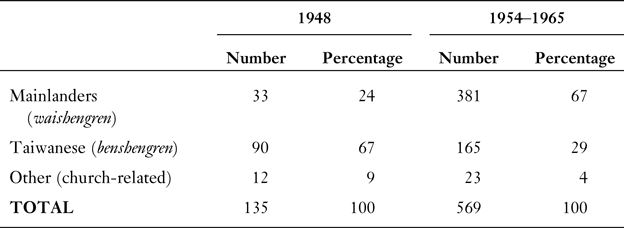
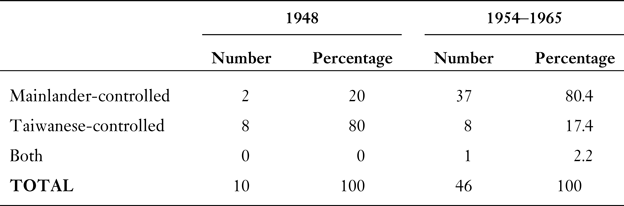
Let's begin by looking at the ethnic backgrounds of the school trustees. The data in tables 1 and 2 suggest that in the mid-1950s, colonizers from China (waishengren) took over the private education sector from the Taiwanese (benshengren). In the late 1940s, as table 1 shows, most trustees of private schools were Taiwanese (ninety out of 135, or 67 percent); while only thirty-three (24 percent) were mainlanders; and twelve were foreigners (9 percent), all priests or teachers of schools run by Christian or Catholic churches. As table 2 reveals, in the earlier period most (80 percent) of private institutions were controlled by Taiwanese, with only two of the 10 schools under mainlanders.Footnote 97 This situation, however, was later reversed. Among the 569 trustees in the sample of schools established between 1954 and 1965, 381 (67 percent) were waishengren; and benshengren—numbering 165 (29 percent)—became the minority. Moreover, in this later period, most of the schools (80 percent) were controlled by waishengren (table 2).
Ethnic Backgrounds of Private Middle School Trustees

Ethnic Backgrounds of Private Middle School Leadership

Sources: Chen Yunlin, ed., Guancang Minguo Taiwan Dangan Huibian [A Compiled Collection of Archives of Taiwan during the Nationalist Era]; and the Department of Education, Taiwan Provincial Government National Archive, Taiwan City, Taiwan.
The dominance of mainlanders in private education—a trend that pleased the KMT—can be attributed to several factors. The first is cultural legacy. In traditional Chinese society, the wealthy and educated were expected to assume the main roles in providing schooling. This traditional model of elite education provider may in part explain the active role that waishengrens played in private schools in postwar Taiwan. Moreover, because of the different sociopolitical conditions in mainland China and Taiwan in the first half of the twentieth century, mainlander elites were probably able to preserve their legacy as education providers better than their islander counterparts. As the Chinese state's capacity to provide education continued to be inadequate after the Republican Revolution of 1911, social elites remained as education providers. During that same period, however, Taiwan had been ruled by the Japanese; thus Han Chinese had fewer opportunities to run schools, both because the colonial state had built a fairly extensive system of public education and because the colonizers curtailed Taiwanese involvement in education provision.Footnote 98
Secondly, mainlander enthusiasm for founding schools was fueled by their desire to duplicate the academies they had established, run, taught in, and attended on the mainland. Information from newspapers, school publications, and other sources reveals that in the mid-1960s, when Taiwan had about a hundred private middle schools, no fewer than twenty-two claimed lineage to a mother institution in China dating from before 1949. Thirdly, the number of Taiwanese-maintained schools stagnated, possibly because events such as the February 28 Incident, the closing of Yanping Academy, and the repression that followed dimmed benshengren enthusiasm for providing education.
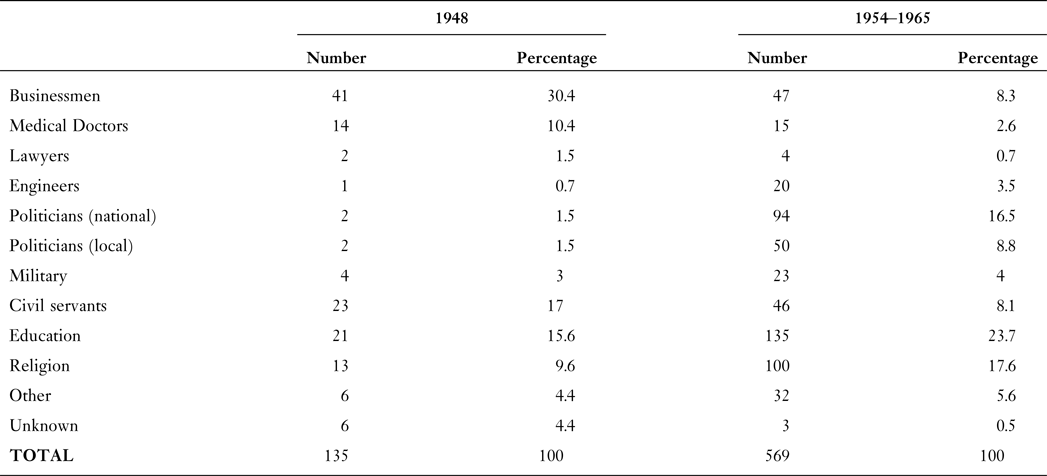
The private education sector also lost a great deal of autonomy beginning in the mid-1950s. Table 3 shows that among the 135 trustees in the late 1940s, 30 percent were businessmen, 10 percent were medical doctors, and 1.5 percent were lawyers—all benshengren; most of them ran their own businesses, clinics, or law firms. Many private school overseers at the time had the material resources to maintain a certain degree of independence from the state. Moreover, the state's ability to influence nonstate education was still limited. Only four school overseers were politicians and another four were military officers. Furthermore, such political influence was “quarantined,” as all eight political and military trustees served at one school—Jinou Girls’ School, an academy run by prominent waishengren from China's Hubei Province.Footnote 99
Professional Backgrounds of Private Middle School Trustees

Sources: Chen Yunlin, ed., Guancang Minguo Taiwan Dangan Huibian [A Compiled Collection of Archives of Taiwan during the Nationalist Era], vol. 256, 314–16; and assorted Department of Education, Taiwan Provincial Government (DETPG) files.
After the mid-1950s, however, the private sector's autonomy declined: among the 569 trustees, the percentage of businessmen had dwindled to 8.3 percent and physicians to 2.6 percent. Moreover, professionals serving as trustees in the 1950s and 1960s were more dependent upon the state. For instance, the number of engineers rose considerably, from almost none in the late 1950s to twenty in the later period. Unlike their mostly self-employed medical and legal predecessors, however, many engineers were employed by state-owned or state-directed enterprises (such as the Taiwan Sugar Corporation and the China Mechanical Incorporation). Furthermore, state elites came to have far more influence on private schools, as among the trustees in the later stage, 16.5 percent were national politicians;Footnote 100 8.8 percent, local politicians,Footnote 101 4 percent, military elites; and 8.1 percent, civil servants making up more than 25 percent of trustees. With so many overseers coming from or connected to the state, the private sector became more subject to KMT influence.
Furthermore, private schools also became governed by religious forces friendly to the regime. Previously, Christian denominations separate from the regime had a solid presence in the nonstate education sector. An inventory from Zhonghuaminguo Nianjian (Yearbook of the Republic of China) shows that in 1951, four of the nineteen private secondary institutions on the island were run by the Presbyterian Church, which the KMT distrusted because of its long association with, and strong sympathy for, islanders.Footnote 102 Among the sample of schools opened between 1954 and 1965, however, eleven out of forty-six were founded by the Catholic Church, and only one by a Protestant denomination (Concordia Lutheran Church in Missouri). The KMT welcomed this development because Catholic schools were under the jurisdiction of the Vatican, which had had diplomatic relations with the Republic of China since 1942 and was anticommunist.
Additionally, many Catholic priests in Taiwan after 1949 were exiles from China. The prosecution they had suffered there, coupled with the fact that almost all Catholic schools were mainlander-controlled, predisposed them to side with the KMT.Footnote 103 Catholic schools were also politically more reliable because their trustees included prominent pro-KMT Catholic figures such as Archbishop Paul Yupin, previously the Vicar Apostolic of Nanjing, who had been declared a war criminal by Beijing; and Stanislaus Lo Kuang, the Republic of China's embassy's religious advisor to the Holy See. As the private education sector had been usurped by the colonizers and influenced by progovernment forces, the ideology most nonstate institutions taught was probably as pro-KMT and China-centered as that of public schools.
Recapitulations and Implications
Although nonstate schools exist widely in many imperial outposts, literature focused on the role of private schools in reproducing colonial rule is surprisingly thin. So far, two views of private schooling and colonialism can be extracted from scholarship in colonial education. Scholars treating colonialism as a detached form of domination tend to portray the emergence and proliferation of nonstate schools in many colonial settings as caused by the colonial state's indifference to providing education facilities to the colonized, whom they regarded as alien subjects. Other researchers, seeing colonialism as inherently antagonistic form of power relationship, portray changes in private schooling in colonial societies as driven by struggles between the imperialists and their subjects. These insights, though useful, are generated from research that treats colonial domination as operating chiefly through exclusionary practices stemming from the colonizers’ apathy or hostility to the colonized. These ideas may not be applicable to settings where the colonizers, while seeking to keep the colonized subordinated, also undertook to win their subjects’ loyalty as citizens in a nationalist project; and where colonial power functioned also through inclusionary means. I have illustrated this point through the case of Taiwan's private junior middle schools in the two postwar decades.
After World War II, colonial rule was imposed in Taiwan. Colonialism there, however, was intertwined with the regime's project of nation-building, which was vastly different from that in many other places. Under the KMT, the colonized islanders were also considered citizens of the Republic of China, and the regime's campaign for regaining the Chinese nation was possible only if the benshengrens were suboordinated to the project through the indoctrination Chinese nationalism. Both because the islanders were also citizens of the Chinese nationals, whose demands for schooling opportunities could not be ignored, and because of the KMT's massive investment in Chinese nationalistic ideologies, the KMT was spurred to build an extensive system of public schools. The state's active approach in making public schools widely available restricted the space for private schools, limiting their number within the education system.
The education goals under national colonialism also unleashed ramifications that stimulated the KMT colonizers to control the private education sector through an approach much subtler than direct suppression. As massive educational demands emanating from nation-building and colonization forced the regime to develop an expansive system of public schools, state education resources were stretched to the limit. Nonpublic schools thus became valuable resources that the impoverished regime could tap to augment its capacity for education provision. The KMT authorities, thus, gave the green light to a modest expansion of the private sector, allowing more nonstate schools, mostly run by mainlanders or agents beholden to the state, to be established. The state also decreed that these institutions adopt official educational missions and curriculum and adhere to state regulations on matters such as tuition rates, personnel, and management. Because of these polices, the private education sector augmented the state's capacity to provide education, preach state ideologies, and consolidate the colonial regime's position.
This case of Taiwan can generate concepts and hypotheses for future research on private schooling and colonialism—an important yet underresearched topic in education history. The dissimilarities between Taiwan's private junior middle schools and what the literature reveals about nonstate institutions under colonialism suggest that colonial rule can perhaps be differentiated conceptually into two major categories—the national and the nonnational. These two forms of domination differ because colonial subjects under national colonialism are also recognized as citizens of the colonizers’ nation, while subjects under the nonnational form are not. When the colonial rule is a nonnational one, domination is reproduced chiefly through exclusionary measures; the relations between the invaders and the indigenous people are separate and at times antagonistic, with the former largely unresponsive to the latter's education demands. Private schools, thus, may have two fates under this form of colonial power: they may proliferate, both because schooling facilities provided by the state are insufficient to meet popular demand and because the colonizers leave the education of the masses to private institutions. They may also face state suppression when the colonizers deem them a threat to the colonial status quo.
National colonialism, however, is a power relation built upon a more balanced mixture of exclusionary and inclusionary practices. Under this form of domination, the goals of nation-building and colonialization are symbiotically connected, and the success of this hegemonic project depends heavily on widespread indoctrination in state nationalistic ideology. Private schools under national colonialism are unlikely to have the freedom to proliferate or the chance to become numerically predominant, both because of the massive expansion of public schools and the state's intense desire for school control. Only when the colonizers need them as extra resources for providing education can the nonstate education sector expand modestly on the condition that the schools substantially compromise freedom in educational mission, pedagogy, and administration and accept extensive intrusion of state power into their management.