INTRODUCTION
Many trophically-transmitted parasites manipulate the phenotype of their intermediate hosts (behaviour, appearance) in ways that appear to increase the probability of the current host being eaten by the next host (reviewed by Moore, Reference Moore2002; Thomas et al. Reference Thomas, Adamo and Moore2005; Lefèvre et al. Reference Lefèvre, Adamo, Biron, Missé, Hughes and Thomas2009; Cézilly et al. Reference Cézilly, Thomas, Médoc and Perrot-Minnot2010; Poulin, Reference Poulin2010). Conspicuous changes in host phenotype frequently arise as parasites become infective to the next host (Bethel and Holmes, Reference Bethel and Holmes1974; Brattey, Reference Brattey1983; Helluy, Reference Helluy1983; Hurd and Fogo, Reference Hurd and Fogo1991; Poulin et al. Reference Poulin, Curtis and Rau1992; Levri and Lively, Reference Levri and Lively1996; Pulkkinen et al. Reference Pulkkinen, Pasternak, Hasu and Valtonen2000; Barber et al. Reference Barber, Walker and Svensson2004; Seppälä et al. Reference Seppälä, Karvonen and Valtonen2005; Franceschi et al. Reference Franceschi, Bauer, Bollache and Rigaud2008), strongly suggesting that the changes serve to increase parasite transmission to the next host. In those studies, host phenotypes were largely unaltered until the parasite was infective. However, a handful of studies have found intermediate hosts harbouring uninfective parasites to exhibit stronger anti-predator behaviours than uninfected controls (Tierney et al. Reference Tierney, Huntingford and Crompton1993; Hammerschmidt et al. Reference Hammerschmidt, Koch, Milinski, Chubb and Parker2009; Dianne et al. Reference Dianne, Perrot-Minnot, Bauer, Gaillard, Léger and Rigaud2011). Parker et al. (Reference Parker, Ball, Chubb, Hammerschmidt and Milinski2009) modelled the evolution of host manipulation and suggested that manipulation should reduce intermediate host mortality when parasites are uninfective (called predation suppression) and increase predation, particularly by suitable next hosts, when parasites are infective (called predation enhancement). Whereas a fair number of studies have established that parasites are able to enhance predation once infective (e.g. see Table 1 in Cézilly et al. Reference Cézilly, Thomas, Médoc and Perrot-Minnot2010), just one has shown that uninfective parasites suppress the predation risk of their intermediate hosts (Dianne et al. Reference Dianne, Perrot-Minnot, Bauer, Gaillard, Léger and Rigaud2011). Note that altered intermediate host behaviour may also serve to avoid consumption by predators that are unsuitable as next hosts (Levri, Reference Levri1998; Médoc et al. Reference Médoc, Bollache and Beisel2006; Médoc and Beisel, Reference Médoc and Beisel2008). While this is a kind of predation suppression, its adaptive value is not dependent on parasite ontogeny. Parasites should suppress predation by unsuitable hosts regardless of their ontogenetic stage, assuming it does not affect predation rates by target hosts (Mouritsen and Poulin, Reference Mouritsen and Poulin2003; Seppälä and Jokela, Reference Seppälä and Jokela2008; Seppälä et al. Reference Seppälä, Valtonen and Benesh2008; Parker et al. Reference Parker, Ball, Chubb, Hammerschmidt and Milinski2009). Here, we focus on predation suppression by parasites that are uninfective to the next host.
Summary of the differences between the five prey choice experiments

* NST, Neustadt, Germany; GPS, Großer Plöner See, Germany; SEV, Skogseidvatnet, Norway.
With 2 parasite species (the tapeworm Schistocephalus solidus and the nematode Camallanus lacustris), we tested the hypothesis that parasites are able to suppress the predation susceptibility of their intermediate hosts while uninfective. Both parasites infect copepods as first host before being trophically-transmitted to fish second hosts (Moravec, Reference Moravec1969; Dubinina, Reference Dubinina1980). In both species, copepods ingest free-living parasite larvae, and the parasites invade the copepod haemocoel where they undergo about 2 weeks of growth and development before reaching infectivity. Copepods harbouring immature, uninfective larvae of S. solidus have lower activity and extended recovery times after a simulated predator attack (Hammerschmidt et al. Reference Hammerschmidt, Koch, Milinski, Chubb and Parker2009; Benesh, Reference Benesh2010b). Whether these changes actually reduce susceptibility to predators has not been tested. We assessed whether copepods harbouring uninfective larvae of these parasites have reduced susceptibility to predation by three-spined sticklebacks (Gasterosteus aculeatus). In the case of S. solidus, sticklebacks are the obligate second intermediate host, whereas for C. lacustris they are a suitable paratenic host. Sticklebacks consume large quantities of copepods (Hynes, Reference Hynes1950), so fish predation on the intermediate host is likely to be an important source of mortality for parasites while uninfective. These 2 parasites have independently evolved similar life cycles, and assuming they suffer similar mortality rates due to predation as uninfective larvae, we expect them to have evolved similar levels of predation suppression (i.e. convergent manipulation strategies; Poulin, Reference Poulin1995; Ponton et al. Reference Ponton, Lefevre, Lebarbenchon, Thomas, Loxdale, Marché, Renault, Perrot-Minnot and Biron2006; Benesh et al. Reference Benesh, Chubb and Parker2011).
In addition to our foremost aim of testing the predation suppression hypothesis, we also evaluated whether the rate of larval parasite growth affects predation susceptibility. Fast larval growth is thought to reduce host (and parasite) survival, but there is relatively little evidence for this in trophically-transmitted parasites (Benesh, Reference Benesh2011). Parasites that grow rapidly might not increase host mortality directly but indirectly via predation susceptibility. For example, the elevated energetic demands of a fast-growing parasite may force a host to engage in risky foraging behaviours (but see Franz and Kurtz, Reference Franz and Kurtz2002; Benesh, Reference Benesh2010b). We manipulated levels of parasite growth in copepods by using sibships that had different growth rates in previous experiments (Hammerschmidt and Kurtz, Reference Hammerschmidt and Kurtz2005; Benesh, Reference Benesh2010a,Reference Beneshb) and by infecting copepods with either 1 or 2 parasite larvae. The accumulation of parasite biovolume is higher in double-infected copepods than in single-infected copepods for both S. solidus (Michaud et al. Reference Michaud, Milinski, Parker and Chubb2006) and C. lacustris (Benesh, Reference Benesh2011).
MATERIALS AND METHODS
We performed 5 experiments to test the predation suppression hypothesis. Experiments I–IV involved the tapeworm S. solidus, whereas Experiment V involved the nematode C. lacustris. The experiments differed in a number of details (fish training regime, densities of infected and uninfected copepods, feeding times, copepod population, experimental setups) (Table 1), but they all tested the same hypothesis.
General experimental protocol: copepod infection and maintenance
Freshwater copepods (Macrocyclops albidus) from our laboratory culture (Van der Veen and Kurtz, Reference Van der Veen and Kurtz2002) were infected with recently hatched coracidia of full-sib clutches of S. solidus. All S. solidus eggs used in the experiment were produced by in vitro breeding of worm pairs taken from wild caught three-spined sticklebacks from the lake Skogseidvatnet (SEV, 60°14′N 5°55′E), Norway. Copepods were kept singly in 24-well plates and were exposed to 1 or 2 coracidia each. For Experiment V, gravid C. lacustris females were collected from the intestines of perch (Perca fluviatilis), which originated from the lake Großer Plöner See (GPS, 54°09′N 10°25′E). L1 larvae were dissected out of more than 10 females and mixed thoroughly. Copepods were individually exposed to either 1 or 2 L1 larvae from this infection mixture.
Only adult male copepods were used in the experiments to reduce host size variation and have standardized conditions for the parasites. Copepods were held at 18 °C and a 16:8 h light:dark cycle where they were fed with 3–5 Artemia salina nauplii 3 times a week. On day 7 post-infection (p.i.), copepods were checked for infection.
General protocol: fish acclimatization
All 190 fish used in the experiments were laboratory bred, and before the experiments they were maintained in groups in tanks at 18 °C and a 16:8 h light:dark cycle. Three days before the experiments, sticklebacks were isolated in individual tanks (except for Experiment I) and acclimated to being transferred by a glass pipe to an experimental tank and to eating live food instead of frozen chironomid larvae. Sticklebacks are calmer and feed more naturally when they are accustomed to the experimental procedures.
General protocol: feeding trials
All experiments took place on day 8 p.i. when worm larvae were still uninfective to fish (Clarke, Reference Clarke1954; Moravec, Reference Moravec1969), yet large enough to be detected easily in copepods. Infected and uninfected copepods were added to the experimental tank and individual fish were given time to eat half of them. After each trial was stopped, fish were transferred back to their home tanks and the water was sieved through a 0·18 mm mesh filter to obtain the surviving copepods. These were counted and checked for infection. Dead copepods were recovered in 8 trials (4·2%). Given the brevity of the trials, we assume that these copepods died due to being attacked by the fish. For data analyses they were considered as eaten, because the end result for the parasite (death) is the same if the host copepod is eaten or just killed by the fish.
Experimental protocol specific to the 5 experiments
The experiments differed in several details described below and summarized in Table 1, but a main difference was that in Experiment I fish were given a set time to eat copepods, which led to larger variation in the number of copepods consumed. In Experiments II-V, fish were observed during feeding and trials were stopped when fish had eaten half of the copepods.
Experiment I
For 7 days, fish were trained before the experiment. Forty fish from 2 different stickleback families originating from a brackish lagoon in Neustadt, Germany (NST, 54°06′N 10°48′E) were randomly distributed in 4 tanks with 10 fish each. Fish size ranged from 2·5 to 3·5 cm. For training, every fish was individually transferred with a glass pipe into tanks (height 15 cm, width 25 cm, depth 15·3 cm) containing 3 L of water and 30 (uninfected) copepods. They were allowed to feed on the copepods for 30 min. As fish became more proficient at feeding on copepods, the feeding time was reduced day by day to 15 min on the final training day before the experiment.
In the experimental trials, 10 infected and 20 uninfected copepods were released in a tank (H 15 cm, W 25 cm, D 15·3 cm) filled with 3 L of water. The copepods had more than 5 min to acclimatize and disperse. The fish were introduced into the tank and allowed to feed on the copepods for 5 min before each fish was removed to its home tank. Preliminary experiments indicated this was the average time needed for fish to consume half of the copepods.
Experiments II–V
The fish used in Experiments II and III originated from NST, whereas in Experiments IV and V they came from the lake GPS. The experimental fish were 2 to 2·5 cm long, a size at which fish prefer to feed on copepods (Christen and Milinski, Reference Christen and Milinski2005). Starting 3 days before the experiments, fish were housed singly in tanks similar to the experimental tank. For training, they were gently caught with a glass pipe, transported to the experimental tank, stayed there for a few sec in the pipe over the experimental tank and were carried back to their home tanks. In the meantime, the home tanks were filled with copepods, Daphnia sp. and Artemia salina to accustom them to feeding on live food after being transported.
The experimental tank and the home tanks (H 11·5 cm, W 18·2 cm, D 12 cm) were coated with black, non-reflecting paper and acrylic glass sanded from inside to avoid mirror effects and the resulting distraction of the fish. In Experiment IV and V, a fine-grained sandy bottom was installed to give the copepods more opportunities to hide. For the experiment, the tank contained 1·3 L of water. A camera (Panasonic Super DYNAMIC WV BP550) hung above the experimental tank for observing and recording the fish without disturbing them. Two 11 W bulbs provided light conditions similar to that in the fishes' home tanks. Around the construction was a black curtain to exclude light reflections and other disturbances.
Nine infected and 9 uninfected copepods were added to the experimental tank and allowed to disperse for 5 min before a fish was added. In Experiments IV and V, for a given trial all infected copepods were either single- or double-infected. Each fish was observed via video with the goal to interrupt foraging after half (i.e. 9) of the copepods were eaten. We could observe attacks by sticklebacks on copepods, but we could not tell whether the attacks were successful. Preliminary experiments suggested that they usually were, so we stopped the trials after observing 10–12 attacks or after 45 min if fish did not attack enough copepods.
Data analyses
We summarized the number of infected and uninfected copepods eaten by a fish with a preference index, Manly's α (Manly, Reference Manly1974). Manly's α accounts for different initial densities of prey types and it is rather robust to the changes in prey densities that occur during feeding experiments. Manly's α ranges between 0 and 1. Values below 0·5 indicate that fish ate more uninfected copepods and those above 0·5 indicate that fish ate more infected copepods.
We first examined 2 possible within-experiment sources of variation in α: differences between S. solidus full-sib families (Experiments I–IV) and trials with singly versus doubly infected copepods (Experiments IV and V). Full-sib S. solidus families differ in their growth in copepods (Hammerschmidt and Kurtz, Reference Hammerschmidt and Kurtz2005; Benesh, Reference Benesh2010a,Reference Beneshb), whereas copepods with 2 S. solidus or C. lacustris harbour more parasite biovolume than those singly-infected (Michaud et al. Reference Michaud, Milinski, Parker and Chubb2006; Benesh, Reference Benesh2011). Thus, an effect of these factors on Manly's α could indicate that different levels of parasite growth affect predation susceptibility. For each experiment, an ANOVA was performed with worm family as a factor. T-tests compared Manly's α between trials with singly-versus doubly-infected copepods.
After determining that these factors did not significantly influence α (see Results section), we performed an ANOVA with experiment as the only factor. For both S. solidus and C. lacustris, the overall mean for Manly's α was compared to the null hypothesis value of 0·5 (i.e. no preference) with a one-way t-test.
One of the S. solidus experiments was a conspicuous outlier (see Results section). We examined 2 variables related to fish behaviour (the feeding rate of each individual fish and the proportion of failed trials in each experiment) to see if they hint at why this experiment was different.
The statistical analyses were performed using PASW Statistics 18 (SPSS Inc., Chicago, Illinois, USA).
RESULTS
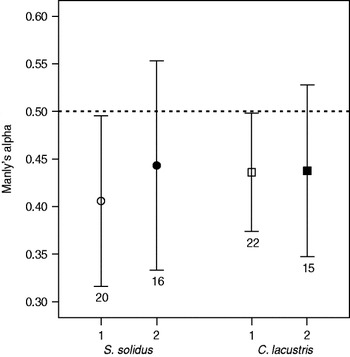
Within experiments, fish preference for infected or uninfected copepods did not differ significantly between worm families (ANOVAs, all F < 1·54, all P > 0·231). We also did not detect any significant differences between trials with copepods infected with a single worm larva and trials with copepods infected with 2 worm larvae (t-tests, Exp. IV with S. solidus: t 34 = − 0·562, P = 0·578; Exp. V with C. lacustris: t 35 = − 0·034, P = 0·973) (Fig. 1).
Mean Manly's α for trials with either singly- (open symbols) or doubly-infected (filled symbols) copepods. Values below 0·5 indicate that relatively more uninfected copepods were eaten, values above 0·5 indicate more infected copepods were eaten. Data for Schistocephalus solidus (circles) were from Experiment IV whereas data for Camallanus lacustris (squares) were from Experiment V. Error bars represent 95% confidence intervals and the numbers below the bars show the numbers of trials in each group.

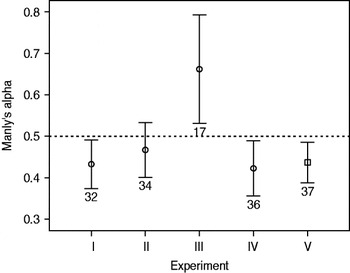
We pooled the data from Experiments I–IV with S. solidus and found that, on average, fish did not prefer uninfected over infected copepods (Manly's α = 0·472, one-way t-test, t 118 = − 1·462, P = 0·146). However, an ANOVA indicated significant differences between experiments (F3, 115 = 6·57, P < 0·001) (Fig. 2). LSD post-hoc tests revealed that Experiments I, II and IV did not differ from each other (all P > 0·342), but they all differed from Experiment III (all P ⩽ 0·001). Fish in this experiment ate more infected copepods (α >0·5), whereas in the other 3 experiments fish ate more uninfected copepods (α <0·5). When taking out this experiment, sticklebacks ate significantly more uninfected copepods (Manly's α = 0·440, one-way t-test, t 101 = − 3·286, P = 0·001). In Experiment V, uninfected copepods were eaten more frequently than copepods infected with C. lacustris (one-way t-test, t 36 = − 2·613, P=0·013), and interestingly the mean α value (0·437) was very similar to that from the experiments with S. solidus (Fig. 2).
Mean Manly's α for each experiment. Values below 0·5 indicate that relatively more uninfected copepods were eaten, values above 0·5 indicate that more infected copepods were eaten. Experiments I–IV (circles) were conducted with Schistocephalus solidus and Experiment V (square symbol) was conducted with Camallanus lacustris. Error bars represent 95% confidence intervals and the numbers below the bars show the number of trials in each experiment.

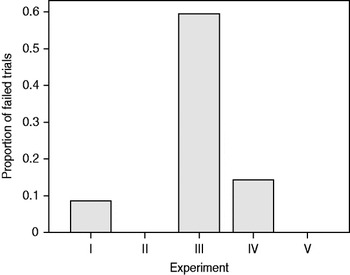
In total, 34 out of 190 total trials had to be thrown out because fish ate too few copepods (less than 3) to assess preference, and most of these were in Experiment III. Here, nearly 60% of the attempted trials had to be discarded because fish did not consume enough copepods, whereas less than 15% of the trials in the other experiments failed (Fig. 3). Moreover, in the trials that did not fail in Experiment III, the fish fed at a slower rate on average (0·76 copepods per min) than those in the other experiments (1·8 to 3·8 copepods per min). These observations suggest that the fish in Experiment III were not motivated to feed compared to the other experiments.
The proportion of trials that were discarded for each experiment. Trials were discarded when fish ate too few copepods to assess susceptibility differences between uninfected and infected copepods. In Experiments II and V all fish could be used.

DISCUSSION
Parasites with complex life cycles manipulate their intermediate hosts to enhance predation when they are infective to their next host (Moore, Reference Moore2002; Thomas et al. Reference Thomas, Adamo and Moore2005; Cézilly et al. Reference Cézilly, Thomas, Médoc and Perrot-Minnot2010), but they may also prevent predation when they are uninfective to the next host (Hammerschmidt et al. Reference Hammerschmidt, Koch, Milinski, Chubb and Parker2009; Dianne et al. Reference Dianne, Perrot-Minnot, Bauer, Gaillard, Léger and Rigaud2011). Our experiments showed that copepods infected with still-developing, uninfective larvae of either S. solidus or C. lacustris generally have lower susceptibility to predation by sticklebacks than uninfected copepods. These two parasites showed very similar levels of predation suppression, and given that they have independently evolved a similar life cycle (i.e. copepod to fish, with sticklebacks as suitable second hosts), this is suggestive of convergence to a shared, optimum level of suppression. The phenomenon of predation suppression by parasites has not received nearly as much attention as enhancement (Médoc and Beisel, Reference Médoc and Beisel2011). Thus, these are some of the first results supporting the hypothesis of adaptive predation suppression by larval parasites.
It must be noted, though, that in 1 of our Experiments (III) sticklebacks consumed more infected than uninfected copepods, opposite to our predictions. Fish in this experiment fed at a much slower pace than fish in the other 4 experiments, and 25 out of 42 fish were excluded from the dataset because they hardly consumed any copepods. A low feeding motivation, by itself, is unlikely to explain the switched prey preference in Experiment III. Within experiments there were no significant correlations between feeding rate and α (not shown), i.e. infected copepods are not necessarily eaten more frequently by slow-feeding fish. Reluctance to forage can occur when sticklebacks are anxious, such as under a perceived threat of predation (Milinski, Reference Milinski1984, Reference Milinski and Pitcher1986). If the fish in Experiment III fed less because they were anxious, they may have avoided making themselves more conspicuous by pursuing the more active uninfected copepods and instead focused on nearby, less active infected copepods. More work will be needed to understand the relationship between predator foraging behaviour and the effectiveness of predation suppression. Nonetheless, the mean α values were quite similar in 4 of 5 experiments, suggesting that the reduced predation susceptibility of infected copepods was relatively robust to changing experimental setups.
Compared to predation enhancement studies, where the predation susceptibility of infected animals increases up to 52 percentage points (see Cézilly et al. Reference Cézilly, Thomas, Médoc and Perrot-Minnot2010), our experiments suggested more modest changes in the susceptibility of infected copepods. For Experiments I, II, and IV, in total 44·6% of the available S. solidus-infected copepods were consumed versus 53·4% of the uninfected copepods. The analogous numbers for C. lacustris were 46·7% and 55·7%. Dianne et al. (Reference Dianne, Perrot-Minnot, Bauer, Gaillard, Léger and Rigaud2011) found predation suppression to be weaker than enhancement in an acanthocephalan, and Poulin et al. (Reference Poulin, Curtis and Rau1992) found enhancement but not suppression by a cestode in its copepod host. Because hosts tend to avoid predators even when uninfected, host and parasite interests are aligned with regard to predation suppression, and it may be difficult or costly for a parasite to suppress predation risk even further than the host does on its own. By contrast, any reduction in predator avoidance behaviours by parasites may be sufficient to substantially enhance the probability of host predation. At this point, though, there are too few studies to judge whether predation suppression by parasites is generally less effective than enhancement.
Hammerschmidt et al. (Reference Hammerschmidt, Koch, Milinski, Chubb and Parker2009) showed that the activity of S. solidus-infected copepods changes over time. When the parasite is not yet infective, it reduces copepod activity and extends copepod recovery time after a mimicked predator attack. The opposite behaviours are observed once the parasite is infective (but see also Benesh, Reference Benesh2010b). Sticklebacks and other planktivorous fish are visual predators that react to movement, so copepod activity is important for predation susceptibility. Accordingly, Wedekind and Milinski (Reference Wedekind and Milinski1996) showed that copepods with infective S. solidus procercoids were consumed more often than uninfected controls. Our study complements theirs by showing that copepods with uninfective S. solidus procercoids have lower predation susceptibility, presumably because they are less active and less conspicuous to fish, suggesting that S. solidus-induced changes in copepod behaviour represent parasite adaptations rather than non-adaptive by-products of infection (Poulin, Reference Poulin1995; Parker et al. Reference Parker, Ball, Chubb, Hammerschmidt and Milinski2009). It is unknown whether the predation suppression achieved by C. lacustris is due to similar changes in copepod behaviour, because behavioural changes in C. lacustris-infected copepods have not been studied. Although visually-hunting, planktivorous fish like sticklebacks are surely important predators of copepods, there are other copepod predators (e.g. Chaorbus spp., dragonfly naiads), and it would be interesting to evaluate whether host behavioural changes reduce predation by all predators or just a subset.
Excessive larval growth is thought to be costly for trophically-transmitted parasites, because fast growth, and the consumption of host resources that it entails, may reduce intermediate host survival and thus parasite transmission (Parker et al. Reference Parker, Chubb, Ball and Roberts2003; Ball et al. Reference Ball, Parker and Chubb2008). Sibships of S. solidus differ in larval growth rates (Hammerschmidt and Kurtz, Reference Hammerschmidt and Kurtz2005; Benesh, Reference Benesh2010a,Reference Beneshb), but we did not find that they differ in predation susceptibility. The differences in growth between worm families could be too small to detect predation-mediated growth costs. However, we also found no difference in the predation susceptibility of singly-versus doubly-infected copepods (neither for S. solidus nor for C. lacustris), even though the growth rate of a single worm is much lower than the growth rate of two worms combined (Michaud et al. Reference Michaud, Milinski, Parker and Chubb2006; Benesh, Reference Benesh2011). Thus, faster larval growth does not seem to increase parasite mortality via increased intermediate host susceptibility to predation, at least under these experimental conditions.
Most trophically-transmitted helminths need to undergo a period of development in which they are uninfective. Our results suggest that parasites have evolved ways to reduce the susceptibility of their intermediate hosts to predation during this vulnerable period. Such predation suppression likely increases the probability of surviving until infectivity, and is thus a parasite adaptation.
ACKNOWLEDGMENTS
Thanks to R. Leipnitz for help with the copepods, to M. Kalbe for technical advice, and to B. Wölfing for helpful comments on an earlier draft of the manuscript.