

INTRODUCTION
In an arresting image in his book Plagues and Peoples, the historian William H. McNeill characterised history as the account of the equilibrium between the microparasitism of disease and the macroparasitism of human interaction.Footnote 1 While ever in delicate balance, in the late medieval period these scales were tipped by epidemic plague, which from the pandemic of the Black Death of 1347–50 to the middle of the eighteenth century scourged Europe with a ferocity that has in more modern times made it the archetype of biological catastrophe.Footnote 2 Something of a scholarly cottage industry has risen to explore the influence of plague on elements of late medieval society, focused in the cultural sphere primarily on literary classics such as the Decameron of Giovanni Boccaccio,Footnote 3 and on visual art, particularly votive altarpieces of saints such as the Virgin Mary and St Sebastian.Footnote 4 However, such research has largely ignored the field of music, and at present our understanding of the composition and performance of music during historical epidemics is quite limited.Footnote 5
This is regrettable, for the expectation and experience of plague was not simply a pressing reality for the vast majority of people living in the fourteenth through sixteenth centuries. There is also considerable evidence that music formed an important part of many people's response to the calamity. This can be illustrated through two accounts which though widely divergent in their time and place seem to stress the key role of music. In his introduction to the Decameron, Boccaccio described how the threat of impending plague infection ‘caused various fears and fantasies to take root in the minds of those who were still alive and well’. While the responses ranged from those who adopted a lifestyle of ‘moderate living and the avoidance of all superfluity … living entirely separate from everybody else … and passing the time in music and suchlike pleasures’ to the immoderate excess of those who ‘thought the sure cure for the plague was to drink and be merry, to go about singing and amusing themselves, satisfying every appetite they could, laughing and jesting at what happened’, all of the actions he described involved singing and some degree of deliberate musical activity.Footnote 6 The musical interest is sustained throughout the work, as Boccaccio goes so far as to specify the lyrics with which his ten well-born protagonists ended each of their days in protective isolation, singing to the accompaniment of the lute.Footnote 7 In more recent history, the court records of Henry VIII indicate that when fear of the plague prompted the king to dismiss his entire court and to remain in quarantine at Windsor, the only people who remained with him were his physician, his three favourite gentlemen, and the Italian organ virtuoso Dionisio Memo.Footnote 8 Given that Memo's relationship to the court in other records is described purely on the basis of his musical ability, the assumption must be that he was retained in this capacity, and that, in other words, during a plague epidemic so deadly that the English court was dissolved, the only people the reigning monarch felt he could not do without were his three most trusted courtiers, his doctor, and … his musician. What was this music, and why was it deemed so important?
These questions are difficult to answer, in part because accounts such as these suggest that one of the major functions of music was to serve as a transitory diversion and relief. Indeed, the evanescence of the medium may have seemed a particularly fitting tribute to the plague; in his Musica of 1490 Adam von Fulda described music as continual meditatio mortis,Footnote 9 probably in reference to the quality that Leonardo da Vinci referred to as the ‘mortal ill’ of music, ‘ever allied with the instant which follows that of the music's utterance’.Footnote 10 Without other factors at work, there would appear to be little reason to write such music down, and even less to preserve it. By the same token, however, anything which was transmitted long enough to be available for modern scrutiny was likely to have found additional uses besides the roles played during epidemics, and might well hint at large bodies of music and musical practices otherwise obscured.
THE SIGNIFICANCE OF THE STELLA CELI EXTIRPAVIT
One set of pieces which seems to offer precisely this rare opportunity is that which makes use of the Marian hymn now known as the Stella celi extirpavit, a text which is unequivocally phrased as a plea for divine clemency in the face of illness in general and plague in particular. The most common version, printed as it appears in the late medieval Horae Eboracenses at York Minster, reads:

Although individual settings of the Stella celi have been discussed in isolation in the scholarly literature (most often in the context of using its reference to plague as a way to localise or date the composition of a musical setting or the copying of a manuscript through correlation with the reporting of disease in chronicles),Footnote 13 the history of its use as a whole has yet to receive a dedicated study.Footnote 14 Based on analysis of musical and textural features across different versions of the hymn, and references to performance in a variety of fifteenth- and early sixteenth-century historical records, it is here proposed that the Stella celi is representative of the beliefs and skills shared by a broad spectrum of late medieval society in the shadow of the plague. Furthermore, the hymn's composition and subsequent transmission share many links with the artistic and intellectual concerns of the Franciscan order, which may have thus enabled otherwise ephemeral music to be preserved as an enduring response to epidemic calamity.
The apparent popularity and flexibility of use granted the Stella celi can be seen in the widely contrasting views of its significance held by modern scholars. In 1909 Samuel Hemingway drew attention to the reference in the rubricated stage directions for the ‘Adoration of the Shepherds’ play of the mid-fifteenth-century ‘N-Town Cycle’, where after the shepherds make the decision to seek the Christ Child in Bethlehem the anonymous scribe indicated that they were first to sing ‘Stella celi extirpavit’.Footnote 15 Though Hemingway described the Stella celi as a ‘very little known’ piece which merited a mention in Chevalier's 1892 Repertorium Hymnologicum only as part of the Feast of the Immaculate Conception in a small number of seventeenth- and eighteenth-century French missals,Footnote 16 scholars such as Eamon Duffy have cited the prayer as a ‘frequently recurring’ element in late medieval English books of hours.Footnote 17 To this we can add that archival searches have also revealed editions of the Stella celi hymn featuring musical notation which had been copied in the margins and pastedown pages of collegiate and monastic manuscripts,Footnote 18 and fully notated polyphonic editions figure in three of the most significant surviving collections of pre-Reformation English vocal music: the Old Hall Manuscript (BL Add. MS 57950), the Eton Choirbook (Eton College Library, MS 178) and twice in the Ritson Manuscript (BL Add. MS 5665).Footnote 19 In other words, the Stella celi hymn figures simultaneously in works of fifteenth-century literature, music, and drama – an exceptional range of use, particularly for a non-biblical text, which, as Margaret Bent noted, ‘occupied no official place in the liturgical books of the principal rites’.Footnote 20 Yet, given the possibility raised above that music associated with plague would need to find a variety of uses in order to be preserved, this may come as less of a surprise.
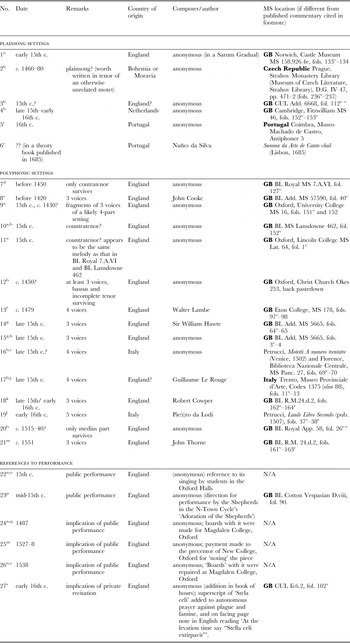
Let us now turn to examine the earliest known history of the hymn. All known editions of and references to musical settings of the Stella celi in fifteenth- and early sixteenth-century sources are listed in the Appendix. When a text enjoys distribution both as an autonomous verbal composition and as the underlay of a piece of vocal music (a madrigal is a good example), the general assumption is that the text was written first as a poem and subsequently selected for musical elaboration. Such a pattern, if it held here, would posit that the Stella celi was originally conceived as an unadorned verbal prayer whose popularity and applicability in the lives of laity led to its copying in books of hours, which then were mined as a source of texts by composers who perhaps ‘were searching for texts of greater variety and a more personal expression’.Footnote 21 Chronologically, the earliest known appearance of the Stella celi is its use as the underlay of a three-voice descant motet attributed to John Cooke in the Old Hall Manuscript. After a long period of study at King's Hall, Cambridge,Footnote 22 Cooke is first recorded as a member of Henry V's household chapel in 1413,Footnote 23 and he accompanied the King to Harfleur and the historic victory over the French at Agincourt in 1415.Footnote 24 Bent's palaeographic analysis suggests that that some of the pieces attributed to Cooke in the Old Hall manuscript (along with those of his colleagues John Burell, Thomas Damett and Nicholas Sturgeon) may be autograph,Footnote 25 which if true offers a potential terminus ante quem for the composition and copying of the Old Hall Stella celi at Cooke's death.Footnote 26 At the same time, the earliest known appearance of the Stella celi without musical notation which can be datable with some accuracy is on fol. 231v of a wide-ranging collection owned by the warrior and poet Duke Charles d'Orléans (BnF lat. 1196). Charles was one of Henry's most famous hostages after the battle of Agincourt,Footnote 27 and during his English captivity (perhaps as early as 1417–24) the French nobleman arranged for the production of this lavishly illustrated and illuminated volume of devotional texts of personal significance.Footnote 28 As several other pieces in the Old Hall manuscript (including one by Cooke) have texts which have been linked to the celebrations after the Agincourt victory,Footnote 29 and it was an established practice in the fifteenth century for composers of vocal music to mine prayer books as sources, as noted above, it is tempting to hypothesise that Stella celi was itself either known to Charles in France or composed anew by him, and then ‘captured’ by Cooke and as a motet made to serve as a testament to the glory of Henry's court, much as Charles himself was. Additional evidence for a special association between the Stella celi text and Charles d'Orléans comes from the fact that after his ransom was paid and the duke returned to France in 1440, he cultivated a household chapel of his own which from 1451 until the duke's death in 1465 employed a singer and composer named Guillaume le Rouge, who composed a four-voice setting of the hymn which is now in Trent, Museo Provinciale d'Arte, Codex 1375 (olim 88), fols. 11v–13.
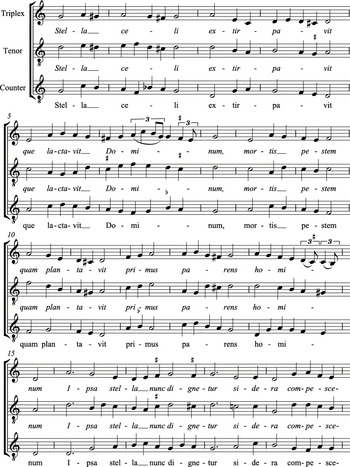
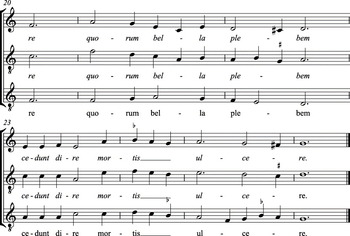
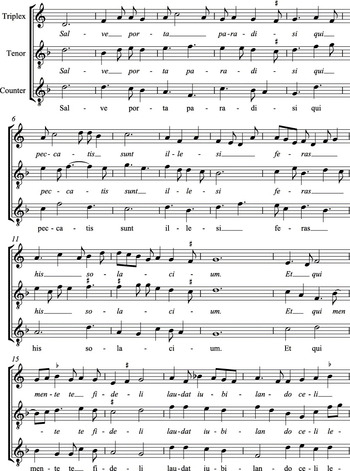
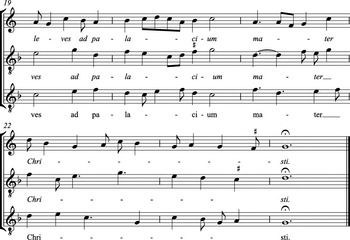
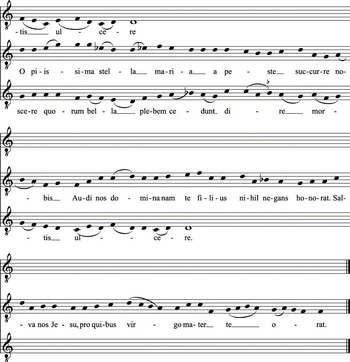
However, there are many other reasons to conclude that this model of linear transmission from poet to a pool of composers is insufficient as an explanation of the origins of the Stella celi, or even that the Stella celi was created in one stroke between 1415 and 1430. First, the dating of Cooke's composition in Old Hall to the first decades of the fifteenth century is based on a larger body of evidence than the arguments for dating the text in Charles d'Orlèans's prayerbook prior to 1430, which means we cannot rule out the possibility that the polyphonic setting was written before the non-musical setting. Second, even given the fact that some of the music in the Old Hall manuscript repertory is characterised by a conservative style, perhaps composed as much as several decades prior to the manuscript's compilation, Cooke's three-voice setting of the Stella celi appears retrospective and anomalous (see Example 1). Most striking is its adherence to rigid homophony in all three voices, and the very short melodic distance between major cadences.Footnote 30 This is a far cry from the compositional aesthetic of the post-Dunstaple generation, as indeed the opening phrases of the piece on the facing page of the manuscript, Damett's Salve porta paradisi, illustrate (see Example 2). In Damett's motet, the only times all three voices employ the same metric values are at the beginning of the work, and at the ends of structurally important sections (see bb. 13 and 20). In between, the voices enjoy considerable rhythmic independence. The phrases are also more expansive, with an average of ten beats of the tactus between major cadences.Footnote 31 Even Cooke's other music in the Old Hall MS more closely resembles that of Damett's Salve porta than his own Stella celi.Footnote 32 While several theories have been proposed to explain this discrepancy,Footnote 33 external corroborating evidence for them has not been found.
John Cooke, Stella celi, in BL Add. MS 57950, fol. 40v


Thomas Damett, Salve porta paradisi, in BL Add. MS 57950, fol. 40r


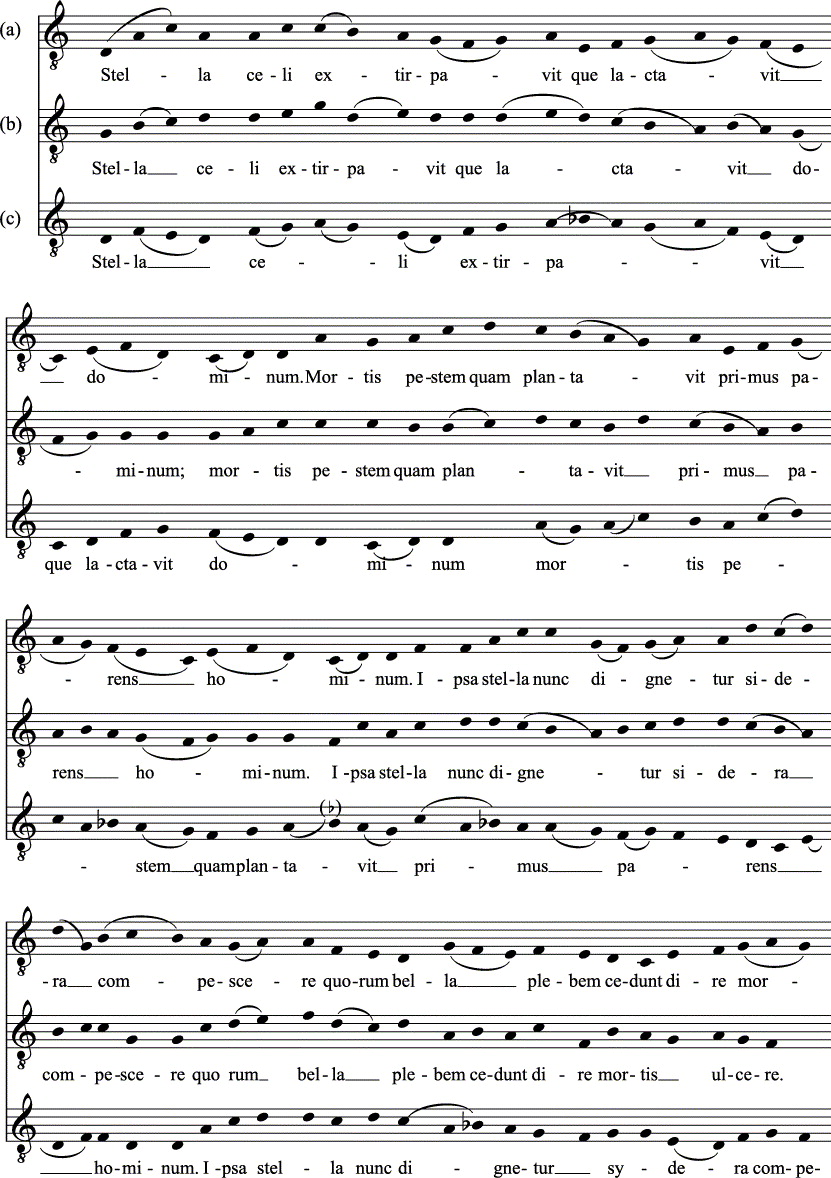
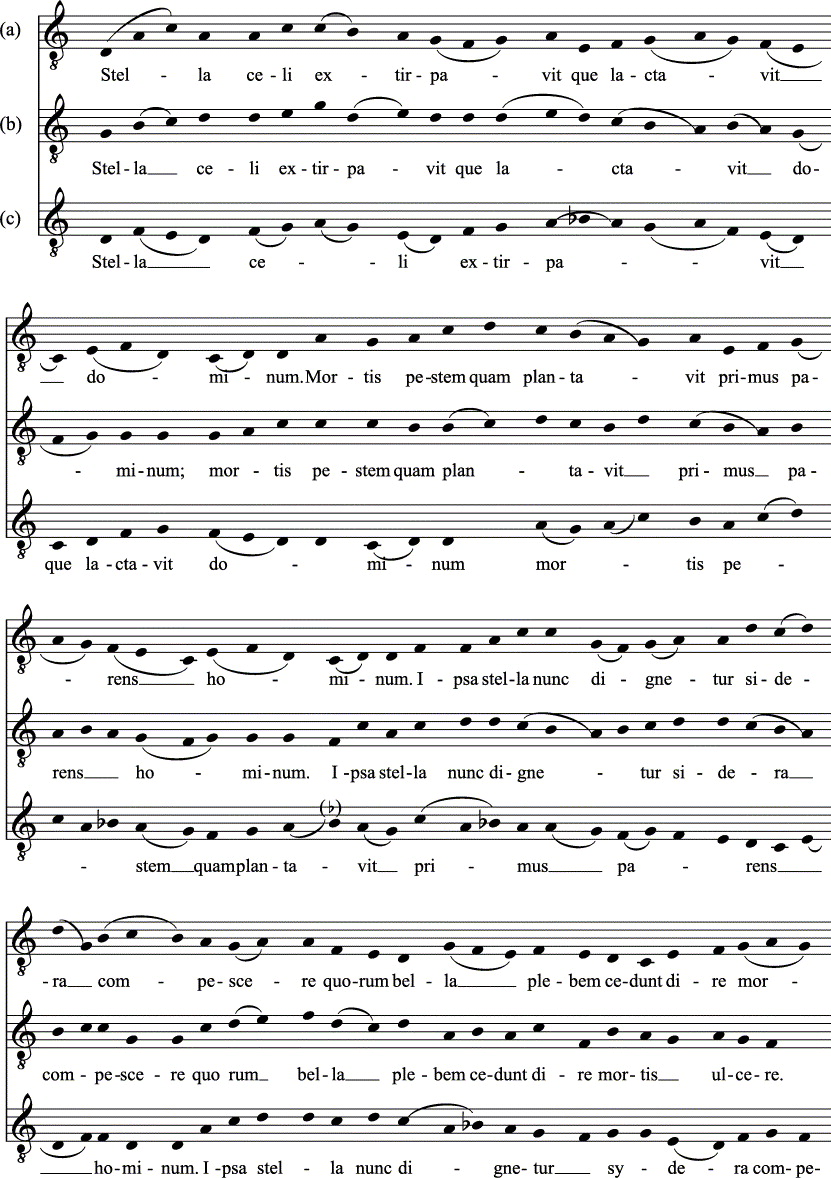
Third, although their exact dates of provenance are unknown, a number of additional early- to mid-fifteenth-century English manuscripts unconnected to the court of Henry V also contain the hymn. These include a plainsong melody in a Liber Cantus now in Cambridge,Footnote 34 a separate plainsong in a Sarum processional in Norwich,Footnote 35 three parts from a probable four-part polyphonic setting in Oxford,Footnote 36 an isolated tenor part in mensural notation in a Sarum Gradual now in London,Footnote 37 and two non-musical Middle English verse translations (one with Latin glosses in the margins referencing the hymn text) attributed to John Lydgate.Footnote 38 In other words, within a single generation of the first surviving written edition, the Stella celi plague hymn had been copied in England non-musically in both formal Latin and the English vernacular, and musically in both monophonic and polyphonic vocal arrangements. Such diversity might imply that rather than being newly composed between 1415 and 1430, the Stella celi had been in circulation for some time before these initial written records either through now-lost textual exempla or through oral transmission. Further support for text-independent dissemination comes from a comparison of the melodies of the monophonic versions in the Norwich and Cambridge manuscripts. These three melodies share little resemblance beyond their modal classification, as is apparent in Example 3.
Comparison of monophonic Stella celi settings in fifteenth-century British MSS: (a) Cambridge, University Library Add. MS 6668, fo. 112r; (b) Cambridge, Fitzwilliam Museum MS 46, fol. 152v; (c) Norwich Castle MS 1919.158.4e

Even more far-flung copies of the hymn have been found, without musical notation, on a piece of fifteenth-century parchment preserved amongst the relics of the monastery of Santa Clara of Coimbra in Portugal,Footnote 39 and copied at the end of the cantus firmus tenor of an unrelated motet ([N/V]obis iustat carminis odas laudibus) in a central European codex now in Prague, which probably dates from c. 1460–80.Footnote 40
THE FRANCISCAN ORDER AND THE STELLA CELI
Rather than looking for a well-defined compositional lineage arising from the lyrical talents of a John Cooke or a Charles d'Orleáns, the evidence above suggests that an alternative account of the history and use of the Stella celi is necessary. For this we turn to the order of Friars Minor established by St Francis, a group whose history and theoretical orientation intersects at many key points the concerns and characteristics of the Stella celi. The order's cultivation of the arts of poetry and music is well established. According to an early biography, St Francis himself instructed his followers to be ‘jongleurs of the Lord’ (joculatores domini),Footnote 41 and in recent years scholars have explored how this mandate shaped a large body of late medieval verse,Footnote 42 song,Footnote 43 and drama.Footnote 44 One technique enthusiastically adopted by the Franciscans was the art of contrafactum, in which the ‘worldly’ lyrics of popular song are replaced with a text of a more devotional slant, either to provide devotional music at short notice or to prevent exposure to spiritually degrading material. Ireland's Red Book of Ossory, begun by the Franciscan Richard de Ledrede in 1316, contains a rubric explaining his order's use of the practice, and in many cases places the textual incipits of the replaced secular songs over or near their sacred counterparts.Footnote 45 This Latin versifying was supplemented by composition in the vernacular, and the Friars Minor are strongly associated with the development of both the Italian lauda and the English carol.Footnote 46
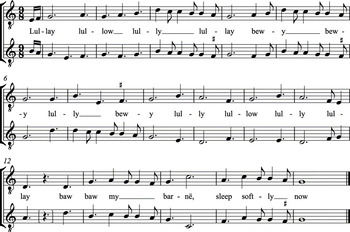
More immediately relevant is the fact that Charles d'Orléans is known to have associated with the Franciscans during his English captivity and made copies of poetic works by the Franciscan friar John of Hoveden, which are still extant.Footnote 47 The Franciscan friar James Ryman, whose fame primarily rests on his contribution to the English carol genre, made a vernacular English translation of the hymn in the late fifteenth century,Footnote 48 and the Ritson Manuscript (BL Add. MS 5665), which was apparently compiled at a Franciscan friary in Devon and intended for use at services with lay congregations, contains two separate editions of the hymn aswell as forty-four English carols.Footnote 49 Even the rigid, note-against-note homophony of the setting attributed to John Cooke in Old Hall manuscript, which appears so anachronistic and anomalous in the context of fifteenth-century English liturgical music, is unexceptional compared to late fourteenth- and early fifteenth-century carols, which developed under the aegis of the Franciscans and which like the Stella celi itself could be monophonic or polyphonic, in Latin or the vernacular.Footnote 50 (See Example 4.)
Other settings display evidence of being contrafacta settings: Manfred Bukofzer noted that the tenor of the Stella celi setting attributed to Guillaume le Rouge in the Trent codex is identical to that of the chanson So ys emprentid.Footnote 51 One of the few additional compositions attributed to Le Rouge, whom we have already encountered as a musician in the chapel of Charles d'Orléans, is a three-voiced mass on the same melody,Footnote 52 and both are similar to the tenor line of the motet [N/V]obis iustat carminis odas laudibus in Prague, Strahov, D.G. IV 47, which as noted above has the words Stella celi … ulcere copied at the end of the music.Footnote 53 In the light of these concordances, we might also wonder whether Franciscan contrafacta of other melodies explains the variety in the monophonic settings such as those in Cambridge University Library Add. MS 6668, Fitzwilliam Museum MS 46 and Norwich Castle Museum MS 158.926.4e.
Descant homophony in a 15th-century English carol, Anon., Lullay, I saw, BL Add. MS 5666, fol. 4v)

Furthermore, in addition to their musical ministry, the Friars Minor were intimately involved in caring for the sick during the Black Death and in subsequent epidemics. According to the chronicle of the Sicilian Franciscan Michele da Piazza, ‘the Franciscans and Dominicans, and [those] of other orders who were willing to visit the sick to hear their confession and impose penance, died in such large numbers that their priories were all but deserted’.Footnote 54 It has been estimated that 42.5 per cent of all the Franciscans in England died during the Black Death,Footnote 55 and their reported mortality in Europe as a whole was catastrophic.Footnote 56 This was probably due to their willingness to minister in unsavoury conditions, and a dedication to caring for the sick during the Black Death which apparently exceeded that of their ecclesiastical colleagues. As Moorman notes, the fact that in mid-fourteenth-century London the Franciscan friary was located on a street so notorious for its unhealthy atmosphere it bore the name ‘Stynkynglane’ is suggestive,Footnote 57 and the Franciscan labouring in the miasmas of plague did not go unnoticed. After the Black Death, a letter from Pope Clement VI to diocesan leaders who had complained about the mendicants' disproportionate receipt of donations after the epidemic upheld the friars' claims to increased wealth, on the grounds that that where ‘so many of the parish priests took flight and abandoned their parishoners, the mendicants cared for and buried them’.Footnote 58 In addition, there is ample evidence that the order cultivated knowledge of natural philosophy and medicine. The first master of the Franciscan school at Oxford from 1229/30 to 1235 was the renowned theologian and natural philosopher Robert Grosseteste,Footnote 59 and a decree enacted at the Franciscan General Chapter in Paris in 1292 formally permitted friars to study medicine and law.Footnote 60 Other testaments to the Franciscans' commitment to education include the biblical commentaries of William Woodford in 1373, which reveal a deep understanding of contemporary theories of natural philosophy, apparently acquired in his time spent in London Greyfriars,Footnote 61 and friar Michael Dawnay's testimony in an early-fifteenth century church court case that while living in a Franciscan house in Hartlepool he studied ‘arithmetic, domification and other [subjects] which are studied for the science of astronomy’.Footnote 62 By the middle of the fourteenth century the Franciscans had developed a large hierarchically organised network of studia with the convent schools of Oxford and Cambridge at the apex, in which schools a friar could receive an education equivalent or superior to those available to secular students anywhere in Europe.Footnote 63 These schools (probably including the house in Hartlepool attended by Dawnay) were accessible to friars from all across Europe through assignation by the order's Chapter General,Footnote 64 which in addition to explaining how the piece could be quickly transported from England to regions as far afield as Coimbra and Prague, helps explain the association between the hymn and the upper echelons of English society. As noted above, prior to joining the Chapel Royal Cooke spent a lengthy period of study at King's Hall, Cambridge, and the Stella celi was one of the five antiphons whose performance was required in the fifteenth century at the ringing of the curfew bell for students living in the Oxford halls (and thus not affiliated with colleges) on vigils for the five feasts of the Virgin Mary.Footnote 65 In a similar vein, in 1487–8 Magdalen College, Oxford purchased two boards (tabelle; now lost) indicating the notes of Stella celi, which were repaired in 1538 and presumably used in the performance of the Marian antiphon by the entire college after Compline on Saturdays and vigils of the Virgin specified in their college statutes.Footnote 66
Within the text itself, the integration of theology with pre-Christian natural philosophy also suggests a degree of erudition explicable with this theory. The primary image of the poem is astrological, as the author calls upon the stella celi and gloriosa stella maris that is the Virgin Mary to hold in check or restrain (compescere) the stars or constellations (sidera) whose strife (in the words of the hymn) ‘brings the people the ulcers of a terrible death’ later identified as plague (quorum bella plebem cedunt / dire mortis ulcere). Metaphors likening the Virgin to a star in the heavens are nothing new, of course.Footnote 67 What is noteworthy is that here that star is placed in explicit opposition to the actions of another star in the heavens, this one not metaphorical but quite literal. Medieval natural philosophy ultimately owed a large debt to the Hellenistic astronomer and mathematician Ptolemy (fl. mid-2nd c. ad), whose works were first translated from Greek into Arabic in the seventh and eighth centuries and from Arabic into Latin between the late eleventh and early thirteenth centuries.Footnote 68 Though Ptolemy's theories exercised an enormous influence across the continuum of medieval medical practice, from the highly educated university-trained physician to the ‘rough-and-ready’ empiricism of barbers, surgeons and other lay practitioners,Footnote 69 their influence was particularly acute in the aftermath of the Black Death. Learned explanations of the epidemic often followed the example set by the medical faculty of the University of Paris, who in chapter 1 of their report of 1348 stated that ‘the distant and first cause of this pestilence was and is the configuration of the heavens’, for which they called particular attention to a conjunction of Jupiter and Saturn amplified by the position of Mars in 1345.Footnote 70 The significance of this event was elaborated by Simon de Covino of Liège, whose poem ‘On the Judgement of the Sun at the Feasts of Saturn’ (De Judicio Solis in Conviviis Saturni) of 1350 described the plague as the result of ‘the strife and conflict between these two planets’,Footnote 71 and by Geoffrey of Meaux, who in his treatise written at Oxford calls attention to Mars' association with ‘illnesses entailing fevers and the spitting of blood … and ulcers’.Footnote 72 The language of the Stella celi hymn thus echoes the educated astrological explanations of the Black Death, and suggests equal familiarity with the constructs of natural philosophy and the doctrine of intercession, even going so far as to have the one check or curb (compescere) the other.Footnote 73
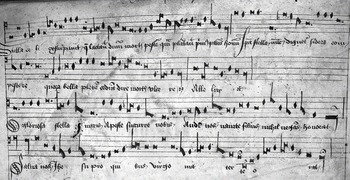
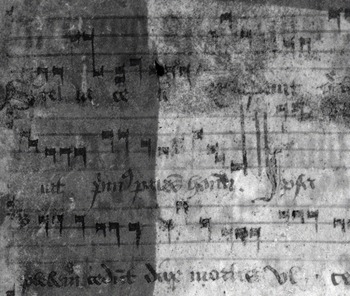
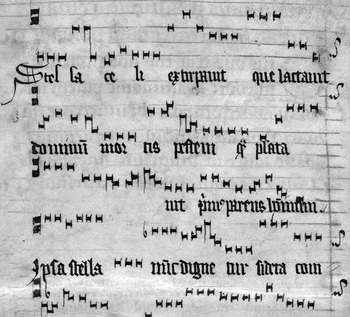
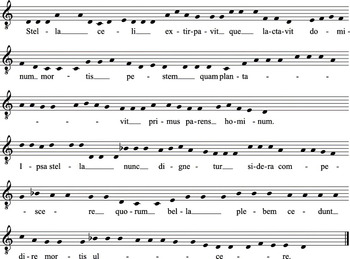
However erudite its origins, by the beginning of the sixteenth century, the hymn had found a place at both ends of the social spectrum. Walter Lambe's sumptuous four-voice setting in the Eton Choirbook, composed sometime before he died in 1499, indicates its performance in the rarefied air of the college, while in humbler surroundings the prayer was added without music to dozens of books of bours and apparently recited as a private devotion at the elevation of the host during the Mass.Footnote 74 Whether in the symbolic form of the shepherds at the Nativity in the Adoration play of the N-town cycle (where the fact that the denotation of the bare incipit of the hymn was deemed sufficient to evoke performance by the scribe of the N-Town ‘Adoration of the Shepherd's’ play strongly indicates that the tune was well known to the performers), or literally in the academic communities of Magdalen College and the Oxford Halls, it is the sense of an inclusive, ‘congregational’ performance aesthetic that comes through most strongly from the study of this repertory. This also comes through in the fragments of polyphonic settings of the Stella celi found in Oxford, Lincoln College MS 64, BL Royal 7.A.VI, and BL Lansdowne 462. All three are of fifteenth-century provenance, although little else is known about their origins.Footnote 75 All three depict the same melodic line, which Nick Sandon described as ‘having no melodic integrity of its own but leaping about as if to produce a counterpoint below another voice which moved largely by step; in fact it behaves like a typical early 15th-century supporting part below a melodic cantus firmus which was presumably so well-known as to make notation superfluous’.Footnote 76 Tellingly, while the fragment in Lansdowne 462 is in ordinary fifteenth-century measured notation, the fragments in both Lincoln College MS 64 and in Royal 7.A.VI are in stroke notation, a graphological technique used in late medieval England to enable singers who might not be familiar with the conventions of mensural notation to sing polyphonic music (see Figure 1 and Example 5).Footnote 77
The melody of Stella celi extirpavit in (a) BL Lansdowne 462, fol. 152v; (b) Oxford, Lincoln College, Lat. 64, fol. iv; (c) BL Royal 7.A.VI, fol.127v. Used by permission of the British Library Board (a and c) and © Lincoln College, Oxford, MS Lat. 64 (b)


The Stella celi melody in the three sources in Figure 1

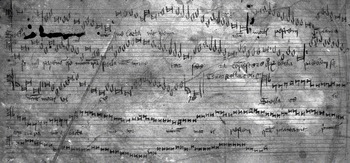
These two notational styles are combined in another fragmentary polyphonic Stella celi, unrelated to these three settings and surviving only by virtue of its being recycled as binding reinforcement for a copy of St Augustine's De Civitate Dei, in which the bass part is written in a white mensural notation, while the tenor part (which follows the bass part immediately on the staff) is in stroke notation (see Figure 2).Footnote 78 Moreover, the single manuscript which contains the greatest number of pieces written in this notation is none other than the Ritson Manuscript (BL Add. MS 5665), a collection to which we have already called attention for its distinction of holding two Stella celi settings, its association with the Franciscans, and its intimation of use in lay devotional contexts.Footnote 79 This observation was first made by Andrew Hughes, and based on his study of these and other exempla he argued that the use of stroke notation to craft ‘a beginner's style of polyphony’ reflects the democratisation of multivocal performance, enabling singers with a non-specialist set of skills to engage with polyphonic repertory.Footnote 80
Back pastedown of Oxford, Christ Church Okes 253, verso. Copyright The Governing Body of Christ Church, Oxford

CONCLUSIONS
Ironically, the characteristics that facilitated the ability of the Stella celi to cross national, economic and educational boundaries and appeal to a broad spectrum of society in the fifteenth and sixteenth centuries may have contributed to its relative obscurity in our own time. Its apparent ubiquity in milieux such as the N-Town mystery plays and the Oxford Halls lessened the imperative to make durable written editions. Many of the musical copies that do survive, like the stroke notation itself used in producing them, owed their appeal less to standards of beauty than to their ability to address a pressing need. In the case of the Stella celi, that need related to the doctrine of intercession invoked for protection against plague, and the wide range of records that contain the hymn is an eloquent testament to its great resonance in late medieval society. From the elaborate filigree of Lambe's setting in the Eton Choirbook to the note to recite the hymn at the elevation of the Host jotted in the Roberts family primer, the Stella celi echoes through the records as a poignant reminder of the precarious nature of life and art in the fifteenth century.
Tracing the fortunes of the Stella celi also illustrates some of the methodological difficulties of working with pieces which are, strictly speaking, neither entirely learned nor vernacular exercises. This is typified in the Franciscan use of contrafacta, which in this case may have facilitated the integration of an unknown number of existing melodies into the Franciscans' framework for responding to plague's perceived significance and aetiology. In such cases it is difficult, if not impossible, to construct a single well-defined compositional lineage; indeed, seeking to do so may be to miss the greater significance of the work, as attempts to unravel the works of John Cooke and Charles d'Orléans illustrate.
Like the images of a kaleidoscope, which are created through the application of simple principles of light and gravity on a small number of objects, the Stella celi may productively be viewed as a product of the Franciscans' concern to reconcile the benefits of the communal performance of music with ideals of spiritual well-being in their flocks. These simple principles could then give rise to the large array of music, verse and drama discussed above, which are united not only in their text but in their intimations of group performance. Peering at the past through the Stella celi is thus to turn Adam von Fulda's meditatio mortis on its head – the fleeting performances hinted at in these works speak less about death than about life in the shadow of the plague.
APPENDIX
Musical Settings and Performances of Stella celi in Fifteenth- and Sixteenth-Century Sources

a Wathey, ‘Newly Discovered Fifteenth-Century English Polyphony at Oxford’, p. 62.
b Bent, ‘New and Little-Known Fragments’, pp. 145–8.
c Corbin, Essai sur la musique religieuse portugaise, pp. 374–8.
d Sandon, ‘Mary, Meditations, Monks and Music’, pp. 47–53.
e Hughes and Bent, ‘The Old Hall Manuscript’, p. 104.
f The Eton Choirbook, ed. Harrison, vol. 3, pp. 32–6.
g Miller, ‘A Fifteenth-Century Record of English Choir Repertory’, pp. 15–23.
h The Ritson Manuscript, ed. Sandon, Bayliss and Lane, pp. 2–3.
i Selections from Motetti A, ed. Sherr, pp. 67–73.
j Sacred Music from the Cathedral at Trent, ed. Gerber, pp. 42, 163–8.
k D. Greer, ‘Cowper, Robert,’ Grove Music Online (accessed 26 Nov. 2007).
l Die Mehrstimmige Italienische Laude um 1500, ed. K. Jeppesen and V. Brondal (Leipzig, 1935), pp. 60–1.
m The Music of York Minster, ed. P. Aston and J. Thorn (London and New York, 1972), pp. 1–3.
n Harrison, Music in Medieval Britain, pp. 85–8, 158.
o Gibson, Statuta Antiqua Universitatis Oxoniensis, p. 575.
p The N-Town Plays, ed. Sugano, p. 144.
q A Register of the Members of St. Mary Magdalen College, Oxford, ed. Macray, p. 16.
r Ibid., p. 18.
s Duffy, Marking the Hours, p. 88.