International bodies call for greater patient involvement in the prevention and control of healthcare-associated infections (HAIs). 1 However, this involvement typically manifests as involving patients in the deployment and/or evaluation of interventions, rather than in research design, the collection and interpretation of data, or the communication of associated findings.Reference Seale, Novytska, Gallard and Kaur 2 These articles suggest a limited understanding of what patient involvement could mean and potentially excludes patient expertise on HAIs. Notwithstanding seminal studies that have involved patients in interventions to prevent and/or control these infections,Reference Srigley, Furness and Gardam 3 these strategies are often conceived by researchers or clinicians and fail to draw on patient capacities.
In this article, we investigate the methodological scope of studies, expressly on patient involvement in HAI research, to ascertain the extent to which these studies are participatory. We conducted a lexical analysis of the methods sections of 148 publications published since 2000, following a methodical review of extant research.
Participatory Methodologies
Participatory healthcare research involving patients and the public is gaining attention as evidence accrues demonstrating its impact.Reference Staley and Minogue 4 This trend includes more relevant research agendas, design, and delivery; more effective patient-centered outcomes; and positive impacts on all stakeholders.Reference Staley 5 Underlying these successes is collaboration with the people whom the research will affect and recognition of them as coresearchers with the same decision-making rights and opportunities as professional researchers.Reference Bergold and Thomas 6
Internationally, patient involvement in healthcare research has been variably interpreted.Reference Staley 5 The Patient-Centered Outcomes Research Institute in the United States uses the term ‘engagement’ to describe active public involvement in research,Reference Apker and Eggly 7 whereas the National Institute of Health Research (NIHR) in the United Kingdom refers to it as ‘involvement.’ 8 For the NIHR, ‘engagement’ refers to the dissemination of information about research to the public rather than something the public are actively involved in. Some have argued that misinterpreted terminologies have clouded a body of research that purports to be participatory, when in fact, participants have only been asked their opinions.Reference Staley 9
Frameworks to guide patient and public involvement in research are often described along a continuum. At one end, patients and the public have limited decision-making authority; for example, patients are consulted for their views on a research project. At the other end, patients and the public share power and responsibility; for instance, they define the research agenda.Reference Ocloo and Matthews 10 Some have claimed that limited researcher understanding of the potential value of participatory research can result in more research being conducted at the former end rather than the latter.Reference Cook 11 While acknowledging the importance of patient consultation, they argued that misperceptions and overreliance on this type of involvement as ‘participatory’ precludes the powerful effects of genuine participatory research.
Some of the powerful effects associated with participatory research are apparent in infant healthcareReference Foster and Young 12 and chronic disease management. For instance, older people with dementia who were trained and supported as coresearchers made ‘valuable’ contributions to a study on transitions between care services.Reference Tanner 13 They helped enrich ‘the understanding of the experiential world of dementia and the ways … people with dementia express their experience, which is necessary … in this field.’ In addition to this scholarly benefit, the coresearcher role:
enabled them to own and embrace a positive dementia identity and utilise this in a constructive way in their interactions with others via the presentation of positive identities, such as “survivor,” “advisor” and “expert”… The project [also] generated opportunities for the communication skills of people with dementia to be exercised and utilised for a specific, socially valued purpose.
Healthcare-Associated Infections
Healthcare-associated infections risk patient safety and are associated with morbidity and mortality.Reference Harris, Pineles and Perencevich 14 Current approaches to reducing HAIs focus on the following: development of infection prevention and control rules and guidelines; promotion of these rules through education; regular audits; and public reports of infection rates and service compliance with established guidelines.Reference Siegel, Rhinehart, Jackson and Chiarello 15 Despite the promotion and uptake of these strategies, HAIs are among the most common adverse events for patients worldwide. 16 This fact has implications for patients; caregivers; staff members (eg, managers, clinicians, or ancillary personnel); as well as policy makers.
The suboptimal effects of strategies to reduce HAIs is partly due to limited research that explicitly acknowledges the expertise of patients and the public.Reference Iedema, Hor and Wyer 17 Participatory action research involving patients in developing innovative practice change can lead to successful outcomes.Reference Kangovi, Grande and Carter 18
Given the prevalence and significance of HAIs, and the aforesaid concerns about HAI research, we aimed to determine the extent to which patients and the public have participated in HAI research using lexical analysis of relevant publications.
METHODS
Search Strategy
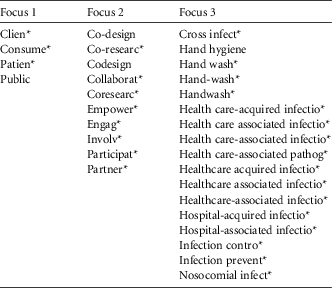
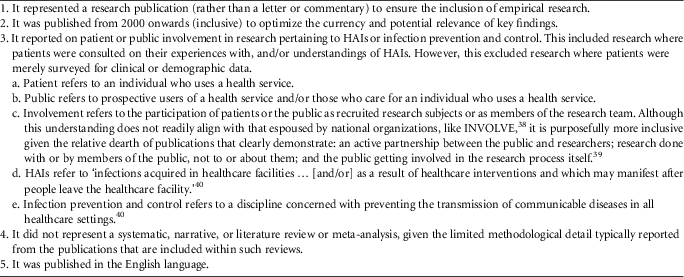
A search strategy was deployed in PubMed in September 2016 to identify all publications on patient involvement in HAI research. PubMed was selected because of its comprehensive database of academic publications. The search strategy encompassed euphemisms for the terms patient (4 terms), involvement (10 terms), and HAI (17 terms) within the title and/or abstract of the publication (Table 1). Publications were included in this review if they met the inclusion criteria (Table 2).
PubMed Search Strategy

Inclusion Criteria

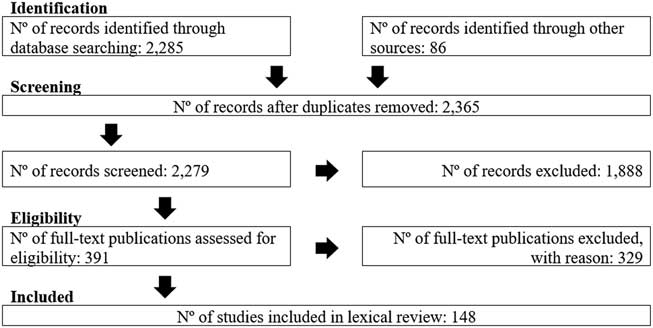
Of the 2,285 publications identified via PubMed, 66 met the criteria (Figure 1), as determined by 1 author and cross checked. Discrepancies were reconciled through discussion. Of the 66 publications, 3 were unavailable for inclusion; another was found to have been retracted. From the remaining 62 articles, an additional 86 publications were identified from the cited references, all of which met the inclusion criteria and were included. The methods section from each publication was prepared for a lexical analysis, which involved omitting all subheadings and citations, given the variable use of these among the publications.
PRISMA flowchart.

Lexical Analysis
To optimize the likelihood of a systematic approach, the lexical analysis was aided by Leximancer (Brisbane, Australia), a data-mining software that uses Bayesian reasoning to detect key concepts and reveal their relationships. Using algorithms, Leximancer identifies frequently occurring and co-occurring words and amalgamates them to form and visually map concepts that reflect themes within the text. The maps convey ‘the main concepts in the text and their relative importance; the strengths of links between concepts (how often they co-occur); and similarities in contexts where links occur.’Reference Hewett, Watson, Gallois, Ward and Leggett 19 Concepts represent ‘collections of words that generally travel together throughout the text.’ 20 The components of these concepts are ordered within a thesaurus, comprised of relevant words and weightings to indicate relative importance. Within the map, connections between concepts that are most probable are represented by a spanning tree of grey lines or branches. Clusters of concepts within a map (known as themes) suggest contextual similarity.Reference Hepworth and Paxton 21 For clarity, themes are color-coded to signify their importance: the ‘most important theme appears in red, and the next hottest in orange, and so on according to the color wheel.’ 20
Leximancer was used in 3 steps. First, following the aggregation of the methods section from each publication, the ‘discovery’ mode was used to determine which concepts were automatically generated by Leximancer without intervention.Reference Angus-Leppan, Benn and Young 22 Second, Leximancer was used to examine the comparative importance of the concepts, as denoted by relevance percentage. A relevance percentage denotes ‘the percentage frequency of text segments which are coded with that concept, relative to the frequency of the most frequent concept in the list… This measure is an indicator of the relative strength of a concept’s frequency of occurrence.’ 23 Third, the pathway mode was used to develop a knowledge pathway. Knowledge pathways reveal the strongest route between concepts of interest and, as such, the concepts that are bypassed en route.Reference Thomas 24 Concepts deemed germane to the focus of this article include patients and research. The relevance of these was determined by inspecting the related concepts and the thesaurus of each term, as well as associated text.
RESULTS
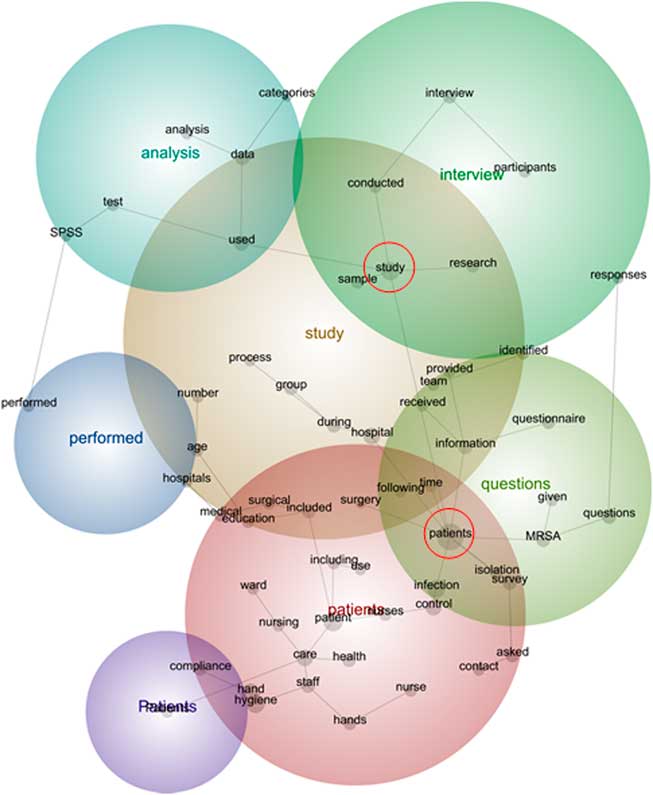
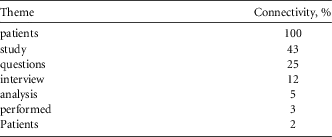
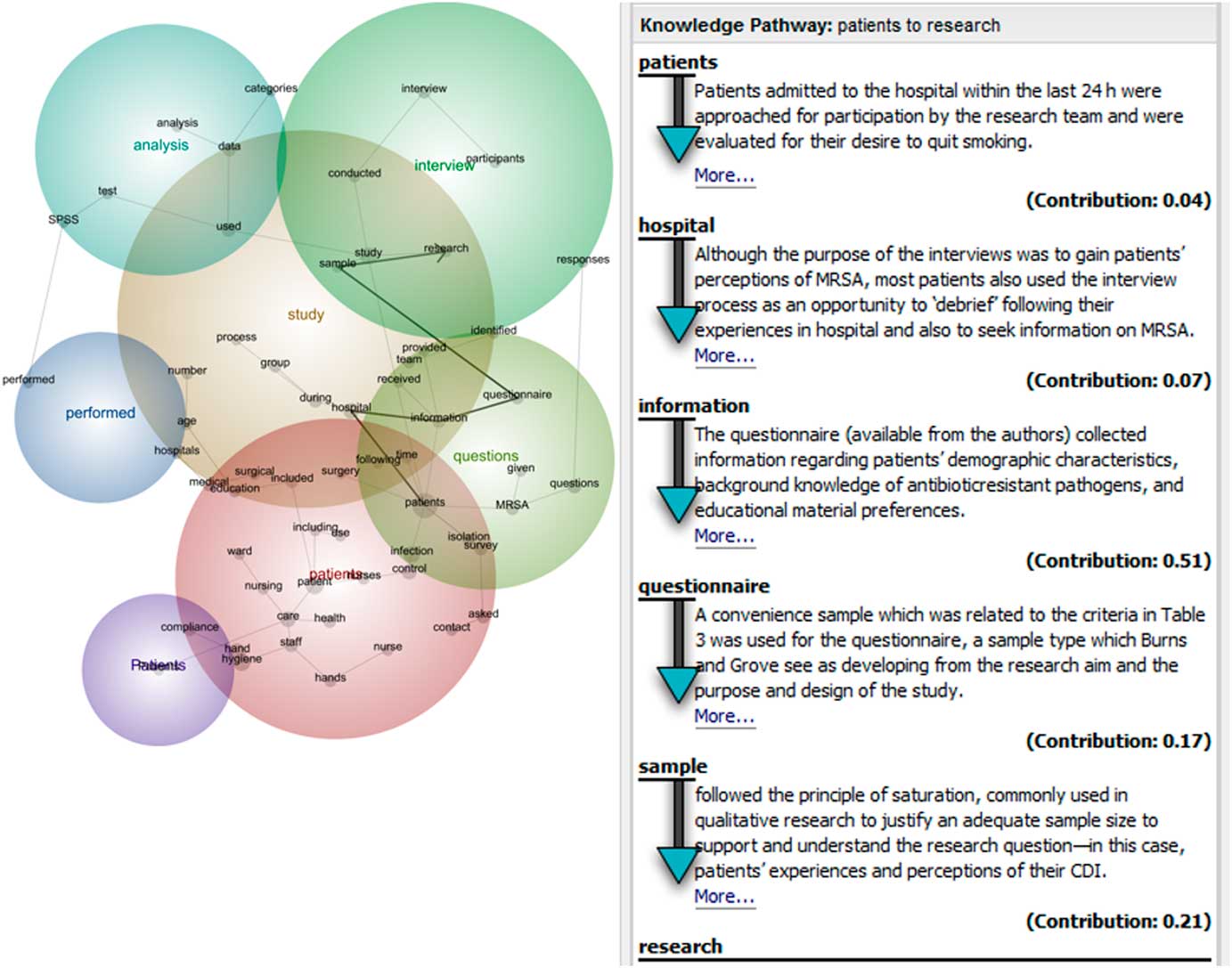
The concept map and the thematic summary reveal 7 themes: patients, study, questions, interview, analysis, performed, and Patients (as a name-like concept, Figure 2 and Table 3). These themes highlight the key clusters of concepts represented within the text. Theme position illustrates the relationships between the themes. Consider for instance, the prominence of patients, which appears in red and overlaps with questions, which appears in green. This suggests that when the publications referred to patients (and the concepts therein), they were inclined to refer to questions (and the concepts therein):
Although many patients had family members or friends with them at the time of the interview, the questions were addressed solely to the patient [emphasis added].
Concept map after merging concepts (theme size: 50%, concept visibility: 100%).

Thematic Summary (n=148)

Notably, the term study is central; it serves as a nexus between patients and Patients at the bottom of the map, and interview and analysis at the top. Thus, when the publications mentioned patients or Patients (and the related concepts), they were disinclined to mention interview or analysis (and the related concepts), and vice versa:
During the observations, patients were observed for no more than 2 opportunities [emphasis added].
Given that every publication in this review met the inclusion criteria, this finding seems counterintuitive. It would suggest, notwithstanding patient responses to questions, that there was little patient involvement in different research tasks, like analysis:
The analysis was carried out using Excel spreadsheets and the results were presented using descriptive statistics [emphasis added].
As the key theme, the term patients encompasses concepts that include hand, hygiene, infection, care, control, survey, education, and compliance, among others. When the publications remarked on patients, they were inclined to refer to these concepts:
Staff were encouraged to engage patients and visitors in the campaign, and wore campaign T-shirts and badges with the campaign logo saying ‘It’s OK to ask’ to encourage patients and visitors to ask HCWs [Health Care Workers] about their compliance with hand hygiene practices [emphasis added].
In this study, the use of language in these ways represents a curious discovery within the concept map. Despite expressed interest in patient ‘knowledge and apprehension,’Reference Ashok, Rodrigues and Azouni 25 as well as ‘engaging patients and families,’Reference Pantle, Fitzpatrick, McLaws and Hughes 26 the methods, as presented in this corpus of data, suggest that patients and the public were largely removed from the research processes and the activities therein:
The researchers liaised with the Nurse Unit Manager … from the surgical wards to identify admitted patients who fitted the eligibility criteria [emphasis added].
This finding does not imply the complete absence of patient inclusion in the research process when the publications are considered individually. Consider for instance, references to a team member who, ‘provided a patient viewpoint.’Reference Goldsack, DeRitter and Power 27 However, this viewpoint was not typically incorporated into the design of an initiative, or related research:
The MRSA clearance program was designed collaboratively by a bedside nurse, a nurse educator, infection preventionists, and a physician.
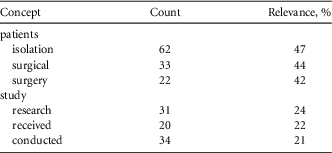
The relative size of their grey points suggests that the concepts patients and study are most salient, with 843 and 559 counts, respectively. Furthermore, these concepts are directly connected, suggesting they are typically coupled within the text. In this study, which purposefully analyzed the methods sections of the publications, this finding might be expected. However, the concepts encircle these prominent concepts and warrant consideration. For instance, the theme patients is closely connected with the concepts isolation, surgical, and surgery, while the theme study is closely connected with research, received, and conducted (Table 4). Thus, patient references within the methods section of the publications were unlikely to travel with concepts that explicitly denote active participation – instead, they were likely to associate with concepts that seem to insulate patients and generally situate them as passive recipients of interventions, and/or research about these interventions:
All patients are also given written information about MRSA and source isolation [emphasis added].
Top 3 Concepts of Relevance to patients and study

Also, references to the study were likely to travel with concepts that denote the operation and the completion of the research, following informed patient consent:
Participants randomized to the active arm received a one-on-one consultation with a study investigator during which time information in the flip chart was verbally delivered [emphasis added].
Although informative, the methods sections collectively placed patients at a distance from the research processes. While many publications duly reported ethics approval ‘to protect the patients and their rights’Reference Ward 28 and the distribution of ‘written and oral explanations pertaining to the nature and method of this study,’Reference Okada, Yamamizu and Fukai 29 the data were largely devoid of text to suggest that patients actively drove these processes with researchers. Although this might be partly due to journal conventions (ie, the use of third-person language and the limited use of active voice) sourcing text associated with these concepts reinforces these findings:
The study team comprised the first author (principal investigator) and five nurses (research assistants) … who were trained over an intensive period of three days [emphasis added].
The pathway mode clarified the connections between the concepts patients and research, given their relevance to this study. This knowledge pathway traversed the concepts hospital, information, questionnaire, and sample. These connections convey a narrative in the voice of the authors represented in this study. As evidenced by the excerpts presented in Figure 3, the way patients became involved in research was largely via hospitals, where they were informed about a study, questioned, and sampled. This procedure is counter to relatively more participatory approaches where patients, rather than clinicians, were (according to the authors) invited to ‘become active research participants.’Reference Wyer, Jackson and Iedema 30
Knowledge pathway from patients to research (theme size: 50%, concept visibility: 100%).

DISCUSSION
The importance of patient and public involvement in safety improvement has international recognition. Yet few published studies demonstrate patient engagement, often diminishing their role and expertise.Reference Schiffinger, Latzke and Steyrer 31 Active patient involvement in research can improve research quality and optimize the relevance of associated outcomes for intended audience(s).Reference Staley and Minogue 4 It is important for researchers to reflect on how they engage with patients and the public, beyond mere recruitment to collect ‘data,’ and this is particularly the case for HAIs.Reference Harris, Pineles and Perencevich 14
Given the international significance of HAIs, a lexical review was conducted to determine how patients and the public have been involved in HAI research. Findings from 148 publications reveal limited demonstrations of patient and public involvement during research design, conduct, and dissemination. Rather, they were largely recruited for research regarding researcher-driven interventionsReference Srigley, Furness and Gardam 3 and/or for their knowledge of, experiences with, and/or attitudes toward HAIs.Reference Gould, Drey, Millar, Wilks and Chamney 32 Although helpful, these approaches do not necessarily harness patient expertise, and they can stymie innovative solutions and/or theory development.Reference Dixon-Woods, Amalberti, Goodman, Bergman and Glasziou 33
Few of the 148 publications explicitly engaged patients or the public in participatory research, including their involvement as coresearchers.Reference Ahmad, Iwami and Castro-Sánchez 34 This finding was illustrated by the concept maps, which show how collections of words travelled (and did not travel) together. These relations included the proximity between the themes, patients and questions; the distance between the themes, patients and Patients at the bottom of the map, and interview and analysis at the top of the map; the concepts that surrounded the key theme, patients, including hand, hygiene, infection, care, control, survey, education, and compliance; as well as those that surrounded the equally-relevant theme, study, including research, received, and conducted (Figure 2). These findings suggest limited opportunities for patients and the public to drive HAI research. This finding was affirmed by the narrative in Figure 3, wherein the pathway from patients to research traversed the concepts, hospital, information, questionnaire, and sample.
Nevertheless, our study has several limitations. First, given the disparate ways that patient involvement and HAI research are described, the PubMed indexing system used to categorize publications might have obscured some relevant publications. Although PubMed represents a comprehensive academic database, the key search terms have multiple synonyms and multiple definitions. Second, given varied understandings of patient involvement in research, it was not possible to verify the reported descriptions of patient involvement in HAI research. Third, the use of Leximancer moderates the researcher’s interpretive skills, which some argue is the key to robust qualitative research.Reference Sotiriadou, Brouwers and Le 35
Despite these limitations, this lexical review suggests that the active involvement of patients and the public in HAI research is limited. Notwithstanding opportunities to complete a survey or be interviewed, patient expertise and skills are largely relegated. With few exceptions,Reference Wyer, Jackson and Iedema 30 , Reference Ahmad, Iwami and Castro-Sánchez 34 the patient and public connection to research (as depicted in this corpus of data) occurred via hospitals, where they were recruited, informed, questioned, and sampled. This finding has implications for scholars, practitioners, and patients.
For scholars, given this era of impact, this review reveals considerable opportunity to actively engage patients and the public in all aspects of research to improve the effectiveness of resulting interventions. Such opportunities might include inviting patients and members of the public to: identify HAI priorities; to co-design methodologies to address these; and to be trained and supported to collect and analyze data, to report on the findings and associated implications, and to communicate these to their preferred audiences.
Several methodologies can promote such engagement, including citizen social scienceReference Dadich 36 and video reflexive ethnography (VRE).Reference Wyer, Jackson and Iedema 30 , Reference Dadich, Collier, Hodgins and Crawford 37 Drawing from crowdsourcing and citizen science, citizen social science involves the examination of social phenomena, the systematic collection and analysis of related data, and the dissemination and translation of these activities to practice by researchers on a primarily avocational basis. In the context of HAIs, citizen social science invites patients and members of the public to collect, access, and/or critique organizational practices; to exchange perceptions of and experiences with these practices; to identify sources of information and knowledge that shape the translation of evidence-based practices into patient care; and to co-create resources to promote evidence-based practices.
Video reflexive ethnography is a collaborative methodology to improve practices by harnessing the expertise of individuals traditionally deemed as research subjects like patients and members of the public. Instead of positioning (external) researchers as experts who collect and analyze data, and report on their findings, VRE invites patients and members of the public to collaborate as coresearchers. Video reflexive ethnography involves inviting these individuals to feature in and/or gather video recordings; to interpret recordings; and to understand practices and experiences. Through ethnography, negotiated videoing, and reflexivity (ie, the interpretation of the footage by researchers and participants to make sense of these data) VRE can help to recognize routine practices and identify improvement opportunities.
For practitioners, findings from this study provoke questions about how to involve the patients they work with in research and/or quality improvement. For patients, given the seeming importance of patient involvement in and research about healthcare,Reference Ocloo and Matthews 10 these findings demonstrate limited participatory research on HAIs. This study, then, is a call to patients to ask how they might be involved in research and/or quality improvement within healthcare services.
ACKNOWLEDGMENTS
The authors thank Ms Serap Boyali who offered expertise as a patient coresearcher, and Dr Clarissa Hughes for her assistance.
Financial support: No funding was secured to support this study.
Potential conflicts of interest: Dr Dadich is not aware of any conflicts of interest to declare.
Dr Wyer is not aware of any conflicts of interest to declare.