Internalizing problems affect approximately 20% of youth at some point in childhood or adolescence (e.g., Kovacs & Devlin, Reference Kovacs and Devlin1998; Zahn-Waxler, Klimes-Dougan, & Slattery, Reference Zahn-Waxler, Klimes-Dougan and Slattery2000) and are associated with a multitude of negative outcomes, including suicide and psychopathology in adulthood (e.g., Fergusson & Woodward, Reference Fergusson and Woodward2002; Knapp, King, Healey, & Thomass, Reference Knapp, King, Healey and Thomass2011). Among the internalizing symptoms two types are often differentiated: anxious and depressive symptoms (Chorpita, Plummer, & Moffitt, Reference Chorpita, Plummer and Moffitt2000; Kiff, Lengua, & Bush, Reference Kiff, Lengua and Bush2011). Several studies have revealed that levels of anxious and depressive problems remain rather low and stable throughout childhood, but these symptoms increase during the transition to adolescence (Buck & Dix, Reference Buck and Dix2012; Garber, Martin, & Keiley, Reference Garber, Martin and Keiley2002; Rodhe, Lewinsohn, Klein, Seeley, & Gau, Reference Rodhe, Lewinsohn, Klein, Seeley and Gau2013; Twenge & Nolen-Hoeksema, Reference Twenge and Nolen-Hoeksema2002). However, it is unclear how many children have individual trajectories of anxious and depressive symptoms that point to a stressful transition into adolescence and how many follow trajectories that suggest a less stressful transition; studies of mean-level changes in symptoms cannot reveal the varied pathways that youth may follow. The present study investigated the different trajectories that youth follow in the development of anxious and depressive symptoms from age 9 to age 15. Further, the study addressed whether youths' personality traits and the parenting they receive predict trajectories of anxious and depressive symptoms, and whether parenting interacts with personality traits to shape those trajectories. Examining these questions has the potential to improve our understanding of children's adjustment during this important developmental transition.
Internalizing Problems During the Developmental Transition Into Adolescence
The transition to adolescence is a potentially challenging and stressful developmental phase because biological, psychological, cognitive, and social changes occur rapidly during this period (Petersen et al., Reference Petersen, Compas, Brooks-Gunn, Stemmler, Ey and Grant1993). Therefore, this transition is of particular interest when studying the development of internalizing problems. Although research has documented an average increase in internalizing symptoms during the adolescent years (see, e.g., Buck & Dix, Reference Buck and Dix2012), different groups of youth are likely to vary in the trajectories of internalizing symptoms they follow. Most research on the development of internalizing symptoms in adolescence has focused on the average longitudinal course of symptoms, thereby neglecting the heterogeneity of development. The recognition that youth follow multiple developmental pathways has already changed research in the study of criminal and antisocial behavior (e.g., Moffitt, Reference Moffitt1993; Nagin, Reference Nagin1999) and drug use (Kandel, Yamaguchi, & Chen, Reference Kandel, Yamaguchi and Chen1992). An examination of subgroups with varying parameters and different levels of severity in internalizing symptoms has the potential to reveal different etiological factors and predictive relationships (e.g., Bauer & Curran, Reference Bauer and Curran2003).
Growth mixture modeling (GMM) can test whether subgroups with markedly distinct developmental trajectories exist within one sample. Previous studies using this approach to study internalizing problems have distinguished four groups with distinct longitudinal profiles of depressive problems between ages 11 and 14 (Brendgen, Wanner, Morin, & Vitaro, Reference Brendgen, Wanner, Morin and Vitaro2005) and four trajectory groups of anxious problems between ages 6 and 12 (Duchesne, Larose, Vitaro, & Tremblay, Reference Duchesne, Larose, Vitaro and Tremblay2010). For shyness/withdrawal, six trajectories have been identified from ages 3 to 15 (Letcher, Smart, Sanson, & Toumbourou, Reference Letcher, Smart, Sanson and Toumbourou2009). In addition, three classes of the broader category of internalizing problems have been identified across ages 2 and 12 (Fanti & Henrich, Reference Fanti and Henrich2010; Sterba, Prinstein, & Cox, Reference Sterba, Prinstein and Cox2007). Recently, Miers, Blöte, de Rooij, Bokhorst, and Westenberg (Reference Miers, Blöte, de Rooij, Bokhorst and Westenberg2013) reported three trajectories of social anxiety during adolescence. Overall, previous studies suggest that different trajectories for internalizing problems can be identified, although there are inconsistencies regarding the number of trajectories that can be distinguished.
Child Personality Facets and Internalizing Problems
Youth's personality traits may play an important role in shaping their trajectories of internalizing symptoms. Children display behavioral differences in the first months of life, and those differences become more pronounced and complex as children move through childhood (Caspi & Shiner, Reference Caspi, Shiner, Damon, Lerner and Eisenberg2006). By middle childhood, youth already display a wide range of individual differences in behaving, thinking, and feeling. Consensus has grown among researchers that adult personality traits can be described in terms of five broad dimensions (factors) labeled the Big Five (John, Naumann, & Soto, Reference John, Naumann, Soto, John, Robins and Pervin2008): Extraversion, Agreeableness, Conscientiousness, Emotional Stability (vs. Neuroticism), and Openness to Experience. Research over the past 15 years has provided convincing evidence that the Big Five model also captures the structure of children's and adolescents' personality traits (Caspi & Shiner, Reference Caspi, Shiner, Damon, Lerner and Eisenberg2006; Shiner & DeYoung, Reference Shiner, DeYoung and Zelazo2013).
The Big Five model assumes a hierarchical organization of personality (Shiner & DeYoung, Reference Shiner, DeYoung and Zelazo2013; Tackett et al., Reference Tackett, Slobodskaya, Mar, Deal, Halverson and Baker2012). The five broad factors represent the top level (e.g., Agreeableness), and each of the Big Five factors subsumes a number of lower level, more specific facets (e.g., altruism is a facet of Agreeableness). Although most research on the Big Five in youth has focused on the traits at the broadest level, the lower level facets are also important to study because they may offer better prediction of youth's outcomes (Caspi & Shiner, Reference Caspi, Shiner, Damon, Lerner and Eisenberg2006). Paunonen and Ashton (Reference Paunonen and Ashton2001) have emphasized that Big Five facet scales have trait-specific variance that is not accounted for by the Big Five factor scales. They have empirically shown that individual facets uniquely predict a variety of important social behaviors, beyond the level of prediction afforded by the broad domains. This suggests that narrow traits may have higher predictive validity than broader traits and that findings for the higher order domains may obscure a pattern of relatively greater specificity at the facet level (Klein, Dyson, Kujawa, & Kotov, Reference Klein, Dyson, Kujawa, Kotov, Zentner and Shiner2012).
Although most researchers agree that personality traits are related to internalizing problems, there is no agreement about the nature of the relation. Several major conceptual models have been proposed to explain this relation (for an overview, see Klein et al., Reference Klein, Dyson, Kujawa, Kotov, Zentner and Shiner2012). The continuum or spectrum model suggests that psychopathology represents the extreme end of a dimensional personality trait or set of traits (Tackett, Reference Tackett2006). In contrast, the vulnerability model holds that children's personality traits may put them at risk for or protect them against the emergence of problems with depression and anxiety (Tackett, Reference Tackett2006). Most research examining the links between personality traits and internalizing problems has been conducted within a vulnerability framework. Youth's personality traits have the potential to shape vulnerability to internalizing symptoms because traits affect interpretations of experiences, engagement with the environment, and coping styles (Lengua & Wachs, Reference Lengua, Wachs, Zentner and Shiner2012; Shiner & Masten, Reference Shiner and Masten2012).
Even though several cross-sectional studies have shown that child temperament and personality factors are associated with child psychopathology (e.g., De Pauw & Mervielde, Reference De Pauw and Mervielde2010; Mervielde, De Clercq, De Fruyt, & Van Leeuwen, Reference Mervielde, De Clercq, De Fruyt and Van Leeuwen2005; Prinzie, Onghena, & Hellinckx, Reference Prinzie, Onghena and Hellinckx2006, Rothbart & Bates, Reference Rothbart, Bates, Damon, Lerner and Eisenberg2006), fewer studies have specifically tested the relationship between the Big Five traits and internalizing problems in youth. Van den Akker and colleagues (Van den Akker, Dekovic, Asscher, Shiner, & Prinzie, Reference Van den Akker, Deković, Asscher, Shiner and Prinzie2013; Van den Akker, Deković, & Prinzie, Reference Van den Akker, Deković and Prinzie2010) showed that children low on emotional stability and low on extraversion were more prone to anxious and depressive behavior. With regard to agreeableness, findings are mixed. Some studies have reported that low Agreeableness is a risk factor for internalizing problems (Clark, Watson, & Mineka, Reference Clark, Watson and Mineka1994). However, recently, Kushner, Tackett, and Bagby (Reference Kushner, Tackett and Bagby2012) reported that among youths aged 9–10 years old higher scores on agreeableness predicted more internalizing problems. In addition, agreeableness predicted specific variance in anxiety. To the best of our knowledge, no studies have yet focused on the relation between lower order personality facets and internalizing problems.
Much of what is known about the role of individual differences in the development of internalizing problems comes from research on temperament (early-emerging basic dispositions in the domains of activity, negative and positive affectivity, attention, and self-regulation; Rothbart & Bates, Reference Rothbart, Bates, Damon, Lerner and Eisenberg2006; Shiner et al., Reference Shiner, Buss, McClowry, Putnam, Saudino and Zentner2012). Contemporary temperament models suggest that there are three key temperament traits: positive affectivity (predisposition toward expressiveness and positive emotions like sociability and joy, similar to extraversion), negative affectivity (predisposition toward negative emotions like distress, anxiety, and irritability, similar to low emotional stability), and effortful control (capacities for self-regulation and attention, most comparable to conscientiousness; Rothbart & Bates, Reference Rothbart, Bates, Damon, Lerner and Eisenberg2006; Shiner & De Young, Reference Shiner, DeYoung and Zelazo2013). In their influential tripartite model, Clark and Watson (Reference Clark and Watson1991) state that negative affectivity is a shared underlying component for anxious and depressive symptoms, which may explain their high co-occurrence (see also Klein et al., Reference Klein, Dyson, Kujawa, Kotov, Zentner and Shiner2012). In addition to this shared component, this model stipulates that both types of symptoms are uniquely correlated with a specific other trait. Low positive affectivity is implicated for depression (Cannon & Weems, Reference Cannon and Weems2006; Naragon-Gainey, Watson, & Markon, Reference Naragon-Gainey, Watson and Markon2009), whereas physiological hyperarousal characterizes anxiety (Clark & Watson, Reference Clark and Watson1991). Research in both children and adults has provided support for this model linking temperamental traits with depression and anxiety (Kiff, Lengua, & Bush, Reference Kiff, Lengua and Bush2011; Klein et al., Reference Klein, Dyson, Kujawa, Kotov, Zentner and Shiner2012).
A small set of studies has gone beyond broader traits to examine the links between facet-level traits and internalizing problems in youth. Higher shyness in children (a facet of low extraversion) is positively related to internalizing problems (Eisenberg, Shepard, Fabes, Murphy, & Guthrie, Reference Eisenberg, Shepard, Fabes, Murphy and Guthrie1998; Kiff, Lengua, & Bush, Reference Kiff, Lengua and Bush2011; Ormel et al. Reference Ormel, Oldehinkel, Ferdinand, Hartman, de Winter and Veenstra2005). Optimism, another facet of extraversion, is also linked with lower levels of depression in adolescents (Wong & Lim, Reference Wong and Lim2009) and adults (Carver & Gains, Reference Carver and Gaines1987; Mashall & Lang, Reference Marshall and Lang1990). Furthermore, low self-esteem, which is often considered a facet of low Emotional Stability, is correlated with internalizing behavior in early adolescence (MacPhee & Andrews, Reference MacPhee and Andrews2006). High irritability is associated with internalizing behavior in children and youth (Deković, Reference Deković1999; Kiff, Lengua, & Bush, Reference Kiff, Lengua and Bush2011; Ormel et al., Reference Ormel, Oldehinkel, Ferdinand, Hartman, de Winter and Veenstra2005; Rothbart, Reference Rothbart2007). Irritability is an aspect of negative affectivity in temperament models, but irritability is typically a facet of agreeableness in child personality taxonomies (De Pauw, Mervielde, & Van Leeuwen, Reference De Pauw, Mervielde and Van Leeuwen2009; Shiner & De Young, Reference Shiner, DeYoung and Zelazo2013). Affiliativeness (an aspect of agreeableness) in older children positively predicts internalizing problems 2 years later (Ormel et al., Reference Ormel, Oldehinkel, Ferdinand, Hartman, de Winter and Veenstra2005). Thus, there is some preliminary evidence for links between lower level facets of personality and both depressive and anxious symptoms in youth, though most personality facets have yet to be investigated in this context.
Personality and Parenting Interactions
The development and maintenance of internalizing problems does not occur in a void, and for children, the parenting context is an important environment for their development. It has long been hypothesized that parenting plays an important causal role in the development of adjustment problems, for both externalizing and internalizing problems (e.g., Bates, Schermerhorn & Peterson, Reference Bates, Schermerhorn, Petersen, Zentner and Shiner2012; Kaslow, Deering, & Racusin, Reference Kaslow, Deering and Racusin1994; see Maccoby, Reference Maccoby1992, for a historical review).
Studies have found that inadequate parenting, such as overreactivity (i.e., a tendency to respond with anger, frustration, and meanness to children's problematic behavior), is associated with internalizing problems (Galambos, Barker, & Almeida, Reference Galambos, Barker and Almeida2003; McLeod, Weisz, & Wood, Reference McLeod, Weisz and Wood2007; Muris, Schmidt, Lambrichs, & Meesters, Reference Muris, Schmidt, Lambrichs and Meesters2001; Rapee, Reference Rapee1997). Children may withdraw from overreactive parents to avoid negative interactions (Bender et al., Reference Bender, Allen, Boykin McElhaney, Antonishak, Moore and Kelly2007). Overreactive parenting may also decrease self-esteem and confidence (Lamborn, Mounts, Steinberg, & Dornbusch, Reference Lamborn, Mounts, Steinberg and Dornbusch1991), individual characteristics that, in turn, are linked with internalizing problems. In a meta-analysis of the associations between parenting and internalizing problems, McLeod et al. (Reference McLeod, Weisz and Wood2007) concluded that approximately 8% of the variance in childhood depression and 4% of the variance in childhood anxiety could be accounted for by parenting. These researchers argued that parenting may play a small role in childhood internalizing problems in general populations but that parenting may play a catalytic role in subgroups of children who are vulnerable to internalizing problems (p. 997). Dispositional factors, such as childhood personality, could represent such a vulnerability factor.
Shyness is an important dispositional factor for social adjustment. Several studies have shown that scoring high on shyness could function as a protective factor against externalizing problems in environments high on delinquency and substance use (e.g., Farrington, Gallagher, Morley, St. Ledger, & West, Reference Farrington, Gallagher, Morley, St. Ledger and West1988), but it could also be a risk factor for internalizing problems in homes high on psychological control (Rubin & Mills, Reference Rubin and Mills1991) or negative parenting (Kiff, Lengua, & Bush, Reference Kiff, Lengua and Bush2011; Kiff, Lengua, & Zalewski, Reference Kiff, Lengua and Zalewski2011). Evidence for interaction effects has also been reported in a comprehensive review of Kiff, Lengua, and Zalewski (Reference Kiff, Lengua and Zalewski2011). They concluded that children high on irritability are more vulnerable to the adverse effects of negative parenting. For example, in a sample of children aged 8 to 12 years, irritability interacted with parenting to predict changes in depression and anxiety (Kiff, Lengua, & Bush, Reference Kiff, Lengua and Bush2011). Finally, Brendgen et al. (Reference Brendgen, Wanner, Morin and Vitaro2005) examined whether children's temperamental negative emotionality and their relationships with parents and peers predicted their trajectories of depressive symptoms in early adolescence. Negative emotionality and children's relationships directly predicted their risk of following a consistently high or increasing trajectory of depressive feelings. However, the results supported an interaction model as well: rejection by same-sex peers predicted the odds of following an increasing symptom trajectory, but only for emotionally reactive girls.
The Big Five traits have been examined in only a small number of studies looking at interaction effects in the development of psychological symptoms, but these studies have primarily consisted of cross-sectional designs with a focus on externalizing symptoms (e.g., O'Connor & Dvorak, Reference O'Connor and Dvorak2001; Prinzie et al., Reference Prinzie, Onghena, Hellinckx, Grietens, Ghesquière and Colpin2003; Van Leeuwen, Mervielde, Braet, & Bosmans, Reference Van Leeuwen, Mervielde, Braet and Bosmans2004). To our knowledge, no studies of personality by context interactions have investigated the lower order facets of personality.
The Present Study
Extending the literature on the longitudinal development of internalizing problems during the transition into adolescence, the current study used GMM to empirically determine whether and how many different developmental trajectories of anxious and depressive symptoms can be distinguished from childhood to adolescence. Considering the findings of Brendgen et al. (Reference Brendgen, Wanner, Morin and Vitaro2005), Fanti and Henrich, (Reference Fanti and Henrich2010), Letcher et al. (Reference Letcher, Smart, Sanson and Toumbourou2009), and Sterba et al. (Reference Sterba, Prinstein and Cox2007), we predicted that in our community-based sample at least three distinct trajectories could be identified for anxious and depressive problems. Furthermore, we investigated whether childhood personality facets and overreactive parenting predicted membership in different trajectory groups for depressive and anxious symptoms. For personality, we focused on the facets of the Big Five factors that have most often been implicated in the development of internalizing symptoms: extraversion, agreeableness/benevolence, and emotional stability. Based on previous research, we hypothesized that the lower order facets shyness and optimism (facets of extraversion), irritability (facet of low agreeableness), and anxiety and low self-esteem (facets of low emotional stability) would predict membership in a class with higher levels of anxious and depressive symptoms (Rothbart, Reference Rothbart2007). Based on the reviewed literature (e.g., Bender et al., Reference Bender, Allen, Boykin McElhaney, Antonishak, Moore and Kelly2007), we expected that overreactive parenting would predict membership in classes with higher levels of internalizing symptoms. Beyond these predicted main effects, we examined whether specific personality facets and overreactive parenting interacted to predict the development and maintenance of internalizing problems. Based on the literature (Kiff, Lengua, & Zalewski, Reference Kiff, Lengua and Zalewski2011), we expected to find that the children high on shyness and irritability would be particularly vulnerable to following trajectories of higher levels of anxious and depressive problems in the context of high overreactive parenting.
Although gender differences were not a major focus of this study, we tested whether the girls and boys varied in their membership in different trajectories of depressive and anxious symptoms. We hypothesized that more girls than boys would experience an increase in anxious and depressive symptoms, as indicated by several other studies (e.g., Angold, Erkanli, Silberg, Eaves, & Costello, Reference Angold, Erkanli, Silberg, Eaves and Costello2002; Cole et al., Reference Cole, Tram, Martin, Hoffman, Ruiz and Jacquez2002; Keiley, Howe, Dodge, Bates, & Pettit, Reference Keiley, Howe, Dodge, Bates and Pettit2001). Recently, Soto, John, Gosling, and Potter (Reference Soto, John, Gosling and Potter2011) showed that Neuroticism increased across early adolescence, especially for girls; this finding would also suggest that girls would be more likely to experience increases in symptoms. More boys were expected in the stable low trajectory (e.g., Hankin, Ambramson, Moffitt, Silva, & McGee, Reference Hankin, Arbramson, Moffitt, Silva and McGee1998), and no gender differences were expected in the stable high trajectory (Birmaher et al., Reference Birmaher, Ryan, Williamson, Brent, Kaufman and Dahl1996; Cole et al., Reference Cole, Tram, Martin, Hoffman, Ruiz and Jacquez2002).
Method
Participants
This study is part of the Flemish Study on Parenting, Personality, and Development. In 1999, a proportionally stratified sample of 167 schools in Flanders (Belgium) was composed, on the basis of the distribution of schools across the five Flemish provinces. Strata were constructed according to geographical location (province), age, and sex. Parents and teachers were selected randomly (a detailed description of recruitment, informed consent procedures, and sample characteristics is found in Prinzie, Onghena, & Hellinckx, Reference Prinzie, Onghena and Hellinckx2005; Prinzie et al., Reference Prinzie, Onghena, Hellinckx, Grietens, Ghesquière and Colpin2004). For the current study, data from the third (Time 1 [T1], 2001), fourth (Time 2 [T2], 2004) and fifth (Time 3 [T3], 2007) measurement waves were used, because these contained the measures of interest. In order to focus on a sample of children who transitioned into adolescence, only children aged 8 or 9 at T1 were included in the present study. Children with at least one parent reporting on all variables at T1 were included. This resulted in a sample of 290 children (141 boys, 48.6%). At T1, the mean age was 8.81 years (SD = 0.54 years, range = 8–9.92 years). The mean age at T2 was 11.75 years (SD = 0.50 years, range = 11–12.92 years), and at T3, 14.75 years (SD = 0.50 years, range = 14–15.92 years). No gender differences for age were found, t (288) = 0.70, p = .49, d = 0.08, 95% confidence interval (–0.96, 2.02). At T1 (T2/T3), 289 (244/235) mothers and 277 (232/215) fathers participated in the study. The mean age of the mothers and fathers at T1 was 42.58 years (SD = 3 years, range = 36–49 years) and 45.17 years (SD = 3.75 years, range = 36–61 years), respectively. Highest educational levels achieved for mothers and fathers were 1.0% and 3.0% for elementary school, 40.5% and 42.2% for secondary school, 37.0% and 23.3% for nonuniversity higher education, and 21.4% and 31.5% for university or higher, respectively. These percentages are representative of the Belgian population. All parents were of Belgian nationality.
Missing data
For anxious and depressive symptoms, 14.1% were missing at T2, and 18.3% were missing at T3. Testing the missingness with the Little missing completely at random test (Reference Little1988) showed that data were missing completely at random, χ² (79) = 94.95, p = .11.
Models were estimated using MPlus 6.11 (Muthén & Muthén, Reference Muthén and Muthén1998–2011), and missing data at the scale level could thus be handled using full-information maximum likelihood estimation, which operates under the assumption that data are missing at random. The procedure allows partial data on the trajectory variables (i.e., anxious and depressive symptoms) but not on the predictor variables (Muthén & Shedden, Reference Muthén and Shedden1999).
Measures
Anxious and depressive problems
At T1, T2, and T3, fathers and mothers completed the anxious and depressive behavior subscales of the Dutch translation of the Child Behavior Checklist (Achenbach, Reference Achenbach1991; Verhulst, Van der Ende, & Koot, Reference Verhulst, Van der Ende and Koot1996). The anxious behavior subscale consists of 14 items (e.g., “My child cries a lot” and “My child is too fearful or anxious”), and the depressive behavior subscale consists of 9 items (e.g., “My child refuses to talk” and “My child would rather be alone than with others”). All items are rated on a 3-point scale, from 0 (not true) to 2 (very/often true). Cronbach αs for the anxious behavior scale ranged from 0.79 to 0.83. The correlations between mothers' and fathers' reports were .62, .69, and .72 for the respective time points. Cronbach αs for the depressive behavior scale ranged from 0.67 to 0.78. The correlations between mothers' and fathers' reports were .65, .58, and .49 for the respective time points. Composite scores were created by averaging the scores between mothers and fathers for each time point.
Child personality
Fathers and mothers reported on the personality of the child at T1 using the Hierarchical Personality Inventory for Children (Mervielde & De Fruyt, Reference Mervielde, De Fruyt, Mervielde, Deary, Fruyt and Ostendorf1999; Prinzie & Deković, Reference Prinzie and Deković2008). This comprehensive Big Five measure includes 144 items, with 8 items for each of the 18 lower order facets. As mentioned before, we focused on extraversion, benevolence, and emotional stability. Sample items are presented in Appendix A. The four facets of extraversion are shyness, expressiveness, optimism, and energy. The five facets of benevolence are egocentrism, irritability, compliance, dominance, and altruism. Benevolence, which is a broader measure of the dimension termed agreeableness in adults, measures the child's prosocial versus antisocial tendencies. Emotional Stability has two facets: anxiety and self-esteem. All items were rated on a 5-point Likert scale, from 1 (barely characteristic) to 5 (highly characteristic). Cronbach αs for the facets ranged from 0.61 to 0.89, and the correlations between mother and father ratings ranged from 0.54 to 0.68. The average scores between fathers and mothers were used in the analyses.
Overreactive parenting
Fathers and mothers filled out the overreactive parenting subscale of the Parenting Scale (Arnold, O'Leary, Wolff, & Acker, Reference Arnold, O'Leary, Wolff and Acker1993) at T1. Overreactivity relates to parenting behaviors of irritability, anger, and frustration, and is associated with an authoritarian style of discipline. It is a parenting behavior that is closely related to harsh or coercive parenting (Patterson, Reference Patterson1982) and includes behaviors such as insulting and hitting the child. Overreactive parenting may be especially problematic for children transitioning to adolescence, because children need support from parents while they are striving for increasing autonomy. Overreactive parenting is power-assertive behavior and not likely to be supportive of autonomy in the child, resulting in a poor fit between the adolescent's developmental stage and the parenting context. Prinzie, Onghena, and Hellinckx (Reference Prinzie, Onghena and Hellinckx2007) reexamined the factor structure and found acceptable to good internal consistency and test–retest reliability. One overreactive parenting score was computed for each respondent by averaging the items. Cronbach αs for the scale was 0.79 for mothers and 0.74 for fathers. The correlation between mothers and fathers was 0.25. In the analyses, paternal and maternal scores were averaged.Footnote 1
Statistical analysis
The statistical analyses consisted of two steps. In the first step, we conducted separate GMM (Muthén & Muthén, Reference Muthén and Muthén2000) on the three waves of anxious and depressive behavior in Mplus 6.11 (Muthén & Muthén, Reference Muthén and Muthén1998–2011). It was tested whether subgroups with distinct longitudinal trajectories could be distinguished. To account for the slight skewness of the outcome variables, the robust MLR estimator was used (Muthén & Muthén, Reference Muthén and Muthén1998–2011). Criteria to decide on the optimal number of latent classes included the sample size adjusted Bayesian information criterion (BIC; Sclove, Reference Sclove1987), and the bootstrap likelihood ratio test (BLRT; Nylund, Asparouhov, & Muthén, Reference Nylund, Asparouhov and Muthén2007). For the BIC, lower values represent better fitting models. A significant test result of the BLRT indicates that a K + 1 class model should be favored over a K-class model (Wang & Bodner, Reference Wang and Bodner2007). Furthermore, the entropy value was calculated to quantify the uncertainty of classification of subjects into latent classes. Entropy values range from 0 to 1, with 0 corresponding to randomness and 1 to a perfect classification (Celeux & Soromenho Reference Celeux and Soromenho1996). The higher this value, the better the classification.
In the second step, we aimed to predict class membership. By means of a multinomial regression, we tested whether personality facets, overreactive parenting, and their interactions could predict to which class a child belonged. To reduce multicollinearity, the personality and parenting variables were centered.
Results
Descriptives
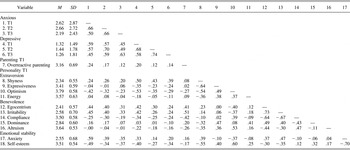
The means, standard deviations, and intercorrelations for anxious and depressive symptoms, overreactive parenting, and personality facets are presented in Table 1. The correlations over time for anxious symptoms ranged from 0.50 to 0.66 and for depressive symptoms from 0.58 to 0.74. Correlations between anxious and depressive symptoms ranged from 0.59 (T1) to 0.70 (T2).
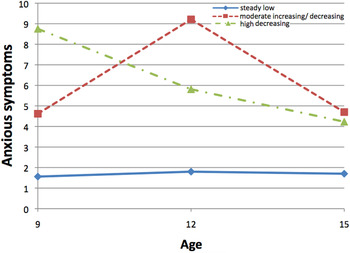
(Color online) Graphic presentation of the estimated means for the trajectories of anxious symptoms.

Means, standard deviations, and correlations for internalizing problems, overreactive parenting, and personality facets

Note: Correlations greater than entry 12 are significant at p < 05. Correlations greater than entry 16 are significant at p < .01. T1–T3, Time 1–Time 3.
Latent growth trajectories of anxious and depressive symptoms
In order to identify groups of children with distinct trajectories of anxious and depressive symptoms, we modeled latent classes over three measurement waves using GMM. In Table 2, the BIC, the BLRT and entropy for the estimated growth-mixture solutions are presented.
Fit indices, entropy, and model comparisons for estimated growth mixture models (GMMs)

Note: N = 290. SSABIC, sample size adjusted Bayesian information criterion; BLRT, bootstrap likelihood ratio test; LL, log likelihood.
*p < .05. **p < .01.
Anxious problems
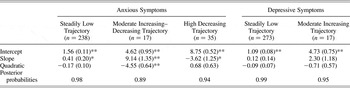
Indices of the growth mixture models for anxious problems indicated that a two-class solution provided incremental fit over a one-class solution, and that a three-class solution provided incremental fit over a two-class solution. For the four-class solution, the sample size adjusted BIC decreased, but entropy decreased sharply, the smallest class contained only 4 participants, and convergence problems were encountered. Therefore, a three-class solution was retained. The entropy of this solution was high (0.93). The trajectories of the three latent classes are presented in Figure 1. Initial anxiety scores for each class were significantly different from 0, as shown in Figure 1 and Table 3. The first trajectory class, called the steadily low class, consists of 238 adolescents (82.0%). This class is characterized by a low initial level of anxious symptoms, with a significant positive linear slope. The quadratic slope is not significant. The second trajectory class, the moderate increasing–decreasing class, shows a medium initial level of anxious symptoms, which increases from ages 9 to 12 and then decreases until age 15. This class includes 17 adolescents (5.9%) and has a significant positive linear slope and a significant negative quadratic slope. The high decreasing class, comprising 35 adolescents (12.1%), can be described by a high initial level of anxious symptoms and a decrease over time. This class has a significant negative linear slope and a nonsignificant quadratic slope.
Unstandardized parameter estimates of latent growth factors and model based (posterior) probabilities

Note: Standard errors are in parentheses.
*p < .05 **p < .01.
Depressive problems
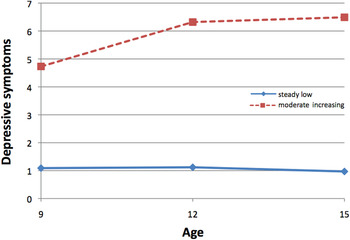
Indices of the growth mixture models for depressive problems indicated that a two-class solution provided incremental fit over a one-class solution. Although a three- and a four-class solution provided incremental fit over a two-class solution, these solutions contained small classes with less than 3% of the participants. Therefore a two-class solution was retained for depressive problems. The entropy of this solution was high (0.96). The trajectories of the two latent classes are presented in Figure 2. Initial scores for each class were significantly different from 0, as shown in Figure 2 and Table 3. The first trajectory class, called the steadily low class, consists of 273 adolescents (94.1%). This class is characterized by a low initial level of depressive symptoms, with a nonsignificant positive linear slope and a nonsignificant quadratic slope. The second trajectory class, the moderate increasing class, shows a medium initial level of depressive symptoms, which increases from ages 9 to 12 and then remains stable until age 15. This class includes 17 adolescents (5.9%) and has a nonsignificant positive linear slope and a nonsignificant negative quadratic slope. Five of these adolescents belonged to the steadily low anxiety group, 8 to the moderate increasing–decreasing group, and 4 to the high decreasing group.
(Color online) Graphic presentation of the estimated means for the trajectories of depressive symptoms.

Class membership
To address our second aim, we performed separate multinomial regressions for anxious and depressive symptoms. Gender, overreactive parenting, the lower-order personality facets, and the interaction terms between parenting and personality were simultaneously entered in the model.
Anxious symptoms
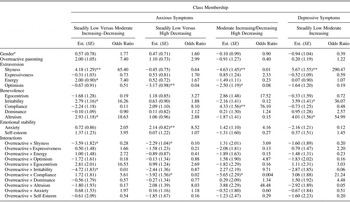
Comparing the steadily low class with the moderate increasing–decreasing class revealed that moderate increasing–decreasing children showed significantly higher levels of shyness and energy (Extraversion facets) and irritability and altruism (Benevolence facets) at T1. Table 4 shows the regression coefficients and odds ratios. In addition, the Shyness × Overreactive Parenting and Irritability × Overreactive Parenting interactions were significant. We interpreted the observed interaction effects following suggestions by Jaccard (Reference Jaccard2001). The results revealed that higher T1 shyness increased the odds of following the moderate increasing–decreasing trajectory but only in the context of high (i.e., 1 SD above the mean; odds = 787, p < .001) or average (odds = 65, p < .001) overreactive parenting. Shyness was not related to the odds of following the moderate increasing–decreasing trajectory when parents showed low (i.e., 1 SD below the mean; odds = 5.43, p = .18) levels of overreactive parenting. In a related vein, higher T1 irritability increased the odds of following the moderate increasing–decreasing trajectory but only in the context of high (odds = 425, p < .001) or average (odds = 15, p < .05) overreactive parenting. Irritability was not related to the odds of following the moderate increasing–decreasing trajectory when parents showed low (odds = 0.62, p = .69) levels of overreactive parenting.
Parameter estimates and odds ratios for predictors of class membership

Note: N = 290.
a Gender was coded with girls = 0 and boys = 1.
*p < .05. **p < .01.
Compared to children in the steadily low class, children in the high decreasing group were less optimistic (Extraversion facet) and more anxious (Emotional Stability facet) at T1. Two interactions were significant when we compared the steadily low class and the high decreasing class; Shyness × Overreactive Parenting and Compliance × Overreactive Parenting. Higher T1 shyness increased the odds of following the high decreasing trajectory but only in the context of low overreactive parenting (odds = 0.13, p < .05). Shyness was not related to the odds of following the high decreasing trajectory when parents showed high (odds = 3.10, p = .32) or average (odds = 0.64, p = .55) levels of overreactive parenting. Compliance increased the odds of following the high decreasing class but only in the context of high overreactivity (odds = 122, p < .05). Compliance was not related to the odds of following the high decreasing trajectory when parents showed average (odds = 8.10, p = .06) or low (odds = 0.54, p = .51) levels of overreactive parenting.
Comparing the high decreasing with the moderate increasing–decreasing class revealed that children in the high-decreasing class showed significantly lower levels of shyness and optimism (Extraversion facets) and higher levels of compliance (Benevolence facet). In addition, the Compliance × Overreactive Parenting interaction was significant. Compliance increased the odds of following the high decreasing trajectory in the context of high overreactivity (odds = 3,799, p < .001) and average overreactive parenting (odds = 76, p < .01). Compliance was not related to the odds of following the high decreasing class in the context of low overreactive parenting (odds = 1.52, p = .74).
The proportion of variance accounted for by the model (Nagelkerke R 2) was 63%. In contrast to our hypotheses, gender and low self-esteem were not significant predictors of trajectory class membership.
Depressive problems
Comparing the steadily low class with the moderate increasing class revealed that children in the low class showed significantly lower levels of shyness (extraversion facet) and irritability and altruism (benevolence facets) at T1. No significant interactions were found. In contrast to our hypotheses, gender and facets of emotional stability were not significant predictors of trajectory class membership. The proportion of variance accounted for by the model (Nagelkerke R 2) was 64%.
Discussion
Developmental trajectories for anxious and depressive symptoms
In line with our expectations, we found that developmental trajectories of anxious and depressive symptoms are not the same for all children. Acknowledging this heterogeneity is important as a first step in learning more about the etiological factors that differentiate subgroups. For anxious symptoms three classes could be clearly distinguished: a steadily low trajectory class, with low, relatively stable levels of anxious symptoms over time; a moderate increasing–decreasing trajectory class, with a medium initial level of anxious symptoms that increased sharply until 12 years and decreased until 15 years; and a high decreasing trajectory class, showing a high initial symptom level and a decrease over time. For depressive problems, in contrast to our hypothesis, only two classes could be distinguished: a steadily low class and a moderate increasing class. We are aware of three previous studies that focused on the broadband internalizing factor or social anxiety and found three classes using GMM; however, one study included a sample of children in foster care (Proctor, Skriner, Roesch, & Litrownik, Reference Proctor, Skriner, Roesch and Litrownik2010), and the others examined development only during childhood (i.e., from 2 to 11 years; Sterba et al., Reference Sterba, Prinstein and Cox2007) or during adolescence (Miers et al., Reference Miers, Blöte, de Rooij, Bokhorst and Westenberg2013). Our results are different from Letcher et al. (Reference Letcher, Smart, Sanson and Toumbourou2009) and Brendgen et al. (Reference Brendgen, Wanner, Morin and Vitaro2005), who found six classes across the age span of 3–15 years and four classes between ages 11 and 14, respectively. Duchesne et al. (Reference Duchesne, Larose, Vitaro and Tremblay2010) found four trajectories for anxious problems. One possible explanation for this difference is the use of different statistical methods. The aforementioned studies employed latent class growth analysis, a method that does not allow within-class variance. In the present study we did allow for within-class variance, possibly leading to fewer classes.
The majority of children transitioned into adolescence with few anxious (82%) or depressive symptoms (94%), suggesting that low levels of internalizing problems are normative. However, for both anxious and depressive symptoms, a small subgroup showed increases during the transition into adolescence. This result indicates that children with a moderate level of internalizing symptoms may respond to the pubertal transition with an increase in anxious or depressive symptoms; perhaps the transition to puberty is a sensitive period for children with moderate levels of internalizing problems. For anxious symptoms, a third group (12.4%) showed high initial levels but decreased over time, which demonstrates that some children may respond to the adolescent transition with decreasing anxious symptoms, rather than increasing ones.
Predicting class membership for anxious and depressive symptoms
Child personality facets
In line with our hypotheses, the latent trajectory groups had unique relations to trait and parenting predictors, which provides evidence for the validity of the groups. An important contribution of the present study is that it showed that different facets of the same personality dimension measured at T1 differentially predicted membership in distinct trajectories of anxious and depressive symptoms across the transition to adolescence. Shyness (Extraversion facet), along with irritability and altruism (Benevolence facets), predicted group membership for both anxious and depressive symptoms. In addition, energy and optimism (Extraversion facets), compliance (Benevolence facet), and anxiety (Emotional Stability facet) were unique predictors for class membership of anxious behavior.
In line with our predictions, the results indicate that, when Shyness is high in childhood, it serves as a risk factor for following a higher increasing trajectory of anxious and depressive symptoms. This is in accordance with findings of Prior, Smart, Sanson, and Oberklaid (Reference Prior, Smart, Sanson and Oberklaid2000), who reported that Shyness at ages 3–4 was associated with a twofold increased risk of anxiety disorders at 13–14 years of age. Our study confirms that shyness can be a barrier to psychological adjustment during the transition into adolescence for some youth. For most adolescents in contemporary Western societies, adolescence is a time characterized by exploration of new physical, social, and cognitive potentials, which allow youth to develop a stable identity. Children with high scores on shyness may be reluctant to face the developmental task of increasing autonomy (Allen et al., Reference Allen, Insabella, Porter, Smith, Land and Phillips2006; Galambos & Costigan, Reference Galambos, Costigan, Weiner, Lerner, Easterbrooks and Mistry2003) and the establishment of friendships (Caspi & Shiner, Reference Caspi, Shiner, Rutter, Bishop, Pine, Scott, Stevenson and Taylor2008).
Irritability was also found to be a significant risk factor for the moderate increasing–decreasing anxiety trajectory and the moderate increasing depression trajectory. Irritability is conceptualized as a tendency to react more easily to stress with feelings of anger and frustration. Recent findings support the clinical notion that irritability is a precursor of internalizing disorders (Kiff, Lengua, & Bush, Reference Kiff, Lengua and Bush2011; Stringaris, Zavos, Leibenluft, Maughan, & Eley, Reference Stringaris, Zavos, Leibenluft, Maughan and Eley2012). Children with high scores on irritability may be more likely to attend to and to focus on the more negative aspects of their context. Studies have shown that irritability predicted daily stressors over time (Hankin, Reference Hankin2010). Other explanations may be that irritable children are less able than others to cope with stressful experiences (Compas, Connor-Smith, & Jaser, Reference Compas, Connor-Smith and Jaser2004) that are characteristic for developmental transitions or that more irritable children have difficulty negotiating the more intense relationships with peers and family that develop in adolescence (Allen et al., Reference Allen, Insabella, Porter, Smith, Land and Phillips2006).
To our surprise, higher altruism characterized the increasing–decreasing anxiety and the increasing depression groups in childhood. Possibly, high levels of altruism result in self-sacrificing or self-effacing behavior, which may lead to a vulnerability or predisposition for internalizing problems (Kushner et al., Reference Kushner, Tackett and Bagby2012; Widiger, Reference Widiger2011). Higher altruism, like shyness, may interfere with the demands for increasing autonomy and independence in adolescence. More altruistic children may manifest greater conflict avoidance and nonantagonistic behavior (Kushner et al., Reference Kushner, Tackett and Bagby2012), which may lead to an increase in internalizing symptoms during the transition to adolescence.
In addition to shyness, irritability, and altruism, which were predictors for both anxious and depressive symptom trajectories, several facets were unique predictors for anxious or depressive class membership. With regard to anxious symptoms, low levels of optimism in childhood differentiated the high decreasing group from the steadily low and the moderate increasing–decreasing group. Dispositional optimism can be defined as the “stable tendency to believe that good rather than bad things will happen” (Scheier & Carver, Reference Scheier and Carver1985, p. 219). The relation between lower optimism and higher levels of anxious symptoms may be explained by coping mechanisms. Children with lower levels of optimism may use more avoidance coping strategies, seeking to avoid or withdraw from stressors and negative emotions, whereas children with higher levels of optimism may use more approach coping strategies aimed to reduce or manage stressors or negative emotions (Solberg Nes & Segerstrom, Reference Solberg Nes and Segerstrom2006). That these children belong to a decreasing trajectory may be explained by the development of coping mechanisms. The transition to adolescence is an important period for the development of coping skills (Skinner & Zimmer-Gembeck, Reference Skinner and Zimmer-Gembeck2007), and perhaps the children with low optimism are learning to better cope with this trait as they develop new, more sophisticated cognitive coping strategies.
Children in the moderate increasing–decreasing class were characterized by higher levels of energy. This facet captures motor agitation and restlessness. Several studies have reported that somatic symptoms, particularly restlessness and agitation, are prevalent in children and adolescents with anxiety disorders (see, e.g., Ginsburg, Riddle, & Davies, Reference Ginsburg, Riddle and Davies2006). Facing the developmental task of increasing autonomy during the transition to adolescence may be a period of intense worrying, which is expressed in tension, agitation, and difficulty relaxing (Fowler & Szabó, Reference Fowler and Szabó2013). This may explain the temporary increase in anxious symptoms.
Comparing the high decreasing class with the moderate increasing–decreasing class revealed that children in the high decreasing class showed significantly higher levels of compliance. Ormel et al. (Reference Ormel, Oldehinkel, Ferdinand, Hartman, de Winter and Veenstra2005) reported that among youths aged 10–11 years old affiliativeness predicted internalizing problems. Children with higher levels of compliance are more reward dependent (Evans & Rothbart, Reference Evans and Rothbart2007) and avoid conflicts, which may result in higher levels of anxious symptoms. Increasing autonomy and the development of interpersonal skills during adolescence may explain the decreasing trend of anxious symptoms during the transition into adolescence.
High levels of anxiety in childhood differentiated the high decreasing group from the steadily low group. That children with high scores on anxiety had the highest scores at age 9 converges with studies that have suggested that child anxiety is linked with a tendency toward insecurity and guilt (Shiner & Caspi, Reference Shiner and Caspi2003). This tendency to experience inner-directed negative emotions is a vulnerability factor for the development of anxious symptoms. An anxiety disposition may produce more arousability and negative emotions (De Pauw & Mervielde, Reference De Pauw and Mervielde2010). In addition, children with high levels of anxiety may be more fearful of potential negative consequences that might follow their behavior and less sensitive to potential rewards (Colder, Mott, & Berman, Reference Colder, Mott and Berman2002).
We hypothesized that self-esteem would predict class membership, but we found no such effect. Although we can only speculate about causal relationships, there is a possibility that low self-esteem does not precede internalizing problems, but is a consequence. Results of previous studies are mixed in this respect (e.g., Lewinsohn, Steinmetz, Larson, & Franklin Reference Lewinsohn, Steinmetz, Larson and Franklin1981; Orth, Robins, & Roberts, Reference Orth, Robins and Roberts2008). However, there might be a conceptual difference between self-esteem as a (stable) personality trait and self-esteem as a (temporal) state. At least one previous study showed that the self-esteem state was correlated with depression, whereas the trait was not (Butler, Hokanson, & Flynn, Reference Butler, Hokanson and Flynn1994).
More generally, it is important to note that although we found specific facets to predict different trajectories of anxious and depressive symptoms, for each dimension there were also facets that were not predictive of trajectory class membership. These findings confirm the hypothesis that it is important to study the relation between personality and internalizing problems at the facet level, because not all facets of a dimension may be equally relevant.
Overreactive parenting: Interactions with personality
Overreactive parenting at T1 had no direct main effect on class membership. This does not imply that parenting and internalizing problems are unrelated. Rather, the level of overreactive parenting did not predict belonging to a higher class, when compared to the lowest class. It is more important that the effect of overreactive parenting should be interpreted in the light of the significant interaction effects, which suggest that overreactive parenting is most relevant to predicting internalizing trajectories when children display particular personality traits. For anxious symptoms, the effects of shyness, irritability, and compliance on class membership were moderated by overreactive parenting. Higher shyness and irritability increased the probability of following the moderate increasing–decreasing trajectory, but only in the context of high or average levels of overreactive parenting. Shyness and irritability were not related to the probability of following the moderate increasing–decreasing trajectory when parents showed low levels of overreactive parenting. In addition, shyness increased the odds of following the high decreasing trajectory, but only in the context of low overreactive parenting. Significant interactions between shyness and negative parenting have also been reported for children aged 8 to 12 years (Kiff, Lengua, & Bush, 2001) and for school-aged boys (Colder, Lochman, & Wells, Reference Colder, Lochman and Wells1997). In preadolescent youth, perceived maternal rejection was related to higher internalizing symptoms for girls who scored high on shyness (Oldehinkel, Veenstra, Ormel, de Winter, & Verhulst, Reference Oldehinkel, Veenstra, Ormel, de Winter and Verhulst2006). Shyness is closely related to behavioral inhibition (Fox, Henderson, Marshall, Nichols, & Ghera, Reference Fox, Henderson, Marshall, Nichols and Ghera2005). This inhibition results in low frequency of behaviors associated with rewards and social interactions. When exposed to overreactive parenting, these children who are particularly sensitive to punishment may develop a negative worldview and self-concept, which may result in elevated levels of anxious symptoms in childhood. The improvement of metacognitive skills and the use of more cognitive strategies to regulate complex emotions when children grow up may explain the gradually decrease of anxious symptoms (Skinner & Zimmer-Gembeck, Reference Skinner and Zimmer-Gembeck2007). Future studies should address the possibility that a shy personality may shape anxious trajectories especially in stressful environments.
Irritability has been demonstrated to amplify the association between negative parenting and internalizing problems (Kiff, Lengua, & Zalewski, Reference Kiff, Lengua and Zalewski2011). Morris et al. (Reference Morris, Silk, Steinberg, Sessa, Avenevoli and Essex2002) reported that perceived hostility and intrusive control were more strongly related to teacher-reported internalizing problems for more irritable than less irritable children. This is in accordance with the notion that children with a predisposition to negative emotional arousal are more reactive and vulnerable to negative parenting because it interferes with children's emotional expression (Jones, Eisenberg, Fabes, & MacKinnon, Reference Jones, Eisenberg, Fabes and MacKinnon2002).
Compliance increased the odds of following the high decreasing class compared to the steadily low class in the context of high overreactivity and the odds of following the high decreasing class compared to the moderate increasing–decreasing class in the context of high and average overreactivity. Overreactive parenting may undermine confidence in children who are highly reward dependent. This may result in higher levels of anxious problems.
Gender
In contrast to our predictions, gender was not a significant predictor for class membership. The focus on the transition into adolescence may be a possible explanation for this finding. Children were 9 years old at the first measurement wave. Several studies have found that the gender differences in the development of internalizing problems begin to emerge at the ages of 13 and 15, with the greatest increase in this difference between ages 15 and 18 (e.g., Hankin et al., Reference Hankin, Arbramson, Moffitt, Silva and McGee1998). Similar to our findings, boys and girls have been found to show equal levels of internalizing problems from age 4 to age 12 (Young, Smolen, Stallings, Corley, & Hewitt, Reference Young, Smolen, Stallings, Corley and Hewitt2003).
Limitations
Several limitations to the present study should be mentioned. First, we only used parent reports and questionnaires. Because children were assessed at as young as 8 years, they did not provide self-reports. Correlations between parent reports and child reports are known to be low to moderate, especially for adolescents (e.g., Barker, Bornstein, Putnick, Hendricks, & Suwalsky, Reference Barker, Bornstein, Putnick, Hendricks and Suwalsky2007). Second, because the study was based on mother and father reports, the threat of common-method variance exists. Subsequent studies should include multiple informants or observations. A third limitation concerns a conceptual issue. This study focused on overreactive parenting. Although overreactive parenting is a strong indicator of negative parenting, other dimensions such as overcontrolling and overprotective parenting may also be important factors in the etiology of internalizing problems (McLeod et al., Reference McLeod, Weisz and Wood2007). These parenting dimensions deserve attention in future research on interactions between parenting and personality facets. Fourth, it is unclear from our study whether the aforementioned personality facets directly predispose children to internalizing problems, or whether they shape the social environment in such a way that it gives rise to internalizing problems (vulnerability hypothesis; Klein et al., Reference Klein, Dyson, Kujawa, Kotov, Zentner and Shiner2012; Ono et al., Reference Ono, Ando, Onoda, Yoshimura, Momose and Hirano2002). In addition, a common (genetic) cause might underlie both these personality traits and internalizing problems, as indicated by Goldsmith and Lemery (Reference Goldsmith and Lemery2000) and Ono et al. (Reference Ono, Ando, Onoda, Yoshimura, Momose and Hirano2002). In a related vein, this study does not allow us to draw conclusions on the relation between child personality and parenting. Previous studies have indicated that bidirectional effects between child personality and parenting behaviors are likely to occur (e.g., Bates, Pettit, Dodge, & Ridge, Reference Bates, Pettit, Dodge and Ridge1998; Kiff, Lengua, & Zalewski, Reference Kiff, Lengua and Zalewski2011; Lengua & Kovacs, Reference Lengua and Kovacs2005). Overreactive parenting does not merely reflect a characteristic of the parents, but could also be induced by the personality of the child. Future research should focus on bidirectional directions between child personality, parenting, and internalizing behavior.
Despite these limitations, we believe that our results offer new insights into the development and maintenance of anxious and depressive symptoms during the transition into adolescence. Acknowledging the heterogeneity of development is important for investigating relationships and etiological factors, because they may vary by subpopulation. To our knowledge, the present study is the first to link lower order personality facets to trajectories of anxious and depressive problems measured with the widely used Child Behavior Checklist. We showed that facets measured as young as age 9 could distinguish different developmental trajectories. The inclusion of facets provides more specific information on the relation between child personality and different forms of internalizing behavior that cannot be captured by the higher order Big Five factors. In addition, we demonstrated that following a certain developmental trajectory depends on both individual and contextual factors, and on the interaction between the two. These findings could have practical implications; intervention and prevention programs could specifically target those at risk for following an elevated trajectory. Information on lower order facets may be more useful for clinicians than broad dimensions in targeting specific problematic dispositional characteristics that may play a role in children's internalizing symptoms.
Appendix A
Sample items of the HiPIC facets