In the century after the Act of Union (1800) effected a legislative unification of Britain and Ireland, bilingualism became commonplace in many Irish-speaking communities. While it is estimated that in the first decades of the nineteenth century between one-third and one-half of all Irish-speakers knew only the Irish language, census records indicate that by 1851 only 21 percent were monoglots and by 1901 fewer than 4 percent were.Footnote 1 English as a second language had thus made incredible inroads into the daily lives of those who continued to speak Irish, a population characterized by its predominantly rural nature and increasingly regional concentration in the provinces of Connacht, Munster, and western Ulster. Such percentages say little, however, about the impact of linguistic volatility on the politics of identity in Irish-speaking localities or the larger relationship between language change and the economic and social transformation of Ireland in this period. Despite numerous ongoing inquiries by scholars into the history of the Irish language, much work to date remains focused on the waning fortunes of Irish-language scribes and manuscript literature, the evolution of Irish-language revivalism and the concomitant ideological place of the Irish language in early twentieth-century nationalism, and the overall causes and trajectory of the language's decline.Footnote 2 As a result, the reaction of Irish-speakers themselves to English-Irish contact and the place of bilingualism in the broader culture remain stubbornly obscure. This problem is compounded by the scarcity of direct evidence from the nineteenth century documenting the popular attitudes of Irish-speakers. Irish-language manuscripts of the time, while plentiful, tend to focus on the literary and political preoccupations of the narrow stratum of educated scribes who produced them, while written accounts by middle- and upper-class witnesses often reveal more about the observer than the observed—a common problem in historical sources purporting to represent rural societies.Footnote 3
The rarity of evidence referring to language shift from a popular perspective makes it all the more striking that one of the richest sources for the linguistic history of Ireland lies in folk humor. Anecdotes or jokes centering on the linguistic misunderstandings of a foolish character circulated extensively in oral form throughout this period. The Irish scholar Robert MacAdam recorded one such story in 1847 in county Meath about two Irish-speakers visiting a town market who engage an English-speaker in a conversation about local events. Struggling to make out the meaning of the English phrases, the Irish-speakers mistake the English word “agony” for the homophonous Irish word eagnaidheacht (argue, dispute), creating a humorous misinterpretation of an otherwise tragic story of a child's death.Footnote 4 Humorous stories about attempts to use English have been found in a string of tales about the adventures of a Connemara hackler, which were originally recorded in Irish by an Irish American born in county Galway in 1832 and recently edited and published by Nancy Stenson.Footnote 5 The Irish scholar Douglas Hyde encountered a number of such stories when he collected oral source material in the last decades of the nineteenth century in Galway and Mayo, and he reportedly had found a Leinster story about the stupidity of Connacht migrant laborers in a Meath manuscript written in 1851. The language revivalist David Comyn also found and published a few examples in the 1880s, presumably taken from popular sources.Footnote 6
The prevalence of these jokes in Irish popular culture can be gauged from the number of them collected by the Irish Folklore Commission in the 1930s and 1940s from oral sources. Founded in 1935 by the Irish Free State government to consolidate and formalize previous folklore initiatives, the Folklore Commission employed a mix of full-time and part-time collectors who together amassed thousands of volumes of interviews transcribed from field recordings of local informants. At least 450 documented allusions to the Irish language have been identified in the Folklore Commission records, and, of these, more than half consisted of jokes and humorous short stories. Most of these jokes were cataloged according to the Aarne-Thompson (AT) international folktale index under Type 1699—stories based on a “misunderstanding because of ignorance of a foreign language.”Footnote 7 The following anecdote (example 1), told by a fisherman born in 1869 from south county Cork, is typical of much of this material. It involves an Irish-speaking butcher who, selling pigs at a market with his wife, is approached by an English-speaking buyer:
Tháinig ceannuightheóir. Bhí sé ag ceannach na muice uaidh. D’fiarthui sé dhe an muar a bhí uaidh. Do freagair sé i nGaoluinn é mar ní raibh a mhalairt aige. “Ah, nonsense man,” adubhairt an ceannuightheóir. Ghlaoidh an fear eile ar a mhnaoi léithreach. “Toir anso,” ar sion, “Tá sé ag ceannach na muice uaim.” “An muair a thúbharfadh sé dhoith?” ar sise “Nonsense adubhairt sé,” ar sion, “agus ní fheadar an muar é sin!”Footnote 8
[A buyer came up. He was buying pigs from him. He asked him how much he wanted. The seller answered him in Irish because he had no other choice. “Ah, nonsense, man,” said the buyer [in English]. The seller called off to his wife. “Come here,” he said, “He is buying a pig from me.” “How much would he give you for it?” she said. “He said ‘nonsense,’” he said, “and I don’t know how much that is!”]
Given the prevalence of such stories, it is no exaggeration to say that humor was the largest single context in which the folklore informants, whether Irish-speakers or English-speakers, discussed the language question in Ireland. Yet aside from valuable investigations by the folklorists Séamus Ó Catháin and James Stewart into the geographical distribution and dialect-specific localism of the jokes, the anecdotes have not been the subject of any extended investigation.Footnote 9
At first glance, the Irish jokes appear rather straightforward in their meaning and function. Many of them, as in example 1, revolve around the misunderstandings and broken English speech of Irish-speakers. A Galway farmer from the barony of Clare recalled another such story (example 2), one that had also been collected and published by the periodical An Claidheamh Soluis in 1903. It involves an Irish-speaker named “Éamuinn a' tSléibhe” (Eamonn of the Mountain), an old man who heads down to the local fair to listen to English-speakers in order to pick up a few words of their language. On returning home, he describes his day in Irish before attempting the same in English:
Dúirt sé mar seo leofa: go ra sé ar aonach na h-Éille agus go dtainic sé abhailí i n-aon chos i n-áirde amháin, nó go dtainic sé go dtí ghabhail-éadain a thighe h-éin; go dtug sé amach a’ bórán agus go dtug sé isteach a lán caorán, nó gur chuir sé síos tine in’ fhíanaisí héin.Footnote 10
[He said it like this to them: that he was at the Éille fair, and that he galloped home until he came to the end-rafters of his own hip-roofed house, that he put out the dried cow dung and that he brought in a lot of small sods of turf, so that he lit up a fire before him.]
Éamuinn then translates this same story into English using his new abilities in the language, yielding an absurd result:
“I went to the fair o’ the fong,” he said. “I came home on the one leggedy high, intil [sic] I came to the fork o’ the face o’ me own house. I brought out the cow-bread an’ I brought in the full ood [sic] of sheep-bread, intil I put down a fire in me own witness.”
With its ridicule of broken English speech, this joke seems to exemplify the historian Seán de Fréine's explanation for the decline of the Irish language in the nineteenth century in terms of a wider rejection of Irish-speaking culture. The Irish, he argued, had “accepted the ethnocentric Ascendancy viewpoint that Irish was a backward language, and that even to speak it was a positive hindrance to progress.”Footnote 11 The opprobrium that the joke assigns to the inability to speak English suggests that humor functioned as a means to enforce larger cultural trends in Ireland that privileged the language linked to the authority and governance of British rule in Ireland under the Union.
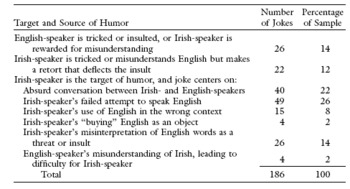
But when the body of stories found in the Folklore Commission's National Folklore Collection is considered as a whole, this interpretation becomes problematic. Of 186 jokes sampled from the folklore collection, 25 percent either feature English speakers as the target of ridicule for their inability to communicate in Irish or else depict an Irish-speaker triumphantly deflecting an insult back onto the English-speaker.Footnote 12 The most common example of such stories involves two
Plots of Sampled Aarne-Thompson Type 1699 Jokes

Irish-speakers who challenge two English-speakers (often soldiers) to a card game and then make fools of them by using Irish in order to secretly win the hand.Footnote 13 Similarly, in an anecdote told about Daniel O’Connell, the famous Irish politician debates the merits of the English and Irish languages with an Englishman. The Englishman compares Irish to the barking of dogs, prompting O’Connell to retort by drawing parallels between English and a bleating goat.Footnote 14 Overall, 14 percent of sampled stories involve either an insulted or tricked English-speaker or an Irish-speaker who is rewarded in some fashion despite experiencing a linguistic misunderstanding. Another 12 percent make the Irish-speaker the butt of the joke but, all the same, include some kind of witty retort that reverses the ridicule (see 1).
Even in the remaining 74 percent of the jokes, the stories in which the Irish-speaker is depicted as the fool, the message conveyed could be uncertain. As the sociologist Christie Davies has argued, verbal humor is often ambiguous precisely because it involves wordplay and texts and can thus be subject to a number of interpretations.Footnote 15 Consider again example 2. Éamuinn speaks in broken English, but the English is actually an overly literal translation of the Irish phrases: for instance, “i n-aon chos i n-áirde amháin,” an idiomatic phrase meaning “gallop,” is rendered word-for-word into English as “on the one leggedy high.” This joke may have invited ridicule of Éamuinn for his mistranslation, but an equally viable interpretation might have been that English could not describe the basic elements of everyday rural life as fluently as Irish. Rather than a rejection of Irish, the story, on the contrary, might have prompted solidarity with Éamuinn for contrasting the expressiveness of Irish with the absurdity of English. This is not to say that an unlimited number of readings of these jokes lay open to nineteenth-century audiences. But the objective in approaching humor, as suggested by the researcher Wladyslaw Chlopicki, should be to establish a limited set of credible interpretations by conducting a closer reading both of the joke texts themselves and of their specific cultural and historical circumstances.Footnote 16
There is a danger in assuming, moreover, that these jokes simplistically mimicked contemporary views of the time denigrating the Irish language in an increasingly English-speaking Ireland. On the contrary, one would expect to find what the anthropologist James Clifford has underscored in discussing dominated communities: authoritative cultural forms are often actively reformulated “in complex, oppositional contexts.”Footnote 17 Research on the projection of cultural power has provided empirical evidence of this recasting of authority—a “production,” in the description of the historian Michel de Certeau, that has a formal, discernible structure.Footnote 18 Indeed, it is arguable that once a prominent discourse emphasizing the power associated with the English language came into existence, the use of Irish itself became, by definition, a challenge to that very discourse. If these jokes represented a rejection of the Irish language, why tell them in Irish? An answer to this incongruity lies in the recognition that popular culture does not straightforwardly assimilate the goals and tactics of elite culture. Approaching these jokes as a formal site for negotiation and reinvention of the status of the Irish language provides a first step in resolving this seemingly incongruous and lighthearted popular response to language contact.
With this principle in mind we next must ask, Why was humor featured so heavily in Irish responses to contact between the Irish and English languages? What was the function of jokes that ridiculed both Irish-speakers and English-speakers? And what do they tell us about the response of Irish-speaking Ireland to the linguistically transitional late nineteenth century, in which many of the informants of the Folklore Commission grew up? Most scholars have portrayed Irish-speaking communities in this period as culturally passive and demoralized. Seamus Deane, for example, has summed up the situation of the nineteenth-century Irish by concluding that acquiring English had become synonymous with obtaining modernity and that general feelings of exile, poverty, and cultural failure of the postfamine period were closely linked to the abandonment of the language by Irish-speakers.Footnote 19 Grace Neville, summarizing the views she has found expressed in Irish folk material, has similarly concluded that Irish-speakers “had internalised the possibility of a link between stupidity and the Irish language.”Footnote 20 The practice of telling jokes about language contact does not fit easily into accounts of cultural trauma and rejection commonly ascribed to the Irish in this period, prompting a closer look at Irish-speaking culture at a time when English was becoming ever more visible.
In explaining why humor figured so prominently in Irish responses to language contact, it is worthwhile to start by confirming that these jokes were intended to be funny. Humor is, after all, culturally determined, and we cannot be certain about the purpose of these stories without reference to their reception in their own time. Indeed, some of these anecdotes might well seem more cruel than humorous to a modern audience. In one story from county Clare, an old man is taunted by a gang of boys who purposely encourage him to discuss his broken wheelbarrow in English, knowing that his mastery of the language is poor.Footnote 21 In a similar story from Galway (example 3), an old fisherman's boat is vandalized by another band of schoolboys, leading him to confront their teacher about punishing them. Lacking English, the old man struggles to explain to the schoolmistress, who has only a little bit of Irish, what had happened:
“It is terrible,” adeir an mháighistreás nuair a thuig sí céard a bhí i gceist aige.
“Ná bí ag cur an mhilléain uilig ar Terrible,” adeir seisean, “bhí chuile dhiabhal gasúr acu chomh dona le Terrible bocht.”Footnote 22
[“It is terrible,” said the mistress when she understood what had happened.
“Don’t be putting all the blame on ‘Terrible,’” he said. “Every damn one of them was as bad as poor ‘Terrible.’”]
The misunderstanding punctuating the end of the anecdote lightens the mood, but it hardly undermines the cruelty apparent in the story overall.
It is clear, nevertheless, that Irish-speakers themselves believed these stories to be humorous and intended them as jokes, for tellers referred to them as scéal grinn or scéal greannmhar (a funny story). The reactions of various characters to episodes in the previously mentioned Connemara hackler tale, for example, show the humorous intent of this type of storytelling. In one instance, an Irish-speaking rent collector named Conán attempts to make conversation with an English-speaking “water-guard” (coast guard officer) named Murphy, who wants to buy milk from him (example 4). Trying to make casual conversation, Conán asks Murphy about recent sightings of the British army in the area amid local concerns about impress ment. Murphy dismisses the question and tries to refocus their talk back onto the transaction at hand, but Conán misunderstands the word “nonsense” in Murphy's response (as did the pig-selling butcher in example 1 above):
“A Mhurphy,” arsa Conán, “an bhfaca tú an tArm Dearg anseo inniu ag pressáil na bhfear?”
“Nonsense,” arsa Murphy.
“Ní neansa ná nápla,” arsa Conán, “ach an tArm Dearg ag pressáil na bhfear.”
“No, no, what nonsense,” arsa Murphy. “Fetch me the milk.”
[“Murphy,” said Conán, “did you see the Redcoats here today press-ganging the men?”
“Nonsense,” said Murphy.
“It's not Neansa [nonsense],” said Conán, “but the Redcoats, pressing the men.”
“No, no, what nonsense,” said Murphy. “Fetch me the milk.”]
The response of observers in the story to these and other events is described unambiguously: “You could have put a live bird down the throat of every man in the house, as they laughed.”Footnote 23 Clearly, tellers and listeners considered these absurd dialogues and misunderstandings to be very funny.
Ireland was not, in fact, unique in featuring humor in the response to language change. Contact between languages has sparked joking stories for centuries, and examples have been found in almost every national context. Among the staples of the Irish repertoire was a story known as “We Three,” a tale that, although classified as AT 1697, shares many features with the AT 1699 stories. This anecdote centered on the attempt by three travelers to speak a foreign language by memorizing stock phrases. In an Irish-language version collected in southwest county Kerry in the late 1920s (example 5), three Irish-speakers learn three English phrases—“We three,” “A purse of money,” and “Right and good reason!”—by following a group of English-speaking gentlemen and discreetly listening in on their conversation. Satisified that they have picked up enough English, the three travelers continue down the road. Later, the men come across a dead body and are approached by a local gentleman who interrogates them in English:
“Who killed the man?” said the gentleman.
“We three!” said the first man.
“For what?” said the gentleman.
“A purse o’ money!” said the second man.
“You’ll be hanged!” said the gentleman.
“Right an’ good reason!” said the third man.Footnote 24
The three men are then arrested and sentenced to be hanged. This and similar anecdotes circulated in both print and oral forms for at least six hundred years. One of the earliest examples in the European context was published in the medieval compendium Summa praedicantium (ca. 1348), by John Bromyard, in which it is three Welshmen traveling in England who are arrested for wrongdoing because of their misapplication of English. Later versions appeared in the French comic tales of Philippe de Vigneulles's Cent nouvelles nouvelles (1505–15)—here, German-speakers try to learn French—and in the Nouvelles récréations et joyeux devis (1558) by Bonaventure des Périers, in which it is three French-speaking brothers whose efforts to learn Latin land them in trouble.Footnote 25 Similar anecdotes based on the motif of misunderstandings due to attempts to use memorized phrases in a foreign language also occurred in the English jest-book tradition, notably the humorous tales known as Scoggin's Jests published by Thomas Colwell in 1565.Footnote 26
Internationally, “We Three” and a variety of similar language-based jokes circulated widely in the nineteenth and twentieth centuries. A version of “We Three” featuring Scots-Gaelic–speakers learning English could be heard in Scotland in the 1860s.Footnote 27 In the United States, the jokes were told about—or even by—immigrants of Irish ancestry: black communities of the late nineteenth and early twentieth centuries told “We Three” stories about Irish immigrants unable to speak English, while another version about recent Irish arrivals who “could speak only a few words of English” was collected in 1938 from an Indiana woman who had heard it, of all places, from her elderly Irish-born aunt.Footnote 28 Worldwide, AT 1699 stories about language misunderstanding have been found in Tunisia, West Africa's Gold Coast, China, Sri Lanka, Indonesia, Somalia, Yemen, Iraq, Lebanon, Syria, Egypt, Israel, Cuba, Puerto Rico, Finland, Estonia, Lithuania, France, the Netherlands, Germany, Italy, Romania, the Czech Republic, Slovenia, Croatia, Hungary, Latvia, Turkey, and Great Britain.Footnote 29
The similarities in setting and plots of the Irish jokes and the international stories are evident. Spanish-speaking communities on the New Mexico–Colorado border, for instance, told jokes in the 1930s about Spanish-speakers bargaining with En glish-speaking shopkeepers in broken and pun-filled conversations.Footnote 30 Much in the same fashion, in an Irish anecdote (example 6) the use of the English word “sick” by a shopman is misinterpreted as the Irish word saic (sacks) by an Irish-speaker looking for material to make clothes:
“Paddy,” arsa seisean, “are ye sick?”
“Leóga,” arsa Padaí, “Ní ádhbhar saic nó saic atá dhe dhith orm ach ádhbhar léineadh dó Máire!”Footnote 31
[“Paddy,” he [the shopman] said, “are you sick?”
“Indeed,” said Paddy, “It isn’t any sacks or material for sacks that I need, but shirt material for Mary!”]
India under British rule produced stories comparable to the many Irish jokes featuring broken English, as in the Bengal story of Kalachand Babu, an Indian staff assistant to the lieutenant governor. This story (example 7), published in 1924 from an oral source, features broken English as Kalachand Babu attempts to serve his master:
Kalachand Babu : Sir, Your Honour—Your humble has Benaresing [coughing]—whole night benaresing—benaresing, no little eye-shutting, Sir.
Lieutenant Governor : How could you go to Benares and return in a night, Kala Babu?
Kalachand Babu : No going Benares, Sir. Throat, Sir, here—Sir—impatient Sir, whole night, Sir.
Lieutenant Governor : Oh, you had a sore throat. You must go to a doctor.
Kalachand Babu : Sir, Sir—I will eat you, Sir!
Lieutenant Governor : Hello! Eat me? What do you mean, Kalachand? How will you digest me?
Kalachand Babu : No, Sir. I will give you a eating [i.e., feed you], Sir.Footnote 32
The Indian motif of the master confronted by the verbal ineptitude of a servant can be compared to an Irish story about a tyrannical landlord named Ivy whose servant boy, Séamus Bán, innocently insults him through his inability to speak English (example 8):
Ceann de na maidineachaibh a thánaig sé isteach agus d’fiafruigh sé conus a bhí sé, agus dubhairt Ivy leis ná raibh sé foghnamh in ain chor. Dubhairt Seámus Bán “God keep you so,” agus cheap sé go raibh an ceart aige á rád leis mar ná raibh ach beagán béarla aige, agus rud éigin, mar “God relieve you” a mheas sé a rádh.Footnote 33
[One of the mornings he came in and asked him how he was, and Ivy said to him that he was not well at all. Séamus Bán said, “God keep you so,” and he thought that he was correct to say it, because he didn’t have a lot of English, and something like “God relieve you” was what he thought to say.]
Certainly, these stories differ enough to indicate that most Irish jokes had not merely been extracted from wider international circulation. Their similarities, however, confirm that the close connection between humor and language was a very common historical phenomenon.
Another source lay in the Irish literary tradition itself, which contained numerous examples of such humor in one or both languages. Early Irish literature, especially the dánfhocail verse epigrams, were heavily steeped in puns and wordplay.Footnote 34 Later, among the works of Irish writers of the early modern period, the mocking of broken speech by upstart lower-class Irish-speakers attempting to adopt English speech figured prominently. Examples can be found in the works of seventeenth- and eighteenth-century Irish authors, including the anonymous prose piece Pairlement Chloinne Tomáis (ca. 1650), the poetry of Aogán Ó Rathaille (ca. 1670–1729), Geoffrey Keating's Trí Bior-Ghaoithe an Bháis (1631), Sean Ó Neachtain's Sgéal Éamuinn Uí Chléirigh (1710), and the poems of Donnchadh Rua Mac Con Mara (1715–1810).Footnote 35 From the opposite end of the ideological spectrum, English literary and dramatic works circulating in Ireland contained similar features: the plays of Shakespeare, for example, included examples of the puns and broken speech of foreigners—many of them Irish, Scots, and Welsh—in plays such as King Henry V.Footnote 36 Since Shakespeare appeared more often than any other playwright in the repertoire of Ireland's fledgling provincial theaters starting in the eighteenth century, this influence cannot be discounted.Footnote 37
These international and historical examples provide more than potential sources for the Irish tales. They also offer important clues as to why language contact elicited humor. In analyzing jokes, most researchers employ variations on the concepts of “incongruity” and language “scripts”—the semantic and cognitive information attached to language and shared by its speakers—as the central defining features of verbal humor. Borrowing from linguistic theory, scholars have argued that all such humor clearly shows the juxtaposition of two scripts, which are revealed by the punch line. These two distinct, or incongruous, categories of understanding are thus suddenly elucidated, leading the listener to jump from one meaning or expectation to another and, ultimately, to laugh.Footnote 38 For instance, in example 3 above, the understanding that the teacher has expressed sympathy that may placate the aggrieved old man (“It is terrible,” she laments) is suddenly punctured by the realization that he believes she has named one of the perpetrators: “Don’t be putting all the blame on ‘Terrible,’” he scolds. The joke plays with two distinct scripts attached to the word “terrible”: first, that it is an adjective denoting dread and misfortune and, as used by the teacher, a broader means of telegraphing sympathy; second, for those unfamiliar with syntactical and lexical usage in English, that it is a proper name, suggesting that the teacher is trying to identify a person. Humor is sparked by the jump from an expected meaning to an incongruous alternate use of a word.
The notion of incongruity is even clearer in jokes relying on puns, as in the story of the sick man whose Irish-speaking wife sends for the doctor (example 9). The doctor asks the wife about her husband's condition:
“How are the bowels?” do cheistig an dochtúir go Gallda.
“Yearra a’ dhochtúir, a ghrádh,” adeir sí go h-úmhail, “deamhain boul ná sácer agam; bhris an cat iad.”Footnote 39
[“How are the bowels?” asked the doctor, in a foreign fashion.
“Well, doctor, my dear,” she said humbly, “I have not a bowl or saucer; the cat broke them.”]
The homophonous connection between “bowels” and “bowls” sets up a punch line revealing two incongruous interpretive frames: a doctor who is inquiring about the symptoms of a patient, and a doctor who is, ridiculously, asking about a woman's crockery. Puns are particularly efficient in setting up these separate scripts because puns enable two scripts to emerge from a single word. And their potential is especially heightened when they involve two languages—as in example 6 above—since similar phonological units will in almost every case involve disparate linguistic scripts. Given the abundance of homophony in language contact, and the centrality of double meanings to verbal humor, it would have been more surprising if jokes had not played a big part in popular responses to the encounter between Irish and English in Ireland.
Nevertheless, while this explains the presence of jokes in Ireland, the universality of humor in response to language contact does not account for the specific features of the anecdotes found in Irish folklore or for their function in their own time and place. The anecdotes collected in the nineteenth and twentieth centuries from older generations clearly represented new and updated versions of past motifs. References in the jokes to Daniel O’Connell (1775–1847), the Battle of Trafalgar (1805), the construction of London Bridge (rebuilt in 1831), Queen Victoria (1819–1901), and the second Boer war (1899–1902) indicate a uniquely nineteenth-century provenance. The same conclusion is intimated by references to datable features like “Peelers” (members of the Royal Irish Constabulary, the police force established by Sir Robert Peel in 1822), dispensary doctors, and emigrant letters from abroad, all aspects of Irish life closely associated with the nineteenth century. Moreover, earlier jokes featuring language misunderstanding in Irish literature, as in the writings of Ó Rathaille and Mac Con Mara, largely portrayed English—not Irish—as the inferior vernacular, whereas the versions datable to the late nineteenth century added the ridicule of Irish-speakers to ongoing jokes about monoglot English-speakers. The humor employed by the Irish-speaking community had clearly taken on new meanings under the different linguistic circumstances of subsequent years. This promps us to examine the jokes within the specific context of Irish-speaking communities of the nineteenth century.
Scholars have often employed the linguistic term “diglossia,” a concept first proposed by the sociolinguist Charles Ferguson in 1959, to refer to societies in which two languages (a “high” variety and a “low” variety, unequal in prestige) coexist by occupying separate domains. This term was subsequently expanded in its scope by John Gumperz, Joshua Fishman, and other scholars to refer to a number of different societies marked by the presence of multiple languages or even varieties of a single language. Unfortunately, the use of this concept in the Irish context has often been too cavalier, leading historians to deduce the specific linguistic circumstances in Ireland from the assumed presence of diglossia rather than to explore the applicability of diglossia from the linguistic evidence itself.
When diglossia is present, a low-status language is preserved through its confirmed place in domestic and private settings. In Ireland, by contrast, English eventually occupied both low and high domains, thereby precluding the possibility of diglossia in Ireland over the long term.Footnote 40 Furthermore, on the personal level, Irish remained the language associated with high-status domains such as religion, evident in the use of Irish for catechizing and prayer in some communities throughout this period.Footnote 41
Nevertheless, on the national level, the imbalance in favor of English—the language of authority and governance, intellectual and political life, and most of Ireland's middle and upper classes—would have been evident to even the most adamant Irish-speaker by the mid-nineteenth century at the latest. For joke tellers of the period, this linguistic disparity was increasingly articulated through the encounter between Irish-speakers and the new institutions appearing in rural communities related to medicine, commercialization, and law. Irish-speakers viewed the individuals associated with these domains—including doctors, shopkeepers, and judges—as English-speaking, leading to the use of dispensaries, shops, and courtrooms as settings for the jokes.
Several stories, for instance, highlight the difficulties of communicating with an English-speaking doctor. Rural medical needs were increasingly being met in the nineteenth century by professionally trained representatives of the network of public dispensaries established in 1805. By the 1840s, the number of such facilities had grown substantially to 650. The Irish system was unique in that it was state supported and largely designed to serve the poor, putting professional medical care within the reach of even the most remote communities.Footnote 42 For Irish people unable to speak English, according to the jokes, the need to seek medical advice was fraught with the frustrations of trying to describe symptoms to health-care providers who spoke only English. In a Kerry anecdote, a husband relies on what English he can muster when responding to a doctor's inquiries about his wife: “What she put in she put out and what she put out she put in,” explains the man.Footnote 43 Joke tellers warned, aside from embarrassment, of the potential for miscommunication when patient and doctor did not share a language. A number of variations on example 9 with its use of the bowel/bowl pun were popular—in a Cork version, a wife replies to the doctor's inquiry, “Doctor, alay, it is long the day since Pad[dy] threw any bowl!”Footnote 44 In another type of tale, the death of a woman's husband brings her to the dispensary only to find that the regular doctor, who spoke Irish, has been temporarily replaced by an English-monoglot physician. “Satharn Cásca” (Easter Saturday), responds the woman to the doctor's inquiry about the time of death, leading the doctor to reassert, “Don’t mind your Cásc, but when did he die?”Footnote 45
Another motif exploited by joke tellers depended on the heightened contact with the world outside Ireland brought by the realities of large-scale emigration and by Irish participation in the newly expansive British imperialism of the late nineteenth century. The direct and immediate exposure to a foreign and English-speaking world ushered in by an emigrant letter from an overseas destination like America was undoubtedly a disorienting experience for some rural inhabitants, and one with humorous potential in folk accounts. In one joke, an emigrant who has successfully become a town mayor writes in English to his Irish-speaking sister back home in Donegal. When the letter is read to her, she confuses the word “mayor” with “mare” and concludes that her brother has turned into a horse.Footnote 46 In other examples, it is the returning emigrant herself, rather than a letter, that sets the humor in motion, as in the case of a daughter who visits her mother after marrying in America. “Do you have any children?” asks the mother in Irish, to which the daughter responds in English, “I have a pretty little ‘bowee’ [boy].” “My goodness! You have a little cow [bóín], and God willing, you’ll have a calf soon,” exclaims the mother in Irish.Footnote 47 Other jokes played on the issue of young Irishmen serving in the British army. Most popular was a tale about a Boer war soldier who writes home to his Irish-speaking mother. When the mother hears the letter read to her, she picks up on the phrase “We are now making a shift for Ladysmith,” a reference to the famous South African town besieged by Boer forces in 1899. “Heavens! And he hadn’t even sewed a button on a pair of trousers before,” comments the mother in Irish, introducing puns on the words “shift” and “Ladysmith” (i.e., Lady Smith).Footnote 48
Joke tellers also connected the language issue to the experiences of Irish-speakers in the courtroom. This is not surprising, given the extension of the courts and legal system into the daily lives of the Irish peasantry, initiated by the introduction of systematic petty session courts in the 1820s. As Desmond MacCabe has uncovered in his research on county Mayo, the ability of the lower classes to pursue claims at law had been heavily restricted prior to this time by the costs and magisterial patronage demanded by the older assizes and quarter sessions. This situation had made the legal system a preserve of the elite. But requirements that the new county petty sessions establish standard fees and the presence of more than one magistrate at a sitting encouraged a more organized and equitable system for humble litigants. The result, as MacCabe concludes, was that “the period from 1823 to 1850 saw an increasingly sophisticated use of law by the western peasantry.”Footnote 49 In short, small farmers and laborers found themselves, for the first time, able to pursue legal action in a court setting offering better protection from the self-interest of landlords, shopkeepers, and other creditors.
While the difficulties of multiple languages in the courtroom played a central role in setting up humor, few jokes suggest any absolute disadvantages faced by Irish-speakers. Instead, it is often the judge or the translator who is left perplexed. In one case, an Irish-speaking witness testifies that her attacker followed her from Cómhartha Mór to Cómthartha Beag, a reference to two local Irish townlands. Confused, and assuming that the witness means cófra (chest), the translator tells the judge that the man followed the witness from “the big chest to the small chest.” This convinces the magistrate that the dispute had been merely domestic—he thinks the plaintiff has reported that the man had followed her from one part of the room to another.Footnote 50 In a Tipperary anecdote, a justice demands that a reluctant interpreter tell him what an Irish-speaking defendant has said and is told that the unfortunate man had asked in reference to the judge, “Who is that old woman above with the bed-curtain around her?”Footnote 51 In another story, entitled “An Gúistúis Nár Thuig Cad Dúbhairt Fear” (The justice who didn’t understand what a man said), an Irish-speaking witness reports to the court that he had observed several men fighting “trí na ceile” (i.e., all fighting each other). Because he believes that the man is talking about yet another witness, the judge adjourns the court in order to “hear trí na ceile's evidence.”Footnote 52
Consumer goods, which also began to infiltrate rural communities in much greater quantities in the second half of the nineteenth century, likewise figured prominently in the stories. Already by the 1830s, despite the poverty of some sections of Irish society, evidence shows that consumption of certain products—such as tobacco, sugar, and tea—was on the rise.Footnote 53 The truly dramatic change came after the famine, when increasing incomes (an index of real wages shows an jump of 60 percent from 1857 to 1877), along with evolving rural retail markets, brought an even greater rise in the consumption of goods. This entailed changes not only in the quantity of goods sold but also in their form and distribution. Itinerant dealers and their wares were increasingly replaced by mass-produced retail goods sold by shopkeepers.Footnote 54 Accordingly, jokes showcased the town shop as a setting for language misunderstanding, with the confused Irish-speaker perplexed about the process of purchasing goods itself, as well as the English phrases of the shopman. In one story, an Irish-speaker tries to ask for a “shirt” but pronounces it “church,” leading the shopman to direct him to a chapel down the street.Footnote 55 In a popular Kerry joke, an Irish-speaker is told to wait for his or her change: “I don’t need change,” retorts the shopper, “just directions to the Blarney road.”Footnote 56
No consumer good, however, was more closely associated with speaking English and social advancement than tea. Already a well-established item in the diet of upper-class Irish households by the eighteenth century, tea became a universal drink in rural households in the nineteenth century and especially in the two decades after 1850.Footnote 57 By 1884, according to the traveler Alexander Shand, reporting from Gweedore, county Donegal, “bad tea” had completely replaced illicit whiskey, the earlier drink of choice among peasants.Footnote 58 For rural inhabitants, the arrival of tea served as a bright marker for the boundary between the past and present. Accounts like Tomás Ó Criomhthain's An tOileánach, the memoir of a Blasket Islander born in 1865, return repeatedly to the subject. As Ó Criomhthain remarked, “I was a grown man before tea was known, and when a pound of tea came our way for Christmas, it was sparingly used, and the remnant saved up till the next Christmas.”Footnote 59 Another Irish-language memoirist, Maurice O’Sullivan (born 1904), recalled his grandfather evoking the lack of tea as a symbol of the past: “It is little the shoe or stocking was worn in those days, not even a drop of tea to be had.”Footnote 60
Not surprisingly, the subject of tea appeared frequently in nineteenth-century folk accounts, particularly in accounts of its first appearance in a community. Such recollections emphasized the confusion about preparing tea, especially among women of an older generation. A Galway respondent born in 1863 remembered, “Our parents who had gone through the famine were not accustomed to tea. They frequently strained away the tea from the leaf. To the tea leaves they added salt, pepper, and butter and eat [sic] them with bread, using the tea as drink.”Footnote 61 A humorous story that circulated at the time involved a woman visited by a distinguished visitor, such as a priest or a gentleman, who produces a packet of tea and asks the woman to prepare it for him. The woman boils the tea, throws out the water, and serves the leaves on a plate.Footnote 62 Similar stories were found in Scotland, as in a story told on the Isle of Skye about a young man returning from Edinburgh with tea for his mother, who didn't know what to make of it.Footnote 63 Tellingly, in some Irish examples the connection between speaking Irish and the novelty of preparing tea was made explicit: in a Donegal version of this anecdote, the visitor is an Irish soldier, returning from service in England, who produces the tea for a confused Irish-monoglot lodgings-keeper.Footnote 64
The connection between tea and modernity was forged in the AT 1699 jokes as well, notably in a popular story about an Irish-speaking traveler who is given his first cup of tea at a lodging house while on the road away from home. Served a presweetened first cup and told in English that it is “Congo tea,” the man drinks it down approvingly. The lady of the house returns with a second, unsweetened cup and tells him, “Sweetin to your likin’.” Not understanding the instructions, the man drinks it plain and balks at its bitter taste: “Well, my love forever for Congo tea,” he remarks in Irish, “but devil take this Sweetin to your likin’.”Footnote 65
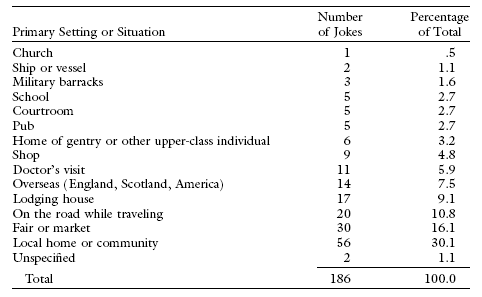
Yet for all the importance placed by joke tellers on the connection between speaking English and engaging with change in rural society, not all humorous anecdotes convey an allegory about modernity and language based on the clumsy exposure of Irish-speakers to the new institutions of retail consumption, law, and medicine. On the contrary, when the settings of these stories are considered as a whole, they show that the gap between speaking English and speaking Irish was more likely to exist within the quotidian context of the local community (see 2). From this vantage point, it becomes clear that the largest category of jokes deal not with the difficulties to Irish-speakers posed by the representatives of modernity but, rather, with the difficulties posed by English-speakers' encounters with Irish-speakers right in their own neighborhoods. Nearly one-half of all stories deal with language misunderstanding in the home, the community, or the local fair or market (46 percent). Even the next most frequently used settings—a country road or lodging house (together totaling 19.9 percent of the jokes)—represent relatively localized,
Joke Settings and Situations
unmarked sites. As table 2 demonstrates, the majority of jokes did not rely on the modernizing settings—church, military barracks, school, courtroom, shop, and overseas migration—often viewed by historians as factors in Ireland's language decline.
That language contact in Ireland was understood largely in local terms is supported by the types of English-speakers who appear in the jokes. These include not just the expected representatives of economic and educational advancement but also many who were not far removed in class or occupation from the Irish-speaking characters themselves. English-speaking landlords, doctors, soldiers, shopkeepers, policemen, middling farmers, judges, teachers, and, of course, English nationals make their appearance in many tales. But so too do English-speakers of more humble (and local) backgrounds: market goers, lodgings-keepers, fishmongers, feather mongers, tailors, pub goers, and even, in one case, a beggar. English-speakers almost always arrived from outside and beyond the Irish community, but they did not always represent developments associated with modernity. Linguistic divide was perceived to be a matter of simple communication breakdown as much as an effect of profound changes in Irish society.
Moreover, for all the insistence in these jokes that learning English is an essential aspect of negotiating the modern world, the English language is never presented as a fully integrated aspect of the community. The most consistent attribute attached to English-speakers regardless of their identity or occupation is their outsider status. English-speakers in these stories are “strangers” and “visitors”—unknown people met out on a road, or individuals encountered in bigger towns and cities. In other cases, they are locals who had moved abroad and then returned after spending time in the outside world. Along with this distancing of English-speakers, the English language itself is objectified as something bought or sold. In one example, a foolish young man is sent out by his father with money to attend school, but he ends up “buying” the English phrase “Good morrow” from a man he meets on the road. A Kerry version describes a group of Irish-speakers who learn the phrase “Good morrow” but later claim to have “lost” it in the mud.Footnote 66 Another joke centers on an Irish-speaking stonemason who achieves success both at home and as an itinerant worker in England. When asked how he had done so well abroad without learning English, he retorts in Irish, “If I didn’t have English, my hammer did!”Footnote 67 In anthropomorphizing the hammer and giving it the ability to speak, this anecdote thus turns the hierarchy of languages upside down: English is associated with economic success, but also with the clanking blows of a dull, blunt instrument. Irish, by contrast, appears organic. While these jokes undeniably portray English as desirable, it nonetheless is seen as originating outside and beyond the limits of the Irish community as an object to be bartered and exchanged.
The AT 1699 stories are thus only partially about new rural institutions and the tendency for English to dominate in those anglicized, modern domains. The outsiders featured in the anecdotes were English-speaking doctors and judges, but they were also English-speaking tailors and beggars. The jokes therefore leave the impression that tellers wished to incorporate a wide variety of everyday motifs centered on language contact but that they saw no one type of linguistic encounter—including the confused Irish-speaker in an anglicized setting—as the sole representative of the language change they were experiencing. Nor is the utility of English represented as anything more than a tool to repair broken lines of communication with outsiders who, in a strong reaffirmation of the vitality of Irish, remained extraneous to the organic linguistic bonds created by those who still spoke the language. This leaves a final question to be settled, one that arises out of the ambivalence created in the jokes by their tendency to mock both English-speakers and Irish-speakers: Were these jokes celebrating the Irish language for the power it bestowed on its community to trick English-speakers, or did this humor perpetuate the fallen prestige of Irish by mocking its speakers in an increasingly anglicized Ireland?
In truth, the line between the Irish-speaking world and the English-speaking world was not the primary division envisioned by the jokes. A far more important divide existed between the monoglot characters in the jokes (both English and Irish) and the bilingual audience and joke tellers. This is illustrated by a closer examination of the joke telling itself and, in particular, the type of audience it demanded. These stories are not short enough to constitute the “conversational joking” examined by the linguist Neal Norrick—jokes of one or two lines that are easily fitted into conversations and can function like proverbs or glosses in adding commentary to the subject under discussion; nevertheless, they are short vignettes that did not require advanced memorization abilities and story-organizing techniques. This made them available to a wider range of individuals, including those with limited storytelling ability.Footnote 68 Also, unlike formal joking relationships—humor strictly confined to interactions between certain members of a family or community—there seems to be no indication that the Irish jokes were similarly restricted to specific audiences or joke tellers. Many informants simply reported hearing the stories from their parents or relatives. As a Donegal man explained, “Seo scéal beag eile a chualaidh mé fá ‘n am nach rabh béarla” (This is another little story I heard about the time there wasn’t English).Footnote 69 Social and cultural restraints on joke tellers and listeners thus appear not to have been a limiting factor in the enjoyment of this humor.
Membership in such audiences would not have been unlimited, however. As the anthropologist Mary Douglas has pointed out, jokes are subject to the bounds of what is permissible in a given social context.Footnote 70 The Irish anecdotes often conveyed the problems associated with speaking only one language, especially Irish. It is therefore doubtful that these tales were told to audiences that did not have at least some abilities in both languages. In fact, many of these jokes are linguistically impossible to understand in any but a bilingual context. If we adapt the useful categories for linguistic jokes and translatability proposed by Robert Lew, it is clear that Irish anecdotes relying on syntactic, lexical, or phonological ambiguity require listeners to possess a knowledge of all the languages employed in the punch line in order to “get” the joke—that is, the wordplay in these anecdotes demands an advanced understanding of meaning and grammar in both Irish and English if the pun is to be decoded or the humor sustained. Example 2 falls into this category, as do fully 50 percent of the stories sampled here. Only jokes that rely on what Lew calls “pragmatic ambiguity” (a violation of the conventions of conversation or discourse) work regardless of the languages used. This is the case in example 5, which, although often told using both Irish and English, requires only one language in its telling.Footnote 71 But while this last category of tales could have been tailored to suit the language abilities of the nineteenth-century audience, few informants appeared to have done so: 85 percent of the sampled stories were told to the collectors in both English and Irish. In sum, these jokes were told largely by bilinguals, for bilinguals.
This conclusion about the intended audience for the jokes is important because it reveals a subtle but critical difference in Irish society between those Irish-speakers who could also speak English and those who could not. By the second half of the nineteenth century there were very few Irish-speaking communities in which English also had not become commonplace. But although some kind of facility in both languages had become the norm, full proficiency in English varied. There were some who undoubtedly attained complete fluency in both languages. As a Cork slater born in 1885 recalled in discussing his father and his cousin David, “They all had brains and they were great talkers. David could converse in Irish and English: it was all the same to him, and my father was the same.”Footnote 72 Others, however, struggled to attain adequate fluency in English—a source of embarrassment as the number of English-speakers both inside and outside the community grew. The Irish scholar Francis Keane explained in 1875 that pressure on locals to acquire the English language was created by the “general influx of strangers visiting those places who do not understand the Irish language, and with whom it becomes a matter of necessity to converse in English.” Furthermore, Keane stated, “It would be felt as an occasion of reproach to be unable to answer a stranger's inquiry in English.”Footnote 73 Under these circumstances, knowing only Irish became a serious disadvantage.
This divide between bilingual and monolingual Irish-speakers is central to understanding the function of the humor considered here. Scholars have long been aware that minority communities tell jokes featuring negative stereotypes of members of their own group. In much the same way, Irish-language jokes in the nineteenth century targeted an Irish-speaking minority within the English-speaking majority in Ireland and the British Isles. But close examination of such humor in other countries has disproved the notion that such jokes represent evidence of self-hatred or self-ridicule. Minority communities often employ stereotyped cultural features of their own group, but they do so in a manner that manipulates these caricatures to celebrate group identity rather than denounce it. In other cases, minority groups will even reverse joke targets and circulate jokes directed at the majority community. Furthermore, humor that appears to target one's own group may in fact focus on just one subset of the larger whole. Jewish humor has long been the most frequently cited evidence of this phenomenon, but other examples, including the emergence of Scottish self-directed humor in the nineteenth century, confirm these findings. In the latter case, for instance, research has revealed that overly zealous religious observance by certain Scottish Presbyterians became a subject of mockery, but not Scottishness itself. Impressed by such examples, scholars have rejected the concept of self-hatred and emphasized the importance of recognizing variations within minority groups rather than treating them as homogenous units.Footnote 74
Similarly, the Irish jokes reflected attempts by bilinguals to put distance between themselves and monolingual speakers rather than any rejection of the Irish language per se. It is Irish monoglots who make fools of themselves in these stories, never bilingual Irish speakers. Bilinguals appear far less often in the jokes, but when such characters do show up, they smoothly manage affairs to their own advantage. They act as interpreters at fairs, in courtrooms, and in lodging houses. They even deceive Irish monoglots. In one story, a bilingual speaker tricks his gluttonous monoglot friend into accepting employment from an English-speaking woman by convincing him that she is offering the Irish-speaker food.Footnote 75 In a Donegal story, a bilingual speaker and his Irish-only partner are out selling secondhand clothes when the time comes to find lodgings. The bilingual mischievously teaches his oblivious friend to tell a female lodging-house keeper in English, “Dear madam, if you let me sleep with you tonight, I’ll see you satisfied in the mornin’!”Footnote 76
The gap between bilingual and monolingual Irish speakers was matched in the jokes by the difference between bilingual and monolingual English-speakers. English monoglots hardly fare any better than Irish monoglots, as bilingual speakers triumph at their expense, too. In one Kerry story, a “bean chliste i nGaoluinn agus i mBéarla” (clever woman in Irish and English) visits a rich farmer's house and obtains a number of choice goods. In exchange, she promises to give to the farmer's English-monoglot daughters a selection of fat hens from a flock at her own house. When the daughters arrive to collect their payment, however, the old woman pretends not to know English or the purpose of their visit. “Perhaps it's her son, Donal, she wants,” exclaims one of the girls in exasperation at the woman's Irish.Footnote 77 Another anecdote has a bilingual man stepping into a pub in England and betting one of the customers that he cannot take down the dictation of a letter to the Irishman's wife. When the Englishman accepts, proud of his literacy, the bilingual speaker wins the bet by composing incomprehensible sentences that combine both languages.Footnote 78 The winning of a wager also turns up in another popular joke, one in which an English monoglot—a landlord or Englishman in most versions—bets an Irish-speaker that he cannot eat a dozen chickens at one sitting. Accompanied by his bilingual associate, the Irishman begins to eat the chickens but soon finds himself too full to continue. The Irish-speaker whispers to his friend that he can’t eat any more; the English-speaker, overhearing this, asks the bilingual to translate. “He says he’d ate twice as many if he had ’em,” explains the bilingual, leading the English monoglot to give up the wager.Footnote 79
Joke tellers even appeared to have been at a loss in deciding which type of monoglot was at a greater disadvantage, as in a county Galway story about an Irish-only old woman who approaches an English-only herring dealer at the Gort fair. The woman asks him to quote a price, and he replies in English, “Fivepence.” Not understanding his reply, the buyer offers him sevenpence in Irish, to which the herring dealer responds, “I couldn’t. I won’t give them without fivepence.” “Who was worse?” asks the teller in concluding the anecdote, as the two monoglots each in turn evade what would have been an advantageous deal.Footnote 80 Directionless conversations between monoglots abound in these jokes, often peppered with clever puns left undeciphered by the two speakers but openly available to a bilingual audience. A Kerry story collected from a farmer born in 1871 offers a prime example in the form of a conversation between a local and a Peeler. “Fine day,” remarks the Peeler, prompting the Irish-speaker, who mistakes the English word “day” for the Irish tae (tea [tay]), to answer in Irish, “Hell if I know where you could get some tea!” The Peeler persists by asking, “Where are you going,” to which the Kerry man, hearing bróg (shoe) for “going,” announces, “I haven’t had shoes for a while—I couldn’t pay for them.”Footnote 81
Ultimately, the jokes offered neither Irish nor English as the triumphant language in these instances. Rather, these nineteenth-century jokes offered both languages as a spectacle to the only observers able to discern the absurdity in such conversations: the bilingual listeners. This marked a strong change from the mocking of upstart English-speakers so central to seventeenth- and eighteenth-century Irish-language literature. Yet far from inverting earlier humor by shifting the focus to Irish-speakers as the target of humor, these jokes in fact incoporated both varieties of monoglots as victims of misunderstandings. Only bilingualism, joke tellers argued, guaranteed immunity from being tricked or caught unaware.
Writing on Texas Mexican American culture and the prominence in Spanish-language folktales of failed attempts by newly arrived Mexican braceros to use English, Rosan Jordan de Caro has argued that scholars need to recognize that bilingualism “stimulates a lore of its own.” The study of linguistic assimilation, she asserted, cannot be depicted as merely the resistance to or acceptance of a new culture by the acculturated group; on the contrary, there is strong evidence that individuals use storytelling to shape that process in a way that enables integration and yet asserts an identity distinct from its surrounding monolingual contexts. It should come as no surprise that de Caro found humor to be a prominent aspect of bilingual Mexican American tales, that such humor ridiculed newly arrived Mexicans for their inability to speak English, or that these jokes were told in a way that only bilinguals could understand them.Footnote 82
This acknowledgment that bilingualism creates “lore of its own” helps untangle the complexities of Irish responses to the linguistic volatility of the nineteenth century. The cultural history of Ireland under the Union has invariably been written in terms of conflict and rupture between native practices and new forms introduced through external forces of modernization (whether economic, religious, colonial, or a combination of all three). The Great Famine of the 1840s, with its consequent large-scale emigration and demographic alteration, has provided a convenient focal point around which historians have structured this story of discontinuity between prefamine Ireland and postfamine Ireland. The country's linguistic history has also been fastened to this larger framework by portrayals of the contact between English and Irish as a similarly disjunctive clash. Language shift, like cultural change, has been described as a process of replacement in which the rejection of Irish and the adoption of English were but two facets of one phenomenon, with bilingualism a brief and insignificant transitional phase.Footnote 83
Yet even this short examination of one particular manifestation of popular response to language contact encourages a closer scrutiny of such conclusions. It is evident that, on one level, bilingual Irish-speakers told jokes to affirm the perceived importance of learning English. A starker message about the feelings of disability, inaptitude, and imprisonment engendered by the prospect of Irish monolingualism in an Ireland full of English-speakers can hardly be imagined. To speak English was to be able to come to terms with the transformations affecting Irish-speaking communities and to master them, particularly those involving the demands brought by new consumer goods, medical and legal developments, and the impact of diaspora and empire. Bilinguals also saw English as a means to bridge gaps that had opened up within Ireland as a whole due to linguistic difference: hence, the preoccupation of many jokes with the ability to speak to outsiders visiting the local community or with the difficulties of encountering strangers on the road, at fairs, in lodging houses, and in other contexts that were externally linked to—familiar though fundamentally different from—that same domestic space.
At the same time, these jokes reveal that bilinguals continued to see their relationship with Irish in a more intimate light, even while expressing the utilitarian advantages of speaking English. Unlike English, Irish was depicted as an insider language of the local community. Strangers spoke English, leaving Irish-speakers to try to buy or seize this foreign tongue. Irish, by contrast, was the fundamental means of communication used both by the characters in the jokes and by the joke tellers themselves to convey the humor. The jokes also perpetuated an older enthusiasm evident in seventeenth- and eighteenth-century literary works for ridiculing English monoglots, thereby reaffirming the importance of speaking Irish and not just English. It is telling that humor targeting the English language even managed to outlive the Irish language in many local communities: as late as the 1950s, when the Irish folk collector Michael Murphy visited the few remaining Irish-speakers left in county Tyrone, an eighty-three-year-old farm woman could still provide a number of stories about Irish-speakers outwitting English-speakers and mocking them.Footnote 84 Evidently, even after English had gained the ascendancy in Irish-speaking communities, Irish-speakers still remained skeptical about the merits of this outsider language.
While such findings impinge most directly on understandings of changing cultural constructions of Irish-speaking identity, they also prompt a reconsideration of historians’ traditional explanations of language shift in Ireland. The jokes suggest that the constitution of modernity as a purely English-speaking condition, as many historians have proposed as a factor in encouraging the abandonment of Irish, was only one of several avenues through which Irish-speakers conceptualized the importance of learning English. It is true that the linguistic requirements of participation in courts, dispensary offices, overseas migrant work, emigration, and soldiering offered a strong motivation for learning English, leading joke tellers to use these circumstances as settings for Irish-speaking mishaps. Yet the need to communicate with English speakers engaged in relatively conventional activities such as selling goods, bargaining at fairs, and negotiating lodging demanded an abandonment of Irish monolingualism as well. These are hardly the primary domains associated by scholars with anglicization, a process associated with schools, Catholic churches, and the political and legal sphere. While these sites certainly had a role to play in the changing linguistic fortunes of Ireland, Irish speakers themselves also perceived the need to know English in more quotidian, unmarked circumstances.
Too much should not be made, ultimately, of the contrasting humor targeting English- and Irish-speakers. Confrontation between Irish and English does not appear to have been the central message encapsulated in the jokes but, rather, the ability of bilinguals to transcend problems arising from monolingualism in either language. Learning English and discarding Irish did not necessarily have to occur simultaneously—on the contrary, the bilingual joke tellers and their audiences used humor to assert their own unique identity in the face of unstable linguistic conditions. A recognition of this reconceptualizing of Irishness based on two languages as more than a brief transition to an inevitable dominance by English suggests new directions in approaching the experiences of the nineteenth-century Irish-speaking community.